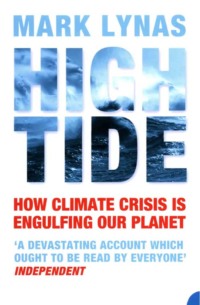
Читать книгу: «High Tide: How Climate Crisis is Engulfing Our Planet»
High Tide
How climate crisis is engulfing our planet
Mark Lynas

For my family
Table of Contents
Cover Page
Title Page
Prologue
1 Britain’s Wet Season
2 Baked Alaska
3 Pacific Paradise Lost
4 Red Clouds in China
5 Hurricane USA
6 Peru’s Melting Point
7 Feeling the Heat
Epilogue: Six Degrees
Afterword
APPENDIX: Campaigns and Contacts
Notes
Index
P.S.
About the book
In Conversation
Acknowledgements
About the Author
Praise
Copyright
About the Publisher
Prologue
There was something different about the rain that night. I noticed it as I lay awake – a purposeful, remorseless drumming on the roof, as if determined to force its way into the house. It rained all night, the claustrophobic intensity of the downpour leaking insidiously into my dreams.
The next day dawned bright and even warm, its weak autumnal sunshine driving away the uneasiness of the previous night. But half a mile from my house, the Thames already looked very different. Instead of the usual sluggish flow, the brown water was racing angrily by. Small whirlpools and eddies played in the strong current, and freshly-torn branches floated past.
The wildlife too indicated that something was wrong: hundreds of earthworms, forced out of their holes by the water, were wriggling uselessly on the banks. Some of the lower watermeadows had been submerged by the rising river, and deep chalky puddles lined the towpath as I splashed through on my bike.
It was almost as a challenge to the elements that I dragged a friend’s kayak down to the riverbank, and – after a brief wobble of trepidation – launched myself into the water. The last thing I remember seeing, as I shot out into the strong current, was my bike propped against a willow tree on the bank.
As I sped downstream, it gradually dawned on me that I had made a mistake. I couldn’t turn around without the risk of capsizing, and I didn’t want to find myself flung into the water so close to the weir. I had already taken the right-hand fork at the island, under the ‘Danger’ sign that warned bigger boats away, and could hear the muffled roar of the rapids ahead.
A few minutes later I could even smell the spray. I eased closer to the bank as the weir came into view, its ugly steel gates fully raised to let through the maximum volume of the swollen river. On the right bank, under a grove of poplars, was the grey concrete memorial to an Oxford University canoeing team who had lost their lives in the same spot almost a century before.
As I should have known it would, the increasing current took me by surprise. I had aimed to pass opposite the weir by hugging the bank on the other side, and then continue on round to the main channel. But the tug was stronger now, and within a few seconds I was away from the bank and losing control. I tried to paddle backwards, but succeeded only in spinning round with a dangerous near-capsizing wobble. All the while the roaring waterfall moved inexorably closer.
I dug the paddles in deeply, as if on a liquid treadmill. I pulled harder, gasping from both the exertion and the adrenalin, until the speed of my kayak began to gradually outpace the water flowing underneath.
Nearing the bank again, I grabbed at an overhanging willow branch. The whole thing snapped off – it’s not called ‘crack willow’ for nothing – the surprise nearly catapulting me into the water. Instead I snatched at a handful of stinging nettles and thorny brambles, clinging to them with relief as I came in close to the bank and safety.
For weeks afterwards the placid Thames became virtually unnavigable. Within hours of my ill-considered kayaking trip, much of the Botley and Abingdon roads – two of the principal traffic arteries leading into Oxford – were underwater. It didn’t spill over from the river directly, but instead appeared spontaneously in low points along the road, surging out from manhole covers and drains. In places the water was over a foot deep.
Further towards the centre of town, Osney Island was also inundated: each house had sandbags across the front door, and small rivers were beginning to flow down some of the lower streets. On the other side of the road allotments were gradually disappearing under the muddy flood. Sightseers were savouring the unusual scene.
A white-haired woman appeared on the towpath. ‘It’s all in the Bible,’ she told me furtively, before scampering back behind her garden wall. ‘This is the beginning of the end.’
She wasn’t the only one to feel something different in the air, that week back in autumn 2000. Radio phone-in shows echoed with a phrase that had been in the national subconscious for a long time, but which was now breaking out into the open: climate change. Long the preserve of only scientists and environmental campaigners, the phrase began to reverberate in day-to-day conversations across the country. The British have always talked about the weather, but the weather was no longer behaving like it used to. Something was wrong.
Even politicians showed signs of noticing it. Tony Blair flew to flooded areas in a helicopter, announcing to journalists his determination not just to improve flood defences but to ‘tackle climate change at the international level’, whatever that meant. Blair’s deputy John Prescott paraded around in wellington boots, also looking suitably grim for the cameras. ‘All these incidents of climate change are reminding everyone, wherever they are in developed or developing countries, that this affects us all,’ he lectured sternly, hiding from the bucketing rain under a temporary shelter of reporters’ umbrellas.
As the rain poured down, the political climate, was changing too.
Not being a scientist, I didn’t know much about global warming, but I did know some of the basic facts. I knew that the Earth had warmed by over half a degree centigrade during the twentieth century. I knew that the rate of warming had doubled since the 1970s. And I knew that eight of the warmest years on record had occurred since 1990.
I understood the underlying science which explained why this was happening: that every year six billion tonnes of the ‘greenhouse gas’ carbon dioxide pour into the atmosphere, and that this comes from familiar sources like car exhausts, power-station chimneys, domestic boilers and the destruction of forests. I knew that levels of carbon dioxide in the atmosphere had risen by a third since the start of the Industrial Revolution, and that those of another greenhouse gas, methane, had doubled. The science explained that these gases acted like the glass on a greenhouse, preventing the sun’s heat from radiating back into space.
But it was all a bit too abstract, and I found it difficult to connect to my everyday reality. Was this why I hadn’t seen a decent snowfall in years? Did it explain the floods too? Was it the reason why the weather was suddenly so hot that spring?
As part of my work at OneWorld.net – where I spent five years – I had covered Hurricane Mitch in Central America, droughts and famines in Africa and Asia, the catastrophic floods in Mozambique and the killer mudslides in Venezuela. Did all of this also connect up into a bigger picture of global warming? I suspected it might, but it was only a suspicion, more of an intuition than a conclusion based on any firm evidence.
Although I wasn’t sure how climate change might fit into it, my concern about the environment was a long-standing preoccupation. I grew up in a country being rapidly destroyed by economic ‘growth’ and ever-increasing consumption. I saw my local shops in Oxford struggling and then closing down once big supermarkets opened on the outskirts of town. I saw pubs with real heritage turned into heritage theme pubs, and streets turned into elongated car parks. I saw rat runs and road rage, and I coughed in the fumes of my own car in motorway traffic jams on the way to work.
Then, spurred into action like many others during the mid-1990s, I climbed trees and dug tunnels to try and stop the building of yet another road. I loved the tall trees, the clear streams and the shaded wild garlic meadows, and something inside me snapped every time I heard the chainsaws and saw the old oaks and beeches come crashing down. I’d grown up trusting that things would generally get better, and that ‘progress’ worked. Now I wasn’t so sure. Even in itself the destruction seemed senseless – but what if it was presaging a wider destruction, giving birth to a society which would poison itself for decades into the future as well?
After the Newbury Bypass was completed, I drove through it, trying to recognise landmarks on either side of the open concrete wound. I saw it fill up with traffic, every car pumping more greenhouse gases into the atmosphere. And I joined the activists’ reunion on the day we blocked the road with a banner and hurled stones down onto the crisp new tarmac from the lifeless earthworks all around.
But what if I’d been missing the bigger picture? What if the real Newbury Bypass tragedy wasn’t just that a forest in Berkshire was destroyed, but that an island in the Pacific was drowned or a Nicaraguan family swept away in a flash flood? What if the local was the global after all? My work at OneWorld had given me an insight into the wider world, and I felt the connection, but it was a hazy picture.
It wasn’t long before I would start seeking answers. My journey had almost begun.
I spent that Christmas at my parents’ small farm in Llangybi, North Wales. It was still raining, and I had to complete the trip up the coast from Machynlleth by bus, because the railway track was cut by flooding (an increasingly frequent occurrence, according to the bus driver). On Christmas Eve my father and I spent the day stretching new fencing around one of the sheep fields, stabbing the rocky earth with a long iron bar to make holes for the wooden posts.
On clear days there is a glorious panorama from Snowdon in the north down to Cadair Idris and even Pembrokeshire in the south, but we could see nothing, just mist and relentless soaking drizzle. Even the sheep looked miserable and bedraggled as they nibbled at the closecropped grass. We worked almost in silence, pulling out muddy stones by hand and banging the posts in quickly before the narrow holes filled with water from the saturated ground.
My mother had a fire blazing in the living-room stove when we came back in, and with my brother and sisters also having arrived we sat down for the customary family slideshow. My father set up the projector, whilst I moved a painting to make enough white space for the image. He’d selected slides of Peru, where the whole family had lived during his overseas geological posting between 1979 and 1982.
The projector whirred, and there we all were, back in 1980 – my brother Richard, just a few weeks old, yelling in a pram outside the house; my little sister Suzanne looking startled in a flowery dress; my elder sister and I naked and tanned on a dark-sanded Pacific beach, building sand-castles; then all of us in the Peruvian Andes, the snowy peaks of the Cordillera Blanca towering behind us. I’d seen the pictures dozens of times, but I was still entranced. My father flicked on to a field trip he’d done the same year with his geologist colleagues into a place called Jacabamba.
‘That’s my altitude record,’ he commented gruffly, over a slide of a pristine snowfield, gleaming brilliant white in the tropical sun. ‘Five thousand, two hundred metres.’ The projector whirred again, revealing an enormous fan-shaped glacier looming over a small lake. Icebergs were floating in it, having tumbled down from the glacier above. It was a spectacular sight.
‘What a place!’ I breathed.
‘I loved it. Incredibly hard work, carrying drilling equipment around to take rock samples, and then spending freezing nights in those crappy old orange tents. But I loved it.’
‘It may not be the same now. I’ve heard that glacial retreat in the tropical Andes is pretty rapid.’
‘Perhaps. But that was a pretty big glacier. Once an iceberg that calved off it into the lake created a huge set of waves which washed away half our equipment. There were ice avalanches coming down from above the whole time.’ He paused. ‘Still, maybe it has changed. I don’t suppose I’ll ever go back, but I wonder what it does look like now.’
‘I wonder…’ I repeated slowly.
Then I said nothing for a while. I’d just had an idea.
That night, in many ways, marked the start of the journey described in this book. Over the next three years I would visit five continents, searching for the fingerprints of global warming. I would interview Mongolian herders, Alaskan Eskimos, Tuvaluan fishermen, American hurricane chasers and a whole army of scientists, all with an urgent story to tell. It was a story, when I first heard it, that left me both shocked and inspired: shocked, because of how few outsiders realised the magnitude of what was unfolding, and inspired because there was still time to avert a far greater catastrophe.
This global quest wouldn’t be easy, and at one point it would almost cost me my life. But at the end of it all I knew I would return to Wales with a box of slides. I would draw the curtains. I would set up the projector. And then I would answer my father’s question.
1 Britain’s Wet Season

It was still raining, and York station was in complete chaos. The railway track was underwater both north and east of the city, and trains for Edinburgh, Newcastle and Aberdeen were terminating there, disgorging their tired and confused passengers into the mêlée. People dragged their luggage in and out of crowded waiting rooms as train after train listed on the display board was cancelled. Harassed staff tried to show passengers alternative routes via local buses, whilst others simply fled from the station concourse, pursued by angry travellers demanding to know how they could ever reach their destinations.
It was the beginning of November 2000. By the end of the month Britain would have experienced some of the heaviest rainfall and worst flooding ever recorded. On the miserable Friday night I arrived in York, newspapers and radio shows were already buzzing with speculation. This wasn’t normal, everyone agreed. Floods had come and gone before, and Britain was supposed to be rainy. But no one could remember anything like this. There had to be some new explanation.
October had also been a washout. On 11 October Kent, Sussex and Hampshire received ten centimetres of rain – more than a month’s usual average in a single day. Sixty government flood warnings were issued for the southeast of England, and the residents of Uckfield awoke to find their town centre under more than a metre of water. Lifeboats rescued people stranded in their homes, and one shopkeeper was washed away by the rising flood as he tried to open his shop door. Horrified neighbours looked on as he was sucked down the high street by the torrent. ‘He didn’t even have a chance to scream, the water was so fierce,’ one told a Guardian journalist. (‘“Unheard of” rain sweeps the south’ was the newspaper’s dramatic headline.1) Happily, the shopkeeper was later found clinging to a riverbank.
Close by, a supermarket’s windows caved in under the pressure of the water, and stock began to float off the shelves and away down the street. In Lewes, a town downstream on the same river, council staff had to drive around with a loudhailer warning residents in low-lying areas to evacuate to higher ground. Six lifeboatmen were lucky to escape with their lives when their boat was nearly trapped under a bridge.
And still it kept on raining. The government’s countryside minister, Elliot Morley, was one of the first to acknowledge something unusual when he visited the area the next day. ‘We seem to be having more violent weather patterns and we accept that it could be due to global warming,’ he said.2
Was the minister right? Had climate change indeed come home to Britain?
York was dark and eerily deserted. The heavy rain had turned to heavy sleet, and just a few cars splashed through the huge puddles that had gathered in the road. I walked along beside the old city walls, down towards the river.
The Ouse was almost unrecognisable. There was no sign of a riverbank – instead the water reached right round the buildings on both sides, and was almost touching the top of the arches of the road bridge. In the glow of the streetlights it looked as slick as oil, but also seemed to be moving impossibly fast, swirling forcefully around the stones of the bridge. In both directions streets which had usually led to boatyards, pubs and restaurants were deserted, the bustle of people replaced with lapping black water.
The worst of the rain had fallen two days earlier, when an intense depression – the remnants of an Atlantic hurricane – crossed the country, dumping several inches on the Pennine Hills. With the ground already saturated from previous deluges, the new water simply sluiced off into the rivers Nidd, Wharfe and Aire. The Aire valley was particularly hard-hit, and in the Yorkshire towns of Keighley, Skipton and Bingley families had been forced to camp out in leisure centres and bed and breakfast accommodation. Further downstream in Leeds the runoff overtopped embankments usually eight metres above the water level, turning city streets into canals temporarily reminiscent of Venice.
York is often hit by floods, but it was soon apparent that this disaster was off the usual scale. The day before I arrived, the Archbishop of York had paddled around his palace in a dinghy, whilst tourist rowing boats had been commandeered to evacuate an old people’s home. That day the water was within half a metre of breaching flood defences, which would have submerged another seven hundred houses.
On 2 November, as I peered over the bridge at the rising River Ouse, the nationwide floods were already the most extensive on record. But the worst was yet to come.
No one knew where I could catch a bus to Scarborough (the railway line was under a metre and a half of water at Malton). I found the coach almost by accident on the station forecourt, already besieged by bedraggled travellers, most of whom wanted it to be going somewhere other than Scarborough. Rain was still coming down in torrents and people hurried on board, shaking off their umbrellas on the bus steps. The journey took much longer than usual, and as we passed through the Yorkshire lowlands the darkness outside was inky black through the steamed-up windows.
My sister’s husband Steve was waiting in his car when we arrived.
‘The main road to Filey’s cut off,’ he said. ‘But there are other ways in on the country roads, so I’m pretty sure we’ll get through.’
As we left Scarborough the rain turned halfway back into sleet, and began to pelt down at an even more incredible rate. Steve had to slow right down, and with the headlights on full beam the drops falling from the sky seemed to unfold like curtains. Water was simply sheeting off the fields into the road, collecting in any dips and low points in large ponds. We passed a big roundabout near Filey which was almost entirely submerged. In the flashing headlights of an emergency vehicle I could see a stranded car in what looked like a lake. We tried several other routes, before finally making it through to Filey on the last open road.
The scale of the damage became clear next morning. Just across the street from my sister’s house is a small stream which runs down to the beach in a narrow cutting, next to a tarmac path which is shaded by trees in the summer. All the way down the valley the path had been ripped up – huge slabs of tarmac tossed around and dumped with piles of other debris on the beach. Rubbish was stranded a metre or so up the trees, showing how high the water level had reached. I hadn’t seen it happen, but it was clear that what had taken place in that quiet valley was virtually a flash flood. Filey was still officially cut off, and all the way along the back of the beach mudslides had fallen from the saturated cliff face. In the town itself, various front gardens had turned into small lakes.
Even then it didn’t stop raining. There was a brief respite for a couple of days, but weather reports identified another storm already gathering out in the Atlantic, where higher-than-average sea surface temperatures were giving the depressions more energy and moisture than usual. In York more than 4000 homes were evacuated as the river crested at levels unmatched in over a century. The tiny village of Naburn, just south of the town, became an island – veterans of the Mozambique floods from the International Rescue Corps were drafted in to help safeguard lives and belongings. Nationwide the death toll now stood at eight. In Naburn there was some good news: a baby was born, tended by a midwife also marooned on the new village-island, and the milkman was still able to make deliveries, albeit by Land-Rover.
On Sunday I returned to York – by road, since the railway was still cut off – to find a city under siege. The sense of crisis was heightened by crowds of sightseers, and by TV crews giving breathless live reports in front of the still-rising river. Brown water lapped around the foot of the castle mound, and in many riverfront streets pumps were fighting to extract water from basements, multiple hosepipes discharging back out into the road. On the west side of the river sandbags had been piled high along the tops of walls.
As I walked around, leaks were springing up everywhere, leading in some places to mini-waterfalls cascading down the bank of sandbags. On the other side of this fragile barrier thousands of tonnes of river water were perilously close to escape – a fact that seemed lost on all the people who, like myself, wandered around carelessly below river level to take pictures. Somewhere on the other side of the defences was a riverside park, though only trees and the tops of bushes testified to its continued existence.
York escaped complete disaster by a mere five centimetres that day, although a thousand properties had already been submerged. It was the worst flooding in four hundred years of records. The River Ouse had peaked five and a half metres higher than normal, and the city centre was only saved by the round-the-clock efforts of police, soldiers and firemen shifting 65,000 sandbags to hold back the water.
And York was far from alone – in Shropshire, Shrewsbury was also being hit hard, as was Bewdley in Worcestershire. Downstream from York a lake the size of Windermere, the largest in the English Lake District, had formed: as my train travelled south back down to Oxford, passengers gawped at the new inland sea (complete with large white-capped waves) which had obliterated fields for miles on both sides of the raised track.
As people cast around for a cause, different theories were advanced. Some blamed new housing developments on river floodplains, whilst others claimed that new farming practices meant that water ran off ploughed fields too quickly. But although both may have played a role, they were far from being the whole story. The truth was much more straightforward: Britain had simply been deluged with a staggering amount of rain.
More than three times the normal monthly average of rain fell in parts of the southeast and Yorkshire. Whilst in most places the deluges were judged to be a once in a century event, rainfall totals were sometimes so extreme that they far outweighed previously-observed natural variability. Plumpton in East Sussex recorded 144 millimetres in a single twenty-four-hour period, something that would be expected only once every 300 years,3 whilst the River Uck catchment in the same county had a thirty-day rainfall total that should only occur once every 650 years.4
Most floods come and are gone again in a few days at most. But in October and November 2000 storm relentlessly followed storm, leaving no time for the water to drain away. In England and Wales the September to December 2000 rainfall total was the highest since records began in 1766. In major river basins the floods were the most extreme of any ninety-day period on record, and for shorter time periods were only outranked by the March 1947 ‘Great Floods’ – which had been generated by rapid snowmelt and rain running off still-frozen ground, and thus were much briefer.5
But even very extreme events – which happen only once in a lifetime or even less – can still be part of the natural variability of the climate. A single flood, however dramatic and destructive, isn’t enough to convince a scientist that global warming is to blame. In order to be able to identify more clearly humanity’s telltale fingerprint on the climate, there has to be a trend – evidence of a definite longer and wider change for which other causal factors can be confidently ruled out.
THE ‘SMOKING GUN’?
As it happens, such evidence is indeed available for the UK. To find out more, I went to visit the climatologist Dr Tim Osborn at the Climatic Research Unit (CRU), part of the University of East Anglia. It was almost two years to the day after the start of the autumn 2000 disaster, and there was a hint of winter in the air as the London train sped through the Essex town of Colchester, past the River Stour saltmarshes and on through the flat Norfolk fenlands to Norwich.
As so often, Osborn confounded my expectations. No white lab coat for him: instead, a youngish, fair-haired man in shorts, trainers and a red golfing T-shirt was leaning over the balcony three floors above as I arrived at the round, glass-fronted CRU building.
‘Hello! Come on up,’ he shouted as I climbed the stairs. His room was strewn with back copies of the International Journal of Climatology and meteorology books, as well as sheafs of paper – many covered with impenetrable algebraic scribbles.
‘Sorry about the mess,’ he said as I sat down on a free chair. Then he swivelled his own chair round to face the computer screen. ‘Now, have a look at this.’
Osborn has spent years analysing nearly half a century of rainfall statistics. From a damp day in 1960s Blackpool to a torrential summer downpour in 1990s Devon, all these records were fed into his number-crunching computer. When spat out the other end into a series of graphs, these statistics – rather than just showing the usual random vagaries of the British weather – showed that something very unusual was going on. In fact the trend was so clear that even Osborn himself was ‘surprised’ by what it revealed.
What Osborn discovered was that over recent decades heavy winter downpours have indeed increased dramatically. ‘Over the period from the 1960s to the mid-1990s there was a doubling of the amount of rain that came in the “heavy category” in winter,’ he explained. ‘So in the 1960s something like seven or eight per cent of each winter’s rainfall came from what we call the “heavy” events, whilst by the mid-1990s that had increased to about fifteen per cent.’6
With more rain falling in a short time, river systems were unable to cope – and floods were the inevitable result. What’s more, this heavier winter rainfall was directly related to rising atmospheric temperatures.
Straightforward atmospheric physics suggests this could be the global warming ‘smoking gun’. The relationship between temperature and the air’s capacity to hold water vapour is not linear – in fact the air can hold proportionally more water as temperature rises.7 So in a given ‘precipitation event’, whether it is snow, hail or rain, more water is available to fall out of the sky over the same short period of time.
This is exactly what seems to be happening in Britain: as a result of global warming, more warm, saturated air rushes in from the Atlantic, causing stronger storms and heavier rainfall. As a result, the probability of heavy rainfall has doubled over the last thirty-five to forty years in southeast England, according to observations and analysis conducted by Osborn and his CRU colleague Mike Hulme.8
These aren’t one-off downpours, either. The frequency of prolonged five-day heavy rainfall events has also been increasing. In Scotland floods have been getting far more frequent over the last few decades, whilst in England and Wales there have been four major floods in the last twelve winters: 1989/90, 1993/94, 1994/95 and, of course, 2000/01.9 The match for 2000 isn’t perfect because the worst flooding came during the autumn – but the floods also lasted right through until January, just as the trend would suggest.
Osborn’s work also coincides with evidence from other parts of the world. Study after study has come to the same conclusion: that throughout Earth’s mid-latitudes, rainfall is getting heavier and more destructive. There has been a steadily increasing rainfall trend in the United States through the twentieth century, and much of that increase has come in the heaviest downpours. A number of catastrophic floods in recent years – most notably the Mississippi floods of 1993, the New England floods of 1997 and the winter floods of 1997 in the Pacific northwest and California – seem to show the shape of things to come.10
Scientists have reached a similar conclusion in Europe,11 whilst in Australia rainfall totals are also rising steadily.12 This might seem to be a good thing in a continent often afflicted by drought – but again, much of the increase has come in the heaviest deluges, which are less likely to soak productively into farmland, and more likely to run quickly off the land in destructive torrents, taking the fertile topsoil with them.
One study looking specifically at large river basins – such as the Yangtze in China and the Danube in Europe – confirms what many people have long suspected: that big floods are indeed getting more frequent. In fact, sixteen of twenty-one ‘great floods’ during the twentieth century have occurred since 1953, and in the planetary mid-latitudes seven out of eight have also occurred in the second half of the century.13 UK-based researchers have also identified a near-global trend towards heavier rain and floods.14
In the most comprehensive survey of all, the Intergovernmental Panel on Climate Change (IPCC) confirmed that rainfall was getting heavier and more extreme in the United States, Canada, Switzerland, Japan, the UK, Norway, South Africa, northeast Brazil and the former USSR.15
This hasn’t affected everywhere: some places have got drier, such as the Sahel in Africa and northern China. But almost the whole of the Earth’s mid-latitudes has been affected, and as Osborn told me, ‘if there’s something coherent going on at all the mid-latitudes, then there must be something virtually global scale driving it’. Computer models of global warming have long illustrated this effect, and now it seems to be showing up in the real world, just as many scientists – including Osborn himself – have long predicted.
MONMOUTH, FEBRUARY 2002
Just under 10,000 homes were flooded in Britain during the 2000 event. Some were hit two or three times, and a few left completely uninhabitable. Transport and power services were disrupted, and the cost of flood-related damage eventually totalled around £1 billion, according to the government’s Environment Agency.16 Everybody breathed a sigh of relief when it was finally over, but only one year and three months later – in the first week of February 2002 – the floods were back.
This time one of the worst-hit places was Monmouth, a historic town just over the Welsh border at the confluence of the rivers Monnow and Wye. On 4 February ‘severe flood warnings’ were issued for both rivers, schools were closed and residents in low-lying areas began to move themselves upstairs. Twenty families were evacuated from mobile homes when the Wye burst its banks, and three streets were completely submerged.
Judging from the news Monmouth sounded well worth a visit. This meant hiring a car, but I was ready to leave by mid-morning, heading towards Cheltenham on the old A40. The River Thames was pretty high, and when the road crossed some small rivers on the way over the Cotswold hills, I could see that each was swollen, its banks only identifiable by lines of willow trees standing in the brown water.
Just outside Gloucester was the first sign of large-scale flooding – a huge new lake stretched almost as far as the eye could see. Trees, telegraph poles and even an electricity substation were surrounded by water, and a couple of swans paddled by.
I drove on. The sky was darkening again with ominous clouds as I neared Wales, and soon a heavy shower sent torrents of new water coursing down off the hillsides.
About ten miles outside Monmouth I spotted a ‘Road Closed’ sign and drove round it to investigate. I was deep in the Forest of Dean, and the small road led down a steep wooded valley towards the River Wye. On the river itself was a small village, little more than a hamlet, called Lower Lydbrook.
Lower Lydbrook looked like it had been doused entirely in mud. Mud was everywhere: across the road, the pavements, people’s drives and lawns. The whole area had clearly been awash with very dirty floodwater only a few hours beforehand. Outside the Courtfield Arms a man was sweeping the sticky brown mess off the car park. I slithered up to him and asked whether he felt the flooding was getting worse.
His answer was surprising. In the past the floods had come once every three or four years. Now it was two or three times in a single year. And the latest inundation was easily the worst for three decades.
On the other side of the road was a restaurant called the Garden Café. All the gravel in its neat drive was coated with the same brown layer, as was a car parked outside. I followed some fresh footprints round to a side door. It was swinging open, and I peered into the gloom inside. Not surprisingly the place was a mess: fridges were stacked up on tables and wet rugs were hanging from the beams. There was a pervasive damp musty smell, and a clear high-water line about a metre up the walls.
The owner was happy to take a break from cleaning up, and introduced himself. ‘Paul Hayes. Owner and chef of the Garden Café.’ He looked around at the disastrous mess and added: ‘Currently on holiday.’
Hayes was certain that the flooding had got worse in recent years. It wasn’t necessarily that more rain fell overall – but rather than being averaged out over a month, the whole lot simply fell in one night.
‘We don’t have a winter any more, we have a wet season. It’s like tropical rainstorms here. And because it’s a hilly area this translates into flash floods. The river rose six metres from its level last week. It came in here at four on Sunday morning, and within another two hours reached a metre up the wall. It never used to flood in the house, but that’s three years in a row we’ve been flooded now.’
As a result, his business was wrecked. All the fridges were ruined, he was losing customers every day the restaurant remained closed, and all his stock would have to be thrown away. Nor was this the first time: during the winter of 2000 – when the building had been flooded on three separate occasions in October, December and January – he had only managed to open for twelve days throughout the whole four-month period. And with the whole property now virtually uninsurable, no buyer would even look at it.
Hayes had a knowing, worldly manner, but I could tell that even he had been thrown by the latest deluge. ‘It came so suddenly,’ he said, almost perplexed. ‘I knew it was going to flood, even though there was no flood warning. And if it rains in the next week it’ll flood again – all that water’s got nowhere to go.’
In Monmouth itself the floodwaters had only just begun to recede. Most of the town was unaffected – the Romans had sensibly founded it on a hill, but developments in more recent centuries have extended the town right along the river. Built at the confluence of two rivers, and not far from the tidal estuary, the area has always been prone to flooding – the one reliable crossing point has been called Dry Bridge Street since Norman times.
When I arrived, though, Dry Bridge Street was half underwater.
Children were splashing around and riding their bikes through it, whilst dog-walkers in wellington boots waded through to a nearby park. Sandbags were stacked in front of every front door. Opposite the bridge itself, the Green Dragon pub had narrowly missed inundation just hours earlier. A hundred yards away, the Britannia Inn had not been so lucky, and water was still being pumped out of it into the road.
I knocked on the door and it was opened by a young woman with short brown hair.
‘We’re closed because of the floods,’ she began, looking at me as if I were stupid. But when I explained what I wanted, she invited me inside.
Several regulars were sitting on benches reading newspapers in the gloomy half-light. A couple of others were helping sweep mud off the stone floor. Everyone agreed that the flooding was getting worse.
‘This place is rotting,’ complained the landlady. ‘There is constant damp from the rain and sewage.’ She poked disapprovingly at some blistered paint on the lower walls. ‘It just keeps getting flooded. In the past it didn’t seem as often – now it’s twice a year. It’s just constantly, all the time. It’s hard enough to make a living in this trade as it is, without all this happening.’
‘Thirty years ago you knew what the seasons were,’ one of the regulars added, leaning on his broom. ‘Now you don’t know. It’s got to be to do with the way the weather changes – the rainfall is unbelievable.’
I drove out of Monmouth and into Wales, the first mountains rising up in the distance. It was raining again, and just before Crickhowell flood warnings appeared by the side of the road. A small house next to a layby was completely surrounded, the water so deep in places that only the tops of the roadsigns stood out. I reached Machynlleth and my old friend Helena’s house, on the west coast of Wales, long after dark, and lay awake listening to the rain hammering on the roof long into the night.
Machynlleth has a small museum-cum-art gallery called the Tabernacle, a compact slate-roofed building not far from the railway station. I headed down there in the morning with Helena. Not being a huge fan of the abstract oil paintings on the wall, I tried instead to engage the white-haired old lady behind the front desk in conversation. It’s always easy, whether you’re in England, Scotland or Wales, to strike up a conversation about the weather.
‘Terrible weather, isn’t it?’ I ventured. The old lady carried on arranging some leaflets on the desk. I noticed her hearing aid, and tried again, more loudly.
‘TERRIBLE WEATHER, ISN’T IT?’
‘Oh yes,’ she answered, ‘such a lot of rain.’
I nodded encouragingly, and she went on. ‘The last few years we’ve had more rain than I ever remember.’ She paused. ‘And no snow either. The last proper snow,’ (and she emphasised the word ‘proper’ to show that she meant snowploughs, the town cut off and so on) ‘was over twenty years ago. The snow we’ve had in the last few years has been hardly anything. Instead, it’s been rain, rain, rain.’
On sale next to the desk were several Christmas cards, each showing children making a snowman under a heavy winter sky, the pretty white flakes swirling around them as they gathered up the snow in their duffle coats and woolly mittens. It was the traditional British winter, everyone’s dream of a white Christmas. And what no one knows – or likes to admit – is that it’s probably gone for good.
SNOW PLACE TO GO
Snow was becoming a rarity even during my childhood. Apart from the years in Peru, I grew up in a small Nottinghamshire village called Colston Bassett – a tiny place with little more than a pub, a primary school, and a local dairy famous for its pungent stilton cheese. Every autumn the village held a harvest festival, when all the local farmers would bring their produce into the village hall for a lavish evening meal. I looked forward to it for two reasons: because I and the other village kids were allowed to get drunk on cider; and because it meant the onset of winter.
I loved winter. From the first frosts in October to the bursting of the buds in April I’d scan the skyline almost hourly for snow. It came, too: we even got snow on Easter Sunday one year. In January 1987 it fell so heavily overnight that the drifts piled up against the side of the house and meant a day off school. The school bus got through after a couple of days, but the snow lasted for almost a fortnight. Every winter there’d always be a few centimetres of snow which would generally last for two or three days. I was filled with barely-suppressed excitement each time the first flakes fluttered past the school windows.
I haven’t seen snow like this for over seven years in Oxford, which isn’t too far from where I grew up. Back in 1996 there were a few days of snow (no big deal, less than ten centimetres deep. I remember it principally because I fell off my bicycle on the ice) but since then nothing. In fact snow has become so rare that when it does fall – often just for a few hours – everything grinds to a halt. In early 2003 a ‘mighty’ five-centimetre snowfall in southeast England caused such severe traffic jams that many motorists had to stay in their cars overnight. Today’s kids are missing out: I haven’t seen a snowball fight in years, and I can’t even remember the last time I saw a snowman.
A quick glance at the official weather records for Oxford confirms my rather hazy impressions. The last decent snow was in 1985, when there were twenty-one days of snow cover. The winter of 1963 was the most extreme in England since 1740, and during the 1970s snow days averaged about eight days per season. How things have changed. Six out of the last ten years have been completely snowless, whereas between 1960 and 1990 there were only two snowless winters during the whole three decades.17
By the 2080s our grandchildren will only experience snow on the highest mountaintops in Scotland, because over most of the English lowlands and the south coast snowfall will be virtually unknown.18
Other familiar things may also look very different. Take the average British garden. Lawns will need mowing all year round, and will die in summer droughts unless heavily watered. Traditional herbaceous border species like aster, delphiniums and lupins will also struggle in the dry soils. Tree-ferns, palms, bamboos and bananas will replace holly, oak and ash. Many fruiting trees and bushes need winter chilling for bud formation, so blackcurrants and apples will need to be replaced with peaches and grapes. Overwintering bulbs need low temperatures to stimulate their development, so gardeners will need to dig up the bulbs and refrigerate them for a few days in order to coax spring flowers out of them. New pests and diseases will spread out of the greenhouse and into the open garden. Aphids, for example, begin their infestations two weeks earlier for every 1°C rise in temperature.19
Many of these changes are already underway, but have been accelerating over the last two decades. Termites have already moved into southern England. Garden centres are beginning to stock exotic sub-tropical species, which only a few years ago would have been killed off by winter.20 In Surrey, horse chestnut trees now come into leaf twelve days earlier than they did in the 1980s. Oak is coming out ten days earlier, and ash six days earlier. Winter aconites are now flowering a month earlier than three decades ago, and crocuses – which used to flower in March – are now putting out petals in mid-January.21 The average UK growing season is now longer than at any time since records began in 1772. In 2000 there was hardly any cold weather at all: the growing season extended from 29 January to 21 December, leaving just thirty-nine days of winter.22
In the summer of 2003 temperatures broke through the crucial 100°F level for the first time in recorded history, peaking at 100.6°F (38.1°C) on 10 August at Gravesend in Kent. Continental Europe, meanwhile, suffered its highest temperatures for 500 years, sparking catastrophic forest fires in France, Spain and Portugal, and killing thousands of elderly people in the sweltering cities. In France alone almost 15,000 people died in the heatwave, sparking a national crisis of guilt and soul-searching as the bodies piled up. Even in the cooler UK, 2000 people died.
Heatwaves catch the headlines, but the insidious effect of higher average temperatures is having a permanent effect on our surroundings. Indeed, the temperature rise is now so rapid that in climatic terms English gardens are moving south by twenty metres each day.23 (This is because, with every 1°C rise in temperature, climatic zones move 150 kilometres north.) English temperatures are predicted to soar by up to 5°C this century alone,24 so by the 2080s our gardens will – metaphorically speaking – be nearing the south of France.
This is particularly bad news for ‘heritage gardens’. The National Trust will be faced with the choice of uprooting everything from its much-loved English country gardens and trucking them to the north of Scotland, or giving up and letting the traditional species die.
In fact the British countryside our grandchildren grow up in is likely to be a very different place to the one we see today. According to the Woodland Trust, increased drought and water stress from hotter, dryer summers means that parts of London, East Anglia and the Midlands might become unsuitable for beech trees in the near future. Although beech woods on chalk soils should fare better (plant roots seem to be able to draw water large distances up through porous chalk rock), die-back has already begun in parts of East Anglia and Southern England. ‘In the worst-case scenarios, beech could soon be absent from large areas of the south,’ the Trust concludes.25
Oaks are also going to be on the endangered list. Although more likely to withstand summer droughts and winter floods, oak trees are threatened by a new disease called oak wilt – which has already devastated woodland in North America.26 Oak wilt thrives in warmer winters: it could turn into a plague of similar proportions to Dutch Elm Disease, which virtually wiped out elms in the UK, once a common wood and hedgerow tree species. Because of Dutch Elm Disease, I have never seen a fully-grown elm tree: and when I was growing up every field boundary was lined with their enormous skeletal carcasses. Could oaks go the same way?
Instead of these familiar trees, woodlands are likely to be predominantly composed of sycamore, with other invasive species like rhododendron and Japanese knotweed making up the undergrowth. The animals which currently fit into our woodland ecosystems will also disappear – woodpeckers, butterflies, frogs and toads – all will need to move to cooler climes or die.27
In theory woodland species could ‘migrate’ further into the north and west of the British Isles to keep pace with the shifting climatic zones. Many butterflies and birds are already doing this: the speckled wood butterfly has moved north by over a hundred kilometres in the last sixty years – and it’s still lagging behind current rates of climate change.28 The nuthatch, a colourful tree-dwelling bird, is now extending its range, and the reed warbler has begun for the first time to breed regularly in Scotland and Ireland.29
But whilst birds and butterflies are clearly fairly mobile, most tree species are not. At the end of the last Ice Age trees could colonise new areas at a speed of up to a kilometre a year, by spreading their seeds and gradually establishing new saplings. But projected warming rates will far outstrip this: climatic zones in the twenty-first century will be shifting north seven times faster than most plant species can follow them.30
There are also some serious practical reasons why natural ecosystems can’t simply move with a shifting climate, such as cities, enormous dead zones of intensive farmland and major roads. The great crested newt, for example, couldn’t move north even if it wanted to – it can’t cross the M4 motorway.31 Nor are my local beechwoods likely to be able to get round Birmingham and Manchester in their supposed long trek north.
Extinction is a certainty for highly-specialised plants and animals which already live in very restricted areas. Norwegian mugwort, a plant which lives only in the Arctic cold of the highest Scottish mountain summits, simply has nowhere higher to go. Nor has the capercaillie, the emblematic Scottish bird which lives in pinewoods and is similarly dependent on low temperatures for its survival. Also on the way out is the natterjack toad – which according to a government study is due to lose its ‘climate space’ as early as 2020, when the seasonal ponds it breeds in dry out. The mountain ringlet butterfly will lose its climate space by 2050, and it too is slated for extinction.32
As with the National Trust’s gardens, climate change will ruin British nature conservation strategies, which are currently based around a patchwork of Sites of Special Scientific Interest and nature reserves. Almost all of these are adapted to specialised habitat – such as upland peatbogs, chalk grasslands or lowland heaths – which depend on particular rocks, soil and topography and therefore, by definition, cannot be moved.
Ecosystems are incredibly complex, with many different species occupying their own niche in the food web. Once these begin to fracture, specialised species will die out in all but the most tiny remnant habitats, to be replaced by only a few highly-adaptable weeds. Biodiversity will decline as these adaptable species, many of them invasive introductions from other parts of the world, take over ever-larger areas of our outdoors.
The British countryside of 2080 is likely to be an eerie, unnerving place, with the same familiar rolling landscape supporting only a few very mobile – but strangely unfamiliar – plants and animals.
Like the Christmas snow, the holly and the ivy may soon be distant memories.
Yet none of this has to happen, or at least not to the extent I’ve outlined above. Some amount of warming is already inevitable, but whether it reaches the extremes described above depends on all of us – and the decisions we take about how to run our lives and our economy. It depends crucially on one thing, and one thing only: how much greenhouse gas we release into the atmosphere over the decades ahead.
On the way back from Wales, I got caught in a traffic jam on the M6 just outside Birmingham. This one was a monster. Three lanes of cars, vans and lorries were packed solid. The whole place stank of petrol and diesel fumes, aggravated by a few irritated motorists who revved their engines pointlessly. A few drivers even got out and stood next to their vehicles, glaring at everyone else, looking for someone to blame. No one spoke. There was none of the camaraderie you often get on a broken-down bus or a delayed train. This was an atomising, frustrating experience. We were all trapped like prisoners in our little metal boxes, and every one of us hated it.
Despite jams and congestion, road traffic in Britain is rising inexorably. Every year Britons spend more time and travel greater distances in their cars. An increasing number of short journeys – under two miles in length, which could easily be done on foot or by bicycle – are now done in cars. Road-traffic levels rose by a fifth between 1988 and 1998, and are predicted to rise by nearly another two-thirds by 2031. Journeys by bicycle, meanwhile, are at an all-time low.33
In many ways car use is a self-reinforcing process. When I was young most children used to walk to school or go by bus. Now – partly because of parental fears about busy roads – the ‘school run’ has become one of the biggest causes of urban congestion. It causes gridlock every morning around eight on many of the roads near where I live. It’s a vicious circle: the more parents who take their kids to school by car, the more cars on the road and the more dangerous the roads become for everyone else, forcing still more parents to resort to their cars. And so it goes on.
Similarly, the growth of out-of-town shopping has encouraged car use, putting town centre shops out of business and reducing the places one can shop without going in the car still further. By building new roads and supporting the growth of supermarkets the government has made matters worse – but we’ve all been complicit in these destructive trends.
And most people with cars can scarcely envisage living any other way. When the RAC recently asked motorists if they agreed with the statement: ‘I would find it very difficult to adjust my lifestyle to being without a car’, 89% said that they did.34
Nor can those of us who have given up our cars – but still, like me, regularly travel by jet aircraft – afford to be smug. A single short-haul flight produces as much carbon dioxide as the average motorist gets through in a year. The flights I undertook to research this book directly produced over fifteen tonnes of carbon dioxide35 – which is equivalent to about forty-five tonnes once the overall warming effect of aviation pollution is taken into account.36 Many people who work for environmental organisations travel enormous distances by plane every year – each with similarly valid reasons for doing so as I felt I had. Speaking personally, the impact of these flights is so enormous that it wipes out all the other aspects of my relatively green lifestyle (no car, green electricity, local food and so on) and is equivalent to my total sustainable personal carbon budget for about twenty years.37 Oh dear.
Although cars are a highly visible pollution source, and transport accounts for a third of the average person’s greenhouse gas emissions, another third comes from the home – over 50% of this from space heating.38 With some insulation, a new boiler and some double glazing, heating costs and the associated emissions could be reduced dramatically – yet most of us don’t bother, or simply can’t afford to do so. Over a tenth of British houses have no insulation at all,39 and 20,000 to 40,000 people – mainly the old and vulnerable – die every year because of cold-related killers like hypothermia and pneumonia.40 As well as reducing climate change, better housing and insulation would save lives.
Бесплатный фрагмент закончился.