Читать книгу: «The Master and The Muses»
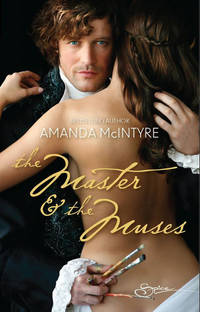
The Master & the Muses
Amanda McIntyre

www.spice-books.co.uk
As always to my supportive family, immediate and extended, for their inspiration, love and patience.
ACKNOWLEDGMENTS
I’d like to thank my editor, Lara Hyde, and the rest of the Spice team at Harlequin, who encourage me to explore outside of the box in my writing. I have grown immensely as a writer under their guidance. I would also like to thank Renee Bernard for her friendship, help with Victorian culture and sharing resources. To Amy and Genella, for the numerous read-throughs, changes and suggestions—you guys rock! To Jo C., my port in the storm who is great at perspective issues. And finally, to Daniel Gabriel Rossetti, the Pre-Raphaelite Brotherhood and their muses—one and all—who by their unconventionality inspired not only this book, but also my view in believing in one’s passion.
Prologue
I HAVE BEEN CALLED MANY THINGS—RECKLESS, arrogant, perverted, self-absorbed and, my personal favorite, an artist of the “fleshy school.” Perhaps these allegations are true; I do not deny them, but to those stifled critics of my work, I turned a deaf ear and listened instead to the beat of my heart, the siren song of my passion.
Had I listened to the naysayers of my work, to the critics who sought to box in my genius, my very soul, I daresay I would not have taken up a single brush.
In truth, I believe the critics are correct in their assessment of my incorrigible behavior. Daring to be different was, and is still, the very essence of my creativity. I am nothing if not tenacious in my beliefs, and proud to be so.
These would-be art connoisseurs know nothing of true art. Their view is monocular, dull and lifeless, linear and plain. It does not see the emotion of a woman’s faint blush of arousal, of her cheeks in bloom at seeing her beloved, of her eyes bright and shining in the afterglow of passion. No, to paint such beauty, one must experience it, feel it and grasp it. No classroom, no stack of books can teach these things.
Despite my parents’ wishes, I was not destined to be a religious man. Rather, I consider myself a spiritualist, a believer in karma more so than doctrine. My passion lies in the tip of my brush, but my inspiration is women. They are my muses. I ask you, what creature in all the earth epitomizes such beauty and grace? Many artists have tried to capture the beauty of this world. Even so, there are few things more persuasive than the delicate color of a woman’s flesh. What could be more inspiring than the soft curve of her shoulder poised to carry the burdens of her world or the pout of her sumptuous mouth determined to carry those burdens with dignity?
Rescued from the mundane existence of their lives, my muses needed no coercion. Fame, independence, appreciation—that is what I gave them in return.
My pulse quickens to think of our conversations, the wine we drank, the free-spirited love we made. I was asked once if I ever loved one more than the other? To that I say, how can a man love only his arm, and not his leg, or his eye, or his mouth? I loved each one for the life she breathed into me, inspiring my work. But I could no more hold them to me forever than I could hold a sunbeam.
Reality and art, in many ways, are one. To my moral censors, I ask how could I not fall in love with each of my muses? Each represents a part of my soul. No, to each one I was utterly and completely a devoted slave.
Did they know this? It will not add to my days to know that answer. Life, love—it is what it is. I was both their savior and their sin. I rescued them from the ordinary, redeemed them with the stroke of my brush.
In my quest to capture the perfect image, I may not have been aware of all that my muses had to endure. But I offered them new worlds, new adventures. If that makes me a selfish bastard, then I accept my guilt with open arms.
Do I have regrets? What good Italian does? The bad has given me a better appreciation for the good. The good reminds me that while it is welcome, it is also fleeting. I have tasted the cup of life and offer no apologies.
To you, my muses, I raise my evening port. You have fueled my imagination and lust. Without your inspiration, I would not be the man I am. Helen, my innocent, fervent in your private desires. Sara, my socialite, always reaching for more. And Grace, in saving you, I saved myself.
I am forever slave, mentor and pupil to your inspiration,
Thomas.
Book 1 HELEN
Chapter One
Leicester Square, 1860
THERE HE WAS, THE SAME MAN AGAIN, WATCHING me as I walked to work. His formal frock coat he wore over an ill-fitting shirt, tucked into rumpled trousers, giving the appearance that he’d just been roused from bed. I assumed he was local by manner of his dress, perhaps not of great wealth, but respectable, except for his deplorable habit of staring. Perched on his head, he wore a too-small brown derby that looked as if it had seen better days. These things I noticed since I’ve been a milliner’s apprentice in one of London’s premier hat shops from a young age. It was my job to be acquainted with the most current chapeau styles.
I must admit, I was not at all accustomed to being the subject of a man’s interest. It intrigued me, but I chose to ignore my admirer, as any respectable lady would do. He was a persistent fellow, however, and for three days, I passed him standing on the opposite side of the street, daring only to glance at him as I arrived for work at Tozier’s hat shop. My overactive imagination, a fault of which I’m reminded often by my mother, soon had me pondering whether he was planning something sinister against my employer.
On the third day just before the noon hour, he entered the shop. I was preparing a hat for display, pretending not to notice the strange thudding in my heart. He hung near the front door for a time, perusing the lady’s handkerchiefs and lace gloves, ever so slowly inching his way over to where I stood. Perhaps I had misjudged him and he was simply debating what to buy for his spouse or mistress. Mrs. Tozier kept a private list of the men who often needed a “little something” for the special woman in their lives—most often not their wife. Discreet and professional, Mrs. Tozier would take their money, wrap their gift and offer them her smile.
“Pardon, mademoiselle,” the mysterious man said in a smooth, baritone voice.
I looked up and met his startling blue-green eyes, clear as the sky and sparked by a mischievous curiosity that sent a shiver through me. His hair was a light brown, slicked behind his ears and dipping just to his collar. The firm line of his jaw, which looked as if it could use a barber’s razor, was accentuated by a wicked dimple when he smiled. Perhaps I was mistaken and he was a foreigner? It might explain his hesitancy to approach me if he was unable to speak any English.
“Are you French, sir?” I enunciated my words clearly. He had an aristocratic air about him, a rather regal, pleasant face and, at closer look, he was quite handsome. Had he been dressed more appropriately, he might have passed as a baron or a duke.
“No, I am not French, mademoiselle.”
Although I was relieved that I would not need to draw on my minimal skills in the French language, his admission raised a new bevy of questions. “Nor am I, sir. Why then, do you pretend to be something you are not?”
He took off his silly brown derby, and, with a sheepish grin, smoothed his palm over his locks in a vain effort to bring them under control. “My apologies for assuming you might speak French, working at a French hat shop.”
“What brings you to our shop, Mr.—?” I waited for his name.
“Rodin. William Rodin. Perhaps you’ve heard the name?”
I studied him evenly and gave no reply.
He waved his hat. “Well, I am confident that one day you will.” His smile would have charmed a snake. “Are you familiar with the world of art, by chance? It is possible you may have heard of my brother, the famous artist, Thomas Rodin.” He fingered his derby as he spoke. I noted by the appearance of its tattered edge that if he, too, was in the business of art, it was not doing very well these days—at least not for him.
“No, Mr. Rodin. I am afraid I have not heard of either you or your brother. My time is quite full with my duties here in the shop.” I turned the hat stand this way and that, as if studying the display. The truth was, I had but a few times actually engaged in conversation with a male since Mrs. Tozier allowed me to work out front. Certainly not one who seemed interested in my thoughts.
He brought his hand to the collar of his coat, taking on a dignified stance as he tossed me a wide smile.
“Then, dear woman, our meeting is your good fortune, for now you will be able to say, ‘I knew Thomas Rodin personally while he was in the prime of his artistic greatness.’”
I dipped my head to hide my smile. I did not wish to offend his pride.
“Are you interested in a hat, Mr. Rodin?”
He placed his bowler on the counter and leaned close. I glanced around the shop and prayed that Mrs. Tozier would not appear. She was a robust woman, with a thick French accent. Not one to tangle with, her grandfather had immigrated to London to open this milliner’s shop. I could not afford to lose my job over some strange man and his absurd interest in telling me about his famous brother. I held up my hand politely. “Mr. Rodin, my apologies, but I do have work to do. If you are not looking to buy a hat, then I must excuse myself and return to my duties.” I turned to leave, and he reached for my arm.
“Let me get right to the point.”
“Just as soon as you remove your hand from my arm, sir,” I said. However, I could not deny the pleasant warmth of his palm.
His mouth lifted at the corner, as if he knew his touch jarred me. Slowly, he removed his hand.
“I have come to offer you a proposition.”
“Excuse me, sir? Perhaps you’ve forgotten just where you are. If you are here to seek companionship for the evening, the Ten Bells Pub is down the street. I’m sure you’ll find what you seek there.”
He looked at me in surprise. “No—I mean, of course not. I’ve come to offer you honest employment. You have the potential to become quite famous.”
He liked to use that word with great frequency. “Famous, you say? As you are famous, Mr. Rodin?”
His eyes narrowed, studying me before he resumed his amiable expression. “My fame is in knowing the genius of the brotherhood. I am a designer, not an artist in the true sense of the word. However, presently being between projects, I have offered my services to my brother.”
“That is quite thoughtful of you, Mr. Rodin. Now if you’ll excuse me.”
“Wait, I beg you to listen. The artists of the Pre-Raphaelite Brotherhood are looking for new models to pose for them. They have a very specific type of woman in mind and you fit the criteria brilliantly.”
“Criteria, for your ‘brotherhood’? Really?” I did not hide my skepticism.
“Indeed. You are what we would call a ‘stunner.’”
The word made me sound like the type of woman one would pick up at the Cremorne on a Saturday evening. His eyes raked over me, unashamed.
I pulled a display between us and I busied myself with adjusting the feather on the band of the hat. He continued to stare. No man had ever seen me as a model before.
“Your hands are quite lovely,” he said, leaning against the counter.
“Please, you’ll smudge the finish. If Mrs. Tozier—”
At that moment, I heard a heavy clomp-clomp coming across the wood floor from the back room.
“There, now you’ve done it. If I lose my position—”
“I’ve just offered you another.” He straightened and offered a pleasant smile.
“Miz Bridgeton, eez there a problem? Are you able to assist the geentleman?”
Mrs. Tozier came to my side. She was two inches shorter than I was, but more than made up for her height with her stern demeanor.
I started to explain, but the tenacious Mr. Rodin interrupted me with a slight lift of his hand.
“Madame Tozier.” He bowed, taking her hand, placing there a quick kiss. “Je suis un artiste de design et de poésie,” he attempted in broken French.
Mrs. Tozier looked at him with a wary eye. She was quite capable of spotting a fake—whether a hat or an accent. She frowned at me, and then at the man. “You are a design artist and a poet. How nice. So, you’ve come to buy a hat, oui?” she stated plainly, tugging her hand from his.
I bowed my head, pretending to be engaged in repositioning the ribbon on the hat in front of me. Mrs. Tozier had little patience for wasting time. And if one had no interest in purchasing a hat then, to her way of thinking, they were wasting her time.
He paused, clearing his throat. “Madame, I would like to discuss the possibility of borrowing your fine clerk, Miss Bridgeton, to hire as an artist’s model.”
Mrs. Tozier’s hand flew to her mouth and her expression changed to blatant anger. “Geet out, geet out of my shop! You…you should be ashamed of coming in here and harassing a young girl, so sweet and innocent. Out,” she snapped, waving her arms, chasing him to the front door. “You will ruin her reputation! That is what you will do.”
I looked down and realized Mr. Rodin had left his hat. Carefully, I tucked it behind the counter. I watched as Mrs. Tozier slammed the door, causing the bell to clatter wildly. With a huff, she pulled down the lace shades that kept out the afternoon sun. She faced me and shook her finger as she stamped back to me.
“Do not speak to such men, Helen. They will only beguile you. Use you like tissue paper and toss you away with as much ease.”
I wondered how she knew of such men. “Merci, Mrs. Tozier. He has been watching me for several days.” Oddly, my heart beat with a fierce and dangerous thrill. In part from her tone, in part from remembering how Mr. Rodin had looked at me. “Do you think he will be back?”
“Non, he won’t if he knows what eez good for him,” she huffed, smoothing her hands down the front of her skirt as if ridding his scent from her hands.
I waited until she disappeared beyond the curtains to the back room before daring to hurry to the front window and peer out.
To my strange delight, he was there, leaning against the corner of the building across the street. He caught me looking at him and placed a finger to his brow in salute, stuffed his hands in his trouser pockets and strolled down the street.
Later that night at supper, I spoke to my family about the incident. My papa knew immediately with whom the young man was associated. His words echoed Mrs. Tozier’s.
“Bad seeds, the lot of them. They condemn the teachings of the scholars at the Royal Academy, claiming they teach rubbish. Then they carouse the streets, preying on young girls to lure into their studios, promising who knows what and, once there, the poor things cannot defend themselves.”
My sisters, fascinated by the conversation, turned their collective wide-eyed gaze to me, waiting for my response.
“But Papa.” I carefully chose my words. It had taken a great deal of effort to convince him to let me apprentice at Tozier’s, and I did not wish to jeopardize that small bit of freedom I had. “Mr. Rodin did not appear to be a deceitful man.” I popped a dumpling in my mouth, slowly raising my eyes to meet my father’s.
“You heard me, Helen Marie. You are to stay away from that riffraff. No good will come of it, I tell you that. Concentrate on your duties and learn the trade. That is what making a real living is—it is not about slapping paint on a canvas and living hand to mouth.”
With one last effort to keep the conversation alive, I glanced at my mama, seated across the table from me. Her expressionless face spoke to me in greater volume than if she’d opened her mouth. The conversation was over. It was not to be brought up again.
I was old enough to make my own decisions but, due to my meager wages, was forced to live with my family because I had no husband. My papa and mama were of the belief that a man was the breadwinner and the woman the keeper of the hearth and home. They did not understand that if I met the right man, I would gladly work hard beside him, just as Madame Tozier worked with her husband at the shop. But according to my parents’ wishes, until some wealthy gent swept into the shop and asked for my hand in marriage, I was destined to become a spinster with a very good knowledge of making hats. Was this my only opportunity to start a life of my own? Was it a chance to get my poetry in front of another creative soul?
As I helped to clear away the supper dishes, my mother placed her hand on my cheek.
“You are a beautiful girl. You will find a good man, like your father. A man who is not afraid of hard work.” She patted my cheek as if that would magically make all my cares disappear.
Later, in the sanctuary of my room, I placed Mr. Rodin’s hat inside a round hatbox that I’d found stacked near the refuse bins outside the shop. I tied it with a brown ribbon and tucked it beneath my bed, hoping that I would be able to give it to him on my way to work tomorrow.
For a long time I stared at the pale moonlight on my ceiling, remembering the look in his eyes as he studied me. I imagined reaching out to touch his unshaven cheek, feeling his warm breath on my face as he drew near. Strange sensations made my body tingle. For the first time in my life, I saw myself as a grown woman instead of a child.
Chapter Two
IT WAS ODD TO SEE MY SHADOW AS I WALKED along the cobbled lane to work. Between the constant downpours and the stench from the river that hovered over the city like a hazy specter, the sun was a strange sight. Its warmth lifted my spirits, but the idea of seeing Mr. Rodin had improved my mood long before I set foot outdoors.
I turned the corner, scanning the block before me, disappointed when I saw only the familiar store managers putting out their wares.
“A fine day to you, miss.”
I took a step back, taken by surprise at Mr. Rodin’s sudden emergence from a closed storefront. “Are you always this forward when in pursuit of potential models, Mr. Rodin?” I squared my shoulders, making sure he thought I did not appreciate him accosting me in this manner. In truth, however, butterflies had taken flight inside me.
He bowed. “Forgive me. I only came to inquire whether you might have seen my hat. I have apparently misplaced it.”
My brave response was prompted by my secret delight in seeing him again. “And you did not wish to encounter Mrs. Tozier again, I presume?” It was as close to flirting with a man as I’d ever done.
His eyebrows rose and he gave me a wicked grin. “How astute you are, Miss Bridgeton. I pray you know me all too well.”
“Oh, Mr. Rodin, something tells me that I have barely scratched the surface. Nonetheless, I did find your hat before Madame Tozier did.” I handed him the round box, which he held high, turning the beribboned container this way and that.
“I can’t say when my old chapeau has ever looked better,” he remarked.
“I quite agree, Mr. Rodin,” I responded with a genuine smile. “If you’ll excuse me, I must get to work.” I started around him.
“Um…excuse me, Miss Bridgeton. May I inquire of your plans this evening after work?”
I stopped and looked over my shoulder. True it was that I did not belong to an aristocratic circle where gentlemen used calling cards to request a lady’s company. Regardless, I was somewhat surprised by his unconventional manner. Then again, what should I expect from a man who had skulked around watching me for days before speaking? I thought of what I would do for one of my sisters. Would I give up easily if I thought they truly needed something? “You must adore your brother very much, Mr. Rodin.”
He pried open the hatbox lid, offering a lopsided grin as he plopped the bowler on his head.
“Indeed, I do, but what makes you say so?”
He had not noticed that I had carefully trimmed the frayed edges of his hat. “Because it is clear that you are not to be put off, isn’t it? No matter how rude I am.”
His blue eyes regarded me with new interest. “Are you being rude?”
“See there, you wouldn’t even know!” I replied.
He laughed and the sound of it was so carefree that I daresay I found my mouth twitching to smile.
“Miss Bridgeton, I assure you that my intentions are honorable. Are you not old enough to accept a simple invitation for a walk in the gardens, maybe to enjoy an ice cream with me?”
“For what purpose, Mr. Rodin?” I knew to accept meant I would hear more about this proposal. Moreover, I feared that my interest was not merely in his proposal, but in seeing him again.
“Very well, Mr. Rodin. Shall we meet at the west gate of the Cremorne Gardens, then? Around five?”
“I look forward to it, Miss Bridgeton. You can ask then all the questions that I’m certain are mulling around that beautiful head of yours.”
We’d taken our ice cream and walked past the dancing platform to get away from the crowd and the loud music of the outdoor stage. It was a pleasant early evening at the gardens. The lights, hung by lanterns in the trees, flickered in the dusky wane of sunlight. A gentle breeze blew, mercifully keeping the lingering stench of the city at bay, at least for a while. “Tell me about your brother, Mr. Rodin.”
I used a spoon to scoop up a bite of the refreshing ice cream infused with lemon. An arched tunnel overgrown with wisteria and vines led to another part of the park. I thought we would be able to talk quietly there.
We walked through the tunnel in silence, the cool shadows as welcome as the treats we ate.
“What would you like to know about him?” Mr. Rodin asked.
I confess my head felt light for no reason I could think of other than the handsome gentleman at my side. Unnerved by my reaction to his proximity, I sought to find a question about his brother that could possibly interest me more than Mr. Rodin. “Why don’t you tell me about his work?”
A small blob of ice cream slid off my spoon and landed in the middle of my chest. I grimaced and Mr. Rodin offered to hold my cone while I rummaged through my bag for a handkerchief.
“There now, Miss Bridgeton. I’ve got it.”
He pulled a handkerchief from his pocket and swiftly wiped away the mess. I felt the slight brush of his fingertips over my breast. A gasp tore from my throat. “Please, Mr. Rodin!”
“My apologies, Miss Bridgeton. It seemed simple enough to remove without touching your—”
My brows shot up. “I receive your meaning, Mr. Rodin. You needn’t embellish.” I took his handkerchief and dabbed at the place where the ice cream had seeped through to my skin. My cheeks burned with embarrassment. “Perhaps we could find a place to sit down?”
“Oh, yes, of course. Here, this looks like a suitable spot.”
He waited as I sat, and I shook my head when he offered me the remainder of my cone. He tossed both cones into a receptacle nearby and sat down beside me.
“Please continue, Mr. Rodin. You were telling me about your brother.” I took a breath and patted my hair, trying not to look too disheveled.
“About Thomas—” he tapped his long fingers together “—he’s a complex fellow, as most men of his position are. His passion is his art and that is what drives him, I suppose.”
“Forgive me, but is he any good? Does he exhibit his work publicly?”
He turned to look at me, his expression curious. “You’ve truly not heard of him?”
I shook my head. “I’m sorry, I have not.”
“His earlier works have been on exhibition at the Royal Academy gallery. I believe one or two still hang in a permanent wing at the insistence of one of the academy’s wealthy contributors.”
“His accomplishments sound most impressive. You must be quite proud.”
“I told you, Miss Bridgeton, he is gifted man. Not perfect, mind you, but bright and determined. He is a romantic at heart. His work is largely of women, using poetic imagery, religious stories and legends from which he derives his ideas. Though, in truth, his inspirations are his muses.”
“May I ask what you mean by ‘his muses’?”
“Let me make one thing perfectly clear, Miss Bridgeton. My brother has a deep, abiding love of women. A reverence, I daresay. Thomas regards women with the same awe that other men reserve for the stars, or a sunrise.”
“My, what a lovely thing to say, Mr. Rodin.” My eye caught the shadowy figures of a couple hurrying into the dense foliage beside the tunnel. There was little doubt in my mind what mischief they were engaging in. I forced my attention back to Mr. Rodin. “Are there many members in this brotherhood, Mr. Rodin? Any other models?”
“There are a handful of us—other artists like Thomas, me, in design…we also have amongst us a poet, a journalist and an author, as well as a few other individuals. You need not take concern, Miss Bridgeton. We are a close-knit group and very watchful of one another.”
A woman’s lusty sigh came from the other side of the wall. I kept my eyes on Mr. Rodin’s face. He continued, despite the distracting animallike sounds coming from nearby.
“There is a certain amount of pride in what we believe in, what we aspire to. Each of us has a purpose, a goal we want to achieve, but we are—”
“Oh, yes…yes, that’s lovely, guvner.” The woman emitted a loud sigh. “Here now,” she said, “let’s see what gift you’ve got for me.”
I heard the soft baritone of a man’s chuckle. “You are an eager one.”
Images of what the couple were engaged in leaped into my imagination and I licked my lips.
“—professional and discreet,” Mr. Rodin finished
My face felt flushed, feverish. I fisted my hands in my lap, trying to stay as detached from the events on the other side of the wall as it seemed Mr. Rodin was. I wanted to ask him if we should take our conversation elsewhere, but he appeared to be perfectly content and I did not wish to convey to him that I was as unsettled as I truly was.
“Discreet?” The word squeaked from my throat. “Oh, yes, an admiral trait, certainly.”
A deep-throated groan wafted through the flowers and I saw the instant Mr. Rodin recognized it. His mouth curled slightly at one side and he averted his eyes for a moment.
“Did you have any other questions, Miss Bridgeton?” he asked.
“Oh, dear lady! What extraordinary skills you possess!” the man growled from inside the bushes.
I turned my head aside, covering my mouth to hide my smile. I cleared my throat, loud enough, I hoped, to alert the couple they were not alone. It did not seem to deter them.
“There now, hold it still, guvnor. You’re plenty ready.”
“But I paid for an hour,” the man remarked with slight agitation in his voice.
“Is that my fault, then? Besides—” she cooed “—there’s no sayin’ that we can’t find us another lovely spot to ‘ave a go at it again, if you get my meaning?”
A deep chuckle followed.
I was so entranced by their repartee that I had all but forgotten Mr. Rodin was seated beside me. My eyes flickered to his steady gaze. “Oh, my, what is it that you asked, Mr. Rodin?”
His grin curled upward, deepening that delightful dimple. “If you had any more—”
“Ah…ah, oh, yes…there, that’s good, guvnor. Real good.”
The trellised latticework wall bowed inward with each punctuated sigh coming from the woman.
“—questions,” Mr. Rodin finished as he glanced at the heaving wall. He removed his hat and suppressed a grin.
“Perhaps we should leave?” I whispered, as the sounds of the couple’s passion escalated. I’d never heard such noises before. A warm, damp feeling formed at the juncture of my thighs. My palms, too, were moist—indeed, my whole body seemed to come alive listening to their lusty cries.
“Are you quite sure? Just when things are getting interesting?” Mr. Rodin smiled openly.
“I think before they get too much more interesting.” I stood, finding the backs of my knees weak.
“Very well, I could use a good walk myself.”
He offered his arm and we continued to the other end of the breezeway. As we reached the open lawn beyond, I took a deep breath of fresh air. I felt as if all the blood had drained to my toes.
“Are you all right, Miss Bridgeton?” Mr. Rodin patted my hand, still tucked through his arm.
“Yes, I’m—”
A man’s loud groan wafted on the breeze along with the music behind us. Few others were in the area as, by now, most people had taken to the dance floor.
I glanced over my shoulder. “I’m well, thank you. Um…might we resume our conversation? I believe you were about to answer my question regarding other models.” He cast me a side look.
“Of course. Models…Normally, our artists do not employ more than one model at a time. Once a theme is chosen, the artist begins to look for the face that will complete his vision.”
Mr. Rodin eased my arm from his and I felt awkward once more. We strolled together to the pond and watched silently as two swans swam by, gliding effortlessly side by side. I thought about the story of the ugly duckling that my sisters and I were told when we were young, of how the strange little duckling was turned into a beautiful swan. I felt such a complexity of emotions. In the wake of overhearing the couples’ tryst, I was more aware than before of my attraction to Mr. Rodin.
“Perhaps you’d like to see some of my brother’s work?” he asked, his eyes on the birds. “It might help convince you that my intentions are honorable.”
“Oh, Mr. Rodin,” I said, not wanting him to think me immature or indecisive. “I do believe you are being truthful. Please understand that I am interested—very interested. It’s only that my family is not entirely agreeable to the idea of my modeling for an artist—any artist.”
“I could speak with them, if you like,” he offered.
I held up my hand. “Oh, no, that would not go over well, I’m afraid. My family’s opinion of artists is much worse than even Madame Tozier’s.”
He frowned. “That is a problem.”
He looked away and I feared he was about to end our association. “However, perhaps I could meet you at the gallery sometime and you could show me your brother’s work?”
He glanced down, a smile lighting up his face. “Splendid. Yes, that would be most enjoyable.”
I breathed a quiet sigh. “Wonderful,” I replied, offering him a smile in return.
“Can you meet me on Saturday, then?” he asked, removing his hat. A slight breeze lifted an errant lock of hair, blowing it across his forehead. My fingers twitched to brush it from his eyes.
“Oh? So soon?” I fretted over whether I could quickly devise an adequate excuse to get out of my Saturday chores. “I—I’m not sure I can make arrangements on such short notice.”
“Your family?” he asked.
I nodded. He faced me then, and rested his hands on my shoulders. “I cannot deceive you into thinking that the members of the brotherhood are saints. We are flesh and blood, young and sometimes reckless, and we have the same drives as all men.”
He searched my face for a moment. “Please go on, Mr. Rodin.” I was grateful he held me upright, as my knees threatened to buckle.
“But our passion does not make us unsavory characters to fear. It is embracing that passion that gives the world its beauty. Do you understand?”
“I think so.”
“And do you fear me, Miss Bridgeton?
I considered his question. “No, Mr. Rodin. I hardly know you, but in truth, I am far more afraid of how to explain my absence at dinner tonight to my family when I get home.”
“Meet with me on Saturday. We can visit the Royal Academy gallery and you can judge for yourself whether you think my brother is worthy of your consideration. Afterward, if you are curious to know more, maybe you’d like to see his studio. I would be most happy to oblige the visit on Thomas’s behalf. I think you will find the studio a welcome venue of artistic expression.”
“I am rather a bit of an artist myself in that I write poetry,” I admitted, precariously considering his offer.
“I knew it.” He grinned. “Then I shall see you on Saturday?”
I swallowed, my confidence wavering. “I don’t know, Mr. Rodin.”
“Come. Let me get you a lemonade while you think on it.”
He offered his arm and, for that, I would gladly think on any subject at great length, but I knew that it was getting late and my family would begin to wonder of my whereabouts.
We walked back to the main path near the dance floor where the crowd was thickening as the shops closed for the day and the city dwellers looked for respite from the heat.
I waited as Mr. Rodin approached a vendor, studying from behind how well he carried himself. As he waited in the line of thirsty patrons, a buxom woman with thick blond hair wound haphazardly atop her head touched his shoulder. He whirled in surprise and caught the woman in a great bear hug. They spoke for a moment, and she left. He paid for our drinks and headed back, offering me a broad grin as he handed me the glass. The drink was ice-cold and soothed my parched throat.
“Thank you,” I said, and glanced at the woman now engaged in speaking to another man.
“Someone you know?” I asked lightly, sipping my drink.
“Jealous?” William teased.
“Oh, no, I…of course not.”
He smiled and sat down beside me. “Please, Miss Bridgeton. Forgive my teasing, I meant no harm.” He glanced at the woman and took a long gulp of his lemonade. He made a face as he smiled at me. “And they claim whiskey burns going down.” He smacked his lips and blinked. “The woman’s name is Grace Farmer. She is an old friend, who occasionally models for the brotherhood. An excellent cook and a fine woman, though gravely misunderstood, I fear.”
“Why is that, and by whom?”
“By virtue that she is a ladybird, I suspect. But only those who know her understand her character and the heart of the lady that she truly is.” He stared at Grace a moment more before he drained his glass. “Besides, my brother lusts after her hair. It is an artist’s dream.”
I tried not to let it bother me that the brotherhood kept relations with prostitutes. That would not bode well where my family was concerned. Bad enough that models were already questioned for their promiscuous behavior. But perhaps she was the only woman with a jaded background.
My hand crept to my fiery red tresses as I wondered what his brother would think of my hair. I kept it swept up most of the time in a loose coil atop my head. I promptly moved my hand away so I would not reveal my concern to Mr. Rodin. “It’s getting late and I should catch one of the ferries back across the river.”
“I’ll escort you to the dock,” he offered.
We walked in silence to where one of the passenger boats lay docked in wait, filling up with weary passengers.
“Thank you, Mr. Rodin. It’s been a lovely evening.”
“Wait,” he stated, and reached for my cheek. His thumb grazed the side of my mouth, sending a shiver down my arms.
“Bit of your ice cream. You want no telltale signs giving you away.”
He could have wiped the ice cream on his trousers but instead he licked it from his thumb. I gave him a hesitant smile, wondering how best to explain his part in my detainment to my family.
“You didn’t say whether we can meet on Saturday.”
“I’ll try, Mr. Rodin,” I responded. “I’m not sure I’ll be able to—”
“I know you’ll need to make arrangements. But please try, Miss Bridgeton.”
I took the boatman’s hand and climbed into the boat.
“I will do my best, I promise.” He walked on the dock alongside me as I made my way to the back of the boat.
Squatting down, he peered at me beneath the safety rails. “Say you will try very hard.”
“Mr. Rodin.”
“Miss Bridgeton, please. What I offer you could well change your life and that of your family.”
I looked up, taking notice at that comment. In my world, art was a foreign thing, the value of it linked only with the great masters, not burgeoning new artists breaking the rules of convention. But I had to ask myself if I was willing to settle for conventional for the rest of my life. Was going against the wishes of my family in order to satisfy my curiosity worth the risk of possible alienation? My German father could be a stubborn and willful man at times.
In truth, I could not offer Mr. Rodin any certainty I could meet him again. Still, I wanted to see him smile once more. “Oh, very well, then. What time?” I called, my voice sounding almost desperate. I glanced around me, confronting the curious look of a woman and her husband.
“Splendid! Ten o’clock,” he volleyed back.
I raised my hand, waving goodbye. “I’ll see you then,” I shouted. I lost sight of him as he made his way back up the dock toward the garden. I dropped my hand in my lap and felt like a foolish ninny wondering if he ran straight back to Grace Farmer. Of all things to think of! I had a much more important task ahead of me in devising a plan to escape my mother’s watchful eye on Saturday.
Chapter Three
MY STOMACH, PRONE TO PANGS OF NERVOUSNESS, had given me trouble throughout the night. When the pain was severe, I was barely able to eat and my mother could tell in an instant if I was worried about something. Mr. Rodin seemed to be going to great lengths to convince me of the validity of this “brotherhood of artists” and the more I pondered my options, limited though they were, the more my stomach gave me issues.
“Did you take your laudanum, Helen?” my mother asked as she cleared away my breakfast bowl, half-full with my porridge. I had waited to come in for breakfast until I knew my sisters and papa were out doing their chores.
“Yes, Mama,” I replied, following her into the kitchen. I had not the gumption yet to tell her that I was going to be gone for the day. I knew that I could not simply tell her the truth. She would not permit me to leave. Besides, I was still debating the wisdom of meeting Mr. Rodin alone. But if I was to achieve my independence, I would first need to find out more information. Until I knew more, there was no reason to involve my family.
“I’ve been invited to…a picnic today.” The lie stuck in my throat. I busied myself with washing the dishes.
“That’s lovely, dear. I’m glad to see you getting out. Who will be going?” she asked, tucking her rolling pin in the cupboard.
She looked at me with such delight that it made my stomach burn. My mother, I think, saw me as a recluse, though she never said the words aloud.
“Some of the girls from the shop.”
“And will there happen to be any gents there?” Her eyes revealed the hope that there might be future marriage prospects involved.
I tried to keep my smile genuine. “It was not my invitation, Mama, I cannot say.”
“Where is the picnic?”
My mind went blank. I had been unprepared for further questions. I scolded myself mentally. “Um…the Cremorne,” I lied again, my stomach protesting my deceit.
She patted my cheek. “Well, it sounds lovely, and it would do you good to get out a bit more. So I shouldn’t plan on you for supper, then?” she asked.
I shook my head. “You best not wait on me tonight. I will be sure to catch the ferry by ten o’clock.”
“Perhaps I should send your papa down to the dock to fetch you. I don’t like the idea of you without a chaperone, especially at that hour.”
“I’ll be fine, Mama. None of the other girls will have their papas meeting them. I’ll be fine.” I hastened to gather up a few items before she could think of more questions to ask.
“Helen?”
I heard my name as I headed down the front path and turned to find her holding my parasol out to me.
“Your skin, you know how you burn. Don’t forget to use this.”
“Thank you, Mum. Stop fretting now. I’ll be fine,” I assured her.
The morning was brilliant, the sun warm on my face as the boat ferried me across the river. The stench was the only thing marring my delight at having managed to get away from the house with so little inquisition.
I hurried along the cobblestone street wishing I could afford the carriage ride, so I would not be wilted by the time I reached Mr. Rodin. I rounded the corner of the gallery and there he was pacing out front. He stopped and checked his stopwatch. Having no such luxury of my own, I took my time from the toll of Parliament’s new clock tower. “Mr. Rodin,” I said breathlessly, forcing a smile as I slowed to a respectable pace.
“Miss Bridgeton.” The peel of the tower bells sounded. “Splendid, you’re right on time.”
He offered me his arm and we went inside. The Royal Gallery was quite beautiful, room after room of high-polished floors and great high ceilings. Pictures were hung in ornate gold frames, stacked next to one another on the walls at eye level and upward.
“You want to be able to get the spot at eye level,” Mr. Rodin explained. “That’s how you know the committee approves of your work.”
“And where is your brother’s work, Mr. Rodin?” I asked, searching the wall as if I would recognize his work when I saw it.
“Third row from the top…over there. It’s a brilliant piece. It should have been lower. But my brother has issues with conforming to the committee’s wishes.”
He smiled at me when I gave him a questioning look.
“Thomas quit the academy under protest of the teachings here. He’s never really quite gotten back on track with the committee. He doesn’t have a number of highly influential friends, as I mentioned.” He looked at the painting. “Truthfully, Miss Bridgeton, I think deep down he wished the committee would judge his work on its own merit, and not on Thomas’s reputation.”
I studied the painting as best as I could from my vantage point. It was a lovely portrait of a woman barely covered by a luxurious blue drape. It was the light in her eyes that struck me the most. They seemed so full of life.
“You mustn’t let this influence your decision, Miss Bridgeton. Often in life, it is the geniuses who are the least understood.”
“Oh, I do understand that.” I slanted him a glance and he returned it with a smile. William’s solid belief in his brother’s work was what made Thomas’s painting stand apart from the rest. I knew little about Thomas Rodin, the artist, but the more time I spent with his brother, the more I came to revere him and the more I desired to meet him. I began to realize, too, that wherever there was opportunity to be around William, I was more than willing to take whatever risks were involved.
We came to a statue of a nude male reclining, as though relaxing in a meadow on a pleasant day. Every muscle was intricately carved, portrayed with lifelike precision, and my eyes were immediately drawn to the size of his phallus lying limp against his leg. Having never before been privy to the human male form, I silently wondered if it was realistically proportioned.
“Artistically enhanced,” Mr. Rodin’s voice issued at my side.
“Oh, I wasn’t—” I started.
He raised his eyebrow.
My cheeks warmed and I looked away.
“Dear Miss Bridgeton, when it comes to art, only an intelligent person would have such questions.”
“Thank you, Mr. Rodin, but how did you know?” I asked.
“Your face reads like an open book,” he replied with a smile.
“I’m sorry, I suppose you find me quite naive.”
“On the contrary. I think your innocence suits you beautifully.”
“You have a wonderful way of making me feel at ease with myself, Mr. Rodin.” I smiled.
He touched my arm. “I want you to feel comfortable in asking me anything. I know already that my brother is going to be as enchanted with you as I am. Your deep-set eyes and that flaming red hair—you’re precisely what the brotherhood has been looking for.”
“You flatter me.”
“Miss Bridgeton, flattery has nothing to do with it. I am trying to convince you to model for us.”
“Us? Do you paint also?” My heart raced a little faster at the thought.
“Me? No.” He smiled. “I leave the painting to my brother.”
As we walked through the remaining rooms, I was impressed by Mr. Rodin’s knowledge of art even though he claimed not to be artistically inclined. It seemed he was forever comparing his brother’s works to the early works of Michelangelo.
After the tour of the gallery, we took in the gallery’s floral gardens. Mr. Rodin plucked a rose from a trellis and handed it to me.
“Thank you,” he said, “for coming today.”
I held the flower to my nose, breathing deeply of its sweet fragrance. “Thank you for asking me. It’s been a lovely day.”
“And do you yet have any concerns or questions that you’d care to discuss with me?”
I studied him a moment, hesitating still to agree to his proposition, knowing it would take far greater convincing of my family than of me. “I beg of you one more day to decide.” My voice tinged on pleading, afraid that my request for delaying my response might change his mind.
He regarded me with a dubious look.
“Please, Mr. Rodin. I am humbly flattered. However, you must understand I’ve never received such a proposition before.”
He smiled, though it appeared guarded. “Of course.”
I offered a sigh of relief and smiled. Looking away, I held my stomach as I attempted to quell my nerves.
“Are you certain all is well, Miss Bridgeton?” he asked
I held up my hand. “It’s…I’m fine. Perhaps a little ginger soda would help.” I knew that I would need to take my medicine soon.
As he searched for a vendor, I scolded myself for getting so nervous.
Mr. Rodin did not press me further for an answer. We spoke on other topics and later that afternoon, he summoned a carriage and escorted me to the ferry.
At the dock, he handed me a card with his brother’s name and address on it.
“If you make your decision, this is where you’ll find me.”
“Thank you again, Mr. Rodin.” I smiled. “I promise to think about it.”
The next day at work, a young boy came into the shop, self-consciously removing his cap as he pushed forward to the counter where I stood. In his arms, he carried a bouquet of lovely flowers. “There’s a gent outside. He paid me a whole shilling. Says I was to give these to the prettiest girl in the shop.” He glanced around and shrugged. “I guess that’d be you, then?”
I took the flowers and thanked the boy, checking the card tucked inside. I held it toward the light so I could read it.
Dear Miss Bridgeton,
Thank you for the lovely afternoon.
W.R.
“Miz Bridgeton, was that a customer at nearly closing time? Remember it is the Sabbath, we must close early, and I have much to do.” Madame Tozier’s eyes grew wide when she saw the flowers in my arms. “From a secret admirer?”
I tucked the card inside my apron.
“Oh, these? No, a young boy brought these by…for the owner.”
“Was there a card?”
“No, Madame. He indicated that the man who sent them wanted to express his thanks.” My mind frantically searched for recent sales. “He mentioned something about a traveling hat for his wife.” It was as good as I could do on short notice.
She looked puzzled. “No name?” Then her eyes brightened. “Oh, Mr. Smythe!”
Relieved that my lie was validated, I nodded, encouraging the deception further. A sharp pang in my stomach reminded me of the stress I caused myself.
I was glad the shop had closed early. After graciously declining Madame Tozier’s invitation to join her Sabbath celebration, I enjoyed the walk through the park for the chance to clear my head.
“Miss Bridgeton!” A familiar voice called from behind. I turned to find Mr. Rodin hurrying toward me. His face was flushed from running.
“I took the chance that you might be closing the shop early due to the Sabbath.” He smiled and I felt my knees grow weak. I am not sure at what point I had begun to fantasize about Mr. Rodin and myself. Perhaps it was merely the fact that no man had ever paid so much attention to me before. Yet he seemed genuinely interested.
“I wondered if you’d had a chance yet to consider my proposal.”
I appreciate your patience, Mr. Rodin, and your tenacity.” My fingers tightened around my parasol’s handle.
“My brother says that I am like a dog with a bone once my mind is made up on a matter.”
His enchanting grin bolstered my confidence. “I am happy that you have not given up.”
He stood before me looking quite dapper in his dark trousers and tan jacket. His wavy hair was brushed back behind his ears, accentuating his chiseled jaw. In his eyes, I saw a palatable hunger.
Although I knew fully that it was not proper for a young woman to accept such a proposal, I had no reason to fear Mr. Rodin. My fear was that his resolve might weaken if I answered no again.
He pulled a long-stemmed rose from behind his back and handed it to me.
Charmed, I took it from him, touching the delicate petals to my mouth as I breathed in its lovely fragrance. Twice, no, three times now, he had given me flowers.
“You received my flowers?” he asked, tipping his head.
I hesitated, trying to find the best way to explain what had happened. “I did, thank you. However, I regret to have to tell you that I gave them away. I am not allowed to accept gifts at the store.”
“Duly noted. I could see where a woman of your beauty could cause problems in that area.”
I averted my eyes. “Please, Mr. Rodin.”
“I mean every word, Miss Bridgeton,” he stated.
He studied me for a long moment, tapping his hat against his leg and then smiled.
“Well, it remains whether I can persuade you to visit the studio.”
I could not have told him no had my life depended upon it. “Very well. Though you realize it is inappropriate for me to accept your invitation without a chaperone.” His eyes raked over me and I admit I quite enjoyed it. There was something daring in the line I was about to cross.
“I believe you have a good head on your shoulders, Miss Bridgeton. I give you my oath, I will be a gentleman.”
I took his proffered arm, hoping he would not be too much of one. I had dreamed for the past few nights of what it would be like to have his mouth on mine. I looked away, feeling my face flush again.
Mr. Rodin and I walked leisurely through the park to the line of carriages awaiting passengers. He assisted me into a two-seater, settling in close beside me.
“Cheyne Walk,” he told the driver.
The open-air carriage jerked forward and I popped up my parasol to stave off the afternoon sun.
“Will your brother be at the studio?” I asked, keeping my eyes on the road ahead. I dared not look at him. Already I felt brazen at accompanying him without a proper chaperone.
“If he isn’t, he will be shortly. He did mention meeting with some of the brotherhood this afternoon.”
“Do you live at the studio with your brother?” I gave him a brief side look. He had a handsome profile, and I noted a cleft in his chin that I had not seen before.
“When I’m in London, yes, I stay with Thomas. It was a little hard at first getting used to his quirks.” He chuckled. “Thomas paints when the mood strikes him—night or day.”
I smiled pleasantly. I had apparently much to learn about the eccentric Thomas Rodin.
The carriage jostled down the cobblestone street, the sun overhead causing me to grow warm. I had bathed and dressed in one of my best gowns, donning a hand-me-down corset I had received as a gift from one of the girls at work. Still, the heat beneath the layers of clothing was suffocating.
At last, the carriage came to a stop in front of a tall, narrow, two-story stone flat. A small balcony looked out over the street from a set of French doors. It was simple, clean and neat, and appeared to be in a good district, putting my mind at ease in that regard.
Mr. Rodin helped me from the carriage and ushered me up a few steps to a painted red door.
“Here we are.”
Inside, I allowed my eyes to adjust to the murky foyer. The entry was narrow, with a small room off to the right. I peeked inside, finding the room void of furnishings, but its floor-to-ceiling shelves were filled with books.
“The brotherhood are voracious readers,” Mr. Rodin said, leaning over my shoulder. “Come, I’ll show you the studio. It’s upstairs.”
He placed his hand on the small of my back, gently guiding me to the dark mahogany stairwell. Allowing me to go first, we walked up a short flight to a landing and took a sharp right turn to proceed up another set of stairs.
I brushed my palm over the ruby-red wallpaper. It had a raised, velvety texture that I had never seen before. “This design is lovely.”
From behind, his hand reached up to rest beside mine. “Do you like it?” he asked.
I tried to ignore his close proximity, how the sound of his rich voice reverberated inside me. “The color is so elegant, like a red wine.” I looked over my shoulder and caught his pleased smile.
“That was my inspiration.”
“Your inspiration?” I asked, surveying the beautiful wall covering.
“This was one of the first designs I sold to a manufacturer right here in London. Granted, it’s for a very limited clientele, but it’s a start.” He chuckled good-naturedly. “Doubtful my designs will ever hang in the academy.”
“There are more homes in this world than museums or galleries, Mr. Rodin,” I responded without hesitation. He lowered his hand, brushing it against mine in the process.
“Thank you, I’ve never thought of it that way.”
I moved onward, more aware than ever of his presence behind me. At the top of the stairs was a wide hallway. Directly across from me was an open archway leading to a large room. To my right the corridor stretched past four more doors to the end of the hallway and a window festooned with delicate lace curtains. A putrid smell came from the larger room ahead and I lifted my hand to my nose. “Oh, goodness, what is that smell?”
Mr. Rodin laughed. “Thomas would tell you that’s the smell of money.”
He lightly touched my back, urging me forward.
“You’ll get used to it. It’s the linseed oil and cleaner for the brushes,” he said over my shoulder. “You certainly smell far better.”
“Mr. Rodin.” A giggle escaped my lips. He eased around me, his chest brushing my side. I held my breath, unnerved at my body’s reaction to him.
“Come in.”
He waved me into the room and I stood a moment, letting my eyes adjust from the dark hallway to the fused afternoon light in the spacious room. It appeared as though a wall had been removed to create a massive combination studio and study. One end of the room was cluttered with easels, props and a lounge chair draped with beautiful gowns. It looked more like the backstage area of a theater than an artist’s haven. At the other end sat a writing desk and another set of shelves holding collectible exotic items and more books. There was an ornate, black marble front fireplace flanked by a grouping of overstuffed chairs. Directly opposite the fireplace, Mr. Rodin had opened the French doors leading to the balcony. Papers pinned to canvasses fluttered in the summer breeze.
“Feel free to look around,” Mr. Rodin said as he puttered around the room.
An errant sketch tumbled past me and kissed my toe. I reached down to pick it up at the same time as Mr. Rodin. Our fingers met briefly and my heart faltered. I let go of the paper, not wanting him to see the flush of my cheeks.
“Have you painted before, Miss Bridgeton?” He held the paper loose in his hand, his eyes steady on me.
I suppose his question was not out of the ordinary. Most well-bred women in London included painting, poetry and music in their list of abilities. “I’ve only written a little poetry. Dreadfully novice, I’m afraid.” My eyes drifted to the sketch in his hand. Done in charcoal, it was the picture of a nearly nude woman reclined on a chaise. A drape thrown haphazardly over her legs. I looked away, scanning the pictures stacked against the wall, and wondered if I would be asked to pose nude.
Without comment, he placed the sketch on a stack of others on the desk, weighing them down with a thick book.
“Who do you read?” he asked, watching me as I inspected the stacks of paintings leaning along the wall. In one group alone, there were as many as a dozen paintings with various backgrounds, but the same woman’s face. “I read most anything, Mr. Rodin. But I have a particular fondness for Dickens.”
He chuckled. “A fine fellow, Charles.” He glanced at the floor. “A bit zealous, but he means well.”
“You know him?” I asked, wide-eyed.
He shrugged. “We had him over to dine one evening. He has some definite ideas on social reform.”
I searched his face wondering whether or not to believe him. I’d begun to think that perhaps Mr. Rodin had not been embellishing on his brother’s notoriety. “Did your brother paint these?” I asked. Mr. Rodin walked up beside me. “They all look like the same woman.”
“Yes, these are the same woman. Thomas can be a bit possessive once he chooses a subject.”
There was an underlying tone in his voice, though I could not pinpoint it exactly. Sadness? Frustration? His breath tickled the back of my neck. The woman in the paintings was undeniably beautiful. How could I compare to such beauty? “Do you think he will find me suitable?” I touched the collar of my blouse nervously.
I became aware in an instant of my ardent feelings for Mr. Rodin. While it was one thing to dream in the privacy of my room, it was quite another to deal with my desire while standing in a room alone, next to him. He had kept his word, remaining the perfect host, the consummate gentleman, and the realization of what I had agreed to illuminated my thoughts. I had hoped for, perhaps secretly wished, this would happen, that we might find ourselves alone, able to address the growing admiration I felt for him and I was nearly certain he felt for me.
It was both exhilarating and frightening to realize that I had just made the first big decision of my adult life.
Бесплатный фрагмент закончился.