Читать книгу: «The Phantom Tollbooth»

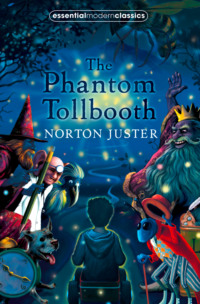
The
Phantom
Tollbooth
NORTON JUSTER


Copyright
HarperCollins Children’s Books HarperCollinsPublishers Ltd, 1 London Bridge Street London SE1 9GF
The HarperCollins Children’s Books website address is www.harpercollinschildrensbooks.co.uk
First published in the USA by Epstein & Carroll Associates Inc. 1961
And by Random House, Inc. 1964
First published in Great Britain by William Collins Sons & Co. Ltd 1962
This edition published by HarperCollins Children’s Books 2008
Copyright © 1961 Norton Juster
Copyright renewed 1989 by Norton Juster
Note from the author copyright © 1999 Norton Juster
Illustrations copyright © 1961 Jules Feiffer
Copyright renewed 1989 by Jules Feiffer
Why You’ll Love This Book copyright © 2008 Diana Wynne Jones
All rights reserved under International and Pan-American Copyright Conventions. By payment of the required fees, you have been granted the nonexclusive, nontransferable right to access and read the text of this e-book on-screen. No part of this text may be reproduced, transmitted, downloaded, decompiled, reverse engineered, or stored in or introduced into any information storage and retrieval system, in any form or by any means, whether electronic or mechanical, now known or hereinafter invented, without the express written permission of HarperCollins e-books.
Source: 9780007263486
Ebook Edition © APRIL 2012 ISBN 9780007370054
Version: 2019-03-29
Some Photographs were unavailable for the electronic edition.
HarperCollinsPublishers has made every reasonable effort to ensure that any picture content and written content in this ebook has been included or removed in accordance with the contractual and technological constraints in operation at the time of publication.
Dedication
To Andy and Kenny who waited so patiently
Contents
Cover
Title Page
Copyright
Dedication
Map
1. Milo
2. Beyond Expectations
3. Welcome to Dictionopolis
4. Confusion in the Market Place
5. Short Shrift
6. Faintly Macabre’s Story
7. The Royal Banquet
8. The Humbug Volunteers
9. It All Depends How You Look at Things
10. A Colourful Symphony
11. Dischord and Dynne
12. The Silent Valley
13. Unfortunate Conclusions
14. The Dodecahedron Leads the Way
15. This Way to Infinity
16. A Very Dirty Bird
17. Unwelcoming Committee
18. Castle in the Air
19. The Return of Rhyme and Reason
20. Goodbye and Hello
Keep Reading
Why You’ll Love This Book: by Diana Wynne Jones
About the Author
About the Publisher
Map


Chapter One MILO
THERE WAS ONCE a boy named Milo who didn’t know what to do with himself – not just sometimes, but always.
When he was in school he longed to be out, and when he was out he longed to be in. On the way he thought about coming home, and coming home he thought about going. Wherever he was he wished he was somewhere else, and when he got there he wondered why he’d bothered. Nothing really interested him – least of all the things that should have.
“It seems to me that almost everything is a waste of time,” he remarked one day as he walked dejectedly home from school. “I can’t see the point in learning to solve useless problems, or subtracting turnips from turnips, or knowing where Ethiopia is, or how to spell February.” And, since no one bothered to explain otherwise, he regarded the process of seeking knowledge as the greatest waste of time of all.

As he and his unhappy thoughts hurried along (for while he was never anxious to be where he was going, he liked to get there as quickly as possible), it seemed a great wonder that the world, which was so large, could sometimes feel so small and empty.
“And worst of all,” he continued sadly, “there’s nothing for me to do, nowhere I’d care to go, and hardly anything worth seeing.” He punctuated this last thought with such a deep sigh that a house sparrow singing nearby stopped and rushed home to be with his family.
Without stopping or looking up, he rushed past the buildings and busy shops that lined the street and in a few minutes reached home – dashed through the hall – hopped into the lift – one, two, three, four, five, six, seven, eight, and off again – opened the door of the flat – rushed into his room – flopped dejectedly into a chair, and grumbled softly, “Another long afternoon.”
He look glumly at all the things he owned. The books that were too much trouble to read, the tools he’d never learned to use, the small electric car he hadn’t driven for months – or was it years? – and the hundreds of other games and toys, and bats and balls, and bits and pieces scattered around him. And then, on the far side of the room, he noticed something he had certainly never seen before.
Who could possibly have left such an enormous package and such a strange one? For, while it was not quite square, it was definitely not round, and it was larger than almost any other big package he’d ever seen.
Attached to one side was a bright-blue envelope which said simply: FOR MILO, WHO HAS PLENTY OF TIME.
Of course, if you’ve ever received a surprise package, you can imagine how puzzled and excited Milo was; and if you’ve never received one, pay close attention, because some day you might.
“I don’t think it’s my birthday,” he puzzled, “and Christmas must be months away, and I haven’t been outstandingly good, or even good at all.” (He had to admit this, even to himself.) “Probably I won’t like it anyway, but since I don’t know where it came from, I can’t possibly send it back.” He thought about it for quite a while and then opened the envelope, but just to be polite. ONE GENUINE TURNPIKE TOLLBOOTH it stated – and then it went on:
EASILY ASSEMBLED AT HOME, AND FOR USE BY THOSE WHO HAVE NEVER TRAVELLED IN LANDS BEYOND.
“Beyond what?” thought Milo as he continued to read.
THIS PACKAGE CONTAINS THE FOLLOWING ITEMS:
One (1) genuine turnpike tollbooth to be erected according to directions.
Three (3) precautionary signs to be used in a precautionary fashion.
Assorted coins for use in paying tolls.

One (1) map, up-to-date and carefully drawn by master cartographers, depicting natural and man-made features.
One (1) book of rules and traffic regulations, which may not be bent or broken.
And in smaller letters at the bottom it concluded:
RESULTS ARE NOT GUARANTEED, BUT IF NOT PERFECTLY SATISFIED, YOUR WASTED TIME WILL BE REFUNDED.
Following the instructions, which told him to cut here, lift there, and fold back all around, he soon had the tollbooth unpacked and set up on its stand. He fitted the windows in place and attached the roof, which extended out on both sides, and fastened on the coin box. It was very much like the tollbooths he’d seen on family trips, except of course it was much smaller and purple.
“What a strange present,” he thought to himself. “The least they could have done was to send a motorway with it, for it’s terribly impractical without one.” But since, at the time, there was nothing else he wanted to play with, he set up the three signs:
SLOW DOWN APPROACHING TOLLBOOTH
PLEASE HAVE YOUR FARE READY
HAVE YOUR DESTINATION IN MIND
and slowly unfolded the map.
As the announcement stated, it was a beautiful map, in many colours, showing principal roads, rivers, and seas, towns and cities, mountains and valleys, intersections and detours, and sites of outstanding interest both beautiful and historic.
The only trouble was that Milo had never heard of any of the places it indicated, and even the names sounded most peculiar.
“I don’t think there really is such a country,” he concluded after studying it carefully. “Well, it doesn’t matter anyway.” And he closed his eyes and poked a finger at the map.
“Dictionopolis,” read Milo slowly when he saw what his finger had chosen. “Oh, well, I might as well go there as anywhere.”
He walked across the room and dusted the car carefully. Then, taking the map and rule book with him, he hopped in and, for lack of anything better to do, drove slowly up to the tollbooth. As he deposited his coin and rolled past, he remarked wistfully, “I do hope this is an interesting game, otherwise the afternoon will be so terribly dull.”

Chapter Two BEYOND EXPECTATIONS
SUDDENLY HE FOUND himself speeding along an unfamiliar country road, and as he looked back over his shoulder, neither the tollbooth nor his room nor even the house was anywhere in sight. What had started as make-believe was now very real.
“What a strange thing to happen,” he thought (just as you must be thinking). “This game is much more serious than I thought, for here I am riding on a road I’ve never seen, going to a place I’ve never heard of, and all because of a tollbooth which came from nowhere. I’m certainly glad that it’s a nice day for a trip,” he concluded hopefully, for, at the moment, this was the one thing he definitely knew.
The sun sparkled, the sky was clear, and all the colours he saw seemed to be richer and brighter than he could ever remember. The flowers shone as if they’d been cleaned and polished, and the tall trees that lined the road shimmered in silvery green.

WELCOME TO EXPECTATIONS said a carefully lettered sign on a small house at the side of the road.
INFORMATION, PREDICTIONS, AND ADVICE CHEERFULLY OFFERED. PARK HERE AND BLOW HORN.
With the first sound from the horn a little man in a long coat came rushing from the house, speaking as fast as he could, and repeating everything several times:

“My, my, my, my, my welcome, welcome, welcome, welcome to the land of Expectations, to the land of Expectations, to the land of Expectations. We don’t get many travellers these days; we certainly don’t get many travellers these days. Now what can I do for you? I’m the Whether Man.”
“Is this the right road for Dictionopolis?” asked Milo, a little bowled over by the effusive greeting.
“Well now, well now, well now,” he began again, “I don’t know of any wrong road to Dictionopolis, so if this road goes to Dictionopolis at all it must be the right road, and if it doesn’t it must be the right road to somewhere else, because there are no wrong roads to anywhere. Do you think it will rain?”
“I thought you were the Weather Man,” said Milo, very confused.
“Oh, no,” said the little man, “I’m the Whether Man, not the Weather Man, for after all it’s more important to know whether there will be weather than what the weather will be.” And with that he released a dozen balloons that sailed off into the sky. “Must see which way the wind is blowing,” he said, chuckling over his little joke and watching them disappear in all directions.
“What kind of a place is Expectations?” enquired Milo, unable to see the joke and feeling very doubtful of the little man’s sanity.
“Good question, good question,” he exclaimed. “Expectations is the place you must always go to before you get to where you’re going. Of course, some people never go beyond Expectations, but my job is to hurry them along whether they like it or not. Now, what else can I do for you?” And before Milo could reply he rushed into the house and reappeared a moment later with a new coat and umbrella.
“I think I can find my own way,” said Milo, not at all sure that he could. But, since he didn’t understand the little man at all, he decided that he might as well move on – at least until he met someone whose sentences didn’t always sound as if they would make as much sense backwards as forwards.
“Splendid, splendid, splendid,” exclaimed the Whether Man. “Whether or not you find your own way, you’re bound to find some way. If you happen to find my way, please return it, as it was lost years ago. I imagine by now it’s quite rusty. You did say it was going to rain, didn’t you?” And with that he opened the umbrella and walked with Milo to the car.
“I’m glad you made your own decision. I do so hate to make up my mind about anything, whether it’s good or bad, up or down, in or out, rain or shine. Expect everything, I always say, and the unexpected never happens. Now please drive carefully; goodbye, goodbye, goodbye, good…” His last goodbye was drowned out by an enormous clap of thunder, and as Milo drove down the road in the bright sunshine he could see the Whether Man standing in the middle of a fierce cloudburst that seemed to be raining only on him.
The road dipped now into a broad green valley and stretched towards the horizon. The little car bounced along with very little effort, and Milo had hardly to touch the accelerator to go as fast as he wanted. He was glad to be on his way again.
“It’s all very well to spend time in Expectations,” he thought, “but talking to that strange man all day would certainly get me nowhere. He’s the most peculiar person I’ve ever met,” continued Milo – unaware of how many peculiar people he would shortly encounter.
As he drove along the peaceful road he soon fell to daydreaming and paid less and less attention to where he was going. In a short time he wasn’t paying any attention at all, and that is why, at a fork in the road, when a sign pointed to the left, Milo went to the right, along a route which looked suspiciously like the wrong way.

Things began to change as soon as he left the main road. The sky became quite grey and, along with it, the whole countryside seemed to lose its colour and assume the same monotonous tone. Everything was quiet, and even the air hung heavily. The birds sang only grey songs and the road wound back and forth in an endless series of climbing curves.
Mile after
mile after
mile after
mile he drove, and now, gradually the car went slower and slower, until it was hardly moving at all.
“It looks as though I’m getting nowhere,” yawned Milo, becoming very drowsy and dull. “I hope I haven’t taken a wrong turn.”
Mile after
mile after
mile after
mile, and everything became greyer and more monotonous. Finally, the car just stopped altogether, and, hard as he tried, it wouldn’t budge another inch.
“I wonder where I am,” said Milo in a very worried tone.
“You’re…in…the…Dol…drums,” wailed a voice that sounded far away.
He looked round quickly to see who had spoken. No one was there, and it was as quiet and still as one could imagine.
“Yes…the…Dol…drums,” yawned another voice, but still he saw no one.
“WHAT ARE THE DOLDRUMS?” he cried loudly, and tried very hard to see who would answer this time.
“The Doldrums, my young friend, are where nothing ever happens and nothing ever changes.”
This time the voice came from so close that Milo jumped with surprise, for, sitting on his right shoulder, so lightly that he hardly noticed, was a small creature exactly the colour of his shirt.
“Allow me to introduce all of us,” the creature went on. “We are the Lethargarians, at your service.”
Milo looked round and, for the first time, noticed dozens of them – sitting on the car, standing in the road, and lying all over the trees and bushes. They were very difficult to see, because whatever they happened to be sitting on or near was exactly the colour they happened to be. Each one looked very much like the other (except for the colour, of course) and some looked even more like each other than they did like themselves.

“I’m very pleased to meet you,” said Milo, not sure whether or not he was pleased at all. “I think I’m lost. Can you help me please?”
“Don’t say ‘think’,” said one sitting on his shoe, for the one on his shoulder had fallen asleep. “It’s against the law.” And he yawned and fell off to sleep, too.
“No one’s allowed to think in the Doldrums,” continued a third, beginning to doze off. And as each one spoke, he fell off to sleep and another picked up the conversation with hardly any interruption.
“Don’t you have a rule book? It’s local ordinance 175389–J.”
Milo quickly pulled the rule book from his pocket, opened to the page, and read, “Ordinance 175389–J: It shall be unlawful, illegal, and unethical to think, think of thinking, surmise, presume, reason, meditate, or speculate while in the Doldrums. Anyone breaking this law shall be severely punished!”
“That’s a ridiculous law,” said Milo, quite indignantly. “Everybody thinks.”
“We don’t,” shouted the Lethargarians all at once.
“And most of the time you don’t,” said a yellow one sitting in a daffodil. “That’s why you’re here. You weren’t thinking, and you weren’t paying attention either. People who don’t pay attention often get stuck in the Doldrums.” And with that he toppled out of the flower and fell snoring into the grass.
Milo couldn’t help laughing at the little creature’s strange behaviour, even though he knew it might be rude.
“Stop that at once,” ordered the fawn one clinging to his trousers. “Laughing is against the law. Don’t you have a rule book? It’s local ordinance 574381–W.”
Opening the book again, Milo found Ordinance 574381–W: “In the Doldrums, laughter is frowned upon and smiling is permitted only on alternate Thursdays. Violaters shall be dealt with most harshly.”
“Well, if you can’t laugh or think, what can you do?” asked Milo.
“Anything as long as it’s nothing, and everything as long as it isn’t anything,” explained another. “There’s lots to do; we have a very busy schedule –

“At 8 o’clock we get up, and then we spend
“From 8.00 to 9.00 daydreaming.
“From 9.00 to 9.30 we take our early midmorning nap.
“From 9.30 to 10.30 we dawdle and delay.
“From 10.30 to 11.30 we take our late early morning nap.
“From 11.30 to 12.00 we bide our time and then eat lunch.
“From 1.00 to 2.00 we linger and loiter.
“From 2.00 to 2.30 we take our early afternoon nap.
“From 2.30 to 3.30 we put off for tomorrow what we could have done today.
“From 3.30 to 4.00 we take our early late afternoon nap.
“From 4.00 to 5.00 we loaf and lounge until dinner.
“From 6.00 to 7.00 we dilly-dally.
“From 7.00 to 8.00 we take our early evening nap, and then for an hour before we go to bed at 9.00 we waste time.
“As you can see, that leaves almost no time for brooding, lagging, plodding, or procrastinating, and if we stopped to think or laugh, we’d never get nothing done.”
“You mean you’d never get anything done,” corrected Milo.
“We don’t want to get anything done,” snapped another angrily; “we want to get nothing done, and we can do that without your help.”
“You see,” continued another in a more conciliatory tone, “it’s really quite strenuous doing nothing all day, so once a week we take a holiday and go nowhere, which was just where we were going when you came along. Would you care to join us?”
“I might as well,” thought Milo. “That’s where I seem to be going anyway.”
“Tell me,” he yawned, for he felt ready for a nap now himself, “does everyone here do nothing”
“Everyone but the terrible watchdog,” said two of them, shuddering in chorus. “He’s always sniffing around to see that nobody wastes time. A most unpleasant character.”
“The watchdog?” said Milo quizzically.
“THE WATCHDOG,” shouted another, fainting from fright, for racing down the road barking furiously and kicking up a great cloud of dust was the very dog of whom they had been speaking.


“RUN!”
“WAKE UP!”
“RUN!”
“HERE HE COMES!”
“THE WATCHDOG!”
Great shouts filled the air as the Lethargarians scattered in all directions and soon disappeared entirely.
“R-R-R-G-H-R-O-R-R-H-F-F,” exclaimed the watchdog as he dashed up to the car, loudly puffing and panting.
Milo’s large eyes opened wide, for there in front of him was a large dog with a perfectly normal head, four feet, and a tail – and the body of a loudly ticking alarm clock.
“What are you doing here?” growled the watchdog.
“Just killing time,” replied Milo apologetically. “You see—”
“KILLING TIME!” roared the dog – so furiously that his alarm went off. “It’s bad enough wasting time without killing it.” And he shuddered at the thought. “Why are you in the Doldrums anyway – don’t you have anywhere to go?”
“I was on my way to Dictionopolis when I got stuck here,” explained Milo. “Can you help me?”
“Help you! You must help yourself,” the dog replied, carefully winding himself with his left hind leg. “I suppose you know why you got stuck.”

“I suppose I just wasn’t thinking,” said Milo.
“PRECISELY,” shouted the dog as his alarm went off again. “Now you know what you must do.”
“I’m afraid I don’t,” admitted Milo, feeling quite stupid.
“Well,” continued the watchdog impatiently, “since you got here by not thinking, it seems reasonable to expect that, in order to get out, you must start thinking.” And with that he hopped into the car.
“Do you mind if I get in? I love car rides.”
Milo began to think as hard as he could (which was very difficult, since he wasn’t used to it). He thought of birds that swim and fish that fly. He thought of yesterday’s lunch and tomorrow’s dinner. He thought of words that began with J and numbers that end in 3. And, as he thought, the wheels began to turn.
“We’re moving, we’re moving,” he shouted happily.
“Keep thinking,” scolded the watchdog.
The little car started to go faster and faster as Milo’s brain whirled with activity, and down the road they went. In a few moments they were out of the Doldrums and back on the main road. All the colours had returned to their original brightness, and as they raced along the road, Milo continued to think of all sorts of things; of the many detours and wrong turns that were so easy to take, of how fine it was to be moving along, and, most of all, how much could be accomplished with just a little thought. And the dog, his nose in the wind, just sat back, watchfully ticking.
Chapter Three WELCOME TO DICTIONOPOLIS
“YOU MUST EXCUSE MY gruff conduct,” the watchdog said, after they’d been driving for some time, “but you see it’s traditional for watchdogs to be ferocious…”
Milo was so relieved at having escaped the Doldrums that he assured the dog that he bore him no ill will and, in fact, was very grateful for the assistance.
“Splendid,” shouted the watchdog, “I’m very pleased – I’m sure we’ll be great friends for the rest of the trip. You may call me Tock.”
“That is a strange name for a dog who goes tickticktickticktick all day,” said Milo. “Why didn’t they call you—”
“Don’t say it,” gasped the dog, and Milo could see a tear well up in his eye.
“I didn’t mean to hurt your feelings,” said Milo, not meaning to hurt his feelings.
“That’s all right,” said the dog, getting hold of himself. “It’s an old story and a sad one, but I can tell it to you now.
“When my brother was born, the first pup in the family, my parents were overjoyed and immediately named him Tick in expectation of the sound they were sure he’d make. On first winding him, they discovered to their horror that, instead of going tickticktickticktick, he went tocktocktocktocktocktock. They rushed to the Hall of Records to change the name, but too late. It had already been officially inscribed, and nothing could be done. When I arrived they were determined not to make the same mistake twice and, since it seemed logical that all their children would make the same sound, they named me Tock. Of course, you know the rest – my brother is called Tick because he goes tocktocktocktocktocktocktock and I am called Tock because I go tickticktickticktickticktick, and both of us are for ever burdened with the wrong names. My parents were so overwrought that they gave up having any more children and devoted their lives to doing good work among the poor and hungry.”
“But how did you become a watchdog?” interjected Milo, hoping to change the subject, as Tock was sobbing quite loudly now.
“That,” he said, rubbing a paw in his eye, “is also traditional. My family have always been watchdogs – from father to son, almost since time began.
“You see,” he continued, beginning to feel better, “once there was no time at all, and people found it very inconvenient. They never knew whether they were eating lunch or dinner, and they were always missing trains. So time was invented to help them keep track of the day and get to places when they should. When they began to count all the time that was available, what with 60 seconds in a minute and 60 minutes in an hour and 24 hours in a day and 365 days in a year, it seemed as if there was much more than could ever be used. ‘If there’s so much of it, it couldn’t be very valuable,’ was the general opinion, and it soon fell into disrepute. People wasted it and even gave it away. Then we were given the job of seeing that no one wasted time again,” he said, sitting up proudly. “It’s hard work but a noble calling. For you see” – and now he was sitting on the seat, one foot on the windscreen, shouting with his arms outstretched – “it is our most valuable possession, more precious than diamonds. It marches on, it and tide wait for no man, and—”
At that point in the speech the car hit a bump in the road and the watchdog collapsed in a heap on the front seat with his alarm again ringing furiously.
“Are you all right?” shouted Milo.
“Umphh,” grunted Tock. “Sorry to get carried away, but I think you get the point.”
As they drove along, Tock continued to explain the importance of time, quoting the old philosophers and poets and illustrating each point with gestures that brought him perilously close to tumbling headlong from the speeding car.

Before long they saw in the distance the towers and flags of Dictionopolis sparkling in the sunshine, and in a few moments they reached the great wall and stood at the gateway to the city.
“A-H-H-H-R-R-E-M-M—” roared the sentry, clearing his throat and snapping smartly to attention. “This is Dictionopolis, a happy kingdom, advantageously located in the Foothills of Confusion and caressed by gentle breezes from the Sea of Knowledge. Today, by Royal Proclamation, is market day. Have you come to buy or sell?”
“I beg your pardon?” said Milo.

“Buy or sell, buy or sell,” repeated the sentry impatiently. “Which is it? You must have come for some reason.”
“Well, I—” Milo began.
“Come now, if you don’t have a reason, you must at least have an explanation or certainly an excuse,” interrupted the sentry.
Milo shook his head.
“Very serious, very serious,” the sentry said, shaking his head also. “You can’t get in without a reason.” He thought for a moment, and then continued: “Wait a minute; maybe I have an old one you can use.”
He took a battered suitcase from the sentry box and began to rummage busily through it, mumbling to himself, “No…no…no…this won’t do…no…h-m-m-m…ah, this is fine,” he cried triumphantly, holding up a small medallion on a chain. He dusted it off, and engraved on one side were the words “WHY NOT?”
“That’s a good reason for almost anything – a bit used perhaps, but still quite serviceable.” And with that he placed it round Milo’s neck, pushed back the heavy iron gate, bowed low, and motioned them into the city.
“I wonder what the market will be like,” thought Milo as they drove through the gate; but before there was time for an answer they had driven into an immense square crowded with long lines of stalls heaped with merchandise and decorated in gaily coloured bunting. Overhead a large banner proclaimed:
WELCOME TO THE WORD MARKET
And, from across the square, five very tall, thin gentlemen regally dressed in silks and satins, plumed hats, and buckled shoes rushed up to the car, stopped short, mopped five brows, caught five breaths, unrolled five parchments, and began talking in turn.
“Greetings!”
“Salutations!”
“Welcome!”
“Good afternoon!”
“Hello!”
Milo nodded his head, and they went on, reading from their scrolls.
“By order of Azaz the Unabridged –”
“King of Dictionopolis –”
“Monarch of letters –”
“Emperor of phrases, sentences, and miscellaneous figures of speech –”

“We offer you the hospitality of our kingdom.”
“Country,”
“Nation,”
“State,”
“Commonwealth,”
“Realm,”
“Empire,”
“Palatinate,”
“Principality.”
“Do all those words mean the same thing?” gasped Milo.
“Of course.”
“Certainly.”
“Precisely.”
“Exactly.”
“Yes,” they replied in order.
“Well, then,” said Milo, not understanding why each one said the same thing in a slightly different way, “wouldn’t it be simpler to use just one? It would certainly make more sense.”
“Nonsense.”
“Ridiculous.”
“Fantastic.”
“Absurd.”
“Bosh,” they chorused again, and continued.
“We’re not interested in making sense; it’s not our job,” scolded the first.
“Besides,” explained the second, “one word is as good as another – so why not use them all?”
“Then you don’t have to choose which one is right,” advised the third.
“Besides,” sighed the fourth, “if one is right, then ten are ten times as right.”
“Obviously you don’t know who we are,” sneered the fifth. And they presented themselves one by one as:
“The Duke of Definition.”
“The Minister of Meaning.”
“The Earl of Essence.”
“The Count of Connotation.”
“The Under-secretary of Understanding.”

Milo acknowledged the introduction and, as Tock growled softly, the minister explained.
“We are the king’s advisers, or, in more formal terms, his cabinet.”
“Cabinet,” recited the duke: “(1) a small private room or closet, case with drawers, etc., for keeping valuables or displaying curiosities; (2) council room for chief ministers of state; (3) a body of official advisers to the chief executive of a nation.”
“You see,” continued the minister, bowing thankfully to the duke, “Dictionopolis is the place where all the words in the world come from. They’re grown right here in our orchards.”
“I didn’t know that words grew on trees,” said Milo timidly.
“Where did you think they grew?” shouted the earl irritably. A small crowd began to gather to see the little boy who didn’t know that letters grew on trees.
“I didn’t know they grew at all,” admitted Milo even more timidly. Several people shook their heads sadly.
“Well, money doesn’t grow on trees, does it?” demanded the count.
“I’ve heard not,” said Milo.
“Then something must. Why not words?” exclaimed the under-secretary triumphantly. The crowd cheered his display of logic and continued about its business.
“To continue,” continued the minister impatiently. “Once a week by Royal Proclamation the word market is held here in the great square and people come from everywhere to buy the words they need or trade in the words they haven’t used.”
“Our job,” said the count, “is to see that all the words sold are proper ones, for it wouldn’t do to sell someone a word that had no meaning or didn’t exist at all. For instance, if you bought a word like ghlbtsk, where would you use it?”
“It would be difficult,” thought Milo – but there were so many words that were difficult, and he knew hardly any of them.
“But we never choose which ones to use,” explained the earl as they walked towards the market stalls, “for as long as they mean what they mean to mean we don’t care if they make sense or nonsense.”
“Innocence or magnificence,” added the count.
“Reticence or common sense,” said the under-secretary.
“That seems simple enough,” said Milo, trying to be polite.
“Easy as falling off a log,” cried the earl, falling off a log with a loud thump.
“Must you be so clumsy?” shouted the duke.

“All I said was—” began the earl, rubbing his head.
“We heard you,” said the minister angrily, “and you’ll have to find an expression that’s less dangerous.”
The earl dusted himself, as the others snickered audibly.
“You see,” cautioned the count, “you must pick your words very carefully and be sure to say just what you intend to say. And now, we must leave to make preparations for the Royal Banquet.”
“You’ll be there, of course,” said the minister.
But before Milo had a chance to say anything, they were rushing off across the square as fast as they had come.
“Enjoy yourself in the market,” shouted back the under-secretary.
“Market,” recited the duke: “an open space or covered building in which—”
And that was the last Milo heard as they disappeared into the crowd.
“I never knew words could be so confusing,” Milo said to Tock as he bent down to scratch the dog’s ear.
“Only when you use a lot to say a little,” answered Tock.
Milo thought this was quite the wisest thing he’d heard all day. “Come on,” he shouted, “let’s see the market. It looks very exciting.”
Chapter Four CONFUSION IN THE MARKET PLACE
INDEED IT WAS for, as they approached, Milo could see crowds of people pushing and shouting their way among the stalls, buying and selling, trading and bargaining. Huge wooden-wheeled carts streamed into the market square from the orchards, and long caravans bound for the four corners of the kingdom made ready to leave. Sacks and boxes were piled high waiting to be delivered to the ships that sailed the sea of Knowledge, and off to one side a group of minstrels sang songs to the delight of those either too young or too old to engage in trade. But above all the noise and tumult of the crowd could be heard the merchants’ voices loudly advertising their products.
“Get your fresh-picked ifs, ands, and buts.”
“Hey-yaa, hey-yaa, hey-yaa, nice ripe wheres and whens.”
“Juicy, tempting words for sale.”

So many words and so many people! They were from every place imaginable and some places even beyond that, and they were all busy sorting, choosing, and stuffing things into cases. As soon as one was filled, another was begun. There seemed to be no end to the bustle and activity.
Milo and Tock wandered up and down between the stalls looking at the wonderful assortment of words for sale. There were short ones and easy ones for everyday use, and long and important ones for special occasions, and even some marvellously fancy ones packed in individual gift boxes for use in royal decrees and pronouncements.
“Step right up, step right up – fancy, best-quality words right here,” announced one man in a booming voice. “Step right up – ah, what can I do for you, little boy? How about a nice bagful of pronouns – or maybe you’d like our special assortment of names?”
Milo had never thought much about words before, but these looked so good that he longed to have some.
“Look, Tock,” he cried, “aren’t they wonderful?”
“They’re fine, if you have something to say,” replied Tock in a tired voice, for he was much more interested in finding a bone than in shopping for new words.
“Maybe if I buy some I can learn how to use them,” said Milo eagerly as he began to pick through the words in the stall. Finally, he chose three which looked particularly good to him – “quagmire,” “flabbergast,” and “upholstery”. He had no idea what they meant, but they looked very grand and elegant.

“How much are these?” he enquired, and when the man whispered the answer he quickly put them back on the shelf and started to walk on.
“Why not take a few pounds of ‘happys’?” advised the salesman. “They’re much more practical – and very useful for Happy Birthday, Happy New Year, happy days, and happy-go-lucky.”
“I’d like to very much,” began Milo, “but—”
“Or perhaps you’d be interested in a package of ‘goods’ – always handy for good morning, good afternoon, good evening, and goodbye,” he suggested.
Milo did want to buy something, but the only money he had was the coin he needed to get back through the tollbooth, and Tock, of course, had nothing but the time.
“No, thank you,” replied Milo. “We’re just looking.” And they continued on through the market.
As they turned down the last lane of stalls, Milo noticed a wagon that seemed different from the rest. On its side was a small neatly lettered sign that said DO IT YOURSELF, and inside were twenty-six bins filled with all the letters of the alphabet from A to Z.
“These are for people who like to make their own words,” the man in charge informed him. “You can pick any assortment you like or buy a special box complete with all letters, punctuation marks, and a book of instructions. Here, taste an A; they’re very good.”
Milo nibbled carefully at the letter and discovered that it was quite sweet and delicious – just the way you’d expect an A to taste.
“I knew you’d like it,” laughed the letter man, popping two Gs and an R into his mouth and letting the juice drip down his chin. “As are one of our most popular letters. All of them aren’t so good,” he confided in a low voice. “Take the Z, for instance – very dry and sawdusty. And the X? Why, it tastes like a trunkful of stale air. That’s why people hardly ever use them. But most of the others are quite tasty. Try some more.”
He gave Milo an I, which was icy and refreshing, and Tock a crisp, crunchy C.
“Most people are too lazy to make their own words,” he continued, “but it’s much more fun.”
“Is it difficult? I’m not much good at making words,” admitted Milo, spitting the pips from a P.
“Perhaps I can be of some assistance – a-s-s-i-s-t-a-n-c-e,” buzzed an unfamiliar voice, and when Milo looked up he saw an enormous bee, at least twice his size, sitting on top of the wagon.
“I am the Spelling Bee,” announced the Spelling Bee. “Don’t be alarmed – a-l-a-r-m-e-d.”
Tock ducked under the wagon, and Milo, who was not over fond of normal-sized bees, began to back away slowly.
“I can spell anything – a-n-y-t-h-i-n-g,” he boasted, testing his wings. “Try me, try me!”
“Can you spell goodbye?” suggested Milo as he continued to back away.

The bee gently lifted himself into the air and circled lazily over Milo’s head.
“Perhaps – p-e-r-h-a-p-s – you are under the misapprehension – m-i-s-a-p-p-r-e-h-e-n-s-i-o-n – that I am dangerous,” he said, turning a smart loop to the left. “Let me assure – a-s-s-u-r-e – you that my intentions are peaceful – p-e-a-c-e-f-u-l.” And with that he settled back on top of the wagon and fanned himself with one wing. “Now,” he panted, “think of the most difficult word you can and I’ll spell it. Hurry up, hurry up!” And he jumped up and down impatiently.
“He looks friendly enough,” thought Milo, not sure just how friendly a friendly bumblebee should be, and tried to think of a very difficult word. “Spell ‘vegetable’,” he suggested, for it was one that always troubled him at school.
“That is a difficult one,” said the bee, winking at the letter man. “Let me see now…hmmmmmm…” He frowned and wiped his brow and paced slowly back and forth on top of the wagon. “How much time do I have?”
“Just ten seconds,” cried Milo excitedly. “Count them off, Tock.”
“Oh dear, oh dear, oh dear, oh dear,” the bee repeated, continuing to pace nervously. Then, just as the time ran out, he spelled as fast as he could – “v-e-g-e-t-a-b-l-e”.
“Correct,” shouted the letter man, and everyone cheered.
“Can you spell everything?” asked Milo admiringly.
“Just about,” replied the bee with a hint of pride in his voice. “You see, years ago I was just an ordinary bee minding my own business, smelling flowers all day, and occasionally picking up part-time work in people’s bonnets. Then one day I realized that I’d never amount to anything without an education and, being naturally adept at spelling, I decided that—”
“BALDERDASH!” shouted a booming voice. And from behind the wagon stepped a large beetle-ink insect, dressed in a lavish coat, striped trousers, checked waistcoat, spats, and a derby hat. “Let me repeat – BALDERDASH!” he shouted again, swinging his cane and clicking his heels in mid-air. “Come now, don’t be ill-mannered. Isn’t someone going to introduce me to the little boy?”

“This,” said the bee with complete disdain, “is the Humbug. A very dislikable fellow.”
“NONSENSE! Everyone loves a Humbug,” shouted the Humbug. “As I was saying to the king just the other day—”
“You’ve never met the king,” accused the bee angrily. Then, turning to Milo, he said, “Don’t believe a thing this old fraud says.”
“BOSH!” replied the Humbug. “We’re an old and noble family, honourable to the core – Insecticus Humbugium, if I may use the Latin. Why, we fought in the Crusades with Richard the Lionheart, crossed the Atlantic with Columbus, blazed trails with the pioneers, and today many members of the family hold prominent government positions throughout the world. History is full of Humbugs.”
“A very pretty speech – s-p-e-e-c-h,” sneered the bee. “Now why don’t you go away? I was just advising the lad of the importance of proper spelling.”
“BAH!” said the bug, putting an arm round Milo. “As soon as you learn to spell one word, they ask you to spell another. You can never catch up – so why bother? Take my advice, my boy, and forget about it. As my great-great-great-grandfather George Washington Humbug used to say—”
“You, sir,” shouted the bee very excitedly, “are an imposter – i-m-p-o-s-t-e-r – who can’t even spell his own name.”
“A slavish concern for the composition of words is the sign of a bankrupt intellect,” roared the Humbug, waving his cane furiously.

Milo didn’t have any idea what this meant, but it seemed to infuriate the Spelling Bee, who flew down and knocked off the Humbug’s hat with his wing.
“Be careful,” shouted Milo as the bug swung his cane again, catching the bee on the foot and knocking over the box of Ws.
“My foot!” shouted the bee.
“My hat!” shouted the bug – and the fight was on.
The Spelling Bee buzzed dangerously in and out of range of the Humbug’s wildly swinging cane as they menaced and threatened each other, and the crowd stepped back out of danger.
“There must be some other way to—” began Milo. And then he yelled, “WATCH OUT,” but it was too late.
There was a tremendous crash as the Humbug in his great fury tripped into one of the stalls, knocking it into another, then another, then another, then another, until every stall in the market place had been upset and the words lay scrambled in great confusion all over the square.
The bee, who had tangled himself in some bunting, toppled to the ground, knocking Milo over on top of him, and lay there shouting, “Help! Help! There’s a little boy on me.” The bug sprawled untidily on a mound of squashed letters and Tock, his alarm ringing persistently, was buried under a pile of words.

Бесплатный фрагмент закончился.