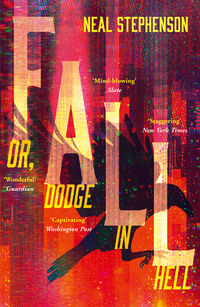
Читать книгу: «Fall or, Dodge in Hell»


Copyright
The Borough Press
An imprint of HarperCollinsPublishers Ltd
1 London Bridge Street
London SE1 9GF
www.harpercollins.co.uk
First published in Great Britain by HarperCollinsPublishers 2019
Copyright © Neal Stephenson 2019
Neal Stephenson asserts the moral right to be identified as the author of this work
Designed by Fritz Metsch
A catalogue record for this book is available from the British Library
This novel is entirely a work of fiction. The names, characters and incidents portrayed in it are the work of the author’s imagination. Any resemblance to actual persons, living or dead, events or localities is entirely coincidental.
All rights reserved under International and Pan-American Copyright Conventions. By payment of the required fees, you have been granted the non-exclusive, non-transferable right to access and read the text of this e-book on screen. No part of this text may be reproduced, transmitted, down-loaded, decompiled, reverse engineered, or stored in or introduced into any information storage and retrieval system, in any form or by any means, whether electronic or mechanical, now known or hereinafter invented, without the express written permission of HarperCollins.
Source ISBN: 9780008168858
Ebook Edition © June 2019 ISBN: 9780008168841
Version: 2019-11-15
Praise for Fall or, Dodge in Hell:
‘It keeps you reading, it makes you think, and, by the end, it generates that sense of wonder that is the very lifeblood of science fiction’
Guardian
‘A staggering feat of imagination, intelligence and stamina … The result is a story that touches on society, technology, spirituality and even eschatology, a far-reaching attempt at a grand myth that is breathtaking in scope and ambition … a one-of-a-kind synthesis of daring and originality, unafraid to venture into wild and unmapped conceptual territory’
New York Times
‘One of the great novels of our time’
Wall Street Journal
‘Captivating … The passages set in the real world display all of Stephenson’s usual witty brilliance when it comes to technology and culture’
Washington Post
‘[Stephenson is a] speculative-fiction virtuoso … There are enough futuristic, envelope-pushing ideas here, especially related to AI and digital consciousness, to keep even nonfans and science buffs intrigued. Best-selling Stephenson is cutting-edge and his followers and all readers intrigued by shrewd speculative fiction will queue up’
Booklist Starred Review
‘Elegantly written’
SFX
‘There’s no part of this book that doesn’t chug and hum with that big-brain energy of near-future extrapolation that Stephenson’s fans love him for … Stephenson’s greatest strength as a writer has always been that he sees just a little bit further and a little bit clearer than the rest of us do’
NPR
‘An audacious epic’
Kirkus, Starred Review
‘A feat of mind-blowing adventure powered by deep existential questions’
Slate
‘Stephenson is the master of long-scale science fiction … I found myself glued to it all … And weeks after I finished reading, the ideas are burning in my brain. Some chapters have ideas that could seed full novels of their own’
CNET Book Club
‘Gripping … a fantasy-science-fiction adventure story that is closer to reality than you might think’
The Week
‘Stephenson is not merely a fantasist of the future; he is a prophet of our present, a virtual architect of the ideas that define our world … a science fiction writer who is not only determined to entertain, but to make the world a better place – even if it means inventing that future himself’
Reason
Dedication
To O. L.
Contents
Cover
Title Page
Copyright
Praise for Fall or, Dodge in Hell
Dedication
Book 1
Part 1
Chapter 1
Chapter 2
Chapter 3
Chapter 4
Chapter 5
Chapter 6
Chapter 7
Chapter 8
Part 2
Chapter 9
Chapter 10
Chapter 11
Part 3
Chapter 12
Chapter 13
Chapter 14
Chapter 15
Chapter 16
Part 4
Chapter 17
Chapter 18
Chapter 19
Chapter 20
Chapter 21
Chapter 22
Chapter 23
Chapter 24
Part 5
Chapter 25
Chapter 26
Chapter 27
Chapter 28
Chapter 29
Chapter 30
Chapter 31
Chapter 32
Part 6
Chapter 33
Chapter 34
Chapter 35
Chapter 36
Chapter 37
Chapter 38
Chapter 39
Chapter 40
Chapter 41
Part 7
Chapter 42
Book 2
Part 8
Chapter 43
Chapter 44
Part 9
Chapter 45
Chapter 46
Chapter 47
Part 10
Chapter 48
Chapter 49
Part 11
Chapter 50
Chapter 51
Chapter 52
Chapter 53
Chapter 54
Chapter 55
Chapter 56
Acknowledgments
About the Author
Also by Neal Stephenson
About the Publisher


1
Dodge became conscious. His phone was burbling on the bedside table. Without opening his eyes he found it with his hand, jerked it free of its charging cord, and drew it into bed with him. He tapped it once to invoke its snooze feature. It became silent. He rolled onto his side and slid the phone under his pillow so that, when the alarm resumed in nine minutes, he would be able to put it back into snooze mode with less trouble. It was a small miracle that his brain contained a sufficient 3-D model of his bed and its surroundings that he was able to do what he had just done without opening his eyes. But there was no reason to press his luck.
He felt no particular desire to go back to sleep, for he had been enduring a curiously boring dream whose central plot seemed to be the difficulty of finding coffee. In this dream, he was in the small town in Iowa where he had grown up. Its landscape and its cast of characters were commingled with places he had been and people he had encountered during the decades since he had left it in the rearview mirror of his pickup truck. But the grid street pattern of that town, covering just a few square blocks, and easily mastered by a boy on a bicycle, was, decades later, the spatial lattice on which virtually all of his dreams were constructed. It was the graph paper on which his mind seemed to need to plot things.
In the dream, he had set out to get some coffee, only to find himself thwarted at every turn by any number of incredibly prosaic obstacles. In the story-world of the dream, this was bizarrely frustrating; it was simply unreal how so many contingencies could get in the way of this simple task.
But from the point of view of the awake, or at least snoozing, Dodge, it all had a clear explanation: it was, in fact, very difficult to obtain coffee while lying in bed with one’s eyes closed.
During the next hour, he hit “snooze” several more times. In between, he slept. But it was a twilight sleep, semiconscious and mindful for a few minutes at a time, until his thoughts would lose coherence and stray into blurry wisps that were to real dreams as cobwebs are to spiderwebs.
He wondered whether the designers of the phone had performed clinical studies on snoozers in order to decide on the nine-minute interval. Why not eight minutes, or ten? The makers of the phone were famously particular about design. This had to have been data-driven. It was no coincidence that Dodge was being afforded just enough time to lose the thread of consciousness before the alarm went off again. If the interval had been much shorter, he would not have had time to drift off and so this feature could not have truly been called a snooze alarm. Much longer, and the snooze would have deepened into true sleep. He was able to maintain a rough count: I have hit the snooze button three times. Five times. Enough times that I have overslept by about an hour.
But no sense of guilt or urgency attended these makeshift calculations. He knew it didn’t really matter, because during the interval of consciousness that had followed the third tap of the snooze button he had remembered that he was not expected in the office today. For he was scheduled to undergo a routine outpatient medical procedure at eleven in the morning, which was still hours away.
Other than the desire for coffee, the only thing that was making him feel any pressure to get out of bed was, curiously, a mild awareness that all of this extra sleeping was going to make it harder for him to have his afternoon nap. This happened every day at two or two thirty. He had been doing it religiously for about a decade. When he had taken up the practice, he had wondered if it was age related, since the oldsters in his family were known for nodding off in church pews, on porch swings, or even behind the wheel. But he could remember being eighteen years old, driving all over the western United States and Canada in various beat-up vehicles, and being overtaken every afternoon by a need for sleep so intense it was almost painful. He’d always tried to fight it off, or else simply avoided driving at that time of day. The only things that had really changed since then were that he was richer, so he could have a private office with a yoga mat and a pillow in the corner, and he was wiser, so he knew better than to fight the mid-afternoon lull. By closing the door, silencing his electronics, unrolling the mat, lying down, and letting sleep take him for twenty minutes, he was able to refresh himself to a degree that would then keep him working alertly for several hours more.
The amount of time spent asleep didn’t really matter. He had decided that the key to it all—the one thing that determined whether the nap would actually refresh him—was the breaking of the thread of consciousness: that moment when he ceased to think in a coherent, sequential, self-aware way and went adrift. Often, this was connected with a jolt of an arm or a leg as he stepped over the threshold from conscious thinking into a dream where he was obliged to reach out and catch a ball or open a door or something. If the jolt didn’t wake him up, then it meant he had snipped the thread of consciousness and that the nap had thereby achieved its only real purpose. Even if he woke up ten seconds later, he would be as refreshed—possibly more so—as if he’d slumbered deeply for an hour.
He had studied the jolt. On those increasingly rare occasions when he slept with a woman, he would sometimes will himself to stay awake as she fell into slumber, listening to her breathing and feeling her body go soft against his until, just at the moment when she drifted away, she would convulsively move a limb.
His business activities (he was the founder and chairman of a large video game company) sometimes involved flying in a private jet to the Isle of Man, eight time zones away, where a longtime business associate—an independently wealthy writer—dwelled in a renovated castle. The writer would put him up in a bedchamber in one of the towers: a round room decorated with medieval bric-a-brac and warmed by burning wood in a fireplace built into the wall. The bed was a four-poster with a heavy canopy. A couple of years ago, after climbing into that bed and lying there sleepless for a while, Richard—for that was Dodge’s real name—had finally drifted off and fallen into a nightmare involving a very dangerous and unpleasant character he had tangled with some years earlier. He had awakened to the hallucinatory awareness that this man was standing next to his bed looking down at him. Which was impossible, since the man was dead—but Richard had been in a half-dreaming state where logic did not hold sway, and all he knew was what he saw. He tried to sit up. Nothing happened. He tried to raise his arms. They did not move even the tiniest amount. He tried to draw breath and scream, but his body did not respond to the command from his brain. He was perfectly helpless, lacking even a bound captive’s power to struggle against his bonds. All he could do was experience the terror of it, and the horror of his complete lack of agency, until somehow he drowsed off again.
Moments later, he had awoken with a start, and sat up convulsively. His body worked again. He threw off the heavy duvet and swung his feet off the bed, turning to face the dying fire a few feet away. No one else was in the chamber. The massive fortress-style door was still bolted. The nightmare impression, which had been so convincing a minute ago, now seemed ridiculous. Lying back down experimentally, he looked up and saw that the lamp on his bedside table was casting a firelight shadow onto the canopy above him, and that the shadow moved about as the fire flickered and the logs settled. He must have half-opened his eyes while sleeping and interpreted this as the shadow of a man.
So the nightmare had an explanation. Still mysterious, though, was the absolute paralysis that had trapped him in that bad dream. Later, Richard had learned that this was a well-recognized and scientifically verified phenomenon known as sleep paralysis. Primitive cultures identified it as some form of enchantment, or made up stories about eldritch night-stalking creatures that would sit on your chest and pin you to your bed and suck the air from your lungs and the screams from your throat.
But there was a perfectly reasonable explanation for it. When you were awake, your brain could of course control your body. When you slept, however, you tended to dream. And in your dreams you could run, fight, and talk. But if the body continued to answer commands from the brain, you’d be thrashing all over the bed, vocalizing, and so on. So a mechanism had evolved whereby, at the moment that the thread of consciousness was severed, the link between brain and body was cut, like throwing a switch. And at the moment you woke up, the switch was thrown back to the “on” position and you went back to moving around as you always did. Normally the system worked with an amazing degree of perfection, so most people lived their whole lives not even knowing that it existed. But every system had glitches. The jolt you sometimes made while drifting off to sleep was one such—it happened when the switch was a fraction of a second late going off. Another, much more impressive and terrifying sort of glitch happened every so often, especially to people who—as in Richard’s case on the Isle of Man—were sleeping off of their accustomed schedule. You would wake up, but the switch would not be thrown to “on” and so you would remain as perfectly paralyzed as you had been a moment ago while sound asleep. Just like a person who, while seeming to slumber and breathe peacefully, is in fact having a terrible nightmare, you would lie there with eyes open in perfect, inescapable repose, unable to do anything about the imaginary monster on your chest, the intruder next to your bed, the fire consuming your house.
In any case, the only lasting consequences for Dodge had been more desultory browsing about how sleep worked and further introspection about his own napping practices. This was how he had developed his theory—which was unsupported by any scientific evidence whatsoever—that the one and only key to a successful nap was to break the thread of consciousness just long enough for the switch to be thrown to “off.” When it got thrown to “on” again, even if it was only a few minutes later, the brain–body system rebooted itself, like a fucked-up computer that just needs to be unplugged from the wall for ten seconds and restarted in order to come back to life in clean working order.
This notion around thread cutting was what finally brought him awake, since a connection had somehow been made in his mind, and now it was going to keep him awake. He had reached the point in his life where very few things could really compel him to get out of bed, but one of the calls to which he would readily answer was that of his own stray musings and thoughts, his mind’s desire to make connections.
It did not, however, actually get him out of bed. Ringing in the ears did that. His tinnitus was especially annoying today—the world’s way of telling him he needed to get up and make a little noise. He’d long suffered from a mild case, the result of too many guns fired and nails pounded in his youth, too many nights in British Columbia biker bars. Then, a few years ago, he had been exposed to a lot of close-up gunfire without appropriate hearing precautions. Without precautions of any kind whatsoever, for that matter. Ever since, he had rarely been without some amount of ringing in the ears—sometimes a high-pitched tone, sometimes a hiss. The cause of the condition was somewhat mysterious. It seemed to be some sort of well-meaning attempt by the brain to make sense of a loss of valid signals from ears that were no longer in perfect working order. Tending to confirm this idea was that it was at its worst when things were quiet; the environment wasn’t giving his auditory system any good data to lock on to. The solution was to get up and make noise. Not necessarily a lot. Just the normal sounds of footsteps and faucet running that reassured his brain that there was a coherent world out there and gave it a few simple clues as to what was actually what.
He got up, pulled on pajama bottoms, urinated, took the pills he was supposed to take before breakfast, and went out to the so-called great room of his penthouse, which was on the top of a thirty-two-story building in downtown Seattle. It was a very expensive piece of real estate that, in the manner typical of Northwest tech industrialists, was built out and decorated in a manner so simple, bare-bones, and informal as to be actually kind of ostentatious. Glass doors made up much of its western exterior wall, and he had left these open all night, doubling the size of the living area by joining it to the terrace. The terrace had a glass roof with infrared heaters like the ones suspended above the cash registers at Home Depot to keep the Somalian and Filipino checkout clerks from succumbing to hypothermia. These made it comfortable even when it was fifty degrees Fahrenheit and raining, which was about half of the year. In late summer and (as now) early autumn, the heaters weren’t needed, and so the terrace just served as an extension of the great room, which flowed into it without interruption. It faced toward Elliott Bay and the Olympic Mountains beyond.
Anomalous splashes of pink and purple flared against the wood, leather, and stone. Richard had a grandniece, Sophia, who for all intents and purposes was his granddaughter, and she came over frequently. Last weekend, her parents—Richard’s niece Zula and her husband, Csongor—had left her with him for two nights so that they could enjoy a little getaway in Port Townsend, on the other side of Puget Sound. Richard’s terrace had a direct view down onto the ferry terminal. He had a huge pair of Soviet military surplus binoculars mounted on a tripod at the railing. As their ferry had churned away from the terminal, Richard had perched Sophia on a stool and helped her get the lenses aimed down at the ferry, where Zula and Csongor, after parking their car belowdecks, had ascended to the topmost deck and stationed themselves at the stern to wave up at her. The whole affair had been coordinated via text message and had come off with the precision of a drone strike, all to the delight of little Sophia. Richard had been unaccountably depressed by it, or perhaps “ruminatively melancholy” was a better way of putting it.
Forty-eight hours of intensive grandniece/great-uncle bonding had ensued. In that short time Sophia’s apparatus of modern kiddom had permeated Richard’s apartment. Even if she never again set foot in this place, he would be finding Cheerios, glitter, sticky handprints, and barrettes for the next twenty years.
Sunday evening they had done the thing with the binoculars again as the parents had steamed back into port. Zula had explained what a good thing it was psychologically for a kid Sophia’s age to see the parents go away, but then to see them come back again. During the stress of executing their withdrawal, they had left behind a Whole Foods grocery sack containing several of Sophia’s books. Richard had placed it by the door so that it would be more difficult to overlook next time. But while his coffee machine was processing he retrieved it. He took it and his coffee to the low table on the terrace and pulled out two large-format picture books, which he had bought for Sophia on Saturday. Both of them featured the same style of colorful faux-naive artwork, for they were both by the same coauthors, Ingri and Edgar Parin d’Aulaire. One was entitled D’Aulaires’ Book of Greek Myths and the other D’Aulaires’ Book of Norse Myths. Richard had picked them up on impulse while he and Sophia had been hanging out in a bookstore. The cover art on Greek, perceived dimly in his peripheral vision, had jumped down his optic nerve to his brain and caused his body to freeze up almost as when he’d experienced sleep paralysis on the Isle of Man. Or, considering the context, as if he had beheld a Gorgon (and come to think of it, might it not be the case that ancient myths concerning Gorgons and basilisks were pre-scientific explanations of the phenomenon of sleep paralysis?).
The d’Aulaire books had been new when Richard had been young. He had worn out his boyhood copy, paging through it again and again, memorizing the lineages of the Titans, the gods, and whatnot, but mostly just staring at the pictures, letting them invade and shape his brain. In their general style they had a lot in common with little-kid art, which was probably what made them glom on to kid neurons like herpes. And like herpes, those pictures had remained silent and dormant in his central nervous system until adulthood. This had been triggered and made virulent by his having spied them in an unguarded moment. In the bookstore last weekend, he had approached the display like an ancient Hellene ascending the steps to the Temple of Zeus, and beheld the book, just like he remembered it, but brand new and unworn, with a new preface written by a famous modern novelist who had apparently had what Richard had had in the way of an infatuation with these books. Sophia, dragged along the whole way as she had been hugging his thigh and using his trouser leg as a handkerchief, had sensed something of the numinous in her uncle’s reaction; she had looked up and been infected. Richard had bought Greek and its companion volume Norse and taken Sophia back to the penthouse for a day’s total immersion, then handed her back to her parents an obsessed changeling, jabbering about Hydra remediation tactics and the house-sized mittens of Utgardsloki, reprimanding her elders for mixing up the Greek and Roman names of the gods. Great had been the wrath of Sophia when it had been discovered that the books had been left behind in the Whole Foods sack. Wide-famed would be Uncle Richard’s deed this afternoon when, following his outpatient procedure, he would swing by the young family’s condo with a d’Aulaire under each arm.
In the meantime, he needed to settle one small point of mythological confusion, lest Sophia find out that he was not perfectly clear on the matter, and take him to task. It had to do with Fates and Norns.
One of Richard’s first acts upon picking up Greek in the bookstore had been to thumb to its index and look up “Furies.” He had done so in a furtive, somewhat guilty frame of mind. A peculiarity of Richard’s was that he lacked a conscience or superego in the normal senses of those terms. His was a soul lacking any built-in adult supervision. In the course of his life, however, he’d had ten or so girlfriends of consequence. All of those relationships had gradually gone sour as those girlfriends had got to know him more thoroughly and drawn up manifests of all that was wanting in Richard. Some of them had kept their opinions to themselves until a relationship-ending moment of cathartic outpouring. Others had registered frank objections in real time. But Richard remembered every word of it, decades after they had presumably forgotten about him. And more than that, his brain had somehow contrived fully autonomous simulacra of these ex-girlfriends, which lived on between his ears immortally, speaking to him at the strangest times, actually changing the way he thought and behaved; before firing an employee or overlooking someone’s birthday he would pause to consider the consequences that would follow as one or more of the Furious Muses—as he called them—would coalesce from his brain vapors long enough to deliver a few choice remarks that would make him feel bad. This conflation of Furies and Muses was, of course, an invention of his own, and the sort of deviation from mythological purity for which Sophia (already turning into a sort of junior-league Furious Muse) would call him to account. He’d been carrying the idea around in his head for so long that the line between those two categories of subgoddesses had become blurry, and so he thought it would be illuminating, now that he had the ur-book in hand, to look them up.
The F section of the index was very short, having only two entries: “Fates” and “Furies.” The latter being a mere cross-ref to the more correct “Erinyes.” The former were glossed as “three old goddesses who determined the life span of man.” Richard had merely scanned those words, since he was really interested in the Furies. Cross-reffing to “Erinyes” (“avenging spirits”), he turned to page 60, their first appearance in the book, and read of souls crossing the Styx (in a ferry no less) and drinking from the spring of Lethe under “dark poplars,” causing them to forget who they were and what they had done during their mortal lives. Fine. But then it said “great sinners” were sentenced to suffer forever under the whips of the Furies. So, that part of it matched up pretty well with Richard’s Furious Muses concept. It was troubling, however, to think that you could be whipped forever in punishment for sins that you had forgotten under the dark poplars. The sinners in the Christian version of hell could at least remember why they were burning in eternal fire, but these poor dumb Greeks could only suffer without knowing why; without, for that matter, even remembering what it was like to be alive and to not suffer. It wasn’t even really clear to Richard that a post-Lethe soul could even be considered the same being, for weren’t your memories a part of you?
And yet it all rang true on some level. He did feel sometimes that he was continuing to suffer guilt pangs for acts he had long ago forgotten—deeds done when he wasn’t the same person. And who hasn’t known a sad sack, a hard-luck case who seems to be undergoing eternal punishment for no particular reason?
The next Erinyes reference happened to occur just before a two-page spread featuring the more cheerful topic of the Muses, which was good stuff, way more Sophia-appropriate, as well as reminding Richard that his own Furious Muses were at least as creative as retributive, for some of his best work had emerged from imaginary dialogues with those estimable ladies. So “Furies” had been the text he was after, and “Fates” an accidental subtext—but this morning something about it was nagging at him.
It had to do with the threads. Lying in bed a minute ago he’d been thinking about the thread of consciousness, and how severing it—breaking the brain–body link—was the key to a proper nap. And he knew that somewhere in d’Aulaire was a picture of the Fates spinning, measuring, and cutting thread. He looked all through Greek as he drank his coffee, and found it not.
The coffee was unutterably fantastic. The machine cost more than Richard’s first car and there was nothing known to coffee technology that was not embodied in its hardware and its algorithms. The beans had come from an artisanal roaster a hundred yards away—a nimble coffee startup founded by java wizards who had been brought here to work for Starbucks and spun out the moment their stock options had vested. The taste of the coffee was not wonderful, however, merely because the machine and the roasters had done such good jobs, but in the categorical sense that Dodge was awake, he was alive, he was actually physically tasting this stuff with his body in a way that sleeping-Dodge-in-a-dream could never have done. In that sense awake Dodge was as superior to sleeping Dodge as a living person was to a ghost. Dreaming-of-coffee Dodge was to drinking-coffee Dodge as one of the shades in Hades—likened, in d’Aulaire, to dry leaves whirling about in a cold autumn wind—was to a living, flesh-and-blood person.
He exhausted the first cup while looking for the thread-cutting picture. He did find a textual description of the spinning, measuring, and cutting operations being carried out by Clotho, Lachesis, and Atropos, respectively, but not the illustration that he clearly remembered showing to Sophia just a couple of days ago.
On his second cup of coffee he had the idea of checking Norse. And there it was: a full-color half-pager of three blondes—here, they were called Norns—spinning the threads of life at the base of the world tree. Urd, Verdande, and Skuld. Names and hair color aside, they seemed to be a direct drop-in replacement for their Greek equivalents.
Now, Richard had run off to Canada before obtaining a higher education and had not set foot in a classroom since, but he had done enough reading to understand that mythology piled up in sedimentary layers. This had to be one of those cases where there had been some early culture predating the Greeks and the Norse alike that had featured the Norns/Fates and laid it down in a base layer on which their various descendants had then added more stuff. Consequently, they always read like an add-on to the more fleshed-out mythology. Or perhaps vice versa. They were too simple to mess with. Richard, who had grown wealthy in the tech industry, saw in the Norns or Fates or whatever you called them a basic feature of the operating system. Zeus had no power over them. They knew the past and the future. They only got invoked in these stories when something had gone drastically wrong on a metaphysical/cosmological level, or else to cover plot holes. In the Greek version, Clotho was the spinner—the creator of these threads. Lachesis was the measurer. So that would be your snooze button right there—she had her nine-minute tape measure out the whole time Dodge was lying in bed. And Atropos was the cutter. The Greek version of the Grim Reaper. Though, according to the theory that Dodge was developing, the loss of consciousness when you fell asleep was basically the same as dying except that you could wake up from it.
He did not eat breakfast because the medical assistant who had scheduled him for the procedure had said something about the desirability of showing up with an empty stomach. Instead he went and took a shower. When he emerged from the shower, he was fascinated to find the bathroom illuminated by a strange light, chilly and mottled, not artificial but not the light of the sun either. The effect was surreal, like entering a dream sequence in a movie made by a director who hasn’t the wherewithal to produce anything truly dreamlike and so is faking it with simple lighting effects. The weird light was flooding in through a window that was aimed north. Was someone welding outside? Finally he worked out that the sun, rising over the Cascades in the east, was hitting him with a bank shot off the half-silvered windows of an office tower a few blocks away. Dodge had been living here for five years but was still occasionally surprised by the way sunlight would carom in from surrounding architecture. He supposed that an astronomer could have a field day calculating the angles: how they varied from hour to hour and season to season.
Because of the weird light, his reflection in the mirror took on a strange new aspect. He turned his head this way and that, checking for new moles. Richard, who was ruddy and freckle prone, had for decades been psyching himself up for a climactic battle with melanoma, which, according to dark prophecies uttered by multiple dermatologists, loomed as a near certainty in his future. Early on he had performed his monthly skin checks with anxiety bordering on clinical paranoia. But then years had flown by with no action. He was now actually beginning to feel somewhat crestfallen that this terrible foe, against whom he had so girded himself, looked to be passing him over.
Presently he fell to shaving, for he had noticed a few days’ reddish growth. Medical personnel would soon be handling his body while he was unconscious. They would be able to stare at him all they wanted, to notice all the ways he wasn’t looking after himself. He was semifamous and ought to be mindful of such things. Maybe it would affect his company’s stock price or something.
He had assumed that the strange light would be a short-lived phenomenon, so was pleasantly surprised that it was getting stronger by the minute. The weird pallor was ripening into something warmer, like fire. A shaft of it was coming in through the window and illuminating the little sink and its backsplash. Richard had shaved, as was his habit, using a bar of soap—a specific type that he bought from a company in southern France. It had a pleasant fragrance, not perfumey and not too persistent. He had just put the soap back in its dish a moment ago and so it had bubbles on it. In a few minutes these would dry out and pop, but just now they were capturing the light being bounced off the windows of the office tower after its passage through ninety-three million miles of space from the vast thermonuclear inferno at the center of the solar system. Each bubble was producing an intensely brilliant spark of light, not white, but iridescent, as some kind of prismlike phenomenon inside the soap film (he was a little weak on the details) fractured the light into pure brilliant colors. A beautiful but perfectly commonplace phenomenon that would not have given him much food for thought were it not for the fact that his video game company had put a lot of money and engineer-years into the problem of trying to more perfectly depict an imaginary world using computer code, and this was exactly one of those things that was most difficult to capture. Oh, there were various ways of faking it; e.g., by applying special computational shaders to bars of soap during the sixty seconds after they had been used and were therefore covered with lather. But they were all just hacks. Actually simulating the physics of soap, bubbles, air, water, etc., was ludicrously expensive and would never be achieved in his lifetime.
It was hard even if you simplified matters by treating each bubble not as a small miracle of fluid dynamics, but as a simple reflecting sphere. At one point, some years previously, one of the engineers at Corporation 9592—a classic liberal-arts-major-turned-coder-so-he-could-make-a-decent-living—had identified this as the Hand met Spiegelende Bol Problem, and had discomfited many of the more hard-core engineers, during a meeting, by flashing up a graphic of the Escher lithograph of the same name. It was a self-portrait depicting the artist reflected in a mirrored sphere supported in his left hand. Escher’s face was in the middle, but a geometrically distorted rendering of his office could be seen around it. In the background of that was a window. This, of course, was gathering in light from at least ninety-three million miles away. The point being that in order to make a faithful 3-D computer graphics rendering of an object as simple as a shiny ball, you would, in theory, have to take into account every object in the universe. The engineer—a new hire named Corvallis Kawasaki—had footnoted his own remarks by mentioning that the mirrored-ball problem reached at least as far back as the German genius and polymath G. W. Leibniz, who had written of it as a way of thinking about monads. At this point in the meeting, the more well-established engineers had shouted him down and Dodge had made a mental note to yank the boy out of whatever branch of the org chart he’d landed in and employ him in Weird Stuff, which was Dodge’s personal department. In any case, the point, in this instance, was that every single bubble on the surface of the bar of soap was at least as complicated as Escher’s ball. Rendering such a scene realistically was completely out of the question. Far from being a source of frustration, this comforted him, and made him happy—perhaps even a little smug—that he lived in a universe whose complexity defied algorithmic simulation.
He closed his eyes while splashing water on his face and then looked back up at the mirror. Now there was a little spot in the middle where he had been dazzled by the brilliant sparks of light from the bubbles. Soon enough the dazzled patch would shrink and be replaced by a correct view of what was really there.
Except that it did not in this case. When Richard closed his eyes again to towel his face, he could still see a little patch of nothing in his visual field. This was a different sort of nothing from the field of red-tinged black that his eyes were seeing simply by virtue of the fact that his lids had closed over them. He knew what this was. The flash of reflected sun, a minute ago, had triggered a thing in his brain called an optical migraine. It was painless and harmless. He got them a few times a year. It was a visual display—“Aura”—caused by a temporary disruption of blood flow to the visual cortex. It always started thus, with a tiny dazzled region that refused to go away. Over the next half hour it would get bigger, making it impossible for him to read. Then it would gradually migrate rightward and mess with his peripheral vision on that side for a little while before disappearing without a trace.
The affected region—the spot where he was absolutely blind—was not black, as you might imagine. This could be proved simply by closing his eyes so that he actually was seeing just black. The blind spot then showed up as a region of vaguely defined yellow and black stripes, like the patterns painted on factory floors to limn danger zones, except that these flashed and fluctuated like an old-time television with its vertical hold out of whack.
Even as he drew these connections he was erecting defenses against a likely flanking attack from Polycultia, one of the Furious Muses, who was always pointing out that everything Richard could possibly think of was culturally relative. In this instance she might expect tactical support from Cerebra, an unintentionally offensive FM who had a knack for pointing out that any idea Richard came up with that he thought was clever was, in fact, but an imperfect rendering of a smarter idea that had occurred to her a long time ago. The projected line of attack from the Polycultia–Cerebra axis went something like this: Okay, because part of Richard’s visual cortex was on the blink, he was seeing “nothing” in that region. His brain was in the business of constructing, from moment to moment, the sort of three-dimensional model of the universe that, for example, enabled him to grab his phone from his bedside table without opening his eyes. As such, it couldn’t tolerate seeing a patch of “nothing” in the middle of an otherwise coherent reality. So it tried to fill in the nothing with something. It was simply the visual equivalent of tinnitus.
But why this particular something? He construed it as black and yellow danger stripes, on-the-fritz TV sets, etc., but that was only because he was a white guy of a certain age from Iowa. A Maori midwife or a gay Roman centurion or an eleventh-century Shinto Buddhist, in the grip of the same underlying neurological phenomenon, would fill in the “nothing” with some other kind of hobgoblin derived from their own set of cultural referents—e.g., the wall of cold magical flames surrounding Gymir’s realm in Jotunheim (according to Norse).
Being temporarily blind gave him an excuse to not expose himself to the Din. In an earlier decade he’d have said “not check his email,” but of course email was actually the least intrusive of all the ways the Miasma—as Richard referred to the Internet—had devised to bay for your attention. Richard lumped all of them together under the general heading of the Din. He deemed it unlikely that there would be much that was important in this morning’s Din, since he had caused his administrative assistant to weave a system of spells and wards: robotic “out of office” messages and whatnot.
He had, in consequence, time to kill before his appointment. He put the d’Aulaires back into their sack. As best as he could while half-blind, he made a sweep through the joint looking for any more of Sophia’s stuff. Then he took the elevator down to the lobby of the building. There was a café and bakery between it and the sidewalk. He had it in mind to buy a copy of the New York Times and, once his vision had cleared, to do the crossword puzzle. Not that he was even really all that fond of crossword puzzles as such, but the mere fact of having time to spend on it was an indicator of being a free man, in a certain sense.
Vo, the proprietor of the bakery, came out to greet him by name. He was a Vietnamese man in his sixties or seventies who, Dodge inferred, had acquired world-class baking skills as some consequence of the French colonial presence in his home country. This operation was serious business: not just a toaster oven under a counter but a whole complex of expansive kneading boards and marble slabs, Evinrude-sized stand mixers, and walk-in ovens reaching deep into the building. Senior Asians and hairnetted hipsters could be viewed rolling out pastry dough and hand-shaping croissants. Vo would not deem the business to have succeeded until he had everyone in a half-kilometer radius walking home every evening with a baguette under his or her arm.
The front of the house sported half a dozen small tables and, where it fronted on the sidewalk, a window counter. A secondary entrance connected to the building’s lobby. Richard came in that way and picked up another cup of coffee and a New York Times. Vo wanted him to understand that he had yesterday acquired a bushel of ripe Yakima Valley apples from a personal connection at the Pike Place Market—just enough to make a few tartes tatin, which he was keeping in reserve for special customers. Not that it was much of a secret, since the apple-y aroma had permeated the whole ground floor. He was wont to back up his verbal communications with physical demonstrations, perhaps a habit acquired during the decades when he had been learning English the hard way. Gently cupping one of Richard’s elbows in the palm of his hand, he led him around behind the counter to display a cardboard box stashed there, half-full of apples. He bent down and pawed through them until he had found a worthy specimen, then pulled it out and held it up in front of Richard’s face, perching it atop his fingertips in a pose that strongly called to mind Escher’s Hand met Spiegelende Bol, save that in this case, of course, it was an apple. It was an apple from which earlier generations of American grocery shoppers would have recoiled in dismay, had they seen it in the produce section at their local Safeway. It was half the size of the brawny, cottony Red Delicious apples usually seen in such places, its color ranged from an almost purple shade of red to an almost yellow shade of green, it had a few minor spots and dimples, and a couple of actual leaves were still attached to its stem. But it was so round and taut that it looked ready to explode. Vo kept thrusting it higher and higher into the air, looking back and forth between it and Richard.
“Now, that is a real apple!” Richard finally said. It was not a particularly clever thing to say but he knew it was the only thing that would calm Vo down. Vo rewarded him by insisting that he take the apple “for lunch.” Richard received it with due ceremony, like a Japanese businessman accepting a business card, running his fingers over its curves and turning it this way and that to admire its color, then placed it carefully into the bag slung over his shoulder. He soon found himself at his customary table with his coffee, his crossword puzzle, and his slice of tarte.
He was at least two-thirds finished with it when he remembered with a start that he was under doctor’s orders not to eat any food before the medical procedure. He had obeyed earlier but forgot himself when confronted with the opportunity of tarte tatin fresh from the oven.
He looked at the remaining part—the best part, since it comprised the edge crust, and he had been raised to save the best for last—with a mixture of guilt and embarrassment. In the end he decided to eat it. He doubted that having food in the stomach was really a significant danger. It was just one of those general recommendations, like turning off your cell phone while pumping gas, that had been promoted to a hysterical warning by lawyers. And to the extent it might actually be dangerous, the die was already cast. Having three-thirds of a slice in his stomach couldn’t be much worse than having two-thirds. And if he left the remainder on his plate, Vo would notice it and take it the wrong way and perhaps demote him from special-customer status.
More important than the possible medical complication was the question, which came quickly to mind, of whether this lapse was an early indicator of senility. The speed with which he had demolished the crossword puzzle seemed to argue against it. But that was all long-term memory, right? He wasn’t sure. As a boy he had been oblivious to the existence of this thing called senility until an older cousin had clued him in to it during a family reunion and supplied a brief (and in retrospect hilariously imprecise) rundown of its symptoms while casting significant glances at Grandma. After that, young Richard had overcompensated for his earlier naivete by becoming hypervigilant to its onset in family members of even modest decrepitude.
2
The doctor’s staff had been very firm on the point that, following the procedure, he would be unfit to drive because of the powerful drugs they were going to give him—that he would, for all practical purposes, be an ambulatory basket case, and that they wouldn’t even begin the procedure unless he had a designated minder who would sign him out afterward and take responsibility for keeping him away from heavy machinery. Accordingly, Richard now walked two blocks to a transit stop, boarded a city bus that would take him to the medical complex on the hill above downtown, and made himself comfortable in a seat amidships.
He woke up his phone. Its home screen was chicken-poxed with little red dots with accusatory numbers in them, the consequences of having turned a deaf ear to the Din for twelve whole hours. He willed himself not to see those and instead brought up his address book. He scrolled to the K section and found five different entries for Corvallis Kawasaki. Some of them had little pictures attached to them, which helped Richard guess how out-of-date they were. Most had accumulated during the years that Corvallis had worked hand-in-glove with Richard at Corporation 9592, the game company that had made Richard a billionaire and Corvallis, in the lexicon of the tech business world, a decimillionaire. The pictures on those tended to show him hoisting pints in bars or in various funny/celebratory poses connected with the company’s rise to prominence in the online gaming industry. One of them, however, was a very straight, formal head shot of Corvallis with his hair neatly trimmed and gelled, wearing a suit and tie. This card—which was only a few months old—identified him as the CTO of Nubilant Industries, a company that did cloud computing. It had been formed last year as part of a “roll-up,” which was tech biz parlance for acquiring and combining several companies that were all operating in the same “space.” Corvallis had been induced, by means of a hefty stock option grant, to leave his position at Corporation 9592 and join the new company. Richard had been sorry to see him go, but he had to admit that it was an excellent fit—Corvallis had overseen the shift of all Corporation 9592’s operations from old-fashioned server racks to the cloud, and he hadn’t been as lavishly compensated as others who had been luckier in their timing. Since Corvallis’s departure to Nubilant—which was headquartered near downtown Seattle—he and Richard had exchanged texts on several occasions, trying to find time to meet up for a drink. So far, it had not come together. But when Dodge pulled up his Corvallis text message stream, he found, at its tail, a flurry of messages from over the preceding weekend, in which Corvallis agreed to take the afternoon off and serve as Richard’s designated minder, collecting him from the clinic in his narcotic haze and taking him to lunch or something as he returned to his senses.
omw to clinic, Richard thumbed. Then he fetched a substantial pair of headphones from his bag and placed them over his ears. The sounds of the bus were muted. He plugged the cord into the phone and turned the headphones on. For these were electronic noise-canceling headphones. Directly they began to feed anti-noise into his ears, making everything quieter yet.
Corvallis texted back, K. The phone displayed the ellipsis indicating that he was still typing.
Dodge activated the music player app and began scrolling through his playlists, looking for the P section. His tinnitus was ramping up because of the unearthly quiet produced by the noise-canceling feature.
Corvallis added, if u r feeling up to it I will take you by the office—would like to show you what we are up to—cool stuff!
Richard decided not to respond to that one. As much as he liked Corvallis, he dreaded going on tours of high-tech companies. He tapped the words “Pompitus Bombasticus.” The lavish tonalities of a full symphony orchestra, backed up by a choir and fortified by a driving modern percussion section, filled his ears. Pompitus Bombasticus was Richard’s favorite group. Apparently it was just one guy working alone in a studio in Germany; the philharmonic, the choir, and all the rest were faked with synthesizers. This guy had noticed, some years ago, that all inexpensive horror movies used the same piece of music—Carl Orff’s Carmina Burana—in their soundtracks. That opus had become a cliché, more apt to induce groans or laughs than horror. This German, who had been living the starving-artist lifestyle while trying to establish a career as a DJ, had been struck by an insight that had transformed his career: the filmmakers of the world were manifesting an insatiable demand for a type of music of which Carmina Burana was the only existing specimen. The market (if the world of composers and musicians could be thought of as such) was failing to respond to that demand. Why not then begin to make original music that sounded like the soundtrack of the sort of movie scene in which Carmina Burana inevitably played? It didn’t have to sound exactly like Carmina Burana but it needed to evoke the same feelings. The German gave himself a new name, which was Pompitus Bombasticus, and put out a self-titled album that was enthusiastically ripped, torrented, downloaded, and stolen by innumerable aspiring young filmmakers united by a common sentiment that if they heard Carmina Burana one more time they would shove pencils into their ears. Since then, Pompitus Bombasticus had come out with five more albums, all of which Richard had legally downloaded and merged into this one long playlist. The breathtaking sweep and emotional bandwidth of the music made unloading the dishwasher seem as momentous as the final scene of 2001: A Space Odyssey. In this case, it cast a haze of fake poignancy over this text from C-plus (as Dodge called Corvallis). He did not wish to come out and say as much directly, for fear that C-plus would take it the wrong way, but, in the later phases of their professional relationship, C-plus’s role had become less all-around tech expert and more general intellectual sidekick and helpmeet. When it came to all of the stuff that Richard had omitted to learn during his extremely colorful late teens and early twenties, Corvallis Kawasaki was Virgil to his Dante, Mr. Peabody to his Sherman.
As an example, when Richard had remarked, a few years ago, on the fact that nearly all of his dreams were set in the landscape of the same small town in Iowa, C-plus had told him that this was related to a well-known insight by a German philosopher named Kant, who had posited that the mind simply was not capable of thinking about anything at all without mapping it onto space and time. The brain was just hooked up that way, nothing you could do about it. Young Richard had learned the basic properties of space-time by pedaling around a particular street grid on his bicycle, trick-or-treating on particular blocks, fleeing from big kids and vice principals through convenient backyards. It was burned into his neural “connectome” now; it was the Kantian substrate of all mental activity relating to space and movement. Perhaps worrying that Richard wasn’t following his argument, C-plus had then wrapped it all up by likening it to the hexagonal graph paper that nerds used to plot out the landscapes on which war games were prosecuted. This final detail had planted a suspicion in Richard’s mind that C-plus was just fucking with him. This had all happened, for no particular reason, minutes before a board meeting: the most important board meeting in the history of Corporation 9592, during which they announced that the company’s annual revenues now exceeded those of the Roman Empire at the height of the Augustan Age. Richard had fobbed the task off on the CFO, who would revel in that kind of thing. While the CFO was running through his PowerPoint deck, Richard had pulled out his phone and, in a merely pro forma attempt to conceal what he was doing, had, under the conference table, Googled Kant. The results looked formidably hard to read but sufficed to prove that there had actually been a guy named Kant and that he had indeed concerned himself with such topics.
The music of Pompitus Bombasticus made Richard’s fifteen-minute bus ride seem as inspiring and yet tragic as the Battle of Stalingrad. As the vehicle swung around a corner downtown, it was halted by a man holding up a stop sign as a long truck full of dirt pulled out into the street, bound for wherever excess dirt was dumped. The soundtrack in Richard’s headphones made this labored but basically simple operation seem as much a technological miracle as the departure of a massive yet graceful starship from its orbiting dry dock. It was taking Dodge a few moments to get his bearings. He realized that an older skyscraper—a building that had helped to define the city’s skyline since the 1960s—had been obliterated while Richard’s attention had been elsewhere. A rendering on a sign depicted a much taller building that was going to replace it. Fogeyish as this was, he felt somehow let down and scandalized. You take your eye off the ball for a minute and a building’s gone.
But in the very next block was a building that had been a celebrated architectural happening when it had gone up, what, five, no, ten years ago. Now it was just part of the landscape. It occurred to him to wonder whether he would still be alive when it was torn down. For that matter, he had been known to wonder whether his current car was going to be the last car he would ever buy, whether the leather jacket he was wearing now was going to outlive him. He was not being morbid. He was not depressed, not thinking about death overmuch. He just assumed that he was on a very long glide path leading to death in perhaps another thirty to fifty years and that he had plenty of leisure in the meantime to ponder it. He saw life as a trench in the First World War sense of that term, dug very deep at one end but becoming more shallow as you marched along, gradually ramping up to surface level. Early in your life you were so deep down in it that you didn’t even know that shells were bursting and bullets zipping over its top. As time went on these became noticeable but not directly relevant. At a certain point you began to see people around you getting injured or even killed by stray bits of shrapnel, but even if they were good friends of yours, you knew, in your grief and shock, that they were statistical aberrations. The more you kept marching, however, the more difficult it became to ignore the fact that you were drawing close to the surface. People in front of you died singly, then in clusters, then in swathes. Eventually, when you were something like a hundred years old, you emerged from the trench onto open ground, where your life span was measured in minutes. Richard still had decades to go before it was like that, but he’d seen a few people around him buy the farm, and looking up that trench he could see in the great distance—but still close enough to see it—the brink above which the bullets flew in blazing streams. Or maybe it was just the music in his headphones making him think thus.
They passed a good restaurant—a favorite of Richard’s when he needed to host a business lunch. A box truck pulled out of the adjoining alley and inserted itself into a gap in traffic in front of the bus. It was decorated with the logo of a company that evidently provided table linens to restaurants that were classy enough to make use of them. Off the little truck went, headed for the next restaurant where it would make a delivery. The bus driver was annoyed by the manner in which it had claimed the space. Richard, ahead of schedule and not responsible for anything, just zoned out on the flow of traffic. As they passed the alley, he saw a beer truck unloading kegs of microbrew. The purposes of linen and beer trucks were obvious, being printed right on their sheet metal, but of course every vehicle on the street and every pedestrian on the sidewalk had a purpose as well. It was the flowing-together and interaction of all those intentions that made a city. The early failure of Corporation 9592’s game designers to capture that feeling had led to several months of Richard’s doing what Richard generally did, which was to attack problems so weird that merely to cop to their existence would have been career suicide for anyone who wasn’t the company founder. The name of the game, and of the imaginary world in which it was set, was T’Rain. The world’s geology had been convincingly simulated by a man who went by the name of Pluto and who was very gifted at that sort of thing. The urban landscapes had turned out to be much less convincing, for reasons not immediately clear. It was one of those problems assumed to be trivial that had turned out to be really hard. What it boiled down to, once they had spent millions of dollars flying people in for seminars and simulating urban traffic flows on supercomputing clusters, was that, in a real city, everyone had something they were trying to do. Sometimes everyone had a different goal, other times (as just before a big sporting event) everyone had the same goal. The way that people and vehicles moved reflected their pursuit of those goals. When you had spent some time in a real-world city, your brain learned to read those behaviors and to process and understand them as citylike. When you visited a made-up city in a massively multiplayer online game, however, you generally saw group behaviors that failed to match those that convinced your brain that you were looking at something real, and the illusion failed.
“Pill Hill,” which loomed above downtown, had long ago been seeded with several hospitals that had done nothing but grow and consolidate as the city had developed into a horn of plenty, morbidity-wise. The few spaces not claimed by the hospitals themselves had sprouted medical buildings, twenty and thirty stories high, all interconnected by skybridges and tunnels. That combined with mergers and consolidations had turned the hill into a fully interlocked, mile-wide, three-dimensional maze entirely devoted to health care. It was well served by mass transit. Richard could have taken the bus right to the entrance of the clinic. Instead he decided on the spur of the moment to get off several blocks early and enjoy a stroll down Cherry Street. The neighborhood was old by local standards, with mature maples that had presumably been imported by settlers who wanted it to look like the leafy towns of the northeastern and midwestern United States. The autumn color was peaking. His earlier musings had caused him to wonder, again just in an idle and non-gloomy way, how many more times in his life he would see the leaves turn. Twenty or thirty? Not a superlarge number. One of the Furious Muses was pointing out to him that the smallness of this figure should drive him to appreciate the beauty more than he was doing. That didn’t seem to work, but he had to admit that the glorious colors were made even more impressive by the current Pompitus Bombasticus selection.
What pathways in the brain, he wondered, connected these patterns of sound to pleasure? And were they intrinsic to the working of the mind or just an accident of evolution? Or to ask the same question another way, if there was an afterlife, either old-school analog or newfangled digital—if we lived on as spirits or were reconstituted as digital simulations of our own brains—would we still like music?
It hadn’t exactly rained, but the walk was wet anyway, with moisture that had condensed from the atmosphere. Red leaves were plastered to it, as if the place had been overrun by patriotic Canadians. The ones underfoot had gone a little dark, but when he gazed down the length of Cherry Street, the trees lining it had a Canadian-flag purity and intensity of redness no less than that of the traffic lights suspended above major intersections.
Corvallis Kawasaki had told him that there was a word for this: “quale.” The subjective experience of (for example) redness. Or of music, or of a tarte tatin. Neurologists and philosophers both wrote of qualia, tried to puzzle out what they were exactly, how you got them, whether they were intrinsic to consciousness. Did the ants feeding on a puddle of spilled soda experience its sweetness? Or were they too simple for that and only responding programmatically? The infrared sensor on an elevator door did not experience qualia of people stepping through its beam; it was just a dumb switch. Where on the evolutionary ladder did the brain stop being a glorified elevator door sensor and begin to experience qualia? Before or after ants? Or was it the case that an individual ant was too simple to experience qualia but a whole swarm of them collectively did?
All of these lofty considerations aside, Richard enjoyed qualia to a degree that bordered on the sexual. He had ruined more than one first date by reacting to a swallow of wine or a bite of steak in a manner that the woman across the table seemed to find a little creepy. A few years earlier, he had passed through a sort of prolonged near-death experience during which he’d had way too much time to think about this. He had even drawn up a list of good ones, as if cataloging them would lead to mastery, or at least understanding:
The black sheen of an old cast-iron griddle, its oily smell when heated.
The pucker in the back of a man’s powder-blue dress shirt.
The smell of a cedar plank fractured along a grain line.
Sparks of sunlight reflecting from waves.
The shape of the letter P.
Finding your exact location on a map.
Shortening your stride as you approached a curb.
Moving around in a house—walls you can’t pass through, doors you can.
Remaining upright. Balance. Standing on one foot.
Bubbles on the bottom of a pan getting ready to boil.
Having an appetite.
Just having been hit on the nose.
The opening strains of “Comfortably Numb.”
So much for the poet in him; the tech magnate idly wondered about all of the processing power that was being consumed by his brain, even in its most idle moments, simply taking in qualia and organizing them into a coherent story about the world and his place in it.
He snatched a particularly brilliant red maple leaf right out of the air and let it plaster its wet anatomy to the palm of his hand. He looked at it the way he might’ve as a kid looking at just such a leaf on a farm in Iowa. An observer at a distance would assume he was looking at his phone. There was something almost sinister about its symmetry, which was far from perfect and yet obvious and undeniable. Dark veins forked away from its spine. On its back surface, they stood out, like girders under a roof. On the front, each vein was a channel grooved into the red flesh, draining it like a system of rills and creeks and rivers, or feeding it like capillaries in an organ. It was a little triumph of spatial organization, like the state of Iowa, replicated millions of times along the length of Cherry Street and about to become mulch in the gutter. He decided to spare this one such an ignominious fate and slipped it into his bag. Later he would show it to Sophia.
He became aware of being looked at. A boy of perhaps twelve was walking up Cherry Street. He had recognized Richard and was approaching, to the mild consternation of his adult minder—presumably his father. On his left forearm he wore a newfangled plastic splint, the kind that made the wearer look like a bionic superwarrior instead of a damaged gimp. And indeed the music of Pompitus Bombasticus made his final approach to Richard seem like the triumphal entry of a hero into Valhalla. With his good hand the kid was fishing his phone out. He would want to take a selfie with Richard so that he could post it and achieve, at least for a few hours, the Miasma’s equivalent of Valhalla-like glory. Richard obligingly pulled the phones from his head and let them encircle his neck. He shook the boy’s hand—this was awkward because of the splint and the phone. Followed at a seemly interval by the adult, the two of them walked side by side for half a block. The boy was a heavy player of T’Rain. He was smart and appealing, with well-formed and completely reasonable ideas on how to make the game even better. They drew to a halt in front of the entrance to the clinic. The kid’s monologue continued, Richard paying attention and nodding, until the father, sensing the nature of Richard’s errand, intervened and directed the boy to wind it up. The boy had, while talking, got his phone configured to take a selfie, which he now did. He was narrating as he did so and Dodge understood that he was not taking a still photo but a snippet of video, more difficult to counterfeit and thus, when posted, more cred enhancing. He shook the kid’s hand and exchanged nods with the dad: Over to you. The kid had got a mildly stricken look on his face; it had occurred to him that Richard Forthrast might be sick.
That’s what medicine was to kids: an acute response to disease. When you got older you understood it was more like brushing your teeth: a system of highly evolved strategies for preempting bad things that could happen to you if you took no preventive measures. Part of him wanted to explain this to the kid, to assuage his little pang of anxiety, but the conversation had gone on long enough and was over now. He went into the building musing on the weird role that his society had picked out for him as a guy who had built, or caused to be built, an imaginary world.
No expense had been spared on the interior design front to make the building seem as little as possible like what it really was. They had even eschewed a traditional matter-based directory in favor of a touch screen. Dodge employed this to remind himself which floor his appointment was on. The thing read like an electronic compendium of maladies. To browse it was to be grateful for all of the things that had not yet gone wrong with his body and his mind. Almost as miraculous as life itself was the number of ways it could end, or at least turn into a living hell. And for each of those there was a different, exquisitely evolved medical sub-subspecialty. He almost felt that he was failing this stupendous industry by not being sick in any interesting way. For today’s procedure was utterly routine, a thing done a thousand times a day. He found his destination on the screen and walked to the correct elevator bank, casting a glance toward the entrance to the parking garage just in case C-plus might happen to show up. But this did not happen and so he had the elevator to himself at first. His clinic was on a high floor. En route, people with various impairments got on and off. Either they were lost or else they were being transferred between cooperating sub-subspecialists. For the most part they were oddly cheerful. Beyond a certain point it was all just kicking through wreckage.
A prominent sign on the check-in counter at the clinic read, PATIENTS: DO NOT EAT OR DRINK ANYTHING BEFORE YOUR SURGERY. But it gave no instructions as to what you should do if it was already too late, and so Richard socked it away in the same round file as the cancer warning signs that were posted on every single flat surface in the state of California. The nurse who was checking him in asked whether he had anyone lined up to take him home. Richard pulled out his phone, shingled with texts from Corvallis Kawasaki complaining of traffic delays, and held it up as a sort of affidavit that his ride would be here long before he was needed. On went the inevitable plastic bracelet. They led him back and had him change into the obligatory gown. An unseemly fuss was made over his wallet, phone, and other valuables, for which they wanted it understood they could not be responsible. Dodge once again scented lawyers with too much time on their hands. He heard C-plus’s voice outside, and thought of calling out a greeting, but didn’t really want to be seen or communicated with in the bracelet and gown—these made him seem sick, which he wasn’t. The pace of preparations was accelerating almost exponentially. Dodge got a clear sense of the proceduralist doctor as a cash cow of such fiscal immensity that his time and movements had to be scheduled and accounted for as carefully as an airline did with each 737. Dodge’s slot was next. They invited him onto a gurney and wheeled him into the procedure environment. An IV was started and taped to his arm. Sensors were clamped to his fingertips and Velcroed around his bicep; machines came alive to him and began to display information about his vitals. He knew where this was going. They were about to render him unconscious with amazing pharmaceuticals. In a minute, Atropos would snip the thread of his consciousness and he would, for all practical purposes, be dead. But when the procedure was finished Clotho would resume spinning his thread and he would come back to life as if it had never happened. It was weird stuff from that deeper and older stratum of myth, pre-Greek, pre-Norse, definitely nothing he would share with Sophia later, when he showed up at her house with the books.
A man came in, presumably the doctor since he didn’t introduce himself and seemed to expect that Richard would know who he was. He mentioned that he had a character in T’Rain and began to ask questions about a certain technicality in the rules of the game. Richard was already getting a little foggy, but he understood that this wasn’t a real conversation. The doctor just wanted to know when the patient had lost consciousness. They must have injected the drug into his IV line. New qualia: a mask over his nose, cold dry gas flooding his nostrils, a hiss. Atropos snipped his thread.
3
Corvallis Kawasaki had, in a funny way, been looking forward to the day’s activities, or lack thereof. His job was to show up in the waiting room of a certain medical specialist, wait for Dodge to come out all groggy, get him into a car, and then take him to some combination of movie and lunch. Compared to what he normally did for a living, it was simple. It was also physical. Not as physical as skiing or welding, but much more physical than his job, which consisted of moving pixels around on screens in certain ways that were projected to be highly lucrative.
There was some professional guilt entailed in taking the day off. He assuaged it in the waiting room by opening up his laptop, connecting to the building’s guest network, establishing a secure link to his company’s network, and writing a number of emails. These were all more or less calculated to hurl tasks into colleagues’ laps, which he reckoned might keep them off balance long enough that they wouldn’t miss him while he was taking in some kind of stupid action movie with Dodge. As he always did while working, he went into a sort of flow state that must have lasted for about half an hour. At the beginning of it he was conscious of his surroundings: patients biding their time, receptionists checking people in, medical personnel in scrubs striding to and fro on their sensible shoes. And, just for a moment, Dodge’s voice heard dimly from the back, making a crack as he was wheeled to the procedure room. Nothing that needed concern him at the moment. Into the universe of email he went, and abided for a time.
He was vaguely aware that people were, all of a sudden, distressed about something. This almost pulled him out of his reverie. But he knew that, whatever was going on, there was nothing he could do about it. People got stressed out at work all the time. It was not his problem.
He did raise his head and look when the front door of the office suite was punched open by a team of three firemen. Waiting for them was a woman in scrubs. She had made eye contact with the firemen before they even reached the door. As they burst in, she turned on her heel and ran into the back, and they understood that they should follow her. They were carrying not axes and hoses, but large boxes emblazoned with red crosses.
The initial reaction of Corvallis was, some would say, curiously detached and unemotional. Evidently, someone in the back of this medical practice had been taken ill. Perhaps an elderly doctor had suffered a heart attack, or something. One would think that a medical practice, sited in a building full, from top to bottom, of medical offices, in a neighborhood entirely given over to the medical industry, would have some special procedure to follow in such a case. But, if Corvallis Kawasaki understood correctly what he was seeing, this was not the case. When there was a problem, the people here dialed 911, just like anyone else. The call was routed to the nearest fire station and the EMTs were dispatched. This was mildly surprising, but the technology executive in him found it actually to be quite reasonable and, in a way, comforting. The EMTs in the fire stations were the best at what they did, the quickest to respond. The system was working.
Now that his focus on the screen of his laptop had been broken, he sat up straight and began to take in further details. A woman in pink scrubs was standing where he could see her, hands clasped together in front of pursed lips, staring down a hallway. Her eyes began to glisten. The EMTs were firing off tight bursts of words. The receptionists had stopped doing their work entirely and were just sitting frozen at their workstations, gripping the edges of their desks, like officers on the bridge of a starship getting ready to be hit by photon torpedoes. The voices of the EMTs became louder and clearer. While continuing to do their work, they were, it seemed, wheeling the patient out of a room, down the hallway, toward the exit. The woman in pink scrubs sprang out of the way. One of the receptionists, who had a better angle than Corvallis, scrambled up, ran across the lobby to the door, and hauled it open.
The EMTs wheeled Richard Forthrast out on a gurney and maneuvered him at reckless speed out the door and in the direction of the elevator bank. He was only visible to Corvallis for one, perhaps two seconds, and so it took a little while for Corvallis to process what he had seen. Richard was shirtless, the open-back hospital gown stripped away from him, and electrodes had been stuck to his torso. A tube had been inserted between his teeth and, presumably, down into his windpipe. One of the EMTs was holding a sort of rubber bag, squeezing it in a slow steady rhythm to force air into Richard’s chest.
Corvallis Kawasaki’s first, absurd instinct was to pull his phone out of his pocket and dial Richard’s number. Because what was going on here was obviously weird, obviously a crisis. On both of these counts it was very much a Richard sort of problem. For much of his postcollege life, Corvallis had been in the comfortable habit of knowing that any such matter could automatically be handed off to Dodge, who would be not merely willing but eager to take it on. Why, Dodge would be offended if weird crises were not instantly dumped into his lap. This was now at odds with the intellectual awareness that Dodge was dying or dead.
He closed his laptop, slid it into his bag, stood up, and followed a debris trail of medical wrappers to the elevator lobby, which he reached just in time to glimpse Richard’s gray face and wired-up torso as a pair of doors glided shut on it. He punched the “down” button and waited for the next lift in a very odd state of mind. Nothing was certain yet. Word had not yet gone out on what Dodge referred to as the Miasma. Corporation 9592’s stock had not begun to slide. Standing there alone in that lobby, he could convince himself that he had just imagined it, suffered a kind of waking nightmare. If Dodge was about to die, should the world not have been crumbling all about him? Should the streets not have been full of wailing gamers? And yet the elevator lobby was just an elevator lobby, changeless as the stars.
When he reached the ground floor he was able to follow a trail of shocked bystanders—security guards, incoming patients, scrub-wearing medics waiting in line for their lattes—to an exit of the building just in time to see an ambulance peel out. A moment later it turned on its lights and its siren.
Corvallis broke into a run. He was able to keep pace with the ambulance for about a block as it negotiated some turns, slowing to honk in righteous fury at a dim-witted motorist, then cutting across six lanes of traffic. Presently it went around a corner and disappeared from view behind a vast hospital, but Corvallis was able to track it by sound, and compare those findings with red signs pointing the way to EMERGENCY. Dodge’s ambulance ride had been all of about three blocks long. They could almost have rolled him there on the gurney.
Corvallis resisted an urge to just run out into traffic, the way characters did in movies. He whacked buttons and waited in law-abiding fashion for pedestrian signals, then ran when he could. He reached the emergency room perhaps sixty seconds after the ambulance had pulled in. Dodge had already been wheeled in past the reception barrier. Here the receptionists were shielded behind thick walls of glass, like inner-city liquor store clerks, and watched over by ceiling-mounted cameras in black glass bubbles, as well as an actual human security guard who seemed a little distracted by what had just blown by him. Corvallis found himself on the outside of the glass barricade, sharing a waiting room with a Hispanic construction worker who had damaged his left hand and a stocky black woman who was texting. The nurse behind the glass wall asked Corvallis whether she could help him. He sensed that she was sizing him up, putting her training to use as she evaluated him for signs of trauma or mental illness. He was wearing khaki trousers and an old T-shirt with a black raincoat. He approached the glass wall and explained that he was with the man who had just been wheeled in from the ambulance.
He didn’t make it past the barrier. It was some kind of policy issue regarding Corvallis’s actual relationship to the patient. He and Richard had not come in together. Richard had not formally designated Corvallis as his wingman. Corvallis could have been anyone. For all they knew, he was a mentally ill person who had just followed the ambulance in. Or perhaps Richard and Corvallis were lovers, and it was a domestic violence situation. The nurse at the front desk had no way of knowing. She had made some remark about “next of kin.” This shut him up and sent him to the nearest waiting room chair. Partly because it was a disturbing turn of phrase and partly because, yes, of course, that was his highest responsibility at this moment: to get in touch with Zula Forthrast and let her know that she needed to come to the hospital.
She was there twenty minutes later, breathing hard. She had simply run from her condo, which was less than a mile away in the adjoining hilltop neighborhood. She worked part-time now, mostly from home, which was within walking distance of Sophia’s preschool. The Forthrast family had adopted her, at the age of seven, from an orphanage in Eritrea, and raised her in a farm town in Iowa. Her adoptive mother had died in an accident and she had become a ward of the whole extended family. Corvallis wasn’t certain who her parents were according to the letter of the law, but she’d become very close to her uncle Richard. Corvallis saw her running down the sidewalk, puffs of steam coming from her mouth. To have come here on foot was an unusual choice, but just the sort of calculation that Zula would make; the distance was such that she could cover it this way faster than it would take to summon an Uber. She slowed to a fast walk as she approached the building. The glass doors opened for her automatically. She was wearing a sweater and jeans and toting the knapsack she often used in lieu of a purse; she hadn’t bothered with a hat or a raincoat. Her uncontained hair had drawn humidity from the air and was a bedewed, corkscrewy glory. As she came in she recognized Corvallis, who had stood up. She took a step in his direction before correcting her course to the nurses’ station. “Zula Forthrast,” she announced, reaching for her wallet. “Here to see my uncle Richard Forthrast.” She slid her driver’s license across the counter. “I was told he was here.” And only then did she look up and meet Corvallis’s eye. She looked alert and interested. After some of the things she had lived through, nothing much could make her distraught. Not that she didn’t have feelings, but she’d learned how to wall them off. The events of a few years ago had thrust her into the public spotlight for a while, forced her to develop the knack that all famous people had of maintaining a certain persona while exposed to the gaze of strangers. It was serving her well now. She had a kind of distracted air about her, and Corvallis couldn’t tell whether she was dazed by the news or being wry. How many things could go wrong in her life?
“Nothing is simple with my uncle, huh?” she said.
“Nope” was the best Corvallis could come up with.
“How bad is it?” she asked.
He didn’t know what to say.
“It’s pretty bad, huh?” she said. Giving him permission.
“I kinda got the sense that it was super bad,” he admitted.
She nodded and blinked.
The nurse informed them that Richard had already been transferred to the ICU and gave them an idea of how to find it.
Corvallis and Zula went down the suggested hallway, found some elevators, and began to navigate the three-dimensional labyrinth of the hospital. Other patients or medical staff were always getting in between them, and so they didn’t try to talk. Zula sent a couple of text messages, then tilted her head back to trap some tears in the pouches of her eyes.
Finally they got to the entrance of the intensive care unit. “Here we go,” Zula said.
“Is there anything—” Corvallis began, but she strode ahead of him and approached the nurse at the front desk. “Zula Forthrast,” she said. “Next of kin of Richard Forthrast, who I think was just brought up here. Is there anyone who can give us the rundown? We have no information whatsoever yet about his condition.”
They found themselves sitting in a small office that, Corvallis guessed, had been placed here specifically for conversations of this type. Modern sofas formed a right-angled U around a coffee table with flowers in a vase. Kleenex boxes competed for space with Purell dispensers. Takeout menus for local restaurants were neatly arranged in a binder; the Wi-Fi password was handwritten on the inevitable Post-it note. A big window afforded a rain-spotted view down the hill to the central business district, white sky above it and gray sea below.
A perfunctory knock on the door preceded the entrance of a scrub-wearing man in his forties. Asian-American, heavy-framed eyeglasses chosen to fit a square face. He introduced himself as Dr. Trinh and invited everyone to make themselves comfortable on the available seating.
“He suffered an unusual complication during the procedure that caused him to stop breathing. The staff were unable to correct the situation. By the time the emergency medical technicians were able to arrive on the scene and insert a breathing tube, his heart had stopped. They had difficulty restarting it. Currently he is on a ventilator. That means that a machine is breathing for him.”
“He’s not capable of breathing for himself?” Zula asked.
“We don’t think so.”
“That means his brain is badly damaged, right?”
“We are observing a complete lack of brain function. In my estimation, he is not coming back. I’m sorry to have to give you this news. But I need to ask you whether your uncle had a living will. Did he ever make a statement as to how he wanted to be treated in the event he ended up on life support?”
Corvallis interrupted the long silence that followed by saying, “I can work on that.”
He knew in his heart that he was taking the coward’s way out. He suspected that Zula knew it too. Her task was a nightmare: to contact all of the other family members and to tell them what was going on while holding it all together for Sophia. And, possibly, to make an executive decision to pull the plug on the man who was the closest thing she had to a father. Merely being in proximity to someone going through all of that was enough to put Corvallis into a cold sweat.
Tracking down a legal document seemed light duty.
Zula nodded and spared him a little smile. “Thank you, C-plus.” She looked at Dr. Trinh. “I would like to see him, if that is okay.”
In the college town that was his namesake, Corvallis had been raised by a father who was clearly on the autism spectrum and a mother who was within spitting distance of it. He was an only child. The household was stable and drama-free. They read books and played board games. Emotional matters were outsourced to relatives, who were all rather far away. From time to time Mom or Dad would be called upon to offer support to a relative or a family member in distress, which they generally did by wiring money, solving a logistical problem, or making a donation to an apposite charity. They didn’t go to church, which—never mind what you actually believed, or didn’t—inoculated children with a steady low-level exposure to christenings, bar mitzvahs, weddings, and funerals. While in middle school Corvallis had started to become aware that he was not much good, compared to other people, at situations where he was called upon to express his emotions. Like the early warning signs of a dread disease, this had first surfaced when he had found himself at a party and discovered that he couldn’t dance. Movement per se he was good at—he already had a brown belt in tae kwon do—but movement expressive of feelings was impossible for him. Since then the condition had only become more pronounced.
This lack of surefootedness extended to simple matters such as talking to strangers on the telephone and complimenting female friends on their new haircuts—two things, among many, that he would cross the street to avoid doing. The mere thought of all the telephone calls that Zula was about to have to make, the crying, the hugging, the writing of notes, tear-soaked airport pickups, long wrenching heart-to-hearts with third cousins twice removed—merely being in proximity to it, with no real expectations or responsibilities at all, was nearly enough to send Corvallis into a panic attack.
But there was always a way out. Corvallis’s dad was the designated photographer at family reunions. He was not a hugger, but he did a dynamite job of taking pictures of people hugging; no hug could escape the sleepless gaze of his bleeding-edge Nikon. Corvallis was enormously relieved now to have a specific task in which expressing emotions was not merely unnecessary but actually somewhat counterproductive. He opened his laptop. He figured out how to get on the hospital’s guest Wi-Fi network. He forced himself to ignore all of the email that had piled up during the hour or so since he had last checked it and went to the website for Argenbright Vail. This was a Seattle-based law firm with branches in San Jose and a few other centers of the tech economy. Formerly a small, white-shoe sort of practice, it had, during the decades since Microsoft had taken root in this area, grown to the point where it now had something like a thousand lawyers. Argenbright Vail had helped Dodge form Corporation 9592, accepting payment in the form of an envelope of twenty-dollar bills, and had represented both him personally and his company ever since. Corvallis didn’t know whether Dodge even had a will, or, if he did, where it might be found, but this was an obvious place to start looking.
“As long as El Shepherd is pouring money into it, it’s difficult to claim otherwise,” Stan said. “But listen, that’s not the only out in this document. Assuming you’re looking for an out. There’s also the question of whether the technology that ELSH is now using is really the best.”
“In the sole judgment of ELSH?” Esme asked.
Stan permitted himself a look of mild satisfaction. “Nope. In the boilerplate contract that was signed by the Ephrata Eleven—the people whose heads ended up in the freezer—the word ‘sole’ is used, but Chris Vail, bless his heart, struck that word out in the one that was signed by Dodge.”
“So we get some say over it,” Zula said.
Esme looked like she wanted to say something, but thought better of it and crossed her arms.
“You get lots of say over it,” Stan said, “and I’ll bet we can make an argument that cutting Dodge’s head off and throwing it in a freezer is no longer the best technology—if it ever was in the first place.”
Zula nodded at this and Corvallis had to swallow a mild feeling of discomfort. Later, he would sit down with Zula and Alice Forthrast and remind them that Argenbright Vail stood to make a lot of money if that case went to court and they had to argue it against El Shepherd’s lawyers. Anyway, his Googling had uncovered more facts that might make it irrelevant. “Turns out,” he announced, “that it’s no longer heads in a freezer. ELSH has moved on.”
“I’m ready,” Stan said. Again, Corvallis found his tone to be a little off. What really mattered was whether Zula was ready. But he could see where this was going. Stan was gradually asserting control over the situation. By the time Alice got off the plane, he’d be fully in command, ready to introduce himself as the Forthrast family lawyer.
Zula exchanged an unreadable look with Esme. A women-insolidarity kind of thing, he guessed.
Corvallis waited until he had caught Zula’s eye and she had given him the nod. “Now that we have cloud computing,” he said, “storing bits is way cheaper than storing body parts in a freezer. A few years ago, ELSH, in its sole judgment, decided that the only thing that really mattered was the connectome—the pattern of connections among the neurons in the brain. They took each of those eleven brains and scanned them. Reduced them to data structures. Stored the data in the cloud.”
“And where are those brains now?” Esme asked. Because that shoe was going to drop eventually.
“The scanning,” Corvallis said, “is a destructive process.” He was reading about it as he spoke. “Destructive” was putting it mildly but he saw no need to be heavy-handed. “By the time it is finished, there is nothing left that could be considered a brain. What is left is, they claim, disposed of in a respectful manner. Cremated. Ashes returned to the next of kin.”
“And since ELSH went over to this process,” Stan asked, “have there been any more?”
“Any more what?” Corvallis asked.
“Any more like Richard,” Zula said.
Stan nodded. “People who had signed a contract with Ephrata Cryonics and then died after the company got into difficulty.”
“If so,” Corvallis said, “no one is talking about it on the Internet.” He scrolled back. “One of these articles does say that ELSH refunded money to some clients, at their request, and canceled the contracts.”
“But not Richard,” Zula said.
“I would have no way of knowing,” said Corvallis.
Zula was staring at him. “C-plus. Come on. This is Richard. Do you really think he would have bothered?”
“No,” Corvallis said. “Dodge wouldn’t have bothered. If he even remembered signing the contract.”
“So, I have some action items,” Stan announced. “If it’s okay with the family, I can reach out to ELSH and find out whether that contract is still in force. Then it’ll be up to you all to decide how you would like to proceed. My recommendation is that we do a little background research on this—what do you call it? The connection thing?”
“Connect—connectomics,” Corvallis said, stumbling over the word in a way that drew puzzled looks from the others. Because some part of his brain had put up an oh shit flag while he was saying it.
“Everything okay, C-plus?” Zula asked. Giving him a mild feeling of shame that she, of all people, was concerned for his state of mind at such a moment.
“Umm, sorry. There’s a weird connection. Pardon the pun.”
“Connection to what?” Esme asked. Her primary reason for remaining in the room had long since become sheer intellectual curiosity.
“I should explain,” Corvallis said, “that I work for—I am the CTO of—a cloud computing company here in Seattle. And one of our clients is—well—”
“Don’t tell me,” Zula said. “Ephrata Life Sciences and Health.”
“Not quite. But Elmo Shepherd has a stable of companies that he runs out of the Presidio. Some for profit. Others are more like think tanks, research institutes, and the like. He’s really interested in the Singularity, which is—”
“I know what it is,” Zula said.
“I don’t. Would you indulge me?” Esme said. She had, in some nonverbal way, bonded with Zula.
Zula nodded and said, “It’s a kind of belief system that in the future we are going to upload our brains into computers and live forever digitally.”
“How do you get ‘Singularity’ out of that?”
“You add in Moore’s Law,” Corvallis said.
“That’s the one that says computers keep getting faster?”
“Exponentially. Extrapolate it out, and it suggests that the souls that have been uploaded to silicon will become super fast, super powerful, and render living, biological brains irrelevant.”
“I still don’t see how ‘Singularity’ describes that—isn’t that a word for a black hole?”
“It’ll happen in a flash, is the idea,” Zula explained.
“And El Shepherd believes in this,” Esme said.
Stan was just sitting there with his hands cupped around his eyes. When is this day going to stop getting weirder?
“Some of his other companies exist to support research on different aspects of phenomena relating to the Singularity. One of those is the connectome of the brain. There’s a whole stable of them. Look, I’m on thin ice here because I can’t breach the confidentiality of Nubilant’s relationship with its customers.”
“But it’s obvious,” Stan said, “from the look on your face that El Shepherd is storing the connectomes of the Ephrata Eleven on your company’s servers.”
“If you haven’t gotten sick of everything being ironic yet,” Corvallis said, “you might enjoy knowing that our biggest server farm is out in eastern Washington State. Not far from Ephrata.”
“Where power is cheap, and cooling water is plentiful,” Zula said. She had majored in geology.
“I feel like I’m losing the thread of this conversation,” Esme admitted.
“This is either really good or really bad, in terms of my ability to be useful,” Corvallis said. “I’ll ask around and see if I can get through to some of Elmo Shepherd’s people in the Presidio.”
“Or El himself,” Stan said. “This warrants his attention, I think.”
4
The conversation petered out as it became clear to them that they were not going to pull the plug on Dodge right away. Dr. Trinh left the room to attend to patients who weren’t beyond helping. Esme distributed business cards and swapped cell phone numbers, then excused herself. Other patients’ families needed to use the room and so Stan, Zula, and Corvallis shifted to the hospital cafeteria. From there they went their separate ways: Stan to his office to bone up on the documents, Zula to her home, Corvallis to his office.
The conversation paused for an afternoon. The pause grew to encompass the evening and the night that followed. Twenty-four hours elapsed before it resumed. Corvallis spent it in a kind of limbo. Until there was a death certificate, Dodge wasn’t legally dead, and so there was no need for an executor. Executor—or, in the more modern gender-neutral usage, “personal representative”—was to be Corvallis’s role. He devoted a little bit of effort to learning how the job worked, but it was mostly legalese of the sort that made his head hurt. He had responsibilities at work.
And at about ten in the evening, word somehow leaked to the Miasma that Richard Forthrast was in the ICU with serious medical problems. Then his world exploded for about six hours and ruled out getting very much sleep. The Miasma behaved, sometimes, as if it expected every man, woman, and child on earth to have a social media and PR staff on twenty-four-hour call. It would have been impossible even if Corvallis had been at liberty to say anything.
When next they got together, it was in a suite in an old but well-maintained luxury hotel a couple of blocks from the hospital. Corvallis knew Alice Forthrast a little—well enough to guess that she hadn’t chosen this place. Zula had done it for her. Alice would have made a sort of performance of her frugality and her lack of interest in the ways of big coastal cities by staying in the cheapest available motel near the airport. Zula had preempted all of that by making other arrangements and simply driving her here and dropping her off last night. The place was within walking distance of where Zula, Csongor, and Sophia lived. The relatives back home would wonder why Alice didn’t just sleep on Zula’s couch, or in Richard’s now-vacant apartment for that matter. But Corvallis followed Zula’s thinking. The family would need a command center near the hospital, some neutral ground from which they could operate. A conference room at Argenbright Vail would have put them too much in the law firm’s pocket. The kitchen table at Zula and Csongor’s condo would have made certain conversations awkward, if Sophia were underfoot asking to have everything explained. So the hotel suite it was.
By the time Corvallis got there with Jake Forthrast—Richard’s younger brother—in tow, Zula had already stocked its fridge with milk, yogurt, and a few other staples so that Alice wouldn’t have to go on making outraged Facebook posts over the cost of room service. Csongor had taken a few days of leave and was at home on full-time Sophia duty so that Zula could focus everything on this. Corvallis had warned people at Nubilant that he would be out of pocket for a few days—almost unnecessary given that most people there had awakened this morning to gales of social media coverage of the Forthrast tragedy. Number one on Reddit was a brief video that some random kid had shot yesterday of himself standing next to Dodge outside of the medical building where, only a few minutes later, Dodge had been stricken. Corvallis had forcibly ignored it for a few times and then just broken down and watched the damned thing. Dodge was being reasonably cheerful about being waylaid by his young fanboy; he’d pulled his headphones down around his neck so that he could hear what the kid was saying, and tinny music could be heard from them when cars weren’t shusshing past on the wet street. Corvallis had expected that the video would wreck him, but instead he found it weirdly comforting, and watched it several times. Reminding himself of who Dodge was, and getting ready for the post-Dodge world.
Corvallis had, a few minutes ago, picked Jake Forthrast up at the train station downtown. He was in his late forties—a straggler, much younger than the other three Forthrast siblings. He lived in northern Idaho, in a remote community of like-minded people, which was to say extreme libertarians with a religious bent. He had a wife and a brood of kids there. Outside of his little area, he couldn’t drive, because he didn’t have a driver’s license, because he did not believe that the government had the authority to issue them. Yesterday, upon hearing the news, he had somehow made his way to the train station in Coeur d’Alene and boarded a westbound Amtrak that was running seven hours late. He and Corvallis had crossed paths before and were more comfortable around each other than might have been expected based on the differences in their backgrounds and their political and religious thinking. The drive from the train station to the valet parking in front of the hotel had not lasted much more than five minutes and so Corvallis had not been able to tell him much, other than that Richard’s condition was unchanged. Jake had a somewhat scruffy beard, auburn turning gray, and had gone mostly bald. He was wearing the sensible flannel-lined work clothes that he wore day in and day out at his job, which was building log cabins and rustic furniture. He gazed around at the lobby’s opulent furnishings with an expression Corvallis did not know how to read. The elevator, which was paneled with finely wrought hardwood, gave him something to focus on.
Alice Forthrast was the widow of Richard’s older brother, John, and the matriarch of the extended family, operating from a farmhouse in northwest Iowa. She was in her seventies but could have passed for younger. She hadn’t bothered with trying to color her hair, which was thoroughly gray now, and cut short. When Corvallis first saw her she was smiling at Zula, showing real teeth, somewhat the worse for wear. They had been remembering something funny that Richard had done. But when Corvallis and Jake came in they sobered up, as if they’d been caught out misbehaving. Jake greeted Zula with a long, warm hug and Alice with a more perfunctory one; she did not fully rise out of her chair, but she did smile at him, lips pressed together, eyes slitted against tears.
Corvallis and Alice had met before, but Zula reintroduced them just in case Alice had forgotten his name. Maybe Alice’s short-term memory was a little leaky, or maybe it was one of those all-Asians-look-the-same deals. Anyway Alice nodded and said, “Of course, I remember Dodge talking about you and your Rome activities.” Referring to an eccentric hobby.
“But he’s also—” Zula put in.
“Of course, I know that there’s much more to C-plus than just that,” Alice said, then turned to Corvallis. “Otherwise I don’t think that Dodge would have entrusted you with being the executor of his will, would he?”
Good. So someone had laid that on her.
Alice continued, “I want you to know that Richard, whatever some people might say about him, was a fine judge of men, and if he trusted you, then we trust you. And I can see all kinds of intelligent reasons to have the executor be someone outside the family—an impartial person.”
“Well, I’m just sorry that we are re-meeting under these circumstances,” Corvallis said. This was a bit of dialogue he had concocted ahead of time, and it sounded that way. So he improvised, “Thanks for your statement that you just made.” Zula and Alice kept looking at him as if they were expecting more. “It means a lot to me,” he tried. Both women seemed to find this acceptable as a termination of whatever it was he’d been trying to gasp out. “I’ll do my best,” he tacked on, unable to stop himself, and they began to look a little unnerved.
He was saved by the timely arrival of Stan, who showed up with a younger lawyer in tow.
The summit conference had now attained a sort of quorum. Alice, Zula, and Jake were the closest Richard had to next of kin: to put it bluntly, enough critical mass to pull the plug on Richard’s ventilator. Corvallis was there in his role as executor, which had not formally commenced yet, and the lawyers were in the house, and on the clock. Insensitive to the ways of lawyers and their hourly rates, Alice insisted on making coffee and small talk, racking up, in Corvallis’s loose estimation, about a thousand dollars’ worth of billable hours before allowing the conversation to spiral around to matters that might be considered business. Distracted by the meter running in his head, Corvallis sipped his coffee—which was terrible—and looked around at the room, which was finished like the abode of a wealthy old lady. Of course, Alice Forthrast was, in fact, a wealthy old lady, but he suspected that her house was finished in an altogether different style.
The younger lawyer was named Marcus, he was from Shaker Heights, he had attended Penn, where he had majored in philosophy and lettered in rowing. After a stint working in a rural Mississippi town with Teach for America, he had gone on to Stanford Law School. He had a lovely wife of Korean ancestry and a six-month-old baby and was just days away from closing on a Tudor Revival three-bedroom in the Queen Anne neighborhood—a bit of a fixer-upper but with good bones, a great family dwelling once they pulled the asbestos-covered heating ducts out of the basement, a job on which they were taking bids now. Alice extracted all of this from him and then, almost as an afterthought, got him to admit that his specialty was structuring transactions in the tech industry and that he didn’t really know anything about family law and had never drawn up a will. Before Stan—who had spent most of the conversation checking his phone—was fully aware of the trap that his young associate had just stepped into, he made a similar confession. Now that it was too late, he assured Alice that Christopher Vail had been quite good at that kind of thing.
Alice shook her head like a disappointed mom. On the flight from Omaha last night, she had blown fifteen bucks on wireless Internet service and apparently spent the whole three hours researching Chris Vail’s background and career and found no evidence at all that he knew anything about wills. “Yesterday I had Zula send a scanned copy of Richard’s will to our family lawyer back home,” she announced, “who may be a small-town lawyer but I can tell you that he has made out a lot of wills, as it is a major part of his practice, and he found three things wrong with it on the first page. Rookie mistakes, he called them.” She shook her head.
Stan had put his phone away and was sitting there red faced. Marcus was agog.
“Do you know what it looks like to me? It looks like this Chris Vail character got a call from Dodge that Dodge wanted a last will and testament drawn up, and he said to himself, ‘I don’t want to lose my billionaire, I do believe I’m just going to take care of it myself. How hard could it be to draw up a will?’ And he wrote the first and probably the last document of that type of his career, and I’m sure he was well-intentioned, but he botched it.”
“Alice—” Stan began.
“Malpractice, is what some would call it,” Alice said.
This woman was a cobra. Corvallis made a note of it.
Wishing he were elsewhere, he let his gaze stray to Zula, who was looking back at him deadpan. Welcome to the family, C-plus.
“Well, it’s all water under the bridge,” Alice sighed. “The will is written the way it’s written and Dodge signed it because he was too busy to care and there is nothing we can do about it now. The man who did it has moved on to a different place and there is no sense in bedeviling him with recriminations and threats. But I am not Dodge. I am paying attention and I will hold Argenbright Vail to a higher standard as far as competence and billing are concerned.”
“Yes, ma’am,” Stan said. But the moment was ruined by the ringing of a phone: Corvallis’s. Stan, perhaps feeling that he had just been saved by the bell, heaved a sigh and looked over at him.
“Sorry,” Corvallis said, and lifted the phone from his shirt pocket. He did a double take at the name on the screen, then held it up so that the others could read it: El Shepherd.
“I would recommend not taking that call just now,” Stan snapped. Then he looked to Alice, as if seeking her approval. She glanced away demurely, which seemed to settle Stan down. “Have you talked to Mr. Shepherd yet?” Stan asked.
“No,” Corvallis said, “just some of his minions.”
“What was the general tenor?”
“Intense focus on the situation,” Corvallis said. “Not a whole lot of what you would call warmth. A sense of lawyers silently gesticulating.”
“Well,” Stan said, “now that we have gotten to know each other a little bit, this gives a segue into the matter at hand. If I may.”
“Please, be my guest,” said Alice.
“Before I get into it, what do we hear from the doctors?”
“No change,” Zula said. “We have to assume that he is braindead and not coming back.”
As she spoke the last few words she glanced over at Jake, who noticed it, and raised his hand momentarily. “I’ve already communicated my views on this,” he said. “Only God can take a life. In Him all things are possible—including a full recovery for Dodge. As long as his soul remains united with his body, Richard is as alive as anyone at this table.”
Stan allowed a few moments to pass in silence before nodding and saying, in his best lawyerly baritone, “Thank you, Jacob. Zula had mentioned to me that you might take that view of it. I want to proceed in a way that is respectful of your beliefs.”
“I appreciate that, sir,” Jake said.
“My job is the law,” Stan went on, “and as I’m sure Alice’s lawyer back in Iowa would be the first to tell you, the health care directive—what some people refer to as the living will—doesn’t necessarily take the beliefs and opinions of family members into account.”
“I am aware of it,” Jake said. “I know I’m in the minority here anyway.” He looked across the table at Alice and Zula, who looked right back at him.
“Under the terms of the health care directive that your brother signed,” Stan said, “life support is now to be withdrawn without further delay. But this is to be done according to a specific technical protocol whose purpose is to preserve the brain. And because of the additional provisions that Chris Vail very carefully worked into the document”—and here he favored Alice with a significant look, which she disdained to notice—“if Ephrata Cryonics is insolvent, or if some better technology has come along in the meantime, there is an out.”
Alice nodded. “And according to my lawyer, one of the problems with this document is that it doesn’t actually specify the nature of the out. It’s open-ended.”
“It is difficult,” Stan said delicately, “to specify the exact nature of an alternative brain preservation technique that hasn’t yet been invented, or even conceived of. The only way to write such a directive is to make the signer’s—Richard’s—intent primary. And his intent, apparently, was to make sure that if there existed, at the time of his death, some plausible technology that might later bring him back to life, then that technology should be invoked. And if more than one such technology existed, he quite reasonably wanted the best—not just whatever Ephrata Cryonics happened to be peddling on that particular day.”
“But who decides that?” Zula asked.
“Ultimately, you—the next of kin—make that decision. No one can gainsay it. There’s no penalty for getting it wrong.”
Jake sat forward. “But you just finished saying a minute ago that the living will doesn’t take the beliefs of family members into account.”
“You can’t just countermand the will,” Stan said, “but as long as you are making an effort in good faith to carry out Richard’s underlying intent, you are allowed some discretion.”
“I guess my point is that we are not experts on neuroscience,” Zula said.
“Then you can go find someone who is,” Stan said. “Seattle is full of high-powered—”
Corvallis interrupted him. “Done.”
Everyone looked at him.
“I mean, it’s still in progress,” Corvallis explained. “But some of the really high-level coders from Corporation 9592 ended up getting hired away, a couple of years ago, by the Waterhouse Brain Sciences Institute. I took the liberty of getting in touch with one of them, Ben Compton, whom I have stayed friends with.”
“Is this the Waterhouse from the weird cyber bank?” Alice asked. “That Waterhouse?” She was referring to one of the local tech philanthropists, an entrepreneur who had been involved in an early cryptocurrency venture that had somehow managed to grow into a serious financial institution.
“The same.”
“Forgive me for asking a dumb question, but why would a brain institute hire video game programmers?”
“Gamification,” Zula said.
“Yes,” Corvallis said, “it’s kind of a long story and I would be happy to fill you in. But the bottom line is that scientists have identified certain problems that are very difficult for computers to solve but easy for humans. If you can turn those problems into a fun game, then you can get lots of people on the Internet solving them for free. The Waterhouse Brain Sciences people stumbled on one of those problems and decided to gamify it—then they came after our best game programmers.”
Alice rolled her eyes. “Anyway. You have friends who work at this high-powered brain institute. Here in town, I assume.”
Corvallis nodded. “Less than a mile from here. So I reached out to them and broke the news about Richard, whom they love, by the way. And I asked if they knew anything on this topic. I told them about the process that ELSH used several years ago to scan those eleven brains that they had frozen. And they—the Waterhouse people—said it is definitely not the state-of-the-art in that field. Much more sophisticated techniques have been developed. Night and day.”
“Then why isn’t ELSH using them?” Alice asked.
“Well, it looks like I could just hit redial on my phone and ask El Shepherd,” Corvallis said, “but the answer is probably that they have never been used on human brains before. Only mice.”
“Only mice,” Alice repeated.
The Forthrasts’ reactions were varied. Alice was incredulous, perhaps wondering why Corvallis had bothered mentioning it if that was the case. Jake shook his head in utter disdain at the foolishness of these rodent-brain-scanning humanists. But Zula got it.
“How many years?” Zula asked.
“What?” Alice asked.
“How many years out? Before they can make one big enough to do a human?”
“That,” Corvallis said, “is what I am trying to find out. I have a call in to—”
“Years? What good does that do us?” Alice demanded. “We have to make a decision now. Richard’s lying in a bed across the street on a ventilator.”
“We could freeze him now,” Corvallis said.
“Who’s ‘we’?” Jake demanded.
“Sorry,” Corvallis said. “Point taken. You, the family, could freeze him now.”
“I’ll have no part of it,” Jake reminded him.
“Jake, stop interrupting,” Alice said. “Go on, please, C-plus.”
“If he were frozen now, using the latest version of the Eutropian protocol—which supposedly preserves the connectome, the pattern of connections among the neurons—and if he were kept frozen for a few years, then, when this new scanning technology did become available, his brain could be scanned that way.”
“But I was told that the company that freezes people was out of business,” Alice said.
“Richard’s net worth is something like three billion dollars,” Corvallis pointed out.
“Enough to buy a freezer, you’re saying.”
“I’m saying it’s an option.”
“Then do we hire someone to stand by the freezer for a few years and make sure it keeps running?” Jake demanded.
“I don’t know,” Corvallis said, “I haven’t thought it through yet.”
Marcus, the junior lawyer, had been silent ever since blundering into Alice’s trap. He spoke up now. “Our law firm has done some work for the Waterhouse-Shaftoe Family Foundation—the primary funder of WABSI, the Waterhouse Brain Sciences Institute,” he announced.
“Of course it has,” Alice said. “Argenbright Vail works for everyone.”
Marcus held up a hand to stay her. “It’s a big firm,” he said, “and we are very careful to avoid conflicts of interest. We have to be. All I’m saying is that, around here, such foundations are pretty common. A lot of people have made a lot of money in tech. When they reach a certain point in their lives, they start giving it away, and that’s how these foundations get established. They interlock”—he laced his fingers together—“in complicated ways. Now, as soon as a death certificate is issued for Richard Forthrast, according to his last will and testament, a new one of those is going to be brought into existence.”
“The Forthrast Family Foundation,” Alice said, “inevitably.”
“You don’t have to buy your own freezer, is my point. I think the odds are that if you go and talk to Wabsy—”
“Wabsy?”
“WABSI, which, as Corvallis points out, is less than a mile away, you can work something out in which Richard’s brain is donated to science.”
“But then they could do anything they like with it!”
Marcus shook his head. “You can write up any contract you want. Be as specific as you like about what is to be done with it.”
“Why would they sign such a contract?” Alice asked.
“Because the Forthrast Family Foundation is going to give them a shit-ton of money,” Zula predicted, “and money talks.”
“I’m just the lawyer here,” Stan said, “but I like this. We cannot make a reasonable argument that Ephrata Cryonics is insolvent, because it is being supported by El Shepherd out of his own seemingly bottomless funds. So. If the family’s preference is that Dodge’s brain not be prematurely subjected to the same destructive scanning process that ELSH is pushing, then, according to the terms of the health care directive, we simply need to make an argument that there is some better process available. And if there’s anything to what Corvallis is saying, that’s going to be easy.”
“Easy enough to satisfy Elmo Shepherd?”
“We don’t have to satisfy him,” Stan said. “We just have to be able to look him in the eye when we’re telling him to fuck off.”
5
Corvallis felt his phone buzzing in his shirt pocket and peeked at the screen. It was a local number that he did not recognize. It ended in two zeroes, suggesting the call was originating from a main switchboard. He excused himself, arose from the table, and walked into the foyer of the suite before answering it.
A minute later he was back in the dining room. In his absence, chairs had been pushed back, dishes collected, laptops slipped back into bags. Zula caught his eye. “El Shepherd still hassling you?”
“It was the place,” Corvallis said. Fully aware of how inarticulate he was being, he blinked, shook his head, and circled around for another try. “The medical office where Dodge was yesterday. Where he was, uh, ‘stricken’ I guess is the word.”
“The people who killed him?” Alice asked. “What did they want?”
“I’m on record as his emergency contact—I was there when it happened,” Corvallis said. “They were just calling to let me know that they have his bag. With his stuff. And his clothes and his wallet and so on. All of that was left behind when the firemen came and grabbed him. So, I guess I’ll walk over there and pick all of that stuff up.” The Forthrasts were all just staring at him. “If, you know, that makes things easier.”
“Please,” Alice said.
“I’ll walk you down,” Stan announced, placing a companionable hand on Corvallis’s shoulder.
In the elevator, Corvallis asked him, “Did I miss anything?”
“Zula is going to talk to a couple of vent farms,” Stan said.
“What’s a vent farm?”
“Horrible term. When you have a patient like Richard, who is fundamentally stable but who can’t be taken off the ventilator, there’s no need to keep him in the ICU. It is overkill. It’s expensive and it takes up bed space that the hospital could use for people who really need intensive care. There are businesses that exist to serve this market. Think of it like a nursing home, except all of the people who live there are …”
“Are like Richard?”
“Yeah. There’s a politically correct term for it, but doctors call it a vent farm.”
“So we’re thinking of moving Dodge to a vent farm?”
“Alice is vehemently opposed,” Marcus said. He managed to say it in a manner that, while utterly deadpan, still conveyed some sense of the vivid impressions he had taken in, during the conversation just concluded, of Alice Forthrast.
“She wants him to stay in the ICU?”
“The alternative would be to move him back to his apartment and put him back in his real bed,” Stan said. “The ventilator would have to go with him, of course. Round-the-clock nursing care, the whole bit.”
“Esme Hurlbut is pushing for it hard,” Marcus added.
“She wants him off the property,” Stan said.
The elevator doors opened and they walked out into the hotel lobby. “She’s a lawyer,” Corvallis pointed out.
“She can see where it’s going—the protocol. The ice bath, the freezing of the remains. No way does she want that happening on hospital property.”
“I see.”
They stepped out into the hotel’s front drive and paused under the awning, which was giving off faint white noise as small drops of rain filtered down onto it from the silver sky. “You’re going to get Dodge’s effects now?”
“Effects? Yeah.” Corvallis wondered at what point the clothes, wallet, and so forth became effects.
“I would be shocked if they tried to pull a fast one,” Stan said, “but say nothing, okay? Other than hello and goodbye.”
“A fast one?”
“They are going to be worried about a malpractice suit. If they start pumping you for information—anything other than just handing over the bag—just walk away. Then call me.”
Corvallis shook hands with Stan and Marcus and then stepped out into the rain and began navigating the streets of First Hill on foot, headed for the medical practice where Dodge had been stricken. It was a short walk but a much-needed head clearer.
Or at least it was until his phone rang again. He was just outside the building, looking down a street lined with spectacular red maple trees. The very spot where Dodge had yesterday been buttonholed by the young fan with the broken arm, and unwittingly filmed his last video.
It was El Shepherd again. Corvallis decided to take the call.
“Corvallis Kawasaki. Is it true that you go by C-plus? Or is that just close friends? I don’t want to be unduly familiar at a time like this. I’m sorry for what you’re going through.”
“At an intermediate level of formality, I am frequently addressed simply as C. I would not take that amiss. And what shall I call you, Mr. Shepherd?”
Elmo Shepherd had been named in honor of a grandfather or great-uncle or something who had been born in a time and place where Elmos, Elwoods, Delberts, and Dewaynes had been thick on the ground, and such names had seemed normal and even dignified. Upon shedding Mormonism and moving to the Bay Area to seek his fortune, he had learned that the name was likely to be seen as somewhat comedic and so had dropped its back syllable. Under the moniker of El he had risen to a level of wealth and influence such that, without provoking snorts of laughter, he could begin using the full name again on formal occasions such as White House dinners and ribbon-cuttings of state-of-the-art research facilities. Corvallis was aware that it was something of a shibboleth. Usage of “El,” in the right tone of voice, could suggest personal acquaintance.
“El is fine, thank you,” said the voice on the other end of the connection. Then there was nothing, for a moment, save for the sound of a propeller-driven aircraft taking off. “Sorry,” he said when the sound had dwindled, “I’m at Boeing Field. Just let me get inside the building here.”
“You flew up?”
“Yes, you might have seen that I tried to call you a couple of hours ago. From the tarmac in San Rafael.” El then gave a muffled thank-you to someone who, to judge from sound effects, had held a door open for him. Corvallis knew exactly where he was: the private jet terminal on the eastern edge of Boeing Field.
“Yes, sorry, I was in a meeting. With the family.”
“Of course.”
“I had heard you didn’t like to fly,” Corvallis said.
“That’s actually true, unlike a lot of stuff that’s written about me,” El said, “but there is a need to take calculated risks.”
As often happened when he was talking on the phone, Corvallis’s gaze was wandering about freely, focusing from time to time on things that lit up his visual cortex: a pretty student from the adjacent university, a purple Tesla driving by, a chocolate Lab taking a crap in the bushes as its owner stood vigil with a blue New York Times bag everted over his free hand. A perfect red maple leaf lay spread-eagled on the sidewalk at his feet, plastered down by the rain. Around it, the concrete was stained with the colors that kids’ toys came in: sickly artificial purples and greens and pinks. Someone had come here with a box of sidewalk chalk and drawn a piece of art. Corvallis took a step away from it and saw a rain-blurred portrait of a man with white hair and beard. A God of the Old Testament in grape-colored robe with a rainbow aura surrounding his head. Inscribed at the base of the artwork was EGDOD. The name of Dodge’s most powerful character in T’Rain. Some fan must have seen the video on Reddit, pulled out its GPS coordinates, and come to the site to pay homage by chalking up an ikon. Maybe they believed that Dodge’s hospital room overlooked this place, that Dodge was in some sort of condition to look out the window and see it.
“You still there?” El asked. “I ducked into a conference room.” The private jet terminal was the sort of place that had nice conference rooms just sitting there available for people like El to duck into.
“How do you see the day taking shape?” Corvallis asked. Because El must have had some reason to take what he viewed as a calculated risk. Basically—according to what was written about him—El Shepherd intended to live forever, and so he didn’t like to place himself in situations where his brain could be destroyed. He had a mobile office, built into a bus, which he preferred over airplane travel. Buses could crash, of course, but unless you T-boned a gasoline tanker at a hundred miles an hour, the destruction probably wouldn’t rise to the level that would completely destroy the brain. Whereas the crash of a jet airplane could leave nothing behind for rescuers to scrape up and put into the freezer.
“I have a few errands I could run, as long as I’m up here,” El returned, “but I’m sure you can guess the primary reason for my visit.”
“Yes.”
“The last thing I want to do is impose on the family at a time like this …”
“It’s fine,” Corvallis said, wondering if El could hear the smile in his voice. He got it. The bereaved family was off-limits but the bereaved friend was fair game. “I am running a brief errand. It will take me five minutes. Then I’ll grab my car and head for Georgetown.” That was the neighborhood just north of Boeing Field. “If you want to pick out a suitable restaurant or whatever, just text me the coordinates and I will be there in half an hour.”
“Fine. Over and out,” El said.
Corvallis snapped a picture of the sidewalk art, then went into the building, steeling himself for yet another in the seemingly endless series of awkward conversations that had accounted for the last day of his life. It was going to be awkward because the people at the medical office were going to try to be nice to him, to voice sympathy. And yet they couldn’t say anything that would place them at a disadvantage when it was repeated in a courtroom during a malpractice suit and so it was all going to be so terribly awkward. By comparison he was actually looking forward to the meeting in half an hour with El Shepherd, who could be relied upon to charge blindly across the emotional minefield and get down as soon as possible to geeking out on connectomics.
They had a little conference room near the front desk of the medical practice, the most generic conference room you could imagine. The office manager escorted Corvallis to it. Sitting there alone in the middle of the table were Dodge’s shoulder bag and a canvas tote bag emblazoned—this was too inevitable—with the logo of the local National Public Radio station. Someone had neatly folded Dodge’s clothing, which Dodge had no doubt simply left in a heap on the floor of the changing room, and placed it into the tote bag. This one detail made it more clear than anything else that Dodge was dead. Corvallis pulled one of the chairs back, sat down, folded his arms on the table, bent forward, and rested his forehead on them. He cried fully and freely for a couple of minutes. The office manager hovered nervously at first, then excused herself, then came back a minute later with a box of tissues, then excused herself again. Corvallis inferred all of this from sounds; he could see nothing through his tears but the fake wood grain of the conference room table. When he sat back up again, he could see her standing outside wringing her hands. He blotted his eyes with tissues and then used them to wipe tears that had spilled onto the tabletop. He threw the damp tissues into a convenient receptacle, then slung Dodge’s messenger bag over his shoulder and tucked the canvas tote under his arm. The office manager opened the door for him. He nodded to her and walked out of the medical practice without looking back.
On the sidewalk outside, someone had, during the last few minutes, placed a bouquet of grocery store flowers on the picture of Egdod. The bouquet had been additionally wrapped up in a length of black wire. On a closer look, it was a controller from a video game console neatly bundled around the stems of the flowers.
6
Half an hour later he was in a booth in the back of a bar in Georgetown. Across from him was El Shepherd. El was wearing a suit. Some Bay Area tech zillionaires liked to cut against the grain by wearing finely tailored clothing. He was one of those. “C,” he said, “I’m sorry for your loss.”
“It’s okay,” Corvallis said, “I did the sad thing. Just took care of it. Done with that now.” His arm was draped over the items he had collected from the medical practice. He had brought them into the bar with him. Georgetown was a complicated neighborhood, car prowls were common, and he didn’t want Dodge’s effects turning up for sale tomorrow on the Miasma. This would have appealed to Dodge’s sense of humor but would have been distressing to Alice.
“Okay,” El said, a little disconcerted. “Look then, I’m not going to beat around the bush. Are you up to speed on the documents that Richard Forthrast signed with Ephrata Cryonics? Do you know about that?”
“Fully,” Corvallis said. “Yes.”
“And you know …”
“About ELSH and everything? The buyout? The scanning and the cloud storage? Yes.”
“This is probably neither here nor there, by the way, but your company …”
“Nubilant is storing those scans. Yes, I was aware of that too.”
“Okay,” said El with a nod, “then it sounds like you are up to speed on what I would consider the past and the present aspects of the situation. But there’s no way that you can know what we have in mind for the future.”
“Fair enough.”
The waitress showed up with a pint of beer that Corvallis had ordered. He felt justified in the consumption of alcohol at lunch under these circumstances. El was drinking a clear fluid with lime, presumably nonalcoholic. Not taking any risks with those brain cells. What was the “calculated risk,” Corvallis wondered, of sitting in a Georgetown bar at all? How many of the people sitting at the bar, drinking at noon, were carrying concealed weapons as a matter of course? An accidental discharge, or a not-so-accidental one, could put a bullet through El’s skull and scatter his brains and his plans for immortality. Did El have a spreadsheet somewhere, where he calculated these probabilities and weighed them against each other?
“Since it’s just you and me here, having a private conversation, I will not insult your intelligence, C, by trying to claim that the scanning technique that was used on the Ephrata Eleven was anything we would consider using today.”
“On Richard Forthrast, you mean.”
“Him or anyone.”
“Anyone?”
“Me. C, please understand that I see myself as being on exactly the same footing as Richard Forthrast. If something were to happen to me today that caused me to end up on a ventilator, then I would want the most advanced possible measures taken to preserve my connectome. No expense would be spared to get it right. I am here to tell you that there is no difference between me and Richard Forthrast as far as that is concerned. There is no such thing as a second-class treatment option.”
Corvallis took a sip of his beer. It was good. He wondered if there was beer in El Shepherd’s digital heaven.
“You’re probably looking at ion-beam scanning,” El said.
“Yes.” This was the new technique Corvallis had alluded to earlier. The one WABSI was using on mouse brains. The family conference in the hotel suite hadn’t felt like the right time or place to delve into its technical details.
If you bought into the proposition, which El Shepherd apparently did, that the connectome was all that there was to the human brain—that, once you had created a digital record of the wiring diagram, and stored that in the cloud, you could throw away what was left of the body and not lose anything that mattered—then ion-beam scanning appeared to be the answer. The older technique, used on the eleven Ephrata Cryonics brains, had been to run them through what amounted to a high-precision bologna slicer, cutting away the thinnest possible layers, one at a time, and photographing what had been thus exposed, and then repeating the process. Then trying to trace the connections as they angled across the photographic layers. This was the hard problem that WABSI had attempted to gamify a couple of years ago. It was only as good as the thinness of the bologna slicing, the resolution of the photographs, and the attention span of the gamers.
Ion-beam scanning destroyed the brain a few molecules at a time in order to save it. A beam of charged particles, focused to subcellular precision, burned away the brain tissue. But as it did so it was gathering information about what it was destroying, and storing it to a much higher resolution than could be attained using the older technique. In its essentials it was the same as bologna slicing; it just worked at higher precision. Instead of a heap of paper-thin brain slices, the physical residue was smoke and steam. A higher form of cremation.
“Look,” Corvallis said. “As far as I am concerned, as a nerd who has read about it on the Internet? Yes. Of course. Way better than running it through a deli slicer and taking pictures.”
“I would go further,” El said, “and say that, once we have it up and running, we are done here. Even if we did later invent a higher-resolution system, it would serve no additional purpose. It would be like making a map of the United States at submillimeter scale: no better than a map done at centimeter scale.”
Corvallis broke eye contact and took a swallow of beer. In the last few moments, some kind of emotional sea change had swept over him. He had come to see all this talk of brain scanning as just another tedious detail to be sewn up as quickly as possible, preferably by other people. Two well-funded think tanks full of smart people—WABSI and El Shepherd’s cluster of foundations and startups—seemed to have independently arrived at the conclusion that ion-beam scanning was the be-all and end-all. Cloud computing companies, such as the one Corvallis worked for, had made the long-term storage of the resulting data so cheap and reliable as to be trivial.
So what was there to talk about? As El himself had just said, they were done here.
“What is your objective in coming up to Seattle today?” Corvallis asked him.
“To see to it that Richard Forthrast’s last will and testament—including the health care directive and the disposition of remains—is enforced,” El said.
“You see that as something you have the moral and ethical authority to do?”
“I don’t know anything about the family,” El said. “You are a different matter, C. Even though we haven’t met, I can evaluate who you are based on your track record, your LinkedIn profile. I came into this bar knowing that you and I would be able to have a conversation that was calm and technically well informed.”
“What does that have to do with my question?”
El held up a hand to placate him. Stay with me, bro. “A thought experiment. A man is born into a primitive tribe where medical care is in the hands of witch doctors. Their most advanced therapeutic technology is a rattle. Later he manages to get an education. He moves to London and becomes well-off. He wants to make sure that, if he gets sick, he’ll get the same medical care as anyone else in London. So he writes a health care directive that—never mind the polite language—basically says the following to the doctor. It says, ‘If I get sick and can’t speak for myself, some of my relatives might show up and try to heal me using rattles. They might try to prevent you, the doctors, from giving me the medical care I want. Well, fuck them. Keep them out of my room. They can hang around on the street outside the hospital shaking their rattles all day and all night, but the only people I want inside the room making decisions about medical care are actual doctors and nurses.’ He writes that all up in a form that is completely bombproof from a legal standpoint and he signs and seals it six ways from Sunday and he files it away in a safe place. Now, let’s say that the worst comes to pass and this man does in fact get so sick that he can’t speak for himself anymore. He winds up in the hospital, and sure enough, his relatives show up with their rattles. And not only do they want to stand by his bed and shake their rattles but they want to exclude the doctors and nurses, pull out the IVs, turn off the machines, withdraw the medicine. In that situation, Corvallis, would you say that the doctor has the moral and ethical authority to have security escort the rattle shakers to the exit?”
“So you want to know if Richard’s next of kin are rattle shakers?”
“Yes.”
“And,” Corvallis said, “just to be clear about your analogy—you are the doctor. And the medical care you are talking about is not just normal medical care as we would conventionally understand it, but—”
“But ion-beam scanning of his brain. Yes.”
It was Pascal’s Wager again. El Shepherd was convinced that with the right technology he could make Dodge immortal. That this was what Dodge wanted. And he wasn’t going to let the family stand in the way of carrying out Dodge’s wishes. The stakes were too high.
“Let’s go back to your analogy for a minute,” Corvallis said. “When push comes to shove, the doctor calls security and has the rattle shakers thrown out of the building. What’s your plan, El, if push comes to shove in this case?”
“I would not hesitate to go in front of a judge and seek a court order.”
“Wow.”
“I mean, look. The Forthrast family will be sad and hate me for a while. That is the downside. The upside is—”
“You save Richard’s life. Or his afterlife—whatever you want to call it.”
“And, down the road? Maybe that of those angry family members too. A million years from now they are thanking me for having taken the steps that were necessary.”
“Just wow.”
“You can maybe see why I wanted to talk to you. Not the family. It could get personal with those people.”
“It’s personal with me.”
“But different, right? Even while you’re hating me, you can see where I’m coming from on the technical level.”
Corvallis thought it perhaps best not to say anything. El Shepherd, undeterred, circled around to probe from another angle. “You said a minute ago that you had taken a look at ion-beam scanning as an option.”
He was right. Corvallis had said that. Perhaps that had been a mistake.
“I take it, then, that you have decided to investigate alternatives to the services being offered by Ephrata Life Sciences and Health.”
Yes, definitely a mistake. “Where is this going?”
“You’re probably looking at the line inserted into the agreement that states the family can go to a non-ELSH option if they decide that there’s something better available.”
“Given that you just threatened to take us to court,” Corvallis said, “why would I even—”
“Speaking as one technically sophisticated man to another,” El said, “allow me to assure you that no such alternative exists. ELSH is second to none in this field. And I intend to be very active in stating our case. Making sure that there are no misunderstandings. Protecting our brand.”
“I wish you all the best of luck with your brand,” Corvallis said, sliding out of the booth, reaching out, almost as an afterthought, to throw an arm over Dodge’s messenger bag and the sack full of his effects. He turned without shaking El Shepherd’s hand and stalked away. His exit route took him right along the line of bar stools. Four of these were supporting humans. For midday drinkers, they seemed curiously fit. Maybe it was because they were all drinking water. They raised their heads and tracked him in their peripheral vision. One then glanced back at El. “It’s okay,” El called, “let him go.”
The sign hanging in the front door said OPEN to Corvallis, which meant that it showed as CLOSED to people on the sidewalk.
So, El had rented out the whole bar just for this conversation, and staffed it with his private security detail.
Let him go. Those were the words that stuck with Corvallis as he strode to his car. Was it a serious possibility that they wouldn’t? Were they thinking of detaining him?
It was unlikely, Corvallis decided, as he shifted his car into gear and began heading north on Airport Way. They might have been goons, but they were probably professional goons. They had no legal power to detain anyone, and they knew it. Inwardly, they had to be thinking about what a dickhead their boss was to even say something like that.
Or maybe he was just trying to settle himself down by telling a comforting story.
7
He had intended to go straight to the hotel to drop off Dodge’s things, but Zula waved him off via text message, letting him know that they were going to be busy with “the transfer” for a couple of hours. Then she added another message: C U @ Richard’s in a couple hours.
So. No vent farm for Dodge. He was going to die in his own bed.
He pulled over into a legit parking space and texted Stan: Can El get a court order? Is that a real thing?
Then he dialed Ben Compton’s number. Of the game programmers who had defected from Corporation 9592 to the Waterhouse Brain Sciences Institute, Ben had been the first to go, and the ringleader. Later, some of them had drifted back to the world of conventional game programming, but Ben had stuck around.
“C-plus.” Ben’s voice was flat. He had, of course, heard the news. His voice was coming out of the car’s sound system, Bluetoothed to the phone.
“Ben. You know about it.”
“Yeah. Of all the fucking horrible things. I don’t know what to say. Almost didn’t come in to work today.”
“Maybe it’s good you did.”
“Anything I can do to help?”
“Reserve a conference room in half an hour.”
“Will attempt. Food?”
“Sure. I just had a really unsatisfactory lunch.”
“What’d you have?”
“Half of a beer.”
“That doesn’t sound so bad. Except for the half part.”
“It was more the company I was keeping.”
“Lawyers?”
On cue, Corvallis’s phone began vibrating down in the cupholder. He glanced at it. Stan was calling from his work number. “Gotta take this. See you in a few.”
He tapped the screen and switched over to Stan. Then he pulled out into a gap in traffic and began heading north toward downtown.
“You took El’s call,” Stan said. “I’d rather you hadn’t.”
“Hell, I sat across the table from him.”
“What!?”
“No shit. While we were talking in the hotel, he flew up from San Rafael. With his security detail in tow.”
“Jesus. And threatened to get a court order?”
“Yeah, is that even possible legally?”
“It’s rare. Rare enough that I’ll need to do some research,” Stan said. “But in principle, yeah. If the family is about to take some step that directly violates the health care directive, then the attorney general can take an interest in it, go to a judge, get a court order.”
“And then—?”
“And then if the family, or the doctors, violate the court order, they’re in contempt of court. So that is definitely a club he can wave over Zula and Alice. But I find it shocking he would even consider it.”
“He’s protecting his brand, he says.”
“Fine way to do it.”
The organization known to Alice as the Weird Cyber Bank had bought a great big old building from an old-school, non-weird, non-cyber bank that, around the turn of the millennium, had gone belly-up in a financial downturn and pursuant imbroglio.
During the 1930s, this building had probably been considered tall and futuristic. Now it was medium-sized and retro-quaint. The new owners had done all of the structural upgrades needed to keep it from collapsing into a huge mound of bricks during the next earthquake and then they had parceled it out into chunks for use by various of their subentities.
The Weird Cyber Bank per se—the for-profit financial institution that had been spawned out of an earlier startup called Epiphyte, and been joined by diverse more or less murky coconspirators—occupied the upper two-thirds of the building. The lower floors were for the Waterhouse-Shaftoe Family Foundation and its offshoot, WABSI.
It was on a steep downtown slope. On the downhill side you walked into the first floor, but on the uphill side, the pedestrian entrance was on the fourth story. In between was a wedge of space that was difficult for spatially challenged visitors and so the architects had made the probably wise decision to leave it mostly deconstructed, exposing all the massive new structural steelwork that was now knitting together the gingerbready brick-and-marble confection on top of it. There was security, befitting a bank with supposed connections to all kinds of mysterious and maybe nefarious clients. But the internal partitions were mostly glass, and so you could at least see all of the places you weren’t being allowed to go.
It was out of the question that Corvallis Kawasaki would just stroll in on short notice and sign the boilerplate NDA that the security guard would present to him. Therefore it went without saying that he was going to be issued a mere sticker, not a badge, and that he’d have to be accompanied by Ben at all times. They’d be restricted to visitor-friendly zones on the building’s lower levels. There were a few meeting rooms for just such occasions, but a glance through their glass walls proved that those were all spoken for at the moment. Therefore Ben and C-plus, having nowhere else to go, began to wander through a permanent museum exhibit that occupied the interior of the first three stories.
This looked expensive. It had not just been thrown together by interns. One sensed that serious people had come over from London and worked on it for years. It was intended to be here for a long time. Wordy plaques, etched in mysterious corrosion-proof metal, explained deep background that struck C-plus as very interesting; he’d have to come back later and actually read them. But the quick visual takeaway, absorbed by some background process in his brain as he ambled around and made small talk with Ben, was that the deep history of this institution reached all the way back to some era of history when men wore large periwigs—not the white-powdered George Washington kind, but normal hair colors—and that there were connections, on the math-and-science side, to Pascal and Leibniz, and on the money side to an old banking dynasty called the Hacklhebers, and politically to—could that really be Peter the Great? Somehow that had come together in an institution called the Leibniz-Archiv, in Hanover, which frankly hadn’t done a heck of a lot for a few hundred years.
The designers of this exhibit had cleverly filled in that awkward gap with some material about early mechanical computers, including a working replica of Babbage’s difference engine (built in a fit of nerd energy, and later contributed to this museum, by a different local tech magnate). There was the obligatory shrine to Ada Lovelace and then a fast-forward to the mid-twentieth century and a black-and-white photo of the young Alan Turing, Lawrence Pritchard Waterhouse, and Rudolf von Hacklheber on a bicycling expedition. This was where C-plus began to feel he was losing the thread, since the last mention of any Hacklhebers he’d seen was from 250 years earlier—but apparently this Rudolf was one of those hyperprivileged white guys who actually turned out to have legit mathematical talent. Anyway it kicked off a whole wing of the exhibit featuring an offbeat mix of stuff C-plus had seen in twenty other museums (Enigma machine, photograph of Turing bombe) with unique exhibits such as a computer that Lawrence Pritchard Waterhouse had apparently made out of organ pipes and mercury-filled U-tubes.
There was a big map of the world festooned with swooping trails of LEDs and flat-panel monitors, trying to convey some elaborate chain of events in which the contents of the Leibniz-Archiv had been removed from Hanover, either to keep these priceless relics safe from Allied bombing raids or because Göring wanted to melt it all down, and somehow made their way, via U-boat, to the Philippines—only to be sunk, and later recovered by Waterhouses and Shaftoes.
The point being that the hoard consisted of gold plates with holes punched in them, like an early version of IBM punch cards, and they were meant to be used in a mechanical computer called the Logic Mill. The Logic Mill had been much talked about, by various savants, since the era of Oliver Cromwell, but had never really been constructed and made to work properly until Randy Waterhouse—one of the founders of the Weird Cyber Bank—had plowed some of his windfall into actually building a working replica. This had taken more than a decade because, to make a long story short, the eighteenth-century design made very little sense on a mechanical engineering level and required a lot of humans to move things around. And yet they had made it work using the actual, original plates from the Leibniz-Archiv.
And it was this detail that finally afforded Ben and C-plus a bit of privacy in which to have a real conversation. For an inner layer of even higher security surrounded the chamber housing the Logic Mill. Casual museum strollers could view it at a distance through a heavy glass window, but if you actually wanted to go in and see the thing working you had to check your bag and your coat and go through a metal detector and a pat-down. And that was enough of a barrier that most visitors were content just to look at it through the glass. Ben and Corvallis, however, went through and found themselves alone in a sunken vault (they sealed it up at night) with a contraption that slowly but inexorably shuffled gold plates around and probed them with metal pins.
“It’s on the Internet!” Ben said, indicating a flat-panel screen suspended on a jointed arm. Lines of text were marching up it so slowly that the display appeared to be frozen most of the time. Corvallis recognized them as low-level Internet codes.
“Of course it is,” he said numbly.
“In their retirement some of the OG Epiphyte geeks figured out how to program the Logic Mill to speak TCP, and gave it its own IP address—you can ping it if you have a lot of time on your hands.”
They stood there for a minute or two, watching the Logic Mill work, deriving a kind of calm satisfaction from the way the metal prods engaged the cards. When it seemed the time was right, C-plus said: “So. Elmo Shepherd.”
“El’s a true believer,” Ben replied.
Ben was in a T-shirt: swag from an early release of T’Rain, well worn in, with a dime-sized moth hole above his right nipple. Corvallis did not have to ask to understand that Ben had made a conscious choice to put it on this morning as a way of remembering Richard Forthrast, who’d given Ben his first job after Ben had been thrown out of Princeton. Ben had a round face, curly brown hair, hadn’t shaved in a while.
“You’ve met El?”
“Sat in on a bunch of meetings with him.”
“Why?”
“A couple of years ago he was hanging around here, trying to make something happen between us and ELSH. Once it got past the flirting stage, the powers that be here at WABSI realized they needed a programmer in the room, just to make sense of what he was proposing.”
“That surprises me a little,” Corvallis said. “I thought El was all about stuff like ion-beam scanning. The connectome. How to collect the data, how to store it in the cloud.”
“Stuff that’s not my department, you mean.”
“Exactly.”
“Well, he’s looking beyond that,” Ben said, and took a swig of his flat white. “In a way, that’s the part of it he’s least comfortable with, right?”
“Because he’s a bit-basher.”
“Yeah. He had to stretch quite a bit to get his head around the biology.”
“That’s kind of reflected in his whole basic approach, come to think of it,” Corvallis said.
“I know, right? The Ephrata Cryonics guys were all about physical preservation of the body. Bringing that particular piece of meat back to life.” Ben waved his hand, pantomiming El Shepherd trying to wave that idea into oblivion. “Not El’s thing at all. No. Turn it into bits. As soon as possible. Throw the meat away.” He gestured emphatically toward the Logic Mill, a wild look on his face, mocking the kind of person who would look at such a machine and say, Now, there’s a proper brain!
“And then simulate that brain digitally.”
“Yes. You know he’s a Singularity guy.”
“Yeah, I knew that about El.”
“So it all fits together,” Ben said. He was grinning, without a great deal of humor behind it.
“And he wanted to partner up with you guys on that aspect of it.” What to do next, in other words. The re-creation of a brain’s functioning in software. Reincarnating a scanned connectome as a digital soul, living in the cloud.
“I signed an NDA, so I can’t say much,” Ben said. “But I already told you I was in the meetings. You can put two and two together.”
“Nothing came of it.”
“Nah!” Ben scoffed. “Elmo tried to hire me, though. After it all failed to materialize.”
“But you didn’t—” Corvallis began.
Ben cut him off with a gesture that he recognized from many a meeting at Corporation 9592: both hands out, palms facing toward the floor, skating rapidly back and forth. As if scrubbing a bad idea off of an imaginary whiteboard. “C. No. Hear my words. He’s fucking crazy.”
“To me he seemed sane but just, I don’t know, excessively literal minded about what he believes?”
“Same diff. It’s his religion, man. And he uses it like all the worst religious people.”
“As an excuse to just do what he wants, you mean.”
“Yeah!”
“I got that about him.”
“He’s going to fail,” Ben said.
“You sound pretty sure of that.”
“It’s because of Dodge.”
“I don’t follow.”
“That’s how I know, C. That’s how I can tell if any company is going to succeed or fail. It comes down to leadership. At 9592 we had a great leader in Richard Forthrast. Here we’ve got that too in the Waterhouse clan. Oh, they couldn’t be more different from Dodge. But they are fine leaders in their own way. El is not a great leader. So it doesn’t matter how much money he has, how smart his people are. It just doesn’t fucking matter.”
Corvallis nodded. They sat there for a few moments in silence, watching the Logic Mill think. Ben said, “Don’t let the son of a bitch have Dodge’s brain, would be my takeaway.”
8
A few hours later Corvallis was in Richard’s apartment, perched on a sofa in his friend’s great room and feeling at loose ends as Zula and Alice talked to various medical personnel. The Forthrasts had had a busy day. Once they’d made the decision to move Dodge home, the next few hours had gone by in an ecstasy of logistics: hiring an ambulance to transport the patient, renting a ventilator and other equipment, interviewing home health care practitioners. Corvallis had shown up only about ten minutes after the attendants had moved Dodge from the gurney to the bed in which he had awakened yesterday morning, and in which he would soon be caused to die. Standing around it were a supervisor and a couple of people in nurselike uniforms, though Corvallis didn’t know whether they were technically nurses or some other category of health care professional. Corvallis didn’t like being in there. He had been gradually adjusting to the idea of his friend’s being dead, so it was terrible to see him lying there obviously alive, seeming as if he could open his eyes at any moment and sit up and demand to have the tube yanked out of his throat.
For a couple of decades, Alice had shouldered most of the responsibility for looking after Grandpa Forthrast, the father of Richard, Jake, and Alice’s husband, John, when strokes and other damage had rendered him dependent on machines and health care workers. She was in her element here, relegating Zula to a silent role standing in the corner texting updates to relatives. Corvallis was entirely useless.
Exiled and alone on the sofa, he unzipped Richard’s shoulder bag, thinking he might take an inventory of its contents. Stuffed into the top of it were the headphones—the same ones, of course, shown on the video that the kid had posted. Richard had simply wadded the cable up on top of them. Corvallis pulled them out carefully, wound the cable around them, and set them on the table.
Remaining in the bag were two large-format picture books and an apple. He pulled the books out and set them on the table. They were children’s books, depicting Greek and Norse myths in bright lithographs. He put the apple on the table and looked at it for a while. It was smaller and less perfectly symmetrical than the ones sold in grocery stores. Straight from some orchard. Maybe Dodge had tossed it in there as a snack.
Other than that the bag contained random odds and ends, tucked into various internal pockets: spare batteries, a candy bar, charger cables for electronic devices, a two-month-old copy of the Economist.
He wondered whether the family would take it amiss if he went through the pockets of Richard’s trousers and performed a similar inventory. He decided against it.
His phone vibrated and he saw a message from Stan: Carrot and stick from El. Call me.
“Let’s start with the stick” was how Corvallis started the conversation. “I take it you heard from his lawyers?”
“Yes, I did,” Stan said.
“And they are threatening the court order?”
“Not only that,” Stan said, sounding dryly amused, “they are even making noise about criminal proceedings.”
“Are you shitting me?”
“The statutes contain weird old stuff about mistreatment of bodies. Probably written into the law centuries ago to punish people who used to steal bodies and take them to labs for dissection. Strangely enough, what the Forthrasts want to do in this case is to take the body and dissect it in a particular way—”
“With an ion beam.”
“Yeah. Look, don’t take this too seriously. It’s smoke and mirrors. No one is going to end up in jail over this. You have to think of it tactically. Alice and Zula have to make a decision. They’re already stressed out over Jake and his religious take on it. Now El comes in looking for anything he can do to get them further stressed out. Talking about court orders and even filing a criminal complaint. It’s all bullshit.”
“But it works as a stick.”
“Yes. Which brings me to the carrot.”
“Okay. What are they holding out?”
“So far it’s just vague, conciliatory noises. But the point has been raised that it’s all just bits.”
“Once Dodge’s brain has been scanned, you mean.”
“Yeah. The output of that process is some smoke going up the chimney and some data stored in a file. They want a copy of the data.”
“Just a copy.”
“Yes. A nonexclusive license. The Forthrast Family Foundation would be able to keep its own copy and do with it as they please.”
“And then they’ll shut up and leave us alone.”
“If I am reading their strategy correctly, yes.”
“Why is El even bothering with this?” Corvallis asked. “Why doesn’t he use some other brain? Lots of people die, right?”
“Lots of people die,” Stan agreed, “but most of them don’t sign legal documents ordering that their brains should be preserved.”
“But he could find one.”
“Sure. But it’s hard to find one whose estate is rich enough to afford this kind of process.”
“So it’s all about money? Can’t El afford—”
“Remember, the ion-beam scanning facility doesn’t exist yet,” Stan said.
“WABSI only has it working on mouse brains.”
“Yeah, and only in a primitive form. Making the right kind of scanner, capable of doing a whole human brain, is going to cost billions. Not even Elmo Shepherd can afford it. But the combined resources of ELSH, WABSI, and the Forthrast Family Foundation might be able to swing it. And he doesn’t want to be frozen out of that coalition.”
“He has a funny way of showing it.”
“Like it or not,” Stan said, “some people actually do business this way. Like I said: carrot and stick.”
“What do you suggest we do now?”
“Exactly what you are doing,” Stan said. “Remember, the scanner won’t exist for a long time. So that’s plenty of time to consider options, make a decision.”
“Obviously, I’m not going to mention this to the Forthrasts.”
“No. Let them grieve. But do give me a call if they suddenly decide to have him cremated.”
During the phone call, Corvallis’s eyes had been wandering. He had noticed an oddity about the Greek myth book. It looked brand new, but it was defective. Seen edge-on, some of the pages in the front were warped, as if they’d been exposed to moisture. He pulled it toward him. D’Aulaires’ Book of Greek Myths it was called. He opened the front cover and noticed two things. First of all, it had been inscribed.
Sophia,
I hope you’ll enjoy these stories as much as I did when I was your age! If you ever want me to read one to you, just tell your mom to call me.
Love,
Uncle Dodge
Second, there was a leaf—a big maple leaf, fire-engine red—flattened between the front cover and the first page. It was still damp and flexible. Dodge must have put it in there sopping wet, because the surrounding pages had soaked up enough water to pick up the sinusoidal warping that Corvallis had noticed a minute ago. It was obvious to him what had happened: Dodge had picked it up off the sidewalk outside of the medical building just before he had gone in there for the procedure. As a way of preserving it for his niece, he had slipped it under the cover of the book.
He felt shame at having looked in on something that was none of his business. He closed the cover of the book gently and put it back on the table.
Not fifteen minutes later, he heard the front door opening as someone came in from the elevator lobby. Someone who had a key to the apartment, obviously. He tortured himself for a few brief moments with the fantasy that it was Dodge, and that all of this stuff had been some kind of dream or hallucination. But then he heard a high-pitched voice calling, “Uncle Richard? Uncle Richard? Hello! Are you getting better?”
In answer came a much deeper voice, speaking with an Eastern European accent. “Ssh, you mustn’t disturb Uncle Richard, he is sleeping.” This was Csongor, Zula’s husband. “Remember, he is very sick.”
Corvallis understood something suddenly and clearly: this was all a sort of performance that the family was mounting, at great effort and expense, for no one’s benefit but Sophia’s. It was difficult to explain to a girl of her age that her favorite uncle had simply ceased to exist for no apparent reason. A brief, serious illness followed by death: miserable as it was, that was the best story they could come up with. She wasn’t ready to hear the facts of the situation, to understand the idea that a seemingly normal and healthy Uncle Richard was in fact a vegetable with no brain to speak of. They would say that he was sick, that he was sleeping. And in a few days they would break the terrible news to her that he had died. A full explanation of the protocols embedded in the health care directive and the disposition of remains would be many years in coming.
“Hello, Corvallis Kawasaki!” Sophia always addressed him thus, reveling in her ability to pronounce the name. She was a tiny thing, barely coming up to midthigh on her bulky father. Fortunately for her, she was more Zula than Csongor, with glorious curls. The Hungarian blood came through in her eyes, which were pale bluegreen with a vaguely Asiatic slant.
Corvallis could not prevent himself from smiling broadly for the first time since all of this had started. “Hello, Sophia!” he said. “How was school today?”
“Fine,” she said, inevitably.
Corvallis and Csongor exchanged nods.
“There they are!” Sophia hollered. She bolted into the room, vaulted up onto the coffee table, and skidded to a halt where she could gaze down on the covers of the books. “Doe-lair’s Book of Greek Myths,” she said, “and Doe-lair’s Book of Norse Myths. My uncle Richard got them for me.” She turned her head and threw Csongor a reproachful look. “Mom and Dad forgot them!”
“Uncle Richard wanted you to have them,” Corvallis said. “He wrote you a note in this one. And left a surprise.”
She grabbed Greek, spun it around, and flipped the cover open. The sudden movement caused the red leaf to lift off the page and become airborne. This surprised her and she fell back on her bottom with an exclamation, and watched it skid to a stop on the surface of the table.
She looked at Corvallis, all serious. “Is that the surprise?”
“Yes.”
“It’s so pretty!” she said.
“Yes, it is.”
“Did he bring me that apple too?”
Corvallis picked up the apple and looked at Csongor, who nodded approval. “Yes, he did,” Corvallis said. “It’s all yours.”

9
Over the next three years Nubilant expanded, somewhat jerkily, as its CEO leapt from one funding predicament to the next like a video game character being presented with various contrived, dire challenges. With each round of funding its valuation grew and Corvallis’s theoretical net worth became larger. He began to consider whether it might be time to begin having a social life. He was not quite sure how to go about it. Much of his spare time was devoted to his hobby: the painstaking reenactment, in parks and on beaches around the Pacific Northwest, of the activities of a Roman legion of ancient times. It was an almost exclusively male pursuit, which would have been very convenient if (as rumor apparently had it) he were gay, but he was pretty resolutely heterosexual. When he did engage in normal social activities such as going out to dinner, it tended to be with Csongor, Zula, and Sophia, who had become like family to him. Sometimes, unaccompanied females would be present and Corvallis would become tongue-tied and withdrawn as he realized that Zula was trying to set him up with potential dates. He rationalized his failure to have a social life by saying that he was in “startup mode” and when you were in startup mode, normal rules didn’t apply. There would be plenty of time to sort things out after Failure or Exit, which were the two possible end states for a startup.
Exit—in the sense of suddenly becoming more rich—happened when Nubilant was acquired by Lyke, a Bay Area social media company that was much larger. Lyke had cloud computing systems of its own that were much more capable, by most measures, than Nubilant’s. But thanks to some canny decisions that Corvallis had made, Nubilant happened to be especially good at certain things that had turned out to be important to social media companies and so was doubly desirable—both on its own merits as a company and because of the prestige, and the bragging rights, that came from having snatched it away from the competition. Thus did Corvallis Kawasaki, just short of forty years old, become a centimillionaire. He was now the chief research officer at Lyke, which was a major publicly traded company based in Mountain View. He could easily have retired but chose to stay on because he enjoyed his work and because he felt some loyalty to the team he had recruited and nurtured in Seattle. He purchased fractional ownership of a private jet that he used to fly down the coast every week or so.
He had barely settled into his new life when he was awakened early one morning by the ringtone he had associated with the personal number of his new boss: the CEO of Lyke.
In truth, he had been sleeping somewhat raggedly the last hour or so. He had left his phone on the ground next to him with its screen facing up. As notifications filtered in, the device would turn its screen on, creating a series of false, bluish dawns. He’d been wondering whether it was worth the effort to reach out and flip the phone over facedown, but some deep nerd part of his brain was worried about scratching the screen on a rock. For like all of the other legionaries in the tent, he was sleeping directly on the ground, wrapped in his woolen cloak. He had not actually looked at any of the notifications.
He had configured the phone in such a way that it would only ring under certain rare circumstances, such as a personal call from the CEO. His legion was on maneuvers in the Bitterroot Mountains of western Montana, which it was using as a proxy for the Alps. Use of cell phones and other portable electronics was discouraged during the daytime, and while in character, but was tolerated in private tents, in the hours of darkness, as long as you weren’t too loud.
But waking people up with an early-morning call was bad manners everywhere, and so when it rang, he lashed out and silenced it as quickly as he could.
“Salve,” he croaked into the phone, over the grumbles of his tentmates.
“I need you down here,” said his boss. “All hands on deck.” Then he hung up without explanation, leaving Corvallis with the vague feeling that he was missing something.
“What the fuck, Corvus,” complained a legionary in the next tent. “Mutate.” Moo-TAH-tay. This was bastard Latin, using the imperative conjugation to tell him to mute his phone. “Corvus” was the Latinized version of his name. He turned off the phone’s sound so that it wouldn’t continue to make cute little noises as he went on messing with it.
The trail of notifications on his phone told the story. They had originated from various people on various social networks, but they had all been triggered by the same event: the surprising obliteration of the town of Moab, Utah, by what was apparently a tactical nuclear weapon.
It had occurred before daybreak, at about 5:20 A.M. local time. The earliest postings were from insomniacal passengers and crew on coast-to-coast red-eye flights, reporting a sudden flash so bright it dazzled them from hundreds of miles away. This had faded too rapidly for people to snap pictures of it, but descriptions had been tweeted and Facebooked via the planes’ onboard Wi-Fi systems, and retweeted and reposted a millionfold by the time Corvallis saw them.
One Larry Proctor, a blogger who knew his way around the military and intelligence world (or so it seemed, anyway, based on a quick scan of a blog he’d been maintaining ever since his last tour of duty in Qatar), had picked up some traffic that had leaked to the civilian Internet from a .mil site, making a cryptic reference to a possible radiological event in southeastern Utah. Personnel stationed at nearby military bases were reporting that leaves were being canceled and units being mobilized. All of this was probably supposed to be kept under wraps, but nothing could prevent spouses and teenage kids from chattering about it. Someone in DC posted a snapshot of a pizza delivery guy on a Pentagon-bound Metro train, toting a stack of pizzas so high he had to use a two-wheeled dolly. Self-proclaimed experts in the comment thread were climbing all over one another to explain that massive pizza deliveries to the Pentagon were an infallible sign that something big was happening. A fourteen-year-old Texas girl’s emoji-splattered post, featuring grainy driveway footage of her camouflage-decked mom heaving a duffel bag into the back of a pickup truck and burning rubber down the street, went viral and was shown over and over on network news sites for lack of anything more definite from the actual scene of the disaster. Moab was a long way from anywhere, situated at an X made by the Colorado River and a two-lane highway. No Internet or phone traffic was coming out of it.
Corvallis took all of this in while putting on his caligae, the sandal-like marching boots of the Roman legionary, and pulling his kit together as efficiently as was possible while focusing most of his attention on his phone. He had been sleeping in his linen tunic, overwrapped with his wool cloak. It was cold up here in the mountains and so he pulled the latter garment around him before stepping outside the tent. This weekend’s event was an informal, light-duty sort of affair, family friendly. They’d set up their camp in a meadow, but a phalanx of modern RVs was visible a quarter of a mile down the hill, in a parking lot at the road head. Generators were purring and electric lights shining down there. Corvallis stuffed his gear into his bag, slung it over his shoulder, and trudged down the slope. He smelled bacon cooking in one of the RVs. Through its window he saw a television monitor showing live network coverage—the RV had a satellite dish mounted to its roof. He slowed down and looked in through the window. The video feed was from LAX, where the first of those red-eyes had apparently just landed and disgorged its passengers. News crews were waiting to gang-tackle witnesses as they emerged from security. Most of the people on that flight had slept through the event, and many didn’t want to talk, but one alert fellow—a fashionably scruffy actor who had been flying from New York to L.A. for a job—had seen the flash in the corner of his eye while playing a game on his phone, and switched it over to video camera mode in time to capture the roiling orange mushroom cloud. So the first broadcast video of the destruction of Moab was simply a close-up of this man’s phone, held in his shaking hands. And, as far as it went, it sure enough looked like a mushroom cloud.
Corvallis walked across the parking lot to his Tesla, threw his duffel bag into the trunk, and climbed into the driver’s seat. His phone connected to the car’s onboard systems and the big video screen in the middle of the dashboard came alive. He dialed the twenty-four-hour hotline for his jet company and told them he needed emergency transportation from Missoula—the nearest town of consequence—to San Jose. They put him on hold. He did a quick scroll through emails and saw a lot of stuff, but nothing that couldn’t wait; the important thing was for him to get on the plane. So he shifted the Tesla into forward driving mode and began gliding silently across the parking lot, headed for the road that would take him down the mountain.
By the time he had reached the highway, the jet dispatcher had come back on the line and let him know that a pilot was en route to Boeing Field. The jet was being fueled. It would be in the air promptly and would probably get to Missoula before Corvallis did.
During the ensuing hour-long drive down the Bitterroot Valley, he mostly resisted the temptation to look at the screen, and instead listened to the radio. This was jammed with emergency coverage, as alarming as it was vague. One would think it would be an easy matter to simply go to Moab and look at it and report back. But all helicopters within an hour’s flying time of ground zero had already been spoken for by mysterious entities, and pilots were being warned not to fly anywhere near Moab for fear of radioactive contamination. Much of the radio coverage simply consisted of reporters summarizing what was turning up on the Miasma. Pictures of military roadblocks were being massively upvoted on discussion forums. Comment-thread geeks were zooming in on details and pegging various items of equipment: radiation detectors, dosimeters, containers of pills you were supposed to swallow in the event of radiation exposure. From time to time they would cut away to the financial desk for a report on the inevitable stock market crash. Trading on the New York Stock Exchange was already suspended for the day. Foreign leaders were expressing grave concern and offering assistance. A jihadist website had apparently posted a video describing the annihilation of Moab as a warning shot, and making it known that they had another such weapon planted in a major American city.
By the time Corvallis reached the outskirts of Missoula, that passenger at LAX had sold his mushroom cloud footage to the highest-bidding network. While stopped at a red light, Corvallis watched it on the dashboard video. It had been taken from hundreds of miles away, so was pretty small in the original clip; the network had zoomed it in (“blown it up,” in the inartful phrase of an anchorwoman) and enhanced it.
They did not get to savor the exclusive for long. By the time Corvallis had reached the airport, another network had come through with even better imagery from a truck driver’s dashboard camera. Apparently the driver, having witnessed the mushroom cloud from twenty miles outside of Moab, had turned his vehicle around and driven back out to the next town where he could get Internet access.
Security waved Corvallis through to a private parking area, and he sat in his car and watched the trucker’s video while the flight crew took his baggage out of his trunk and stowed it in the jet’s luggage compartment. This footage was a lot better than the cell phone video but still left a certain amount to the imagination. The truck had not been pointed squarely at Moab when the bomb had detonated, and so about half of the mushroom cloud was cropped off the right edge of the frame. But it was very obviously a mushroom cloud and you could see its interaction with various layers of the atmosphere as it rose above Moab, and in otherwise dark parts of the frame you could see how Moab-facing hillsides and mountains were lit up by it.
He handed the Tesla off to one of the ground crew for parking, then walked about fifty feet to the jet. One of the pilots was already in the cockpit doing his piloty things while the other was getting the luggage hatch squared away. A flight attendant, whom Corvallis vaguely recognized as Bonnie, was standing at the top of the steps. He wasn’t sure where the jet company obtained people like Bonnie, but his working hypothesis was that they were fashion models who had turned thirty. They lived in a world that was as disjoint from his world as ancient Egypt, even though it coexisted in the same time and place. In rare moments, such as when Corvallis climbed the steps into his jet and greeted Bonnie or one of her colleagues, his world glanced off of hers, and if he wasn’t too distracted he might sneak a look at her and ponder the sheer differentness of their respective existences.
Today, her passenger just happened to be a tech geek who, while technically not a billionaire, might as well have been one. He happened to be wearing the tunic and cloak of a Roman legionary, but it might as well have been jeans, T-shirt, and hoodie.
Bonnie’s welcoming smile faltered a little when she saw how he was dressed, but she bore up well under the shock and seemed to have recovered her professionally mandated persona by the time his caligae crossed the plane’s threshold. His iron hobnails clacked on the exotic hardwood flooring until he reached the aisle of the main cabin, which was carpeted. He peeled off his woolen cloak and handed it to Bonnie, who ran her hand over it in an evaluative way, then took it forward to the little closet.
Perhaps her eye had been drawn to the embroidery that ran around the edge of the garment: a repeating pattern of crows’ heads. In reenactment groups it was customary for each participant to adopt a persona, or, at a bare minimum, a nickname that wouldn’t sound too jarringly anachronistic when called out in the heat of action. Corvallis had become Corvus, which was just the Latin word for “crow.” It was partly an obvious contraction of his real name and partly a reference to his coloration. One of his parents had been half Japanese, the other South Asian. Noticing this, and calling it out in a nickname, wouldn’t have been polite by modern standards. But there was no getting around the fact that, in a Roman legion, he’d have stood out as some sort of exotic from the Eastern provinces. The other Romans would have slapped some such name on him. Corvus it was. At first he’d been mildly uncomfortable with it, as he’d associated such birds with Edgar Allan Poe and goth culture in general. With time and repetition his thinking had adjusted. He now saw it through a hybrid of Pacific Northwest aboriginal myths and Roman aviomancy. The only birds you saw in Seattle were seagulls, crows, and eagles. Seagulls were ubiquitous, mindless consumers. Eagles were spectacular, huge, badass, but comparatively rare; people would actually stop what they were doing and look up when an eagle flew by. Crows, or ravens (the distinction was unclear), were set apart by their extreme intelligence, memory, and resourcefulness; but no matter how well they embodied those fine traits, no one appreciated them.
Of crows, people tended to predicate the same traits that they did of Asians when they had forgotten politically correct habits of speech, or never acquired them in the first place. Crows were commendably intelligent, and forever busy, but you couldn’t tell them apart and their motives were inscrutable. But living inside of his own head, Corvus well knew his own motives. There was nothing wrong with those motives and he didn’t need to justify them to anyone else.
When Richard Forthrast had been alive, Corvallis’s relationship to him had been like that of a raven to an eagle. Or so he had convinced himself in retrospect; and every time he looked out a window to see an eagle gliding above the lake, being harried by a dive-bombing crow, he thought of himself and Dodge. He’d become comfortable with the nickname Corvus. As he’d gone deeper into the reenactment world, and spent more money on clothing, armor, and weapons, he’d taken the trouble to personalize all of it with raven iconography. He’d found a graphic artist on Craigslist who had produced some convincingly classical-looking line art for him, and he’d found others willing to stitch that artwork onto his clothing or hammer it into his armor. You could get anything on the Miasma, including a whole alternate historical identity.
“Corvus” turned around and sank into his customary position on the front right and buckled the seat belt over his tunic, then pulled his laptop out of its bag and got it booted up as the jet was taxiing to the head of the runway. The laptop fell into a kind of stupor as umpteen different apps tried to synchronize themselves over an overloaded wireless connection. It wasn’t until the jet had taken off and climbed to an altitude where its onboard Wi-Fi system kicked in that Corvallis was able to get proper Internet. On the left side of his screen he set up an ordinary browser window so that he could see the world as other people saw it, and on the right he launched a couple of other apps that were connected directly to Lyke’s internal systems over an encrypted, secure connection. The former was sluggish. The latter showed why: Lyke’s systems were badly bogged down, and the same was presumably true of all the other social media platforms.
Weather forecasters, as a public service, had taken to posting maps based on current and projected wind patterns, showing the area likely to be contaminated by the fallout plume. A traffic jam had formed on I-70 near Grand Junction, Colorado, as residents fled and commenced banging into each other. Another kind of jam-up had materialized on the tarmac at Aspen as every private jet tried to get clearance for takeoff at once. Such images were played over and over again by networks lacking actual footage of Moab.
Suddenly the lidless eye of Breaking News swung around to Las Vegas. What looked like the entire Las Vegas Police Department was evacuating a high-rise casino/hotel, landing choppers on the roof, and (clearly visible to long-lensed cameras on drones, or simply aimed out the windows of surrounding high-rises) conducting a room-to-room search of a penthouse suite using sniffer dogs and Geiger counters. Military experts, watching the raid in real time on television, pointed out that the top of such a tower would be the optimal location to detonate a tactical nuke—much more devastating than a ground burst. By the time the official order went out to evacuate every building within a mile, the streets were jammed anyway with tourists who’d decided not to wait.
From Corvallis’s point of view—watching the feeds in one window while monitoring Lyke’s systems in another—the events in Vegas produced the social media equivalent of a nuclear chain reaction as seemingly everyone there tried to post pictures and videos at the same moment. The result was something approaching a blackout. Lyke’s server farms had been designed to handle huge traffic surges, and the technology they’d acquired from Nubilant had made them even better at doing so. All of that stuff was working. But there were only so many computers and so much bandwidth to go around. When those had all been maxed out, there was nothing to do but wait for things to settle down.
So he waited, along with a billion other Miasma users staring at frozen screens. His mind went back to poor Moab. Remote, difficult to reach, cut off by roadblocks, radioactive, probably reduced to cinders, it had become something of an afterthought. He had been there, a few years ago, on a rafting trip, and thought it a nice little town, a Mecca for young, strenuous, happy-go-lucky dudes in cargo shorts and girls with sports bras and pigtails.
It occurred to him that this would be the best time to change out of his Roman legionary clothes and into the normal-guy clothing he’d brought with him. Yesterday, when he’d reached the site of the camp, he’d changed in the backseat of his Tesla and stashed the modern garb in a duffel bag in the trunk of his car. But that duffel bag was now in the plane’s luggage compartment, unreachable until they landed.
A meme cropped up claiming that Moab had actually gone off the grid two days earlier as most of its residents had fallen victim to an explosively contagious plague that had presumably escaped from a nearby bioweapons facility, and that the president had made the decision to sterilize the whole town with a nuke. The roadblocks on the surrounding highways weren’t there to prevent curiosity-seekers from getting in. They were to stop any infected survivors’ getting out. The call went out for all armed citizens living anywhere near Moab to set up watch posts on hills and rooftops and to report, or shoot, escaping zombies. This and other alternative versions of reality were shouted down by stentorian typists even as they were being embellished on fringe talk radio programs and fervently taken up by upstart networks of true believers.
The president, who’d been on a state visit to the Far East, made an appeal for calm, then canceled his engagements and boarded Air Force One, bound for home—though a leaked document, widely reblogged and reposted, showed a flight plan terminating at the U.S. nuclear command bunker in Colorado Springs.
Temporarily at a loss for anything useful to do, Corvallis reckoned that he could at least make some headway debunking the zombie hypothesis. Over the VPN that connected him to Lyke’s servers, he could search the colossal database in which was recorded every scrap of social media activity that had occurred since the company had first gone online. This was the sort of thing he had got rather good at during his tenure at Corporation 9592, where tracking the actions taken by the game’s millions of players had been essential to making it fun, successful, and profitable. Compared to that, it was a simple matter to run a query that would list all Lyke activity originating from users in Moab, Utah, during the last week.
Of course, Corvallis didn’t believe for a moment that a bioweapon plague had actually struck the town. This was clearly the work of trolls. The only open question was whether they were nihilistic trolls who just liked to see the world burn, or motivated trolls with some vested interest in gulling credulous millions into clicking on this or that link. But one of the Miasma’s perversities was that it made otherwise sane people like him—people who had better things they could have been doing—devote energy to arguing with completely random fuckwits, many of whom probably didn’t even believe in their own arguments, some of whom weren’t even humans. By making this database query, Corvallis was marshaling evidence for use in one of those pointless debates. If it really was the case that Moabites had suddenly begun getting sick in large numbers, they’d have posted complaints on social media. They’d have called in sick, canceled social engagements, sympathized with one another, exchanged harebrained home remedies, and searched for certain keywords like “high fever and rash” or what have you. Even if a government conspiracy had later severed the town’s links to the outside world, all prior activity would remain archived in Lyke’s servers, where it could be collated and analyzed by someone like Corvallis who had the requisite privileges.
Not surprisingly, the result of the query was a week’s worth of utterly normal social media traffic from the good people of Moab. Nothing whatsoever about mysterious deadly plagues. So the bioweapon narrative was easy to quash, at least if you were among the small minority of Miasma users who actually cared about logic and evidence.
Less out of curiosity than a mindless, OCD-ish compulsion to organize things, he sorted the results of his search by their time stamps, arranging them so that the most recent postings were at the top of the list. Now he could see every jot and tittle of social media traffic that had come out of Moab, Utah, in the days and hours leading up to the detonation.
Most of the entries now visible on his screen had come in last night, petering off into the wee hours as people went to bed. There was a drunken selfie from a party at 3:12 A.M., then nothing for almost two hours.
The item at the very top of the list—in other words, the last social media post to have made it out of Moab, Utah, before it had been nuked—was from an account owned by a company called Canyonland Adventures. Their profile indicated that they were based in Moab and that they were in the business of running white-water rafting trips down the Colorado River. Historically, their postings had comprised promotions, tidbits of news (the cat in their office had been in an altercation with a dog), photos of happy rafters in beautiful settings, and logistical updates for their customers.
The final pre-nuke posting was apparently one of the latter. It was text only, with no pictures or links. It read, “Jones party: your friendly guide Maeve here, up at the crack of dawn, chuffed for today’s adventure—looking forward to seeing y’allz at the sandbar at 6 am sharp—posting this from my phone since my wifi just went down! If you need to reach me, use my cell. And remember: SUNSCREEN AND HATS!!!”
The attached metadata indicated that the post had indeed been made from the mobile app using the SMS, or text messaging, system. The time stamp was 5:05 A.M. local, so about fifteen minutes before the nuke had detonated.
10
A few years earlier, Corvallis had been in a moderately serious car accident in stop-and-go traffic. He’d slowed down. The car behind him hadn’t—its driver was texting—and had rearended him hard enough to total Corvallis’s vehicle. Looking back on it later, the weird thing about it was how long it had taken for his brain to assemble anything like a correct picture of events. The first thing that had happened, as far as Corvallis’s mind-body system was concerned, was that his car’s headrest had struck him in the back of the skull hard enough that he could feel the little rivets in its frame. Then a bunch of other stuff had happened and he had been distracted for a while, but it wasn’t until maybe an hour later that he’d noticed his head hurting and reached up to find a bump on the back of his skull.
This was kind of like that. Reading the time stamp on Maeve’s message and her words my wifi just went down were the blow to the base of his skull, but it was a while before he really focused on it.
It was easy to find Maeve’s last name (Braden) and look up her address. She lived right in the middle of Moab, just a few blocks away from the offices of Canyonland Adventures. Whether she’d sent that text from her home or from the office, she’d probably been within a few hundred yards of ground zero.
He spent a while aimlessly clicking through Maeve’s various social media activities. On Lyke and other social media platforms, she had registered using variant spellings of her first name (Mab, Mabh, Madbh) and her last (Bradan, O Bradain). Apparently both names were Gaelic and so the spelling was all over the place. This was a common subterfuge used by people who didn’t want to sign up for social media accounts under their real names, but who understood that the fake name had to be convincing enough to pass an elementary screen by an algorithm somewhere; “Mickey Mouse” or “X Y” would be rejected, but “Mabh O Bradain” was fine. “Mab” was only one letter different from “Moab” and he wondered if Maeve had used it for that reason, as a sort of pun on her adopted home.
She was Australian, living in the States because of some family complications only murkily hinted at on social media. She was a double amputee—one of those people who suffered from a congenital malformation of the lower legs that made it necessary to remove them, below the knee, during childhood. She had been pursuing rowing and paddling sports for much of her twenty-nine years. Verna, her older sister in Adelaide, had stage 3 melanoma; Maeve had a lot to say about the importance of sun protection for outdoorsy people.
He had been clicking on links for a while without reading them. He had gone down a rat hole and found himself reading a page on modern high-tech prosthetic legs. He knew a couple of other people who used them, and had once invested in a startup that was trying to make better ones. So as random as it might have seemed, it felt like a point of connection between him and Maeve.
The jet was over the Bitterroots, aimed south-southwest. Corvallis pulled up a map and zoomed it to the point where he could see San Jose in the bottom left, Moab in the bottom right, and Missoula up top.
He unbuckled his seat belt and walked forward past the little galley, where Bonnie was making coffee. She had kicked off her high-heeled pumps and switched to her sensible in-flight footwear. She looked up at him, moderately startled; the toilet was in the back, he had no particular reason for being up at this end of the plane.
Procedures on private jets were pretty relaxed. Cockpit doors weren’t armored, and frequently were left open so that curious passengers could look out the front. At the moment, this one was closed. Corvallis hesitated before knocking on it. He was hesitating because he was about to make a decision he couldn’t unmake, and he knew that everyone was going to be disconcerted by it, and he wasn’t good at that kind of thing—at the mere fact of making himself the center of attention. So before knocking he had to engage in a bit of mental prep that had become a habit in the last few years. He was visualizing Richard Forthrast, hale and healthy, standing exactly where Corvallis was standing right now, confidently knocking on the door. Hell, Dodge wouldn’t even knock, he would just open it. He would greet Frank and Lenny, the pilot and copilot, and he would say what he had to say.
Bonnie was giving him an odd look.
He smiled and nodded at her, then rapped on the door. Then he opened it.
“Frank and Lenny,” he said. “According to my map, Moab is approximately the same distance from where we are now as San Jose. Therefore, we ought to have enough fuel on board to fly to Moab. I would like to file a new flight plan and go to Moab.”
They looked at him like he was crazy. As he’d known they would. But the reality of it wasn’t as bad as he’d feared. It never was. The anticipation was always worse.
“Moab, where the bomb went off?” asked Frank, who was the alpha pilot.
“Yes. That Moab.”
“I think that’s shut down,” said Lenny, the beta pilot. “I mean, the FAA won’t let us near there.”
“Do you know that for a fact, Lenny, or is it just a reasonable surmise based on news and social media stuff?”
Lenny looked to Frank.
“Well, we haven’t actually contacted the FAA, if that’s what you mean,” Frank said.
“I would like you to change course for Moab, and file the flight plan, and see what happens,” Corvallis said. “If the FAA won’t allow us to land there, maybe we can fly past it en route to somewhere farther away, and look down at it. All I really need is to see the town from above.”
Frank and Lenny looked at each other. Frank nodded.
“I’ll get on it, boss,” said Lenny.
“Okay. Let me know how it goes. I’m really interested to hear any particulars about how the FAA behaves when you run this by them.”
Corvallis got back to his laptop, and its live Miasmic news feeds, in time to see a big military chopper lifting off from the roof of that casino in Las Vegas. Dangling below it was something that looked heavy. It flew off in the direction of the nearby air force base, which was described as a top secret facility that had once been used for nuclear weapons testing. The all-clear was sounded in Vegas. But immediately it was swamped, on the news feeds, by reports of a precisely similar incident taking shape on the top floor of a skinny residential tower under construction in midtown Manhattan. This had to duel for airtime with shocking new footage just coming in from Moab, where, for the first time since it had all started, we were now seeing photos of horribly burned victims, and shaky video of their being unloaded from medical choppers. From outside the cordon, downwind of Moab, bloggers on horseback and all-terrain vehicles were now reporting elevated radiation levels. The mainstream media were ignoring, or actively suppressing, these reports, presumably because the government had admonished them not to spread panic. But social media were more effective at spreading what passed for news and so it scarcely mattered.
Someone had finally got close enough to Moab to do a flyover with a drone. They couldn’t get too close because of military units that were interdicting travel in the area, and also because they didn’t want to expose themselves to radiation, but they were able to transmit some footage of the ruined town. The low frame rate, the bricky pixels, the compression artifacts in the image, the tendency of the camera to be aimed in the wrong direction as it flew through smoke and dust, all contributed to a feeling of cinema verité that was beginning to strike his increasingly jaded eye as too good to be true.
Keeping an eye on Lyke’s internal email system, Corvallis noticed that Jason Crabb was online. Jason was a systems administrator for Nubilant who had jumped to Lyke in the wake of the acquisition. It had given him a pretext for moving to the Bay Area, which he’d been wanting to do anyway, because of a complicated girlfriend situation. Corvallis clicked on the little video camera icon next to Jason’s name. After a minute or so of user interface fuckery, he found himself looking at a moving image of Jason, who was sitting in his girlfriend’s bed, propped up on a lot of pillows. The upward camera angle of his laptop made Jason’s beard huge and magnificent in a rufous shaft of morning sunlight. He did not greet Corvallis but just stared at him, alert and expectant. On a day such as this one, “C-plus” would not have taken the unusual step of initiating a video call unless it was important.
“Suppose there’s a company in Moab with a website, or some other kind of Internet presence of any kind whatsoever for that matter,” Corvallis began.
“Yeah?”
“It’s off the air now, let’s say.”
“No shit!”
“Okay, but pretend for a moment we don’t actually know why. There are two possible explanations for its being off the air. You need to get all Sherlock and figure out which is the truth.”
“Okay—??”
“Scenario one is that Moab got nuked and the wires, or the optical fibers, don’t even reach into town anymore, they are just dangling from a burning telegraph pole in the desert. Scenario two is that Moab is still there but the ISP that serves it is being crushed under a DDoS attack.” Meaning, as Jason would know, “distributed denial of service.” “Or for that matter any kind of remote hack that would shut it down for a while. Is there a way you could distinguish between those two scenarios without getting out of bed?”
“I have to pee,” Jason said.
“You know what I mean.”
“Probably.”
“Okay, please do that and get back to me,” Corvallis said, and disconnected.
Lots more was happening in Manhattan now, on news and social media sites, on talk radio. The wave had not crested yet. If Corvallis were among the billions who actually believed that Moab had been nuked, he’d have been fully absorbed. As it was he found himself in a weirdly peaceful and calm state.
“I called an audible,” Frank was saying to him.
Corvallis looked up to see the pilot standing in the aisle, looking down at him. His brain slowly caught up. Calling an audible was some kind of sports-based metaphor. It meant that Frank had made a decision on his own—improvised in a way he hoped Corvallis would later approve of.
“I filed a flight plan to El Paso.”
“El Paso?”
“It’ll take us near Moab. Near enough that we can look down on it like you said. But we’ll be at forty thousand feet—above the box.”
“The box?”
“The box of airspace around Moab where the FAA doesn’t want us to go.”
“El Paso’s a lot farther away,” Corvallis pointed out.
Frank nodded. “The only thing that’s a little sketchy about this is that we really don’t have that much fuel. I mean, we could stretch it, but we’d be in the red zone. So we’ll have to land somewhere else, short of El Paso.”
“That’s okay,” Corvallis said, “everything will be different by then.”
“It’s okay for you,” Frank said, “but it makes me look like a fucking idiot for filing a flight plan that doesn’t make sense fuel-wise.”
“Just tell me who I need to talk to. I’ll take responsibility.” Corvallis generally didn’t like looking people in the eye, but from watching Dodge he knew that there were certain times when it was a deal-breaker. So he forced himself to look Frank in the eye. “I will personally take responsibility for this and I will get you off the hook.” Frank shrugged, raised his eyebrows, and went back to the cockpit.
Corvallis had been thinking about a detail that had passed under his gaze while he’d been clicking around learning about Maeve Braden. He had to dig surprisingly deep into his browser history to find it. This was complicated by the fact that he had been checking her out both on the public Miasma and in Lyke’s secure file system. Eventually he tracked it down in the latter. It was the personal data record associated with her account—the result of her having filled out a form, years ago, when she’d joined Lyke, and having clicked the “submit” button. Which, come to think of it, was a pretty strange bit of semantics. But anyway, she had listed several telephone numbers, including one that began with “011,” which was the prefix for dialing international calls from the United States. He had already learned of her Australian background and so upon scanning this for the first time he’d made the obvious assumption that it was an Oz number. But it wouldn’t make any particular sense for her to go to the trouble of entering such a number into her profile unless she was actually spending a lot of time in Australia.
On a second look, the country code was 881, which wasn’t Australia; it was a special code used by satellite phones.
Corvallis wasn’t hugely knowledgeable about sat phones, but he knew a couple of people who owned them, either just because they were geeks or because they did a lot of travel in places with no cell phone coverage. It seemed pretty obvious that Maeve was one of the latter. Her whole job was taking groups of tourists on trips deep into the canyons of the Colorado River, where cell phone use was out of the question. Of course Canyonlands Adventures would own sat phones, and of course they’d issue them to their guides.
Whether she would keep the thing turned on, and within easy reach, was another question. For all he knew, it might have been turned off and buried in a waterproof bag at the bottom of a raft. But then it might get dumped overboard if the raft flipped—which was exactly the kind of situation where you’d need it. It would make more sense for the lead guide to carry it on her person.
It was worth a go, anyway. Corvallis’s cell phone wouldn’t work on the plane, but he had pretty good Internet and he could make voice calls through his laptop. He plugged in his headphones for better audio, booted up the relevant app, and typed in the number. There was a long wait—much longer than for conventional calls.
“Hell-low!?” said a woman. She sounded Australian, and pissed off that someone would call her. In the background it was possible to hear other people chattering and laughing. Corvallis visualized them on the raft, in a quiet stretch of the Colorado. He heard a splash and a kerplunk. Someone had jumped in for a swim.
Just from this, Corvallis had already learned what he needed to know: that Moab had not been nuked. But it seemed only polite to explain himself. “Maeve, I’m sorry to bother you but this is important. You don’t know me. My name is Corvallis Kawasaki.”
“As in the town of Corvallis? Oregon?”
“Yes. You can Google me when you get home, I’m an executive at Lyke. The social media company.”
“You work for Lyke?”
“Yes.”
“Is there something going wrong with my account? Did I get hacked or something?” He liked the way she asked it. Her tone wasn’t apprehensive. It was more as if she would find it wryly amusing to have been hacked.
“No. Your account is fine. Everything is fine where you’re concerned.”
She laughed. “Then why are you calling me? To ask me out on a bloody date?”
“That would be a violation of our confidentiality policies,” Corvallis responded. “This is about something else that you should probably be aware of.” And he went on to explain, as best as he could without taking all day, what had been happening. During this time, Maeve didn’t say much. It was a lot to take in. And for all of its complexity, for all of the millions of people on the Miasma who sincerely believed in its reality, it must have seemed ridiculous and dreamlike to her, gliding down the Colorado with her sun hat pulled down over her head and her paddle on her lap, looking at the ancient rocks, watching the Jones family gambol in the cool water.
“At about five twenty this morning, you were still in or near Moab, right?”
“I was at the office,” she said, “loading up the van.”
“In downtown Moab.”
“Yeah.”
“Did you see anything like a bright flash in the sky?” He already knew the answer, but he had to ask.
“No. There was no such thing.”
“But the Internet had gone down.”
“I’d got up at four thirty and it worked. Half an hour later it had crashed. Nothing.”
“Did you try to use your cell phone at all?”
“The Joneses did. They tried to ring me at five thirty, five forty, something like that. Nothing worked.”
“Why’d they want to call you?”
“To tell me they’d be late.”
“But you met at the sandbar and got off without anything unusual happening.”
“Yeah.”
“And the sandbar is, what, only a couple of miles outside of Moab?”
“That’s right. Hang on.” The phone went shuffly/muffly. Corvallis heard enough snatches of Maeve’s voice to guess that she was trying to explain matters to her clients, who had overheard enough to be curious.
“I’m here,” she assured him.
“Maeve? There’s a lot more we could say to each other,” Corvallis said, “but I’m betting that the Joneses have friends and family who know they were in Moab this morning and who are frantic with worry right now. You should probably hang up and call them.”
“Why haven’t they called already, I wonder?”
“They probably don’t have the sat phone number. To get the sat phone number, they’d have to reach your main office, and …”
“And all the comms are down, yeah. All right. How can I call you back, Corvallis?”
He gave her his number, and she recited it back to him, using the quasi-military “niner” in place of “nine,” which he found unaccountably confidence inspiring. Then she hung up without formalities.
While all of this had been going on, Jason Crabb had emailed him back to tell him what he already knew, namely that the communications blackout in Moab appeared to be the result of a conventional DDoS attack.
Corvallis called Laurynas, his boss, the fifty-ninth-richest man in the world, who answered the phone with “Don’t sell any of your stock.”
“Huh?”
“After the stock market reopens, that is. Legal’s sending out a company-wide blast.”
It took Corvallis a few seconds to catch up with the logic. “You know the Moab event is a hoax.”
“Yeah. It is becoming increasingly obvious.”
“You’re worried it’s going to be a bloodbath for our stock. Because so much of it is happening on our network. We look negligent. People will sue us.”
“But for now that is insider knowledge, C, and if you sell any of your stock, you are insider trading.”
“Got it.”
“Where are you, man? Other than on a plane.”
“Headed for Moab.”
Laurynas laughed. Corvallis had the sense it was the first time he had laughed all day. “No shit?”
“When I got suspicious I asked the pilots to plot a new course.”
“That is awesome.” Laurynas was ten years younger than him. “You going to try to land at Moab?”
“Probably not. No real plan yet.”
“You’re just calling an audible. That. Is. Awesome!”
“Thanks.”
“When did you first get suspicious, C?”
“At a subconscious level? It was all that shit about the Moabites.”
“What are you talking about?”
“In the video from the terrorists, where they take responsibility for the attack?”
“Yeah. It’s a pretty long sermon,” Laurynas said, a little defensively. “I didn’t have time to sit through the whole thing.”
“He quotes a lot of Old Testament crap about the ancient Moabites and how they were apparently the bad guys. Born of incest or something.”
“As if that justifies the attack on Moab, Utah.”
“Yeah, and on one level I’m thinking it sounds like the usual convoluted jihad-think but at the same time I’m like, ‘Come on, man, you could have nuked any old town you chose, and most would be easier to reach than Moab.’ I mean, why even bother with a warning shot?”
“They were trying too hard,” said Laurynas, getting it. “Piling on a lot of verbiage to explain why they picked that town.”
“Yeah. As if they were worried that people would see through it. When the real reason’s obvious.”
“Yeah. If they did a nuke hoax in Paterson, New Jersey, people in the next town over would just check it out with fucking binoculars and say, ‘Nope, still there.’ It had to be somewhere isolated.”
“It’s the key to the whole plan,” Corvallis said.
“Yeah, it sets up the red-eye flight, the truck driver, and the rest. These guys are good.”
“So if I were you, with the resources you’ve got, I’d be digging into the fake footage, the burn victims …”
“We found some metadata suggesting it came out of a Nollywood special effects house.”
“You mean Bollywood?”
“Nollywood. November. Not Bravo. Nigerian film industry. Huge.”
“Jeez, why is it always Nigeria?”
“It isn’t,” Laurynas said flatly. “This is classic misdirection. Whoever did this knows that, when it comes to light, people will focus way too much attention on the Nigeria angle.”
“Well, so what do you want me to do?” Corvallis asked, after they had both sat there quietly pondering Nigeria for some moments.
“Save the company.”
“And how do you think I might achieve that?”
“By getting to Moab before the president of the United States gets there. Or, barring that, soon.”
“How does that save the company?”
“When people understand that this is a hoax, burning feces are going to fall out of the sky and bury us to a depth of six Empire State Buildings,” Laurynas said. “The best we can do is spread the blame—point out that all the other networks got used in the same way. This becomes infinitely more effective if we can say, ‘And look, our dude C was on the ground in Moab before sundown, personally establishing the ground truth.’”
Laurynas was a Lithuanian basketball prodigy who had attended Michigan on a scholarship and then wrong-footed everyone by turning out to be actually smart. He would answer to “Lawrence.” He had picked up American tech-bro speech pretty accurately, but his accent broke the surface when he was envisioning something that he thought would be awesome.
“Before sundown?” Corvallis repeated.
“That would be preferable. Darkness, video, not a good fit.” Laurynas was laughing as he hung up. He had the big man’s joviality when it came to the doings of small people.
On a Miasma news feed, some scientists in white lab coats were giving a press conference in front of a backdrop covered with many copies of the logo and name of the Los Alamos National Laboratory. Corvallis listened to it for a while. It was perfect. The actors portraying the scientists were well cast: There was the eminence grise who didn’t say much but who conveyed huge gravitas and authority when he did. The engaging young beard who did most of the talking and reminded you of your favorite science teacher who rode around campus on a recumbent bicycle. The demure, middle-aged, maternal, but still-kind-of-hot woman. The introverted Asian dude showing flashes of wry humor. Whoever had produced this counterfeit had completely nailed the sound: you could hear chairs scraping, shutters clicking, fingers pounding laptop keyboards, people’s cell phones going off, all conveying the sense that a hundred journalists were crammed into the room. The payload—the informational warhead on the tip of this social media rocket—was that they had performed isotopic analysis of fallout collected by volunteers downwind of Moab and confirmed that it matched the fingerprint of half a dozen Soviet-era suitcase nukes that had gone missing in Uzbekistan some years ago.
Even as C-plus was admiring the quality of the pseudoscientific dialogue being spouted by these actors, the “news conference” was suddenly “shut down” as the room was invaded by a squad of beefy-looking guys in beards and wraparound sunglasses who looked like they had just stepped out of a casting call for a SEAL Team Six movie. Their leader’s face was visible only for a few frames as he reached out and swiped at the camera’s lens. The camera ended up on the floor, sideways, transmitting a close-up of a knocked-over Starbucks cup and some chair legs, with murky sound of the scientists protesting as they were hustled out of the room.
A logo at the bottom of the screen claimed it was live on CNN. Which was by definition wrong, since Corvallis wasn’t actually watching it on CNN. He had found it on YouTube by clicking on a Twitter link in which some concerned citizen watchdog claimed that they had captured this sensational footage earlier on the live CNN feed and were just posting it for the benefit of the general population and that everyone should download it and copy it and post it everywhere before the government suppressed the news.
Out of curiosity, Corvallis went over to CNN’s Twitter feed and found a tweet from twenty minutes ago insisting that the press conference footage on YouTube was not genuine CNN content, had never aired on CNN, and was some sort of hoax. It had already drawn thousands of angry and skeptical replies from people saying that CNN was obviously being controlled by deep-state actors.
Temporarily at a loss for anything to do, Corvallis rewound the fake press conference video to a close-up of the woman scientist, took a screen grab of her face, and pasted it into Lyke’s face-recognition app. Within seconds he was reading the IMDb profile of this actress, a veteran of numerous television commercials and a few indie films. He didn’t waste his time repeating the experiment with the other members of the cast. Or for that matter with the scruffy young actor who had climbed off the red-eye earlier and released the mushroom cloud footage to the world. Or the truck driver in Utah. Or Larry Proctor, the blogger. It would be the same with all of them. And when the hoax was discovered and quashed, all of them would be tracked down by vengeful Miasma sleuths and all of them would probably tell a similar story: they had been recruited by a production company working on a low-budget indie thriller, they had gone to certain soundstages and recited certain lines. They and the production crew had all been paid in some untraceable way, through Bitcoin or whatever, and they’d moved on to the next job.
A text came through from Laurynas: We found the people who made the mushroom cloud sim—a CGI house in the Philippines.
He Googled Moab hoax and found a basically infinite amount of stuff already posted. Much of it was right for the wrong reasons. Ninety percent of it was about the bioweapon theory.
These people—the people who had done this—were awesome. They knew that some people would see through the hoax and denounce it as such. Those skeptics couldn’t be silenced. But they could be drowned out. So, the hoaxers had inoculated the Miasma with a ready-made hoax narrative that was obviously ridiculous, and tailor-made to appeal to the vociferous citizens of Crazytown. Right now everyone’s uncle Harry—the angry truther at Thanksgiving dinner—was typing as fast as he could with the caps lock key in effect. If you were a member of the reality-based community who suspected that it was a hoax, you had to wade through a hundred zombie-related postings in order to find one that made sense, and wherever you went on the Miasma to argue for a skeptical and reasoned approach, you were lumped in with the zombie truthers, ridiculed and downvoted. As an example, he found a thread in which zombie truthers were being shouted down by people who had just seen the fake Los Alamos news conference on YouTube and were using it as evidence that Moab had been nuked by foreign terrorists, not by the United States government.
Frank’s voice came through on the intercom. “Moab is under cloud cover.”
Of course it was under cloud cover. Corvallis wondered if the authors of this hoax had waited for a cloudy day in Moab before pulling the trigger.
He went up to the cockpit so that he could look out the windshield over the pilots’ shoulders. The weather was generally clear, but clouds were stuffed like cotton into low places in the landscape, including the valley of a prominent river that Corvallis assumed was the Colorado. No-fly zone or not, people could fly over Moab all day long and not be able to come back with a definitive answer as to whether it still existed.
“We need to land,” Corvallis announced.
“The Moab airport is closed,” Frank told him.
Without thinking, Corvallis said what Dodge would have said: “I didn’t say anything about an airport. See if there’s an airstrip or a straight stretch of highway.”
“Highway!?”
“I might be able to contact someone who knows the area,” Corvallis said, and stepped out of the cockpit. His phone was ringing. Or rather, the app running on his laptop that did what a phone did, except over the Internet. He strode up the aisle and pivoted to look at the screen. A window had popped up, making him aware of an incoming call from an international number with an 881 area code.
Corvallis fell in love with Maeve.
It was another one of those transitions like being rear-ended and clubbed in the base of the skull by the headrest. To say that he wasn’t aware of it would’ve been wrong. It was palpable. But the part of his nervous system that had registered it was way down in the boiler room, as it were, sending out email alerts that would take a long time to make their way through the spam filters and middle-management layers of his brain. Weeks might pass before the meeting in which, sitting in the boardroom of his soul, Corvallis Kawasaki would be confronted by a PowerPoint slide, projected eight feet wide, announcing in no-nonsense sans-serif type, “IN LOVE WITH MAEVE.” What he had just experienced was more like the subtle click of a really well-engineered piece of machinery being snapped together.
He plugged in his headphones and answered the call. “Maeve?”
A thing happened where he simultaneously channeled both Forthrasts, Richard and Zula. “No,” he said, hearing his own voice strangely through blood-engorged ears. “The day I rode in the back of a truck with you.”
She actually took a step back, and raised her eyebrows. “You can have one. Make sure it fits.”
“Okay. No peeking.” He pulled his tunic up over his head and tossed it aside.
“Fair’s fair,” she returned. He heard a clank and a thud followed by a hissing, slithering sound. He turned just in time to see her peeling her sun shirt off. This had necessitated shrugging off her red suspenders, so her cargo shorts had impacted the pavement a moment earlier. Now she was down to a garment that he identified, vaguely, as a sports bra, and a pair of granny panties.
“Oh, excuse me,” he blurted.
“You looked?” she returned, mock outraged. “It’s all right. Nothing you wouldn’t see at the beach, right?”
He had turned his back on her and was pretending to sort through T-shirts. “Still … I didn’t mean to.”
He could hear bionic footsteps. “Would you like me to help you with that?”
“I’m good, thanks.”
She came up very close behind him, reached around his body, and plucked out a T-shirt. “You’d look smashing in this. Turn around and we’ll check the size.”
He turned to face her. She held the shirt up in front of him, pinning it against his shoulders with her thumbs, and looked him up and down. “It’s not long enough to hide your doodle,” she observed.
He made a reasonable guess as to the meaning of the term. “Doodle containment’s an issue,” he admitted, “with boxers.”
“One of these containers has some Sthetix men’s briefs,” she said. “Nice and tight.” She pulled the shirt away and tossed it into the box.
They stood there for a few moments looking at each other from rather close. When she’d pulled the hood off, her hair had come loose and tumbled messily down her back. A bit of gentle tugging and head-shaking would have worked wonders, but she didn’t give a shit.
Corvallis reached out slowly and put his hands on her hips.
“After my friend died,” he said, “and I got over the shock, you know what happened? Like, around the time of the funeral?”
“You got inappropriately horny and felt like fucking everything that moved?”
“Yeah, has that ever happened to you?”
“Yeah. When my dad died. When my company died. And now,” she said. “Even though no one died in this case.” She took a step forward, leaving maybe a quarter of an inch of clearance between her belly and the tip of his boxer-tented doodle. “It comes from thinking about mortality, right? Leads to a ‘life is short—let’s go’ mentality.”
He pulled her into him and mashed his doodle, bolt upright, against her stomach. She wrapped her arms around his neck for purchase and mashed back. They went on to perform sexual intercourse on the big pile of T-shirts on the rug. These could be grabbed in bunches and wadded up and jammed under body parts to facilitate various positions. She wasn’t talking much, but he got the idea that she wanted to be able to touch herself while also looking him in the face. Fair enough. They found a way to make it happen by what would have been described, in a PowerPoint presentation, as agile deployment to leverage the T-shirts’ structural modularity. He came first, perhaps inevitably given that he hadn’t had sex with anyone in three years. But he stayed in while she finished up, staring at him the whole time through half-closed eyes.
Somewhat later, at her suggestion, he gave her a piggyback ride up the stairs to the bathroom and deposited her in the shower stall, then went back and fetched her legs. While she showered, he attempted to clean up. As if blindly following its sole imperative, his semen had ended up all over the place, distributing itself over the maximum conceivable number of T-shirts as well as locations on the rug. There was a washing machine in the corner of the basement; he stuffed it full. He started the machine and, through the white noise of the plumbing above, heard Maeve denouncing him as some kind of fucker or other. He switched the cycle to cold.
For a while now, the part of Corvallis that was a responsible executive had, as it were, been bound and gagged in a closet, trying to get his attention by banging his forehead on the floor in Morse code. Considering what the rest of him had been up to, this was pretty hopeless, but now that Corvallis was alone in the office in a Sthetix T-shirt and a pair of tight Sthetix undies, drinking a postcoital beer and listening to Maeve wash her hair, he began to hear a few of those distant thumps and to consider the larger context of the day. Laurynas wanted him to save the company, or something.
He settled in behind the office computer and found the password yellow-noted on the underside of the keyboard. He made various efforts to use the Internet and satisfied himself that Moab’s sole ISP was still utterly screwed. His phone was showing three bars, but it still wouldn’t actually do anything. He reckoned that the best he could do was to document his presence in the city and squirt it out to the Internet when he could.
Maeve emerged, fully reassembled and impossibly distracting. He studied her, partly because he could and partly for cues as to how lovey-dovey he was supposed to be at this moment. She seemed all business, though she did take the liberty of slapping him on the ass as he headed for the shower. So, mixed messages. By the time he emerged, she had pulled the company van around and hitched on a trailer that was pretty clearly designed to carry inflated rafts.
She drove him to Main Street. He sat in the van in his underwear while she went into a store and came back with a pair of jams that would fit him. These were designed to appeal to a man half his age, which he assumed was her sense of humor at work. She took some photos of him partying with Moabites and talking in a really serious way to National Guardsmen and mugging with local kids, all composed to show as much authentic Moab background scenery as possible. Then a panorama of the whole street scene.
They drove to Angel Rock Ranch to check on the jet and its crew. Bonnie had found refuge at the ranch lodge; the pilots were camped out in the plane, awaiting a delivery of jet fuel. Next stop was the lodge itself, where Corvallis was able to get through to Laurynas on a landline. Laurynas was desperate for the photos, so they split up for a couple of hours; Maeve drove down to the sandbar to fetch Tom and the rafts while Bob drove Corvallis up to the top of a mesa from which he predicted—correctly—that it would be possible to get cell phone coverage from another town, many miles from Moab and unaffected by the DDoS attack. From there Corvallis was able to transmit the photos, though it was slow. By the time all of those pictures had seeped down the pipe and Bob had driven him back to the landing strip, Maeve was back with Tom and the rafts, waiting for him.
Maeve: Corvallis’s girlfriend. During this little excursion he had suddenly remembered this a few times and been delighted by the newness of it.
A couple of years ago he had broken a bone in his hand during weapons practice and been obliged to wear a cast for some time. During the first few days, he’d forget it was there, and then be surprised by some new limitation as he would discover that he couldn’t hit the Return key on his keyboard or operate the shift lever on his car. Suddenly having a girlfriend was the opposite thing, with all of the discoveries, so far, being good ones. Enhancements, not limitations. Prosthetics.
As they were driving back into Moab, Tom—who had been relegated to a back seat—said, “Fuck me,” while looking significantly out a window on the left side of the vehicle. Maeve said, “Holy shit.” Corvallis nearly had to put his head into her lap to see what they were looking at: a blue-nosed 747 banking into its final approach for landing, a few miles to the northwest.
“Air Force fucking One,” Tom said.
This time, they actually were stopped on the outskirts of town, but once Maeve had explained herself, and the Secret Service guys had checked IDs and given the van and the trailer a once-over, they were allowed through. She ditched the vehicle, and Tom, in the parking lot of Canyonland Adventures, and then walked with Corvallis to Main Street.
By the time the president had rolled into town and his press secretary and staff had finished arranging things and the media had set up their equipment, the day was in its last hour. Which might have been calculated, since the light was magical, and lit up the red rocks east of town perfectly while making everyone seem ten years younger and twice as good-looking. They found a place where the president could look into that light, with mountains and a big sign that said MOAB in the background of the shot. They set up the presidential lectern and handpicked people to stand to the left, and to the right, and behind it: uniformed National Guardsmen; Native Americans; salt-of-the-earth farmers; outdoorsy types with frizzy, sun-bleached hair; a minister; and an Asian-American tech executive with a disabled girlfriend. The president came online and announced to the world that Moab, the states of Utah and Colorado, the United States of America, and indeed the entire world had been the victims of a hoax that had been perpetrated almost entirely on the Internet. Nothing had happened here, save for a denial-of-service attack, originating overseas, that had shut down its Internet service and its cell phone towers. There had never been a bright flash of light; this was just a pattern of fake social media posts. The young actor at LAX was just that—a performer who had been hired to play a role, under the pretext that it was some kind of reality television show. Local police departments had been conned into setting up roadblocks by telephone calls that had originated overseas but been digitally tweaked to look as if they were local. A similar call had summoned the SWAT team in Las Vegas. They’d found nothing more than an empty suite that had been booked and paid for online. No one had ever checked in, but a package had arrived from overseas and been delivered to the suite by hotel staff. It turned out to be some old radium-dial watches in a scary-looking box: enough to make the cops’ Geiger counters click but not in any way dangerous. A similar gambit had been used in Manhattan. All of the confirmatory posts that had hit the Internet in the next hours—the burn victims, the fallout samples, the Los Alamos press conference—had been faked and injected onto the Internet via social media accounts and domains controlled through untraceable overseas shell companies.
Much of this was just placing an official stamp on information that legitimate news organizations had been piecing together all day but been unable to articulate loudly enough to be heard over the din. It brought out a kind of bloodlust in the assembled White House press corps, which was gathered right there in the middle of Main Street. During the wait, they’d had plenty of time to sample Moab’s impressive range of locally produced microbrewery offerings. Having spent the whole day sifting through incredibly depressing news reports, they were bouncing back to a kind of giddy frame of mind brought on by a combination of completely natural and understandable happiness that Moab was fine; beer; and schadenfreude directed at the social media companies that had been chipping away at their industry and their job security for the last couple of decades. Pointed questions were asked about how just unbelievably irresponsible those companies had been today and whether the scorpion-filled pits into which their executives should now be lowered should be a thousand meters deep or two thousand. After the third such question, the president was handed a note by his press secretary. He read it, then raised his head and glanced over to his right, scanning his way down the line of nearby Moabites until he found the one person there whose last name could possibly be Kawasaki. “Why don’t you direct your questions to someone who knows? Mr. Kawasaki, from Lyke, has been here all day, working hard to establish the ground truth.”
11
Maeve didn’t want to think of herself, or to be seen, as someone who had been in need of getting rescued by a Prince Charming in a jet, and so this added a lot of texture to her relationship with Corvallis in the early going. Fortunately for that relationship, but not so much for Maeve and her family in Australia, those issues were soon swamped by something else.
All of the people in the Miasma’s conspiracy/troll ecosystem had been sucked into the vortex of Moab and begun to devote excruciating levels of attention to the entire cast of characters: the actor from the red-eye, all of the other performers in all of the fake videos, the cops who had searched the penthouse suite in Vegas, the sheriff ’s deputies who had manned roadblocks, et cetera.
And, of course, Corvallis Kawasaki and Maeve Braden. For he had been identified by name, on national television, by the president of the United States, and had been a reasonably well-known person to begin with. And she had been standing next to him. So within twenty-four hours, the citizens of Crazytown had compiled a huge dossier of mostly wrong material on him, and begun to evince interest in her; and within a week, she had become a figure of greater significance, in the collective mind of Crazytown, than he.
Crazytown was repelled by facts and knowledge, as oil fled from water, but was fascinated by the absence of hard facts, since it provided vacant space in which to construct elaborate edifices of speculation. Toward power it felt some combination of fear and admiration, and Corvallis was powerful. Toward vulnerability it was drawn, in the same way that predators would converge on the isolated and straggling. Within a week, Maeve—who suffered from the fatal combination of being mysterious, vulnerable, and female—had been doxxed. Canyonland Adventures, as a business, had been destroyed by a flood of fake negative reviews and various other hacks. Maeve sought refuge at Angel Rock Ranch, but after a couple of days, Bob’s wife decided to believe some of the more wildly slanderous posts being made about Maeve on social media and decided it was time for her to leave. Tom, having nothing else to do now that the business was wiped out, bundled Maeve into a car, handed her a shotgun, and drove her to Salt Lake City, where he dropped her off (minus the shotgun) at the private jet terminal to await a jet that Corvallis had dispatched. Maeve only went into the waiting lounge long enough to use the toilet. Her legs were visible under the stall door. They were glimpsed in a mirror by a young woman who was standing in front of a sink freshening up. She was the best friend of another young woman who was the daughter of a hedge fund manager and private jet owner; they, along with other friends and family, were all on some kind of one-percenter vacation trip. The two young women, having recognized Maeve, took pictures of her and posted them on their poorly secured social media accounts. One of the pictures included the tail number of the private jet that Maeve boarded en route to Seattle. Its flight plan was obtained from the Miasma. More Moab truthers were awaiting Maeve in Seattle; they weren’t allowed into the private jet terminal at Boeing Field, but nothing prevented them from witnessing Corvallis’s arrival in his Tesla.
And so it went. All they could do was let it burn. Maeve’s harassment became the topic of hand-wringing coverage by the decent folk of the Miasma, but the mere fact that people were defending her only drove the truthers into higher transports of rage or made it that much more amusing for trolls to go after her. Maeve’s entire family was doxxed. Business records of Sthetix were pulled up from somewhere and laid bare. That she was now under Corvallis’s wing dampened the truthers’ ardor, since they were sadists and preferred to focus their energies on the helpless. But they did manage to find her sister, Verna, who lived in a bedroom community outside of Adelaide. After a first round of surgery and chemo, she’d enjoyed three years’ remission from her cancer, but it had now come back. She was on chemo again. Through a combination of social engineering and poor security precautions, a particularly avid set of nihilist hackers tracked her down to a hospital in Adelaide, and phoned in a bomb threat, and SWATted the place for good measure. All of the patients had to be taken out of the wing of the building where Verna was receiving her treatment. Not enough gurneys were available, and she was strong enough to walk with assistance, and so she ended up lying on the ground in the shade of a gum tree, dressed only in her hospital gown, still hooked up to the wheeled apparatus that was dripping the chemo drug into her IV line. A local truther, positioned outside the place with a long-lensed camera, was able to capture video of her rolling onto her side to puke. It went up on the message board favored by the truthers and became a humorous meme. The mother of Maeve and Verna got really angry and ventured out onto the front stoop of her house to denounce the hackers; a still frame of her indignant, tear-stained face became another meme.
Corvallis chartered a larger, longer-range jet to take him and Maeve to Australia. They drove to Boeing Field. The jet wasn’t quite ready yet and so they had to wait in the lounge for half an hour.
Shortly before they boarded, Pluto showed up.
Pluto had been one of the cofounders of Corporation 9592 and had made a corresponding amount of money. For a while, Corvallis had seen him every day, but after his switch to Nubilant, they’d lost contact and had not communicated at all except for a brief, awkward exchange at Dodge’s funeral. Pluto, well aware of his own social ineptitude, had obviously pored over an etiquette manual before showing up, and so, during his rote interactions with Zula and other immediate family members, had acquitted himself well if bizarrely, addressing them in high-Victorian grief speech straight out of whatever scanned and archived Emily Post book he’d memorized.
Pluto walked into the waiting area, which was furnished like a high-end hotel lobby, and shrugged his bag off onto a leather club chair. He seemed to have packed for a long trip. He sat down across from Corvallis and Maeve, who were in a love seat, just zoning out, not daring to look at the Miasma. Instead of greeting them, or even making eye contact, he opened up his laptop and pulled on a pair of reading glasses.
“Presbyopia has caught up with you, I see,” Corvallis said.
Maeve startled, and tensed; she hadn’t realized that this new guy and Corvallis knew each other.
“It would be unusual for one of my age not to have it!” Pluto scoffed.
Maeve had been sprawled back with her head resting on Corvallis’s outstretched arm, but she now sat up, the better to pay notice to this interloper.
Corvallis remembered, now, that back in the old days, the key persons at Corporation 9592 had made use of an iPhone app that enabled them to track each other’s locations on a map. It saved a lot of messing around with text messages whose sole purpose was to establish someone’s whereabouts. Corvallis had shared his location with Dodge and with Pluto. Dodge was dead. Pluto he had forgotten about. He made a mental note to turn the feature off. Not that he didn’t trust Pluto. But it was bad practice to just dumbly leave that stuff running.
“Your luggage is of impressive size and weight,” Corvallis observed, “and I note you have purchased a new sun hat.” For the price tag, and the tiny documentation booklet, were still dangling from Pluto’s headwear.
“Because of the ozone hole,” Pluto began, in a cadence suggesting he had a lot to say about it.
Maeve interrupted him, though. “This person is coming with us?”
“His name is Pluto,” Corvallis said. Then, before Pluto could correct the error, he amended his statement: “Nickname, I meant to say.”
Pluto seemed to finish whatever business he had been conducting on his laptop and peered over the lenses of his reading glasses at Maeve’s legs. Pluto’s general habit was to stare at people’s shoes when he was talking to them, and so Corvallis interpreted this as Pluto’s gearing up to engage in conversation. Maeve saw it as gawking at her prostheses. Corvallis, whose arm was still draped around behind Maeve, reached down to give her shoulder a squeeze and a pat.
“It came to my attention that you were being abused on the Internet,” Pluto said, “and so I am here to destroy it.”
“Destroy what?” Corvallis inquired.
“The Internet,” Pluto said. “Or what Dodge referred to as the Miasma. Does your jet have Wi-Fi?”
“Yes, but it doesn’t work over the Pacific Ocean.”
Pluto sighed. “Then it will have to wait until we have reached Australia.”
“I didn’t like your friend at first,” Maeve said, “but I’m warming up to him.”
“That is convenient, Maeve, if I may take the liberty of addressing the lady by her Christian name, because I will require your permission. Your complicity in utterly destroying your reputation.”
“It’s already destroyed, haven’t you seen a bloody thing?”
“It is not sufficiently destroyed yet,” Pluto said. He glanced at the screen of his laptop. “The total number of unique slanderous and defamatory statements that have been made about you, on all of the blogs, boards, and social media networks being tracked by my bots, currently stands at a little more than seventy-three thousand. Peak traffic occurred yesterday, at four point five kiloBradens.”
“What’s a kiloBraden?” asked Maeve, taking a personal interest since her last name was Braden.
“A Braden is a unit of measurement I coined for my own purposes, equal to the number of hostile posts made in an interval of one hour. It has now slumped to just over one hundred Bradens as the focal point of the attack has shifted to your mother and …” Pluto’s brow furrowed as he read something from the screen. “Someone called Lady?”
“Her Lhasa apso,” Maeve sighed. For the dog had been heard yapping incessantly on the soundtrack of Maeve’s mother’s front-stoop press conference, and was now receiving death threats.
“Anyway, we need to get that up into the megaBraden or preferably the gigaBraden range in order to achieve saturation,” Pluto intoned, “and we need much wider ontic coverage.”
“Ontic?” Corvallis asked, so Maeve wouldn’t have to.
The jet’s pilot entered through the door that communicated with the tarmac and gazed at Corvallis in an expectant way. “One more,” Corvallis told him, since there’d be paperwork. To Pluto he said, “Passport?” and then regretted it.
“A passport and a visa are required for entry to—” Pluto began, a little confounded by the question.
“Never mind. He has a passport and a visa,” Corvallis called to the pilot.
After they had walked to the plane and got settled into their seats, Pluto resumed the previous conversation as if nothing had happened. “This kind of thing has to be gone about in a systematic way, so that nothing is missed,” he said, now staring out the window at a fuel truck. “Partly through direct study of dictionaries, thesauri, and so on, and partly through brute-forcing archives of defamatory Miasma postings, I have compiled what I think is a pretty comprehensive ontology of execration. A mere lexicon doesn’t get us anywhere because it’s language-specific. Both in the sense of relating to only one language, such as English, and in the sense that it only covers defamation in a textual format. But many defamatory posts are now made in the form of images or videos. For example, if you want to call someone a slut—”
“We don’t need to go there right now,” Corvallis said.
“‘Slut,’ ‘bitch,’ ‘hag,’ ‘fatty,’ all the bases need to be covered. If we generate traffic in the gigaBraden range—which I think is easily doable—but it’s all skewed toward, say, ‘feminazi,’ then the impression will be created in the minds of many casual users that the subject is indeed a feminazi. But if an equal amount of traffic denounces the subject as a slut, a bitch, a whore, an attention seeker, a gold digger, an idiot—”
“I think we get the idea,” Corvallis said.
“—why, then even the most credulous user will be inoculated with so many differing, and in many cases contradictory, characterizations as to raise doubts in their mind as to the veracity of any one characterization, and hence the reliability of the Miasma as a whole.”
“Pluto, we sort of missed the part where you explained the whole premise of what you’re doing,” Corvallis said.
“I’m glad you said so,” said Maeve, “because I was wondering if I had blacked out.”
“What I’m gathering is that you have been developing some kind of bots or something …”
“Autonomous Proxies for Execration, or APEs,” Pluto said. “I took the liberty of drawing up a logo.”
“Please don’t show us programmer art, Pluto, it’s not—” But it was too late, as Pluto had swiveled his laptop around to display an unbelievably terrible drawing of an animal that was just barely recognizable as some kind of ape. One shaggy arm had its knuckles on the ground, the other was whipping overhead as it hurled a large, dripping gob of shit. Wavy lines radiated from the projectile as a way of indicating that it smelled bad. It was even more terrible than most of Pluto’s programmer art, but he was smiling broadly and even sort of looking at them, which counted for something. Worse yet, Maeve liked it, and laughed. Corvallis hadn’t heard her laugh in a while.
“By typing in a few simple commands, I can spawn an arbitrary number of APEs in the cloud,” Pluto said.
“What do you mean, arbitrary?” Maeve asked.
“As many as he wants,” Corvallis said.
“As many as I want.”
“Don’t they cost money or something?”
Pluto looked startled for a moment, then laughed.
“Pluto has ten times as much money as I do,” Corvallis said.
“Nineteen,” Pluto corrected him, “you don’t know about some of the interesting trading strategies I have been pursuing.” Redirecting his attention from Corvallis’s shoes to Maeve’s prosthetic legs, he went on, “I have hand-tuned the inner loops to the point where a single APE can generate over a megaBraden of wide-spectrum defamation. The number would be much larger, of course, if I didn’t have to pursue a range of strategies to evade spam filters, CAPTCHAs, and other defenses.”
“Have you tried this out yet?” Corvallis asked.
“Not against a real subject,” Pluto said. “I invented a fictitious subject and deployed some APEs against it, just to see how it worked in the wild. The fictitious subject has already attracted thousands of death threats,” he added with a note of pride.
“You mean, from people who saw the defamatory posts seeded by the APEs and got really mad at this person who doesn’t even exist.”
“Yes. It worked unexpectedly well. So, another part of the strategy might be to spawn a large number of nonexistent harassment targets and deploy APEs against them as well. I just thought of that.”
“You said earlier you needed my complicity,” Maeve said. “My permission.”
“Yes, what I would like to do is run a troop of APEs at something like a gigaBraden for a couple of weeks, directed at you.”
“So if I understand the math,” Corvallis said, “during that whole time, a billion defamatory posts would be made every hour, personally directed against Maeve. Denouncing her as every kind of bad thing you have included in your ontology of execration. In all languages as well as using imagery. And on all kinds of social media outlets.”
“Her Wikipedia entry alone,” Pluto said, “would be edited a thousand times during the first tenth of a second. New material would be added describing Maeve’s career as a pirate, murderess, sex worker, headhunter, terrorist, and coprophage. By that point the entry will probably have been locked by the administrators, but not before all of the defamatory material is archived in the page history. Meanwhile my APEs will be spawning hundreds of thousands of new accounts on social media systems, and using those accounts to make millions of posts in a similar vein. Existing botnets will be leveraged to generate a colossal spam campaign. The Twitter attack will proceed in three phases. Phase Zero is already under way, in a sense, and consists of—”
“Why do you need my complicity?” Maeve asked. “Don’t get me wrong, it’s polite of you to ask, but …”
“It’s an open campaign. We would announce it. Publish statistics on how it’s going. You could do press interviews, if you wanted. The sheer magnitude of it would make it obvious, even to the most credulous user of the Miasma, that it was all a bunch of nonsense. Afterward, no one in their right mind would ever believe anything negative about you that had ever been posted on the Miasma. But because it is all technically slanderous, you would have to promise not to sue me.”
“Didn’t you say, when you first came in, that you were going to destroy the Internet? The Miasma?” Maeve asked.
“Yes.”
“How does this accomplish that?”
“I am going to open-source all of the tools for spawning APEs and running troops of them,” Pluto explained. “Combined with an easy-to-use graphical user interface, this will make it possible for anyone in the world to spawn an APE troop for pennies, and manage their activities from an app.”
Corvallis raised a finger. “I work for Lyke,” he pointed out. “If your APEs are setting up fake accounts and hurling shit on Lyke, it’s a problem for me.”
Corvallis was a while processing that news. There was only one way to make sense of it: El was behind the Moab hoax that had brought Maeve and Corvallis together.
Sinjin seemed to derive a bit of light amusement from watching him think about it. “Your next question ought to be, why did I just tell you that?”
“Not because you get a kick out of snitching on your client, I’m guessing.”
Sinjin thought that was funny. “Indeed. Otherwise I’d have a very fun, very brief career. No, it’s my job to look out for Mr. Shepherd’s interests. I’m divulging this to you, and you only, because the time has come when his interests are best served by allowing you, Corvallis, to have a broader understanding of the context within which Mr. Shepherd and his foundations and companies have been operating.”
“I’ve suspected from day one that El was responsible for Moab,” Corvallis said. “Up to a point it kind of made sense. The Internet—what Dodge used to call the Miasma—had just gone completely wrong. Down to the molecular level it was still a hippie grad student project. Like a geodesic dome that a bunch of flower children had assembled from scrap lumber on ground infested with termites and carpenter ants. So rotten that rot was the only thing that was holding it together. So I can totally see why El or anyone with a shred of crypto knowledge would want to just burn it down. To make it so that no one would ever trust it again. Moab was a pretty effective way of doing that, and ENSU came along right on its heels and dumped a 747-load of gasoline on that fire. But the other shoe never dropped.”
“What do you suppose the other shoe ought to have been in this case?” Sinjin asked.
Corvallis was about to answer, then stopped himself, sensing the absurdity of it.
Sinjin let him work it out on his own for a bit, then, in a gentle tone that barely rose above the lapping of the waves on the boat’s hull, said, “Elmo Shepherd releases a statement a week after Moab in which he fesses up. Pulls back the veil. Maybe plays some behind-the-scenes video showing how the hoax was staged—a blooper reel of the actors, some ‘making of’ footage about burn makeup and CGI mushroom clouds. ‘All this was done on a one-million-dollar budget,’ he says, and gives a sermon about how if he can get you to believe Moab was nuked by spending a million bucks, just imagine what the Russians and the big Internet companies are doing to your mind every day with much larger budgets. Followed by a pitch for a cryptographically secure successor to the Internet.”
“Yeah,” Corvallis said. “That’s pretty much what I had in mind in the way of an other shoe.”
“That video was actually made,” Sinjin said.
“No shit!?”
“I kid you not. I was there, Corvallis. I vetted the script and sat off camera while he read it off the teleprompter. That whole video was in the can, ready to go, before the exploit was launched.”
“But he changed his mind.”
“By degrees.”
“What?”
“El changed his mind by degrees, over a period of weeks. He was holed up in Z-A to avoid any possible issues around extradition.”
As Corvallis knew, Z-A was Zelrijk-Aalberg, a Flemish nanostate and tax haven where El had been spending most of his time the last few years.
“So there was a degree of insulation from legal consequences—but even so he was disconcerted by how effective it had been. By the fact that people died.”
“I can see how that would give you pause,” Corvallis said, a bit sarcastically.
Sinjin raised his eyes studiously and declined to rise to the bait. “So the airing of the video was delayed, and delayed again, as he pondered his next move. ENSU happened and seemed to take the wind out of his sails. He wasn’t expecting that.”
“It did a lot of his work for him,” Corvallis said, nodding. “Made the same point.”
“Inasmuch as ENSU succeeded, it made Moab seem unnecessary. Cack-handed. Inasmuch as ENSU failed, it made him wonder whether there was any real future in his own visions for a secure Internet.”
“When you say ENSU failed, you’re referring to the fact that—”
“That billions of people went on believing everything they saw on the Internet in spite of it.”
“I can’t argue with that,” Corvallis said.
“Then you must feel a little of what Elmo Shepherd felt,” Sinjin said.
“Why fight it?”
Sinjin nodded. “What’s the point? The mass of people are so stupid, so gullible, because they want to be misled. There’s no way to make them not want it. You have to work with the human race as it exists, with all of its flaws. Getting them to see reason is a fool’s errand.”
“Seems kind of bleak. There are things you could do in the way of education—”
“Not if your primary focus is on preparing for the next world.”
“You mean, what happens after death.”
Sinjin nodded.
“I’ve seen El on social media, suggesting that Moab actually was nuked. Like, openly pandering to the people who still believe that,” Corvallis said. “I don’t see how that helps. That’s crazy.”
“Exactly!” Sinjin said, brightening. “This brings us back to the main thread of this conversation.”
“Which is?” Corvallis asked, throwing up his hands in bewilderment.
“El’s going crazy.”
Corvallis turned to look Sinjin in the eye. Sinjin wasn’t joking.
“Elmo Shepherd suffers—has always suffered—from an incurable genetic disorder. I’ll tell you the medical name later and you can Google it if you want to know the gory details. It runs in his family. He’s been aware of it since he was in college. One of its inevitable results is a degeneration of the brain that typically begins when the sufferer is in his forties or fifties. Mr. Shepherd is fifty-two.”
“Okay,” Corvallis said, after a pause to consider this news. “I see what you mean about the main line of the conversation. Everything he’s done with Ephrata Life Sciences, the preservation and scanning of brains—it all relates to this.”
“We are all mortal,” Sinjin said grandly, “and we differ only in the extent to which we ignore that fact. Mr. Shepherd was never granted the luxury of being able to ignore it and so he has prepared for it with greater forethought than most.”
“How does Moab fit in?”
“I wish I knew,” Sinjin sighed. “In addition to the things you and I talk about—the brain stuff—there is a vast scope of other activity. He compartmentalizes well, so I don’t always know of these projects until he chooses to make me aware of them. But in the last year or so I have become conscious of an acceleration.”
“You mean, he’s getting sick faster, or kicking these projects up into high gear?”
“Both. And since ‘getting sick’ here is a euphemism for going crazy, well, you can probably see that I have a quite interesting job. When one of his fascinating projects comes to light, as it does from time to time, I honestly can’t say whether Mr. Shepherd is pursuing some profound strategy or succumbing to his disease.” Sinjin paused for a few moments—a rare occasion in which it seemed he was groping for words. “You should understand that El thinks highly of you and of Zula Forthrast. In my judgment, he would not knowingly take actions that were in any way injurious to either of you.”
“‘Knowingly’ being the key word in that sentence,” Corvallis said.
“Indeed, Corvallis, just as the existence of your beautiful young family is an unpredictable side effect of one of my client’s more imaginative projects, there’s no telling what the future may hold as Mr. Shepherd’s disease progresses toward its inevitable conclusion and his affairs pass into the management not just of me, but of others he has decided to entrust with this or that task. Until he changes his mind, however, I’m your man when it comes to all things brain related.”
“When does he want to do it?” Corvallis asked.
Sinjin said nothing for a while. He pretended to pay attention to some important nearby boat traffic.
“That’s his dilemma, isn’t it?” Corvallis went on. “On the one hand, he should wait until the technology is better proven. On the other, his brain is degenerating, and he knows it. What’s the point in perfectly preserving a brain that has gone to pieces?”
“It’s a question we could all ask ourselves,” Sinjin said. “He just has to ask it every minute of every day.”

12
Seventeen years after Richard Forthrast’s death
The ancestral home of the Forthrasts was situated in the northwestern quadrant of Iowa: a two-hundred-mile-wide quadrangle defined by Interstates 80 and 90 to the south and north, and 29 and 35 to the west and east. It was now being displayed in miniature, superimposed on a coffee table in an eating club at Princeton University, visible only to Sophia and to the friends she had shared it with: Phil, Julian, and Anne-Solenne. They could see it as long as they were wearing their glasses.
They were planning a summer road trip. They had worked it out as far as Des Moines by following interstate highways. Now Sophia was proposing a diagonal transit to Sioux City on two-lane roads. The very idea of it had led first to blank stares, then to head scratching, and finally to outright concern among Sophia’s traveling companions. The conversation had stalled entirely, and the plan for their summer adventure had been at risk of collapse, until a solution had taken shape in the agile brain, and sprung from the perfectly sculpted lips, of Sophia’s boyfriend Phil: “Look. I’m just not going to tell my parents—or anyone—that we are temporarily going off grid.”
This had led to a pause as they admired the audacity of it. Sophia decided on the spot not to dump Phil for at least another few weeks. Julian and Anne-Solenne, who had been draped over each other on a couch opposite, disentangled and put their brains in gear. “Well,” said Anne-Solenne, probing the idea for weaknesses, “you’d pretty much have to tell your editor—unless you’re truly shutting everything off. Going actually dark.”
“Sure!” Phil agreed. “You know what I mean.”
“We would all have to align, as far as that goes,” Julian pointed out, “since everyone is going to know we are traveling as a group. I think that my editor would be willing to tell a little white lie for—how long?”
Sophia shrugged. “The roads are decent by the standards of Ameristan. Farmers need roads to move stuff around, so they don’t see them as a government plot—they don’t tear them up on principle, they don’t ANFO the bridges. There are not a lot of roadblocks. So, call it two days, with one night at the farmhouse—which is in a little pocket of blue.” She leaned forward so that she could reach the coffee table to which she’d anchored the virtual map. The four interstates aligned roughly with the table’s edges. To her and Phil, Des Moines was in the near right corner and Sioux City in the far left, next to Anne-Solenne’s knee. “We are crossing diagonally,” she said. “We say goodbye to Phil’s car in Des Moines—”
Phil had pushed his glasses up on his forehead. So he could no longer see the map. He wasn’t paying attention to Sophia. He had got stuck on what Julian had last said. “That’s your editor’s job,” he pointed out. He spread the fingers of his left hand in just the faintest hint of a dismissive gesture, putting Sophia on hold.
“Actually,” Julian said, “I kinda think her job is to do whatever my mom and dad—who pay her to edit for our whole family—want her to do.”
Phil shook his head. “You might as well save some money and just subscribe to an edit stream if that’s how it is.”
Julian was exasperated. “As long as Mom and Dad are paying for my hookup—”
“See, this is why you have to get your own editor.”
The two women exchanged a look, the meaning of which was that Sophia gave Anne-Solenne permission to yell at Sophia’s boyfriend. She did so: “Wake up! Not everyone can afford a cool hipster editor in New York.” She delivered this with the sweet/blunt blend that had caused Sophia to fall platonically in love with her during their freshman year. Together, Sophia and Anne-Solenne were token holders on three different collective PURDAHs, which was a way of saying that their identities had become commingled in ways that could never be undone. Software written by one of those had led to Anne-Solenne’s summer internship in San Francisco. Getting her there was the nominal purpose of the road trip that they were now planning.
“That’s not what I’m suggesting,” Phil said. “Manila, Calcutta, Lagos, all teeming with totally cool native-English-speaking eds who’ll cost less than what you spend on coffee.”
“It’s a sore subject in my family,” Julian said. “There’s a whole subtree of cousins who went off the rails because they went in together on a bad editor who ended up mainlining Byelorussian propaganda into their feeds. We lost a whole branch of the family, basically. So my mom in particular is super sensitive about this.”
This actually shut Phil up long enough for Sophia to lunge forward and put her thumb down on Des Moines. “Assume we solve the problem of getting our families not to lose their shit over the fact that we are venturing off-interstate for two whole days,” she said. “Like I said, we hop out of Phil’s car here, just take overnight bags, leave most of the luggage in it, and tell it to meet us in Sioux City.” For the benefit of those who did not know their Iowa geography, she pointed at same, and Anne-Solenne helpfully positioned her espresso cup on it, near where Iowa, Nebraska, and South Dakota came together. Phil pulled his glasses back down over his eyes so that he could see.
“It’ll get there in just a few hours,” Sophia went on. “After that it can drive around Sioux City at random or hang out in a parking space until we catch up with it. Meanwhile we switch to a rental vehicle that is better suited for local conditions.”
A pause as all imagined local conditions.
“And—what I will euphemistically call local guides?”
“I really don’t think that they are necessary. Not where we’re going. But the rental company won’t let us do a one-way without them.”
13
It’s like any place else,” Phil confirmed, three weeks later, as they watched his car drive out of the lot and pull into traffic on Fleur Drive. A pair of driverless trucks politely adjusted their speed to give it a gap to merge into. The four of them were sweating in the greenhouse summer of central Iowa. Overnight bags were suspended from index fingers instead of slung over shoulders. They jockeyed languidly to catch stray breezes. Planes whined overhead coming in to land. This was not the shaded and air-conditioned comfort of the airport’s car rental center, but an outlying lot catering to basically anyone who intended to venture more than a couple of miles from an interstate highway.
“You can set your bags down and they will be as safe as if they were locked up in a bank vault,” said Larry, the manager on duty, using a thumb to shift the strap on his shoulder and expose a sweat-darkened stripe of T-shirt. Dangling from the strap was an assault rifle, poised in such a way that its muzzle was usually aimed at the ground. Which seemed dangerous; but Larry for his part was aghast at his four young customers’ unwillingness to let their bags out of their grasp and clearly imagined that wherever they came from, no property was safe.
Sophia had her glasses up on her forehead. She was tempted to flip them down and see if they could face-rec this Larry and if so find out who his editor was—or more likely what edit stream he subscribed to and what particular flavor of post-reality it was pumping into his mind. But Larry didn’t have his glasses down and so it would have been somewhat impolite.
He turned away and led them across heat-softened asphalt toward an old vehicle that Sophia recognized vaguely as a Land Cruiser or Land Rover or one of those: boxy, upright, of a general design that was four or five decades old. But it was clean, well cared for, beaded with rinse water from the car wash. It had been modded in various ways that Larry wanted them to notice and to appreciate. He stepped up onto a running board, carefully adjusting the angle of his assault rifle so it wouldn’t bang into the side of the vehicle, and patted the roof, which was covered in bright yellow composite.
“Kevlar,” he announced. “Now. Contrary to the scare propaganda you have probably been fed, celebratory fire is overrated as far as danger. A descending round has lost most of its energy. Terminal velocity is much less than muzzle velocity. So you don’t need full armor on the roof. This will do you fine.”
“Is there a lot of celebratory fire where we are going?” Julian asked.
“No. Iowans are stoic,” Phil answered in the unduly confident tones of one who was just reading about it.
“That’s not the point Larry’s making,” said Sophia. “The point is, why spend money armoring against a nonexistent threat?”
Larry nodded. “Doors and windows, of course, that’s a different story, but those are full.”
“Full?” Julian asked.
“Fully armored. As a precaution. In case of stray rounds, accidental discharges. Wouldn’t do you much good in an engagement. But that’s what Tom and Kevin are for.” Larry hooked his thumb back over his shoulder at a pickup truck idling at the edge of the lot. Tom and Kevin were seated in the cab, luxuriating in the A/C. Mounted in the pickup’s open bed was a tripod, currently vacant. A steel locker running athwart the bed, triple padlocked, contained the machine gun that they would take out and mount to the tripod when venturing into regions where an impressive show of force was deemed prudent. Sprawling across the roof of the cab was a streamlined shape that might be mistaken for the world’s most aerodynamic cargo rack until you realized it was actually a fixed-wing drone.
Larry stepped down and opened the driver’s-side door. “Now,” he said, “which one of y’all claims to be able to drive a car?”
Sophia raised her hand as the other three sidled backward. Larry gave a little nod.
“Where are you from?” Sophia asked.
Larry looked a bit startled. “I’m from here.”
“But how far back?”
“As far back as you wanna look. Great-greats came over from Holland. Why do you ask?”
“You said ‘y’all.’”
Larry was confused.
“Never mind. Sorry,” Sophia said. “I’m the driver. I’m the only one who can drive.”
“If you would just show me. Just take it for a spin around the lot,” Larry said.
“I understand. Requirements of insurance,” Sophia said, shoving off against the running board and vaulting into the driver’s seat.
“We don’t got none,” Larry responded. “This is a requirement of us.”
“What was that about?” Anne-Solenne asked, as soon as they were out on the streets of Des Moines, headed west. She was riding shotgun. Phil and Julian were in the backseat gazing at the outskirts of the city, which looked exactly like any other place.
“What?” Sophia asked. It had been a little while since she had driven a car and she was rigid: eyes locked on the tailgate of Tom and Kevin’s truck, hands clenching the steering wheel. Surrounding traffic was at least 95 percent robo-piloted, and giving their little caravan a wide berth since you never knew what a human-piloted car was going to do.
“‘Where are you from? How far back?’ Those weird questions you were asking Larry.”
“Oh. Something I heard from my mom—who heard it from my uncle.”
“Dodge?” Anne-Solenne asked, with the forced casualness that people always affected when uttering that name.
“Yeah. About people who say ‘y’all.’ Or, ‘We don’t got none.’”
“Just sounds like rural America to me.”
“Southern America. It’s totally a Southern way of talking. Iowa is a Northern state. Fought on the Union side in the Civil War. Never had slavery. Settled by Scandinavians. So, either Larry is a migrant from the South—”
“Which he just said he isn’t …”
“Or he, or his dad, adopted—affected—Southern stylings. Northerners don’t talk like that, they don’t drawl, they don’t say ‘y’all’ …”
“Or put the Stars and Bars on their bumpers,” said Julian, getting into the spirit of things. He extended an arm forth between the front seats and pointed at a Confederate flag sticker on the back of Tom and Kevin’s truck. It was balanced, on the other side of the license plate, by a “Remember Moab” sticker.
“I don’t know, man,” said Phil. “I see that shit all over the place. Always have. It’s a constant.”
“To you,” Sophia agreed. “Point being, it was not like that to my uncle, who lived from the mid-1950s to about seventeen years ago. He saw the change during his lifetime. When he was born, the Civil War was only ninety years in the past—almost within living memory. It would have seemed weird for Northerners to paste the traitors’ flag on their bumper or cop an accent from Alabama. But while he was alive—”
“The cultural border shifted north,” Anne-Solenne said.
The border, of course, was not a line on a map; it couldn’t be, because it did not legally exist, had no official reality. It was a blended zone that straddled that belt of the outer suburbs where Walmarts tended to exist. As they moved outward from the city, vehicles containing nonwhite people found reasons to pull off the street into the parking lots of businesses, parks, schools, or churches. Nothing ever impeded the flow of traffic outward. Vehicles coming the other way, inbound from the country, were rarely if ever stopped Checkpoint Charlie–style. But they were sure as hell scrutinized. Nothing came in from that direction without being seen and scanned by a hundred cameras. Vehicles that were hard to see into, because of darkly tinted glass or no glass at all, tended to get pulled over by peace officers who expressed polite curiosity about how many people were in the back and what they were carrying. It was all so understated that an inattentive observer might not have noticed it. Had Uncle Dodge been somehow resurrected and joined them on this drive, he might have seen very little overt change from how it had looked in his day. But, gray and blurred as it might have been, the border, staked out by Walmarts and truck stops, was as real as anything from Cold War Berlin.
But nothing really happened; there was no one moment when they definitely crossed over into Ameristan. The closest thing to a formal ceremony was when Tom pulled over onto the gravel shoulder of a two-lane road between cornfields and turned on his four-ways. Sophia followed suit. Kevin got out of the passenger side, ambled back, and yanked off the truck’s license plate—which was evidently held on with magnets. He then went round in back of the Land Cruiser and collected its plate, then gave the back of the vehicle a companionable slap. He tossed both plates—now stuck together by the magnets—into the back of the pickup. Then the caravan was back on the road.
“When in Rome,” Julian said.
They picked up speed on a decently paved two-lane highway, navigating a few bends that took them down to a bridge across a motionless brown river. Then they climbed up into flat farmland. Sophia dropped back a little in case Tom hit the brakes, and Tom didn’t seem to mind. Conversation halted. The others flipped their glasses down and lost themselves in stories or games. Left alone behind the wheel, Sophia kept the conversation going in her head for a while. But there was nothing to sustain it. The occasional fiberglass statue of a political leader, erected by a farmer in the front yard of an isolated house, or a makeshift billboard railing against contraception. Not so much different from what Dodge might have seen. About an hour out of Des Moines, they did pass by a tiny sign—Sharpie on plywood—bearing what might have been the burning-cross logo of the Levitican Church. An arrow pointed to the right down a gravel road that seemed to lead nowhere. She recognized it only a fraction of a second before she blew by it, and was left wondering if it had been real. The only other person who seemed to have noticed was Kevin, in the escort truck, who turned his head to the right and scanned the horizon, more curious than alarmed. Then he turned and exchanged words with the driver, Tom. Kevin bent forward for a few seconds. When he sat up straight again, the barrel of an assault rifle came into view, pointed up at the ceiling next to his head. He made some remark to Tom and both of them had a laugh. Tom reached out with his right hand and fiddled with something on the truck’s center console. That fixed-wing drone rose into the air from the pickup’s roof and climbed into the sky. Kevin pulled his glasses down over his eyes—though “goggles” might have been a better term for what he was sporting. They did all the same things as what Sophia and her friends wore. But those were styled as eyeglasses, meant to be small and unobtrusive. Those worn by Tom and Kevin came from a whole different aesthetic universe and Sophia was pretty sure that their advertising copy made frequent use of the words “tactical,” “rugged,” “mil spec,” and “grueling.” What Kevin was presumably seeing through them now was a drone’s-eye view of the surrounding few square miles of landscape. Here, that was pretty much guaranteed to consist of a graph-paper matrix of two-lane roads, some paved and some gravel, dicing the flat green territory up into square-mile production units.
Ameristan couldn’t have had less in common with how it would have been depicted in a movie or video game. Tom and Kevin had perceived or imagined some threat. Its nature was hinted at by the handmade sign they had passed at the crossroads. Maybe these guys also had access to edit streams of geodata showing hot spots of gunfire and of traffic slowdowns that might suggest roadblocks or checkpoints. But whatever they were worried about would have little to no visual signature. There was not going to be a central base, a nerve center with roads and wires converging on it. You could put anything in a barn.
Or maybe Kevin was bored and wanted to exercise the drone.
Their overall course was diagonal, but because of the grid they were always going either north or west. This made sense and worked perfectly in the almost obscenely flat middle part of the state. But the big rivers all ran from very slightly higher ground in the northwest to the very slightly lower southeast. So the caravan’s rectilinear zigzagging caused them to cross and recross rivers, and around the rivers there was some interesting topography, some actual valleys between legit hills, forested country a stain on the land infallibly marking every part of it that was too steep to profitably cultivate. The higher places—worn-down traces of a glacial moraine, she suspected—sprouted wind turbines of the most enormous type. The bigger they were, the slower they turned, which was a good thing for birds. Some didn’t turn at all because, one assumed, they were down for maintenance, or not finished yet. She grew used to them as hours went by.
And that was how the giant Flaming Cross of the Leviticans sneaked up on her, though the people working on it would probably have felt that she sneaked up on them. It wasn’t actually flaming. It wasn’t even capable of flaming yet, because it wasn’t finished. Its general size and shape were not terribly far off from that of a wind turbine. It was sited on the top of what passed for a hill around here—not to catch the wind, but to be seen from a distance as it burned in the night. Anyway, by the time she accepted that she was actually seeing it, the thing was less than a mile away. She could see a clutter of pickup trucks parked around its base and some pop-up canopies sheltering tables where workers could take water breaks. A row of portable toilets stood sentry next to an office trailer.
On an impulse, she opened a voice channel to Tom. In normal circumstances, his edit space and Sophia’s were totally disjoint; they would never encounter each other online, never meet, never see the same news stories. Anything that originated from the likes of Tom would be fastidiously pruned by the algorithms used by Sophia’s editor before human eyes ever reviewed it, and anything that came from Princeton or Seattle would never reach Tom’s feed until it had been bent around into propaganda whose sole function was to make Tom afraid and angry. But for today’s purposes they had a direct channel, unfiltered, unedited. “Hey,” she said, “how do you think those people would feel about our dropping in for a visit? Just, you know, in tourist mode?”
“Copy. Stand by,” Tom returned.
The sound of Sophia’s voice had broken her companions out of their media reverie, and so now came several moments of their pushing up their glasses, being astonished by the spectacle of the cross, talking about it, pulling glasses back down to search for more information.
“There’s a visitor center,” Tom reported. “With changing rooms. Probably easiest unless you want to have all your garments inspected.”
“Well, if there’s a visitor center, they must be okay with visitors,” Sophia said.
Phil, Julian, and Anne-Solenne could not hear Tom’s audio stream and so the changing rooms came as a surprise to them. They were in separate trailers for men and women; all of the Princetonians knew that it would be pointless, and probably inflammatory, to make inquiries about non-gender-binary cases. But the idea of having to don different garments just to set foot on a specific property was new to them.
“If we don’t, they’ll have to stone us to death,” Sophia explained. “And according to their interpretation of Leviticus, the modern equivalent of stoning people is shooting them.”
“Oh, I get it,” Phil said. “Because bullets are like little rocks.”
“On the advice of my mother’s attorneys,” Sophia said, “I will not address him as Uncle but as Cousin.”
The others turned their heads to study her face and see whether she might be speaking in jest. She did not give them any clues. Sometimes there was no gap between joke and real.
“Sophia!” Pete called as he approached, tactfully avoiding the use of any loaded terms. Pete was a lawyer who had finally succumbed to the inevitable and folded his practice in Sioux City to move here and look after the affairs of John and Alice’s estate—a full-time job given that Alice had died a billionaire.
“Peeet!” Sophia called back, drawing it out in a way that implied more familiarity than was really the case. She had not seen him in five years. She began walking toward him, steeling herself for the awkwardness of the to-hug-or-not-to-hug dance. But some combination of Midwestern stiffness and lawyerly formality carried the day; when they were still ten paces apart, he extended his right hand to shake. He was silver-blond, ruddy, portly, wearing a suit and tie even though he worked alone in a farmhouse. “How’s Princeton treating you?” he inquired. Which could have passed for a perfectly routine conversation starter, but she heard it as his saying, Look, kid, in spite of all that happened, you’re on easy street.
“Well,” she answered, shaking his hand, “and how’s the estate treating you?” A slightly barbed response that he accepted with a forced smile.
“It is a never-ending source of tasks. Comparable to being a farmer in that way, I guess.”
They let go of each other’s hands and took a moment to regard each other. She found it impossible to hate him. “This is a pleasant surprise,” he said. “Some of your … cousins and whatnot could take some pointers from you in how to better protect their privacy. I worry over them when they go off to college and people find out who they are.”
Sophia let it pass with a nod. “My friends and I decided to see the country on our way out to the coast. I thought the least I could do was place some flowers on my grandmother’s grave—and on Alice’s.”
There. She’d said it. Her mother’s attorney in Seattle could not have phrased it better.
Pete nodded. “It would be my privilege to drive you there. Or you and your friends can follow me. It’s only about a mile—”
“One point two.”
Pete glanced away, a bit sheepishly.
“I’d love it if you would drive us there,” Sophia said.
Pete heaved a quiet sigh. It was a sigh of relief.
14
Anne-Solenne, Phil, Sophia, and Julian all knew and would have acknowledged that by virtue of being enrolled at Princeton they were members of a globe-spanning, self-perpetuating elite caste. They would all end up making millions or billions unless they made a conscious decision to drop out, and even if they became ghetto-dwelling junkie artists they would do so with an invisible safety net. So Sophia’s friends were almost eerily polite to the locals, starting with Pete Borglund and moving on, as the afternoon progressed, to Karen, to the Mexican-American caretaker at the grave site, and to various shirttail relatives, estate-running functionaries, and local dignitaries who came out to say hello and to accompany them on a tour of the house and of the creek bottom where the Forthrast boys had gone to play cowboys and Indians with live ammunition.
Eventually the visitors were treated to a thoroughly non-ironic dinner at an Applebee’s. A gender-based split materialized at the table—actually two tables pushed together. Sophia saw it happening in real time but, like Pharaoh watching the Red Sea part, was powerless to stop it. She did a passable impression of giving a shit about the lady talk but was close enough to the man end to be a quasi-participant in their conversation. Pete asked a few questions to which he clearly didn’t know the answers, and not in an interrogating way, but just out of curiosity. They were all strangely grateful to be in the presence of someone who was willing to be that vulnerable. Phil and Julian opened up, and so it was that Pete got the general story on how they had come to find themselves in an Applebee’s in northwestern Iowa. The nominal purpose of the journey was to drop Sophia off in Seattle and then swing down the coast to San Francisco, where Anne-Solenne had an internship lined up. After that, Julian would wander down to L.A., and Phil would fly back to New York to spend his summer writing hedge fund code on Wall Street.
Thus briefed on the visitors’ overall plan, Pete began to answer questions from Phil and Julian on how it all worked in this part of the world. The visitors were now thoroughly disoriented. They had barely had time to register their shock over the two-hundred-foottall flaming cross of the Leviticans—which was clearly visible from the Applebee’s—before they had found themselves in this small and apparently stable town that, while a far cry from Iowa City, was definitely a Blue State pocket. It was completely surrounded by Ameristan but it was populated by people like Pete who had a college degree, asked questions, and seemed to be plugged into sane and responsible edit streams. Pete tried to explain it. “People like that,” he said, cocking his head in the direction of the Leviticans’ cross, “claim to believe certain things. But obviously if you spend ten seconds looking for logic holes or inconsistencies, it all falls apart. Now, they don’t care.”
“They don’t care that their belief system is totally incoherent?” Phil asked. Not really asking. Since this much was obvious. Just making sure he was following Pete’s line of argument.
“That is correct.”
“Explains a lot!” Julian said.
“They can go a surprisingly long time without bumping up against reality,” Pete said, “but at the end of the day when a pregnant mother needs a C-section or you can’t get your Wi-Fi to work, or a thousand other examples I could give, why, then you do actually need someone nearby who can help you with that.”
“So you have doctors and dentists in this town?” Phil asked.
“No, they all moved away years ago, but we have practitioners who can help patients get urgent care over webcam, get telerobotic surgery, and that sort of thing. Both men and women, since the Leviticans won’t let male physicians examine female patients. And I could give other examples of the same general thing. Some percentage of their children are gay. Some percentage have an intellectual or artistic temperament. Those kids need a place to go. Ames and Iowa City are far away. So they find their way into town, move into abandoned houses, and live their lives. Now, if you ask the guys who are up on that hill building that cross, they’ll quote Leviticus at you concerning gay people. But a lot of them have a child or a nephew or a cousin who’s gay and who is hanging out in this town minding their own business.”
“It’s an accommodation, you’re saying. Unspoken, unwritten.”
Pete nodded. “It’s not just that it’s unspoken. It’s that it can’t be spoken of.”
At Pete’s invitation they ended up lodging at the farmhouse, paired up in two of the upstairs bedrooms. These bore faint traces of refurnishings, rewirings, recarpetings, and rewallpaperings beyond count. The most recent wave had apparently been aimed at getting the place back to some kind of historical condition thought of as pure: hardwood floors reexposed and finished, layers of paint scraped off the heavy door trim, wallpaper stripped all the way down to the original horsehair plaster, light fixtures and doorknobs that had either spent most of a century piled in a hayloft or been painstakingly manufactured to look that way. Sophia didn’t have the talents or the sensibilities of a decorator, but she knew her critical theory, and as she lay awake on the iron bunk bed—now upgraded with an extra-firm Gomer Bolstrood mattress that had probably been slept on all of half a dozen times—she wondered about the way of thinking that held this one particular era of the house’s history to be somehow canonical: the logical end state to which it ought to be returned and in which it then ought to be preserved by the flawed machine of Richard Forthrast’s last will and testament. Between when it had first looked thus and the moment, a few years ago, when it had been returned to the same state, it had passed through who could guess how many intermediate phases of interior decoration. Almost all of these had been devoted to covering up—literally papering over—the simple bare rustic character that had now been expensively reinstated. Probably those decorators—various generations of Forthrast moms—had seen it as embarrassing and had sought to expunge it from their visual environments while spending as little money as possible.
When Karen—Pete’s wife, and now the chatelaine—had been assigning them to beds on the way back from Applebee’s, she had quite naturally and reasonably assumed that Sophia would want to sleep in Patricia’s former bedroom. Patricia had been the only girl in the generation that had included Alice’s husband, John; Sophia’s uncle Richard; and Jake, the straggler, the only one still living. Naturally John and Dodge had bunked in one room so that Patricia could have her own: a small, cozy third-story attic build-out with sloping walls. Upon reaching adulthood, getting married, and discovering that she was infertile, Patricia and her worthless husband had adopted Zula—Sophia’s mother—from Eritrea. The husband had gone on the lam and was no longer spoken of. Patricia had then died young in a freak accident. Zula had been raised by John and Alice, with Richard always hovering around the edges as a favored, cool, transgressive uncle. She’d ended up in Seattle, employed by Richard’s company. They had become close. Thus, when Sophia had been tiny, Richard had been her uncle/granddad. She still had memories of sitting on his lap reading books.
Three years ago, when she had been packing for the move out to Princeton, she had found the tattered copies of the D’Aulaires’ Greek and Norse myths that he had given her shortly before his untimely death. Opening Greek she had found a dried maple leaf, still faintly reddish, and heard the story from her father, Csongor, about how Richard had slipped it in there only minutes before the medical procedure that had killed him. They had taken it to an art store to have it framed under glass, and Sophia still had it among her effects. In sum, to the extent that Sophia conceived of herself as being part of an extended Forthrast clan, it was all about Richard, and about her longing—which would never be satisfied, and never go away—for the relationship she might have had with him.
And so she had requested that Karen Borglund place her, and, by implication, Phil, in the room that Richard and John had once shared. Karen—acting as designated driver since Pete had indulged himself with two flagons of Miller Lite—had given her an amused, knowing look in the SUV’s rearview mirror. “That room still has the original bunk beds,” she warned, with the briefest flick of the eyes at Phil.
“We’ll manage, thank you,” Sophia said. “Did Richard sleep on the top or the bottom?”
“To judge from the graffiti carved into the underside of the top bunk, he slept on the bottom.”
“As befits the younger brother,” Pete threw in, being as puckish as it was possible for a podgy Swedish-Iowan estate lawyer to get.
“Is that graffiti still there?” Sophia asked.
Karen paused before giving the answer, and the back of her neck flushed. “No,” she admitted, “it was on a sheet of what do you call it—”
“Masonite, sweet,” Pete said.
“—that was laid over the—”
“Slats.”
“—and supported the mattress. Which was just foam rubber. The whole thing had gone bulgy with age. I believe we took it to the dump. I can have Manuel hunt around for it.”
“No worries,” Sophia said, “I was just curious.” Earlier her voice had betrayed a little too much eagerness, and now she was trying to walk it back.
“The names of girls,” Pete informed her. “He would, I’m told, become very attached to certain young ladies, and then a breakup would occur for one reason or another, but they stayed on his mind for a long time after. He felt things deeply but didn’t always show it, your uncle Richard.”
After lying awake for a time in the lower bunk, hearing the slats creak as Phil settled into slumber above her, she reached over the edge of the bed, groped for her shoulder bag, and found the little flashlight she kept in an outside pocket. Rolling over on her back, she turned it on and played it over the blank sheet of plywood that had replaced the bulgy Masonite. There was, of course, nothing there except a layer of varnish. The slats themselves bore traces of carved words, but these had been painted over. All traces of Richard, or for that matter of Patricia or John or anyone else, had been expunged from the house. All of the history had been erased in Karen’s earnest efforts to make the house historical.
Later, she got up and padded out of the room. To the embarrassment of Karen, the master bath—originally the only bathroom in the house—was out of commission, as some plumbing was being replaced. So the visitors had been relegated to a sort of gimcrack mini-bath that the father of John, Richard, Patricia, and Jake had shoehorned into a wedge of space under the attic stairs so that he would have a decent statistical likelihood of being able to take a crap in peace. Stepping into it was like time-traveling to 1970. Its autumn-toned daisy Formica countertop, its op-art wallpaper, its light fixture, even its shower knobs were straight out of a Nixon administration Sears, Roebuck catalog. Sophia made herself comfortable on the padded seat of its harvest-gold toilet and reflected that this was probably where Uncle Richard had taken his last piss before walking out the door in 1972 to head for Canada to avoid the draft. Though of course he’d have been standing up. Sitting down, she was looking directly into the door of the shower stall. Its walls were covered in little inch-square tiles with a sort of randomized pattern. The floor had been adorned with peel-and-stick daisies made of some grippy high-friction plastic, to prevent slip-and-fall accidents. They’d been there, silently waiting to perform their assigned task, for sixty years. The color, she guessed, had faded—these were daisies as reinterpreted and geometrically abstracted by one of those acid-dropping hippie artists who made album covers for the Beatles or whatever. Through some fascinating process of aesthetic percolation, they had made their way here of all places in the world. The colors were now pastels, but she guessed they’d started out as primaries.
She had brought her bag with her. Tucked into the end pocket was a folding multitool—a going-to-college gift from her uncle Jake. This detail empowered her, somehow, to do what she did after she was finished on the toilet, which was to crawl into the shower stall on hands and knees and get the blade of the knife under the edge of a nonslip daisy—the best preserved of all the specimens, only one of three that still had all of its petals, not directly visible from the toilet, bettering her odds of getting away clean. With care and patience born of insomnia she pried up each of the petals, one at a time, exposing fiberglass that had not seen light since the Vietnam War. Then she worried the circular middle loose. Finally it came free and she gazed at it delightedly on the palm of her hand; it was limned in grime rich with Forthrast biomass, smelling faintly of Comet. The rest of Uncle Richard’s DNA might have been reduced to water vapor and air by the ion-beam scanner, but perhaps traces of it were still embedded in the slip-proof porosities of this artifact. She doubted she would ever make any practical use of it as genetic material, but it did make for a nice souvenir.
15
Lovely people, but the weird was strong in that place,” Phil announced as the town receded in the Land Cruiser’s rearview mirror the next morning. He had swapped places with Anne-Solenne and was now riding shotgun, the better to see Tom and Kevin’s pickup truck. During the night, Tom and Kevin had opened up the locker in its back, taken out the machine gun, and mounted it on the tripod. They’d kept it under a blue tarp until the caravan had got out of town, then pulled over onto the shoulder long enough for Kevin to hop out, remove the tarp, and take a seat atop the locker. For the time being, the barrel was still canted sharply upward and Kevin was keeping his hands off the controls. Apparently the sole point of all this was to make everyone in their vicinity aware that they were a hard target.
“Mmm,” Sophia answered.
“Is this an okay time to talk about the finer points of estate law?” Anne-Solenne asked, swiveling around to cast a significant look behind them. Just a couple of car lengths to their rear, Pete’s SUV loomed. Pete was driving. Most of its seats were occupied by men—a mix of extended family and servants—who were open-carrying a range of long and short guns. “Just so I have a basic TLDR-level grasp of the weirdness? Because those people are super nice and everything but I can tell that you are dancing through a minefield.”
“Per stirpes,” Sophia said, and then spelled it out. “Look it up. Read it and weep. Those of you who finish early may wish to refamiliarize yourselves with the storyline of Bleak House.”
“Per stirpes” turned out to be a term of art, used in writing wills. It basically meant a scheme for dividing up an estate in which the money was split evenly among siblings (or, at any rate, people in the same generation of a family).
“Got the idea?” Sophia said, after she’d given them some time—a stretch of Iowa five miles or so wide—to digest it. “Richard’s will basically said, ‘Create two things: a foundation and a trust. Put some of my money into the foundation and use it to do cool stuff. Put the rest of it into the trust, which is there to provide a safety net for my extended family—so I don’t have any grandnephews who can’t afford to go to college or get medical care or whatever. Set up the trust so that the money is divided per stirpes among my generation.’ He signed that will and then forgot about it. So far, so good. But then he proceeded to get much richer than he had ever imagined. The amount of money that was destined to be dumped into the trust became way bigger than was conceivably needed just for a safety net. It started to look like a ticket to easy street for everyone who could call Richard a brother, an uncle, or a great-uncle.”
“The amount wasn’t capped?” Phil asked.
“Should have been. But wasn’t. One of many defects in the language.”
“And I’m guessing he never got around to updating it?” Anne-Solenne asked.
“Wasn’t in his nature.”
“So, were people, like, just licking their chops and waiting for him to kick the bucket?”
“No, actually. Because he should have lived decades longer than he did. And anyway no one knew what was in the will until Corvus read it in the hospital.”
“Corvallis Kawasaki,” Phil explained. He’d learned that much, at least, from being Sophia’s boyfriend.
“Seriously?” Julian asked. “Corvallis Kawasaki is, like, your family retainer!?”
Sophia met his eyes and thought he was looking at her in a new light. He raised both hands, palms up, and made a salaam gesture, or as best he could while belted in. Sophia took a moment wryly to imagine how C-plus would react to hearing himself described as a retainer.
“Okay,” Phil said, impatient for drama. “So C-plus reads the will and does the math. Word gets out that this trust is going to be set up.”
“Set up by him personally, because he turned out to be the ‘personal representative,’ or what they used to call the executor,” Sophia said. “And C-plus was duty-bound to follow the language in the will. The per stirpes language meant dividing the trust money equally among Richard’s siblings—or, in a case where a sibling had already died, the heirs of that sibling. So. One-third would be allocated to John and Alice, one-third to Patricia, and one-third to Jake. Or that was his intent when he signed the will.”
“But Patricia was already dead?” Anne-Solenne asked.
Sophia nodded. “Patricia—my mom’s adopted mother—was already dead.”
“So her third of it should have gone to Zula—your mom—Patricia’s heir?”
“Should have. Didn’t. Because John and Alice had legally adopted my mom. And the law says that once you have been legally adopted by a new set of parents, you can’t inherit from the previous set. So the trust was split two ways instead of three. Jake got half of it. Alice—because John was dead by this point—got the other half. Then she made a decision to split the trust up, not among her four kids—or five, if you count Zula—but among their kids, of which there are now a total of thirteen. So, I ended up with one-thirteenth of one-half of the trust.”
“Instead of one-third,” Julian said.
“The one-third that Richard probably intended you to get,” Anne-Solenne added.
“Probably he was expecting my mom to get one-third,” Sophia said. “I wasn’t born yet. But yeah. That is basically the story.”
A new thought had crossed Julian’s mind. “Was this how C-plus and Maeve became interested in PURDAH and VEILs? Because of all these hassles over this one paper document?”
Sophia shook her head. “I would say not. I mean, this was all after the blockchain craze, and all of the issues related to anonymity and privacy on the Old Internet.”
“Mmm,” Julian said, going a little passive-aggressive on her.
“No, seriously,” she insisted. “Again, it goes back to the language in the will. One of the stated missions of the foundation was to work on applications of gaming technology outside of what was conventionally thought of as the game industry. And to tackle social issues related to games. And a hot topic in those days, before the Fall, was that women in the games industry were subjected to a lot of overt harassment. And even when they weren’t being harassed as such, their contributions just weren’t taken seriously by gamer bros.”
“Got it,” Anne-Solenne said. “PURDAH was a way around that—any coder or team could use it to sign code.”
“Code that would have to be evaluated strictly on its own merits—just like with any test essay or job app that we’ve ever turned in,” Sophia said.
Phil had been silent for a little while, doing arithmetic in his head. “The difference between one-third and one-twenty-sixth is a number with a lot of zeroes,” Phil said.
“Yeah,” Sophia said. She was staring out the window. A smile came over her face. “And look. Here’s the thing. At Princeton we talk a lot about privilege, right? Well, the reality is that Richard was so wealthy, and the amount of money that mistakenly went into the trust was so huge, that even one-twenty-sixth of it—my share—is huge. I’ll never have to work. I am fantastically privileged because of him. Those zeroes that Phil mentioned are pretty much meaningless. But it’s still a huge number.”
“What about the foundation?” Phil asked.
“Completely separate from the trust,” Sophia said.
“Your mom runs it,” Julian reminded her.
“The saving grace of the will,” Sophia said, “was that it named John as the director of the foundation. If he was deceased, and if my mom was old enough, then she was to become the director. He was. So she did. She’s been running the Forthrast Family Foundation for the last fifteen years. She’s been drawing a salary. Nothing crazy. There are all kinds of rules around conflict of interest and so on.”
“How’s that going to affect your little plan?” Anne-Solenne asked.
“You mean, my little plan to spend my summer working for the Forthrast Family Foundation?”
“Yeah. Isn’t that a conflict of interest or something?”
“Not the way I’m doing it.”
Бесплатный фрагмент закончился.