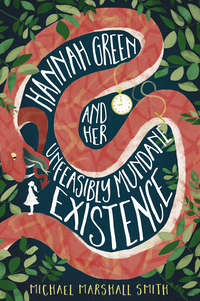
Читать книгу: «Hannah Green and Her Unfeasibly Mundane Existence»
HANNAH GREEN AND HER UNFEASIBLY MUNDANE EXISTENCE
MICHAEL MARSHALL SMITH

Copyright

HarperVoyager
An imprint of HarperCollinsPublishers Ltd
1 London Bridge Street,
London SE1 9GF
www.harpervoyagerbooks.co.uk
First published in Great Britain by HarperCollinsPublishers 2017
Copyright © Michael Marshall Smith 2017
Michael Marshall Smith asserts the moral right to be identified as the author of this work.
A catalogue record for this book is available from the British Library.
This novel is entirely a work of fiction. The names, characters and incidents portrayed in it are the work of the author’s imagination. Any resemblance to actual persons, living or dead, events or localities is entirely coincidental.
All rights reserved under International and Pan-American Copyright Conventions. By payment of the required fees, you have been granted the non-exclusive, non-transferable right to access and read the text of this e-book on screen. No part of this text may be reproduced, transmitted, downloaded, decompiled, reverse engineered, or stored in or introduced into any information storage and retrieval system, in any form or by any means, whether electronic or mechanical, now known or hereinafter invented, without the express written permission of HarperCollins.
Source ISBN: 9780008237912
Ebook Edition © July 2017 ISBN: 9780008237936
Version: 2018-09-21
Dedication
For Nate,
who heard some of this first,
and without whom it wouldn’t exist.
One’s destination is never a place but rather
a new way of looking at things.
—Henry Miller
Big Sur and the Oranges of Hieronymus Bosch
Table of Contents
Cover
Title Page
Copyright
Dedication
Epigraph
Then
Part 1
Chapter 1
Chapter 2
Chapter 3
Chapter 4
Chapter 5
Chapter 6
Chapter 7
Chapter 8
Chapter 9
Chapter 10
Chapter 11
Chapter 12
Chapter 13
Chapter 14
Part 2
Chapter 15
Chapter 16
Chapter 17
Chapter 18
Chapter 19
Chapter 20
Chapter 21
Chapter 22
Chapter 23
Chapter 24
Chapter 25
Chapter 26
Chapter 27
Chapter 28
Chapter 29
Chapter 30
Chapter 31
Chapter 32
Part 3
Chapter 33
Chapter 34
Chapter 35
Chapter 36
Chapter 37
Chapter 38
Chapter 39
Chapter 40
Chapter 41
Chapter 42
Chapter 43
Chapter 44
Chapter 45
Chapter 46
Chapter 47
Chapter 48
Chapter 49
Chapter 50
Chapter 51
Now
Acknowledgements
About the Author
Also by Michael Marshall Smith
About the Publisher
Then
Imagine, if you will, a watchmaker’s workshop.
In fact, please imagine one whether you wish to or not. That’s where something’s about to happen, something that won’t seem important right away but will turn out to be – and if you’re not prepared to listen to what I’m saying then this whole thing simply isn’t going to work.
So.
Imagine that thing I just said.
If it helps, the workshop is on the street level of an old and crumbling building, in a town some distance from here. With the exception of the workbench it is cluttered and dusty. The watchmaker is advanced in years and does not care about the state of the place, except for the area in which he works.
It is a late afternoon in autumn, and growing dark. Quite cold, too. It is quiet. The workshop is dimly lit by candles, and the watchmaker – you can picture him in the gloom, bent over his bench, if you wish – is wearing several layers of clothing to keep warm. He is repairing a piece he made several decades ago, the prized possession of a local nobleman. It will take him perhaps half an hour, he estimates, after which he’ll lock up his workshop and walk through the narrow streets to his house, where since the death of his wife he lives alone but for an elderly and bad-tempered cat. On the way he will stop off to purchase a few provisions, primarily a bag of peppermints, of which he is extremely fond. The watchmaker. Not the cat.
The timepiece he is working on is intricate, and very advanced for its time, though the watchmaker knows that were he to embark upon crafting something like it now he’d do things quite differently. He has learned a great deal since he made it. He doesn’t make anything new any more, however. He hasn’t in a long while. The story of his life has already been told. He is merely waiting for its final line.
Nonetheless, his eyes remain sharp and his fingers nimble, and in fact it only takes ten minutes before the watch is working perfectly once more. He reassembles it, and polishes the outside with his sleeve. Finished. Done.
He stands with the piece in his hands. He is aware, through his profound understanding of its workings, of the intricate mechanisms involved in its measuring of time, the hidden movements. He feels these as a subtle, almost imperceptible vibration, like the murmur of a tiny animal cupped in his hand, stirring in its sleep.
And he is aware of something else.
Not one thing, in fact, but a multitude – a cloud filling his mind like notes from a church organ, soaring up towards heaven. He is aware of children, and a grandchild. They cannot be his, because he has none: his marriage, though long and comfortable, was without issue. Aware, too, of the people who had come before him, his parents and grandparents and ancestors, aware not merely of the idea of them but their reality, their complexity – as though he has only ever been the soloist in the music of his life, supported upon the harmonies of others.
He’s aware also that though the candles in the workshop illuminate small areas, there are patches of darkness too, and parts that are neither one thing nor the other. That his entire life has been this way, not forever pulled between two poles but borne instead along far more complex currents, of which ticks and tocks are merely the extremes.
How did he come to be standing here on this cold afternoon? he wonders. What innumerable events led to this?
And why?
He shakes his head, frowning. This is not the kind of thought that usually occupies his mind. He is not normally prey, either, to a feeling of dread – though that is what is creeping up on him now. Something bad is about to happen.
Something wicked this way comes.
He hears footsteps in the street outside. He half turns, but cannot see who is approaching. The windows are grimy. He has not cleaned them in many years. Nobody needs to see inside. His venerable name on the sign is advertisement enough, and as he has gradually withdrawn from the world so he has come to value the privacy the windows’ opaqueness confers.
But now suddenly he wishes he could see who’s coming. And he wonders whether his life is over after all.
He waits, turning back to the bench, busying his hands.
And the door opens.
No, no, no. Sorry. Stop imagining things.
I’ve got this completely wrong. I’ve tried to tell the story from the beginning.
That’s always a mistake. I’ve learned my lesson since, and have even come to wonder if this is what I was dimly starting to comprehend on that cold, long-ago afternoon. Life is not like a watch or clock, something that can be constructed and then wound for the first time, set in motion.
There is no beginning. We are always in the middle.
OK, look. I’m going to start again.
PART 1
A story is a spirit being, not a repertoire,
allegory or form of psychology.
Martin Shaw
Snowy Tower
Chapter 1
So. This is a story, as I’ve said. And stories are skittish, like cats. You need to approach calmly and respectfully or they’ll run away and you’ll never see them again. People have been spinning tales for as long as we’ve been on this planet, perhaps even longer. There are stories that are so ancient, in fact, that they come from a time before words – tales conjured in gestures and grunts, movement of the eyes; stories that live in the rustling of leaves and lapping of waves, and whose ghosts hide in the tales we tell each other now.
Be good, and be careful.
Beware of that cave; that forest; that man.
Some day the sun will go dark, and then we will hide.
But all stories – and I’m talking about proper ones here, not stories about sassy teens becoming ninja spies or needy middle-agers overturning their lives in a fit of First World pique and finding true love running a funky little bookshop in Barcelona – need us to survive. Humans are the clouds from which stories rain, but we are also shards of glass that channel their light, focusing them so sharply that they burn.
Humans and stories need each other. We tell them, but they tell us too – reaching with soft hands and wide arms to pull us into their embrace. They do this especially when we have become mired in lives of which we can make no sense. We all need a path, and stories can sometimes usher us back to it.
That’s what happened to Hannah Green. She got caught up in a story.
And this is what it is.
Hannah lives in a place called Santa Cruz, on the coast of Northern California. It has a nice downtown with organic grocery stores and a Safeway and coffee shops and movie theatres and a library and all the things you need if you want other towns to take you seriously. It is home to a well-regarded branch of the University of California and also to a famous boardwalk, where you can go on fairground rides and scare yourself witless should you be so inclined. The boardwalk features a house of horrors and a carousel and shooting galleries and the fifth-oldest rollercoaster in America (the famed Giant Dipper, which Hannah had ridden only once, with her grandfather: both emerged shaken from the experience, and he later described the contraption as ‘potentially evil’) and places to buy corn dogs and garlic fries and Dippin’ Dots. It is a matter of lasting chagrin to the childfolk of Santa Cruz that they’re not allowed to go to the boardwalk every single day.
Though outsiders have been visiting for many years to walk on the beaches or surf or eat seafood, the town – as Hannah’s mother sometimes observed – is rather like an island. Behind it stand the sturdy Santa Cruz Mountains, covered in redwoods and pines, cradling the town and providing a barrier between it and Silicon Valley and San Jose. Once these mountains were home to wolves and bears but the humans got rid of them to make the place tidier, and for the convenience of those who wish to hike. South lies the sweeping bay, where not much happens except for the cultivation of artichokes and garlic and other unappealing grown-up foodstuffs, until you get to Monterey, and then Carmel, and finally the craggy wilderness of Big Sur. On the northern side of town there’s mainly emptiness along seventy miles of beautiful coast until you reach San Francisco, or ‘the city’, as everyone calls it in these parts. Santa Cruz could therefore seem somewhat cut off from the rest of California (and indeed the world), but luckily almost everyone who lives there is content with this arrangement. So Hannah’s mother sometimes said, without much of a smile.
Hannah hadn’t heard her mother say much recently, however. Before Hannah became embroiled in the story I’m about to tell, she was already a participant in several others, starring in The Tale of Being an Eleven-Year-Old Girl, The Story of Having Annoyingly Straight Brown Hair, The Chronicles of My Friend Ellie Being Mean to Me for No Reason, and The Saga of It Being Completely Unfair that I’m Not Allowed to Have a Kitten. One story had come to dominate her life recently, however, looming so large and changing so many things in such enormous ways that it drowned out all the rest.
It’s an old and sad and confusing tale, called Mom and Dad Don’t Live Together Any More.
Hannah knew the exact moment when this story began, the point at which some malign spirit had furrowed its brow and wondered ‘What if?’ and started messing around with her life.
It was a Saturday, and they were in Los Gatos. Hannah’s mom liked Los Gatos. It’s neat and tidy and has stores they didn’t have in Santa Cruz. Hannah’s dad was never as keen to make the half-hour journey over the mountains (the most doom-laden highway in the world, according to him, attractive but luridly prone to accident, and it’s hard to be completely sanguine about the fact it actually crosses the San Andreas Fault) but between the Apple Store and a coffee shop and the nice square outside their favourite restaurant he seemed able to pass the morning pleasantly enough while Hannah and her mother shopped.
Lunch afterwards was always fun. The restaurant they visited was bright and airy and the waiters were friendly and wore smart uniforms and before you got your food they brought baskets of miniature breads and pastries which Hannah’s parents would try to stop her eating. Meanwhile they’d talk and sip wine and Hannah’s mom would show her dad some of the things she’d bought (though never, Hannah noticed, absolutely everything).
All of Hannah’s memories of Los Gatos were good, therefore, until the time six months before, when she happened to glance up while nibbling a tiny muffin and saw her mother looking out of the window. Mom’s face was blank and sad.
Surprised – lunches in Los Gatos were always cheerful, sometimes so cheerful recently that they might even have seemed a little shrill – Hannah looked at her father.
He was watching her mom. The expression on his face was not blank, though it was also sad.
‘Dad?’
He blinked as if waking from a dream, and gave her a hard time for starting another pastry, though she could tell his heart wasn’t in it. Meanwhile her mother kept staring out of the window as though watching something a long way away, as if wondering if she were to jump up from the table right now and run out of the door as fast as she could, she might be able to catch up with it before it disappeared from sight.
Food arrived, and everybody ate, and then they drove home. They didn’t go to Los Gatos again after that. As far as Hannah was concerned, that lunch was when it all started to go wrong.
Because two months later Hannah’s mom moved out.
A lot of things stayed the same. Hannah attended school, did homework, went to French class on Tuesday afternoons (which was extra, because Mom thought she ought to be able to understand it, even though the nearest place anybody spoke French was probably France). Dad had always done the grocery shopping and cooked the evening meal – as Hannah’s mom travelled a lot for work, all over America and Europe, and had always seemed baffled and infuriated by the oven – so that was business as usual.
There’s a difference between ‘Mom being away until the weekend’, however, and ‘Mom is away … indefinitely.’ The kitchen table goes all big. The dishwasher sounds too loud.
Her grandfather came to stay with them for a week – or, at least, his meandering path through the world brought him into Santa Cruz – which was nice. He did the kind of thing he usually did, like making odd little sculptures out of random objects he found on his walks, and dozing off in an armchair (or spending periods ‘resting his eyes’). He cooked dinner one night though it wasn’t entirely clear what it was, and tried to help Hannah with her science homework, but after ten minutes of frowning at the questions simply said that they were ‘wrong’.
Hannah also saw her Aunt Zo, who came down a few times to keep her company. Zoë was twenty-eight. She lived in the city and was an artist-or-something. She had alarmingly spiky dyed-blond hair and several tattoos and wore black most of the time and was her dad’s much younger sister, though it seemed to Hannah that Zo and her dad always looked at each other with cautious bemusement, as if they weren’t sure they belonged to the same species, never mind family. Hannah didn’t know what an ‘artist-or-something’ even was. She’d intuited it might not be an entirely complimentary term because it was how her mother described Zoë, and Hannah’s mom and Zo had not always appeared to get on super-well. It had to be different to an ‘artist’, certainly, because extensive tests had demonstrated that Aunt Zo couldn’t draw at all.
She was friendly, though, and fun, and had gone to a lot of trouble to explain that the fact Hannah’s parents didn’t live together right now didn’t mean either of them loved her any less. Sometimes people lived together forever, and sometimes they did not. That was between them, and the reasons could be impossible for anybody else to understand. Sometimes it was because of something big or weird and unfixable. Sometimes it was merely something ‘mundane’.
Hannah hadn’t understood what this word meant. Aunt Zo waved her hands vaguely, and said, ‘Well, you know. Mundane.’
Later Hannah looked it up on the internet. The internet said that the word came from the Latin mundus, meaning ‘world’, and thus referred to things ‘of the earthly world, rather than a heavenly or spiritual one’. That made zero sense until she realized this was only a second thing it could mean, and that usually people used it to mean ‘dull, lacking interest or excitement’.
Hannah nodded at this. She didn’t see how Mom and Dad not living together could be without interest, but she was beginning to feel her life in general most certainly could.
The next time she saw Zo was when her aunt came to babysit overnight because Hannah’s dad had to fly down to a meeting in Los Angeles. Hannah dropped the word into conversation, and was pleased to see her aunt smile to herself. Emboldened, Hannah tentatively asked whether maybe, next time, rather than Zo coming to Santa Cruz, Hannah could come up to the city instead. She did not say, but felt, they could be girls together there, and have new and unusual fun that would not be dull or lack excitement. Zo said yes, maybe, and how about they made some more popcorn and watched a movie.
Hannah was old and smart enough to understand that whatever ‘mundane’ might mean, ‘maybe’ generally meant ‘no’.
Otherwise, life dragged on like a really long television show that was impossible to turn off. She went to school and ate and slept. Mom sent her an email every couple of days, and they spoke on Skype once a week. The emails were short, and usually about the weather in London, England, where she was working. The phone conversations were better, though it sometimes felt as though the actress playing her mother had changed.
Hannah realized it wasn’t likely that, even when (or if) her mom did come back, she was going to come and live with Hannah and her dad. Straight away, anyway. Missing her mother was tough, but bearable. Hannah put thoughts of her in a box in her head and closed it up (not too tightly, just enough to stop it popping open all the time and making her cry) and told herself that she was welcome to look inside however often she liked. In her imagination the box was ornate and intricate and golden, like something out of a storybook.
Missing her dad was worse, because he was right there.
He hadn’t gone away, but he had. Virtually everything about him with the exception of his appearance (though he often looked tired, and didn’t smile with his eyes) had changed. He hugged her at bedtime. He hugged her at the school gate. When something needed to be said, one of them said it, and the other listened. But sometimes when Hannah came into a room without him realizing, she would look at him for a while and it was as though there was nobody there.
Otherwise, nothing much changed.
School.
Homework.
Food.
Bed.
School.
Homework.
Food.
Bed …
… like waves lapping on a deserted shore. Life was flat and grey and quiet, all the more so because every other adult with whom she came into contact – teachers at school, her friends’ moms and dads, even the instructor at gym, who’d always been snarky with literally everyone – treated her differently now. They were polite and accommodating and they always smiled and seemed to look at her more directly than before. They were so very nice to her, in fact, that the world no longer had edge or bite. It lost all shape and colour and momentum, and any sense of light or shade. It was like living in a cloud.
Late one autumnal afternoon, as she sat watching through the window as a squirrel played in the tree outside, looking so in charge of its life, having so much fun, Hannah realized that her own life had become ‘mundane’.
Horribly, unfeasibly mundane.
So I suppose that’s where we’ll begin.
Don’t worry, things will start to happen. This hasn’t been the actual story yet. It’s background, a few moments spent sifting through the tales already in progress in order to pick a moment in time and say: ‘So now let’s see what happened next.’
And we will.
But before we get any further into Hannah’s story, we need to go and meet someone else.
Chapter 2
Because, meanwhile, an old man was dozing on the terrace of the Palace Hotel, on Miami’s South Beach.
The hotel stands amidst a half-mile of art deco jewels restored to their former glory in the 1980s, and – like many of the others – was determinedly now running back to seed, as though that was the state in which it felt most comfortable. The old man had a local newspaper on his lap but he had not read it. To one side, on the table supporting the umbrella protecting him from the sun, was a glass of ice tea that had long ago come up to ambient temperature. A large bug was swimming in it, a leisurely freestyle. The waiter working the terrace had approached the table several times to see if the gaunt old buzzard wanted his glass refreshed. Each time he’d discovered the man’s eyes were closed. His position had not changed in quite a while.
Nonetheless the waiter decided to try one more time. In half an hour his shift would be over. In most ways that was awesome. The afternoon had been hellishly humid and the waiter was looking forward to returning to his ratty apartment, taking a shower, sitting out on his balcony and smoking pot for a couple of hours before hitting the town in the hope of finding some margarita-addled divorcée or, failing that, simply getting wasted. Business on the terrace had not been brisk, however. He was below quota on tips (and behind on his rent), and that was why he decided – now it was approaching five – it was worth one final attempt to upsell the old dude in the crumpled suit into a big glass of wine or, better still, an overpriced cocktail.
He went and stood over him.
The old man’s head was tilted forwards in sleep, showcasing a pale forehead dotted with liver spots, a sizable beak of a nose, and combed-back hair that, though pure white, remained in decent supply. Large, mottled hands rested on knees that appeared bony even through the black linen of his suit. Who wore black in Florida, for God’s sake?
The waiter coughed. There was no response.
He coughed again, more loudly.
Consciousness returned slowly.
It felt as though it was coming from a great distance, and that was because this was not a normal awakening. It wasn’t merely a matter of rising from sleep. On this day, the old man woke from a far deeper slumber.
He opened his eyes and for a moment he had no idea where he was. It was hot. It was bright, though the quality of the light suggested it must be towards the end of the afternoon. He could see the glint of some ocean or other, past the stone terrace on which he sat.
And there was a young man, wearing a white apron, standing in front of him and smiling the kind of smile that always had financial outlay attached to it.
‘Refreshed, sir?’
The old man stared confusedly at him for a moment, and then sat up straight. He peered around the terrace and saw young couples at other tables, and a few older people wearing hats and looking out at the ocean as if waiting for it to do something. Hotels on either side. Palm trees.
He turned back to the waiter. ‘Where am I?’
The waiter sighed. The old fart had seemed fine when he ordered his ice tea earlier. Evidently a day in the sun had fried what was left of his wits.
‘Wondered if I could interest you in a cold glass of Chardonnay, sir? We have an intriguing selection. Though perhaps a crisp Sauvignon Blanc would be more to your taste? Or a Martini, a Bellini, or a Sobotini? That’s the signature creation of our in-house executive mixologist, Ralph Sobo, and features a trio of—’
‘Did I ask you to recite the entire drinks menu?’
‘No, sir.’
‘So?’
The waiter smiled tightly. ‘You are on the terrace of the Palace Hotel,’ he said, offensively slowly. ‘South Beach. Miami. The United States of America.’ He leaned forwards and added, loudly enough for people nearby to turn and smile to themselves, ‘Planet Earth.’
The man frowned. ‘How long have I been here?’
‘In this spot? The entire afternoon. The hotel? I have no clue. I’m sure reception can assist you with that information, along with your name, if that’s also slipped your mind. Now – can I help you with a beverage, or not?’
The man shook his head. ‘Just my bill.’
The waiter walked off, bouncing his tray against his knee, vowing that he would use everything within his power to make sure that the wrinkly old fool received his bill only after a very significant delay.
This waiter had only been working at the Palace for a couple of days, and didn’t yet know many other members of staff. Otherwise he might have heard, in passing, whispers about this particular old man. Rumours that in the three months he’d been resident in a suite on the thirteenth floor, it had proved impossible to place guests in the accommodation on either side. The hotel’s sophisticated computer system appeared to have developed an intermittent glitch that meant those rooms showed up as occupied, even when they were not. Any attempt to override or ignore this resulted in double- or even treble-booking, with the inevitable fallout of enraged guests, and so for the time being reception had stopped trying to allot the rooms. They had also temporarily halted attempts to get to the bottom of the means of payment the old man had presented. His credit card, though unimpeachable in status and hue, proved impossible to retain reliably in the system. As a result – and to the hotel manager’s increasing disquiet – no charge had yet been levied against it. The technical department claimed this would be fixed very soon. The manager hoped this was true, though it was not the first or even third time he’d been given this assurance.
The waiter didn’t know any of this, however. So he went over to the register and surreptitiously tore up the old man’s bill, before hanging up his apron and leaving the terrace, whistling a tune to himself.
It’d only take the senile old bastard ten or fifteen minutes to get a new bill from the next waiter, but any inconvenience was better than none.
The man sitting under the umbrella didn’t wait that long, however. He laid ten dollars on the table, securing it under his glass. He stood. For a few moments he didn’t move any farther, apparently becalmed, his face blank.
Then suddenly he smiled.
It was not a simple smile, one of pleasure or joy. It was complicated, rueful. If you’d been watching, you might have thought he’d remembered something, a matter that was not urgent but which he felt foolish for having neglected.
He took a last look at the ocean and then turned and walked towards the doors to the hotel lobby, moving with a good deal more grace and speed than you might have expected.
An hour later, after a shower and in the middle of his second joint, the waiter from the Palace Hotel was relaxing on his balcony when it suddenly collapsed, dropping him forty feet into the chaos of his downstairs neighbour’s scrap of yard, where he died, reasonably quickly, as a result of a sheared metal strut which punctured his ribcage and heart.
This was not a coincidence.
Chapter 3
It was seven in the evening, and Hannah was waiting.
Waiting.
Waiting.
She’d been waiting since breakfast, during which her father had been even more distant and insubstantial than usual; and waiting since he’d dropped her at school, saying goodbye with a hug and a kiss but an odd look in his eyes. He had forgotten to shave that morning, she noticed. He’d forgotten the day before, too. She hadn’t waited during the math homework they’d endured after pick-up, as she knew she had to pay attention. Her dad had more than once described helping her with math as his punishment for all the evil things he didn’t remember doing in a previous life, or lives, and while she doubted this was true she understood his patience was not limitless, especially now.
She then waited while he cooked dinner, her favourite, a creamy pasta dish with bacon and peas that he’d invented for her when she was small and the very smell of which made her feel safe and warm even when she knew that the world had changed. In fact, as she sat in the corner of the kitchen reading while he cooked, she wondered whether it was accidental that he happened to be cooking creamy bacon pasta this evening, or if it was in some way related to whatever it was that she knew – without having any reason she could put a finger on – that she was waiting for. The menu had been notably random in recent weeks, occasionally featuring complicated things she’d never seen before, but then frozen pizza three nights in a row.
And now tonight, suddenly, it was her favourite.
Waiting.
They ate at the kitchen table. Her father asked about her day, and listened, seeming more ‘there’ than for the last day or two. He didn’t eat much, though.
Afterwards Hannah carried her plate to the dishwasher and went to the living room to wait some more. Finally her father came through holding a cup of coffee. He perched on the edge of the sofa. ‘I need to say something,’ he said.
For a dire moment, Hannah was convinced he was going to tell her that Mom was never coming back from London, or that Hannah had to leave too, or he’d decided they needed to move to another town or something. She stared at him, barely able to breathe, but saw that his eyes looked soft, and so she thought probably – hopefully – it wasn’t something as bad as that.
‘What?’ she asked.
He pursed his lips and stared down at the carpet. He looked tired. Some of his bristles were grey. Had they been that way before Mom left? Hannah wasn’t sure. He’d never forgotten to shave when Mom was around.
‘I’m not handling this as well as I’d like,’ he said. ‘Your mom being … not here, I mean. I’m trying to do what needs to be done. And it’s working, right? We’re doing OK?’
Hannah nodded dutifully. Most of the time it sort of was OK, but even if it hadn’t been, she understood he hadn’t asked the question in order for her to answer it. Grown-ups did that a lot, saying something they believed to be a fact but putting a question mark at the end. It was meant to make you take the fact more seriously, or something. You learned that you weren’t expected to say anything in reply, just as you learned that if you were a girl you didn’t always want to mention your video-game scores to boys, especially if yours were higher.
‘But …’ He stopped. He didn’t seem to know what he wanted to say next.
‘You’re sad,’ she said.
He laughed, surprised. ‘Well, yeah. You are too, I know. It’s, uh, it’s a strange time.’
‘I’m sad,’ she agreed. ‘But not like you are.’
‘What … do you mean?’
‘You’re badly sad.’
He stared at her, nodding, and she was intensely scared to see that his eyes were full. She had never, ever seen her dad cry. She didn’t want to see it now. She knew life sucked but if it turned out it was bad enough to make her father cry, it was far worse than she realized. That would be beyond mundane.
‘Did I say something wrong?’
‘No. You said something smart.’ He sniffed briskly, and stopped looking like he was going to cry. ‘I need some time,’ he said. ‘Firstly … well, all this.’ He raised his hands, referring to the house, and what was in it, and what was not in it any more. ‘Plus … work. I’m getting behind. One or the other thing, I could handle. Both at once, not so much. It seems.’
Hannah understood that her father typed for a living, for people who lived down in Los Angeles, helping them make stories. She knew this was a hard job sometimes, partly because – so she had gathered, from overhearing conversations between him and Mom – almost all of the people her dad worked for were assholes and idiots, with the creative acumen of mosquitoes and the moral sensibilities of wolverines. He said things like this very quietly, though, as if concerned they might be able to hear him from over three hundred miles away.
‘OK, look,’ he said. ‘Here’s the thing. I wondered if you’d like to go stay with Granddad for a while.’
Hannah wanted to say ‘yes’ immediately, but dimly understood that she should not. ‘Granddad?’
Her father was watching her carefully. ‘Yes.’
‘Why not Aunt Zo?’
‘Zo-zo’s busy.’ He sighed. ‘Got an exhibition coming up, or a performance, or some … thing. Plus you’ve seen her apartment. She has to stand up when she goes to sleep.’
This was an old family joke and Hannah smiled as always, or tried to. It felt different now. In the past there would never have been any question of her staying with Aunt Zo. Now it had evidently been considered, and rejected. That made Hannah feel rejected too. ‘And I was thinking … of you going for more than a couple of days.’
‘How long?’
‘A week. Maybe two.’
Two whole weeks? ‘When?’
‘Tomorrow.’
‘But … what about school?’
‘I talked to Teacher Jen. She said it would be OK.’
Hannah looked hard at her father, and knew he was not telling the truth. Not the whole truth, anyway. He would have talked to her teacher, yes. You couldn’t just yank a kid out of school without clearing it with mission control.
But it struck her now that, though he had not shaved, he’d been wearing smart chinos and a shirt when he dropped her at school that morning – the first time in ages he hadn’t been wearing the raggedy jeans he used to only wear at the weekend. She didn’t think you could bail your kid out of school for two weeks just by saying ‘I’m having a hard time.’ So probably he’d said it was something to do with working for the wolverines instead, which is why he’d been wearing business clothes. Things to do with work were always incredibly important for grown-ups. They were respected without question. Far more, it sometimes seemed, than things to do with children.
‘Have you asked Granddad?’
‘Yes. I spoke to him last night. Well, emailed. There’s no phone signal there.’
‘Where is he now? Where on earth?’
Her father smiled, and this time it looked genuine. It made Hannah realize what a long time it had been since she’d seen that kind of smile on his face.
‘Washington State,’ he said, as if this meant the far side of the moon. ‘God knows why. But where he’s staying sounds pretty cool. I think you’ll like it. And he says he’s really looking forward to seeing you.’
From the moment Dad first mentioned the idea, Hannah had wanted to go. She loved her dad’s dad, and the prospect of getting out of Santa Cruz for a while, doing something – anything – other than plodding through her mundane existence, felt desperately attractive. She’d held back from leaping at it because she knew she shouldn’t seem as if she wanted to get away from her father. That also meant she had to say what she said next. ‘But I’ll miss you.’
As soon as the words were out of her mouth, she realized how true they were. How badly true.
Her dad’s lips clamped together, the way they sometimes did when he was mad. His eyes didn’t look mad, though. Not at all.
‘I’ll miss you too,’ he said. ‘But we can Skype, and email, and it’s not so long. And when you get back, things will be better here. I promise.’
‘OK,’ Hannah said. ‘Can I watch some Netflix now?’
‘Sure,’ he said, wrong-footed.
‘Yay.’
She jumped up and ran to the den and switched on the big TV. As she was waiting for her show to load she glanced back into the living room and saw that her father was still sitting on the edge of the sofa, shoulders bowed and head lowered. She could not see his face or eyes.
His shoulders seemed to shake, for a moment, and then shake again. Presumably he was laughing at something.
Chapter 4
The driver pulled over to the side of Ali Baba Avenue and turned to look at the guy in the back of his cab.
‘You sure this is where you want to be?’
The old man had been silent throughout the long journey into Dade County from South Beach, successfully resisting Domingo’s attempts to involve him in conversation. Domingo was good at conversation, too. His game was tight. He didn’t mind listening either, a much rarer gift, and so he could usually get customers to chat with him, and he did this out of a simple desire to tell people things and to hear stuff about where they’d come from and where they were going, not just because it meant a bigger tip, though that was always welcome.
This customer, though … he wasn’t buying it. Anything Domingo said, he’d said nothing back, remaining relentlessly and noisily silent. He was currently looking out of the window at the twilight, his big, pale hands resting on the knees of his suit. ‘Yes,’ he said. ‘This looks perfect.’
Domingo laughed briefly. ‘Right. You want to get mugged or score some dope that’s gonna put you straight in ER, that may be true. This could be Heaven on earth right here.’
The passenger held out a few bank notes to signal their business was concluded. Domingo was not to be so easily dismissed, however.
‘The hell you want to come to Opa Locka for, anyway? Some dumbass website say there’s authentic down-home cooking? They lied, brother. The only specialty they got around here is rat boiled in meth. You want food, I can take you places, good places, back where the locals don’t eat each other.’
The old man opened his door. Domingo tried one last time. ‘Look. At least take my card, OK? How the hell else you going to get back? Don’t you be flagging down no cab here, even if you see one, which you won’t. For real. They’ll take you round the corner and rob your ass. If you’re lucky.’
The man got out and walked off down a street that looked as though it had recently withstood a minor hurricane and hadn’t been remotely picturesque before that. Domingo thought about going after him, but this was, bottom line, not a neighbourhood where he wanted to linger any longer than necessary.
So he drove away.
The old man spent an hour strolling the streets as the light faded. He saw low storage buildings of indeterminate purpose, fortified with barbed wire. He passed squat one-storey dwellings interspersed with clumps of stunted palm trees, houses set apart from each other not for the luxury of space but as though the inhabitants didn’t trust their neighbours enough to live in closer proximity. There were no sidewalks, so he walked down the middle of the streets, which were pitted and patched and ragged at the edges and sprouting grass in many places: the kind of broken roads you’d expect to see down the dusty end of country towns that had been dying for decades. It was stiflingly humid.
He encountered few people. Every now and then a child would run past, but never stop. A woman stared at him from the stoop of her small, battered house, as if wondering what kind of fool he might be. A couple of times he observed men loitering outside corner grocery stores, their eyes following him. He passed slowly, in case it would be one of these who’d show him where he needed to go. None moved, however. They seemed winded, listless, as though they couldn’t summon up the energy to rob a frail-looking old man who was evidently a long way from base.
But eventually he hesitated.
He felt something.
He turned in a slow circle, sniffed the air, and then set off up the next cross street. The houses were even farther apart here, and few showed a light. It felt … right.
When he saw the abandoned warehouse down the end, looming in dark isolation, he knew for sure that it was.
They looked up as he entered.
It was a large, empty space, the heart of the disused building. A fire built of fallen palm leaves and broken furniture burned in the centre.
Five men stood around it. Three white, one black, one half-Latino, none of them kids, all in their late twenties or thirties, but dressed in hoodies and ragged jeans all the same. Each looked as though it would be their pleasure to hurt you quite badly. There were a lot of candles, a hundred or more, spread over the floor and flickering in cavities in the walls.
One of the men, the tallest of the white guys, laughed. ‘Whoa,’ he said. ‘Holy crap, are you lost.’
The old man kept walking until he was within ten feet of the fire. He put his hands together as if in prayer, and looked at each of the men in turn.
‘No,’ he said in a calm and thoughtful voice. ‘I believe this is precisely where I need to be.’ He pulled out his wallet and threw it on the floor closest to the man who’d spoken. ‘Let’s get that part over with. I’d hate us to get distracted by mere theft.’
The tall guy frowned.
One of the others picked up the wallet. He leafed through it with a professional eye, and whistled. ‘Six hundred,’ he said to the tall guy, evidently the leader. ‘And change. We going to kill him now?’
The tall guy said nothing. His real name was Robert. That’s what his mother had called him, anyhow. She was dead and had been for a long time, along with his father and two sisters, and these days most people called him Nash instead. He’d been alive for nearly forty years – a long story by local criminal standards – and during that period had done many things. It’d be hard to come up with something he hadn’t done, in fact. Suffice it to say there were women, and men, and children, who woke in the night with his face in their minds as they lay sweating with the terrible memories they had acquired at his hands. Nash had stolen and beaten, and he had killed, via the media of gun and knife and bare hands and the sale of drugs cut with everything from toilet cleaner and chalk to concrete dust idly swept up off the street.
Bottom line: Nash was a very bad man, and in the last six months he’d started to explore whole new realms and means and levels of being not-good.
He was, however, also not-dumb. The way the old guy was presenting said you didn’t simply kill him. Not yet. ‘What do you want?’
‘Tell me about the candles.’
The other three guys glanced at each other. ‘We’re Satanists,’ one said proudly, the guy who’d rifled through the wallet, and still clutched it in his hand.
‘Shut up,’ Nash said.
The old man seemed intrigued. ‘Is that so?’
The guy holding the wallet didn’t want to stop talking. ‘You don’t believe us?’
‘You say you are, you are.’
‘You’d better bel—’
Nash turned to the wallet guy, his eyes hard. The other man went silent. He froze, his mouth open in mid-word. It looked as though he was trying to close it but could not. Eventually, after a great deal of effort, he managed to. Sweat had broken out on his forehead and his hands were trembling.
The old man watched all this with interest.
The trembling man retreated into the shadows. The others followed suit, leaving only Nash standing opposite the old man.
‘Going to ask you one last time,’ Nash told him. ‘What do you want?’
The old man shrugged in a friendly way. ‘I’m curious. I have a fondness for ruins, the abandoned, the lost. I was walking, and saw this place. I decided I’d take a look. I was assuming it would be empty or that I’d find a few homeless or addicts sprawled over the floor. Instead …’ He gestured around. ‘Candles. They look well enough. But you don’t seem the Martha Stewart Living type. So I’m curious.’
‘Who are you?’
‘Merely what I appear to be. But who are you, Robert? What are you these days?’
Nash stared at him. ‘How you know that name?’
‘It’s just a game of mine. Whenever I don’t know someone’s name, I call them Robert, that’s all. So tell me. Was what he said true? Are you gentlemen really Satanists?’
Nash elected to tell the truth, not because he considered the practice to be important or valuable, but because it was time to let the weird old dude know exactly what – and who – he was dealing with.
He lifted his right hand, raising it to chest height. His eyes on the other man’s, he coughed, once.
A small glow puffed into life in his palm, at first very dim, but quickly growing into a little ball of bright orange fire, about the size of a golf ball.
The old man watched the flame. ‘Huh,’ he said, as if impressed.
‘Right,’ Nash said, closing his hand and lowering it back to his side. ‘That answer your question?’
‘I suppose it does.’
‘Good. Got any more, or are you going to leave? Or I guess you could stay, and we could beat up on you for a while. For practice. That could work.’
‘How’d you do it? The fire.’
‘It’s a gift.’
‘From whom?’
‘From him. The Dark One. For doing his work.’
‘How? What kind of thing?’
‘We pray to him,’ Nash said. ‘Every day. And we make sacrifice.’
The old man nodded as if someone was explaining an important change in the terms and conditions of his health insurance. ‘What kind? Animals? People?’
‘No.’ Nash laughed scornfully. ‘That’s retro bullshit. You do the wrong thing with the right intent, you don’t need that Dennis Wheatley crap.’
‘So what do you do?’
‘We break, we burn. We spoil.’
‘You say “we”?’
The other men watched from the background, silent, as if knowing this conversation was out of their league.
‘Me, mainly. These guys … they got a ways to go.’
‘So show me something. The kind of thing you do.’
Nash hesitated. On the one hand the situation was kind of whack. He didn’t have a clue who this guy was. Could be a cop for all he knew. But if so, he couldn’t have anything on Nash or he’d have come with back-up and guns – even assuming Miami PD kept detectives on the payroll after they got so old they looked like they should have their feet up on a porch, waiting for the grandkids to come visit so they could go to Disneyworld and waste enough money to feed an Opa Locka family for a month.
The other thing was that Nash did want to show someone, someone other than the hangers-on lurking in the shadows. He’d shown those guys what to do, countless times, but none of them was making progress. They couldn’t get it to click, and that failure was holding him back. Nash understood that it wasn’t enough to walk this road by yourself. You got status from how many you dragged along with you. It was a gift you had to keep on giving. Day after day. Night after night.
He put his hand in his jeans and pulled out a small cardboard container, about the size of a pack of cigarettes. He held it up.
‘What’s that?’
Nash opened it. The interior had been padded with cotton wool. Lying in the centre was a tiny box. He removed this and held it up for the old man to see.
The man leaned forwards and squinted, seeing an intensely shiny black surface over most of the box, apart from the lid. There, someone had spent a great deal of time painting a detailed winter scene: pine trees and snow and a horse-drawn sleigh with two people on it, wrapped in old-fashioned coats and furry hats. It was so precise that it looked as if it must have been painted with a brush of a single hair, white and green with highlights of intense red and purple and dots of gold, all the more striking for the blackness of the box. It was extraordinarily shiny, too, as if coated with many coats of colourless varnish. In its detail and lustre it reminded the old man of something else, a far larger box he had once commissioned to be built.
‘And?’
‘Old guy who lives a couple blocks from here,’ Nash said, putting the tiny box carefully down on the floor. ‘I heard him talking in the store. His wife’s dying of cancer. Her mother was from Russia. The one thing she brought with her from the old country was a box like this. A lacquer box, they call it. It got stolen when this guy’s wife was a kid, but she’s remembered it all these years. Like it stood for her mom, or some shit. So this guy, he knows his wife’s dying, and he’s got cash salted away she doesn’t know about. He’s been saving all these years for the right time, putting a buck away here, fifty cents there. He figures this is the right time. So I overhear him telling all this to the guy behind the counter – who doesn’t give a crap, I mean he really could not care less – telling him that he’s blown this money, seven hundred fifty dollars, on buying one of these on the internet. Spent weeks tracking down a box like the one he’s heard his wife describe all these years. It’s her birthday in a week. He’s going to give it to her then. Or … he was. Until I paid a visit to their house, last Sunday morning when they were at church.’
‘You stole it. Nice.’
Nash smiled. ‘Right. But that’s not it.’
He raised his right foot and paused, closing his eyes as if in supplication, and then brought the heel of his boot down on the lacquer box, smashing it to pieces.
He was quiet for maybe ten seconds, relishing the moment. Then he opened his eyes.
‘That’s what he likes.’
The old man was motionless, as if listening for something. After a few moments he shook his head. ‘I got nothing,’ he said. He seemed irritated, and something else. Disconcerted, perhaps.
Nash was confused too, having anticipated a very different reaction. ‘What?’
The old man stood there, lips pursed, furrow-browed. Up until this point he’d seemed relaxed, as if their discussion had been quite interesting but no big deal. He didn’t look that way now. He looked unhappy, and thoughtful. He looked serious.
‘What’s up, dude?’
The old man glanced at Nash as though his mind was already on other things. ‘What’s up? I’ll tell you what is up. I like your style, but there’s a problem.’
‘What kind of problem?’
‘A big one. I don’t know who you’ve been sacrificing to, my friend, but he is not the Devil.’
‘Oh yeah? How do you know he’s not?’
‘Because I am,’ the old man said.
He turned to the man in the shadows who was still holding his wallet, held up a hand, and clicked his fingers.
Бесплатный фрагмент закончился.