Читать книгу: «Mrs Whistler»


Copyright
The Borough Press
An imprint of HarperCollinsPublishers
1 London Bridge Street
London SE1 9GF
www.harpercollins.co.uk
Published by HarperCollinsPublishers 2018
Copyright © Matthew Plampin 2018
A catalogue record for this book is available from the British Library
Matthew Plampin asserts the moral right to be identified as the author of this work
Cover design by Dominic Forbes © HarperCollinsPublishers Ltd 2018
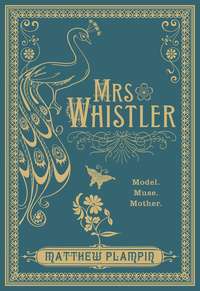
Cover illustrations © Whistler Butterfly, c.1890 (pencil on paper), Whistler, James Abbot McNeil (1834-1903) / Freer Gallery of Art, Smithsonian Institution, USA / Gift of Charles Lang Freer / Bridgeman Images (Whistler’s signature); Shutterstock.com (peacock).
This novel is entirely a work of fiction. The names, characters and incidents portrayed in it, while at times based on historical figures, are the work of the author’s imagination.
All rights reserved under International and Pan-American Copyright Conventions. By payment of the required fees, you have been granted the non-exclusive, non-transferable right to access and read the text of this e-book on-screen. No part of this text may be reproduced, transmitted, down-loaded, decompiled, reverse engineered, or stored in or introduced into any information storage and retrieval system, in any form or by any means, whether electronic or mechanical, now known or hereinafter invented, without the express written permission of HarperCollins e-books
Source ISBN: 9780008163624
Ebook Edition © May 2018 ISBN: 9780008163631
Version: 2018-03-22
Dedication
For Sarah
Epigraph
‘Maud could tell the whole story, but she will not.’
Elizabeth and Joseph Pennell,
The Life of James McNeill Whistler (1908)
Contents
Cover
Title Page
Copyright
Dedication
Epigraph
Part One: The Falling Rocket
Part Two: Arrangement in Grey and Black
Part Three: The Gold Scab
Author’s Note
About the Author
Also by Matthew Plampin
About the Publisher
Part One

October 1876
Maud woke to the sound of a piano. The room around her was dark, its heavy shutters closed. Jimmy was standing to the left, framed by a doorway. She started to speak, to ask what was happening, and he darted forward, shimmering slightly as he passed. Angling her head, she watched as he went to the end of the bed, collected together his possessions and packed them into an old leather bag. When this was done, he whipped off his smock, revealing the suit beneath; and there was that glittering again, like golden fish scales. She realised it was tiny flecks of the Dutch metal he was applying downstairs.
‘Up,’ he said.
The piano was somewhere towards the bottom of the house. It was being played much too hard, attacked almost, the music tangled and all out of time. After a short struggle with the bedclothes – which were the best cotton, far finer than theirs – Maud managed to rise onto an elbow.
‘What in heaven—?’
‘Leyland has reappeared,’ Jimmy told her, cramming the smock into his bag. ‘And he is displeased. We must absent ourselves, my girl, tout de suite.’
Maud swung her legs over the side of the bed, her toes spreading on the bare floorboards. Her shift was damp with sweat. She smelt rather ripe, an oniony sharpness mingling with the curdled whiff of nausea. Despite the warmth, a shiver prickled up the back of her neck; the shadowy room, empty save for the bed, seemed to drift like a raft on a pond.
‘It’s after three,’ said Jimmy. ‘You’ve been asleep for nearly five hours.’ He stopped to study her. ‘How are you faring?’
‘Well,’ she lied. ‘Better.’
‘Come then,’ he said, adjusting the length of lavender ribbon that served him as a necktie. ‘Haste, Maudie. Let’s be off.’
Maud dressed as quickly as she could. Stockings, petticoat and corset. One of her everyday gowns, the colour of old brick with black lacquered buttons. The fabric felt odd against her skin, stiff and coarse, and her boots were tight, as if they’d shrunk a size while she slept. She gathered in her hair, winding it into a loose, greasy bun. Jimmy waited by the open door with the bag between his feet, wiping Dutch metal from his eyeglass with a handkerchief, wincing as the piano struck a particularly jarring note. Maud eased herself from the bed and went over to him, grinning a little as she looked at that mobile, actorly face; the white forelock resting amongst the oiled black curls; the small, sardonic line etched at the corner of his mouth. His eyes were a bright, sun-bleached blue. Wide at first, they dipped until very nearly closed, like a cat’s. He smiled back at her with affectionate impatience.
‘My hat,’ she said, picking a gold flake from his moustache. ‘Think it’s downstairs.’
Jimmy slotted the eyeglass into his breast pocket, scooped his bag from the floor and took her hand. Together they started through the house. Even now, moving at speed, her head muddled by sleep and sickness, and that terrible music grinding out in the background – Beethoven was it meant to be? – the pair of them seemed to sweep across the expanse of the landing; to descend the staircase, lent majesty by that grand marble curve; to proceed into the swank hallway below. It was borrowed, of course, wholly counterfeit, but it felt good nevertheless.
They swerved right, towards the dining room. This was Jimmy’s realm, where he’d spent much of the summer. He’d been brought in to finish off the original, rather dull decorative scheme – left incomplete, Maud understood, after its designer fell ill – and had decided instead to transform it into something truly astonishing. She hadn’t been in there for a day or two, which refreshed the effect – so much so that she slowed to a halt upon the paint-spattered floorboards, her hat momentarily forgotten. It was like entering a pavilion at a great international fair. The woodwork, the many yards of intricate spindle shelving, had been coated with gleaming gold. Much of the wainscot, cornice and ceiling was now gold also, and was being overlaid with a pattern of Prussian blue peacock feathers. And there, on the inside of the shutters, were the birds themselves. The central set had been closed, as if to show them off to a caller. A pair of peacocks perched at the top of the tall panels, their magnificent tails arranged beneath them in a cascade of fronds and scales and glistening discs. They were Japanese in character, ancient-looking and otherworldly. The low light in the dining room didn’t place them at the least disadvantage; the gilded wood positively blazed in the gloom, while the blues appeared a rich, fluid black.
That Maud was at Jimmy’s side, that she was helping him to do this – his finest achievement yet, sure to open up a whole new territory – made her so extraordinarily proud it brought tears to her eyes. There was bitterness in her too, though, just a hint; for already, before its completion, this splendid thing had become tainted. A week or so earlier, Jimmy had returned home to Chelsea in a state of fizzing agitation, talking of a development; of how the philistines were everywhere, absolutely everywhere, even lurking within those one had previously thought enlightened, with whom one had considered oneself friends. Eventually, after much shouting and cursing, the full story had been extracted. Frederick Richards Leyland, the house’s millionaire owner, had made an unannounced visit from his base of operations in Liverpool. His reaction to Jimmy’s efforts – undertaken without prior consultation, as a marvellous surprise, a gift to the entire Leyland family – had been, well, a touch disappointing.
‘He didn’t ask for it. That was his response. He didn’t ask for it and he didn’t want it. Not the gold, not the peacocks. Not even your flowers, Maudie.’
Under the original scheme, the dining-room walls had been covered with antique leather, brownish yellow in tone and patterned with spiralling ribbons of summer flowers. When Jimmy had taken over he’d decided that a number of these blooms had to be retouched, with their colours switched from red to blue – and that this task should be entrusted to Maud, in her occasional role as his pupil. It had been monotonous work in truth, with several hundred little flowers to be repainted exactly the same, but she’d done it with enormous care. Learning that it had merely added to the patron’s discontent hadn’t been pleasant.
‘It was like having a lead ingot tied around my neck,’ Jimmy had continued, ‘and being tipped into the goddamned river. Nine years, Maud. Nine years I have been cultivating that unappealing fellow. Much indeed has passed between us, oh yes, well beyond the scope of artistic patronage. And yet throughout all of this, throughout all of my attempts to school him in art, Leyland has understood, truly understood, not a single goddamned jot. All that discourse, all that forbearance, all that blasted time – squandered!’
The room, however, had to be finished. Of this Jimmy had been quite certain. He wanted London society to see precisely what this shipbroker from Liverpool had chosen to reject. Leyland had gone north again, to attend to his business, and so the slighted artist had embarked upon a last surge of industry. He’d moved to Kensington, living in the vacant, half-furnished house, enduring the scrutiny of an increasingly suspicious caretaker and applying himself entirely to his labour. Maud had come to see him that morning, with food and a couple of clean shirts. It had been her first visit, on account of this lingering weakness in her stomach. She’d hoped it was gone, more or less, but the jolting of the omnibus had left her so wracked with cramps that she’d been obliged to head directly upstairs, to the room Jimmy had been using, where she could rest without disturbance.
But now disturbance had found her out. The piano hit a crescendo, like a crate of bottles cast onto the ground, then, with barely a pause, lurched into another piece. Maud looked towards the hall, wondering how fast they could get away. ‘What happened between you two?’
Jimmy released her hand. He’d thought of a few things of his own that he wanted to take with him, and began a rapid survey of the tools and materials that lay about, picking out this and that, tucking brushes and knives and pencils into his jacket pockets. ‘A new friend had stopped by. The Marquess of Westminster.’
‘Oh, the marquess, was it?’
‘What can I say? His lordship wished to be shown the room. Word is going around, Maudie, of what has been done here. Everyone wishes to see it, from society and the press. And everyone who comes is quite awed.’ Jimmy looked up at the majestic, mystical birds arrayed across the shutters, a trace of reflected gold colouring the whiteness of his throat. ‘But then, honestly, how the devil could they be otherwise?’
Maud’s stomach groaned; she swallowed, her amusement fading. The smells in the dining room seemed especially pungent that afternoon, the cloying, heady odour of varnish mixing disagreeably with the metallic tang of the Dutch metal.
‘Our marquess, however, is not one merely to admire – no, my girl, he wanted it for himself. He’s taken to me, I think. Told me he liked Americans, and Southerners in particular. Something to do with mental independence. At any rate, he was soon talking of how he would have me let loose on a wing of Eaton Hall. He was ready to make terms, right there and then.’ Jimmy frowned; he gave his feathery white forelock a twist. ‘But then Leyland showed himself. Fresh from a railway carriage and ready to kill, in that dead-eyed way of his. The marquess’s compliments were thrown back in his face. The room, and by extension its creator, were maligned most viciously. And this nobleman, this fine person of taste and manners, was all but ejected from the premises.’ He snatched his cane – a length of bamboo, rather longer than was usual – from the corner in which it had been left and marched back to the door. ‘I really cannot stay here another moment. We must go, Maud. Now.’
Maud’s hat was hanging on the back of a wooden chair, beneath an empty stretch of patterned leather on the south wall. It was straw, tied around with black taffeta; as she put it on, an uneasy sensation tightening around her midriff, she spotted a tin basin on the seat of the chair, used for thinning pigment but presently empty. Best to be safe, she thought, and tucked it under her arm.
Jimmy was beckoning, reaching out for her hand, starting them towards the front door as if they were running for a steamer. It was too much. After only a half dozen steps the basin slipped free, crashing against the marble floor. The lopsided sonata belting up from below broke off abruptly. Jimmy hissed a curse; and leaving the basin where it had landed, they hurried out into the street.
Leyland caught them thirty yards from the house. Jimmy was trying to flag down a hansom, which was proving rather difficult; he’d acquired a reputation among the cabmen of Prince’s Gate for pennilessness, for partially paid fares and absent tips, and the first few that went by ignored his hails completely. Maud watched Leyland approach, pulling a little nervously on Jimmy’s sleeve, but he affected not to notice until the shipbroker was directly beside them.
‘Whistler,’ said Leyland, ‘you will finish the room.’
Jimmy stood back from the kerb. ‘But why on earth would you want that, mon cher,’ he said, squinting at the dreary sky, ‘when you consider it such a calamity? Surely it would be best to start anew, with an artist more suited to your preferences?’
‘You are too close to completion. I will see it done, and your price agreed.’
The shipbroker was a tall, straight sort of man, standing a good foot over Jimmy and Maud. A neat dark beard masked a narrow chin, while blank black eyes stared from beneath a broad forehead. He was wearing his standard, somewhat peculiar costume: a black suit and elaborately frilled shirt, with shiny, buckled shoes, like a music-hall undertaker. There was nothing music-hall about his manner, though – he was utterly cold, his voice without expression. Maud had actually met him on three previous occasions, for dinners at Lindsey Row, at which he’d been awkward, humourless, quite unable to blend with the artists, writers and actresses seated around him. They hadn’t conversed exactly, but they had spoken. Those black eyes had roamed over her, proprietorial and unashamed. Now he paid her no notice at all.
‘We are to make our terms here in the street, are we?’ Jimmy asked. He was using his performance voice, Maud noticed, which was rather more high-pitched than normal, with everything exaggerated – the American vowels yet longer and the Frenchified flourishes more pronounced. ‘Like men haggling over a horse?’
Leyland waited.
‘Two thousand guineas, then. There’s my price. That’s what I asked you for, if you recall.’
Maud turned away, smothering a laugh. He was joking, surely. The dining room was extremely fine, of course it was – but two thousand guineas? That was enough to buy the bloody house it stood in.
Jimmy was perfectly in earnest, however. ‘Four hundred apiece for the three peacock shutters,’ he said, ‘and a further eight hundred for the rest. Very fair, Leyland, by any yardstick.’
‘Do not test me, Whistler. I could have you barred from the house. I could have those peacocks of yours torn out and burned in the garden.’
There was condescension in the shipbroker now. He believed he had Jimmy outclassed, that this was a matter of bargaining, of forming a contract − his province. Regardless of what he thought of the room, the fellow’s pride plainly insisted on victory, and the imposition of his will; that his artist be put in his place and led, chastened, back to work. Maud hugged herself, feeling the first spot of rain land upon her cheek. She knew for a cast-iron fact that it would not be as simple as that.
‘You are right.’ Jimmy inclined his head graciously, as if accepting a fault. ‘You are quite right. My apologies. Bon Dieu, how appallingly rude of me. The decoration is an out-and-out disaster, after all, as you have ruled – as you have just declared so candidly to the Marquess of Westminster, and no doubt many others. The only honourable course, my dear Leyland, the only course open to me as a gentleman and a person of manners, is for us to take this sum of mine and split it between us. I will pay my thousand guineas, as my share in the dining room, and you will pay yours.’
A cab pulled up, a four-wheeler, the driver seeming to recognise Leyland. He leaned over to ask the destination; at close sight of the shipbroker he thought better of it.
‘You are not serious.’
‘I want justice.’ Jimmy cracked the end of his cane emphatically against the pavement. ‘We bear alike the humiliation of this affair, do we not? You for having entered into it so unknowingly; me for having disappointed so very publicly? It only seems right that we should therefore bear the expense in the same proportions. One thousand guineas apiece.’
The figure was uttered with a certain swagger, almost as if it was being attained rather than surrendered. Maud could sense Jimmy’s satisfaction; she could imagine him at the head of their dinner table, in fact, recounting the exchange to laughter and applause. Her head was beginning to spin. She wanted badly to sit down.
Leyland looked to his gaudy shoe buckles, digesting this proposal. ‘Should I consent,’ he said, ‘the sum would be my payment to you for the dining room, and a handsome payment indeed. There would be no question of it being half of anything.’
‘Naturellement,’ Jimmy replied, with an obliging nod. ‘But I must be allowed the time I need. This is paramount, Leyland. I won’t be hurried out or interrupted. I won’t have your blessed caretaker always looking over my shoulder.’
‘You will have the remainder of the year,’ Leyland told him. ‘I am leaving for Liverpool in the morning, and won’t be returning to London until December at the earliest. I expect industry, though, Whistler. Promptitude.’ He glanced Maud’s way at last, and she had a keen, uncomfortable notion of how she must appear: half their age, pale and unkempt, hair falling from beneath her straw hat. Not respectable in the least. ‘I cannot permit any more of this … coming and going. These visitors, whomsoever they may be.’
Jimmy opened the cab door, gave the driver their address and slung in his bag. ‘It will be finished soon enough. I have no desire at all to prolong this experience, Leyland, believe me.’ He reclaimed Maud’s hand. ‘I shall take Miss Franklin here home and see her settled, and then return early tomorrow.’
And just like that they were going, leaving the millionaire businessman standing on the pavement in the gathering rain. Leyland seemed to have been wrong-footed. He simply stood there, arms by his sides, as Jimmy closed the cab door behind them.
‘One thousand,’ he stated, by way of farewell. ‘That is the agreement.’
*
‘There you have it,’ Jimmy declared. ‘There you have the philistine, Maud, revealed in his full and most ignoble aspect.’ The insouciant act was beginning to slip; Maud could see the anger quivering in his jaw. ‘I have to say that the crudity of his methods has been surprising. That business with the Marquess of Westminster, that deliberate insolence, was done merely to tenderise me, don’t you see, ahead of our little negotiation. This is the manner of creature we are dealing with here. A cut-throat professional.’
The cab turned out of Prince’s Gate. Rain was falling steadily now; people were ducking into doorways and opening umbrellas.
‘You asked him for two thousand guineas,’ Maud murmured.
Saying the sum aloud amazed her all over again. She thought of the recent spate of dinners at Lindsey Row, dinners she’d been too sick to attend, held after Leyland’s first reaction to the peacocks – councils of war, Jimmy had called them, with Godwin and Eldon and the rest of them. Had this figure been agreed then? There had certainly been a lot of laughter.
Jimmy crossed his hands atop his cane. ‘Labour has been carried out, my girl. Payment has to follow. That’s how it goes.’
‘But – two thousand guineas, Jimmy?’
‘Nothing had been agreed. Do your work, my friend Frederick Leyland said, and then let me know what I owe you. That’s how it stood between us.’
Maud was annoyed, she realised, beneath her perplexity. She could see this for what it was. Provocation. Cheek. ‘So knowing that he didn’t care for what you’d done, you decided to ask him for a bloody fortune. What good did you imagine that would do?’
‘The villain has twenty times that a year,’ Jimmy countered. ‘Many hundred times it in the bank. Gained, I might add, through business practices of the utmost ruthlessness. And anyway, Maudie, you heard what just happened. I have scaled back my bill. Let a thousand guineas go. It’s quite the move, don’t you think? The rejection of the yoke. A lesson in the limits of a millionaire’s power.’
He ran on for a while, growing increasingly pleased with himself – conceding that the lost money was significant, undeniably, but would soon be made elsewhere, once word of the dining room’s beauty had spread among people of true taste. Maud honestly didn’t know what to make of it all. She was dog-tired, despite having slept through so much of the day. Once again, also, she was being assailed by unspeakable smells, of the kind that tended to linger in public carriages. Old cheese and filthy clothes. The foul stuff that gathered beneath your toenails. These odours seemed to reach into her, to coat the inside of her throat, to coil around her innards. She stared hard out of the window. They were still a good ten minutes from home – from the broken gate and the grimy front door; from the panelled hallway beyond, leading through to the back; from the small cobbled yard and the outhouse in its corner.
Jimmy had fished his tobacco pouch from his pocket, along with a couple of papers. He rolled them both a cigarette, passing hers over. Maud accepted it, knowing that she could no sooner smoke the damned thing than eat it whole. He put a match to his own and a new aroma filled that tiny, rocking box. Maud liked to smoke, always had, since she was ten years old. Now, though, the smell of it made her think of bitumen and burnt hair, of blood blackening on a butcher’s floor, of something poisonous and revolting. The cab slowed, approaching a corner. Her fingers closed around the door handle and she was out, clinging to a lamp post like it was a ship’s mast in a storm, swinging around and sliding down, coughing up a rope of treacly, yellow-green bile in the rough direction of the gutter.
It went on for a while, until her convulsions produced only a ghastly croaking sound. Jimmy was close by, perhaps two feet away. Oblivious to the rain, he was sitting on the high kerb, his leather bag beside him, finishing off his cigarette. Behind him was a parade of fine shops, their lamps alight. Traffic was rolling past, all hooves and horse legs and spinning spokes. Their cab was nowhere to be seen.
‘Could it have been an oyster?’ he mused. ‘Or that trout, maybe, that we had the Wednesday before last? River fish, Maudie, should never be trusted. One simply does not know what they’ve been swimming through. Why, if I were—’
‘There’s a child,’ Maud said.
She released the lamp post and leaned against it, trying to straighten her hat. Her gown was wet through across the shoulders; a cold drip weaved inside her corset, running down to the small of her back. It had been obvious. A sickness that can’t be shaken. Constant, deadening fatigue. The horrible intensity of smells. And the courses, the blasted courses, late now by more than a week. For nearly four years Maud had managed to avoid even the slightest scare. She knew when the lapse had occurred, though – she knew at once. It had been on the morning Jimmy had finished the shutters. She’d come over to Prince’s Gate, having not seen him for five straight days; and those peacocks, those extraordinary, mystical creatures, had been there to greet her, seeming to have blinked into existence at the snap of Jimmy’s gold-smeared fingers. He’d been up all night and was quite wild with exultation, proclaiming his deep delight that it was her – his Madame, his muse, his sacred partner – who’d been the first to stand before them. She was there, he’d said, in the peacocks – could she not see it? The raw elegance in those necks, in those trailing tails? It was hers.
They’d moved closer, arms entwining, talking excitedly of how pleased the Leylands would be when they took up residence there, and the great advancement it would surely bring. She’d glanced at him admiringly; he’d caught her eye and held it, in a kind of dare; and it had happened, right there on the floorboards, amid the pots and brushes and screwed-up bits of paper.
Jimmy was quiet for a minute. Then he flicked his cigarette end into a drain and began to speak about Charlie, his six-year-old son, who was lodged somewhere near Hyde Park in an arrangement that was satisfactory for everyone. This didn’t bring much reassurance, however, either to Maud or Jimmy himself. He stopped mid-sentence, pinching the bridge of his nose, thinking no doubt of the money – the thickening wad of bills on the hall dresser; the back rent due on their damp little house; the deal he’d just made with Leyland, and the different terms that might have been reached.
‘We’ll find an answer,’ he said at last. ‘We will.’
Maud drew in a shivering breath. She knew what was required of her. The babe would arrive, and the babe would go – to a foster family elsewhere in London most probably. Jimmy wouldn’t have children under his roof. He’d made that plain from the beginning: inimical to art, he’d said. And dear God, Maud didn’t want it either! She was a model, for goodness sake – training to be an artist herself, with Jimmy’s tutelage and encouragement. This could wreck it all. She pressed a palm against her forehead. How could she have been so careless? So bloody stupid?
‘Edie will help,’ she muttered. ‘She knows people, I think, back in Kentish Town.’
Saying her sister’s name prompted a series of sudden thoughts, each one weightier and more unwelcome than the last. Sooner or later, she was going to have to visit Edie and submit to a barrage of I-told-you-so’s. Her slender body, starved with such discipline, would swell up to a grotesque size. Jimmy would have to find another model, a girl who might well be better and end up replacing her for good. And she was going to have to give birth. Lord above. All that blood and pain and madness. She gulped, and gasped; and she leaned over sharply to be sick again.

October 1876
Swooping in through the door of the Knightsbridge telegraph office, Jim snatched up a form and a pencil from the counter and settled himself ill-temperedly in a corner. For a second or two he took in the hushed, assiduous atmosphere, the smell of ink and electrical wire, the tap-tapping of the machines. Then he inserted the eyeglass and began to write.
Have received your cheque at last.
He hesitated. This really didn’t do justice to the indignities of the weekend. Scratching together enough coin for basic sustenance had taxed his ingenuity – and he’d give much, much indeed, to forget the disdainful gratification on the landlord’s boiled-beef face as another two days’ grace had been begged of him.
Pounds I notice.
The pencil, gripped very fiercely, now popped out from between Jim’s fingertips, disappearing onto the floor. He bit back an exclamation. This was no good. Already he’d used nearly a third of the available space. A telegram might be immediate, but there was insufficient room for his anger to unfurl its wings. He needed to write an old-fashioned letter, signed with the Whistler butterfly – copied and numbered, as had become his habit in this particular correspondence. Publication, both the threat and the reality, was a weapon he was perfectly prepared to wield. Why the devil not? Let the vindictive philistine be hoist by his own petard. He had a supply of pens and paper at Prince’s Gate. The notion of composing a damning missive under its recipient’s own roof had a compelling audacity to it; so Jim tore the telegraph form in half, then quarters, then eighths, returned the eyeglass to his breast pocket and strode back onto the Brompton Road.
He quickly became aware that someone in the telegraph office had followed him out. This fellow had fallen in a few feet behind, but was now drawing level, leaning in to peer beneath the brim of Jim’s hat. He was tall, substantially built and clad in pale grey.
‘Jimmy,’ he said. ‘Jimmy Whistler, my dear chap.’
Jim didn’t slow down. He recognised this voice: the foreign accent, slight but distinct, married rather curiously to a very English turn of phrase. ‘The Owl,’ he said.
‘How—’ The man weaved around a street-sweeper filling a sack with dead leaves. ‘How are you keeping, Jimmy?’
Looking sideways, Jim saw a long, reddish-brown moustache, a bright enamelled tiepin, and that decoration on his lapel, the folded strip of scarlet ribbon, said to be an honour of some kind from his native land. He knew this man well, or had done: Owl, the resourceful Anglo-Portuguese, an unequalled repository of art knowledge, on familiar terms with everyone. They hadn’t spoken, however, in at least five years; Owl remained close to a number of people Jim no longer saw. Whether this was by drift or rift he could scarcely remember.
‘You still Rossetti’s man, Owl?’
‘That,’ answered Owl, assuming a regretful air, ‘is a complicated question. Gabriel is a blessedly complicated cove. I may as well tell you, however, that it is coming to an end. I fear he and I have done all that we can do. I know that you two have long ceased your intimacy, Jimmy, but I fear for his health. He barely sleeps these days. Why, only the other week Watts arrived at dawn to find him up a tree in his nightshirt. Out on the Walk, this was – practically dangling over the bloody river. He claimed to be counting off the stars. Luckily I was on hand as well. Ended up luring the poor devil down with a beaker of brandy.’
This was Owl, Jim recalled, to the absolute degree. Some men wrote, some painted, some founded factories, or drew up legislation, or commanded troops in battle. The Owl talked. He had a tale for every situation, an endless roll of gossip and indiscretion – things that he really shouldn’t be repeating but was anyway, with every detail vividly and enthusiastically imparted.
‘Frederick Leyland, they say, is half mad with worry,’ Owl went on. ‘Watts tells me that he makes a special point of coming round whenever he’s in town – to spend time, you know, and discuss how he will arrange Gabriel’s canvases in his new London pile. I’ve heard talk of commissions as well. For the future. Something large.’ He paused. ‘Are you still engaged on the decoration there? Is that what brings you to this neck of the woods?’
Jim came close to smiling here – not an especially subtle fellow, this Owl – but his amusement was hindered by unease. So Rossetti got Leyland’s respect. Rossetti got shows of concern and allowances made, and further work promised to him. And for what? Certainly nothing as glorious as that dining room. Not by a very long distance. Jim’s unease grew into resentment. It was quite preoccupying. His eyes glazed over; he clicked his thumbnail against one of the ridges in his bamboo cane. He had to force his mind back to Owl’s enquiry.
‘Barely,’ he replied. ‘Today might well see the last of it.’ After which, he thought, I shall be gone. I shall flee that blasted place like it was Bluebeard’s oubliette. ‘I’ve other things to be doing. My contribution to the Grosvenor Gallery, for instance.’
‘Yes indeed,’ said Owl. ‘Sir Coutts Lindsay’s exhibition. I’d heard that he’d approached you.’ An eagerness had crept into him, of the sort that preceded the asking of a favour. ‘I’d like very much to see the room, Jimmy, if I may. Since we are so close to it. Just for a few minutes, as you apply the finishing touches. What d’you say? Can it be done?’
The two men had arrived at the corner of Prince’s Gate; ahead were the Botanical Gardens, the glass roof glittering through a screen of denuded branches. Jim considered the Owl – his languid, humorous eyes, his squarish forehead and rounded chin, the high shine of his expensive-looking top-boots. This was a cavalier, a dandy of the slickest stripe, but his keenness was disarming. That morning, the prospect of showing the peacocks to someone who might value them had a definite appeal. Jim nodded in the direction of Leyland’s house.
Although perhaps a foregone conclusion, Owl’s opinion of the dining room was expressed with his usual flair. ‘Transporting,’ he declared, after two reverential circuits. ‘A chamber utterly apart from the rest of the world, far beyond its troubles and interruptions. It is like – it is like being at the pinnacle of a lofty tower. Or in a gilded car slung beneath a balloon, floating a mile above London.’
How could Jim, propped against the sideboard, not grin at this? ‘Yes, well,’ he said, prodding at an empty varnish tin with his cane, ‘I’m afraid that the patron may disagree.’
‘Leyland? What else can you expect, though, from such a creature? The fellow is callousness made flesh. A shark, old man, of the Great White variety.’
‘Why Owl,’ Jim observed, ‘you appear to know the gentleman.’
‘It is impossible, my dear Jimmy, to work on Gabriel Rossetti’s behalf and avoid him. There’s a fascination between them. A kinship, if you like, despite the obvious differences.’ Owl turned back to the room. ‘We’ve done a deal or two of our own as well, over the years. That Rembrandt head, do you remember?’
Jim did. Rembrandt, in his view, had been a rather optimistic attribution.
‘You can take a cur,’ Owl continued, ‘from the alleys of Liverpool. You can give it an ocean-spanning armada of iron-clad vessels. You can wash its hide, and dress it in mountebank frills and silver shoe buckles. And it is still, under it all, a cur. You can see it in Leyland’s eyes, very clearly. The way he looks at you as if he’d gladly bite off your damned hand. Did you know that his mother ran a pie-shop, back in his home city? Down on the quay?’
Owl spoke incautiously, without so much as a glance out towards the hall, apparently indifferent to the fact that he was standing in Leyland’s house; that anybody could be listening in, as far as they knew, even the cur himself. It was a display, Jim realised this, staged for his benefit, but there could be no denying the nerve involved.
‘I’d heard,’ he said.
‘And yet you were caught out by his reaction to your room?’ Owl faced him again. ‘Forgive me, Jimmy, but this is no enlightened prince. This is Frederick Richards Leyland. The most hated man in Liverpool. This is the modern British businessman, in all his bone-headed viciousness.’
‘I have received a schooling, this past week,’ Jim admitted, ‘in business wisdom – as Leyland understands it.’
‘He has paid you what he owes, though, hasn’t he?’
And then, almost to Jim’s surprise, he was telling the Owl everything. He abandoned his remote, stoical stance – profoundly uncharacteristic as it was – and provided a full account of his travails, assuming the same confidence, the same disregard for discretion, as his companion, relishing every disclosure and the sympathy with which it was received. The climax, the peak of indignation, was reserved for the events of that same morning.
‘So I set aside my material needs – which are grave, I don’t mind saying – and hatch a deal that is wholly to his advantage. He tells me to name my price, Owl, so I do, and when this is deemed unacceptable I agree to take only half of the rightful sum – rewarding him, in essence, for his philistinism. He makes me wait for it, of course. Three rather trying days. Yet finally it arrives. Bon Dieu! The trumpets sound – the angels sing. I tear open the envelope.’
Owl was listening intently.
‘It was pounds. Pounds, Owl! We have moved from the guinea of tradition, of honour – with which he has always paid me in the past – to the base sovereign, the payment of tradesmen. My fee was shorn of its shillings, and left fifty quid lighter as a result. I swear I nearly threw the thing on the fire.’
There was some truth to this. At the breakfast table, Jim had waved the offending cheque aloft, holding forth about how it was a vulgar insult and warranted immediate destruction. After a minute, Maud had risen from her chair and come to his side, to offer consolation he’d thought; but instead she’d plucked the crumpled rectangle of paper from his grasp, smoothed it against her thigh and tucked it into her sleeve for safekeeping.
Owl understood, however, in a way that dear Maud simply could not. ‘It’s the best the brute can do,’ he said. ‘The one stone he has left to throw. I pity him, almost.’ He gestured towards the room. ‘This, though – this alone remains the fact. All else is mere anecdote. Our friend Leyland has earned himself much the same place in history as the dullard who paid Correggio in pennies.’
Jim liked this. ‘Indeed.’
‘So in sum,’ said Owl, producing a cigarette case and offering one to Jim, ‘your patron works you like a slave. Looks upon your works with no more feeling than a beast of the field. Pays you like a joiner, or a greengrocer, or the man who brings him those frilled shirts of his, and less than half the proper amount.’ He struck a match and held it out. ‘Jimmy old man, I’d say this room was half yours, half yours at least. To do with as you damn well please. Remove the shutters, these wondrous peacocks, and sell them elsewhere. Enhance the design, if you see fit.’
‘Enhance?’ Jim, sensing criticism, was suddenly alert. ‘What d’you mean?’
Owl lit his own cigarette, untroubled by the sharpness of Jim’s tone. ‘The shutters are magisterial,’ he said. ‘It’s the only word. Hiroshige has been eclipsed. And the patterns, these feather motifs – again, exceptional, beyond fault. This, however, this leather …’ He pointed to the panels that stretched behind the shelves and spanned the empty space above the sideboard and fireplace. ‘You’ve made an attempt, I see that. But it doesn’t go. The flowers look Dutch, for God’s sake.’
He was right. Jim knew it at once. There was a challenge here too, plain as day. You have been supine, Owl was saying. Supplicatory. Is this really how an artist should behave?
‘They are antique,’ Jim said. ‘Several hundred years old, I’m told.’
Owl shrugged. He puffed on his cigarette. ‘It doesn’t go.’
*
December 1876
The front door opened, admitting a current of wintry wind; it nosed through the papers scattered across the dining-room floor, lifting the large mural cartoon like the airing of a bedsheet. Jim scowled atop his stepladder. Young Walter Greaves, dispatched on an errand an hour or so earlier, had been instructed most firmly not to use the main entrance. He was shouting out something to this effect when Maud hushed him. She’d been sitting in a corner, wearing her coat, reading one of the art papers; but now she was up, already on her way outside, making for the French doors behind the central set of shutters. He glanced down at her. Several months had now passed, yet he could detect no outward sign of her condition. Her face retained its striking angularity; her figure was as lissom as ever. A small part of him continued to hope that it was a false alarm.
‘Jimmy,’ she said. ‘That isn’t Walt.’
Jim cocked his head to listen. From the hall came not the assistant’s hob-nailed thuds but the sigh of fine fabric, dragging in folds across the bare stone. Maud left, closing the shutters silently behind her. Jim climbed from the stepladder and crept to the doorway. Mrs Leyland and Florence, the middle daughter, were standing in the unlit hall, little more than dark shapes against the marble. Dressed for travel, they were looking around them in a faintly expectant fashion. A male servant came in and summoned the caretaker from his downstairs parlour. There was a brief exchange, then all eyes turned towards the dining room. Jim pulled back; he considered quickly how he should be found.
The room, thankfully, was brilliant. It had been enriched past hope or prediction by Jim’s greatest change: the painting of those awkward leather panels with a deep, obliterating shade of Prussian blue. This had been a mighty feat indeed, demanding every last ounce of his strength and his vision. His hands and forearms were still stained a little, having a greenish, cadaverous hue; numerous aches hampered the movement of his shoulders, his elbows, his wrists. But none of this mattered. His satisfaction with the result was difficult to overstate. In certain sections – and particularly now, under gaslight – the effect was so smooth and intense that it quite confounded the notion of surface, the gilded shelves seeming to float before a field of pure colour. The whole thing was transformative. Entering the dining room changed your mood, the very feel of your skin.
And then there was the mural. Emblazoned across the southern wall – upon which Leyland had once talked of hanging one of Jim’s own canvases – this was the feature with which he was most pleased of all. He chose a spot beneath it and darted over, arranging himself next to the sideboard.
The two fine Leyland ladies stood speechless, blinking as people do when brought forward suddenly into the light. They looked remarkably similar at first: the compact luxury of their clothes, the corseted uniformity of their figures, the handsome solemnity of their faces. Leyland, however, was in the daughter as well – those dark, baleful eyes, that regrettably broad forehead – and seemed even to taint her aesthetic responses; for as her mother’s initial shock was replaced by a kind of incredulous regard, her own expression grew rather more negative.
‘It is every bit as bad,’ she announced, ‘as it sounded in that wretched newspaper. Father will be furious. He will be furious.’
Commendably direct, Jim thought. He’d never seen this in Florence before: how old was she, eighteen? It was hard to keep track. Over the past five or six years he’d painted nearly every member of this family, starting with Ma and Pa and working down from there. Florence’s portrait was the least complete of his Leyland pantheon, now stacked out of sight in a corner of the studio. She’d been a difficult subject, querulous and impatient and impossible to impress; and although wholly at leisure she’d granted him only four sittings, of a couple of hours each. Not at all how Jim liked to work. Luckily Maud had been on hand to stand in her place, just as she had done for the mother and elder sister – wearing the three different gowns, occupying the three different poses, with her usual ease.
‘My only wish, Miss Leyland,’ he said calmly, ‘was to give yourself and your family the most beautiful room that has ever been.’
‘Did you obtain my father’s permission for this? For any of it?’
‘I cannot apologise for inspiration, Miss, and the paths down which—’
‘What of the leather? Did you pause, even, before turning it all blue?’
Flippancy here became irresistible. ‘I did wonder for a moment if it would take the paint,’ Jim answered. ‘But it did, as you can see. Admirably.’
Florence’s right hand tightened its grip upon her left. ‘Mr Whistler, that leather was salvaged from a ship wrecked with the Spanish Armada. It cost my father a great deal.’
‘And it did not harmonise with the rest. There is really nothing more I can tell you, Miss Leyland. The colours, the patterns – they could not be made to work.’
This didn’t satisfy Florence, not in the least, but she would argue no further. She informed her mother that she was going to look around upstairs, then strode back through the doorway, calling tartly for a lamp. Mrs Leyland, walking the length of the room, made no reply. Jim sensed that the day’s journey had taken its toll upon family concord.
‘My husband is in London,’ she said, once Florence was out of earshot, ‘and will be arriving soon. He left us at the station. Apparently there was a call he had to make.’
‘I see.’
‘We are not staying here. Frederick has booked a suite at the Alexandra.’
‘My dear Mrs Leyland,’ said Jim, ‘I should hope you aren’t. Why, most of the furniture is still in crates.’
‘He has had a piano assembled, though, I assume?’
‘Bien sûr. The poor instrument is beaten to its knees each time he crosses the threshold.’
Mrs Leyland’s laugh was a shade too loud. ‘As I believe we have observed before, Mr Whistler,’ she said, ‘he plays just as he goes about everything else.’
Unlike her daughter, Frances Leyland had sat willingly for her portrait. She’d given her time generously – had been reluctant to leave, in fact, even as the day grew dim. It hadn’t taken much to prompt an unburdening. Perched on the studio chaise longue, wearing the loose flesh-pink gown in which Jim was painting her, she’d told him of the indifference and sullen silences, the dozens of petty abuses and betrayals – of a marriage warping into something intolerable. Jim had listened with sympathy and close interest, undeniably flattered by this sudden intimacy – yet also savouring the clandestine thrill of access to another man’s most private affairs. Naturally, he’d promised to tell no one, pledging himself to a bond of secrecy. An alliance had thus been forged, and was further strengthened as Mrs Leyland’s portrait had advanced almost to completion. Leyland had been unconcerned by this friendship, seeming to trust Jim as much as he trusted anyone. He had no inkling, needless to say, of its confidential depths.
Smiling still, Mrs Leyland laid a gloved hand upon her collarbone and looked around again at the absorbing richness of the blue, at the yards of lustrous feather-patterning, at the resplendent birds. ‘It is not at all how I expected. It is like walking inside a jewel box. A Japanese cabinet.’
‘My intention precisely,’ said Jim. ‘A Japanese cabinet. I am so glad, Mrs Leyland, that you at least can appreciate what I have done. Although, who knows – perhaps dear Florence is mistaken. Perhaps your husband will as well.’
The lady laughed again, at the improbability of this Jim supposed. The sound was caustic, and also strangely helpless. He was considering whether to express regret at how things had gone, or provide his justification, or simply to laugh himself, when he noticed that she was taking her first proper look at the mural behind him.
The two new peacocks faced each other across the expanse of painted leather, the gilt in which they’d been depicted built up to a low relief. Their bodies were tense, their heads in hard profile; for despite their grace, and the sweeps of ornate plumage that framed them, these creatures were locked in confrontation.
Wonder had wiped everything else from Mrs Leyland’s features. ‘What is—?’
Jim stepped leftwards to improve her view. ‘It is entitled The Rich Peacock and the Poor Peacock.’
‘They are fighting.’
‘The rich peacock would fight, yes. Certainly he would. See the angle of his wing, how he points with it so haughtily – how he puffs up that great tail of his. How his beak opens to squawk his commands and the eye flashes a murderous red.’ Jim glanced up: the eye-bead, twisted that same morning from the band of one of Maud’s more flamboyant hats, was pleasingly ruby-like. ‘In contrast, the poor peacock meets this unwarranted aggression with firmness, but also with a noble resignation. With pride of a different type – a deserved pride. He steps back, Mrs Leyland. He will not fight.’ He paused again, regarding this bird’s as yet empty socket. ‘That eye will be green. The green of peace and reason. Once a suitable stone has been located.’
‘Are those – are those coins? Around the rich one’s feet – in its feathers?’
‘Shillings, madam,’ Jim stated. ‘They are shillings. Shorn, one might speculate, from guineas, leaving but neutered pounds behind. That the rich bird denies, in its meanness, despite the fact that they literally spill from it. That they are nothing to it.’
Mrs Leyland continued to stare at the painting, the reference lost on her. This was a detail her husband had omitted to share. Hardly surprising.
‘You may note that these shillings are rendered in silver, as are various other details.’ Jim pointed with his mahlstick. ‘See the throat of the rich bird, for instance, and the fronds that frill along it so very modishly. And the poor bird – upon his head there …’
Whereas the rich peacock sported a golden comb, the poor one had a single plume of whitish silver, jutting out like a unicorn’s horn – a forelock of Whistlerian prominence. What the image lacked in nuance, Jim felt, it compensated for in sheer poetic exquisiteness. Every time Leyland used the dining room, every time he threw a napkin over his frill and subjected a table of guests to his leaden conversation, he would see it. Everyone would see it. The mere fact of its existence made him want to seize hold of Mrs Leyland and waltz out into the hall.
‘Some may claim to detect meaning in this scene,’ Jim continued, ‘an allegory, one might say. On this I could not possibly—’
‘Mr Whistler.’ Mrs Leyland’s eyes were still fixed on the mural. The joke did not delight her – far from it. ‘Mr Whistler, do you realise what you have done?’
Бесплатный фрагмент закончился.