Читать книгу: «The Secret Messenger»
THE SECRET MESSENGER
Mandy Robotham

Copyright
Published by AVON
A Division of HarperCollinsPublishers Ltd
1 London Bridge Street
London SE1 9GF
www.harpercollins.co.uk
First published in Great Britain by HarperCollinsPublishers 2019
Copyright © Mandy Robotham 2019
Cover design © HarperCollinsPublishers 2019
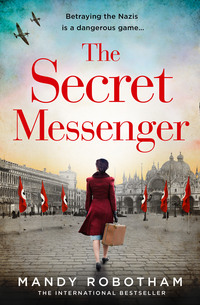
Cover photographs © Mary Evans Picture Library (Piazza San Marco, Venice), Elizabeth Ainsley/Trevillion images (woman), Shutterstock.com (flags, planes, sky)
Mandy Robotham asserts the moral right to be identified as the author of this work.
A catalogue copy of this book is available from the British Library.
This novel is entirely a work of fiction. The names, characters and incidents portrayed in it are the work of the author’s imagination. Any resemblance to actual persons, living or dead, events or localities is entirely coincidental.
All rights reserved under International and Pan-American Copyright Conventions. By payment of the required fees, you have been granted the non-exclusive, non-transferable right to access and read the text of this ebook on screen. No part of this text may be reproduced, transmitted, downloaded, decompiled, reverse engineered, or stored in or introduced into any information storage and retrieval system, in any form or by any means, whether electronic or mechanical, now known or hereinafter invented, without the express written permission of HarperCollins.
Source ISBN: 9780008324261
Ebook Edition © December 2019 ISBN: 9780008324254
Version: 2020-02-20
Dedication
To my mum, Stella – a woman of stamina and enduring style
Contents
Cover
Title Page
Copyright
Dedication
Author’s note
Prologue: Clowns
Chapter 1: Grief
Chapter 2: The Lion’s Den
Chapter 3: Bedding In
Chapter 4: Discovery
Chapter 5: A New Task
Chapter 6: Two Sides of the Coin
Chapter 7: New Interest
Chapter 8: Finding and Frustration
Chapter 9: Drinks with the Enemy
Chapter 10: A New Role
Chapter 11: Casting Out
Chapter 12: Opening Up
Chapter 13: Story Time
Chapter 14: A Voice from the Lagoon
Chapter 15: Love and Fury
Chapter 16: A Lull
Chapter 17: On Hold
Chapter 18: Small Talk
Chapter 19: A Detour
Chapter 20: Arrival
Chapter 21: The City Cauldron
Chapter 22: The Seeker
Chapter 23: A Fiery Reaction
Chapter 24: Across the Lagoon
Chapter 25: A New Hope
Chapter 26: Revenge
Chapter 27: The Bloody Summer
Chapter 28: Seeking and Waiting
Chapter 29: Sorrow
Chapter 30: A Low Ebb of the Tide
Chapter 31: Playing Detective
Chapter 32: A Parting
Chapter 33: In Hiding
Chapter 34: The Search for Coffee
Chapter 35: Red-Handed
Chapter 36: Taking Flight
Chapter 37: Age and Enlightenment
Chapter 38: After
Chapter 39: Completion
Chapter 40: The Typewriter
Acknowledgements
Keep Reading …
About the Author
By the Same Author
About the Publisher
Author’s note
War is ugly. Wherever it strikes, it destroys people, families and places, decimates lives and precious objects. Yet being so widespread, conflict also happens in beautiful places, and it was that contrast of light and dark which prompted The Secret Messenger. For me, there is no more stunning or fantastical place on earth than Venice; since my first trip in 1990, I’ve been beguiled on countless visits by the idea of a city effectively floating. I’m still in awe of its very existence and its beauty.
When I began to research how World War Two affected Venice, it became clear that historians were less captivated by its story of Resistance as perhaps in France or the Netherlands; that Venice, by comparison, had experienced a ‘soft’ war. What research I found seemed brief and factual, but those details of Venetian life – of how Venetians existed day by day – were scant. On a research trip (yes, of course, I needed to go back again!) I walked miles through Venetian calles, itching to know which areas of the city played their part in the fight against the Nazis and fascists combined.
It wasn’t until my return home that I struck gold; a chance email launched into cyberspace sparked a reply from the wonderfully named Signor Giulio Bobbo, a historian at IVESER, the Venetian Institute for the History of Resistance and Contemporary Society. His own area of expertise? The Resistance in wartime Venice. It was like manna from heaven.
Thanks to Giulio, his grounding in factual research and the nuggets of priceless detail about real life in wartime Venice, the book began to take shape. At last, I could see a Venice under the cloak of war. The more Giulio and I traded emails, the more my search seemed to run parallel to the quest within the story – it seemed only fitting Giulio’s character should make an appearance, along with Melodie the cat who, by the way, is very real and does indeed love a warm photocopier!
I knew also that I wanted to highlight the role of women in the eventual victory over the Nazis; not only the bravery of undercover agents, but the army of female messengers across Italy – Staffettas – who helped the Allies to victory. It’s hard for us in this day of social media and instant messaging to understand the value of transporting a simple slip of information on foot or by boat, but in those times it was crucial. Life-saving, in fact. Without the thousands of mothers and grandmothers across Europe who risked their own lives by carrying contraband in prams and shopping bags, we might never have seen peace at all. I hope Stella is an embodiment of those women – selfless for those around them.
Once Stella and her city became my backdrop, the next element was easy. Where else is better suited for romance to blossom than a place that hovers amid the constant ripple of water and sits under the most stunning of sunsets? And, of course, my Venice is in there too: the Accademia is my favourite bridge, Campo Santo Stefano among my preferred piazzas to people watch, and there is a small café in the corner opposite the church doorway where I have sat many a time with a good coffee and my notebook, imagining myself as a writer. Oh, and to the side is a very good gelato parlour. You can’t escape it – Venice gets under your skin.
I hope I have paid homage to those who braved the conflict in Venice; there is no such thing as a ‘soft’ war when one person loses a life, one mother a son. Venice lost too. But as with the previous centuries of invasion and plague, it recovered. It remains a jewel. Glittering. And I’ll be back there soon.
Prologue: Clowns
Venice, June 1934
A sudden eruption of noise guided us – one burst after another, pushing up into the air like fireworks on a dark night. We zigzagged through the crowds, my grandfather slicing through the swarm with his broad muscular shoulders – still with a boat-builder’s strength despite his sixty-five years. Reaching the edge of the vast piazza he pulled me by the hand, threading his way to the front of the audience, which was fenced off with a line of black-shirted militia, their backs to the expanse of the square and their stern, fixed faces towards the crowd. Inside the square, lines of Italian troops paraded up and down like ants to a continual brass band pomp of military music.
At seventeen, I was of average height and had to crane my neck to see the object of our attention, along with the rest of the crowd. The imposing, rounded girth of Benito Mussolini was easily spotted – a common figure on the front pages of the fascist-run newspapers. Even from behind, he had the appearance of being smug and overbearing, strutting next to the slightly smaller man walking beside him, distinctive only because of his dark suit rather than a gilded uniform dripping with medals. There was nothing physically remarkable about Mussolini’s revered guest from the distance we were at. I knew who he was, what he represented, but to my young eyes his presence didn’t warrant the thousands of fascist militia flooding Venice over recent days, let alone the crowds mustered to welcome him – some of whom we suspected had been strong-armed into their flag-waving support.
‘Popsa, why have we come here?’
I was perplexed. My grandfather was a confirmed anti-fascist and, though he kept his hatred of Mussolini largely within the family, he had nonetheless been a fierce opponent in the twelve years since ‘Il Duce’ had ruled Italy with his brigade of militarised bully boys. Quietly, at home or in the cafés with his most trusted friends, he raged over the way good Italians were being trodden on, their freedom curtailed, both morally and physically.
He bent to whisper into my ear. ‘Because, my darling Stella, I want you to see with your own eyes the enemy we will face.’
‘An enemy? But isn’t Hitler proposing to be a friend to Italy? An ally?’
‘Not to Italians, my love,’ he whispered again. ‘To good, ordinary people – Venetians like us – he is no friend. Look at him, watch his stealth – know your enemy when the time comes.’ His heavy, lined face set into a frown, and then he painted on a false smile as the militia neared, hoisting their guns to elicit a timely cheer from the crowd.
I peered at the object of their fraudulent praise, dwarfed by Mussolini’s pompous stature. I couldn’t see the distinctive face or the sharp lines of his frankly mocked hairstyle, which had dominated the newspapers in recent days. Yet the way Adolf Hitler moved among the Italian troops in the Piazza San Marco seemed almost reticent, guarded. Was this what we were supposed to be afraid of? Next to Mussolini and his army of bullies, he looked smaller in every way. Why did my big, burly and strong grandfather seem almost fearful?
Looking back on that day, Popsa’s whole demeanour was my first experience of the mask we Venetians – Italians, in fact – needed to adopt over the coming years. Behind the beautiful and glittering facade of Italy’s jewelled city, the veneer of Venice would take on Popsa’s frown, hiding its determination to maintain the real fabric of its people against Hitler and fascism.
But, back then, in my late teens, I wasn’t politicised – I was a young woman enjoying my last days at high school, relishing a summer on the beautiful beaches of the Lido, the late, low sun of endless Venetian days and perhaps the prospect of a fleeting summer romance. It was several years before I appreciated the significance of Hitler’s visit on that warm June day more than five years before war broke out, or the impact of Mussolini’s public fawning to a man who would become the devil to a good part of the world. At the dawn of war, when Italy pledged its military might alongside Hitler, I recall telling my grandfather what I later learned about that day in 1934.
‘You know what Mussolini said about Hitler on that visit?’ I asked him, pulling up the blanket over his whispery chest hair, watching his beleaguered lungs fighting the pneumonia which only days later would defeat him. ‘He called him “a mad little clown”.’
Popsa only smiled, suppressing a laugh he knew would force his lungs into a lengthy coughing fit.
He scooped in a breath. ‘Ah, but Mussolini is simply a big clown. And you know what clowns do, Stella?’
‘No, Popsa.’
‘They create havoc, my darling. And they get away with it.’
1
Grief
London, June 2017
The tears come in a torrent – great fat orbs that well up from inside her, catching momentarily on her eyelids. For a second, she feels as if she is looking through a piece of the thick, warped Murano glass dotted around her mother’s living room, until she blinks and they roll down her dried-out cheeks. Ten days into her grief, Luisa has learned not to fight it, allowing the deluge to cascade in rivers towards her now sodden chin. Jamie has helpfully placed boxes of tissues around her mother’s house; much like city dwellers are supposed to be never more than six feet from some kind of vermin, now she is never without a man-size hankie to hand.
Emotional fallout over, Luisa faces a more frustrating issue. The keyboard of her laptop has fared badly from the human cloudburst, and a glass tipped over in her temporary blindness – several of the keys are swimming in salt tears and tap water. It’s too late to mop up the flood – even a consistent jabbing of various keys tells her the screen is frozen and the machine displaying its dissatisfaction. Electronics and fluids do not mix.
‘Oh Jesus, not now,’ Luisa moans into the air. ‘Not now! Come on, Dais – work, come on girl!’ She jabs at the keyboard again, following it up with a few choice expletives, and more tears – this time of frustration.
It’s the first time she’s been able to face opening Daisy, her beloved laptop, since the day before her mum … died. Luisa wants to say the word ‘died’, needs to keep on saying it, because it’s a fact. Her mum didn’t pass away, because that somehow alludes to a serene exit, floating from one dimension to another without rancour, where there is time to put things to right amid crisp white sheets and soft blankets, to say things you want to say – need to say. Even with her limited experience of death, Luisa knows it was short, blunt and brutal. Her mum died. End of. Two weeks from first diagnosis, one week of that in a drug-induced coma to combat the unbearable pain. And now Luisa is the one enduring the inevitable ache of grief. Throw anger and frustration into the mix and you might touch on the myriad of emotions pitching and rolling around her head, heart and assorted organs, twenty-four/seven.
So, Luisa attempts what she always does when she cannot settle, eat, speak or socialise. She writes. Battle-scarred and sporting dog-eared stickers of love and identity, Daisy has been a reliable friend to Luisa in her need to bleed emotions onto a screen page. Often, it’s nothing more than crazy ramblings, but occasionally there is something of worth amid the jumble of words – a sentence or string of thought she might squirrel away for future use or that might well make it into the book one day. The book she will write when she is free of the inane meanderings she currently commits to the features pages of various magazines about the very latest thing in cosmetics, or whether women really do want to steer their own destiny (of course they do, she thinks as she writes – do I really need to spell it out in no more than a thousand words?). But it’s work. It keeps the wolf from the door while Jamie establishes himself as a jobbing actor. But one day the book will happen.
Daisy is party to this dream, a workmate and a keeper of secrets too, deep down in her hard drive.
‘Christ Daisy, what happened to loyalty, eh?’ Luisa mutters, and then feels immediately disloyal to her hi-tech friend. Half drowned in human tears, she may well have reacted in the same way and refused to go on. Daisy needs TLC and time to dry out on top of the boiler. In the meantime, there are pent-up emotions to spill – and for some inexplicable reason a pen and paper is not up to the job. Luisa feels the need to hit something, to bash and clatter at the keys and watch the words appear on screen as if they have magically appeared from somewhere deep inside her, separate to her conscious thinking. Being a child of the computer age, and with her grief threatening to spew, a pen will simply not allow those words to explode from her with venom or unbounded love, or the anger that she cannot contain.
A thought strikes her: Jamie had been up in her mother’s attic the day before to assess just how much clearing out lay ahead of them. As Luisa was tackling the cancelling of direct debits and council tax, he mentioned seeing a typewriter case tucked in the eaves, one that looked fairly old but ‘in good nick’. Would it be worth anything? Or was it sentimental value, he’d asked. At the time, she dismissed it as non-urgent but now her need is greater.
The loft space is like a million others across the globe: a curious odour of old lives dampened and dust that flies up with irritation as you disturb its years of slumber. A single light bulb hangs from the timbers, and Luisa needs to adjust her eyes before objects come into focus. She recognises a few Christmas presents she took pains to choose for her mother – a thermostatic wrap for her aching back and a pair of sheepskin slippers – both of which look to have been barely out of their wrappers before being abandoned to the ‘Not Wanted’ pile. Another reminder of the distance between mother and daughter, now never to be bridged. She pushes the memory away – it’s too deep inside her for now, though it constantly threatens to push through into her grief. It’s therapy for another day. Luisa ferrets around for a few minutes, feeling her frustration rise and wondering if this is the best pastime at this moment, when things still feel so raw. She both relishes and dreads finding a family album where she knows she won’t be able to stop herself from turning the dog-eared pages of so-called happy memories. All three of them on the beach – her, Mum and Dad – fixed Kodachrome smiles all round. In better days.
Mercifully, an object that is not a fat bound book of memories pushes its way out of the gloom. Instead, it’s a grey, moulded case whose shape – square and sloping towards a brown leather handle – means it can only be one thing. It has the look of a life well worn, the scuffs and scratches immediately reminding her of the history Daisy sports on her own casing. There is a distinctive twang as both clasps spring upwards under Luisa’s fingers, and what almost sounds like the escape of a human breath as she lifts the lid. Even under the dim light, she can see it is beautiful – a monochrome mix of black and grey, white keys ringed with a dull metal and glowing bright against the dimness. Luisa puts a tentative finger on one of the keys, pressing it gently, and the mechanism reacts under her touch, sending a thin metal shaft leaping towards the roller. It hasn’t seized up. She notes, too, that there is a ribbon still attached and, even better, a spare, sealed reel tucked alongside the keyboard. The aged cellophane is intact but almost disintegrates under her finger. If fate is on her side, however, the ribbon won’t have dried up.
Luisa fixes the lid back down and pulls the case away from a pile of boxes – it’s surprisingly light for an old machine. As she pulls, the lid on one of the boxes slides off, sending a puff of dust in its wake. She turns to replace it, but her eye catches a single photograph, black and white yet sepia-toned with age. It features a man and a woman – their joyful expressions suggest a couple – standing in St Mark’s Square in Venice, the distinctive grandiose basilica behind them, surrounded by a groundswell of pigeons. She recognises her mother in the features of the woman, but not the man. Luisa searches her memory – did her mother and father even mention going to Venice, perhaps for their honeymoon? It looks that kind of photo – the couple seem happy. It’s not how she remembers her parents, but she thinks even they must have been in love once. And yet the photo looks older than that, from a bygone age.
Luisa is aware of her Italian roots, the spelling of her name being an obvious indication. Both of her mother’s parents were Italian, but they died some years ago; her grandfather when she was just a baby, and grandmother in her early teens. She knows very little about their history – her mother would never talk about it – except that they were both writers. She likes to think she has inherited at least that family trait from them.
She flips over the photograph; scrawled in pencil are the words ‘S and C, San Marco June 1950’. Her mother was Sofia, but she was born in 1953, so maybe it’s her grandmother’s face beaming contentment? S for Stella? Perhaps that’s Luisa’s grandpa standing alongside her – Luisa barely remembers him, only a fleeting image of a kindly face. But his name was Giovanni. So who is C? It’s entirely possible he was a suitor before Grandpa Gio, as she knows they called him. Luisa’s curiosity gives way to a smile, her first in days, and the movement of the muscles feels odd. She thinks they look so stylish, he in his high-waisted suit trousers, and she in a neat Chanel-like suit and elegant court shoes, her hair swept in a chic, black wave.
Luisa bends to replace the photograph in the box, but sees that underneath a decaying layer of tissue paper there is more – photographs and paper scraps, some hand-scribed and others typed in an old font, perhaps on the newly discovered machine? To any other curio browser it would warrant a look at the very least, but to a journalist it spikes the senses. There is something about the smell too – the pungency of old dust – which sticks in Luisa’s nostrils and makes her heart beat faster. It reeks of lives lived and history unmasked.
The whole box is heavy and awkward to manoeuvre down the attic stairs and into the living room. In the daylight however, she sees the real treasure come to light. Under a layer of loose type and several browned, brittle newspapers bearing the name Venezia Liberare, Luisa can sense it: a mystery. It’s in the fine sandy texture under her fingers as she gingerly lifts the paper cache – men and women grinning in fuzzy tones of black and white, some she notes casually using rifles as props, or proudly holding them across their chests, women included. Momentarily, she is shocked; in a distant memory, her grandma never appeared as anything other than that – a sweet old lady who dished out cuddles and chocolates, grinning mischievously when she was inevitably rebuked by Luisa’s mother for spoiling her with sweets. Sometimes, Luisa remembers her slipping little wrapped bars when no one was looking, whispering ‘Shh, it’s just our secret’, and she felt like they were part of a little gang.
The typewriter is momentarily forgotten as Luisa picks up each piece, peering at its faded detail, squinting to fill in the gaps of pencil scratchings lost to the years. It hits her squarely then – how many people’s histories are contained in this cardboard box with its sunken edges and corners gnawed at by the resident mice? What might she discover in its depths amid the deceased spiders and smell of mould? What will she learn about her family? She wonders, too, if there is an element of fate in her discovery, if today of all days she was meant to find it – to piece it all together in some order, and in turn glue her recently shattered self back together. For the first time in weeks, she feels not defeated or leaden with grief, but lifted a little. Excited.
2
The Lion’s Den
Venice, early December 1943
I think of that pre-war exchange with Popsa often; the word ‘havoc’ resonates a lot these days, more so after last night’s atrocities in the Jewish ghetto: hundreds rounded up like cattle by Nazi troops and their fascist handmaidens, men and women pulled out of their homes – stoical in the face of their screaming, tear-stained children abandoned behind them – and herded into boats destined first for the prison of Santa Maria Maggiore. To be separated from their families was bad enough, but all of Venice knew their eventual destination, and they did too – east into Germany, to Auschwitz. To an almost certain death.
I rub the obvious lines around my eyes, hoping to smear away any smut from the fires that continue to smoulder in the ghetto. Having spent the early hours running from house to house across Venice, breathlessly passing messages and false identification papers to those in need of them, the smell of cordite and desperation is still there in my nostrils. If there was any chance to save even a few families from the cull, we – the Resistance – had to try; huddling women and children in the smallest of hiding places, in cupboards and attics. I saw mothers trying desperately to keep their babies quiet, hands cupped over little mouths, the fear of just one cry or murmur etched on their faces. Our partisan leaders were taken by surprise by the Nazis’ sudden strike on the Jewish enclave; as I weaved breathlessly through the warren of alleyways and tiny passages, avoiding the Nazi scrum, staying out of sight of any patrol and their inevitable questions as to why I was out during curfew and where exactly I was going, it felt like we were fighting a losing battle. We worked all night but, in the clear light of day, it’s evident we only succeeded in damage limitation.
My whole body feels limp and defeated, though I’ve had the luxury at least of returning briefly to my own apartment for an hour’s sleep, a change of clothes and a smear with a wet flannel. Those Jews taken simply for their birthright, born into a religion despised by the Nazis, are now on a cold, inhospitable floor with little respite to look forward to. I am a lucky woman.
‘Another espresso?’ Paolo pulls away my empty cup from the counter and pushes a second, full cup in its place, without waiting for an answer. He only has to look at my face, hastily touched with some of the precious make-up I’ve been rationing and a smear of red lipstick. The coffee is welcome, though it isn’t, of course, the sharp but silken blend of pre-war days. Paolo and his father, owners of the café in the square below my apartment since time began, are masters at making the fake coffee – ersatzkaffee – seem Italian at least; the hiss of the gleaming machine, the way Paolo pours it lovingly into the tiny cup with a true flourish. If nothing else, it helps wake me up.
‘Good luck, Stella,’ Paolo chimes as I swallow down the coffee and wave goodbye. His parting wink tells me he knows exactly where I’m going.
I walk the twenty minutes from streets around the Fondamenta Nuove to the Nazi headquarters on the grand central piazza of San Marco, trying to nurture a spring in my step the closer I get to the Platzkommandantur. The bright winter sun rising over the Arsenale helps lift my mood, lending a distinct pinky hue through the smaller canals, from one bridge crossing to another, the milky jade of the water lapping at the red and orange brickwork. Usually, this is the best time of the day for me, when Venice is waking up, stout old women in black optimistically on their way to buy whatever they can in the relatively sparse markets. Today, though, the morning buzz feels dampened as news of the ghetto’s cull winds its way through the city. Soon, each and every café and bar will have talk and opinion, someone will know of another who has been taken – be it relative or colleague. In a city like Venice, the people connect and weave like the canals that are its vital arteries.
There are few troops – either Nazi or fascist – around at this time of the morning, but we Venetians have been schooled into believing that eyes are everywhere. Despite my true feelings, those of a proud anti-fascist, like my beloved grandfather, I have to look eager as I’m about to enter the enemy’s nerve centre – and not as a prisoner or suspect, but an enthusiastic new member of staff. Automatically, I adjust my mask and take on the look of a grateful collaborator, a Venetian glad to have the protection of our better, bigger German cousins. We Italians have learned to play the part of the poor relation very well. We’ve had years of practice.
We know what people in the outside world say – that Venetians have had a ‘soft’ war, protected as a kind of oasis because of our city’s beauty and grandeur, its precious art, targeted by the Allied bombers as a place to avoid rather than effect ruin. To some extent it’s true: the classical music still plays in Piazza San Marco, although these days it’s more likely to be the Hermann Goering Regimental Band with its stylistic pomp, replacing any true elegance. The annual celebration of art at the Biennale continues, attracting the rich and beautiful, as well as the Nazi propaganda king in Joseph Goebbels. But tell that to the mothers whose teenage boys were swiftly marched away to Lord knows where as slave labour for the Nazi machine, like a warped playing out of the Pied Piper fable. That early September day only a few months ago is still fresh with me, when the coloured leaflets fluttered from the sky, informing us that the Nazis were coming to conquer our city. To most Venetians – after years of fascist dictatorship under Mussolini – it was simply another coup, another plague. It was followed only days later by the resounding stomp of jackboots on our ancient flagstones, and the Nazis quickly made themselves very comfortable in our requisitioned palaces on the Grand Canal, easing themselves into the bars and outdoor eating places like it was some sort of vacation.
Venice appears on the surface to be compliant, relenting. But I know different. For all its outward splendour, Venice hides itself well; in deep, dark alleyways, behind the painted green shutters, I know for certain there are hives of activity, thousands working to skew the intricate planning of our unwelcome squatters and claim back our city. For now, we do it quietly. But we aim to be ready.
It was a heart-stopping moment when I received a message to attend the offices of the German High Command, on one end of the Piazza San Marco. Since the full occupation in September, when the city swarmed with the grey-green troops of the Wehrmacht and the ashen colours of the SS, it’s a place I’ve taken pains to sidestep, going out of my way to avoid walking across the piazza in full view of the young German sentries, bored and eyeing up pretty young Venetian women. On being summoned, I imagined my membership of the anti-fascist Action Party had been discovered or revealed, but, if it had, there would have been no request to attend – more likely a sudden raid by Italian fascist Blackshirts, and a stay in their none too salubrious headquarters at Ca’ Littoria, becoming painfully familiar with their torture methods. We have learned quickly that the Germans are not here to get their hands dirty if at all possible. Only to oversee the annihilation of freedom.
I have been careful in recent years to publicly align myself with no one in particular, keeping a low profile as a typist in the Venetian works department, the government division responsible for making our fairy-tale city function day to day, even through war. I’d been ‘recommended’ for the job by Sergio Lombardi, a seemingly fine upstanding citizen who, in his other life, is Captain Lombardi, the commander of Venice’s Resistance brigade. The information I gleaned while in the works department proved useful to the partisan groups fighting the Nazis and fascists across the entire Veneto region, though I never imagined it saved lives. When I doubted it, when I itched to do something more useful – more visible – Sergio took pains to reassure me that the detailed knowledge of the city’s workings was vital in helping their troops move undiscovered in and out of Venice. The comprehensive plans I had access to were perfect tools for ghosting Allied soldiers away to safety now the Nazi occupation of Northern Italy made it impossible to move freely.
And now, thanks to maintaining that low profile, I am here, about to enter the lion’s den; my transfer to Nazi High Command – the Reich headquarters – has been requested because of my fluent German, although the move couldn’t be more timely or fortuitous. Or intimidating.
Beyond the grand exterior near the Correr Museum in San Marco, I present my pass from the works department and a young German soldier runs down a list for my name. He seems pleased to find it.
‘Up the stairs, first door on your right,’ he says in faltering Italian.
‘Thank you, I’ll find it,’ I say in German and he smiles his embarrassment. Poor boy, he’s no more than a child, perhaps the same age as my brother, Vito. Too young for this, both of them.
The office at the top of the sweeping marble stairway is behind a large, ornately carved door. It’s filled with desks in a strict formation, the opulent walls of the vast room deadened by the austere dark wooden furniture and the Nazi icons dotted around. A fierce clattering of typewriters hits me like a wave and I’m briefly startled. I must have shown it because a man approaches – I can tell from his face and his civilian clothes that he’s Italian, and I’m surprised again, though pleased too. Even now, a stark Nazi uniform makes me pull in a short breath and I feel a guilt rising in me, although I’ve become adept at hiding it.
‘Morning. Can I help you?’ the man, in his well-cut grey suit, says in Italian. He’s not Venetian; his accent says he’s from the south. Tall and with a short, dark beard – in his early thirties I guess – he looks immediately out of place amid the military surroundings, reminding me of an academic or librarian. His whole demeanour is Italian; it’s only the tiny metal pin on his jacket lapel – the jawless death’s head insignia – that tells me he is a fascist too. A paid-up member of Mussolini’s gang. In any other scenario, I might have thought him attractive, but here, he is marred by his allegiance.
‘I’ve been sent here by the works department – as a typist and translator,’ I venture, holding out my references. ‘Am I in the right office?’
He scans the papers, holding them closer to his face, and I notice his large brown eyes scanning the script.
‘Welcome Signorina Jilani,’ he says. ‘Yes, you’ve found the right place. I’ll show you to your desk.’
He turns and leads me towards the back of the room, passing a vacant desk with a silent typewriter upon it. Backing onto a wall entirely shelved with books and files, he gestures to an empty desk with a large machine to the side.
‘There, that’s for you,’ he says.
‘Oh, I thought I would be over there with the other typists,’ I say, casting a backwards glance. The desire to blend in is well grounded in me.
‘Well, as you’ll be translating for General Breugal, I thought it would be better if you were nearer his office’ – he nods his head slightly towards a closed door, even larger and more ornately carved than the last – ‘since he has a tendency to be a little brief when it comes to instructions. I can’t see him striding across the office ten times a day – he would get a bit annoyed about that. It will hopefully spare you some of his …’ he falters over the next word carefully … ‘irritation.’
He smiles as he says it, an embarrassed offering, perhaps because he’s betrayed a little of his opinion of the general, in painting him as some blustering despot. Except the general’s reputation is anything but – a despot, yes, but his cruelty is already well known within the Resistance.
‘Well, thank you for that in advance,’ I say. I’m genuinely grateful, since the last thing I want to do is attract any unwanted attention. I’m here to type, to translate and to absorb what will help the partisan Resistance wage war with effective sabotage against our German trespassers. But I’m also here to be utterly compliant, in office hours at least.
‘Marta will show you the bathroom and the canteen, and I will arrange a meeting with General Breugal when he arrives shortly.’
I nod, and he turns to go. ‘Oh, and by the way, my name is Cristian – Cristian De Luca – under-secretary to the general, admin mostly. Civilian.’ He adds the last part most definitely, as if he doesn’t want me to guess he’s a card-carrying fascist. As if by not wearing a black shirt and donning a dark ski cap, he’s not part of the bully brigade. But I know plenty of innocents who have been condemned by a typewriter, by being on a list. I have to remind myself that what I’m doing is not collaborating – my Resistance commander assures me the information I can absorb will save many more lives than I could ever condemn.
‘Please come to me if you need anything, or you have a problem.’ Cristian De Luca smiles weakly, but even his friendly eyes don’t convince me. I nod again and return his expression, because that’s what I’m supposed to do.
I have time enough to meet some of the other typists over tea before I’m called in through the foreboding door. I grab the pen and notebook on my desk, not knowing whether it’s simply an interview or if I’m expected to begin work immediately. Beyond the door, the walk towards the desk is a long one as the office is vast, with high ceilings and walls crawling with carved plaster figures. My eye is drawn to the overly large picture of the Führer placed over the grand fireplace. His expression in such portraits never ceases to make me laugh inside, as though he’s swallowed too much of my mother’s chilli pasta and is feeling the effects on his digestion. There’s an unmistakable stench of cigar smoke, and the winter sun streaming through the tall windows creates a swirl of dirty white clouds.
‘Fräulein – I beg your pardon – Signorina.’ A voice comes from behind the smoke, and I see his face at last. It’s fat. That’s my first impression. He’s vast. His red, oily skin is stretched tight over wide cheeks, pumped up no doubt by good living and too much grappa, and he sports a meagre moustache, not even worthy of being fashioned into anything like Hitler’s silly little brush. His black eyes sit like minuscule cherries in the pudgy dough of his face; his body a larger version of the same, squeezed with effort into his green Wehrmacht tunic. At first I think he has the face of a fool, but know at the same time it’s never good to underestimate the hatred he and his kind might harbour; hatred for Jews, alongside a disdain for weak Italians who need hand-holding in this war. He hasn’t earned his place behind that desk by not showing strength. Already General Breugal has made a distinct – and deadly – impression on Venice’s opposition to Nazi penetration of our city; last night’s ghetto cull was just one example of his zeal to carry out Hitler’s cleansing of Jews from our city.
Breugal doesn’t get up, but merely extends a hand across the desk and I have to make contact with his moist fingers before I sit down in one of two chairs placed in front of the desk. He looks up from his furious scribble and digs the stub of his cigar in a nearby ashtray.
‘So, I will need a minimum of two typed reports daily, translated from German to Italian,’ he says in clipped German. ‘I take it you are fluent?’
‘Yes, Herr Breugal.’
‘General,’ he corrects briskly.
‘Sorry – General,’ I say. I worry that I’ve marked myself out already but he barely looks at me, so I feel safe his arrogance will lead to a general ignorance about me. And that’s the way I want to keep it.
Once I’m dismissed with a grunt and a wave of the general’s hand, I head back to my desk, clutching the first report I need to translate. Outside the door, I meet the general’s long and lean – and much younger – deputy, Captain Klaus. He introduces himself, but there’s no emotion in his voice – it’s merely duty. There is, however, a steely glint to his blue eyes. I do the best I can to remain businesslike even though I can almost feel the heat of this first report on my chest.
Finally, Captain Klaus feels we have exhausted the formalities and I sit down and open the pages. This is pure gold for the Resistance, information straight from the horse’s mouth which they will use to plan sabotage of German movements, initiate rescues of targeted families, and generally be a thorn in the side of the Nazi regime. Tempting though it is, we can’t use all of the intelligence consistently – my Resistance colleagues have made it clear my position is to be protected, so that I can remain in post without arousing suspicion. To General Breugal, and the slightly odd Cristian De Luca, I am a good Italian girl, a patriot and lover of order, a true believer that fascism will win out over the current chaos. I am to be trusted.
At first glance, the report I am to translate looks to be merely an engineering update on precious water supplies in Venice, pumped in from the mainland. But as I consult my German-Italian dictionary for more specific words, I discover it’s also about rerouting food supplies through new shipping lines, although the word ‘supplies’ doesn’t always appear to refer to scarce flour, sugar or wheat. The report’s complexity means I can’t possibly remember it word for word, despite having a talent for ingesting and harbouring facts. Luckily, the Resistance has prepared for this. They know I can’t risk making a carbon copy of my translation, or writing notes in my own hand, so it’s been agreed with my unit that I’ll type up brief notes I can immediately recall in the office. Operating in plain sight is sometimes the best form of camouflage and I’m suddenly grateful that having a desk backing onto a bookcase is useful for not being overlooked. Or else I will scribble any facts the minute I can make excuses for a toilet break. A sympathetic cobbler has already made adjustments to several pairs of shoes, allowing me to hide folded notes in my heels. I’ll return to my desk, with an expression of indifference and a willingness to carry on the Reich’s work. That’s the plan.
‘Fräulein Jilani, have you settled in?’ The voice is raised above the office noise and takes me by surprise, not least because Cristian De Luca’s German is cut-glass perfect. He sees my surprise.
‘Yes, we speak German in the office – the general prefers it,’ he explains. ‘Do you have everything you need?’
‘Yes, thank you,’ I say, my eyes glancing back to my keyboard. I need to work quickly to complete both the official and unofficial notes, though not so noisily that I attract attention. Sergio, Captain of the Venetian Resistance Central Brigade and my commander, has stressed that I’m to lie low for several days, or even weeks, not be intent on passing information, but this to me looks too important. I feel sure it could really make a difference. I need to get on and this man is loitering.
Still, Cristian De Luca hovers beside my desk. I look up, inquisitive.
‘Erm, I’m just hoping everything was all right with you and the general?’ he ventures. ‘Nothing too … brusque?’
‘No … no,’ I lie, purposely upbeat. ‘He was … direct, but perfectly charming.’
‘Good, well, don’t hesitate to, you know …’ His last words are lost as the general’s voice comes booming from behind me, prompting one of the secretaries to scurry towards the door, almost turning a heel as she goes.
Cristian De Luca walks towards a desk by the window, annoyingly only two away from my own. He puts on a pair of tortoiseshell-rimmed glasses and opens up a file to read. Now I think he looks even more like a librarian.
The efforts of the previous night are beginning to take their toll – my eyes are smarting with tiredness as I pull the cover over my machine at the end of the day, while the office begins to empty. One of the office girls asks if I’d like to join them for a drink but I make an excuse that I’m expected at my parents’ for dinner. The thought of a bowl of Mama’s pasta – exquisite even with increasingly scant ingredients – makes my mouth water, but instead I grab a bread roll from a nearby bakery and head briskly in the opposite direction, wrapping my coat around me as I head towards the canal’s edge. Despite my fatigue, it’s time for the third part of my full and sometimes complicated life.
Waiting at the stop for the vaporetto that will transport me across the expanse of water to the island of Giudecca, I stare at the soaring tower of the church of San Giorgio Maggiore, perched on the adjacent island’s edge. The Palladian monolith looks particularly magnificent tonight, caught in the occasional beam of boat traffic toing and froing across the lagoon. I’m not particularly religious – not as much as Mama would wish anyway – but the tower’s continued existence through centuries of war and strife warms my heart. That warmth is particularly welcome now since the bitter wind is apt to whip through this wide stretch between Venice proper and what’s considered the less ornate, more industrial Giudecca. But that’s what’s so attractive about it tonight, for me at least. The sometimes choppy waters are a divide which helps more than hinders.
The crossing is unhindered by German patrol boats and takes just ten or so minutes; I’m one of only a dozen or so passengers stepping onto the pontoon at Giudecca. The streets are mostly dark with minimal lighting – a consequence of burned-out bulbs not replaced – but I have a mind map of where I’m going. I think I could find it in my sleep, which is a bonus since my eyes are struggling to stay open after so little rest. But I must. This is business and not pleasure. However tired I am, there is more typing to do, though rather than reports to uphold the Nazi occupation, these are my words. Each time I come to Giudecca, I become a different type of translator, one whose fiercely loyal passion for the Resistance is laid on a page for all of Venice to see. It’s one part of my contribution to the partisan cause, defenders of our city. Popsa always said that one day my love of words would mark me out and, each time I step onto Giudecca, I like to think he’s right.
As I round the corner into the tiny, darkened square, a glow pushes out from the ground-floor windows of the café-bar, blinds only half drawn, while the low hum of conversation from behind a heavy wooden door is the sole noise in the empty plaza.
‘Evening Stella,’ says Matteo, the bar’s owner, as I walk in to a general wave of welcome from the ten or so customers. I’m among friends here.
‘Hello everyone,’ I say as chirpily as I can manage. I walk to the back of the bar and into a tiny room, little more than a cupboard, where I replace my coat with a white waitress’s apron around my waist. Instead of heading back out to the bar, though, I knock three times on a door tucked in one corner of the room and turn the handle.
‘It’s Stella,’ I sing in warning as I descend a short set of wooden stairs, towards the dim light below. Arlo looks up from his desk, squinting at me and then back at the paper he’s working on. Poor Arlo – his eyesight is bad enough as it is, without the strain of the faint light and the tiny print he peers at for hours on end. His thick glasses lie discarded on the table as he pulls the page close to his face – his eyesight is a family trait that saved him from an enforced draft into the Italian army, and more than likely prevents the Resistance from allowing him anywhere near a gun, but he’s the best of typesetters. Twice a week, our little band of aspiring paper-producers meets under a cloak on Giudecca to create and construct the weekly Venezia Liberare newspaper. As its name suggests, it’s about spreading the word of liberty and freedom for all Venetians, reclaiming something of our own. And amid the typeset lines of news and local chatter, there is – we think – a manifesto of hope.
Yet Venezia Liberare does not lie side by side on the newsstands with Il Gazzettino and other mainstream papers, those largely controlled by fascist sympathisers. It’s created, printed and collated in this tiniest of spaces, packed and transported under cover of darkness to all corners of Venice, where shopkeepers loyal to the cause will keep a pile of ‘something special’ under their counters, passing over the goods on the quiet, and, with it, the word that we are all still here. Ready and waiting.
‘Hey, Stella, we’ve got eight pages to fill tonight. I hope you’re raring to go,’ Arlo says enthusiastically. My heart sinks for a second and my fatigue rises like a wave but, as I pull up my chair and lift the lid on my typewriter, there’s a rush of energy within me. Just the sight of this machine has that effect on me. It’s much smaller and neater than my industrialsize typewriter in the Reich office, the one with a high slope of keys and tall roller, the shiny metal of grey and black, emulating the SS livery. The shine that my own machine once sported on its black frame is now dimmed and scratched, and some of the bright white keys are grey and smudged with ink, tattooed with my own fingerprints, but it cheers me like a good friend. For years now, since Popsa brought it home on my eighteenth birthday, this small machine has been my workmate, my comrade even. My voice.
We’ve been through quite a lot. In what now seems like an entirely different life as a journalist, I shunned the heavy, brooding office typewriters in favour of my neater, more portable tool. We went on story assignments together, allowing me to type up my notes quickly, settle my thoughts on paper, sometimes sitting on the steps of a nearby church or outside a quiet café, basking in the spring sunshine. I was a junior reporter only, but it was my dream job after high school: slightly frowned on by Mama, secretly tolerated by Papa, and overwhelmingly encouraged by Popsa.
‘This could be your future,’ he’d beamed as I’d opened the carefully wrapped birthday present. ‘You can win battles and change minds with this, Stella – better than any weapon.’ He had insisted on buying an Olivetti machine, the good Italian family firm having solid anti-fascist affiliations, later proven in their wartime actions of creative sabotage which saved many lives.
Of course, being Popsa, he was right. I typed until I drove the entire household to distraction; I created stories, I tapped out memories and wrote fairly terrible poetry. And all those words, channelled from inside me onto the page, via the conduit of my beautiful, clattery Olivetti, helped me towards securing my dream post on Il Gazzettino, the influential daily covering the entire mainland Veneto region surrounding Venice. I was blissfully happy for a time, until its increasingly fascist politics became as dark as the storm clouds of war over Europe.
However, I haven’t got time to dwell on that as I sit in the much less salubrious – but no less important – underground office of our clandestine newspaper. In my hand is a sheaf of hand-scrawled notes on crumpled scraps of paper, some typewritten reports and shorthand transcripts of radio transmissions. Each has made its way from Resistance members in Venice or captains in charge of the mountain fighting groups, via several messengers, to our unassuming basement office. Mothers and grandmothers have sat for hours in their dimly lit kitchens listening to transmissions via Radio Londra – the aptly named BBC service which brings us news of the outside world – scratching down details of the fight beyond Venice. Somehow, in the next three hours, I have to understand and shape these snapshots of defiance into news stories, in time for Arlo and his one regular helper, Tommaso, to typeset and print our weekly edition of Venezia Liberare. It’s our own, tangible way of telling ordinary Italians that they are not alone in the fight against fascism.
Matteo brings me another welcome cup of coffee and I set to work. Not for the first time, I thank providence that my first year on Il Gazzettino was spent converting press statements into readable stories. Back then, I thought it a form of punishment for the new girl, intensely frustrated at not being allowed beyond the office doors to carry out any real reporting. Now I know it was a valuable skill to perfect. As each story is finished, I tear it from the machine, lean backwards in the chair and hand it to Arlo and Tommaso, a young boy not yet out of school whose father is a partisan lieutenant, as they set to work mapping out the pages.
Tommaso is fairly new to our little workroom and, we’ve recently discovered, is something of an artist with a gift for adult cartoons; his dry, sarcastic take on fascist leaders – our pompous beloved Benito Mussolini especially – has worked its way into the pages. In among the serious reports of partisan victories in the mountains, ground captured and trains derailed, we’re able to provide a lighter tone to our readers. After all, it’s our sense of humour as Italians that’s enabled us to survive through twenty years of fascist oppression, and a war to top it off. In the cafés and canteens and campos, you can still hear Venice laugh.
When he first joined us, I could sense Tommaso’s wonder at the barmaid in her apron typing out the stories – the whispered question to his fellow setter – until Arlo explained that my name is on the bar’s list of employees and as such I have to be ready to play my part at a second’s notice, albeit quite badly. Fascist soldiers occasionally make it over to Giudecca in the late hours, looking for trouble, alcohol, or both. Only a month ago. two officers – already half-drunk – demanded drinks along with the employee rota; I just managed to make it up from the basement in time to grab a discarded apron, steering them away from the ‘beer cellar’ with a winning smile and several more drinks. Since then, I’ve donned an apron as a habit.
Бесплатный фрагмент закончился.