Читать книгу: «Good Wives»
GOOD WIVES
Louisa May Alcott

Copyright
William Collins
An imprint of HarperCollinsPublishers
1 London Bridge Street
London SE1 9GF
WilliamCollinsBooks.com
This eBook edition published by William Collins in 2016.
Life & Times section © HarperCollinsPublishers Ltd
Gerard Cheshire asserts his moral right as author of the Life & Times section
Classic Literature: Words and Phrases adapted from Collins English Dictionary
Cover by e-Digital Design
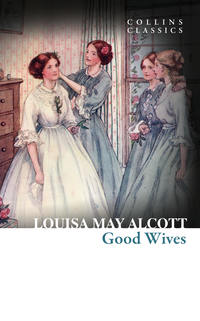
Cover image: Meg prepares for her wedding to John Brooke, in the gown she has made herself, M. V. Wheelhouse, 1911 © Mary Evans Picture Library
A catalogue record for this book is available from the British Library.
All rights reserved under International and Pan-American Copyright Conventions. By payment of the required fees, you have been granted the non-exclusive, non-transferable right to access and read the text of this e-book on-screen. No part of this text may be reproduced, transmitted, down-loaded, decompiled, reverse engineered, or stored in or introduced into any information storage and retrieval system, in any form or by any means, whether electronic or mechanical, now known or hereinafter invented, without the express written permission of HarperCollins.
Source ISBN: 9780008166731
Ebook Edition © January 2016 ISBN: 9780008166748
Version: 2015-12-04
History of Collins
In 1819, millworker William Collins from Glasgow, Scotland, set up a company for printing and publishing pamphlets, sermons, hymn books, and prayer books. That company was Collins and was to mark the birth of HarperCollins Publishers as we know it today. The long tradition of Collins dictionary publishing can be traced back to the first dictionary William published in 1824, Greek and English Lexicon. Indeed, from 1840 onwards, he began to produce illustrated dictionaries and even obtained a licence to print and publish the Bible.
Soon after, William published the first Collins novel, Ready Reckoner; however, it was the time of the Long Depression, where harvests were poor, prices were high, potato crops had failed, and violence was erupting in Europe. As a result, many factories across the country were forced to close down and William chose to retire in 1846, partly due to the hardships he was facing.
Aged 30, William’s son, William II, took over the business. A keen humanitarian with a warm heart and a generous spirit, William II was truly ‘Victorian’ in his outlook. He introduced new, up-to-date steam presses and published affordable editions of Shakespeare’s works and The Pilgrim’s Progress, making them available to the masses for the first time. A new demand for educational books meant that success came with the publication of travel books, scientific books, encyclopedias, and dictionaries. This demand to be educated led to the later publication of atlases, and Collins also held the monopoly on scripture writing at the time.
In the 1860s Collins began to expand and diversify and the idea of ‘books for the millions’ was developed. Affordable editions of classical literature were published, and in 1903 Collins introduced 10 titles in their Collins Handy Illustrated Pocket Novels. These proved so popular that a few years later this had increased to an output of 50 volumes, selling nearly half a million in their year of publication. In the same year, The Everyman’s Library was also instituted, with the idea of publishing an affordable library of the most important classical works, biographies, religious and philosophical treatments, plays, poems, travel, and adventure. This series eclipsed all competition at the time, and the introduction of paperback books in the 1950s helped to open that market and marked a high point in the industry.
HarperCollins is and has always been a champion of the classics, and the current Collins Classics series follows in this tradition – publishing classical literature that is affordable and available to all. Beautifully packaged, highly collectible, and intended to be reread and enjoyed at every opportunity.
Life & Times
About the Author
Louisa May Alcott was born into a family of American transcendentalists, the second of four daughters. Transcendentalism was essentially a movement initiated in reaction to a feeling that society was eroding its mores and was consequently in need of reform. Alcott was therefore immersed in an environment of progressive thinking and intellectualization during her formative years. This included a strong moral objection to the notion of slavery, which would become the lynchpin of the American Civil War (1861–5). The Alcotts hid a runaway slave in their house in 1847, such was their commitment to the cause.
During the war itself Alcott worked as a nurse and it was her experiences that served to hone her story-telling skill. It wasn’t until early middle age, however, that she became a success. In 1868 the first part of Little Women was published to great acclaim and her reputation grew from there. But her life was not a long one, and she died of ill health at the age of 55 in 1888.
Apart from the Little Women trilogy, she wrote many other novels and children’s stories, which are better known in the United States. Her writing style remained more or less similar to Little Women, because she was primarily interested in the comings and goings of people in her stories. They are the forerunner of the cast novels written by modern-day writers such as Maeve Binchy, where the stories are windows into many interrelated lives.
On a socio-political level, Alcott’s legacy is that she is held aloft as an early feminist and humanitarian. Her high intellect rendered her unable to resist the testing of conventions in her real life and in her literary alter-egos. She lived through the turbulence of the American Civil War and saw America metamorphose into a modern nation where slaves were freed of their literal chains and women were freed of their metaphorical chains. It was a dual emancipation and Alcott effectively documented the event in her prose.
Little Women
Published in its entirety in 1880, Little Women is a novel about an American family from a female perspective. Louisa May Alcott based the story on the formative years of herself and her three sisters. It is a novel that says a great deal about people and society without requiring a complex or sweeping plot to carry the reader along.
The primary theme is that siblings each have different personalities despite their having been brought up in the same family environment – nature versus nurture. Alcott gives each of the four sisters particular idiosyncrasies that signature their personalities and generate advantages and disadvantages for them. Thus they are each known for being vain, quick-tempered, coy or selfish. The novel is partly about the extent to which children live up to their ascribed personality traits once they are known for them, or rather are allotted them, as if parents need to compartmentalize their children’s characters.
Alcott was writing at a time when people held deeply Christian values, where the ideal person was the opposite of all of these traits: modest, level-headed, outgoing and giving. The idea was to pretend to be that ideal, albeit unattainable, synthesis. It was all about being virtuous and wholesome in the eyes of the Christian God, and also a good prospect as potential wife or husband material in the eyes of others who held the same views. Thus Alcott generally regards the traits of the March sisters as personality flaws, as opposed to strengths, and the four sisters struggle to overcome them rather than embrace them.
The title Little Women has been interpreted in two ways. Firstly, as an expression of the relative unimportance of women in comparison to men in 19th-century America. Secondly, the title is often read as a statement about the general lack of significance of most people in society. It seems likely that the title encompasses both meanings: i.e. that women, and especially those of mediocrity, possess a diminutive presence.
The Character of Josephine March
Alcott allegedly based the central character, Josephine March, on herself. She is the one with a furious temper, and acts as a device by which Alcott can vent her frustrations at the world’s unfairness to women. Like Alcott, Josephine is something of a tomboy and therefore cannot appreciate why society draws a distinction between the genders. As far as she is concerned, women can do anything men can do.
The author’s intention was to make Josephine the perpetual spinster due to her feminist views, but rather ironically, she ended up marrying her off to keep her readership happy, such was society’s desire to see her conform to norms. Josephine struggles throughout the book with the parameters of womanhood. She wishes to take up arms during the Civil War and she wishes to attend college, but both ambitions are denied to her. Most of all she is vexed by other people’s expectation of her to mellow her extreme views and find a protective husband. Inevitably this makes her ever more bristly. Little Women was followed by two sequel volumes that took the life of Josephine into middle age. She becomes the governess of a school where she finds her maternal instinct by teaching and caring for her charges.
In some ways the overall story demonstrates how a strong-willed personality can initially baulk at convention, but eventually capitulate once they realize that they are affecting no one but themselves. It’s likely in the modern world that Josephine would be described as ‘high maintenance’ for her initial efforts at resisting expectations, but instead of becoming the neurotic spinster, she finds a way to contain herself by using her teaching as a vehicle to express her views. Her husband, who runs the school with her, is able to tolerate her idiosyncrasies because he is an intellectual and finds her intelligence attractive.
Good Wives
Good Wives, the sequel to Little Women that begins three years after the first novel ends, was published in 1869, just a year after Little Women. The two are sometimes published together in a single volume, forming part of The Little Women Trilogy that also includes Jo’s Boys as its third title.
In Good Wives, Alcott describes the journey from adolescence to adulthood as experienced by the four March sisters. Despite their disparate personalities, she extolls the virtues of inherent goodness, kindness, tolerance and forgiveness – important Christian transcendentalist values. Alcott was also concerned with the compromise that women often had to make between pursuing their own ambitions and fulfilling their roles as daughters and wives. In many respects she was a pioneering feminist, communicating through her characters that ambition could be a female trait too. Hers was a pragmatic feminism, still ultimately valuing the love and contentment that marriage and family life bring above all else. Both Little Women and Good Wives are a complex web of relationships and in this regard read rather like an early soap opera, which would go some way to explaining the mass appeal and popularity of Alcott’s books.
The United States had different social and cultural concerns in the late-nineteenth century to those of Victorian England, since the nation had only recently recovered from a brutal civil war, where the libertarian values of the North had triumphed. Alcott was writing for an audience who were interested in the ethics and morals of the American population, and was among the vanguard of female writers from this time.
CONTENTS
Cover
Title Page
Copyright
History of Collins
Life & Times
Chapter 1: Gossip
Chapter 2: The First Wedding
Chapter 3: Artistic Attempts
Chapter 4: Literary Lessons
Chapter 5: Domestic Experiences
Chapter 6: Calls
Chapter 7: Consequences
Chapter 8: Our Foreign Correspondent
Chapter 9: Tender Troubles
Chapter 10: Jo’s Journal
Chapter 11: A Friend
Chapter 12: Heartache
Chapter 13: Beth’s Secret
Chapter 14: New Impressions
Chapter 15: On the Shelf
Chapter 16: Lazy Laurence
Chapter 17: The Valley of the Shadow
Chapter 18: Learning to Forget
Chapter 19: All Alone
Chapter 20: Surprises
Chapter 21: My Lord and Lady
Chapter 22: Daisy and Demi
Chapter 23: Under the Umbrella
Chapter 24: Harvest Time
Classic Literature: Words and Phrases
About the Publisher
CHAPTER 1
Gossip
In order that we may start afresh, and go to Meg’s wedding with free minds, it will be well to begin with a little gossip about the Marches. And here let me premise, that if any of the elders think there is too much “lovering” in the story, as I fear they may (I’m not afraid the young folks will make that objection), I can only say with Mrs. March, “What can you expect when I have four gay girls in the house, and a dashing young neighbor over the way?”
The three years that have passed have brought but few changes to the quiet family. The war is over, and Mr. March safely at home, busy with his books and the small parish which found in him a minister by nature as by grace,—a quiet, studious man, rich in the wisdom that is better than learning, the charity which calls all mankind “brother,” the piety that blossoms into character, making it august and lovely.
These attributes, in spite of poverty and the strict integrity which shut him out from the more worldly successes, attracted to him many admirable persons, as naturally as sweet herbs draw bees, and as naturally he gave them the honey into which fifty years of hard experience had distilled no bitter drop. Earnest young men found the grayheaded scholar as young at heart as they; thoughtful or troubled women instinctively brought their doubts and sorrows to him, sure of finding the gentlest sympathy, the wisest counsel; sinners told their sins to the pure-hearted old man, and were both rebuked and saved; gifted men found a companion in him; ambitious men caught glimpses of nobler ambitions than their own; and even worldlings confessed that his beliefs were beautiful and true, although “they wouldn’t pay.”
To outsiders, the five energetic women seemed to rule the house, and so they did in many things; but the quiet scholar, sitting among his books, was still the head of the family, the household conscience, anchor, and comforter; for to him the busy, anxious women always turned in troublous times, finding him, in the truest sense of those sacred words, husband and father.
The girls gave their hearts into their mother’s keeping, their souls into their father’s; and to both parents, who lived and labored so faithfully for them, they gave a love that grew with their growth, and bound them tenderly together by the sweetest tie which blesses life and outlives death.
Mrs. March is as brisk and cheery, though rather grayer, than when we saw her last, and just now so absorbed in Meg’s affairs that the hospitals and homes, still full of wounded “boys” and soldiers’ widows, decidedly miss the motherly missionary’s visits.
John Brooke did his duty manfully for a year, got wounded, was sent home, and not allowed to return. He received no stars or bars, but he deserved them, for he cheerfully risked all he had; and life and love are very precious when both are in full bloom. Perfectly resigned to his discharge, he devoted himself to getting well, preparing for business, and earning a home for Meg. With the good sense and sturdy independence that characterized him, he refused Mr. Laurence’s more generous offers, and accepted the place of book-keeper feeling better satisfied to begin with an honestly-earned salary than by running any risks with borrowed money.
Meg had spent the time in working as well as waiting, growing womanly in character, wise in housewifely arts, and prettier than ever; for love is a great beautifier. She had her girlish ambitions and hopes, and felt some disappointment at the humble way in which the new life must begin. Ned Moffat had just married Sallie Gardiner, and Meg couldn’t help contrasting their fine house and carriage, many gifts, and splendid outfit, with her own, and secretly wishing she could have the same. But somehow envy and discontent soon vanished when she thought of all the patient love and labor John had put into the little home awaiting her; and when they sat together in the twilight, talking over their small plans, the future always grew so beautiful and bright that she forgot Sallie’s splendor, and felt herself the richest, happiest girl in Christendom.
Jo never went back to Aunt March, for the old lady took such a fancy to Amy that she bribed her with the offer of drawing lessons from one of the best teachers going; and for the sake of this advantage, Amy would have served a far harder mistress. So she gave her mornings to duty, her afternoons to pleasure, and prospered finely. Jo, meantime, devoted herself to literature and Beth, who remained delicate long after the fever was a thing of the past. Not an invalid exactly, but never again the rosy, healthy creature she had been; yet always hopeful, happy, and serene, busy with the quiet duties she loved, every one’s friend, and an angel in the house, long before those who loved her most had learned to know it.
As long as “The Spread Eagle” paid her a dollar a column for her “rubbish,” as she called it, Jo felt herself a woman of means, and spun her little romances diligently. But great plans fermented in her busy brain and ambitious mind, and the old tin kitchen in the garret held a slowly increasing pile of blotted manuscript, which was one day to place the name of March upon the roll of fame.
Laurie, having dutifully gone to college to please his grandfather, was now getting through it in the easiest possible manner to please himself. A universal favorite, thanks to money, manners, much talent, and the kindest heart that ever got its owner into scrapes by trying to get other people out of them, he stood in great danger of being spoilt, and probably would have been, like many another promising boy, if he had not possessed a talisman against evil in the memory of the kind old man who was bound up in his success, the motherly friend who watched over him as if he were her son, and last, but not least by any means, the knowledge that four innocent girls loved, admired, and believed in him with all their hearts.
Being only “a glorious human boy,” of course he frolicked and flirted, grew dandified, aquatic, sentimental, or gymnastic, as college fashions ordained; hazed and was hazed, talked slang, and more than once came perilously near suspension and expulsion. But as high spirits and the love of fun were the causes of these pranks, he always managed to save himself by frank confession, honorable atonement, or the irresistible power of persuasion which he possessed in perfection. In fact, he rather prided himself on his narrow escapes, and liked to thrill the girls with graphic accounts of his triumphs over wrathful tutors, dignified professors, and vanquished enemies. The “men of my class” were heroes in the eyes of the girls, who never wearied of the exploits of “our fellows,” and were frequently allowed to bask in the smiles of these great creatures, when Laurie brought them home with him.
Amy especially enjoyed this high honor, and became quite a belle among them; for her ladyship early felt and learned to use the gift of fascination with which she was endowed. Meg was too much absorbed in her private and particular John to care for any other lords of creation, and Beth too shy to do more than peep at them, and wonder how Amy dared to order them about so; but Jo felt quite in her element, and found it very difficult to refrain from imitating the gentlemanly attitudes, phrases, and feats, which seemed more natural to her than the decorums prescribed for young ladies. They all liked Jo immensely, but never fell in love with her, though very few escaped without paying the tribute of a sentimental sigh or two at Amy’s shrine. And speaking of sentiment brings us very naturally to the “Dove-cote.”
That was the name of the little brown house which Mr. Brooke had prepared for Meg’s first home. Laurie had christened it, saying it was highly appropriate to the gentle lovers, who “went on together like a pair of turtle-doves, with first a bill and then a coo.” It was a tiny house, with a little garden behind, and a lawn about as big as a pocket-handkerchief in front. Here Meg meant to have a fountain, shrubbery, and a profusion of lovely flowers; though just at present, the fountain was represented by a weather-beaten urn, very like a dilapidated slop-bowl; the shrubbery consisted of several young larches, undecided whether to live or die; and the profusion of flowers was merely hinted by regiments of sticks, to show where seeds were planted. But inside, it was altogether charming, and the happy bride saw no fault from garret to cellar. To be sure, the hall was so narrow, it was fortunate that they had no piano, for one never could have been got in whole; the dining-room was so small that six people were a tight fit; and the kitchen stairs seemed built for the express purpose of precipitating both servants and china pell-mell into the coal-bin. But once get used to these slight blemishes, and nothing could be more complete, for good sense and good taste had presided over the furnishing, and the result was highly satisfactory. There were no marble-topped tables, long mirrors, or lace curtains in the little parlor, but simple furniture, plenty of books, a fine picture or two, a stand of flowers in the bay-window, and, scattered all about, the pretty gifts which came from friendly hands, and were the fairer for the loving messages they brought.
I don’t think the Parian Psyche Laurie gave lost any of its beauty because John put up the bracket it stood upon; that any upholsterer could have draped the plain muslin curtains more gracefully than Amy’s artistic hand; or that any store-room was ever better provided with good wishes, merry words, and happy hopes, than that in which Jo and her mother put away Meg’s few boxes, barrels, and bundles; and I am morally certain that the spandy-new kitchen never could have looked so cosey and neat if Hannah had not arranged every pot and pan a dozen times over, and laid the fire all ready for lighting, the minute “Mis. Brooke came home.” I also doubt if any young matron ever began life with so rich a supply of dusters, holders, and piece-bags; for Beth made enough to last till the silver wedding came round, and invented three different kinds of dishcloths for the express service of the bridal china.
People who hire all these things done for them never know what they lose; for the homeliest tasks get beautified if loving hands do them, and Meg found so many proofs of this, that everything in her small nest, from the kitchen roller to the silver vase on her parlor table, was eloquent of home love and tender forethought.
What happy times they had planning together, what solemn shopping excursions; what funny mistakes they made, and what shouts of laughter arose over Laurie’s ridiculous bargains. In his love of jokes, this young gentleman, though nearly through college, was as much of a boy as ever. His last whim had been to bring with him, on his weekly visits, some new, useful, and ingenious article for the young housekeeper. Now a bag of remarkable clothes-pins; next, a wonderful nutmeg-grater, which fell to pieces at the first trial; a knife-cleaner that spoilt all the knives; or a sweeper that picked the nap neatly off the carpet, and left the dirt; labor-saving soap that took the skin off one’s hands; infallible cements which stuck firmly to nothing but the fingers of the deluded buyer; and every kind of tin-ware, from a toy savings-bank for odd pennies, to a wonderful boiler which would wash articles in its own steam, with every prospect of exploding in the process.
In vain Meg begged him to stop. John laughed at him, and Jo called him “Mr. Toodles.” He was possessed with a mania for patronizing Yankee ingenuity, and seeing his friends fitly furnished forth. So each week beheld some fresh absurdity.
Everything was done at last, even to Amy’s arranging different colored soaps to match the different colored rooms, and Beth’s setting the table for the first meal.
“Are you satisfied? Does it seem like home, and do you feel as if you should be happy here?” asked Mrs. March, as she and her daughter went through the new kingdom, arm-in-arm; for just then they seemed to cling together more tenderly than ever.
“Yes, mother, perfectly satisfied, thanks to you all, and so happy that I can’t talk about it,” answered Meg, with a look that was better than words.
“If she only had a servant or two it would be all right,” said Amy, coming out of the parlor, where she had been trying to decide whether the bronze Mercury looked best on the whatnot or the mantle-piece.
“Mother and I have talked that over, and I have made up my mind to try her way first. There will be so little to do, that, with Lotty to run my errands and help me here and there, I shall only have enough work to keep me from getting lazy or homesick,” answered Meg tranquilly.
“Sallie Moffat has four,” began Amy.
“If Meg had four the house wouldn’t hold them, and master and missis would have to camp in the garden,” broke in Jo, who, enveloped in a big blue pinafore, was giving the last polish to the doorhandles.
“Sallie isn’t a poor man’s wife, and many maids are in keeping with her fine establishment. Meg and John begin humbly, but I have a feeling that there will be quite as much happiness in the little house as in the big one. It’s a great mistake for young girls like Meg to leave themselves nothing to do but dress, give orders, and gossip. When I was first married, I used to long for my new clothes to wear out or get torn, so that I might have the pleasure of mending them; for I got heartily sick of doing fancy work and tending my pocket handkerchief.”
“Why didn’t you go into the kitchen and make messes, as Sallie says she does, to amuse herself, though they never turn out well, and the servants laugh at her,” said Meg.
“I did, after a while; not to ‘mess,’ but to learn of Hannah how things should be done, that my servants need not laugh at me. It was play then; but there came a time when I was truly grateful that I not only possessed the will but the power to cook wholesome food for my little girls, and help myself when I could no longer afford to hire help. You begin at the other end, Meg, dear; but the lessons you learn now will be of use to you by and by, when John is a richer man, for the mistress of a house, however splendid, should know how work ought to be done, if she wishes to be well and honestly served.”
“Yes, mother, I’m sure of that,” said Meg, listening respectfully to the little lecture; for the best of women will hold forth upon the all-absorbing subject of housekeeping. “Do you know I like this room most of all in my baby-house,” added Meg, a minute after, as they went upstairs, and she looked into her well-stored linen-closet.
Beth was there, laying the snowy piles smoothly on the shelves, and exulting over the goodly array. All three laughed as Meg spoke; for that linen-closet was a joke. You see, having said that if Meg married “that Brooke” she shouldn’t have a cent of her money, Aunt March was rather in a quandary, when time had appeased her wrath and made her repent her vow. She never broke her word, and was much exercised in her mind how to get round it, and at last devised a plan whereby she could satisfy herself. Mrs. Carrol, Florence’s mamma, was ordered to buy, have made, and marked, a generous supply of house and table linen, and send it as her present, all of which was faithfully done; but the secret leaked out, and was greatly enjoyed by the family; for Aunt March tried to look utterly unconscious, and insisted that she could give nothing but the old-fashioned pearls, long promised to the first bride.
“That’s a housewifely taste which I am glad to see. I had a young friend who set up housekeeping with six sheets, but she had finger bowls for company, and that satisfied her,” said Mrs. March, patting the damask table-cloths, with a truly feminine appreciation of their fineness.
“I haven’t a single finger-bowl, but this is a ‘set out’ that will last me all my days, Hannah says;” and Meg looked quite contented, as well she might.
“Toodles is coming,” cried Jo from below; and they all went down to meet Laurie, whose weekly visit was an important event in their quiet lives.
A tall, broad-shouldered young fellow, with a cropped head, a felt-basin of a hat, and a fly-away coat, came tramping down the road at a great pace, walked over the low fence without stopping to open the gate, straight up to Mrs. March, with both hands out, and a hearty—
“Here I am, mother! Yes, it’s all right.”
The last words were in answer to the look the elder lady gave him; a kindly questioning look, which the handsome eyes met so frankly that the little ceremony closed, as usual, with a motherly kiss.
“For Mrs. John Brooke, with the maker’s congratulations and compliments. Bless you, Beth! What a refreshing spectacle you are, Jo. Amy, you are getting altogether too handsome for a single lady.”
As Laurie spoke, he delivered a brown paper parcel to Meg, pulled Beth’s hair-ribbon, stared at Jo’s big pinafore, and fell into an attitude of mock rapture before Amy, then shook hands all round, and every one began to talk.
“Where is John?” asked Meg anxiously.
“Stopped to get the license for to-morrow, ma’am.”
“Which side won the last match, Teddy?” inquired Jo, who persisted in feeling an interest in manly sports, despite her nineteen years.
“Ours, of course. Wish you’d been there to see.”
“How is the lovely Miss Randal?” asked Amy, with a significant smile.
“More cruel than ever; don’t you see how I’m pining away?” and Laurie gave his broad chest a sounding slap and heaved a melodramatic sigh.
“What’s the last joke? Undo the bundle and see, Meg,” said Beth, eying the knobby parcel with curiosity.
“It’s a useful thing to have in the house in case of fire or thieves,” observed Laurie, as a watchman’s rattle appeared, amid the laughter of the girls.
“Any time when John is away, and you get frightened, Mrs. Meg, just swing that out of the front window, and it will rouse the neighborhood in a jiffy. Nice thing, isn’t it?” and Laurie gave them a sample of its powers that made them cover up their ears.
“There’s gratitude for you! and speaking of gratitude reminds me to mention that you may thank Hannah for saving your wedding-cake from destruction. I saw it going into your house as I came by, and if she hadn’t defended it manfully I’d have had a pick at it, for it looked like a remarkably plummy one.”
“I wonder if you will ever grow up, Laurie,” said Meg, in a matronly tone.
“I’m doing my best, ma’am, but can’t get much higher, I’m afraid, as six feet is about all men can do in these degenerate days,” responded the young gentleman, whose head was about level with the little chandelier. “I suppose it would be profanation to eat anything in this spick and span new bower, so, as I’m tremendously hungry, I propose an adjournment,” he added presently.
“Mother and I are going to wait for John. There are some last things to settle,” said Meg, bustling away.
“Beth and I are going over to Kitty Bryant’s to get more flowers for to-morrow,” added Amy, tying a picturesque hat over her picturesque curls, and enjoying the effect as much as anybody.
“Come, Jo, don’t desert a fellow. I’m in such a state of exhaustion I can’t get home without help. Don’t take off your apron, whatever you do; it’s peculiarly becoming,” said Laurie, as Jo bestowed his especial aversion in her capacious pocket, and offered him her arm to support his feeble steps.
“Now, Teddy, I want to talk seriously to you about to-morrow,” began Jo, as they strolled away together. “You must promise to behave well, and not cut up any pranks, and spoil our plans.”
“Not a prank.”
“And don’t say funny things when we ought to be sober.”
“I never do; you are the one for that.”
“And I implore you not to look at me during the ceremony; I shall certainly laugh if you do.”
“You won’t see me; you’ll be crying so hard that the thick fog round you will obscure the prospect.”
“I never cry unless for some great affliction.”
“Such as fellows going to college, hey?” cut in Laurie, with a suggestive laugh.
“Don’t be a peacock. I only moaned a trifle to keep the girls company.”
“Exactly. I say, Jo, how is grandpa this week; pretty amiable?”
“Very; why, have you got into a scrape, and want to know how he’ll take it?” asked Jo rather sharply.
“Now, Jo, do you think I’d look your mother in the face, and say ‘All right,’ if it wasn’t?” and Laurie stopped short, with an injured air.
“No, I don’t.”
“Then don’t go and be suspicious; I only want some money,” said Laurie, walking on again, appeased by her hearty tone.
“You spend a great deal, Teddy.”
“Bless you, I don’t spend it; it spends itself, somehow, and is gone before I know it.”
“You are so generous and kind-hearted that you let people borrow, and can’t say ‘No’ to any one. We heard about Henshaw, and all you did for him. If you always spent money in that way, no one would blame you,” said Jo warmly.
“Oh, he made a mountain out of a mole-hill. You wouldn’t have me let that fine fellow work himself to death, just for the want of a little help, when he is worth a dozen of us lazy chaps, would you?”
“Of course not; but I don’t see the use of your having seventeen waistcoats, endless neckties, and a new hat every time you come home. I thought you’d got over the dandy period; but every now and then it breaks out in a new spot. Just now it’s the fashion to be hideous,—to make your head look like a scrubbing-brush, wear a strait-jacket, orange gloves, and clumping, square-toed boots. If it was cheap ugliness, I’d say nothing; but it costs as much as the other, and I don’t get any satisfaction out of it.”
Laurie threw back his head, and laughed so heartily at this attack, that the felt-basin fell off, and Jo walked on it, which insult only afforded him an opportunity for expatiating on the advantages of a rough-and-ready costume, as he folded up the maltreated hat, and stuffed it into his pocket.
“Don’t lecture any more, there’s a good soul! I have enough all through the week, and like to enjoy myself when I come home. I’ll get myself up regardless of expense, to-morrow, and be a satisfaction to my friends.”
“I’ll leave you in peace if you’ll only let your hair grow. I’m not aristocratic, but I do object to being seen with a person who looks like a young prize-fighter,” observed Jo severely.
“This unassuming style promotes study; that’s why we adopt it,” returned Laurie, who certainly could not be accused of vanity, having voluntarily sacrificed a handsome curly crop to the demand for quarter-of-an-inch-long stubble.
“By the way, Jo, I think that little Parker is really getting desperate about Amy. He talks of her constantly, writes poetry, and moons about in a most suspicious manner. He’d better nip his little passion in the bud, hadn’t he?” added Laurie, in a confidential, elder-brotherly tone, after a minute’s silence.
“Of course he had; we don’t want any more marrying in this family for years to come. Mercy on us, what are the children thinking of?” and Jo looked as much scandalized as if Amy and little Parker were not yet in their teens.
“It’s a fast age, and I don’t know what we are coming to, ma’am. You are a mere infant, but you’ll go next, Jo, and we’ll be left lamenting,” said Laurie, shaking his head over the degeneracy of the times.
“Don’t be alarmed; I’m not one of the agreeable sort. Nobody will want me, and it’s a mercy, for there should always be one old maid in a family.”
“You won’t give any one a chance,” said Laurie, with a sidelong glance, and a little more color than before in his sunburnt face. “You won’t show the soft side of your character; and if a fellow gets a peep at it by accident, and can’t help showing that he likes it, you treat him as Mrs. Gummidge did her sweetheart,—throw cold water over him,—and get so thorny no one dares touch or look at you.”
“I don’t like that sort of thing; I’m too busy to be worried with nonsense, and I think it’s dreadful to break up families so. Now don’t say any more about it; Meg’s wedding has turned all our heads, and we talk of nothing but lovers and such absurdities. I don’t wish to get cross, so let’s change the subject;” and Jo looked quite ready to fling cold water on the slightest provocation.
Whatever his feelings might have been, Laurie found a vent for them in a long low whistle, and the fearful prediction, as they parted at the gate, “Mark my words, Jo, you’ll go next.”
CHAPTER 2
The First Wedding
The June roses over the porch were awake bright and early on that morning, rejoicing with all their hearts in the cloudless sunshine, like friendly little neighbors, as they were. Quite flushed with excitement were their ruddy faces, as they swung in the wind, whispering to one another what they had seen; for some peeped in at the dining-room windows, where the feast was spread, some climbed up to nod and smile at the sisters as they dressed the bride, others waved a welcome to those who came and went on various errands in garden, porch, and hall, and all, from the rosiest full-blown flower to the palest baby-bud, offered their tribute of beauty and fragrance to the gentle mistress who had loved and tended them so long.
Meg looked very like a rose herself; for all that was best and sweetest in heart and soul seemed to bloom into her face that day, making it fair and tender, with a charm more beautiful than beauty. Neither silk, lace, nor orange-flowers would she have. “I don’t want to look strange or fixed up to-day,” she said. “I don’t want a fashionable wedding, but only those about me whom I love, and to them I wish to look and be my familiar self.”
So she made her wedding gown herself, sewing into it the tender hopes and innocent romances of a girlish heart. Her sisters braided up her pretty hair, and the only ornaments she wore were the lilies of the valley, which “her John” liked best of all the flowers that grew.
“You do look just like our own dear Meg, only so very sweet and lovely that I should hug you if it wouldn’t crumple your dress,” cried Amy, surveying her with delight, when all was done.
“Then I am satisfied. But please hug and kiss me, every one, and don’t mind my dress; I want a great many crumples of this sort put into it to-day;” and Meg opened her arms to her sisters, who clung about her with April faces for a minute, feeling that the new love had not changed the old.
“Now I’m going to tie John’s cravat for him, and then to stay a few minutes with father quietly in the study;” and Meg ran down to perform these little ceremonies, and then to follow her mother wherever she went, conscious that, in spite of the smiles on the motherly face, there was a secret sorrow hid in the motherly heart at the flight of the first bird from the nest.
As the younger girls stand together, giving the last touches to their simple toilet, it may be a good time to tell of a few changes which three years have wrought in their appearance; for all are looking their best just now.
Jo’s angles are much softened; she has learned to carry herself with ease, if not grace. The curly crop has lengthened into a thick coil, more becoming to the small head atop of the tall figure. There is a fresh color in her brown cheeks, a soft shine in her eyes, and only gentle words fall from her sharp tongue to-day.
Beth has grown slender, pale, and more quiet than ever; the beautiful, kind eyes are larger, and in them lies an expression that saddens one, although it is not sad itself. It is the shadow of pain which touches the young face with such pathetic patience; but Beth seldom complains, and always speaks hopefully of “being better soon.”
Amy is with truth considered “the flower of the family;” for at sixteen she has the air and bearing of a full-grown woman—not beautiful, but possessed of that indescribable charm called grace. One saw it in the lines of her figure, the make and motion of her hands, the flow of her dress, the droop of her hair,—unconscious, yet harmonious, and as attractive to many as beauty itself. Amy’s nose still afflicted her, for it never would grow Grecian; so did her mouth, being too wide, and having a decided chin. These offending features gave character to her whole face, but she never could see it, and consoled herself with her wonderfully fair complexion, keen blue eyes, and curls, more golden and abundant than ever.
All three wore suits of thin silver gray (their best gowns for the summer), with blush-roses in hair and bosom; and all three looked just what they were,—fresh-faced, happy-hearted girls, pausing a moment in their busy lives to read with wistful eyes the sweetest chapter in the romance of womanhood.
There were to be no ceremonious performances, everything was to be as natural and homelike as possible; so when Aunt March arrived, she was scandalized to see the bride come running to welcome and lead her in, to find the bridegroom fastening up a garland that had fallen down, and to catch a glimpse of the paternal minister marching upstairs with a grave countenance, and a wine-bottle under each arm.
“Upon my word, here’s a state of things!” cried the old lady, taking the seat of honor prepared for her, and settling the folds of her lavender moire with a great rustle. “You oughtn’t to be seen till the last minute, child.”
“I’m not a show, aunty, and no one is coming to stare at me, to criticise my dress, or count the cost of my luncheon. I’m too happy to care what any one says or thinks, and I’m going to have my little wedding just as I like it. John, dear, here’s your hammer;” and away went Meg to help “that man” in his highly improper employment.
Mr. Brooke didn’t even say “Thank you,” but as he stooped for the unromantic tool, he kissed his little bride behind the folding-door, with a look that made Aunt March whisk out her pocket-handkerchief, with a sudden dew in her sharp old eyes.
A crash, a cry, and a laugh from Laurie, accompanied by the indecorous exclamation, “Jupiter Ammon! Jo’s upset the cake again!” caused a momentary flurry, which was hardly over when a flock of cousins arrived, and “the party came in,” as Beth used to say when a child.
“Don’t let that young giant come near me; he worries me worse than mosquitoes,” whispered the old lady to Amy, as the rooms filled, and Laurie’s black head towered above the rest.
“He has promised to be very good to-day, and he can be perfectly elegant if he likes,” returned Amy, gliding away to warn Hercules to beware of the dragon, which warning caused him to haunt the old lady with a devotion that nearly distracted her.
There was no bridal procession, but a sudden silence fell upon the room as Mr. March and the young pair took their places under the green arch. Mother and sisters gathered close, as if loath to give Meg up; the fatherly voice broke more than once, which only seemed to make the service more beautiful and solemn; the bridegroom’s hand trembled visibly, and no one heard his replies; but Meg looked straight up in her husband’s eyes, and said, “I will!” with such tender trust in her own face and voice that her mother’s heart rejoiced, and Aunt March sniffed audibly.
Jo did not cry, though she was very near it once, and was only saved from a demonstration by the consciousness that Laurie was staring fixedly at her, with a comical mixture of merriment and emotion in his wicked black eyes. Beth kept her face hidden on her mother’s shoulder, but Amy stood like a graceful statue, with a most becoming ray of sunshine touching her white forehead and the flower in her hair.
It wasn’t at all the thing, I’m afraid, but the minute she was fairly married, Meg cried, “The first kiss for Marmee!” and, turning, gave it with her heart on her lips. During the next fifteen minutes she looked more like a rose than ever, for every one availed themselves of their privileges to the fullest extent, from Mr. Laurence to old Hannah, who, adorned with a head-dress fearfully and wonderfully made, fell upon her in the hall, crying, with a sob and a chuckle, “Bless you, deary, a hundred times! The cake ain’t hurt a mite, and everything looks lovely.”
Everybody cleared up after that, and said something brilliant, or tried to, which did just as well, for laughter is ready when hearts are light. There was no display of gifts, for they were already in the little house, nor was there an elaborate breakfast, but a plentiful lunch of cake and fruit, dressed with flowers. Mr. Laurence and Aunt March shrugged and smiled at one another when water, lemonade, and coffee were found to be the only sorts of nectar which the three Hebes carried round. No one said anything, however, till Laurie, who insisted on serving the bride, appeared before her, with a loaded salver in his hand and a puzzled expression on his face.
“Has Jo smashed all the bottles by accident?” he whispered, “or am I merely laboring under a delusion that I saw some lying about loose this morning?”
“No; your grandfather kindly offered us his best, and Aunt March actually sent some, but father put away a little for Beth, and despatched the rest to the Soldiers’ Home. You know he thinks that wine should be used only in illness, and mother says that neither she nor her daughters will ever offer it to any young man under her roof.”
Meg spoke seriously, and expected to see Laurie frown or laugh; but he did neither, for after a quick look at her, he said, in his impetuous way, “I like that! for I’ve seen enough harm done to wish other women would think as you do.”
“You are not made wise by experience, I hope?” and there was an anxious accent in Meg’s voice.
“No; I give you my word for it. Don’t think too well of me, either; this is not one of my temptations. Being brought up where wine is as common as water, and almost as harmless, I don’t care for it; but when a pretty girl offers it, one doesn’t like to refuse, you see.”
“But you will, for the sake of others, if not for your own. Come, Laurie, promise, and give me one more reason to call this the happiest day of my life.”
A demand so sudden and so serious made the young man hesitate a moment, for ridicule is often harder to bear than self-denial. Meg knew that if he gave the promise he would keep it at all costs; and, feeling her power, used it as a woman may for her friend’s good. She did not speak, but she looked up at him with a face made very eloquent by happiness, and a smile which said, “No one can refuse me anything to-day.” Laurie certainly could not; and, with an answering smile, he gave her his hand, saying heartily, “I promise, Mrs. Brooke!”
“I thank you, very, very much.”
“And I drink ‘long life to your resolution,’ Teddy,” cried Jo, baptizing him with a splash of lemonade, as she waved her glass, and beamed approvingly upon him.
So the toast was drunk, the pledge made, and loyally kept, in spite of many temptations; for, with instinctive wisdom, the girls had seized a happy moment to do their friend a service, for which he thanked them all his life.
After lunch, people strolled about, by twos and threes, through house and garden, enjoying the sunshine without and within. Meg and John happened to be standing together in the middle of the grass-plot, when Laurie was seized with an inspiration which put the finishing touch to this unfashionable wedding.
“All the married people take hands and dance round the new-made husband and wife, as the Germans do, while we bachelors and spinsters prance in couples outside!” cried Laurie, promenading down the path with Amy, with such infectious spirit and skill that every one else followed their example without a murmur. Mr. and Mrs. March, Aunt and Uncle Carrol, began it; others rapidly joined in; even Sallie Moffat, after a moment’s hesitation, threw her train over her arm, and whisked Ned into the ring. But the crowning joke was Mr. Laurence and Aunt March; for when the stately old gentleman chasséed solemnly up to the old lady, she just tucked her cane under her arm, and hopped briskly away to join hands with the rest, and dance about the bridal pair, while the young folks pervaded the garden, like butterflies on a midsummer day.
Want of breath brought the impromptu ball to a close, and then people began to go.
“I wish you well, my dear, I heartily wish you well; but I think you’ll be sorry for it,” said Aunt March to Meg, adding to the bridegroom, as he led her to the carriage, “You’ve got a treasure, young man, see that you deserve it.”
“That is the prettiest wedding I’ve been to for an age, Ned, and I don’t see why, for there wasn’t a bit of style about it,” observed Mrs. Moffat to her husband, as they drove away.
“Laurie, my lad, if you ever want to indulge in this sort of thing, get one of those little girls to help you, and I shall be perfectly satisfied,” said Mr. Laurence, settling himself in his easy-chair to rest, after the excitement of the morning.
“I’ll do my best to gratify you, sir,” was Laurie’s unusually dutiful reply, as he carefully unpinned the posy Jo had put in his button-hole.
The little house was not far away, and the only bridal journey Meg had was the quiet walk with John, from the old home to the new. When she came down, looking like a pretty Quakeress in her dove-colored suit and straw bonnet tied with white, they all gathered about her to say “good-by,” as tenderly as if she had been going to make the grand tour.
“Don’t feel that I am separated from you, Marmee dear, or that I love you any the less for loving John so much,” she said, clinging to her mother, with full eyes, for a moment. “I shall come every day, father, and expect to keep my old place in all your hearts, though I am married. Beth is going to be with me a great deal, and the other girls will drop in now and then to laugh at my housekeeping struggles. Thank you all for my happy wedding-day. Good-by, good-by!”
They stood watching her, with faces full of love and hope and tender pride, as she walked away, leaning on her husband’s arm, with her hands full of flowers, and the June sunshine brightening her happy face,—and so Meg’s married life began.
Бесплатный фрагмент закончился.