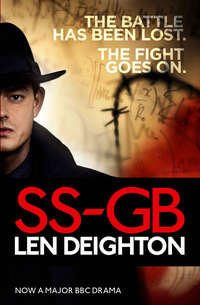
Читать книгу: «SS-GB»
LEN DEIGHTON
SS-GB

Copyright
This novel is entirely a work of fiction. The names, characters and incidents portrayed in it are the work of the author’s imagination. Any resemblance to actual persons, living or dead, events or localities is entirely coincidental.
Published by HarperCollinsPublishers Ltd 1 London Bridge Street London SE1 9GF
www.harpercollins.co.uk
A paperback edition 2009
FIRST EDITION
First published in Great Britain by
Jonathan Cape Ltd 1978
Cover design © HarperCollinsPublishers Ltd 2017 Cover photograph © Sid Gentle Films Ltd 2017
Copyright © Len Deighton 1978
Introduction copyright © Pluriform Publishing Company BV 2009
The verse from ‘The White Cliffs of Dover’ is reproduced by permission of EMI Publishers Ltd 138–140 Charing Cross Road, London WC2H 0LD. © 1941 by Shapiro Bernstein & Co., Inc., subpublished by B. Feldman & Co. Ltd
Len Deighton asserts the moral right to be identified as the author of this work
A catalogue record for this book is available from the British Library
All rights reserved under International and Pan-American Copyright Conventions. By payment of the required fees, you have been granted the non-exclusive, non-transferable right to access and read the text of this e-book on-screen. No part of this text may be reproduced, transmitted, down-loaded, decompiled, reverse engineered, or stored in or introduced into any information storage and retrieval system, in any form or by any means, whether electronic or mechanical, now known or hereinafter invented, without the express written permission of HarperCollins e-books.
Ebook Edition © 1978 ISBN: 9780007347742
Version: 2017-05-22
Table of Contents
Cover
Title Page
Copyright
Introduction
Chapter One
Chapter Two
Chapter Three
Chapter Four
Chapter Five
Chapter Six
Chapter Seven
Chapter Eight
Chapter Nine
Chapter Ten
Chapter Eleven
Chapter Twelve
Chapter Thirteen
Chapter Fourteen
Chapter Fifteen
Chapter Sixteen
Chapter Seventeen
Chapter Eighteen
Chapter Nineteen
Chapter Twenty
Chapter Twenty-one
Chapter Twenty-two
Chapter Twenty-three
Chapter Twenty-four
Chapter Twenty-five
Chapter Twenty-six
Chapter Twenty-seven
Chapter Twenty-eight
Chapter Twenty-nine
Chapter Thirty
Chapter Thirty-one
Chapter Thirty-two
Chapter Thirty-three
Chapter Thirty-four
Chapter Thirty-five
Chapter Thirty-six
Chapter Thirty-seven
Chapter Thirty-eight
Chapter Thirty-nine
Chapter Forty
About the Author
By Len Deighton
About the Publisher
Introduction
‘My book, Inside the Third Reich, never reached the top of the New York best seller list,’ Albert Speer told me. ‘It was Everything You Always Wanted to Know About Sex but were afraid to ask that always remained at number one.’
I am still not sure if he was joking. Hitler’s onetime Minister of Armaments had a sharp sense of humour, especially about the men with whom he had been in Spandau prison; he always referred to Field Marshal Milch as ‘Milk’. And when writers get together sales talk is not unusual.
But Albert Speer was not the catalyst for SS-GB. It began over a late-night drink with Ray Hawkey the writer and designer, and Tony Colwell my editor at Jonathan Cape. ‘No one knows what might have happened had we lost the Battle of Britain,’ said Tony with a sigh as we finished sorting through photos to illustrate my book, Fighter: The True Story of the Battle of Britain.
‘I wouldn’t go as far as that,’ I told him. ‘A great deal of the planning for the German occupation has been found and published.’
I had read some of that material and, after this conversation, I sought out the official German publications and began wondering if Britain under German rule would make a book. It would have to be what was then called an ‘alternative world’ book and that was outside all my writing experience. On the other hand, research for Fighter and Funeral in Berlin and particularly Bomber, had brought me into contact with many Germans, mostly men who had fought in the war.
I work very slowly so I don’t embark on a story until I am confident that I will be able to get the material for it and live with it for many months, perhaps years. The plot problems seemed insurmountable. Would I create a hero in the German occupation army? I wouldn’t want a Nazi as a hero. If I told the story through the eyes of a British civilian how would such a person have enough information to make the plot work? A notable member of the resistance would qualify as a hero but such heroes would all be dead, or fugitives.
This story had to be told from the centre of power. The police would be the people who connected the conquerors with the conquered but that sort of compromise role was not attractive to me. I went round and round on this until I thought of a Scotland Yard detective as hero. A man who solved crimes and hunted only real criminals could have contacts at the top and yet still be acceptable as a central character. I would frame it like a conventional murder mystery, with corpse at the start and solution at the end.
I like big charts and diagrams. They serve as a guide and reminder while a book is being written. Using the German data I drew a chain of command showing the connections between the civilians and the puppet government, black-marketeers and quislings and the occupying power with its security forces and bitterly competitive army and Waffen SS elements. My old friend, and fellow writer, Ted Allbeury had spent the immediate post-war period in occupied Germany as what the locals called ‘the head of the British Gestapo’. Ted’s experience was very valuable indeed and I used his experience and anecdotes to the full.
For the London scenes, I used only places that I had known in the war, so in that respect there is an autobiographical element in the story. I remembered London in wartime: the dimly lit streets, gas lights that hissed and spluttered, tin baths in front of the fire, rationing that made food a constant subject of thought and conversation, and bombed homes that spewed their intimate household contents into the streets.
The Scotland Yard building had to be the stage upon which my story was played but the police were no longer using it. It had become an office building for members of parliament and was strictly guarded. The Metropolitan Police were very cooperative about letting me into their new building and they let me use their fascinating library and their archives too without restrictions of any kind. I spent many days studying wartime crimes and looking at pictures of Scotland Yard detectives in the natty suits that were mandatory at that time. But the obstacle remained, the police had no authority over the building they had vacated.
By a wonderful piece of luck I found an elderly ex-policeman who knew the building from cellar to attic. I recorded hours of his descriptions but I still could not get into it until a friend named Freddy Warren devised a method by which I could explore every nook and cranny of the historic Scotland Yard building. Freddy’s authority as an official of the Whip’s office was to allot the offices to the politicians. He took me on a guided tour. With him I went everywhere; opening doors, interrupting conferences, awakening sleepers and declining liquid refreshment. No one was going to risk upsetting Freddy. I remain indebted to him and I hope that this record of the Scotland Yard building, as once it was, justifies the trouble he took on my behalf.
When writing the main text begins I have found it beneficial to step away from phones and friends and any social commitments. Together with my wife Ysabele and two small children I climbed into an old Volvo with its trunk crammed with research material. We went to Tuscany. My friend Al Alvarez the writer and broadcaster lent us his wonderful mountainside house near Barga. It was winter and, no matter about the pictures in the brochures, winter in northern Italy is cold and wet. I searched far and wide for an electric typewriter and failed to find one. All I could find was a tiny lightweight portable Olivetti Lettera 22. Yes I know the Lettera 22 is an icon of the nineteen fifties and is found in design museums, but after the soft touch joys of an electric machine, pounding the mechanical keyboard took a lot of getting used to. My fingers swelled up like salsiccia Toscana. But rural Italy worked its magic. Our elderly ‘next door’ neighbours adopted us. Signora Ida and her husband Silvio lavished our children with love, made pizzas for us in their outdoor oven and showed us the secret of making ravioli and the secret of happiness on the slim budget that a few olive trees provide. We will never forget those two wonderful people. They made my time in Tuscany writing SS-GB one of the happiest times of my happy life.
Len Deighton, 2009
‘In England they’re filled with curiosity and keep asking, “Why doesn’t he come?” Be calm. Be calm. He’s coming! He’s coming!’
Adolf Hitler. 4 September 1940, at a rally of nurses and social workers in Berlin.
Oberste Befehlshaber
Berlin, den 18.2.41
Der Oberste Befehlshaber der Wehrmacht
 10 Ausfertigungen Ausfertigung

Instrument of Surrender – English Text. Of all British armed forces in United Kingdom of Great Britain and Northern Ireland including all islands.
1 The British Command agrees to the surrender of all British armed forces in the United Kingdom and Northern Ireland including all islands and including military elements overseas. This also applies to units of the Royal Navy in all parts of the world, at port and on the high seas.
2 All hostilities on land, sea and in the air by British forces are to cease at 0800 hrs Greenwich Mean Time on 19 February 1941.
3 The British Command to carry out at once, without argument or comment, all further orders that will be issued by the German Command on any subject.
4 Disobedience of orders, or failure to comply with them, will be regarded as a breach of these surrender terms and will be dealt with by the German Command in accordance with the laws and usages of war.
5 This instrument of surrender is independent of, without prejudice to, and will be superseded by any general instrument of surrender imposed by or on behalf of the German Command and applicable to the United Kingdom and the Allied nations of the Commonwealth.
6 This instrument of surrender is written in German and English. The German version is the authentic text.
7 The decision of the German Command will be final if any doubt or dispute arises as to the meaning or interpretation of the surrender terms.

Chapter One
‘Himmler’s got the king locked up in the Tower of London,’ said Harry Woods. ‘But now the German Generals say the army should guard him.’
The other man busied himself with the papers on his desk and made no comment. He thumped the rubber stamp into the pad and then on to the docket, ‘Scotland Yard. 14 Nov. 1941’. It was incredible that the war had started only two years ago. Now it was over; the fighting finished, the cause lost. There was so much paperwork that two shoe boxes were being used for the overflow; Dolcis shoes, size six, patent leather pumps, high heels, narrow fitting. Detective Superintendent Douglas Archer knew only one woman who would buy such shoes: his secretary.
‘Well, that’s what people are saying,’ added Harry Woods, the elderly Sergeant who was the other half of the ‘murder team’.
Douglas Archer initialled the docket and tossed it into the tray. Then he looked across the room and nodded. It was a miserable office, its green and cream painted walls darkened by age and the small windows heavily leaded and smeared by sooty rain, so that the electric light had to be on all day.
‘Never do it on your own doorstep,’ advised Harry now that it was too late for advice. Anyone other than Harry, anyone less bold, less loquacious, less well-meaning would have stopped at that. But Harry disregarded the fixed smile on his senior partner’s face. ‘Do it with that blonde, upstairs in Registry. Or that big-titted German bird in Waffen-SS liaison – she puts it about they say – but your own secretary…’ Harry Woods pulled a face.
‘You spend too much time listening to what people say,’ said Douglas Archer calmly. ‘That’s your trouble, Harry.’
Harry Woods met the disapproving stare without faltering. ‘A copper can never spend too much time listening to what other people say, Super. And if you faced reality, you’d know. You may be a bloody wonderful detective, but you’re a shocking bad judge of character – and that’s your trouble.’
There weren’t many Detective Sergeants who would dare speak to Douglas Archer like that but these two men had known each other ever since 1920, when Harry Woods was a handsome young Police Constable with a Military Medal ribbon on his chest, and a beat littered with the broken hearts of pretty young housemaids and the hot meat pies of doting cooks. While Douglas Archer was a nine-year-old child proud to be seen talking to him.
When Douglas Archer became a green young Sub-Divisional Inspector, straight from the Hendon Police College, with no more experience of police work than comes from dodging the Proctors in the back streets of Oxford, it was Harry Woods who had befriended him. And that was at a time when such privileged graduates were given a hard time by police rank and file.
Harry knew everything a policeman had to know and more. He knew when each night-watchman brewed tea, and was never far from a warm boiler house when it rained. Harry Woods knew which large piles of rubbish would have money under them, never taking more than a third of it, lest the shopkeeper found some other way to pay the street-cleaners for their extra work. But that was a long time ago, before the generosity of the publicans and barmen of London’s West End had provided Harry with his ruddy face and expanded his waistline. And before Douglas Archer’s persistence got him into CID and then to Scotland Yard’s Murder Squad.
‘C Division have got a juicy one,’ said Harry Woods. ‘Everyone else is busy. Shall I get the murder bag ready?’
Douglas knew that his Sergeant expected him to respond in surprise, and he raised an eyebrow. ‘How the devil do you know about it?’
‘A flat in Shepherd Market, crammed with whisky, coffee, tea and so on, and Luftwaffe petrol coupons lying around on the table. The victim is a well-dressed man, probably a black-marketeer.’
‘You think so?’
Harry smiled. ‘Remember that black-market gang who killed the warehouse manager in Fulham…they were forging Luftwaffe petrol coupons. This could be the same mob.’
‘Harry. Are you going to tell me where all this information comes from, or are you going to solve the crime without getting out of your seat?’
‘The Station Sergeant at Savile Row is an old drinking pal. He just phoned me. A neighbour found the body and told the police.’
‘There’s no hurry,’ said Douglas Archer. ‘We’ll move slowly.’
Harry bit his lip. In his opinion Detective Superintendent Douglas Archer never did otherwise. Harry Woods was a policeman of the old school, scornful of paperwork, filing systems and microscopes. He liked to be talking, drinking, interrogating and making arrests.
Douglas Archer was a tall, thin, thirty-year-old. He was one of a new generation of detectives, who’d rejected the black jacket, pin-stripe trousers, roll-brim hat and stiff collar that was almost a uniform for the Murder Squad. Douglas favoured dark shirts and the sort of wide-brimmed hat he’d seen on George Raft in a Hollywood gangster film. In keeping with this, he’d taken to smoking small black cheroots as often as his tobacco ration permitted. He tried to light this one for the third time; the tobacco was of poor quality and it did not burn well. He looked for more matches and Harry threw a box across to him.
Douglas was a Londoner – with the quick wit and sophisticated self-interest for which Londoners are renowned – but like many who grow up in a fatherless household, he was introspective and remote. The soft voice and Oxford accent would have better suited some more cloistered part of the legal profession but he’d never regretted becoming a policeman. It was largely due to Harry, he realized that now. For the lonely little rich boy, in the big house on the square, Harry Woods, without knowing it, became a surrogate father.
‘And suppose the Luftwaffe petrol coupons are not forgeries; suppose they are real,’ said Douglas. ‘Then you can bet German personnel are involved, and the case will end up with the Feldgericht der Luftwaffe, Lincoln’s Inn. Waste of time our getting involved.’
‘This is murder,’ said Harry. ‘A few petrol coupons can’t change that.’
‘Don’t try to re-write the laws, Harry, there’s enough work enforcing the ones we’ve got. Any crimes involving Luftwaffe personnel, in even the smallest way, are tried by Luftwaffe courts.’
‘Not if we got over there right away,’ said Harry, running his hand back over hair that refused to be smoothed down. ‘Not if we wrung a confession out of one of them, sent copies to Geheime Feldpolizei and Kommandantur, and gave them a conviction on a plate. Oherwise these German buggers just quash these cases for lack of evidence, or post the guilty ones off to some soft job in another country.’
For Harry the fighting would never end. His generation, who’d fought and won in the filth of Flanders, would never come to terms with defeat. But Douglas Archer had not been a soldier. As long as the Germans let him get on with the job of catching murderers, he’d do his work as he’d always done it. He wished he could get Harry to see it his way.
‘I’d appreciate it, Harry, if you’d not allow your personal opinions to intrude into the preferred terminology.’ Douglas tapped the SIPO Digest. ‘And I’m far from convinced that they are soft on German personnel. Five executions last month; one of them a Panzer Division Major, with Knight’s Cross, who did nothing worse than arrive an hour late to check a military vehicle compound.’ He tossed the information sheets across to his partner’s desk.
‘You read all that stuff, don’t you?’
‘And if you had more sense, Harry, you’d read it too. Then you’d know that General Kellerman now has his CID briefings on Tuesday morning at eleven o’clock, which is just ten minutes from now.’
‘Because the old bastard drinks too much at lunch-time. By the time he reels back from the SS Officers’ Club in the afternoon he can’t remember a word of English except, “tomorrow, tomorrow!”’
Harry Woods noted with satisfaction the way that Douglas Archer glanced round the empty chairs and desks, just in case anyone had overheard this pronouncement. ‘Whatever the truth of that may be,’ said Douglas cautiously, ‘the fact remains that he’ll want his briefing. And solving a murder that we’ve not yet been invited to investigate will not be thought sufficient excuse for my not being upstairs on time.’ Douglas got to his feet and collected together the documents that the General might want to see.
‘I’d tell him to go to hell,’ said Harry. ‘I’d tell him the job comes first.’
Douglas Archer nipped out his cheroot carefully, so as to preserve the unsmoked part of it, then put it into the top drawer of his desk, together with a magnifying glass, tickets for a police concert he’d not attended, and a broken fountain pen. ‘Kellerman’s not so bad,’ said Douglas. ‘He’s kept the Metropolitan Force more or less intact. Have you forgotten all the talk of putting German Assistant Commissioners upstairs? Kellerman opposed that.’
‘Too much competition,’ muttered Harry, ‘and Kellerman doesn’t like competition.’
Douglas put his report, and the rest of the papers, into his briefcase and strapped it up. ‘In the unlikely event that West End Central ask for us, have the murder bag ready and order a car. Tell them to keep the photographer there until I tell him to go and to keep the Divisional Surgeon there, as well as the pathologist.’
‘The doctor won’t like that,’ said Harry.
‘Thanks for telling me that, Harry. Send the doctor a packet of wait-about tablets with my compliments, and remind him you are phoning from Whitehall 1212, Headquarters of Kriminalpolizei, Ordnungspolizei, Sicherheitsdienst and Gestapo. Any complaints about waiting can be sent here in writing.’
‘Keep your shirt on,’ said Harry defensively.
The phone rang; the calm impersonal voice of General Kellerman’s personal assistant said, ‘Superintendent Archer? The General presents his compliments and asks if this would be a convenient time for you to give him the CID briefing.’
‘Immediately, Major,’ said Douglas, and replaced the phone.
‘Jawohl, Herr Major. Kiss your arse, Herr Major,’ said Harry.
‘Oh for God’s sake, Harry. I have to deal with these people at first hand; you don’t.’ ‘I still call it arse-licking.’
‘And how much arse-licking do you think it needed to get your brother exempted from that deportation order!’ Douglas had been determined never to tell Harry about that, and now he was angry with himself.
‘Because of the medical report from his doctor,’ said Harry but even as he was saying it he realized that most of the technicians sent to German factories probably got something like that from a sympathetic physician.
‘That helped,’ said Douglas lamely.
‘I never realized, Doug,’ said Harry but by that time Douglas was hurrying up to the first floor. The Germans were sticklers for punctuality.
Chapter Two
General – or, more accurately in SS parlance, Gruppen-führer – Fritz Kellerman was a genial-looking man in his late fifties. He was of medium height but his enthusiasm for good food and drink provided a rubicund complexion and a slight plumpness which, together with his habit of standing with both hands in his pockets, could deceive the casual onlooker into thinking Kellerman was short and fat, and so he was often described. His staff called him ‘Vater’ but if his manner was fatherly it was not benign enough to earn him the more common nickname of ‘Vati’ (Daddy). His thick thatch of white hair had beguiled more than one young officer into accepting his invitation for an early morning canter through the park. But few of them went for the second time. And only the greenest of his men would agree to a friendly game of chess, for Kellerman had once been the junior chess champion of Bavaria. ‘Luck seems to be with me today,’ he’d tell them as they became trapped into a humiliating defeat.
Before the German victory, Douglas had seldom visited this office on the first floor. It was the turret room used hitherto only by the Commissioner. But now he was often here talking to Kellerman, whose police powers extended over the whole occupied country. And Douglas – together with certain other officers – had been granted the special privilege of entering the Commissioner’s room by the private door, instead of going through the clerk’s office. Before the Germans came, this was something permitted only to Assistant Commissioners. General Kellerman said it was part of das Führerprinzip; Harry Woods said it was bullshit.
The Commissioner’s office was more or less unchanged from the old days. The massive mahogany desk was placed in the corner. The chair behind it stood in the tiny circular turret that provided light from all sides, and a wonderful view of the river. There was a big marble mantelpiece and on it an ornate clock that struck the hour and half-hour. A fire blazed in the bow-fronted grate between polished brass fire-irons and a scuttle of coal. The only apparent change was the shoal of fish that swam across the far wall, in glass-fronted cases, stuffed, and labelled with Fritz Kellerman’s name, and a place and date, lettered in gold.
There were two men in army uniform there when Douglas entered the room. He hesitated. ‘Come in, Superintendent. Come in!’ called Kellerman.
The two strangers looked at Douglas and then exchanged affirmative nods. This Englishman was exactly right for them. Not only was he reputed to be one of the finest detectives in the Murder Squad but he was young and athletic looking, with the sort of pale bony face that Germans thought was aristocratic. He was ‘Germanic’, a perfect example of ‘the new European’. And he even spoke excellent German.
One of the men picked up a notebook from Kellerman’s desk. ‘Just one more, General Kellerman,’ he said. The other man seemed to produce a Leica out of nowhere and knelt down to look through its viewfinder. ‘You and the Superintendent, looking together at some notes or a map…you know the sort of thing.’
On the cuffs of their field-grey uniforms the men wore ‘Propaganda-Kompanie’ armbands.
‘We’d better do as they say, Superintendent,’ said Kellerman. ‘These fellows are from Signal magazine. They’ve come all the way from Berlin just to talk to us.’
Awkwardly Douglas went round to the far side of the desk. He posed self-consciously, prodding at a copy of the Angler’s Times. Douglas felt foolish but Kellerman took it all in his stride.
‘Superintendent Archer,’ said the PK journalist in heavily accented English, ‘is it true that, here at Scotland Yard, the men call General Kellerman “Father”?’
Douglas hesitated, pretending to be holding still for the photo in order to gain time. ‘Can’t you see how your question embarrasses the Superintendent?’ said Kellerman. ‘And speak German, the Superintendent speaks the language as well as I do.’
‘It’s true then?’ said the journalist, pressing for an answer from Douglas. The camera shutter clicked. The photographer checked the settings on his camera and then took two more pictures in rapid succession.
‘Of course it’s true,’ said Kellerman. ‘You think I’m a liar? Or do you think I’m the sort of police chief who doesn’t know what goes on in my own headquarters?’
The journalist stiffened and the photographer lowered his camera.
‘It’s quite true,’ said Douglas.
‘And now, gentlemen, I must get some work done,’ said Kellerman. He shooed them out, like an old lady finding hens in her bedroom. ‘Sorry about that,’ Kellerman explained to Douglas after they’d gone. ‘They said they would need only five minutes, but they hang on and hang on. It’s all part of their job to exploit opportunities, I suppose.’ He went back to his desk and sat down. ‘Tell me what’s been happening, my boy.’
Douglas read his report, with asides and explanations where needed. Kellerman’s prime concern was to justify money spent, and Douglas always wrote his reports so that they summarized the resources of the department and showed the cost in Occupation Marks.
When the formalities were over, Kellerman opened the humidor. With black-market cigarettes at five Occupation Marks each, one of Kellerman’s Monte Cristo No 2s had become a considerable accolade. Kellerman selected two cigars with great care. Like Douglas, he preferred the flavour of the ones with green or yellow spots on the outer leaf. He went through a ceremony of cutting them and removing loose strands of tobacco. As usual Kellerman wore one of his smooth tweed suits, complete with waistcoat and gold chain for his pocket watch. Typically he had not worn his SS uniform even for this visit by the photographer. And Kellerman, like so many of the senior SS men of his generation, preferred army rank titles to the cumbersome SS nomenclature.
‘Still no word of your wife?’ asked Kellerman. He came round the desk and gave Douglas the cigar.
‘I think we have to assume that she was killed,’ said Douglas. ‘She often went to our neighbour’s house during the air attacks, and the street fighting completely demolished it.’
‘Don’t give up hope,’ said Kellerman. Was that a reference to his affair with the secretary, Douglas wondered. ‘Your son is well?’
‘He was in the shelter that day. Yes, he’s thriving.’
Kellerman leaned over to light the cigar. Douglas was not yet used to the way that the German officers put cologne on their faces after shaving and the perfume surprised him. He inhaled; the cigar lit. Douglas would have preferred to take the cigar away with him but the General always lit them. Douglas thought perhaps it was a way of preventing the recipient selling it instead of smoking it. Or was it simply that Kellerman believed that, in England, no gentleman could offer a colleague a chance to put an unsmoked cigar in his pocket.
‘And no other problems, Superintendent?’ Kellerman passed behind Douglas, and touched the seated man’s shoulder lightly, as if in reassurance. Douglas wondered if his general knew that his internal mail had that morning included a letter from his secretary, saying she was pregnant and demanding twenty thousand O-Marks. The pound sterling, she pointed out, in case Douglas didn’t know, was not the sort of currency abortionists accepted. Douglas was permitted a proportion of his wages in O-Marks. So far Douglas had not discovered how the letter got to him. Had she sent it to one of her girlfriends in Registry, or actually come into the building herself?
‘No problems that I need bother the General with,’ said Douglas.
Kellerman smiled. Douglas’s anxiety had led him to address the general in that curious third-person form that some of the more obsequious Germans used.
‘You knew this room in the old days?’ said Kellerman.
Before the war it had been the Commissioner’s procedure to leave the door wide open when the room was unoccupied, so that messengers could pass in and out. Soon after being assigned to Scotland Yard, Douglas had found an excuse for coming into the empty room and studying it with the kind of awe that comes from a schoolboy diet of detective fiction. ‘I seldom came here when it was the Commissioner’s room.’
‘These are difficult times,’ said Kellerman, as if apologizing for the way in which Douglas’s visits were now more frequent. Kellerman leaned forward to tap a centimetre of ash into a white china model of Tower Bridge that some enterprising manufacturer had redesigned to incorporate swastika flags and ‘Waffenstillstand. London. 1940’ in red and black Gothic lettering. ‘Until now,’ said Kellerman, choosing his words with care, ‘the police force has not been asked to do any political task.’
‘We have always been completely apolitical.’
‘Now that’s not quite true,’ said Kellerman gently. ‘In Germany we call a spade a spade, and the political police are called political police. Here you call your political police the Special Branch, because you English are not so direct in these matters.’
‘Yes, sir.’
‘But there will come a time when I can no longer resist the pressure from Berlin to bring us into line with the German police system.’
‘We English don’t take quickly to new ideas, you know, sir.’
‘Don’t play games with me, Superintendent,’ said Kellerman without changing the affable tone of voice or the smile. ‘You know what I’m talking about.’
‘I’m not sure I do, sir.’
‘Neither of us wants political advisers in this building, Superintendent. Inevitably the outcome would be that your police force is used against British Resistance groups, uncaptured soldiers, political fugitives, Jews, gypsies and other undesirable elements.’ Kellerman said it in a way that conveyed the idea that he didn’t consider these elements nearly so undesirable as his superiors in Berlin thought them.
‘It would split the police service right down the middle,’ said Douglas.
Kellerman didn’t answer. He reached for a teleprinter message on his desk and read it, as if to remind himself of the contents. ‘A senior officer of the Sicherheitsdienst is on his way here now,’ said Kellerman. ‘I’m assigning you to work with him.’
‘His duties will be political?’ asked Douglas. The SD was the SS intelligence service. Douglas did not welcome this sinister development.
‘I don’t know why he’s coming,’ said Kellerman cheerfully. ‘He is on the personal staff of the Reichsführer-SS and will remain directly responsible to Berlin for whatever he has to do.’ Kellerman inhaled on his cigar and then let the smoke drift from his nostrils. He let his Superintendent dwell upon the facts and realize that the new man presented a danger to the status quo for both of them. ‘Standartenführer Huth,’ said Kellerman finally, ‘that’s this new chap’s name.’ His use of the SS rank was enough to emphasize that Huth was an outsider. Kellerman raised his hand. ‘Under the direct orders of Berlin, so that gives him a special…’ he hesitated and then let the hand fall, ‘…influence.’
‘I understand, sir,’ said Douglas.
‘Then perhaps, my dear chap, you’d do everything you can to prevent the indiscretions – more particularly the verbal indiscretions – of your mentor downstairs from embarrassing us all.’
‘Detective Sergeant Woods?’
‘Ah, what a quick mind you have, Superintendent,’ said Kellerman.
Chapter Three
Some said there had not been even one clear week of sunshine since the cease-fire. It was easy to believe. Today the air was damp, and the colourless sun only just visible through the grey clouds, like an empty plate on a dirty tablecloth.
And yet even a born and bred Londoner, such as Douglas Archer, could walk down Curzon Street, and with eyes half-closed, see little or no change from the previous year. The Soldatenkino sign outside the Curzon cinema was small and discreet, and only if you tried to enter the Mirabelle restaurant did a top-hatted doorman whisper that it was now used exclusively by Staff Officers from Air Fleet 8 Headquarters, across the road in the old Ministry of Education offices. And if your eyes remained half-closed you missed the signs that said ‘Jewish Undertaking’ and effectively kept all but the boldest customers out. And in September of that year 1941, Douglas Archer, in common with most of his compatriots, was keeping his eyes half-closed.
The scene of the murder to which, as Detective Sergeant Harry Woods had predicted, they were called, was Shepherd Market. This little maze of narrow streets and alleys housed a mixture of working-class Londoners, Italian shopkeepers and wealthy visitors, who found in these tortuous ways, and creaking old buildings, some measure of the London they’d read of in Dickens, while being conveniently close to the smart shops and restaurants.
The house was typical of the neighbourhood. There were uniformed police there already, arguing with two reporters. The ground floor was a poky antique shop not much wider than a man could stretch both arms. Above it were rooms of doll’s-house dimensions, with a twisting staircase so narrow that it provided an ever-present risk of sweeping from its walls the framed coaching prints that decorated them. Only with difficulty did Harry get the heavy murder bag to the top floor where the body was.
The police doctor was there, seated on a chintz-covered couch, a British army overcoat buttoned up tight to the neck, and hands in his pockets. He was a young man, in his middle twenties, but already Douglas saw in his eyes that terrible resignation with which so many British seemed to have met final defeat.
On the floor in front of him there was the dead man. He was about thirty-five years old, a pale-faced man with a balding head. Passing him in the street one might have guessed him to be a rather successful academic – the sort of absent-minded professor portrayed in comedy films.
As well as blood, there was a large smudge of brown powder spilled on his waistcoat. Douglas touched it with a fingertip but even before he raised it to his nose, he recognized the heavy aroma of snuff. There were traces of it under the dead man’s fingernails. Snuff was growing more popular as the price of cigarettes went up, and it was still unrationed.
Douglas found the snuff tin in a waistcoat pocket. The force of the bullets had knocked the lid off. There was a half-smoked cigar there too, the band still on it, a Romeo y Julieta worth a small fortune nowadays; no wonder he’d preserved the unsmoked half of it.
Douglas looked at the fine quality cloth and hand stitching of the dead man’s suit. For such expensive, made to measure garments they fitted very loosely, as if the man, suddenly committed to a rigorous diet, had lost many pounds of weight. Sudden weight loss was also suggested by the drawn and wrinkled face. Douglas fingered the bald patches on the man’s head.
‘Alopecia areata,’ said the doctor. ‘It’s common enough.’
Douglas looked into the mouth. The dead man had had enough money to pay for good dental care. Gold shone in his mouth but there was blood there too.
‘There’s blood in his mouth.’
‘Probably hit his face as he fell.’
Douglas didn’t think so but he didn’t argue. He noted the tiny ulcers on the man’s face and blood spots under the skin. He pushed back the shirt sleeve far enough to see the red inflamed arm.
‘Where do you find such sunshine at this time of the year?’ the doctor said.
Douglas didn’t answer. He drew a small sketch of the way that the body had fallen backwards into the tiny bedroom, and guessed that he’d been in the doorway when the bullets hit him. He touched the blood on the body to see if it was tacky, and then placed a palm on the chest. He could feel no warmth at all. His experience told him that this man had been dead for six hours or more. The doctor watched Douglas but made no comment. Douglas got to his feet and looked round the room. It was a tiny place, over-decorated with fancy wallpapers, Picasso reproductions and table lights made from Chianti bottles.
There was a walnut escritoire, with its front open as if it might have been rifled. An old-fashioned brass lamp had been adjusted to bring the light close upon the green leather writing top but its bulb had been taken out and left in one of the pigeon-holes, together with some cheap writing paper and envelopes.
There were no books, no photos and nothing personal of any kind. It was like some very superior sort of hotel room. In the tiny open fireplace there was a basket of logs. The grate was overflowing with ashes of paper.
‘Pathologist here yet?’ Douglas asked. He fitted the light bulb into the brass lamp. Then he switched it on for long enough to see that the bulb was still in working order and switched it off again. He went to the fireplace and put his hand into the ash. It was not warm but there was no surviving scrap of paper to reveal what had been burned there. It was a long job to burn so much paper. Douglas used his handkerchief to wipe his hands.
‘Not yet,’ said the doctor in a dull voice. Douglas guessed that he resented being ordered to wait.
‘What do you make of it, doc?’
‘You get any spare cigarettes, working with the SIPO?’
Douglas produced the gold cigarette case that was his one and only precious possession. The doctor took the cigarette and nodded his thanks while examining it carefully. Its paper was marked with the double red bands that identified Wehrmacht rations. The doctor put it in his mouth, brought a lighter from his pocket and lit it, all without changing his expression or his position, sprawled on the couch with legs extended.
A uniformed Police Sergeant had watched all this while waiting on the tiny landing outside the door. Now he put his head into the room and said, ‘Pardon me, sir. A message from the pathologist. He won’t be here until this afternoon.’
Harry Woods was unpacking the murder bag. Douglas could not resist glancing at him. Harry nodded. Now he realized that to keep the Police Surgeon here was a good idea. The pathologists were always late these days. ‘So what do you make of it, doctor?’ said Douglas.
They both looked down at the body. Douglas touched the dead man’s shoes; the feet were always the last to stiffen.
‘The photographers have finished until the pathologist comes,’ said Harry. Douglas unbuttoned the dead man’s shirt to reveal huge black bruises surrounding two holes upon which there was a crust of dried blood.
‘What do I make of it?’ said the doctor. ‘Gunshot wound in chest caused death. First bullet into the heart, second one into the top of the lung. Death more or less instantaneous. Can I go now?’
‘I won’t keep you longer than absolutely necessary,’ said Douglas without any note of apology in his voice. From his position crouched down with the body, he looked back to where the killer must have been. At the wall, far under the chair he saw a glint of metal. Douglas went over and reached for it. It was a small construction of alloy, with a leather rim. He put it into his waistcoat pocket. ‘So it was the first bullet that entered the heart, doctor, not the second one?’
The doctor still had not moved from his fixed posture on the couch but now he twisted his feet until his toes touched together. ‘There would have been more frothy blood if a bullet had hit the lung first while the heart was pumping.’
‘Really,’ said Douglas.
‘He might have been falling by the time the second shot came. That would account for it going wide.’
‘I see.’
‘I saw enough gunshot wounds last year to become a minor expert,’ said the doctor without smiling. ‘Nine millimetre pistol. That’s the sort of bullets you’ll find when you dig into the plaster behind that bloody awful Regency stripe wallpaper. Someone who knew him did it. I’d look for a lefthanded ex-soldier who came here often and had his own key to get in.’
‘Good work, doctor.’ Harry Woods looked up from where he was going through the dead man’s pockets. He recognized the note of sarcasm.
‘You know my methods, Watson,’ said the doctor.
‘Dead man wearing an overcoat; you conclude he came in the door to find the killer waiting. You guess the two men faced each other squarely with the killer in the chair by the fireplace, and from the path of the wound you guess the gun was in the killer’s left hand.’
‘Damned good cigarettes these Germans give you,’ said the doctor, holding it in the air and looking at the smoke.
‘And an ex-soldier because he pierced the heart with the first shot.’ The doctor inhaled and nodded. ‘Have you noticed that all three of us are still wearing overcoats?’ said Douglas. ‘It’s bloody cold in here and the gas meter is empty and the supply disconnected. And not many soldiers are expert shots, doc, and not one in a million is an expert with a pistol, and by your evidence a German pistol at that. And you think the killer had a key because you can’t see any signs of the door being forced. But my Sergeant could get through that door using a strip of celluloid faster than you could open it with a key, and more quietly too.’
‘Oh,’ said the doctor.
‘Now, what about a time of death?’ said Douglas.
All doctors hate to estimate the time of death and this doctor made sure the policemen knew that. He shrugged. ‘I can think of a number and double it.’
‘Think of a number, doc,’ said Douglas, ‘but don’t double it.’
The doctor, still lolling on the couch, pinched out his cigarette and put the stub away in a dented tobacco tin. ‘I took the temperature when I arrived. The normal calculation is that a body cools one-and-a-half degrees Fahrenheit per hour.’
‘I’d heard a rumour to that effect,’ said Douglas.
The doctor gave him a mirthless grin as he put the tin in his overcoat pocket, and watched his feet as he made the toes touch together again. ‘Could have been between six and seven this morning.’
Douglas looked at the uniformed Sergeant. ‘Who reported it?’
‘The downstairs neighbour brings a bottle of milk up here each morning. He found the door open. No smell of cordite or anything,’ added the Sergeant.
The doctor chortled. When it turned into a cough he thumped his chest. ‘No smell of cordite,’ he repeated. ‘I’ll remember that one, that’s rather rich.’
‘You don’t know much about coppers, doc,’ said Douglas. ‘Specially when you take into account that you are a Police Surgeon. The uniformed Sergeant here, an officer I’ve never met before, is politely hinting to me that he thinks the time of death was earlier. Much earlier, doc.’ Douglas went over to the elaborately painted corner cupboard and opened it to reveal an impressive display of drink. He picked up a bottle of whisky and noted without surprise that most of the labels said ‘Specially bottled for the Wehrmacht’. Douglas replaced the bottles and closed the cupboard. ‘Have you ever heard of postmortem lividity, doctor?’ he said.
‘Death might have been earlier,’ admitted the doctor. He was sitting upright now and his voice was soft. He, too, had noticed the coloration that comes from settling of the blood.
‘But not before midnight.’
‘No, not before midnight,’ agreed the doctor.
‘In other words death took place during curfew?’
‘Very likely.’
‘Very likely?’ said Douglas caustically.
‘Definitely during curfew,’ admitted the doctor.
‘What kind of a game are you playing, doc?’ said Douglas. He didn’t look at the doctor. He went to the fireplace and examined the huge pile of charred paper that was stuffed into the tiny grate. The highly polished brass poker was browned with smoke marks. Someone had used it to make sure that every last piece of paper was consumed by the flames. Again Douglas put his hand into the feathery layers of ash; there must have been a huge pile of foolscap and it was quite cold. ‘Contents of his pockets, Harry?’
‘Identity card, eight pounds, three shillings and tenpence, a bunch of keys, penknife, expensive fountain pen; handkerchief, no laundry marks, and a railway ticket monthly return half; London to Bringle Sands.’
‘Is that all?’
Harry knew that his partner would ask for the identity card and he passed it across unrequested. Harry said, ‘Travelling light, this one.’
‘Or his pockets were rifled,’ said the doctor, not moving from his position on the sofa.
Harry met Douglas’s eyes and there was a trace of a smile. ‘Or his pockets were rifled,’ said Douglas to Harry.
‘That’s right,’ said Harry.
Douglas opened the identity card. It was written there that the holder was a thirty-two-year-old accountant with an address in Kingston, Surrey. ‘Kingston,’ said Douglas.
‘Yes,’ said Harry. They both knew that, ever since the Kingston Records Office had been destroyed in the fighting, this was a favourite address for forgers of identity documents. Douglas put the card in his pocket, and repeated his question. ‘What sort of game are you playing, doctor?’ He looked at the doctor and waited for an answer. ‘Why are you trying to mislead me about the time of death?’
‘Well it was silly of me. But if people are coming and going after midnight the neighbours are supposed to report them to the Feldgendarmerie.’
‘And how do you know that they didn’t report it?’
The doctor raised his hands and smiled. ‘I just guessed,’ he said.
‘You guessed.’ Douglas nodded. ‘Is that because all your neighbours ignore the curfew?’ said Douglas. ‘What other regulations do they regularly flout?’
‘Jesus!’ said the doctor. ‘You people are worse than the bloody Germans. I’d rather talk to the Gestapo than talk to bastards like you – at least they won’t twist everything I say.’
‘It’s not in my power to deny you a chance to talk to the Gestapo,’ said Douglas, ‘but just to satisfy my own vulgar curiosity, doctor, is your opinion about benign interrogation techniques practised by that department based upon first-hand experience or hearsay?’
‘All right, all right,’ said the doctor. ‘Let’s say three A.M.’
‘That’s much better,’ said Douglas. ‘Now you examine the body properly so that I don’t have to wait here for the pathologist before getting started and I’ll forget all about that other nonsense…but leave anything out, doc, and I’ll run you along to Scotland Yard and put you through the mangle. Right?’
‘All right,’ said the doctor.
‘There’s a lady downstairs,’ said the uniformed police Sergeant. ‘She’s come to collect something from the antique shop. I’ve told the Constable to ask her to wait for you.’
‘Good man,’ said Douglas. He left the doctor looking at the body while Harry Woods was going through the drawers of the escritoire.
The antique shop was one of the hundreds that had sprung up since the bombing and the flight of refugees from Kent and Surrey during the weeks of bitter fighting there. With the German Mark pegged artificially high, the German occupiers were sending antiques home by the train-load. The dealers were doing well out of it, but one didn’t need lessons in economics to see the way that wealth was draining out of the country.
There were some fine pieces of furniture in the shop. Douglas wondered how many had been lawfully purchased and how many looted from empty homes. Obviously the owner of the antique shop stored his antiques by putting them in the tiny apartments upstairs, and justified high rents by having them there.
The visitor was sitting on an elegant Windsor chair. She was very beautiful: large forehead, high cheekbones and a wide face with a perfect mouth that smiled easily. She was tall, with long legs and slim arms.
‘Now maybe someone will give me a straight answer.’ She had a soft American voice, and she reached into a large leather handbag and found a US passport, which she brandished at him.
Douglas nodded. For a moment he was spellbound. She was the most desirable woman he’d ever seen. ‘What can I do for you, Madam?’
‘Miss,’ she said. ‘In my country a lady doesn’t like being mistaken for a Madam.’ She seemed amused at his discomfiture. She smiled in that relaxed way that marks the very rich and the very beautiful.
‘What can I do for you, Miss?’
She was dressed in a tailored two-piece of pink wool. Its severe and practical cut made it unmistakably American. It would have been striking anywhere, but in this war-begrimed city, among so many dressed in ill-fitting uniforms or clothes adapted from uniforms, it singled her out as a prosperous visitor. Over her shoulder she carried a new Rolleiflex camera. The Germans sold them tax-free to servicemen and to anyone who paid in US dollars.
‘My name is Barbara Barga. I write a column that is syndicated into forty-two US newspapers and magazines. The press attaché of the German Embassy in Washington offered me a ticket on the Lufthansa inaugural New York to London flight last month. I said yes, and here I am.’
‘Welcome to London,’ said Douglas dryly. It was shrewd of her to mention the inaugural flight on the Focke-Wulf airliner. Göring and Goebbels were both on that flight; it was one of the most publicized events of the year. A journalist would have to be very important indeed to have got a seat.
‘Now tell me what’s going on here?’ she said with a smile. Douglas Archer had not met many Americans, and he’d certainly never met one to compare with this girl. When she smiled, her face wrinkled in a way that Douglas found very beguiling. In spite of himself, he smiled back. ‘Don’t get me wrong,’ she said. ‘I get on well with cops, but I didn’t expect to find so many of them here in Peter’s shop today.’
‘Peter?’
‘Peter Thomas,’ she said. ‘Come on now, mister detective, it says Peter Thomas on the door – Peter Thomas – Antiques – right?’
Бесплатный фрагмент закончился.