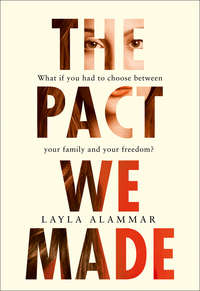
Читать книгу: «The Pact We Made»


Copyright
The Borough Press
An imprint of HarperCollinsPublishers Ltd
1 London Bridge Street
London SE1 9GF
www.harpercollins.co.uk
First published in Great Britain by HarperCollinsPublishers 2019
Copyright © Layla AlAmmar 2019
Cover design by Holly Macdonald © HarperCollinsPublishers Ltd 2019
Cover photography © HMoodboard/Getty Images
Layla AlAmmar asserts the moral right to be identified as the author of this work.
A catalogue copy of this book is available from the British Library.
This novel is entirely a work of fiction. The names, characters and incidents portrayed in it are the work of the author’s imagination. Any resemblance to actual persons, living or dead, events or localities is entirely coincidental.
All rights reserved under International and Pan-American Copyright Conventions. By payment of the required fees, you have been granted the non-exclusive, non-transferable right to access and read the text of this e-book on screen. No part of this text may be reproduced, transmitted, down-loaded, decompiled, reverse engineered, or stored in or introduced into any information storage and retrieval system, in any form or by any means, whether electronic or mechanical, now known or hereinafter invented, without the express written permission of HarperCollins.
Source ISBN: 9780008284442
Ebook Edition © March 2019 ISBN: 9780008284466
Version: 2019-01-16
Dedication
To Mom, my first reader, for handing me a book all those years ago.
Epigraph
‘At a very early period she had apprehended instinctively the dual life – that outward existence which conforms, the inward life which questions.’
Kate Chopin, The Awakening
‘No man, for any considerable period, can wear one face to himself and another to the multitude, without finally getting bewildered as to which may be the true.’
Nathaniel Hawthorne
Table of Contents
Cover
Title Page
Copyright
Dedication
Epigraph
Chapter 1: The Marriage Pact
Chapter 2: Hush
Chapter 3: A Grotesque Pandemonium
Chapter 4: A Marauding Heart
Chapter 5: The Architect
Chapter 6: Snow Globes
Chapter 7: They Spin Finely
Chapter 8: The Sleep of Reason …
Chapter 9:… Produces Monsters
Chapter 10: Who More Is Surrendered?
Chapter 11: Tantalus
Chapter 12: He Cannot Make Her Out
Chapter 13: What One Does to the Other
Chapter 14: Hunting for Teeth
Chapter 15: A Cowslip’s Bell
Chapter 16: Fifteen Candles
Chapter 17: Those Specks of Dust
Chapter 18: When Day Breaks
Chapter 19: There It Goes
Chapter 20: You Will Not Escape
Chapter 21: It Is Time
Chapter 22: I Have Chosen
Acknowledgments
About the Author
About the Publisher
1
The Marriage Pact
We were eight years old in my first memory of the marriage pact. Mona and I were at Zaina’s house. Her oldest sister had just gotten married, and we were bursting with talk of all that we’d seen and heard at the wedding. We looked like mummy brides, wrapped in her mother’s headscarves. Mona had found ribbons and flowers which she’d braided and pinned into our hair. We took turns being the bride while the other two played the parts of sisters, supporting the train, giving admonishing smiles during the Yelwa, and bobbing up and down in exultant dances.
‘When she came through the door, everyone was so quiet,’ Zaina said, standing at the door to her room, holding a bouquet of fake roses. ‘All the lights went out and there was just a spotlight on her, and then “Heb AlSa’ada” came on and she started walking. Like this.’ She took solemn steps forward, her feet drowning in the heels we’d pilfered. Mona held and re-draped her train as she walked. I was supposed to sing the song, but I was imagining walking down a long aisle with a spotlight on me while everyone stared. It wouldn’t be like weddings we saw on television where the man stood at the end. It would just be me and a never-ending aisle leading to an empty settee. I could trip and fall, walk too slow or too fast, forget to smile at the photographer or drop my bouquet. Anything could happen.
‘Dahlia!’ Mona whined, drawing out all the syllables in my name. I started singing, but Zaina had already reached the desk chair we were using as a kosha. She turned to look over her shoulder while Mona metamorphosed into photographer, snapping shots of Zaina smiling, laughing, and looking coy. I knew what was coming next; I always got the groom’s role.
‘Yella ya mi’ris,’ Mona hissed, waving me back towards the door.
I obeyed, hurrying down our makeshift aisle. Mona immediately sprang into action, chanting the groom’s song as I walked back towards them. The man had it easier; he didn’t have to milk the moment. He was encouraged to walk as quickly as possible to his bride. I got to Zaina and gave her a kiss on the forehead before taking the chair beside her. Mona re-draped the train and continued to snap fake photos as we interlocked our arms and mimed sipping juice from tall, flutey glasses.
‘We should get married together,’ Zaina said, sighing up to the ceiling. ‘All three of us, on the same day.’
‘Yeah!’ Mona cried, clapping her hands together. ‘And we can have one big party!’
‘We could all walk down the aisle together,’ I offered.
‘No!’ Mona and Zaina shouted, frowning at me. ‘We’ll take turns,’ Zaina said with a nod.
‘Who goes first?’ Mona asked.
Zaina chewed her lip and picked at a scab from where she’d scraped her elbow. ‘We’ll go by the alphabet.’
‘Yeah!’ Mona exclaimed, linking fingers with Zaina and waiting for me to join.
My stomach clenched into something hard and tight and unfamiliar, but I added my fingers to our ‘promise’ link and we shook on it.
We were terribly young then, and they were only words.
The pact changed, evolving as we matured: at ten, we dismissed the alphabet idea as stupid and decided the eldest should go first; a few years later we would sometimes draw straws or have a competition to see who could flick their marble the furthest. We chose arbitrary ages that seemed far off in some unseeable future—twenty, twenty-two, twenty-seven. By fifteen I wanted out of the pact, but was kept in by Mona and Zaina’s un-wavering enthusiasm. At nineteen, Mona decided the pact wasn’t cool and joined me, but in our early twenties the two of them were back in competition.
Our families thought the pact was charming at first, some adorable little fancy for little girls. They saw it as early confirmation that life would turn out like they expected it to, that their daughters would turn out as planned. Later, it became funny, an amusing anecdote to share at gatherings, something to laugh about with friends and aunties. Finally, it became tiresome, just one more thing for our mothers to worry about in their efforts to see us settled in happy marriages. Whose daughter would go first? Even then, there were comparisons. Mama wanted to beat the record she’d set with my sister Nadia, who was married at twenty-three. When Mona got rowdy, her mother would say she needed to set a good example for her younger sister, but what she really meant was ‘Don’t do anything to lower your chances.’ And Zaina’s parents were forever reminding her how small the country was, and how everyone knew everything about everyone and she should never forget that.
I’ve often wondered whether it might not be better to eradicate the nuclear family altogether, to just let us disperse like loose seeds, striking our roots into some foreign earth, unfettered by customs and bonds and the burden of ancestry. How much damage do parents do, unintentional though it may be? A word that cleaves the psyche, a withheld embrace that ripples through generations, an episode that festers like an open wound. Might these things not be so easily avoided if we all just scattered ourselves to the wind?
There was a lot of weeping in our house, mostly by me, but my mother did her fair share. There were times, when I wasn’t speaking and spent my days locked in the bathroom, that I would wander the house at all hours of the night. Gliding down the halls and up the stairs like some restless spirit, I would pass my parents’ room, and from within I would hear her sobs – like something was desperate to break free of her – and Baba’s quiet, comforting nonsense. I never knew exactly what her tears were for – love, grief … despair. With my mother, it was like my little cousin Bader, who could never tell if the face you were giving him was a happy or sad one. I couldn’t decipher her tears, and for the longest time I wasn’t even sure she was on my side.
Our lives are sustained by rituals. Up in the morning, shuffle to the bathroom, pick out an outfit, coffee run, and head to work. Family lunches on the weekend and rushing outside when the first rain of the year comes. Gathering around the table for futoor during Ramadan and buying new clothes for Eid. Compulsory calls to relatives just back from vacation, three days of funerals for those that have died.
A man comes to see you, and it’s a whole other set of rituals. You wait at the top of the stairs, never greeting him at the door – that’s for your chaperones to do. When your mother and sister and aunts have ushered him into the fancy sitting room, you still wait five minutes or so. You stand on the stairs, and maybe your nerves die away or maybe they gather strength like a western dust storm, obliterating everything in its path. Finally you come down, you kiss his mother’s cheeks and nod politely at him. Don’t smile too much, that reeks of desperation. Let the chaperones do most of the talking; let him lead the discussion. He speaks English to impress you. Try not to spill the tea when you pour it for him.
‘So, I’ll be working at St Thomas,’ he said, plopping two sugars in the hot liquid, ‘but I’m also giving a lecture at Oxford while I’m there.’ The stirring spoon looked tiny in his hand, like something from a dollhouse.
‘But you’re so young,’ Mama exclaimed, nudging another slice of pound cake his way.
He shrugged with a smile that was meant to be modest, but I could see he was pleased with her comment. By midnight I would have forgotten what he looked like. ‘Yes, well, I worked hard at school.’
‘Dahlia always got by well at school,’ she said, patting me on the knee. ‘Decent grades, but I thank Allah every day she didn’t get it in her head to be a doctor or some such.’
‘It’s difficult work.’ He nodded. ‘Long hours.’
‘Yes, and a woman’s hours shouldn’t be spent on other women’s husbands and children at the expense of her own,’ added Mama.
‘True,’ his mother said, smiling at me like she was proud of the choices I’d made.
I didn’t make many choices. It wasn’t my choice that they should come over that night, or that I should participate in this ritual. The only thing I had chosen was my dress. It was my go-to number. Black. Simple – ‘Boring,’ Mama said – and straightforward. I’d worn it so many times that the buttons down the front had gone a bit loose and the organza layers of the skirt had dulled. It was the polar opposite of the one Mama had laid out on the bed. That one was colorful and frilly and not me. She’d bought it the previous spring because I’d needed to ‘get in touch with my roots’. The dress was cocktail length, but designed to resemble a dara’a, with multiple layers of cotton and chiffon and thick silver embroidery in the shape of Arabic calligraphy. The fabric was rich, weighty with expectation, and I imagined for a moment that I could read my future in those curling, twisting letters: noon for Nasser, the name I’d always assigned to the hypothetical husband I might one day have; ain for wedding, the word that would return to everyone’s lips over the next few months; sa’d for patience, which people always told me would be rewarded.
I’d squashed it into a heavy, loose ball and shoved it deep into a drawer.
‘Her father considered medicine long ago, but I confess that I talked him out of it,’ Mama continued, shaking her head. ‘It was selfish, but I wanted him home at normal hours, not spending his nights with dying people.’
‘A natural instinct,’ the suitor said, inclining his head like he was at an interview, which I suppose he was.
The sadu carpet under the coffee table was woven in thick strands of black and white and bold red. Geometric patterns bordered by thick blocks of color. An Arab’s idea of neutral. I picked a thread at random and followed it down through the weave. My eyes tracked it up and over the ziggurats, sliding down the incline of a diamond, hopping across little interruptions of white. The pattern was a choice someone had made, the will of another that the thread was obliged to bend to. If you picked the right thread, you could follow it back to the beginning. Thread Zero, the one that started it all, the one holding it all together, that one element upon which everything was built.
Did my life have one such string? If I pulled at it, would it all come crashing down?
Later, when our guests had left with promises of forthcoming calls, I headed to a complex of restaurants by the water. It was a beautiful night, clear and calm, with that sweet, clean scent that was such a rarity. The parking lot was full of Porsches and BMWs growling with impatience; I’d borrowed the Jag, and I handed it over to the valet despite knowing Baba wouldn’t like it.
I left the line of rumbling cars behind and walked the long corridor of the open-air compound. There were portable heaters dotted around the outdoor seating areas, their flames high and orange. A Mexican place had tiki torches instead, but they didn’t seem to do the trick judging by the people in their coats and wraps. There was barely any conversation to be heard over the clinking and clattering of plates and glasses, the obsequious tones of waiters, and the tinny music dropping from the speakers. Hardly any of the people at the tables were even facing one another; instead their chairs were directed at the aisle I was walking down. They fiddled with their phones and watched the people passing by; sometimes they turned to their companion to comment on something – a skirt too short, a blouse cut too low, or a patently ridiculous choice of footwear. I was wholly unremarkable, I knew, with the boring black dress and my sensible slingbacks that didn’t have red soles. I passed unnoticed, eyes barely sweeping my form before moving to the next person.
I moved through the outdoor seating area of the Italian restaurant where I was meeting the girls. The queue was five groups deep at the door, but I spotted Zaina seated at the far end of the area and the hostess waved me through.
She gave me a big hug and said, ‘Mona’s running late as well.’
I took the seat across from her, facing the water. The restaurant jutted out over the shore, slightly away from the main complex; it was quiet away from the hullabaloo at the start of the compound. For a moment I could almost imagine I wasn’t there, but at a café on the South Bank, watching lights play over the Thames. But it was Kuwait, and the moon was out, low and slinky in the sky, trailing a long, blurry milky way in the water. A light breeze played with my hair and ruffled my dress, but it really wasn’t too cold.
A waiter materialized at our side seeking a drinks order, his gray and white uniform crisp and glowing in the light. I asked for water. Zaina already had a Coke in front of her, and she barely looked up to tell him we were waiting on a friend when he tried to shift to food orders. She tapped at her phone, and I stared at the water. Minutes passed. I got my water, and our table got a bread basket and a plate of vinegar and olive oil before she put it down.
‘So, how’d it go?’ she asked, coffee-colored eyes turning to me.
‘Same old, same old.’
She scowled and leaned forward, elbow to table, rounded chin in palm – the picture of attentiveness. ‘Well, what happened?’
I was too tired to rehash it all, but I knew she wouldn’t let up, and it was better to get it out before Mona joined us and spun it into a whole thing. I never knew where to start with such stories, so I just said the first thing that came to mind. ‘We talked about … scuba diving.’
Her brows rose against her pale forehead. ‘Why?’
I shrugged helplessly.
‘I mean, what got you there?’
I shrugged again. ‘We were talking about that Gutentag Red Bull thing—’
‘Flugtag,’ she corrected with a laugh.
‘Whatever, and that led us to talking about extreme sports in general, and that took us to scuba diving.’
She frowned thoughtfully, her fingers playing with the gold hoops in her ears. ‘Is scuba diving an extreme sport?’
‘In my book, it is.’
‘And did you tell him you’re scared of open water?’
I shook my head. ‘Mama was giving me her agree-with-everything-he-says-or-I’ll-kill-you look.’
‘Ah,’ she said, nodding along with the sympathy of someone who’d been on the receiving end of such a look. ‘So, not a love match, then?’
I let out a mirthless laugh, my eyes straying over the water. ‘That’s not really the point, is it?’
She leaned back in her seat, pulling her olive-green scarf tighter around her. ‘I guess not.’
The water rolled in and out. Our eyes met, and I could tell she was about to force this cloud away. It was a familiar routine. ‘Well,’ she finally said, ‘maybe he’ll want to see you again, and it’ll go better.’
I pulled a slice of bread from the basket and started tearing it into small squares I had no intention of eating. ‘You do realize we were talking about this same shit when we were in college? Ten years, Zaina.’ She nodded along, eyes glazing over, and I knew she was thinking back to those hours in the cafeteria where all we could talk about was which of our classmates we’d consider marrying. ‘I was so naive. I just assumed that by the time I was thirty I’d have those things we went on and on about, like it was a given. But look … it’s a decade later and nothing is different.’
‘I know.’
But she didn’t know. Her gold wedding band, tucked under the five-year-old engagement ring, bore silent witness to the fact that she might have understood what I was talking about intellectually, but she didn’t really know. How could she? I shook my head again and turned back to the water. She was preparing a more elaborate reassurance, I could tell, but Mona showed up before I had to hear it.
‘Sorry, sorry, sorry. Traffic was a nightmare,’ she said, bustling around the table to drop kisses on our cheeks before taking a seat.
Mona was all flashing lights. If I found solace in blending in, Mona was my opposite. She lived for the flash, loved the spotlight, craved all those appraising eyes, confident they always found her worthy. Everything about her was designed to attract attention, from her Mia Farrow circa Rosemary’s Baby hair to the outfits and the statement jewels. I often wondered if we’d have been friends had we met later in life, or if she’d known at six how little I’d end up caring about fashion, how utterly drab I’d be capable of looking. Though perhaps that was a positive in her eyes, a contrast designed to highlight her fabulousness, like a matte frame on a glossy photo.
The waiter bustled over as soon as she was settled. Luckily Mona was never one to ponder menus and asked for her standard chicken salad. Zaina opted for a salad as well. I’d planned to console myself with a plate of pasta, but I crumbled under pressure and seconded Mona’s order.
‘How are the plans coming along?’ Zaina asked when he’d noted everything down and left.
‘Not bad,’ Mona said, running a hand heavy with cocktail and knuckle rings over her smooth, brown hair, and I thought, if I were as small as her I’d cut off all my hair as well.
‘Rulla’s gone a bit crazy on us,’ she continued, ‘which is weird timing since all the plans have been finalized.’
Zaina gave her a sympathetic look. ‘It’s probably just because it’s getting so close.’
‘Yeah, but she needs to calm down. I was never like that for my wedding. She completely lost it at Mom when we were at the tailor the other day. The florist called to say her bouquet would have ten white roses instead of fifteen, and she lost her mind.’
‘Why can’t she have fifteen?’ I asked.
‘The bouquet would be way too big, proportion-wise,’ she replied, looking at me like it was obvious. ‘Rulla thinks bigger is better, but she doesn’t need that many.’
Zaina nodded in agreement. ‘So what happened?’
‘Nothing,’ she said with a shrug. ‘Rulla and Mom started yelling at each other, Mom stormed off, and I gave Rulla a lecture on proportions all the way home,’ she finished with a chuckle. ‘Oh, yeah, I almost forgot.’ She put a hand on my arm to get my attention. ‘You’re going to be in the Yelwa, right?’
I was saved from an immediate answer by the arrival of our food and the resultant shuffling of things on the table to make space, the offers of extra cheese, more bread, fresh pepper and the like.
The last time I participated in a Yelwa must have been at Zaina’s wedding. That particular tradition is the only one where the bride doesn’t really take center stage, despite being perched on her own little makeshift throne. No, the focus isn’t on her, but on the ones surrounding her – the unwed girls, family and close friends circled around her chair, holding a large, green and gold embroidered blanket over her head. I remember the feeling, standing there clutching my bit of fabric while all the women watched us flutter and flap the thing over the bride’s head. They ought to have been directing good wishes to the bride, and perhaps they were, but everyone knew the women took it as an opportunity to get a good look at the unmarried girls. ‘That one in pink might appeal to my son.’ ‘The one in yellow is too tall.’ ‘Yes, but prettier than the one in ruffles, don’t you think?’ We were presented for quite a long time: at least fifteen minutes, or three songs, whichever finished first. Standing there, flapping and fluttering the fabric, trying to keep in time with the music and the chants of blessing. Flapping and fluttering, until our elbows locked and our arms threatened to fall off.
‘Hey,’ Mona said, drawing my attention back to her. ‘You’ll do it, right?’
I puffed out a breath, pushing my fork through the salad. ‘I don’t know.’
‘What do you mean, you don’t know?’ she said, frowning. ‘She’s my sister.’
‘I’ll be the oldest one doing it.’
She smiled, and though it was full of sympathy, it wasn’t lacking in resolve. ‘All the more reason not to say no.’
I looked from her to Zaina. She was holding her breath, forever fearful of confrontation. But it was such a little thing, and Mona and I had been friends for a long time. I nodded my assent.
‘Excellent,’ Mona said, attacking her salad with relish now that things had been sorted. ‘It’ll be fun.’ I scoffed at her attempt to console me. We’d been to a lot of weddings; she wasn’t fooling anyone. ‘Okay,’ she continued, black eyes drifting up to the sky in thought for a moment. ‘You, Heba, Eman, and Fatima makes four from our side. The groom’s family can get the rest from their end. Did I tell you how my aunt called to remind me about it?’ Zaina and I shook our heads. ‘She calls and goes, “Mona, how many virgins have you found for the Yelwa?”’
Zaina nearly choked on her chicken, and my laugh caught the attention of the guys at the neighboring table. Mona leaned forward, and we followed suit. ‘I said to her, “I can find unmarried girls, but beyond that I make no promises.”’
The boys shifted their torsos towards us, leaning forward and back around each other for a better view at what had us laughing so hard. We pulled in even closer to one another, Zaina’s hand covering her mouth as she giggled uncontrollably. I shook my head at the nonsense our aunties were capable of speaking. Finally, we composed ourselves, calm and quiet in a moment, reduced to a dome of decorum, and Zaina asked Mona about her job. I wasn’t listening though; I kept thinking about what Mona’s aunt had said. I wondered what it would be like if the Yelwa cloth could somehow detect non-virgins, like if the fabric started to smoke when I held it. I imagined the pointing, the gasping, the shaking of heads as the fabric burned my fingers. I wondered how many girls it would smoke for; would I really be the only one?
Later that night I lay panting in my bed. There was a vise around my lungs, squeezing tight. It burned. I sucked in air through my nose and mouth, great big gulps, but it didn’t help. My lungs continued to sting like acid. I flicked on the lights, turned on some music, needing as much stimulation as possible. Maybe it would distract me from the sensations, from the certainty that I was, at that moment, dying.
There’s this lore, or perhaps it’s superstition. It’s about a demon called a yathoom who comes to you in the night. He sits on your chest, feet splayed in a squat, growing heavier and heavier until you wake because you can no longer breathe. Even waking will not save you; he’ll cling while you gasp and scratch at your breasts. When you feel on the brink, like you can’t take it anymore, the yathoom rolls off and back down to hell. He’s only supposed to visit on Thursdays, which is both arbitrary and unexplained.
I’ve had one for years. He adheres to no schedule and cannot distinguish day from night. His splayed feet bear claws, sunk into my chest beneath my armpits. He is a compression on my lungs that I can’t shake. Some days he gives me respite, curling on my diaphragm so I’m hardly aware of his presence, but it’s never long before he’s back, slathering my lungs with his black cement tongue. I tip my head back every so often, mouth open in a silent scream, but nothing startles him. He just hugs me tighter.
Sometimes I think my yathoom is my loneliness in form and function. Something my subconscious has obsessed over so much, it’s been made real, like that mythological monster who only exists because you believe in him. Maybe that’s true of all monsters, I’m not sure.
2
Hush
‘So I’m going to start a film club,’ Yousef said, plopping himself down on the corner of my desk and sending documents drifting to the floor.
I scowled and bent to retrieve them. ‘Like a movie club but pretentious?’
‘Ha ha,’ he replied. ‘No, seriously. I want to start a club and every month we’ll screen a film and discuss it. And it won’t be blockbusters or even festival darlings, it’ll be little-known movies and adaptations … like that Tempest film we watched. That was fun, right?’
I nodded. ‘Sure.’
It had been fun. He’d set up a projector in the apartment he had created for himself by converting the basement of his parents’ house. He had low, squishy sofas that swallowed you when you sat in them and a large blank wall onto which he projected movies. The copy had been of poor quality; he’d said it was from the 60s and had been meant for television.
Less fun had been the discussion, though it was more of a lecture, that had followed the film. We’d both read the play in our respective schools, but he maintained that sixteen-year-old me couldn’t have hoped to contemplate something so complex. I couldn’t say twenty-nine-year-old me fared any better, but I could see how into it he was. He spoke of how the sprite Ariel and the monster Caliban were facets of Prospero’s identity – how Prospero wanted to protect his daughter, Miranda, while also lusting after her in some subconscious beastly manner. Putting his psychology degree to some use, Yousef went on about ids and super-egos and the renunciation of power and dominance.
It was all well and good, but such concepts flew right over my head. All I’d gotten from the film was a strange crush on the actor playing Ariel, captivated by the shapes his body made as he flung himself around the rudimentary set. I was left with a desire to sketch him – the pointy ears and sharp features and wiry hairs sprouting from his blue-silver head.
‘So, yeah, I’m going to start one out of my house. Spread the word,’ Yousef said, twisting his torso so he could see his reflection in the window of my cubicle. He wore fancy shirts to work, with slim-fitted jackets and pocket squares and tapered pants, instead of the standard dishdasha. In all the years I’d known him, I’d never seen him in one, and I always suspected it was more to do with not wanting to wear the ghutra, which was notorious for causing premature baldness, in order to preserve the thick, black hair he kept gelled in a perfect wave rising up and away from his forehead.
We left my cubicle and headed for the staff room. Yousef busied himself making a pot of coffee while I dug around in the cabinets. As the coffee started brewing, Yousef lit a cigarette and started smoking out the open window, trying not to set off the smoke alarms.
‘You’re going to get in so much trouble one day,’ I said, shaking my head.
He shrugged like trouble was inevitable. ‘I forgot to ask,’ he said, tapping the cigarette against the window sill, ‘did your mom bring that guy over to see you?’
‘Yeah,’ I replied with a grimace.
‘And?’
‘Disaster.’
He chuckled. ‘As expected then?’
‘Yeah,’ I said with a little laugh.
He nodded and poured out half a cup of coffee. Taking several puffs from the cigarette, he put it out on the sill and tossed it in the trash. He held out the pot of coffee, but I shook my head. ‘Well, I wouldn’t worry about it.’
‘Why would I worry?’ I asked with a frown.
‘Just because …’ We made our way back towards the office, and he paused at the elevator. I was going up two floors to a meeting. ‘You know …’ I did know. I adored Yousef, but I felt like stabbing him with a pen. Forcing a smile and a nod, I waved him away.
Yousef, like everyone else, it seemed, was tremendously worried about my next birthday. Still months away, and its significance had already grown to mythic proportions. If I remained prospectless at thirty, I may as well give up on life entirely; the pool of acceptable men, already quite small, would shrink further as they set their sights on younger and younger girls. My aunts would start calling with questions like, ‘Is it okay if he’s a divorcé?’ and ‘How do you feel about raising another woman’s children?’ As though these were questions with clear-cut answers.
With arranged marriages you’re asked to pass judgment on people you don’t know and on situations you don’t fully understand. Those initial queries of interest have nothing to do with personal compatibility. They’re as impersonal as questionnaires. I wondered what potential men were told about me … ‘Well, she doesn’t wear the hijab – is that okay?’ ‘She’s a bit tall for a Kuwaiti girl.’ ‘No, I don’t know how much she weighs, but I’ll ask.’
Bu Faisal was there when I arrived, sipping at a Turkish coffee and reading the front page of the paper. He rose to greet me with a smile and firm handshake, purple prose spilling from his lips like it always did. There were at least fifteen minutes of embarrassed laughter as he ran through his ‘There’s my favorite account manager’ and ‘They should put your picture up in reception: boost business!’ routine. He was of my father’s generation; they’d gone through the same bureaucratic training ground before heading off to their careers. Our families had been quite close once upon a time, spending weekends at each other’s beach houses and meeting up on summer trips to London or Paris. His dark eyes were kind, but practically disappeared beneath low lids when he smiled, the crow’s feet extending far and deep. He had a generous mouth and thin black hair that was salted at the temples.
Our ceremony done, he tugged at his pants’ legs and took a seat. Bu Faisal with his three-piece suits, always the same design, whether it was blue or black or gray or brown. He must have had a dozen of them made – all of them expertly stitched in heavy fabrics, twills and sharkskin wools, with Thomas Pink shirts peeking out at the collar and sleeves, and color-coordinated silk pocket squares. Like Yousef, I’d never seen him in a dishdasha.
‘How are you, my dear?’
‘I’m good,’ I replied, settling into my seat across from his at the small meeting table. ‘How was Tokyo?’
‘Oh, you know the Japanese,’ he said with a wave of his hand.
I shrugged and chuckled. ‘I don’t actually.’
‘Everything’s so small there. Makes me feel like a bear blundering through a museum gift shop. I did find this for you though.’ He reached under the table for a black gift bag.
‘You shouldn’t have,’ I said with a small frown. Bu Faisal had a habit, which I could not break, of bringing me little things from his business trips. Chocolates, perfume, scarves and trinkets. I tried to hint that it was inappropriate to accept gifts from clients, but he never got it, or more likely chose to ignore it.
‘It’s nothing at all,’ he said, waving his hands as I peered into the bag. ‘Just a little thing I saw that made me think of the flowers you draw everywhere.’
I pulled out the item nestled among the white and pale pink gift paper. A Japanese folding fan. It was made of light-colored bamboo, overlaid with scallop-edged ivory silk. The design on it looked hand-painted and very old: a winter landscape, all white fields, black trees, gray skies and crystal blue ice. Snowflakes fell from the sky, looking like cherry blossoms coming to earth. There were ladies walking through the scene, ducking beneath parasols, the reds and oranges of their kimonos like red-breasted robins streaking across the snow. The trees were black and bare and laden with powdery white; bent with hunchbacked heights, they made me think of this ukiyo-e art I saw in a book, floating worlds, like Hokusai’s The Great Wave off Kanagawa.
I turned it over, gently running my hand over the delicate silk. ‘Is this an antique?’
‘I don’t know,’ he replied. ‘I found it in a shop and thought you’d like it.’
I shook my head, trying to think how much it might have cost him. ‘I can’t accept this.’
He pulled back with a look of mock horror. ‘Don’t be silly! What will I do with it if you don’t take it? Keep it. It’s nothing, I promise you.’ I was of a mind to protest further, but he changed the subject. ‘My accountant still needs to send you some documents, but you should have them within the week. How’s work anyway?’
I shrugged, returning the gift to the bag and laying it on the table. ‘Hamdilla. Work is good.’
‘And our boy, Yousef?’
‘Really good. We can stop by and see him after the meeting if you like.’
‘Yes, yes, after the meeting,’ he repeated with an officious nod and a grin. ‘Let’s talk risk, shall we?’
And we did. We talked risk and premiums and protections. We went through all the accounts, for all the many holdings across all his many businesses, all of them insured by our little firm because our chairman was an old squash buddy of his. I didn’t know exactly how insurance schemes worked, and he had so much money that at times I felt like he must have been insuring himself as well as all our other clients in some roundabout manner. I was not qualified when I took over his accounts a couple of years ago. Bu Faisal and I had run into each other by chance when he came by to say hello to the chairman. After asking how the family was getting on, he’d asked Bu Mohammad if I could handle his accounts. I was given some of his smaller holdings to start with, but he preferred dealing with me rather than Old Haithum, who’d been with the company thirty years and always smelled like cardamom and paprika, so after a while I was given all of his accounts to manage. For the most part, the work took care of itself, and when it didn’t, he usually knew what I needed to do to fix it.
Bu Faisal was married to an old friend of my mother. Despite how close they used to be, I only saw his wife every once in a while, at a wedding or reception of some sort. She looked how most Kuwaiti women of her generation would like to look: hair long and thick, with highlights that looked natural; a face kept young with regular injections of Botox and collagen; a body that didn’t bear witness to the four children she’d had. She would get up and dance with the younger girls at weddings, tying a scarf around her hips when the belly-dancing numbers came on. She wore the outrageous jewels and big-name brands that she told you were from Paris or Milan, even though they all had branches at the local mall.
When I was younger, when our families used to spend time together, Mama would bring up their marriage a lot. ‘Look at how Bu Faisal treats her,’ she would say, pointing at him serving his wife tea, so unlike my father and uncles, who expected their wives to do that sort of thing. Or when his wife would show off a ring or necklace he’d bought her, and Mama would turn to me and my sister and say, ‘That’s the sort of man we want for you,’ as though lavishing someone with gifts made for a perfect marriage. She painted him as the ideal man, and my sister gobbled it up, but I wasn’t so easily convinced. At an early age I’d learned about men and the masks they wore.
Evening fell and with it the temperature. There was a definite chill in the air: on the tip of your nose; in the soles of your feet; across your shoulders. I sat in the garden, giving in to my desire to sketch Ariel from the film I’d seen with Yousef. I was attempting to duplicate those delicate features and lithe form, but my sprite was looking nothing like the actor.
It was something I often did, try and replicate things I’d seen in films or famous paintings in galleries I visited on vacation. Usually I would alter the paintings in some way, twist them into something relevant to my own time and place; I’d add Bedouin tents to a background or turn an English nose into one more reminiscent of a Saluki. Less often an image would come to me, fresh and original, and I would rush to transfer it to a sketchbook, but I was, for the most part, powerless to execute these things my mind conjured. I found more success with paintings and illustrations that were already created. When I was younger, I’d dreamed of going to art school, of becoming an artist, but Baba maintained that art was a hobby and not a career and besides, copying work rather than creating it probably wasn’t what art schools looked for. I’d done business at university because I was ‘meant to’, and I subsequently took a job in the finance industry because I was ‘meant to’. It was expected of me, like it’s expected of most of us.
I abandoned Ariel and started doodling my namesake in a halo around his head, petals curling around his pointy ears. I’d been drawing dahlias since I found out my name was a flower. My father had come back from a business trip once and brought me a coloring book of different flowers. When I’d colored them all, I tried drawing them from scratch. He bought tracing paper and taught me how to secure it with paper clips, then, his hand over mine, he showed me how much pressure to put on the pencil as I followed the lines and curves. Over and over, until I could do it with my eyes closed.
My dahlias were everywhere: on old schoolbooks; on the knees of the faded jeans I ran around in; along the borders of other illustrations I attempted; on steamed-up car windows, notepads at work and paper place mats at restaurants.
Raju, the houseboy, startled me, wheeling out the duwa – the tea trolley with built-in charcoal pit. It was brass and silver with shiny black wheels. A tea set was loaded on the bottom shelf: little glass cups; sturdy metal teapot from the old souq; mini-cans of condensed, tooth-rotting milk. He set it before me like I’d asked for it and went about lighting the charcoal cubes. Baba stepped out the front door with a ‘Ha!’ when he saw me curled up in the wicker chair. He swung his arms to the front and side, an akimbo Macarena, a bastardized version of the routine we’d all done during morning assemblies at school.
He stepped off the porch and into the yard, surveying the grass for bald spots and inspecting the date trees. It’s a barren land, but you wouldn’t know it looking at our garden. The proper names of trees and vegetation aren’t common knowledge in Kuwait, at least not among the younger generations. If pressed I could possibly have identified an orange tree, but only if it were blossoming. Baba wandered over to his herb corner as Raju finally got a proper fire going and left the duwa in my care. My father squatted down on his chicken legs to check the nets protecting his rosemary and mint. He was happy, enormously happy, his only concern whether the street cats were messing with the herbs again. There was a particularly fierce tom, a wall-prowling howler with a personal vendetta against mint, who tore through the nets Baba set up and gnawed at the baby stems and leaflings. This infuriated him. I’d suggested, more than once, that he move his herbs inside, but he said they would taste different if they were grown through glass.
The front gate opened, and Nadia and her brood spilled into the yard. First came the twin boys, tearing across the grass to the trampoline Baba had set up for them in the corner. ‘Shoes off!’ I called as they hoisted themselves over the bar, a directive that was ignored until their grandfather sent over a quelling look.
Then came the little one, Sarah, tiny hand clutched by Nadia as she had a distressing tendency to sprint towards the street. She tugged and tugged, but only when the gate was firmly shut behind them was she released and allowed to fly through the yard and jump in my lap. Nadia couldn’t get so much as a greeting in until Sarah was done telling me about her day: there was the spring show rehearsal and the girl next to her who didn’t know any of the words; there was the PE class where she wasn’t chosen in Duck, Duck, Goose; there was the teacher who was having a baby, and why couldn’t Mommy have one too?
I laughed over at Nadia, who had a horrified expression on her face. ‘Maybe in a few years, baby,’ I consoled Sarah, running my hand over her curly hair, so much like mine when I was her age.
‘But I want one now,’ she whined into my neck.
‘I’d sooner shoot myself,’ Nadia mumbled, jerking her chin towards the boys, who were half jumping, half wrestling on the trampoline.
I cuddled the little one tighter in my lap. ‘It’d be okay if you had another girl.’
‘Can I get a guarantee?’
Mama came out to join us, and Nadia rose to greet her. Sarah wanted to stay put, but I nudged her to her feet and over to her grandma.
‘Hayati!’ Mama lifted a wriggling Sarah up into her arms for a hug and a smattering of kisses. When she put her down, she scurried back and climbed into my lap. ‘Go play with your brothers.’
‘La Yumma,’ Nadia said with a shake of her head. ‘They’re too rough with her on there.’
Sarah didn’t seem inclined to move anyway, snuggling up to me while we talked over her head. Eventually Baba abandoned his garden to come get her; he pushed her on the swing set, trying to teach her to propel herself. I’d forgotten about the duwa, but Nadia always had impeccable manners, and she got up to serve Mama. The tea might have been too strong at that point, but she tipped the pot over a cup so it came out in a steaming, perfect arc. She filled the cup almost to the brim, knowing how our mother liked it, then cracked open a can of condensed milk and filled the remaining space with the white, syrupy liquid before handing it over.
I was a mistake. Various members of my family, at various times, have said it. Always with a smile or a wink, but the words don’t change. My parents, though they married young, had problems conceiving. Mistrustful of Western medicine, my mother watched the moon instead, counting her cycles, frequenting the lesser pilgrimage, and drinking teas of sage and fenugreek and anise. After six years, when the dismay was so entrenched that Mama had broached the topic of my father taking a second wife to give him children, she finally conceived. Nadia was received like an heir to something greater than what my parents had to offer. They took their miracle baby and wished for nothing more. Eight years later, I announced myself when Mama vomited at a table laden with four types of fish.
‘Oh,’ my sister said, turning to me, ‘I forgot to ask how it went the other night.’
I winced. Mama frowned, but I couldn’t tell if it was because of the topic or because the tea was too hot. ‘No effort from this one, as usual.’
‘Yumma, don’t start,’ I said, shaking my head.
‘What? She should know what I go through with you. I set out a beautiful dara’a, blue and silver and bright, and she wears black like she’s going to a funeral. He’s a wonderful man. Tall, smart, lovely eyes, and she stares at her knees all evening.’
‘I was being demure.’
‘Ekh!’ Mama said, flicking her hand at me like I was a fly that required swatting. ‘Allah forgive me, it’s almost like you don’t want to get married.’ She shook her head, giving off an impression that was equal parts martyrdom and disappointment. If she were Catholic, she’d have been crossing herself. Turning to Nadia, she added, ‘Talk to your sister before she becomes a spinster and—’
‘Dies,’ I finished, making Ariel’s wiry hair a bit too dark.
‘Allah forgive you,’ she hissed, smacking my thigh. ‘Don’t say such things.’
‘You’re the one talking about spinsters,’ Nadia retorted in my defense.
‘Well, we’re getting there.’ She sighed like she was carrying an impossible burden and folded her arms over her stomach.
I dropped the sketchpad and pencil on the floor and went to join the kids. The boys were running screaming circles around Baba. They would never have to concern themselves with this. Their lives would be so easy. They would have freedoms my sister and I never contemplated: the freedom to study anywhere in the world; the freedom to live their lives without constant scrutiny, where society responded to their mistakes with ‘boys will be boys’ instead of ‘you bear the family’s honor’; and, perhaps most meaningful of all, the freedom to not marry without shame or guilt. My heart slumped at what was in store for Sarah. She was still in the swing, whining about not being strong enough to propel herself yet, so I obliged her. Nadia and Mama continued to talk, my sister tossing out gentle reprimands that my mother deflected like a ninja.
Let them talk. It was all just words.
3
A Grotesque Pandemonium
Did I have a happy childhood? It’s hard to say. I suspect many of my memories are compiled from the stories of others. That if I peeled back Nadia’s hand gestures, tossed out Mama’s commentary, and blacked out Baba’s impressions, I would be left with no memory at all save for perhaps some flashes of light or lingering scents. As a result, I put very little faith in my recollections. I’m unattached to them, can go over them with all the emotional connection of someone flicking through a waiting-room magazine. Mona and Zaina would argue about things in our past, each passionately denying or affirming what had or hadn’t happened and in what sequence. And when my vote was sought, they’d huff when I insisted I didn’t remember.
I was rarely lying when I said that.
There are flashes, though; scenes I remember with eye-watering clarity. One vacation in London where Baba took us to a museum because, ‘You need culture. Not just games and fun and shopping.’ I was twelve, and Nadia and I rolled our eyes all the way to Bloomsbury; even Mama huffed when the taxi drove down Oxford Street. Once there, Baba hustled us through the courtyard, not allowing us to pose for the obligatory gate shot: ‘Later, when the rain stops.’ It was before the renovation, before that geometric-patterned, glass monstrosity was installed overhead. He pushed us past Ancient Egypt, past the idols and the hybrid gods with their perfect posture. He allowed no more than a pause before the hieroglyphs. On through to the Assyrians, to something we could claim, as though our family roots were in Iraq and not central Saudi Arabia. We stood before reliefs of military campaigns, of hunting with chariots, of demons and human-headed bulls, while Baba talked about what he knew of Mesopotamia. Nadia got into it; she had wanted to study history at university, and she started arguing with him about the city of Ur, only for him to spin it into a discussion of Ibrahim and Nimrod and a fire that didn’t burn.
Mama and I left them there and meandered through Greece and Rome, past the amputated statues and more white reliefs showing battles and processions. Mama admired the drapes and folds wrapped around the sculptures, the way they looked like real fabric, and I stood over the shoulder of a girl as she sketched what she saw before her – hands and arms, tilting heads, and warrior poses. I watched her hand, the deft and sure movements, and the way she looked up, then down, then up again – drawing as she watched, and watching as she drew. It was mesmerizing, like a pendulum swinging back and forth. Mama took my hand and we stepped into the Parthenon, our footsteps loud in an otherwise hushed room. We went down the line quickly, hardly stopping to look at the chariots or centaurs or horses. ‘They all look the same,’ she said. I allowed her to pull me along; those headless figures didn’t interest me. And then we reached the end of the room and came face-to-groin with a statue of a man, his privates on display, hanging there like forgotten fruit. My eyes went wide, and my mouth fell open at the sight. Mama gasped, this choked sound that seemed to bounce off the marble and multiply. She clapped her hand over my eyes as she urged me to the door, but my hearing was heightened and all the way back to Baba and Nadia, I heard her stifling her laughter.
For the remainder of the day, every time I caught her eye or she mine, we would giggle behind our palms like schoolgirls.
Mona’s husband, Rashid, joined us at the mall for lunch on Saturday. Architect by day, sculptor by night, I liked him from the first time I met him. I hid it well, my affection for him. Even Mona, with all the years she’d known me, with the very way in which they’d met, had never realized it. And on the occasions when he joined our outings, or nights in, or the odd time – like that Saturday, when I became a third wheel – I was careful to remain distant so as not to sound any alarms.
After lunch we went our separate ways, Rashid to the furniture stores while Mona dragged me around the shops. She tried on outfits while I oohed and aahed on cue. I tried on shoes while she thumbed-up or thumbed-down. I endured a makeover at the makeup counter, docilely accepting lipstick and mascara while trying not to think about communicable diseases and whether there was such a thing as eye herpes.
The mall was a series of shop-lined walkways that fed into wide, octagonal spaces where you could pretend it wasn’t as claustrophobic as it seemed. You could imagine you didn’t feel the need to curl into yourself, smaller and tighter, until you were a ball of no consequence. On weekends the malls were packed: high school and college kids in their designer clothes loping from one end to the other; girls in their sky-high heels pouting their lips and flipping their hair; the brunch groups taking pictures of their food and asking the waiter to take one more shot of them. For each group like these you’d find one of the more traditional sort, women in full niqab with their little girls covered up in the hijab and their husbands with the long beards and short robes moving from one end of the mall to the other like it was another kind of pilgrimage.
There was so much there, stimulants bombarding you from all sides: bright lights bouncing off gleaming floors; neon in all the windows, on the people; shouting and laughing and music and shopkeepers asking ‘Can I help you?’ over and over. Try the new fragrance from so-and-so, the new moisturizer from this-and-that. Buy, buy, buy. Maybe if you consume enough, you can fill all those holes in your heart and head and soul.
Too much. It was too much. It attacked me from all angles until a circuit tripped in my brain. And then, a fog would descend and I could pretend, for just a moment, that I was like all the others. Normal and in desperate need of an edible food basket for a friend’s birthday.
They didn’t often believe me, on those rare occasions when I divulged my anxiety; people sought justification, saying it was impossible to feel panic on, say, a lazy Saturday at the mall. ‘Besides, you don’t look like you’re having any kind of attack,’ they’d say, gesturing at how still I was when inside I was malfunctioning. They didn’t understand how, at those times, it wasn’t so much that the panic was taking over as that the calm was evaporating. And I had to reach and grab for it like the string of an escaping balloon. Sometimes I’d catch it; I could bring it back down and hug it to my chest. Other times, it just floated away.
In any case, I had a firm grip on it that day as we walked through the crowds. Past the perfume corridors and café eyes, we wound up at a fro-yo place. Mona took a seat, giving her shopping bags over to the empty chair beside her, and turned to face the people walking by. She liked to be prepared. We’d already run into two former colleagues of hers and a girl we’d gone to university with. Saturday at the mall, it was unavoidable, and Mona liked to see before she was seen.
It was my turn to choose, so I stood in line, looking over the options, while she scanned the faces in the crowd. By the time I’d picked our toppings, she was on the phone. I shoved two spoons in the swirled yoghurt and fruit and headed back to the table. As I slid into the seat on her other side, she mouthed ‘Rashid’ while pointing at the phone and rolling her eyes. I smirked, imagining he was trying to convince her they needed a new coffee table or corner piece. She listened mainly, saying ‘yes’ or ‘no’ but not much more.
And then it happened. Just like in the movies. My spoon even froze halfway to my mouth and my brain stuttered like it had hit a speed bump. Rashid walked by, with that purposeful New York City stride he’d never lost, head down and eyes on the store catalog in his hands. Mona turned to see what I was looking at, her mouth dropping open then sucking her bottom lip between her perfect white teeth. I could still hear a male voice, tinny and far away, yammering into her ear. But it was not him.
It was not him.
Rashid didn’t see us and kept walking. I returned my spoon to the bowl and stared into the crowd. Mona hissed and snapped into the phone before hanging up and dropping it into her open purse. She steepled her fingers, a ring on every one so you could hardly see the wedding band, and met my eye.
It was a long silence. Her soda fizzled and snapped. The fro-yo started to melt. My heart pounded, and I had trouble thinking. Her foot jiggled under the table, tapping mine with every other beat, but she must have thought it was the table leg. The people were loud; they passed in front, behind, and around us. They yelled out orders to friends heading to the counter. They laughed about things we couldn’t hear. They scraped back chairs and rapped knuckles on tables.
‘If that was a colleague or friend, you would have said so,’ I finally managed, but my voice felt like it wasn’t mine, and I didn’t know where the words came from.
‘Dahlia …’
‘Why didn’t you just say that?’ I asked, shaking my head ‘Why didn’t you just say that?’
She mirrored the shaking, her eyes going shiny, and I thought to myself she’d better not cry. ‘I wasn’t thinking.’
‘What?’
She repeated herself, but it didn’t get through. I leaned towards her. ‘Are you sleeping with him, whoever he is?’
The look she gave me was very close to pity. ‘Dahlia …’
I nodded, feeling foolish. ‘How long?’
‘Please—’
‘How long?!’ I tried to keep my voice down, but there was adrenaline and my fingers trembled.
She shook her head down at the table. ‘A couple of months.’
My brain stuttered again. I leaned back in my seat, crossed my arms and covered my mouth with my hand. It was not possible. This was some bizarre dream. My best friend couldn’t be one of those people, the kind we heard about all the time and shook our heads at. Mona put her elbows on the table and pressed her palms to her ears, like she was trying to block out the noise around us or contain her thoughts.
‘You don’t understand.’
‘What’s there to understand? Rashid is perfect.’
She flopped both arms to the table and scoffed. ‘Nobody’s perfect.’
‘Clearly,’ I sneered. ‘I can’t believe you would do this. I honestly can’t believe this.’
She reached forward to grip my hands, but I recoiled. ‘You can’t tell anyone.’
‘Are you even listening to yourself?’ I barked. ‘What is wrong with you?’
‘Look.’ And now she had her ‘be reasonable’ face on, the face that managed to convince anyone of anything, and I turned my head to avoid it. ‘I made a mistake, okay? An awful mistake.’ I snorted, but she continued. ‘Things have been rough with me and Rashid these last few months and I made a mistake. But I’m going to end it, okay?’ I looked at her. She looked sincere. I wanted to believe her, but she felt like a stranger. ‘Just don’t tell Zaina, please. I’d die if she knew about this. I’m going to end it.’
‘If you don’t want to be married, tell Rashid you want a divorce.’
‘I love him.’
‘Give me a break,’ I replied, shaking my head again. ‘You wouldn’t treat him like this if you loved him.’
She leaned forward, eyes darkening. ‘You don’t know anything about marriage, Dahlia, even less about love. You don’t know what my relationship with him is like, so don’t sit here lecturing me about what love means.’
I sat back and crossed my arms, averting my gaze. ‘I’ve been in relationships.’ She made a sort of mocking sound. ‘I have,’ I insisted.
‘Who?’ she replied. ‘That Fahad guy? That lasted like two seconds.’
‘Not Fahad,’ I said, my voice low, my eyes on the strangers passing by, on their way to regular lunches on a regular Saturday at their regular mall.
She followed my gaze, chastened. ‘Hamad.’ She nodded. ‘That was real.’
It had been real. My first boyfriend: we’d met at my first job when he spent a few months interning there. He’d reminded me of Rashid in a lot of ways, and perhaps that was why I’d said yes to him when I’d never so much as entertained the thought of anyone before. He had the same prominent nose, kind, sleepy eyes, and a full mouth that was always smiling. Only his build was different – slighter than Rashid’s tall, broad frame. He was patient and gentle, eager to please and reassure.
Slowly, so slowly, he coaxed me out. His kisses were praising and yielding. His hands the hands of a follower, a supplicant, never demanding more than I would give.
We spent hours in his green jeep, parked in dark, empty lots, at the beach, or on empty side streets. We would talk about life, about leaving Kuwait, about religion and Ancient Egypt. He told me about Istanbul, the only place outside of the Middle East he’d ever been, and I told him about our family trips to anywhere Baba could think of. We sang along to the radio and played thumb-war and tic-tac-toe on the fabric of my jeans.
We discovered that when he kissed me behind my left ear, I’d make a sound I hadn’t known I was capable of. I discovered that my hands didn’t tremble when I wanted to touch a man. I learned not to panic when his weight settled on me, that his hands would not bring pain.
I’ve always had difficulty remembering events of an intimate nature. I can never remember full sequences, only little snapshots. I don’t remember everything that happened in Hamad’s green jeep. Whenever I think of those nights, all that comes to mind is blue cigarette smoke, lights on the console, and his breath on my shoulder when he decided to write on me with a ballpoint pen. I hear the knocking of innocent limbs against dashboard, his hum against my pulse, and the interjections of the Turkish singer blaring from the stereo.
What we had (love?) was art, and we made each other art.
At one point I told him what had happened to me.
I see that conversation in snapshots too. Wretched silences. Bursts of rage, fists on a black steering wheel. ‘It wasn’t my fault.’ A dead sky. ‘I know, but …’ Tears dripping onto the backs of my hands. ‘It wasn’t my fault.’ A prominent nose in profile, sleepy eyes looking out of the sunroof. ‘I know, but …’ Hand moving, fingers inching across the center divide. ‘It wasn’t my fault.’ Fists on thighs, clenched. ‘I know, but …’
A couple of years later I was reading the newspaper, and my eyes drifted over the back page. His name was there, in bold black print, his much-too-young age in brackets next to addresses for the men’s and women’s funerals. Over the next few days I would see the small article about the accident, and the picture with the charred green jeep flipped on its back, and everything would feel terribly, terribly pointless.
I shook the recollections from my mind and returned my eyes to Mona. The anger flared in me again, like the catching of a candle’s wick. ‘It’s not about love,’ I said. ‘It’s about respect and affection and the fact that he doesn’t deserve this. And even if I don’t tell him or Zaina—’
‘If?!’
‘It won’t change the fact that you did it. That for months, you lied to him, to all of us. I mean …’ I shrugged my shoulders. ‘What kind of person does that?’ Her eyes were shiny again, but my sympathy was nonexistent, and I couldn’t look at her anymore. I stood and grabbed my bags.
‘Please don’t tell anyone,’ she said, but I was already moving.
The worst thing about knowing of Mona’s infidelity was that nothing changed. For the whole of the following week, she continued to participate in our group chats with Zaina as though the betrayal meant nothing. She sent pictures of the record player Rashid had purchased (her husband squatting at its side and pointing at it with a big, goofy grin) because he’d suddenly decided to start collecting vinyl. She cracked jokes and suggested evenings for us to come to her place.
I’m lying. That wasn’t the worst part. It was her nature to avoid an issue by pretending it didn’t exist. We had that in common, I think. But this thing … the idea of adultery had always been very far away, an alien concept I never needed to concern myself with. But then it was there, a stranger sitting between us. I didn’t know what to do with it. I kept quiet in our chats, but then I thought that seemed suspicious, so I overdid it. I spun plates on sticks while it seemed like Mona couldn’t care less. I obsessed over the real-life implications of it.
I used to try and picture Mona and Rashid having sex. The first time was the night of the wedding, after they had walked out of the ballroom – him in his gold-lined black bisht and ghutra, her in a body-hugging lace number cut low in the back. Later, when I was home, in bed, with hairspray-stiffened hair and a full face of makeup I was too tired to wash off, I wondered how they would proceed. She’d told us, me and Zaina, that she and Rashid had done ‘everything but’ in the time they’d been together: she’d told us about the first time she blew him, in the front seat of his car, and how she’d cried after because it was the first time she’d done that and it wasn’t supposed to happen like that and what would he think of her; Zaina and I could recount, with disturbing accuracy, every detail of their first kiss – right down to the song playing on the radio when it happened (Meatloaf’s ‘I’d Do Anything For Love’, which we teased her about mercilessly); we knew when and where she’d let him touch her. We’d even been go-betweens when they fought, a two-headed Switzerland shuttling messages and apologies back and forth.
She’d said she was saving herself for him, or rather for whomever she’d end up marrying.
Would it be fast and frantic? Or slow and gentle, Rashid showing off his stamina? Would she cry that first time? Would he be patient when she tensed, or would the frustration show on his brow, in the line of his lips, the strain in his neck?
But now there was this nameless, faceless man to contend with. This nameless, faceless man pressing down on her, taking what she’d decided to give so freely. This usurper, this pickaxe scraping at their marriage. I hated him. I hated him for catching her eye, for worming his way in, for being whatever she thought Rashid wasn’t.
I chewed over her insistence that she loved her husband, worrying at it like a chipped tooth. Intimacy and trust, I’d learned from a young age, were very different from sex or what passed for it in our society. It was easy enough to divorce one from the other, but for her to have that trust with Rashid, to say she loved him, all while giving her intimacy to someone else … I couldn’t fathom it. My brain refused to process it. No, that’s wrong. My brain had no trouble comprehending it. The part of me that struggled was something else. Something mobile. Something that slithered from my mind and sat heavy on my sternum.
Baba walked around his little kingdom, hands clasped behind his back like a general inspecting his troops, and admired the green shoots and little buds sprouting all over. His skin was darker than usual from hours spent in his garden while the weather was agreeable. He stomped up and down every so often, pushing to test the firmness of the dirt. If it was too soft, I heard him grumble about the houseboy over-watering – ‘Leaves the hose on and goes to talk on the phone, that donkey.’ Every so often he called to where I sat in my white plastic chair, soaking up the sun, and said something like, ‘Look how tall the tomato plant has gotten,’ and I would nod and smile like an indulgent parent. ‘The radishes will start popping up soon,’ he said, squatting low to the ground for a better look. When everything was deemed satisfactory, he pulled up a chair by me, sinking into it with a ‘Ya’Allah,’ and a happy sigh.
We sat in comfortable silence for a while. Unlike Mama, my father never felt the need to fill pauses with mindless chatter. I inherited that, and some of my fondest memories of him contain no words – just blessed silences. That morning wasn’t one of them, though.
‘So nothing came of that boy then?’
I kept my eyes closed, feeling the sun through my lids. ‘I guess not.’
‘Your mother hasn’t heard from them …’ I couldn’t tell if that was a statement or a question; either way I chose not to respond. ‘It’s fine.’
‘I know it’s fine.’
‘I think she has another one lined up for later this week.’
My heart pounded, once, twice, all jangly, and I suddenly felt like crying. ‘She hasn’t said anything to me.’
‘You know how she is. She likes to wait till the last possible minute to tell you. I think she thinks it makes you less likely to find a way to escape.’
‘I don’t know why she thinks the situation is so desperate.’
He chuckled, folding his arms over his gut. ‘Your birthday is just around the corner.’
‘Have you approved of the guy?’ I asked, pushing my fingers through my tangle of curls.
‘On paper, yes.’
I nodded; it was important for things to line up on paper. ‘Do you know when they’re coming?’
‘Thursday, I think.’ The houseboy passed us on his way to the gate, talking on his phone, and Baba took the opportunity to yell at him about over-watering and how he’d break that phone if he kept doing it. The houseboy pocketed it, nodding like a bobblehead, and scurried out the gate. Baba leaned back in his seat, attention once more on me, and said, ‘Shidday hailich.’
‘What does that even mean?’ I replied, sitting up and turning to him. ‘Can you stop and think about that phrase for a minute? Really think about it. What exactly am I supposed to “try harder” at?’
‘You know—’
‘No, Baba, listen. You and my aunties and Mama, you spit out that phrase like it’s no more than a punctuation point, like it doesn’t cut me every time I hear it. How am I supposed to try harder at something I have zero control over?’ I said, slicing the air with my hand. ‘I sit here waiting for someone to choose me. Not only does the mother have to approve of me, but then I have to appeal to the guy. How can it work with odds like that?’
He accepted my mini-rant with a pensive nod, looking back out over his garden. My eyes followed. Was he thinking, like I was, how much simpler it would be if life followed such sure rules as seeding, watering, and reaping? Was he wishing he could control all our lives with such certainty?
It had worked with my sister. Nadia had played by the rules; she had never so much as had a personal conversation with a man until she’d met the one she would marry. Their marriage was arranged by Mama and her sisters when Nadia was twenty-three, and the first time she’d met Sa’ad had been at our house when he’d come to see her. Baba had given him an ultimatum; he could talk to Nadia on the phone for one week, by the end of which they would either make their engagement official or sever contact. Four months later they were married. That was fifteen years ago; Sa’ad had given her a beautiful house and an easy life, and Nadia had given him two sons and a daughter.
It had all worked out exactly as it was meant to. As sure as the cycles Baba went through with his garden. Almost too easy, some would say, which is probably why they got me.
Бесплатный фрагмент закончился.