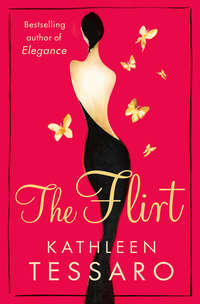
Читать книгу: «The Flirt»
KATHLEEN TESSARO
THE FLIRT

Copyright
This novel is entirely a work of fiction.
The names, characters and incidents portrayed in it are
the work of the author’s imagination. Any resemblance to
actual persons, living or dead, events or localities is
entirely coincidental.
Published by HarperCollinsPublishers Ltd 1 London Bridge Street London SE1 9GF
www.harpercollins.co.uk
1
Copyright © Kathleen Tessaro 2008
The author asserts the moral right to
be identified as the author of this work
A catalogue record for this book
is available from the British Library
All rights reserved under International and Pan-American Copyright Conventions. By payment of the required fees, you have been granted the non-exclusive, non-transferable right to access and read the text of this e-book on-screen. No part of this text may be reproduced, transmitted, down-loaded, decompiled, reverse engineered, or stored in or introduced into any information storage and retrieval system, in any form or by any means, whether electronic or mechanical, now known or hereinafter invented, without the express written permission of HarperCollins e-books.
Ebook Edition © 2008 ISBN: 9780007330676
Version: 2017-12-08
Praise for Kathleen Tessaro’s previous bestsellers:
‘More heart than you’ll ever find on a catwalk … written with élan and panache.’
Daily Mail
‘It’s friendship, not elegance, that proves Louise’s real saviour, and the friendships that develop through the book are drawn carefully and with insight.’
Independent
‘A perfect pick-me-up.’
Cosmopolitan
‘It’s surprising that this is Kathleen Tessaro’s first novel as her style shows the confidence and ease of a more seasoned writer. A charming, entertaining novel.’
Punch
Table of Contents
Copyright
Praise
Chapter 1 - La Vie Bohème
Chapter 2 - A Self-Made Woman
Chapter 3 - Tea for Table Five
Chapter 4 - 45 Chester Square
Chapter 5 - Free Lunch or a Shag
Chapter 6 - Armenian Plumbers
Chapter 7 - The King of the Tennis Ball
Chapter 8 - A Stranger at the Garrick Club
Chapter 9 - 111 Half Moon Street
Chapter 10 - A Subtle Twist of Fate
Chapter 11 - The Interview
Chapter 12 - The Rules
Chapter 13 - Professional Massagers of the Female Ego
Chapter 14 - La Dame aux Camélias
Chapter 15 - High Tea at Claridge’s
Chapter 16 - A Brief History of the Professional Flirt (A Small Digression)
Chapter 17 - The World’s Most Exclusive Hairdresser
Chapter 18 - Another Moriarty Original
Chapter 19 - A Man’s World
Chapter 20 - Nick the Nose
Chapter 21 - Make Me a Willow Cabin at Your Gate
Chapter 22 - The Cardinal Rule (A Moment of Silence, Please, for Freddie)
Chapter 23 - A Clean Break
Chapter 24 - The Ghost Chair
Chapter 25 - The C Word
Chapter 26 - Breakfast at Graff
Chapter 27 - Professional Massagers of the Female Ego at Large (Part One)
Chapter 28 - Professional Massagers of the Female Ego at Large (Part Two)
Chapter 29 - No Ordinary Mark
Chapter 30 - Drip, Drip, Drip
Chapter 31 - Professional Massagers of the Female Ego at Large (Part Three)
Chapter 32 - To the Lighthouse
Chapter 33 - The Savoy
Chapter 34 - All Hail Athena
Chapter 35 - Love According to Flick
Chapter 36 - The History of the Cyrano (Another Digression)
Chapter 37 - The Perfect Plan
Chapter 38 - The Perfect Plan (Hughie’s Version)
Chapter 39 - Venus Blinks
Chapter 40 - The Invitation
Chapter 41 - On the House
Chapter 42 - It’s Me … Emily
Chapter 43 - Walk with Me
Chapter 44 - Into the Care of Mr Lewis
Chapter 45 - International Polo Player
Chapter 46 - Leticia Eats
Chapter 47 - The Last Resort
Chapter 48 - The Next Generation
Chapter 49 - Waiting
Chapter 50 - Meant for Better Things
Chapter 51 - A Suitable Client
Chapter 52 - Unusual
Chapter 53 - The Opera
Chapter 54 - Liberty
Chapter 55 - Professional
Chapter 56 - Perspective
Chapter 57 - Two for the Price of One
Chapter 58 - Domestic Harmony
Chapter 59 - Faux Pas
Chapter 60 - Speed
Chapter 61 - A Deadly Virus
Chapter 62 - The Good Wife
Chapter 63 - A Cold November Evening
Chapter 64 - Life Jogs On
Acknowledgements
About the Author
Also by Kathleen Tessaro
About the Publisher
La Vie Bohème
The ad appeared in the Stage in the second week of September, when the Edinburgh Festival was officially over and real life made its unpleasant appearance again in the collective consciousness of the large number of unemployed young actors who populate the London area.
It read:
Unique situation available for an attractive, well-mannered, morally flexible young man. Hours irregular. Pay generous. Discretion a must.
Please send photo and brief romantic history to:
Valentine Charles
111 Half Moon Street
Mayfair, London
Hughie Armstrong Venables-Smythe was sitting at his usual table, next to the window in Jack’s Café, armed with a pen he’d nicked from the waitress, a strong cup of builder’s tea and his mobile phone, which was running out of credit. Outside, the sun was radiant, the air sharp with a brisk autumn breeze. Elderly shoppers, dragging battered tartan trolleys, paused to examine the merits of the half-price bleach in pink plastic baskets outside the Everything For a Pound shop on Kilburn High Road. Others hurled themselves into bargaining sessions with the red-faced Irish butcher, his bacon suspiciously reasonable.
Here, Hughie was among his people; living the front-line, hand-to-mouth existence of a jobbing actor in NW6, still quite a rough neighbourhood according to his mother, despite the recent boom in house prices.
Spotting the ad, he circled it and leant back, satisfied. In his trade, buying the Stage and circling ads was considered an entire day’s work. He lit a fresh cigarette to celebrate.
He’d only just started smoking; Marlboro Lights. It was a disgusting habit. He’d picked it up from his girlfriend Leticia, who was full of the most delightfully disgusting habits known to man, of which smoking was easily the most socially acceptable. At twenty-three, it made him feel sophisticated. But then Hughie needed all the help he could get, especially as Leticia was a great deal older than him and more sophisticated than he was ever likely to be. Although they’d only been (he was thinking of calling it ‘going out’. But was it really going out if in fact you never went anywhere or did anything but just met several times a week in strange, dark places to have wild, wordless, pornographic sex? Probably not. The proper social heading was more likely to be ‘seeing one another’, which they’d only been doing for about two weeks), Hughie was already violently in love.
Ah, Leticia!
What was not to love?
Everything about her was perfect—from her glossy, black bob, doe-like brown eyes and soft, pink Cupid’s bow lips, to the way she screamed, ‘Spank harder, you horny little bastard!’ in the alleyway behind the bespoke lingerie shop she ran in Belgravia.
Closing his eyes, he silently thanked the Lord above, as he did many times a day now, for the particular good fortune that forced him to sit down next to her on that crowded number 12 bus. From the first moment he felt her delicate hand creeping up his inner thigh as they passed Marble Arch to the hasty exit they both made at Piccadilly Circus, he’d known that the course of his life was changed for ever. Until that day, God had been little more than a vague concept but afterwards, Hughie concluded that no other force in the universe could’ve so perfectly answered all of his prayers.
Then, taking another drag, he frowned.
Leticia was a real woman, not some fluffy student. Deliciously perverse, she was also popular, ruthless and easily bored. How was he going to keep her? Love alone was not enough. A diet of non-stop delights and amusements was needed to sweep her off her feet.
Having no money was neither delightful nor amusing.
This was the torment he’d been warned about in drama school: the very crux of La Vie Bohème. Here he was, a struggling young actor caught in the maelstrom of artistic integrity versus commercial demands. He imagined an audience observing his silent heroism and, with a gallant gesture, swept his mop of ash-blond hair back from his handsome face.
In fact, everyone he met expected him to be employed. How few people understood the fragile relationship between working in the acting profession and actually being paid!
Hughie took another drag.
Whatever happened to art for art’s sake?
Hughie’s mother and sister, Clara, went on endlessly about how was he going to live, to eat, to be a useful member of society, blah, blah, blah. But they were missing the point. And not for the first time, Hughie felt the familiar, frustrating weight of being a Venables-Smythe.
There was a time when being a Venables-Smythe was a destiny; a passport into the world of the English upper classes. However, by the time Hughie was born into the once-illustrious clan, all that was left to inherit was the name, posh accent and a mildly traumatizing public-school education. His grandfather had sold the family pile, priceless antiques and family portraits included, to an American hotel chain in 1977 for what had seemed an enormous amount of money at the time but in retrospect had been a bargain. Instead, he’d bought a badly converted flat in Chelsea, invested heavily in Betamax, and funded Hughie’s father, Robert Armstrong Venables-Smythe, in his playboy lifestyle. His father, as attractive as Hughie was now, had a taste for Ralph Lauren shirts, Gucci loafers, Italian cars and bubbly, big-breasted blondes. He met Hughie’s mother, Rowena Compton Jakes, a nineteen-year-old, flat-chested brunette, shy to the point of being socially disabled, when she was working in the wedding-list department of Tiffany’s. They were married two years later and Robert set up business as a Fulham estate agent. He knew nothing about the property market. He did, however, have a great deal of charm which he expended on long lunches at San Lorenzo with a series of young secretaries who called him Bobby.
When Hughie was five, his father disappeared in a mysterious deep-sea-fishing accident off the coast of Malta. His mother still claimed it was all a hoax but he never returned and his business went quietly bankrupt. This devastating blow signalled the beginning of Hard Times.
However, Hard Times give rise to great acts of heroism. And so it came to pass that Hughie’s mother showed her true mettle. She painted the living room red, bought a few scatter cushions from Peter Jones and announced that she was now an interior designer of the Jocasta Innes variety. One stiff early-morning drink took the edge off her shyness. She maintained a veneer of social respectability by shopping at designer second-hand shops and, at tremendous personal sacrifice, sending her children to the best schools. Her single obsession was that they should gain not only the kind of financial security that had eluded both their father and their grandfather, but also launch themselves back into the bosom of their class.
And so, Hughie’s older sister Clara diligently won a scholarship to study classics at Cambridge while Hughie, rejected from almost every institution of any note, enrolled in a third-rate drama school in King’s Cross, where he set about studying his craft.
Every once in a while, Hughie tried to imagine his father’s face. (His mother had systematically eliminated all his photographs.) What might he look like now?
Tucking the cigarette into the side of his mouth, Hughie took out the one remaining photo from his wallet. The faded Polaroid showed Hughie at three, holding his father’s hand on a beach in Spain. Robert was bending towards him, his hand pressed into the small of Hughie’s back. He was laughing, tanned, happy.
Hughie had studied the photograph for so many hours, over so many years, that it formed a memory where none existed. Sometimes he imagined he could still feel his father’s reassuring touch, a firm hand guiding him through the unknown, towards a version of himself he would be proud of.
Hughie slipped the photo back into his empty wallet.
The Unknown: here it was again, looming before him.
He was just back from a three-week stint in Edinburgh performing in an improvised musical about homelessness called Waste! He couldn’t sing much beyond ‘Land of Hope and Glory’ but he’d listened to enough Benjamin Britten during his Harrow education to pretend he was obsessed with atonal harmonies. Whenever he hit a sour note, he looked very serious and sang louder. Over time, the rest of the cast came to admire his musical daring. (After the late-night drinking sessions, he’d done a lot more atonal singing than even he’d intended.)
But now he was back in London, living on the sofa in Clara’s front room, and money was officially a problem. Actually, Clara was a problem too.
Clara had taken her mother’s advice: she worked in a large business PR firm in the City. She walked like a man in heels and wore navy-blue suits, hair in a limp, mousy bob—a look that might have been sexy in a Miss Moneypenny kind of way on anyone else but Clara. Her hours and ambition were such that Hughie hardly ever saw her but she left little yellow Post-it notes telling him what to do (or not, as the case might be). Sometimes, Hughie felt sure that she’d come home in the middle of the day to plaster a fresh supply on everything he’d ever touched. ‘This is NOT an ashtray!’ on the eighteenth-century porcelain china planter given to her by her fiancé Malcolm (a china specialist at Sotheby’s who was so obviously gay to everyone else in the world but Clara). ‘Put the seat DOWN!’ on the loo lid, ‘Buy your OWN MILK!’ on the refrigerator and ‘Don’t forget your fucking KEYS again!’ on the back of the door, just as he was about to go out (without his fucking keys). True, he’d only meant to stay a few days but she was being a cow about the whole thing. Nothing had changed between them since he was six and she ten, bossing him around all day like a shorter, fiercer mother, only she was considerably more sober than their mother and therefore more relentlessly eagle-eyed.
Stubbing out his cigarette, he hailed the waitress.
A tiny, auburn-haired girl came over and handed him the bill.
‘You don’t, by any chance, take Amex, do you?’ Hughie smiled. (The Venables-Smythe smile was something to behold—two dazzling rows of even white teeth, punctuated by dimples and a pair of intensely blue eyes.)
‘I, ah…’
‘Look,’ he peered at her name tag, ‘the thing is, Rose, I’m a bit short of change. But I’m a regular—you’ve seen me. I’m here almost every day’
‘Yes, yes…that’s true,’ she admitted. ‘But this is the third time in a week you’ve been short.’
‘Listen.’ He stood up. ‘I’ll tell you what, why don’t you spot me for one more day and I promise, on my mother’s grave, that tomorrow I’ll come in and make it up to you.’ He smiled wider. She blushed bright scarlet. ‘So do we have a deal?’
‘OK.’
Hughie landed a quick kiss on her cheek. ‘You’re a star, Rose! An absolute star!’ He swung open the door.
‘Wait a minute! What’s your name?’
‘Forgive me! Hughie.’ He offered his hand. ‘Hughie Armstrong Venables-Smythe. Now, don’t give up on me, Rose, will you? I’ll be in first thing in the morning, you have my word.’ And tucking his copy of the Stage under his arm, he left.
Once outside, he picked up a rogue apple rolling just out of sight of the fruit seller on the corner, rubbed it clean on his jeans, took a bite and considered the ad as he strolled home.
Hours irregular. Pay generous. Both sounded just the ticket. But the moral flexibility excited him most. He was uncertain as to the existence of any moral substance in his nature to begin with. How did one know nowadays? What were the criteria? Apart from the most obvious guidelines (would you kill anyone? How do you feel about stealing from old people?), he felt curiously uninformed in this area. It was clear, though, that morally flexible was by far the sexier of the two options.
And Leticia would love him for it.
A Self-Made Woman
Leticia Vane jangled the set of keys in her hand and sauntered down Elizabeth Street. She was the kind of girl (and even nearing her mid-thirties, she still thought of herself as a girl) who was aware of how her body looked and the shapes it made when she moved. Even though there was no one about much before noon in this part of the world, she liked to think she was being watched and that people noticed in her a certain dangerous pleasure.
And indeed, Leticia Vane was in many ways her own finest creation. She’d taken what little rough material nature had allotted her and moulded, shaped, hacked away at it as a sculptor chips away at a hunk of marble.
Nothing remained from her previous life as Emily Ann Fink of Hampstead Garden Suburb. The uni-brow that God had seen fit to adorn her with was gone, plucked into two slim, expressive arches; the overbite long replaced; the dull, brown hair dyed a gleaming black that brought out the colour of her eyes. Her face was pleasing but, understanding that she was no beauty, she’d taken a great deal of time over her figure. She ate once a day and smoked the rest of the time. Dying young was far preferable to dying fat. It had taken a lot of hard work to make Leticia Vane, the kind of work not a lot of people appreciated.
And of course there was the back story, too. One of two children of a chartered accountant and a depressed schoolteacher wouldn’t do. Leticia wanted something more fascinating. So she transformed her parents into diplomats, serving in faraway countries. She’d been raised in a series of exotic locations; learnt languages (she was far too polite to show them off in public); had affairs at a preternatural age; been doted upon but still suffered from a past too secret and too painful to reveal to anyone.
She’d always longed to be exclusive. Rare. And now she figured she probably had another ten years to really enjoy the fruits of her labours. However, the fragile nature of her accomplishments made them all the more dear.
And so she sauntered, just in case someone was looking out of the window, wondering what that fetching young woman was doing up at this time of day. And with a swagger, she twisted the keys in the lock of the tiny shop.
Bordello was a lingerie shop but it had no shelves, no long lines of silk nothings swinging on rails, no emaciated mannequins with stiff nipples adorned in lace thongs. In fact it looked more like a small, turn-of-the-century Parisian drawing room than a shop. The walls were papered with fine black-and-white stripes, the Louis Quatorze fauteuils were covered in ivory raw silk; a rare, cobalt-blue chandelier sent beams of azure light darting around the room. Leticia offered a bespoke service. There were no samples. There were, however, yards and yards of the most exquisite aged silk and satin in the palest colours: champagne, dove grey, pearl and thumb-nail pink. Bolts of filmy organdies were piled into corners and there were baskets with drifts of lace—antique, handmade, tiny works of art she’d collected from all over the globe. On a round mahogany table in the centre of the room, her sketchbooks were piled high, full of her latest creations. There were no changing rooms, only a luxuriously appointed bathroom to the rear, complete with an antique slipper bath, next to a narrow workroom.
Leticia was selling a sexual dream in which each of her clients starred. So she created a stage setting of subtle erotic chic; just glamorous and sensual enough to stir the imaginations of the women she catered to.
And Leticia Vane didn’t cater to just anyone. Clients had to be referred. Exclusivity wasn’t a matter of money nowadays; everyone and anyone had money. In order to be desirable, you had to be unavailable. Celebrities were the kiss of death to any business; as they went out of fashion, so would you. And she didn’t make anything for women who’d had breast implants. Leticia’s objections were purely aesthetic. They simply ruined the balance of her creations. She prided herself on being able to lend a hand where nature had been careless or abrupt. Her nightdresses all had inbuilt bras which she fashioned from plaster moulds of her clients’ breasts. Discrepancies in size and shape were all catered to and gently adjusted. By raking the insides of each cup, she made the breasts fall forward, spilling recklessly, yet never fully escaping, bound by tissue-thin layers of sheerest net.
She didn’t make anything as vulgar as crotchless panties or cut-out bras, but she knew how to heighten the colouring, hand tinting the fabric of each design so that the nipples appeared pink and slightly swollen. And her famous French knickers were so silky and loose that they could easily be pushed to one side without ever completely removing them.
Leticia’s greatest asset was that she understood men and sympathized with women. The difficulty with most lingerie was that it repelled the very thing it claimed to enhance. Not every man was thrilled to arrive home after a long day to find his wife trussed up in three hundred pounds’ worth of bizarre, lurid corsetry—trying to act sexy in a get-up that had taken her a full half-hour to wriggle into. Both of them would be embarrassed by the effort of such a blatant overture; unsure of how to work various snaps and ties. Then there would be added pressure of having an unprecedented sexual experience that would warrant the expense. Leticia understood that when a woman went to such trouble, it was usually because her sex life had reached a crisis. But the very unfamiliarity of such a costume could make her feel ridiculous and, even worse, desperate. A deliberate performance always increases the possibility of sexual rejection.
Leticia firmly believed that quality was the result of quantity.
Good sex was simply a by-product of having a great deal of all sorts of sex; rough, slow, quick and to the point or dreamy and drawn out, random gropes, teasing touches, full-on oral feasts—all these things qualified as sex to her. And so, to facilitate an unconscious air of sexual susceptibility, she created heightened versions of everyday pieces; deceptively simple white nightdresses, only fashioned from such sheer material and cut so cleverly that they draped the body in a provocative, filmy gauze, accentuating the peek of nipples, hugging the curve of hips, lengthening legs; billowing beguilingly with each movement. Because they appeared so innocent and unassuming, they were undeniably erotic. Instead of shouting, ‘Fuck me!’ they whispered, ‘Take me…see…I’m not even looking!’ The cleverest bit was that, while a man couldn’t help but be hypnotized by the erotic undertones, the idea of sex would be his. The pieces compelled a man to act, and made the woman feel languid. She could lie back and lure her husband into action. And a man who initiates sex always feels more virile than one who has it thrust upon him.
Leticia had been taught this invaluable insight along with the rest of her trade by her godfather, Leo. He’d been a West End theatrical costume designer. And like Leticia, he was entirely self-created. He smoked thin, black Russian cigarettes, probably had his nose done back in the sixties and wore his beautiful silver hair loose around his shoulders. His uniform was what he called ‘an Audrey’—a black cashmere polo neck, black tailored trousers and soft, leather slippers he had specially made.
He laughed often and firmly refused to countenance any form of self-pity or pessimism.
He came from a different world—not just a theatrical one but from another age entirely—an age that had no qualms about artifice; that had no desire to appear natural, and understood that a little sleight of hand was nothing to be ashamed of. He’d been a dresser to Marlene Dietrich when she used to pin her scalp back under her wig; had sewn sweat guards into Julie Andrews’s gowns in My Fair Lady and even adjusted the sleeves on Vivian Leigh’s costumes so that no one could see her hands shaking after a bad night.
Leticia slipped off her jacket, hung it up on a hook behind the door and looked round with satisfaction. Leo was retired now but he adored the shop. The slipper bath had been his idea. (It shuddered violently if you turned on the taps but it looked exquisite.) He was the only other person who really appreciated her collection of lace or the rare quality of the bolts of beautiful fabric.
If it hadn’t been for him, she might still be languishing in Hampstead Garden Suburb. He gave her a subscription to Vogue when she was eight. When she was ten, he presented Leticia with a little work table all her own in his studio. There she sat, making sketches, watching carefully as the greatest stage divas of the day were transformed from frightened, self-obsessed neurotics into creatures worthy of universal adoration. In her teens, he took her to the theatre, bought her her first cocktail in Kettner’s, showed her how to pluck her eyebrows and move in a way that commanded attention. He taught her the difference between presence, which includes everyone in its warm glow, and attitude, which keeps the whole world at bay.
There was nothing Leo couldn’t render magical. Nothing he couldn’t fix.
She opened her appointment book and examined the names. A romance novelist, a duchess and a rich American woman from Savannah. She didn’t like more than three appointments a day and nothing before 11 a.m. Early morning wasn’t sexy; once you were out of bed and dressed, the weight of the day pressed too hard on everyone’s conscience.
Her phone buzzed. She flicked it open. It was Leo.
‘Angel, how are we this morning?’ he purred, his voice tempered by thousands of cigarettes.
‘Brilliant. Are you coming in today? Please say you’re coming! I’ve got an order for a silk kimono I can’t make drape properly for love nor money. The woman has a bust like a mountain range. I promise to buy you a long, boozy lunch if you can fix it.’
‘Would love to but I can’t. Feeling a bit rough this morning. Truth is I was up late last night playing strip poker with Juan. You remember Juan, don’t you?’
‘That male nurse from Brazil?’ She riffled through the morning post. Another postcard from her parents in Israel. More brown envelopes. How boring. She tossed them unopened into the bin. ‘Didn’t you decide he was too young for you? Does he even speak English?’
‘Don’t be catty, darling. His English has come on a treat. Besides,’ she could hear him lighting a fresh cigarette, ‘we don’t waste our time on conversation.’
‘Please! I don’t want to know all your secrets!’
‘You know them all anyway’
She smiled. ‘I have one.’
‘Really? What or rather who is it?’
‘Now who’s being catty? His name’s Hughie and he’s delicious!’
‘How old?’
‘Oh, I don’t know…early twenties?’
She heard him exhale. ‘You need a real man, Leticia. Not some boy’
‘This from you!’ She closed the appointment book firmly. ‘Real men don’t exist. Or haven’t you noticed? Besides, he’s only a fling.’
‘They have feelings, you know’
‘I doubt it. All men want is sex. Especially young men.’
‘And what about you? What do you want?’
Her fingers ran over a particularly exquisite and costly bolt of French blue silk organdie. ‘Who cares what I want? It’s what I can have that matters.’
‘Emily Ann…’
She winced. ‘You know I hate that name; it’s so impossibly ugly!’
‘Emily’ he repeated firmly, ‘I’m concerned. These flings are getting to be a habit with you.’
‘And why not? We live in a disposable world. There’s no point in investing yourself too heavily.’
‘You’re too young to be so cynical.’
‘Oh, please!’ She sighed. ‘Let’s not do serious today! I can’t; I’m not in the mood. I just want to have some fun. And Hughie’s fun.’
‘He’s also real.’
‘What am I now, some corrupting influence? No lectures—not today.’
‘I’m only saying that you’ve got to be careful.’
‘Stop, Leo,’ she warned.
He ignored her. ‘You pretend to be tough but we both know you’re not.’
‘I have to go.’
‘Darling, I love you and I don’t want to see you hurt.’
‘What? By Hughie?’ she laughed. ‘See, that’s the whole point! He can’t hurt me! And I can’t hurt him. We have rules, Leo. It’s strictly sex…nothing more.’
‘I’ve got news for you, sunshine. Rules or no rules, you’re not in control of your heart. No one is.’
‘Listen, I’ll call you later. I have heaps to do and if you’re not coming round I’ll have to try to sort out this kimono monstrosity by myself. Speak later? And no more hot Brazilians, understand?’
She clicked the phone shut, pressed her hand over her eyes.
He was being so difficult.
And suddenly, it was back again; the dull ache, pressing hard.
It was an ache now, but for at least a year it had been a searing, slicing pain across her whole chest, like someone performing open-heart surgery without an anaesthetic. She couldn’t eat, couldn’t sleep…
Damn him! Why did he have to be so…so judgemental?
She took a deep breath.
It didn’t matter. It was all over now. She was on her feet again, better than ever.
In her workshop, Leticia put the kettle on and lit a cigarette. There was time between the duchess and the novelist to have Hughie come round. And leaning her back against the counter, she inhaled deeply and closed her eyes.
Hughie was so tall, so young, so classically handsome. And so easy to control! There were no power struggles, no coy dating rituals or manipulations. She rang, he came, they fucked. And then they fucked some more.
It was a simple relationship and, in a way, beautiful. There was something different about Hughie: a freshness. No deep thoughts or dark moods interfered with his performance. Of course, he had a lot to learn; a diamond in the rough. But that was exciting. And the best part was, he was insane about her. It was only a fling, but in every relationship there was the one who adored and the one who was adored. She’d done the adoring and preferred by far when it was the other way round.
The kettle boiled. Spooning the loose leaves of Earl Grey tea carefully into a Tiffany blue pot, she poured in the hot water. The aroma of bergamot filled the room.
She stared out of the window into the small garden at the back.
Leo was wrong. No one could hurt her again; she wouldn’t let them.
Giving the tea a quick stir, she poured herself a cup. These were the hours she liked best; the day glimmered before her like a golden promise, untouched by disappointment or frustration. And sitting down at the table, she placed her teacup on a small bench well away from her work, unfolded a tissue-paper parcel full of silk and deftly threaded her needle.
The morning sun warmed her back, outside birds sang. Leticia sipped her tea.
Few things were more fragile than antique lace or the human heart.
Then she heard something.
Persistent, irritating.
Coming from the bathroom.
A dripping sound.
The kind of sound, in fact, that signalled the urgent need for a plumber.
Tea for Table Five
The waitress at Jack’s Café, Rose, paused by the window, watching as Hughie Armstrong Venables-Smythe sauntered away down the street through the crowds of people.
‘Order up!’ shouted Bert from the kitchen behind her.
‘I said, order up!’ he called again.
Rose turned and delivered the two fried eggs, sausage, beans and tomato to the man at table seven before clearing away Hughie’s breakfast remains. Then she took £4.95 from her own pocket of tips and put it into the till.
‘Rose! Tea for table five!’ Bert shouted. ‘What the hell’s got into you today?’
‘Nothing,’ she said, pouring out the tea. ‘Nothing at all.’
She took it over to Sam the plumber, a regular at table five. In his late thirties, Sam had a mop of dark unruly hair, now flecked with grey, wild pale green eyes and a sardonic smile. He’d inherited his father’s floundering plumbing and heating business earlier that year; along with the same ready laugh and long, loping gait. He was poring over a catalogue of plastic U-bend pipes.
‘Thanks.’ He took a sip, frowning with concentration.
‘God, Sam, don’t you ever take a break?’
‘What for?’ he shrugged. ‘It’s my business now; no one’s going to make it a success but me.’
‘But U-bends at breakfast?’ She shook her head. ‘Your dad was always more relaxed.’
‘Yeah, well, if my old man had put as much time into the business as he did into going to the pub, he might still be with us.’ His voice was sharp.
Old Roy, Sam’s dad, had lived in the same block of council flats as Rose; she’d known both of them for years. He’d been a larger-than-life character, equally popular with men and women; a man whose cheeky good humour seemed to exempt him from the normal rules of life. Over the years he and Sam, both stubborn characters, had spent a lot of time at loggerheads. Sam was ambitious and Old Roy was usually hungover. But now that he was gone, Rose detected an edginess to Sam; a cloud of uncharacteristic seriousness coloured his personality. Lately he only had time for one thing: his career.
‘Sorry, Sam, I’m not thinking today’. She pushed a cloth absent-mindedly around the tabletop, knocking the sugar over. ‘Oh, damn!’
He glanced up; clear eyes surrounded by a thick fringe of lashes. ‘Off in your dream world again?’
‘What are you talking about?’
‘Well,’ he put his mug down, ‘he kissed you, didn’t he, Red?’
Sam was nothing if not observant.
‘So what if he did?’ She was blushing again. Turning, she pretended to be deeply engrossed in removing a coffee stain from another table. ‘And don’t call me Red. I’m too old for nicknames. I’m nearly twenty-two, not some child.’
‘Yeah. Sure.’
Without looking round, she knew he was laughing.
‘You like him,’ Sam teased.
‘Oh, I don’t know,’ Rose tried to sound blasé and sophisticated. Unfortunately, she was too excited to keep up the pretence for long. ‘But I think he likes me. He’s coming back tomorrow!’
‘Did he pay his bill?’
‘Well, he would’ve, only we don’t take Amex.’
Sam rolled his eyes. ‘Every time he comes in, you end up out of pocket.’
‘He’s just short of cash, that’s all. A lot of people don’t get paid till the end of the month.’ She knotted her hair back in a ponytail at the nape of her neck. (Now that he was gone, she could put it up again.) ‘I think he looks like Prince William.’
‘Why don’t you meet a nice normal guy?’
‘And where would I find the time for that?’ she asked, irritated. ‘Remember, I have a child to feed. Who wants to go out with a single mother?’
‘Oh, bollocks, Rose! You’re only young! There will be plenty of guys. You know, real guys—with cash instead of promises.’
Rose made a face at him.
‘Speaking of kids, how is Rory?’ he asked.
She sighed. ‘He bit another kid in nursery yesterday’.
‘Well, all of them go through tricky patches when they start school.’
‘You don’t understand.’ She gathered up all the ketchup dispensers and began refilling them. ‘He bit the little boy who’s allergic to nuts, wheat and milk; this kid hardly has anything to live for! And the day before that he headbutted the teacher. She had a lump on her forehead the size of an egg!’
‘Well…’ She’d obviously stretched his bachelor experience to the limit. ‘I wouldn’t worry about him. Now,’ he shifted the subject back to more familiar ground, ‘what are we going to do with you?’
‘Me?’ Rose wiped the shiny lids clean.
‘Yes, you. You’re a smart girl. Don’t you think it’s time you did something more than waitressing?’
She smiled wryly. ‘Not all of us are business tycoons, Sam.’
He arched an eyebrow. ‘What does that mean? Listen, I’ll make a going concern of this business if it kills me. If you think I’m going to live and die like my dad in a council flat in Kilburn, you’re wrong.’
‘Hey!’ She swatted him with her tea towel. ‘What’s wrong with that, I’d like to know?’
‘What’s wrong with what?’
They turned.
It was Ricki, Rose’s cousin. Ricki worked as a landscape gardener for a company in Islington. With her cropped hair, tanned muscular frame and uniform of heavy work boots, a fitted T-shirt and jeans slung low across her hipbones, showing off her firm, flat belly, she looked handsome rather than pretty. Every day she stopped in on her way to work for a takeaway coffee and toast. Hands thrust deep into her pockets she strolled over, grinning slyly at Sam.
‘He’s not banging on about conquering the world with his plunger again, is he?’ She gave his shoulder a squeeze. ‘How many times do we have to tell you? It’s OK that you’re insane and power crazy. We support you.’
‘Thanks. I feel a lot better.’
‘How’s it going anyway?’ She slid in across from him, picked up the catalogue. ‘Wow Fascinating. You know, you ought to get out more.’
‘I know, I know,’ he admitted, running his long fingers through his shaggy curls. ‘But if I can get the business to turn a profit this year, then pretty soon I’ll be able to expand, take on a few more guys. I mean, my old man left it in a real state. Everything was about flying by the seat of your pants with him. You want to know what his filing system was? A cardboard box shoved under the kitchen sink.’
Ricki stole a slice of toast from his plate. ‘You could do with a bit more flying by the seat of your pants.’
‘What’s that supposed to mean?’
‘It means,’ she tore off a bite, ‘that you’re too bloody serious. When was the last time you went out?’
‘You don’t get it.’
Ricki looked at him. ‘I do get it. You miss him.’
Sam shifted, stared out the window. ‘Yeah. Well…actually,’ he changed the subject, ‘I was picking on Rose for a change.’
‘Oh, yeah?’ Ricki grabbed Rose’s hand, pulled her down onto her knee. ‘I’ll take some of that action. So what are we picking on her for today?’
‘Piss off!’ Rose squirmed but Ricki was strong and held her fast.
‘I’m thinking she can do better than Jack’s Café, what do you think?’
‘I agree. Two thousand per cent.’
‘And that blond guy she likes gave her a kiss today!’ Sam added.
‘No way? Posh Pants?’
‘Enough!’ Rose managed to wriggle free. ‘I don’t need career or love advice from you two losers! Besides,’ she straightened her apron imperiously, ‘I’ve got plans.’
Sam and Ricki looked at each other. ‘Ooooooooo-ooowwwww!’
‘Like what?’ Sam wanted to know.
‘They’re private,’ Rose sniffed, heading back to the kitchen to get Ricki’s coffee. ‘But rest assured, it doesn’t involve pouring you idiots cups of tea all day long!’
‘Good. Glad to hear it,’ Ricki called after her. She looked at Sam, shook her head. ‘Fuck.’
‘Yeah, that about sums it up,’ he agreed. ‘You OK?’
‘Just tired,’ Ricki yawned. ‘And lonely. And tired of being lonely’.
Sam finished off his tea. ‘So get a girlfriend.’
‘Yeah, right. If it were that easy, even you would have one by now.’
‘Hey I’m not lonely!’ he objected. ‘I’m just too fascinating and busy and…’
‘Old?’
‘Yeah, old. You could always lower your standards.’
Ricki snorted. ‘I will if you will.’
‘Actually,’ he considered, ‘I’d rather be alone.’
‘Me too.’
Rose came back with her order and, handing her a fiver, Ricki stood up. ‘Well, I’d better get my skates on; I’ve got a new client today.’ She kissed Rose on the cheek. ‘Give me a ring if you need a hand with Rory this week, OK?’
‘OK. Thanks.’
‘And you,’ Ricki turned to Sam, ‘take care of yourself. Don’t get too obsessed about work. Take it easy.’
‘I’ll take it easy when I’ve retired early to my holiday home in Tuscany.’
‘Yeah, well, ciao, baby!’
Sam picked up the catalogue again.
Rose replaced the ketchup dispensers.
The breakfast rush was over.
Straightening a few chairs, Rose propped open the door. Fresh air rushed in. She closed her eyes; it felt cool and refreshing on her face.
Her luck was turning; she could feel it. Not only had the man she’d had a crush on for two weeks finally noticed her but she also had a job interview; the first real interview of her life. And wasn’t just any job; it was prestigious—for the position of junior assistant to the acting assistant household manager of a grand house in Belgravia.
Number 45 Chester Square.
Belgravia.
Even the name had poetry!
Last Saturday afternoon, she’d taken Rory there on the bus, just to make certain she knew where she was going. They’d stopped in front of number 45, with its tiers of neat window boxes and round bay trees bordering the front door. The brass knocker in the shape of a lion’s head gleamed against the lustrous black paint. The windows sparkled in the sun. Everything was even, balanced; pleasing to the eye.
Nothing bad could ever happen in a house as beautiful as this. A longing filled Rose’s chest. She wanted to have her own front-door key. She’d step inside and find a world marked by ease and elegance, a world completely removed from the one she inhabited now.
Perched behind the till, Rose took out a copy of Hello! magazine, losing herself in the glossy pages of celebrity photos.
The café was peaceful; quiet.
Then Sam’s phone rang.
‘Yes? Yes, that’s right. A drip? What kind of drip? Oh. A gush, eh? Yeah, well,’ he checked his watch, ‘I could come by now but I may not be able to fix the whole thing today.’ He collected his things. ‘What’s the address?’
A pack of off-duty dustmen piled through the door. Sam pushed past them, waving to Rose as he went.
Rose nodded back.
In a few short days, life was bound to become very interesting indeed. But until then, there were tables to serve.
45 Chester Square
Olivia Elizabeth Annabelle Bourgalt du Coudray sat in the gold-and-blue breakfast room of number 45 Chester Square, twisting the enormous diamond eternity ring round on her finger, waiting for her husband’s wrath to begin.
She’d made the mistake of getting up in the night, waking her husband. So he’d spent the entire night tossing round as violently as he could, whipping the sheets on and then kicking them off again, pulling at the pillow and sighing in frustration. And now, sick with nerves, Olivia sat holding her cup of coffee, knowing that as soon as he came down he’d lecture her and accuse her of keeping him up.
Her husband, Arnaud, liked to get angry. Along with Cuban cigars, and being recognized in public, it was one of his favourite things. There was nothing like a good rant to start the day off; his eyes lit up and his skin glowed. It didn’t matter that he owned half of the world’s tennis-ball factories or that his family wealth was such that he was regarded as a political figure in France (his views were petitioned on everything from the future of the European Union to cheese production). Even billionaires could have their peace destroyed by an insomniac wife.
As one of six daughters of the famous Boston Van der Lydens, Olivia had spent her youth gliding between New York, the Hamptons and the French Riviera, lingering in Boston only so long as it took to scrape together a degree in Art History. She’d been privileged, emulated; photographed regularly for Vogue and Harper’s Bazaar. When Arnaud began his rigorous courtship of her, the American press greeted it as a union between two shining stars in the international social firmament. But here in England she was virtually invisible. And in Paris with Arnaud’s family, she felt positively gauche. It didn’t help that Arnaud’s mother, the fearsome Comtesse Honorée Bourgalt du Coudray, followed her around her own wedding reception at the Paris Opéra correcting her French and apologizing for the state of her new daughter-in-law’s hair.
Olivia glanced up, catching sight of her reflection in the oval mirror that hung across the room. She possessed the wholesome American glamour that inspires Ralph Lauren and Calvin Klein; athletic good cheer coupled with classical features. Her blonde hair was thick and even, her blue eyes large, her cheekbones high, but, as she’d heard her mother-in-law declare loudly one evening to Arnaud, ‘She’s unremarkable, bland, no cachet.’ Then she’d uttered the damning verdict that had obsessed Olivia ever since. ‘Why choose fromage frais when you could easily afford camembert?’
Even now, the spectre of her mother-in-law haunted her; a constant front-row critic in her head.
Bland. Unremarkable. The Comtesse had only articulated what she had suspected all along: she was a fraud; a pale imitation of a person with no real talents or original thoughts, no tangible purpose in life. Her beauty and breeding had been sufficient for so many years. And now that she was forty, even those were fading.
Olivia was Arnaud’s second wife. By the time she married him, he already had two grown-up children, a huge social network spanning several continents, a daunting diary of engagements, houses all over the world, a variety of businesses, and armies of staff. He also had a reputation as an incurable playboy. At the time, she’d been foolish enough to think she could influence him. But after ten years of marriage, the opposite had happened.
And she’d failed in the one role nature might have provided.
No wonder Arnaud had grown so indifferent.
She sipped her coffee.
It was cold.
He had always been difficult, dictatorial. But before, she’d occupied a privileged position in his psyche; she was the prized object, perfect, unassailable.
Last year changed all that.
She’d wanted children so badly, for so long. Then she finally discovered she was pregnant. No longer clinging, limpet-like to Arnaud’s life, she developed poise and sureness. Best of all it endowed her husband with the one thing money couldn’t buy. He was young again, about to be a father; bursting with unassailable masculinity. Hand over her growing bump, he ferried her around London with pride. Never before had they been so close. Together they’d chosen nursery furniture, selected schools, debated names.
Then at eighteen weeks, she woke in the middle of the night. There was blood, sticky and warm, between her legs and pain, like a tightening fist, gripping her torso.
Arnaud was out of the country. She’d gone alone to the hospital. The delivery was long, painful.
She never saw her child; never held it.
Arnaud refused to mention the miscarriage. Instead, he bought her the eternity ring: flawless; gleaming; hideously expensive.
Night-time haunted her ever since.
So Olivia sat, holding the cold coffee in the beautifully decorated Regency-inspired gold-and-blue breakfast room of Chester Square. Behind her, on the mantelpiece, the ghastly ormolu clock the Comtesse had given them as a wedding present ticked loudly.
Fifteen minutes later Arnaud descended. At sixty-two, he was still tanned and trim; he was an avid tennis player and kept up to three yachts moored in Monte Carlo, depending on his mood. His black hair was thinning. He had it trimmed each morning by his valet so that it fell over any balding patches. He shook his head now, it tumbled into place.
Olivia ran her fingers over her hair; there was the familiar fear of being less than satisfactorily groomed in his presence.
Gaunt, the butler, stalked in, delivering fresh coffee and toast with grim formality.
‘Good morning, sir.’
Arnaud grunted.
Gaunt slunk away.
For a while Arnaud said nothing; tossed his toast aside, folded open the paper loudly…
Then, of course, she had to ask. ‘How did you sleep?’
His black eyes narrowed. He put the paper down. ‘How did I sleep? Let me ask you, how do you think I slept?’
‘I don’t know.’
‘Badly! That’s the answer: badly!’
‘I’m sorry,’ she faltered.
‘Up and down! Up and down! What do you do all night?’
‘I don’t know. I’m sorry, Arnaud.’
‘You need a pill! You need to go to the doctor and get a pill.’
‘Yes.’ She stared hard at her plate, at the black interlocking chain design that bordered its silvery white edges.
‘I’ll have my things moved into another room if this goes on.’ He pushed away from the table. ‘I have important things to attend to. Gaunt! Gaunt!’
‘Yes, sir?’ Gaunt appeared out of thin air.
‘Get Mortimer on the phone for me! I promised Pollard supper at the Garrick tonight. We have to discuss marketing strategies.’ He tossed his napkin down.
‘Yes, sir.’
‘I want the car out front in forty minutes.’
‘Very good, sir.’
‘Will you…’ Olivia hesitated.
He stared at her. ‘Yes? Will I what?’
She hated asking the question; her voice sounded small, plaintive. ‘Will you be home tonight?’
‘Sweetheart, what have I just said? I’m meeting Pollard at the Garrick tonight. Perhaps if you slept at night instead of wandering around like a cat I wouldn’t have to repeat myself.’
He stalked away, taking the paper and his coffee with him. Halfway up the stairs, she could hear him ranting at Kipps, the valet, who’d placed his slippers on the wrong side of the bed. Eventually a door slammed.
In the silence that followed, Olivia was aware of countless pairs of unseen eyes upon her; witnesses to their growing domestic disharmony. The months that Arnaud had spent wooing her belonged to another lifetime.
His personality was so strong, so forceful; he always knew exactly what he wanted and what to do. Then he turned the full glare of his powerful attention on her. Her initial indifference spurred him into unprecedented romantic gestures. Fresh boxes of flowers were delivered to her each morning; gifts of diamond earrings, a sapphire ring, even a rare black pearl necklace, were sent from the finest jewellers. Once he bought her a Degas sketch she’d casually admired in a Bonham’s catalogue. They’d travelled in his private jet to exotic locations all over the world where her every need was quickly catered for. She receded into the shadow of his larger-than-life persona. It was a relief to slot into a readymade life; where every decision was made for you.
But all that was gone now.
Slowly, she pushed her chair back.
Suddenly Gaunt was there again, picking up the napkin from the floor, folding it, holding the door open.
‘May I get you anything, ma’am?’
His attentiveness almost felt like kindness. The prick of tears threatened. ‘No,’ she forced a smile. ‘Breakfast was lovely. Just perfect. Thank you.’
She wandered out into the hallway. Hours stretched out before her, empty and unbearable.
‘Begging your pardon…’ Gaunt hovered like a dark shadow in the doorway.
‘Yes?’
‘The gardener would like a word about the new water feature.’
‘Oh. Of course.’
Olivia followed him outside.
It was a London garden: a small courtyard leading to a narrow patch of grass, augmented by neat rows of flower beds. A tiny fountain trickled away in one corner and there were three long, slender eucalyptus trees near the back wall for privacy.
A dark-haired young man was waiting with his back to her.
He turned as Olivia stepped forward into the sunlight; for a moment its rays blinded her. But as her eyes adjusted, she realized that he was in fact a she; a tall, tanned young woman with dark, cropped hair. She was wearing a white T-shirt, her thumbs hooked into her pockets. Her dark eyes met Olivia’s, lips parting into a slow smile.
‘This is Ricki, the gardener,’ Gaunt introduced them.
‘Hi.’ She offered a firm handshake. ‘So, you want to get rid of this fountain, is that right?’
‘Yes, it makes the most irritating dribbling sound.’
‘Humm. It’s easily done. Have you thought about what sound you want it to make?’
‘You mean I can choose?’
‘Yeah, water makes different sounds depending on the material the feature’s made of, how high the drop is, the depth of pool underneath…it’s up to you. Personally, I’d move it out of the corner, get something a bit more dramatic going, right here,’ she indicated the centre of the lawn, ‘right down the middle. Do you have any kids?’
‘No,’ Olivia replied sharply. ‘Why?’
‘Nothing. Only kids and water don’t mix; it’s dangerous.’
‘Oh. Yes. Of course.’
‘But since that’s not a problem,’ Ricki continued, ‘we could do something fantastic. An aluminium gulley maybe, running the full length of the lawn.’ She strode into the centre. ‘Water can be fed in from a tall black slate waterfall here at the back, against this wall. See, the aluminium catches the light, contrasts with the density of the slate. Really stunning! And in the summer when the grass is bright green, it’s like a silver blade, cutting the lawn in two. Placed high enough it makes the most wonderful, rolling sound, you know, no burbling or babbling brook bullshit, but something strong, soothing…What do you think?’
The vision of a blade of water slicing across the lawn intrigued Olivia. And Ricki’s enthusiasm was compelling. ‘Oh, yes! That sounds beautiful! There’s only one thing: my husband will hate it.’
Ricki laughed, shrugged her shoulders. ‘So what?’
‘You don’t know my husband,’ Olivia smiled wryly. ‘It’s safer if we go for something a little more traditional.’
‘Let me guess, a seashell bird bath with a peeing cherub on top?’
‘Yes, that sounds more like what he was expecting,’ she admitted.
Ricki shook her head, looking at her hard with those large black eyes. ‘Sometimes the most dangerous thing you can do is play it safe. We could do something really interesting here—something bold.’
To her surprise Olivia blushed. ‘Well, yes, but…’
‘Pardon me, madam.’
It was Gaunt again.
‘Simon Grey from the Mount Street Gallery is waiting in the drawing room. He doesn’t have an appointment but he says it’s a matter of some urgency.’
‘Of course.’ She turned back to Ricki. ‘I’m sorry, I must go.’
‘So, it’s peeing cherubs all round?’
‘Yes. Yes, I’m afraid so. Lovely to meet you.’
Ricki tilted her head. ‘And lovely to meet you.’
Heading back into the house, Olivia felt perplexed. Simon, here, at this hour? How strange.
Simon Grey was the curator of the Mount Street Gallery, which she generously helped fund for the promotion of young artists. At his urging, she’d recently become chairman. They were opening their biggest show ever in two weeks’ time: The Next Generation, featuring the work of a controversial new performance artist named Roddy Prowl.
Art was one thing that ignited Olivia’s whole being. She often regretted she had no ability herself. Not that she’d ever dared to take a drawing course. But when she first expressed a desire to paint at the age of nine, her parents steered her firmly towards the old masters.
‘This is painting,’ her mother explained, removing a bit of lint gingerly from her daughter’s otherwise immaculate school uniform. ‘So don’t even try.’
‘When a Van der Lyden attempts, a Van der Lyden succeeds!’ her father boomed in his gin-soaked voice.
They suggested art history instead. ‘So much more useful and infinitely less messy than dabbling with paint.’
Perhaps this is what inspired Olivia’s appetite for the postmodern.
She pushed open the drawing-door door. ‘Simon. Oh, dear! Simon?’
Normally fastidious and fearsomely arranged in the manner of only the truly visually gifted, Simon’s state of disarray was shocking. His sleek dark hair was all on end, his trademark Paul Smith scarf askew; he paced the floor like a caged animal. In an instant, she knew something was terribly wrong.
‘What’s happened?’
‘Olivia, it’s nothing short of a disaster! Roddy Prowls checked himself into rehab! He refuses to come back!’ Tears filled his prodigiously lashed brown eyes; his long aquiline nose flared red at the end. ‘We have no enfant terrible, Olivia! The entire show is ruined!’
Бесплатный фрагмент закончился.