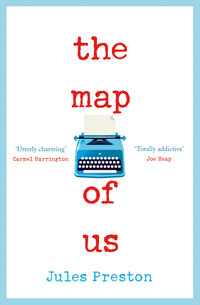
Читать книгу: «The Map of Us»


A division of HarperCollinsPublishers
www.harpercollins.co.uk
HarperImpulse
an imprint of HarperCollinsPublishers Ltd
1 London Bridge Street
London SE1 9GF
www.harpercollins.co.uk
First published in Great Britain by HarperCollinsPublishers 2018
Copyright © Jules Preston 2018
Cover images © Shutterstock.com
Cover design © HarperCollinsPublishers Ltd 2018
Jules Preston asserts the moral right to be identified as the author of this work.
A catalogue copy of this book is available from the British Library.
This novel is entirely a work of fiction. The names, characters and incidents portrayed in it are the work of the author’s imagination. Any resemblance to actual persons, living or dead, events or localities is entirely coincidental.
All rights reserved under International and Pan-American Copyright Conventions. By payment of the required fees, you have been granted the non-exclusive, non-transferable right to access and read the text of this e-book on screen. No part of this text may be reproduced, transmitted, down-loaded, decompiled, reverse engineered, or stored in or introduced into any information storage and retrieval system, in any form or by any means, whether electronic or mechanical, now known or hereinafter invented, without the express written permission of HarperCollins.
Source ISBN: 9780008300975
Ebook Edition © May 2018 ISBN: 9780008300968
Version: 2019-06-25
Table of Contents
Cover
Title Page
Copyright
Epigraph
the beginning
2 years ago
5 things about me
2 years ago (too)
2 years ago (still)
the marriage report
clarity
wasps
something about squirrels
G.I.T.S.
handbags
blue
sand
N
boots
oversight
name
kissed
distance of paper
more sofa
half
dreams
sorry
rainbow
tortoise
view
64.726%
same
5 things about washing machines
free coffee
agreement
more sand
NE
date night
special friend
title
volume one
praise for Galbraith’s Boot
drawn
5 things about the garden
music question
Lazy Mo
blueberry
reminder
coincidence
5 things about Jack
yes
new arrivals
trumps
start
party
tired
date night again
5 things about Grace
7 letters to Grace
E
37 words
sandwich
roses
royalty
28 minutes
finished
calibrating
brushstrokes
late
promises
5 things about Matt’s mother
hard to tell
impulsive
top bunk
where Matt was
spoilage
a ‘friend’
in-flight
south and a little west
strangers
SE
path
closer
closer still
gift
doors
tablecloth
true
output
68%
ex
couch surfing
5 things about Katherine
list
cluck
olives
3rd
layers
silence
S
walls
map
home
petunias
lucky
snoring
company
wonderful
5 things about my father
old flame
art school
bijou
view
colour
overlap
pie
blip
perspective
transformation
twit
SW
extortion
4lb 11oz
Juniper
5 things about the Norths
£1,000
important
rivers
unexpected
matches
cook
paintbrush
turning
more twit
lobster
W
witch
5 things about Abigail North
falling
awry
can’t
defined
5 things about Owen
the proposal
Ruth Pennywheal’s reply
drawer
5 things about my mother
October
tide
blub
swim
him
deep end
reservations
whisk
decision
glass
NW
cake
found
lost again
wish
broken
truth
when
eventually
mistake
soon
score
delirious
toast
not Katherine
perfect
tick tick tick
5 things about Daniel’s father
sore feet
seal
more cake
family
gloves
resilient
always
5 things that changed
tie
the Matilda Eastleigh Compatibility Index
maybe ten
merit
dark road
nice
imagine
jazz
waiting
tap water
extra
next?
lawnmower
opening
fault
errands
undone
wanted
the Matilda Eastleigh Compatibility Index
folly
ice cream
couldn’t
sketches
wheelbarrow
‘Rooks Wood to Coldbank Ruins’
3 miles
full circle
Acknowledgements
About the Author
About HarperImpulse
About the Publisher
Numbers are a poor measure of love.
Millicent Fenwick
Mathematician 1970-
the beginning
Violet North could not walk far. She had a pleasing enough disposition and an inquiring mind, but she had lost the use of her legs as a child. Polio was the cause. She was now twenty-six years of age and not expected to marry. She had other complications from her childhood illness that meant she seldom left her home without the help of company. As she was not often seen outside, there were precious few who she could call upon for such assistance.
Her family had lately abandoned her in a house with several staircases and a large garden in the hope that she would fall and die as quickly and conveniently as possible. They had told her as much when they left. She had been a burden to them for long enough. Violet could not walk far, but she was twenty-six and had her own house with a large garden and decided to be as inconvenient as possible. She did a grand job.
Violet North had many interests beyond the confines of the front parlour in the summer and the study in the winter. She sent off for maps and globes of the world and invited those she knew to send her postcards from the places they had been. It did not matter where. Places that she would never see fascinated her. She read travelogues and the biographies of great explorers. For her, climbing the stairs to the third floor was an exhausting expedition, fraught with unknown dangers.
A photograph of the nearest railway station, no more than three miles away, was a particular delight to her. She knew she would never see it in person. Even if she could somehow surmount all the difficulties of getting there alone, how could she buy a ticket? She had no destination. Violet knew no one she could visit by train.
To occupy her inquiring mind and her passion for places that would forever be a mystery to her, she invented an explorer and a place for them to explore and wrote about their adventures on a Royal Quiet Deluxe typewriter that she borrowed from a neighbour. It was turquoise blue, and the ‘e’ often stuck.
The place that she invented looked very much like love.
I have seen it.
Violet North was my grandmother. And yes, that is where the journey to this started. Right there.
2 years ago
‘Where do you think we went wrong?’ Matt said.
‘10.37am, April 22nd,’ I said.
‘Oh,’ he said.
He put his glass down on the table and stared absently out of the window. A dog was barking at a paper bag somersaulting down the January street. I felt responsible. Not for the paper bag or the barking dog. I felt responsible because the absence that we both felt was my fault.
Sometimes people don’t want simple answers. Most of the time, in fact. They say they do, but they don’t. Not really. My soon-to-be ex-husband didn’t. Not like that. Not right then. I could see him trying to compute the information. He was struggling. It was all too clinical. Too precise.
10.37am. The exact moment when our marriage fell apart. Or started to. Or finally shattered into a million unrecognisable pieces. He wanted something else. Something vague and meaningless.
‘I don’t know.’
Would have been good for starters.
‘What do you think?’
Would have been a fairly safe follow-up.
He wanted to talk about it. I had just made sure that the conversation started without a heartbeat. I didn’t do it on purpose.
‘Oh,’ he said again, as if that would resuscitate anything. It didn’t.
I said nothing. That didn’t help. What else could I say? I had already answered his question. And with a level of accuracy that I rarely manage to achieve in my day job.
I couldn’t help myself. Me being me isn’t always easy on those I love.
Loved.
Both. I guess.
It’s complicated.
Read the report.
It’s all in there.
Read it.
You’ll see.
5 things about me
My mother always called me Matilda. Always. She was the only one that did. Everyone else calls me Tilly. It is who I am. More or less. I have an older brother called Jack and a sister that is older still called Katherine. No one has ever called her Kate or Katie. Never. They wouldn’t dare. Katherine does not respond well to familiarity.
My father makes sand sculptures. He wears shorts and sandals and trails sand around wherever he goes. He drives old estate cars that are always French and don’t like to start when it’s damp. They are full of sand, too. And buckets and trowels and brushes and tarpaulins and tent pegs and half a dozen identical straw hats in different sizes to suit the prevailing wind conditions. When my father finds a slightly younger French estate car, he gives the old French estate car to me. Then I drive it until the wheels fall off. Literally. Or sand gets into something important and the engine seizes up. Whichever comes first, really.
I like numbers, but numbers have not always been my friend. Not always. We had a disagreement. Early on. We got over it. It may have taken a reversing caravan to resolve the problem, but I cannot be sure. Numbers are beautiful and complex and do not always tell the truth even though you think they should. Numbers are not as straightforward as they seem. They have the capacity to lie and deceive and betray and confuse. That’s why I work in statistics. I like numbers. We get on okay now. Most of the time anyway.
At the time, I was working for a company called Compass Applied Analytics. Their offices were on the first floor of a recently redeveloped building that once housed an industrial-scale launderette. They were called Super Efficient Laundry Services. You could still see where their name had been painted over on the wall outside. They had a logo, too. It was hard to make out, but I always thought that it looked like a pair of sprinting underpants.
My job was to compile sophisticated market research data for product evaluation and assessment. I specialised in low-fat snack bars for the health-conscious sector. I didn’t eat them myself. I am health-conscious though. Not always. Sometimes. I prefer chocolate.
2 years ago (too)
‘So, what do consumers think of the name?’ The Marketing Executive from Bearing Foods asked.
‘Loved the name,’ I said.
‘Uh-huh,’ he said, writing something down.
‘“Seedy-Pea-Nut-Slices” got a positive 86% approval rating from the focus group of average supermarket shoppers that we interviewed.’
‘Pretty good figures,’ Helen added, eager to be involved.
Helen doesn’t usually attend my presentations on low-fat snack bars for the health-conscious sector. She’s a strategist for new product development in the pre-packaged smoothies segment. She can’t drink anything with pineapple in it though. It makes her tongue go numb.
Our head of department thought I might need a little moral support towards the end of the report. I disagreed, but I assumed that Helen being there was a sign that the company were taking no chances. Bearing Foods was one of our biggest clients.
‘What about the packaging?’
‘Loved the packaging, too. The packaging received a solid 75% approval. Potential customers thought it was fresh, bright and informative,’ I said.
‘Uh-huh,’ he said, making another note.
‘Without being too fresh, bright and informative to scare off an older demographic,’ I added.
‘That’s a big thumbs up on the packaging,’ Helen said. I nudged her with my elbow. She scowled at me.
‘What about the ingredients?’
‘Loved the ingredients. 79% approval on the ingredients. Peas, quinoa and seaweed were generally perceived as innovative, natural and nutritious. They loved the passive product claims, too. “Wholegrain.” “Additive-free.” “High in fibre.” All had excellent penetration.’
‘Great work on the ingredients,’ Helen said, pumping the air with her fist.
‘Uh-huh,’ he said, thankfully not looking up from his notepad.
Pineapple, I thought.
I knew what was coming next.
‘Visual appeal?’
Now this was where things got tricky.
‘Not so good on the visual appeal of the product itself,’ I said.
‘Uh-huh,’ he said, looking up this time. Helen crossed her arms and looked at me too.
‘Only 29% of respondents were entirely positive about how the snack bar looked.’
‘We had a few comments, too,’ Helen said before I had a chance to stop her. ‘“Looks like squirrel poo,” mostly,’ she said.
‘Uh-huh,’ he said. The temperature in the conference room seemed to dip a few degrees. Maybe it was me. Maybe I was being overly sensitive. Helen took the awkward silence that followed as an opportunity to whisper in my ear.
‘Sorry to hear that you and Matt have split up, Tilly.’
‘Thanks, Helen,’ I whispered back.
Pineapple.
‘It must be difficult for you both,’ she said.
‘Yes. Thanks, Helen,’ I said.
Pineapple.
‘So, did your marriage last longer than the national average, or was it slightly less?’ She sneered.
Suddenly it all made sense. This was payback for a comment I may have been overheard making about Helen being married and divorced twice in 64.726% of the national average. It was a statistics joke. We like that sort of thing around here. It was funny at the time. Helen waited patiently for a response.
Pineapple, I thought.
‘Taste profile?’ The Marketing Executive said.
I was glad that we were moving things on. The results for visual appeal were always disappointing with any granola-type snack bar. They all looked like rabbit food, or worse. ‘Chewy’ in the name didn’t help. If it had ‘Chewy’ in the name, you could expect a further 6-8% drop in positive responses.
‘Loved the taste,’ I said. ‘Significant approval ratings for the taste.’
‘Uh-huh,’ he said writing something down.
‘Once they got over the fact that it looks like squirrel poo, of course,’ Helen said.
‘Uh-huh,’ he said drawing a line through the thing that he had just written down.
Pineapple.
While I tried to murder Helen with the power of my eyes, he flicked through his notes dejectedly.
‘So, what you’re saying is that we have a fantastic product that could reshape the market in low-fat snack bars for the health-conscious sector if only it didn’t look quite so much like squirrel excrement?’
‘Essentially. Yes,’ I said.
There was no getting around it.
‘In a nutshell,’ Helen said, trying not to grin.
‘Uh-huh,’ he said.
Pineapple, I thought.
‘Seedy-Pea-Nut-Slices.’ So many things to love. Just a few important things that weren’t quite right.
A bit like Matt really.
2 years ago (still)
The bottle of ‘sturdy’ Rioja we had chosen tasted thin and vinegary. It wasn’t our usual choice. It clung to the side of the glass in an odd way. I swilled mine around just to have something to do with my hands.
The table top was a slab of grey slate. It had a ring of wax where yesterday’s candle had burnt down. I didn’t pick at it. I wanted to though. I wondered how many other couples had sat where we were sitting now and had got together or broken up or talked about getting a dog or moving in together or celebrated or commiserated or decided to give it another go and had gone home hand in hand for the first time in months and made love and then separated for good. Maybe even while yesterday’s candle was burning down to a stub. I could see where today’s candle had been shoved into the candlestick holder on top of it and on top of other melted stubs for what looked like the passing of centuries.
‘10.37am?’ Matt said.
‘Yes,’ I said.
‘Not 10.37pm?’ he said.
‘No,’ I said.
‘Oh.’
He looked more confused than ever. Somehow it bothered him that our marriage had come apart in the morning. Before lunchtime even. Not at night. Did it really make any difference? The end result was the same.
We were sitting in our favourite wine bar – that wasn’t really ‘ours’ anymore – discussing who should take custody of the three-seater sofa from the living room. It had seen better days. So had we.
‘10.37am,’ Matt repeated absently. Like the title of a film that he had never seen, starring someone that he couldn’t quite remember.
How could I be so exact? I had an affair. It started at 10.37am on April 22nd. It was a Thursday. I have a graph that explains why. Not why it was a Thursday – why it started at 10.37am. It’s more of a flow chart, actually. It’s on Page 5 of the report. We’ll get to that. Maybe later.
I didn’t really want the sofa. But Matt did.
the marriage report
Okay. Maybe writing a report on our marriage with footnotes and a summary and a series of conclusions was another spectacularly bad idea. But that is what I did.
Matt just wanted to blame someone and feel betrayed and hang up on me all the time. I could see his point. But I wanted something more precise. I wanted to look at the distribution of fault and the relative impacts of known and random variables. Everything could be quantified and evaluated and interpreted using samples and controls and baselines – even the ups and downs of our relationship. I wanted to make sense of it all. I wanted a number. A simple diagram. Something that I could understand at a glance.
It was just another Bearing Foods presentation. It was no different. Not really. First, I had to identify my research aims. Then I had to gather evidence. When I had analysed all the available data, I could make informed statements and recommendations.
I chose to use a large lever arch file for my report. Something that would accommodate items of evidence that weren’t all flat. I couldn’t think of any items that might possibly fit that category, but I wanted to be prepared for the eventuality that one might crop up.
Matt and I had been married for three years. Our time together was like a low-fat snack bar for the health-conscious sector. A low-fat snack bar that had actually turned into something resembling squirrel poo. Now I was going to pick through the sticky ingredients with my fingers looking for answers. It was the least I could do.
clarity
I was in Trish Hudson’s office. Trish is my boss. She’s the head of the Statistical Analysis Department at Compass Applied Analytics. She is also quite short, so she wears irresponsibly high heels and has a blow-up cushion on her chair and wears a lot of vertical stripes because she thinks they make her look taller and thinner. They are only partially successful. She walks with a strange juddering totter because of her irresponsible shoes, and the thin vertical stripes make her look like a clump of dry grass swaying in a gale.
I get called to Trish’s office quite a lot. I got called to her office the time that I was overheard making a comment about Helen being married and divorced twice in 64.726% of the national average. It was just a joke. But Trish doesn’t think that statistics are a laughing matter. That’s why she’s the head of department. I suppose.
My trips to her office had been tapering off nicely. I was hoping this was only a blip in a long-term downward trend.
Trish looked like she had a wasp in her ear. That was fairly normal. She always looked like she had a wasp in her ear. When you got summoned to her office it was sometimes hard to tell if you were in trouble or not.
‘Am I in trouble?’ I asked.
‘Yes,’ she said.
That cleared that up then.
wasps
The cause of Trish’s constant expression of irritated malevolence was the subject of much discussion and conjecture in the office.
Most speculated that it was the result of botched plastic surgery around the eyes in an attempt to make her look younger. The high heels and vertical stripes seemed to support the hypothesis. She already went to a great deal of effort to look taller and thinner.
Another, smaller contingent suggested that the blow-up cushion on her chair was not just to enable her to reach her phone but hinted at some chronic problem with her unmentionables. It was hard not to laugh at this one. For lots of reasons. None of them kind. I am a bad person. I admit it.
A third group thought that she did actually have a wasp jammed in her ear. Poor thing. The wasp, that is.
I’m not sure what I believed. It didn’t matter now. I was fairly certain that the current look of squinty-eyed hostility had something to do with the Bearing Foods presentation earlier.
Blaming Helen would be futile. I knew that. Helen was the only bridesmaid at Trish’s lavish destination wedding last year. The venue was a remote island in the Indian Ocean that took 5 hours to get to by small boat. I wasn’t invited. I’m glad I wasn’t. It rained for nine days straight. I’ve seen the rainfall figures. They were the highest ever recorded. A little over 320% of the normal monthly average. It was impossible to get outside. In the end Trish was married in the main guest hut surrounded by overflowing buckets and the sound of palm trees being blown over.
Trish and Helen went to the same prestigious university too. I didn’t. I went somewhere less prestigious that had an infamous nightlife.
On Fridays they sometimes shared a car to work. Neither had ever accepted a lift in mine. I could see their point. It used to belong to my father. It was full of sand. I tried to get it professionally cleaned once. They took one look at it and said no. Then they asked me to leave their forecourt, but the car wouldn’t start because it was damp and it was French, and they had to push me down the road while I tried to bump start it and I only remembered to take the handbrake off when they had to ask more people to come out and help push.
Yup. There was no point blaming Helen. That much was clear. If this was about the Bearing Foods presentation, I was done for.
something about squirrels
‘It’s about the Bearing Foods presentation,’ Trish said.
Nuts.
I tried not to shrug. I do a lot of shrugging. Especially when I’m about to get told off. I shrug at other times, too. Maybe it has something to do with hanging out in old French cars for so long.
Trish was wearing a cap sleeve shift dress with wide pink and white vertical stripes. She looked like a deckchair. A small deckchair. I could hear her blow-up cushion protesting as she squirmed in her chair and straightened to her full height. I could still barely see her over her laptop.
‘I’ve just had Daniel Bearing on the phone,’ she said.
Daniel Bearing was the CEO of Bearing Foods. We’d met, briefly.
‘Yes?’ I said.
No shrugging.
‘He’s not happy.’ She said.
‘I’m sorry to hear that.’ I said.
Must not shrug.
‘He said that there was some problem with the new Seedy-Pea-Nut-Slices?’
‘Really?’ I said.
I could feel my shoulders tighten and lift slightly.
‘Something about squirrels,’ she said.
‘How odd,’ I said.
Shrug averted. That was close. Now I just had to stop myself from smiling. Trish had drafted a policy document about smiling in the workplace. It was stuck on the wall in the kitchenette. In her view, smiling was the sign of an idle mind. She thought it looked unprofessional and insincere. She wanted her team to remain impassive and focused. She did her very best to lead by example. Apart from the whole wasp in the ear thing.
‘I thought that Helen was helping you?’ Trish said.
‘Helen was great,’ I said, suddenly aware that I shrug when I lie as well. Too late.
‘Sort it out,’ she said.
‘I will,’ I said.
And then I was dismissed.
I was glad. Trying not to shrug had really taken it out of me. I was exhausted.
G.I.T.S.
The Group Imaginative Thinking Session at Bearing Foods was not going well. Daniel Bearing’s father didn’t like the term ‘brainstorming.’ He thought it sounded outdated and silly. Group Imaginative Thinking Sessions were his idea. They happened once a week. It was part of his legacy. They also had an unfortunate acronym.
Daniel’s father had recently retired and was now living in the Outer Hebrides in a former shooting lodge that had its own stone harbour and a beach of pure white sand and nine bedrooms and views to the Isle of Skye. He had worked hard for over thirty years so that he could live peacefully among puffins and grey seals and bottle-nosed dolphins in the middle of the North Atlantic. The constant buffeting of the wind was playing havoc with his hair implants.
Daniel was in charge now. He could call the weekly sessions anything he wanted to. He didn’t really care one way or the other. Everyone just argued about the same things they always did. Mostly about cashews being too expensive and the laxative effect of eating too much coconut and whether chocolate chips really had any place in a low-fat snack bar.
Daniel Bearing wasn’t really listening. He had a lot on his mind.
Dear Matilda
Just a quick note to let you know that washing machine No.76 arrived safely earlier today. How exciting. I doubt it will last any longer than the others, but it looks very fine in its cardboard overcoat. I haven’t unpacked it yet. It’s sitting in the middle of the living room at the moment. It seems happy enough. It has no idea what we have in store for it.
Mr Southerton (Jnr) has promised to come around tomorrow to plumb it in for me. Mr Southerton (Snr) is retiring. He says that he is too old to play around with hoses and stopcocks. He says his son is very good at fixing things. Much better than he is. Was. His son is called Bailey. He went to school with Jack. Do you know him? He has a very nice voice on the phone. He has also agreed to take the remains of washing machines No.74 and No.75 to the dump so that your father can park the car in the garage for a change. He won’t. But he could.
Mr Southerton (Snr) says he will still call by and see Sidney when he is passing. I know that Sidney is very fond of his company.
Your brother is in South America somewhere. Don’t ask me where. He did say, but you know what Jack is like when he starts talking about things that are blue. He gets all artistic and lyrical. I stopped listening in the end.
I have not heard from Katherine. I fear that the ‘handbag problem’ may have flared up again. I will keep you posted.
Your father is at the Festival of Sand at Barmouth beach all week. He called and said there are seven dolphins already and he thinks there may be some mermaids arriving later. I fear another second place is on the cards.
Must dash. When are you coming to see us?
Love
Mum x
handbags
It was a patent leather top handle with a double zip and a detachable cross body strap. Katherine knew that she shouldn’t stop and look. It was already too late. She had stopped. She had looked. She was drawn in. Her face was pressed against the glass.
It was sitting on its own acrylic plinth in the window of a shop that she was not allowed to enter. She was not banned. Katherine was always welcome inside. Cash or credit card. That was not the issue. She had made a promise. She had made the same promise before and been weak. Her resolve had not held. Not for long. She had given in after a month. Maybe a little less, but a month sounded better.
She had other top handle handbags of a similar design. Thirty or so. And three hundred different styles of handbag as well. In their own room. Lined up. On glass shelves. Constantly rearranged by size and colour and designer and season. That was a lot of handbags. That was why she had promised. So many times before. No more handbags. But this was different. This was something else. It was £485. It was worth it.
She tried to walk away but found herself walking towards the door of the shop instead. She couldn’t stop herself. She went inside and was greeted like an old friend. She was weak. She knew it. She hated herself. But she bought the handbag anyway. She wanted it.
blue
Jack was lying in a tent near a small village in the palm swamps of an isolated area on the border of two South American countries. He had no idea which side of the border they were on. It didn’t matter. He was floating a foot off the ground, and his toenails were talking to him. He had a fever. He was sweating. He was ice cold. He wasn’t drinking enough water. He couldn’t keep it down. He was hallucinating.
The nearest doctor was 80 miles away upriver. The journey would take six days. His guide assured him that the fever would break in 48 hours. He had seen it before. If it did not break in 48 hours, he would probably be dead. Either way, they weren’t getting in the boat and traveling upriver to get a second opinion.
Jack was drifting in and out of consciousness. He did not mind. He had seen a Hyacinth Macaw in the wild. It had taken almost a week to reach the palm swamps on the edge of a border that had no real edges, only endless trees and muddy rivers.
Jack had seen the lurid blue of the Indigo Bunting, the pale blue of the Blue-Gray Gnatcatcher and the elegant blue of the Purple Martin. The Hyacinth Macaw was another blue again. He was glad that he had traveled so far to see it. He would never forget.
He fell asleep. All his dreams were blue.
sand
Not sure that the nose is right.
Doesn’t look right.
Looks wonky.
Askew.
Maybe it’s just the direction of the sun?
Getting low now.
Sunset at 8.26pm.
Low sun.
That’s all.
That’s the problem.
Yeah.
It will look fine in the morning.
Stop messing with the nose.
You’ll make it worse.
Move on.
Still got the tail to do.
Haven’t even started on the tail.
Or the wings.
Going to be tricky.
Wrong sort of sand for wings.
Should have thought of that.
Why didn’t I think of that?
Same thing last year.
Wrong sort of sand for porcupine quills.
Still got second place though.
Don’t know how.
Idiot.
Sand sculpture of a porcupine?
Idiot.
What was I thinking?
Maybe if I used the plaque scaler again?
Add some more detail.
Won’t notice it’s wonky.
More scales.
Good thinking.
Useful having a dentist in the family.
Odd bloke though.
Wouldn’t want to go on a camping holiday with him.
Get stuck in a tent.
Man has a thing against sand.
Odd bloke.
Doesn’t know what he’s missing.
Still looks wonky.
Not the sun then.
Bollocks.
Taken too much off the nose.
The nose is all wrong.
Don’t think dragons have noses.
Snouts?
Muzzles?
Doesn’t really matter.
The nose is wrong.
Should have done a bloody dolphin.
Don’t be an idiot.
Just do the nose right.
Can’t.
Not enough sand.
Already taken too much off.
Off the nose.
Or the muzzle.
Snout.
Whatever it’s called.
Have to start again.
Bollocks.
Idiot.
Don’t have to start again.
Just make the whole thing smaller.
Done it before.
What time is high tide?
Should have done a bloody dolphin.
Idiot.
N
Abby was standing just inside the school gates. She had pen on her uniform. Asha Jackson did it. Abby didn’t mind. Asha was her friend. They sat next to each other in class. Not all the time though. Sometimes she sat next to Francesca Drinkwater. She had long hair. Abby didn’t have long hair. She had short hair. It was easier for her mum.
Abby was standing with a teacher. Abby didn’t know what the teacher’s name was. She was new. She wasn’t really a teacher. Not yet. She was something else. Abby didn’t know what.
Abby was getting bored of waiting. Everyone else had gone home. It was just her and the teacher that wasn’t a teacher yet. Abby wanted to sit down. And something to drink.
Another teacher came out and told them both to come back inside. She said it like she didn’t want Abby to hear, even though Abby was standing right there in front of her. She was called Mrs Whittle. She was the deputy headmistress.
Abby’s mother wasn’t coming to collect her.
Abby was six.
boots
At first Violet North sent her imaginary hero to sea, but it did not sit well with him. The blank expanse of blue water was not to his liking. The food was stale. His cabin was compact and stuffy. It was too near the engine room to sleep. The metal plates of the hull gathered condensation that seeped into his bunk. He shared the cabin with a fellow traveler who had bad dreams and tied his boots to his wrist so they would not be stolen. He could hear the cargo shifting. He worked his passage as far as the Azores and then disembarked, tired and disillusioned.
Violet offered him a better cabin, but he would not leave the comfort of the shore. She made him the Captain of a merchant ship. And a smuggler. And a retired Admiral. But he would not go. He found cheap lodgings and ate plump grilled sardines and drank green wine, and as the sun dipped he stood on the harbour wall and wondered what it was he would do next.
Violet sent off for a book to keep up with him. It was in Portuguese. Things could not continue this way.
She gave him boots. They were stolen from his companion in the cabin. She had invented them. They were hers to steal. They did not fit, so she wrote that they were another size. That was better. He liked the boots more than he had liked the food onboard ship. He went for a walk to try them out.
oversight
Violet left him to walk in stolen boots for some time. She did not want a repeat of his disastrous voyage at sea. He was not turning out to be the man she had thought she imagined. Not at all. He had a mind of his own and a temperament that was combustible and a face she had not yet had the delicacy to finalise. His stride was long, and he had the hands of a violin player, or perhaps a pianist, and a voice that had not yet been tested. It was not until he had gone some several miles into an unwritten wasteland that she realised she had sent him on his way without a name. It was an oversight that she sought to quickly remedy.
Violet thought of her father, but his name would not do. He was a cruel man who had shunned her and stayed away and led a life elsewhere that did not include a daughter who could not walk far and whose frailty was a downright disappointment. She did not wish to recall his name. Or the name of her brother who pinched and pushed and kicked and dropped things from a height. Sharp things. Heavy things. Just because her legs did not work did not mean that she could not feel.
There were other names. Many. She wrote a list. And all the while a man with an uncertain face walked away from her into a shapeless void that had not yet been typed.
name
Violet’s house had four floors and an attic. It was detached and made of hard white bricks and was surrounded by a large garden that was already beginning to look unkempt and overgrown. There were 93 steps inside. The staircases were narrow with painted banisters and fluted spindles. Some of the spindles were broken or missing. The staircase from the ground floor to the first floor was carpeted. The rest were bare boards. The carpet was held in place by brass stair rods made by Galbraith & Sons of Edinburgh. That would be his name.
The washbasin in the first-floor bathroom was manufactured by Arthur & Co. It sat on a cast iron stand and had a white marble surround. There were 14 steps and a small landing between the ground floor and the bathroom. It took Violet five minutes to reach it. She clung to the banister. The paint had worn off in places. There were many layers of paint hidden beneath. Violet hoped to see them all one day. That would be his name.
And so Arthur Galbraith was born. Not exactly born, but brought into the world of imaginary existence. He was the child of a brass stair rod and a first-floor washbasin with a marble surround. They represented the outer limits of Violet’s universe. A name should mean something. His seemed apt somehow.
kissed
Violet had been thinking about Arthur Galbraith’s face again, but she was yet to be convinced by any of the faces she had devised. None of them would do. She did not ask his opinion, for he had already shown himself to be difficult and ill-tempered when it came to making a choice.
Her problem was further complicated by a small technical matter. Almost every element of his face had an ‘e’ in it somewhere and the ‘e’ on her borrowed turquoise blue Royal Quiet Deluxe typewriter often stuck. There was an ‘e’ in ‘nose’ and ‘ear.’ There were two in ‘eye’ and ‘eyebrows’ and cheeks’ and ‘teeth’ and ‘forehead.’ It was infuriating. Every time she would have to press a small button and the top of the Royal Quiet Deluxe typewriter would pop open automatically, making the interior of the machine accessible. Then she would unstick the ‘e’, replace the top, press the backspace key and start again.
Only Arthur’s chin and mouth and lips were immune from the lengthy and annoying process. But they were not a place she cared to start. She knew something of chins and mouths, but a man’s lips were unknown to her. She found herself thinking about them far more regularly than his nose. Did it matter what an imaginary explorer’s lips looked like or felt like? She would never be kissed by such a man – and ‘kissed’ had an ‘e’ in it.
distance of paper
Violet set Arthur Galbraith to walk upon the Great Moor. It was a place of beauty and sadness and longing and hope and regret and joy, and it would take a lifetime to walk, for some things are not as simple as distance and direction.
Arthur put his boots to good use. They were no longer stolen. They were his. He had rock and peat and plain earth beneath his feet. He had a long stride, an unknown purpose and a Great Moor stood before him. Unexplored. Uncertain. A place without a map. He would be its pen.
And as he walked a face emerged. Not a face that Violet could have imagined. It was his face. It was his to choose. And strong hands not meant for instruments and a voice that said little that it did not mean.
The son of a brass stair rod and a washbasin finally appeared on a hilltop overlooking the Great Moor and looked south and east and north and west and decided to refuse the stars their steady counsel and let love guide him. He had a long road ahead. Not straight or flat or without discomfort.
And that is where Arthur and Violet and a turquoise blue Royal Quiet Deluxe typewriter began their journey together. Almost touching. Merely the distance of paper apart.
more sofa
Matt called the day after our meeting in the wine bar. The fate of the three-seater sofa was still preying on his mind. The whole 10.37am thing had rather overwhelmed the conversation.
‘Hi,’ he said. ‘It’s me.’
I knew who it was. We had been together for five years. Married for three. Just because we were separated now didn’t mean that I would suddenly forget, even if I wanted to.
‘Hi,’ I said.
‘Sorry about last night.’
‘Yeah,’ I said. I wanted to see where this was going before I said anything more definite.
‘Are you busy?’
This was a typical Matt tactic. He liked to make sure that I was in the middle of doing something so that I’d have to stop doing it and give him my undivided attention. I made a mental note to find some way of quantifying his approach in a graph.
‘Just stuff,’ I said, trying not to be curt.
‘I wanted to talk to you about the sofa,’ he said.
‘I know,’ I said.
‘How do you know?’ He said.
‘Because you always want to talk about it,’ I said.
‘Oh’ he said. He sounded small and distant and brittle.
I sighed. I couldn’t help it. This was getting ridiculous.
‘You can have the sofa. Okay? I don’t want it.’ I said.
It was the truth.
There was a pause on the line.
‘Why do you have to be such a bitch all the time,’ he said. Then he hung up.
half
We bought the three-seater sofa from a local secondhand furniture centre. It was hidden under a nest of tables and a glass-fronted display cabinet full of dog hair. It cost £55. I paid for it, and Matt said he would pay for his half when he got a full-time job. He had a full-time job for a while, but he didn’t pay me back. We were still 92% in love back then, so I didn’t mind that much. I minded when it suited me though. I used it against him sometimes. His unpaid half of the sofa had some value in a petty argument.
‘You still haven’t given me the money for your half of the sofa,’ I’d say.
‘Well I’ll sit on the floor then!’ he would say.
Then he would sit on the floor for about five minutes until he thought I’d calmed down. Then he would sneak back onto the sofa and hope that I hadn’t noticed. I noticed. It was a victory of sorts.
The three-seater sofa was dusty pink. It was tired-looking. Grumpy even. The zips on the cushion covers were all broken. The arms were covered in coffee stains. At least that’s what we hoped they were. It only had three casters. They were an unusual size that no one stocked anymore. We used a copy of ‘Elementary Statistics and the Role of Randomness’ to stop it from rocking backwards.
Matt liked to sleep on it in the afternoon when he was considering his future. He considered his future a lot. With his eyes closed. Gently snoring. He also got to sleep on it when our arguments weren’t quite so petty. He didn’t seem to mind. Matt and the grumpy pink sofa had some sort of connection that I didn’t fully understand. I had never slept on the sofa. Why should I? I paid for the double bed as well.
dreams
I’m not sleeping. Not really. I sleep for an hour, then I wake up and listen. I’m not sure what I hope to hear. Breathing maybe. The bed feels wrong. Not empty so much as at the wrong angle. Too flat. I’m used to Matt being there. I told him we should have got a futon in the first place, but he didn’t listen.
If I do get to sleep, I don’t dream. Nothing. Not even fleeting glimpses. I have tried eating strong cheese before bed. And spicy food. It didn’t work. Not in the way I hoped for anyway.
I miss dreaming. I used to dream. I don’t know where my dreams have gone. I hope it’s only a temporary thing. I hope they come back to me. Maybe they are unhappy, too? Maybe my dreams are having trouble adjusting?
I was going to draw a graph for the report, but I couldn’t see the point. There was nothing to show.
sorry
Matt called back an hour later.
‘Sorry,’ he said.
I didn’t say anything for a while.
That’s when he hung up again.
Great.
We’ve been having a lot of conversations like that. Not really conversations. Single words followed by about a thousand miles of tense silence. ‘Sorry’ was fairly common. We’ve both said it. I’ve said it more. Not that I’m counting or anything.
We used to a talk a lot. Nothing profound. Just normal stuff. Endlessly.
I miss it and I don’t.
Sometimes I wanted to talk about things that mattered to me. That didn’t happen so often. That took preparation and timing. Maybe a takeaway. Or a rented DVD from the corner shop. And a bottle of wine. Always a bottle of wine. Or two.
I had to pay for the preparation. Sometimes it worked. I couldn’t always make him listen though. That’s where the timing came in. After the takeaway was normally too soon. After the film had finished and Matt had watched all the special features and deleted scenes and alternate endings – that was my chance. After the bottle of wine was too late.
I don’t buy as much wine now. Or takeaways. I haven’t rented a DVD since he left.
I lied about the wine. I still buy about the same amount. I just get better wine, and it lasts a lot longer.
I’m getting used to the quiet. It’s hard. I talk to myself. There’s no one else.
rainbow
I decided early on that the centrepiece of my research would be a detailed questionnaire. It would be a paper-based document of as many pages as were necessary. I had a large lever arch folder to fill.
I knew that the answers to certain questions would carry more weight than others, so it would be subdivided into several different sections that I would score separately when it was complete.
I would call it ‘The Compatibility Index.’ It sounded great. I wrote it down on a piece of paper with a purple felt tip pen. It looked great, too. So I outlined it in yellow pen. Then I drew little green stars around the outline. Then I drew larger red stars around the green stars. Then I filled the space between the inner green stars and the outer red stars with small orange hearts. Then I drew a rainbow in the background with all the wrong colours and realised I had probably gone too far. It was a mess. My brother was good with pens. I wasn’t. Maybe I was being overly critical? I reminded myself that if Jack had drawn the same thing it would all be blue, including the rainbow, which would rather defeat the object.
I got out another piece of paper and wrote ‘The Compatibility Index’ again, this time in ordinary pen. It looked sad, like a room after you take down all the party decorations. It could not be helped. I punched some holes in the sheet of paper and clipped it inside the vast empty folder. That was even worse. Now it looked sad and lonely, like a room full of decorations when no one shows up to the party. I knew that feeling. I’ve had birthdays like that. Let’s not go there.
I stuck the messy rainbow picture on the wall by my desk. The tape would probably tear the wallpaper off when I tried to take it down, but it didn’t matter. It was my flat, and I didn’t like it all that much anyway.
I liked the little orange hearts best. I went to get some chocolate. I was having fun already. Yeah. How hard could it be?
tortoise
I haven’t always been good with numbers. For a long time, I had a disagreement with the numbers 3 and 5. They looked exactly the same to me. It sounds stupid. But however hard I looked I could not tell the difference between them. I tried. I practiced writing them down and always got them wrong. Reversed. Mirrored. Substituted one for the other. I wrote whole pages of perfectly formed numbers only to discover they were not the numbers I thought they were. My brother used to laugh at me. He was older. It was his job to laugh and point and call me names and make me the object of his ridicule. Jack wasn’t good at numbers either. His disagreement ran much deeper. He had a problem with all of them. They were a foreign language to him.
Jack liked coloured pencils. I liked coloured pencils too, but I couldn’t get them to do the things he could. He made coloured pencils sing. I made them squawk. He could do the same with felt pens and crayons and chalk and poster paint. He was rarely without colour. On his hands or face. Under his fingernails. On his clean shirt. If he could not find paper or a wall to draw on, he drew on his trousers. Every six months my parents had to buy a new washing machine. And more trousers. I liked trousers, too.
Katherine was not like us. Not ever. She liked dresses. With flowers. She brushed her hair and wore socks.
I failed exam after exam. Dates of important events muddled. Sums confused and incomplete. The world conspired against me. Everything had a 3 or a 5 in it. Or both.
Then one day it stopped. Just like that. 3 and 5 were suddenly not the same any more. They were different. Individual. Unique looking. I don’t know how it happened. I was eleven. Nearly. I remember. It was the same day that Mr Everson from across the road backed his caravan over our tortoise. He said it was an accident. I don’t know if the two things are linked somehow. I doubt there is a correlation. Nothing that I can prove now anyway.
view
Helen had been in my office again. I could tell. I don’t leave traps or anything. That would be childish. I used to though. I could tell because there was a card waiting for me on my desk. It had ‘I Am Sorry’ written on it in silver glitter with a picture of a sad hamster holding a wilting daisy. It wasn’t signed. I knew it was from Helen. She left the price on the back.
Helen and I have a love hate relationship that is heavily skewed towards the loathe and detest end of the spectrum. Apparently I have a better office than her. It has a window that overlooks the canal. The canal is a toxic slick of greeny-brown water full of traffic cones and paper coffee cups, topped with a thick layer of oily scum. Occasionally a rat will float by. On its back. Legs in the air. Usually with another rat trying to eat it. Or mate with it. It’s hard to tell. Helen’s window looks out over the allocated parking in front of the building and the main road. Somehow my view is superior.
Helen likes to ‘borrow’ my things and leave them on her desk in plain sight - daring me to come and reclaim them. Proving ownership of a stapler can be a difficult and time-consuming process. Now she has begun to write her name on the bottom of things that don’t belong to her.
So have I. She uses a marker pen. I have a UV security pen that can’t be seen under normal light. I may have written something rude about her on the bottom of my desk organiser. I know it will be her next target. She can’t lift my filing cabinet.
64.726%
Helen has been where I am now. Twice. I would have expected her to be more understanding. She still has both of her wedding rings. And a tattoo. I haven’t seen it. I’ve heard about it though. Apparently it says something about undying love with a heart in the background and some poorly drawn butterflies. Romantic. Only one problem. To my knowledge, she was never married to anyone called Derek.
Her first marriage lasted an impressive nine days. The argument started at the reception. It escalated during the taxi ride to the airport. They were asked to leave the Executive Departure Lounge when other passengers complained about the shouting. Free champagne on the flight calmed things down, but it was only a temporary reprieve. It all kicked off again when they reached the hotel. They didn’t even make it to the end of their honeymoon. Her husband flew home early with a budget airline and got diverted to Stockholm. Helen decided to stay behind. The resort was all-inclusive, with three vast swimming pools and an attractive bar manager with taut abdominal muscles.
Helen’s second marriage lasted a little longer. I am not sure how. The pair lived entirely separate lives from around the third month. He came to one office party, but we weren’t sure who he was, so no one talked to him, least of all his wife.
By the time she was twenty-eight, Helen had been a Mrs Drake and a Mrs Cortes. Now she is using her maiden name again. Miss Cook. The sign on her door just says ‘Helen.’ It was easier for everyone to remember.
In case you were wondering, the average marriage lasts around 8 years. Not an exact figure. 64.726% was therefore an approximation based on limited data. Here is how I worked it out:
(y1 - x1) + (y2 - x2) = z
(z x 8 x 365)/100 = 64.726%
But that isn’t why it’s funny. It’s a statistics joke. It’s funny because it’s accurate to three decimal places. See?
I don’t know why I bother.
same
Daniel Bearing had seven identical suits. They were grey. And seven identical ties. They were black. And seven identical shirts. They were white. They hung in a row in a purpose built, humidity-controlled wardrobe on identical hand crafted wooden coat hangers. They were Italian walnut. He had seven identical pairs of shoes. They were handmade black wingtip Oxfords.
Daniel had a nice car and a nice apartment in a nice area and nice neighbours and absolutely no social life because he was never at home.
Daniel worked for twelve hours a day, six days a week and only took a holiday when he was told to. He lived alone. He was too busy to live with anyone else. They would never see him. They would never notice he had been and gone because all his clothes were identical.
Daniel’s life was a carbon copy of his father’s. His father had worked for over thirty years to build Bearing Foods into an award-winning company with an annual turnover in the millions.
Daniel didn’t have to think for himself. It had all been done for him. Right down to the colour of his socks. They were grey. Like his suits.
Daniel Bearing knew one thing though. He didn’t want to end up on a puffin-infested island wearing a hat like his father.
Dear Matilda
Just a quick note to say that washing machine No.76 has settled in nicely and is behaving itself – so far. Bailey Southerton did an excellent job of installing it. He turned up as arranged and was not what I expected at all. He has mended some other things around the house, too. And he found the lawnmower. He has taken it away as it requires new parts and a full service. He says he might even have some wooden spindles to replace the ones on the staircase that are broken or missing. Bailey Southerton really is a very nice young man. I think you will like him. Mr Southerton (Snr) sends his best regards.
Sidney is recovering from a bad cold. He is asleep under the apple tree in the garden as I write this. He does so love the garden. Despite his illness, he could not be persuaded to stay in bed this one time. He was overjoyed to hear that Bailey might be able to fix the lawnmower. He remembers the garden how it was when your grandfather was alive.
Your brother is back from his trip to South America but has now flown to Italy, where he is working with a cosmetics company who are looking for a new blue. I didn’t think there was a such a thing as a ‘new blue,’ but Jack feels confident that he will be able to come up with something that they haven’t seen before. He started talking about wavelengths and nanometres and the optical spectrum of visible light again. That’s when I stopped listening.
Katherine is buying handbags again. Oh dear.
Your father will be at the 3rd Annual Sand-athon at Cabthorne beach all weekend. He has high hopes this time. I’m fairly certain he will be disappointed. Bloody dolphins! Washing machine No.76 will have its first real test on his return. We would all love to see you.
Love
Mum x
5 things about washing machines
Washing machines usually lasted about six months in our house. The abrasive nature of sand saw to that. My father’s clothes were always full of it. There was a well-established pre-wash ritual of pocket emptying and shaking and leaving things out to dry and more shaking and rinsing, but it didn’t seem to make a lot of difference. After six months, something would always snap or disintegrate or crack, and we would have to buy another washing machine to take the place of the one in the kitchen that was in pieces.
Whenever we needed a new washing machine, everyone always blamed Jack. It was tradition. His pen- and paint- and crayon-covered trousers were bad at times, but it wasn’t his fault. We blamed Jack because it made him happy. He was intensely proud of destroying so many innocent washing machines. It was the highlight of his childhood.
We started giving the washing machines names, but that just made it harder when they inevitably broke and had to get taken to the tip. I cried for a week when Marjorie was carted away. Everyone was glad to see the back of Graham.
The record for the longest lasting washing machine was held by Desmond at eight months and two days. On the third day of the eighth month, Desmond burst into flames in the middle of a cotton cycle. Something to do with the heating element getting covered in fluff. We blamed Jack, as usual.
All our washing machines were supplied and installed by Mr Bill Southerton of ‘Southerton’s Electrical Appliances’ in the village. He was glad of the regular trade. He paid off his mortgage, went on two holidays a year and paid for his own hip replacement. We got a 15% discount.
free coffee
Jack did not look like a world authority on the colour blue. Everyone said that. At first. They doubted him. They kept him waiting in the lobby. They asked him if he wanted tea or coffee or chilled water, and then they left him sitting there for half an hour while they checked his credentials rigorously. They secretly called other companies he had worked for in the past and asked for a detailed description. They all said the same thing.
‘He’s about six-foot-tall with long hair and he wears jeans and faded T-shirts and he looks nothing like a world authority on the colour blue. He looks like he just left his skateboard outside and came in for free coffee.’
That set alarm bells ringing. Sometimes they got security to check for skateboards.
‘Is he really a world authority on the colour blue?’ Would be the next question.
‘Yes,’ would be the answer.
‘Okay. Thanks for your time. Sorry to bother you,’ they would say and put the phone down.
Then they would apologise for keeping him waiting in the lobby for so long, and Jack would joke with them that he was used to it and it happened all the time.
On the way to the meeting they would always ask him why it was that he favoured blue over any other colour.
And Jack would smile.
‘It was the colour of my grandmother’s typewriter,’ he would say.
agreement
Katherine thought that she might be able to sneak the top handle handbag into the house without her husband seeing. She was wrong. Clive was home early. His 5.15 had cancelled. Clive was a dentist who had scrupulously clean hands and very small eyes that were worryingly close together. He was a good man who enjoyed drilling holes in people’s faces. He was a contradiction.
Katherine and Clive lived in a modern and minimalist house where visitors were welcome as long as they took their shoes off in the hall and washed their hands before touching anything. It was painted throughout in shades of white. It all looked the same white, but all the whites were actually infinitesimally different. It was a subtle effect. Some of the walls looked slightly dirtier than others, but you had to look really closely.
Clive was sitting on the white stairs when Katherine walked through the white door and took her shoes off in the white hallway. There was really no way she could hide the patent leather handbag that was wrapped in tissue paper inside the carrier bag that had ‘Exclusive Handbags’ written on the side in big letters. Clive pinched the skin between his eyebrows. There wasn’t much to pinch. Katherine knew what it meant.
‘I thought we had an agreement,’ he said.
‘I know,’ she said.
‘You were doing so well,’ he said.
‘I know,’ she said.
‘Then why?’ he said.
‘Because it’s perfect.’
Clive laughed. Not a cruel laugh or an amused laugh but a laugh that was full of inevitability and surrender.
‘No handbag is perfect,’ he said.
‘Don’t say that,’ she said, suddenly close to tears.
‘I love you,’ he said, softly.
‘I know,’ she said. Then she left him sitting on the stairs while she went to find a place on a glass shelf for her new handbag.
more sand
It’s going to break off.
I’m telling you.
Wind keeps up like this it’s going to break off.
Dry out.
Crumble.
The whole thing.
Break off.
Nice idea.
Too ambitious.
Wrong sort of sand for ambitious.
This is play-it-safe sand.
Saw it as soon as I got out of the car.
Don’t-take-any-chances sand.
Not the right sort of sand for a giraffe.
A sand sculpture of a giraffe?
Idiot.
What was I thinking?
Be fine.
Be extra careful.
Soft brushes.
Small tools.
Grain at a time stuff.
Big things.
Giraffes.
Take longer.
That’s all.
You can do it.
Three hours left.
Delicate touch.
Spray bottle.
Not too much.
A mist.
You can win.
Beat the dolphins with a giraffe.
See their faces then.
I miss her.
Try not to think about it.
Think about the giraffe.
I miss her.
Giraffe.
I miss the sound of that stupid typewriter.
The look on their faces.
I miss the sound of her breathing next to me.
Don’t.
I miss everything about her.
Stop.
Stop now.
Don’t want to forget.
She’s gone.
It’s going to break off.
I’m telling you.
Wind keeps up like this.
Crumble.
Everything does.
You can do it.
Steady hand.
Be gentle.
Grain at a time stuff.
Look.
Over there.
Dolphin.
Dorsal fin has gone.
Broken off.
Told you.
Still in it.
Still got a chance.
Giraffe?
Idiot.
I miss her.
NE
Abby was waiting in Mrs Whittle’s office. She was sitting in the green chair in front of Mrs Whittle’s desk where you sat when you had done something wrong. Abby hadn’t done anything wrong. Not that she could remember. She had pen on her uniform, but you couldn’t get told off for that. It wasn’t bad pen. It looked like a fish. Or a balloon. You could hardly see it.
Mrs Whittle was talking outside in the corridor. Abby didn’t know who she was talking to. The other teacher had gone home. The teacher that was still learning to be a teacher. She had nice hair and a fringe. She had funny teeth though. Abby wanted a fringe. She couldn’t have one. Her hair was too short. It was easier for her mum.
Abby was alone in the room. She wanted to go home. It was 5.18pm. There was a clock on the wall behind the desk. It didn’t make any sound.
Mrs Whittle stopped talking. Abby heard her walking away down the corridor. She was with someone. Abby didn’t know who. She couldn’t see. The door was pulled to.
The school was empty. Abby didn’t like it. She wanted her mum to come and collect her. Her mum didn’t. Someone else did.
date night
It was 8.35pm. The bar wasn’t exactly packed. It was snowing outside. Not the kind of snow that can make even a disreputable old city like London look picturesque, but the other kind that quickly turns into a grey mush and leaves a ragged tidemark on your shoes that is almost impossible to get out. That kind. The singles event was supposed to have started an hour ago. Matt had been told that it was always busy. Every Wednesday night. Except this one. Clearly anyone with any sense had stayed at home and saved their shoes for another day.
There were a few people milling around. Maybe about forty in total. Mostly middle-aged men with unbuttoned suit jackets and thinning hair. They were all sucking their guts in and looking at the door. He wondered how long it would be before one of them passed out. Matt hoped he wouldn’t end up like them.
There were a few single women, too. One was wearing a chunky sweater that had one arm longer than the other and looked like it had been knitted by a chimpanzee. The other appeared to have a chandelier hanging from her nose. It caught the light in a strange way and sent a shower of sparkles dancing across the ceiling.
Matt had never been to the bar before. It was new. A few months ago it had been a trendy seafood restaurant, and before that it was a trendy delicatessen. Now it was a trendy bar that was practically empty. Matt was drinking a glass of tap water with ice and a slice of lime. He was drinking it like it was a gin and tonic. It was much, much cheaper to pretend.
Matt had come a long way. He thought he’d better make some kind of effort. There was a woman sitting next to him on a stool. She had short red hair and freckles. She looked like trouble.
‘Hi,’ Matt said.
‘Hello,’ the woman with the red hair said back.
‘I’m Matt,’ he said.
‘Yes. I know,’ she said.
Matt looked confused.
‘Do I know you?’
‘I don’t think so,’ she said, smiling. ‘It’s written on your name badge.’
‘Oh,’ Matt said, suddenly feeling like a dropped ice-cream. ‘Yeah. I forgot.’
‘First time?’ she said. It was a statement more than a direct question.
‘Yeah. Something like that. How about you?’
‘I’ve been coming for a couple of months,’ she said, sipping her drink. It was probably a real gin and tonic. Matt could see the bubbles.
‘Months?’ Matt said.
‘What can I say? I’m picky. I’ve made mistakes in the past.’
‘Me too,’ he said.
The woman with the real gin and tonic and the red hair and freckles turned towards him.
‘Are you married?’ she said. There was a hint of disquiet and suspicion in her voice.
‘I was,’ Matt said.
‘Divorced?’
‘Separated.’
‘Not quite divorced then,’ she said. Her smile was thin.
‘Getting divorced.’
‘How’s that going?’
‘We’re sorting through some stuff. Arguing over a sofa mostly.’
‘A sofa?’
‘Yeah. Sounds stupid, doesn’t it?’
‘A little,’ she said. Then her face softened. ‘What do I know? I’m here too, right?’
‘And you?’ he asked.
‘Unexpectedly single. It happens. I just never thought it would happen to me.’
Matt looked into his drink and hoped she didn’t notice it was tap water.
‘This is kind of scary. It’s been a while.’
‘You’ll be fine,’ she said. ‘You’ll soon get to know everyone. Just watch out for Gretchen in the hand knitted jumper. Oh, and Tabitha with the dangly nose ring. She’s a little intense. Whatever you do, don’t mention astrology.’
‘I’ll try not to.’
‘And Lindsey isn’t here yet. She’s always late. She collects china elephants. If you don’t like china elephants, I really wouldn’t bother talking to her. She’s lovely though. So, if you do like china elephants, you’re in luck. Have a great night.’
The woman with the red hair got up and started to walk away.
‘Nice meeting you,’ Matt said.
‘You too. Best of luck with the sofa thing.’
‘Thanks. I didn’t catch your name.’
‘It’s on my badge,’ she said, turning back so that he could read the large white label that had been staring him in the face the whole time.
‘Charlotte?’ he said.
‘Yeah.’
‘Maybe see you later then?’
‘Maybe,’ she said, and then she was gone.
special friend
The turquoise blue Royal Deluxe typewriter was fast becoming Violet’s dearest friend. They spent most of each day together.
It came in a hard case with a key on a piece of string and a black plastic handle and an instruction booklet inside. The instruction booklet had helpful touch-typing exercises in the back. Violet ignored those. She typed slowly and deliberately using only the middle fingers of each hand. She made small fists with the rest, locked in place by her thumbs. It served her well enough, and she was in no hurry. Arthur Galbraith could wait.
She typed on both sides of the paper. It seemed wasteful for her to do otherwise. She had to send off for it and it was expensive and it arrived wrapped in waxed paper and there were only 80 watermarked sheets in each pack. She had a choice to make – 80 pages single-sided or 160 pages double-sided. Violet knew the value of thrift. She was by now twenty-seven years of age and had her own house with a large garden, and she had already sold most of the good furniture to get by.
The typewriter had many special features that she did not fully understand. The right-hand margin warning bell was fairly self-explanatory. It also had a Variable Line Spacer and a Magic Margin Button and a Speed Selector and a Touch Control that adjusted the sensitivity of the keys. Violet was not impressed by any of it. The typewriter was turquoise blue. That was what made it special.
title
Arthur Galbraith’s adventures were to be written in the form of walking guides. As she seldom left her own house, Violet considered a walking guide to be much like a cookery book – they were bought to be looked at and not to be followed. But she was eager to avoid being called a charlatan or a fraud, even though that was exactly what she had it in her mind to become. She did not want her readers to find themselves lost.
She immediately removed Arthur Galbraith from the present and placed him on the Great Moor some distance in the past. If any person should set about to walk in Arthur’s footsteps believing the landscape he traversed was real, they would find it much altered and assume that the passage of time was to blame for erasing the landmarks and byways that were described in such detail in the book.
To further confuse people, Violet decided to accompany the text with a series of rudimentary pen and ink sketches that were so general and imprecise that they offered the walker no help at all in identifying where they were or what it was they had the intention of traveling towards. Places that only had shape and colour and substance in the thoughts of a lonely young woman sitting at a borrowed typewriter, trapped in a house with a large and untidy garden.
Violet would call the book Galbraith’s Boot. She chose the title for one simple reason: it did not contain a troublesome ‘e.’
volume one
The first volume of Galbraith’s Boot, entitled ‘Walks from Shiny Brook to Burton Hole,’ was published in 1961 when Violet was twenty-eight. It purported to be a reprint of the original edition from 1897, written by Arthur Galbraith himself and illustrated by his own hand in a notebook that he carried for such a purpose. It was, of course, a lie. All of it. There was nothing printed on any page that was not a fiction or a clever deceit of some kind.
It was a walking guide written by a woman who could not walk far, writing as a man who had died four decades earlier and only ever existed in her imagination. It proved to be surprisingly popular.
The first volume was a small, pocket-sized book, bound in cheap board. It sold out in a fortnight and was reprinted several times thereafter. A second volume, ‘Walks from Black Lake to Tin Gate Mire,’ appeared a few months later and did much the same.
Violet North purchased the Royal Quiet Deluxe typewriter from her neighbour with her first royalties and bought for it a new carbon ribbon and a great deal of paper. She settled down to write, little realising the momentous upheaval she would cause. The Great Moor was stirring.
praise for Galbraith’s Boot
The foremost book on the Great Moor. Full of atmosphere and sly wit.
John Wallace Dobson.
Curator of Diairies & Journals
British Library
Arthur Galbraith was a pioneer and a visionary.
Edgar Mant
Monthly Gazette of Walking
Authentic and comprehensive. An unmatched work of topographical genius.
Joyce Scoines
Chief Cartographer
The Admiralty
A much sought-after guide for the intrepid walker and amateur explorer alike.
Sir Evelyn Stevens
Explorer
A gifted artist and a fearless author.
Barbara Atkins
Arthur Galbraith’s fine illustrations remind me of places that I visited often as a child. He was a remarkable fellow, and I feel honoured and fortunate to have called him my friend.
William Bell
Broadcaster
drawn
Violet considered drawing her sketches of the Great Moor in the garden.
The garden was large. A little more than an acre. Violet knew what it looked like from her window on the first floor. She thought that it was beautiful, but she did not go there. Not anymore. She was afraid. Inside was bad enough. They had put her out in the sun when she was younger. Put her out in the sun in the garden and left her there. Fresh air and sun would be good for her. Good for her bones. Make her strong. Get her out of the way.
Some nights they forgot to bring her in. Some nights it was something other than forgetting.
Violet drew her sketches in the front parlour or sitting on the stairs instead.
5 things about the garden
The garden had walls on three sides made from the same hard white brick as the house and topped with cement and tall shards of broken glass. The house occupied the fourth side of the square and was connected to the wall by a wrought iron fence that needed painting. Honeysuckle and wisteria and clematis and ivy covered the walls and the rusting fence and the house and some of the upper floor windows too. No one looked out of those.
The garden once had several circular lawns connected by gravel paths. And a glasshouse and a potting shed and flower beds and shaped hedges and pears and peaches trained against the south-facing wall and an apple tree and a compost heap and a belief in itself that had since been sorely shaken.
The lawns were gone. The paths were overrun. The glasshouse looked like a pond of broken ice. The potting shed was hidden beneath brambles and stinging nettles. Honeysuckle and wisteria and clematis and ivy had strangled the pears and peaches. The apple tree was the home of wasps. It was not the garden’s fault. The garden had done its best to survive. Just as Violet had.
The garden was lonely and heartbroken. It wanted so much to please her. It knew that she was frightened. It wanted to help, but it could not. It could not do it on its own.
The garden was patient. As all gardens are. As they have to be. Violet watched it from her window, and the garden tried to say to her ‘forgive me,’ but it was only a garden, and it could not speak. Instead it waited. There was still time.
Бесплатный фрагмент закончился.