Читать книгу: «Selected Poems and Letters»
SELECTED POEMS AND LETTERS
John Keats

Copyright
William Collins
An imprint of HarperCollinsPublishers Ltd
77–85 Fulham Palace Road,
Hammersmith, London W6 8JB
WilliamCollinsBooks.com
This eBook edition published by William Collins in 2014
Life & Times section © HarperCollinsPublishers Ltd
Silvia Crompton asserts her moral right as author of the Life & Times section
Classic Literature: Words and Phrases adapted from Collins English Dictionary
Cover by e-Digital Design
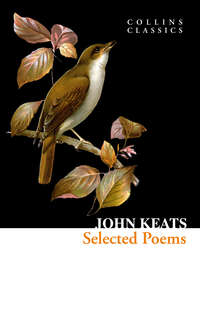
Cover image: Nightingale © duncan1890 / iStock
A catalogue record for this book is available from the British Library.
All rights reserved under International and Pan-American Copyright Conventions. By payment of the required fees, you have been granted the non-exclusive, non-transferable right to access and read the text of this e-book on-screen. No part of this text may be reproduced, transmitted, down-loaded, decompiled, reverse engineered, or stored in or introduced into any information storage and retrieval system, in any form or by any means, whether electronic or mechanical, now known or hereinafter invented, without the express written permission of HarperCollins.
Source ISBN: 9780007558100
Ebook Edition © September 2014 ISBN: 9780007558117
Version: 2014-08-19
History of Collins
In 1819, millworker William Collins from Glasgow, Scotland, set up a company for printing and publishing pamphlets, sermons, hymn books, and prayer books. That company was Collins and was to mark the birth of HarperCollins Publishers as we know it today. The long tradition of Collins dictionary publishing can be traced back to the first dictionary William published in 1824, Greek and English Lexicon. Indeed, from 1840 onwards, he began to produce illustrated dictionaries and even obtained a licence to print and publish the Bible.
Soon after, William published the first Collins novel, Ready Reckoner; however, it was the time of the Long Depression, where harvests were poor, prices were high, potato crops had failed, and violence was erupting in Europe. As a result, many factories across the country were forced to close down and William chose to retire in 1846, partly due to the hardships he was facing.
Aged 30, William’s son, William II, took over the business. A keen humanitarian with a warm heart and a generous spirit, William II was truly “Victorian” in his outlook. He introduced new, up-to-date steam presses and published affordable editions of Shakespeare’s works and The Pilgrim’s Progress, making them available to the masses for the first time. A new demand for educational books meant that success came with the publication of travel books, scientific books, encyclopedias, and dictionaries. This demand to be educated led to the later publication of atlases, and Collins also held the monopoly on scripture writing at the time.
In the 1860s Collins began to expand and diversify and the idea of “books for the millions” was developed. Affordable editions of classical literature were published, and in 1903 Collins introduced 10 titles in their Collins Handy Illustrated Pocket Novels. These proved so popular that a few years later this had increased to an output of 50 volumes, selling nearly half a million in their year of publication. In the same year, The Everyman’s Library was also instituted, with the idea of publishing an affordable library of the most important classical works, biographies, religious and philosophical treatments, plays, poems, travel, and adventure. This series eclipsed all competition at the time, and the introduction of paperback books in the 1950s helped to open that market and marked a high point in the industry.
HarperCollins is and has always been a champion of the classics, and the current Collins Classics series follows in this tradition – publishing classical literature that is affordable and available to all. Beautifully packaged, highly collectible, and intended to be reread and enjoyed at every opportunity.
Life & Times
About the Author
John Keats is one of the greatest English poets ever to have lived, a leading light of the Romantic movement, famed as much for his sentimental odes and melancholic meditations as for his contemplative correspondence. When Keats died in 1821 at the tragically young age of 25, Lord Byron lamented “his genius … undoubtedly of great promise”, concluding: “He is a loss to our literature.” His legacy is all the more remarkable when one considers that Keats had only been a published writer for four years before his death, that a great many contemporary critics were exceptionally unkind about him, and that he only sold 200 copies of his combined work during his lifetime.
The Cockney Poet
The high regard in which Keats is nowadays held developed during the nineteenth century, in the decades following his death. In his own time, it was really only his publishers and friends who truly appreciated the beauty of his imagination and writing; literary reviewers – those able to inform public opinion – tended to deride him for his lowly upbringing and schooling.
They had a point. Keats was born in Moorgate, at that time the eastern extremity of London, quite possibly at the tavern where his father worked as a stableman. He received an ordinary, inexpensive education and was raised by his grandmother from the age of eight, following the death of his father. Money was tight, and aged fourteen he left school to begin an apprenticeship with his grandmother’s neighbour, a surgeon, seeming for many years to be destined for a career in medicine.
But Keats had also taken to reading poetry, particularly the works of London poets Byron and Leigh Hunt, and increasingly he neglected his studies in order to write. Through his childhood friend, the author Charles Cowden Clarke, Keats was introduced not only to great literature but also to the great writers of his day. In 1816, the same year he qualified as an apothecary and surgeon, Keats composed “On First Looking into Chapman’s Homer”, expressing his wonder at the new world of poetry that had opened up to him: “Then felt I like some watcher of the skies / When a new planet swims into his ken.” By the end of that year, Keats was a published poet – Leigh Hunt had included “O Solitude” in his weekly magazine – and he abandoned medicine for good.
The critics never quite forgave him for his upbringing, however. His first collection of poems in 1817 was almost universally panned or ignored. The influential Blackwood’s Review was particularly harsh, referring to Leigh Hunt and Keats, among others, as the “Cockney School” of poets. Reviewing Keats’ “Endymion” in 1818, the journal commented that the “imperturbable drivelling idiocy” was the symptom of “an able mind reduced to a state of insanity”, advising that “it is a better and wiser thing to be a starved apothecary than a starved poet.”
Beauty is Truth
Neither bad reviews nor poverty could dissuade Keats from writing. In the winter of 1818–19 he moved to Wentworth Place in Hampstead – now the Keats Museum – and wrote a series of odes that are regarded as some of his best work. They include “Ode on a Grecian Urn”, “Ode to a Nightingale” and the great “To Autumn”, often praised as his most perfect poem. Keats was experimenting with the ode, a form popular with earlier English poets including Spenser and Dryden, as well as older Romantic poets such as Wordsworth and Coleridge, and the odes he composed in 1819 are regarded as landmarks of the form.
The last lines of “Ode on a Grecian Urn” are among Keats’ most famous: “‘Beauty is truth, truth beauty,’ – that is all / Ye know on earth, and all ye need to know.” It is an idea very much in keeping with Keats’ philosophy on both life and the purpose of poetry, with his sharp eye for detail and his yearning to express wonder in words. He had said as much in a November 1817 letter to his friend Benjamin Bailey, writing of “the truth of the imagination” and concluding that “whatever the imagination seizes as beauty must be truth.”
Keats’ letters are an invaluable asset in understanding the inspiration behind his writing. He took his time over his correspondence, and repeatedly ideas played with in letters appear in subsequent poems. In a letter to the poet John Hamilton Reynolds in September 1819, for example, Keats wrote of the beauty of autumn – “somehow the stubble plain looks warm” – lines which, in more polished form, found their way into “On Autumn”. In May 1818 Keats had, in another letter to Reynolds, toyed with the idea of life as a “Mansion of Many Apartments”, a notion that returned the following year in “The Fall of Hyperion: A Dream”. More than any other subject, Keats wrote about poetry itself, and though his letters, like his poems, did not achieve fame until after his death, they finally found their audience in the great poets of the twentieth century. T. S. Eliot considered them “the most notable and important ever written by any English poet”, their statements on poetry ringing true even “for greater and more mature poetry than anything Keats ever wrote”.
Love and Death
The two subjects that intrigued Keats most clashed repeatedly in the last years of his life. Towards the end of 1818, around the time he moved to Wentworth Place, Keats lost his beloved younger brother Tom to tuberculosis but also met the love of his life, Fanny Brawne. She helped him in his grief during the months in which he composed his odes, and Keats had her in mind when he wrote “Bright star, would I were as steadfast as thou”. In October 1819 he wrote to her: “I have been astonished that Men could die Martyrs for religion – I have shudder’d at it – I shudder no more – I could be martyr’d for my Religion – Love is my religion – I could die for that – I could die for you.” That same month, Fanny accepted his proposal of marriage, although her mother refused to give her consent until the failed poet had proved his financial worth.
But Keats himself had by now begun to show symptoms of tuberculosis, the disease that had killed his mother and two brothers. His condition worsened during 1820 until finally, in September, he departed for the warmer climate of Rome on doctors’ orders. Knowing that he would never return, he never wrote to Fanny again.
Following a storm-wracked voyage, Keats reached Rome in mid-November, two months after he had left London. The weather had turned wintry and he took to his bed. He wrote his last letter on 30 November, telling his friend Charles Armitage Brown: “I am leading a posthumous existence.”
Keats died in Rome on 23 February 1821. Convinced that he had left no lasting impression on the world of literature – a year earlier he had written to Fanny: “I have left nothing to make my friends proud of my memory” – he asked his doctor to arrange a plain, nameless and dateless gravestone simply saying: “Here lies One whose Name was writ in Water”. His doctor ignored this wish, and the simple tombstone that lies to this day in the Protestant Cemetery in Rome bears the following, more elaborate inscription: “This Grave / contains all that was Mortal / of a / YOUNG ENGLISH POET / Who / on his Death Bed, in the Bitterness of his Heart / at the Malicious Power of his Enemies / Desired / these Words to be / engraven on his Tomb Stone: / Here lies One / Whose Name was writ in Water.”
It was not until 1848, thirty years after their composition, that some of Keats’ own poignant thoughts on leaving the world behind were published: “When I have fears that I may cease to be / Before my pen has glean’d my teeming brain, / … And when I feel, fair creature of an hour! / That I shall never look upon thee more, / Never have relish in the faery power / Of unreflecting love! – then on the shore / Of the wide world I stand alone, and think / Till Love and Fame to nothingness do sink.”
CONTENTS
Cover
Title Page
Copyright
History of Collins
Life & Times
Poems
Addressed to Haydon
I stood tip-toe upon a little hill
Imitation of Spenser
Three Sonnets to Woman
Isabella; or, The Pot Of Basil. A Story from Boccaccio
La Belle Dame Sans Merci
Lamia
Part I
Part II
O Solitude! if I must with thee dwell
Ode on a Grecian Urn
Ode on Melancholy
Ode to a Nightingale
Fancy
Ode to Psyche
On first looking into Chapman’s Homer
To Autumn
Sleep and Poetry
Specimen of an Induction to a Poem
The Eve of St. Agnes
To Charles Cowden Clarke
To Kosciusko
Hyperion: A Fragment
Book I
Book II
Book III
Endymion: A Poetic Romance
Book I
Book II
Book III
Book IV
Letters
CLASSIC LITERATURE: WORDS AND PHRASES adapted from the Collins English Dictionary
About the Publisher
Poems
Addressed to Haydon
Highmindedness, a jealousy for good,
A loving-kindness for the great man’s fame,
Dwells here and there with people of no name,
In noisome alley, and in pathless wood:
And where we think the truth least understood,
Oft may be found a “singleness of aim,”
That ought to frighten into hooded shame
A money mong’ring, pitiable brood.
How glorious this affection for the cause
Of stedfast genius, toiling gallantly!
What when a stout unbending champion awes
Envy, and Malice to their native sty?
Unnumber’d souls breathe out a still applause,
Proud to behold him in his country’s eye.
I stood tip-toe upon a little hill
I stood tip-toe upon a little hill,
The air was cooling, and so very still.
That the sweet buds which with a modest pride
Pull droopingly, in slanting curve aside,
Their scantly leaved, and finely tapering stems,
Had not yet lost those starry diadems
Caught from the early sobbing of the morn.
The clouds were pure and white as flocks new shorn,
And fresh from the clear brook; sweetly they slept
On the blue fields of heaven, and then there crept
A little noiseless noise among the leaves,
Born of the very sigh that silence heaves:
For not the faintest motion could be seen
Of all the shades that slanted o’er the green.
There was wide wand’ring for the greediest eye,
To peer about upon variety;
Far round the horizon’s crystal air to skim,
And trace the dwindled edgings of its brim;
To picture out the quaint, and curious bending
Of a fresh woodland alley, never ending;
Or by the bowery clefts, and leafy shelves,
Guess were the jaunty streams refresh themselves.
I gazed awhile, and felt as light, and free
As though the fanning wings of Mercury
Had played upon my heels: I was light-hearted,
And many pleasures to my vision started;
So I straightway began to pluck a posey
Of luxuries bright, milky, soft and rosy.
A bush of May flowers with the bees about them;
Ah, sure no tasteful nook would be without them;
And let a lush laburnum oversweep them,
And let long grass grow round the roots to keep them
Moist, cool and green; and shade the violets,
That they may bind the moss in leafy nets.
A filbert hedge with wild briar overtwined,
And clumps of woodbine taking the soft wind
Upon their summer thrones; there too should be
The frequent chequer of a youngling tree,
That with a score of light green brethen shoots
From the quaint mossiness of aged roots:
Round which is heard a spring-head of clear waters
Babbling so wildly of its lovely daughters
The spreading blue bells: it may haply mourn
That such fair clusters should be rudely torn
From their fresh beds, and scattered thoughtlessly
By infant hands, left on the path to die.
Open afresh your round of starry folds,
Ye ardent marigolds!
Dry up the moisture from your golden lids,
For great Apollo bids
That in these days your praises should be sung
On many harps, which he has lately strung;
And when again your dewiness he kisses,
Tell him, I have you in my world of blisses:
So haply when I rove in some far vale,
His mighty voice may come upon the gale.
Here are sweet peas, on tip-toe for a flight:
With wings of gentle flush o’er delicate white,
And taper fulgent catching at all things,
To bind them all about with tiny rings.
Linger awhile upon some bending planks
That lean against a streamlet’s rushy banks,
And watch intently Nature’s gentle doings:
They will be found softer than ring-dove’s cooings.
How silent comes the water round that bend;
Not the minutest whisper does it send
To the o’erhanging sallows: blades of grass
Slowly across the chequer’d shadows pass.
Why, you might read two sonnets, ere they reach
To where the hurrying freshnesses aye preach
A natural sermon o’er their pebbly beds;
Where swarms of minnows show their little heads,
Staying their wavy bodies ’gainst the streams,
To taste the luxury of sunny beams
Temper’d with coolness. How they ever wrestle
With their own sweet delight, and ever nestle
Their silver bellies on the pebbly sand.
If you but scantily hold out the hand,
That very instant not one will remain;
But turn your eye, and they are there again.
The ripples seem right glad to reach those cresses,
And cool themselves among the em’rald tresses;
The while they cool themselves, they freshness give,
And moisture, that the bowery green may live:
So keeping up an interchange of favours,
Like good men in the truth of their behaviours
Sometimes goldfinches one by one will drop
From low hung branches; little space they stop;
But sip, and twitter, and their feathers sleek;
Then off at once, as in a wanton freak:
Or perhaps, to show their black, and golden wings,
Pausing upon their yellow flutterings.
Were I in such a place, I sure should pray
That nought less sweet, might call my thoughts away,
Than the soft rustle of a maiden’s gown
Fanning away the dandelion’s down;
Than the light music of her nimble toes
Patting against the sorrel as she goes.
How she would start, and blush, thus to be caught
Playing in all her innocence of thought.
O let me lead her gently o’er the brook,
Watch her half-smiling lips, and downward look;
O let me for one moment touch her wrist;
Let me one moment to her breathing list;
And as she leaves me may she often turn
Her fair eyes looking through her locks aubùrne.
What next? A tuft of evening primroses,
O’er which the mind may hover till it dozes;
O’er which it well might take a pleasant sleep,
But that ’tis ever startled by the leap
Of buds into ripe flowers; or by the flitting
Of diverse moths, that aye their rest are quitting;
Or by the moon lifting her silver rim
Above a cloud, and with a gradual swim
Coming into the blue with all her light.
O Maker of sweet poets, dear delight
Of this fair world, and all its gentle livers;
Spangler of clouds, halo of crystal rivers,
Mingler with leaves, and dew and tumbling streams,
Closer of lovely eyes to lovely dreams,
Lover of loneliness, and wandering,
Of upcast eye, and tender pondering!
Thee must I praise above all other glories
That smile us on to tell delightful stories.
For what has made the sage or poet write
But the fair paradise of Nature’s light?
In the calm grandeur of a sober line,
We see the waving of the mountain pine;
And when a tale is beautifully staid,
We feel the safety of a hawthorn glade:
When it is moving on luxurious wings,
The soul is lost in pleasant smotherings:
Fair dewy roses brush against our faces,
And flowering laurels spring from diamond vases;
O’er head we see the jasmine and sweet briar,
And bloomy grapes laughing from green attire;
While at our feet, the voice of crystal bubbles
Charms us at once away from all our troubles:
So that we feel uplifted from the world,
Walking upon the white clouds wreath’d and curl’d.
So felt he, who first told, how Psyche went
On the smooth wind to realms of wonderment;
What Psyche felt, and Love, when their full lips
First touch’d; what amorous, and fondling nips
They gave each other’s cheeks; with all their sighs,
And how they kist each other’s tremulous eyes:
The silver lamp, – the ravishment, – the wonder –
The darkness, – loneliness, – the fearful thunder;
Their woes gone by, and both to heaven upflown,
To bow for gratitude before Jove’s throne.
So did he feel, who pull’d the boughs aside,
That we might look into a forest wide,
To catch a glimpse of Fawns, and Dryades
Coming with softest rustle through the trees;
And garlands woven of flowers wild, and sweet,
Upheld on ivory wrists, or sporting feet:
Telling us how fair, trembling Syrinx fled
Arcadian Pan, with such a fearful dread.
Poor nymph, – poor Pan, – how he did weep to find,
Nought but a lovely sighing of the wind
Along the reedy stream; a half heard strain,
Full of sweet desolation – balmy pain.
What first inspired a bard of old to sing
Narcissus pining o’er the untainted spring?
In some delicious ramble, he had found
A little space, with boughs all woven round;
And in the midst of all, a clearer pool
Than e’er reflected in its pleasant cool,
The blue sky here, and there, serenely peeping
Through tendril wreaths fantastically creeping.
And on the bank a lonely flower he spied,
A meek and forlorn flower, with naught of pride,
Drooping its beauty o’er the watery clearness,
To woo its own sad image into nearness:
Deaf to light Zephyrus it would not move;
But still would seem to droop, to pine, to love.
So while the Poet stood in this sweet spot,
Some fainter gleamings o’er his fancy shot;
Nor was it long ere he had told the tale
Of young Narcissus, and sad Echo’s bale.
Where had he been, from whose warm head out-flew
That sweetest of all songs, that ever new,
That aye refreshing, pure deliciousness,
Coming ever to bless
The wanderer by moonlight? to him bringing
Shapes from the invisible world, unearthly singing
From out the middle air, from flowery nests,
And from the pillowy silkiness that rests
Full in the speculation of the stars.
Ah! surely he had burst our mortal bars;
Into some wond’rous region he had gone,
To search for thee, divine Endymion!
He was a Poet, sure a lover too,
Who stood on Latmus’ top, what time there blew
Soft breezes from the myrtle vale below;
And brought in faintness solemn, sweet, and slow
A hymn from Dian’s temple; while upswelling,
The incense went to her own starry dwelling.
But though her face was clear as infant’s eyes,
Though she stood smiling o’er the sacrifice,
The Poet wept at her so piteous fate,
Wept that such beauty should be desolate:
So in fine wrath some golden sounds he won,
And gave meek Cynthia her Endymion.
Queen of the wide air; thou most lovely queen
Of all the brightness that mine eyes have seen!
As thou exceedest all things in thy shine,
So every tale, does this sweet tale of thine.
O for three words of honey, that I might
Tell but one wonder of thy bridal night!
Where distant ships do seem to show their keels,
Phoebus awhile delayed his mighty wheels,
And turned to smile upon thy bashful eyes,
Ere he his unseen pomp would solemnize.
The evening weather was so bright, and clear,
That men of health were of unusual cheer;
Stepping like Homer at the trumpet’s call,
Or young Apollo on the pedestal:
And lovely women were as fair and warm,
As Venus looking sideways in alarm.
The breezes were ethereal, and pure,
And crept through half closed lattices to cure
The languid sick; it cool’d their fever’d sleep,
And soothed them into slumbers full and deep.
Soon they awoke clear eyed: nor burnt with thirsting,
Nor with hot fingers, nor with temples bursting:
And springing up, they met the wond’ring sight
Of their dear friends, nigh foolish with delight;
Who feel their arms, and breasts, and kiss and stare,
And on their placid foreheads part the hair.
Young men, and maidens at each other gaz’d
With hands held back, and motionless, amaz’d
To see the brightness in each others’ eyes;
And so they stood, fill’d with a sweet surprise,
Until their tongues were loos’d in poesy.
Therefore no lover did of anguish die:
But the soft numbers, in that moment spoken,
Made silken ties, that never may be broken.
Cynthia! I cannot tell the greater blisses,
That follow’d thine, and thy dear shepherd’s kisses:
Was there a Poet born? – but now no more,
My wand’ring spirit must no further soar. –
Imitation of Spenser
Now Morning from her orient chamber came,
And her first footsteps touch’d a verdant hill;
Crowning its lawny crest with amber flame,
Silv’ring the untainted gushes of its rill;
Which, pure from mossy beds, did down distill,
And after parting beds of simple flowers,
By many streams a little lake did fill,
Which round its marge reflected woven bowers,
And, in its middle space, a sky that never lowers.
There the king-fisher saw his plumage bright
Vieing with fish of brilliant dye below;
Whose silken fins, and golden scales’ light
Cast upward, through the waves, a ruby glow:
There saw the swan his neck of arched snow,
And oar’d himself along with majesty;
Sparkled his jetty eyes; his feet did show
Beneath the waves like Afric’s ebony,
And on his back a fay reclined voluptuously.
Ah! could I tell the wonders of an isle
That in that fairest lake had placed been,
I could e’en Dido of her grief beguile;
Or rob from aged Lear his bitter teen:
For sure so fair a place was never seen,
Of all that ever charm’d romantic eye:
It seem’d an emerald in the silver sheen
Of the bright waters; or as when on high,
Through clouds of fleecy white, laughs the coerulean sky.
And all around it dipp’d luxuriously
Slopings of verdure through the glossy tide,
Which, as it were in gentle amity,
Rippled delighted up the flowery side;
As if to glean the ruddy tears, it tried,
Which fell profusely from the rose-tree stem!
Haply it was the workings of its pride,
In strife to throw upon the shore a gem
Outvieing all the buds in Flora’s diadem.
Three Sonnets to Woman
I.
Woman! when I behold thee flippant, vain,
Inconstant, childish, proud, and full of fancies;
Without that modest softening that enhances
The downcast eye, repentant of the pain
That its mild light creates to heal again:
E’en then, elate, my spirit leaps, and prances,
E’en then my soul with exultation dances
For that to love, so long, I’ve dormant lain:
But when I see thee meek, and kind, and tender,
Heavens! how desperately do I adore
Thy winning graces; – to be thy defender
I hotly burn – to be a Calidore –
A very Red Cross Knight – a stout Leander –
Might I be loved by thee like these of yore.
II.
Light feet, dark violet eyes, and parted hair;
Soft dimpled hands, white neck, and creamy breast,
Are things on which the dazzled senses rest
Till the fond, fixed eyes, forget they stare.
From such fine pictures, heavens! I cannot dare
To turn my admiration, though unpossess’d
They be of what is worthy, – though not drest
In lovely modesty, and virtues rare.
Yet these I leave as thoughtless as a lark;
These lures I straight forget, – e’en ere I dine,
Or thrice my palate moisten: but when I mark
Such charms with mild intelligences shine,
My ear is open like a greedy shark,
To catch the tunings of a voice divine.
III.
Ah! who can e’er forget so fair a being?
Who can forget her half retiring sweets?
God! she is like a milk-white lamb that bleats
For man’s protection. Surely the All-seeing,
Who joys to see us with his gifts agreeing,
Will never give him pinions, who intreats
Such innocence to ruin, – who vilely cheats
A dove-like bosom. In truth there is no freeing
One’s thoughts from such a beauty; when I hear
A lay that once I saw her hand awake,
Her form seems floating palpable, and near;
Had I e’er seen her from an arbour take
A dewy flower, oft would that hand appear,
And o’er my eyes the trembling moisture shake.
Isabella; or, The Pot Of Basil
A Story from Boccaccio
I.
Fair Isabel, poor simple Isabel!
Lorenzo, a young palmer in Love’s eye!
They could not in the self-same mansion dwell
Without some stir of heart, some malady;
They could not sit at meals but feel how well
It soothed each to be the other by;
They could not, sure, beneath the same roof sleep
But to each other dream, and nightly weep.
II.
With every morn their love grew tenderer,
With every eve deeper and tenderer still;
He might not in house, field, or garden stir,
But her full shape would all his seeing fill;
And his continual voice was pleasanter
To her, than noise of trees or hidden rill;
Her lute-string gave an echo of his name,
She spoilt her half-done broidery with the same.
III.
He knew whose gentle hand was at the latch,
Before the door had given her to his eyes;
And from her chamber-window he would catch
Her beauty farther than the falcon spies;
And constant as her vespers would he watch,
Because her face was turn’d to the same skies;
And with sick longing all the night outwear,
To hear her morning-step upon the stair.
IV.
A whole long month of May in this sad plight
Made their cheeks paler by the break of June:
“To-morrow will I bow to my delight,
To-morrow will I ask my lady’s boon.” –
“O may I never see another night,
Lorenzo, if thy lips breathe not love’s tune.” –
So spake they to their pillows; but, alas,
Honeyless days and days did he let pass;
V.
Until sweet Isabella’s untouch’d cheek
Fell sick within the rose’s just domain,
Fell thin as a young mother’s, who doth seek
By every lull to cool her infant’s pain:
“How ill she is,” said he, “I may not speak,
And yet I will, and tell my love all plain:
If looks speak love-laws, I will drink her tears,
And at the least ’twill startle off her cares.”
VI.
So said he one fair morning, and all day
His heart beat awfully against his side;
And to his heart he inwardly did pray
For power to speak; but still the ruddy tide
Stifled his voice, and puls’d resolve away –
Fever’d his high conceit of such a bride,
Yet brought him to the meekness of a child:
Alas! when passion is both meek and wild!
VII.
So once more he had wak’d and anguished
A dreary night of love and misery,
If Isabel’s quick eye had not been wed
To every symbol on his forehead high;
She saw it waxing very pale and dead,
And straight all flush’d; so, lisped tenderly,
“Lorenzo!” – here she ceas’d her timid quest,
But in her tone and look he read the rest.
VIII.
“O Isabella, I can half perceive
That I may speak my grief into thine ear;
If thou didst ever any thing believe,
Believe how I love thee, believe how near
My soul is to its doom: I would not grieve
Thy hand by unwelcome pressing, would not fear
Thine eyes by gazing; but I cannot live
Another night, and not my passion shrive.
IX.
“Love! thou art leading me from wintry cold,
Lady! thou leadest me to summer clime,
And I must taste the blossoms that unfold
In its ripe warmth this gracious morning time.”
So said, his erewhile timid lips grew bold,
And poesied with hers in dewy rhyme:
Great bliss was with them, and great happiness
Grew, like a lusty flower in June’s caress.
X.
Parting they seem’d to tread upon the air,
Twin roses by the zephyr blown apart
Only to meet again more close, and share
The inward fragrance of each other’s heart.
She, to her chamber gone, a ditty fair
Sang, of delicious love and honey’d dart;
He with light steps went up a western hill,
And bade the sun farewell, and joy’d his fill.
XI.
All close they met again, before the dusk
Had taken from the stars its pleasant veil,
All close they met, all eyes, before the dusk
Had taken from the stars its pleasant veil,
Close in a bower of hyacinth and musk,
Unknown of any, free from whispering tale.
Ah! better had it been for ever so,
Than idle ears should pleasure in their woe.
XII.
Were they unhappy then? – It cannot be –
Too many tears for lovers have been shed,
Too many sighs give we to them in fee,
Too much of pity after they are dead,
Too many doleful stories do we see,
Whose matter in bright gold were best be read;
Except in such a page where Theseus’ spouse
Over the pathless waves towards him bows.
XIII.
But, for the general award of love,
The little sweet doth kill much bitterness;
Though Dido silent is in under-grove,
And Isabella’s was a great distress,
Though young Lorenzo in warm Indian clove
Was not embalm’d, this truth is not the less –
Even bees, the little almsmen of spring-bowers,
Know there is richest juice in poison-flowers.
XIV.
With her two brothers this fair lady dwelt,
Enriched from ancestral merchandize,
And for them many a weary hand did swelt
In torched mines and noisy factories,
And many once proud-quiver’d loins did melt
In blood from stinging whip; – with hollow eyes
Many all day in dazzling river stood,
To take the rich-ored driftings of the flood.
XV.
For them the Ceylon diver held his breath,
And went all naked to the hungry shark;
For them his ears gush’d blood; for them in death
The seal on the cold ice with piteous bark
Lay full of darts; for them alone did seethe
A thousand men in troubles wide and dark:
Half-ignorant, they turn’d an easy wheel,
That set sharp racks at work, to pinch and peel.
XVI.
Why were they proud? Because their marble founts
Gush’d with more pride than do a wretch’s tears? –
Why were they proud? Because fair orange-mounts
Were of more soft ascent than lazar stairs? –
Why were they proud? Because red-lin’d accounts
Were richer than the songs of Grecian years? –
Why were they proud? again we ask aloud,
Why in the name of Glory were they proud?
XVII.
Yet were these Florentines as self-retired
In hungry pride and gainful cowardice,
As two close Hebrews in that land inspired,
Paled in and vineyarded from beggar-spies;
The hawks of ship-mast forests – the untired
And pannier’d mules for ducats and old lies –
Quick cat’s-paws on the generous stray-away, –
Great wits in Spanish, Tuscan, and Malay.
XVIII.
How was it these same ledger-men could spy
Fair Isabella in her downy nest?
How could they find out in Lorenzo’s eye
A straying from his toil? Hot Egypt’s pest
Into their vision covetous and sly!
How could these money-bags see east and west? –
Yet so they did – and every dealer fair
Must see behind, as doth the hunted hare.
XIX.
O eloquent and famed Boccaccio!
Of thee we now should ask forgiving boon;
And of thy spicy myrtles as they blow,
And of thy roses amorous of the moon,
And of thy lilies, that do paler grow
Now they can no more hear thy ghittern’s tune,
For venturing syllables that ill beseem
The quiet glooms of such a piteous theme.
XX.
Grant thou a pardon here, and then the tale
Shall move on soberly, as it is meet;
There is no other crime, no mad assail
To make old prose in modern rhyme more sweet:
But it is done – succeed the verse or fail –
To honour thee, and thy gone spirit greet;
To stead thee as a verse in English tongue,
An echo of thee in the north-wind sung.
XXI.
These brethren having found by many signs
What love Lorenzo for their sister had,
And how she lov’d him too, each unconfines
His bitter thoughts to other, well nigh mad
That he, the servant of their trade designs,
Should in their sister’s love be blithe and glad,
When ’twas their plan to coax her by degrees
To some high noble and his olive-trees.
XXII.
And many a jealous conference had they,
And many times they bit their lips alone,
Before they fix’d upon a surest way
To make the youngster for his crime atone;
And at the last, these men of cruel clay
Cut Mercy with a sharp knife to the bone;
For they resolved in some forest dim
To kill Lorenzo, and there bury him.
XXIII.
So on a pleasant morning, as he leant
Into the sun-rise, o’er the balustrade
Of the garden-terrace, towards him they bent
Their footing through the dews; and to him said,
“You seem there in the quiet of content,
Lorenzo, and we are most loth to invade
Calm speculation; but if you are wise,
Bestride your steed while cold is in the skies.
XXIV.
“To-day we purpose, ay, this hour we mount
To spur three leagues towards the Apennine;
Come down, we pray thee, ere the hot sun count
His dewy rosary on the eglantine.”
Lorenzo, courteously as he was wont,
Bow’d a fair greeting to these serpents’ whine;
And went in haste, to get in readiness,
With belt, and spur, and bracing huntsman’s dress.
XXV.
And as he to the court-yard pass’d along,
Each third step did he pause, and listen’d oft
If he could hear his lady’s matin-song,
Or the light whisper of her footstep soft;
And as he thus over his passion hung,
He heard a laugh full musical aloft;
When, looking up, he saw her features bright
Smile through an in-door lattice, all delight.
XXVI.
“Love, Isabel!” said he, “I was in pain
Lest I should miss to bid thee a good morrow
Ah! what if I should lose thee, when so fain
I am to stifle all the heavy sorrow
Of a poor three hours’ absence? but we’ll gain
Out of the amorous dark what day doth borrow.
Goodbye! I’ll soon be back.” – “Goodbye!” said she: –
And as he went she chanted merrily.
XXVII.
So the two brothers and their murder’d man
Rode past fair Florence, to where Arno’s stream
Gurgles through straiten’d banks, and still doth fan
Itself with dancing bulrush, and the bream
Keeps head against the freshets. Sick and wan
The brothers’ faces in the ford did seem,
Lorenzo’s flush with love. – They pass’d the water
Into a forest quiet for the slaughter.
XXVIII.
There was Lorenzo slain and buried in,
There in that forest did his great love cease;
Ah! when a soul doth thus its freedom win,
It aches in loneliness – is ill at peace
As the break-covert blood-hounds of such sin:
They dipp’d their swords in the water, and did tease
Their horses homeward, with convulsed spur,
Each richer by his being a murderer.
XXIX.
They told their sister how, with sudden speed,
Lorenzo had ta’en ship for foreign lands,
Because of some great urgency and need
In their affairs, requiring trusty hands.
Poor Girl! put on thy stifling widow’s weed,
And ’scape at once from Hope’s accursed bands;
To-day thou wilt not see him, nor to-morrow,
And the next day will be a day of sorrow.
XXX.
She weeps alone for pleasures not to be;
Sorely she wept until the night came on,
And then, instead of love, O misery!
She brooded o’er the luxury alone:
His image in the dusk she seem’d to see,
And to the silence made a gentle moan,
Spreading her perfect arms upon the air,
And on her couch low murmuring “Where? O where?”
XXXI.
But Selfishness, Love’s cousin, held not long
Its fiery vigil in her single breast;
She fretted for the golden hour, and hung
Upon the time with feverish unrest –
Not long – for soon into her heart a throng
Of higher occupants, a richer zest,
Came tragic; passion not to be subdued,
And sorrow for her love in travels rude.
XXXII.
In the mid days of autumn, on their eves
The breath of Winter comes from far away,
And the sick west continually bereaves
Of some gold tinge, and plays a roundelay
Of death among the bushes and the leaves,
To make all bare before he dares to stray
From his north cavern. So sweet Isabel
By gradual decay from beauty fell,
XXXIII.
Because Lorenzo came not. Oftentimes
She ask’d her brothers, with an eye all pale,
Striving to be itself, what dungeon climes
Could keep him off so long? They spake a tale
Time after time, to quiet her. Their crimes
Came on them, like a smoke from Hinnom’s vale;
And every night in dreams they groan’d aloud,
To see their sister in her snowy shroud.
XXXIV.
And she had died in drowsy ignorance,
But for a thing more deadly dark than all;
It came like a fierce potion, drunk by chance,
Which saves a sick man from the feather’d pall
For some few gasping moments; like a lance,
Waking an Indian from his cloudy hall
With cruel pierce, and bringing him again
Sense of the gnawing fire at heart and brain.
XXXV.
It was a vision. – In the drowsy gloom,
The dull of midnight, at her couch’s foot
Lorenzo stood, and wept: the forest tomb
Had marr’d his glossy hair which once could shoot
Lustre into the sun, and put cold doom
Upon his lips, and taken the soft lute
From his lorn voice, and past his loamed ears
Had made a miry channel for his tears.
XXXVI.
Strange sound it was, when the pale shadow spake;
For there was striving, in its piteous tongue,
To speak as when on earth it was awake,
And Isabella on its music hung:
Languor there was in it, and tremulous shake,
As in a palsied Druid’s harp unstrung;
And through it moan’d a ghostly under-song,
Like hoarse night-gusts sepulchral briars among.
XXXVII.
Its eyes, though wild, were still all dewy bright
With love, and kept all phantom fear aloof
From the poor girl by magic of their light,
The while it did unthread the horrid woof
Of the late darken’d time, – the murderous spite
Of pride and avarice, – the dark pine roof
In the forest, – and the sodden turfed dell,
Where, without any word, from stabs he fell.
XXXVIII.
Saying moreover, “Isabel, my sweet!
Red whortle-berries droop above my head,
And a large flint-stone weighs upon my feet;
Around me beeches and high chestnuts shed
Their leaves and prickly nuts; a sheep-fold bleat
Comes from beyond the river to my bed:
Go, shed one tear upon my heather-bloom,
And it shall comfort me within the tomb.
XXXIX.
“I am a shadow now, alas! alas!
Upon the skirts of human-nature dwelling
Alone: I chant alone the holy mass,
While little sounds of life are round me knelling,
And glossy bees at noon do fieldward pass,
And many a chapel bell the hour is telling,
Paining me through: those sounds grow strange to me,
And thou art distant in Humanity.
XL.
“I know what was, I feel full well what is,
And I should rage, if spirits could go mad;
Though I forget the taste of earthly bliss,
That paleness warms my grave, as though I had
A Seraph chosen from the bright abyss
To be my spouse: thy paleness makes me glad;
Thy beauty grows upon me, and I feel
A greater love through all my essence steal.”
XLI.
The Spirit mourn’d “Adieu!” – dissolv’d, and left
The atom darkness in a slow turmoil;
As when of healthful midnight sleep bereft,
Thinking on rugged hours and fruitless toil,
We put our eyes into a pillowy cleft,
And see the spangly gloom froth up and boil:
It made sad Isabella’s eyelids ache,
And in the dawn she started up awake;
XLII.
“Ha! ha!” said she, “I knew not this hard life,
I thought the worst was simple misery;
I thought some Fate with pleasure or with strife
Portion’d us – happy days, or else to die;
But there is crime – a brother’s bloody knife!
Sweet Spirit, thou hast school’d my infancy:
I’ll visit thee for this, and kiss thine eyes,
And greet thee morn and even in the skies.”
XLIII.
When the full morning came, she had devised
How she might secret to the forest hie;
How she might find the clay, so dearly prized,
And sing to it one latest lullaby;
How her short absence might be unsurmised,
While she the inmost of the dream would try.
Resolv’d, she took with her an aged nurse,
And went into that dismal forest-hearse.
XLIV.
See, as they creep along the river side,
How she doth whisper to that aged Dame,
And, after looking round the champaign wide,
Shows her a knife. – “What feverous hectic flame
Burns in thee, child? – What good can thee betide,
That thou should’st smile again?” – The evening came,
And they had found Lorenzo’s earthy bed;
The flint was there, the berries at his head.
XLV.
Who hath not loiter’d in a green church-yard,
And let his spirit, like a demon-mole,
Work through the clayey soil and gravel hard,
To see scull, coffin’d bones, and funeral stole;
Pitying each form that hungry Death hath marr’d,
And filling it once more with human soul?
Ah! this is holiday to what was felt
When Isabella by Lorenzo knelt.
XLVI.
She gaz’d into the fresh-thrown mould, as though
One glance did fully all its secrets tell;
Clearly she saw, as other eyes would know
Pale limbs at bottom of a crystal well;
Upon the murderous spot she seem’d to grow,
Like to a native lily of the dell:
Then with her knife, all sudden, she began
To dig more fervently than misers can.
XLVII.
Soon she turn’d up a soiled glove, whereon
Her silk had play’d in purple phantasies,
She kiss’d it with a lip more chill than stone,
And put it in her bosom, where it dries
And freezes utterly unto the bone
Those dainties made to still an infant’s cries:
Then ’gan she work again; nor stay’d her care,
But to throw back at times her veiling hair.
XLVIII.
That old nurse stood beside her wondering,
Until her heart felt pity to the core
At sight of such a dismal labouring,
And so she kneeled, with her locks all hoar,
And put her lean hands to the horrid thing:
Three hours they labour’d at this travail sore;
At last they felt the kernel of the grave,
And Isabella did not stamp and rave.
XLIX.
Ah! wherefore all this wormy circumstance?
Why linger at the yawning tomb so long?
O for the gentleness of old Romance,
The simple plaining of a minstrel’s song!
Fair reader, at the old tale take a glance,
For here, in truth, it doth not well belong
To speak: – O turn thee to the very tale,
And taste the music of that vision pale.
L.
With duller steel than the Perséan sword
They cut away no formless monster’s head,
But one, whose gentleness did well accord
With death, as life. The ancient harps have said,
Love never dies, but lives, immortal Lord:
If Love impersonate was ever dead,
Pale Isabella kiss’d it, and low moan’d.
’Twas love; cold, – dead indeed, but not dethroned.
LI.
In anxious secrecy they took it home,
And then the prize was all for Isabel:
She calm’d its wild hair with a golden comb,
And all around each eye’s sepulchral cell
Pointed each fringed lash; the smeared loam
With tears, as chilly as a dripping well,
She drench’d away: – and still she comb’d, and kept
Sighing all day – and still she kiss’d, and wept.
LII.
Then in a silken scarf, – sweet with the dews
Of precious flowers pluck’d in Araby,
And divine liquids come with odorous ooze
Through the cold serpent-pipe refreshfully, –
She wrapp’d it up; and for its tomb did choose
A garden-pot, wherein she laid it by,
And cover’d it with mould, and o’er it set
Sweet Basil, which her tears kept ever wet.
LIII.
And she forgot the stars, the moon, and sun,
And she forgot the blue above the trees,
And she forgot the dells where waters run,
And she forgot the chilly autumn breeze;
She had no knowledge when the day was done,
And the new morn she saw not: but in peace
Hung over her sweet Basil evermore,
And moisten’d it with tears unto the core.
LIV.
And so she ever fed it with thin tears,
Whence thick, and green, and beautiful it grew,
So that it smelt more balmy than its peers
Of Basil-tufts in Florence; for it drew
Nurture besides, and life, from human fears,
From the fast mouldering head there shut from view:
So that the jewel, safely casketed,
Came forth, and in perfumed leafits spread.
LV.
O Melancholy, linger here awhile!
O Music, Music, breathe despondingly!
O Echo, Echo, from some sombre isle,
Unknown, Lethean, sigh to us – O sigh!
Spirits in grief, lift up your heads, and smile;
Lift up your heads, sweet Spirits, heavily,
And make a pale light in your cypress glooms,
Tinting with silver wan your marble tombs.
LVI.
Moan hither, all ye syllables of woe,
From the deep throat of sad Melpomene!
Through bronzed lyre in tragic order go,
And touch the strings into a mystery;
Sound mournfully upon the winds and low;
For simple Isabel is soon to be
Among the dead: She withers, like a palm
Cut by an Indian for its juicy balm.
LVII.
O leave the palm to wither by itself;
Let not quick Winter chill its dying hour! –
It may not be – those Baälites of pelf,
Her brethren, noted the continual shower
From her dead eyes; and many a curious elf,
Among her kindred, wonder’d that such dower
Of youth and beauty should be thrown aside
By one mark’d out to be a Noble’s bride.
LVIII.
And, furthermore, her brethren wonder’d much
Why she sat drooping by the Basil green,
And why it flourish’d, as by magic touch;
Greatly they wonder’d what the thing might mean:
They could not surely give belief, that such
A very nothing would have power to wean
Her from her own fair youth, and pleasures gay,
And even remembrance of her love’s delay.
LIX.
Therefore they watch’d a time when they might sift
This hidden whim; and long they watch’d in vain;
For seldom did she go to chapel-shrift,
And seldom felt she any hunger-pain;
And when she left, she hurried back, as swift
As bird on wing to breast its eggs again;
And, patient, as a hen-bird, sat her there
Beside her Basil, weeping through her hair.
LX.
Yet they contriv’d to steal the Basil-pot,
And to examine it in secret place:
The thing was vile with green and livid spot,
And yet they knew it was Lorenzo’s face:
The guerdon of their murder they had got,
And so left Florence in a moment’s space,
Never to turn again. – Away they went,
With blood upon their heads, to banishment.
LXI.
O Melancholy, turn thine eyes away!
O Music, Music, breathe despondingly!
O Echo, Echo, on some other day,
From isles Lethean, sigh to us – O sigh!
Spirits of grief, sing not your “Well-a-way!”
For Isabel, sweet Isabel, will die;
Will die a death too lone and incomplete,
Now they have ta’en away her Basil sweet.
LXII.
Piteous she look’d on dead and senseless things,
Asking for her lost Basil amorously;
And with melodious chuckle in the strings
Of her lorn voice, she oftentimes would cry
After the Pilgrim in his wanderings,
To ask him where her Basil was; and why
’Twas hid from her: “For cruel ’tis,” said she,
“To steal my Basil-pot away from me.”
LXIII.
And so she pined, and so she died forlorn,
Imploring for her Basil to the last.
No heart was there in Florence but did mourn
In pity of her love, so overcast.
And a sad ditty of this story born
From mouth to mouth through all the country pass’d:
Still is the burthen sung – “O cruelty,
To steal my Basil-pot away from me!”
Бесплатный фрагмент закончился.