Читать книгу: «The Dictionary of Body Language»

Copyright
While the manuscript for this book was reviewed by the Federal Bureau of Investigation (FBI) prior to publication, the opinions and thoughts expressed herein are those of the author exclusively.
Thorsons
An imprint of HarperCollinsPublishers
1 London Bridge Street
London SE1 9GF
www.harpercollins.co.uk
First published in the US by HarperCollinsPublishers 2018
This UK edition published by Thorsons 2018
FIRST EDITION
Text © Joe Navarro 2018
Cover layout design © HarperCollinsPublishers Ltd 2018
Illustration credits: chapter head motifs the Head, the Eyes, the Mouth, the Chin, the Face, the Neck, the Shoulders, the Hands and Fingers, the Chest, Torso, and Belly, the Feet © Anna Rassadnikova/Shutterstock, Inc.; the Arms © freelanceartist/Shutterstock, Inc.; the Hips, Buttocks, and Genitals © Oksana Usenko/Shutterstock, Inc.; the Legs © makar/Shutterstock, Inc.
A catalogue record of this book is available from the British Library
Joe Navarro asserts the moral right to be identified as the author of this work
All rights reserved under International and Pan-American Copyright Conventions. By payment of the required fees, you have been granted the nonexclusive, non-transferable right to access and read the text of this e-book on screen. No part of this text may be reproduced, transmitted, downloaded, decompiled, reverse engineered, or stored in or introduced into any information storage retrieval system, in any form or by any means, whether electronic or mechanical, now known or hereinafter invented, without the express written permission of HarperCollins e-books.
Find out about HarperCollins and the environment at www.harpercollins.co.uk/green
Source ISBN: 9780008292607
Ebook Edition © August 2018 ISBN: 9780008292614
Version 2018-07-11
Dedication
This book is dedicated to the love of my life, my best friend, and the first editor of everything I do—my wife, Thryth Hillary Navarro
Epigraph
If language was given to men to conceal their thoughts, then gesture’s purpose was to disclose them.
JOHN NAPIER
Introduction
In 1971, at the age of seventeen, for reasons unknown to me then or now, I began to keep a journal on human behavior. I catalogued all sorts of “nonverbals”—what is more generally called body language. At first it was the quirky things people did: why did they roll their eyes when they were disbelieving or reach for their neck when they heard bad news? Later it became more nuanced: why did women play with their hair while on the phone or arch their eyebrows when they greeted one another? These were small actions, but they captured my curiosity. Why did humans do such things, in such variety? What was the purpose of these behaviors?
I admit it was an odd pursuit for a teenager. My friends told me as much; they were focused on trading baseball cards, knowing who had the best batting average or kicked the most extra points that season. I was far more interested in learning the intricacies of human behavior.
In the beginning I catalogued my observations on three-by-five-inch cards for my own benefit. At that time I was unfamiliar with the work of Charles Darwin, Bronisław Malinowski, Edward T. Hall, Desmond Morris, or my future friend Dr. David Givens—the giants in the field of human behavior. I was simply interested in how others acted, and why, and I wanted to preserve my observations. I never thought I would still be collecting them on index cards forty years later.
Over the years, I collected several thousand entries. Little did I know back then that I would later become an FBI Special Agent and would, for the next twenty-five years, use those observations as I pursued criminals, spies, and terrorists. But perhaps, given my interest in how and why people behave, that was the natural trajectory all along.
I CAME TO the United States as a refugee fleeing Communist-controlled Cuba. I was eight years old and didn’t speak English. I had to adjust quickly—in other words, I had to observe and decode my new surroundings. What native speakers took for granted, I could not. My new existence consisted of deciphering the only thing that made sense—body language. Through their countenance, their look, the softness in their eyes, or the tension in their face, I learned to interpret what others implied. I could figure out who liked me, who was indifferent toward my existence, whether someone was angry or upset with me. In a strange land, I survived by observing. There was no other way.
Of course, American body language was a little different from Cuban body language. People in America spoke with a different cadence and vibrancy. Cubans got close to one another when they spoke, and often touched. In America they stood farther apart, and social touching might receive an uncomfortable glance or worse.
My parents worked three jobs each, so they did not have the time to teach me these things–I had to learn them on my own. I was learning about culture and the influence it has on nonverbals, even if I couldn’t have put it in those words at the time. But I did know that some behaviors were different here, and I had to understand them. I developed my own form of scientific inquiry, observing dispassionately and validating everything I saw not once or twice but many times before it made its way onto an index card. As my cards grew in number, certain patterns in behavior began to stand out. For one, most behaviors could be broadly categorized as markers of either psychological comfort or discomfort; our bodies reveal very accurately, in real time, our state of unease.
I would later learn that many of these comfort markers or behaviors, to be more precise, originated in the mammalian or emotional areas of the brain—what is often referred to as the limbic system. This type of involuntary response squared with what I had seen in Cuba and was seeing now in America. At school or through the window at the corner store, people would flash their eyes with their eyebrows to greet those they truly liked. Such universal behaviors I grew to trust as authentic and reliable. What I did doubt was the spoken word. How often, after I had learned English, I heard people say they liked something when just an instant earlier I had seen their face reveal the complete opposite.
And so, too, I learned at an early age about deception. People often lie, but their nonverbals usually reveal how they actually feel. Children, of course, are terrible liars; they might nod to acknowledge they have done something bad even as they are verbally denying it. As we get older, we get better at lying, but a trained observer can still spot the signs that say something is wrong, there are issues here, a person does not appear to be completely forthcoming, or someone lacks confidence in what he is saying. Many of those signals or behaviors are collected here in this book.
As I grew older, I came to rely more and more on nonverbals. I relied on them at school, in sports, in everything I did—even playing with my friends. By the time I had graduated from Brigham Young University, I had collected more than a decade’s worth of observations. There, for the first time, I was living among many more cultures (east Europeans, Africans, Pacific Islanders, Native Americans, Chinese, Vietnamese, and Japanese, among others) than I had seen in Miami, and this allowed me to make further observations.
At school I also began to discover the fascinating scientific underpinnings of many of these behaviors. To take just one example: in 1974 I got to see congenitally blind children playing together. It took my breath away. These children had never seen other children yet were exhibiting behaviors that I had thought were visually learned. They were demonstrating “happy feet” and the “steeple” with their hands, despite having never witnessed them. This meant these behaviors were hardwired into our DNA, part of our paleo-circuits—these very ancient circuits that ensure our survival and ability to communicate and are thus universal. Throughout my college career, I learned about the evolutionary basis of many of these behaviors, and throughout this book, I will reveal these often surprising facts we take for granted.
WHEN I FINISHED my studies at Brigham Young University, I received a phone call asking me to apply to the FBI. I thought it was a joke, but the next day two men in suits knocked on my door and handed me an application and my life changed forever. In those days, it was not unusual for FBI scouts to look for talent on campus. Why my name was handed up, or by who, I never learned. I can tell you that I was more than elated to be asked to join the most prestigious law enforcement agency in the world.
I was the second-youngest agent ever hired by the FBI. At the age of twenty-three I had again entered a new world. Though I felt unprepared in many ways to be an agent, there was one domain I had mastered: nonverbal communication. This was the only area where I felt confident. FBI work is, for the most part, about making observations. Yes, there are crime scenes to process and criminals to apprehend, but the majority of the job is talking to people, surveilling criminals, conducting interviews. And for that I was ready.
My career in the FBI spanned twenty-five years, the last thirteen of which I spent in the Bureau’s elite National Security Behavioral Analysis Program (NS-BAP). It was in this unit, designed to analyze the top national security cases, that I got to utilize my nonverbal skills as if on steroids. This unit, comprising just six agents selected from among twelve thousand FBI Special Agents, had to achieve the impossible: identify spies, moles, and hostile intelligence officers seeking to do harm to the United States under diplomatic cover.
During my time in the field I honed my understanding of body language. What I observed could never be replicated in a university laboratory. When I read scientific journals about deception and body language, I could tell that the authors had never actually interviewed a psychopath, a terrorist, a “made” Mafia member, or an intelligence officer from the Soviet KGB. Their findings might be true in a lab setting, using university students. But they understood little of the real world. No lab could replicate what I had observed in vivo, and no researcher could approximate the more than thirteen thousand interviews I had done in my career, the thousands of hours of surveillance video I had observed, and the behavioral notations that I had made. Twenty-five years in the FBI was my graduate school; putting multiple spies in prison based on nonverbal communications was my dissertation.
AFTER RETIRING FROM the FBI, I wanted to share what I knew about body language with others. What Every BODY Is Saying, published in 2008, was the product of that quest. In that book the concepts of “comfort” and “discomfort” took center stage, and I unveiled the ubiquity of “pacifiers”—such as touching our faces or stroking our hair—body behaviors we use to deal with everyday stress. I also sought to explain where these universal behaviors came from, drawing upon psychological research, evolutionary biology, and cultural contexts to explain why we do the things we do.
What Every BODY Is Saying became an international best seller; it has been translated into dozens of languages and has sold more than a million copies around the world. When I wrote What Every BODY Is Saying, I had no idea how popular it would become. At my speaking engagements in the years following its publication, I kept hearing the same thing: people wanted more, and they wanted it in a more easily accessible format. What many readers asked for was a field guide of sorts, a quick reference manual for behaviors they might encounter in day-to-day life.
The Dictionary of Body Language is that field guide. Organized by areas of the body—moving from the head down to the feet—it contains more than four hundred of the most important body-language observations I have made over the course of my career. My hope is that reading through The Dictionary of Body Language will give you the same insight into human behavior that I and other FBI agents have used to decode human behavior. Of course, we have used it when questioning suspects of crime. But you can use it as I have every day since I came to this country—to more fully understand those we interact with at work or at play. In social relationships, I can think of no better way to comprehend your friends or partners than by studying the primary means by which we communicate—nonverbally.
If you have ever wondered why we do the things we do, or what a particular behavior means, my hope is to satisfy your curiosity. As you go through the dictionary, act out the behaviors that you read about and get a sense for how they appear as well as they feel. By acting these out, you will better remember them the next time you see them. If you are like me and enjoy people watching, if you want to discern what people are thinking, feeling, desiring, fearing, or intending, whether at work, at home, or in the classroom, read on.
The Head
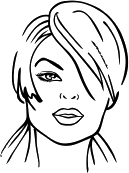
All behavior, of course, originates from inside the head. The brain is constantly at work, whether on a conscious or subconscious level. The signals that go out from the brain regulate the heart, breathing, digestion, and many other functions—but the exterior of the head is tremendously important as well. The hair, forehead, eyebrows, eyes, nose, lips, ears, and chin all communicate in their own way—from our general health to emotional distress. And so we begin with the part of the body that, from the time we are born until we die, we look to for useful information—first as parents, later as friends, work mates, lovers—to reveal for us what is in the mind.
1. HEAD ADORNMENT—Head adornment is used across all cultures for a variety of reasons. It can communicate leadership status (Native American chiefs’ feather headdresses), occupation (a hard hat or miner’s hat), social status (a bowler hat or an Yves Saint Laurent pillbox hat), hobbies (bicycle or rock-climbing helmet), religion (cardinal’s cap, Jewish yarmulke), or allegiance (favorite sports team, labor union). Head adornments may offer insight into individuals: where they fit in society, their allegiances, their socioeconomic status, what they believe, how they see themselves, or even the degree to which they defy convention.
2. HAIR—Sitting conveniently on top of the head, our hair conveys so much when it comes to nonverbal communication. Healthy hair is something all humans look for, even on a subconscious level. Hair that is dirty, unkempt, pulled out, or uncared for may suggest poor health or even mental illness. Hair attracts, entices, conforms, repels, or shocks. It can even communicate something about our careers; as renowned anthropologist David Givens puts it, hair often serves as an “unofficial résumé,” revealing where one ranks in an organization. And in many cultures hair is critical to dating and romance. People tend to follow both cultural norms and current trends with their hair; if they ignore these societal standards, they stand out.
3. PLAYING WITH HAIR—Playing with our hair (twirling, twisting, stroking) is a pacifying behavior. It is most frequently utilized by women and might indicate either a good mood (while reading or relaxing) or stress (when waiting for an interview, for example, or experiencing a bumpy flight). Note that when the palm of the hand faces the head it is more likely to be a pacifier, as opposed to the palm-out orientation discussed below. Pacifying behaviors soothe us psychologically when we feel stress or anxiety; they also help us to pass the time. As we grow older we go from pacifying by sucking our thumbs to such behaviors as lip biting, nail biting, or facial stroking.
4. PLAYING WITH HAIR (PALM OUT)—When women play with their hair with the palm of the hand facing out, it is more of a public display of comfort—a sign that they are content and confident around others. We usually only expose the underside of our wrists to others when we are comfortable or at ease. This is often seen in dating scenarios where the woman will play with her hair, palm out, while talking to someone in whom she is interested.
5. RUNNING FINGERS THROUGH HAIR (MEN)—When stressed, men will run their fingers through their hair both to ventilate their heads (this lets air in to cool the vascular surface of the scalp) and to stimulate the nerves of the skin as they press down. This can also be a sign of concern or doubt.
6. VENTILATING HAIR (WOMEN)—The ventilating of hair is a powerful pacifier, relieving both heat and stress. Women ventilate their hair differently than men. Women lift up the hair at the back of their neck quickly when concerned, upset, stressed, or flustered. If they do it repeatedly, most likely they are overly stressed. Nevertheless, we cannot discount overheating due to physical activity or ambient temperature as a cause. Men tend to ventilate on the top of the head by running their fingers through the hair.
7. HAIR FLIPPING/TOUCHING—Hair flipping, touching, or pulling is common when we are trying to attract the attention of a potential mate. The movement of the hand as it touches the hair is often deemed attractive (note most any hair commercial). Our orientation reflex (OR), a primitive reaction that alerts us to any movement, is especially attuned to hand movements—something magicians have always counted on. A hand reaching for the hair can draw our attention even from across the room. Incidentally, the orientation reflex operates on such a subconscious level, it is even seen in coma patients as the eyes track movement.
8. HAIR PULLING—The intentional and repetitive pulling out of hair is called trichotillomania. Hair pulling is more often seen in children and teenagers who are experiencing stress, but it is also occasionally seen in adults. Men tend to pluck hair from the corners of their eyebrows, while women are far more wide-ranging: plucking their eyelids, head hair, eyebrows, and arm hair. This is a stress response; even birds will pull out their own feathers when stressed. The repetitive pulling out of the hair, like a nervous tic, pacifies by stimulating nerve endings; unfortunately, when it becomes severe, it requires medical intervention.
9. HEAD NODDING—During conversations nodding serves to affirm, usually in cadence, that the person is hearing and receptive to a message. Generally, it signals agreement, except in those situations where the head nodding is accompanied by lip pursing (see #154), which might suggest disagreement.
10. HEAD NODDING (CONTRADICTION)—We usually see this in young children, as when a parent asks a child “Did you break the lamp?” and the child answers “No” but nods. This contradictory behavior betrays the truth. I have seen this with kids, teenagers, and even adults.
11. HEAD PATTING, BACK OF HEAD—When we are perplexed or mentally conflicted, we often find ourselves patting the back of our head with one hand, perhaps even stroking our hair downward as we struggle for an answer. This behavior is soothing because of both the tactile sensation and the warmth that is generated. Like most hand-to-body touching, this is a pacifying behavior that reduces stress or anxiety.
12. HEAD SCRATCHING—Head scratching soothes us when we have doubts or feel frustrated, stressed, or concerned. You see it with people trying to remember information or when they are perplexed. This explains why it is often seen by teachers as students ponder a test question. Very rapid head scratching often signals high stress or concern. It can also signal the person is conflicted as to what to do next.
13. HEAD STROKING—Beyond the function of keeping one’s hair in place, people will stroke their hair with the palm of the hand to soothe themselves when stressed or confronted with a dilemma or while pondering how to answer a question. This is not dissimilar to a mother comforting her child by stroking the child’s head. This pacifying behavior can have an immediate calming effect. Once more, this behavior may signal doubt or conflict, especially if done to the back of the head.
14. HEAD SCRATCHING WITH TUMMY RUBBING—The simultaneous rubbing of the belly and the head indicates doubt or wonder. It can also signal insecurity or incredulity. Interestingly, many primates do this as well.
15. INTERLACED FINGERS BEHIND HEAD, ELBOWS UP—The interlacing of the fingers behind the head with the elbows out is called “hooding” because the person looks like a cobra when it hoods—making the person seem bigger. This is a territorial display we do when comfortable and in charge. When we hood, the interlaced fingers behind the head are both comforting and soothing, while the elbows out project confidence. Hooding is rarely done when someone of higher status is present.
16. REACHING FOR HEAD (STUPEFIED)—People who are shocked, in disbelief, or stupefied might suddenly reach for their head with both hands so that the hands are near the ears but not touching them, with the elbows out toward the front. They might hold this position for several seconds as they try to make sense of what happened. This primitive, self-protective response might follow when someone has made a major faux pas,such as a driver crashing into his own mailbox, or a player running toward the wrong goal line.
17. INTERLACING FINGERS ON TOP OF HEAD—Usually performed with the palms down, this behavior stands out because it is intended to cover the head and yet the elbows are usually out and wide. We see this when people are overwhelmed, at an impasse, or struggling, when there has been a calamity (after hurricanes or tornados by those who lost property), or when things are not going their way. Note the position of the elbows: as things get worse, they tend to draw closer together in front of the face almost unnaturally, as if in a vise. Also note the pressure: the worse the situation, the greater the downward pressure of the hands. This behavior is quite different from “hooding” (see #15), where the palms are placed on the back of the head and the person is quite confident.
18. HAT LIFTING (VENTILATING)—Under sudden stress, people may suddenly lift up their hat to ventilate their head. This often occurs when receiving bad news, during an argument, or after a heated moment. From a safety perspective, be aware that in situations of high anger (e.g., traffic accidents or road-rage incidents), disrobing (removing hats, shirts, sunglasses) often precedes a fight.
The Forehead
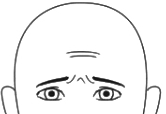
From the time we are babies, we begin to scan the forehead for information. Even at just a few months of age, infants will respond to the furrows on their mother’s forehead—perceiving it as something negative. This small space between the bridge of the nose and the hairline reveals to others, in real time, how we are feeling. It is a remarkable part of the body closely connected to the brain, which allows us to communicate sentiments quickly, accurately, and prominently.
19. FOREHEAD TENSION—On some individuals, stress manifests as sudden tension of the forehead, a result of the stiffening and tensing of underlying muscles. The face has more than twenty distinct muscle groups that can create more than four thousand distinct expressions, according to Dr. Paul Ekman. Six muscles in particular, including the large occipitofrontalis, the procerus, and the temporalis, account for the tightening or furrowing of the forehead when we are stressed. Obviously, one has to see people in a calm environment to get a baseline read on their forehead, but when people are stressed, tension of the forehead is frequently very noticeable and is an excellent indicator that something is wrong.
20. FOREHEAD FURROWING—Furrowing of the forehead in response to a stimulus is usually a good indicator that something is amiss, there are issues, or a person is insecure. It is also seen when people are concentrating or trying to make sense of something. Furrowing of the forehead is usually associated with doubt, tension, anxiety, or concern. Keep in mind that Botox, which many use for cosmetic purposes to obscure stress lines on the forehead, might mask true sentiments.
21. BOTOXED FOREHEAD (ISSUES)—Both men and women are now taking advantage of Botox injections to erase stress lines on their foreheads. This has created problems for couples and even for children who would normally look to the forehead for information as to how a person might feel. Babies as young as four weeks old will respond to a furrowed forehead as something negative. Interestingly, both children and adults have reported an inability to read their parents or their spouses who have used Botox for emotional cues as easily as they could before.
22. STRESS LINES—On some individuals, their life struggles are marked by deep grooves on their forehead, even at a young age. Life experiences often etch our foreheads with lines, furrows, and other indentations. The forehead can reflect a difficult or stressful life or a life that has been spent outdoors in the sun, which tends to make forehead markings more prevalent.
23. FOREHEAD SWEATING—If the degree of stress is high enough, some people begin to spontaneously sweat. Sweating is very individual. Some sweat profusely with their first sip of coffee, or climbing a flight of stairs, so make sure to get a baseline of this behavior before jumping to any conclusion. Baseline behaviors are those behaviors we equate with “normal,” when a person is not stressed or overly affected by emotions.
24. TEMPLE VEIN THROBBING—When a person is under stress, the superficial temporal veins (those nearest the skin on the sides of our heads and just behind the eyes) might pulse or throb visibly. It is a very accurate indicator of autonomic arousal due to anxiety, concern, fear, anger, or, occasionally, excitement. Autonomic arousal is the brain’s way of automatically going into survival mode—compelling the heart and the lungs to work faster in anticipation of physical activity such as running or fighting.
25. FOREHEAD MASSAGING—We tend to massage our foreheads when we have headaches (literally), when we are processing information, or when we have worries, concerns, doubts, or anxiety. It is a pacifying behavior, which helps to soothe tension or apprehension.
26. POINTING AT FOREHEAD—Pointing a finger at the forehead or making a screwing motion with the finger while pointing at the forehead is very insulting—it means that the observer is ill informed, stupid, or crazy. This is a culturally based cue, generally seen in Germany, Switzerland, and Austria, where it is very offensive, and sometimes in the U.S. Because it is insulting it should be avoided.
27. PRESSING HAND ON FOREHEAD—Pressing the hand flat against the forehead helps relieve tension caused by stress, doubt, or insecurity. This is different from slapping the hand on the forehead; it looks as though the person is trying to push his head backward. As with so many other behaviors, this is intended to soothe the individual psychologically through tactile pressure on the skin.
28. PUZZLED LOOK—The area between the eyes is pulled together, often causing furrowing or knitting of the eyebrows. The eyes may squint or look away, and sometimes the head is canted slightly to the side. We often see this distressed look when someone is struggling with something mentally or trying to work through a problem. It usually results from a high cognitive load (arduous thinking or recalling).
29. COVERING FOREHEAD WITH HAT—Stress or embarrassment will cause some to actually cover their forehead with headgear (a hat, visor, or hood). We generally see this in children and teenagers but also sometimes in adults. I have often watched drivers do this when being ticketed for speeding. It is almost as if they are trying to hide in shame.
The Eyebrows

The eyebrows lie just above the supraorbital arches of the eye sockets and serve a variety of purposes. They protect our eyes from dust, light, and moisture, but they also communicate how we feel. From an early age we rely on people’s eyebrows to help us interpret their facial expressions. And in many cultures, eyebrows are an aesthetic concern: something to be tweezed, shaped, plucked, colored, highlighted, waxed, stylized, removed, or extenuated. Like the rest of our face, the eyebrows are controlled by a variety of muscles (corrugator supercilii principally, but also the nasalis and levator labii superioris from our nose), and thus can be very expressive and communicate exquisitely our feelings.
30. EYEBROW ARCHING/FLASHING (HAPPY)—Eyebrow arching or flashing conveys excitement (such as when greeting a close friend) or the recognition of something pleasing. We arch our brows in less than one-fifth of a second. It is a gravity-defying behavior, as it is performed in an upward direction, and as with most gravity-defying behaviors, it signifies something positive. Babies just a few months old light up when their mother flashes her eyebrows. Here is a great behavior to let others know we care and are happy to see them. A happy eyebrow flash can be immensely useful and powerful in everyday situations both at home and at work.
31. EYEBROW GREETINGS—We flash our eyebrows when we recognize someone we know and cannot speak up at that moment, or simply to recognize a person’s presence, with or without a smile, depending on circumstances. We are quick to notice when this courtesy is not extended to us, for example, when we enter a store and the clerk makes no effort to establish any kind of eye contact. We can let others know we value them, though we may be occupied, with a very simple eyebrow flash.
32. EYEBROW ARCHING (TENSE)—This occurs when a person is presented with an unwanted surprise or shock. Coupled with other behaviors such as a tense face or lip compression, it can let us know someone has experienced something very negative. It is the tension in the muscles that control the eyebrows that differentiates this behavior from the eyebrow greeting described above and it is held for a few seconds longer.
33. EYEBROW ARCHING (CHIN TOWARD NECK)—We arch our eyebrows with our mouths closed, chin toward the neck when we hear something we immediately question or are very surprised to hear or learn. When we witness an embarrassing situation we also employ this behavior, as if to say, “I heard that and I didn’t like it.” It is a look teachers often give to misbehaving students.
34. EYEBROW ASYMMETRY—People use this signal when they have doubts or uncertainty. One eyebrow will arch high, while the other remains in the normal position or sinks lower. Asymmetry signals that the person is questioning or doubting what is being said. The actor Jack Nicholson is famous for questioning what others say, on- and offscreen, by this method.
35. EYEBROW NARROWING/KNITTING—The area between the eyes and just above the nose is called the glabella, and when the glabella becomes narrow or furrowed, it usually means there is an issue, concern, or dislike. This universal sign may happen very quickly and thus can be difficult to detect, but it is an accurate reflection of sentiments. Some people will knit their brow when they hear something troubling or are trying to make sense of what they’re being told. The sentiment is communicated with the >< emoji.
The Eyes

Our eyes are the visual gateway to the world around us. From the moment we are born, we are scanning for information in familiar faces, movement or novelty, color, shading, symmetry, and always for the aesthetically pleasing. Our visual cortex, large in proportion to the rest of the brain, seeks novelty and new experiences. Our eyes show love and compassion as well as fear and disdain. Welcoming or joyous eyes can make our day. But eyes can also let us know that something is wrong, that there are worries or concerns. Eyes can own a room or cower in a crowd of strangers. We adorn our eyes to attract and avert them to avoid. They are usually the first thing we notice in others, which is why when a baby is born we spend so much time looking at the eyes. Perhaps because we truly are looking through the window to their soul.
36. PUPIL DILATION—When we are comfortable or like something or someone we encounter, our pupils dilate. We have no control over this. When couples are at ease around each other their pupils dilate as their eyes try to soak up as much light as possible. This is why dimly lit restaurants are a good place to meet, as it naturally softens the eyes and makes the pupils larger—an effect that makes us relax even more around others.
37. PUPIL CONSTRICTION—Our pupils constrict when we see something we don’t like or when we have negative emotions. Pupil constriction is easier to detect in light-colored eyes. Pupils suddenly shrinking to pinpoints suggest something negative has just transpired. Interestingly, our brain governs this activity to make sure that our eyes are focused in times of distress, as the smaller the aperture, the greater the clarity. This is why squinting improves focus.
38. RELAXED EYES—Relaxed eyes signal comfort and confidence. When we are at ease, the muscles around the eyes, the forehead, and the cheeks relax—but the minute we are stressed or something bothers us, they become tense. Babies often demonstrate this quite strikingly, as their facial muscles suddenly scrunch up before they begin to cry. When trying to interpret any body-language behavior, always refer back to the eyes for congruence. If the orbits (eye sockets) look relaxed, chances are all is well. If suddenly there is tension around the eyes or squinting, the person is focusing or might be stressed. The muscles of the eyes and the surrounding tissue react to stressors much more quickly than other facial muscles do, offering almost immediate insight into a person’s mental state.
39. EYE SOCKET NARROWING—When we feel stressed, upset, threatened, or other negative emotions, the orbits of the eyes will narrow due to the contraction of underlying muscles. The brain immediately makes the eye orbits smaller in response to apprehension, concern, or doubt. It is a good indicator that there is an issue or something is wrong.
40. QUIVERING UNDER EYES—The tiny muscles directly under the eyes (the inferior underside of the Obicularis oculi) and just above the cheekbones, as well as the surrounding tissue, can be very sensitive to stress. When there is concern, anxiety, or fear, these soft areas will quiver or twitch, revealing the person’s true emotional state.
41. BLINK RATE—Blink rates can vary depending on environment and the amount of stress or arousal a person is experiencing. Each individual is different, but a typical rate is between sixteen and twenty blinks per minute, depending on lighting conditions and humidity. People looking at computers blink less (many of whom complain of dry eyes or eye infections—tears have antibacterial properties), while those who work where there is dust or pollen will blink more. Also, be aware that wearing contact lenses can increase how often we blink. When we are around someone who arouses us, our blink rate also tends to increase.
42. FREQUENT BLINKING—People who are nervous, tense, or stressed will generally blink more rapidly than those who are not. Frequent blinking is erroneously associated with deception. It is only indicative of stress or other factors noted above as even the honest blink more frequently when being questioned aggressively.
43. EYE CONTACT—Eye contact is governed by cultural norms and personal preferences. In some cultures it is permissible to look at someone for three to four seconds, while in others anything beyond two seconds is considered rude. Culture also determines who can look at whom. Even in America, eye contact is determined by what area of the country you are from. In New York City, staring at someone for more than a second and a half might be perceived as an affront. Particular ethnic and cultural groups have their own norms. For instance, many African American and Hispanic children are taught to look down when addressed by elders, as a form of respect.
44. EYE AVOIDANCE—We avoid eye contact when it is inconvenient to talk to someone, or when we find a person unlikable, obnoxious, or repressive. In prison, for example, inmates will avoid eye contact with jailers or inmates known to be aggressive. Eye avoidance can be temporary or long term. Temporarily, people might avert their eyes when a person does something embarrassing. And in the United States, unlike other parts of the world, when we are in close proximity, as in an elevator, we tend to avoid making eye contact with strangers and even with those we know, especially if there are strangers present. Eye avoidance is not indicative of deception, but it can indicate shame or embarrassment.
45. GAZE SUPERIORITY—All over the world, studies have shown that high-status individuals engage in more eye contact, while both speaking and listening. Less powerful people tend to make more eye contact with these higher-status individuals while listening but less while speaking. In Japan as well as other Asian Pacific countries this is even more pronounced. Incidentally, we tend to favor individuals who make direct eye contact with us, especially if they are of higher status. Eye contact from high social status individuals, movie stars, for instance, makes us feel favored.
46. EYE-CONTACT SEEKING—When we are interested in starting a conversation, whether in a social or a dating environment, we will actively scan until we make eye contact that says “I am here—please talk to me.”
47. GAZE AND SENTIMENTS—Around the world, those who study dating cues have noted that oftentimes the first clue that people’s feeling for each other have changed is how they look at each other. Long before words are exchanged, the look of increased interest telegraphs that the relationship is changing from friendly to more intimate. How Julie Andrews (as Maria) began to change the way she looked at Christopher Plummer (Captain Von Trapp) in the movieThe Sound of Music or how Emma Stone (Mia) changed the way she looked at Ryan Gosling’s character (Sebastian) in La La Land is emblematic of how our gaze changes to reflect our changing sentiment before our words do. It is true in real life as well as in the movies.
48. GAZE ENGAGING—This is a behavior intended to get the attention of another person in a warm or romantic way. What makes this behavior stand out is the softness of the face and the repeated attempts to connect, eye to eye, always with a gentleness of the eyes, face, and mouth. We most often see this in dating settings, where it lets the other person know you are interested in further contact or proximity. I have seen strangers engage gazes across broad spaces, communicating their yearning.
49. GAZING VERSUS STARING—There is a big difference between gazing at someone and staring at someone. Staring tends to be more impersonal, distant, or confrontational, signaling that we find someone suspicious, alarming, or odd. On the other hand, gazing signals that we take comfort in someone, a much more inviting behavior. When we stare we are on alert; when we gaze we are intrigued, even welcoming. Staring can trigger offense, especially in close quarters such as a bus or subway.
50. CLOSED EYES—During a meeting, someone with closed eyes that take a long time to open or that suddenly shut and remain so for longer than usual is probably having issues. It is a blocking behavior that reveals dislike, concern, disbelief, or worries—some form of psychological discomfort. Long delays in eye opening reveal deep concern. Conversely, in an intimate setting, closed eyes say, “I trust you, I am blocking everything else out, and I am in the moment with my other senses.” Notably, even children born blind will cover their eyes when they hear things they don’t like or they find troubling.
51. EYES CLOSING FOR EMPHASIS—Oftentimes, when we want to emphasize something or agree in congruence, we will close the eyes ever so briefly. It is a way of affirming what is being said. As with all behaviors, context is key to ensure it is not a reflection of disagreement.
52. COVERING OF EYES—Sudden covering of the eyes with a hand or fingers is a blocking behavior associated with a negative event, such as the revelation of bad news or threatening information. It also indicates negative emotions, worry, or lack of confidence. You also see it with people who have been caught doing something wrong. As I note above, congenitally blind children will also do this, though they cannot explain why; clearly this behavior has an ancient evolutionary basis.
53. EYES CLOSED, RUBBING BRIDGE OF NOSE—Individuals who close their eyes and rub the bridge of their nose at the same time are transmitting that they are concerned or worried. This is both a blocking behavior and a pacifier, usually associated with negative emotions, dislike, insecurities, concern, or anxiety.
54. CRYING—Crying serves a variety of personal as well as social purposes, most notably providing a cathartic emotional release. Unfortunately, children also learn quickly that crying can be used as a tool to manipulate, and some adults don’t hesitate to use it similarly. In observing a person’s behavior, crying should not be given any more weight than other signals that a person is having a hard time. Crying, if it occurs with great frequency, can also let us know when someone is clinically depressed or struggling psychologically.
55. CRYING WHILE CLUTCHING OBJECTS—Individuals who cry while clutching at their neck, necklace, or shirt collar are likely undergoing more serious negative emotions than a person merely crying.
56. EYES DARTING—Eyes that dart back and forth feverishly are usually associated with the processing of negative information, doubt, anxiety, fear, or concern. Use this behavior in conjunction with other information such as facial tension or chin withdrawal (see #184) to provide a more accurate assessment. It should be noted that some people will dart their eyes back and forth as they analyze a situation, consider options, or think of solutions. This behavior alone is not itself indicative of deception.
57. EYE-ACCESSING CUES—As we process a thought, an emotion, or a question posed to us, we tend to look laterally, downward, or up and to the side. This is referred to as conjugate lateral eye movement (CLEM) in the scientific literature. There has been a myth for decades, now well debunked by more than twenty studies, that a person looking away or to the side while answering a question is being deceptive. All we can say when someone looks in a certain direction as they process a question or as they answer it, is that they are thinking—it is not per se indicative of deception.
58. EYELIDS FLUTTERING—Sudden eyelid fluttering suggests that something is wrong or that a person is struggling with something (think of the actor Hugh Grant, who often flutters his eyes on-screen when he has issues or has messed something up). People often flutter their eyes when they are struggling to find the right word or can’t believe what they just heard or witnessed. Incredulity is often observed as eyelid fluttering.
59. EYE POINTING—In some cultures an index finger just under an eye communicates doubt or suspicion. But many people across cultures also do this subconsciously in the form of a light scratching motion as they ponder or question something being said. When traveling abroad, ask locals if this means anything special. In Romania, I was told that the finger under the eye was a sign often used to communicate “Be careful, we don’t trust everyone who is listening.”
60. EYE-POINTING CLUSTER—Pointing of the index finger just under the eye (see #59) clustered with eyebrow arching and compressed lips simultaneously conveys doubt, bewilderment, or incredulity. This is especially accurate if the chin is tucked in rather than jutted out.
61. EYE ROLLING—Rolling of the eyes communicates contempt, disagreement, or dislike. Children often do it to their parents to communicate contention or rebellion. It has no place in a professional setting.
62. EYELID TOUCHING—Eyelid touching can be a form of eye blocking coupled with tension relief. Often when people say something they shouldn’t have, people nearby will touch or scratch their closed eyelid—this is a good indicator that something improper was uttered. You see this often with politicians when one misspeaks and another catches it.
63. FATIGUED EYES—Fatigue usually shows in the eyes first. The eyes and the area around them look strained, puffy, weathered, even discolored. This may be due to long hours working; external factors, such as stress; or crying.
64. FAR-OFF LOOK—When alone, or even in conversation with others, staring into the distance, avoiding distractions, allows some people to think or contemplate more effectively. This may be a signal not to interrupt someone when they are deep in thought or recollection.
65. GLAZED EYES—Any number of things can cause the eyes to look glazed, including drugs such as marijuana and alcohol as well as more dangerous substances. When trying to assess whether a person is under the influence of drugs or alcohol, an observer will want to take other behaviors into consideration, such as slurred speech or slowness to respond.
66. LOOKING ASKANCE—Looking askance (sideways) is often used to show a person’s doubt, reluctance to commit, disregard, suspiciousness, or even contempt. It is a universal look that reflects disbelief, concerns, or incredulity.
67. LOOKING AT CEILING OR SKY—We often see this dramatic look upward at the sky, with the head tilted back, when suddenly things seem impossible or a person has had a run of bad luck. We see this in sports, such as when a golfer misses a putt. It is a look of disbelief, as if imploring someone on high, in the heavens, to help us or take pity on us. This behavior does have some utility; stress causes tension of the neck, which this position can help relieve by stretching the sternocleidomastoid muscles of the neck.
68. LOOKING FOR ACCEPTANCE—When individuals lack confidence or lie, they tend to scrutinize their audience, scanning faces to see if they are being believed. This behavior is not necessarily demonstrative of deception, only of seeking acceptance for what is said. A rule of thumb: the truth teller merely conveys, while the liar often tries to convince.
69. EYES LOWERED—This is different from eye avoidance in that the individual does not break eye contact but rather shows deference, piety, humility, or contriteness by slightly lowering the eyes so that eye contact is not direct or intense. This is often culture based, and we see it frequently with children who are taught not to look back at elders or authority figures when being chastised. Black and Latino children are often taught to look down as a form of respect, which should in no circumstances be confused for an attempt to deceive. In Japan it is rude to stare intently at the eyes of a person you meet for the first time; at a minimum, the eyelids must be lowered out of social deference.
70. SAD EYES—Eyes look sad, dejected, or depressed when the upper eyelids droop and seem to have no energy. The look may be similar, however, to eyelids drooping from fatigue.
71. LOOKING AWAY—Looking away when conversing has to be viewed in context. When there is psychological comfort, such as when talking to friends, we may feel relaxed enough to look away as we tell a story or remember something from the past. Many individuals find looking away helps them recall details. Looking away is not an indication of deception or lying.
72. LONG STARE—In conversations, silence is often accompanied by a long stare. It can be directed at a person or at something in the distance; it merely indicates that the person is in deep thought or processing information.
73. SQUINTING—Squinting is an easy way to register displeasure or concern, especially when we hear or see something we don’t like. Some people squint whenever they hear something bothersome, making this an accurate reflection of their feelings. But keep in mind that we also squint when we are simply focusing on something or trying to make sense of something we have heard, so context is crucial in interpreting this behavior.
74. SQUINTING (SLIGHT)—Often when we are subduing anger we will squint slightly with lowered eyelids. This behavior (narrowing of the slits of the eyes) must be considered in context with other behaviors such as facial tension or, in extreme circumstances, the making of a fist.
75. STARING AGGRESSIVELY—A stare can intimidate or serve as the prelude to an altercation. Aggression is signaled by the laser-like focus on the eyes, with no attempt to look away or even blink. Interestingly, other primates also engage in this behavior when observing behaviors that are not tolerated or when there is about to be a physical confrontation.
76. ANGRY EYES—Anger is usually displayed by a constellation of facial cues beginning with the distinctive narrowing of the eyes near the nose (like this: ˃ ˂ ), coupled with a wrinkled or dilated nose and sometimes the pulling back of the lips to reveal clenched teeth.
77. EYES WIDENING (STIFF)—Eyes that remain wide usually indicate stress, surprise, fear, or a significant issue. If the eyes remain stiffly wide longer than usual, something is definitely wrong. This is usually caused by an external stimulus.
78. EYE ADORNMENT—Since the time of the Egyptian pyramids, women and men across the globe have adorned their eyes (eyelids, under the eye, the sides, etc.) with a variety of colors to make themselves more aesthetically appealing. Using inks, dyes, minerals, and oils, people have made this part of their cultural traditions, and it has been passed down to our modern society for a reason: it works. We are attracted to eyes, even more so when they are adorned with colors. We are also attracted to long, thick eyelashes—something that mostly women but some men accentuate to make themselves more appealing.
Бесплатный фрагмент закончился.