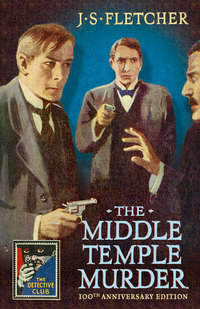
Читать книгу: «The Middle Temple Murder»
‘THE DETECTIVE STORY CLUB is a clearing house for the best detective and mystery stories chosen for you by a select committee of experts. Only the most ingenious crime stories will be published under the THE DETECTIVE STORY CLUB imprint. A special distinguishing stamp appears on the wrapper and title page of every THE DETECTIVE STORY CLUB book—the Man with the Gun. Always look for the Man with the Gun when buying a Crime book.’
Wm. Collins Sons & Co. Ltd., 1929
Now the Man with the Gun is back in this series of COLLINS CRIME CLUB reprints, and with him the chance to experience the classic books that influenced the Golden Age of crime fiction.

Copyright
COLLINS CRIME CLUB
An imprint of HarperCollinsPublishers Ltd
1 London Bridge Street
London SE1 9GF
www.harpercollins.co.uk
This Detective Club edition published 2019
First published in Great Britain by Ward Lock 1919
‘The Contents of the Coffin’ published in The Adventures of Archer Dawe (Sleuth-Hound) by Digby, Long & Co. 1909
Introduction © Nigel Moss 2019
Cover design © HarperCollinsPublishers Ltd 2019
J.S. Fletcher asserts the moral right to be identified as the author of this work.
A catalogue copy of this book is available from the British Library.
This novel is entirely a work of fiction. The names, characters and incidents portrayed in it are the work of the author’s imagination. Any resemblance to actual persons, living or dead, events or localities is entirely coincidental.
All rights reserved under International and Pan-American Copyright Conventions. By payment of the required fees, you have been granted the non-exclusive, non-transferable right to access and read the text of this e-book on screen. No part of this text may be reproduced, transmitted, down-loaded, decompiled, reverse engineered, or stored in or introduced into any information storage and retrieval system, in any form or by any means, whether electronic or mechanical, now known or hereinafter invented, without the express written permission of HarperCollins.
Source ISBN: 9780008283049
Ebook Edition © January 2019 ISBN: 9780008283056
Version: 2018-11-28
Contents
Cover
Title Page
Copyright
Introduction
I. THE SCRAP OF GREY PAPER
II. HIS FIRST BRIEF
III. THE CLUE OF THE CAP
IV. THE ANGLO-ORIENT HOTEL
V. SPARGO WISHES TO SPECIALISE
VI. WITNESS TO A MEETING
VII. MR AYLMORE
VIII. THE MAN FROM THE SAFE DEPOSIT
IX. THE DEALER IN RARE STAMPS
X. THE LEATHER BOX
XI. MR AYLMORE IS QUESTIONED
XII. THE NEW WITNESS
XIII. UNDER SUSPICION
XIV. THE SILVER TICKET
XV. MARKET MILCASTER
XVI. THE ‘YELLOW DRAGON’
XVII. MR QUARTERPAGE HARKS BACK
XVIII. AN OLD NEWSPAPER
XIX. THE CHAMBERLAYNE STORY
XX. MAITLAND alias MARBURY
XXI. ARRESTED
XXII. THE BLANK PAST
XXIII. MISS BAYLIS
XXIV. MOTHER GUTCH
XXV. REVELATIONS
XXVI. STILL SILENT
XXVII. MR ELPHICK’S CHAMBERS
XXVIII. OF PROVED IDENTITY
XXIX. THE CLOSED DOORS
XXX. REVELATION
XXXI. THE PENITENT WINDOW-CLEANER
XXXII. THE CONTENTS OF THE COFFIN
XXXIII. FORESTALLED
XXXIV. THE WHIP HAND
XXXV. MYERST EXPLAINS
XXXVI. THE FINAL TELEGRAM
THE CONTENTS OF THE COFFIN
Keep Reading …
The Detective Story Club
About the Publisher
INTRODUCTION
THE year 2019 marks the centenary of The Middle Temple Murder by J.S. Fletcher (1863–1935), first published in 1919 in the UK (Ward Lock) and US (Knopf). Well received by literary critics on both continents, it attracted lavish praise from US President Woodrow Wilson as the best detective story he had read. The book quickly became a bestseller, especially in the US, where Fletcher was even heralded as the literary successor to Arthur Conan Doyle, and it later entered the Haycraft-Queen Cornerstone list of landmark mysteries. Though Fletcher was already an established author, he was now propelled to literary fame and commercial success, and during the 1920s and early 1930s his vast output was rivalled only by Edgar Wallace and E. Phillips Oppenheim. His influence contributed significantly to the growth in popularity, social acceptance and respectability of crime fiction and was of historical importance to the genre.
Joseph Smith Fletcher was born in 1863 in Halifax. His father, a clergyman and keen bibliophile, died when Fletcher was still a baby, and he was raised by his maternal grandmother on her farm in Yorkshire. A semi-invalid for much of his youth, Fletcher’s formal education did not begin until his mid-teens. However, he developed a passionate enjoyment for reading prose and poetry at a young age, particularly the great adventure stories of Fenimore Cooper, Captain Marryat, Walter Scott and Jules Verne, and by age 16 claimed to have read over two thousand books. This was reflected in the hugely fertile imagination and wordsmith skills displayed in Fletcher’s fictional writings. Before turning age 17, Fletcher had published his first collection of poetry.
After completing his schooling in Wakefield, Fletcher moved to London to study law. He attended fraud and murder trials and gained an in-depth knowledge of criminal law, useful for his later detective fiction. But plans to become a barrister were abandoned in favour of journalism, and by age 20 he was working as a sub-editor on an educational journal in London. He soon returned to Yorkshire, where for the next 15 years Fletcher worked for various regional newspapers, including the Leeds Mercury (writing rustic pieces under the pseudonym ‘Son of the Soil’) and the Yorkshire Post. Fletcher married in his early-20s, but this was to end in separation. His second marriage was to Irish novelist Rosamond Langbridge, noted for her psychological study of Charlotte Brontë, and they lived in the home counties until his death.
In his late-20s, while still working in journalism, Fletcher’s wide-ranging and prolific writing career took off, encompassing poetry, biography, history and historical fiction, topography, country life, cricket, religion and detective fiction, extending for over 40 years, and resulting in some 237 books—almost half were mysteries—a true literary behemoth. Fletcher’s first fictional work was a historical romance, When Charles I was King (1892), one of the last Victorian three-decker novels. He published collections of journalistic pieces about the Yorkshire countryside, and novels of rural life after the style of Richard Jefferies. Fletcher’s regional dialect writings earned him the soubriquet ‘the Yorkshire Hardy’. His historical reference works about Yorkshire were admired and respected, especially the three-volume A Picturesque History of Yorkshire (1900), and he was made a Fellow of the Royal Historical Society.
In the early-1900s, Fletcher gave up journalism to devote himself to writing books, including his first crime novels. This was a time of buoyant public demand for mystery stories, a lucrative pastime for authors. The Sherlock Holmes stories of Conan Doyle were especially popular. Fletcher’s early crime fiction was a mix of orthodox mystery novels and short stories, as well as thriller ‘shockers’ similar to those of Edgar Wallace and Sax Rohmer. His best-known mystery story collection featured an elderly Yorkshire amateur detective, The Adventures of Archer Dawe, Sleuth-Hound (1909), followed later by stories of private investigator Paul Campenhaye, Specialist in Criminology (1918). By the end of WWI, Fletcher had gained a reputation as a moderately successful, talented author, writing in different genres on a wide range of subjects.
The Middle Temple Murder (1919) was to prove a breakthrough for Fletcher. It begins, in arresting fashion, with Frank Spargo, a young sub-editor on the Watchman newspaper, walking home from Fleet Street in the early hours of a June morning in 1912. He happens upon the discovery of the body of an elderly man who has been found bludgeoned to death, lying in the entrance to barristers’ chambers on Middle Temple Lane, a narrow thoroughfare running between Fleet Street and the Embankment. There are no means of identification on the body; the victim’s pockets are empty, save for a scrap of paper bearing the name and address of Ronald Breton, a young barrister. Spargo senses a potential journalistic scoop. He gains the trust of Detective-Sergeant Rathbury of Scotland Yard, and accompanies him during initial enquiries. Subsequently they agree to exchange and share information, while pursuing their investigations independently. Spargo adopts the novel approach of publishing his findings in the Watchman and inviting the public to come forward with information. This strategy proves successful—as well as advancing the paper’s circulation. The narrative focuses on Spargo’s unravelling of the mystery—who the murdered person was, why he was murdered, and who did it. Breton assists him in the background.
The book succeeds on many different levels. Spargo is personable and likeable, a refreshingly principled journalist. Although wholly inexperienced at sleuthing, he displays enthusiasm, determination and wisdom. Along with E.C Bentley’s earlier fictional creation Philip Trent, Spargo was one of the first journalist-detectives, later to prove popular with American and British crime writers. The story is mainly set in urban London, around Fleet Street, the Temple and Waterloo, areas with which Fletcher was familiar. There are occasional excursions—to Market Milcaster, a decaying, genteel West Country market town, and at the conclusion to the northern Fell country. The atmosphere of each location is vividly and evocatively conveyed, enhancing the storytelling.
The plot is well constructed, complex and entertaining. The diverse storyline threads and multi-dimensional sub-plots are akin to the pieces of a complicated jigsaw puzzle; eventually slotting together to form a pleasing symmetry and reveal an intricate and intriguing mystery. Colourful new minor characters are introduced at different stages, and fresh clues regularly emerge during the investigation to set the story off in a new direction, in the vein of a pursuit thriller; these help to hold the reader’s interest throughout. The pace is quicker than in many other detective stories of the period, with plenty of plot twists, red herrings and historic crimes subordinate to the murder which reveal a motive deep in the past. Fletcher doesn’t leave loose ends. With a tightly plotted, swiftly moving and suspenseful storyline, he manages to keep the murderer’s identity hidden until the penultimate page. Fletcher’s journalistic skills show in the short chapter structure, multi-layered plots and page-turning, cliffhanger style of writing, typical of series publications. The book is well written but unpretentious; it has a surprisingly modern feel, brisk and light, and still holds up well today.
One of the sub-plots is developed from the short story ‘The Contents of the Coffin’, which appeared in Fletcher’s earlier collection The Adventures of Archer Dawe, Sleuth-Hound. That story is helpfully included in this new edition; it offers an interesting comparison.
The success which followed the publication of The Middle Temple Murder in August 1919 transformed Fletcher’s writing career. At the end of WWI Fletcher was in his mid-fifties, and thereafter until his death in 1935 he predominantly wrote detective fiction, prodigiously averaging three mystery novels annually. The Middle Temple Murder was Fletcher’s first detective novel to be published in America. It went through six printings during the first year and together with Woodrow Wilson’s widely-publicised encomium quickly established Fletcher’s reputation in the US. The New York Times Book Review in August 1920 hailed Fletcher as a ‘new’ author of detective fiction that was ‘ingenious, complicated and much better written than the average’. Fletcher was dubbed ‘the Dean of Mystery Writers’. One leading American critic wrote of his ‘concocting detective stories that hold the reader absolutely breathless’; and another ‘I simply live from Fletcher to Fletcher’. The traditional Englishness and vibrantly described settings (usually in London and Yorkshire), as well as refined style of Fletcher’s mysteries, were particularly appealing to Anglophile readers. During the 1920s, more than 40 Fletcher mystery novels and short story collections appeared in the US, including reprints of earlier works published in the UK. Those who enjoy The Middle Temple Murder are recommended to The Charing Cross Mystery (1923), a comparable example of his best mystery writing.
In the late-1920s critics began referring to the ‘Fletcher Factory’ or ‘Fletcher Mill’ to describe his prodigious, almost business-like output. His reliable and entertaining novels became a mainstay of public libraries and high-street shops. But the sheer speed of writing and over-production inevitably meant fluctuation in quality. By the mid-1930s Fletcher’s popularity had started to wane. The Golden Age was in full flow in England and had brought in a fresher, more modern style of detection writing; and in America darker ‘hard-boiled’ mystery stories were in vogue, reflecting the recent economic depression. However, Franklin D. Roosevelt kept up the US presidential Fletcher-reading tradition, with several Fletcher detective novels among his summer vacation books in 1934. Fletcher died in January 1935 at his home in Dorking, just short of age 72; his writing career had spanned five decades.
Since his death, Fletcher’s works have largely been out of print and neglected, except for The Middle Temple Murder. There are several evident contributing factors for this decline. Firstly, the older style of Fletcher’s mystery writing: he was from an earlier generation than most Golden Age authors, a contemporary of Conan Doyle. Many of Fletcher’s crime novels pre-date the Golden Age and are mystery adventures and thrillers typical of the Holmesian era; even those written within it are of a very different style. There is no closed form of detection and fair play clueing, and his plots lack the sophisticated puzzles and emphasis on deduction contained in the works of Christie and other Golden Age leading practitioners. Dorothy L. Sayers wrote in 1933, ‘Mr Fletcher does not write detective stories in the modern sense of the phrase,’ rather that he appealed to those readers ‘who like being puzzled, but do not want to sit down to a mystery story as though it were an examination paper.’ As he wrote in various genres, Fletcher chose mostly not to stick with one hero or detective in a series, save for the early Archer Dawe and Paul Campenhaye short stories and one series detective, Ronald Camberwell, a private enquiry agent, who first appeared only in 1931 in the twilight of the author’s writing career.
What of Fletcher’s place within the period as one of its most prolific authors? Fletcher has accurately been described as ‘a journeyman writer … a true professional who knew what his readers wanted (and wanted in quantity) and produced what was needed’. His sleuths were mostly young inexperienced men in unexpected situations, who display energy, dedication and courage to solve problems and uncover hidden truths—quite different to the typical Golden Age professional detectives. His mysteries were well-constructed tales, written with zest and appealing spontaneity; they contain original, ingenious problems, often involving fraud and clever swindles as well as murder, with rapid-paced thrilling incidents and workmanlike storylines, leading to logical but often surprising conclusions. Barzun and Taylor praise Fletcher’s ‘true knack of storytelling and ability to create atmosphere’. Another commentator has written that ‘his stories and characters linger in the mind, his yarns are perfect for their period, and he writes with humour and compassion and not a little empathy and insight’.
Edward Powys Mather, better known as ‘Torquemada’, who reviewed mystery fiction and compiled cryptic crosswords for the Observer in the 1930s, completed Fletcher’s unfinished novel Todmanhawe Grange (1937) after the author’s death, and wrote an Introduction with this tribute: ‘It may be said that with the late J.S. Fletcher, Yorkshireman, journalist, historian and nature lover, the detective story was only a parergon; yet he played a considerable part in its literary development, and the earliest books on his long list of mystery stories were worthy pioneers in an army which has since invested England in its hundreds of thousands’. Fletcher’s novels were translated into fifteen European languages, and even Chinese. His considerable international success throughout the 1920s fuelled the demand for and growth of crime and detective fiction; it also encouraged many of the Golden Age writers who followed and, ironically, have outlasted him in popularity.
And the starting point for this achievement was The Middle Temple Murder.
NIGEL MOSS
June 2018
CHAPTER I
THE SCRAP OF GREY PAPER
AS a rule, Spargo left the Watchman office at two o’clock. The paper had then gone to press. There was nothing for him, recently promoted to a sub-editorship, to do after he had passed the column for which he was responsible; as a matter of fact he could have gone home before the machines began their clatter. But he generally hung about, trifling, until two o’clock came. On this occasion, the morning of the 22nd of June, 1912, he stopped longer than usual, chatting with Hacket, who had charge of the foreign news, and who began telling him about a telegram which had just come through from Durazzo. What Hacket had to tell was interesting: Spargo lingered to hear all about it, and to discuss it. Altogether it was well beyond half-past two when he went out of the office, unconsciously puffing away from him as he reached the threshold the last breath of the atmosphere in which he had spent his midnight. In Fleet Street the air was fresh, almost to sweetness, and the first grey of the coming dawn was breaking faintly around the high silence of St Paul’s.
Spargo lived in Bloomsbury, on the west side of Russell Square. Every night and every morning he walked to and from the Watchman office by the same route—Southampton Row, Kingsway, the Strand, Fleet Street. He came to know several faces, especially amongst the police; he formed the habit of exchanging greetings with various officers whom he encountered at regular points as he went slowly homewards, smoking his pipe. And on this morning, as he drew near to Middle Temple Lane, he saw a policeman whom he knew, one Driscoll, standing at the entrance, looking about him. Further away another policeman appeared, sauntering. Driscoll raised an arm and signalled; then, turning, he saw Spargo. He moved a step or two towards him. Spargo saw news in his face.
‘What is it?’ asked Spargo.
Driscoll jerked a thumb over his shoulder, towards the partly open door of the lane. Within, Spargo saw a man hastily donning a waistcoat and jacket.
‘He says,’ answered Driscoll, ‘him, there—the porter—that there’s a man lying in one of them entries down the lane, and he thinks he’s dead. Likewise, he thinks he’s murdered.’
Spargo echoed the word.
‘But what makes him think that?’ he asked, peeping with curiosity beyond Driscoll’s burly form. ‘Why?’
‘He says there’s blood about him,’ answered Driscoll. He turned and glanced at the oncoming constable, and then turned again to Spargo. ‘You’re a newspaper man, sir?’ he suggested.
‘I am,’ replied Spargo.
‘You’d better walk down with us,’ said Driscoll, with a grin. ‘There’ll be something to write pieces in the paper about. At least, there may be.’ Spargo made no answer. He continued to look down the lane, wondering what secret it held, until the other policeman came up. At the same moment the porter, now fully clothed, came out.
‘Come on!’ he said shortly. ‘I’ll show you.’
Driscoll murmured a word or two to the newly-arrived constable, and then turned to the porter.
‘How came you to find him, then?’ he asked
The porter jerked his head at the door which they were leaving.
‘I heard that door slam,’ he replied, irritably, as if the fact which he mentioned caused him offence. ‘I know I did! So I got up to look around. Then—well, I saw that!’
He raised a hand, pointing down the lane. The three men followed his outstretched finger. And Spargo then saw a man’s foot, booted, grey-socked, protruding from an entry on the left hand.
‘Sticking out there, just as you see it now,’ said the porter. ‘I ain’t touched it. And so—’
He paused and made a grimace as if at the memory of some unpleasant thing. Driscoll nodded comprehendingly.
‘And so you went along and looked?’ he suggested. ‘Just so—just to see who it belonged to, as it might be.’
‘Just to see—what there was to see,’ agreed the porter. ‘Then I saw there was blood. And then—well, I made up the lane to tell one of you chaps.’
‘Best thing you could have done,’ said Driscoll. ‘Well, now then—’
The little procession came to a halt at the entry. The entry was a cold and formal thing of itself; not a nice place to lie dead in, having glazed white tiles for its walls and concrete for its flooring; something about its appearance in that grey morning air suggested to Spargo the idea of a mortuary. And that the man whose foot projected over the step was dead he had no doubt: the limpness of his pose certified to it.
For a moment none of the four men moved or spoke. The two policemen unconsciously stuck their thumbs in their belts and made play with their fingers; the porter rubbed his chin thoughtfully—Spargo remembered afterwards the rasping sound of this action; he himself put his hands in his pockets and began to jingle his money and his keys. Each man had his own thoughts as he contemplated the piece of human wreckage which lay before him.
‘You’ll notice,’ suddenly observed Driscoll, speaking in a hushed voice, ‘you’ll notice that he’s lying there in a queer way—same as if—as if he’d been put there. Sort of propped up against that wall, at first, and had slid down, like.’
Spargo was taking in all the details with a professional eye. He saw at his feet the body of an elderly man; the face was turned away from him, crushed in against the glaze of the wall, but he judged the man to be elderly because of grey hair and whitening whisker; it was clothed in a good, well-made suit of grey check cloth—tweed—and the boots were good: so, too, was the linen cuff which projected from the sleeve that hung so limply. One leg was half doubled under the body; the other was stretched straight out across the threshold; the trunk was twisted to the wall. Over the white glaze of the tiles against which it and the shoulder towards which it had sunk were crushed there were gouts and stains of blood. And Driscoll, taking a hand out of his belt, pointed a finger at them.
‘Seems to me,’ he said, slowly, ‘seems to me as how he’s been struck down from behind as he came out of here. That blood’s from his nose—gushed out as he fell. What do you say, Jim?’ The other policeman coughed.
‘Better get the inspector here,’ he said. ‘And the doctor and the ambulance. Dead—ain’t he?’
Driscoll bent down and put a thumb on the hand which lay on the pavement.
‘As ever they make ’em,’ he remarked laconically. ‘And stiff, too. Well, hurry up, Jim!’
Spargo waited until the inspector arrived; waited until the hand-ambulance came. More policemen came with it; they moved the body for transference to the mortuary, and Spargo then saw the dead man’s face. He looked long and steadily at it while the police arranged the limbs, wondering all the time who it was that he gazed at, how he came to that end, what was the object of his murderer, and many other things. There was some professionalism in Spargo’s curiosity, but there was also a natural dislike that a fellow-being should have been so unceremoniously smitten out of the world.
There was nothing very remarkable about the dead man’s face. It was that of a man of apparently sixty to sixty-five years of age; plain, even homely of feature, clean-shaven, except for a fringe of white whisker, trimmed, after an old-fashioned pattern, between the ear and the point of the jaw. The only remarkable thing about it was that it was much lined and seamed; the wrinkles were many and deep around the corners of the lips and the angles of the eyes; this man, you would have said to yourself, has led a hard life and weathered storm, mental as well as physical.
Driscoll nudged Spargo with a turn of his elbow. He gave him a wink. ‘Better come down to the dead-house,’ he muttered confidentially.
‘Why?’ asked Spargo.
‘They’ll go through him,’ whispered Driscoll. ‘Search him, d’ye see? Then you’ll get to know all about him, and so on. Help to write that piece in the paper, eh?’
Spargo hesitated. He had had a stiff night’s work, and until his encounter with Driscoll he had cherished warm anticipation of the meal which would be laid out for him at his rooms, and of the bed into which he would subsequently tumble. Besides, a telephone message would send a man from the Watchman to the mortuary. This sort of thing was not in his line now, and—
‘You’ll be for getting one o’ them big play-cards out with something about a mystery on it,’ suggested Driscoll. ‘You never know what lies at the bottom o’ these affairs, no more you don’t.’
That last observation decided Spargo; moreover, the old instinct for getting news began to assert itself.
‘All right,’ he said. ‘I’ll go along with you.’
And re-lighting his pipe he followed the little cortège through the streets, still deserted and quiet, and as he walked behind he reflected on the unobtrusive fashion in which murder could stalk about. Here was the work of murder, no doubt, and it was being quietly carried along a principal London thoroughfare, without fuss or noise, by officials to whom the dealing with it was all a matter of routine. Surely—
‘My opinion,’ said a voice at Spargo’s elbow, ‘my opinion is that it was done elsewhere. Not there! He was put there. That’s what I say.’ Spargo turned and saw that the porter was at his side. He, too, was accompanying the body.
‘Oh!’ said Spargo. ‘You think—’
‘I think he was struck down elsewhere and carried there,’ said the porter. ‘In somebody’s chambers, maybe. I’ve known of some queer games in our bit of London! Well!—he never came in at my lodge last night—I’ll stand to that. And who is he, I should like to know? From what I see of him, not the sort to be about our place.’
‘That’s what we shall hear presently,’ said Spargo. ‘They’re going to search him.’
But Spargo was presently made aware that the searchers had found nothing. The police-surgeon said that the dead man had, without doubt, been struck down from behind by a terrible blow which had fractured the skull and caused death almost instantaneously. In Driscoll’s opinion, the murder had been committed for the sake of plunder. For there was nothing whatever on the body. It was reasonable to suppose that a man who is well dressed would possess a watch and chain, and have money in his pockets, and possibly rings on his fingers. But there was nothing valuable to be found; in fact there was nothing at all to be found that could lead to identification—no letters, no papers, nothing. It was plain that whoever had struck the dead man down had subsequently stripped him of whatever was on him. The only clue to possible identity lay in the fact that a soft cap of grey cloth appeared to have been newly purchased at a fashionable shop in the West End.
Spargo went home; there seemed to be nothing to stop for. He ate his food and he went to bed, only to do poor things in the way of sleeping. He was not the sort to be impressed by horrors, but he recognised at last that the morning’s event had destroyed his chance of rest; he accordingly rose, took a cold bath, drank a cup of coffee, and went out. He was not sure of any particular idea when he strolled away from Bloomsbury, but it did not surprise him when, half an hour later he found that he had walked down to the police station near which the unknown man’s body lay in the mortuary. And there he met Driscoll, just going off duty. Driscoll grinned at sight of him.
‘You’re in luck,’ he said. ‘’Tisn’t five minutes since they found a bit of grey writing paper crumpled up in the poor man’s waistcoat pocket—it had slipped into a crack. Come in, and you’ll see it.’
Spargo went into the inspector’s office. In another minute he found himself staring at the scrap of paper. There was nothing on it but an address, scrawled in pencil:
Ronald Breton, Barrister, King’s Bench Walk, Temple, London.
CHAPTER II
HIS FIRST BRIEF
SPARGO looked up at the inspector with a quick jerk of his head. ‘I know this man,’ he said.
The inspector showed new interest.
‘What, Mr Breton?’ he asked.
‘Yes. I’m on the Watchman, you know, sub-editor. I took an article from him the other day—article on ‘Ideal Sites for Campers-Out’. He came to the office about it. So this was in the dead man’s pocket?’
‘Found in a hole in his pocket, I understand: I wasn’t present myself. It’s not much, but it may afford some clue to identity.’
Spargo picked up the scrap of grey paper and looked closely at it. It seemed to him to be the sort of paper that is found in hotels and in clubs; it had been torn roughly from the sheet.
‘What,’ he asked meditatively, ‘what will you do about getting this man identified?’
The inspector shrugged his shoulders.
‘Oh, usual thing, I suppose. There’ll be publicity, you know. I suppose you’ll be doing a special account yourself, for your paper, eh? Then there’ll be the others. And we shall put out the usual notice. Somebody will come forward to identify—sure to. And—’
A man came into the office—a stolid-faced, quiet-mannered, soberly attired person, who might have been a respectable tradesman out for a stroll, and who gave the inspector a sidelong nod as he approached his desk, at the same time extending his hand towards the scrap of paper which Spargo had just laid down.
‘I’ll go along to King’s Bench Walk and see Mr Breton,’ he observed, looking at his watch. ‘It’s just about ten—I daresay he’ll be there now.’
‘I’m going there, too,’ remarked Spargo, but as if speaking to himself. ‘Yes, I’ll go there.’
The newcomer glanced at Spargo, and then at the inspector. The inspector nodded at Spargo.
‘Journalist,’ he said, ‘Mr Spargo of the Watchman. Mr Spargo was there when the body was found. And he knows Mr Breton.’ Then he nodded from Spargo to the stolid-faced person. ‘This is Detective-Sergeant Rathbury, from the Yard,’ he said to Spargo. ‘He’s come to take charge of this case.’
‘Oh?’ said Spargo blankly. ‘I see—what,’ he went on, with sudden abruptness, ‘what shall you do about Breton?’
‘Get him to come and look at the body,’ replied Rathbury. ‘He may know the man and he mayn’t. Anyway, his name and address are here, aren’t they?’
‘Come along,’ said Spargo. ‘I’ll walk there with you.’
Spargo remained in a species of brown study all the way along Tudor Street; his companion also maintained silence in a fashion which showed that he was by nature and custom a man of few words. It was not until the two were climbing the old balustraded staircase of the house in King’s Bench Walk in which Ronald Breton’s chambers were somewhere situate that Spargo spoke.
‘Do you think that old chap was killed for what he may have had on him?’ he asked, suddenly turning on the detective.
‘I should like to know what he had on him before I answered that question, Mr Spargo,’ replied Rathbury, with a smile.
‘Yes,’ said Spargo, dreamily. ‘I suppose so. He might have had—nothing on him, eh?’
The detective laughed, and pointed to a board on which names were printed.
‘We don’t know anything yet, sir,’ he observed, ‘except that Mr Breton is on the fourth floor. By which I conclude that it isn’t long since he was eating his dinner.’
‘Oh, he’s young—he’s quite young,’ said Spargo. ‘I should say he’s about four-and-twenty. I’ve met him only—’
At that moment the unmistakable sounds of girlish laughter came down the staircase. Two girls seemed to be laughing—presently masculine laughter mingled with the lighter feminine.
‘Seems to be studying law in very pleasant fashion up here, anyway,’ said Rathbury. ‘Mr Breton’s chambers, too. And the door’s open.’
The outer oak door of Ronald Breton’s chambers stood thrown wide; the inner one was well ajar; through the opening thus made Spargo and the detective obtained a full view of the interior of Mr Ronald Breton’s rooms. There, against a background of law books, bundles of papers tied up with pink tape, and black-framed pictures of famous legal notabilities, they saw a pretty, vivacious-eyed girl, who, perched on a chair, wigged and gowned, and flourishing a mass of crisp paper, was haranguing an imaginary judge and jury, to the amusement of a young man who had his back to the door, and of another girl who leant confidentially against his shoulder.
‘I put it to you, gentlemen of the jury—I put it to you with confidence, feeling that you must be, must necessarily be, some, perhaps brothers, perhaps husbands, and fathers, can you, on your consciences do my client the great wrong, the irreparable injury, the—the—’
‘Think of some more adjectives!’ exclaimed the young man. ‘Hot and strong ’uns—pile ’em up. That’s what they like—they—Hullo!’
This exclamation arose from the fact that at this point of the proceedings the detective rapped at the inner door, and then put his head round its edge. Whereupon the young lady who was orating from the chair jumped hastily down; the other young lady withdrew from the young man’s protecting arm; there was a feminine giggle and a feminine swishing of skirts, and a hasty bolt into an inner room, and Mr Ronald Breton came forward, blushing a little, to greet the interrupter.
‘Come in, come in!’ he exclaimed hastily. ‘I—’
Then he paused, catching sight of Spargo, and held out his hand with a look of surprise.
‘Oh—Mr Spargo?’ he said. ‘How do you do?—we—I—we were just having a lark—I’m off to court in a few minutes. What can I do for you, Mr Spargo?’
He had backed to the inner door as he spoke, and he now closed it and turned again to the two men, looking from one to the other. The detective, on his part, was looking at the young barrister. He saw a tall, slimly-built youth, of handsome features and engaging presence, perfectly groomed, and immaculately garbed, and having upon him a general air of well-to-do-ness, and he formed the impression from these matters that Mr Breton was one of those fortunate young men who may take up a profession but are certainly not dependent upon it. He turned and glanced at the journalist.
‘How do you do?’ said Spargo slowly. ‘I—the fact is, I came here with Mr Rathbury. He—wants to see you. Detective-Sergeant Rathbury—of New Scotland Yard.’
Spargo pronounced this formal introduction as if he were repeating a lesson. But he was watching the young barrister’s face. And Breton turned to the detective with a look of surprise.
‘Oh!’ he said. ‘You wish—’
Rathbury had been fumbling in his pocket for the scrap of grey paper, which he had carefully bestowed in a much-worn memorandum-book. ‘I wished to ask a question, Mr Breton,’ he said. ‘This morning, about a quarter to three, a man—elderly man—was found dead in Middle Temple Lane, and there seems little doubt that he was murdered. Mr Spargo here—he was present when the body was found.’
‘Soon after,’ corrected Spargo. ‘A few minutes after.’
‘When this body was examined at the mortuary,’ continued Rathbury, in his matter-of-fact, business-like tones, ‘nothing was found that could lead to identification. The man appears to have been robbed. There was nothing whatever on him but this bit of torn paper, which was found in a hole in the lining of his waistcoat pocket. It’s got your name and address on it, Mr Breton. See?’
Ronald Breton took the scrap of paper and looked at it with knitted brows.
‘By Jove!’ he muttered. ‘So it has; that’s queer. What’s he like, this man?’
Rathbury glanced at a clock which stood on the mantelpiece.
‘Will you step round and take a look at him, Mr Breton?’ he said. ‘It’s close by.’
‘Well—I—the fact is, I’ve got a case on, in Mr Justice Borrow’s court,’ Breton answered, also glancing at his clock. ‘But it won’t be called until after eleven. Will—’
‘Plenty of time, sir,’ said Rathbury; ‘it won’t take you ten minutes to go round and back again—a look will do. You don’t recognise this handwriting, I suppose?’
Breton still held the scrap of paper in his fingers. He looked at it again, intently.
‘No!’ he answered. ‘I don’t. I don’t know it at all—I can’t think, of course, who this man could be, to have my name and address. I thought he might have been some country solicitor, wanting my professional services, you know,’ he went on, with a shy smile at Spargo; ‘but, three—three o’clock in the morning, eh?’
‘The doctor,’ observed Rathbury, ‘the doctor thinks he had been dead about two and a half hours.’
Breton turned to the inner door.
‘I’ll—I’ll just tell these ladies I’m going out for a quarter of an hour,’ he said. ‘They’re going over to the court with me—I got my first brief yesterday,’ he went on with a boyish laugh, glancing right and left at his visitors. ‘It’s nothing much—small case—but I promised my fiancée and her sister that they should be present, you know. A moment.’
He disappeared into the next room and came back a moment later in all the glory of a new silk hat. Spargo, a young man who was never very particular about his dress, began to contrast his own attire with the butterfly appearance of this youngster; he had been quick to notice that the two girls who had whisked into the inner room had been similarly garbed in fine raiment, more characteristic of Mayfair than of Fleet Street. Already he felt a strange curiosity about Breton, and about the young ladies whom he heard talking behind the inner door.
‘Well, come on,’ said Breton. ‘Let’s go straight there.’
The mortuary to which Rathbury led the way was cold, drab, repellent to the general gay sense of the summer morning. Spargo shivered involuntarily as he entered it and took a first glance around. But the young barrister showed no sign of feeling or concern; he looked quickly about him and stepped alertly to the side of the dead man, from whose face the detective was turning back a cloth. He looked steadily and earnestly at the fixed features. Then he drew back, shaking his head.
‘No!’ he said with decision. ‘Don’t know him—don’t know him from Adam. Never set eyes on him in my life, that I know of.’
Rathbury replaced the cloth.
‘I didn’t suppose you would,’ he remarked. ‘Well, I expect we must go on the usual lines. Somebody’ll identify him.’
‘You say he was murdered?’ said Breton. ‘Is that—certain?’
Rathbury jerked his thumb at the corpse.
‘The back of his skull is smashed in,’ he said laconically. ‘The doctor says he must have been struck down from behind—and a fearful blow, too. I’m much obliged to you, Mr Breton.’
‘Oh, all right!’ said Breton. ‘Well, you know where to find me if you want me. I shall be curious about this. Good-bye—good-bye, Mr Spargo.’
The young barrister hurried away, and Rathbury turned to the journalist.
‘I didn’t expect anything from that,’ he remarked. ‘However, it was a thing to be done. You are going to write about this for your paper?’
Spargo nodded.
‘Well,’ continued Rathbury, ‘I’ve sent a man to Fiskie’s, the hatter’s, where that cap came from, you know. We may get a bit of information from that quarter—it’s possible. If you like to meet me here at twelve o’clock I’ll tell you anything I’ve heard. Just now I’m going to get some breakfast.’
‘I’ll meet you here,’ said Spargo, ‘at twelve o’clock.’
He watched Rathbury go away round one corner; he himself suddenly set off round another. He went to the Watchman office, wrote a few lines, which he enclosed in an envelope for the day-editor, and went out again. Somehow or other, his feet led him up Fleet Street, and before he quite realised what he was doing he found himself turning into the Law Courts.
CHAPTER III
THE CLUE OF THE CAP
HAVING no clear conception of what had led him to these scenes of litigation, Spargo went wandering aimlessly about in the great hall and the adjacent corridors until an official, who took him to be lost, asked him if there was any particular part of the building he wanted. For a moment Spargo stared at the man as if he did not comprehend his question. Then his mental powers reasserted themselves.
‘Isn’t Mr Justice Borrow sitting in one of the courts this morning?’ he suddenly asked.
‘Number seven,’ replied the official. ‘What’s your case—when’s it down?’
‘I haven’t got a case,’ said Spargo. ‘I’m a pressman—reporter, you know.’
The official stuck out a finger.
‘Round the corner—first to your right—second on the left,’ he said automatically. ‘You’ll find plenty of room—nothing much doing there this morning.’
He turned away, and Spargo recommenced his apparently aimless perambulation of the dreary, depressing corridors.
‘Upon my honour!’ he muttered. ‘Upon my honour, I really don’t know what I’ve come up here for. I’ve no business here.’
Just then he turned a corner and came face to face with Ronald Breton. The young barrister was now in his wig and gown and carried a bundle of papers tied up with pink tape; he was escorting two young ladies, who were laughing and chattering as they tripped along at his side. And Spargo, glancing at them meditatively, instinctively told himself which of them it was that he and Rathbury had overheard as she made her burlesque speech: it was not the elder one, who walked by Ronald Breton with something of an air of proprietorship, but the younger, the girl with the laughing eyes and the vivacious smile, and it suddenly dawned upon him that somewhere, deep within him, there had been a notion, a hope of seeing this girl again—why, he could not then think.
Spargo, thus coming face to face with these three, mechanically lifted his hat. Breton stopped, half inquisitive. His eyes seemed to ask a question.
‘Yes,’ said Spargo. ‘I—the fact is, I remembered that you said you were coming up here, and I came after you. I want—when you’ve time—to have a talk, to ask you a few questions. About—this affair of the dead man, you know.’
Breton nodded. He tapped Spargo on the arm.
‘Look here,’ he said. ‘When this case of mine is over, I can give you as much time as you like. Can you wait a bit? Yes? Well, I say, do me a favour. I was taking these ladies round to the gallery—round there, and up the stairs—and I’m a bit pressed for time—I’ve a solicitor waiting for me. You take them—there’s a good fellow; then, when the case is over, bring them down here, and you and I will talk. Here—I’ll introduce you all—no ceremony. Miss Aylmore—Miss Jessie Aylmore. Mr Spargo—of the Watchman. Now, I’m off!’ Breton turned on the instant; his gown whisked round a corner, and Spargo found himself staring at two smiling girls. He saw then that both were pretty and attractive, and that one seemed to be the elder by some three or four years.
‘That is very cool of Ronald,’ observed the elder young lady. ‘Perhaps his scheme doesn’t fit in with yours, Mr Spargo? Pray don’t—’
‘Oh, it’s all right!’ said Spargo, feeling himself uncommonly stupid. ‘I’ve nothing to do. But—where did Mr Breton say you wished to be taken?’
‘Into the gallery of number seven court,’ said the younger girl promptly. ‘Round this corner—I think I know the way.’
Spargo, still marvelling at the rapidity with which affairs were moving that morning, bestirred himself to act as cicerone, and presently led the two young ladies to the very front of one of those public galleries from which idlers and specially-interested spectators may see and hear the proceedings which obtain in the badly-ventilated, ill-lighted tanks wherein justice is dispensed at the Law Courts. There was no one else in that gallery; the attendant in the corridor outside seemed to be vastly amazed that anyone should wish to enter it, and he presently opened the door, beckoned to Spargo, and came half-way down the stairs to meet him.
‘Nothing much going on here this morning,’ he whispered behind a raised hand. ‘But there’s a nice breach case in number five—get you three good seats there if you like.’
Spargo declined this tempting offer, and went back to his charges. He had decided by that time that Miss Aylmore was about twenty-three, and her sister about eighteen; he also thought that young Breton was a lucky dog to be in possession of such a charming future wife and an equally charming sister-in-law. And he dropped into a seat at Miss Jessie Aylmore’s side, and looked around him as if he were much awed by his surroundings.
‘I suppose one can talk until the judge enters?’ he whispered. ‘Is this really Mr Breton’s first case?’
‘His very first—all on his own responsibility, anyway,’ replied Spargo’s companion, smiling. ‘And he’s very nervous—and so’s my sister. Aren’t you, now, Evelyn?’
Evelyn Aylmore looked at Spargo, and smiled quietly.
‘I suppose one’s always nervous about first appearances,’ she said. ‘However, I think Ronald’s got plenty of confidence, and, as he says, it’s not much of a case: it isn’t even a jury case. I’m afraid you’ll find it dull, Mr Spargo—it’s only something about a promissory note.’
‘Oh, I’m all right, thank you,’ replied Spargo, unconsciously falling back on a favourite formula. ‘I always like to hear lawyers—they manage to say such a lot about—about—’
‘About nothing,’ said Jessie Aylmore. ‘But there—so do gentlemen who write for the papers, don’t they?’
Spargo was about to admit that there was a good deal to be said on that point when Miss Aylmore suddenly drew her sister’s attention to a man who had just entered the well of the court.
‘Look, Jessie!’ she observed. ‘There’s Mr Elphick!’
Spargo looked down at the person indicated: an elderly, large-faced, smooth-shaven man, a little inclined to stoutness, who, wigged and gowned, was slowly making his way to a corner seat just outside that charmed inner sanctum wherein only King’s Counsel are permitted to sit. He dropped into this in a fashion which showed that he was one of those men who loved personal comfort; he bestowed his plump person at the most convenient angle and, fitting a monocle in his right eye, glanced around him. There were a few of his professional brethren in his vicinity; there were half a dozen solicitors and their clerks in conversation with one or other of them; there were court officials. But the gentleman of the monocle swept all these with an indifferent look and cast his eyes upward until he caught sight of the two girls. Thereupon he made a most gracious bow in their direction; his broad face beamed in a genial smile, and he waved a white hand.
‘Do you know Mr Elphick, Mr Spargo?’ enquired the younger Miss Aylmore.
‘I rather think I’ve seen him, somewhere about the Temple,’ answered Spargo. ‘In fact, I’m sure I have.’
‘His chambers are in Paper Buildings,’ said Jessie. ‘Sometimes he gives tea-parties in them. He is Ronald’s guardian, and preceptor, and mentor, and all that, and I suppose he’s dropped into this court to hear how his pupil goes on.’
‘Here is Ronald,’ whispered Miss Aylmore.
‘And here,’ said her sister, ‘is his lordship, looking very cross. Now, Mr Spargo, you’re in for it.’
Spargo, to tell the truth, paid little attention to what went on beneath him. The case which young Breton presently opened was a commercial one, involving certain rights and properties in a promissory note; it seemed to the journalist that Breton dealt with it very well, showing himself master of the financial details, and speaking with readiness and assurance. He was much more interested in his companions, and especially in the younger one, and he was meditating on how he could improve his further acquaintance when he awoke to the fact that the defence, realising that it stood no chance, had agreed to withdraw, and that Mr Justice Borrow was already giving judgment in Ronald Breton’s favour.
In another minute he was walking out of the gallery in rear of the two sisters.
‘Very good—very good, indeed,’ he said, absent-mindedly. ‘I thought he put his facts very clearly and concisely.’
Downstairs, in the corridor, Ronald Breton was talking to Mr Elphick. He pointed a finger at Spargo as the latter came up with the girls: Spargo gathered that Breton was speaking of the murder and of his, Spargo’s, connection with it. And directly they approached, he spoke.
‘This is Mr Spargo, sub-editor of the Watchman,’ Breton said. ‘Mr Elphick—Mr Spargo. I was just telling Mr Elphick, Spargo, that you saw this poor man soon after he was found.’
Spargo, glancing at Mr Elphick, saw that he was deeply interested. The elderly barrister took him—literally—by the button-hole.
‘My dear sir!’ he said. ‘You—saw this poor fellow? Lying dead—in the third entry down Middle Temple Lane! The third entry, eh?’
‘Yes,’ replied Spargo, simply. ‘I saw him. It was the third entry.’
‘Singular!’ said Mr Elphick, musingly. ‘I know a man who lives in that house. In fact, I visited him last night, and did not leave until nearly midnight. And this unfortunate man had Mr Ronald Breton’s name and address in his pocket?’
Spargo nodded. He looked at Breton, and pulled out his watch. Just then he had no idea of playing the part of informant to Mr Elphick.
‘Yes, that’s so,’ he answered shortly. Then, looking at Breton significantly, he added, ‘If you can give me those few minutes, now—?’
‘Yes—yes!’ responded Ronald Breton, nodding. ‘I understand. Evelyn—I’ll leave you and Jessie to Mr Elphick; I must go.’
Mr Elphick seized Spargo once more.
‘My dear sir!’ he said, eagerly. ‘Do you—do you think I could possibly see—the body?’
‘It’s at the mortuary,’ answered Spargo. ‘I don’t know what their regulations are.’
Then he escaped with Breton. They had crossed Fleet Street and were in the quieter shades of the Temple before Spargo spoke.
‘About what I wanted to say to you,’ he said at last. ‘It was—this. I—well, I’ve always wanted, as a journalist, to have a real big murder case. I think this is one. I want to go right into it—thoroughly, first and last. And—I think you can help me.’
‘How do you know that it is a murder case?’ asked Breton quietly.
‘It’s a murder case,’ answered Spargo, stolidly. ‘I feel it. Instinct, perhaps. I’m going to ferret out the truth. And it seems to me—’
He paused and gave his companion a sharp glance.
‘It seems to me,’ he presently continued, ‘that the clue lies in that scrap of paper. That paper and that man are connecting links between you and—somebody else.’
‘Possibly,’ agreed Breton. ‘You want to find the somebody else?’
‘I want you to help me to find the somebody else,’ answered Spargo. ‘I believe this is a big, very big affair: I want to do it. I don’t believe in police methods—much. By the by, I’m just going to meet Rathbury. He may have heard of something. Would you like to come?’
Breton ran into his chambers in King’s Bench Walk, left his gown and wig, and walked round with Spargo to the police office. Rathbury came out as they were stepping in.
‘Oh!’ he said. ‘Ah!—I’ve got what may be helpful, Mr Spargo. I told you I’d sent a man to Fiskie’s, the hatter! Well, he’s just returned. The cap which the dead man was wearing was bought at Fiskie’s yesterday afternoon, and it was sent to Mr Marbury, Room 20, at the Anglo-Orient Hotel.’
‘Where is that?’ asked Spargo.
‘Waterloo district,’ answered Rathbury. ‘A small house, I believe. Well, I’m going there. Are you coming?’
‘Yes,’ replied Spargo. ‘Of course. And Mr Breton wants to come, too.’
‘If I’m not in the way,’ said Breton.
Rathbury laughed.
‘Well, we may find out something about this scrap of paper,’ he observed. And he waved a signal to the nearest taxi-cab driver.
Бесплатный фрагмент закончился.