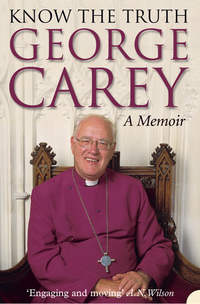
Читать книгу: «Know the Truth»
KNOW THE TRUTH
A MEMOIR
George Carey

COPYRIGHT
Harper Press
An imprint of HarperCollinsPublishers Ltd. 1 London Bridge Street London SE1 9GF
www.harpercollins.co.uk
This edition published by Harper Perennial 2005
First published by HarperCollinsPublishers 2004
Copyright © George Carey 2004, 2005
George Carey asserts the moral right to
be identified as the author of this work
A catalogue record for this book
is available from the British Library
All rights reserved under International and Pan-American Copyright Conventions. By payment of the required fees, you have been granted the nonexclusive, nontransferable right to access and read the text of this ebook on-screen. No part of this text may be reproduced, transmitted, downloaded, decompiled, reverse engineered, or stored in or introduced into any information storage and retrieval system, in any form or by any means, whether electronic or mechanical, now known or hereinafter invented, without the express written permission of HarperCollins ebooks
HarperCollinsPublishers has made every reasonable effort to ensure that any picture content and written content in this ebook has been included or removed in accordance with the contractual and technological constraints in operation at the time of publication
Source ISBN: 9780007120291
Ebook Edition © OCTOBER 2012 ISBN 9780007439799
Version: 2016-09-30
CONTENTS
Cover
Title Page
Copyright
Foreword
PART I
1 No Backing Out
2 East End Boy
3 Signals
4 Shaken Up
5 A Changing Church
6 Challenges of Growth
7 Letters from Number 10
8 Archbishop-in-Waiting
PART II
9 Women Shake the Church
10 Forced to Change
11 Bishop in Mission
12 Power and Politicians
13 Clash of Cultures
14 Empty Stomachs Have no Ears
15 The Rosewood Tree
16 The Challenge of Homosexuality
17 Lambeth ’98
18 Opening the Door
19 Rubbing Our Eyes
20 From Crusades to Co-Operation
21 The Glory of the Crown
22 A World in Crisis
23 Quo Vadis?
Index
About the Author
About the Publisher
FOREWORD
When, halfway through my archiepiscopate, I decided to write my memoirs I was surprised to discover that I am the only one of 103 Archbishops to have done so. Admittedly Archbishop Thomas Secker in the eighteenth century set out on the task but his sudden death left his memoirs unfinished. This book is a reflection on a ministry of which Archbishop Cosmo Lang said long ago: ‘The post [of Archbishop of Canterbury] is impossible for any one man to do, but only one man can do it.’ Any holder of this historic office knows from first-hand experience that its demands, expectations and opportunities take one to the edge of human endurance, and require of its holders a recognition of our frailty and our need of God’s everlasting grace.
This edition of Know the Truth gives me an opportunity to comment on some of the reactions of those who have read the first edition.
I might have anticipated that certain sections of the press, and, indeed, a few Church leaders, would focus attention on what I wrote about the Royal Family. I was accused of breaking confidentiality, and one writer even saw this as ‘the ultimate betrayal of trust’. There is no truth in this claim. As will become clear to the reader, no conversation I had with any member of the Royal Family is divulged in the book. I have always kept strictly to the principle of pastoral confidentiality, with the Royal Family and indeed with anyone else. However, what particularly caught the media’s attention was the revelation that I had several private conversations with Mrs Parker Bowles. Again, no report of our conversation is given: all that is offered is my opinion of her as an extremely able and nice person.
Controversially, the book did offer my view that the Prince of Wales should marry Mrs Parker Bowles in due course, and I was delighted when the marriage took place on 9 April 2005 in St George’s Chapel, Windsor. If the uproar caused by my views encouraged their decision to marry I am pleased to have played a small role.
April 2005 also saw the death of Pope John Paul II and the inauguration of Pope Benedict XVI. Pope John Paul II will be remembered as an outstanding Pope and I feel privileged to have known him, and to have worked and prayed with him. If he has left behind him a great deal of unfinished business, it is up to his successor to take forward the hope that his predecessor has given. Scepticism has already greeted the appointment of the new Pope, whose record as President of the Sacred Congregation for the Defence of the Faith does not lead one to expect a great change in policy. However, Joseph Ratzinger has a brilliant mind and a deep love for his Lord. He knows the secular challenges all too well. I pray that he will take risks for the sake of the gospel. His own Church is dying in many parts of the West for lack of vocations to the priesthood. Now is the time to tackle the issue of priestly celibacy and make it optional in the Church, the time to look more sympathetically on the ordination of women and to encourage a healthy debate both within and outside the Roman Catholic Church. Now is also the time to support the action of Catholic agencies in caring for those affected by HIV/AIDS by allowing the use of condoms as part of the strategy to defeat the pandemic. I also suggest that now is the time to make Pope John Paul II’s encyclical Ut Unum Sint a gift to the unity of the Church. Only the Roman Catholic Church, with its pre-eminence in numbers, can do this. Many Christians have become impatient with the slowness of ecumenism and question the amount of time and money going into structural unity at the expense of mission and service.
In the first edition of this book I warned that the consecration of a practising homosexual in the American Church would lead to deep divisions in the Anglican Communion. This has proved the case and the future of the Communion may be bleak if the Episcopal Churches of the United States and Canada continue to assume that they can take unilateral actions on this matter without regard to the rest of the Communion. Events have confirmed my worst fears about the weakness of the Anglican theology of the Church.
Since original publication events have also shown the importance and urgency of the chapter on inter-faith co-operation. I remain convinced that Christians must continue their dialogue with Muslims and Jews in particular, but without forgetting links with other world faiths. Dialogue without friendship, kindness and honest criticism will always remain aloof and bland; with bonds of affection it can contribute substantially to our divided and polarised world.
Few spiritual journeys are ever walked alone. So many people have travelled with me, and I shall remain everlastingly grateful for their patience, kindness, friendship and support. Pride of place goes gladly to my wife Eileen, whose rock-like presence in my life and work is evident throughout this journey. What a great friend she has been over these tumultuous years and what times have we shared together. Then there are our parents who, though out of sight through death, are never out of our minds and grateful hearts. We think of our brothers and sisters whose lives are inextricably linked with our story, and of our beloved children and their husbands and wives, who have shared our joy and pain over some difficult years. Thank you, Rachel and Andy, for your love and care for us at the Old Palace; and Mark and Penny, Andrew and Helen and Lizzie and Marcus – not forgetting thirteen wonderful grandchildren. Thank you, each one of you, for constantly reminding us that life is a gift to be enjoyed.
In the making of this book there are a number of people who should be thanked and appreciated. I am so grateful to Julia Lloyd, who spent a year at Lambeth going through the records and recording speeches, travel journals and staff records in such a way that my task was made much easier. My son Andrew has also been a tower of strength, going over the draft chapters with a careful eye, reminding me of incidents I had forgotten – and in some cases those I wanted to forget! I am grateful to him for his thoroughness, wisdom, insight and incisiveness. Thanks must go to Sir Philip Mawer, Richard Hop-good and Richard Lay for their help with the chapter on the Church Commissioners; to Dr Mary Tanner for her careful insights on the ecumenical chapter; to Canon Andrew Deuchar, Canon Roger Symon and Dr Alistair Macdonald-Radcliffe for their suggestions with respect to the chapters dealing with the Anglican Communion; to Canon Andrew White and Canon David Marshall for positive comments on the inter-faith chapter; and to the Very Reverend Michael Mayne and Sir Ewan Harper for helpful criticisms of the chapter on the Royal Family. I alone am responsible for the use I have made of all the assistance offered; any shortcomings are entirely my fault.
I also wish to record my debt of gratitude to those whose contribution is deeper than I can possibly state. To Dr Ruth Etchells, whose friendship goes back many years, and whose wisdom has always been there and often sought. To Dr James and the Reverend Elisabeth Ewing, two dear American Christians, whose grace has touched the lives of our family so many times over the last decade. To Sir Siggy and Lady Hazel Sternberg and Lord Greville Janner, wonderful Jewish friends whose kindness has reminded me constantly of what we owe to Judaism. In recent years a rich friendship has been established with Professor Akbar Ahmed, a dear Muslim friend, whose scholarship and commitment to dialogue I admire. To Professor Richard McBrien, Professor of Theology at Notre Dame University; Beverley Bra-zauskas; and Professor Gerry O’Collins of the Gregorian University, Rome, for their rich Catholic contribution to our lives.
Finally, I am grateful, too, for the help and professionalism of my editors and the staff at HarperCollins. The final word of thanks must go to God himself. My journey has been one of finding the truth about the Creator through his final revelation in Jesus, the Christ. If my story helps others to find him my unworthy offering will be worth all that Eileen and I have shared together.
GEORGE CAREY
May 2005
I
1 No Backing Out
‘It is perhaps significant that though state education has existed in England since 1870, no Archbishop has so far passed through it. The first Prime Minister to do so was Lloyd George. Nor has anyone sat on St Augustine’s Chair, since the Reformation, who was not a student at Oxford or Cambridge. Understandably nominations to Lambeth have been conditioned by the contemporary social climate, but such a limitation of the field intake is doubtless on the way out. It is inconceivable that either talent or suitability can be so narrowly confined.’
Edward Carpenter, Cantuar: The Archbishops in Their Office (1988)
AS THE DOOR OF THE OLD PALACE BANGED behind Eileen and the family as they departed for the cathedral, I was left alone in the main lounge to await the summons that would most certainly change the direction of my life. At lunchtime with my family around the kitchen table there had been nervous laughter as Andrew, who had had his hair cut that morning, recounted hearing another customer talk about the ‘enthornment’ of the new Archbishop. We all agreed that that was a great description of it, although another of the family volunteered, ‘At least he didn’t say “entombment”.’
Somewhere in the building Graham James, my Chaplain, was sorting out the robes I would shortly wear. From the lounge window I could see and hear the crowds of people teeming around the west front of the cathedral. They were there to capture a glimpse of the Princess of Wales and other dignitaries including the Prime Minister, John Major. I could not help thinking wryly that within twenty yards of where I was standing another Archbishop of Canterbury, Thomas Becket, had met his death in the same cathedral on 30 December 1170. My journey from this room was not going to lead me to his fate, but it was bound to bring me too in touch with opposition and conflict, as well as with much joy and fulfilment. The massive, enduring walls of the cathedral overshadowing the Old Palace however were a reassuring sign that the faith and folly, the strengths and weaknesses, the boldnesses and blunders of individual Archbishops are enveloped by the tender love of God and His infinite grace.
The television was on in the room, and I could hear Jonathan Dimbleby and Professor Owen Chadwick solemnly discussing the significance of the enthronement of the 103rd Archbishop of Canterbury. Professor Chadwick, a well-known Church historian, was reminding the viewers of the significance in affairs of state of the role of the Archbishop, an office older than the monarchy and integral with the identity of the nation.
Graham swept in with the first set of clothing I had to wear. ‘We’d better get you dressed, Archbishop,’ he said. ‘There’s no backing out now!’
I put on my cassock as I heard Owen Chadwick say that today, 19 April, was the Feast Day of St Alphege, a former Archbishop of Canterbury who, in 1012 ad in Greenwich, was battered to death by Vikings with ox bones because he refused to allow the Church to pay a ransom for his release. It seemed a hazardous mantle I was about to don.
Suddenly a great deal of noise erupted outside, and we walked over to the window to see the Prime Minister arrive with several other Ministers of State. He waved to the crowds and was ushered into the cathedral.
The whole world, it seemed, was present at the service in one way or another. Not only all the important religious leaders in the country – Cardinal Hume and Archbishop Gregorius, Moderators of the Church of Scotland, the Methodist Church and the Free Churches – but also the Patriarchs of the four ancient Sees of Constantinople, Alexandria, Jerusalem and Antioch. Billy Graham was present as my personal guest and as someone whose contribution to world Christianity was unique and outstanding. Cardinal Cassidy represented Pope John Paul II and the Pontifical Council for Christian Unity. Every Archbishop in the Anglican Communion was present, as was every Bishop in the Churches of England, Wales, Scotland and Ireland.
Behind me Dimbleby and Chadwick were now speculating about the new Archbishop. I caught several of the comments: ‘A surprising appointment … he has only been a Bishop less than three years … Yes, an evangelical, but open to others … was born in the East End of London … working class … No, certainly not Oxbridge, but has taught in three theological colleges and Principal of another … comes with experience of parish life as well as being Chairman of the Faith and Order Advisory Group … I think he will be an unpompous Archbishop.’
Mention of my background brought home to me how much I owed to my godly and good parents, who sadly were not here to share in today’s momentous events. How proud, and yet how humble, they would have felt. I smiled to myself as I recalled my mother’s loud comment when in 1985 I was made Canon in Bristol Cathedral: ‘Now I know what the Virgin Mary must have felt like!’ Eileen, rather shocked, wheeled on her: ‘Mum, that’s blasphemy!’ Mother, unrepentant, just smiled.
Yes, how thrilled Mum and Dad would have been; but as realistic Christians they would not be glorying in the pomp and majesty of the day, so much as in the service it represented. They would also be sharing in the tumult of my feelings, and my apprehension as I faced a new future.
Actually, I was not the slightest bit ashamed of my working-class background, which I shared with at least 60 per cent of the population. The popular press had of course milked the story thoroughly, and it was the usual tale of ‘poor boy makes good’ by overcoming huge obstacles to ‘get to the top’. How I hated that kind of language of ‘top’ and ‘success’. It encouraged the stereotype that I was a ‘man of the people’, and therefore in tune with the vast majority of the populace. There was no logic in that, as a moment’s thought should have reminded such journalists that David Sheppard’s background – to take one example of many – did not prevent him from being closely in touch with the underprivileged. Nevertheless, I hoped with all my heart that it was true, and it was very much at the centre of my ministry to represent the cares and interests of ordinary people, with whom I could identify in terms of background.
Some writers, astonishingly, had drawn the conclusion that because I came from an evangelical background my politics were essentially conservative. That was clearly not the case, but neither did it mean that I automatically identified with any particular political party. I saw my role as Archbishop as a defender of the principles of parliamentary democracy. I wanted to support those called to exercise authority, and I would later remind Prime Ministers of both major parties that I saw it as my duty to confront them if they embarked upon policies which I felt undermined the nation in any way.
But what kind of Archbishop was I going to be? As the 103rd Archbishop I was spoiled for choice if modelling myself on any of my predecessors was the way to proceed. Becket feuded so regularly with his King that he spent most of his time in exile. No, that was not for me. The quiet, scholarly Cranmer, perhaps, with whose theology I could identify; but, then again, he was too vacillating and cautious. Nearer my time perhaps one of the greatest of them all, William Temple – scholar, activist, social reformer and inspirer. Yes, a giant among Archbishops, but he was Archbishop of Canterbury for a mere two years during wartime. As a model for this post there were many great men to consider. It struck me that whatever inspiration I received from my illustrious predecessors, I had to be my own man. One thing I could depend upon was that the same divine grace and strength that the previous Archbishops had received was available to me too.
‘It’s time to go, Archbishop,’ said a smiling Graham, handing me my mitre, and then with a prayer we walked towards the door, leaving the television commentary still describing the scene within the cathedral as we advanced to be part of it.
2 East End Boy
‘Perhaps more typical of the period after 1940, when the war settled down into the long slog that it became for most non-combatants is the comment of an old lady from Coventry. Asked by her priest what she did when she heard the sirens, she replied: “Oh, I just read my bible a bit and then says ‘bugger ‘em’ and I goes to bed.” ’
W. Rankin
THE WORLD INTO WHICH I WAS BORN on 13 November 1935 was a very troubled and insecure one. The nations were just emerging from the effects of the devastating Wall Street crash that had led to thousands of bankruptcies and to the ruin of many millions of ordinary people around the world. Europe had been badly affected by the Depression, and the rise of fascism was beginning to trouble many. The United Kingdom was not immune from the turmoil and confusion of the period, with unemployment blighting the lives of millions. An absorbing and important sideline was the worrying problem of the monarchy, that would very shortly lead to the abdication of Edward VII and the accession to the throne of George VI.
To what extent my working-class parents shared in these questions and concerns I have no knowledge, although poverty was an abiding reality in our home. Number 68 Fern Street, Bow, London E3, was a typical working-class terrace house, with two bedrooms and a toilet upstairs, and two rooms and a scullery downstairs. I never heard my parents complain about their council home. They kept it clean and were proud of it.
It was a very happy and loving home into which I was born. I was the eldest of five children. Dennis, the twins Robert and Ruby, and Valerie followed at roughly two-year intervals. It was our privilege to have two wonderful parents.
To outward appearances, there was nothing remarkable about them. Their marriage certificate declared that our father, George Thomas Carey, was a labourer at the time of my birth. His schooling had stopped at fourteen years of age, and from birth until well into his teenage years he was the beneficiary of cast-off clothes and shoes. His background was impressive only for the extent of its poverty and deprivation. He was eight months old when his father died in St Bart’s Hospital as a result of an appendicitis operation at the age of twenty-five. His earliest memory was of his mother’s second marriage to an Irish Roman Catholic, a street trader, who was habitually drunk and who often beat his wife when under the influence of alcohol.
In addition to his older brother John, Dad’s mother gave birth to a further eight children. She only married her Catholic husband on the clear understanding that the two sons of her first marriage were brought up in the Church of England faith. She often took them to Bow Church, which to this day occupies a position of prominence on Mile End Road.
My father told me that two moments of his childhood stand out. His maternal grandparents were both born blind, and when his grandmother passed away his grandfather joined this already very large family. The cramped house necessitated grandson and blind grandfather sharing a single bed. A close relationship grew between them, and the old man devoted many hours to teaching the boy to read. My father was encouraged to recite huge passages of the Bible that later in life he could still recall and repeat. At the age of ten, Dad was due to go on a school trip to Regent’s Park Zoo. The day before the trip, Granddad gave his daughter some money, with the mysterious instruction that should anything happen to him, nothing should stop George going to the zoo. Dad was suddenly woken up during the night and transferred into another bed without knowing why. On his return home from the zoo the following day his mother told him gently that his dear grandfather had died in the night with his arms around him. A very special bond was broken – but Dad remained devoted to the memory of his blind grandfather throughout his life.
Dad’s second memory was of a night in his early teens when he was woken by loud screaming and the sound of breaking furniture. Fearfully he crept out of bed, and struggled downstairs. The screaming was his mother’s. Candles were the only form of lighting, so it was with some difficulty that he found his way to her bedroom. Suddenly, confronting him was his stepfather, breathing heavily and clearly the worse for drink.
‘What’s the matter, Georgie?’ came the harsh voice.
‘I heard Mum scream, and it frightened me,’ the boy said.
His stepfather replied, ‘Go to bed, George. Your mother is all right.’
The following day he found out that his older brother had also heard the screaming and had pulled their drunken stepfather off their mother, who had been savagely beaten. He in turn was practically strangled before Nell, one of the stepsisters, was able to rescue him. Mother, son and stepdaughter were thrust from the house and spent the remainder of the night at an uncle’s home. The battered face of his mother the following day told the sorry story of the power of drink in his stepfather’s life. Apparently he could be the most charming of men when sober, but rarely did my father talk of him. There was, however, no mistaking the depth of the love between my father and his mother. Although I have no recollection of her whatsoever, the fragrance of her presence was almost tangible in my father’s life. Few of us realise how lasting is the impact that such caring and close relationships have on our children.
My mother, Ruby Catherine Gurney, came from a more secure and more prosperous working-class home – although the same struggle for existence blighted her life too. Looking at the earliest photos I possess of my mother, she was clearly a good-looking and gentle woman, intelligent, full of life with a great sense of humour. She too was from a large family, and like my father did not have the chance of a decent education.
It was not until many years later that I discovered the extraordinary fact that my mother’s side of the family had close links with Canterbury. My mother’s great-great-grandparents, Thomas and Mary Gurney, were born in Canterbury and baptised in St Alphege’s Church, just fifty yards away from the Old Palace. Their son James was married to Louisa Dawson in the same church on 26 March 1849, and their place of residence was recorded as Archbishop’s Palace, Canterbury. The Gurney family later moved to the East End of London, where my mother was born and grew up. One firm recollection of my parents, sharply etched in my memory, is the fact that they remained in love and cherished one another throughout their lives. I have no memory of them ever having an argument, and with their children they would rely on kindness and good humour to resolve any tense situation.
At some point shortly before the war my parents moved to Dagenham in Essex, which was just as well, as 68 Fern Street was badly damaged during the Blitz. We moved to a larger council house with three bedrooms. The houses around swarmed with young families, and the small number of cars on the roads meant that children could play safely on most of the sidestreets. Impromptu football matches started after school on most days. At the age of five I was enrolled at Monteagle Primary and Junior School, just a few minutes’ walk from home. Later in life I was surprised to discover that my academic year at Monteagle School was not only to yield a future Archbishop of Canterbury, but also a senior officer in the Royal Air Force and the captain of a Cunard liner.
My recollections of those early years are exceedingly vague, and consist of a kaleidoscope of war memories: the excitement of being bundled into underground shelters, the shattering of the calm order of life through three evacuations to Wiltshire, the drone of planes overhead, the sound of the dreaded ‘doodlebugs’ and the destruction they wrought. A tremendous camaraderie developed among the families in our road, and people went to great lengths to support one another, even to the degree of sharing rations if the children did not have enough to eat. Dad became very accomplished at making toffee, and Mum’s cooking became highly inventive, as she had to make do with whatever ingredients she had to hand to produce food for us all. Dad was not called up, but was involved in essential services’, working at Ford’s motor company churning out tanks and armoured vehicles for the army. Often after work he had to take his turn of duty as one of the Home Guard. As youngsters we were tickled pink to see our father donning his uniform, cleaning his Lee-Enfield rifle and parading with other members of his brigade to different parts of the city. In later years I could never watch BBC TV’s Dad’s Army without thinking of my father.
At times in the early days war did seem exciting and rather intoxicating. A sense of urgency gripped the nation, and that feeling of living on the edge of survival penetrated even the world of children of my age. It was impossible to escape the business of war. We knew we were living in desperate days. During the day barrage balloons filled the sky, and the unmistakable traces of fighter-plane tracks high in the heavens were witnesses to the dogfights going on far above us. I became all too familiar with the sound of the ‘doodlebug’, the German V1 rocket, which did so much damage to the East End. I learned that if you could hear it you were safe. It was when the engine cut out that you knew its journey was over, and you had better run for cover. Sadly, my best friend at school, Henry, was badly injured in a doodlebug attack. War invaded our daily lives – everyone, it seemed, had at least one relative in the forces, and at school assemblies prayer was earnest. All children learned how to put gasmasks on, and took in their stride regular visits to the air-raid shelters in the back garden – even though the dirty conditions and the presence of spiders made such times less than appealing.
War also intruded on our diet, in the form of rationing, which affected every person in Britain. Everyone had a ration book, and food was rigidly controlled, with priority given to expectant mothers and children. With five children, my parents had a hard time ensuring that we all received adequate nourishment. But while everyone was hungry in wartime Britain, no one starved. The irony is that, despite people having to go without, on the whole rationing meant that the nation was better fed than it had been in the 1930s. People preferred equality to a free-for-all in which the well-off might stockpile food and the poor starve. Poorer families such as ours were entitled to free school meals. Some of my most exciting memories are of my father saving enough sugar to make fudge for all the family.
3 Signals
‘Why couldn’t Quirrell touch me?’
‘Your mother died to save you. If there is one thing Voldemort cannot understand it is love … love as powerful as your mother’s leaves its own mark. Not a visible sign … but to have been loved so deeply, even though the person who loved us is gone, will give us some protection forever.’
J.K. Rowling, Harry Potter and the Philosopher’s Stone
WITH A YOUTHFUL IMAGINATION fired by Mr Kennedy’s stories of the Royal Navy, and fed by my experience in the Sea Cadets, my preference was to do my National Service in the navy. Unfortunately, the Royal Navy did not accept conscripts at that time, so it had to be the Royal Air Force. As it turned out I was not to be disappointed in the slightest. For a young man eager to explore life and widen his horizons, the Air Force suited me down to the ground.
First came a week of ‘kitting out’ at RAF Cardington, where hundreds of dazed and subdued eighteen-year-olds gathered to be allocated to billets, receive severe haircuts and don the blue uniform of the youngest service. Pit-Pat’s final advice to me the previous day seemed particularly daunting: ‘George, you must disclose that you are a Christian right from the start. Don’t be ashamed of your faith. When lights go out, kneel by your bed and say your prayers.’ This had seemed easy enough to agree to when in church, but I confess that as I surveyed the crowded billet on my first evening, with the good-natured banter of high-spirited young men all around me, my resolve wavered. Nevertheless, taking a deep breath, I knelt and spent several minutes in prayer.
The reaction was interesting. First there was a quietening-down of voices as everyone realised I was praying and, unusually courteously, gave me space for prayer. The second reaction – clearly predicted by Pit-Pat – was that it marked me out as someone who took his faith seriously. The following day at least six young men in the billet took me aside and declared that they were practising Christians. By the end of the second day we were told of a SASRA (Soldiers and Sailors Scripture Readers’ Association) Bible-study meeting that evening. SASRA was particularly favoured by nonconformist and evangelical Christians, and throughout my National Service I found it a wonderful source of fellowship and support.
I never found that my practice of public praying, which I kept going for a great deal of my time in the Air Force, limited or negatively affected my relationships with other servicemen. To be sure, there were often jokes when I knelt down to pray. There were several times when things were thrown at me, and once my left boot was stolen while I was on my knees – just minutes before an inspection. Somehow I managed to keep to attention with one boot on and one off as the officer advanced through the billet.
Years later, in fact just a few weeks before I retired, I was touched to receive a letter from a Mr Michael Moran, who wrote to my secretary at Lambeth Palace:
Dear Sir,
Are you able to tell me whether George Carey spent the early years of his National Service at the basic training camp at RAF Cardington? When I was there at that time I was deeply impressed (and this has remained with me ever since) by the devotion and courage of an eighteen-year-old named George who knelt to pray at the side of his barrack-room bed. At no time in the following two years did I see anyone else show such evidence of his faith.
I was rather uncomfortable to receive such praise, because I did not kneel down to impress people by my courage, or to be the odd man out. In fact, I shrank from doing so. I did it simply because I felt Pit-Pat was absolutely right: if prayer is important, and if one is in a communal setting with no private place to pray, one ought not to be ashamed or embarrassed to be known as someone who loves God and worships Him. Later in life I would put the issue as a question to others: ‘Muslims aren’t ashamed to pray publicly, so why should Christians feel embarrassed? If it is a good way of praying when one is alone, why should we be ashamed of acknowledging a relationship with God when we are with others?’
The relative calm of the kitting-out week was followed by eight weeks’ hard square-bashing at West Kirby, near Liverpool. To this day, while I am left with many questions about the psychology behind the tyrannising and brutal attitude of the Platoon Leaders and Sergeants, there can be little dispute that it is a highly efficient way of moulding young men into effective members of a military unit. For eight weeks we were terrorised by screaming NCOs who told us in unambiguous terms that we were the lowest forms of life ever to appear on earth: ‘You are a turd of unspeakable putrefaction’, ‘a cretin with an IQ lower than a tadpole’, ‘You are the scum of the earth! What are you? Repeat it after me: the scum of the earth’, ‘You are hopeless, hopeless, hopeless.’
The verbal ingenuity of some descriptions was rehearsed in the billet long into the evening, as we sympathised with victims or rejoiced at the misfortune of a rival platoon. There were times when I too became the object of the Squad Corporal’s wrath. ‘Carey, you little bleeder!’ he screamed into my face, his saliva making my eyes water, ‘I am about to tear your ****ing left arm off and intend to beat your ****ing ’ead in with the bloody end, until your brains – if you have any – are scattered far and wide.’ Imagine my disappointment when I discovered later that this threat was far from original, and was in fact a tried and trusty favourite of that particular NCO.
I was able to gauge attitudes to the Church from the viewpoint of the ordinary conscript. The vast majority of my ‘mates’ had no contact with institutional religion. Although most of them, deep down, had faith, few of them had the ability to convert it into anything of relevance. They were not, on the whole, helped by the Chaplains, who held officer rank and talked down to the conscripted men. We all had to go to compulsory religious classes, and I can only say that from a Christian point of view these were something to be endured rather than enjoyed. The talks were usually moralistic, and the most embarrassing were about sex, a subject on which the Chaplains were definitely out of touch with the earthy culture of working-class people. I remember asking myself: ‘Why are they so shy about talking about the subject where they are expert? About the existence of God, about spirituality and prayer, about Jesus Christ and His way?’
Even more frustrating to me was the fact that I never saw a Chaplain visiting the men, either in the mess or in the billets. Far more effective was the ordinary ‘bloke’ from SASRA, who at least had the courage to meet the men where they were. Church parades were no different. The hymns were sung indifferently, and the sermons went over the heads of all. I was often embarrassed by the effete way services were conducted, and felt that overall they did more harm than good to the Church.
Although I was glad when the square-bashing was over, I have to admit that it taught me a lot about myself and how to cope when pushed to one’s limit. At the end of the eight weeks I was posted to RAF Compton Bassett in Wiltshire to train as a Wireless Operator. If I was not able to be a Wireless Officer in the Royal Navy, well, being a Wireless Operator in the Royal Air Force seemed an interesting challenge. And so it turned out to be. The training took twenty weeks, and included elementary electronics as well as having Morse code so drummed into us that by the end of it most of us were able to send and receive Morse at over twenty words a minute. As VHF was still in its infancy even in the RAF at that time Morse code was a reliable and efficient form of communication, though of course very slow.
At Compton Bassett we were able to participate in many activities, ranging from sport to hobbies of all kinds. Discipline continued to be very strict, but we were now finding that the ordered life enabled work and leisure to function smoothly. I played a lot of football, and enjoyed running as well. At weekends evening worship at Calne Parish Church was certainly far more authentic than the formal and compulsory church parades.
At the end of the training, everyone waited with impatience for their postings. I was astonished to be selected for the post of Wireless Operator on an air-sea rescue MTB (motor torpedo boat) operating out of Newquay in Devon. It seemed that at last my dreams would be fulfilled. If not the Royal Navy, at least I would be at sea with the RAF. But it was not to be. Two days before taking up my posting I was told to report to the CO’s office, where I was given completely different instructions – to go home on leave immediately, and to report to Stansted airport the following Sunday evening for an unknown destination.
I was among twenty or so extremely puzzled airmen on a York aircraft which left Stansted that September Sunday evening in 1955. To the question I put to the Sergeant on duty I received the friendly rejoinder, ‘You’ll know soon enough where you are when you land, laddie.’
Sure enough, I did. The following morning I found myself in Egypt, and the same day I started work as a Wireless Operator (WOP) at RAF Fayid – a huge RAF camp alongside part of the Suez Canal known as the ‘Bitter Lakes’. With a large group of other WOPs work began in earnest, handling signals from Britain and the many RAF bases in the Middle East. In my leisure time I enjoyed exploring beyond the base and discovered many things about Egypt, its culture and life. I settled down to church life on the base, and made many friends.
After three months at RAF Fayid I was sent to RAF Shaibah – a posting which was greeted by howls of sympathy by my colleagues. Shaibah was a tiny base about fifteen miles from Basra, at the top of the Persian Gulf. It is very hot most of the year, and the temperature rarely falls below 120 degrees in the shade in summer. With just 120 airmen to service the squadron of Sabre jets and cover the region I was told that it was a deadly appointment, and that I was to be pitied.
On the way to Shaibah a bizarre incident took place that was to make me chuckle often in later life. The journey began with a flight to Habbaniyah, a large RAF camp close to Baghdad, from where I was to make my way by train to Basra. I boarded the plane and was shown to my seat by the WOP, who told me, ‘Carey, your lunch is on your seat. Make yourself at home,’ before disappearing into the cockpit alongside the pilot. There were no other passengers, but I noticed that there was another lunchbag on the seat alongside mine. Surely this was for me too, I concluded. It was, I admit, naïve of me to suppose that the RAF would offer me two lunches and without hesitation I scoffed both of them. To my surprise the plane landed in the Transjordan, and as we taxied towards the concourse the terrible truth dawned on me – we were about to pick up another passenger, and I had eaten his lunch.
The passenger in question was an elderly clergyman, who was greeted with deference by the crew and shown to his seat alongside mine. We had a brief chat, and the plane took off. The moment came when he reached for his lunchbox, and I had to stammer out an apology for having eaten his lunch. He made light of it, and we relaxed into a pleasant conversation in which he showed great interest in my welfare and future. On landing at Habbaniyah I was impressed to see a red carpet laid out to welcome somebody – I knew it was not for me. The top brass were all there alongside the CO. The elderly clergyman paused to say goodbye to me, then turned to the steps to be greeted by the CO and whisked away.
‘Who was that?’ I asked the WOP.
‘Oh, that’s Archbishop McInnes, Archbishop of Jerusalem and the Middle East,’ came the reply.
Sadly, I never had an opportunity to apologise again to Archbishop George McInnes for having eaten his lunch that day; but at least I was later able to tell his son, Canon David McInnes, of the incident. David had followed his father into the Church, and completed a very distinguished ministry as Rector of St Aldate’s, Oxford. He was sure that his father would have been delighted and thoroughly amused that the culprit was a future Archbishop of Canterbury.
Despite the warnings of my colleagues at Fayid, Shaibah was to prove a wonderful posting for me. I was one of eight WOPs who had a special role as High Frequency Direction Finding Radio Operators (known as HF/DF Operators). So primitive and sensitive was this means of communication that it required the erection of special radio huts three miles from the camp, out in the desert. On each side of the hut stood four large aerials which received signals from transport planes, and which provided an accurate beam by which a plane could determine its position and find its way to us.
Operators were on duty in these isolated huts for eight hours at a time, and for many months we worked around the clock. The duty was often boring, very hot and lonely. There were however times when the importance of our work was driven home. On one occasion several Secret Service personnel called on me to help trace the position of a Russian radio network which was proving to be a nuisance to the RAF. Another time, a two-engine transport plane from Aden to Bahrain was in serious trouble, with one engine on fire and the other causing problems. To this day I recall the SOS ringing through my headphones, and the signal telling me that the plane needed help urgently as it was about to crash. All the training I had received was focused at that very moment on giving the crew directions on how to find their way to Shaibah, then alerting the main camp and the emergency services that a crippled plane was in need of help. As a member of the air-ground rescue team I would be required to switch instantly to new responsibilities if the plane crashed in the desert. Fortunately I was able to help nurse the plane to the base, where it made an emergency landing and all was well.
It was a lonely job most of the time, but I loved it. It gave me time to read and reflect. When things were quiet and no planes were within a two-hundred-mile radius it was safe to walk a short way from the hut and explore the desert. The idea that the desert was void of life, I discovered, is quite erroneous. There were always fragile, tiny yet beautiful flowers that one could find, and the place teemed with insects, snakes and scorpions. As for human contact, I often met passing Bedouin tribespeople: sometimes shy, giggling young girls hidden behind their flowing black robes, herding their black goats; sometimes their more confident brothers and fathers. They were always friendly, even though we could only communicate through signs and through my limited Arabic, which caused great merriment. In exchange for water, which I had in abundance, I would often receive figs, dates and other fruits. Their simple, uncomplicated lives seemed attractive and natural. It was always a joy to meet them, and for a few moments share a common humanity in a hostile terrain.
I do recall though one terrifying time when I wandered a little too far, and could not find my little signals hut in the expanse of desert. The realisation that I was totally lost, without water, and that my replacement would not arrive at the hut for six hours panicked me greatly. I tried to take my bearings from the puffs of smoke coming from the distant oilwells in Kuwait, but to no avail. I walked carefully north, hoping to find some clue that might orient me. Then, with relief, I heard the sound of singing, and into view came some of my Bedouin friends. They were shocked to see me so exhausted, and after a drink of water I was taken back to the hut. Perhaps only forty minutes had passed, but it made me aware of how fragile life is, and how the desert can never be taken lightly.
In our leisure time there was opportunity to explore the surrounding region, including the teeming city of Basra, a forty-minute car ride away. Every Sunday evening dozens of us would go to worship at St Peter’s Church, where there was a hospitable expatriate congregation. I confess that I can scarcely recall the services at all, and the only thing I remember is the vicar’s fascination for the card game Racing Demon, that was played every Sunday evening following choral evensong. But the worship was excellent, and almost without realising it I was nurtured and sustained by it.
Several of us went on a number of trips to the ancient Assyrian site of Ur of the Chaldees, home to Nebuchadnezzar. Time had reduced this great archaeological site to pathetic heaps of stone, but its grandeur and imposing scale was undiminished.
It was the living, vibrant Iraq that intrigued me, however, and I went out of my way to find out more about the life of its people. I made some enquiries at the Education Centre on the base, and enrolled in a class to learn Arabic. In this way I encountered Islam as a living faith. I was the only pupil in the class, and I took advantage of such personal tuition. My teacher was an intelligent middle-aged Iraqi named Iz’ik, who took great delight in teaching me the rudiments of a graceful language. In addition to the language, he introduced me to his faith. Through his eyes I gained a sympathy towards and an interest in Islam that has endured until the present time.
I was impressed by my teacher’s deep spirituality and devotion to God. It was not uncommon to see Muslim believers serving on the camp lay out their prayer mats wherever they were and turn to Mecca at the set times of the day. Many of my fellow airmen mocked them, but I could not. I sensed a brotherhood with them in their devotion and their openness about their spirituality. Although sharp differences exist between the two world religions, the way that Islam affects every aspect of life continues to impress me.
I was led also to appreciate the overlap between the Christian faith and Islam. I discovered its deep commitment to Jesus – a fact hardly known to most Christians – who is seen as a great prophet who will come as Messiah at the end of time. I began to appreciate the remarkable role of Mohammed in Islam, and the way in which he is a role model for male Muslims. Perhaps one of the most striking things that Iz’ik revealed to me was the fact that in Iraq Christians had been living alongside Muslims for centuries in complete harmony. In time I met a number of Assyrian Christians whose faith was deep and real.
Iz’ik and I often discussed the areas of faith and life where our religions diverged. Among these was the Trinity, and I hope that my youthful explanation led my teacher to understand that Christianity is monotheistic, and not polytheistic as many Muslims believe. I argued as strongly as I could for the relevance of Jesus Christ and the determining significance of Him for faith. As I saw it then – and still do – one can have a high regard for Jesus (as Muslims undoubtedly do), yet fail to see that unless He is central to the faith, that faith is inadequate without Him. Some thinkers have termed this the ‘scandal’ of Christianity, and the reason it can be seen as uncompromising and exclusive.
Perhaps above all I was led to appreciate the spirituality of Islam, and its devotion to prayer and the disciplined life. Although, as a young evangelical, I was perhaps over-eager to convince Iz’ik of the truth of Christianity, he would give as good as he got, and we both enjoyed our weekly discussions. Later in life those times would help me to treat Islam not as a faith hostile to Christianity, but as a religion with many virtues and many similarities to our own. Sadly, when I left Shaibah I left the study of Arabic behind me as well. In 1956 I did not consider it remotely possible that I would ever find the language useful in the days to come. How wrong I was.
The months passed quickly because there was so much to do. As the Wireless Operator of an air-ground rescue crew, I enjoyed several weekends on practices in the wonderful Iraqi marshes, which in recent years Saddam Hussein has so destructively drained. In the 1950s it was a fertile area for wildlife and fishing, and if the truth be known, the air-ground rescue practices were in fact an opportunity for the CO to indulge his love of shooting game. Besides being the wireless link with the base, my other job was to pluck and skin the beautiful pheasants he shot. Ironically, on one of these weekends an aircraft actually did crash in Kuwait, and an ad hoc rescue team had to be formed to do what we were supposedly training to do.
Because the desert ground was so hard, and the heat so debilitating, free time was passed in less strenuous activities, and the open-air swimming pool was our daily centre when off-duty. I was keen on other sports too, and accompanied a friend who was a dedicated runner in punishing laps of the perimeter of the airfield. The daily routine of work and sport allowed time for Christian fellowship as well. Of the 120 men on the base, there was a small but healthy number of practising Christians of all denominations and traditions. There was no Chaplain, so we had to create our own worship, which usually took the form of Bible study with hymns and prayers.
Towards the end of my time at Shaibah I found an old building left open for spring cleaning. Shaibah had been a huge base during the Second World War, and most of the former camp was now closed up. To my surprise I found myself in a well-kept Anglican chapel. I immediately conferred with some of my friends, and we agreed that it would be good to keep it open – that is, if the CO agreed. He did, but for a limited time only. So for several weeks we held services according to the Book of Common Prayer rite and I celebrated holy communion – quite illegally, of course. I don’t suppose for one moment that the Almighty was bothered that in the absence of a priest a group of young men took it in turns to use the words of the 1662 Prayer Book and to celebrate communion.
Once a week a flight from RAF Habbaniyah would bring us one of the latest films being shown in the UK, and we would gather in the open air to watch them. I well remember one which suggested to me the residual hostility some people felt towards the Church of England. The title I cannot remember, but one of the characters, a vicar, was a detestable man out to con an old woman of her wealth. When he was shown putting on his dog collar, jeers and whistles of disgust drowned out the soundtrack. The moment seemed to show that young people felt alienated from the life of the Church. That of course had not been so in my case, but I had to remember that not everyone had had good experiences of clergymen.
There was a darker side to service life which brought home to me the value of a faith, with its framework of moral values. Several times a week men would visit the brothels of Basra, and sometimes they returned with the unexpected fruits of pleasure – in the form of gonorrhoea, syphilis and other sexually transmitted diseases. This meant that we had to endure horrific educational films on the dangers of these diseases, which certainly disturbed many of us, but did not seem to dampen the ardour of others. I did not see it as my job to reprove them, although I would certainly put my view forward. Neither was I immune from the temptation that led them to succumb, but I suppose I felt that my faith expected me to honour women, and not to treat them as mere objects of sexual gratification.
As time drew close to my demob, the next stage on my journey increasingly occupied my mind and prayers. One evening when I was on a late shift, the silence of the desert called me to reflect deeply on the future. When the shift ended I signed the usual summary of work, then waited outside for the car that would bring out my replacement and take me back to the camp. I could not but marvel at the beauty and brilliance of the night sky from the darkness of the desert in which I stood. Thousands of stars illuminated the heavens, and seemed within an arm’s length of me. As I drank in the awesome scene, I was overcome by the finiteness and smallness of man when measured against the age of the universe. And yet, that did not intimidate me. Later Gerard Manley Hopkins’s great poem ‘The World is Charged with the Grandeur of God’ would become one of my favourites, and would capture for me the feeling of awe I felt then.
It has sometimes puzzled me that the size of the universe has led thinking people into agnosticism. Some have said to me, ‘How can you possibly believe in a personal deity when our planet is a third-rate planet in a tenth-rate galaxy in one of countless solar systems?’ I would usually reply that this was making too good a case for the earth, but that size has little to do with it. If the Almighty is so awesome that He has created as many galaxies as there are grains of sand in a million deserts, that same awesome God may still love us and be our heavenly Father. Pascal’s cry, ‘The silence of eternal space terrifies me,’ did not stop him trusting in the maker of all things.
It was those evenings in the southern Iraqi desert, under the velvety blanket lit by the brilliance of thousands of stars, that led me to take an interest in cosmology and the mystery of creation. I have not read anything since that has caused me to falter in my conviction that a personal faith in a loving God is not irrational or incredible. But it is not faith that drives people to serve God and others, so much as love. I was convinced of the love of God for all, and that was the element that energised my response perhaps more than any other.
But that moment beneath the stars also crystallised a question that had been on my mind for months: what was I going to make of my life on my return to England in a few weeks? Teaching was an admirable profession. Social work too attracted me. But the tug at my heart was definitely the ordained ministry, and in prayer I tried to put into words my deep desire to serve God and humankind with all my heart.
I had no qualifications to speak of, just an overwhelming longing to make something of my life with all the energy and ability I had been given. Yet even with the optimism and self-confidence one has at that age, I was conscious of the huge challenge ahead of me. But under that wonderful night sky the thought began to enter my head that ordination might not be beyond me. I might lack academic qualifications, but I did not lack ability or a great desire to do something useful with my life. I was still young enough to learn. I could only do my very best, and rely on God’s grace.
Бесплатный фрагмент закончился.