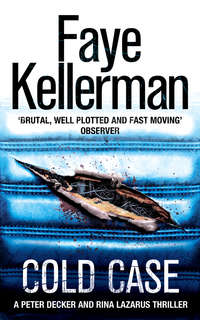
Читать книгу: «Cold Case»

COLD CASE
FAYE KELLERMAN

Table of Contents
Chapter 1
Chapter 2
Chapter 3
Chapter 4
Chapter 5
Chapter 6
Chapter 7
Chapter 8
Chapter 9
Chapter 10
Chapter 11
Chapter 12
Chapter 13
Chapter 14
Chapter 15
Chapter 16
Chapter 17
Chapter 18
Chapter 19
Chapter 20
Chapter 21
Chapter 22
Chapter 23
Chapter 24
Chapter 25
Chapter 26
Chapter 27
Chapter 28
Chapter 29
Chapter 30
Chapter 31
Chapter 32
Chapter 33
Chapter 34
Chapter 35
Chapter 36
Chapter 37
Chapter 38
Chapter 39
Chapter 40
Chapter 41
Chapter 42
Also by Faye Kellerman
Copyright
About the Publisher
For Jonathan—for now and forever
And welcome to Lila
CHAPTER 1
TWENTY-FIVE YEARS AGO, they were called nerds.
Today, they're called billionaires.
Even among outcasts, Genoa Greeves suffered more than most. Saddled with a weird name—her parents' love for Italy produced two other children, Pisa and Roma—and a gawky frame, Genoa spent her adolescence in retreat. She talked if spoken to, but that was the extent of her social interaction. Her teenage years were spent in a self-imposed exile. Even the oddest of girls would have nothing to do with her, and the boys acted as if she'd been stricken by the plague. She remained an island to herself: utterly alone.
Her parents had been concerned about her isolation. They had taken her through an endless parade of shrinks who offered multiple diagnoses: depression, anxiety disorder, Asperger's syndrome, autism, schizoid personality disorder, all of the above in comorbidity. Medication was prescribed: psychotherapy was five days a week. The shrinks said the right things, but they couldn't change the school situation. No amount of ego bolstering or self-esteem-enhancing exercises could possibly counteract the cruelty of being so profoundly different. When she was sixteen, she fell into a deep depression. Medication began to fail. It was Genoa's firm opinion that she would have been institutionalized had it not been for two entirely unrelated incidents.
As a woman, Genoa had definitely been born without feminine wiles, or any attributes that made girls desirable sexual beings. But if she wasn't born with the right female qualities, at least Genoa did have the extremely good fortune to be born at the right time.
That is, the computer age.
High tech and the personal computer proved to be Genoa's manna from heaven: chips and motherboards were her only friends. When she spoke to a computer—mainframes at first and then the omnipresent desktops that followed—she found at last that she and an inanimate object were communicating in a language that only the blessed few could readily understand. Technology beckoned, and she answered the summons like a siren's call. Her mind, the primary organ of her initial betrayal, became her most welcome asset.
As for her body, well, in Silicon Valley, who cared about that? The world that Genoa eventually inhabited was one of ingenuity and ideas, of bytes and megabytes and brilliance. Bodies were merely skeletons to support that great thinking machine above the neck.
But even growing up at the cutting edge of the computer age wasn't a guaranteed passport to success. Achievement was surely destined to elude Genoa had it not been for one individual—other than her parents—who believed in her.
Dr. Ben—Bennett Alston Little—was the coolest teacher in high school. His specialty was history with a strong emphasis on political science, but he had been so much more than just an educator, a guidance counselor and the boys' vice principal. Handsome, tall, and athletic, he had made the girls swoon and had garnered the boys' respect by being tough but fair. He knew everything about everything and had been universally loved by the Twenty-five hundred high school students he had served. All that was good and fine, but virtually meaningless to Genoa until that fateful day when she passed him in the hallway.
He had smiled at her and said, “Hi, Genoa, how's it going?”
She had been so stunned she hadn't answered, running away, her face burning as she thought, Why would Dr. Ben know my name?
The second time she passed him, she still didn't answer back when he asked “how's it going?” but at least she didn't exactly run away. It was more like a fast step that converted into a trot once he was safely down the hall.
The third time, she looked down and mumbled something.
By the sixth time, she managed to mumble a “hi” back, although she still couldn't make eye contact without her cheeks turning bright red.
Their first, last, and only actual face-to-face conversation happened when she was a junior. Genoa had been called into his office. She had been so nervous that she felt her bladder leaking into her cotton underwear. She wore thick baggy jeans and a sweatshirt, and her frizzy hair had been pulled back into a thick, unwieldy ponytail.
“Sit down, Genoa,” he told her. “How are you doing today?”
She couldn't answer. He looked serious, and she was too anxiety ridden to ask what she did wrong.
“I just wanted to tell you that we got your scores back from the PSAT.”
She managed a nod, and he said, “I'm sure by now that you know that you're a phenomenal student. I'm thrilled to report that you got the highest score in the school. You got the highest score, period. A perfect 1600.”
She was still too frightened to talk. Her heart was pumping out of her chest, and her face felt as if it had been burned by a thousand heat lamps. Sweat was pouring off her forehead, dripping down her nose. She quickly wiped away the drops and hoped he didn't notice. But of course, he probably did.
“Do you know how unusual that is?” Little went on.
Genoa knew it was unusual. She was painfully aware of how unusual she was.
“I just called you in today because I wanted to say congratulations in person. I expect big things from you, young lady.”
Genoa had a vague recollection of muttering a thank-you.
Dr. Ben had smiled at her. It had been a big smile with big white teeth. He raked back his sandy blond hair and tried to make eye contact with her, his eyes so perfectly blue that she couldn't look at them without being breathless. He said, “People are all different, Genoa. Some are short, some are tall, some are musical, some are artistic, and the rarefied few like you are endowed with incredible brainpower. That head of yours is going to carry you through life, young lady. It's like the old tortoise and the hare story. You're going to get there, Genoa. You're going to get there, and I firmly believe you're going to surpass all your classmates because you have the one organ that can't be fixed by plastic surgery.”
No comment. His words fell into dead air.
Little said, “You're going to get there, Genoa. You just have to wait for the world to catch up to you.”
Dr. Ben stood up.
“Congratulations again. We at North Valley High are all very proud of you. You can tell your parents, but please keep it quiet until the official scores are mailed.”
Genoa stood and nodded.
Little smiled again. “You can go now.”
TEN YEARS LATER, from her cushy office on the fourteenth floor looking over Silicon Valley, about to take her morning hot cocoa, Genoa Greeves opened the San Jose Mercury News and read about Dr. Ben's horrific, execution-style homicide. If she would have been capable of crying, she would have done so. His words, the only encouraging words she had received in high school, rang through her brain.
She followed the story closely.
The articles that followed emphasized that Bennett Alston Little didn't appear to have an enemy in the world. Progress on the case, slow even in the beginning, seemed to grind to a halt six months later. There were a few “persons of interest”—it should have been “people of interest,” Genoa thought—but nothing significant ever advanced the case toward conclusion. The homicide went from being a front-page story to obscurity, the single exception a note on the anniversary of the homicide. After that, the files became an ice-cold case sitting somewhere within the monolith of what was called LAPD storage.
Fifteen years came and went. And then, quite by happenstance, Genoa picked up a copy of the Los Angeles Times and read about a homicide with overtones of Dr. Ben's murder. When she saw the article, she was sitting in the president's chair, located in the CEO's office of Timespace, which was housed on the fifteen through the twentieth stories of the Greeves Building in Cupertino. But unlike Dr. Ben's murder, suspects had been arrested for this carjacking.
She wondered …
Then she picked up the phone and called up LAPD. It took a while to get through to the right person, but when she did, she knew she was talking to someone with authority. Though Genoa didn't demand that the Little case be reopened, her intent was crystal. It was true that she had money to hire a battalion of private detectives to investigate the murder herself, but she didn't want to step on anyone's toes—and why should she shell out money when she paid an exorbitant amount of California state taxes? Surely the cash that she would have had to expend in private investigations could be put to better use in LAPD, aiding the homicide detectives in their investigation.
Lots of money, in fact, should the department decide to reopen the Ben Little homicide and actually solve it.
The inspector listened to her plaints, sounding appropriately eager and maybe just a tad sycophantic.
Genoa wanted to reopen the case to do right by Bennett Alston Little.
Genoa wanted to reopen the case because the more recent homicide brought to mind the Little case and she thought about a connection.
Genoa wanted to reopen the case to bring a murderer to justice.
Genoa wanted to reopen the case to bring peace and solace to all of the victims' friends and families.
Genoa wanted to reopen the case because at this stage in her life, and sitting on 1.3 billion dollars, she could do what ever the hell she pleased.
CHAPTER 2
THE CONVERSATION WENT like this: ‘The case is fifteen years old,’ I say. Then Mackinerny responds, ‘Strapp, I don't give a solitary fuck if it's from the Jurassic era; there's a seven-figure endowment riding on this solve, and you're going to make it happen.’ I respond, ‘Not a problem, sir.’”
“Good comeback.”
“I thought so.”
Lieutenant Peter Decker regarded Strapp, who within the last ten minutes seemed to have gained a few more wrinkles from frowning. He was turning sixty this year, but still had the bull frame of a weight lifter. The man had a steel-trap mind and a matching metallic personality. “I'll do what I can, Captain.”
“That's the idea, Lieutenant. You'll do what you can. I want you to handle this personally, Decker, not pass it off to someone in Homicide.”
“My homicide squad is more up to date on the latest techniques and forensics. They'd probably do a better job since most of my time is spent doing psychotherapy and scheduling vacations.”
“Horse shit!” Strapp rubbed his eyes. “Last summer you spent way more time in the field than in your office, judging from the amount of overtime you racked up flying Southwest to San Jose and to Santa Fe. Surely you got a couple of free trips out of that.”
“We cleared two homicides.”
“One of which was Twenty-five years old, so this one should be a snap. We've got a hell of lot riding on this solve.”
A potential seven-figure gift could lift LAPD into state of the art. Equipping the department with the newest in forensic machinery could potentially put more felons behind bars. Still, Decker has found that in the end, it was always the human factor: men and women sweating hours on end to extract confessions, noticing a detail that was overlooked, doing just one more interview.
Not that technology didn't have its place. And with a big endowment …
Money talks, etc.
“What prompted the call?” Decker asked Strapp.
“She read about the Primo Ekerling carjacking in Hollywood and it reminded her of the unfinished business with the Little case.”
“Doesn't Hollywood have a few cholos in custody for that one?”
“It does, but that's not the point. The parallels were similar enough to strike a chord in her very wealthy mind.”
“What's her connection to Little other than the fact that he was her guidance counselor?”
“I think it's as simple as that. She told Mackinerny that Little was the only one who had been kind to her during her awkward years, and now she has enough money to get people to jump,” Strapp said. “We were both in Foothill when the Little murder happened. From what I remember, he was a good guy.”
Decker hadn't followed the details closely. He did recall that the case had occupied space in the local newspapers. “How soon do you want me on this?”
“How does yesterday sound, Lieutenant? Top priority. Got it?”
“Got it, and over and out.”
***
THOUGH HE COULDN'T delegate the thinking, Decker could certainly dole out the grunt work. He assigned one of the newest detectives the necessary but excruciatingly frustrating task of driving from the West Valley to downtown to pick up the Little file. In morning rush-hour traffic that was a heavy one- to two-hour commute, depending on the amount of Sigalerts on L.A.'s arteries. In the meantime, Decker went over his current assignments, clearing most of his paperwork to devote his attention to the Little case.
The department had detectives who worked cold cases routinely, and why they didn't pick this one up was anyone's guess. Decker suspected that if West Valley got the solve, a substantial slab of the coveted cash would be directed to Strapp. Also, it was logical that the local detectives might have better luck concluding a case that happened in their own backyard.
By the time Decker could actually turn his attention to the six boxes that had been checked out from storage, it was after six in the evening. Too many miscreants had occupied the day, and if he was to get anywhere, he needed solitude to read and think. He decided to work from his home office, and though it wasn't proper procedure to carry out official material, it happened all the time.
The drive to his house took less than fifteen minutes, down Devonshire Boulevard to his ranch-style wood-sided house. Decker's property was over a third of an acre, not nearly as big as the ranch he had owned when the Little case broke through to the media, but the space was large enough for him to spread out his workbench on a lovely spring day and play with his tools. The grounds had become a feast for the eyes since Rina had taken up gardening about two years ago. She had turned what had been a boring sheet of green lawn into lush gardens with riotous colors. Last spring, it had made the L.A. Garden list of places to visit. One entire Sunday had been taken up by troupes of gardening aficionados traipsing through his property oohing and aahing and congratulating Rina on a job well done.
Upon arriving home, Decker could smell garlic coming from the kitchen. His wife's cooking skills even surpassed her eminent prowess as a landscaper. Balancing three of the boxes while fiddling with the front door key, he managed to make an entrance, place the boxes on his dining room table, and not fall on his ass. It was a good sign.
Rina emerged from the kitchen, her hair maddeningly black without a hint of gray even though the woman was in her forties. Her lack of aging never ceased to painfully remind Decker that he was in his fifties and had a head streaked with silver. The follicles that retained the most of Decker's original carrot red coloring were embedded in his mustache. The facial hair was maybe a bit out of style, but Rina claimed it made him look very masculine and handsome, and she was the only one he was still trying to impress.
Rina wiped her hands on a dish towel. She pointed to the boxes. “What's all that about?”
“I got saddled with another cold case, only this one needs a quick solve.”
“See what happens when you're too successful?”
Decker smiled. “Aren't you my good friend. What smells so good?”
“Chicken cacciatore over pasta. I've loaded it with garlic trying to stave off the current flu bug. My plan is to make it uncomfortable for anyone to get too close to us. But we'll be okay with each other because we'll both eat the same entrée.”
“What about our progeny? Will she be able to come close?”
“Hannah is irrelevant since I basically haven't seen her in three days—the consequence of a driver's license. She's at Lilly's studying for a chemistry test.”
Decker brightened. “So we're all alone?”
“Yes. How about if you clear off the table and I'll open the wine. I've picked out a Sangiovese that I found on KosherWine.com.”
“Sounds wonderful but just a single glass for me, darlin'. I've got to work.”
“Hence the boxes.”
“There are still three more in the car.”
“Yikes. Can I help?”
“No, just leave these on the table for a moment, and I'll drag everything into the office. Then we can have dinner before I plow my way into ancient history. How's your day been?”
Rina's eyes twinkled flashes of blue. “The same as always. I try to teach resentful kids something that they have no interest in learning.”
“Charming. For what they pay you, you can walk away.”
“I could …” Again she smiled. “But then life wouldn't hold any challenges. As much as I love gardening, a plant is no substitute for a surly teenager. And honestly, I really do like the kids.”
“The cold case I'm working on was a teacher.”
Rina turned serious. “Who?”
“It happened fifteen years ago. A history teacher at North Valley.”
“Bennett Little. Found in the trunk of his Mercedes, shot execution style.”
“What a memory.”
“It was a big case. You were still at Foothill and we were living at your old ranch.” She smiled. “I miss the ranch sometimes, even though it was a two-and-a-half-mile walk to shul.”
“I miss the ranch, too, although I do not miss cleaning horse stables. My hands are dirty enough as is. I'm really impressed with your memory, although it makes sense. At your age, I had a pretty good memory as well.”
“I know, Peter, you're ready for the glue factory.”
“What else do you recall about the Little case?”
“In the end, the ruling was that it was probably a carjacking.” She frowned. “Am I wrong or isn't there a current Hollywood case similar to Little that actually is a carjacking?”
“Indeed there is. Two sixteen-year-old punks have been arrested.”
“Are the two related?”
“Fifteen years apart?” Decker shrugged. “Doubt it, but without knowing the specifics of either case, I can't say.”
“Did they open the Little case because of the Hollywood case?”
“Indirectly, yes.” Decker blew out air. “I'll explain it over dinner. Let me get those other boxes inside. Then I'll clear the table and we can eat. I'm starving.”
“Are you sure I can't do anything else for you, Peter?”
“You can bring out the candles. As far as I know, a little atmosphere and romance never hindered anyone's investigation. And I suppose you can make a strong pot of coffee. I'm going to need it to night.”
CHAPTER 3
THE DRY FACTS of the homicide played out like this. After a full day of work, Little left his office and headed to the school parking lot. Before he reached his three-year-old silver 350SL Mercedes-Benz, he was cornered by a group of six students. The pupils described the interchange as jocular. They chatted with Dr. Ben until Little checked his watch and excused himself, saying he was late for a meeting. According to the kids, Little left the parking lot around four-thirty.
The meeting consisted of a local group of residents and Connie Kritz, a member of the L.A. Board of Supervisors. They were talking about community shelters for the homeless—a hot-button issue in the nineties.
Not that the homeless weren't just as needy today. But having gone through years of dealing with civic issues, Decker knew that there was only so much room for star status. The unwashed schizophrenics seemed to have been supplanted by global warming.
According to records, Dr. Ben had called his home number from his car phone at 4:52 P.M. Melinda Little, Ben's wife of fifteen years, said that the conversation was brief because the car phone's reception was full of static. Ben stated that he expected to be home around seven.
When the clock struck eight, Melinda started to grow concerned. She called his car phone but no one answered. She paged him on his beeper but he didn't call back. Still, she wasn't really worried, figuring that Little had turned off his beeper and was deep in debate. Passions ran high when dealing with the homeless. When her cuckoo clock struck nine and there was still no word from Ben, Melinda told her sons that she was going out for a few minutes.
Melinda drove to Civic Auditorium only to find it empty. With shaking hands, she drove back home, locked herself in the bedroom, and started going through a roster of community numbers until she managed to secure the home phone listing for Connie Kritz. The supervisor was surprised that Melinda hadn't heard from Ben. Connie told her that the homeless meeting had finished up around seven-thirty. She thought that Ben had left with the rest of the group.
It was now close to ten.
Melinda called the police, only to be told that an adult isn't considered officially missing until he or she has been gone for at least forty-eight hours. She told them how unusual it was for Ben to be late, but the sergeant wasn't interested. He suggested some other possibilities.
Maybe he was with a friend.
Maybe he was with a girlfriend.
Maybe he stopped off to get some dinner.
Maybe he stopped off at a bar.
Maybe he took a drive.
Maybe he was having a midlife crisis and needed some time to think.
What ever the situation was, the sergeant suggested that she go to bed and the situation would probably resolve itself by morning.
Melinda would have none of that. She knew that if Ben had gotten waylaid, he would have called on the car phone. That's what the damn thing was for. Emergencies.
At eleven-thirty that evening, the boys knocked on the bedroom door and asked why their mother had been locked in her bedroom for the past hour and a half. Not wanting to alarm them, Melinda said she was helping a friend in crisis.
“Where's Dad?” asked the youngest.
“Out helping someone else.”
The sons had no problem believing the story. Ben was always helping someone.
Melinda told her sons to go to bed and began making more phone calls. An hour later, when Melinda still hadn't heard from Ben, her closest friends came over to stay with her until this ordeal resolved. Their corresponding husbands had been sent out to look for Ben and/or his car.
The dreaded call came in at three-thirty in the morning. Ben Little's Mercedes had been spotted—the sole vehicle in a paved lot at Clearwater Park. The police had been called. Two squad cars eventually arrived at the location.
The interior of the Mercedes was empty and there was no sign of Ben anywhere. As the group decided on their next move, a particularly alert officer noticed that the back of the Benz was sagging, and something was dripping from the rear of the car. Gloving up, one of the uniforms fiddled with the lock until the trunk popped open.
Bennett Alston Little was fully clothed. His hands and feet had been tightly bound by generic shoelaces, and a blindfold had been placed over his eyes. He had been shot three times in the back of the head.
Again Melinda found herself talking to the police.
This time they had taken her very seriously.
THE FIRST THING Decker did was sort through photographs. In cases where he wasn't the original primary detective, he liked to have clear mental images. The premortem snapshots showed that Ben Little had been a very handsome man: sharp light eyes, a wide, bright smile, a strong chin, and an athletic build. The file contained two head shots and one with Ben and his family.
In contrast, the postmortem shots showed the hapless teacher in the fetal position with his knees bent and touching his forehead—an odd position to take after death. Ben's head was resting in a big pool of blood. Decker continued to read the crime scene report until he found what he was looking for. Several bullet shells had been found inside the trunk, which probably meant that the trunk was the original crime scene. Ben had been living when he had been placed inside and had instinctively curled up in a defensive position. Then he had been executed.
There was something otherworldly about reading original case notes. It transformed a corpse into a living, breathing human being. The two original homicide investigators—Arnold Lamar and Calvin Vitton—seemed to have worked hard, and the file was complete. The resurrection of Ben Little would demand that Decker have a long chat with Lamar and Vitton, but he wanted to form his own opinions first.
Slowly, Little emerged as a complete and complex person. He had his idiosyncrasies—knuckle cracking, a braying laugh, and compulsive list making—but he didn't seem to have any overt or dangerous vices. According to Melinda Little, her husband was a man of boundless energy, involved with the school, with the faculty, with the troubled students, with the honor students, with community clubs and civic duties, and—not to be neglected—with his family. Once in a blue moon, he'd wear out and come down with a cold or flu, and when this happened, Ben reverted, “as most men do, to a complete baby.”
Melinda claimed that she was more than happy to wait on him hand and foot, to give back because he was always giving to others. As far as she knew, there were no other women.
“When would he have time?”
He was always leaving her schedules, addresses, and phone numbers of his meetings in case of an emergency. And the few times she had to locate him, he was always where he said he would be.
He didn't drink, and he didn't take drugs. They had money in the bank, a retirement plan, life insurance, and college plans for both the boys. If Ben was spending money on a vice, he wasn't taking anything out of their savings account. The house didn't have a secret second mortgage, the car payments were timely, there was always money for birthday and Christmas presents, and he and Melinda always made a point to get away alone at least once a year. Ben was kind and thoughtful, and if he had one fault, it was his overextension. A few times, he had missed the boys' playoff games and a couple of their school plays, but wasn't that the case with most working husbands?
When pressed, Melinda admitted that Ben had occasional down periods. There had been a student who had died in a car accident, another who died in an overdose. A promising girl had gotten pregnant. Those kinds of things made him blue, but his favored way of coping was to throw himself into another project. He didn't dwell on what was out of his control.
At the time of Ben's death, his sons, Nicolas Frank and Jared Eliot, had been fifteen and thirteen, respectively. They'd be thirty and twenty-eight by now. Decker wondered about the boys' perceptions now that they were adults. They needed to be interviewed.
By the time Decker was done with the file, it was three in the morning. His eyes were shot, his back hurt, and his shoulders felt the crushing weight of obligation. He tiptoed into his bedroom and slipped under the covers of his bed, taking precautions not to wake up his wife. As soon as Rina felt the shifting of the mattress, she nestled closer to her husband.
“Everything okay?” she asked.
“Fine.”
“Love you.”
“Love you, too.” Decker was exhausted, but even so it took him a little time to fall asleep. His dreams were disturbing, but when he woke up the next morning, he couldn't remember them, only a hollowness somewhere in the recesses of his heart.
CHAPTER 4
TOOLING THROUGH THE Santa Monica canyons with the windows opened provided Decker with a blast of misty brine in his face, a welcome change from the hotter and drier climate of his work and residence. Here in the Palisades was the California dream: multimillion-dollar houses cut into rocky hillsides with landscaping that was far too green to thrive without the help of additional irrigation. Towering eucalyptus and ficus stood like sentries on either side of the asphalt. The sun was breaking through the fog, patches of cobalt peeking through the gray clouds. The temperature was mild, and at ten in the morning, the day was shaping up to be a good one.
Decker pushed his hunk of junk Crown Vic upward, straining with each twist and turn of the road. The address put him on the top ledge of a prominence where parking was limited but at least the street was flat. The house that corresponded to the numbers was modern, fashioned from wood, glass, and concrete.
Melinda Little Warren answered the door before he even rang the bell. She invited him in and offered him a seat on a white sailcloth sofa. No small talk; the woman was all business.
“After all these years … why now?” Melinda wanted to know. Decker gave the question some thought while looking out the window at a commanding view of the Pacific blue. “I could tell you it's because your late husband, Ben, was a good man and the open case has always bothered a lot of people. And that would be true. But the real reason is someone offered LAPD a big endowment if the case gets solved.”
The woman must have been in her midfifties, but she looked younger with her dark flashing eyes, a mane of blond hair, and legs that wouldn't quit. She wore olive drab capri pants and a white linen blouse and had sandals on her feet.
“It's always about money, isn't it?” She raked long fingernails through miles of ash-colored tresses. “I suppose I should have thought about that myself. Of course, I did hire a private detective after the case went cold. It cost me a lot of money and a lot of heartache.”
Taking out a note pad and a pencil, Decker said, “Did he have any success?”
“Certainly nothing that cracked the case.”
“Do you remember his name?”
“Phil Shriner. I haven't talked to him in years.”
“I'll check him out.”
“Fine if you do, fine if you don't.” She shook her head. “When I think about what Mike took on when he married me … my rock-bottom finances, and my needy boys … admiration for the man just grows logarithmically.”
Mike was Michael K. Warren of Warren Communications. His techno specialty was voice activation. He and Melinda had lived in this piece of paradise for ten years. The interior had natural wood floors, a two-story fireplace, and walls of glass. The furnishings were white and spare, but the place didn't blow a frosty attitude. Maybe it was all the knickknacks—the tchotchkes, as Rina would say.
“Logarithmically,” Decker said. “You must have been a math teacher?”
She smiled. “And you must be a detective.”
“That's how Ben and you met.”
“Right again.” Her eyes misted. “I've had so much misfortune in my life, but I've also been overly fortunate in the relationship department. I guess you can't have it all.”
Decker wondered what her other misfortunes were.
Melinda said, “May I ask who offered to donate the money?”
“Genoa Greeves. She's the CEO of Timespace.”
“I've heard of Timespace. What was her connection to Ben?”
“She was his student in the early eighties. She describes herself as a typical geek, and according to her, your husband was the only person other than her parents who ever gave her a word of encouragement. Smart people have long memories.”
She raised an eyebrow and said nothing.
“Do you remember her?” Decker asked.
“Not at all, but her words don't surprise me. Ben was always doing things for other people. I've never met a more altruistic man in my entire life. Sometimes I almost wish I had discovered a drug habit or a mistress. It would have made him more human. By now, the man has reached Godlike stature in my eyes. Everyone falls short. Although I adore Mike, he can never …” Tears rolled down her cheeks. “I'm sorry. This is very painful.”
“I'm sure it is, but if I'm going to do this case correctly, I have to start from the beginning.”
She dabbed her tears with a Kleenex. “I'm afraid I don't have anything new to tell.”
“It would be helpful if you went over the incident for me.”
A heavy sigh. “Why not? I've only told the story about a million times. Ben said he'd be home around seven. When he wasn't home by ten, I started to worry. I got in the car and went down to Civic Auditorium, trying to find someone from the meeting. Everyone was gone. I drove back home and called the police. They told me to call back in forty-eight hours. A grown man missing is no big deal.”
“Do you remember who you spoke to on the phone?”
“Wendell Festes. He wound up apologizing to me for his flippant attitude, but then started saying things like ‘you gotta understand what usually happens.’” Melinda clenched her teeth. “I really didn't give a damn about what usually happens. The man was rude, and I told the captain that when I spoke to him.”
Decker nodded. “So what did you do after speaking to Festes?”
“A few of my friends came over to the house to keep me company. Their husbands went out searching for Ben. They found his car and called the police, and the police found Ben.” She sat down on a leather club chair and made a swipe at the tears in her eyes. “That's really all I can recall … I'm sorry.”
“What do you think might have happened that night?” Decker asked.
Melinda shook her head. “I thought about it endlessly for years. His car was all alone at Clearwater Park. Maybe he got a last-minute phone call and was meeting someone there, although his car phone records didn't indicate that. But he could have made a call from a phone booth. The cell phones back then weren't reliable.”
“Who would he have met?”
“If he was meeting anyone, it was a student in trouble. I suggested that to the detectives at the time, but that went nowhere.”
“What do you mean?”
“You know how teenagers are, especially the boys. Risk takers. They do stupid stuff and usually get caught. Doing something idiotic doesn't mean that the kid is a sociopath. Ben was their best advocate. He went the extra mile for them the first time.”
“And the second time?”
“Their pleas fell on deaf ears. Ben had a sense of fairness and justice. If you didn't prove yourself to be trustworthy, you didn't get trusted.”
“So it is possible that Ben might have angered the repeat offenders.”
“The chronic troublemakers would have gotten expelled, anyway, regardless of what Ben might have told the administration. You can't sell pot continually to your fellow students and expect not to be expelled.”
“Do you have a specific kid in mind?”
“Darnell Arlington … a real charmer. One of the few kids who fooled Ben in a big way, but I must tell you, the police checked him out thoroughly. Darnell had moved to Ohio to live with his grandmother. The night of Ben's murder, he was playing in a basketball game at the local high school. About a hundred people saw him.
“From what I was led to believe, Darnell was turning his life around. His grandmother was a no-nonsense person. But check him out if you want.”
“Do you remember any other wayward students?”
“Not specifically, but there could have been others. I do remember Ben being upset about Darnell even after he moved. For some reason, the kid tugged at his heartstrings.”
“Did Darnell ever come to the house?”
“No, not on your life. Ben kept his students away from his family. He never gave out his home phone number or his car phone number.”
“What about his pager?”
“From what I recall, no one had paged Ben that evening.”
Her memory was correct. No activity was recorded on Ben's pager on the evening of his demise. Still, Decker didn't have Ben's pager records for the previous morning and afternoon. It was possible that someone had paged him earlier in the day and Ben used a public phone to return the call that evening. Maybe a hasty meeting was set up. That would explain why Ben was at Clearwater Park, but it wouldn't shed any light on why Ben hadn't called his wife.
“Was Ben familiar with Clearwater Park?”
“We'd been there before for cookouts when the boys were little.”
“So Ben had driven the roads around that area before.”
“Why do you ask?”
“If you were going to Clearwater Park from Civic Auditorium, you'd have to take some small roads and at night. If Ben wasn't familiar with the park, it would indicate to me that he was driven there by his abductors. If he knew the park well, maybe he was meeting someone.”
“We'd been there a few times.
That's all I can tell you.” She shrugged.
“The primary detectives interviewed scores of people, including quite a few students. What did you think of the detectives?”
“That's an odd question.”
Decker didn't respond.
“Arnie Lamar and Cal Vitton.” She smiled, but it lacked mirth. “I suppose they were nice enough; they just didn't get anywhere. It was always Arnie's contention that it was a carjacking. That didn't make sense to me.”
“How so?”
“First of all, Ben wasn't a fool. If someone wanted the car, he would have handed over the keys. The other option is that they stole the car and purposely put Ben in the trunk while they went on a joyride.” She made a face. “I don't see kids driving a stolen car with a dead man in the trunk.”
“There's a case in Hollywood right now that's similar to Ben's case: a body was discovered in the trunk of his Mercedes. Two teens are currently in custody.”
Melinda's hands flew to her mouth. “Do you think they're connected?”
“The boys that were arrested weren't even alive when Ben was murdered,” Decker said. “It's the boys' contention that they didn't know the body was in the trunk when they stole the car for a joyride. But that would be the logical thing to say. The victim's name was Primo Ekerling. Does the name sound familiar?”
She thought a moment. “No … no, not at all.”
“He was around forty. The papers listed him as an in de pen dent music producer and an entrepreneur.”
“That's L.A. speak for a slacker.”
“I must admit that nonspecific occupations tweak my antennas. But the case isn't mine, and Hollywood has plenty of well-trained homicide detectives. I'm sure they have their reasons for arresting the punks.”
“I'm sure they do.”
“Still, now that I've been assigned your husband's case, I'd like to know more about the Hollywood carjacking. If I'm going to get anywhere, I can't just cover old ground.”
“I agree.”
“I'm glad you do because there were people who were not interviewed the first time around that I'd like to talk to. Your sons, for instance.”
“My boys?” Melinda was taken aback. “They were just kids.”
“Kids have memories, Mrs. Warren. They see things, they hear things, they experience things. Oftentimes, they won't volunteer any information because that road has gotten them into trouble before. But many times if you ask them a question pointblank, they're not likely to lie. Your sons are adults now, so I don't need your permission to contact them. However, it would help if I had your cooperation.”
Her mouth frowned although her forehead remained smooth— Botox. “Let me call them up and get back to you. I'm sure they won't mind talking. Ten years of therapy has taught them how to talk to anyone.”
Бесплатный фрагмент закончился.