Читать книгу: «The Last Protector»
THE LAST PROTECTOR
Andrew Taylor

Copyright
Published by HarperCollinsPublishers Ltd
1 London Bridge Street
London SE1 9GF
www.harpercollins.co.uk
First published in Great Britain by HarperCollinsPublishers 2020
Copyright © Andrew Taylor 2020
Cover design © HarperCollinsPublishers Ltd 2020
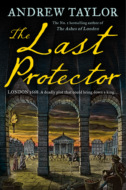
Cover illustrations © Andrew Davidson/The Artworks Inc
Andrew Taylor asserts the moral right to be identified as the author of this work.
Endpapers show a reduced copy of Fisher’s Ground Plan of the Royal Palace of Whitehall, 1680’, (1881) © The Print Collector/Alamy Stock Photo
A catalogue copy of this book is available from the British Library.
This novel is entirely a work of fiction. The names, characters and incidents portrayed in it are the work of the author’s imagination. Any resemblance to actual persons, living or dead, events or localities is entirely coincidental.
All rights reserved under International and Pan-American Copyright Conventions. By payment of the required fees, you have been granted the non-exclusive, non-transferable right to access and read the text of this e-book on screen. No part of this text may be reproduced, transmitted, down-loaded, decompiled, reverse engineered, or stored in or introduced into any information storage and retrieval system, in any form or by any means, whether electronic or mechanical, now known or hereinafter invented, without the express written permission of HarperCollins.
Source ISBN: 9780008325510
Ebook Edition © April 2020 ISBN: 9780008325534
Version: 2021-02-04
Dedication
For Caroline
Contents
Cover
Title Page
Copyright
Dedication
The Main Characters
Epigraph
Map
Chapter One
Chapter Two
Chapter Three
Chapter Four
Chapter Five
Chapter Six
Chapter Seven
Chapter Eight
Chapter Nine
Chapter Ten
Chapter Eleven
Chapter Twelve
Chapter Thirteen
Chapter Fourteen
Chapter Fifteen
Chapter Sixteen
Chapter Seventeen
Chapter Eighteen
Historical Note
Read on for a sneak peek of The Royal Secret, the next book in Andrew Taylor’s acclaimed series due April 2021
Keep Reading …
About the Author
By the Same Author
About the Publisher
THE MAIN CHARACTERS

Infirmary Close, The Savoy
James Marwood, clerk to Joseph Williamson, and to the Board of Red Cloth
Margaret and Sam Witherdine, his servants
Stephen, his footboy
At the sign of the Rose, Henrietta Street
Simon Hakesby, surveyor and architect
Catherine Hakesby, his wife, formerly Lovett
Jane Ash, her maid
Brennan, Hakesby’s draughtsman
Pheebs, the porter
Whitehall
King Charles II
Lord Arlington, Secretary of State
Dudley Gorvin, his clerk
Joseph Williamson, Undersecretary of State to Lord Arlington
William Chiffinch, Keeper of the King’s Private Closet
George Villiers, second Duke of Buckingham
Ezra Reeves, a mazer-scourer
Ferrus, the mazer-scourer’s labourer
Others
Mistress Elizabeth Cromwell, late Lady Protectoress of England (died 1665)
The Reverend Jeremiah White, formerly chaplain to the Lord Protector
Richard Cromwell, late Lord Protector of England, in succession to his father, Oliver Cromwell
Elizabeth Cromwell, Richard’s eldest daughter
Mistress Dalton, her godmother
Wanswell, a waterman
Mr Veal, known as the Bishop
Roger Durrell, his servant
Madam Cresswell
| MertonChlorisMary |  in her employ |
Epigraph
‘I shall not say how sad a condition I and my family, nay the nations, are in, for it is better for me to throw myself in the dust and cry before the Lord …’
Richard Cromwell, late Lord Protector of England, in a cypher letter to his brother Henry (the letter is undated but was probably written in May 1659)
Map

CHAPTER ONE
The Walls Run with Blood
Friday, 13 November 1665
THE REVEREND JEREMIAH White took the Lincoln road from Peterborough, riding north through watery sunshine. He was a tall, narrow man, stiff and twig-like, dressed in black. The horse he had hired from the inn was a small, brown creature. White’s feet were too close to the ground for dignity.
He had set off in good time, not long after eight of the clock. The journey was no more than six or seven miles, but it took him longer than he had expected. The roads were treacherous after the recent rains, and the mare proved to be a sluggish, sour-tempered jade. He did not reach Northborough until the middle of the afternoon – well after the dinner hour, as his stomach reminded him with steadily increasing insistence.
The gates of the manor were standing open. He clattered under the arch of the gatehouse into the courtyard beyond. The stableman came out of the coach house, touching his cap with one hand and taking the horse’s bridle with the other.
‘Does she still live?’ White asked.
‘Aye, sir.’ The man looked up at him. ‘Though it will be a mercy when God takes her.’
White dismounted. There was a bustle at the main door of the house. Claypole came out with two servants behind him.
‘Thank God you’re here,’ he said. ‘Mistress Cromwell has been asking after you all day. She’s working herself up to one of her fits. What kept you?’
‘The roads were treacherous. I—’
‘It doesn’t matter now. Come in, come in.’
In his urgency, Claypole almost dragged White into the house, taking him into the great hall to the left of the screens passage, where logs smouldered in the grate. He guided White to a chair. One servant took his cloak. Another knelt before him and drew off his travelling boots.
‘Will you see her directly?’ Claypole said.
‘A morsel to eat first, perhaps,’ White suggested.
Claypole glanced at the nearest servant. ‘Bread, cheese, whatever there is to be had quickly.’ He turned back to White, rubbing his eyes. ‘She … she was in great pain during the night again, and she was not in her right mind, either.’ His mouth trembled. ‘She says – she keeps saying …’
White took his host’s hand. ‘She says what?’
Claypole stared at him. ‘She says the walls are running with blood.’
‘Perhaps she has a fever. Or perhaps God has vouchsafed her a vision of the world to come, though I hope not for her or for you or me. But for now, my friend, there is nothing we can do except try to make the poor lady as comfortable as possible. And, above all, we must pray for her. Do you know why she wants me? Is it the will again?’
‘I don’t know – I asked her, but she wouldn’t say. She can be close and suspicious, even with us, her family.’
The servant brought cold mutton and a jug of ale. White ate and drank a few mouthfuls, but his host’s urgency had suppressed his hunger.
‘The food must wait,’ he said. ‘I’d better see her ladyship now.’
The two men went upstairs. On the landing, a maidservant, her face grey with exhaustion, answered Claypole’s knock at one of the doors.
‘Mistress knows you’re here,’ she whispered to White. ‘She heard you below.’
‘Is she in a fit state to receive him?’ Claypole said in a low voice.
The maid nodded. ‘If it’s not for too long. God send it will ease her mind.’
To White’s surprise, the bed was empty, though a fire burned on the hearth. The air smelled of herbs and sickness.
‘She’s in the closet,’ the maid murmured to him, pointing to a door in a corner of the room. ‘She made me move her there when she heard your horse in the yard. Come, sir.’
Claypole made as if to follow them but she stopped him with a hand on his arm. ‘Forgive me, master. She wants to see Mr White alone.’
She held open the door no wider than necessary to allow White to pass through. As soon as he was inside, he heard the clack of the latch.
The closet was tiny – no more than two or three yards square – and crowded with shadowy objects. The walls were panelled. The room had been built out over the porch and it faced north. The windows were small, their lattices set with thick green glass that let in little light. The air was stuffy with the smells of age and sickness. It was very cold.
For an instant, he thought the maid had played a trick on him and the closet was empty. Then, as his eyes adjusted, there came a rustle in one corner. The old lady was there, propped up against pillows and swathed in blankets.
‘Mr White,’ she said. ‘God bless you for coming all this way again. I’m obliged.’
He bowed. ‘My wife sends her service to you. She prays for you.’
‘Katherine is a good girl.’
‘How are you, my lady?’
Mistress Cromwell drew in her breath and whimpered like a dog. He waited; he knew better than to say or do anything. In a moment, when the pain had subsided, she said, ‘I’ll be in my grave by the end of the month.’
‘God’s will be done.’
‘The workings of God’s will seem mysterious indeed, these last five or six years.’
‘It is not for us to question Him.’ White paused, but she said nothing. ‘Is it about the will? Should I send for the lawyer again?’
‘No. Not that. Call for a candle, will you? It grows darker and darker.’
He opened the door a crack. Claypole had gone, but the maid was still in the chamber beyond. She had already lighted the candles and she brought him one.
‘Will mistress take her draught now?’ she asked as she handed it to him.
The old woman’s ears were sharp. ‘No, I will not, you foolish woman,’ she said. ‘Afterwards.’
He closed the closet door again and set the candle on a bracket in the wall. Mistress Cromwell watched him. It seemed to him that her face was markedly thinner than it had been in the summer, and her body beneath the coverings was no bigger than a child’s. She had been a sturdy woman in her prime, with a plump, round face and a brisk, bustling air as she went about the tasks of her household. In the seven years since Oliver’s death, she had slowly changed. It was as if time itself was devouring her.
‘Sit down, Mr White.’
There was a low stool beside a chest, the only other furnishing in the closet beside the daybed on which she lay. When he sat down, his knees rose towards his chin. You could hardly see the floor.
‘I don’t care for candles,’ she went on. ‘It’s when I see the blood on the walls. Smell it, too, sometimes. Fresh blood, you see.’
‘It is the fever, madam, I assure you. There is no blood.’
She made a low, rattling noise that might have been a laugh. ‘No, sir. There is always blood. There has been too much blood altogether. But enough of that for the moment. Will you do something else for me, as well as act as my executor?’
He bowed his head. ‘Anything, madam. Anything I can.’
‘You and Katherine will not be the losers. There will be something for you when I am gone.’ A hand appeared from the blankets, small and wrinkled as a monkey’s paw. ‘Take this.’
It was an iron key, three inches long and warm to his touch with heat borrowed from its owner.
‘Unlock the chest, sir. You will find a bundle of papers inside, on the top. Have the kindness to give them to me.’
He obeyed. The papers were tied together with a broad black ribbon. He glimpsed a dark, rich fabric underneath them; the candle flame glinted on the gold thread that brought the sombre material to life. A relic of the Whitehall days, he thought sadly, wondering what else the chest contained, what other mementoes of other places, of other, better times.
She slipped the ribbon from the papers. ‘Hold the candle higher.’
She peered at the papers. On one of them he recognized the familiar hand of the old lady’s late husband, the Lord Protector himself, Oliver Cromwell of blessed memory. She paused, stroking the paper as if to give it pleasure and comfort. Her lips mumbled rhythmically like a papist telling the beads of her rosary. Words, then phrases, then whole sentences emerged from the muttering:
‘Thou are dearer to me than any creature; let that suffice … My Dearest, I could not satisfy myself to omit this post, though I have not much to write; yet indeed I love to write to my dear who is very much in my heart. It joys me to hear thy soul prospereth; the Lord increase His favours to thee more and more … I love to write to my dear … dearer to me than any creature—’
She was wracked with a second spasm of pain, worse than the first. White sat there, still holding the candle, watching the agony twist her features beyond recognition. Automatically he found himself praying aloud, imploring God to ease her suffering in this world and the next. The pain slowly retreated.
‘Madam,’ he said. ‘You’re tired and you suffer much. Shall we continue later? I should ask your servant for your draught. It will help you sleep.’
‘No,’ she said with sudden vigour. ‘I shall sleep long enough later.’ Her hands went back to the papers. She shuffled through them. ‘Ah! This one, Mr White, this is what we need.’ She held it up so he could see. The paper was folded like a letter, but there was no name on it. She turned it over, showing him that the folds on the back were secured by three large seals. He made as if to take it, but she snatched it away and clasped it to her breast.
‘What would you have me do?’ he asked.
‘This is for my son,’ she said. ‘It must reach him with the seals unbroken. Promise me you will guard it with your life. My husband trusted you, and I shall too.’
‘You have my word, my lady. If you wish it, I shall set off for Spinney Abbey tomorrow.’ Old women, he thought, made such a business out of nothing. But he was relieved to know that the task was as straightforward as this; it would be tedious and tiring, but once it was done, he could find his way home to Katherine without returning here. ‘What is it? No more than forty or fifty miles from here across the Fens. It may take me more than a day at this time of year, but—’
Mistress Cromwell waved the letter, cutting him off in mid-sentence. ‘No, no, Mr White. You misunderstand me. You must wait until I’m dead and in my grave. And this letter is not for my son Henry. It’s for my elder son Richard.’ Her mouth twisted. ‘Tumbledown Dick. Poor Dick. It wasn’t his fault.’
He stared at her. ‘For Richard? But—’
‘He is in France or Italy, I think.’ Her mouth split wide, revealing pink gums: either a smile or a grimace of pain. ‘Think of it – the second Lord Protector, as he would be still, if God had so wished, in succession to his dear father; but he has not a roof to call his own or a gold piece in his pocket.’ The pain stabbed her again. He prayed silently while he waited for it to subside. After a few minutes, she went on: ‘You must wait, sir – months, if necessary. They watch us, you know, especially Henry and me, and also Richard’s wife. They may search this house when I am dead.’
He thought, dear God, all this will cost a deal of money. He was also fearful for himself. Of all the surviving Cromwells, Richard was the one whom the King’s spies would watch most closely. He said, ‘How do I find him?’
‘You don’t.’ Mistress Cromwell gave him another glimpse of the pink gums. ‘Someone will find you, and you will give that person the letter. With the seals intact.’
White leaned forward. Despite the cold, he felt sweat breaking out on his forehead and under his armpits. ‘How will I know him, my lady?’
‘Or her. Because the person in question will say these words to you: The walls run with blood. And you will say, Aye, fresh blood.’
She drifted away from him. Her eyes closed. She rubbed the blanket between forefinger and thumb, slowly and carefully, as though assessing the quality of the material. In a moment or two, even that movement stopped. Her breathing steadied. When he judged she was asleep, he rose and tiptoed to the door.
At the sound of the latch, Mistress Cromwell stirred and said something.
‘Madam? What was that?’
‘Bid him be kind to poor Ferrus.’
‘Ferrus?’ he repeated, unsure that he had caught the name correctly. ‘Who is Ferrus?’
‘I only gave him a penny. I should have given him more.’
Mistress Cromwell murmured something else as she glided into sleep or unconsciousness. It might have been ‘Ferrus will help him.’ Or it might not.
CHAPTER TWO
The French Style
Thursday, 16 January 1668
THAT NIGHT, FERRUS sleeps with the dog that guards the kitchen yard at the Cockpit. The dog is a large, brindled creature with rough fur and a spiked collar. He is called Windy because that’s what he is. Ferrus has known Windy since Windy was a puppy. In those days, Windy was so tiny that Ferrus could hold him in his cupped hands.
Ferrus and Windy don’t like each other. But they take each other for granted like rain and sun and nightfall. They keep each other warm on those nights when Ferrus can’t sleep in the scullery on account of something he has done wrong. (Cook never allows him to sleep in the kitchen itself, even on the coldest nights, because of the smell.)
Ferrus is chilled to the bone when he wakes. It is still dark. He lies there, huddled against the dog’s flank, and pulls his cloak more tightly around him. He listens to the cocks of Whitehall and Westminster crowing on their frosty dunghills. His teeth are aching again but he ignores the pain as best he can. He is hungry. He is almost always hungry. Sometimes he is tempted to eat the food they put out for Windy; but he knows that if he does that, Windy will tear out his throat.
Despite the pain, the cold and the hunger, he likes this time before the light, before the world stirs. He likes its emptiness. He stares at a pinprick of light in the eastern sky and listens to the cocks. He waits for the dawn when it will all begin again.
The first I heard about the duel was on the day itself. I was one of the very few who were aware of it beforehand. My master, Mr Williamson, summoned me into his private room at Scotland Yard shortly after nine o’clock in the morning. He told me to make sure that the door was closed. The door was made of close-fitting oak and the walls were thick. Even so, he beckoned me closer and spoke in an undertone.
‘My Lord Shrewsbury has challenged the Duke of Buckingham.’
Startled, I said, ‘Won’t the King stop them? Does he know?’
Williamson stared at me, and I knew that I had overstepped the mark. ‘The King will do as he pleases, Marwood. And you will do as I please.’
‘Yes, sir. Of course, sir.’
‘They are to fight this afternoon. It’s likely to be a bloody business. My lord has decided that the duel will be in the French style, so he and the Duke will both be supported by two seconds.’
Three against three, I thought, slashing at each other with their swords in the name of honour: not so much a duel as a pitched battle. Anything could happen in such a mêlée, anyone could be killed. What worried me was why Williamson was telling me such a dangerous secret.
‘Who are the seconds?’ I asked.
‘My lord has his cousins, Sir John Talbot and Bernard Howard, Lord Arundel’s son. The Duke has Sir Robert Holmes and a man called Jenkins, whom I don’t know. He’s an officer in the Horse Guards.’ Williamson paused. ‘And a former fencing master.’
In that case, Buckingham had chosen carefully. I had never heard of Jenkins, but his qualifications were obvious. Holmes was well known as a ruthless fighter. He had served as both a soldier and a sailor in his time. On the other hand, Talbot and Howard were both reputed to be fine swordsmen. Talbot was an MP; he frequently attacked Buckingham and his allies in Parliament. He was a close ally of Lord Arlington, Williamson’s superior.
‘Can’t it be stopped, sir, if so much is known about it? Perhaps the King—’
Williamson frowned at me. ‘If that had been possible, we would not be having this conversation.’ He went on in a more conciliatory tone: ‘Of course the reason for the duel is obvious enough. The only wonder is that my lord has put up with the injury he has suffered for so long.’
As all the world knew, Lord Shrewsbury could hardly have avoided hearing that Buckingham had injured him: the whole town had known for months. The Duke flaunted the fact that Lady Shrewsbury was his latest mistress; so for that matter did she. But I was now quite sure that there was more to this affair than a straying wife and a cuckolded husband.
‘I want you to be there,’ Williamson said, leaning back in his chair. ‘At the duel. To be my eyes.’
My skin crawled. Duels were illegal. Besides, I wanted nothing to do with the quarrels of noblemen. Especially these two: Buckingham and Shrewsbury. ‘Sir, they would kill me if—’
‘I agree – it would not be convenient to either of us if you were seen,’ he interrupted. He opened a drawer in his desk and took out a small wooden box, which he handed to me. ‘Open it.’
I obeyed. The box contained a perspective glass made of brass, small enough to slip in a pocket.
‘Keep your distance. Once the duel’s over, come back as soon as you can and report to me. I want to know who’s been killed, who’s been wounded. I want to know exactly what happens, and who is there. Not just the combatants. Everyone.’
I made one last effort to avoid the commission. ‘Sir, is it wise? The Duke would recognize my face if he chanced to see me. And several members of his household know of my employment at Whitehall.’
Williamson nodded. ‘Who do you know among the Duke’s people?’
‘One is a clergyman named Veal, not that you would know he was in orders if you saw him. He served in the New Model Army, first as a soldier and then as a chaplain. He was given a living during the Commonwealth, but he was later ejected from his benefice. They sometimes call him the Bishop, because of his calling, though he’s not fond of bishops. He has a servant, a brute of a man named Roger, who served with him in the army.’ I cleared my throat. ‘Neither of them has any cause to like me, any more than their master has.’
‘My intelligence is that the Duke uses these two rogues a good deal for his secret dealings. The servant’s surname is Durrell. The more I can learn about them both the better. If they are there today, it will be a proof positive of how much the Duke trusts them. But the important thing is the duel itself and what happens to the principals. And I can’t emphasize enough that I don’t want our interest in the matter to be known.’ He coughed, turning his head towards the window and looking down at a team of oxen dragging an overladen coal waggon across the second courtyard at Scotland Yard. ‘My interest, that is.’
‘Where is the duel to be held, sir?’ I asked, noting this hint that Williamson was not acting solely on his own initiative.
‘Barn Elms.’ He turned back. ‘After dinner – two o’clock, according to my information. I’m told that they left the decision about the time and the place until the last moment, to avoid the risk of detection. I don’t even know precisely where in Barn Elms. You had better hire a boat and get there before them. I imagine they must come by river.’
He dismissed me. At the door, however, he called me back. He scowled at me. ‘Take great care, Marwood. I don’t want to lose you.’
Williamson waved me away and lowered his head over his papers. I supposed I should take his last remark as a twisted compliment.
I had time to return to my lodgings in the Savoy. The weather was milder than it had been last winter, but it was cold enough in all conscience. I had Margaret, my maidservant, send out for a fricassee of veal. While I waited for the dish to arrive, I went up to my bedchamber and put on a second shirt and a thicker waistcoat.
After I had eaten, I put on my heaviest winter cloak and a broad-brimmed hat that I hoped would conceal most of my face. It was now about half-past eleven. I walked down to the Savoy stairs. The tide was up, and several boats were clustered about the landing place, waiting for new fares. Here I had a stroke of good fortune. Among the boats was the pair of oars that belonged to a waterman named Wanswell. I had used him often enough in the past year, usually to take me up the river to Whitehall or Westminster.
‘I want to go up to Barn Elms,’ I told him. ‘And I’ll need you to wait for me. Perhaps for a few hours.’
‘Picnic, is it, master?’ He had a flat, sardonic way of speaking that made it hard to know if he was smiling or sneering inside. His face gave no clue. Exposure to weather had made it a ruddy mask, stiff as old leather. ‘Perhaps a bit of singing after you’ve eaten and drunk your fill?’
‘Don’t be more of a fool than God made you,’ I said.
‘I leave that to others, sir.’
I chose not to take offence. The watermen were notorious for their surliness. For my present commission, however, I would rather trust Wanswell than a complete stranger. He had been pressed into the navy in his youth and he had served for a time with Sam Witherdine, Margaret’s husband. The two men often spent their leisure drinking together. I asked him how much he would charge.
He spat in the water. ‘Seven shillings each way. A shilling an hour waiting time.’
It was an extortionate price. ‘But the tide’s with you now,’ I pointed out. ‘And it’ll be on the turn by the time we come back.’
‘It’s six or seven miles up to Barn Elms. The wind’s freshening, too.’
‘Six shillings.’
‘Seven.’ Wanswell was no fool. He sensed my urgency. ‘All right, sir. Here’s what I’ll do. I’ll take you there. But once the tide turns, I’m off. And whatever happens I’m leaving long before dusk. Which means I want my money when we reach Barn Elms. Take it or leave it, just as you please. It’s all one to me.’
I haggled a little more for honour’s sake, but he would not give ground. In the end I agreed to his terms. I believed him to be honest enough in his way, and he would think twice about cheating me because of Sam.
We set off, making good time because the wind was with us, as well as the tide. It was most damnably cold on the water, though, with nothing to shield us from the weather, and I wished I had a rug to cover me. The sky was a dark, dull grey, sullen as uncleaned pewter. There were patches of snow on either bank of the river.
The last time I had been to Barn Elms it had been full summer. The estate lay on a northerly loop of the Thames on the Surrey bank. There was an old mansion there, with gardens and parkland. The place had become a favoured resort of Londoners in the warm weather. I had never been there in winter but I guessed that, away from the house and the home farm, it would be a desolate spot. The duellists had chosen well.
Wanswell brought me to the landing stage used by the villagers rather than the parties of pleasure from London. An alehouse stood nearby, and it was there he proposed to wait for me.
Time was galloping away – it was already past one o’clock. If the duellists had arrived before me, it would prove difficult to find them in the expanse of gardens, orchards and pastures that formed the estate. My best plan was to keep within sight of the river.
I followed a lane that ran north along the bank, a field or two away from the river itself. Having no alternative, I pressed on for perhaps half a mile, plodding through mud and slushy snow. At this point, the lane veered closer to the water. I paused at a stile to find my bearings and to make sure I was not overlooked. It was then that I saw two or three boats hugging the shore and making for a landing stage about a quarter of a mile upstream. They had four oarsmen apiece, and each of them carried two or three passengers under the awning at the stern. The passengers were all men, and all wearing dark clothes.
I hung back in the shelter of an ash tree and took out the perspective glass. The party disembarked at the landing stage. The boatmen stayed with their boats. I twisted the brass cylinder to bring the passengers into focus. They were marching in single file towards a spinney that crowned a gentle rise in the ground too slight to be called a hill. I recognized both Sir John Talbot, a tall, red-faced man, and Lord Shrewsbury himself, a thin, stooping figure who struggled to keep up with his kinsman. The third man must be Howard, who was talking earnestly to his lordship as they walked, gesturing with his arm to emphasize what he was saying. The others had the look of servants.
I was about to follow them as discreetly as I could, when another boat appeared on the water. This one came at speed from the opposite bank of the river. It was much larger, a richly painted barge with a dozen or more oarsmen and a cabin made private with leather curtains. Such an ostentatious craft made an instructive contrast with Shrewsbury’s three unobtrusive boats. There was a brazier of coals in the stern, and three gentlemen stood beside it warming their hands. One of them was taller than the others. I knew who he was before I fixed the glass on him and made out the florid features of the Duke of Buckingham.
Among the other passengers were two men standing on the other side of the cabin, near the oarsmen. Their faces were shaded by their hats. Both were big men, one thin and tall; the other more than making up for his relative lack of height by his breadth. They were almost certainly the men I had encountered last autumn, when I had had certain difficulties with Buckingham: his confidential servants, the Reverend Mr Veal and Roger Durrell.
While the Duke’s party were disembarking, I moved away from the ash tree, following a line of hedgerow towards the spinney. I concealed myself among the trees. Buckingham and his followers marched away from the river, making no attempt to conceal themselves; I heard one of them laughing, as if he were on a jaunt.
By this time the Shrewsbury party had vanished into the spinney. When the trees had swallowed Buckingham’s party as well, I followed cautiously. The one advantage of spying on members of the aristocracy was that they were so absorbed in their own affairs, so shrouded in a sense of their overwhelming importance in God’s creation, that they tended to be careless of what was going on around them. They (or more probably their advisors) had taken the precaution of choosing this secluded spot for the duel; but, once here, it did not occur to them to take particular precautions against being observed.
By the time I reached the spinney, the duellists and their supporters were out of sight, but I heard the sound of voices in the distance. There was a path through the trees, the soft ground churned up by the passage of a dozen or so people. I advanced slowly among the leafless trees, a mix of birch, ash saplings and the occasional oak. Though the path was clear, it was obvious from the tangled undergrowth that the spinney had not been coppiced for some years.
I was aware of a leaden sensation in my belly, together with an inconvenient urge to empty my bowels. I walked even more slowly than before. Unlike the gentlemen ahead, I was not the stuff of which heroes are made. I could imagine, all too easily, what the duellists and their entourage would do to me if they found me here.
The voices ahead were louder. Then came a deep and throaty shout, a word of command. It was followed by the clash of steel, fast, furious and shockingly harsh. All this time I was continuing to advance. The path rounded a corner and suddenly they were all in front of me.
The spinney was bounded by a low line of bushes that once had been a hedge. The path passed through a wide gap and into a small field, a close perhaps used for confining stock. Beyond it were more trees and more hedges, which cut off the view of what lay beyond.
The six swordsmen were going at each other in a blur of movement, grunting, shouting and stamping. The others had gathered in two camps, one on each side of the close. It was fortunate that everyone’s attention was drawn exclusively to the duel, otherwise I must have been seen at once. But they had eyes for nothing else.
I took in this picture in a fragment of a moment. At the same time I leapt backwards, skidding on the mud, in my effort to avoid being seen. As it was, I stumbled, almost falling into a vast yew tree beside the path. The tree swallowed me up: it was hollow inside, for its centre had been eaten away by time, leaving a sturdy palisade of offshoots and bark, thickly covered with evergreen foliage. I slowly parted two of the branches on the side of the yew nearest the field. At this point, the tree had invaded the hedgerow, and my spyhole gave me a view of the duel.
The swordsmen had put off their cloaks and hats, removed their coats and tucked up the cuffs of their shirt sleeves. Buckingham had removed his hat and golden peruke. His shaven scalp was pinker than a lobster in the pot. He towered over Shrewsbury, who was breathing hard and retreating before the onslaught of the Duke’s thrusts. The other four were hacking and slashing with the abandon of madmen. There was no science to this – no elegant dance of thrust, parry and riposte: this was as bloody and brutal as a pitched battle between rival packs of apprentices in Moorfields. In such a brawl, weight, muscle and length of arm were more important than skill or agility.
Screaming in triumph, Buckingham ran Shrewsbury through in the chest, driving the blade up into the right shoulder. The Earl dropped his sword and fell to the ground. The Duke tugged his sword free.
Holmes and Talbot were evenly matched, giving each other blow for blow, so Buckingham swung to his right to aid Jenkins, who was hard pressed by Howard. Howard saw the danger. Snarling, he flicked away the Duke’s blade, putting him off balance and causing him to lurch towards Jenkins. The latter, his sword arm impeded by Buckingham, tried to recover. But he was too late. In a fluid, unexpectedly graceful movement, Howard switched his attack from the Duke and drove his blade into Jenkin’s left side. The young soldier cried out and fell.
The duel was over as abruptly as it had begun. The bystanders rushed forward, shouting. The four remaining swordsmen stood suddenly still, their blades hanging towards the ground; they were open-mouthed, red-faced, panting like bellows; their expressions were confused and embarrassed, as if they had been unexpectedly caught out in an act of folly.
One man, a physician perhaps, knelt beside Shrewsbury and felt for his pulse. Blood was pumping on to the grass. The Earl made a feeble attempt to stand, his left arm flailing for purchase on the ground; one of his servants pressed him back down and tore off his own cloak to cover his master.
Jenkins lay silent and unmoving. Mr Veal was bending over him and shaking his head at a question from Buckingham. ‘Dead, Your Grace,’ I heard him say. ‘The poor brave fellow.’
‘Oh God’s blood,’ Buckingham said, mopping the sweat from his scalp with his sleeve.
‘And now?’ Veal said, in a lower voice I could hardly catch.
‘Dog and bitch …’ said the Duke.
That was what it sounded like, but as the words were fainter and more muffled than before, I wasn’t at all sure I had heard him accurately. He might have been saying ‘something which …’ or ‘the wound needs a stitch’ or a dozen other phrases. He was still speaking, but I could no longer hear any of the words, only see his lips moving, and his arm gesturing to the two men lying on the ground with the blood soaking into their shirts.
In a moment or two, both parties would be returning to the boats. It was time for me to leave. I retreated through the spinney and made the best speed I could, running and walking, down to the lane. The tide was high, and it was still light, so with luck Wanswell would be waiting at the alehouse. I glanced towards the river, where the boats were moored alongside the Barn Elms stairs.
To my horror, one of Buckingham’s boatmen was pointing in my direction. Ignoring the stitch in my side, I pushed myself to walk faster, praying that the boatmen would take me for a passing farmworker.
The alehouse by the landing place was crowded with men who made their living on and from the river. Several of them turned to scowl at me as I blundered into the smoke-filled, low-ceilinged room. Wanswell was one of the men drinking at the long table by the window.
‘Come – we must go,’ I said.
He raised his head. ‘Must we, master?’ He appealed to the company at large. ‘Must we, boys?’
‘No,’ someone said loudly. ‘You’re as free a man as any in London. Have a drink instead. Let’s all have a drink.’
His fellows agreed with a clatter of mugs and bottles on the table.
I brought my head down to the level of Wanswell’s. ‘Another five shillings if we go now,’ I said pleasantly. ‘Or I start walking to Putney, and you lose your return fare as well as your shilling-an-hour charge for waiting.’
He accepted the offer, though for pride’s sake he took his time finishing his ale. I led the way outside, with the waterman staggering behind me. The delay had cost me five minutes, and that was too much. Roger Durrell, Mr Veal’s servant, was pounding down the lane towards the alehouse. Despite his bulk, he was capable of a surprising turn of speed. When he saw me, he stopped thirty yards away, his hand dropping to the hilt of his old cavalry sword.
‘God’s arse, if it ain’t Marwood,’ he said. He had a sonorous, phlegm-filled voice. ‘That will interest Mr Veal. So those web-footed watermen were right after all. You come along with me, sir, eh?’
Wanswell staggered to my side. ‘Who you calling web-footed?’
‘Save your breath, numbskull.’
‘Me? A numbskull? I’ll rip your guts out for that, you fat bag of wind.’
Durrell looked at the small squat man and burst out laughing. ‘Quite the little gamecock, ain’t you?’
Wanswell held his gaze for a moment. Then he spat, shrugged and retreated to the alehouse, abandoning me to my fate.
Durrell advanced slowly towards me. I backed away along the path to the river, with a half-baked idea in my head that I might leap into a boat and escape him that way.
The alehouse door opened again, and Wanswell returned. He was carrying a staff shod with iron. Behind him came six or seven of his fellows. One of them had an axe over his shoulder. Another had a billhook with which he was slashing the air before him.
‘That’s him,’ Wanswell said, shaking his staff at Durrell. ‘That’s the poxy windfucker. He’s the one calling us web-footed fools. Fat whoreson.’
The watermen advanced towards him in a solid, menacing phalanx. Durrell ripped out his sword. He stood there irresolutely. Then he turned tail and walked rapidly back the way he had come.
The clock over the guardhouse stairs struck five.
When Mr Undersecretary Williamson had dismissed his clerk Marwood, he allowed himself a moment to consider what he had learned, and the most advantageous way to present it to my Lord Arlington. Then he rose from his chair, put on his cloak and walked through Scotland Yard into Whitehall itself. Rain drifted from a dark sky heavy with clouds. Twilight was creeping through the palace. He made his way to Lord Arlington’s office overlooking the Privy Garden and requested the honour of an interview with his lordship.
The clerk returned almost immediately and ushered him into the Secretary’s presence. The curtains were drawn and the candles lit. Arlington acknowledged Williamson’s greeting with a stately inclination of his head; he had spent four years representing the King in Spain, and he had brought back with him the manners of the Spanish court, as well as its language.
‘There’s news?’ he demanded.
‘Yes, my lord. I had a witness to the whole affair.’
‘What happened?’
‘They met in a close at Barn Elms. It did not turn out as we might have wished. Buckingham wounded my Lord Shrewsbury.’
‘Mortally?’
‘We don’t know yet. The blade went into the right side of his chest and came out at the shoulder. He fell to the ground. There was a good deal of blood. Apparently he was still conscious, but unable to stand.’
‘It’s most unfortunate,’ Arlington said. ‘I must tell the King at once.’ But he stayed in his chair, staring at the fire and showing no apparent signs of urgency. ‘I thought that Talbot and Howard would take care of matters, I really did. They hate Buckingham enough. Was anyone else hurt? Or killed?’
‘Jenkins. Once my lord was down, the Duke got in the way of Jenkins’ sword arm, and that’s when Howard ran him through.’ Williamson pursed his lips. ‘He’s dead.’
Arlington considered the information. Williamson waited, accustomed to his superior’s silences and knowing better than to interrupt. The Secretary always wore a narrow strip of black plaster across his nose, which Williamson privately thought a ridiculous affectation. The plaster was supposed to cover the scar of a wound sustained when Arlington had fought for the King in one of the early battles of the Civil War. People said its only purpose was to remind the world of his loyalty to the crown in the late wars. But they didn’t say it to his face.
‘It’s a great misfortune.’ Arlington frowned and then brightened. ‘Though of course there is a silver lining: we have a dead man, after all, and Shrewsbury wounded, if not worse: it cannot bode well for the four that survived unharmed. They must go into hiding, even flee the country.’
‘It depends on how the King responds,’ Williamson said.
‘Indeed.’
‘My lord, you know as well as I do that the King needs Buckingham’s services at present. He can’t manage Parliament without him.’
‘But he can’t ignore what’s happened, either. Such a flagrant breaking of the law. It must be manslaughter at the very least, with Buckingham at the heart of it, even if he did not deal the fatal blow himself. Who was your witness, by the way? We may need his testimony.’
‘My clerk Marwood.’
Arlington met Williamson’s eyes. ‘Ah. I know the name.’
‘I regret to say that one of Buckingham’s creatures saw him in the neighbourhood. A broken-down trooper from Cromwell’s horse. The rogue recognized him and tried to detain him. Marwood gave him the slip, but the fact he was there will get back to the Duke.’
‘That’s a pity. Do you trust him? Marwood, I mean.’
‘I believe so, my lord. He’s served us well in the past. He’s a careful man, and he knows the value of his place with me. His father was a Fifth Monarchist, but he himself has none of that dangerous nonsense about him.’ Williamson hesitated. ‘The King has employed him too, once or twice, through Mr Chiffinch, which I cannot say I like, though the King was much pleased with Marwood’s service. He gave him the clerkship of the Board of Red Cloth as a reward.’
Arlington stared up at the fresco on the ceiling. It showed the Banquet of the Gods, with Jupiter bearing a marked resemblance to King Charles II. ‘I think you’re probably right about Buckingham – in the next week or two, there will be a great deal of fuss and then a royal pardon, at least for him. The King opens Parliament on the sixth of February, so he needs the Duke in harness by then. He has to be, if he is to carry out his promise and persuade the Commons to grant the King the money he needs for the navy.’
‘If …’ said Williamson.
Arlington tapped his fingertips on the table before him, as if playing a flourish of notes on the keyboard of a clavichord. Probably a jig, Williamson thought sourly. The Secretary had a vulgar taste for them. Williamson himself sneered at jigs. His own tastes were more sophisticated. He loved the work of the new French and Italian composers, and particularly the unfairly beautiful harmonies of papist choral music.
‘Exactly,’ his lordship said at last. ‘You see the situation as I do.’
He smiled. Williamson could not avoid smiling back. The Undersecretary distrusted charm above all things – in the last few years, its dangers had been amply demonstrated by the King himself, who could have charmed the angels out of heaven if he had set his mind to it, and then handed them in chains to the Devil if the Devil had been willing to pay the right price and keep his mouth shut about the transaction.
‘In time Buckingham will damn himself in the King’s eyes,’ Arlington went on. ‘He’s a firecracker, dangerous when he catches a spark because you can never tell which way he will jump. But give him a steady job of work to do and he will soon show his want of application, his inability to match deeds to word. He can no more manage the House of Commons for the King than my daughter could. In the meantime, though, we have another difficulty, don’t we?’
Williamson said nothing. Arlington was always seeing difficulties, and for once he had no idea which one his lordship meant.
Arlington lowered his voice. ‘My Lord Shrewsbury has been complaisant about his cuckold’s horns for nearly two years. Her ladyship and Buckingham have let the world know of their passion for one another, so Shrewsbury must have known about it from the first. Which means that Buckingham must be wondering, why now, why after all this time should my lord have challenged him? And in the French style, too, with three against three, which makes it so likely that a great deal of blood will be spilt. And with Talbot as one of his seconds, who is one of the Duke’s greatest enemies not just in Parliament but in the whole of London. And my supporter.’
‘You think, my lord, His Grace may suspect that …’
‘That we had a hand in it,’ Arlington said. ‘Yes. Not that it was a bad idea in itself.’
He and Williamson had persuaded Talbot to work on the cuckold’s sense of grievance and issue the challenge to the Duke. If they had fought one against one, the smaller, older Shrewsbury would have been at a disadvantage against Buckingham. But a duel in the French style had offered the Earl a chance to tilt the odds in his favour. Obviously it had been a risky business from the outset but, had it come off, the rewards would have been immense. Arlington’s most powerful political rival would have been either disgraced or dead, and through a tragic train of circumstances that had no apparent connection to Arlington.
‘I always had my doubts that the plan would work,’ he continued. ‘Still …’
Williamson clamped his lips together. The scheme had been Arlington’s from start to finish.
‘Buckingham already has no reason to like us,’ the Secretary went on. ‘This will make him hate us. And, if I’m any judge of character, it will also make him want to make fools of us.’ His fingers danced on the table; another damned jig, no doubt. ‘He will want his revenge. But how will he set about it?’
CHAPTER THREE
A Friend from the Country
Friday, 17 – Sunday, 19 January 1668
MASTER KICKS FERRUS awake. He has fallen asleep over his empty bowl. The bowl slipped from his hands. It’s upside down on the flagstones.
Ferrus was sitting on the floor, leaning against the wall by the door to the yard. The toe of Master’s boot lands just above Ferrus’s elbow. The impact pushes him over. He lies on the threshold, covering his face with his hands. He curls himself into a ball.
Hedgepig, he thinks. He likes hedgepigs. Sometimes they come into the yard from the park, hoping for kitchen scraps. When Windy tried to kill one, the hedgepig rolled itself into a bundle of spikes and the spikes hurt Windy’s nose. In a while, Windy grew bored and left the hedgepig alone. Time passed. The hedgepig uncurled and crept away.
Another kick lands, this one on Ferrus’s thigh. He cries out, because Master likes that, but the pain is bearable.
Time passes.
Ferrus is hedgepig.
At ten o’clock in the morning on Friday, Mistress Hakesby was at Burton’s the instrument-maker’s shop at the sign of the Bear’s Head, which was a few doors along from the Devil Tavern in Fleet Street. She was attended by her maid, a thirteen-year-old girl named Jane Ash, who was more of a hindrance than a help. But Mr Hakesby did not think it proper for his wife to go about town by herself, and Jane was the price that Cat had to pay for a degree of independence.
Mr Burton opened the box with a flourish. ‘There, mistress,’ he said with the air of a man giving a treat to a child, ‘this is what your husband ordered. Imported especially from France.’
Cat lifted the brass instrument from the box. A magnetic compass was set within the semicircular arc, which was marked in degrees. Below it was an alidade capable of rotation around the semicircle. It was designed for the precise measurement of angles. She carried it to the doorway, where the light was better. She turned it over in her hands.
‘The French call it a graphometer,’ Mr Burton said. ‘But I prefer the good old English term of semicircle. Be that as it may, tell Mr Hakesby that he will find it improves the accuracy of his surveys a thousandfold. It may seem expensive but, at times like these, with so much building going on, so many measurements to be taken, he will find it a most valuable investment. One can do nothing without accurate angles.’
‘No,’ said Cat.
‘What?’
‘This won’t do, Mr Burton.’
‘Mistress Hakesby, I think we must let your husband be the best judge of that, and I’m quite sure he will agree with me—’
‘I said it won’t do.’ Cat came back into the shop and laid the graphometer on the counter. ‘Look, the alidade does not rotate as cleanly as it should. I’m not satisfied with the engraving of the degrees either. The workmanship is poor.’
Mr Burton drew himself to his full height. He towered a good nine inches above Cat. ‘I can assure you that—’
‘I have seen better elsewhere, thank you. I wish you had sent to Antwerp for it, sir. Their instruments are infinitely superior.’
‘I – I shall write to Mr Hakesby about this. Or call on him. I think you—’
‘By all means, Mr Burton. Goodbye.’
‘Won’t master mind?’ Jane said timidly when they were outside again. ‘If Mr Burton goes to him and—’
‘Your master will agree with me,’ Cat said sharply. She glanced at Jane’s frightened face and went on more gently. ‘The instrument is not what it should be. He will know that better than I do.’
‘Catherine!’ A woman called. ‘Catherine Lovett!’
Startled, Cat swung round. A hackney coach was drawn up by the line of posts that kept those on foot apart from the traffic on the roadway. A woman had pulled aside the leather curtain and was smiling tentatively at Cat.
‘It is Catherine Lovett, isn’t it?’
‘It was,’ Cat said, her voice wary. ‘I’m Catherine Hakesby now.’
The woman was well dressed, indeed a little overdressed, though not in the height of fashion. She was very young, with plump, pink cheeks and small eyes. Something about the eager face was half-familiar.
‘Forgive me, I—’
‘You don’t know me?’ The woman looked mortified for a moment, but then the expression was smoothed away and the eagerness returned. ‘We’ve all changed, but you not so much as I perhaps. Shall I give you a clue?’ She beckoned Cat closer. ‘Cast your mind back ten years or so,’ she whispered. ‘Elizabeth.’ She hesitated. ‘Elizabeth from Whitehall. We used to play together.’
It was her grandfather’s long, straight nose that gave Cat the clue she needed, that and the wide mouth. ‘Elizabeth,’ she said slowly, recognition dawning. ‘Elizabeth Cromwell.’
‘You were so kind,’ Elizabeth said. ‘Those endless games of shuttlecock. And you would tell me stories, and build me houses made of twigs.’
‘Yes,’ Cat said. ‘I remember. Where—?’
‘Am I living now? We’re down in Hampshire, at Hursley, my father’s house. But he can’t be with us there …’ Elizabeth broke off. The eagerness and the smiles had vanished. She looked unhappy. Then: ‘And you, too. I – I was sorry to hear about your father’s death, and your uncle’s.’ She grimaced. ‘So many changes, and not all for the better. But you’re married, then – how wonderful that must be. Hakesby, did you say? Do you live in London?’
‘Yes. Mr Hakesby’s a surveyor. He designs and builds houses. Forgive me, but he’s waiting and I should go.’
‘But I can’t lose sight of my old playmate.’ Elizabeth pouted, summoning up the ghost of the child she had once been. ‘Not now, when I’ve just found you again. Where do you lodge? We can take you there.’
‘Henrietta Street by Covent Garden,’ Cat said. ‘I’ll be there faster if I walk.’ She could see another young woman in the hackney and an older man. ‘Besides, you won’t have room for both of us.’
Elizabeth looked disconcerted. ‘But I cannot let you go like this. You must dine with us, and Mr Hakesby too. I’m staying at my godmother’s by Hatton Garden. You will, won’t you?’
‘It’s kind of you but—’
‘I shall write to you at the sign of the Rose this very afternoon, and name a day. I want to meet your husband. I’m sure he’s a most admirable gentleman.’
Cat kept a smile on her face, but privately she writhed with embarrassment. ‘I can’t promise that we shall be able to come. He has not been well, and he does not go out a great deal, except in the way of business.’
Without warning, Elizabeth lunged forward, steadying herself by holding the strap that retained the curtain. She tried to plant a kiss on Cat’s cheek. Instead she pushed the brim of her hat into Cat’s eye. Cat recoiled with a cry of mingled pain and surprise.
‘I’m so sorry,’ Elizabeth said. ‘I was always so clumsy. Pray forgive me.’
‘It’s nothing,’ she said, aware her eye was watering.
The younger woman looked so miserable that Cat could not be cross with her. She remembered the clumsiness well enough: Elizabeth had been a child who was always spilling her milk and tripping over her skirts. She still was not much more than a child. She was younger than Cat, and could be no more than seventeen or eighteen.
‘And you’ll dine with us?’ Elizabeth said, her cheeks pinker than ever. ‘I haven’t put you off with my blundering? Catherine, please say you will.’
‘Yes, if you wish it,’ Cat said, moved by pity. ‘With pleasure.’
‘Catty. Do you remember? I called you Catty and you called me Betty.’
‘Cromwell?’ Hakesby said, frowning. ‘Is this a piece of drollery?’
In his irritation, he spoke more loudly than usual, and Brennan the draughtsman looked up from his stool on the other side of the Drawing Office.
‘No, sir,’ Cat said quietly, trying to control her irritation. ‘Elizabeth Cromwell.’
‘Really? Were you not aware that her highness the Protectoress died three years ago?’ At times, when his illness was upon him, Hakesby affected a bitter, satirical tone. ‘Or do you mean her daughter Elizabeth, my Lady Claypole? She’s been dead for even longer. What nonsense is—’
‘I mean Oliver’s granddaughter, sir. The eldest child of Richard, the last Protector. I used to play with her as a child.’
Hakesby stared at his wife, with his mouth open. His nose was red and it had a drop of moisture on the end. He was suffering from a cold, which made worse a temper that was increasingly uncertain at the best of times. It was his illness that made him unpredictable and often cross; he had not always been like this. It was unfortunate that he was not only irritable this morning but relatively vigorous as well. He said: ‘You … you knew the Protector and his family?’
‘My father was much in Oliver’s company, and he knew Richard, too, though he was more friendly with Henry, Richard’s brother. Sometimes my father would take me to Whitehall with him.’
When Cat thought of it, which was rarely, her memories of those days seemed to belong to someone else. It seemed unreal to her, the young wife of an elderly surveyor, that she had once been an heiress, and that her parents had been intimate with the Cromwells. Her father had been one of the wealthiest stonemasons in London, and her mother had been allied to the Eyres, substantial Suffolk gentry. The Lovetts and the Eyres had been staunch supporters of Parliament in the wars against the King, and later of the Cromwells. Thomas Lovett had been one of the regicides who had signed the death warrant of Charles I.
‘If the truth be told, I wish Oliver were still alive,’ Hakesby muttered.
‘Hush, sir.’
‘I know the King is back,’ Hakesby said, ‘and naturally we are his loyal subjects. But it was better in the old days, when we were ruled by godly men, and England held its head up high among the nations of Europe. All that was Oliver’s doing.’
‘The times have changed, sir. Oliver is gone, and so is his son. And Mistress Elizabeth is eager to resume her acquaintance with me.’
‘Well, why not?’ Hakesby straightened in his chair.
‘She says she will ask us to dine with her at her godmother’s house in Hatton Garden. She is staying there for a while.’
Hakesby wiped the drop from his nose with the sleeve of his shirt. ‘We shall accept. I shall be honoured to dine with her.’
‘I’m not sure it would be wise. Though the Protector’s family are allowed to live peacefully in England, it would not be sensible for you to be seen with them. They are not encouraged to show themselves in London.’
‘Who are you to tell me what’s wise?’ Hakesby scowled at her. ‘Have you forgotten I’m your husband, and the duty you owe to me?’
‘No, sir. I never forget that.’
There was a silence between them. Cat heard Brennan’s pen scratching on the paper, as he indited a list of the scaffolding and other timber that would be required for the next stage of the Dragon Yard commission, which was the major project they had in hand at present. The draughtsman could hardly have avoided hearing Hakesby’s side of the conversation, and probably some of hers.
Hakesby closed his eyes. Waves of weariness often swept over him without warning. Cat waited, hoping he would doze off.
But his eyes snapped open. ‘She knows where to find us? Here at the sign of the Rose?’
‘Mistress Cromwell?’
‘Who else could I mean?’
‘Yes, sir, she does know where to find us.’
Here at the sign of the Rose.
The eyes closed again, and soon Hakesby’s breathing had slowed and steadied. His mouth fell open again. He began to snore.
‘What about the chimney stacks, mistress?’ Brennan asked in a low voice. ‘Should we order extra props for the inner frames?’
Cat said absently, ‘As you think best.’
She still stood beside her husband’s chair, though there were a dozen tasks waiting to be done. Elizabeth Cromwell had known where to find them because Cat had told her: in Henrietta Street by Covent Garden. But how had Elizabeth known that they were living in the house at the sign of the Rose?
Бесплатный фрагмент закончился.