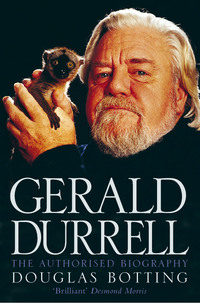
Читать книгу: «Gerald Durrell»
GERALD DURRELL
THE AUTHORISED BIOGRAPHY
Douglas Botting

Copyright
HarperCollinsPublishers Ltd. 1 London Bridge Street London SE1 9GF
www.harpercollins.co.uk
First published in Great Britain by HarperCollinsPublishers in 1999
Copyright © Douglas Boning 1999
The Author asserts the moral right to be identified as the author of this work
A catalogue record for this book is available from the British Library
All rights reserved under International and Pan-American Copyright Conventions. By payment of the required fees, you have been granted the nonexclusive, nontransferable right to access and read the text of this ebook on screen. No part of this text may be reproduced, transmitted, downloaded, decompiled, reverse engineered, or stored in or introduced into any information storage and retrieval system, in any form or by any means, whether electronic or mechanical, now known or hereinafter invented, without the express written permission of HarperCollins ebooks
HarperCollinsPublishers has made every reasonable effort to ensure that any picture content and written content in this ebook has been included or removed in accordance with the contractual and technological constraints in operation at the time of publication
Source ISBN: 9780006387305
Ebook Edition © JANUARY 2014 ISBN: 9780007381227
Version: 2019-06-10
Praise
Further reviews for Gerald Durrell:
‘Douglas Botting is to be congratulated on Gerald Durrell. He has done a magnificent job in telling the complex story of a complex person, wrinkles and all. Here is your chance to rediscover the man who for over sixty years exasperated and fascinated his friends and fans, giving hope to generations that there was a future for animals, plants and people.’
DAVID BELLAMY, Literary Review
‘The book serves up so much by way of compelling detail that the reader forges happily ahead … [an] affectionate account of a rumbustious figure.’
PENELOPE LIVELY, Daily Telegraph
‘Douglas Botting’s biography of Gerald Durrell is a whacking great book … But then, the environmentalist, naturalist, humorist, bestselling author and adventurer was a whacking great personality. His riotous enjoyment of life and his passion-ate, loving struggle for animal conservation fly off the pages. It’s an absorbing, hugely appealing story.’
New Scientist
‘Botting’s admiration and affection for his subject are infectious.’
Sunday Times
‘An extraordinary story … a biographer’s dream.’
EDWARD MARRIOTT, Evening Standard
‘Douglas Botting quotes continually from unpublished material – letters, journals, diaries – which prove to be a treasure-house of agile and acute observation … [He] is a perceptive, vigorous, unabashed chronicler … at his best in dealing with the complexities of Durrell’s own character and the crises in his life … This is the most enjoyable biography I have read for years.’
J.B. PICK, Scotsman
‘A compelling read.’
DAVID NICHOLSON-LORD, Financial Times
‘Botting gives us a full-on Durrell … a wonderfully detailed account.’
RICHARD D NORTH, Independent
‘Exhaustive research … poignant reading.’
CAROLINE MOOREHEAD, Spectator
‘Absorbing.’
Tatler
‘Gerald Durrell was a man of immense character as this enormous biography testifies … and he shines out of these pages. Botting’s writing style is a delight. He has a wry eye and his own dry wit … He has told a powerful story.’
JULIA LANGDON, The Herald (Glasgow)
‘Wonderfully affectionate account … wonderfully readable.’
CHRISTINE BARKER, Birmingham Post
‘The best parts are the descriptions of furry animals – both Durrell’s and the author’s – which appear on page after page … the book is a love story of a sort.’
ROY HATTERS LEY, Mail on Sunday
‘Joyful reading … Botting is on sure, captivating ground as he relates Durrell’s escapades … a valuable chronology of Durrell’s experiences.’
ROSEMARY GORING, Scotland on Sunday
‘Douglas Botting paints a vivid picture … an excellent reflection of the man behind the magic’
ISOBEL OSMONT, Jersey Evening News
‘This revealing and compulsive biography will inspire many generations to come.’
JOHN BURTON, World Land Trust Review
‘Botting’s biography is vast, vibrant, intense.’
MICK MIDDLES, Manchester Evening News
‘In this superb biography Douglas Botting keeps you turning the pages and even succeeds in conjuring tears at the end. Meticulous research has enabled him to bring us an in-depth picture of the man. It is a measure of its success that I seriously resented having to go to work, or to bed, whilst reading it.’
HILARY PAIPETI, The Corfiot Magazine, Greece
Epigraph
Right in the Hart of the Africn Jungel a small wite man lives. Now there is one rather xtrordenry fackt about him that is that he is the frind of all animals.
From ‘The Man of Animals’ by Gerald Durrell, aged ten
Whoever saves one life,
Saves the world.
The Talmud
When you get to the Pearly Gates and St Peter asks you, ‘Well, what did you do?’ if you can say, ‘I saved a species from extinction,’ I think he’ll say, ‘OK, well, come on in.’
John Cleese
Contents
COVER
TITLE PAGE
COPYRIGHT
PRAISE
EPIGRAPH
PREFACE
PROLOGUE
PART 1: ‘The Boy’s Mad … Snails in his Pockets!’
1 Landfall in Jamshedpur: India 1925–1928
2 ‘The Most Ignorant Boy in the School’: England 1928–1935
3 The Gates of Paradise: Corfu 1935–1936
4 The Garden of the Gods: Corfu 1937–1939
5 Gerald in Wartime: England 1939–1945
6 Odd-Beast Boy: Whipsnade 1945–1946
7 Planning for Adventure: 1946–1947
PART 2: Promise Fulfilled
8 To the Back of Beyond: First Cameroons Expedition 1947–1948
9 In the Land of the Fon: Second Cameroons Expedition 1948–1949
10 New Worlds to Conquer: Love and Marriage 1949–1951
11 Writing Man: 1951–1953
12 Of Beasts and Books: 1953–1955
13 The Book of the Idyll: 1955
14 Man and Nature: 1955–1956
15 ‘A Wonderful Place for a Zoo’: 1957–1959
PART 3: The Price of Endeavour
16 A Zoo is Born: 1959–1960
17 ‘We’re All Going to be Devoured’: Alarms and Excursions 1960–1962
18 Durrell’s Ark: 1962–1965
19 Volcano Rabbits and the King of Corfu: 1965–1968
20 Crack-Up: 1968–1970
21 Pulling Through: 1970–1971
22 The Palace Revolution: 1971–1973
23 Gerald in America: 1973–1974
24 ‘Two Very Lost People’: 1975–1976
25 Love Story: Prelude: 1977–1978
26 Love Story: Finale: 1978–1979
PART 4: Back on the Road
27 A Zoo with a View: 1979–1980
28 Ark on the Move: From the Island of the Dodo to the Land of the Lemur 1980–1982
29 The Amateur Naturalist: 1982–1984
30 To Russia with Lee: 1984–1985
31 Grand Old Man: 1985–1991
PART 5: A Long Goodbye
32 ‘Details of my Hypochondria’: 1992–1994
33 ‘A Whole New Adventure’: 1994–1995
AFTERWORD
THE DURRELL WILDLIFE CONSERVATION TRUST
SOURCES
BIBLIOGRAPHY
INDEX
ABOUT THE AUTHOR
BY THE SAME AUTHOR
ABOUT THE PUBLISHER
Preface
I met Gerald Durrell only once in the flesh. It was in the early summer of 1989 at the London Butterfly House in Syon Park, where he and his wife Lee ceremonially launched an initiative called ‘Programme for Belize’ – intended to save for posterity a superb tract of tropical forest in the north-east of that country – by releasing newly hatched Belizean butterflies into the Butterfly House. Our encounter afterwards, as Durrell passed down a line of extended hands on his way out through the door, was brief, polite and perfunctory. At this meeting neither he nor I could have dreamed that biographer was meeting biographee. Had we known it, we would have had a lot to talk about. With better luck all round, we might have been talking still.
I thought no more about this until, one scorching late September noon in 1994, I found myself sitting with my elder daughter Kate on the terrace of the White House, Lawrence Durrell’s old pre-war home at Kalami on the north-east coast of Corfu, watching the caïques coming in to the bay one by one, each with its complement of tourists on board. Across the water I could hear the running commentary of the Greek skippers. ‘And now we enter beautiful Kalami Bay,’ they intoned. ‘On your left you will see the famous White House where Gerald Durrell once lived in Corfu and wrote his famous book, My Family and Other Animals …’
Gerald Durrell, of course, had done nothing of the kind. I turned to Kate. ‘That’s all wrong,’ I said. ‘Someone ought to do something to get it right. Come to think of it, someone ought to do something about writing a proper biography of Gerald Durrell.’
Kate, who was a Durrell fan, replied: ‘Perhaps you ought to write it yourself.’
It was not a totally wild idea. I had already written two books about traveller-naturalists, and my recently published biography of the author-naturalist Gavin Maxwell had been well enough received for me to begin to think about writing some kind of sequel. I had read most of Gerald Durrell’s books, I had even reviewed one or two for the national press, I felt I understood his world and mind-set, I had even – dammit! – shaken the man by the hand in the Butterfly House. As soon as I returned to England I phoned Gerald Durrell’s personal assistant at Jersey Zoo, and on his advice wrote to Durrell’s literary agent enclosing a copy of my latest book and, for good measure, proposing myself as her client’s future biographer.
Within a few hours my book was in Durrell’s hands in a London hospital ward, where he lay gravely ill after a major operation. He knew of Gavin Maxwell, of course, and had reviewed Ring of Bright Water for the New York Times. He opened the book and read the first lines of the preface: ‘The sea in the little bay is still tonight and a full moon casts a wan pallor over the Sound and the hills of Skye. A driftwood fire crackles in the hearth of the croft on the beach, and through the open window I can hear all the sounds and ghosts of the night – the kraak of a solitary heron stalking fish in the moonlight at the edge of the shore, a seal singing softly in the bay, the plaintive child-like voice rising and falling like a lullaby in the dark …’ Here in the noisy bedlam of the public ward, a world of bedpans, drips, catheters, trolleys and rubber sheets, of pain, squalor and despair, his weary head sunk deep into his hard starched pillow, his wild white hair strewn about him, he recognised at once a kind of mirror image of his own past life and dreams. He turned the page. ‘A guru of the wilds among a whole generation, Gavin Maxwell was ranked with John Burroughs, W. H. Hudson and Gerald Durrell as one of the finest nature writers of the last hundred years …’
Durrell sat up a bit. For some time he had been putting together scattered fragments of his own autobiography. But lately, as the ceaseless cycle of fever and crisis, relapse and remission continued seemingly without end, he had put aside his notebook and pen. From time to time in recent years he had been approached by authors or would-be authors who had put themselves forward as his prospective biographer. Many of these had been wishful-thinkers and no-hopers, but one or two had been serious candidates. So long as he was well and active the story of his life was his own copy, and his alone. But now the situation had changed. He asked his wife Lee to read the book aloud to him, and as she read he began to feel that perhaps he had found his biographer. Henceforth the biography was a reality, something to aim at, a goal to achieve. In the highly adverse circumstances in which he found himself, it was to be one of the last preoccupations of his life.
Gerald was anxious to meet up with me in order to talk about the project face to face, and to come to a decision. But each time Lee called me with a date on which to visit the hospital she would have to ring back to reschedule, because Gerald was back in intensive care. Our meeting was not to be. Shortly after his death in January 1995, Lee authorised me to write a full and frank account of his life and work.
Over the next two years, I came to know more about Gerald Durrell than I did about myself. I thought I had got the measure of the man. Then one day I came upon an extraordinary, and utterly unexpected, sequence of private love letters. Here was a man moved by passion, joy, fear, romantic and erotic love, and by gratitude to the love of his life and to life itself and to the world. As I read, I inwardly sang and laughed and declaimed with him. And then I came to a letter written on 31 July 1978, and I fell silent:
I have seen a thousand moons: harvest moons like golden coins, winter moons as white as ice chips, new moons like baby swans’ feathers … I have felt winds as tender and warm as a lover’s breath, winds straight from the South Pole, bleak and wailing like a lost child … I have known silence: the implacable stony silence of a deep cave; the silence when great music ends … I have heard tree frogs in an orchestration as complicated as Bach singing in a forest lit by a million emerald fireflies. I have heard the cobweb squeak of the bat, wolves baying at a winter’s moon … I have seen hummingbirds flashing like opals round a tree of scarlet blooms. I have seen whales, black as tar, cushioned on a cornflower blue sea. I have lain in water warm as milk, soft as silk, while around me played a host of dolphins … All this I did without you. This was my loss …
As I read, I began to realise, first with disbelief and then with some degree of unease, that the voice inside my head was no longer my own. I had heard enough of Gerald Durrell’s soft, beguiling, cultured English diction on tapes of interviews and radio and television broadcasts to be able to identify it with certainty. There was no doubt. The voice reading this impassioned love letter was Durrell’s own. Not only had I got the measure of Gerald Durrell; Gerald Durrell, it seemed, had got the measure of me. I recalled something Sir David Attenborough had said at the farewell celebration of the man in London after his death: ‘Gerald Durrell was magic.’
This, then, is the biography of Gerald Durrell – naturalist, traveller, raconteur, humorist, visionary, broadcaster, best-selling author, one of the great nature writers of the twentieth century, one of the great conservation leaders of the modern world, champion of the animal kingdom, founder and Honourary Director of Jersey Zoo and the Jersey Wildlife Preservation Trust, saviour of endangered species, champion of the lowly, the defenceless and the doomed.
I don’t think it is hyperbole to say that though Gerald Durrell was not a particularly saintly man – his warts were several, and sometimes spectacular – he led a saintly life in pursuit of a saintly mission: simply put, to save animal species from extinction at the hands of man. In his way he was a latter-day St Francis, confronting a problem that St Francis could never have conceived in his worst nightmare. Since his struggle with that problem helped to kill him, it could be said that Gerald Durrell laid down his life for the animal kingdom and the world of nature he loved.
From the outset this biography was conceived as a full, searching and rounded portrait of the man, his life and his work. It was Lee Durrell’s wish, when she authorised the book after her husband’s death, that it should be so. In other words, though this book is described as the ‘authorised’ biography, I have had carte blanche in the writing of it, and the portrait of the man and the narrative of the life are mine and mine alone – though none of it could have been put together without the help of many others.
What ‘authorised’ actually means in this case is that I have been allowed exclusive access to the personal and professional archives of Gerald Durrell (which are voluminous) and to the files of the organisation he founded and directed, the Jersey Wildlife Preservation Trust (now renamed the Durrell Wildlife Conservation Trust). I also enjoyed unqualified freedom in approaching anybody involved in the Gerald Durrell story, of whom there are many.
I would especially like to thank Dr Lee Durrell, Gerald Durrell’s widow and Honorary Director of the Durrell Wildlife Conservation Trust, for her unstinting support and tireless assistance during the researching and writing of this biography. I am doubly grateful to her, first for allowing me unconditional access both to the Durrell private archives and the archives of Jersey Zoo and Trust, and second for allowing me to refer to and quote from the unpublished works of Gerald Durrell in this book. I would also particularly like to thank Jacquie Durrell, who plays a crucial part in this story at several key stages, for her tremendous help and encouragement in the preparation of the first half of this biography, as well as those who have contributed to this story from its very centre – Margaret Duncan (née Durrell), Jeremy Mallinson OBE (Director of the Durrell Wildlife Conservation Trust), John Hartley (International Programme Director of the Trust), Simon Hicks (currently Development Director of the Trust) and Tony Allchurch (General Administrator, Jersey Zoo). I am also grateful to Peter Harrison, who between teaching assignments in Poland, Russia and the Gulf delved tirelessly into the Durrells’ early years, introduced me to Gerald Durrell’s Corfu and its dramatis personae, and produced a meticulous gloss on my first draft; John and Vivien Burton of the World Land Trust, for many valuable comments and insights; Anthony Smith, for his untiring advice in matters of science and zoology; and Sir David Attenborough, for critically important guidance. Thanks also to my publisher Richard Johnson and my editor Robert Lacey at HarperCollins for the care and support they have afforded this project, and my agent Andrew Hewson at John Johnson and Gerald Durrell’s agent Anthea Morton-Saner at Curtis Brown for all their hands-on help and encouragement in bringing this huge task to fruition.
My thanks to Curtis Brown, acting on behalf of Mrs Lee Durrell, for permission to quote from published and unpublished works by Gerald Durrell.
Extracts from Lawrence Durrell’s book Prospero’s Cell (Faber & Faber, 1945), Bitter Lemons (Faber & Faber, 1957) and Spirit of Place, Mediterranean Writings (Faber & Faber, 1969) are reproduced by kind permission of the publishers.
Extracts from Jacquie Durrell’s Beasts in my Bed (Collins, 1967) are reproduced by kind permission of the author; extracts from David Hughes’s Himself and Other Animals: A Portrait of Gerald Durrell (Hutchinson, 1997) are reproduced by permission of the author and the publishers.
I would also like to thank Jill Adams; Michael Armstrong; Marie Aspioti; Michael Barrett; Quentin Bloxam (General Curator, Durrell Wildlife Conservation Trust); Kate and Anna Botting; Gordon Bowker; Gerry Breeze; Nicholas Breeze; Sarah Breeze; Tracy Breeze; Felicity Bryan; Rev. Geoffrey Carr; David Cobham; Philip Coffey; Anthony Condos; Menelaus Condos; Fleur Cowles; Sophie Danforth; Anthony Daniells; Eve Durrell; Mr and Mrs Alex Emmett; Doreen Evans; Dr Roger Evans (Manuscript Department, British Library); Tom Evans; W. Paterson Ferns; Bronwen Garth-Thornton; Bob Golding; Anna Grapes; Peter Grose; Lady Rhona Guthrie; Dr Jeremy Guyer; Jonathan Harris; Paula Harris; Gwen Hayball; E.C. (Teddy) Hodgkin; Penelope Hope (née Durrell); David Hughes; Dr Michael Hunter; The Earl of Jersey; Carl Jones; Colin Jones; Dorothy Keep; Sarah Kennedy; Françhise Kestsman; Patrick Leigh-Fermor; Vi Lort-Phillips; Thomas Lovejoy; Judy Mackrell; Odette Mallinson; Stephen Manessi; Dr Bob Martin; Alexandra Mayhew; Alexia Mercouri; Dr Desmond Morris; Lesley Norton; Richard Odgers; Dr Alan Ogden; Dr Guy O’Keeffe; Peter Olney; Eli Palatiano; Christopher Parsons OBE; Joss Pearson; Peggy Peel; Lucy Pendar; Julian Pettifer; Joan Porter; Tim R. Newell Price (Archivist, Leighton Park School); Betty Renouf; Dr Marielle Risse; Robin Rumboll; Tom Salmon; Peter Scott; Richard Scott-Simon; Dr Bula Senapati; Maree Shillingford; Trudy Smith; Mary Stephanides; Dr Ian Swingland; Dr Christopher Tibbs; Lesley Walden; Sam and Catha Weller; Edward Whitley; Celia Yeo.
Douglas Batting
14 December 1998
Prologue
The blue kingdom of the sea is a treasure-house of strange beasts which the boy longs to collect and observe. At first it is frustrating, for he can only peck along the shoreline like some forlorn seabird, capturing the small fry in the shallows and occasionally being tantalised by something mysterious and wonderful cast up on the shore. But now he has got a boat, and the whole kingdom is opened up for him, from the golden red castles of rock and their deep pools and underwater caves in the north to the long, glittering white sand dunes lying like snowdrifts in the south.
When he goes on any long expedition in the boat the boy always takes plenty of food and water in case he is blown off course and shipwrecked. If he has a full crew on board – three dogs, an owl, and sometimes a pigeon – and is carrying a full cargo – some two dozen containers full of seawater and specimens – it is a back-aching load to push through the water with the oars.
On this particular day the boy has decided to pay a visit to a small bay where a host of fascinating creatures dwell. His particular quarry is a peacock blenny, a curious-looking fish with a body shaped like an eel, and pop eyes and thick lips vaguely reminiscent of a hippopotamus. The boy is anxious to capture some of these colourful little fish, since it is their breeding season, and he is hoping to establish a colony of them in one of his aquariums so that he can watch their courtship.
After half an hour’s stiff rowing he reaches the bay, which is rimmed with silvery olive groves and great tangles of broom that sends its heavy, musky scent out over the still, clear waters. He anchors the boat in two feet of water near the reef, and then, armed with his butterfly net and a wide-mouthed jar, he steps into the gin-clear sea which is as warm as a bath.
Everywhere there is such a profusion of life – sea slugs, sea urchins, chitons and top shells, hermit crabs and spider crabs – that it requires stern concentration for the boy not to be diverted from his task. Before long he catches a fine male blenny, brilliant and almost iridescent in its courting outfit of many colours, and by lunchtime he has also collected two green species of starfish which he has not seen previously.
The sun is now blisteringly hot, and most of the sea life has disappeared under rocks to lurk in the shade. The boy makes his way to the shore to sit under the olive trees and eat his lunch. The air is heavy with the scent of broom and full of the zinging cries of cicadas. Presently, after finishing his lunch, he loads up the boat, gets the dogs on board, and begins to row home so that he can settle the blennies in their aquarium.
When he gets up the next morning he finds, to his intense annoyance, that the blennies must have been active at dawn, for a number of eggs have been laid on the roof of the catching pot. Which female is responsible for this he does not know, but the male is a very protective and resolute father, attacking the boy’s finger when he picks up the pot to look at the eggs.
The boy waits eagerly for the baby blennies to appear, but there must be something wrong with the aeration of the water, for only two of the eggs have hatched. One of the diminutive babies, to his horror, is eaten by its own mother, before his very eyes. Not wishing to have a double case of infanticide on his conscience, he puts the second baby in a jar and rows back down the coast to the bay where he caught its parents. Here he releases it, with his blessing, into the clear tepid water ringed with broom, hoping against hope that it will rear many multicoloured offspring of its own.
As a pioneer experiment in captive breeding, the blenny business is not an unqualified success. But it doesn’t matter. The blenny is not an endangered species. The sea round Corfu is stuffed with blennies. And there is plenty of time, for the boy, Gerald Durrell, is still only twelve years old, a whole life with animals stretches before him, and the summer blazes on for eternity.
PART ONE ‘The Boy’s Mad … Snails in his Pockets!’
ONE Landfall in Jamshedpur India 1925–1928
Gerald Malcolm Durrell was born in Jamshedpur, Bihar Province, India, on 7 January 1925, the fourth surviving child of Louisa Florence Durrell (nee Dixie), aged thirty-eight, and Lawrence Samuel Durrell, forty, a civil engineer.
When Gerald was older his mother told him something about the circumstances of his entry into the world. During the later stages of her pregnancy, it seems, she had swelled up to a prodigious degree, her enormous girth accentuated by her diminutive height, for she stood only five feet tall in her stockinged feet. Eventually she had grown so ashamed of her immense rotundity that she refused to leave the house. This annoyed her husband, who told her she ought to get out and about and go down to the Club, the social and recreational centre where all the local members of the British Raj used to congregate. ‘I can’t go to the Club looking like this,’ she retorted. ‘I look like an elephant.’ Whereupon Gerald’s father suggested building a howdah in which she could pass unnoticed, a flippancy which so annoyed her that she refused to speak to him for two days.
‘As other women have cravings for coke or wood shavings or similar extraordinary foods when they are in this state,’ Gerald was to record in an unpublished memoir about his Indian childhood, ‘my mother’s craving was for champagne, of which she drank an inordinate quantity until I was born. To this I attribute the fact that I have always drunk excessively, and especially champagne, whenever I could afford it.’
Gerald was by far the largest of his mother’s babies, which might explain why she had grown so huge during her pregnancy, and when he was fully grown he would stand head and shoulders not only above her but above his sister and two brothers, who were all almost as small as their mother. But his birth, when it came, was simple. ‘I slipped out of her like an otter into a pool,’ he was to write, relating what his mother had told him. The staff from the household and from his father’s firm gathered round to congratulate the sahib and memsahib on the arrival of their latest son. ‘All the Indians agreed that I was a special baby, and that I had been born with a golden spoon in my mouth and that everything during my lifetime would be exactly as I wished it. Looking back at my life, I see that they were quite right.’
Both of Gerald’s parents, as well as his grandfather on his mother’s side, were Anglo-Indians in the old sense of the term (not Eurasians, but British whites with their family roots in India) who had been born and brought up in the India of the Raj. His father had been born in Dum Dum in Bengal on 2.3 September 1884, and his mother in Roorkee, North-West Province, on 16 January 1886. Her father too had been born in Roorkee, and was six years old when the Indian Mutiny polarised the subcontinent in 1857.
Gerald’s family thus had little knowledge or experience of the distant but hallowed motherland of England. The depth of their association with India, which they regarded as their true home and native land, was such that when, many years later, Gerald’s mother applied for a British passport, she was to declare: ‘I am a citizen of India.’ Though Gerald was not to live long in India, its influence on his sense of identity was palpable, and at no point in his life was he ever to feel himself entirely English, in terms of nationality, culture or behaviour. For his three older siblings, who lived a good deal longer in India – Lawrence George (not quite thirteen when Gerald was born, and at school in England), Leslie Stewart (seven, and also about to go to school in England) and Margaret Isabel Mabel (five) – the sense of dislocation was even stronger.
Gerald’s mother was of pure Protestant Irish descent, the Dixies hailing from Cork in what is now the Irish Republic. It was to this Irish line that two of her sons, Gerald and Lawrence, were to attribute their gift of the gab and wilder ways. Louisa’s father, George Dixie, who died before her marriage, had been head clerk and accountant at the Ganges Canal Foundry in Roorkee. It was in Roorkee that she first met Lawrence Samuel Durrell, then aged twenty-five, who was studying there, and in Roorkee that the couple married in November 1910. ‘God-fearing, lusty, chapel-going Mutiny stock’, was how Gerald’s eldest brother Lawrence was to describe the family’s Indian roots. ‘My grandma sat up on the veranda of the house with a shotgun across her knees waiting for the mutiny gangs: but when they saw her they went the other way. Hence the family face … I’m one of the world’s expatriates anyhow.’
Louisa Durrell was an endearing woman, rather shy and quietly humorous, and totally dedicated to her children. She was so protective towards her brood that she was for ever rushing home from parties and receptions to make sure they were safe and sound – not without reason, for India was a dangerous place for children: her second-born, Margery Ruth, had died of diphtheria in early infancy, and Lawrence and Leslie were often ill with one ailment or another. Her husband adored her, but forbade her from involving herself in most of the usual routines and duties of a wife and mother of her era (including the daily practicalities of running a home and family, all of which were attended to by the native servants) because he felt she should observe the proprieties of her status as a memsahib of the Raj.
But though she was utterly devoted to her dynamic, patriarchal and largely conventional husband, and seemingly compliant to his every wish, there lay behind Louisa’s quiet, non-confrontational façade a highly individual and unusual woman, independent of spirit and not without fortitude, who unobtrusively went her own way in many things and quietly defied the rigid codes of conduct laid down for her sex in that era of high empire. As an Anglo-Indian, she was less mindful of her exalted status than the average white memsahib who passed her time in the subcontinent in a state of aloof exile. As a young woman she had defied convention and trained as a nurse, and had even scrubbed floors (unheard of for a white woman in India then). When her husband’s work took him up-country or out into the wilds, his young wife, along with their children, would go with him and rough it without complaint. When he was back in town, and out at the office or on a construction site, she would spend hours in the heat and smoke of the kitchen learning from cook the art of curry-making, at which she became very adept, and developing a taste for gin at sundown, though Lawrence Samuel made sure she limited herself to no more than two chota-pegs a day. It was probably from his mother that Gerald (like his two brothers) inherited his humour and the alcohol gene. But it was from his father that he inherited his bright blue eyes and hair type (full and flopping over his eyes) and his height, exceptional in an otherwise very short family.
Physically minute, impractical, fey and seemingly somewhat bewildered as a person, Louisa was also in a way rather Oriental in her outlook and mindset – her son Lawrence was to describe her as a kind of born-again Buddhist. If Father was the respectable, uncomplicated patriarch, Mother was to a degree his opposite. ‘My mother was the neurotic,’ Lawrence Durrell once remarked. ‘She provided the hysterical Irish parts of us and also the sensibility that goes with it. She’s really to blame for us, I think – she should have been run in years ago.’ Not altogether surprisingly, she had an interest in the paranormal. Perhaps it was the Irish in her, perhaps it was the miasma of India, but she had a fondness for ghosts, and felt no fear of them. In one of the family’s Indian postings their house backed on to a wild forest, and the servants, shivering with fright, would complain to Louisa of the lonely spirit that cried there at night. She would then take a lantern – so the story goes – and set off into the depths of the forest on her own, with the servants trying to stop her, crying, ‘Oh memsahib, oh memsahib,’ until she was swallowed up by the trees and all they could hear was her voice calling out, ‘Come on, come on,’ as if trying to placate the lonely, desolate spirit.
Mother was to remain a hugely important figure in the lives of her offspring. ‘I was the lucky little bastard that got all the attention,’ Gerald was to recall years later. ‘She was a most marvellous non-entity; a great mattress for her children.’ But though Gerald was always the closest to his mother, it was Leslie who was her favourite, perhaps because she realised he might have the most need for her. Everyone loved Louisa – everyone, that is, except her eldest son Lawrence, who never forgave her for allowing him to be sent to England to complete his education, abandoned among the ‘savages’.
Gerald’s father, Lawrence Samuel Durrell, was, strictly speaking, not a Durrell at all. The facts of the matter are buried in a tangle of relationships involving his grandmother, Mahala Tye, in the depths of rural Suffolk in the early years of the Victorian era. After the suicide of her first husband, William Durrell, it seems that Mahala gave birth to an illegitimate son, whose biological father was a Suffolk farmer by the name of Samuel Stearne. Shortly afterwards Mahala married Henry Page, a labourer, who became the baby’s stepfather and by whom she had five other children. Later in life the illegitimate son – the future grandfather of Gerald Durrell – sailed to India, and in Lucknow in 1883 he married for the second time, to Dora Johnstone, the twenty-one-year-old daughter of a sergeant-major in the Royal Horse Brigade, by whom he had eight children. Grandfather Durrell went on to serve with distinction in the Boxer Rebellion in China, rising eventually to the rank of major and dying in Portsmouth in 1914, shortly after volunteering for active service in the Great War at the age of sixty-three. The first of his children by his second wife was Gerald Durrell’s father, Lawrence Samuel, elevated from birth by his illegitimate father’s steady climb through the social scale from yokel stock to officer class.
Lawrence Samuel Durrell by all accounts was a decent but rather distant and often absent figure to his children, for his work as an engineer took him across the length and breadth of British India, from the Punjab and the Himalayas to Bengal, and as far away as the jungles of Burma. According to his eldest son, Lawrence, he was a good, serious, sincere man, deeply imbued with the Victorian faith in the overriding power of science to solve all things. He was not an imaginative man, nor was he particularly cultured, but though he was a straightforward servant of empire, he was not an entirely conventional one; he did not live like the British but like the Anglo-Indians, and he resigned from his club when an Oxford-educated Indian doctor he had proposed for membership was blackballed, even though he had saved his eldest son’s life. This disregard for racial distinctions was shared by his wife.
Gerald’s father was clearly a man of exceptional ability, determination and industry who rose from relatively modest beginnings to become a trail-blazing railway builder and civil engineer of the kind celebrated by the laureate of the Raj, Rudyard Kipling – an empire-builder in the classic mould. Dedicated to playing his part in laying down the infrastructure of a modern, industrialising India, from the construction of roads, railways, canals and bridges to the building of hospitals, factories and schools, Lawrence Samuel slogged away in monsoon and jungle, carting his family around with him like a band of privileged gypsies, and earning the highest commendations from his employers. ‘A splendid man at his work,’ went one report, ‘full of energy and careful over details … With tact and gentle persuasion, Mr Durrell has managed his workmen splendidly.’
By 1918 Lawrence Samuel was Chief Engineer with the Darjeeling and Himalaya Railway on the India-Tibet border, leaving two years later to found his own company – Durrell & Co., Engineers and Contractors – in the new industrial boom town of Jamshedpur, planned and built as a ‘garden city’ by the giant Tata Iron and Steel Company, but in those days a raw-edged place in the middle of a hot, dusty plain. In the four years preceding Gerald’s birth he became one of the fat cats of British India, successful, rich – and desperately overworked.
Most of the major construction projects that Durrell & Co. helped to build in Jamshedpur still stand today, among them extensions to the Tata works, the Tinplate Company of India, the Indian Cable Company, the Enamelled Ironware Company and much else beside, including ‘Beldi’, the home in which Gerald was born and in which he spent the first years of his life. ‘Beldi’ was a regulation D/6 type bungalow in European Town, Jamshedpur, a residence appropriate to Lawrence Samuel Durrell’s status as a top engineer – a rung or two below the Army and the Indian Civil Service, a rung or two above the box-wallahs and commercials. It was not grand, but it was comfortable, with cool, shuttered rooms, a large veranda with bamboo screens against the heat of the sun, and a sizeable garden of lawn, shrubs and trees, where Gerry the toddler took his first steps.
Gerald was never much aware of his three older siblings during his infant years in India. His elder brother Lawrence had already been packed off to school in England by the time he was born, and Leslie (now back in India) and Margaret (five years his senior), had advanced far beyond baby talk and infant toys. He was even less aware of the outer fringes of the Durrell family network – the army of aunts and his daunting paternal grandmother, Dora, the overweight, doom-preaching, oppressive and rather terrifying matriarch known as ‘Big Granny’, who circulated around the family and was destined not to expire until 1943. For much of his time Gerald was left in the company of his Indian surrogate mother, or ayah. ‘In those days children only saw their parents when they were presented to them at four o’clock for the family tea,’ Margaret was to recall. ‘So our lives revolved around the nursery and our Hindu ayah and Catholic governess. Gerry would have had more to do with the ayah than we older children did, so the biggest influence in his Indian years would have been the Indian rather than the European part of the household.’
In later years Gerald claimed to remember a number of incidents from his early life in Jamshedpur. One of the most vivid of these, often recounted, was his first visit to a zoo, an experience so memorable that he attributed to it the beginning of his lifelong passion for animals and zoos. In fact there was no zoo in Jamshedpur in Gerald’s day, though there is one now. Even if there had been a zoo, it is highly unlikely that Gerald could have remembered it, for when he was only a toddler of fourteen months he left Jamshedpur with his father, mother, sister Margaret and Big Granny Dora, never to return. On 11 March 1926 the Durrell party sailed from Bombay for England on board the P&O ship SS Ranchi, and by April they were in London.
In the India of that time it was normal for British servants of the Raj to take a furlough in Britain roughly every two years, but it seems that the Durrells also had a mission to perform during their visit. Lawrence Samuel was keen to find a property to buy in London, either as an investment or as a place to retire to, or both. As a successful engineer of empire he had begun to amass a small fortune, and had already invested in a large fruit farm in Tasmania, which he had purchased unseen. He was now forty-two, and his workload was punishing. Many years later his future (albeit posthumous) daughter-in-law Nancy, first wife of his eldest son Lawrence, was to recall as she lay dying: ‘Father decided he’d had enough of this sort of life and wanted to go to England and live an entirely different sort of life. His ambition was to go on the stage and partner Evelyn Laye in the music hall.’ Whether this was true (which seems improbable) or was one of Lawrence’s numerous canards (which seems very possible), it appears that Father did intend to strike camp at some time, and leave an India where the clamour for self-rule was growing noticeably more vociferous and militant. But not yet. In due course he purchased a suitably grand eight-bedroomed house at 43 Alleyn Park in Dulwich, not far from Lawrence and Leslie’s schools.
On 12 November 192.6 Big Granny sailed back to Bombay on board the SS Rawalpindi after a six-month spell in England. A little later Louisa, Leslie, Margaret and Gerald followed her. They returned not to Jamshedpur but to Lahore, where Lawrence Samuel, who was engaged on contract work in the region, had established a new home in a substantial bungalow at 7 Davis Street. It was in Lahore that such memories as Gerald retained of his life in India were formed – though these were fragmentary and fleeting, and undoubtedly coloured by what his mother, brothers and sister later told him.
From an early age, it seems, Gerald was endowed (like his brother Lawrence) with a highly developed, almost photographic memory. He was to recall in an unpublished memoir:
My handful of memories of this time were just little sharply etched vignettes in brilliant colour, with sight and sound and smell and taste added – the scarlet of the sunsets, for example, the harsh singing cries of a peacock, the smell of coriander and bananas, the tastes of different kinds of rice, especially the wonderful taste of my favourite breakfast, which was rice boiled in buffalo milk with sugar. I remember I used to wear little suits made out of tussore. I remember the lovely colour of it – a very pale biscuit brown – and the delicious soft silky feel of it and the rustling sound it made as my ayah dressed me in the morning. I remember my ayah refused to wake me in the morning unless it was to the strains of Harry Lauder on the gramophone, because otherwise I would be grumpy and morose and she couldn’t do anything with me. The gramophone was a wind-up one and although it was very scratchy, like a lot of mice in a tin box, it was wonderful to my ears, and I would wake up with a beaming smile on my face, which made my ayah heave a sigh of relief.
It was in the India of his infancy that Gerald’s intense sense of colour was born, but it was the young child’s first glimpse of other life forms that was to have the profoundest impact on him. That glimpse was brief and unpromising, but for Gerald it was unforgettable, and from it all else was to follow. He was walking with his ayah, he remembered, and happened to wander to the edge of the road, where there was a shallow ditch.
Here I found two enormous slugs, at least they appeared enormous to me, though they were probably not much more than three or four inches long. They were pale coffee colour with dark chocolate stripes and they were slowly sliding about over each other in a sort of dance and the slime from their bodies made them glitter as though they were freshly varnished. They were glutinous and beautiful and I thought they were the most marvellous creatures I had ever seen. When my ayah discovered I was slug-watching she pulled me away and told me that I must not touch or even watch such disgusting creatures as they were dirty and horrible. I could not understand, even at that age, that she could think such beautiful creatures could be dirty, and throughout my life I have met so many people who think things are disgusting or dirty or dangerous when they are nothing of the sort but miraculous pieces of nature.
Before long the infant Gerald really did set foot inside his first zoo, and his life was transformed for evermore. The zoo was in Lahore (not, as he was later to recall, in Jamshedpur), and the impact of this modest establishment was overwhelming. Gerald was to recall of this landmark in his life:
The rich ammonia-like smell coming from the tiger and leopard cages, the incredible chatter and screams from the small group of monkeys and the melodious song of the various birds that inhabited the little zoo captivated me from the start. I remember the lovely black freckles on the leopard’s skin, and the tiger, as he walked, looking like a rippling golden sea. The zoo was in fact very tiny and the cages minuscule and probably never cleaned out, and certainly if I saw the zoo today I would be the first to have it closed down, but as a child it was a magic place. Having been there once, nothing could keep me away.
According to his mother, ‘zoo’ was one of the first words Gerald ever uttered, and whenever he was asked where he wanted to go he would say ‘zoo’, loudly and belligerently. If he didn’t go to the zoo his screams of frustration could be heard ‘from the top of Everest to the Bay of Bengal’. Once, when he was too ill even to visit the zoo, Gerald was provided with a sort of substitute zoo of his own by the family butler, Jomen, who modelled a whole menagerie of animals – rhinoceros, lion, tiger, antelope – out of red laterite clay from the garden. Perhaps it was this collection of little mud replicas that gave Gerald the idea – that was to become an idée fixe by the time he was six – of having a real zoo of his own one day.
Other creatures that reinforced Gerald’s love of animals made their appearance at this time:
One day my Uncle John, Mother’s favourite brother, a great shikar [hunter] who lived at Ranchi, and was employed by the government to shoot man-eating tigers and rogue elephants, sent us, in a moment of aberration, two fat Himalayan bear cubs. They were weaned but had come straight from the wild and no attempt had been made to tame them. They had very long, sharp claws and very sharp, white teeth and uttered a series of yarring cries of rage and frustration. They were housed temporarily under a big, dome-like basket on the back lawn and a man was detailed to look after them. Of course, having your own bears was a wonderful thing, even though they did smell very lavatorial. Unfortunately, at that age Margaret was ripe for any sort of mischief, and as soon as the bears’ minder went off for some food she would overturn the bears’ basket and then run screaming into the house, shouting, ‘The bears are out! The bears are out!’ After two or three days of this my mother’s nerves could stand no more. She was terrified that the bears would escape and find me sitting on my rug and proceed to disembowel me. So the bears were packed up and sent down to the little zoo.
The long, golden days of Gerald’s privileged infancy, with an army of servants and all the perks of an imperial elite, were to come to an abrupt stop in a tragedy of great consequence for all the Durrells.
Early in 1928 Gerald’s father fell seriously ill. Though the illness was never satisfactorily diagnosed, the symptoms suggest a brain tumour of some kind. Margaret remembered her father suffering from severe headaches, and talking and behaving in a very odd and frightening manner. One day, for example, she was dismayed to see him reach for the inkwell on his desk and drink its contents as if it were a glass of whisky or a cup of tea. Friends and relatives suggested it might help if the ailing man was taken up into the cool of the hills, away from the heat of the Lahore plains, and eventually he was transported to the hill station of Dalhousie, which at a height of nearly eight thousand feet crowned the most westerly shoulder of a magnificent snowy range of the lower Himalayas. Dalhousie had a small English cottage hospital looking out over the mountains, the air was crisp and the ambience calm.
Lawrence Samuel was made as comfortable as possible, but his condition continued to deteriorate. Louisa stayed at the hospital to be near him, while the younger children were billeted at a nearby house with their Irish governess. Sometimes the family would drive out into the surrounding hills, where in the cool pine forests, loud with the rustle of the trees, the throbbing chorus of birdsong and the bubbling of the shallow, brownwater streams, Gerald was given a broader vision of the world of nature. Occasionally he was given rides on his father’s large bay horse, surrounded by a ring of servants in case he fell off. Not even the death of the horse, which fell down a cliff when Gerald suddenly startled it as it grazed with its feet tethered near the edge one day, could wean him off his burgeoning passion for the animal world.
On 16 April 1928, when Gerald was three years and three months of age, his father died of a suspected cerebral haemorrhage, and was buried the next day at the English cemetery at Dalhousie. Neither Gerald nor Margaret attended the funeral. Mother was entirely shattered.
Within the family there was a general feeling that Father’s premature death, at the age of forty-three, was brought on by worry and overwork. He had made a fortune as a railway-builder, but had fared less well when he turned to road construction, on one occasion undertaking to build a highway on a fixed-price contact, only to find that the subsoil was solid rock. His sister Elsie believed he had ‘worked himself to death’, and was told that at the moment he was taken ill he was ‘out in the heat of the midday sun supervising a critical piece of work on a bridge’. According to Nancy Durrell (who would have got it from her husband Lawrence), her father-in-law had quarrelled with the Indian partners in his business. ‘They apparently turned a bit nasty, and there was a very gruelling lawsuit, which he handled all by himself, he wouldn’t have a lawyer. But he got overexcited, and what exactly happened I don’t know, but in the end he had a sort of brainstorm, and he died rather quickly.’
In July 1928 Lawrence Samuel’s will was granted probate, and Louisa, now embarking on almost half a lifetime of widowhood, was left the sum of 246,217 rupees, the equivalent of £18,500 at the exchange rate of the time, or more than half a million pounds in today’s money. Financially enriched but emotionally beggared, she was left bereft: grieving, alone and helpless. So great was her despair that years later she was to confess she had contemplated suicide. It was only the thought of abandoning Gerry, still totally dependent on her love and care, that restrained her. Mother and child were thus bound together for ever in a relationship of mutual debt and devotion, for each, in their different ways, had given the other the gift of life.
‘When my father died,’ Gerald was to recall, ‘my mother was as ill-prepared to face life as a newly hatched sparrow. Dad had been the completely Edwardian husband and father. He handled all the business matters and was in complete control of all finances. Thus my mother, never having to worry where the next anna was coming from, treated money as a useful commodity that grew on trees.’
Gerald himself was seemingly unscathed by the family tragedy:
I must confess my father’s demise had little or no effect upon me, since he was a remote figure. I would see him twice a day for half an hour and he would tell me stories about the three bears. I knew he was my daddy, but I was on much greater terms of intimacy with Mother and my ayah than with my father. The moment he died I was whisked away by my ayah to stay with nearby friends, leaving my mother, heartbroken, with the task of reorganising our lives. At first she told me her inclination was to stay in India, but then she listened to the advice of the Raj colony. She had four young children in need of education – the fact that there were perfectly good educational facilities in India was ignored, they were not English educational facilities, to get a proper education one must go ‘home’. So mother sold up the house and had everything, including the furniture, shipped off ahead, and we headed for ‘home’.
Mother, Margaret and Gerald took a train that bore them across half the breadth of India to Bombay, where they were to stay with relatives while they waited for the passenger liner that was to carry them, first class, to England. So Gerald sailed away from the land of his birth, not to return till almost half a century had gone by and he was white-haired and bushy-bearded. Like most of the other children on board, he was a good sailor – unlike the grown-ups. ‘Two days out,’ he wrote in his unpublished memoir, ‘we were struck by a tumultuous storm. Huge grey-green waves battered the ship and she ground and shuddered. All the mothers immediately succumbed to sea-sickness, to be followed very shortly by the ayahs, who turned from a lovely biscuit brown to a leaden jade green. The sound of retching was like a chorus of frogs and the stifling hot air was filled with the smell of vomit.’
The reluctant crew were forced to take charge of a dozen or more children of around Gerald’s age. Twice a day the children were linked together by rope like a chain gang, so that none of them could fall overboard, and taken up on deck for some fresh air, before being taken back down again to play blind man’s buff and grandmother’s footsteps in the heaving, yawing dining saloon. One of the crew had a cine projector and a lot of ‘Felix the Cat’ cartoon films, and these were shown in the club room as a way of diverting the children during the long haul to Aden and Suez.
‘I was riveted,’ Gerald remembered. ‘I knew about pictures but I had not realised that pictures could move. Felix, of course, was a very simplistic, stick-like animal, but his antics kept us all enthralled. We were provided with bits of paper and pencils to scribble with, and while the others were scribbling I was trying to draw Felix, who had become my hero. I was infuriated because I could not get him right, simple a drawing though he was. When I finally succeeded, I was even more infuriated because, of course, he would not move.’
Whether it was a real live creature, or an animated image, or a drawing on a page, the child brought with him a passion and a tenderness for animals so innate it was as if it was embedded in his genes. In the years to follow, come hell or high water, this affinity was not to be denied.
So young Gerald came to a new home in a new country – and a new life without a father. The loss of the family’s patriarch was to have a profound effect on the lives of all the Durrell siblings, for, deprived of paternal authority, they grew up free to ‘do their own thing’, decades before the expression came into vogue.
TWO ‘The Most Ignorant Boy in the School’ England 1928–1935
The house at 43 Alleyn Park, in the prosperous and leafy south London suburb of Dulwich, now became the Durrell family home. It was a substantial house, befitting the family of a servant of empire who had made his pile, with large rooms on three floors and a big garden enclosing it. Before long Mother had installed Gerald’s Aunt Prudence, a butler and a huge mastiff guard dog that chased the tradesmen and according to Gerald devoured two little dogs a day. But the new house was vast, expensive to run, and haunted: one evening Mother saw the ghost of her late husband, as plain as day, smoking a cigarette in a chair – or so Gerald claimed.
Early in 1930, therefore, when Gerald was five, the family took over a large flat at 10 Queen’s Court, an annexe of the sprawling Queen’s Hotel, a Victorian pile stuck in the faded south London suburb of Upper Norwood. Mother’s cousin Fan lived here, along with other marooned refugees from the Indian Army and Civil Service, so for her the place felt almost like home. The family’s new abode was a strange, elongated flat in the hotel grounds. The entrance was through the hotel, but there was a side door which allowed access to the extensive garden, with its lawns, trees and pond. ‘The flat itself consisted of a big dining room cum drawing room,’ Gerald recalled, ‘a room opposite which was for Larry, then a small room in which I kept my toys, then a minuscule bathroom and kitchen, and finally Mother’s spacious bedroom. Lying in bed in her room, you could look down the whole length of the flat to the front door.’
Mother’s susceptibility to the paranormal showed no signs of abating, for this place too turned out to be haunted, one ghost being visible, two others audible. The first took the form of a woman who appeared at the foot of Mother’s bed when she woke from a siesta one day. The woman smiled at Mother, then faded slowly away. She appeared again a few weeks later, this time witnessed by Gerald’s cousins Molly and Phyllis, who came running into the kitchen shouting, ‘Auntie, Auntie, there’s a strange lady in your room.’
The second ghost took the form of a voice that kept telling Mother to put her head in the gas oven, and the third manifested itself in Larry’s room one night when he was playing in a jazz band up in town. In Larry’s room reposed the great teak roll-top desk that his father had had built to his own design. When the roll-top was raised or lowered the noise, Gerald recalled, was indescribable. That night, while Mother lay smoking in bed, waiting anxiously for Larry’s return, she heard the unmistakable racket of the roll-top opening and closing. ‘Taking me firmly by the hand,’ Gerald was to recount, ‘we went down the length of the flat, listening to the constant clatter of the lid being pulled shut and then opened again, but the moment we opened the door and looked into the room there was nothing to be seen.’
It was in the garden of the Queen’s Hotel, while he was trying to catch birds by putting salt on their tails, that Gerald first came face to face with the more sensual side of life, in the form of a beautiful young woman called Tabitha. ‘She had big, melting brown eyes,’ he recalled, ‘brown and glossy as new horse chestnuts, a wide smile, brown hair bobbed and with a fringe like a Christmas cracker.’ Before long Tabitha was looking after him in her tiny flat whenever Mother went off house-hunting. She had a cat called Cuthbert and two goldfish called Mr Jenkins and Clara Butt, as well as a lot of gentlemen friends who came and went and seemed to spend a shorter or longer time in her bedroom – to talk business, she told her young friend.
‘I loved the days I spent with Tabitha,’ Gerald wrote in his private memoir:
In fact I loved Tabitha very much. She was so gentle and gay, her smile engulfed you with love. She smelt gorgeous too, which was important to me, since Mother smelt gorgeous as well. She was not only very sweet and kind but very funny. She had a squeaky wind-up gramophone and a pile of records of Harry Lauder and Jack Buchanan, so we would clear away the furniture and Tabitha would teach me how to do the Charleston and the waltz. At times we went round and round so fast that eventually we would collapse on the sofa, she with peals of laughter and me giggling like a hysteric. Tabitha also taught me lots of songs, including one which enchanted me:
Iz ’e an Aussie, iz ’e, Lizzie?
Iz ’e an Aussie, iz ’e, eh?
Iz it because ’e iz an Aussie
That ’e makes you feel this way?
But alas, somehow or other Mother got to hear of Tabitha’s business associates and my visits to her flat were ended. So Tabitha’s lovely brown eyes and wonderful smell disappeared from my world, and I mourned the fact that I could no longer waltz and Charleston and sing silly songs with this enchanting girl.
Looking back in later years, it struck Gerald as odd that Mother should have been so prim. ‘After all,’ he noted, ‘she was rearing a brood of offspring who became sexually precocious and pursued their own interests with the relentlessness of dynamos. Still, her fledglings managed to erode her Victorian attitudes and train her into more broad-minded ways, so that when, at the age of twenty-one, I went home one weekend with a girlfriend, I found a note from my mother which said: “I have made up two beds, dear, and the double bed, since you didn’t tell me whether you are sleeping together or not. The sheets are aired and the gin is in the dining room cupboard.”’
It was while living at the Queen’s Hotel annexe that Mother got to know the Brown family – a matriarchy of English provenance who had recently come over from America, consisting of Granny Richardson, her daughter Mrs Brown, and Mrs Brown’s young daughter Dorothy. Like the Durrells, the Browns had a garden flat at the hotel, and the two mothers soon became good friends, for both were exiles who had returned to a foreign motherland. Dorothy Brown was eleven when she first encountered Gerald, who had just turned five. ‘He was a bright little spark,’ she recalled, ‘and even then he was very fond of animals. When our cat had kittens he was always there on the doorstep, clamouring to see them. He was very much a mother’s boy and always terribly fond of her. As far as he was concerned she could do no wrong.’
Like Louisa Durrell, the Browns were looking for a house to buy, and finally settled on Bournemouth, a salubrious seaside resort on the south coast, stuffed with decaying ex-members of His Majesty’s Forces and genteel ladies eking out modest pensions, but warmer and sunnier than most towns in England, and surrounded by beautiful countryside. Mother decided to follow her friends’ example and move to Bournemouth, and early in 1931 the family became the proud possessors of Berridge House, at 6 Spur Hill, Parkstone, complete with a butler, a housekeeper and two servants. This marked the beginning of the Durrells’ close association with Bournemouth, which has lasted to the present day.
Berridge House was a huge Victorian mansion standing in four acres of grounds, part woodland, part orchard, with a lawn on which two games of tennis could be played at once and a herbaceous border which was, Gerald remembered, ‘slightly wider than the Nile and home to nearly every known weed, with the exception of Mandrake’. When Mother was asked if the house was not a trifle large for a widowed lady and a six-year-old boy – Margaret was now at Malvern, Leslie at Dulwich and Larry at a crammer’s – she answered, rather vaguely, that she had to have room for her children’s friends. To the young Gerald the place looked like a gigantic dolls’ house, with a bewildering quantity of bedrooms, bathrooms and attic rooms, a huge drawing room, dining room and kitchen, a cellar and a parquet-floored basement ballroom that ran the length and width of the house. On rainy days this vast ballroom was his playroom, where he could indulge in ingenuity and uproar without knocking anything over or disturbing anyone upstairs.
To celebrate the move Mother bought Gerald a Cocker spaniel, the first dog of his very own. It arrived in a cardboard box, and when Gerald opened it the creature inside took his breath away – ‘a dog all soft and squidgy, with hair the colour of ripe corn and big brown eyes and a loving disposition’. Gerald named the dog Simon, and from the moment he lifted him from his cardboard box he became his devoted companion.
There was no comparable companion for Mother, however, and the reality of her lonely state began to take its toll of her. ‘The difficulties of living in a great, echoing, empty house with only a small boy as a companion began to tell on Mother’s nerves,’ Gerry was to write in his memoir. She devoted herself to her cooking and teaching Gerald how to cook, and to tending the herbaceous borders in the garden, but then came the evening, and solitude. ‘She was lonely,’ Gerald wrote, ‘and she took to mourning the death of my father in earnest with the aid of the Demon Drink, resorting to the bottle more and more frequently.’
It helped, perhaps, that Gerald shared her bed with her. ‘At the end of the day I would have my bath and then, with a clothes brush, I would climb into the bed that I shared with Mother and dust it carefully to make sure there was not a speck of dust anywhere. Then Mother would come to bed and I would curl up against her warm body in its silk nightgown and frequently I would wake to find myself pressed up against her in a state of arousal.’ For many years to come, mother and child were to remain closer to one another than to any other human beings.
Eventually, matters reached a crisis. ‘Mother departed,’ Gerald remembered, ‘to have what in those days was called a “nervous breakdown” and Miss Burroughs entered my life.’ Miss Burroughs was Gerald’s first and last English governess. ‘She had a face,’ he recalled, ‘which disappointment had crumpled, and embedded in it were two eyes, grey and sharp as flints.’ Miss Burroughs had never had to deal with a small boy before. Terrified for some reason that Gerald might be kidnapped, she instituted a regime of locked doors, as though he were a dangerous prisoner. ‘I was locked in the kitchen, the drawing room and the dining room, but the worst thing was that she banished Simon from my bedroom, saying that dogs were full of germs, and locked me in at night, so that by morning my bladder was bursting, and as I didn’t dare wet the bed I had to lift a corner of the carpet to relieve myself.’
Miss Burroughs’ cooking left a lot – indeed, ‘virtually everything’ – to be desired. She was, Gerald recollected, the only person he had ever met who put sago in the gruel she called soup – ‘like drinking frog-spawn’. If the weather was bad, he was confined to the ballroom, where he and Simon invented their own games. Boy and dog built up an astonishing rapport, understanding completely how each other’s human and canine imaginations were working.
‘Sometimes, miraculously, Simon would become a pride of lions,’ Gerald was to record, ‘and I a lone Christian in an arena. As I prepared to strangle him, he would behave in the most un-lionlike way, slobbering over me with his moist, velvet-soft mouth and crooning endearments. At other times I would change into a dog and follow him round the ballroom on all fours, panting when he panted, scratching when he scratched and flinging myself down in abandoned attitudes as he did.’
Simon, Gerald noticed, was basically a coward, for whom ‘a lawnmower was a machine from hell’, and sadly it was his cowardice, which should have saved his life, that was to cause his death. Startled by a chimneysweep driving away from the house on a motorcycle and sidecar, he turned and fled down the drive, into the road and under the wheel of a car, which, Gerald was to lament, ‘neatly crushed Simon’s skull, killing him instantly’.
Gerald was left as alone as his mother, now returned from her cure and, for the moment, recovered from her addiction. It was high time, she decided, for him to begin some kind of formal education and to mix with other children. Down the hill from Berridge House was a kindergarten called The Birches, run by a large old lady called Auntie and a dapper, kindly, intelligent woman called Miss Squire, better known to the children as Squig. Gerald remembered The Birches with fondness. It was the only school he ever attended where he completed the course.
Gerald loved The Birches because both Auntie and Miss Squire knew exactly how to teach and treat young people. Every morning he would take a tribute of slugs, snails, earwigs and other creepy-crawlies down to Squig, sometimes in matchboxes and sometimes in his pocket, thus forming a zoo of a kind. ‘The boy’s mad!’ exclaimed brother Lawrence when he learnt of this. ‘Snails in his pockets …!’
‘Aren’t they lovely?’ Gerald would tell Squig.
‘Oh, yes dear, quite beautiful,’ Squig would reply, ‘but I think they would probably be happier in the garden.’
Noticing the interest that Gerald’s wrigglies aroused in his fellow pupils, Squig bought and installed an aquarium with some goldfish and pond snails in it, and they would all watch the antics of these creatures absolutely enthralled. It was about this time that Gerald, still only six, announced to his mother his wish to have a zoo of his own one day. He had kept a collection of small toy animals made of lead – camel, penguin, elephant, two tigers – in a wooden orange-box at the Queen’s Hotel, but one day as he walked along the Bournemouth promenade with his mother he described to her his blueprint for a collection of real creatures, listing the species, the kinds of cages they would be housed in, and the cottage in which he and his mother would live at his zoo.
In 1932 the family moved a short distance to a brand new house at 18 Wimborne Road, Bournemouth, which Mother named Dixie Lodge in honour of her family. Though still substantial, it was a rather smaller property than Berridge House, in less extensive grounds, and so easier and cheaper to run. In Gerald’s view it was a pleasanter place altogether, and the garden contained a number of climbable trees which were home to all sorts of strange insects. Here he settled down – ‘quite happily’, he said, ‘under the raucous but benign influence of Lottie, the Swiss maid’.
But then, when he was eight, disaster struck out of a clear blue sky:
Mother did something so terrible that I was bereft of words. She enrolled me in the local school. Not a pleasant kindergarten like The Birches, where you made things out of plasticine and drew pictures, but a real school. Wychwood School was a prep school where they expected you to learn things like algebra and history – and things that were even greater anathema to me, like sports. As both my scholastic achievements and interest in sports were nil, I was, not unnaturally, somewhat of a dullard.
Football and cricket were an utter bore for Gerald, gym and swimming lessons an absolute torture, bullying a constant menace. The only part of the curriculum that appealed to him was the one and a half hours per week devoted to natural history. ‘This was taken by the gym mistress, Miss Allard,’ he remembered, ‘a tall blonde lady with protuberant blue eyes. As soon as she realised my genuine interest in natural history, she went out of her way to take a lot of trouble with me and so she became my heroine.’
Gerald came to hate the school so vehemently that it was all Louisa could do to keep him there at all. ‘He used to be taken to school by his mother in the morning,’ recalled a visitor to Dixie Lodge; ‘at any rate she tried to take him – and he would cling onto the railings on the way, screaming, and then he’d have to be taken home, and then he’d get a temperature and the doctor would say, it’s no good, you’ll have to keep him away from school.’ Eventually the GP diagnosed Gerald’s recurring condition as a chronic form of what he called ‘school pain’ – a psychosomatic reaction which prevented the boy from ever completing his prep school education.
Soon after the Durrells moved into Dixie Lodge, Lawrence (who lived there off and on, as did Leslie and Margaret) had struck up a friendship with Alan Thomas, the assistant manager at Bournemouth’s famous Commin’s bookshop, a young man of about Lawrence’s age who shared many of his intellectual and literary interests. Enormously tall, thin, bearded and ‘spider-like’, Alan lived in nearby Boscombe, and soon got to know the family well, becoming a kind of extra brother to the boys and a lifelong friend. It was not long after Gerald had joined the unhappy ranks of Wychwood that Alan happened to spot the headmaster browsing in his shop.
‘I believe you have the brother of a friend of mine at your school,’ said Alan.
‘Oh?’ said the headmaster. ‘What’s his name?’
‘Durrell. Gerald Durrell,’ Alan replied.
‘The most ignorant boy in the school,’ snapped the headmaster, and stalked out of the shop.
Gerald stumbled with difficulty through his lessons, until one day, falsely accused of a misdemeanour by the school sneak and given six of the best on his bare bottom by the headmaster, his mother took the mortified boy away from the school for good, thus terminating his formal schooling for ever at the age of nine.
To help Gerald get over the trauma of his beating, Mother decided to buy him a present, and took him down on the tram to Bournemouth town centre to choose a dog at the pet shop. Gerald recalled:
There was a whole litter of curly-headed black puppies in the window and I stood for a long time wondering which one I should buy. At length I decided on the smallest one, the one that was getting the most bullying from the others, and he was purchased for the noble sum of ten shillings. I carried him home in triumph and christened him Roger and he turned out to be one of the most intelligent, brave and lovely dogs that I have ever had. He grew rapidly into something resembling a small Airedale covered with the sort of curls you find on a poodle. He was very intelligent and soon mastered several tricks, such as dying for King and Country.
Roger was destined one day to become famous – and, in a sense, immortal.
Relieved of the intolerable burden of schooling, Gerald reverted to his normal cheerful, engaging self, exploring the garden, climbing the trees, playing with his dog, roaming around the house with his pockets full of slugs and snails, dreaming up pranks. It was Gerald, Dorothy Brown recalled, who would put stink-bombs in the coal scuttle when he came over with the family for Christmas. Mother presided over the moveable feast that was life at Dixie Lodge. ‘No one was ever turned away from her table,’ Dorothy remembered, ‘and all her children’s friends were always welcome. “How many of you can come round tonight?” she would ask, and they would all sit down, young and old together. Mother was very small but she had a very big heart. She was very friendly and a good mixer and she was a wonderful cook.’
The delicious aromas that drifted out of Mother’s kitchen, the range and quality of the dishes she brought to the dining table, and the enthusiasm, good cheer and riotous conversation enjoyed by the company that sat down at that table had a deep and permanent impact on her youngest child. Gerald emerged into maturity as if he had been born a gourmet and a gourmand. Much of her cooking Louisa had learned from her mother, the rest from her Indian cooks in the kitchens of her various homes, where she would secretly spend hours behind her disapproving husband’s back. When she returned to England she brought with her the cookbooks and notebooks she had carted around the subcontinent during her itinerant life there. Some of Louisa’s favourite recipes – English, Anglo-Indian and Indian – had been copied out in a perfect Victorian copperplate by her mother: ‘Chappatis’, ‘Toffy’, ‘A Cake’, ‘Milk Punch’, ‘German Puffs’, ‘Jew Pickle’ (prunes, chillies, dates, mango and green ginger). Most, though, were in her own hand, and embraced the cuisine of the world, from ‘Afghan Cauliflower’, ‘Indian Budgees’ and ‘American Way of Frying Chicken’ to ‘Dutch Apple Pudding’, ‘Indian Plum Cake’, ‘Russian Sweet’, ‘All Purpose Cake’, ‘Spiral Socks’ (a mysterious entry) and ‘Baby’s Knitted Cap’ (another). But Indian cookery was her tour de force and alcoholic concoctions her hobby: dandelion wine, raisin wine, ginger wine (requiring six bottles of rum) and daisy wine (four quarts of daisy blossoms, yeast, lemons, mangoes and sugar).
Not surprisingly, Alan Thomas was soon spending almost every evening and weekend with the family. They were, he quickly realised, a most extraordinary bunch:
There never was more generous hospitality. Nobody who has known the family at all well can deny that their company is ‘life-enhancing’. All six members of the family were remarkable in themselves, but in lively reaction to each other the whole was greater than the sum of the parts. Amid the gales of Rabelaisian laughter, the wit, Larry’s songs accompanied by piano or guitar, the furious arguments and animated conversation going on long into the night, I felt that life had taken on a new dimension.
At this time Lawrence was writing, Margaret rebelling about returning to school, and Leslie ‘crooning, like a devoted mother, over his new collection of firearms’. As for Gerald, though he was still tender in years he was already a great animal collector, and every washbasin in the house was filled with newts, tadpoles and the like.
‘While one could hardly say that Mrs Durrell was in control of the family,’ Alan recalled, ‘it was her warm-hearted character, her amused but loving tolerance that held them together; even during the occasional flare-ups of Irish temper. I remember Gerry, furious with Larry who, wanting to wash, pulled the plug out of a basin full of marine life. Spluttering with ungovernable rage, almost incoherent, searching for the most damaging insult in his vocabulary: “You, you (pause), you AUTHOR, YOU.’”
But the boy Gerald owed much to his big brother’s selfless and unstinting support: ‘Years ago when I was six or seven years old and Larry was a struggling and unknown writer, he would encourage me to write. Spurred on by his support, I wrote a fair bit of doggerel in those days and Larry always treated these effusions with as much respect as if they had just come from the pen of T.S. Eliot. He would always stop whatever work he was engaged upon to type my jingles out for me and so it was from Larry’s typewriter that I first saw my name, as it were, in print.’
Near the end of his life, with more than half the family now dead, Gerald looked back with fondness and frankness at the turmoil of his childhood days, scribbling a fleeting insight in a shaky hand on a yellow restaurant paper napkin: ‘My family was an omelette of rages and laughter entwined with a curious love – an amalgam of stupidity and love.’
At about the time Mother bought Dixie Lodge, Lawrence met Nancy Myers, an art student at the Slade, slightly younger than him and very like Greta Garbo to look at – tall, slim, blonde, blue-eyed. Just turned twenty, Lawrence was living a dedicatedly Bohemian, aspiringly artistic existence in London, playing jazz piano in the Blue Peter nightclub, scribbling poetry, grappling with his first novel and reading voraciously under the great dome of the British Library. ‘My so-called upbringing was quite an uproar,’ he was to recall. ‘I have always broken stable when I was unhappy. I hymned and whored in London. I met Nancy in an equally precarious position and we struck up an incongruous partnership.’ Soon he and Nancy were sharing a bedsit in Guilford Street, near Russell Square. ‘Well, we did a bit of drinking and dying. Ran a photographic studio together. It crashed. Tried posters, short stories, journalism – everything short of selling our bottoms to clergymen. I wrote a cheap novel. Sold it – well that altered things. Here was a stable profession for me to follow. Art for money’s sake.’
Before long Lawrence decided it was time Nancy was given her baptism of fire and shown off to the family. Many years later, Nancy vividly remembered her introduction to that unforgettable ménage.
We drove down in the car for the weekend. I was fascinated to be meeting this family, because Larry dramatised everything – mad mother, ridiculous children, mother drunk, throwing their fortune to the winds, getting rid of everything … hellish, foolish, stupid woman. I mean, it’s wonderful to hear anybody talking about their family like that, and I was very thrilled.
The house had no architectural merit at all, but the rooms were a fair size, and they had a certain amount of comfort – a rather disarray sort of comfort. I mean, they had a few easy chairs and a sofa in the sitting-room and the floors were carpeted and things. It all seemed a little bit makeshift somehow. But I remember I loved the house – the sort of craziness of it, people sort of playing at keeping house rather than really keeping house. You felt they weren’t forced into any mould like people usually are – every sort of meal was at a different time, and everybody was shouting at everybody else, no control anywhere.
Really it was the first time I’d been in a family – in a jolly family – and the first time that I’d been able to say what I liked – there was nothing forbidden to say. It was a great opening-up experience for me, hearing everybody saying ‘You bloody fool!’ to everybody else, and getting away with it. It was marvellous. So I really fell in love with the family.
Gerry was six or seven at the time – a very slender, very delicate, very charming little boy who looked a bit like Christopher Robin and was too sensitive to go to school. Even at that time there was quite a lot of friction between Larry and Leslie, and Larry used to tease his brother mercilessly. Leslie was never very quick-witted, and Larry would make him look a fool any time he liked, and any time Leslie crossed him he used to absolutely flay him, which Leslie minded very much.
But my first visit ended in disaster. On our first morning Larry came into my room and hopped into bed with me, and then Gerry came along and hopped into bed too, so we were all sort of cosy under the blankets, cuddled together, the three of us, and this was too much for Mother. She came in and said she’d never been so disgusted in her life. ‘What a way to behave!’ she said, shouting. ‘Out you go, out you go this minute, out you both go, five minutes and you must get out, I’m not having Gerry corrupted!’ She could have histrionics when she wanted to.
I was a bit abashed, feeling terrible about it, but Larry said, ‘Oh, the silly woman, she’ll get over it. Come on, we’ll go. She’ll get over it in a day and be pleased to have us back. Silly nothing – just like a stupid woman. Don’t be such a fool, Mother …’
So we sort of tiptoed out of the house – but within a fortnight or so we were welcomed back, and you know, Mother closed her eyes to whatever we were doing from then onwards. And she was terribly sweet to me. I mean, I always felt rather like a goose among ducklings – they were all so small and I was so long and thin. But they couldn’t have been sweeter. After that first moment Mother was always clucking over me. She thought I looked consumptive and used to give me lots of gold-top milk and butter and fill me up with cream and Weetabix and whatever was going. And she was a marvellous cook; she did most of the cooking, a lot of hot stuff, curries, Indian cooking …
I just loved the whole craziness of it. Mother used to drink a lot of gin at that time, and she used to retire to bed when Gerry went to bed – Gerry wouldn’t go to bed without her, he was afraid of being on his own, I think – and she’d take her gin bottle up with her when she went. So then we all used to retire up there, carrying a gin bottle up to bed. She had a large double bed, and an enormous silver tea-tray with lots of silver teapots and things on it, and we’d carry on the evening sitting on the bed, drinking gin and tea and chatting, while Gerry was asleep in his own bed in the same room. I think he must have been able to go to sleep if there was a noise going on. It was all very cosy.
Though friends might adore the Durrells, the wider family – the cohort of aunts and grannies – disapproved mightily. They were appalled at Mother’s incompetence and extravagance when it came to money, dismayed that she would not help her cousin Fan out of her penury, and scandalised at the way she was bringing up her children – her lack of control; their wild, undisciplined ways; the outrageous Bohemian ambience of her household, as they saw it, doubly shocking in the deathly polite context of suburban Bournemouth. Leslie especially was a cause for concern. One cousin, Molly Briggs, the daughter of Gerald’s father’s sister Elsie, remembered:
Leslie drove Aunt Lou mad at this time, staying in bed till midday and slouching about. He never settled to anything, never saw anything through. As children my sister and I didn’t like him very much. Sometimes he would condescend to play with us, but you never knew from one minute to the next how he would behave. He would suddenly turn nasty for no reason at all. Both Gerry and Leslie ran rings round Aunt Lou and were quite unmanageable, But Gerry was a beautiful little boy, really, and great fun. He used to shin up a tree where he had a secret place we didn’t dare follow him to. And he used to play with three slow worms, fondling them and winding them around his hands. We had been brought up in Ceylon to fear snakes, so were terrified of Gerry’s pets and wouldn’t touch them. I remember we learned to ride a bike with Gerry on a sunken lawn surrounded by heather banks. We were terribly noisy and shrieked with laughter whenever we fell over, which was very often, so eventually Larry, who was probably composing something, leaned out of an upstairs window and shouted: ‘Stop that bloody row!’
‘It’s curious – something one didn’t realise at the time – but my mother allowed us to be,’ Gerald recalled.
She worried over us, she advised (when we asked) and the advice always ended with, ‘But anyway, dear, you must do what you think best.’ It was, I suppose, a form of indoctrination, a form of guidance. She opened new doors on problems that allowed new explorations of ways in which you might – or might not – deal with them – simple things now ingrained in me without a recollection of how they got there. I was never lectured, never scolded.
Lawrence and Nancy had been living for a year with their friends George and Pam Wilkinson in a cottage at Loxwood in Sussex, where Lawrence wrote his first novel, a novice work called Pied Piper of Lovers, which was published in 1935. At the end of 1934 the Wilkinsons had struck camp and moved on, emigrating to the Greek island of Corfu, where the climate was good, the exchange rate favourable and the living cheap and easy. Lawrence and Nancy, meanwhile, moved in with the family at Dixie Lodge. From time to time a letter would arrive from George Wilkinson describing the idyllic life they were leading on their beautiful, verdant and as yet unspoilt island, and gradually the idea began to grow – in Lawrence’s mind first – that perhaps that was where he and Nancy should live and have their being, a perfect retreat for a young aspiring writer and a young aspiring painter, both of them keen to learn what they could of ancient Greek art and archaeology. There was nothing to keep Lawrence in England. It was not the land of his birth, he had no roots there, and there was much about the place and the English outlook and way of life – ‘the English way of death’, he called it – that he had detested from the moment he set foot there as a lonely, bewildered boy of eleven, exiled from his native India to begin his formal education at ‘home’. ‘Pudding Island’ was his dismissive term for Britain. ‘That mean, shabby little island,’ he was to tell a friend much later, ‘wrung my guts out of me and tried to destroy anything singular and unique in me.’ Its dismal climate alone was reason enough to move on. ‘Alan,’ he had remarked to Alan Thomas after receiving a letter from George Wilkinson describing the orange groves surrounding his villa, ‘think of the times in England when everybody you know has a cold.’ Though the running was made by Lawrence, the idea of moving to Corfu soon took hold of the whole family.
While his mother was still alive, Gerald’s version of events described a kind of mass migration to the sun dreamed up and pushed through by his eldest brother. It had all begun, he was to relate in a famous passage, on a day of a leaden August sky. ‘A sharp, stinging drizzle fell,’ he wrote, ‘billowing into opaque grey sheets when the wind caught it. Along the Bournemouth seafront the beach-huts turned blank wooden faces towards a greeny-grey, froth-chained sea that leapt eagerly at the cement bulwark of the shore. The gulls had been tumbled inland over the town, and they now drifted above the housetops on taut wings, whining peevishly. It was the sort of weather calculated to try anyone’s endurance.’
At Dixie Lodge the family were assembled – ‘not a very prepossessing sight that afternoon’. For Gerald the weather had brought on catarrh, and he was forced to breath ‘stertorously’ through open mouth. For Leslie it had inflamed his ears so that they bled. For Margaret it had brought a fresh blotch of acne. For Mother it had generated a bubbling cold and a twinge of rheumatism. Only Larry was as yet unscathed, and as the afternoon wore on his irritation grew till he was forced to declaim: ‘Why do we stand this bloody climate? Look at it! And, if it comes to that, look at us … Really, it’s time something was done. I can’t be expected to produce deathless prose in an atmosphere of doom and eucalyptus … Why don’t we pack up and go to Greece?’
After his mother’s death Gerald was to give an alternative – or perhaps additional – motive for the idea. Mother, it seems, had found some grown-up consolation and companionship at Dixie Lodge, in the company of Lottie, the family’s Swiss maid. But then Lottie’s husband fell ill – Gerald thought with cancer – and Lottie had no option but to leave Mother’s employ in order to help look after her husband. ‘So back to square one,’ Gerald wrote in his unpublished memoir:
Lonely evenings, where Mother had only myself, aged nine, as company. So loneliness, of course, nudged Mother closer and closer to the Demon Drink. Larry, recognising the pitfalls, decided that decisive action must be taken and told Mother he thought we ought to up sticks and go and join George in Corfu. Mother, as usual, was hesitant.
‘What am I supposed to do with the house?’ she asked.
‘Sell it before it gets into a disreputable state,’ said Larry. ‘I think it is essential that we make this move.’
Larry himself gave a third, perhaps more cogent reason for emigrating, which he explained in a note to George Wilkinson out in Corfu: ‘The days are so dun and gloomy that we pant for the sun,’ he wrote. ‘My mother has gotten herself into a really good financial mess and has decided to cut and run for it. Being too timid to tackle foreign landscapes herself, she wants to be shown around the Mediterranean by us. She wants to scout Corfu. If she likes it I have no doubt but that she’ll buy the place …’
It is very likely that all three pressures – booze, money and sun – played their part in the final decision. But Mother did not need a great deal of persuading. She always hated to say no, Lawrence said, and in any case there was not much to keep her in England. In fact there wasn’t much to keep any of them there, for they were all exiles from Mother India, and none of them had sunk many roots in the Land of Hope and Glory. ‘It was a romantic idea and a mammoth decision,’ Margaret was to relate. ‘I should have been going back to school at Malvern but I said, “I’m not going to be left out!” and Mother, being a bit like that about everything, agreed.”’
So the decision was made. The whole family would go – Larry and Nancy, Mother, Leslie (who would be eighteen by the time they sailed), Margaret (fifteen) and Gerald (ten). When Larry replied to George Wilkinson’s invitation to move to Corfu, he asked about schooling for Gerry. A little alarmed, Wilkinson replied: ‘D’you all intend coming(!) and how many is all?’ But it was all or none. The house was put up for sale and goods and chattels crated up and shipped out ahead to Corfu.
The fate of the animals of the household presented a major headache, especially for Gerald, to whom they all belonged. The white mice were given to the baker’s son, the wigged canary to the man next door, Pluto the spaniel to Dr Macdonald, the family GP, and Billie the tortoise to Lottie in Brighton, who twenty-seven years later, when Gerald was famous, wrote to ask if he wanted it back, adding: ‘You have always loved animals, even the very smallest of them, so at least I know you couldn’t be anything but kind.’ Only Roger the dog would be going off with the family, complete with an enormous dog passport bearing a huge red seal.
Lawrence and Nancy were due to go out as the vanguard early in 1935. While they were living in Dixie Lodge prior to departure they decided to marry in secret – perhaps to keep the news from Nancy’s parents, who may have disapproved of such a raffish and Bohemian husband for their beautiful daughter. The marriage took place on 22 January at Bournemouth Register Office. Alan Thomas was sworn to secrecy and asked to act as witness. There was some anxiety before the wedding that because Alan and Nancy were so tall and Lawrence so short, the registrar might marry the wrong pair without realising it. ‘With a view to avoiding any such contingency,’ recalled Alan, ‘we approached a couple of midgets, then appearing in a freak-show at the local fun-fair, and asked them to appear as witnesses; but their employer refused to allow such valuable assets out of his sight.’
On 2 March 1935 Lawrence and Nancy set sail from Tilbury on board the P&O liner SS Oronsay, bound for Naples on the first stage of their journey to Corfu. Within the week the rest of the family were also en route. On 6 March they checked into the Russell Hotel in London, from where, the following day, Leslie sent Alan Thomas a postcard: ‘We are going to catch the boat this evening (with luck). P.S. Note the address – we are getting up in the world – 12/6 a night bed and etc!!!!’
In his published account of the family’s Corfu adventure, Gerald gives the impression they travelled overland across France, Switzerland and Italy. In fact Mother, Leslie, Margaret, Gerald and Roger the dog sailed from Tilbury, travelling second class on board a Japanese cargo boat, the SS Hakone Maru of the NYK Line, bound for Naples. Leslie seems to have been the only Durrell on board who was up to writing, and his postcards and other missives constitute virtually his last recorded utterance in this history. Chugging through the Dover Straits he told Alan Thomas on 8 March: ‘So far I have a cabin of my own. The people in the Second Class are quite nice and very jolly. The ship’s rolling a bit but the Durrells are all fine.’
Two days later, butting their way across the Bay of Biscay, the adventure was hotting up nicely. ‘We had a heavy snow storm this morning,’ wrote Leslie, ‘and we had to go up to the top deck where the lifeboats are and give that ******* dog some exercise. God what a time we had, what with the dog piddling all over the place, the snow coming down, the old wind blowing like HELL – God what a trip! No one seemed to know what to do at lifeboat drill, so if anything goes wrong it will only be with the Grace of God (if there is one) if any of us see the dear coast of Old England again.’
By 15 March, after a trip ashore at Gibraltar – ‘none of the Durrells sick so far, not even that ******* dog,’ reported Leslie – they had reached Marseilles. Next stop Naples, the train to Brindisi and the ferry to Corfu, 130 miles away across the Strait of Otranto and the Ionian Sea
It was an overnight run. ‘The tiny ship throbbed away from the heel of Italy,’ Gerald recalled of that fateful crossing, ‘out into the twilit sea, and as we slept in our stuffy cabins, somewhere in that tract of moon-polished water we passed the invisible dividing-line and entered the bright, looking-glass world of Greece. Slowly this sense of change seeped down to us, and so, at dawn, we awoke restless and went on deck.’ For a long time the island was just a chocolate-brown smudge of land, huddled in mist on the starboard bow.
Then suddenly the sun shifted over the horizon and the sky turned the smooth enamelled blue of a jay’s eye … The mist lifted in quick, lithe ribbons, and before us lay the island, the mountains sleeping as though beneath a crumpled blanket of brown, the folds stained with the green of olive-groves. Along the shore curved beaches as white as tusks among tottering cities of brilliant gold, red, and white rocks … Rounding the cape we left the mountains, and the island sloped gently down, blurred with silver and green iridescence of olives, with here and there an admonishing finger of black cypress against the sky. The shallow sea in the bays was butterfly blue, and even above the sound of the ship’s engines we could hear, faintly ringing from the shore like a chorus of tiny voices, the shrill, triumphant cries of the cicadas.
Decades later, old and sick and near the verge of death, Gerald Durrell was to recall that magic landfall that was to transform his life with all the pain and longing of remembered youth. ‘It was like being allowed back into Paradise,’ he whispered. ‘Our arrival in Corfu was like being born for the first time.’
THREE The Gates of Paradise Corfu 1935–1936
A few hours later the Durrells disembarked at the quay in Corfu town, Gerald clutching his butterfly net and a jam-jar full of caterpillars, Mother – ‘looking like a tiny, harassed missionary in an uprising’ – holding on tightly to a dog desperate to find a lamp-post. Two horse-drawn cabs, one for the family and one for the luggage, conveyed the party through the narrow, sun-bright streets of the island’s elegant, faintly rundown capital, and after a short ride they reached the first stop in their island adventure, the Pension Suisse, not far from the Platia, the town’s main square, where they were reunited with Lawrence and Nancy. ‘The family crawled ashore today,’ Lawrence reported to Alan Thomas, ‘and took us in bed so to speak … The scenic tricks of this paragon of places are highly improbable, and I don’t quite believe my eyes yet.’
Next morning Mother and her brood were taken house-hunting by the hotel guide, driving round the surrounding countryside in a cloud of dust to inspect villas of all sorts and situations. But Mother shook her head at everything she saw, for not one of the properties had an essential requirement – a bathroom. In the meantime the whole family hung on at the Pension Suisse. On 29 March Leslie wrote to Alan asking him to send various newspapers and magazines – the Daily Mirror and the overseas edition of any other newspaper; Puck and Crackers for Gerry; Stitchcraft and Good Housekeeping for Mother; and The American Rifleman and Game and Gun for Leslie. At the end of the letter Mother added a postscript suggesting Corfu had so far fallen some way below her expectations.
We are still in the hotel and hope some day to be settled. Don’t believe a word they say about this smelly island. The country around is beautiful, I will admit, but as for the town – the less said about it the better. However, if you ever feel like coming out we will give you a corner. You might have to sleep with Leslie or Gerry – but one gets used to anything in Corfu.
Mother had good reason to feel dejected. They all did. They were stranded in a strange country, whose language they did not speak and whose manners they did not understand, not knowing what they were doing or where they were going, and feeling confused, anxious and querulous. Worse, the bank in London hadn’t sent any money, so they were penniless, and Lawrence’s and Nancy’s baggage hadn’t turned up, so Lawrence was shirtless and bookless. Stuck in the stuffy recesses of the Pension Suisse, they survived by borrowing from the proprietor. Margaret, or Margo, as she was always known on Corfu, was homesick and cried; and Gerry howled in unison. Only the colours in the streets, he recalled, and the look of the sea down by the old fort gave any promise or hope.
It was below the old fort during those early limbo days in Corfu town that Gerald made a crucial breakthrough in his island life, and finally entered a new dimension of existence, by learning to swim. During his brief time at prep school swimming lessons had filled him with dread and taught him nothing but a profound fear of drowning. But all that suddenly changed when he reached the island.
‘Mother and I,’ he recalled,
accompanied by a bustling Roger, would go down to a small rocky cove beneath the great sandcastle-like Venetian fort that dominated the town. It was here that I learnt for the first time what a delicious, magical element water was. At first I was up to my knees, then up to my armpits and then, incredibly, I was swimming in the blue, warm, silky blanket, tasting the wonderful rind of salt on my lips, buoyed up by the water and rid of my fear. Soon I was swimming so far out in this liquid glass that Mother used to get alarmed and run up and down the shore like a distraught Sandpiper, imploring me to come back into the shallows.
While the rest of the family hung about in the town, Lawrence and Nancy were soon fixed up with a small house on a hill near the Villa Agazini, the home of their friends the Wilkinsons at Pérama, along the coast to the south. From the hill they could look down on the great sweep of the sea and the comings and goings on the dirt road below them. A fortnight or so after moving Lawrence wrote to Alan Thomas:
I’ve told you how unique it is up here, stuck on the hillside, haven’t I? Well, multiply that by four. Today we rose to a gorgeous sunlight and breakfasted in it. Our breakfast table looks out plumb over the sea, and fishing boats go swirling past the window. There is a faint mist over Albania today but here the heat is paralysing. Bees and lizards and tortoises are making hay … God the Sun.
Shortly afterwards, while Mother was still scouting for a place to settle, Lawrence wrote again to Alan, unable to contain his enthusiasm for his new island home.
I’d like to tell you how many million smells and sounds and colours this place is. As I sit, for instance. Window. Light. Blue grey. Two baby cypress lulling very slightly in the sirocco. Pointed and perky like girls’ breasts. The sea all crawling round in a bend as the coast curves away to Lefkimo with one sailing boat on it. In the road … the peasants are passing on donkeys. Raving, swearing, crashing colours, scarves and head-dresses. To the north nothing. Ahead Epirus and Albania with a snuggle of creamy cloud clotted on them. South mists and the mystery of the other islands lying out there, invisible, on the water.
Mother meanwhile had decided to hire a car so that she and Leslie, Margo and Gerald could go and view a house in Pérama owned by the proprietor of the Pension Suisse. It was thus that the family came face to face with an outsize character who was to change their life on the island, or at any rate greatly facilitate the way they conducted it. Jostled and harassed at the taxi-rank in the main square by a crowd of grumpy taxi drivers who spoke only Greek, they were suddenly startled by a deep, vibrant, booming voice – ‘the sort of voice you would expect a volcano to have’, Gerald recalled – speaking in English, or at any rate a sort of English.
‘Hoy! Whys donts yous have someones who can talks your own language?’
‘Turning, we saw an ancient Dodge parked by the kerb,’ Gerald was to write, ‘and behind the wheel sat a short barrel-bodied individual, with ham-like hands and a great leathery, scowling face surmounted by a jauntily-tilted peaked cap.’
‘Thems bastards would swindles their own mothers,’ he roared. ‘Wheres you wants to gos?’
This was the family’s first glimpse of Spyros Chalikiopoulos, better known as Spiro Americano on account of the eight years he had spent working in Chicago making enough money to come home, a great fire-eating fury of a man with a heart of gold who was to become the family’s fixer, philosopher and friend on a virtually permanent basis. To Gerald he was a ‘great brown ugly angel … a great suntanned gargoyle’; to Lawrence he resembled a ‘great drop of olive oil’.
‘Bathrooms?’ Spiro brooded. ‘Yous wants a bathrooms? Oh, I knows a villa with a bathrooms.’
Seated in Spiro’s Dodge, they shot off through the maze of streets and out along the dusty white prickly-pear-lined road into a countryside of vineyards and olive groves.
‘Yous English?’ Spiro bawled, swivelling round to address the family in the back as his Dodge swayed from one side of the road to the other. ‘Thought so … English always wants bathrooms … I likes the English … Honest to Gods, if I wasn’t Greek I’d likes to be English.’ Spiro, it seems, was an anglophile to his very guts. ‘Honest to Gods, Mrs Durrell,’ he informed Mother later, ‘you cuts me opes you find the Union Jack inside.’
They bowled along the edge of the sea, then sped up a hill. Suddenly Spiro jammed his foot on the brake and the car juddered to a halt in a thick cloud of dust.
‘Theres you ares,’ he said, jabbing with a stubby finger; ‘that’s the villa with the bathrooms, likes you wanted.’
They saw a small, square, single-storeyed, strawberry-pink villa, situated only a stroll away from Larry and Nancy’s place. It stood in its own minuscule garden, guarded by a group of slim, gently swaying cypresses, with a sea of olive trees filling the valley and lapping up the hill all around. The tiny balcony at the front was overgrown with a rampant bougainvillaea and the shutters had been faded by the sun to a delicate, cracked green. They loved the place, instantly and totally. ‘The warm air was thick with the scent of a hundred dying flowers,’ Gerald recalled, ‘full of the gentle, soothing whisper and murmur of insects. As soon as we saw it, we wanted to live there – it was as though the villa had been standing there waiting for our arrival. We felt we had come home.’
Moving day came, and the family’s baggage was carted up the hill, the shutters opened, floors swept, linen aired, beds made, charcoal fire lit in the kitchen, pots and pans arrayed, a home slowly formed amid much babble and commotion. To keep out of the way Gerald absconded to the garden, a strange garden with tiny flowerbeds laid out in complicated geometrical patterns of stars, half-moons, triangles and circles. That garden was a revelation – ‘a magic land,’ he remembered, ‘through which roamed creatures I had never seen before.’ Never had he seen such fecundity in nature. Under every stone he found twenty different creatures, on every plant stem twenty more: ladybirds, carpenter bees, hummingbird hawk-moths, giant ants, lacewing-flies that laid eggs on stilts, crab-spiders that changed colour like chameleons. Bewildered by the profusion of life on his doorstep, he wandered round the garden in a daze, then spent hours squatting on his heels watching the private lives of the creatures around him. ‘It wasn’t until we moved into that first villa,’ Gerald was to tell a friend years later, ‘that suddenly we realised we had been transported into paradise … For me it was like being pushed off the Bournemouth cliffs into heaven. From then onwards, just like that, I was home.’
So the family settled in, with the thunderous Spiro attending to their every need. It was Spiro who took them shopping down in the town, bargaining fiercely over the smallest purchase. It was Spiro who chivvied and harassed the bank manager about Mother’s missing funds and hectored the customs officials over confiscated baggage. It was Spiro who, ‘bull-voiced and scowling’, advised them on everything they needed to know about day-to-day life on the island and tended to their smallest whim. Mother he adored, hovering over her like a guardian angel, and he was horrified one day when Leslie told him: ‘She’s really not much good as a mother, you know.’ Spiro leapt instantly to her defence. ‘Donts says that!’ he roared. ‘Honest to Gods, if I hads a mother like yours I’d gos down every mornings and kisses her feets.’
Each member of the Durrell family adapted to their new environment according to their temperament and needs. Margo’s adaptation was the quickest. Short, blonde and attractive, by simply donning a revolutionary two-piece swimsuit and sunbathing in the olive groves she soon attracted an admiring band of peasant youths who appeared ‘like magic’ out of an apparently empty countryside. Or so Gerald was to claim in the best-selling account of Corfu he wrote twenty years later, My Family and Other Animals, a book which gives much of the essence of the Durrells’ years on Corfu, though only the barest outline of the chronology. Margo saw herself differently. ‘Gerald thought of me as a totally idiotic girl who was only interested in boys,’ she complained years later. ‘Gerry never saw the real me, the depth of character I consider I have. Looking back, I see myself as having been a romantic, sensitive person who wanted to understand the spirit of the Greeks. I’m the one who got to grips with the reality of Corfu.’
Leslie’s acclimatisation was the noisiest. The moment he arrived he unpacked his guns, cleaned, oiled and loaded them, then blazed away at an old tin-can from his bedroom window. Mother meanwhile pottered about all day in the kitchen, tending the bubbling pots on the charcoal fires amid an aroma of garlic and herbs. ‘Mother Durrell and I had a lot of fun cooking,’ Nancy recalled. ‘She was very keen on making tremendously hot things that nobody else could really eat. We made all kinds of lime chutneys, and tomato jam and marrow jam, and we ate loquats in the season, and lots of prickly pears.’
As for Lawrence, he was, Gerald recorded later, ‘designed by Providence to go through life like a small, blond firework, exploding ideas in other people’s minds, and then curling up with cat-like unctuousness and refusing to take any blame for the consequences’. Though My Family and Other Animals gives the impression that Lawrence shared the same house as the rest of the family, in fact he and Nancy lived under a separate roof for most of their time on Corfu. Equally, though Lawrence liked to declare publicly that he never saw the family on the island except at Christmas, in fact he and Nancy saw them a great deal. This was easy in the first months, when they were near neighbours at Perama, but relatively more difficult when they moved to the north of the island later. Nancy was to recall her association with the family all too clearly.
Бесплатный фрагмент закончился.