Читать книгу: «Season of Harm»
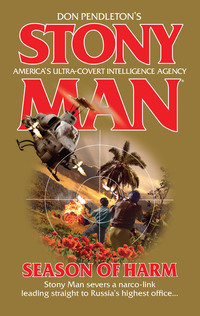
THE GUNSHIP GAINED ALTITUDE
Grimaldi allowed the deadly machine to crest the rise at the far end of the now-burning poppy field. Below, in the depression beyond, sat the camp and heroin-processing center. Phoenix Force would be moving in from the perimeter just now; Grimaldi would, therefore, fight from the center of the camp, moving outward. He overflew the camp, chose his spot and yanked hard on the controls, making the gunship shudder and dance as it dumped its velocity. He brought the killing snout of the helicopter around in a slow arc.
“G-Force is all go, twice,” he said aloud. “Heads down, gentlemen.”
The M-28 turret’s twin M-134 miniguns began spitting 7.62-millimeter death. The slow arc of the chopper fanned the slugs out as Grimaldi picked his targets, centering on the small, prefabricated, corrugated metal buildings closest to the center of the camp. Men carrying Kalashnikovs began running for their lives. Something volatile within one of the buildings exploded, throwing shrapnel and flames in every direction. Grimaldi kept the pressure on, his gunship’s inventory ticking down in his head, the chopper wreaking havoc in the enemy’s midst.
He began whistling “The Battle Hymn of the Republic,” smiling faintly as the Triangle drug plant slowly disintegrated at the touch of his trigger finger.
Season of Harm
Don Pendleton
Stony Man®
America’S Ultra-Covert Intelligence Agency
 www.mirabooks.co.uk
SEASON OF HARM
CONTENTS
CHAPTER ONE
CHAPTER TWO
CHAPTER THREE
CHAPTER FOUR
CHAPTER FIVE
CHAPTER SIX
CHAPTER SEVEN
CHAPTER EIGHT
CHAPTER NINE
CHAPTER TEN
CHAPTER ELEVEN
CHAPTER TWELVE
CHAPTER THIRTEEN
CHAPTER FOURTEEN
CHAPTER FIFTEEN
CHAPTER SIXTEEN
CHAPTER SEVENTEEN
CHAPTER EIGHTEEN
CHAPTER NINETEEN
CHAPTER TWENTY
CHAPTER TWENTY-ONE
CHAPTER TWENTY-TWO
CHAPTER TWENTY-THREE
CHAPTER TWENTY-FOUR
EPILOGUE
CHAPTER ONE
Camden, New Jersey
Agent Marie Carrol surveyed the decaying buildings and littered streets through the passenger window of the SUV. The city of Camden always depressed her. It wasn’t simply that the Bureau had repeatedly ranked the city of nearly eighty thousand people as one of the most dangerous in the country. No, what bothered her about Camden was the crushing sense of hopelessness. Like Newark, Camden was also one of the poorest cities in America, but she’d seen both crime and poverty before. Something about Camden was different, as if a cloud of misery hung over the place, and could not be dispelled even by the sights and attractions of the relatively prosperous waterfront. She’d seen it all before, from the Adventure Aquarium to the USS New Jersey, and she wasn’t impressed.
Ironically, the warehouse to which their small convoy traveled was in the Urban Enterprise Zone, whatever that was supposed to mean. She had no doubt that their quarry had a bustling urban enterprise under way. Too bad that it was completely illegal.
Carrol looked at her reflection in the tinted window glass. She wasn’t doing too bad, she thought. Not yet forty, her auburn hair still all her own color. Smooth features, a few laugh lines. She filled out her suit fairly well, too, if she said so herself; the time in the gym every other night was paying off. The ring still on her finger was a sore point with her mother, who told her she was clinging to the past; Jim was gone and the divorce was long final. There was no point dwelling on it, her mother kept telling her. Well, she’d come to terms with it in her own way, and on her own time. Carrol sighed as she watched the streets of Camden slide past.
“You’ve been awfully quiet,” said her partner, Agent Michael McCray. McCray, as the senior agent with the task force, was in charge of the operation. He drove with casual ease. They had two trucks of FBI agents behind them, not to mention plenty of guns, and Carrol felt absolutely ridiculous. All this hardware and all these agents to take down a room full of DVD pirates. It was obvious to Carrol that McCray wasn’t worried, and why should he be? He knew as well as she did that this was about making an impression, about looking good for the cameras. They didn’t have any press with them, but that would change as soon as they secured the warehouse and spread the loot out to make a good show for the press conference. It was the usual dog and pony show, and if the tables were piled high with cocaine or guns, the display made sense enough. It was hard to think they were really keeping the homeland safe from organized crime, however, by busting traffickers caught red-handed with illegal copies of Showgirls.
Public relations, that’s what it was. The word had come down from above that they were to keep an eye open for the on-camera benefits, generate some positive press for the Bureau. With half the nation downloading movies illegally, Carrol wondered what taking down a room full of old-style DVD burn-and-bootleggers was going to accomplish.
“Marie?” McCray prodded. “What’s the matter, not talking to me?”
Carrol turned to him and frowned. She sighed again. “No, Mike.” She shrugged under her seat belt. “It’s just…you know. The assignment.”
“I know it’s not terribly exciting,” McCray said. “But indications are that this is just the tip of the iceberg. You know that. We take down the crew here in Camden, see who rolls over and then take the investigation up the chain. Eventually we get them all.”
“In theory,” Carrol said. “But they’re still just movie pirates.”
“What’s the matter,” McCray said, chuckling, “do you wish they were heroin smugglers?’
“I’d feel like we were doing something more important.”
McCray nodded. “Well, I suppose we would, at that.” He shifted in his seat. The senior agent was a big man with snow-white, close-cropped hair, craggy features and a tie cinched tight around his thick neck, over a shirt whose collar appeared just a bit too small. “But this is an important assignment. This bootlegging ring has its fingers in several different industries, if the preliminary reports are correct. They’re taking in what could be millions of dollars. That’s no small thing, no matter how dull the operation itself might be.”
“I know, Mike.” Carrol nodded. “Just permit a little griping ahead of time.”
McCray chuckled again. “Fair enough,” he said. “Look at it like a wedding you don’t want to go to. You’ll be glad you did when it’s over. And it’ll take longer for the photos afterward than for the ceremony itself.”
Carrol laughed despite herself. “Okay, Mike.”
“At least I’ll be home at a decent hour,” McCray said. “Ellen has really been riding me about the overtime.”
He picked up the walkie-talkie in the cup holder in the center console. “McCray to Two and Three,” he said. “We’re a block away. Everybody get ready.”
“Two, ready,” came one response.
“Three, roger,” came the second.
“Ready to do some good?” McCray winked at Agent Carrol.
“Let’s not get carried away,” Carrol said. She laughed again; McCray’s sense of humor was hard to resist.
Agent McCray brought the SUV to a halt along the curb fronting the warehouse. The half-dozen FBI agents who made up the rest of the task force piled out of their trucks, some toting AR-15 rifles, some carrying Glock pistols. Two of the agents carried a portable battering ram. Doing her best to keep her expression neutral, Carrol joined McCray as the two walked purposefully up the cracked asphalt walk to an access door at the side of the warehouse. Both agents drew their Glock sidearms.
“Do it.” McCray nodded.
The two agents with the battering ram took position, braced themselves and swung the heavy metal cylinder.
The door lock broke easily and the agents swarmed in. The two lead agents dropped the ram and let their fellow agents cover them, drawing their own weapons as the team spread out to control the space within.
“FBI! Nobody move! Federal Bureau of Investigation!” the agents announced themselves. Men and women froze, putting up their hands and staring in confusion.
The warehouse was a large rectangle, with tall, painted-over and dirt-smeared windows dominating the long ends of the box. A catwalk and what was apparently a partial upper level ran along the outer perimeter. Carrol spotted a metal staircase at the back of the warehouse floor that led to the upper level.
The floor itself was a maze of tables and benches. On each of these were piles of DVDs in various states of packaging. Carrol recognized a set of burning machines on a table at one end of the room. The machines were humming away, still automatically copying whatever disks were placed within them. On other tables, color-photocopied labels were being cut and placed in plastic sleeves on clam-shell DVD cases. Cardboard boxes were everywhere, piled two and three deep under the tables and next to them, forming narrow aisles through which the workers had to navigate.
The workers blinked in confusion as the FBI agents moved among them, searching and securing them. Most of them did not appear to speak English. A few spoke in Spanish or broken English; Carrol wondered what a background check would turn up.
“Bonarski, Gerdes,” McCray ordered. “Up the stairs and secure the upper level.”
“Sir,” another agent called. He had opened one of the cardboard boxes stacked under the table closest to him.
“What is it, Harney?” McCray asked.
“Sir, I knocked over that plastic bin of DVDs. Look what was inside it…and inside this.” He pointed at an overturned plastic container and at the cardboard box just unsealed.
McCray came over and peered inside the carton.
“Holy shit,” he said.
The box was full of large plastic zipper-lock bags stuffed with white powder. McCray bent, removing a small pocket knife from his suit jacket. He snapped the blade open and poked it into the bag. Careful not to inhale the powder, he raised the coated blade to his nose and let its odor travel to his nose.
“Heroin,” he said. He looked up. “Watch them,” he ordered the agents, indicating the confused workers. “And check those other boxes.”
“Here, too, sir,” Agent Harney called. “Packed full. Every box.”
Agent Carrol looked around the warehouse in amazement, counting the cardboard packages. “Mike, if every one of these boxes is full of heroin…”
“Still think a DVD piracy ring isn’t worth busting?” McCray grinned back at her. He lowered his Glock as she did the same. “This has to be millions of dollars of heroin. Maybe more. I’ve never seen so much in one place.”
Suddenly, Carrol felt very anxious. “Mike, what have we stumbled onto here?” She scanned the room, her fingers clenching as she half raised her weapon once more.
“Easy,” McCray said. “Easy, now. Sometimes luck just works on our side. Relax, Marie.”
“I know, I know,” Carrol said. She couldn’t help it; she couldn’t shake the feeling something was wrong.
“Bonarski! Gerdes! What have you got up there?’ McCray looked up to the catwalk. When there was no answer, he called again, “Gerdes? Agents Gerdes and Bonarski, report, damn it.”
The only response was a corpse that came flying over the catwalk.
Carrol felt her heart leap into her throat. The body that struck the floor, scattering workers and bringing up the heads of the workers and the assembled FBI personnel, was that of Agent Gerdes.
The ghastly expression on his face left no doubt that he was in fact dead. His throat had been cut from ear to ear.
“All agents—” McCray began to order.
“That,” a voice shouted in accented English, “will be quite enough!” Punctuating the words were the sounds of a dozen assault rifles being cocked. The barrels of the Kalashnikov rifles suddenly appeared over the catwalk railing, wielded by small, deadly-looking men who appeared more than ready to use them.
“Drop your weapons!” McCray ordered.
“You,” said the man who had spoken previously, “are in no position to make demands.” He appeared at the railing, holding a gun to Agent Bonarski’s head.
He was a small man, perhaps five feet, four inches, with a swarthy complexion and vaguely Asian features. To Carrol he looked Filipino, or maybe Thai. He was dressed much the same as the other armed men now looking down from the catwalk, sporting a mixture of civilian clothes and castoff military uniform. Specifically, he wore cut-off BDUs, unlaced combat boots and an open and very faded olive-drab fatigue blouse over a Rock-and-Roll Café T-shirt. A red-and-white bandanna was tied over his skull, knotted above his forehead. He was chewing an unlighted cigarillo. The hammer of the .45-caliber pistol in his hand was jacked back, and a very nervous Agent Bonarski was sweating as the barrel was jammed into his temple.
“Do not hurt that agent!” McCray commanded. “Identify yourself!”
“You may call me Thawan.” The man smiled, his face a mask of petty cruelty. “And you may also call me master of your fate. Drop your guns.”
“I can’t do that.” McCray shook his head. “I’m ordering you to stand down, mister!”
“Such arrogance,” Thawan said. “It does not surprise me. Do you, American, have any idea what you have walked into this day?”
“I’ve got an idea,” McCray said. “Now put down those guns!”
“No,” Thawan said. He chewed on the cigarillo, switching it from one side of his mouth to the other. “You are about to die, American. It can be quick and clean. It can also be very, very messy.”
“Sir…” Agent Bonarski said.
“Silence!” Thawan hissed. He pressed the .45 more tightly against Agent Bonarski’s head. “American,” he said to McCray, “think carefully about the choice I give you.”
“Drop your weapons!” McCray ordered again. “I am an authorized representative of the federal government and I will not tell you again!”
“You poor, sad little man.” Thawan’s smile broadened. “Messy, then.”
The .45 went off, and Agent Bonarski’s suddenly lifeless body fell from the catwalk.
Hell erupted.
The agents on the warehouse floor began firing their weapons as the men above held back the triggers on their Kalashnikovs. Full-auto weapons fire echoed through the cavernous space, drowning out all other sound.
The wave of heat and light and pressure broke over Agent Carrol as the gunfire surrounded her. Time slowed. As she moved, raising her Glock and firing round after round, she felt as if she were trying to move through water, her every action encountering impossible resistance. Her eyes widened in horror as she watched blood blossom on Mike McCray’s chest. He staggered under the onslaught of dozens of rounds, dropping his weapon and falling to the floor.
Carrol acted on instinct. She emptied her Glock in the direction of the catwalk as she ran for the cover of the nearest benches, diving beneath one and colliding with the cardboard cartons of drugs and DVD cases. She grunted as her shoulder hit the stack of boxes, then rolled, bullets tearing up the table above. Several rounds struck the cartons, scattering fine white mist in every direction as the bags of heroin were punctured.
From her position, Carrol could see the exit, the very door whose lock the team had broken so casually just minutes before. It was so close and yet so impossibly far. With bullets striking the table, the floor, and burning through the air all around her, she pushed herself to her feet and ran for the door, her Glock useless and locked open, no thought of reloading or fighting back. Blind flight instinct kicked in as the chaos around her became total. She saw another of the armed agents die scant feet away as she ran.
If only she could make the car. If only she could get to the radio. If only she could call for backup. There was still a chance.
The hammer blow to her chest felt like a cinder block against her ribs. Her knees buckled. She felt herself falling, the floor taking a thousand years to come up, everything happening so slowly…
She saw stars in her vision as the floor hit her face. The pain was a distant sensation, hardly significant. Some part of her was able to process that she had been shot. How many times and how badly she didn’t know. She felt warm blood on her cheek; she tasted it in her mouth. She thought, as she floated, disconnected from her body, that she had broken her nose in the fall. She tried to push herself to her feet and could not. She couldn’t feel her legs.
The agent who had gone down in front of her stared back at her, eyes glassy in death. Carrol tried desperately to think, to act, as her mind clouded over with pain and then numbness. Her hand struggled to find the inner pocket of her suit jacket.
The gunfire died away. Thawan’s men filed down from the catwalk and began moving from body to body. A single shot rang out, and then another, from opposite sides of the warehouse. The shooters were killing the survivors. Those workers unharmed in the gunfight were being herded to one side of the workspace. The wounded workers were shot dead with the same casual disregard the gunmen had shown the FBI agents.
“Now, move, move,” Thawan was ordering the remaining workers, who looked at him with wide-eyed terror. “Collect the boxes. Collect the drugs. Everything must be packed and made ready for shipment. Gig!”
One of the gunmen, an even smaller, misshapen man with a scar across his face, hurried forward, cradling his Kalashnikov.
“Yes, boss.”
“Call for the trucks. We must move up the timetable.”
“That will take time, boss. The schedule is complicated. We will have to rearrange the drops.”
“Gig Tranh,” Thawan said with an exaggerated sigh, “did I ask for your opinion?”
“No, boss.”
“Then do as I tell you!” Thawan shouted, waving his .45 to punctuate the point.
“Yes, boss.” The small man scuttled off, pulling a wireless phone from his BDU jacket as he did so.
“You and you,” Thawan pointed to the nearest frightened workers. “Come here. You will help me search the bodies. We will take everything of value. Guns, ammunition. Their wallets. Their watches. Also, I want their badges. One never knows when such things will be of value.”
Agent Carrol, against the increasing, crushing weight of her limbs, managed to drag her own wireless phone from her jacket. Thawan was moving back and forth across the hazy field of her vision. She had one chance. She could feel her life slipping away; could feel her hold on consciousness ebbing. From what little she could see from the floor, it did not appear that any of the other FBI agents had survived. If they had, they would be killed. It was only luck that nobody had gotten to her yet.
She had to live long enough to let someone know, to get out word of what had happened. If only Thawan would move back into view…
Thawan stopped, turned and looked straight at her.
She snapped the picture with her phone’s camera option.
“Well, well,” Thawan said. He walked to her deliberately, not hurrying, seemingly not at all concerned. “What do you think you are doing?”
Carrol could feel her vision turning gray at the edges. The sound of Thawan’s voice was hollow in her ears, as if he spoke through a metal pipe.
She hit Send, transmitting the MMS message to the first contact in her phone’s address book.
Thawan reached down and snatched the phone from her. He took notice of the empty Glock still clutched in her other hand. Contemptuously, he kicked her pistol aside. Then he examined the phone.
“Well,” he said, shaking his head, “it appears you will not be calling for help. Even if you had, pretty lady—” he smiled, showing rotted, uneven teeth “—it would do no good. We will be gone before anyone arrives. You have died for nothing.” He dropped the phone to the floor and stomped it with one booted foot. It took several tries, but he was finally able to crush the phone, snapping it into several pieces.
“You…” Carrol managed to say, her breath coming in short rasps now. “You…won’t…”
“Won’t what, pretty lady?” Thawan smiled. “Won’t get away with it? Won’t escape? Won’t walk over the bodies of your dead fascist pig brothers and escape? I will, and more.” He squatted and took her face in his left hand. His right still held the .45. Holding her chin and jaw, he moved her head from side to side. “Such a shame. Such a waste. You are really not so bad-looking, you know? We could have had some fun, my boys and I. But no,” he said and let her go. She collapsed, now staring directly at the ceiling. “No, you are too far gone. But not so far gone that I will not help you there.”
The last thing Agent Carrol saw was Thawan standing over her, the barrel of the .45 impossibly large as he aimed it between her eyes.
The muzzle-blast was very bright.
CHAPTER TWO
Stony Man Farm
In the War Room at Stony Man Farm, the stern-looking and apparently disembodied face of Hal Brognola stared from one of the plasma wall screens, twice as big as life. Across from the screen, seated near one end of the long conference table, Barbara Price tapped keys on a slim notebook computer.
“How about now, Hal?” she asked.
“Yes, I can hear you.” Brognola nodded, his disembodied voice amplified by the wall speakers positioned around the room. Price tapped a key to lower the volume slightly, bringing the big Fed’s virtual presence to something closer to normal. The microphone on Brognola’s end of the scrambled connection was producing some feedback, which Price eliminated with the stroke of a key.
“You forgot,” Aaron “the Bear” Kurtzman said, rolling into the room in his wheelchair, “to ask him to say, ‘Testing, one, two, three.’ Hardly a dignified state in which to find the director of the Sensitive Operations Group.”
“What can I say?” Brognola said, his voice dry. “I’m a man of the people.”
Price nodded. The big Fed was broadcasting from his office on the Potomac, roughly eighty miles away in Washington, D.C. Even through the scrambled link, she could tell that Brognola was forcing the humor. The strain was visible around his eyes. It would not be the first time she had seen his image on the screen and worried for his health. Brognola drove his people hard, but he drove himself much harder.
Kurtzman rolled into position next to Price’s chair and put his heavy stainless, industrial-size coffee mug on the conference table. “It’s a mystery to me,” he said, “how the settings on that connection change from conference to conference.”
“Goes with the territory, Bear,” Price said. “The first rule of technology is that anything that can malfunction will do so just before the meeting.”
“Sounds familiar, at that,” Kurtzman grunted. The head of the Farm’s cybernetics team—not to mention a computer genius in his own right—took a long swallow from his mug of coffee.
The rest of the computer support team filed in, heralded by the dull roar from the MP3 player whose headphones were jammed into Akira Tokaido’s ears. The young Japanese computer expert was, as always, listening to heavy metal at eardrum-bursting decibel. He wore a leather jacket and an eager expression.
After Tokaido was Carmen Delahunt, who looked unusually somber this morning. Price knew why; the normally vivacious redhead was formerly with the FBI. She was speaking in hushed tones with fellow cybernetics team member Huntington “Hunt” Wethers. The refined, graying black man said something to which Delahunt only nodded. The pair took seats on either side of Akira, making way for the personnel crowding the corridor behind them.
Phoenix Force was first into the room, led by David McCarter. The lean, hot-headed Briton was sipping from a can of soda and muttering something under his breath. It was, Price thought, probably a complaint of some kind that he would be more than happy to air during the briefing.
The former SAS operator was followed by quiet, solid demolitions expert Gary Manning. The big Canadian and former member of an antiterrorist squad with the Royal Canadian Mounted Police was in turn chatting with Cuban-born guerilla expert Rafael Encizo. The deadly Encizo moved with a quiet grace that was an interesting counterpart to Manning’s comfortable, solid gait.
Behind the two men, Calvin James, the dark-skinned, wisecracking product of Chicago’s South Side, said something Price couldn’t hear that made Manning smile and caused Encizo to laugh out loud. The former SEAL and expert knife fighter had a cutting sense of humor, as he was fond of saying. It was an old but dependable joke. James was followed by former Ranger and born-and-bred Southern boy T. J. Hawkins, whose easygoing manner and comfortable drawl masked a dynamic and keen-minded soldier.
Together, the five men of Phoenix Force were the Farm’s international warriors, taking the fight for justice from America’s shores to the rest of the world. The three men of Able Team, Stony Man’s domestic counterterrorist operators, were close on their heels. The trio took the remaining seats around the now-crowded conference table.
Blond, crew-cut, bull-necked and ever gruff, Able’s leader, Carl “Ironman” Lyons, looked to be in a typically cross mood. Lyons had little patience for these briefings, which Price knew usually reminded the former L.A. police officer of the bureaucracy he’d left behind so many years before. Next to him, trying and failing to banter with him, was Hermann “Gadgets” Schwarz. Schwarz was an electronics expert whose devices and designs had supplemented the Stony Man teams’ gear on more than one occasion. Schwarz was more than an electronics whiz, though; he was also an experienced counterterror operative and veteran of countless battles.
Quietly considering all assembled was Rosario “Politician” Blancanales. The normally soft-spoken Hispanic was a former Black Beret and an expert in the psychology of violence and role camouflage. As such, Price had noted many times before, he tended to hang back, observe and gather data before saying anything. When he finally spoke, it was normally worth listening to him.
“All right,” Price said. “Hal, you’re ready?”
“Yes, go ahead.” Brognola nodded on the plasma screen.
Price touched a key on her notebook computer. The plasma screen opposite Brognola, visible to all at the table, came to life. The image it displayed was that of a small, dark-skinned man wearing an open BDU blouse over a novelty T-shirt. He carried a .45 in one hand. The image was somewhat grainy and had clearly been enhanced, but the face of the man—and the cruelty evident on it—was clearly visible.
“This,” Price said, “is Mok Thawan. This photo was taken seconds before Thawan executed a gravely wounded FBI agent.”
Delahunt swore under her breath. The rest of the Stony Man personnel nodded or simply took in the image, saying nothing.
Price pressed another key. The image changed to that of a large interior space littered with empty tables—and dead bodies. “Camden, New Jersey,” she said. “This warehouse was the target of an FBI task force pursuing what is believed to be one of the largest retail piracy rings operating in the United States. According to the data assembled by the task force members beforehand, this site was a clearinghouse for the smuggling of illegally manufactured and copied DVDs.”
The image changed again as Price touched the key once more. She scrolled through several photos of the dead FBI agents, whose bodies had been marked with evidence tags. Empty shell casings littered the floor.
“What is that dust everywhere?” McCarter asked, sipping his Coke.
“That,” Price said, tapping a couple of keys and bringing up some close-up shots, “is heroin.”
“Bloody hell,” McCarter said.
“Not long after the shoot-out,” Price explained, “local police responded. They found what you see here. Dead FBI agents, stripped of their weapons. An empty warehouse. And heroin residue everywhere.” She entered something on the notebook computer and scanned the file on her screen. “The police reports indicate that all of the agents were shot except one, who had his throat cut. There was nothing else in the warehouse except a few empty boxes and several shattered plastic DVD cases. Whoever was operating there, whatever the extent of their activities, they pulled up stakes and got out of there fast and completely.”
“So the Bureau raided what they thought was a fairly tame retail piracy operation,” Blancanales said, “and instead got heroin smugglers?”
“That’s just the beginning of it,” Price said. She switched the image on the plasma screen back to that of Mok Thawan. “Thawan is a known quantity, with an Interpol dossier a mile long. Specifically, he figures prominently in organized crime centered in southern Asia. He’s an enforcer for a group that calls itself the Triangle.”
“The Triangle runs heroin from Thailand and Burma to the United States,” Brognola said. “Just about every major law-enforcement agency, foreign and domestic, is aware of its activities, but precious little has been done about it up to now.”
“Why is that, Hal?” Schwarz asked.
“A combination of factors,” Brognola said, sounding weary. “Corruption in the local governments, especially in Thailand. There is some evidence that the Burmese government is directly involved, too, but it’s less overt, which might mean it’s even worse.”
“If they bother hiding it, there’s something to hide,” Encizo said.
“Exactly.” Brognola nodded. “The Triangle is also incredibly violent. They respond with ruthless, overwhelming force whenever threatened. This bloodbath in New Jersey is nothing compared to the slaughter of government troops in Thailand last year, when a joint DEA-Interpol task force got close to the Triangle’s operations there.”
“If they’re so big a problem,” McCarter interrupted, “why haven’t we targeted them before now?”
“Until recently,” Brognola said, “they’ve been ghosts. International law enforcement has been a step behind the Triangle for the past three years. Several attempts to penetrate the organization with undercover agents have also failed.”
“Every one of the agents has turned up dead or gone missing entirely,” Price explained. “Interpol claims to have at least one agent unaccounted for, but nobody’s heard from him or her for at least six months.”
“Likely swimming with the fishes,” McCarter concluded.
“The massacre in New Jersey has the Man agitated,” Brognola said, “and for good reason. The sad but direct fact of the matter is that we cannot allow government agents to be killed en masse on U.S. soil, not without mounting a response.”
“You don’t mean to tell me this is about making a statement?” McCarter demanded. “Bloody Christ, Hal! Is that what we’ve come to now?”
“You know better than that, David,” Brognola said sternly. “There are certain political realities, yes,” he explained, “but what’s changed is that we finally have a way to track the Triangle and get out in front of their operation.”
“Bear and his team—” Price nodded to Kurtzman, Tokaido, Delahunt and Wethers “—have conducted an extensive investigation into financial accounts and networks known to be linked to the Triangle.”
“By ‘extensive,’ she means ‘illegal,’” Wethers said with a faint smile.
“Very.” Price glanced at Brognola, whose expression had gone sour. “Using Interpol and U.S. federal agency records as the jumping-off point, we’ve gotten to know the Triangle intimately, exposing portions of its operation, identifying links in the poppy production and heroin trafficking, and discovering certain key facts.” She looked to Delahunt.
“First,” Delahunt said, “the Triangle operates a conventional bootlegging ring that appears to smuggle several different consumer products. Counterfeit designer clothing, the DVDs found in New Jersey, consumer electronics…it’s very extensive, perhaps the biggest ever to operate internationally.”
“The Triangle is piggybacking the distribution of the heroin on the smuggling of their retail goods,” Price said. “They’re using the same network, but sheltering the more serious criminal activity with the bootlegging.”
“It’s brilliant,” Blancanales put in. “Vice is always easier to understand than legitimate commercial activity. It offers a unique shield, for if the smuggling is discovered, those exposing it will be tempted to stop at the piracy, thinking they’ve found what there is to find.”
“Bloody right,” McCarter said. “Nobody trusts a guy who says he’s got nothing to hide. But if you think you’ve found him out—”
“You stop looking for whatever else he might be doing,” Blancanales finished. “Multiply that across an entire organization and you have a very clever strategy for covering the true depths of a criminal enterprise.”
“Trickery of that type goes only so far, of course,” Brognola said. “That’s why the Triangle is so ready and willing to do violence to shield its activities. When discovered, they immediately hit, and hit hard, then fade from view. The method has served them well until now.”
“What’s changed, Hal?” Schwarz asked.
“I’ll answer that,” Price said. She tapped a couple of keys and an exploded-view mechanical drawing of a satellite appeared on the plasma screen opposite Brognola. “This,” she said, “is NetScythe. It’s an experimental military spy satellite developed by DoD in conjunction with some of the more brilliant boys and girls at NASA.”
“What does it do?” Schwarz asked.
Price nodded to Tokaido.
“It is really very amazing,” Tokaido said, pointing to the plasma screen. “NetScythe uses a combination of fuzzy-logic algorithmic processing, digital satellite imaging and an advanced telescopic array very much influenced by the Hubble Space Telescope. This allows it to track targets on the ground, very specific targets that correspond to complicated threat or interest profiles developed by analysts on the ground.” He pointed to himself, to Wethers and to Delahunt. “By inputting our target criteria and our warning flags, we can have NetScythe track Triangle assets on the ground, from space. When those assets move, be they people, vehicles or people and vehicles moving to and from specified target profile locations, NetScythe’s heuristic meta-analysis can predict where those assets may move to next.”
“Bloody hell,” McCarter said. “The thing predicts the future?”
“In a way, perhaps,” Hunt Wethers said. “It’s a bit more complicated and not quite as definitive as that, but essentially, it will tell us how to get ahead of the Triangle’s operatives in order to target components of its organization. Much more important, analysis of the target assets may tell us where the links in the Triangle’s chain are located. We can use what we know to learn what we don’t know. With several Triangle assets designated, we can find others of which we were previously unaware.”
“It’s the break we’ve needed to dig into the Triangle and root it out,” Brognola said. “But there are other considerations at play.”
“Which brings us to the second very important piece of information we uncovered.” Price nodded once more to Delahunt.
“The Triangle is funneling money, and large quantities of it, through several holding companies and multiple banks,” Delahunt said. “The money is finding its way to Aleksis Katzev.”
“That Aleksis Katzev?” Blancanales asked.
“The same,” Price said. She touched a key and the image of Russia’s strong-man president appeared on the plasma screen. “Aleksis Katzev. President of Russia. Former KGB operative, rumored to have Spetsnaz special forces training. Also linked to the deaths of several political rivals, often by poisoning, none successfully traced to Katzev or his operatives.”
“In other words,” Encizo said, “not a very nice man.”
“No,” Brognola put in. “Specifically, Katzev has been rattling sabers for months now, talking about recovering the glory days of the Soviet Union, and using the United States as the scapegoat that will pull the Russian people back together against a common foe. We believe Katzev is receiving funding from several known terrorist organizations, in fact, though the Triangle is by far his biggest investor.”
“What do you mean by ‘rattling sabers,’ Hal?” T. J. Hawkins asked.
“Russian naval assets and air power have been buzzing U.S. planes and ships in international waters off Russia for some time now,” Brognola said. “The hostilities are growing. Katzev gives a fiery speech just about every week on state television out of Moscow, too, usually working in references to the Great Satan that is the United States.”
“Sounds like an old script,” Calvin James said.
“But it works,” Brognola said. “Tensions between the U.S. and Russia are at an all-time high, and diplomatic relations are getting very close to breaking down. There’s some chance that this will subside after the elections, but there are no guarantees, and if Katzev secures another term, we have no way of knowing just how far he’ll take this.”
“The Triangle,” Delahunt said, “apparently hopes to expand its operations farther into Russia, which is what it gains by funding Katzev. Katzev has strong ties to the Russian mafiya, and the Triangle won’t make any inroads without their say-so. They’re violent, but the mafiya are no strangers to protecting their turf. We all know just how interwoven organized crime is with Russian society. We’re basically seeing the opening steps of a business merger in the making.”
“That’s a merger we need to prevent,” Price said. “There is, however, some hope that Katzev’s hold on Russia can be broken. He faces a hard fight in the country’s imminent national elections.” She tapped a key, and another man appeared on the plasma screen. He was younger, perhaps early forties, and dressed in a neatly tailored suit. “This is Yuri Andulov,” Price said. “He’s an experienced diplomat and a known friend to the West. He’s got a growing base of support in Russia. Polling data is unreliable and shows heavy favoritism to Katzev, the incumbent, but we believe Andulov may very well be slightly ahead.”
“The problem,” Brognola said, “will be keeping him alive until the elections occur. Katzev’s enemies have a way of dropping dead from mysterious food poisonings or other ailments. One got cancer rather suddenly. Another disappeared completely, along with his family. Katzev plays for keeps, and it seems very doubtful he intends to go head to head with Andulov at the ballot box—not if he can take him out before it comes to that.”
“More than one attempt has been made on his life, in fact,” Price said. “To now, his bodyguards have kept him out of harm’s way, but the assassins only have to succeed once.”
“I don’t have to tell you,” Brognola said, “that Katzev’s term of office has marked very difficult U.S.-Russia relations. Andulov could turn that around, normalize things between the two countries, and bring Russia back from the brink of open war with the West. Another Katzev term, by contrast, will very well take us to that precipice.”
“Are you saying we’ve taken an active interest in eliminating Katzev?” McCarter asked.
“No,” Brognola said, “only in exposing Katzev’s link to the Triangle. The rest will take shape on its own, provided Andulov isn’t murdered before he can take office.”
“It smacks of nation-building, Hal,” McCarter said.
“No.” Brognola shook his head. “That is not what we do. But Katzev is an active threat to United States’ interests, and he is linked to a violent criminal organization. If that link comes to light, if Katzev’s activities are exposed and if we can put a stop to whatever he might be doing in conjunction with those activities, it is in everyone’s best interests that we do so.”
“Fair enough,” McCarter said. He traded glances with Carl Lyons, his fellow team leader. Lyons frowned and nodded.
“I do not have to point out,” Brognola said, “the potential for an international incident that this raises. We cannot afford to enflame an already difficult situation where Russia is concerned. Plausible deniability must be the order of the day, even if they know we’re only making a show of it, and we know that they know. The situation in Thailand and Burma might get tricky, too—no government official likes to be accused of being in bed with international organized crime or terrorism. You can count on no local support abroad.”
“Bloody wonderful,” McCarter groused. “Can I assume we will be traveling sterile?”
“You will,” Brognola said. “Your personal weapons, if you have a preference, should prove no problem in the case of sidearms, but use your best judgment. You’ll be issued other operational gear that cannot be traced directly to any specific distributor.”
“Gadgets has consulted with our technical team,” Price said, nodding to Schwarz, “and we will be issuing both Able and Phoenix several pieces of microsurveillance and hacking equipment that should prove useful in your mission. There’s something else, however.” She looked to Tokaido once more.
“We will also be providing all of you with these,” Akira said, holding up a small breathing mask. “It contains microfilter technology. You may encounter very large quantities of drugs and fumes from drugs, especially if destroying caches of narcotics. These masks will protect you from the fumes and filter out the toxins, enabling you to breathe without difficulty.”
McCarter reached across the table for the mask. Tokaido gave it to him, and McCarter turned it over and over in his hands thoughtfully, examining it.
“I want you all to draw equipment from Cowboy and assemble within two hours,” Price directed, referring to John “Cowboy” Kissinger, the Farm’s expert armorer. “Phoenix, we have the first target for you in Thailand. Jack Grimaldi is ready to provide air support and will meet you on the ground there. He’s coordinating the transportation of certain assets.” Grimaldi was Stony Man’s veteran pilot, a capable operator of almost any flying machine, from fighter jets to helicopters.
“And us?” Carl Lyons asked.
“We’ve traced the Triangle’s financial records and uncovered a second facility owned by the holding company that held the lease to the Camden warehouse,” Price told him. “It’s a casino in Atlantic City. You’ll start there.”
“Sounds like fun,” Schwarz said.
“It won’t be,” Lyons said dourly.
“All right, people,” Brognola said. “This is an important operation. The stakes are high. The price paid already…well, it’s been too high. We’re on the job to stop this before it goes any further. A lot is riding on this. The Man has made this our highest priority. Do what you do.”
“Let’s move, everyone,” Price said.
CHAPTER THREE
Atlantic City, New Jersey
“Kind of out of the way, isn’t it?” Schwarz said from the passenger seat of the Chevy Suburban. Next to him, Carl Lyons was replacing the magazine in his Daewoo USAS-12 automatic shotgun. He chambered a heavy 12-gauge buckshot round with a heavy clack of the charging handle. The 20-round drum magazine in place on the massive weapon was supplemented by the 10-round box magazines Lyons carried in the pockets of his heavy canvas vest. The vest also covered the .357 Magnum Colt Python in a shoulder holster under Lyons’s left arm.
Lyons sipped from a disposable cup of fast-food-chain coffee and eyed the front of the casino. The street was busy enough; cars moved past in both directions, and plenty of pedestrians bustled by. The gambling house itself, the Drifts, was not too far from the old Sands building, but still not exactly located in prime real estate compared to its competitors. It was as out of the way as a casino in Atlantic City was likely to be, Lyons thought. He looked at Schwarz and grunted, taking another long sip from his coffee cup.
Like Lyons, Schwarz wore casual civilian clothes. His dark blue windbreaker concealed the Beretta 93-R, custom-tuned by Cowboy Kissinger, that he wore in a shoulder rig of his own. On his belt under the windbreaker he also carried several small grenades, most of them flash-bang and incendiary charges.
“You know, it occurs to me that we spend a lot of time waiting in the truck while Pol gets to go out and have fun,” Schwarz said, ignoring Lyons’s attempt to shut down the conversation before it could begin.
“He gets shot at more, too,” Lyons said.
“Like I said,” Schwarz confirmed. “All the fun.”
Lyons ignored that. Each member of the team wore a microelectronic earbud transceiver in his ear. The little devices transmitted to each other on a tight frequency and had an automatic cutoff for sounds above a certain decibel level. This allowed the team members to stay in constant touch with each other without relaying deafening gunfire over the channel. Through this link, they both heard Pol Blancanales say quietly, “Let’s not wish any undue excitement on me, gentlemen.” Schwarz smiled at that, but Lyons didn’t react.
The fact was, for all their banter, Blancanales was indeed in a precarious position. Before Able Team could roll through the Drifts with guns blazing, they had to determine exactly what was going on inside. If the Triangle owned an interest in the casino but was running no significant smuggling or trafficking operations within, Blancanales’s quiet reconnoiter might best be followed up with another soft probe in which they raided local documents, file cabinets and computers, looking for additional hints to the Triangle’s operation. It would prove dull and disappointing, given the mission parameters and their desires to bring the Triangle’s people to justice, but it would be the only way to handle such a scenario.
On the other hand, if Blancanales found himself surrounded by enemies who were trying to kill him, it would pretty much be open season.
“All right, guys,” Blancanales said quietly. “I’m in position.”
“Roger,” Schwarz said. He took the small video unit from the dashboard and adjusted the frequency. On the color screen set in the handheld unit, a picture appeared, showing the inside of the casino at chest level. The video stream was being transmitted by a tiny camera set within the belt buckle Blancanales wore. The video captured from it would give Able Team a visual record they could review later, while giving Lyons and Schwarz a real-time briefing of what they faced within should the situation get ugly.
Lyons leaned over to get a better view. Schwarz held the video unit up between them. Blancanales’s words, and some of the ambient noises around him, were transmitted to both men’s earbud transceivers, just slightly out of the sync with the picture.
Blancanales was moving through the main lobby of the casino, headed toward the slot machine pits. The crowd looked like the dregs of Atlantic City, the sort of regulars, drifters, grafters and barflies who would gravitate to one of the seedier establishments among the many gambling houses. Schwarz spotted several hookers working the crowd. Lyons ignored him until he started counting them off, then told him to shut up.
“Thank you,” Blancanales said softly. It wasn’t clear whether he was expressing his gratitude to Lyons or to the cocktail waitress who had just offered him a bottle of sparkling water.
Blancanales worked his way around the room, blending in as one of the customers. The nondescript outfit the Politician had chosen for this little run included a tan button-down shirt open, dark slacks and a leather blazer that had seen better days. In short, Blancanales looked just like one of the nightcrawlers gambling at the Drifts, which was exactly what he’d wanted. The Politician could blend in anywhere, anytime. It was one of the things that made Blancanales so effective an operative in these scenarios.
He was moving through the slot machine pit now, dodging lifers of all ages transfixed by the one-armed bandits. Lyons was amused to see the magnetic cards being swiped through the machines. He supposed a lot had changed since the last time he’d been in a modern casino, but it didn’t seem the same to him: waiting to hit the jackpot so you could increase the balance on your gambling card, rather than filling a plastic cup with metal tokens. It was all fool’s gold, he supposed, but that didn’t make it any less amusing. He and Schwarz watched as Blancanales passed row after row of desperate players swiping those cards and pressing push-button gaming screens instead of yanking on metal handles.
As the two other Able Team members watched, Blancanales made a slow, careful circuit of the entire main level of the casino. While not the largest or the nicest gambling house in Atlantic City by any means, the Drifts was still a fairly elaborate establishment. It took some time, and Blancanales knew his work well enough not to push too hard. Hurrying would look suspicious. He had to search the casino without looking like he was searching the casino, being careful not to raise any suspicions.
“There,” Lyons said finally. “There’s another one.”
“Another one?” Schwarz asked, looking at him.
“Pol,” Lyons instructed, “without looking like you’re doing it, back up three paces and slowly pan right.”
Blancanales took his time. He managed to make the move look natural, from what the two in the truck could see. The scan from his camera eventually took in what Lyons had noticed. He pointed to the screen.
“That guy?” Schwarz queried.
“That guy,” Lyons said. “That’s the second big mother in a black turtleneck and black jeans I’ve seen tonight, just standing around. They’re not dressed like casino security.” They had seen the official security guards working the casino; those guards wore matching maroon blazers.
“Sure looks like a guard,” Schwarz agreed. “What’s he guarding?”
“Pol, can you tell what he’s pretending not to cover?” Lyons asked.
Blancanales moved around slowly, taking in the guard from two different angles, then moving farther down the corridor just off this corner of the casino. Finally he found a remote corner where, Lyons figured, there was no one to overhear.
“There’s a fire door at the end of the hallway, opposite the guard,” he reported, whispering. “There’s also a camera focused on that door.”
“Take another look around,” Lyons said. “Let’s be sure.”
Blancanales did so. He worked his way across the casino again, paying special attention to the darkest corridors and corners. When he was satisfied that the door he’d seen was the only one guarded in that manner, he reported as much. Lyons nodded to Schwarz. During Blancanales’s sweep, they had counted a total of three of the black-clad incognito guards. Two of them were surreptitiously guarding the front and rear entrances, in both cases doubling up on the more overt casino security personnel. The lone guard in front of the camera-equipped door was therefore unique.
“How do you—” Blancanales said, then stopped. Schwarz and Lyons watched as a pair of women in micro-mini black dresses flounced past him.
“Not bad,” Schwarz remarked.
“Hookers,” Lyons said.
“As I was saying,” Blancanales said once they were out of range, “how do you want to play it?”
“I’d like to know what’s beyond that door,” Lyons said, “but I’d rather not tip our hand just yet.”
“All right,” Blancanales said. “But we’ll only get one shot at this. It might get hairy on the way out.”
“If it does, so much the better,” Lyons said. “We’ll back you up.”
“Easy for you to say, Ironman.” Schwarz poked him in the ribs.
“Zip it,” Lyons growled.
The two watched as Blancanales moved along the corridor, essentially flanking the lone guard while staying out of what was likely to be the mounted camera’s field of view. He affected a drunken stagger, if the sudden swaying of the video feed was any indication. Then he was stumbling into the guard.
“Hey,” the guard said, sounding disgusted. “Get the hell off me, asshole.”
“Whereza baffroom?” Blancanales slurred.
“Not here, stupid.” The guard reached out to give Blancanales a shove. To Lyons and Schwarz it looked as if he was reaching right for the camera.
Blancanales lashed out with a sudden, vicious edge-of-hand blow to the side of the man’s neck, staggering him. Blancanales followed up with a knee to the man’s groin and then a relatively light blow to the back of the head. The guard dropped like a stone.
“Remind me not to piss off Pol,” Schwarz cracked.
“I said shut up,” Lyons said absently. It was an old act between the two of them, and one neither man had to think about consciously.
Blancanales dragged the guard into the corridor he was guarding, careful to stop short to stay out of the mounted camera’s field of view. Lyons and Schwarz watched as their teammate quickly searched the man, after first checking his pulse.
“He’s not dead, is he?” Lyons asked.
“No,” Blancanales said quietly.
“Proceed,” Lyons instructed.
Blancanales found a 1911-pattern .45-caliber pistol in the man’s waistband, under his turtleneck. He also found a key card. He tucked the .45 into his own waistband, where Lyons knew it would keep Blancanales Beretta 92-F company. Then he moved quickly to the door, swiped the magnetic key card and popped the door open.
“Go fast, Pol,” Lyons said. “Whoever’s watching knows you’re not supposed to be there.” He checked the loads in his Colt Python before replacing it in its shoulder holster. “Get ready, Gadgets.”
“Roger,” Schwarz said. He set the video unit on the console between them and drew his 93-R. Then he checked the machine pistol’s 20-round magazine.
On the small color screen, Blancanales was making his way down a stairway. It was dimly lighted by small red light bulbs set within metal grates along the cinder-block wall. All pretense of the supposedly lavish gambling establishment had been dropped here. Whatever this was, wherever it led, no attempt had been made to disguise it.
Blancanales stopped at the bottom of the stairs. He was facing a pair of metal double doors. Pushing past these, he found himself in an empty anteroom. There was another set of doors. These were locked, but the electronic lock pad on the wall matched the one that had been installed at the top of the stairs. Blancanales used the key card again, sliding it through, and was rewarded with the metallic click that signaled the door unlatching.
He pushed the door quietly open.
At least a dozen men looked up at him.
On the screen, the scene was clear enough, in the split second Lyons and Schwarz had to observe it. The basement, which was lighted by overhead fluorescent lights, was filled with long, low tables. Men sat at these tables, weighing and dividing individual portions of white powder into smaller plastic bags. Several other men holding shotguns and rifles, a mixture of Mini-14s, AR-15s and even Ruger 10/22s, stood around the room at intervals watching over the process.
“Who’s he?” one of workers asked.
“Hey, that’s not—” another said.
Blancanales ran for it.
The first bullets struck the doors behind him as he cleared the next set of double doors.
“Go, go, go!” Lyons ordered. He grabbed the Daewoo shotgun as he piled out of the truck. Schwarz was close behind with his 93-R. The two men ran through the traffic outside the Drifts, dodging honking vehicles as they made for the entrance to the casino.
“I’m coming up the stairs,” Blancanales reported through their earbud transceivers. “The sewing circle I just interrupted is hot on my trail.” There was some static, suddenly, over the connection.
Gunfire.
Schwarz and Lyons burst through the front doors of the casino, Lyons leading the way with his Daewoo at port arms. Customers scattered. A woman screamed at the sight of the big Able Team leader with the massive automatic shotgun in his arms.
“Stop!” a uniformed security guard yelled. He walked up to Lyons. “You there, you can’t come in here with that!”
“Buddy,” Lyons growled, “you’d best back up.”
The security guard reached out, placing a hand on Lyons’s shoulder. “I said stop!”
Lyons butt-stroked him, lightly, slamming the Daewoo’s stock into the side of his head. He folded over with a grunt. “Told you,” Lyons said.
Schwarz had the 93-R in both hands and was covering the crowd. “Everyone out!” he said. “Proceed to the exits in an orderly fashion! We are federal agents!”
The casino’s patrons didn’t need to be told twice. They started hurrying toward the main exit, giving the Able Team commandos a wide berth. A couple of the uniformed guards looked as if they wanted to say something, but they were apparently unarmed and seemed to Lyons to be just what they were supposed to be—civilians hired to watch for pickpockets and roust the occasional drunk.
“Gadgets,” Lyons said, bringing the Daewoo up to his shoulder as they approached the corridor Blancanales had entered, “find me those other covert guards.”
“On it,” Schwarz said. He broke from Lyons and began sweeping the wing they had just passed.
As Lyons neared the hallway, he fought the urge to react as Blancanales came bursting through the fire door. Blancanales had his 92-F in his left hand and the captured 1911 .45 in his right. As the fire door slammed, bullets ricocheted from the opposite side. They did not go through.
“You all right?” Lyons asked calmly.
“Never better.” Blancanales smiled. “But we’ve got a nest of hornets down below.”
“Positions?”
“Bottom of the stairwell.” Blancanales jerked a thumb toward the fire door.
“Good,” Lyons said, hefting the Daewoo. “Get ready on the door.”
Blancanales stowed the 1911 and transferred the 92-F to his right hand. “You sure?”
“Yes,” Lyons said. He grinned. It was not a pleasant smile.
Somewhere behind and to the left, they heard a shotgun blast, followed by the chatter of Schwarz’s 93-R.
“That’ll be Gadgets ferreting out our friends,” Lyons said. “Back him up after I go.”
“Will do,” Blancanales said. “Triangle operatives, you figure?”
“Doesn’t matter,” Lyons said. “Triangle or not, they’ve got a heroin distribution center in the basement.”
“Could have been baking powder.”
“More power to them if it was,” Lyons said. “Okay, in three.”
Pol nodded and gripped the fire door’s handle.
“Three…two…one…now.”
Blancanales ripped open the fire door and triggered several shots down the stairwell. Lyons dived through, flat on his belly with the Daewoo in front of him. He threw himself with such force that he slid down the steps, holding the trigger of the Daewoo back as he did so. The buckshot rounds ripped up the doors at the bottom of the stairwell, tearing through the gunmen who waited in front of them.
The gunners screamed and died horribly. Lyons was up and charging as soon as he hit the bottom of the stairs. He slammed a combat-booted foot against the double doors, mowing down a gunman with an Uzi pistol who was waiting in the anteroom. He dropped the now-empty drum magazine in his USAS-12 and swapped in a 10-round box.
Another kick parted the doors separating him from the basement area. He dived through the doors, narrowly avoiding the answering fusillade. The workers were running and ducking for cover, but the gunmen guarding them and the product on the tables were cutting loose with everything they had. Full-automatic weapons fire converged on Lyons’s position. He surged to his feet and, in a half crouch, carved through the ranks of the enemy gunmen like a shark swimming through a school of fish.
Bullets raked the table to his left, shredding plastic bags of heroin before shattering a set of electronic scales. Lyons triggered a blast that knocked the gunmen down and out forever.
Moving heel-to-toe in a combat glide, Lyons kept up his pace, staying calm and deadly in the middle of the fire-storm. Each time his shotgun blasts found an enemy, the remaining shooters were that much more demoralized, firing that much more wildly. Finally, as the second to last man fell with a load of double-aught buck in his face, the last of the guards cut and ran for the doors.
“Oh, no, you don’t, you little scumbag.” Lyons let the USAS-12 drop, since it was empty, and drew the Colt Python from his shoulder holster and leveled it at the fleeing man. “Stop! Federal agent!”
The running man paused, spun and brought up a snubnose revolver. Lyons double-actioned a .357 Magnum round through his chest. The dead man never got off a shot.
“Lyons clear. Basement secure,” Lyons announced.
“Gadgets clear,” Schwarz said.
“Blancanales clear,” Blancanales reported. “Two down up here, Carl. We weren’t able to take them alive, unfortunately.”
“Understood,” Lyons said. He surveyed the drugs scattered around the room, and the dead men among the living. “Everyone over there,” Lyons directed, pointing with the barrel of the Python. “Against the wall.”
One of the workers looked at him, wide-eyed, and said something in rapid-fire Spanish.
“Pol, did you hear that?” he asked. “I’ve got several prisoners down there. They look to be noncombatants.”
“Just barely,” Blancanales said. “He says…Well, he says a lot, but it boils down to, ‘we just work here.’”
“Yeah,” Lyons said. He herded the workers. “Come on, people. Go.”
“I’m on my way down,” Blancanales reported over the transceiver link.
“Good,” Lyons said. “I could use a translator.”
“I’ll stay up here and mind the store,” Schwarz said. “It looks like the Justice Department identification Hal gave us is going to get a workout.” The sirens were barely audible over the transceiver link.
“All right,” Lyons said. “Run interference with the Atlantic City PD for us. Pol and I will work our way through these jokers, see if there’s anything to be found.”
“Any computers down there?” Schwarz asked.
Lyons double-checked, scanning the room carefully. He retrieved his Daewoo as he did so, holstering the Python and swapping box magazines in the shotgun. “Doesn’t look like it,” he said. “We’ve got a pile of drugs, some dead guards and not much else.”
Blancanales entered the room, stepping over the dead body near the doors. He took out his secure satellite phone, part of the standard kit issued by the Farm, and took a digital photograph of the dead man. He would do the same for the others; it was standard procedure. The photos would be transmitted to the Farm for analysis, run through international crime databases using facial-recognition software. Identifying the gunmen might give them some connection to the Triangle’s operation.
“Dead end?” Blancanales asked.
“Dead men,” Lyons corrected. He jacked a round into the chamber of the USAS-12. “But us? We’re just getting started.”
CHAPTER FOUR
Thailand
Jack Grimaldi whistled “Flight of the Valkyries” to himself as the Cobra gunship came in low and slow over the landscape, moving up on the isolated poppy field that was Phoenix Force’s first target. As Grimaldi flew, he listened to the radio chatter over his earbud transceiver. The little device linked him via relay from the chopper’s electronics to the rest of the team on the ground. Phoenix Force was moving into position to attack the camp located at the east end of the poppy field. From the satellite surveillance imagery provided by NSA security satellites as well as NetScythe, it was apparent the camp included a full processing facility. Hitting the field and the processing plant would deal the Triangle a significant blow, sending a clear message.
Insertion of the team, including acquiring the Cobra gunship and making sure it was in position, had been relatively easy. While there was no way to count on the support of the government, especially given the covert nature of the operation, the Farm had plenty of discretionary funds to throw around at times like these. The Stony Man team had bribed their way over the Thai border and easily past Customs. The chopper had been more difficult, but even that had not proved much of an obstacle. While old, the machine was in great shape, and the armament it carried was in top condition. Grimaldi had checked it out at the airfield himself. Then he’d made his way by air in support of Phoenix Force’s ground insertion that was utilizing hired commercial trucks. If anyone had noticed him, by eye or by radar, nobody had challenged him. No doubt everyone and his uncle who could in any way be bought off had been paid well enough to look the other way.
Strange bedfellows, the pilot thought. If the men they’d bribed to drive them out here thought anything of the armed men seeking to tangle with the local drug lords, they hadn’t commented on it. No doubt they thought they were pocketing the money of dead men. That was fine; it meant they’d be even less likely to speak of it after the fact, though they’d been bribed well enough for their silence.
It was all part of the shadow war, the type of conflict in which Phoenix Force specialized. Evil criminals of the type found in the Triangle organization were accustomed to preying on others. They did not deal well with coming under sudden fire; they did not grasp that they, too, could become the victims of seemingly random violence. When, suddenly, they found themselves attacked from what seemed all sides by a foe they could not at first identify, they became confused and afraid. For many of them, fear was a new sensation, and one the Stony Man pilot was happy to bring them.
I love the smell of terrified organized crime bosses in the morning, Grimaldi thought to himself.
The AH-1 gunship was a familiar aircraft, one that Grimaldi enjoyed flying. Once the backbone of the United States military’s fleet of attack helicopters, long since eclipsed by the AH-64 Apache, it remained a very dependable, very lethal aerial weapon.
He checked his chronograph, then his GPS unit. “G-Force,” Grimaldi said over the transceiver link, “in position.”
“Roger, G-Force,” McCarter’s voice came back to him. “By the numbers. One, two.”
“One, two, roger,” Grimaldi said.
He angled the nose of the Cobra, allowed himself to pick up more speed and began triggering the hellstorm under his command.
The twin rocket pods unleashed their 70 mm cargo of Mark 4 folding-fin aerial rockets. The M-156 white phosphorous rounds detonated across the poppy field, leaving actinic flashes in Grimaldi’s vision. He worked the chopper back and forth in a zigzagging pattern, making sure his deadly payload did its gruesome work among the flowers.
“G-Force is all go, zero one,” Grimaldi reported as he fired the last of his rockets. The explosions radiated heat; he gripped the controls firmly, controlling the gunship. “Good hunting, gentlemen.”
“Roger,” David McCarter’s voice came through the transceiver link. “Start run two, G-Force. Repeat, start run zero-two.”
“G-Force is go zero-two,” Grimaldi reported.
The gunship gained altitude. Grimaldi allowed the deadly machine to crest the rise at the far end of the now-burning poppy field. Below, in the depression beyond, sat the camp and heroin-processing center. Phoenix Force would be moving in from the perimeter just now; Grimaldi would therefore fight from the center of the camp, moving outward. He overflew the camp, chose his spot and yanked hard on the controls, making the gunship shudder and dance as it dumped its velocity. He brought the killing snout of the helicopter around in a slow arc.
“G-Force is all go, twice,” he said out loud. “Heads down, gentlemen. I repeat, heads down.”
At Grimaldi’s direction, the M-28 turret’s twin M-134 miniguns began spitting 7.62 mm death. The slow arc of the chopper fanned the slugs out as Grimaldi picked his targets, centering on the small, prefabricated, corrugated-metal buildings closest to the center of the camp. Men in olive-drab fatigues, carrying Kalashnikovs, began running for their lives. Something volatile within one of the buildings exploded, shooting shrapnel and flames in every direction and throwing several of the running figures to the ground. Grimaldi kept the pressure on, his gunship’s inventory ticking down in his head, the chopper wreaking havoc in the enemy’s midst.
He began whistling “The Battle Hymn of the Republic,” smiling faintly as the Triangle drug plant slowly disintegrated at the touch of his trigger finger.
“YOU HEAR THAT?” Calvin James said.
“Hear what?” Rafael Encizo asked.
“Nothing.” James shook his head. “Thought I heard whistling. Faint, like.”
McCarter chuckled but said nothing.
Phoenix Force waited from cover at the perimeter of the camp, southwest of Grimaldi’s position. They were crouched behind an old bus that had somehow been trucked in and buried half in and half out of the ground to form a makeshift storage bunker. Now that bunker provided them with adequate concealment as Grimaldi softened up the camp.
“Masks on, lads,” McCarter instructed. “The fumes will reach us any minute.” The team members donned their breathing gear. The black plumes from the burning poppy field were visible far beyond the chopper. The staccato drumbeat of the gunship’s nose cannons slapped echoes from the metal buildings around them. Return fire from within the camp was sporadic, but left no doubt that Phoenix Force would encounter armed resistance once they made their foray inside.
Per the mission parameters, they were dressed and armed for plausible deniability. The members of the team each wore Russian surplus camouflage fatigues. Some of their equipment was mundane and readily available on the world market, like their web belts and the Ka-bar Next Generation fighting knives they carried. Their sensitive surveillance, communication and breathing gear was custom-built but untraceable to the Farm or the United States. They also carried folding-stock Kalashnikov rifles. None of the team favored the weapons overmuch, but they were all very familiar with them. Despite their ergonomic flaws and generally sloppy tolerances, the rifles were serviceable, reliable and deadly in their trained hands. The fact that ammunition would likely be readily available in the field was another point in the rifles’ favor, too.
If they needed the extra firepower, Gary Manning also carried a Heckler & Koch HK-69 40 mm grenade launcher and a bandolier of grenades. Each team member also carried a sidearm. Manning had his .357 Magnum Desert Eagle, and McCarter carried his favored Browning Hi-Power. Hawkins, Encizo and James all carried untraceable Glock 17 pistols. Each man’s web gear was laden with a variety of grenades, smoke canisters, extra magazines and a variety of other tools of the trade.
“G-Force, all in, all in,” Grimaldi reported.
“That’s our cue,” McCarter said. As the chopper rose higher above the carnage its pilot had created, Phoenix Force moved in.
Without being told to do so, Encizo and James broke to the left, while Manning and Hawkins moved off to the right. They would skirt the perimeter and take their own paths toward the burning center. McCarter headed straight up the middle, splitting the difference.
It was a straightforward operation. While they would keep an eye out for any intel they might gather on the ground, there were no specific target objectives other than the destruction of this Triangle asset. It was a refreshingly direct drop and smash, McCarter thought. No hostages to rescue, no supersensitive electronic devices to recover, no nuclear warheads to disarm. Just walk in, run about and burn it down.
A gunman in the olive-drab fatigues that seemed to be the uniform of the camp came running headlong from the nearest metal shack, heedless of the danger and failing to look around himself. McCarter let him go right on by, drawing a bead with his AK and pressing the extended metal stock to his shoulder.
“Hey,” McCarter called, his voice only slightly muffled by his breathing mask.
The gunman turned and tried to bring up a pistol. McCarter shot him neatly through the chest. Two more men, one carrying a shotgun and the other a Kalashnikov of his own, came fast on the heels of their dead comrade. McCarter snapped his AK to full auto, held the weapon low and squeezed off a burst that cut the men down in their tracks.
Gunfire was audible from several different parts of the camp now. There were more firefights, to McCarter’s ear, than there were contingents of Phoenix personnel. That was good; it meant that the men guarding the camp were panicking, firing blindly around themselves without clear targets. Filling the environment with lead made it decidedly unsafe, but scattered, unaimed fire was something with which the team could easily cope. A disorganized enemy was no better than sheep, to be carved up and brought down by McCarter’s wolves. They’d done it many times before.
A long metal Quonset-hut-style building stood in front of him. McCarter moved quickly to the heavy wooden door at one end. He tried it, but it was dogged shut from inside, apparently. He took one of the high-explosive grenades from his web gear, pulled the pin, let the spoon fly free and dropped the bomb in front of the door before moving around the corner of the building.
The explosion buckled the metal wall of the hut and splintered the door, which fell inward. McCarter plunged in after it, his AK spitting lead as several men inside opened up on him. Bullets tore through the bunks on either side of him; the former SAS commando had blundered into a barracks. He dropped first one, then another, then a third gunman.
“Report!” he said out loud, stalking from bunk to bunk, checking the bodies to make sure none of the fallen men was shamming.
“Found the processing plant,” James said. After a pause, there was an incredibly loud explosion that reverberated through the camp, shaking the walls of the barracks in which McCarter stood. “Processing plant eliminated,” James said. “It’s snowing.”
“Don’t stand around with your tongue out,” McCarter said.
“Clear here,” Encizo reported. “Several shooters down.”
The dull thump of another, smaller explosion reached McCarter’s ears as he cleared the other end of the barracks and exited through that side. Through the twisted wreckage of several small metal huts, he saw another one burst apart. That would be Manning, with his grenade launcher.
“Mopping up,” Manning’s voice said in McCarter’s ear, as if on cue. “No problems.”
“Clear,” Hawkins said.
The Cobra gunship continued to swoop low over their heads, making a series of lazy circles around the camp. The rotor wash swirled the smoke plumes, giving the scene a surreal cast.
“Form up at the center,” McCarter instructed. “What’s left of that wooden structure.” The two-story building in the middle of the camp, which Grimaldi had used as his reference for the chopper run, was obviously older than the metal structures erected around it. It bore the sagging roof and sun-weathered beams of several years in the Thai sun. What was left of elaborate woodwork on the shutters was mostly chipped away, either by time or, in the past few minutes, stray bullets. McCarter nodded approvingly as the members of Phoenix Force emerged from the surrounding area as if they’d been invisible moments before.
He pointed to Hawkins, Encizo and James. “Perimeter,” he instructed.
The three team members took up positions around the hut, like the posts on a three-legged stool, eyes sharp for enemy incursion. Thanks largely to Grimaldi’s opening attack, but also because of the lightning-fast Phoenix Force raid, the camp had become a burning ruin in only minutes. It was far from a secure location, however, and there was no telling how many gunmen might still be running loose and looking for payback.
The old wooden building had one door, which was of the same heavy, sun-bleached wood as the rest of the structure. McCarter motioned for Manning to move in with him. The two men took positions on either side of that door.
McCarter knocked loudly.
The Briton had only moved his hand out of the way a split second before when a shotgun blast tore through the middle of the door. Without missing a beat, Manning pulled a stun grenade from his web gear, popped it and threw it into the ragged hole.
McCarter and Manning closed their eyes and turned away. The blast was loud even outside the building; inside, it would have been deafening. Manning slammed aside what was left of the door with one heavy kick.
“In we go,” McCarter said. “Go high.”
Manning nodded.
They burst through the doorway, weapons ready. A man on the floor was writhing in pain, holding his face. Manning quickly rolled him over and secured him with two pairs of plastic zip-tie cuffs at wrists and ankles.
“I’m headed upstairs,” McCarter said. There was a rickety stairway at the rear of the building. The ground floor itself was one large room, with a wooden table and several metal folding chairs at one end, and a makeshift kitchen at the other. A pool table, one leg gone and replaced by a pair of cinder blocks, sat in the center of the space. The felt was badly ripped.
Three different refrigerators in the kitchen area were connected to a generator, which still chugged quietly in the corner. An exhaust hose led to the outside. One of the refrigerators had been popped open by the blast or simply left open by the man who was now Phoenix Force’s prisoner; it revealed shelf after metal shelf of cold beer.
So it was a rec room, McCarter concluded as he took the stairs two at a time. To men like these, recreation had only a couple of forms. The first was the booze, and the second—
“Bloody hell,” McCarter muttered.
The stained mattress and twisted bedclothes in the center of the floor still boasted human occupants. A gunman wearing only olive-drab fatigue pants stood in the center of the room, with a naked woman held in front of him. The gunner had one arm around the woman’s throat and the barrel of a 1911-pattern pistol to her head. He spit something at McCarter that the Briton couldn’t understand.
“Easy now,” he said in a calm voice. “Let’s not do anything we’ll regret later, shall we?”
“English,” the man said. The girl squirmed and he tightened his arm around her neck. She was wide-eyed with fear and looked badly used; there was an old bruise yellowing on her jaw. McCarter guessed her age at midtwenties, though it was hard to tell. She was probably a local hooker but could just as easily have been kidnapped for the sport of the Triangle gunmen.
“English,” McCarter confirmed. “Speak the Queen’s tongue, do you?”
“I speak.” The man nodded. “You let me go.”
“We might be able to work something out, at that,” McCarter said. “But I tell you what, mate. I’ll lower my gun here—” McCarter gestured gently with the Kalashnikov “—and you let that girl go. There’s no need to hurt her. She’s done nothing to you, now, has she?”
“You let me go,” the man said, pressing the pistol harder against his captive’s temple. “I kill her. You see. I kill her.”
“That’s really not a good idea,” McCarter said. He placed the Kalashnikov on the floor. “You see? Completely unnecessary. My gun is down. Nobody’s trying to hurt you. Just let her go and you can walk downstairs.”
“No,” the man said. “You not alone. You all let me go.”
“Bloody hell,” McCarter muttered again. This one was not stupid, for all his other abundantly evident personal failings. More loudly, he said, “All right. Now look, friend, I’m sure we can come to an understanding—”
In midsentence, McCarter’s hand closed around the butt of the Hi-Power in its holster on his web belt. The gun came up, rattlesnake fast, and McCarter snapped off a shot that took the gunman between the eyes. His head snapped back. The 1911, and the dead man, hung there for a moment as if gravity was suspended…and then both the corpse and the pistol in its hand hit the ground, leaving the shocked girl standing there without a stitch on.
It only took her a few seconds to start screaming.
“Easy,” McCarter said again. “Easy. It’s over. It’s over.” He grabbed her and pulled her to him. “It’s all over now….”
The pearl-handled switchblade the girl had been hiding behind her back came up and snapped open. McCarter, who had been waiting for that, simply side-stepped and popped her under the jaw with a closed fist. Her eyes rolled up into her head and she folded, falling onto the now bloody mattress.
“David,” Manning said from behind him. “Are you all right?”
“Right as rain,” McCarter said, looking down and shaking his head. “Mind the girl, here. She’s one of them, or near enough.” He bent, folded the switchblade and pocketed it.
“I saw,” Manning said. “How did you know?”
“Kept that one arm behind her back even after he went down.” McCarter jerked his head to the dead gunman. “Probably figured to stick me after I gave in to his demands.”
“Triangle operative, you think?” Manning asked.
“No,” McCarter said, “not necessarily. Doesn’t appear to have been treated like just one of the boys, now, does she?” He regarded the unconscious woman as Manning gently rolled her over, wrapped her in a sheet from the bed and secured her wrists and ankles with zip-tie cuffs. “Probably just a local. Threw in her lot willingly with this bunch. Doesn’t matter. Let’s see if there’s anything to see.”
They searched the structure, then paired off in teams while Hawkins guarded the prisoners. Two at a time, they searched what was left of the burning camp, moving as quickly as possible. They found drugs, weapons and paraphernalia relating to both, but no additional intelligence and nothing that could be used against the Triangle.
“All right, lads,” McCarter said, signaling to Grimaldi, who was hovering around in close support. “Let’s clear out. Burn as we go, by the numbers. Move.”
Each team member had incendiary grenades. As they withdrew from the camp, they threw these into any structures not already on fire or otherwise destroyed. The dull, hissing thumps of the grenades going off was followed by the red-orange glow of the chemical flames they spread.
“Everyone to the evac point,” McCarter said.
“Meet you at the airfield, gentlemen,” Grimaldi said. He dipped the nose of the Cobra in salute once, then again, and then was flying away.
“Let’s hope those truck jockeys are where we told them to meet us,” Encizo said.
“Two to one says they’ve cleared out,” James put in, “rather than get caught in whatever heavy stuff they’ll figure is going down.”
“No bet there.” Encizo shook his head.
“Can the chatter, lads,” McCarter said. “If they’re not there, we’ll have a long hike to the airfield. Come on, people. Move.”
“Great,” Encizo said.
Manning smiled, shook his head and took off in the lead, setting a grueling pace.
“Well,” James said, nodding after the Canadian, “you going to let him show you up like that?”
“Bloody hell,” McCarter groused.
Бесплатный фрагмент закончился.