Читать книгу: «Monarchy: From the Middle Ages to Modernity»
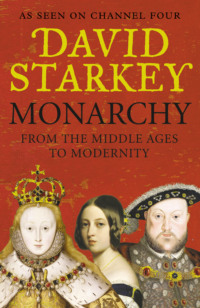
MONARCHY

From the Middle Ages to Modernity
DAVID STARKEY

To Hal and Susie Bagot,
under whose roof it was finished.
For friendship and hospitality.
CONTENTS
GENEALOGY
INTRODUCTION: The Imperial Crown
PART I
1 The Man Who Would Be King
2 King and Emperor
3 Shadow of the King
4 Rebellion
5 New Model Kingdom
PART II
6 Restoration
7 Royal Republic
8 Britannia Rules
9 Empire
10 The King is Dead, Long Live the British Monarchy!
EPILOGUE: The Challenges of Modernity
INDEX
Also by David Starkey
Credits
Copyright
About the Publisher
PICTURE CREDITS
SECTION I
Page 1
1 King Edward IV, by unknown artist, (oil on panel). The National Portrait Gallery, London.
2 Elizabeth Woodville. © The President and Fellows of Queens’ College.
3 King Richard III, by unknown artist, late 16th century, (oil on panel). The National Portrait Gallery, London.
4 Lady Margaret Beaufort, by unknown artist, c.1600, (oil on panel). The National Portrait Gallery, London.
Pages 2–3
1 King Henry VII, by unknown artist, 1505, (oil on panel). The National Portrait Gallery, London.
2 Elizabeth of York, by unknown artist, c.1500, (oil on panel). The National Portrait Gallery, London.
3 King Henry VIII, (miniature), Horenbout Lucas, 1526–7. The Royal Collection © 2006, Her Majesty Queen Elizabeth II.
4 Catherine of Aragon, (miniature), attributed to Horenbout Lucas, c.1525. The National Portrait Gallery, London.
5 Meeting at the Field of the Cloth of Gold, 7th June 1520. From an original by Hans Holbein, the Elder (oil on canvas), this copy by Friedrich Bouterwek. © Chateau de Versailles, France/Lauros/ Giraudon/The Bridgeman Art Library.
Pages 4–5
1 The Whitehall Mural, or The Dynasty Portrait. From an original by Hans Holbein, this copy by Remigius van Leemput, late 17th century. The Royal Collection © 2006, Her Majesty Queen Elizabeth II.
2 The Great Bible, title page, 1539. © Lambeth Palace Library, London, UK/The Bridgeman Art Library.
Pages 6–7
1 The Family of Henry VIII, by unknown artist, c.1545, (oil on canvas). The Royal Collection © 2006, Her Majesty Queen Elizabeth II.
2 Thomas Cranmer, by Flicke Gerlach, 1545, (oil on panel). The National Portrait Gallery, London.
3 King Edward VI and the Pope, by unknown artist, c.1570, (oil on panel). The National Portrait Gallery, London.
4 Queen Mary I by Hans Eworth or Ewoutsz, (fl.1520–74). © Society of Antiquaries, London, UK/The Bridgeman Art Library.
5 Foxe’s Book of Martyr’s (page detail), c.1500. © Lambeth Palace Library.
Page 8
1 Queen Elizabeth I in Coronation Robes, by unknown artist, c.1559, (panel). © National Portrait Gallery, London, UK/The Bridgeman Art Library.
2 Mary, Queen of Scots after a miniature, by unknown artist, c.1560–1565, (oil on panel). The National Portrait Gallery, London.
3 James I (in robes of state), van Somer Paul, c.1620. The Royal Collection © 2006, Her Majesty Queen Elizabeth II.
SECTION II
Page 1
1 The Somerset House Conference, by unknown artist, 1604, (oil on canvas). The National Portrait Gallery, London.
2 Right hand side of Diptych showing the Parliament of James I of England, VI of Scotland and the Gunpowder Plot, detail of the Gunpowder Plotters from the bottom right hand corner, by English School, 17th century, (oil on panel). © St. Faith’s Church, Gaywood, Norfolk, UK/The Bridgeman Art Library.
3 Great Seal of James I (detail) by English School, 17th century, (engraving). © Private Collection/ The Bridgeman Art Library.
Pages 2–3
1 King Charles I and his Family, by school of Sir Anthony van Dyck, (oil on canvas). © Royal Hospital Chelsea, London, UK/The Bridgeman Art Library.
2 Archbishop William Laud, after Sir Anthony van Dyck, c.1636, (oil on canvas). The National Portrait Gallery, London.
3 Parliament Assembled at Westminster on 13th April 1640, by unknown artist, 17th century, (engraving). © Museum of London, UK/The Bridgeman Art Library.
Pages 4–5
1 The Battle Plan of Naseby from Anglia Rediviva, 1647. © The British Library, London.
2 Oliver Cromwell by Walker Robert, c.1649, (oil on canvas). The National Portrait Gallery, London.
3 Execution of Charles I (1600–49) at Whitehall, January 30th, 1649 (oil on canvas) by Coques, Gonzales, attr.to. © Musee de Picardie, Amiens, France/Giraudon/The Bridgeman Art Library.
4 The Pourtraiture of his Royal Highness, Oliver, Late Protector etc, in his Life and Death, with a short view of his Government. © The British Library, London.
Pages 6–7
1 Coronation Procession of Charles II to Westminster from the Tower of London, by Dirck Stoop, 1661. © Museum of London, UK/The Bridgeman Art Library.
2 Charles II enthroned wearing the recreated Regalia, by John Michael Wright, 1660–1670. The Royal Collection © 2006, Her Majesty Queen Elizabeth II.
3 The Royal Gift of Healing, King Charles II healing the sick, by unknown artist, 1684. © Heritage Image Partnership/The British Library.
Page 8
1 Dutch attack on the Medway: The Royal Charles carried into Dutch waters, 12th June 1667, by Ludolf Bakhuizen, 1667, (oil on canvas). National Maritime Museum, London.
2 Titus Oates, by Robert White, 1679, (line engraving). The National Portrait Gallery, London.
SECTION III
Page 1
1 A perspective of Westminster Abbey from the High alter to the West end showing the manner of his Majesties crowning ( James II). From The History of the Coronation, Francis Sandford, 1687. © Lambeth Palace Library.
Pages 2–3
1 Louis XIV in Royal Costume, by Hyacinthe Rigaud, 1701, (oil on canvas). © Louvre, Paris, France/Giraudon/The Bridgeman Art Library.
2 King William III, by unknown artist, c.1690, (oil on canvas). The National Portrait Gallery, London.
3 Mary II as Princess of Orange, attributed to Nicholas Dixon, c.1677. The Royal Collection © 2006, Her Majesty Queen Elizabeth II.
Pages 4–5
1 Apotheosis of William and Mary, Ceiling of the Painted Hall, by Sir James Thornhill, 18th century. Courtesy of the Greenwich Foundation for the Old Royal Naval College.
2 Queen Ann and William, Duke of Gloucester, studio of Sir Godfrey Kneller BT, c.1694, (oil on canvas). National Portrait Gallery, London.
Pages 6–7
1 John Churchill, 1st Duke of Marlborough, and Sarah, Duchess of Marlborough, with their children, by Johann Closterman, (oil on canvas). © Blenheim Palace, Oxfordshire, UK/The Bridgeman Art Library.
2 The Duke of Marlborough surveys his troops at the Battle of Oudenarde in the Spanish Netherlands, 30th June 1708, tapestry woven by Judocus de Vos. © Blenheim Palace, Oxfordshire, UK/The Bridgeman Art Library.
3 View of Blenheim Palace from the column of Victory. © Skyscan.
Page 8
1 Rear wall painting of the Upper Hall at Greenwich glorifying George I and the House of Hanover, by Sir James Thornhill. Courtesy of the Greenwich Foundation for the Old Royal Naval College.
SECTION IV
Page 1
1 The pediment of the Temple of Concord and Victory, c.1735, at Stowe Landscape Garden. Courtesy of Stowe School Photographic Archive (M. Bevington).
2 Robert Walpole, 1st Earl of Orford, Studio of Jean Baptiste van Loo, 1740, (oil on canvas). The National Portrait Gallery, London.
3 William Pitt the Elder, 1st Earl of Chatham, studio of William Hoare, c.1754, (oil on canvas). The National Portrait Gallery, London.
Pages 2–3
1 George Washington, by Gilbert Stuart. © Metropolitan Museum of Art, New York, USA/The Bridgeman Art Library.
2 Thomas Jefferson, 3rd President of the United States, by James Sharples, c.1797, (oil on canvas). © Bristol City Museum and Art Gallery, UK/The Bridgeman Art Library.
3 Wren building of the College of William and Mary, Williamsburg, Virginia, USA. © G.E. Kidder Smith/CORBIS.
4 George III in his Coronation Robes, by Allan Ramsay, 1761. © Scottish National Portrait Gallery, Edinburgh/Bridgeman Art Library.
5 Edmund Burke, studio of Sir Joshua Reynolds, c.1767–69, (oil on canvas). The National Portrait Gallery, London.
6 The severed head of Louis XVI, King of France, in the hands of the executioner, (Stipple engraving). Photo: akg-images, London.
Pages 4–5
1 The Plum Pudding in Danger, by James Gillray, 1805, (colour engraving). © Private Collection/The Bridgeman Art Library.
2 King George IV in Highland Dress, 1830, (oil on canvas), Sir David Wilkie. Apsley House, The Wellington Museum, London/The Bridgeman Art Library.
3 The Quadrant, Regent Street, from Piccadilly Circus, published by Ackermann, c.1835–50, (coloured aquatint). © Private Collection/ The Stapleton Collection/The Bridgeman Art Library.
Pages 6–7
1 King William IV, by Sir Martin Archer Shee, c.1800, (oil on canvas). The National Portrait Gallery, London.
2 Sir Herbert Taylor, Private Secretary to King William IV, by John Simpson, exhibited 1833, (oil on canvas). The National Portrait Gallery, London.
3 The House of Commons, 1833, by Sir George Hayter, 1833–1834, (oil on canvas). The National Portrait Gallery, London.
Page 8
1 The Royal Family in 1846, Franz Xavier Winterhalter, 1846. The Royal Collection © 2006, Her Majesty Queen Elizabeth II.
2 Opening of the Great Exhibition by Queen Victoria on 1st May 1851, Henry Courtney Selous, 1851–52. © V&A Images, London.
GENEALOGIES
The English and British Monarchy from the Middle Ages to Victoria
The House of York and Lancaster, The House of Tudor
The House of Stuart and the Hanoverians


INTRODUCTION
THE IMPERIAL CROWN
IN LATE 1487, King Henry VII had much to celebrate. In the space of only two years he had won the crown in battle; married the heiress of the rival royal house; fathered a son and heir; and defeated a dangerous rebellion. Secure at last on the throne, he decided to commemorate the fact in the most dramatic way possible by commissioning a new crown. And he would first wear it on the Feast of the Epiphany, 6 January 1488, at the climax of the Twelve Days of Christmas, when the monarch re-enacted the part of the Three Kings who had presented their gifts of gold, frankincense and myrrh to the Christ Child.
The new ‘rich crown of gold set with full many precious stones’ caused a sensation. As well it might. The circlet was thickly encrusted with rubies, sapphires and diamonds, highlighted with large and milky pearls. From the circlet there rose five tall crosses alternating with the same number of similarly proportioned fleur-de-lis. These too were thickly set with stones and pearls, with each fleur-de-lis in addition having on its upper petal a cameo carved with an image of sacred kingship. The crown was surmounted by two jewelled arches, with, at their crossing, a plain gold orb and cross, and it weighed a crushing seven pounds.
It was the Imperial Crown of England. As such it sits on the table at the right hand of Charles I in his family portrait by van Dyck as the symbol of his kingly power.
This book is the story of the Imperial Crown and of those who wore it, intrigued for it and, like Charles I himself, died for it. They include some of the most notable figures of English and British history: Henry VIII, whose mere presence could strike men dumb with fear; Elizabeth I, who remains as much a seductive enigma as she did to her contemporaries; and Charles I, who redeemed a disastrous reign with a noble, sacrificial death as he humbled himself, Christ-like and self-consciously so, to the executioner’s axe.
Such figures leap from the page of mere history into myth and romance. And they do so, not least, because of the genius of their court painters, such as Holbein and van Dyck, who enable us to see them as contemporaries saw them – or, at least, as they wanted to be seen.
I have painted these great royal characters – and a dozen or so other monarchs, who, rightly or wrongly, have left less of a memory behind – with as much skill as I can. But this is not a history of kings and queens. And its approach is not biographical either. Instead, it is the history of an institution: the monarchy. Institutions – and monarchy most of all – are built of memory and inherited traditions, of heirlooms, historic buildings and rituals that are age-old (or at least pretend to be). All these are here, and, since I have devoted much of my academic career to what are now called court studies, they are treated in some detail.
But the institution of monarchy, and I think this fact has been too little appreciated, is also about ideas. Indeed, it is on ideas that I have primarily depended to shape the structure of the book and drive its narrative. But these are not the disembodied, abstract ideas of old-fashioned history. Instead, I present them through the lives of those who formulated them. Sometimes these were monarchs; more usually they were their advisers and publicists. Such men – at least as much as soldiers and sailors – were the shock-troops of monarchy. They shaped its reaction to events; even, at times, enabled it to seize the initiative. When they were talented and imaginative, monarchy flourished; when they were not, the Crown lost its sheen and the throne tottered.
I have already sketched this ideas-based approach in my earlier The Monarchy of England: The Beginnings, which deals with the Anglo-Saxon and Norman kings. In it, I argue that Wessex, round which the unitary kingdom of England coalesced in the ninth and tenth centuries, was a participatory society, which balanced an effective monarchy at the centre with institutions of local government which required – and got – the active involvement of most free men. It was this combination which enabled Wessex to survive and absorb the Viking invasions and finally to thrive. It is also why, after the destructive violence of the Norman Conquest and its immediate aftermath, the Norman kings decided that both the ethos and the methods of Anglo-Saxon government were too useful to be abandoned. Instead, the great law-giver kings of the Middle Ages, such as Henry II and Edward I, embodied them in an elaborate framework of institutions: the Common Law, the Exchequer and Parliament.
But, by the late fifteenth century, when I pick up the story, much of this was played out. The sense of mutual responsibility between Crown and people, which was the great legacy of the Anglo-Saxon nation-state, had eroded, and Parliament was flatly refusing to impose adequate taxation. The result was that the English kings, who had been the great military and imperial power of western Europe for much of the Middle Ages, found themselves outclassed by rulers who could raise more or less what revenues they wanted without the awkward business of getting their subjects’ agreement first.
The young Henry VIII tried to breathe life into the embers. But even he had to admit defeat. Instead, the English monarchy took a radically different tack. And it did so purely by accident. Because he wanted a son – and because he wanted Anne Boleyn even more – Henry decided to divorce his first wife, Catherine of Aragon. But Continental power politics meant that the Pope refused. To get Anne, therefore, Henry had to do the hitherto unthinkable and displace the Pope by making himself head of the Church. The result fused politics with religion, first strengthening the monarchy beyond limits, then presenting it with the novel challenge of ideological opposition as the kingcum-Supreme Head of the Church found himself caught up in the vicious doctrinal disputes of the Reformation.
And all of this came to focus on Henry VII’s Imperial Crown. Forged in an earlier age and for utterly different purposes, it came to symbolize the monarchy’s inflated claims to rule Church as well as state, and, with the Stuart accession, Scotland as well as England.
But the very scale of the crown’s claims triggered an equal and opposite reaction, and a century later a king was beheaded, the monarchy abolished and the Crown Imperial itself smashed and melted down.
This book tells the story of how and why this happened: of the Tudors, who carried the Crown of England to its peak; of the Stuarts, who united England and Scotland but eventually mishandled both; of the revolution that tried to extirpate monarchy in Britain. And, finally, of the monarchy’s apotheosis – its extraordinary transformation from a priest-ridden absolutism to a limited, constitutional power in the state and the figurehead of the most extensive empire in the history of the world.
PART I


THE MAN WHO WOULD BE KING
HENRY VII
I
THE MAN WHO ordered the Crown Imperial to be made was the founder of the Tudor dynasty, Henry Tudor. But Henry was a man who should never have been king at all. He seized the throne against the odds, amid bloodshed and murderous family feuds. But behind the beheadings and the gore was the fundamental question of how England should be ruled. Henry thought he knew the answer. But his cure proved as bad as the disease.
The story begins five years before Henry Tudor’s birth, when a nine-year-old girl was summoned to court. Her name was Margaret Beaufort, and with her fortune of £1000 a year, she was the richest heiress in England. Even more importantly, as the direct descendant of John of Gaunt, Duke of Lancaster, Margaret was of the blood royal. Her cousin, the Lancastrian King Henry VI, had decided that she should marry his own half-brother, Edmund Tudor – a man more than twice her age. It was a sordid mixture of money and power, with the technicalities fixed by a venal and accommodating Church.
King Henry VI was weak. He had failed in war; was incapacitated by long bouts of madness, and had fathered just one child, thus leaving the succession dangerously in doubt in an age of civil war and rival kings. The union of Margaret and Edmund would, Henry hoped, strengthen the weakened royal family. It would surely produce children, and therefore fulfil the Lancastrian dynasty’s duty to provide a line of potential successors to the crown should anything happen to the sole heir. For what was the monarchy for if it could not guarantee the continuity of effective rule long into the future?
When Margaret was barely twelve, the earliest legally permissible age for sexual intercourse, Edmund brought her to Wales, where they lived together as man and wife. Shortly before Margaret’s thirteenth birthday she became pregnant, but six months later, weakened by imprisonment during a Welsh feud and finished off by the plague, Edmund died on 1 November 1456. His child bride, widowed and heavily pregnant, sought refuge with her brother-in-law at Pembroke Castle.
And it was in a tower chamber at that castle that Margaret gave birth to the future Henry VII on 28 January 1457. Actually, it was a miracle that both mother and child survived. It was the depths of winter and the plague still raged, while Margaret, short and slightly built even as an adult, was not yet fully grown. The birth probably did severe damage to her immature body because, despite two further marriages, Margaret was to have no more children. Yet out of this traumatic birth an extraordinary bond was forged between the teenage mother and her son.
Margaret would need to be the strong woman behind her son; Henry was born into an England that was being torn apart by civil war. For their family, the Lancastrians, were not the only ones with a claim to the throne. Their opponents were the three brothers of the House of York. Also descended from Edward III, they had at least as good a claim to the throne, one which they determined to make good by force. The resulting conflict later became known as the Wars of the Roses, after the emblems of the two sides: the red rose of Lancaster and the white rose of York.
Such emblems, known as badges, were worn not only by the followers of the two rival royal houses, but by all the servants of the nobility and greater gentry. And the more land you had, the bigger the private army of badge-wearing retainers (as they were called) you could afford. The forces of York and Lancaster and their noble allies were evenly balanced, with the result that after fifteen years of fighting, the crown had changed hands twice between the Lancastrian King Henry VI and his rival Edward of York, who had declared himself Edward IV.
Their final showdown came at Tewkesbury in Gloucestershire, in May 1471. Edward – young, warlike, charismatic and supported by both his brothers, the twenty-one-year-old George, Duke of Clarence, and Richard, Duke of Gloucester, who was eighteen – was determined to annihilate the House of Lancaster once and for all. The battle soon turned into a massacre, leaving thousands dead on the field. It was a decisive victory for York; a disaster for Lancaster.
After the battle, many of the Lancastrians fled to Tewkesbury Abbey, where they took refuge in the church. The victorious Edward and his men then burst in. There are two different versions of what happened next.
According to the official account, Edward behaved with exemplary decorum, pardoning the fugitives and offering up solemn thanks at the high altar for his victory. But the unofficial accounts tell a different and much more shocking story. Edward and his men, rather than turning their thoughts to God and mercy, began to slaughter the Lancastrians. A lucky few were saved by the intervention of a priest, vested and holding the holy sacrament in his hands, in front of whom even the bloodthirsty Yorkists felt some shame. Edward then recovered control of the situation by issuing pardons to his defeated enemies. But already enough blood had been spilt to pollute the church and to require its reconsecration.
The Yorkists also claimed that the Prince of Wales had died in the carnage of the battlefield. But darker rumours had it that he had been taken prisoner and brought before Edward, who accused him of treason, pushed the boy away and struck him with a gauntlet. He was then murdered by Clarence and Richard. A day or two later, despite his solemn pardon, Edward ordered the beheading of most of the remaining Lancastrian leaders. Now only the life of the feeble Lancastrian king, Henry VI, stood between Edward and an unchallenged grasp of the throne.
On 21 May Edward entered the City of London in triumph. That night, between the hours of eleven and midnight, Henry VI was murdered in the Tower of London, probably with a heavy blow to the back of the head. Only one man is named as being present in the Tower at the time: Edward’s youngest brother, Richard, Duke of Gloucester, who already, at the age of only eighteen, was emerging as the most effective hatchet man of the Yorkist regime. As he struck the fatal blow, he is supposed to have said, ‘Now there is no heir male of King Edward the Third but we of the House of York!’ Now, surely, the Wars of the Roses were over.
No one, a Yorkist chronicle exulted, of ‘the stock of Lancaster remained among the living’ who could claim the throne. But one Lancastrian claimant – however remote – did remain: Henry Tudor. Fourteen years had passed since Margaret had had her son. Now the teenage Henry was in danger of his life. Not even the massive walls of Pembroke Castle could protect the boy against the vengeful power of Edward of York, and his mother urged him to flee. He took ship at Tenby, and crossed the Channel to Brittany. And there Henry had to endure a decade and a half of politically fraught exile before he would see either England or his mother again.
II
Having annihilated his Lancastrian enemies, Edward of York was now King Edward IV of England indeed. But the problem of nobles who were almost as rich and powerful as the king himself remained. And richest and most powerful of all was Edward’s middle brother George, Duke of Clarence, the man Shakespeare described as ‘False, fleeting, purjur’d Clarence’.
The phrase is memorable. But it is misleading. It suggests that the key to Clarence’s story lies in his character defects. It doesn’t. It lies instead in his position. For Clarence was what Queen Elizabeth I, who would occupy the same unenviable place herself, called ‘second person’. His title, Duke of Clarence, was the one that was given in the Middle Ages to the king’s second son. As such, he was endowed with vast estates and many grand castles like Tutbury and Warwick. Here he kept what he called his ‘court’ with a state that was indeed royal. Only the life of Edward himself, and in time Edward’s two sons, stood between Clarence and the throne itself. Some second persons were content to remain merely loyal lieutenants. Clarence was not one of them. He had a power over the king that was at once malicious and deeply harmful to the peace of England. Clarence’s knowledge, should he choose to reveal it, concerned the future of the House of York itself and all that the brothers had fought for. It related to his sister-in-law, Elizabeth.
Elizabeth Woodville was one of the most controversial women ever to have been Queen of England, with a past that could provide plenty of ammunition for a man as unscrupulous as Clarence. She was beautiful, ambitious, greedy and a widow of modest family background, on her father’s side at least. Edward first met her when she petitioned him about a problem with her late husband’s estate. Edward, young, handsome and sensual, immediately propositioned his pretty supplicant, but Elizabeth defended herself, it is said, with a knife. Edward, as seems then to have been his habit when women resisted his advances, offered her marriage. But this time it was not an empty promise to ensure a seedy seduction and the two were married secretly at her father’s house.
Perhaps Edward had intended to repudiate this clandestine marriage to an attractive but nonetheless obviously unsuitable wife once he had got what he wanted. But he did not. Had the marriage turned out to be valid after all? Had Edward the playboy fallen in love? At any rate, six months later the marriage was made public and Elizabeth acknowledged as queen. By the mid-1470s, Elizabeth had presented Edward with five daughters and, crucially, two sons. Immortalized in stained glass at Canterbury Cathedral, they look like the perfect royal family. Edward had what every king desired: an heir and a spare and a collection of marriageable daughters.
The elder son was called Edward; the younger, Richard. History would know them as the Princes in the Tower. But if their parents’ marriage proved to be invalid, the serene image of a happy royal family that would carry on the Yorkist line long into the future would be shattered. The boys would become bastards, and Clarence would be heir once more. So the ambitious second person revived an old rumour. It was said that the libidinous king had been married to another woman at the time he married Elizabeth, thus making the present union bigamous and therefore illegal.
The rumour of a previous marriage may well have been true – certainly, bearing in mind Edward’s notorious way with women, it was plausible. That only made it the more dangerous, and by throwing his weight behind it Clarence had tested his brother’s patience too far. Clarence was arrested and put on trial before a specially convened parliament in January 1478. Edward had packed the parliament with his own supporters. He was himself both judge and prosecutor, and no one dared to speak on behalf of the accused but Clarence himself.
The verdict of guilty was a foregone conclusion, and on 18 January 1476 Clarence was executed in the Tower, famously by drowning in a butt of malmsey. The middle brother of York was gone. But the problem he represented was not. The monarchy had been weakened by the Wars of the Roses. Much royal land had been given away to buy support from the nobles, some of whom, like Clarence, had threatened to become mightier than the king. Such overweening subjects were difficult to manage at the best of times. But when there were rival claims to the throne, they became a dangerous source of visibility as Clarence’s own career had shown.
To guard against the possibility of future Clarences, Edward needed to strengthen his own position and that of the Crown. To help him do it, he enlisted a surprising ally: a man who had spent thirty years working for the enemy. Sir John Fortescue had served as the Lancastrian Lord Chief Justice; had spent years in exile with the Lancastrian Prince of Wales, and had been captured after the Battle of Tewkesbury. But the king not only pardoned him; he placed him on his council.
At first sight, it’s rather surprising that Edward decided to spare Fortescue. An enthusiastic hanging judge, Fortescue had planned the judicial murder of the young Edward and the whole Yorkist family. He had also written powerfully and learnedly against Edward’s claim to the throne. But Edward set these personal grievances aside. He had work for the old man to do. Fortescue, the leading intellectual of Lancastrian England, would play an important part in the construction of the new, reformed Yorkist monarchy of England.
Fortescue could be called England’s first constitutional analyst, his key ideas shaped by the years he had spent in exile in Scotland and France. For his experience of how other countries were governed led him to reflect on his own, and to ask a series of fundamental questions. What was unique and valuable about the English system of government? What had gone wrong with it to breed the dreadful malaise of the Wars of the Roses? And how could the disease be cured without killing the very benefits that made England what it was?
Fortescue set out his answers in a short but remarkable book. It is usually called The Governance of England, but its full title, as it appears in the early printed edition, is The Difference between an Absolute and a Limited Monarchy. Or in Fortescue’s own lawyerly Latin terminology, between a ‘dominium regale’ and ‘dominium politicum et regale’.
France, Fortescue says, is the supreme exemplar of absolute monarchy – dominium regale – and England of limited, or mixed, monarchy – dominium politicum et regale. And the key to the difference between the two lies in the rules governing taxation. In France, the king could tax the common people at will, a system Fortescue strongly disliked as it made the king rich, but kept the people poor. But in England the rule established since at least the thirteenth century was that the king could only tax with the agreement of Parliament. For the English had an inviolable right of private property, and in that lay their liberty.
This certainly made the English rich, with a standard of living that was the envy of foreign visitors and the boast of patriotic Englishmen like Fortescue. But did the rules limiting taxation make the English king poor, and because he was poor, weak and incapable of military conquest and enforcing the rule of law against a fractious and turbulent nobility? Fortescue thought that they did, and that this weakness was the explanation for the Wars of the Roses. For the administration of the laws – which guaranteed the property rights and liberty of Englishmen – worked only when the monarchy had the independence and authority to govern the powerful men of the kingdom. And that in turn depended on the relative balance of wealth and power between the king and his greatest subjects, the nobility. As it was, in the late fifteenth century the king was relatively poor, whereas a handful of the nobles were extremely rich, which made them in Fortescue’s vivid phrase ‘over-mighty’ and potentially ungovernable.
One solution would have been for the King of England to follow the path of French absolutism and impose by force taxes that Parliament wouldn’t vote by consent. But such a challenge to traditional English freedom – or more accurately to the rights of property owners – would be dangerously revolutionary. The question, therefore, was how to achieve the apparently impossible, and reconcile monarchical authority with the liberty of the subject. Fortescue’s proposal was to strengthen the Crown within the existing system of limited monarchy. The king, he said, should acquire land, and rule by virtue of being the richest man in the kingdom. For if the king had an independent source of income, Fortescue argued, the English people would enjoy their wealth and liberty without being imposed upon by the monarch, who would in turn uphold the law because he would ‘exceed in all lordship all the lords of his realm, and none of them would grow to be like him, which thing is most to be feared of all the world’. The execution of his brother allowed Edward to do just that, by keeping Clarence’s vast estates for himself.
The royal revenues from land increased rapidly, which meant that Edward didn’t need to call a parliament again for the unusually long period of almost five years. But land, Fortescue also understood, was about power as well as cash. And Edward took advantage of his new-found freedom to redraw the political map. He carved England up into territories, each controlled by a trusted member of his own household or family. It was all very cosy, but it depended to a dangerous extent on the force of Edward’s own personality. It also loosened ties of loyalty, since it meant that those outside the charmed circle didn’t care very much one way or another about who the king happened to be.
But as long as Edward remained alive and well, none of that mattered. Indeed, for the next five years the king grew rich; his Yorkist regime grew strong and it seemed that Lancastrian Henry Tudor, still sheltering in Brittany, would live out the rest of his life in exile. But at Easter 1483, disaster struck the House of York. Edward was taken ill with a fever after going fishing on the Thames. Within ten days he was dead. Only Richard, youngest of the brothers, remained of the generation of Yorkists that had defeated the Lancastrians at Tewkesbury. He was no more his brother’s heir than Clarence, but true to family form he too would make his own brutal bid for power.
III
After the unexpected death of King Edward IV, all eyes turned west, towards Ludlow in the Welsh Marches, where Edward’s son, heir and namesake – Prince Edward – was being brought up. But at twelve, was the boy old enough to rule in his own name? Much of the Yorkist clique, particularly the queen’s family, who had become powerful after the secret marriage, staked their future on the premise that the child could reign in his own right. They had been responsible for his education and upbringing; they had much to gain in the new reign. But a faction emerged in favour of appointing the prince’s uncle Richard as ‘Protector’ or regent until the boy was old enough to exercise power himself.
Queen Elizabeth, sensing danger, was determined to get her son crowned quickly, and the council agreed that the coronation should take place without delay. On 23 April, following the council’s decision, Edward left Ludlow for London, his coronation and his reign. His escort, as his council insisted, was limited to 2000 men. It was enough to put on a fine show as the young king took possession of his kingdom. But the great lords of the kingdom were able to muster as many men or more. And unbeknown to the boy or his mother, Richard was summoning his own troops. He too was heading south.
Late on the night of 2 May, Queen Elizabeth Woodville, waiting in London for the arrival of her eldest son, received alarming news. Edward’s cavalcade had been intercepted by his uncle, Richard, who had taken possession of his young nephew. The duke professed loyalty to the late king’s son and heir, his own nephew after all. But Elizabeth, immediately suspicious of Richard’s motives, fled that night with her younger son into the safe sanctuary of the abbey at Westminster. Richard entered London with his nephew a few days later. The council quickly ratified Richard’s role as ‘Protector’. Young Edward’s coronation was ‘postponed’ until late June, and he was placed in ‘lodgings’ in the Tower.
What was Richard doing and why? Hitherto, he had had a reputation, in contrast to the flighty Clarence, for rock-solid loyalty to his brother Edward, who had rewarded him with the government of the whole of the north of England. There he had won golden opinions as a fine soldier and a fair judge, and the model of a king’s younger brother. Nevertheless, his portrait suggests a man not entirely at ease with himself – or others. He is tight lipped, and he is fiddling nervously with the rings on his fingers; he also had the tic of biting hard on his lower lip and constantly pushing and pulling his dagger in and out of its sheath. Was he repressed, paranoid? A hypocrite with an iron grip on himself ? Or did he genuinely believe, in view of Edward’s tangled marital history, that he, Richard, was now rightful King of England?
On 10 June Richard, an over-mighty subject indeed, summoned his troops to London. His bid for the crown had begun in earnest. A week later, Queen Elizabeth was compelled to give up her younger son Richard into his uncle’s charge. The young prince now joined his brother in the Tower.
Their uncle Richard now had both boys, first and second in line to the throne, under lock and key. On 22 June a compliant parliament decreed that King Edward’s marriage to Queen Elizabeth was invalid, and the princes bastards. Richard had succeeded where his brother Clarence had failed. He had robbed his nephews of their right to the crown and cleared his own path to the throne. He was crowned King Richard III at Westminster on 6 July, with the full blessing of Parliament.
During those frantic weeks, the two princes had been seen less and less around the Tower. Now they seemed to have disappeared altogether. By the late summer of 1483 everybody, including the princes’ own mother, Elizabeth Woodville, took for granted that they were dead. They also took it as read that the responsibility for their deaths rested with Richard. For only Richard had the power, opportunity and above all the motive.
To this day, their exact fate remains a mystery. Writing thirty years later, Thomas More claimed that the Constable of the Tower was ordered to do them to death, but refused. Others, however, proved willing, and the two boys, More says, were smothered to death in their sleep with pillows, on the orders of their uncle.
His elder brothers were dead, the princes gone. The crown was his. But apparently doing away with the rightful heirs to the throne was a step too far, and opposition to Richard was now growing. Richard had been popular and might in theory have been a suitable king. But his sudden and bloody means of gaining power were seen as bringing a curse on England and perverting the sacred rule of succession. Soon he would be fighting to the death for the crown he had taken by fraud and force.
Opposition came to centre on a plot hatched between two powerful and aggrieved mothers: Queen Elizabeth Woodville, whose sons were lost, and Margaret Beaufort – whose son Henry Tudor was in exile. Their machinations would prove Richard’s undoing, and decide England’s fate.
Some time in the late summer of 1483 Queen Elizabeth Woodville, still in sanctuary in the abbot’s lodgings at Westminster, received a visit from a singular Welshman, Dr Lewis Caerleon. Dr Caerleon was a scientific jack-of-all-trades – mathematician, astronomer, astrologer and physician – and, unlike many polymaths, he was a master of all of them. The sanctuary, of course, was heavily guarded by the king’s men, but Dr Caerleon was waved through because he was the queen’s physician. He was also, not coincidentally, physician to Lady Margaret Beaufort, and in his doctor’s bag he carried, on Lady Margaret’s behalf, a remarkable proposal. The queen’s eldest daughter – also called Elizabeth – should marry Margaret’s son Henry. Thus the bloodlines would converge, and York, Woodville and Tudor should join together against the usurping Richard III. That Elizabeth accepted the proposal confirms that she was convinced that her sons were dead.
That Margaret made it shows that she had realized that Richard’s murderous ambition had opened the way for her son to gain the throne of England. Margaret had been nursing her ambitions for her exiled son, Henry Tudor, for years. Now, thanks to Richard’s murderous path to the throne, she could put them into practice.
His mother’s plot under way, the thirty-year-old Henry set sail from Brittany, where he had lived in exile for the fifteen years of impregnable Yorkist rule, to make his bid for England’s throne. On 7 August 1485, at Milford Haven, just a few miles from his birthplace at Pembroke, Henry Tudor’s army made landfall in the evening. His years of exile were at an end.
As soon as he stepped ashore Henry knelt, overcome with emotion at his seemingly miraculous return, and began to recite the psalm ‘Judge me Lord and fight my cause’. Then he kissed the sand and, making the sign of the cross, called on his troops in a loud voice to follow him in the name of God and St George. It was a magnificent beginning for a would-be King of England.
But only 400 of Henry’s men were English. Most of the rest of his little army of 2000 or 3000 were French, and they had come in French ships with the aid of French money and the blessing of the French king. Indeed, most of Henry’s own ideas about kingship were probably French as well. So just what kind of King of England would he be? That question was not asked for the moment. First, he had to wrench the crown from Richard’s powerful grasp.
The two sides came face to face at Bosworth in the Midlands, where the fate of England’s monarchy would be decided. The battle began when the vanguard of Richard’s army, thinking to overwhelm Henry’s much smaller force, charged down the hill. But instead of breaking and running, Henry’s front line smartly reformed themselves into a dense wedge-shaped formation. Against this, the attack crumbled.
Richard, high up on Ambian Hill, now caught sight of Henry with only a small detachment of troops at the rear of his army. With courage or desperation, Richard decided that the battle would be settled by single combat – Richard against Henry, York against Lancaster. Wearing his battle crown, with a light robe with royal symbols over his armour, Richard led a charge with his heavily armed household knights down the hill. With magnificent courage he cut down Henry’s standard-bearer and came within an inch of Henry himself. But once again, Henry’s foot soldiers proved capable of assuming an effective defensive position. And Richard, isolated and unhorsed, was run through by an unknown Welsh pikeman, mutilated and stripped naked, more like a dishonoured outlaw than a vanquished King of England.
The third and last of the brothers of the house of York was dead. By his reckless ambition Richard had split the Yorkist party and handed victory and the crown to Henry Tudor. The symbolic union of York and Lancaster was made flesh in January 1486, when Henry Tudor married Elizabeth of York, just as their respective mothers had planned. A new iconography of union was created, merging the two once warring roses, red and white, into one – the Tudor Rose. A new dynasty was born.
But two years after the wedding, Henry ordered a new, ostentatious crown to be made, one that hinted at political ambitions that went well beyond Fortescue’s limited monarchy. The crown was soon known as the Crown Imperial. Its unusual size, weight and splendour symbolized the recovery of the monarchy from the degradation of the Wars of the Roses and the expurgation of the foul crimes of Richard, which had brought down a curse upon the kingdom. The French fleur-de-lis, alternating with the traditional English cross round the band of the crown, looked back nostalgically to England’s lost conquests in France. But might there be more to it than that? Henry had witnessed at first hand the powers of the absolute monarchy in France and, some said, he had liked what he had seen. Might the Crown Imperial be the means by which these ideas could, as Fortescue had feared, be smuggled back into England?
Бесплатный фрагмент закончился.