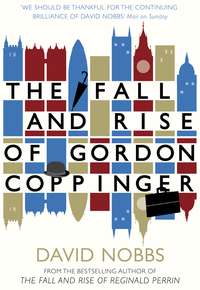
Читать книгу: «The Fall and Rise of Gordon Coppinger»
DAVID NOBBS
The Fall and Rise of Gordon Coppinger

For Briget, Mark and Max
Table of Contents
Title Page
Dedication
So it had come to this
The suspicions that would overwhelm him
It was going to be one of those days
‘I really have shocked myself’
Can we be absolutely certain that they can’t lip-read?
We never said a word about Jack
The evening ended, as it had begun, in silence
A great deal nearer than the Solway Firth
Those insidious doubts
Perhaps we have intruded enough
Staring at himself with astonishment
Not such a useless lump of a nun after all
‘Shame’
His night’s work is done
A serious mistake
‘A perfect memento’
That didn’t make Sir Gordon happy at all
It began to rain
A great deal of pain
He was gone
He might yet be able to save his fortune
‘Siobhan,’ said Sir Gordon, ‘you’re a genius.’
Flat, flat, flat
Back into the real world
An opportunity had been lost
He would need a long, hot bath
There was no chance
It’s wasted already
She is even more astonished
‘I do not listen to your calls. Ever.’
And felt an answering squeeze
What hope is there?
I hope we haven’t
Beyond Gravesend
Fred Upson went pale
What the letters SFN actually stood for
He rather liked bees
A thing that they had never done before
‘I can’t afford to get rid of him’
‘Decision time’
A magic moment
He didn’t think that problem would be any easier
Suddenly he was very sober
The Great Fire of Stoke
‘I’m so sorry’
‘For Jack’
A plan was beginning to take shape
He was fibrillating wildly
It has no future either
And went to bed
The message from his wife
‘Grief makes you very hungry’
No respecter of wealth
Scrambled eggs are his favourite
Acknowledgements
About the Author
Also by David Nobbs
Copyright
About the Publisher
So it had come to this
He woke with a sense of shock. He had no idea who he was. Or where he was. Or who this woman was, sleeping so peacefully beside him.
Oh God. Did he want to know who he was? Would it be an unpleasant surprise?
Later, when he told his doctor, he would estimate that this blankness, this disorientation, this absence of self, probably lasted less than a minute, maybe not even thirty seconds. At the time it seemed like an age.
What he also realized later – and this he didn’t tell his doctor, couldn’t tell his doctor, couldn’t tell another human being ever – was that he had experienced, in that brief moment, the first intimation of doubt. To most of us, plagued as we are by doubt, this may seem incredible, but men like this man – I feel it would be impolite, in a curious way, to give you his name before he himself has remembered it – manage to live without feeling any doubt at all, do things that would be impossible if they felt even a shred of doubt. Garibaldi, Hitler, Colonel Gaddafi, could they have done what they did if they’d had doubts? Not that I am putting our still unnamed hero in that category.
He felt something that he had not felt in his life for a very long time – real alarm. This was extremely disconcerting. He was always so completely in command of himself, prided himself on not needing an alarm clock because his body did what he told it to do; he was always in control, people thought him a control freak.
Well, that was something. That was a piece of knowledge about himself. He was a control freak. But today he was a control freak out of control. He was breaking into a sweat, he could feel the wetness of panic all over his skin.
Memory came back to him in small bits. Somebody calling him Gordon. He was Gordon somebody. This narrowed it down, but it really didn’t help all that much. Then from nowhere, in the utter darkness of the bedroom, there flashed into his mind a vivid memory of Mr Forbes-Harrison, his maths teacher, calling out, in a grim yard behind a grim school on a grim, grey morning, ‘You, Coppinger, where do you think you’re going?’ to which he had replied, to his own astonishment, as well as Mr Forbes-Harrison’s, ‘To the very top, sir.’
And with that ‘sir’ there came the thought that he hadn’t called anybody ‘sir’ for a very long time. People called him ‘sir’ now. He wasn’t just Gordon Coppinger. He was Sir Gordon Coppinger.
Now complete awareness flooded in, astonishing him. He was a great man and a rich one. He was a financier and an industrialist with a finger in many pies, ‘not all of which are steak and kidney’, as he used to say only too often, to prove that he still had a sense of humour, though many people thought it proved that he hadn’t. He owned the twenty-six-storey Coppinger Tower in Canary Wharf. In his huge and luxurious yacht, the Lady Christina, based in Cannes, he gave holidays every summer to men of power and influence.
He was a patriot and a philanthropist. He had created the Sir Gordon Coppinger Charitable Foundation, which supported many good causes. He owned the Coppinger Collection, which housed many masterpieces. The football team that he owned played at the Coppinger Stadium. It was time to get up.
Or was it? Not quite yet, perhaps. He knew who he was now, but he still wasn’t sure where he was. The darkness in the room was absolute, which suggested that he was at home, in the vast master bedroom, with its thick gold curtains and its thermal blinds. But suggestion wasn’t enough. He needed to know.
The question of where he was had no great importance in itself, beyond the necessity of finding a light switch or risk walking in the blackness straight into a row of wire coat hangers in some hotel bedroom, as had happened to a friend of his. Make that an acquaintance of his. He didn’t do friends. But until he knew where he was he couldn’t be sure of the identity of the woman who was sleeping so quietly beside him.
If it was a woman. But that had all been a very long time ago, and, surely, if it was a man, after all this time, he would have remembered. No, it was a woman. Her gentle breathing was unmistakably female.
Just occasionally, the soft breathing became a faint, whistled, wistful snore, as if she was thinking, Surely my life should be happier than this? No man’s snore could come with so many fancy adjectives attached to it. Male snores were loud, or beery, or catarrhal. Male snores were simple.
Were these slight snores Lady Coppinger’s? He wasn’t sure. Was he in the master bedroom of Rose Cottage, the cottage being ironic, and the rose reflecting Her Ladyship’s greatest interest? Or was he in a hotel? Was this woman Francesca? Or Mandy? Please let him not be in Mandy’s flat. He sniffed. No, he wasn’t in Mandy’s flat. There was a faintly unpleasant smell of stale humanity in the room, but Mandy’s flat smelt of drains – distant drains, but unmistakable.
How could he ever have been so unwise as to go to bed with a woman called Mandy? Few names had more baggage attached to them, few names screamed ‘tabloid press’ as much as Mandy. He had been lucky to get away with it this long. Mandy must go.
He was wide awake now, and shocked by the timidity of his thoughts. Her name was half the point of Mandy. The risk was everything. Was he going soft? He felt for his prick. Yes, he was, but that wasn’t what he’d meant.
He tried to remember the events of the previous evening, but they stubbornly refused to come. Had he made love? He didn’t think so. That suggested, but didn’t prove, that he was with his wife. The fact that he couldn’t remember also seemed to indicate, but again didn’t prove, that he’d endured an ordinary Sunday evening at home.
Yes! They’d been watching the Antiques Roadshow. He’d said, ‘Bloody morons, they’ve had it for thirty-five years and they haven’t even noticed the maker’s name’; she’d told him to shut up in a very unladylike tone; he’d said, ‘I wish he’d break that fucking vase over Fiona Bruce’s head’; she’d said, ‘If you’re going to be unpleasant leave me alone’; and then not half an hour later she’d ticked him off for not wanting to watch Downton Abbey with her. Downton Abbey! He’d explained that life was too short to bother with things that hadn’t happened to people who’d never existed. She’d shouted, like a fishwife – was that fair on fishwives, if such people still existed? – that he was ruining her Sunday evening.
Yes, he was at home.
Lady Coppinger had watched Downton Abbey; he’d trawled the Net looking for references to himself, while slowly sipping a large glass of the sixteen-year-old Lagavulin and wondering from what revolting bottle Jack was seeking oblivion at that very moment, under some bridge or in some dark alley. Then he’d slipped quietly into bed beside Her Ladyship, planted the obligatory kiss on her cheek so softly that it could not possibly arouse her, switched the light off and gone straight into guiltless sleep, while she’d read a bit of some soppily romantic book by some much-loved authoress who in real life had been such a frightful snobbish bitch that she’d have been drummed out of Dudley with disdain.
He was at home with Christina. A cocktail of relief and disappointment swept over him, and suddenly he recalled the date and realized why he had felt that this was an important day. It was 31 October. Halloween. His wife’s birthday.
Yes, he had married a witch.
No, he hadn’t married a witch. That had been their little joke. It wasn’t a joke now. She hadn’t been a witch when he’d met her. She’d been as lovely and as full of promise as the dawn. She hadn’t been a witch when he’d courted her, proposed to her, married her. She had been his innocence. He had turned her into a witch. He had fucked his own innocence.
He didn’t like these thoughts, and he wasn’t used to having thoughts that he didn’t like. It was time to get up.
But he didn’t. His body still didn’t stir.
This was dreadful. Regret could play no part in his life. There wasn’t time for regret. Besides, he had everything he wanted. How can a man have regrets if he has everything he wants? Because he didn’t want to have everything he wanted? That was ridiculous. Because he didn’t actually have everything he wanted? Because it was impossible to have everything you wanted, because what you wanted came attached to what you didn’t want, as in fame and photographers?
Photographers! If he had known what was to come!
And yet – and again this only occurred to him afterwards – that morning he did have at least an inkling of what was to come. He had a presentiment. Perhaps, he would suggest to his doctor later, his blankness had been caused by his having, subconsciously, a presentiment that he was going to have a presentiment. His doctor, who was Scottish, would say that was a bit too fanciful for him. He would say that there must have been a physical cause, the position he had slept in, the supply of blood, maybe even some kind of very minor stroke. He would suggest tests. Sir Gordon would pretend to agree.
At last he began to move, easing himself slowly out of the king-sized bed. He padded carefully across the thick, luscious carpet in the utter blackness. He knew from long experience the exact position of the door. He placed his hand on the handle, turned it ever so slowly.
Lady Coppinger gave a low moan which seemed to Sir Gordon to be a rebuke of cosmic proportions, but she didn’t wake.
He was relieved that his wife was still asleep, that he didn’t have to face her yet.
So it had come to this.
The suspicions that would overwhelm him
He seated himself at the round rosewood (what else?) dining table in the exact centre of the gigantic dining room, whose panelling was as Elizabethan as it could be in a house built in 1932. The table seated twelve, and most mornings, as he breakfasted in solitary splendour, he derived pleasure from the sight of the eleven empty places.
He was smartly dressed in the clothes Lady Coppinger had laid out for him the previous evening. He had no colour sense. She did. You couldn’t breed roses without having a colour sense.
Farringdon emerged from the kitchens and slid gravely towards Sir Gordon like a stately home on legs. He carried a glass of freshly squeezed orange juice and a pile of newspapers. Sir Gordon, who was still feeling quite deeply disturbed by his lapse of memory, tried to look the essence of calm, and gave a small, studied smile.
‘Good morning, Farringdon,’ he said, and he thought he detected a slight nervous quiver in his voice. Farringdon didn’t appear to notice it, but then Farringdon would not have appeared to notice it if his employer had come in to breakfast naked. In the early days Sir Gordon had been slightly unnerved by Farringdon’s eyes. There never seemed to be any expression in them. It looked, in certain lights, from certain angles, as if he had two glass eyes. Sir Gordon was used to this now. He found it restful.
‘Good morning, sir. Sir has slept well?’ said Farringdon gravely.
‘Sir has slept very well, thank you, Farringdon.’
‘That is good news, sir.’
The politenesses over, Farringdon got straight down to business, listing for Sir Gordon, in the unchanging daily ritual, all the pages of the newspapers that mentioned him: ‘Telegraph page seven, Times business page two, Sun page two—’
‘Opposite the totty!’
‘Indeed, sir.’
‘Mirror page twenty-seven—’
‘Page twenty-seven! That’s a bit far back.’
‘Indeed, sir, but perhaps the fact that it is a page lead will assuage the disappointment.’
Sir Gordon wasn’t given to idle speculation, but even he did wonder sometimes if Farringdon had once discovered a night-school course on the Language of Butlers.
Farringdon went on to list articles in the newspapers that the team judged to be of relevance to Sir Gordon, mainly from the business sections. Important though their impact on his day’s decisions might be, he would only turn to those after he had finished reading about himself.
Sir Gordon took it entirely for granted that several of his employees had been up since three in the morning, driving the early editions of the papers down to Surrey, where other early risers had hunted through them for stories relevant to himself; while yet more, in London, were at their computers finding and collating references to him on Twitter, YouTube, Facebook and, only slightly less important, news bulletins. He thought that his researchers trawled through every page of every paper. He hadn’t heard of Google Alert.
He began the process of opening the newspapers at the pages that Farringdon had listed, and which he had not needed to write down. Sir Gordon was proud of his memory. His eyes swept contemptuously past several headlines that told of the sad state of our world in the autumn of 2011. Air-disaster fears soar as laser louts blind pilots. Thieves desecrate memorials to our war heroes every two days. Nineteen glasses of wine by the age of twelve. The behaviour of the lower orders from whom he had so thoroughly escaped was of no interest to him.
He found the first reference to himself in the business section’s editorial comment:
Rumour has it that the City is bracing itself for a disappointing set of results from SFN Holdings. While this is not particularly significant in itself, SFN being a fairly small player in the global game, any bad news from the Coppinger empire is bound to be …
Farringdon arrived with a pot of tea, a jug of water, and a bowl of Coco Pops. Sir Gordon had a proudly sweet tooth.
‘Thank you, Farringdon. English Builders’ Tea, the best drink in the world.’
Farringdon raised his eyebrows in agreement. Agreement would have figured largely in his job description, had there been one.
‘You can keep your champagne.’
Again Farringdon, who had no champagne to keep, raised his eyebrows in agreement, and moved off, in his slightly bent, tactful way. He was three inches taller than Sir Gordon, and found it sensible not to emphasize the fact.
… destabilizing at this sensitive time. Also, SFN is believed to be close to Sir Gordon Coppinger’s heart, if such an organ can be located, as it is in his native and beloved Dudley.
‘If such an organ can be located!’ Cheeky bugger. Rather flattering, though. Except … wasn’t he loved, despite his wealth, despite his ruthlessness, because he was British, not Russian or Chinese? A British oligarch. A walking assertion that Britons can still become rich. A patriot. And famously possessed of charm. When he wanted it. When he needed it. Which was most of the time. Which could become irksome.
But could it be – no, it wasn’t possible – that the press were beginning to attack him, to test the waters? And why print these comments anyway, if not to destabilize? They must know that SFN Holdings made a loss every year, though he hoped that they didn’t know that making a loss every year was the whole point of SFN Holdings.
By the time Farringdon returned with the crispy bacon and scrambled eggs, Sir Gordon had already located another story about himself. Well, this one was about Lady Coppinger, variously described in the press as fragrant, elegant, enigmatic – what a gift she was to the world of adjectives, and to imagery taken from roses, as in the headline to this particular story.
A PIECE OF CAKE FOR THORNY CHRISTINA
It’s a long road from selling Battenburg cake to breeding the champion climbing rose at the Baden-Baden October Flower Festival, but even that honour couldn’t make Sir Gordon Coppinger’s elegant wife Christina smile for long.
My German friend Gisela informed me yesterday that Christina didn’t win many hearts as she accepted the prestigious Der Meisteroktoberbergsteinerrosigpreis for her George Clooney Perpetua, named after her favourite film star.
She popped in to the famous and elegant German spa town by private …
‘Thank, you, Farringdon.’
… jet, made a brief speech without using a single word of German, and popped out as fast as her long but no longer quite so slim legs could carry her.
Gisela informs me that Christina did not endear herself to her hosts by wearing her Remembrance poppy throughout.
Can it be that the former confectioner’s assistant and beauty queen – she was voted Miss Lemon Drizzle in 1980, Miss Danish Pastry (West Midlands) in 1982 and Miss West Bromwich in 1983 – was anxious to show her husband that she shares his fanatical xenophobia, or was there perhaps a more personal reason for the brevity of her visit?
Did she feel that she needed to get back to find out what Sir Gordon was up to?
Sir Gordon smiled. She would hate that. She would be furious at the slur cast on her famous legs. She would loathe the references to her days as a beauty queen. How the world would mock. Didn’t she have the sense to see that the whole point of their lives was that they had gone up, up, up and so it was great publicity that they had once been down, down, down? Even Miss Lemon Drizzle can dream of leaving the world of cake far behind and breeding world-class roses. Christina could have been a heroine for our times, a walking representative, in her high heels, on her long but no longer quite so slim legs, of the social mobility so loved by prime ministers who had been to Eton.
And, to his great surprise, he felt a distant flicker of sexuality at the reference to those legs. He even felt stimulated by the thought that they were no longer quite so slim. Few men are turned on by perfection. You couldn’t believe what was in the papers but it might be rather exciting to check on the accuracy of the observation. Good God. Was it possible – was it? – that this year his birthday dinner with her would not be an ordeal?
But … this apparently trivial diary entry also worried Sir Gordon just a little as he ate his exquisite, always exquisite, bacon and scrambled eggs. He didn’t like that phrase, ‘what Sir Gordon was up to’.
What he had been up to was Francesca Saltmarsh. He had taken the rare opportunity, while Christina was abroad, of staying the night. They had made love three and a half times. That half haunted him. Was he beginning to grow old?
Could the press possibly have known about Francesca? No. It was just a shot in the dark. No! If the worst they could come up with was a snide suggestion in a little diary piece, he had nothing to worry about. He was invulnerable, as his fellow ‘Sir,’ Jimmy Savile, had been, because the great British public would not allow him to be attacked. They loved him so much, just as much as he in his turn hated them.
No, his concerns were exaggerated. A second cup of good old British tea, and the world would be fine again.
But as he turned to the third article about himself, his world felt not quite so fine.
Climthorpe United’s challenge for promotion to the Premiership faltered when they were held to a goalless draw by lowly Barnsley at the Coppinger Stadium in yesterday’s late kick-off.
The Gordoners missed a hatful of chances, the best of which fell to taciturn Bulgarian striker Raduslav Bogoff. The fans in the Abattoir Stand have started to boo him every time he touches the ball, and the same message comes from the increasing number of placards being paraded around the ground. Their message wouldn’t be shortlisted for the Man Booker Prize, but it gets its point across clearly and simply: “Bogoff, Bogoff.”
Manager Vernon Thickness continues to defend the moody target man from the Black Sea resort of Varna. “He gives us different options, which the punters can’t always appreciate,” he explained in his post-match press conference. “He’s creating the chances, and the goals will come.”
Does Thickness really believe this, or is he no more than a mouthpiece for owner Sir Gordon Coppinger’s ideas? And why does Sir Gordon persist with the surly Slav, when it is his express intention eventually to turn Climthorpe into the only all-British side in the Championship, and, whatever his motives may be, we have to applaud that intention.
Sir Gordon has stated that the clumsy seasider gives the team a dimension of subtlety which brings out the best in his British teammates. “I am British through and through and have got rid of no fewer than eight foreign players since I bought the club,” Sir Gordon explained recently, “but I haven’t yet found a British striker who gives me exactly what Raduslav offers.”
The eponymous owner was not present in the Sir Gordon Coppinger Stand yesterday to see his Eastern European protégé miss yet more chances. Nor was Bogoff’s lovely wife, the svelte Svetoslava.
Could it be that her presence in Britain, and her absence from the match, has something to do with Sir Gordon’s continued faith in her hapless hubby?
Sir Gordon loved to read about other great men, and he knew that all truly great men had to be vigilant in their examination of themselves for traces of incipient paranoia. He was honest enough to wonder if there was a touch of the disease in his suspicion that there might be a connection between this story and the diary piece about Christina. Had the press decided to go on the offensive against him, albeit slowly and carefully, putting their toes into the ocean with little hints? Well, they were hopelessly on the wrong tack with Svetoslava. Apart from everything else, he didn’t know when he had seen a less svelte Slav.
But even this very gentle rumour and tittle-tattle made him feel uneasy, and he wasn’t used to feeling uneasy. He’d have liked a third cup of good old British tea, but it was out of the question. Great men can’t be seen clambering out of their Rolls-Royces for a quick pee at the side of the Kingston By-Pass, or taking a bottle with them just in case. To be seen by Kirkstall performing awkward manoeuvres into a bottle on the back seat, it was unthinkable. The urination of great men – and indeed of great women – must be hidden from the world.
Through the huge picture windows of the dining room he could now see that an unlovely dawn was creeping shyly in over the lush Surrey countryside. Dawns didn’t break, they arrived mysteriously. As a boy he had sometimes stood by the window in the dark in that little house in Dudley, stopwatch in hand, waiting to record the exact second when it began to get light, in order to enter it into ‘Coppinger’s Almanac’, his life’s work. He had always failed, and the failure had made him furious. He never failed now, and he was rarely furious. Fury used up energy that needed to be stored for more important use.
He was pleased that it was such an unappetizing grey morning. What was the point of being driven to work by a chauffeur in a luxurious Rolls-Royce if the hoi polloi in their ghastly clothes were standing at their bus stops in warm sunshine? He hoped it would chuck it down this evening, so that all the trick-or-treaters would get soaked.
He turned, reluctantly, to the financial pages.
Insecurity grows. House prices fall. CBI wants tax breaks to help young unemployed.
What? Tax breaks? Help for the young unemployed? He almost choked on his last sip of tea.
China: Don’t count on us to help you.
Bastards. Who was ever naive enough to think they would? He’d boycotted Chinese restaurants for five years now. That had shown them.
In a sudden surge of temper he flung the papers to the floor.
He clambered slightly stiffly out of his chair. That wouldn’t do. He was only fifty-six, and fifty-six was the new forty-three.
He picked the papers up, smoothed them down, and put them in a neat pile.
Thank goodness nobody had witnessed his brief rage. He never lost his temper. He was always cool and collected. Nobody ever saw him ruffled.
He would have been astonished if he’d known that this would be one of the reasons for the suspicions that would overwhelm him.
It was going to be one of those days
It was a day like any other, and yet it was a day like none other. Everything was as it usually was, yet nothing was as it usually was.
Every moment of every day in the life of Sir Gordon Coppinger (fifty-six), control freak, of Rose Cottage, Borthwick End, near Borthwick Magna, in the county of Surrey, was calculated, planned, and conducted with calm authority. On this grey Halloween morning, however, a ghost of anxiety sat on his shoulder, drove with him into that strange place known as Canary Wharf – half smart city, half urban village – accompanied him as Kirkstall steered smoothly past trim tower blocks whose names on their summits proclaimed the point of the place: Barclays, HSBC, Credit Suisse, J.P. Morgan, Coppinger.
The anxiety walked with him up the steps and through the wide glass doors into the great foyer of the slim, sleek, Coppinger Tower, affectionately known, because of its ribbed structure, and the delicate frond-like curves at its top, as the Stick of Celery. The Coppinger Tower stood a little off the centre of Canary Wharf, but commanded a splendid view over a long bend of London’s river. At its top gleamed that single, powerful word, in gold letters: ‘Coppinger’.
On this grey Halloween morning he took with him, past all the huge rubber plants, only the appearance of calm authority. He was more shaken by the manner of his awakening than he would ever admit. It was as if for those moments of blankness he had been outside his body, and it was as if he still hadn’t quite slipped fully back in, didn’t quite fit neatly yet. And he was aware, too, that he was, almost subconsciously, nervous about the evening. He was dreading the birthday dinner with his wife. The hope that he might enjoy it this year had withered in the cruel light of dawn.
‘Good morning, Alice, how was your weekend? Did you and Tom do anything interesting?’
Alice Penfold, neatly groomed, intelligent, modern, confident receptionist, had slender legs and shapely knees that banished instantly any depression caused by the traffic on the Kingston By-Pass. Sir Gordon wished that she didn’t have a stud in the middle of her chin and a ring through the left nostril of her sweet flared nose, but they had the advantage of giving out a strong signal that this skyscraper was not a stuffy place. She blushed, as if she really believed that the great man was interested in her puny doings. That was the extraordinary effect Sir Gordon had on people. He asked about the wretched Tom at least once a week, but he had no interest in the man, who was a keen cyclist and birdwatcher, the twerp. He could just imagine Tom, with his heavy binoculars, his orange Lycra and his spots, stopping to pee behind some sodden hedge in Sussex. Strange. That was the second time that morning that he had thought about peeing at the side of the road.
‘We went to Brighton for the day, Sir Gordon. It was lovely.’
Brighton! Lovely! Dear God. And yet … he recalled a trip he had made, all those years ago, all the way to Llandudno, with Cindy on the back of his motorbike, and he felt, for Alice, a pang of envy, soon stifled with a slight, involuntary shake of the head – imagine it, a movement of the body that was unplanned, what was going on?
‘Good for you.’
What a stupid comment, but Alice seemed pleased.
As he walked towards the busy lifts, Sir Gordon saw the cheery bulk of Siobhan McEnery entering the building, and he slowed down to speak with her. She greeted him with a smile as wide as the Shannon. There was a warmth about Siobhan McEnery that reached even into Sir Gordon’s heart, and he wondered briefly what it would be like to take her to his secret seduction suite on the twenty-second floor. But then he wondered about this with most women.
‘Good morning, Sir Gordon.’
‘Good morning, Siobhan. Everything sorted for Saturday?’
Siobhan McEnery’s unofficial title was Head of Fun. Her official title was Head of Corporate Entertainment. Sir Gordon stretched this to include making all the preparations for his great biennial Bonfire Night bash.
‘Everything sorted, Sir Gordon. Oh, Liam and I are so looking forward to it.’
‘And how’s wee Ryan?’ Sir Gordon asked as they entered the lift. The database that was his mind saved the names of all his employees’ offspring.
Siobhan flushed with pleasure at this evidence of her employer’s interest in her family. She little knew that he couldn’t have cared less about wee Ryan.
‘The wee mite’s not so good this morning, Sir Gordon, but nothing to worry about.’
‘I hope not.’
Siobhan got out at the fourth floor. As the doors closed behind her Sir Gordon gave a little shake of the head at the thought of sex with her. He realized that the only other occupant of the lift, a courier, had seen that shake, and this shocked him slightly. It had been the visual equivalent of talking to oneself. He was beginning to grow old.
The glass lift, built on the outside of the Stick of Celery, took him swiftly, smoothly, silently up to the nineteenth floor. He smiled at the courier as if the unkempt oaf was his equal. As the lift rose it opened up a view of wharves and water stretching to the towers of the City of London itself, but he had no eyes for that. He had eyes only to turn in upon himself. He was remembering that he had always peed a lot, as a child, when he’d been nervous. He didn’t remember that he’d ever been nervous since he was a child. But he wanted to pee now. Odd how peeing was dominating his thoughts that morning.
He walked from the lift to his office past the massed ranks of his employees. He had asked for the floor to be designed that way. He liked to see them all hard at work making him richer in their awful open-plan working space. In the ante-office to his own, enclosed office sat his secretary, Helen Grimaldi, these days more grim than aldi. She gave him her smile which suggested that she still remembered that Tuesday, and flicked her eyes towards a young man seated on the white settee. Sir Gordon recalled that he had three meetings this morning. He thought of them as if he could see them written in his diary: ‘8.30 Martin Fortescue, 9.30 Fred Upson, 10.30 GI.’
Martin Fortescue was the twenty-one-year-old son of a man he didn’t like who had asked him to see the boy as a favour. He’d arranged for him to come in at eight-thirty, to test his punctuality. He was disappointed to see that the long streak of piss (oh no, another urine reference) was there already. His little lecture on the importance of punctuality would remain unspoken yet again. What was wrong with people, all turning up on time in these hard days?
The boy rose from his seat in the outer office, rose … and rose … and rose. Much too tall. And the innocence, the keenness. Sir Gordon suddenly felt as if he was seventy-seven.
‘See you in a moment.’
‘No problem, sir.’
Sir Gordon’s office was enormous, as were his rosewood (what else?) desk and his sleek swivelling chair. There were four hard chairs and four soft chairs for visitors. Whether he seated you on a hard chair or a soft chair had huge significance. Half the wall opposite the door consisted of a vast curved picture window. On the rest of the wall there were just five pictures: a portrait each of Lady Coppinger looking arrogant, his elderly father Clarrie looking wise, his banker brother Hugo showing all the warmth of a cheque book, his artist son Luke looking artistic, and his daughter Joanna looking as though she had never had a man and wouldn’t know what to do with him if she ever did.
There was no picture of Jack.
He kept the boy waiting for eleven minutes, just long enough to make him feel anxious, which would show he was the wrong type, not hard enough – or irritated, which would show that he was a different kind of wrong type, bit above himself. But the lad, to do him credit, seemed utterly unfazed. That’s what Winchester and Cambridge did for you, gave you confidence, damn and blast it. That’s what you had to find for yourself if you’d been to a secondary modern in Dudley.
He indicated the hard chair that he had placed in isolation at the other side of the desk.
‘Did they offer you a drink? Tea? Coffee?’
‘Yes, thank you. No, I’m fine, sir. I’m all right.’
Excuse me, but that’s what we’re here to find out.
‘Winchester, eh?’
‘Yes, sir.’
‘Like it?’
‘I think it was great. I felt privileged.’
You are.
A barge hooted urgently on the sullen river. Sir Gordon never found time to stand at his great picture window and look at the boats. All he saw when he looked at the window were the window cleaners’ bills.
‘Good school motto, Winchester. “Manners maketh man.”’ Most stupid bloody motto in the history of mottoes. Manners concealeth man. ‘We certainly set great store by manners here.’
‘I can see that, sir.’
You can see nothing.
‘So why do you want to work in the City?’
‘It would be stupid to pretend that I didn’t like the idea of making a lot of money, sir, but I honestly do think it would be the right career path for me.’
‘It doesn’t worry you that you might be setting out on this … “career path” … at a time when it may be turning into a rather rocky road?’
‘I hardly think working for you could ever be described as being on a rocky road, sir.’
Too smooth for his own good. Could be quite clever, though, could fancy making a name for himself. Keep him well away from Gordon Investments.
‘I’m going to offer you a job, Martin, but … you’re going to have to prove yourself.’
‘I would expect nothing else, sir.’
‘Good. Good. If you accept it, you’ll have to move to Stoke.’
That’ll teach you for being six foot five.
‘Stoke?’
‘On-Trent.’
‘Oh yes, sir, I know of it. The Potteries.’
‘Exactly. Arnold Bennett country.’
‘I’m sorry, sir. I’m not with you.’
‘Arnold Bennett was a famous man from that region.’
‘Oh, really. What did he … what was he famous for, sir, exactly?’
‘He invented a very well-known omelette.’
‘Good heavens.’
‘Full of smoked fish.’
‘Good Lord.’
‘I know.’
Sir Gordon swivelled idly from side to side in his large executive chair, as if he was weighing up what to say next, though he knew perfectly well what he was going to say next.
‘I daresay you dream of getting rich overnight, but I want to test your mettle in manufacturing, Martin.’
‘Manufacturing, sir?’
‘Yes. I have factories that actually make things. I’m not just a money man, you know.’
‘Oh, I know, sir.’
The first lie. Oh well.
‘Have you heard of Porter’s Potteries Pies?’
‘I can’t say that I have, sir.’
Avoided a second lie. Well done. Not a bad lad, sadly.
‘Well, I have a finger in many pies, and they happen to be one of them.’
Didn’t even smile. No sense of humour? That could be a problem, working for Porter’s Potteries Pies.
‘Porter’s – they’re the Wedgwood of the pie.’
‘Ah.’
‘Cut your teeth on them, and the world could be your oyster.’
‘Thank you, sir. Do you … um …’ A roguish look spread over Martin Fortescue’s face. ‘Do you ever put oysters in your pies? I know people used to.’
‘Arnold Bennett, probably. No, we never have. Maybe you could explore the possibility.’
‘Thank you, sir. I certainly will.’
Sir Gordon sent Martin on his way and immediately telephoned his father. Martin’s father, not his own. No point in telephoning his own father. Not compos mentis. No longer wise. Very sad. Terrible, actually.
‘Julian?’ He was relishing this moment. He only wished he could see Julian Fortescue’s self-satisfied face when he told him he was sending his precious son to a pie factory in the Potteries. ‘I’ve seen your son, Julian, and I’m offering him a job. In my pie factory. In Stoke.’
‘Stoke?’
‘On-Trent.’
‘I know where Stoke is, Gordon. Oh, Gordon, pies, that’s marvellous, that’ll take the smile off his face. And Stoke. All the way to Stoke. We were wondering how the hell we could ever persuade him to leave home. I can’t thank you enough for this, Gordon.’
It was going to be one of those days.
‘I really have shocked myself’
His second meeting was with Fred Upson, MD of SFN Holdings.
Fred was one of those people who irritated you by their passivity, and then irritated you even more by their passive acceptance of your right to irritate them. He was one of life’s natural victims, and Sir Gordon, like most other people, couldn’t resist a little bit of ritual humiliation.
He had to be careful, however, very careful. Fred knew where the body was buried, the body in this case being SFN Holdings. He would be committing professional suicide if he alienated Fred. Fred might perhaps suspect that he was being humiliated at these Monday meetings, but he must never be allowed to know it for certain. The relationship was on a knife-edge, but then the edges of knives were Sir Gordon’s favourite territory.
He also had to pay Fred extremely well.
He moved the hard chair to an obscure corner of the room, and brought forward one of the soft chairs.
His meetings with Fred were always scheduled for nine-thirty, just early enough to make it impractical for him to get to Euston from Dudley that morning, and so forcing him to spend a night in the London that he loathed so much.
Fred was on time, of course, exactly on time, on the dot, as always. How irritating was that?
Sir Gordon indicated the soft chair.
‘Make yourself comfortable.’
‘Thanks.’
‘Tea? Coffee?’
‘Had coffee at the hotel, thank you. Vile. Put me off the stuff for weeks.’
‘Something stronger, then?’
‘Oh no. No, no. No thanks. Bit early for me.’
Fred had a drink problem. Offering him something stronger was just perfect – right on the edge of the knife.
‘So, hotel not good?’
‘Disgusting.’
‘I thought we’d got you a new one, F.U.’
The edge of that knife again. Fred could hardly complain, they were his initials, but he must have resented it. He didn’t show it at all, though, which of course made Sir Gordon want to say it all the more.
‘You did, Sir Gordon. I’ve now tried the Ibis, the Travelodge, the Travel Inn, the Kwality Inn, the Premier Inn, the Outside Inn, the Innside Out, the Orvis …
‘I think that’s a shirt.’
‘Oh, sorry. Anyway, it’s one that begins with an O, and ends in tears. They’re all awful.’
‘Well, if you refuse to go beyond Euston Road, what can you expect?’
‘Speaking about the hotel, I gave Helen a list of my expenses. They have rather piled up. If they could be … er … processed …’ Fred Upson didn’t quite have the courage to use the verb ‘paid’. ‘… I’d be very grateful. Not that I … but … you know.’
‘Absolutely. Helen will be processing them even now, if I know Helen.’ Sir Gordon was almost tempted, just to see Fred Upson’s face, to add, ‘And I do know Helen. In the biblical sense.’ But he resisted it. Mustn’t give employees ammunition.
‘Right. The most important matter is dealt with.’ Sir Gordon smiled at Fred Upson, to show that this was, and at the same time wasn’t, a joke. Fred Upson’s expenses were a legend in the Stick of Celery. ‘Everyone in my employ is the best at something,’ Sir Gordon had once said. ‘And in Fred Upson’s case it’s expenses.’
‘So! To business! How are things at good old SFN?’
‘You know how they are, Sir Gordon. They never change.’
‘True.’
‘I read that article about our results being disappointing. Strange that SFN should be mentioned at all, but rather reassuring.’
‘I wondered if they meant you were going to declare a profit.’
‘Oh my God, no.’
‘Actually, Fred …’
The phone rang. It was part of the ritual.
‘Sorry about this.’
That was part of the ritual too. Sir Gordon wasn’t at all sorry. In fact, he had instructed Helen to send through as many phone calls as possible during Fred Upson’s visits. It was his little joke, for his own amusement only. Power can be boring, and absolute power can be absolutely boring. Fred might suspect that she was doing this, but he couldn’t know it.
Helen didn’t always do Sir Gordon’s bidding. In fact, she was becoming less and less compliant. He couldn’t sack her, unfortunately, or she would rearrange the vowels and issue a complaint. One unwise Tuesday he’d had sex with her for seven minutes and he’d regretted it for eleven years. But she did what he asked with regard to Fred Upson. She too found pleasure in annoying him. Mother Teresa herself would have found the temptation hard to resist.
‘Coppinger,’ he announced briskly into the phone.
‘Me too.’
‘Oh, hello Hugo.’ He mouthed, ‘My brother. Won’t be long,’ to Fred. ‘How are you, Hugo?’
Hugo went straight to the point. Phones weren’t made for small talk.
‘Can you do lunch? The Intrepid Snail, one o’clock. A.A. Gill slated it, so it can’t be bad.’
‘Well, yes, but … any reason? Not that it matters.’
‘No reason, except … well, two things, only one of which I would dream of mentioning on the phone.’
‘Do you think your phone may be being hacked?’
‘They wouldn’t dare. No, I think your phone may be being hacked.’
‘So what’s the reason you can mention?’
‘Jack. We must do something about him.’
‘Ah. The Intrepid Snail, one o’clock, right.’ He put the phone down and smiled insincerely at Fred Upson.
‘Sorry about that, F.U. Where were we?’
‘Your tone changed and became serious and you said, “Actually, Fred …”’
‘Ah, yes. Yes. Actually, Fred …’
The phone rang again.
‘Oh good heavens, so sorry about this.’ He picked up the phone. ‘Coppinger.’
‘It’s me, Dad.’
‘Luke!’ He mouthed, ‘My son. Won’t be long,’ to Fred.
Fred gave him an ‘I understand. It doesn’t matter. He’s family. I’m not. I’m just an employee’ look which irritated Sir Gordon so much that he felt tempted to have a really long chat, except that no good could come out of a long chat with Luke. These thoughts had the suitable accompaniment of at least three vehicles rushing through the windy streets around Canary Wharf with sirens blaring.
‘Is it a bad time?’
‘Absolutely not.’
‘That’s a miracle.’
‘So, how can I help?’
‘I don’t know if you can.’
Sir Gordon looked across to Fred Upson, sitting there so patiently, seemingly content to be ritually humiliated, and suddenly all irritation left him. He felt a stab of sympathy for the man. This wasn’t good, he wasn’t at home with sympathy the way he was with irritation, but he found himself wondering about Fred’s home life, was he married, could he be married, what sort of woman could possibly … and then he realized that he hadn’t heard a word of what his son was saying. This was awful. Get a grip, Gordon.
‘So what would you advise, Dad?’
‘Luke, I have a big problem here …’ He shook his head several times, trying to tell Fred that the problem was nothing to do with him, or that the problem was a fiction. ‘… and I’m afraid I … I didn’t fully catch what you said.’
‘Well, how much did you catch?’
‘Luke, it might be better just to tell the whole story again.’
‘Are you all right, Dad? This isn’t like you.’
‘I know. I don’t seem to be terribly like me today.’
‘What?’
‘Never mind. Get on with it.’
Sir Gordon felt that he was in danger of raising his voice, of losing his rag, and he never did that in the office. Well, never anywhere, but particularly not in the office.
‘OK,’ continued Luke. ‘Look, you know my painting of the Garden of Eden?’
‘Not specifically.’
‘Well, I showed it to you last time you visited us, and you asked if it was Le Manoir aux Quat’Saisons.’
‘Oh, that one. Yes, vaguely. Sorry.’
‘Well, you may not like it, but Carmarthen Art Gallery think it’s pretty wonderful. Or was.’
‘What? “Was”?’
‘It’s been vandalized.’
‘What?’
‘Horrid words daubed all over it.’
Another siren. You’d have thought the world must be ending somewhere, but it was just another routine London day.
‘What horrid words?’
‘Well … sorry, Dad … “Fuck off”.’
‘“Fuck off”?’ Sir Gordon smiled apologetically at Fred.
‘Yes. And … “Ffycia bant”.’
‘“Ffycia bant”?’
‘Yes. That’s Welsh.’
‘Welsh for what?’
‘Welsh for “Fuck off”.’
‘I see. So somebody’s told you to fuck off in two languages.’ Good for them. Almost worth learning another language just for that. ‘I think that’s carrying nationalistic sensitivity a bit far.’ He smiled apologetically at Fred once again. ‘Not very friendly to you.’
‘Not just to me, Dad.’
‘What?’
‘There’s something else. That’s why I’m ringing you. It says something else.’
‘What?’
‘“Like father, like son”.’
‘In two languages?’
‘In two languages. Somebody out there doesn’t like us, Dad.’
‘It seems like it. Oh dear. What do you want me to do, Luke?’
‘I don’t think you can do anything. But the press know. I thought I ought to warn you.’
‘OK, right. Thanks.’
He couldn’t just ring off. He had to say something, show – that surprise word again, that stranger from the unused pages of the dictionary of his mind – sympathy.
‘And Luke?’
‘Yes, Dad?’
‘I may not understand your pictures. I may not like them. Probably I’m wrong, since they fetch such amazing prices, but … I’m sorry. Really. That’s an awful thing to happen to an artist.’
‘Well, thanks, Dad, I … thanks.’
Thank God we’re on the phone, thought Sir Gordon. If we’d been together we might have hugged.
‘Sorry about that, F.U.,’ he told Fred after he had rung off, ‘but it was important. My son’s picture of the Garden of Eden has been vandalized.’
Fred shifted uneasily in his easy chair. He wasn’t interested in Luke’s troubles, but he clearly felt that he had to ask something.
‘Was it blasphemous?’
‘I didn’t understand it well enough to be able to say. I suppose it could be some religious nutter. Plenty of them about. But part of the message read, “Like father, like son”. I assumed that was us.’
‘Could have been God the Father and Jesus the Son. They’re pretty well known too.’
Sir Gordon looked at Fred Upson in astonishment.
‘Sorry,’ said Fred.
‘No. No. I rather … fair point. Rather good, Fred. I …’
I almost liked you there, for a moment. Couldn’t say that.
‘So what was it you were going to say to me when the phone went?’
‘Obviously we still need to declare big losses, Fred.’
A smile played with the edges of Sir Gordon’s mouth as he recalled the day he appointed Fred. ‘So you are asking me to be MD of a loss leader?’ ‘Yes.’ ‘So you consider me the ideal man to run a firm that is a loss leader?’ ‘Yes.’ ‘I see.’
The smile died.
‘But in the present climate, Fred,’ said Sir Gordon, suddenly very solemn, ‘we may not be able to afford to continue to actually make big losses. The office is costing too much to run. Declare more losses, make fewer. I want a report on potential savings on my desk one month from today. One month from today, F.U. Things could be going to get serious. We’re going to have to up our game.’
Their eyes met again, and each held his gaze.
‘You’ve shocked me,’ said Fred Upson.
‘I’ve shocked myself,’ said Sir Gordon. ‘I really have shocked myself.’
Бесплатный фрагмент закончился.