Читать книгу: «The Liar’s Daughter»
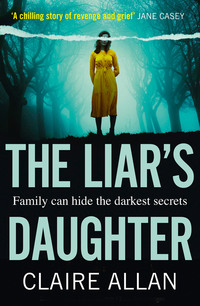
THE LIAR’S DAUGHTER
Claire Allan

Copyright
Published by AVON
A Division of HarperCollinsPublishers Ltd
1 London Bridge Street
London SE1 9GF
www.harpercollins.co.uk
First published in Great Britain by HarperCollinsPublishers Ltd 2020
Copyright © Claire Allan 2020
Cover design © HarperCollinsPublishers Ltd 2020
Cover photograph © Rekha Garton / Arcangel Images
Claire Allan asserts the moral right to be identified as the author of this work.
A catalogue copy of this book is available from the British Library.
This novel is entirely a work of fiction. The names, characters and incidents portrayed in it are the work of the author’s imagination. Any resemblance to actual persons, living or dead, events or localities is entirely coincidental.
All rights reserved under International and Pan-American Copyright Conventions. By payment of the required fees, you have been granted the non-exclusive, non-transferable right to access and read the text of this ebook on screen. No part of this text may be reproduced, transmitted, downloaded, decompiled, reverse engineered, or stored in or introduced into any information storage and retrieval system, in any form or by any means, whether electronic or mechanical, now known or hereinafter invented, without the express written permission of HarperCollins.
Source ISBN: 9780008378356
Ebook Edition © January 2020 ISBN: 9780008321956
Version: 2019-12-13
Dedication
To my children,
who make me want to be the best person
I can be every single day.
I love you both so much.
Contents
Cover
Title Page
Copyright
Dedication
Prologue: Now
Chapter One: Heidi
Chapter Two: Heidi
Chapter Three: Heidi
Chapter Four: Ciara
Chapter Five: Ciara
Chapter Six: Ciara
Chapter Seven: Joe
Chapter Eight: Heidi
Chapter Nine: Heidi
Chapter Ten: Ciara
Chapter Eleven: Heidi
Chapter Twelve: Heidi
Chapter Thirteen: Heidi
Chapter Fourteen: Joe
Chapter Fifteen: Ciara
Chapter Sixteen: Heidi
Chapter Seventeen: Heidi
Chapter Eighteen: Joe
Chapter Nineteen: Heidi
Chapter Twenty: Heidi
Chapter Twenty-One: Ciara
Chapter Twenty-Two: Heidi
Chapter Twenty-Three: Heidi
Chapter Twenty-Four: Heidi
Chapter Twenty-Five: Heidi
Chapter Twenty-Six: Heidi
Chapter Twenty-Seven: Heidi
Chapter Twenty-Eight: Heidi
Chapter Twenty-Nine: Ciara
Chapter Thirty: Heidi
Chapter Thirty-One: Heidi
Chapter Thirty-Two: Heidi
Chapter Thirty-Three: Heidi
Chapter Thirty-Four: Heidi
Chapter Thirty-Five: Ciara
Chapter Thirty-Six: Heidi
Chapter Thirty-Seven: Ciara
Chapter Thirty-Eight: Heidi
Chapter Thirty-Nine: Heidi
Chapter Forty: Heidi
Chapter Forty-One: Heidi
Chapter Forty-Two: Heidi
Chapter Forty-Three: Ciara
Chapter Forty-Four: Heidi
Chapter Forty-Five: Heidi
Chapter Forty-Six: Heidi
Chapter Forty-Seven: Ciara
Chapter Forty-Eight: Heidi
Chapter Forty-Nine: Heidi
Chapter Fifty: Heidi
Chapter Fifty-One: Heidi
Chapter Fifty-Two: Ciara
Chapter Fifty-Three: Ciara
Chapter Fifty-Four: Ciara
Chapter Fifty-Five: Ciara
Chapter Fifty-Six: Ciara
Chapter Fifty-Seven: Heidi
Chapter Fifty-Eight: Ciara
Chapter Fifty-Nine: Heidi
Chapter Sixty: Heidi
Chapter Sixty-One: Ciara
Chapter Sixty-Two: Heidi
Chapter Sixty-Three: Ciara
Chapter Sixty-Four: Heidi
Chapter Sixty-Five: Alex
Chapter Sixty-Six: Ciara
Chapter Sixty-Seven: Heidi
Chapter Sixty-Eight: Ciara
Chapter Sixty-Nine: Ciara
Chapter Seventy: Heidi
Chapter Seventy-One: Ciara
Chapter Seventy-Two: Heidi
Chapter Seventy-Three: Heidi
Epilogue: Kathleen
Keep Reading …
Acknowledgements
About the Author
Also by Claire Allan
About the Publisher
Prologue
Now
Joe
They’ve told me I’m dying. A doctor in a white coat, and a blue shirt with a stripy navy tie that had a coffee stain on it, had perched on the end of my bed and adopted a very serious expression on his face.
A nurse – who I had heard give out to her colleagues about the lack of resources on the ward and how she was getting ‘sick, sore and tired of working her arse off’ for too much responsibility and not enough money – had pulled the clinical blue curtain around my bed to afford me some privacy.
Her sombre expression mirrored that of the doctor, although it was clear it was a front. It was almost the end of her shift. This was a life-changing moment for me – the moment I heard I was condemned to die despite all the chemotherapy and surgery that they had been able to offer. For Katrina the nurse, with her short brown hair and ice-blue eyes, it was just the end of another shift. And she was tired. She had to do this final grim task before she clocked out and went home. She’d get a cup of tea, or coffee, or maybe a glass of wine (she seemed the type). She’d kick off her shoes and watch something mindless on the TV. She might even laugh if it was funny.
I doubted she’d think about me and the fact that I was dying. That no more could be done for me. I was already in the past tense for Katrina.
I was feeling sorry for myself, but that was allowed, wasn’t it?
I wasn’t that old. This shouldn’t have been happening yet.
I didn’t deserve this.
I wanted to scream that I didn’t deserve this.
But it was like there was a tiny voice, or a chorus of voices, whispering in her ear that this is exactly what I did deserve. In fact, I deserved much, much worse.
Chapter One
Heidi
Now
The back seat of my car is full to bursting. Lily is bundled up in her car seat, asleep and blissfully ignorant of the strained atmosphere between her fellow passengers. A weekend bag, filled with pyjamas and underpants to be laundered, a toilet bag containing a razor, toothbrush, soap and shaving foam sits beside her.
A plastic ‘Patient’s Property’ bag sits in the footwell. It’s loaded with boxes of medication, dressings, instructions that I will have to will my postpartum brain into reading and understanding once we are back at Joe’s house.
I won’t call it home. It ceased to be my home the moment my mother died – also from cancer. Unlike Joe McKee, the man who has played the role of my father for the past twenty-one years, she didn’t deserve it.
‘Did you lift my slippers?’ Joe asks as I help him ease his seat belt on. He is still sore – still tender from the operation to try to remove the tumour found in his lung. Except that they found it had company, all through his body. ‘Riddled with it,’ he said, sadly, when he told me.
‘Yes, I lifted your slippers. They’re in your bag, along with your pyjamas and dressing gown.’
‘There was a book in the locker. Did you …’
‘Yes, I lifted it as well. And packed it. Along with your prayer book and your reading glasses.’
He nods. ‘I wonder how many more books I’ll read,’ he says, to himself as much as anything.
‘You know what the doctor said,’ I tell him. ‘Take it one day at a time.’
‘Those days are still numbered, though, aren’t they? I doubt I’ll see the spring.’
He looks out onto the bleak, grey car park of Altnagelvin hospital, on the very outskirts of Derry, Belfast in one direction and the city centre in the other. The sky is almost as dark as the tarmac below us. Heavy and angry-looking. It seems apt.
Joe has always liked spring. More so as he grew older and found comfort in God. ‘A time of renewal,’ he would say as the evenings stretched and the temperatures crept up.
I know as well as he does, there’ll be no renewal for him this year.
‘You never know,’ I say, even though we do know. Odds are he’ll be gone before the seasons change.
He shakes his head slowly, looks ahead. ‘Some things you feel, Heidi.’
I switch on the engine, nudge the car into first gear.
‘It’s not a lot of time, is it?’ he asks. ‘To do all the things I need to do or to make things right.’
Joe McKee could have a whole other lifetime to live and it wouldn’t be long enough for him to make things right. There’s a time in a person’s life, if they are truly, truly wicked, when they move beyond the point of redemption.
I stay quiet. If he’s looking for some sort of absolution, he’s looking in the wrong place.
Ten minutes of a silent drive home later, we pull up outside his house. The house my mother owned, which in turn will belong to me when he is gone. This is where the first almost ten years of my life were blissfully happy. My mother created a loving, warm and magical childhood for me.
Then she died.
Even all these years later, there are times when that realisation hits me like a punch to the gut.
The world has never seemed fair or right since.
‘Will we get you inside?’ I ask Joe.
He nods. ‘I’m tired.’
He looks pale, his eyes red, dark circles around them. The effort of the short journey has worn him out. He looks wretched. It’s almost, but not quite, enough to make me feel sorry for him.
‘Sure, we’ll get you in and to bed then,’ I say. ‘Just let me take Lily in first. I don’t want to leave her here in the car on her own.’
He nods. ‘Of course not.’
I open the door, carry Lily, who is thankfully still sleeping, through to the living room in her car seat and allow myself a few seconds to take some deep breaths. I’m shaking, I realise, but it’s not from the cold. I count my breaths in and out until the shaking lessens. I tuck Lily’s blanket around her, stroke her cheek. Note how she is filling out, changing. Only five months old and already I can see shades of the little girl she will become.
I do not like being here with Joe. Even in his frail condition, I still feel scared to be close to him.
I’ve tried to have as little as possible to do with him, especially after I moved away to university at eighteen. But somehow, and much to my shame and self-hatred, I still find myself unable to cut him from my life entirely.
It will be nigh on impossible now, not without appearing to be cold and uncaring. Not without telling people all the things that happened. The things I’ve tried so hard to bury.
The thought of how much he will rely on me over the coming months make me feel sick to my stomach.
‘It must be nice in a way,’ the nurse at the hospital had said, ‘to care for him now. After all he did for you after your mother died. There aren’t many men who would take on the responsibility of someone else’s child like that.’
Joe had told her he had only done what any decent person would do.
But Joe McKee doesn’t have a decent bone in his cancer-riddled body.
The sweat is lashing off me by the time I have helped Joe upstairs and into bed. I do not like the feel of him leaning his weight on me as I help him up the stairs. I do not like helping him slip off his shoes and socks and lift his feet into bed. He is complaining of the cold, even though the heating is on full and the extra oil-filled radiator in his room is pumping out a dusty, dry heat.
I pull an extra blanket from the airing cupboard and put it over him, offer to make a cup of tea. ‘It might bring you round a bit,’ I say. I feel I’m speaking the words from a script of what a good daughter should say to an ailing parent.
‘It might, aye,’ he replies. ‘That would be nice, Heidi.’
He makes a move as if he is going to pat my hand and I pull it away quickly. The gesture makes him flinch, but I won’t have any physical contact with him that isn’t strictly necessary.
I catch him looking at me, his face sorrowful. I wonder if he’ll say it, now. The words he’s never said in all these years. ‘I’m sorry.’
‘Maybe …’ he starts. ‘When I’ve had a rest, maybe you could call Ciara for me? She should know how ill I am. Or maybe you’ve spoken to her already?’
Ciara. Joe’s daughter. His real daughter. The one tied to him by biology. The one he left behind when he moved in with Mum and me all those years ago. She has never forgiven him. Or me, for that matter. We don’t speak. I can’t remember the last time I saw her face-to-face.
‘I’ve not spoken to her yet,’ I tell him. I understand why he thinks it would be easier for her to hear from me first, so I know I’ll have to do it. Regardless of the state of her relationship with her father, she has a right to know he is dying. ‘But I will. When you wake up. You look exhausted.’
‘That’s what dying will do to you,’ he says with a sad smile.
I don’t return it, I just nod and leave the room, head for the kitchen, where I disseminate his various medicines into boxes and baskets for easy access while waiting for his tea to brew.
I’ve long since given up any idea of religion, but while I’m waiting for the kettle to hiss and rattle, I wish there was a godlike figure I could pray to for the strength to get through the next few weeks without wanting to throw myself off a bridge or put a pillow over his face.
Chapter Two
Heidi
Then
I first met Joe when I was seven years old. He was already sitting at the table in Fiorentinis Ice Cream Parlour on the Strand Road, looking around him at the old photos and pictures on the wall, when my mother and I arrived.
‘I’ve someone I’d like you to meet,’ my mother had said.
I remember that she looked happy. That her eyes seemed to sparkle. She’d put on make-up and I could smell she was wearing her favourite perfume – the kind she saved for special occasions. She’d even let me have a little spritz on my wrists. I remember that I was happy for her. Her excitement was contagious and yes, I was a little nervous, too. But that was okay, my mother had told me. It’s okay to feel nervous about meeting new people.
I liked the cocooned world my mother and I shared. Just the two of us, with Granny and Grandad popping in occasionally to check on us. To fuss. To ask if we had everything we needed. My mother’s response was always the same. ‘Sure we have each other and that’s all that we need,’ she’d smile.
My grandmother’s eyes would tighten so that I could see the fine lines of wrinkles spread out across her face. ‘You know I worry,’ she would say.
‘There’s no need to,’ my mother would reply.
And there wasn’t. We were happy. We had what we needed. A small house with a garden big enough to play in. Food in the cupboards. And if I needed new shoes or a new school coat, or sometimes just because Mum thought we deserved a treat, she would reach into the tin tea caddy on the top shelf of the corner cupboard in the kitchen, lift out some money and treat us.
Occasionally, the topic of my father would come up. Usually around Father’s Day, or after we’d watched some schmaltzy family movie. My mother would tell me, as gently as she could, that my father had moved away before I’d been born. ‘He wasn’t ready to be a daddy just yet,’ she’d say, and sometimes there would be a sadness in her eyes about it. ‘But that was everything to do with him and nothing to do with you,’ she’d tell me.
I suppose I knew she was lonely sometimes. She would read romance novels and sigh, and I knew most of my friends had both their parents living together. I suppose it was understandable my mother might want to find a partner too, even if she said that we had all we needed to be happy between the pair of us.
But if I was nervous that day in Fiorentinis, it was nothing compared to how nervous this man, Joe, appeared to be. He was fidgeting in his seat and, as he stood up to say hello, he almost knocked over his teacup.
I was as shy then as I am now. I stayed close to my mother, my hand gripped in hers, my cheek pressed against the soft fabric of her coat.
‘Heidi, this is Joe,’ she said. ‘He’s a friend of mine.’
The man smiled, extended his hand towards mine. Dark hairs crawled from the cuff of his jacket. They looked like spiders. I cuddled in closer to my mother.
‘Heidi, say hello,’ she said, an urgency in her voice.
He withdrew his hand and sat down. ‘She doesn’t have to if she doesn’t want to. Isn’t that right, Heidi? I’m a little nervous, too.’ His smile was kind.
The tightness in my chest eased as he lifted his teacup and sipped from it. I dared to take a step away from the safety of my mother’s long, green woollen coat.
‘I know it’s cold and rainy outside, but maybe you’d like an ice cream anyway? Since we’re here?’ he asked.
‘You’d like that, wouldn’t you, Heidi?’ My mother’s voice was more relaxed again, too.
I nodded.
‘How about we get them to make you the biggest ice cream they’ve got?’ he asked and my eyes widened at the thought. There was little that seven-year-old me loved more than ice cream.
‘With jelly?’ I asked, because jelly came a close second.
‘Lots of jelly,’ Joe said with a wink, and I smiled at him and then at my mother.
The smile on my face was mirrored on her own. Then I noticed how she looked at him. How her smile was different when she was smiling in his direction. It was how those men and women smiled at each other on the front covers of her romance novels. She was falling in love. I knew it at once.
It was only when he came back from ordering and reached out to hand me the giant ice cream he was carrying that I noticed the glint of a gold ring on his finger.
I may have been only seven, but I knew what that meant. And I also knew he wasn’t married to my mother. He was grinning at me. Telling me he asked for extra sprinkles. I could sense Mum beaming at him from beside me. I knew she wanted me to smile, so I did. I remembered my manners just like I’d always been taught, and I thanked him and ate the ice cream. I pretended it didn’t suddenly taste a little sour.
Chapter Three
Heidi
Now
I wonder what the official protocol is when it comes to saying no to a dying man. Is it an out and out no-go area, or is it okay in some circumstances?
I chew the nail of my left thumb while I try to build up the nerve to call Ciara.
Alex, my husband, tells me getting her involved might be a good thing. She may be able to lessen any burden on me. Which sounds great, but still I’m not so sure. I’m not sure I have enough emotional energy to deal with a second toxic relationship just now.
I sigh as I realise that despite my misgivings, I have to do this. I just have to suck it up.
Alex is at least sitting close to me as I call Ciara’s number. I draw a little strength from him. My hands are shaking, my tummy tight. Even the sound of her voice makes me nervous.
I take a deep breath. Remind myself that she is an adult now. As am I. I’m a wife and mother, for goodness sake. I should be able to speak to another grown woman without losing my nerve.
But the truth is Ciara has always intimidated me. At times she has utterly terrified me, if I’m being honest. She was the loud to my quiet. The tall to my short. The confident to my terrified. The angry to my sad. She was always bigger and badder and more able to dominate a room than I ever had been or ever could be. She’s the kind of person who can shred your self-confidence to ribbons with just one look.
I hear a soft voice say hello in a calming Scottish lilt. ‘Hello, Ciara’s phone.’
I’m momentarily thrown. ‘Hello,’ I stutter, ‘I’m … I’m Heidi Lewis. It’s about Ciara’s father, Joe …’
I hear an intake of breath. An awkward ‘uhm’, which tells me what I suspected. This phone call will not be welcomed.
‘Is she there? I need to speak to her about him.’
‘One moment please, I’ll check,’ the voice answers, efficiently as if she is speaking to a business associate.
Perhaps Ciara is still at work. Maybe this isn’t the best time to call. I think about hanging up. It would be easier and I’d have a good excuse to do so.
I’m just about to take my phone away from my ear and end the call, when I hear the calming Scottish lilt replaced by a brusque Derry hello.
‘Ciara?’ I say, to be sure.
‘Yes. It’s me. Heidi, what can I do for you?’
She sounds as pissed off now as she did as a truculent teenager. I revert to type and feel inadequate. My tongue feels heavy in my mouth. I feel unable to form coherent sentences.
‘Erm, are you still at work? Because maybe, you know, this would be a call better taken later, a conversation … you know … to have when you’re free to talk.’
I sound like an imbecile.
It annoys her.
‘I’m at home,’ she says, her voice terse. ‘What is it?’
‘It’s your father,’ I begin. I wait for an interruption that doesn’t come. ‘He asked me to call you. Look, Ciara, maybe this really is a conversation better had face to face.’ I realise I don’t want to tell her. I don’t want to have to be the one to say those words to her.
‘I’d rather you just spat it out,’ Ciara says. ‘What is it? Does he need money? Has he met someone else?’
I take a deep breath.
The easiest way to do something you really don’t want to is to do it quickly, like tearing off a plaster. That’s what my mother would say, so I say the next sentence quickly. Probably too quickly. The words rattle off my tongue.
‘It’s nothing like that. Ciara, he’s not well. He’s just been in hospital for surgery and well, the news isn’t good. It isn’t good at all, I’m afraid. And he has asked me to call you to let you know he’d like to see you if you’d be willing.’
There’s a pause. ‘Are you telling me he’s dying?’ Ciara asks, as forthright as she always was.
I nod before saying, ‘Yes, Ciara. It’s cancer. He’s been given maybe three to six months, at best.’
The phone line goes quiet. I wonder if she has hung up, take the phone from my ear to see if the call is still connected.
‘Good,’ she says eventually, although I hear a trace of emotion in her voice that wasn’t there before. ‘Good. He’s dying. Good enough for him.’
‘Ciara …’
I start to talk but the line goes dead. She has hung up. I sit staring at my phone, my face blazing, wondering how I tell Joe what has just happened.
Chapter Four
Ciara
Now
‘Dinner’s ready,’ Stella calls from the kitchen.
I don’t answer. I’m staring at my phone, trying to process the conversation I’ve just had with Heidi bloody Lewis. The golden child. It had to be her to tell me, didn’t it? It couldn’t have been anyone else. He couldn’t have spoken to Mum and got her to break the news. No, he was always one to go for maximum impact. Maximum distress.
The bastard.
Anger wells in me and I throw my phone at the sofa, watch as it bounces off the cushion and hits the solid wooden floor with a crack. I’ll have broken the screen, in my anger.
‘Good enough for him,’ I’d said to Heidi. It had been my gut reaction, to feel angry and shocked and think fuck him for getting her to contact me only to tell me he was dying.
He is dying.
My father, for all that word really meant to me, is dying.
‘Ciara,’ I hear Stella, ‘are you still on the phone, only the pasta …’
She walks into the room, glass of white wine in hand, and looks from me to the phone on the floor and back to me again. The glass is put down on the table and she is across the room beside me before I can figure out what to say to her.
‘What is it?’ she asks, her eyes searching my face for information that I’m still trying to process.
‘He’s dying,’ I say, thinking about how the words feel on my tongue. How they sound in my voice. Alien. Weird. Melodramatic.
Her eyes on mine, her blue eyes, deep and dark and able to see the real me. ‘Oh, sweetheart,’ she says, one hand gently caressing the side of my face. It’s her sympathy, not the news of my father’s terminal illness, which brings tears to my eyes.
‘The bastard has cancer,’ I tell her.
One tear falls and she brushes it away with the pad of her thumb.
Stella knows I have a complicated relationship with my father. Or had. We haven’t had much of a relationship at all in at least ten years. I’ve been more than happy about that.
‘He wants to see me,’ I say as she leads me to the sofa. All thoughts of dinner, or glasses of wine or the movie we had planned to curl up on the sofa to watch, are gone. ‘He asked Heidi to call me. Not enough balls to even call me himself.’
That angers me. Maybe it shouldn’t. Maybe he is now just a frail old man facing a death sentence and I should give him some leeway; but then again, when did he ever give me leeway for anything? He walked in and out of my life, leaving damage in his wake without so much as looking back. So much damage.
‘Do you want to see him?’ Stella asks.
Only she could ask that question and not have me bite back at her. She understands me in a world where it feels like no one else does.
I shrug. ‘I don’t know. Maybe. Maybe I’d like to tell him exactly what I think of him.’
‘Or maybe it would help you find your own peace and move on a bit?’ Stella asks. ‘But, you know there’s no right or wrong in this? You do what you want to do. If you want to see him, I’ll come with you. If you want to tell him to go to hell, I’ll hold your hand while you do it.’
I brush away a second pesky tear, take a deep breath. I’ll be damned if he can force me to make a decision like this quickly. Who does he think he is to get his mousey little minion to call me and ask me to come over?
‘Is there much wine left in that bottle?’ I sit back and ask Stella.
‘Not much,’ she says. ‘But there’s a second bottle in the fridge and I’m sure there’s another bottle of something in the rack.’
‘Okay,’ I say, sniffing and sitting up straight. ‘That dinner we spent all of fifteen minutes cooking is going to be absolutely ruined if we don’t eat it now. So, I say we eat. I don’t want to waste any more energy today thinking about that man.’
Chapter Five
Ciara
Then
I was an only child and I was deliriously happy in my only-child status. I was never lonely. I had lots of friends. We lived in a busy street in the Creggan Estate – a proudly working-class area on the west bank of the River Foyle.
There was always someone to play with. Come rain or shine we would be riding up and down the streets on our bikes, or on scooters or roller-skates. We would play ‘padsy’ or ‘tig’ and occasionally a gang of us would disappear en masse into one of our friends’ houses to watch a movie and eat crisps and biscuits.
I’d seen how friends with a houseful of siblings didn’t get the same treats that I did. Or the same attention from their parents, either. I was the apple of both of my parents’ eyes – but at heart I was always a daddy’s girl.
Right up until the day he left.
At thirteen years old, I experienced the worst, most painful, heartbreak of my life.
It didn’t make sense. I thought my daddy loved me. I was his special girl. I trusted him never to hurt me. But then he left – on a Thursday afternoon. I came back from school to find my mother perching on the edge of the sofa, a cigarette in her hand and a tautness to her posture that screamed that something was wrong. Being thirteen, my first thought was that I was in trouble. I braced myself for her to launch into some rant about my messy bedroom or the three pounds I’d nicked from her purse that morning. I expected her to use my full name and though my heart sank at the thought of the rollicking I was about to receive, I was already preparing my best eye-roll and ‘But, Mammy …’ response.
‘Sit down, pet,’ she said.
It was the ‘pet’ that threw me. She was hardly going to give out yards to me if she was using ‘pet’. I felt a knot in the pit of my stomach.
‘Look, there’s no easy way to tell you this, Ciara, so I’m going to come right out and say it. I want you to know that I love you very much. And your daddy loves you, too. You’re not to doubt that, ever. Okay?’
There was a strange buzzing sound in my ear. I could feel something build up inside of me, a burst of adrenaline that made me want to fight or run. I dug my fingernails as hard as I could into the palm of my hand to try to ground myself. I’d seen enough corny movies to guess where this was going.
‘Daddy has moved out,’ she said, the shake in her voice belying her true feelings. ‘It was a mutual decision and it’s just that we don’t make each other happy any more.’
‘Where has he gone?’ I asked. I needed to know where I could see him. When I could see him.
My mother’s face coloured. She sagged momentarily before straightening her back again. ‘He’s gone to live with a friend,’ she said.
Of course it wasn’t long before I found out that friend was another woman, and that woman had a daughter.
My father had left us to go and be with another family. A family he’d known for less than a year. A family with a daughter for him to love.
My teenage heart hurt so much that I cried until I threw up.
Chapter Six
Ciara
Now
It’s two days since Heidi called and I’m now standing, with Stella, outside the front door of my father’s house. It’s less than ten minutes’ walk away from our riverside apartment, but it might as well have been another country for all these years.
I have avoided the shops I know he frequents. Stayed away from the library where he used to work, and where he still liked to spend his mornings drinking strong tea from polystyrene cups and reading over the day’s papers.
He holds court there, talks to everyone who comes in. Shares his stories of old Derry and snippets of local history. It’s laughable for the man who barely looked at a book when he lived at home with my mother and me. Once he left, he transformed himself. Discarded his working-class persona entirely, lost himself in books. Went back to college. The few old friends he still deigned to spend time with gave him the nickname ‘The Professor’ because he was considered so learned. He enjoyed feeling superior to them. He enjoyed revelling in their new-found respect for him.
Learned and respected. It galls me to this day.
I feel Stella give my gloved hand a little reassuring squeeze.
I see lights on through the stained-glass panelling of the front door. It might be the middle of the day but it’s dull and dark, and January has us firmly in its grip. The darkness is as oppressive as this house looming over us. Semi-detached. With a big back garden. There was a wooden swing set there when I first visited all those years ago – a sure sign of wealth, along with a phone in the hall that didn’t have a lock on it to stop anyone from running up a big bill.
I’d felt intimidated then, but that was nothing compared to how I feel now.
‘I’m not sure I can go in,’ I say to Stella.
‘You know you don’t have to, but you’ve come this far. And look, if it feels all wrong, you never have to come back again. Focus on that.’
I squeeze her hand. There’s no way I could be here without her by my side. ‘Okay, then,’ I say. ‘Here goes nothing.’ I reach up and rattle the brass knocker, and it’s not long before I hear footsteps clacking along the tiled floor and see the shadow of a person approach.
I’ve not seen Heidi in as long as I’ve not seen my father. She was only a teenager the last time our paths had crossed, in her second year at university. She’d come home for the Christmas break – wherein my father had made a disastrous attempt to have us all round for drinks. I shudder at the memory.
Looking at Heidi now, she looks as if more than ten years have passed. Her face is pale. Tired-looking. There are dark circles under her eyes, and her hair, which clearly could benefit from a wash, is pulled back in a tight ponytail, which does her no favours. Her roots need touching up, I notice. There’s a lot of grey there for a woman still in her twenties.
She pulls an oversized grey cardigan around her small frame, wrapping her arms tightly around herself as she does. Her body language screams that she is deeply uncomfortable with this situation.
She blinks at me as if it is taking her some time to put a name to a face. I know I look different now – but not that different. And she had been aware that I was coming.
‘Heidi?’ It is Stella who breaks the silence – coming to my rescue as she always does. ‘We spoke on the phone. I’m Stella, Ciara’s partner.’
I watch for any sort of reaction on Heidi’s face at the realisation that I’m gay. It has never been something I’ve advertised. It’s no one’s business but my own, and Stella’s, of course.
Heidi barely blinks. She looks from Stella to me and then takes a step backwards to allow us in. ‘Please, come in, both of you,’ she says, her voice quiet. ‘It’s nice to meet you, Stella,’ she says. ‘And it’s good to see you again, Ciara.’
I smile at her because it is what is expected. We both know that what she has said is a lie. It’s not nice to see each other at all. I think we could have quite happily existed without ever seeing other again and been perfectly happy.
I hear the cry of a baby, look to Heidi.
‘That’s Lily,’ she says. ‘My baby. She’s due a feed. If you’ll excuse me. Joe’s sleeping just now, but I’m sure he would be okay with you waking him.’
‘Maybe we’ll just wait a bit,’ I say.
She nods, looks anxiously towards the living room door where the cry is becoming more persistent. ‘Well, you know where the tea and coffee are, why not make yourselves a cup?’ she says, and with that she scurries, mouse-like, into the living room, closing the door behind her.
I lead Stella to the kitchen.
‘So that’s Heidi,’ Stella says as she sits down and I switch the kettle on to boil.
‘It is indeed. Although she is much more mouse-like than before. And she was pretty mouse-like then.’
‘It must be hard for her, with a new baby to look after and Joe to be minding,’ Stella says as she looks around the room, taking in the slightly dated décor. I bristle. I do not want to be any part of a ‘poor Heidi’ narrative. I saw and heard enough of it over the years to be done with it for good. I’m not so much of a bitch that I don’t accept she had it rough to lose her mother at a young age, but she has led a life of privilege, and him – my father – he chose her over me. Not just once. But time and time again.
I don’t answer Stella. I just make the tea, rattle around the cupboards for sugar. This house is familiar and yet it isn’t. It’s quieter. Darker. Colder. I think briefly of the angry teenager I had once been. I can almost hear echoes of her stomping up the stairs or slamming the front door. My heart aches for her a little. I wish things had been different.
I turn to hand Stella a cup of tea. I see her shudder.
‘Are you okay?’ I ask.
‘Hmmm, uhm, yes, I think so,’ but she doesn’t look it.
‘You know you’re a terrible liar, don’t you?’
‘Never mind me. It’s nothing. I’m being silly.’ But I notice she is holding on to the mug of tea for dear life.
‘Stella?’ I raise an eyebrow.
‘Honestly,’ she says, ‘it’s nothing. Someone just walked over my grave. If you could find me a biscuit I’d feel much better.’
I look at her for a moment, sure it’s more than that, but I know her well enough to know she won’t be drawn any further, so I start to rummage for biscuits in this house that has never been my home.
This has never been a place where I was made to feel particularly welcome.
As a teenager it had felt as if every time I’d visited here I was reminded of just how much I was no longer the centre of my father’s universe.
I’d asked him once if I could put some posters up in the spare room – the room I slept in every time I visited. He shook his head. It wouldn’t be right, he’d said. He didn’t want Natalie to think he was making assumptions. It was still her house, he said. He was just a guest. I didn’t understand it, not really. Not at the time. Natalie was always so welcoming. Annoyingly so. She was desperate for me to like her, but that was never going to happen. Not when she had taken him away from me.
I’d left my pyjamas there once, about six months after my father moved in. It was shortly after Natalie took sick, I remember that. I remember I felt, momentarily, sorry for her. I wanted to help more. To do more. I folded them and stashed them under the pillow, waiting for me to pick them up and put them back on. When I came back the following week they were folded and neatly placed in a plastic carrier bag on the end of the bed.
‘Now’s not the time to make changes,’ my father had said. I always wondered who decided that. Was it him? Or was it Natalie? Regardless, I felt a renewed hatred towards them both.
I find a pack of Bourbon creams, pass them to Stella and sit down, the only noise around us being the ticking of the big clock in the hall.
‘Do you want me to come up and see him with you?’ Stella asks, splitting the biscuit in two.
I think of all the things I need to say and want to say and shake my head. ‘I need to do this on my own.’
His room smells of dust and stale breath and illness. The curtains are drawn tight and an electric radiator is pumping out heat into a room that feels oppressively warm. I feel myself break into a sweat.
He is small in that bed of his. So small that for the briefest of moments, I question if he is there at all. I look behind me, half expecting to see him come out of the bathroom larger than life, as imposing as he ever was. Tall, sturdy, full of bravado and his own self-importance.
As my eyes adjust to the darkness, his new shape becomes more apparent. Illness has shrivelled him. He’s curled on his left-hand side, his duvet and blankets folded up to his chin. The cancer has carved hollows in his face. His skin sags limply over his bones, grey, thin, wrinkled. His hair is now more salt than pepper.
I step forwards. Slowly. Quietly. As if he might jump up at any moment to shock and surprise me. He doesn’t shift. I contemplate leaving. I could close the door. Lie to Stella that I’ve spoken to him and we have nothing more to say to each other.
But I can’t lie to Stella. I don’t want to. It’s not what we’re about. She knows almost everything about me.
He shifts, just a little, a loud sigh accompanying the movement followed by a small groan of pain. My heart quickens. I should let him know I’m here, but what do I say? Do I say ‘Daddy’, or ‘Joe’, or ‘You bastard’?
I feel tears prick at my eyes. I have to hold in a low groan of pain myself. I’m not sure who I want to cry for most right now. Him, or the little girl I was, who was so hurt all those years ago.
‘Dad,’ I say softly. ‘It’s Ciara.’
He should know, of course. I’m the only person who has ever called him ‘Dad’. Despite their many years together, Heidi has never given him that title. He stirs. I can almost hear his bones creak as he does so. He’s still a relatively young man, only in his early sixties, but the way in which he tries to pull himself to sitting in his bed is more fitting to a man much older. I wince at the sight of him – the thinness of his hands as he reaches out to lift his glasses from the bedside table and put them on.
‘Ciara?’ he mutters. ‘Open those curtains. Let me see you.’
I fall into the role of dutiful daughter quickly, to my annoyance, and pull open the curtains. Not that it makes much difference. The gloom outside is such that the light barely lifts in the bedroom. I reach over and switch on the bedside lamp instead.
Then I sit at the bottom of the bed. Far enough away that he cannot touch me. I have drawn my lines. I have to. Self-preservation is everything.
‘I didn’t know if you would come,’ he says, his hand shaking as he reaches for a glass of water from the bedside table.
I lift it and hand it to him, watching him take a few sips before I take it from him again.
‘I didn’t know if I would come, either,’ I say. There’s a harshness to my voice that makes me feel both proud and ashamed of myself.
‘Well, I’m glad you did. And Heidi told you, did she? My news?’
‘That you’re dying? Yes.’
He winces a little at the word dying, as if my uttering it will summon the Grim Reaper sooner.
‘If I can get over this operation, I might get back on my feet again,’ he says. ‘For a while anyway.’
I nod. I don’t know what he expects me to say.
‘Ciara, I don’t have much time, but I wondered if I might have enough time to make things right with you. We’ve wasted so many years. If there’s any chance at all that we can even start to reconcile … it would mean more to me than I can say.’
I wait for him to say he’s sorry. I will him to say it. I’ve wanted him to say it for twenty years. Surely now, when time is running out, when he says he wants to reconcile – when he wants that more than he can say – surely now he can force those words out.
Maybe, if he does, I can think about a reconciliation. He’s scared now – I can see that in his eyes – in the way he looks at me. I need to know if he is really interested in acknowledging the pain he caused, or if he’s just scared of the judgement he’ll face from his God.
‘Heidi says you have maybe three months. Six at most,’ I say, picking imaginary fluff from the blanket on the bed.
‘I’ll not see six,’ he says. ‘I feel it. I can feel it getting closer. The cancer’s spreading.’
I look at him. There’s so much I want to say that I don’t know where to start. I could quip that the cancer started to spread a long, long time ago. But I don’t.
‘I’m scared, Ciara,’ he says, his voice weak. Pathetic.
I close my eyes. Just once, Dad, I think. Just say sorry once.
I can feel tears prick at my eyes. A well of emotion I know wants a release rises up in me. It’s a mixture of anger and grief and fear. I’m that thirteen-year-old again having her heart broken, asking her daddy to say he loved her enough to stay and that he was sorry that he ever hurt her.
I swallow them down and look him straight in the eyes. He will not see me cry. He will never know how much he hurt me, or how scared I was.
‘I’m not sure what you want me to do about that,’ I say, not caring in that moment about the icy tone in my voice.
Бесплатный фрагмент закончился.