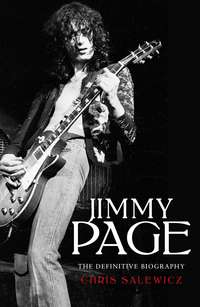
Читать книгу: «Jimmy Page: The Definitive Biography»

Copyright
HarperCollinsPublishers
1 London Bridge Street
London SE1 9GF
www.harpercollins.co.uk
First published by HarperCollinsPublishers 2018
FIRST EDITION
© Chris Salewicz 2018
Cover layout design Claire Ward © HarperCollinsPublishers 2018
Cover photograph © Gijsbert Hanekroot/Redferns/Getty Images
Extract from I’m With the Band: Confessions of a Groupie by Pamela Des Barres published by Omnibus Press © Panela Des Barres
A catalogue record of this book is available from the British Library
Chris Salewicz asserts the moral right to be identified as the author of this work
While every effort has been made to trace the owners of copyright material reproduced herein and secure permissions, the publishers would like to apologise for any omissions and will be pleased to incorporate missing acknowledgements in any future edition of this book.
All rights reserved under International and Pan-American Copyright Conventions. By payment of the required fees, you have been granted the nonexclusive, non-transferable right to access and read the text of this e-book on screen. No part of this text may be reproduced, transmitted, downloaded, decompiled, reverse engineered, or stored in or introduced into any information storage retrieval system, in any form or by any means, whether electronic or mechanical, now known or hereinafter invented, without the express written permission of HarperCollins e-books.
Find out about HarperCollins and the environment at
www.harpercollins.co.uk/green
Source ISBN: 9780008149291
Ebook Edition © July 2018 ISBN: 9780008149307
Version: 2018-06-21
Dedication
For Alex and Cole
Contents
Cover
Title Page
Copyright
Dedication
Preface
Introduction
1 SPANISH GUITAR IN SURREY
2 FROM NELSON STORM TO SESSION PLAYER
3 SHE JUST SATISFIES
4 BECK’S BOLERO
5 BLOW-UPS
6 ‘YOU’RE GOING TO KILL ME FOR A THOUSAND DOLLARS?’
7 ‘LIKE A LEAD ZEPPELIN’
8 AMERICAN ADVANCES
9 ‘WHOLE LOTTA LOVE’
10 LED ZEPPELIN II
11 ‘DO WHAT THOU WILT’
12 THE BEAST 666
13 ALL THAT GLITTERS
14 THE LEGEND OF ZOSO
15 CITY OF ANGELS
16 THE KING AND JIMMY PAGE
17 COCAINE NIGHTS AND HAUNTED HOUSES
18 AN ACCIDENT IN EXILE
19 THE KENNETH ANGER CURSE
20 FACE TO FACE
21 THE RULES OF ENGAGEMENT
22 BONZO’S LAST STAND
23 THE HERMIT
24 MIDDLE-AGED GUITAR GOD
25 THE SORCERER’S APPRENTICE
26 PHOENIX RISING
Picture Section
Sources
Acknowledgements
Index of Searchable Terms
About the Publisher
Preface
One chilly February evening in 1975, Jimmy Page journeyed in a black Cadillac limousine to David Bowie’s rented house on 20th Street in Manhattan. The Led Zeppelin leader and Bowie had known each other since the mid-sixties, Page having played on several of Bowie’s early records.
The pair were also linked through Lori Mattix, Page’s Los Angeles-based underage lover and a cause of considerable concern in the Zeppelin camp, thanks to the criminal complications this could create for the Biggest Band in the World. What few knew was that Bowie had taken Mattix’s virginity when she was just 14.
With the superstar pair having been reintroduced by Mick Jagger, Bowie had invited Page over to his place for an evening’s entertainment largely comprising lines of cocaine and glasses of red wine, along with Ava Cherry, Bowie’s girlfriend.
Mired in his Cracked Actor phase, Bowie was known to be living on milk and cocaine, and on the edge of madness. He had been inspired to devour the writings of Aleister Crowley, whose philosophy he had first dabbled in during the late 1960s: Bowie believed that Page’s deep knowledge of Crowley had enhanced the guitarist’s aura until it was rock hard and ringing with power.
But despite being intrigued, Bowie was extremely wary of Page. Conversation was somewhat stiff, although there was brief talk about Page’s progress, or lack of it, on the soundtrack to filmmaker Kenneth Anger’s occult masterpiece Lucifer Rising. Attempting to inquire how Page had developed his extreme aura, Bowie found his questions were never answered: Page would simply smile mysteriously.
‘It seemed that he did believe he had the power to control the universe,’ wrote Tony Zanetta, the head of Bowie’s management organisation MainMan, in his book Stardust. Besides, Page was only too aware that Bowie was picking his brain, endeavouring to crack a magician’s tricks.
At one point Bowie disappeared out of the room, and Page accidentally spilled red wine on a satin cushion. When the singer returned, Page tried to blame Ava Cherry, who wasn’t in the room.
His guest’s inscrutable behaviour had already rankled Bowie, and now he knew that Page was lying. ‘I’d like you to leave,’ he said.
Page’s response was simply to smile at Bowie. The window was open, and Bowie pointed at it, snapping his words out furiously: ‘Why don’t you leave by the window?’
Page remained sitting there, maintaining his enigmatic rictus smile, gazing through Bowie. Finally, the Led Zeppelin leader stood up silently, stepped towards the front door and left, shutting the door forcefully behind him.
Bowie was terrified. Immediately afterwards he ordered that the house be exorcised. A sensitive soul whose perceptions were addled by drugs, Bowie believed ‘it had become overrun with satanic demons whom Crowley’s disciples had summoned straight from hell’.
When he later ran into Page at a party, Bowie straightaway fled the event.
Introduction
John Bindon, Led Zeppelin’s security guard, had stagehand Jim Matzorkis pinned to the floor of a backstage trailer at Oakland Coliseum. Bindon, a sometime actor and London gangland heavy who had reputedly once bitten off a man’s testicles and would stab another man to death the following year, was viciously pummelling Matzorkis with his fists and feet. But it was only when Bindon started trying to gouge out the stagehand’s eyes that Matzorkis fully appreciated the danger he was in.
For much of this day of Saturday 23 July 1977 the possibility of such a grim outcome had been building. Many of Zeppelin and their crew seemed in a state of permanent rage, as if they had surrendered control to the large quantities of drugs consumed during the course of a 51-date tour that had begun on 1 April.
Later, Jimmy Page would be obliged to deny to me that what happened that day was karmic recompense for his flirtations with the occult. ‘I don’t think we were doing anything … evil,’ he said, two years later.
It was especially ironic that what happened at Oakland Coliseum that day, which would utterly transform the fortunes and career trajectory of Led Zeppelin, should be on the turf of Bill Graham, whose Fillmore West had been a temple of popularity for the Yardbirds, Page’s previous group, and, along with Graham’s New York showcase the Fillmore East, the scene of early break-out triumphs for Led Zeppelin. Although the confluence of the interests of Bill Graham and Peter Grant, Led Zeppelin’s manager, had proved mutually advantageous in the past, it was always a disaster waiting to happen. Graham was the most powerful music promoter in the United States; Grant had reinvented the relationship between managers and promoters in the United States, often through heavy-handed behaviour. And as much as Grant terrified people, Graham also possessed a fierce temper.
The previous evening, Graham, who was promoting Day on the Green, as this event was billed, for an audience of 65,000, had been summoned to Led Zeppelin’s hotel, the San Francisco Hilton, to honour a sudden demand for a $25,000 cash advance against their fee for the shows. Entering their suite, Graham noticed a cowboy-hat-wearing local dealer of hard drugs; in a flash he realised what the money was needed for.
Arriving only 20 minutes before the start of the gig, Page was so evidently befuddled from his drug consumption, by that stage largely heroin, that Graham could only watch as the Led Zeppelin leader set off for the stage in entirely the wrong direction; he was rescued by an aide who stopped him and despatched him on the correct course. Midway through the set Bindon crawled out onto the stage on his hands and knees and licked Page’s boots.
As the wheezing, out-of-shape man-mountain that was Peter Grant lumbered up to the stage, Jim Downey, a member of the stage crew, commiserated with him about the excessively steep climb. For this presumption Bindon, who was accompanying Grant, punched Downey with such force that he slammed him into a concrete pillar and knocked him out.
‘What happened? The fuck did I do?’ wondered the victim as he came to. Downey was clearly unaware of an extraordinary management edict – egregiously pathetic in its arrogance – on what would become the final Led Zeppelin American tour: no one was permitted to speak to any member of the act, or to Grant, unless they were first spoken to. (Flying on the group’s plane, journalist Steven Rosen had been made fully aware of this. He was startled when the normally benign bass player, John Paul Jones, had verbally assaulted him, demanding all of his interview tapes – a response to an apparently unfavourable comparison of Zeppelin to the Jeff Beck Group that Rosen had made years previously. This incident was indicative of the prevailing mood on the tour.)
‘What I didn’t like about Led Zeppelin was that they came with force,’ Graham wrote later. ‘I had heard stories from other cities about how they had muscled promoters to get better deals. How they had shaken them down for money … I had heard about the ugliness of their security.’
But far worse was to come. Midway through Led Zeppelin’s show, during Page’s acoustic set, Matzorkis noticed a young boy removing wooden plaques from the doors of the dressing-room trailers: plaques that had the names of the artists on them, and which would be required for the repeat show the following day. Also on the bill, as support acts, were Judas Priest and Rick Derringer. Matzorkis told the kid to put them back. The kid was insistent that he would be taking them. So Matzorkis took them from him – allegedly cuffing him round the back of the head, although Matzorkis has always denied this – and wandered over to the storage trailer to lock them away. Unbeknown to Matzorkis, the boy was Warren Grant, the 11-year-old son of Peter Grant.
A few minutes later Matzorkis was still in the storage trailer when John Bonham, Led Zeppelin’s drummer – surplus to requirements during Page’s acoustic set – called to him from the bottom of the short flight of steps outside it. Peter Grant was with him.
‘You don’t talk to my kid that way,’ Grant said, as Matzorkis stood in the trailer’s doorway. The burly Bonham, an effigy of muscle and blubbery booze-fat, simply stood there, as though he was Grant’s security wingman. Then Grant escalated matters, like the barrack-room lawyer and bully he could be: ‘You don’t talk to my kid that way. Nobody does. I can have your job.’ Grant continued in this vein, accusing Matzorkis of ‘roughing this kid up. I heard you hit this child.’
Stepping up the stairs, Bonham then kicked Matzorkis between the legs, sending the stagehand flying back into the trailer. Bonham followed him in, while a pair of bodyguards endeavoured to restrain the drummer, shouting at Matzorkis to get out of there. He did, through a rear door.
When he learned of the incident, Graham went to find Grant in his trailer. For 20 minutes Graham put up a spirited defence of Matzorkis, yet Grant refused to budge from his thinking: ‘Your man put his hands on my people. On my son. How could you let this happen? How could you hire these people? I’m very disappointed in you.’
‘Let me speak to this man,’ Grant repeatedly demanded. When Grant finally insisted that all he wanted was to meet again with ‘the man’ who had caused these problems to ‘make my peace with him’, Graham somewhat reluctantly agreed to the manager’s request.
Walking over to find Matzorkis in another trailer, Graham observed that Grant was now flanked by a pair of other men; one of them was Bindon.
When Graham introduced Grant to Matzorkis, Led Zeppelin’s manager seized the stagehand, yanked him towards him and smashed him full in the face with a ring-covered fist, knocking him back into his seat. When Graham lunged at Grant, one of the security men picked up the promoter, threw him down the steps and shut the door of the trailer, standing guard in front of it.
Inside the trailer Bindon held Matzorkis from behind, while Grant started to work him over, punching him ceaselessly in the face, knocking out a tooth and kicking him in the balls.
Somehow, Matzorkis, who was screaming for help, broke free of Bindon. He managed to manoeuvre himself to the rear of the trailer, but this was when Bindon leapt upon him and went for his eyes. Fuelled by adrenaline, Matzorkis finally twisted away and got to the door.
Despite the security man guarding it, Matzorkis managed to get out of the trailer and run off across the backstage area.
Meanwhile, tour manager Richard Cole, armed with a chunk of metal pipe, had been attempting to enter the trailer. Bob Barsotti, who with his brother served as Bill Graham’s creative director, had prevented him, so he then turned on him. Realising that Cole was demented from the drugs he had seen him consuming during the day, Barsotti ran off, leading him on a merry dance down into the car park, where Cole ran out of steam.
By now several of Graham’s security men had gone to retrieve their ‘pieces’ from where they were stashed in their cars’ boots, but a seasoned member of the backstage crew reminded all concerned that the next day there would be another Led Zeppelin show: if the group did not play, 65,000 fans might very well riot. Yet the Graham crew consensus was that somehow the next day they would ‘deal’ with Zeppelin and their team. The promoter agreed with this thinking. He also made an offer: if they couldn’t ‘do’ Led Zeppelin and their cohorts the next day, then he would personally fly 25 of his men to New Orleans, the next date on the tour, and they could mete out revenge there.
At Graham’s home that evening, where the promoter had taken Matzorkis for protection following his release from hospital, he received a call from Led Zeppelin’s US lawyer: he demanded that Matzorkis sign an indemnity waiver, giving Led Zeppelin protection against being sued over what he referred to as a ‘minor altercation’. Unless this was received, Led Zeppelin ‘would find it difficult to play’ the next day.
Graham agreed to sign; his own lawyer told him that as he was acting under duress, it would not be legally binding. Besides, Graham had a plan. Knowing that Led Zeppelin would be staying in San Francisco for a further night following the Sunday show in Oakland, he had arranged with the local district attorney to arrest those culpable on the Monday morning.
At the Sunday concert the loathing of Graham’s entire crew towards Led Zeppelin was palpable: they glowered at the band and anyone connected with them. Page played most of the show seated, and he and Jones both looked bored. Robert Plant, however, sang very well indeed, dropping occasional words of commiseration in the direction of Graham; bootlegs indicate that it was a far better show than the previous day, partly because Led Zeppelin appeared drug-free. Still, it was a tense affair, and many in the audience were drunk and rowdy. Rumours were running round that a murder had been committed the previous day.
The next day, Bonham, Grant, Bindon and Cole were arrested at the San Francisco Hilton and taken, hands cuffed behind their backs, across the bay to Oakland to be booked, where they were held in a cell for three hours. There was a very real chance that if the case went to a criminal court, all involved would be deported and never be able to work again in the United States, a serious financial worry.
Bonham was charged with a single count of battery, as was Grant; Cole and Bindon were each charged with two counts of battery. The news of their arrest and the incident at Oakland Coliseum made the news all around the world. When they were eventually released they were bailed at $250 on each charge.
As the arrests at the hotel were taking place, Jones was exiting the Hilton through a rear door. He climbed into a camper van with his family and drove out of San Francisco towards Oregon and Washington state, on a planned holiday before Led Zeppelin’s next date, in New Orleans, at the city’s Louisiana Superdome. He was set to rejoin the band there on 30 July, in time for the show that night.
‘As far as I was concerned, every one of those guys in the band was absolutely 100 per cent accountable for that shit. Because they allowed it to go on,’ said Bob Barsotti. ‘And we weren’t the only ones it happened to. We were just the last ones. We were the only ones who stood up and said something. When we started looking into it, there were incidents like that all across the country on that tour. Trashed hotel rooms. Trashed restaurants. Literally like twenty-thousand dollars’ worth of damages at some restaurant in Pennsylvania. Really outrageous stuff. Like where they physically abused waiters and people in the restaurant, and then just bought them off.’
‘They would do things after the show,’ said Peter Barsotti. ‘The traditional “go get chicks out of the audience for the band”. I remember standing by the ramp and seeing these guys get girls to come over. It was like no other feeling I’d ever experienced. It was like these girls were going to be sacrificed. I wanted to go out and grab these girls and say, “Don’t do it, honey. Don’t do it.” I’m as hardcore as the next guy. But I was afraid for these girls.’
If it could be possible, worse was to come. Arriving on 26 July at the Royal Orleans Hotel in New Orleans, Plant received a phone call from his wife in England: she told her husband that Karac, their five-year-old son, was seriously ill and had been taken to hospital.
Then came another call from her. Karac had died.
A devastated Plant flew back to England. All remaining dates on that eleventh Led Zeppelin tour of the United States were cancelled.
At the funeral of Karac, Plant was joined by Bonham and Cole. But there was no Page, who had flown instead to Cairo, where he was ensconced by the pyramids in the luxurious Mena House Hotel. Jones, for his part, had simply resumed his family holiday. And Grant had also remained in the US. Plant would not forget this.
On 26 July Graham received a call from the Zeppelin manager. ‘I hope you’re happy,’ Grant muttered down the line.
‘What are you talking about?’ Graham asked.
‘Thanks to you, Robert Plant’s kid died today.’
That one absurd assessment by Grant captured everything that had gone wrong with Jimmy Page’s Led Zeppelin project.
Just considering the death of Karac Plant sets off an inescapable collision of images of those nude blond children crawling up the boulders on the Houses of the Holy sleeve, and of the child being held aloft, as though for sacrifice. You can’t help but feel that this might have crossed the mind of the bereft Robert Plant on his wretched plane ride home.
The Oakland incident, and the death of his singer’s son, marked an extraordinary, certainly hubristic fall for Jimmy Page, who since the beginning of Led Zeppelin in 1968 had become the greatest archetype of a globally successful rock star that Britain has ever seen.
‘Jimmy Page grew up in the hypocrisy of the United Kingdom in the 1950s and found three chords that saved him,’ said his friend Michael Des Barres. ‘As Led Zeppelin developed, heroin was obviously the fuel of that mad coach ride through the countryside. And inevitable.’
The mystery of Led Zeppelin had been established almost entirely through the endless enigma that is Page; later, as the apprentice matured, Plant would offer a separate sort of leadership within the group. In tandem with their extraordinarily lyrical atmospherics, Zeppelin’s complex beats were the dominant soundtrack for popular culture for nigh on a decade. But the music was only one part of it; without Page’s extremely pure comprehension of the intangibles of rock ’n’ roll – the perfect manner in which to exit a limousine, for example – Led Zeppelin would not have been granted their place in the pantheon of rock ’n’ roll gods.
From the very start – those first publicity pictures with his fluttering eyelashes and choirboy’s face – Page displayed a slightly smirking look of utter confidence and haughty control, with a hidden promise of something sinister cloaked beneath it. There is that very early photograph of the four Led Zeppelin musicians in 1968 clustered around the bonnet of a Jaguar Mk 2 3.8, which had a reputation as a bank robber’s car. Page is encased in a then fashionable double-breasted overcoat, its collar pulled rakishly up; he stares at the camera from between those curtains of crimped black hair, smouldering with self-assurance and poise. It is an image maintained in the first official promotional shot of the band, issued by Atlantic Records: the utter Capricorn control of Page leaning over the other three members – his string-pulling hands resting on the shoulders of the two Midlands neophytes, drummer John Bonham and Plant, who resembles a frightened faun caught in the headlights.
Their look – especially that of Page – is like that of Charles I’s cavaliers, perhaps especially of Lord John Stuart and His Brother, Lord Bernard Stuart, Anthony van Dyck’s 1638 painting of two teenagers who would be killed in the English Civil War.
Half an inch under six foot tall, permanently clad in sensuous velvet and sexy ruffled shirts, his jawline frequently dusted with five o’clock shadow, and always with that aura of androgynous otherness, Page looked to many women – and plenty of men too – like dirty sex on a stick. This image was as integral to his art as the 20-minute guitar solos with which he would blast his audience’s eardrums – the violin bow he would employ when performing ‘Dazed and Confused’ clearly doubled as a wizard’s wand to manipulate concertgoers.
And it only gets better: this romantic dandy lives in a castle with a moat. Jimmy Page does very bad drugs seemingly forever and – unlike Keith Richards, a mere also-ran in the greatest ever UK rock star stakes – never gets busted … at least until Zeppelin is over. Moreover, he is held responsible for an entire genre of music – heavy metal! – with which his group is only tangentially involved, his true focus being a blending of UK and US folk traditions with a garage band sense of hard rock.
In his renowned isolation he is like a rock ’n’ roll version of Howard Hughes. But in many ways, the very idea of Jimmy Page is as much a construct as any of David Bowie’s personae. And – lest we take this too seriously – it is worth considering that when his own persona is deconstructed, Page is sometimes little more than a high-art version of Screaming Lord Sutch, the plumber rock ’n’ roll showman on whose attractively kitsch shock-rock records he played session guitar.
‘Everyone I worked with in the 1960s thought that rock ’n’ roll was really an aspect of showbiz,’ said Dave Ambrose, who played bass in Shotgun Express (with Rod Stewart) and the Brian Auger Trinity, who supported Led Zeppelin in San Francisco in April 1969. Later, as an A&R man, Ambrose signed the Sex Pistols, Duran Duran and the Pet Shop Boys, among others.
Many of Page’s expenditures – the palatial residences, the vintage cars he was unable to drive (he never passed his test), the enormous collection of rare guitars – seemed designed to garner respect and support among the world’s wealthy and influential, to make people aware of him, to elevate his extraordinarily inscrutable profile, and to establish himself as one of the principal men about whichever town he found himself in.
But at the same time, here was a rebel cocking a snook at the Establishment, having what he knew he wasn’t meant to have. With Led Zeppelin there always was that sense of being resolutely ‘underground’, a card played with perfect panache by the band for most of their career: hardly ever on television, with no singles released in their homeland, Zeppelin existed from the very beginning as their own outsider identity. In a sense the damning review of their first album by John Mendelsohn in Rolling Stone, a magazine Page came to loathe, was perfect for them; it set in motion the ‘us against them’ agenda from which Led Zeppelin’s success soared.
By 1977, the year their myth savagely unravelled, they would come to be seen as the embodiment of behemoth rock, all that the new punk movement stood against, but when Led Zeppelin started out in 1968 their anti-Establishment stance was about as punk as it could be.
‘The big question today is, Why hasn’t he done new music?’ said Michael Des Barres. ‘Well, why does he have to? Jimmy Page is his own art piece, a performance artist, and he’s busy curating his legacy. There is nobody else whose roadie was Aleister Crowley. And it worked. Led Zeppelin were not a band; they were a cult.
‘Led Zeppelin brought together all those kids who otherwise would just hang around parking lots in two-bit American cities, kids for whom the obvious decadence of the Rolling Stones didn’t really connect. Instead, Led Zeppelin were their cult; they became a focus for and brought together all those disaffected, lost souls who would take the fantasy world of the group and its subject matter and project onto it their own interpretation of what they were.’
The world was ready for just such a package. Around the time the Rolling Stones were writing 1968’s ‘Sympathy for the Devil’, Mick Jagger and Keith Richards had dabbled in a friendship with the Californian film director and occultist Kenneth Anger, but – as though proof that in such areas they were distinctly lightweight – fled his company the next year after the debacle of Altamont. Instead it was Led Zeppelin, driven by Page’s assiduous academic interest in altered states and realities, that provided the soundtrack to the building public interest in the occult. In 1972 TIME magazine ran a cover story bearing the strapline ‘Satan Returns’. Colin Wilson’s mammoth groundbreaking study simply titled The Occult had been published in 1971. More populist was the Man, Myth and Magic partwork series, which commenced in 1970, providing highly readable accounts of a secret world that was exciting to the newly stoned with their now-opened third eyes. As was the manner of partworks, Man, Myth and Magic was extensively plugged in television adverts, featuring an image of a demonic figure, painted by Austin Osman Spare. Spare had been close to Aleister Crowley and was sometimes described as ‘Britain’s greatest unknown artist’; Page would become the world’s leading collector of Spare’s work.
By then there was something frightening about the very notion of Led Zeppelin. After I interviewed Page in 1979 in a relatively forthright manner for the NME, a senior editorial member asked me if I wasn’t nervous of any potential repercussions. When I told casual acquaintances I was writing this book, I was met with similar responses: ‘Jimmy Page? Black magic?’
For some years – a decade or so – this was the prevailing view of Page. But of course time is a healer, so it should be no great surprise that by the end of the first decade of the twenty-first century, and in his own seventh and eighth decades, Page had redeemed himself to become the most loved and revered of all classic rock stars.
This redemption was fitting, given that this is the man who almost singlehandedly established the notion of the guitar hero as part of contemporary culture. ‘What about Eric Clapton?’ you may ask. No: Clapton was too diverse in the paths he trod. It was the singularity of Page’s work with his vehicle Led Zeppelin, underpinned by his extraordinarily startling and sinisterly attractive appearance, that awarded him the guitar hero crown. Guitar hero? Guitar god, more like.
His is an extraordinary story that has taken him to the very darkest of areas – but always driven by the search for his art. You might not approve of the methods employed to unleash and liberate his creativity, and you can’t avoid the impression that Page was vain, arrogant, fanatical and power-hungry, and indulged in a scandalous private life – much, of course, to the adoration of his fans. Yet many of the accusations against him were probably fabricated or at least exaggerated by his numerous enemies – though many of these, in the timbre of the times, were no more than cosmic spivs.
Certainly, Page was a man of his age – ambitious, worldly and pleasure-loving – but the demonic caricature of evil is mostly an elaborate myth. Not that he didn’t gladly play it himself, of course. By mentioning in a very matter-of-fact manner how the congregation of the original church at Boleskine House, a home of Crowley, had burned to death, Page was positioning himself as being metaphysically hard, a cosmically tough motherfucker with complex connections to ghoulish gangs of strange spirits. It was, of course, a good way to attract impressionable women, a variant on those college student ‘astrologers’ who would take girls back to their rooms to read their charts and then shag them.
For a time Page was fascinated with – to give it its full title – the Isis-Urania Temple of the Hermetic Order of the Golden Dawn, a late-19th-century group of occultists whose members had included the Irish poet W. B. Yeats and Crowley, who – unsurprisingly – considered his poetry superior to that of Yeats and had a bitter falling out with the Irishman.
‘Much of the Golden Dawn magic,’ wrote Gary Lachman in his biography of Crowley, ‘as well as Crowley’s, has to do with what is called the “assumption of the god form”, when the magician imagines he has become the particular god he wants to invoke by visualising his form enveloping his own.’ Except you might feel that the ‘particular god’ Page wished to invoke was none other than himself: Jimmy Page, rock god.
And this stance was carried through to every aspect of his existence, including his appearances on stage.
‘On the surface,’ writes the American cultural commentator Erik Davis, ‘Page’s live performances present typical rockist values of spontaneity, virtuosity and sweaty abandon. But Page adds a novel element to the figure of the guitar hero, an element … of mystery. So even as Page bares his cock rock before tens of thousands of fans, the Zoso doodle emblazoned on his clothes, he reminds us that he knows something that we don’t. There is a gap between the hero whose performance we consume and the sage behind the curtain, who remains concealed, literally occult. This mystique makes Page far creepier than Ozzy Osbourne, who is hiding nothing, except maybe his debt to The Munsters.’
A balanced appreciation of Page’s character reveals traits both admirable and detestable, but claims of his ethical failings have sometimes overshadowed an appreciation of his keen creative mind. Besides, his flamboyantly dissolute lifestyle was hardly different from that of many other rock stars of his age – such as David Bowie, or Mick Jagger, or Rod Stewart.
But Page had a longstanding relationship with the art of destruction, and had been preparing for a career of hotel-wrecking since early in his life. At the rear of the secondary school he went to, on Epsom’s Danetree Road, there was a bomb shelter left over from the war. Although efforts to destroy it had been made on several occasions by his fellow pupils, it was a 14-year-old Jimmy Page who finally succeeded.
In what seems less an example of urban terrorism and more like a yarn from one of Richmal Crompton’s Just William stories, an older boy had combined sodium sulphate, weed killer and icing sugar to make several miniature bombs. A couple of these had exploded in the school grounds, with the blame always attributed to the rough kids from the neighbouring council estate.
But then this arms race escalated. Another boy constructed a pipe bomb and placed it inside the bomb shelter. Once lit, however, the fuse on the bomb burned interminably slowly. After some 20 minutes without much progress, one of boys offered a solution: he had a fuse taken from a Jetex, a motor for model aircraft that was popular at the time, which they put in the pipe bomb.
‘But nobody dared light it,’ remembered Page’s friend Rod Wyatt. ‘So Jimmy said, “I’ll do it.” So he goes in the entrance of the shelter, and then he comes running out. As he runs out it goes off: P-F-O-O-F! B-R-A-MMM! And the whole corner, which was thick concrete, flies up in the air, bricks following it. And Jimmy is running out, laughing his head off into the playground.
‘Reflecting on this, I thought, “Was that a sign of the times? That he was going to be part of the loudest rock ’n’ roll band ever?” This gentlemanly young guitar player says, “I’ll light the jet engine. I don’t mind.” It fits Led Zeppelin perfectly.’
1
SPANISH GUITAR IN SURREY
Born at 4 a.m. on 9 January 1944 in Heston, Middlesex, on the far fringes of London’s western suburbs, James Patrick Page was the son of an industrial personnel manager, also called James, and Patricia, a doctor’s secretary. The future superstar musician’s name was a combination of both of his parents’, who had been married at Epsom Register Office on 22 April 1941.
According to the mythology of his rock-star legend, Jimmy Page was ‘born on a full moon’, with all the occult, mystical weight that that phrase carries. Yet this is not precisely true. He was in fact born 31 hours before the full moon of 10 January 1944. While the baby boy and his mother might have felt the powerful energy of the rising Cancer full moon as he was born, the earth’s only natural satellite was not yet at its peak. In time Page would become a student of astrology; he would learn that in his astrological chart his moon was in moody Cancer, his sun sign was determinedly ambitious Capricorn, and he had Scorpio rising, with its suggestion of powerful sexuality and interest in arcane areas of life.
To an extent this only child – until he started school at the age of five he hardly knew any other children – was always self-educated, manifesting a strong sense of self-fulfilment, even destiny – though there is often something fixed and inflexible about the self-taught. ‘That early isolation probably had a lot to do with the way I turned out,’ he said later. ‘Isolation doesn’t bother me at all. It gives me a sense of security.’
Heston, his birthplace, has a distinct sense of J. G. Ballard-like suburban anonymity, the net curtains firmly drawn on all manner of potential darkness. Heston lies on the direct flight-path into Heathrow Airport, less than three miles away, and today is a place blighted by the ever-present roaring reverse thrust of descending jet airliners. It was the beginnings of this noise pollution that led the Page family to move first to nearby Feltham, a distance of some four miles, where unfortunately the noise from aeroplanes was even more acute, and then the ten miles or so to the south-east, to 34 Miles Road in Epsom, Surrey, in 1952. (In 1965 Page would, with Eric Clapton, record a song entitled ‘Miles Road’.)
Eight-year-old Jimmy Page was enrolled at Epsom County Pound Lane Primary School, and at the age of eleven he moved on to Ewell County Secondary School, on Danetree Road in adjacent West Ewell. His headmaster, Len Bradbury, who took over in 1958 when Page was in year three, had played football for Manchester United, and Bradbury’s arrival at the school was only a few months after his former team had been decimated in the Munich air disaster. (Many years later Bradbury would be a guest of honour at Manchester United’s ground, with pictures of him taken with the team’s captain, Roy Keane, and Ryan Giggs.) Page was in the proximity of celebrity – and he could see that such individuals were sort of ordinary people.
At 34 Miles Road, Page discovered a Spanish guitar that had been left behind, presumably by the previous occupiers. Had it ever been played? Perhaps not. In the 1950s a Spanish guitar as an objet d’art in the home was considered a sign of sophistication. ‘Nobody seemed to know why it was there,’ he told the Sunday Times. ‘It was sitting around our living room for weeks and weeks. I wasn’t interested. Then I heard a couple of records that really turned me on, the main one being Elvis’s “Baby Let’s Play House”, and I wanted to play it. I wanted to know what it was all about. This other guy at school showed me a few chords and I just went on from there.’
‘This other guy’ was called Rod Wyatt. Although fascinated by the Spanish guitar, Page all the same had been flummoxed by how to play the instrument. During a lunch break at secondary school, he came across Wyatt, who was in a class a couple of years above him. The owner of an acoustic guitar of his own, Wyatt was running through a version of ‘Rock Island Line’, a chart hit by the revered Lonnie Donegan, when he met Page. In response to the younger boy’s query, Wyatt instructed him to bring his Spanish acoustic to school and he would show him how to tune the instrument. From then on the pair became firm friends.
‘My mate Pete Calvert and I were always at Jimmy’s house bashing out our guitars for a couple of hours on a Saturday afternoon,’ said Wyatt. ‘Sometimes I’d go round to Jimmy’s and his mum would say, “No, he’s practising.” When he suddenly realised he had it, he spent a lot of time practising. Sometimes six or seven hours a day. He told me he needed to improve his technique. And he eventually became the all-round perfect guitarist. Practice is what it’s all about.’
What had really turned Page on in Elvis Presley’s rockabilly song ‘Baby Let’s Play House’, released in the UK six days before Christmas 1955, was the guitar playing of Scotty Moore, who served as Presley’s guitarist from 1954 to 1958. On 5 July 1954 Moore had, with bassist Bill Black and Elvis himself, mutated the original arrangement of ‘That’s All Right’ by bluesman Arthur Crudup into a version that combined blues and country music, creating one of the foundations of rock ’n’ roll.
‘Scotty Moore had been a major inspiration in my early transitory days from acoustic to electric guitar. His character guitar playing on those early Elvis Sun recordings, and later at RCA, was monumental. It was during the fifties that these types of song-shaping guitar parts helped me see the importance of the electric guitar approach to music,’ said Page.
On ‘Baby Let’s Play House’ Moore played a burnished rockabilly rhythm. Page’s love of the tune would not leave him, even after almost 20 years: about nine minutes into the live version of ‘Whole Lotta Love’ in the Led Zeppelin film The Song Remains the Same he breaks into a close simulacrum of Moore’s licks. But that was a long way in the future: for now the 12-year-old Page assiduously studied and copied Moore’s parts. There could hardly be a purer, more perfect example of this brand new musical form, an ideal introduction to what his life would become. Every day he would take his guitar to school on Danetree Road.
‘When I grew up there weren’t many other guitarists,’ he told America’s National Public Radio in 2003. ‘There was one other guitarist in my school who actually showed me the first chords that I learned and I went on from there. I was bored so I taught myself the guitar from listening to records. So obviously it was a very personal thing.’
But he also had a seemingly separate life as a choirboy. Each Sunday, wearing the appropriate surplice and cassock, he would sing hymns at Epsom’s St Barnabas Anglican Church. The first image in his 2010 photographic autobiography is of him in this mode – clearly he is being ironic. As so often in the life of Jimmy Page, cold realism lay behind the impetus for his choirboy stints.
‘In those days it was difficult to access rock ’n’ roll music,’ he said to the Sunday Times in 2010, ‘because after all the riots happened in the cinemas, when people heard “Rock Around the Clock” in the film Blackboard Jungle, the authorities tried to lock it all down. So you needed to tune in to the radio or go to places where you could hear it. It just so happened that in youth clubs they would play records and you’d get to hear Elvis, Jerry Lee Lewis and Ricky Nelson – but you had to either go to church or be a member of the choir to go to the youth club.’
Page had many of the characteristics of the only child, burying himself in books and, almost the ultimate cliché, collecting overseas postage stamps. But more and more since discovering that Spanish guitar at Miles Road, he immersed himself in becoming adept on the instrument. ‘The choirmaster at St Barnabas remembered that I used to take my guitar to choir practice,’ he said, ‘and ask if I could tune it up to the organ.’
In Epsom there is a prominent motorcar showroom named Page Motors. It has often been claimed, even by myself, that this business is owned by members of Page’s family. But this is not the case at all. His relatives on his father’s side came from Grimsbury in Northamptonshire, and his paternal grandfather had been a nurseryman, tending to plants. (An irony that would not be lost on Page, who later had a Plant of his own to deal with, of course.) On his father’s side there was Irish blood.
At 122 Miles Road, at the far end of the street from the Page family home at number 34, lived a boy of similar age to Page called David Williams. According to Williams, Miles Road, which lay to the west of Epsom, was distinctly the wrong side of the high street. To the east lay the plush property in which affluent commuters to London were ensconced. The Page house backed onto the railway line that transported these people to the capital, less than 20 miles away, and was identical to the Williams home, having a downstairs living room and dining room and a pair of bedrooms upstairs. Downstairs, beyond the kitchen, was an outside toilet. Although most of these houses, including the Pages’, later had this feature adapted into a full bathroom, there is no getting away from the fact that these were distinctly basic homes.
Page’s father worked in nearby Chessington, a personnel manager at a plastic-coating factory, and his mother was the secretary at a local doctor’s practice. Despite the impeccable ‘BBC English’ – as such received pronunciation was known at the time – with which rock star Jimmy Page would express himself, his background was no more than lower middle-class, almost jumped-up working-class.
Another good friend, Peter Neal, lived on Miles Road. Page, Peter Neal and David Williams would hang out at each other’s houses. Gradually Page’s home – without any brothers or sisters to get in the way – became a focal point. He also had the advantage of enjoying both parents – although Wyatt mentions some growing tension between his mother and father. When Williams was just 13, his own mother had died: ‘I am certain that Jim’s mother was the initial driving force behind his musical progression. She was a petite, dark-haired woman with a strong personality, a glint in her eye and wicked sense of humour. She liked to tease me in a good-natured way, but let me hang out endlessly in their front room with Jim. I think she must have known my mother and, given the new circumstances I found myself in, I guess she felt sorry for me. Although I didn’t realise it at the time, I can now appreciate her kindness and tolerance, for I must have been a fairly constant presence in her house.’
After hearing Chuck Berry, the black poet of rock ’n’ roll sensibility, on American Forces Network radio broadcasting fuzzily from Germany in 1956, Williams acquired a UK EP that gathered together the songs ‘Maybellene’, ‘Thirty Days (To Come Back Home)’, ‘Wee Wee Hours’ and ‘Together (We Will Always Be)’. He and Page played it incessantly, the latter being especially taken with ‘Maybellene’ and its tale of amorous automobile class struggle, and with ‘Thirty Days’.
From the equipment Page quickly began to amass, it seems that this only child was a little spoilt – or, at least, certainly lucky. He was the first of his friends to acquire a reel-to-reel tape recorder, which he soon replaced with a newer model, selling the older one to Williams so he could then pass on the tapes of songs he would diligently record off the radio.
Discerning in their taste, certainly to their own minds, these boys truly cared for only a handful of artists: Elvis Presley, Gene Vincent, Little Richard, Chuck Berry and Jerry Lee Lewis – the eccentric and wild Jerry Lee, with his 13-year-old bride, being Page’s especial preference. Eddie Cochran would soon emerge to join this pantheon.
They would visit and revisit their local cinemas to watch such films as The Girl Can’t Help It, a minor triumph in 1956 that featured Little Richard, Fats Domino, Eddie Cochran, Julie London and the Platters. Also released that year was the more pedestrian Rock, Rock, Rock!, which had a highlight performance of ‘You Can’t Catch Me’ by Chuck Berry, his patent-leather pompadour and sneering grin permanently lending him the appearance of one of those black pimps whose look Elvis Presley had tried so hard to emulate. One Saturday afternoon in 1960 Page and Williams would hitchhike 50 miles to Bognor Regis to catch Berry performing a solitary tune in the classic film Jazz on a Summer’s Day.
In the record department of Rogers, an electrical goods shop on Epsom High Street, the three boys ingratiated themselves with the girl behind the counter. This ally would provide them with glimpses of record-company schedules of forthcoming releases. The boys would search out the most interesting names. ‘Frankie Avalon and Bobby Rydell were clearly to be overlooked in favour of the likes of Screamin’ Jay Hawkins or Big “T” Tyler,’ recalled Williams. ‘Also, song titles could often be a good indication of something a little stronger. The dreaded “A White Sport Coat (and a Pink Carnation)” was hardly going to evoke the sort of enthusiasm and anticipation we would have for titles such as “Rumble”, “I Put a Spell on You” or “Voodoo Voodoo”, was it?’
Soon appreciating the limitations of his Spanish acoustic instrument, Page worked for some weeks during the school summer holidays on a milk round, until he had saved up enough money to buy a Höfner President acoustic guitar. ‘It was a hollow-bodied acoustic model with a simple pickup,’ said Williams, ‘but when he attached it to a very small amplifier, it made something like the sound we all admired. I can recall that Saturday morning when I was summoned to his house to first feast eyes on it. Jim was like the cat with the cream. Pete and I were allowed a strum, but by now we realised that any aspirations we might have had in that direction were going to be dwarfed by Jim’s talent, desire and progress.’
After Page had acquired his Höfner President, his parents paid for lessons from a guitar tutor. But the teenager, anxious to play the hits of the day, found himself mired in learning to sight-read; soon he abandoned the lessons, preferring to attempt to learn to play by ear. Later he would appreciate that his impatience had been an error, finally picking up the skill of reading music in the mid-1960s.
‘Rock Island Line’, the tune that Wyatt had been playing when Page approached him, was a Top 10 hit in 1956 for Lonnie Donegan on both sides of the Atlantic – in the UK alone the record sold over a million copies. The song was an interpretation of the great bluesman Leadbelly’s own version, and it became the flagship for skiffle music.
Skiffle, a peculiarly British grassroots companion movement to rock ’n’ roll that required no expensive equipment, was played on guitars but also on homemade and ‘found’ instruments. Donegan, a member of Ken Colyer’s Jazzmen, would play with a guitar, washboard and tea-chest bass during intervals at Colyer’s traditional jazz sets. In 1957 the BBC launched its first ‘youth’ programme, Six-Five Special, with a skiffle title song. The craze swept Britain at an astonishing rate: it was estimated that in the UK there was a minimum of 30,000 youngsters – maybe almost twice that – playing the musical form. Across the country groups were created: John Lennon’s Quarrymen were a skiffle group that would lead to the formation of the Beatles.
In accord with this spirit of the age, Page formed such a skiffle group, which his parents permitted to rehearse in their home. Really, this ‘group’ was little more than a set of likeminded friends, sharing their small amounts of knowledge about this new upstart form. Yet they seemed bestowed with a measure of blessing: in 1957, with Page just 13 years old, the James Page Skiffle Group, following an initial audition, won a spot on an early Sunday evening children’s BBC television show, All Your Own, hosted by Huw Wheldon, a 41-year-old rising star (11 years later Wheldon would become director of BBC television). The slot in which they were to be featured was one hinged around ‘unusual hobbies’. How did they get this television slot? By chance, runs part of their appearance’s myth: the show was looking for a skiffle act, and someone working on it was from Epsom and had heard of Page’s band. But there is also a suggestion that Page’s ever-supportive mother wrote a letter to the programme, suggesting her son’s group.
Unfortunately, the membership of the James Page Skiffle Group has largely been lost in time. For the television appearance, a boy named David Hassall, or perhaps Housego, was involved. Not only did his family own a car, but his father possessed a full set of drums, which David endeavoured to play.
On a day during the school holidays when the show was to be recorded, Page and Williams caught a train up to London to the BBC studio. Page’s mother had phoned William’s father to ask if his son would accompany him to the recording. ‘The electric guitar itself was already heavy enough for him to carry, but the amplifier was like a little lead box and he clearly could not carry both.’
At around 4 p.m. Huw Wheldon appeared, fresh from a boozy media lunch, and asked: ‘Where are these fucking kids then?’
His hair Brylcreemed into a rock ’n’ roller’s quiff and his shirt collar crisply fitted in the crew-neck of his sweater, Page – his Höfner President guitar almost bigger than himself – led his musical cohorts through a pair of songs, ‘Mama Don’t Want to Skiffle Anymore’ and ‘In Them Old Cottonfields Back Home’. (Page had also prepared an adaptation of Bill Doggett’s ‘Honky Tonk’, but he was – rightly – doubtful he would get to play it, as he felt certain they would need him to sing.) After the performance, he was interviewed by Wheldon, and, with an irony now all too evident, Page declared to the avuncular presenter that his intention was to make his career in the field of ‘biological research’, modestly declaring himself not sufficiently intelligent to become a doctor. His ‘biological research’ remark certainly was not glib; Page wanted, he told Wheldon, to find a cure for ‘cancer, if it isn’t discovered by then’. Clearly this was a serious, thoughtful young man.
You can only imagine the confidence that this TV appearance must have engendered in the boy who had just become a teenager: in 1957 no one knew anyone who had appeared on the magical new medium of television.
Having been watched by an audience of hundreds of thousands at the age of 13, why not carry on as he had begun? Success might not have been instant, but within four years Jimmy Page would become a professional musician.
In the meantime, BBC television had finally begun to give limited exposure to rock ’n’ roll, and Buddy Holly appeared on its solitary television channel. ‘When he was killed in a plane crash in 1959,’ said David Williams, ‘I recall that Pete, Jim and I put on black ties and went to the local paper shop to buy all the newspapers that carried photos and obituaries of one of our heroes.’
In his woodwork class Page carved a reasonable simulacrum of a Fender Jazz Bass, modelling it on the instrument used by Jerry Lee Lewis’s bassist in the film Disc Jockey Jamboree. ‘It sounded good enough,’ said Williams.
‘To say Jim was dedicated would be an understatement. I hardly ever saw him when he wasn’t strapped to his guitar trying to figure out some new licks.’ Williams noted that Page’s principal inspiration was no longer Elvis Presley or the anguished Gene Vincent, but the ostensibly more wholesome Ricky Nelson. This should not be a surprise: Nelson’s upbeat rockabilly tunes featured the acclaimed James Burton on guitar, as much an inspiration to Page as Scotty Moore. Ten years later Burton would be leader of Elvis Presley’s TCB band, playing with the King until Elvis’s death in 1977.
‘Those old Nelson records might seem pretty tame now, but back then the guitar solos (including the ones played by Joe Maphis) were cutting-edge stuff and greatly impressed my pal,’ said Williams. ‘I remember that he struggled for a long time with the instrumental break of “It’s Late”, but eventually someone showed him the fingerings he was after and he happily moved on.’
Now Page set about forming a group that played more than skiffle. He found a boy who played rhythm guitar – though with little of the feel of rock ’n’ roll – in nearby Banstead, and then he found a pianist.
Although lacking either a drummer or a name, the trio were, after a number of practice sessions, deemed sufficiently ready by Page to play their first show at the Comrades Club, a drinking establishment for war veterans in Epsom town centre.
The gig was not a colossal success. In fact, Williams said it was ‘a complete shambles’. Certainly, it didn’t help that the three musicians lacked a drummer to propel the tempo; later in his career Page would ensure he played with the very best drummer he could find.
‘As rock ’n’ roll progressed,’ said Wyatt, ‘Jimmy and I added pickups to our guitars; we were going electric. Pete Calvert, a left-handed guitarist and friend of Jimmy’s and mine, had a small early Watkins amplifier and I had a Selmer. Jimmy had a bigger Selmer, a sign of what was to come? All three of us were always around each other’s houses banging rock ’n’ roll. Tommy Steele was making headlines as Britain’s first rock ’n’ roller, and although that was cool we preferred the grittier sound of the American artists such as Eddie Cochran, Gene Vincent and the Blue Caps and, of course, Elvis. And for Jimmy and me, the sound made by Gene Vincent’s lead guitarist, Cliff Gallup: that was the style and guitar sound we loved the best in those days.’
Page knew something had to change. At an electronics trade fair at London’s Earls Court Exhibition Centre, he watched a young schoolboy called Laurie London stand up to sing on one of the stands. (Soon London would be at the top of the charts, in both the UK and USA, with his interpretation of the gospel song ‘He’s Got the Whole World in His Hands’.) Page noticed that the guitarist in London’s backing group was playing a Fender Telecaster, the solid-body guitar he truly coveted that he had seen Buddy Holly playing on television. After the performance, Page spoke with London’s guitarist, took the Telecaster in his hands and played ‘Go Go Go (Down The Line)’, a Roy Orbison tune covered by Ricky Nelson, with Page’s idol James Burton on the guitar parts.
Fender Telecasters, made in the United States, were extremely pricey. Far more affordable, and on sale in London’s musical-instrument shops, was the Futurama Grazioso, a Fender copy replete with tremolo arm, manufactured in Czechoslovakia. Page acquired a second-hand version of this instrument.
Concert venues across the United Kingdom were responding to the new youth market for rock ’n’ roll. By 1958 Epsom’s Ebbisham Hall, little more than a church-hall-type building, had been renamed the ‘Contemporary Club’ for the rock ’n’ roll events it put on each Friday night.
But with another group with whom he briefly played, Page would not even get as far as the Contemporary Club. At around the age of 14, Page briefly became a member of a fledgling local act called Malcolm Austin and the Whirlwinds. On lead vocals was the aforementioned Austin. Tony Busson played bass; Stuart Cockett was on rhythm guitar; there was a drummer named Tom whose surname has evaporated with time; and ‘James Page’, as he was billed, played lead guitar. It was Wyatt who had introduced the various musicians to each other. In 1958 Malcolm Austin and the Whirlwinds played at Busson’s school Christmas concert, a set largely consisting of covers of Chuck Berry and Jerry Lee Lewis tunes; they played no more than another couple of dates.
Busson, who was two years older than the group’s guitarist, said that ‘James’ Page was ‘very trendy: Italian jackets and Italian shoes – very pointed. Very cool in his tight jeans and trousers, but very baby-faced. We would go round to his house with our acoustic guitars and listen to his 45s and albums. His mum was always very receptive. She’d give us soft drinks. All we really talked about were guitars and pop music. When I first met Jimmy he only had a semi-acoustic Höfner. Then he got a solid electric, a Futurama Grazioso. He was a great fan of Gene Vincent and the Bluecaps, and also of Scotty Moore. I think he liked anything that was a bit complicated and a bit different.’
The guitarist’s home, remembered Busson, was ‘very lower middle-class.’ But Page struck him as ‘very arty: I thought if he didn’t have a career as a musician he’d be an artist. He left school at 15. I thought he would make it. But I also wondered, “How are you going to support yourself in the interim?”’ Soon Busson would receive an answer.
For Epsom also had larger venues in which more prestigious acts would perform. Wyatt recalled the buzz when a genuine professional rock ’n’ roll show came to Epsom – creating an atmosphere like that of a circus or fair arriving in town. The concert was held at the local swimming baths. ‘Top of the bill,’ said Wyatt, ‘was a singer, one Danny Storm, whose claim to fame was being Cliff Richard’s double. He was a dead ringer. The second headliner was the Buddy Britten Trio. Buddy was a Buddy Holly lookalike. Both Jimmy and I went along to the show, which was very exciting at the time. Halfway through, the compère announced an open-mike talent show; Jimmy and I entered. We both got to play a guitar. I did “Mean Woman Blues” and Jimmy did an instrumental, either “Peter Gunn” or “Guitar Boogie Shuffle”.’
Undaunted by the experience of his show at the Comrades Club, Page had persevered and found a drummer and come up with a name: the Paramounts. And at the end of the summer of 1959 he had a show booked for the Paramounts at the Contemporary Club, supporting Red E. Lewis and the Redcaps, a London group modelled largely on the act, antics and material of Gene Vincent and His Bluecaps.
Although the Paramounts even had a vocalist of sorts, their material that night largely consisted – in the manner of the time – of an instrumental set; Page’s strident guitar playing on Johnny and the Hurricanes’ recent hit ‘Red River Rock’ was notable, impressing Red E. Lewis. Lewis informed his group’s manager, one Chris Tidmarsh, of this guitarist’s prowess: at the end of the Red E. Lewis and the Red Caps’ set, Page came out onstage, borrowed the solid-body guitar of Red Caps guitarist Bobby Oats and played a few guitar parts, including some Chuck Berry solos.
From the rear of the hall Page was watched by his parents. Did they believe he would grow out of this silly interest? He told me: ‘No. Actually they were very encouraging. They may not have understood a lot of what I was doing, but nevertheless they had enough confidence that I knew what I was doing: that I wasn’t just a nut or something …’
Also watching the Paramounts that night, from nearer the stage than his parents, was Sally Anne Upwood, Page’s girlfriend at school, a relationship that lasted for a couple of years. Older than her boyfriend, Sally Anne was in Wyatt’s class and able to observe Page’s musical development.
Jimmy Page and the Paramounts played further shows at the Contemporary Club; they supported such acts as the Freddie Heath Combo, who would later be known as Johnny Kidd & the Pirates, one of the greatest English rock ’n’ roll groups. And when Bobby Oats left Red E. Lewis and the Redcaps at Easter 1959, Chris Tidmarsh invited 15-year-old Page to audition, above a pub in Shoreditch, East London. He got the gig, at £20 a week.
Clearly Page’s life was expanding – philosophically, as well as musically. ‘My interest in the occult started when I was about 15,’ he told me in 1977. At this time in his life, when still at school, he read Aleister Crowley’s Magick in Theory and Practice, a lengthy treatise on Crowley’s system of Western occult practice; not an easy book to first comprehend, and a clear indication of the full extent of Page’s precocious intelligence. The book struck into his core, and he said to himself, ‘Yes, that’s it. My thing: I’ve found it.’ From that age he was on his course.
2
FROM NELSON STORM TO SESSION PLAYER
At first Jimmy Page could only play with Red E. Lewis and the Redcaps at weekends; he was, after all, still at school.
In fact, at first his father had nixed the idea of his playing with the group. Chris Tidmarsh had needed to come down to 34 Miles Road to see him; it was only when he explained that almost all of the Redcaps’ dates were at the weekend and would hardly interfere with his son’s schooling that Jimmy’s dad agreed. ‘Oh, okay then,’ said the elder James Page.
Yet soon Page had a major contretemps with Miss Nicholson, the deputy headmistress. When he informed her that he intended to be a pop star when he left school, this martinet was utterly dismissive of him. The minimum school-leaving age was 15 at the time, so he walked out of the school with his four GCE O levels and never looked back.
‘Jimmy’s playing was constantly evolving,’ recalled Rod Wyatt. ‘After he left school he could play lead and pick like Chet Atkins; he was a real prodigy. We still jammed at each other’s houses, but not so frequently. The thing about Jimmy was that, unlike most guitarists of those early days, he could play many styles and genres of music.’
Chris Farlowe and the Thunderbirds were an emerging act on the R&B circuit in 1960. Page had first seen Farlowe perform three years before, at the British Skiffle Group Championship at Tottenham Royal in north London.
Farlowe’s throaty soul vocals fronted the outfit, but it was his guitarist Bobby Taylor who Page would assiduously study. ‘He would sit there and watch Bobby playing. Then he’d come backstage and say, “Oh man, what a great guitar player you are.” So Bobby influenced him a great deal,’ Farlowe told writer Chris Welch. ‘Jimmy was very keen to meet him as he thought he was the coolest guitarist he’d ever seen. Bobby Taylor was a very handsome bloke and always dressed in black … Jimmy used to come to our gigs at places like the Flamingo. Then one day he walked up to us at some hall in Epsom, where he lived, and said, “I’d like to finance an album of you and the band.”’
Clearly the 16-year-old Page, who was the same age as Farlowe, had a lucid eye on his future, as he had saved the money, aware that this creative investment would eventually repay him handsomely. And he also declared that he would be the producer of this album, a pronouncement of almost shocking confidence and self-possession from one so young.
The album was recorded at R. G. Jones Studios in Morden, Surrey. Page, observed Farlowe, seemed thoroughly au fait with the workings of a recording studio: ‘He knew what to do and just plugged the guitar directly into the system without using any amplifiers. He didn’t play any guitar himself. He didn’t want to, not with Bobby Taylor playing in the studio.’
The songs included a powerhouse version of Carl Perkins’s ‘Matchbox’ and a hard rendition of Barrett Strong’s ‘Money’, driven by a thundering Bo Diddley beat. But the LP would not be released until 2017, on Page’s own label.
Not content with working his way to becoming the greatest rock guitarist, Page’s intuition had clearly told him to study the art of record production too. Did he have a glimmer that he would bring all this together in the not-too-distant future?
In 1960 Red E. Lewis and the Red Caps were introduced to the beat poet Royston Ellis, who was looking for musicians to back him at a series of readings.
Ellis was born in 1941, three years before Jimmy Page, in Pinner, north-west London, an outer suburb, like Heston in far west London, where Page first lived. Leaving school at 16, he was determined to become a writer, and at the age of 18 he had his first book published, Jiving to Gyp, a collection of his poetry. Ellis was immediately taken with rock ’n’ roll; he would supplement his meagre earnings from poetry by writing biographies of the likes of Cliff Richard and the Shadows and James Dean. In 1961 he published his account of UK pop music, The Big Beat Scene.
Ellis referred to his live events, mixing beat music and poetry, as ‘Rocketry’. At first he had been supported by Cliff Richards’s backing group, the Drifters, who, upon changing their name to the Shadows to avoid confusion with the American R&B vocal group, almost immediately had a number one hit with ‘Apache’ and could no longer fulfil this function for the poet.
Determinedly bisexual and looking for someone to pick up, in 1960 Ellis had encountered George Harrison in the Jacaranda coffee bar in Liverpool. Although Harrison managed to avoid the poet’s advances, the Beetles – as they were then known – ended up backing his poetry reading in the city. Ellis always claimed it was he who suggested they substitute the second ‘e’ in their name for an ‘a’. Lennon later said he saw Ellis as ‘the converging point of rock ’n’ roll and literature’; the song ‘Paperback Writer’ was said to have been inspired by him.
Through Red E. Lewis and the Redcaps, Ellis had learned of the stimulant effects of chewing the Benzedrine-covered cardboard strip inside a Vick’s inhaler, useful for the increasing array of late-night shows the group needed to play in far-flung parts of Britain. The poet turned the Beatles on to this, staying up talking to them until nine o’clock the next morning.
When it came to his backing music, Ellis decided he did not require the entire musical combo of Red E. Lewis and the Red Caps. Instead he settled on only one musician: Jimmy Page.
Between late 1960 and July 1961 Page played several stints backing Ellis. One of the most significant dates they played was a television broadcast, on ITV’s Southern Television, recorded in Southampton with Julian Pettifer. Ellis would later claim that he had secured Page his first TV appearance, though this was manifestly not the case.
Page was still playing his second-hand Futurama Grazioso; soon it would be replaced with a genuine Fender Telecaster. On 4 March 1961 he and Ellis played together at Cambridge University, at the Heretics Society. And on 23 July 1961, having played in assorted coffee bars and small halls, the pair were faced with a bigger challenge. Twenty-year-old Ellis, accompanied by seventeen-year-old Page, was part of the Mermaid Festival at the newly opened experimental Mermaid Theatre, by London’s Blackfriars Bridge. Such illustrious names as Louis MacNeice, Ralph Richardson, Flora Robson and William Empson were also giving readings at the festival.
‘Jimmy Page was very dedicated to my poetry, understood it, and we worked well together, producing a dramatic presentation that was well received both on TV and stage,’ said Ellis.
‘Jimmy composed his own music to back my poems – usually ones from Jiving to Gyp, although I might have been performing the one with the line “Easy, easy, break me in easy” from my subsequent book Rave. The Mermaid show was the peak – and possibly the final one – of our stage performances.’
‘Royston had a particularly powerful impact on me,’ said the musician of the poet’s work. ‘It was nothing like I had ever read before and it conjured the essence and energy of its time. He had the same spirit and openness that the beat poets in America had.
‘When I was offered the chance to back Royston I jumped at the opportunity, particularly when we appeared at the Mermaid Theatre in London in 1961. It was truly remarkable how we were breaking new ground with each reading.
‘We knew that American jazz musicians had been backing poets during their readings. Jack Kerouac was using piano to accompany his readings, Lawrence Ferlinghetti teamed with Stan Getz to bring poetry and jazz together.’
These arty events with Royston Ellis were, however, rare and unusual for Page. More commonly he simply toured incessantly with Red E. Lewis and the Redcaps – and then Neil Christian and the Crusaders.
Red E. Lewis and the Redcaps’ manager Chris Tidmarsh had decided that he would become the group’s singer, renaming himself Neil Christian. In accordance with his own change of identity, Tidmarsh/Christian gave the group the moniker the Crusaders, and Page became ‘Nelson Storm’. Rhythm guitarist John Spicer was henceforth known as ‘Jumbo’, while drummer Jim Evans was given the sobriquet of ‘Tornado’.
Playing the same circuit, with Screaming Lord Sutch and the Savages, was a guitarist who had also grown up in Heston. His name was Ritchie Blackmore, and he had a bright future as a founding member of Deep Purple and celebrated guitar hero in his own right.
‘I met Jimmy Page in 1962. I was 16, 17,’ he recalled of their first meeting, at a time when ‘Nelson Storm’ had acquired a new instrument. ‘We played with Neil Christian and the Crusaders. Jimmy Page was playing his Gretsch guitar. I knew he was going to be somebody then. Not only was he a good guitar player, he had that star quality. There was something about him. He was very poised and confident. So I thought, “He’s going to go somewhere, that guy – he knows what he’s doing.” But he was way ahead of most guitar players. He knew he was good too. He was the type of guy, who … he wasn’t arrogant, but he was very comfortable within himself.’
After two years of life on the road, Page came down several times with glandular fever, a lingering virus that was a consequence of exhaustion and a bad diet – and possibly too regular an ingestion of the Vick’s Benzedrine strip. In October 1962, when he was only 18, ‘Nelson Storm’ quit the Neil Christian outfit.
Almost immediately he enrolled at Sutton Art College in Surrey to study painting, a love almost as great as the guitar. Needless to say, Page’s love of music was undimmed, and he had extremely broad taste, eagerly lapping up classical music, both old and new, especially the groundbreaking work of Krzysztof Penderecki, the Polish composer whose 1960 work Threnody to the Victims of Hiroshima conveyed the devastation wrought on 6 August 1945 on the Japanese city. Page’s study of Penderecki’s work would be reflected much later in his use of the violin bow on his guitar.
‘I was travelling around all the time in a bus,’ he told Cameron Crowe in Rolling Stone in 1975. ‘I did that for two years after I left school, to the point where I was starting to get really good bread. But I was getting ill. So I went back to art college. And that was a total change in direction … As dedicated as I was to playing the guitar, I knew doing it that way was doing me in forever. Every two months I had glandular fever. So for the next eighteen months I was living on ten dollars a week and getting my strength up. But I was still playing.’
Only days after Jimmy Page left Neil Christian and the Crusaders he experienced something of an epiphany. For the very first time a package tour of American blues artists was scheduled to play in the United Kingdom. Following concerts in Germany, Switzerland, Austria and France, the American Folk Blues Festival had a date scheduled on 22 October 1962 at Manchester’s Free Trade Hall, with both afternoon and evening performances. On the bill were Memphis Slim, Sonny Terry and Brownie McGhee, Helen Humes, Shakey Jake Harris, T-Bone Walker and John Lee Hooker.
Page arranged to go with his friend David Williams, but opted to catch the train and meet him in Manchester rather than travel together by road. By now he seemed to have registered that one of the causes of his ill health had been squeezing into an uncomfortable van to travel those long distances across Britain with the Crusaders.
David Williams travelled with a trio of companions he had met at Alexis Korner’s Ealing Jazz Club, in reality no more than a room in a basement off Ealing Broadway in West London. Fellow aficionados of this music, these companions had recently formed a group. Its name? The Rolling Stones. These new friends were called Mick Jagger, Keith Richards and Brian Jones.
Although the first set of the American Folk Blues Festival rather failed to fire, perhaps an expression of the wet Manchester afternoon that it was, the evening house more than lived up to their expectations. Especially when John Lee Hooker closed the show with a brief, three-song set, accompanied only by his guitar. ‘It may have been a damp and grey Manchester outside, but we thought we were sweltering down on the Delta,’ said Williams. Hooker had been preceded by T-Bone Walker, the ‘absolute personification of cool’, according to Williams. ‘He performed his famous “Stormy Monday” on his light-coloured Gibson. His playing seemed effortless, and his set just got better and better as he dropped the guitar between his legs and then swung it up behind his head for a solo. I did not look at Jim, Keith or any of the others while this was all going on, but I can tell you that afterwards they were full of praise and mightily impressed.’
Page, Jagger, Richards, Jones and Williams then drove back to London through the night, Jones nervous about the rate of knots at which they were travelling. In 1962 the M1, Britain’s only motorway, extended no further from London than to the outskirts of Birmingham, a hundred miles north of the capital. ‘Eventually we made it to the motorway and came across an all-night service station. Again, for most of us this was a real novelty. However, Jim was a seasoned night-traveller by now and he clearly enjoyed talking me through the delights of the fry-up menu. After a feed we resumed our journey, and it was still dark when we reached the outskirts of London.’
Early on in his time at Sutton Art College, Page encountered a fellow student called Annetta Beck. Annetta had a younger brother called Jeff, who had recently quit his own course at Wimbledon Art College for a job spray-painting cars. Hot-rod-type motors would become an obsession for Beck.
In a 1985 radio interview on California’s KMET, Beck told host Cynthia Foxx: ‘My older sister, as I remember it, came home raving about this guy who played electric guitar. I mean she was always the first to say, “Shut that racket up! Stop playing that horrible noise!” And then when she went to art school the whole thing changed. The recognition of somebody else doing the same thing must have changed her mind. She comes home screaming back into the house saying, “I know a guy who does what you do.” And I was really interested because I thought I was the only mad person around. But she told me where this guy lived and said that it was okay to go around and visit. And to see someone else with these strange-looking electric guitars was great. And I went in there, into Jimmy’s front room … and he got his little acoustic guitar out and started playing away – it was great. He sang Buddy Holly songs. From then on we were just really close. His mum bought him a tape recorder and we used to make home recordings together. I think he sold them for a great sum of money to Immediate Records.’
Beck and Page began to spend afternoons and evenings at Page’s parents’ home, playing together and bouncing ideas off each other. Page would be playing a Gretsch Country Gentleman, running through songs like Ricky Nelson’s ‘My Babe’ and ‘It’s Late’, inspired by Nelson’s guitarist James Burton – ‘so great’, according to Beck. They would play back and listen to their jams on Page’s two-track tape recorder. The microphone would be smothered under one of the sofa’s cushions when they played. ‘I used to bash it, and it would make the best bass drum sound you ever heard!’ said Beck.
But this extra-curricular musical experimentation was not necessarily in opposition to what Page was doing on his art course at Sutton Art College: rather, these two aspects of himself complemented each other. Many years later, when asking Page about his career with Led Zeppelin, Brad Tolinski suggested that ‘the idea of having a grand vision and sticking to it is more characteristic of the fine arts than of rock music: did your having attended art school influence your thinking?’
‘No doubt about it,’ Page replied. ‘One thing I discovered was that most of the abstract painters that I admired were also very good technical draftsmen. Each had spent long periods of time being an apprentice and learning the fundamentals of classical composition and painting before they went off to do their own thing.
‘This made an impact on me because I could see I was running on a parallel path with my music. Playing in my early bands, working as a studio musician, producing and going to art school was, in retrospect, my apprenticeship. I was learning and creating a solid foundation of ideas, but I wasn’t really playing music. Then I joined the Yardbirds, and suddenly – bang! – all that I had learned began to fall into place, and I was off and ready to do something interesting. I had a voracious appetite for this new feeling of confidence.’
Despite starting his studies at Sutton, Page would, from time to time, step in during evening sessions with Cyril Davies’s and Alexis Korner’s R&B All-Stars at the Marquee Club and other London venues, such as Richmond’s Crawdaddy Club or at nearby Eel Pie Island. Soon he was offered a permanent gig as the guitarist with the R&B All-Stars, but he turned it down, worried that his illness might recur.
There was another guitar player on the scene at the time, a callow youth nicknamed Plimsolls, on account of his footwear. Although at first Plimsolls could hardly play at all, he was known to have a reasonably moneyed background that enabled him to own a new Kay guitar. He had another sobriquet, Eric the Mod, a reflection of his stylish dress sense, and he would shortly enjoy greater success when, rather like his idol Robert Johnson, he seemed to suddenly master his instrument, and he reverted to his full name: Eric Clapton.
Page recalled that one night after he had sat in with the R&B All-Stars, ‘Eric came up and said he’d seen some of the sets we’d done and told me, “You play like Matt Murphy,” Memphis Slim’s guitarist, and I said I really liked Matt Murphy and actually he was one of the ones that I’d followed quite heavily.’
Eric Clapton was not the only one to note Page’s expertise. Soon came an approach from John Gibb of the Silhouettes, a group from Mitcham, on the furthest extremes of south London. Gibb asked Page to help record some singles for EMI, starting off with a tune called ‘The Worryin’ Kind’.
The Silhouettes would later occasionally feature Page’s new friend Jeff Beck on guitar. What has always been a fascinating psychogeographical truth is that Jimmy Page, Eric Clapton and Jeff Beck, Britain’s greatest and most creative rock guitarists of the 1960s, grew up within a radius of about 12 miles of each other.
Having witnessed Page’s guitar skills with the R&B All-Stars at the Marquee Club, Mike Leander, a young arranger and producer, pulled him into a studio for a stint as rhythm guitarist in late 1962. Page was moonlighting from art school – something that would become a pattern.
Leander had been alerted to go and check out Page by Glyn Johns, another Epsom boy, a couple of years older than Page who had watched him play years before and was now a tape operator. Of that first meeting, years before, Johns said: ‘One evening we had a talent night. I remember a boy in his early teens no one had seen before, who sat with his legs swinging over the front edge of the stage and played an acoustic guitar. He was pretty good, he may have even won, but I don’t think anyone in the hall that night had any idea that he was to become such an innovative force in modern music.’
‘I was really surprised,’ Page told Beat Instrumental magazine in 1965 about Leander asking him to play. ‘Before that I thought session work was a “closed shop”.
‘Mike was an independent producer then. And he wanted me to play on “Your Momma’s Out of Town” by the Carter-Lewis group. The record was released and I believe it helped him considerably in joining Decca full time.’
Soon Mike Leander had another, more prestigious session gig for Page. This studio date was with Shadows expatriates Jet Harris, a bass player, and drummer Tony Meehan. The resulting tune, ‘Diamonds’, was a number one smash, the first of a run of hits for the duo. Later, Harris and Meehan hired one John Baldwin to accompany their act on the road. Already there were glimmers of some kind of destiny at work; soon John Baldwin would metamorphose into John Paul Jones, so renamed for a solo single by Rolling Stones manager Andrew Loog Oldham; Baldwin’s new moniker was derived from the film John Paul Jones, a popular 1959 movie about the famed US naval commander.
Even though Harris and Meehan had departed the Shadows, it was a huge honour for the 18-year-old Page to play with the alumni of the group that, prior to the Beatles, was the biggest in the UK, largely due to the skill and charisma of Hank Marvin, their bespectacled guitarist.
‘When did I first discover Hank Marvin? When I was about 14, because in those days it was really skiffle for young kids who wanted to learn three chords and have a good time,’ Page told John Sugar on BBC Radio 4 in 2011. ‘But going past that, more into the world of the American rockabilly and rock ’n’ roll was starting to seduce us all as kids. Then you had Cliff Richard and the Drifters [as the Shadows were first known] at that time, putting forward a really, really damned good rendition of it, but it still had that sort of grit identity to it.
‘So really it was a question of seeing Hank playing with Cliff as a kid, looking at Hank on the television. He was good, but he came alive with the Shadows. I mean it was such a really, really good band and Hank was such a stylist … I mean, he was so cool. He was and still is. He had this image … He was such a fluent player … In those early years, all of us – Jeff Beck, myself, Eric Clapton – we all played things like “Apache”, “Man of Mystery”, “F.B.I.”, those sort of [Shadows] hits …
‘Hank managed to come up with this unique sound, and that sound is just so recognisable. He inspired so many guitarists in those days as kids, kids who had no idea they may even be rock stars themselves one day.’
Playing guitar with Jet Harris and Tony Meehan on live dates, along with John Baldwin, was one John McLaughlin, who had given Page some guitar lessons when McLaughlin was working in a guitar shop. ‘I would say he was the best jazz guitarist in England then, in the traditional mode of Johnny Smith and Tal Farlow,’ said Page. ‘He certainly taught me a lot about chord progressions and things like that. He was so fluent and so far ahead, way out there, and I learned a hell of a lot.’
The ‘Diamonds’ session kick-started a new career for Page, one in which he would play up to ten sessions a week, although he was still officially at Sutton Art College. For the next three and a half years, again while officially still a student, he became one of the UK’s top two guitar session players: the other was Big Jim Sullivan, and for a time the boy from Epsom, where he continued to live at his parents’ house, became known as ‘Little Jim’. Working with all manner of artists and styles, he honed his guitar playing during this period. In his early sessions he largely used a black Les Paul Custom he had played with Neil Christian. Known as ‘the fretless wonder’, and with a trio of pickups, it gave Page great tonal flexibility. When required, he also used a 1937 Cromwell archtop acoustic guitar and a Burns amplifier, or from time to time a Fender Telecaster.
In June 1963 Page was interviewed on Channel Television, ITV’s smallest franchise, broadcasting only to the 60,000 inhabitants of the Channel Islands. With his hair immaculately swept back, Page certainly looked the rocking part, yet his accent and precise, formal speech constructions suggested someone from a rather more middle-class background than his actually was. Noted for the duty-free alcohol and tobacco on offer in this UK tax haven, Jersey and Guernsey enjoyed a certain hip cachet as a holiday location: was that why Page was there?
The interview was filmed on an outdoor quayside. The first question was the set-up:
What is a session guitarist?
‘A guitarist who’s brought in to make records, not necessarily doing one-night stands, hoping they’ll get into the hit parade – only getting an ordinary fee.’
He doesn’t work for any particular singer all the time?
‘Not necessarily.’
I gather there are only a few young session guitarists like yourself: why is that?
‘Well, it seems to be quite a closed shop. The Musicians’ Union have their own chaps in and they don’t really like to get the young people in because the old boys need the work.’
So how did you become a session guitarist?
‘I don’t know. Perhaps it was because I had the feel for it.’
How long have you been playing the guitar?
‘Four years.’
Have you always been a session guitarist?
‘No, no. For the last 18 months.’
Do you play for a regular group yourself?
‘Yes: Neil Christian and the Crusaders.’ [By now Page was no longer playing with them.]
And what sort of things do you do with this group?
‘Well, we do one-night stands all over England.’
What are the big names that you have backed on disc?
‘Jet Harris and Tony Meehan, Eden Kane, Duffy Power.’
What is it like working with some of the really big names of show business?
‘Disappointing.’
Why is that?
‘Well, they don’t come up to how you expect them to be. Rather disappointing on the whole, I would say.’
That’s probably bad news for some record fans. What is your professional ambition? Do you want to be a guitarist all the time? Do you want to make your own records?
‘No, not necessarily. I’m very interested in art. I think I’d like to become an accomplished artist.’
Rather than a guitarist?
‘Yes, possibly.’
Is this a means to an end for you? Are you hoping to earn enough money through your guitar playing?
‘Yes. Yes. I’m hoping to finance my art by the guitar.’
The quality of the acts Page worked with built steadily. Carter-Lewis and the Southerners’ ‘Your Momma’s Out of Town’ was an early example. ‘He was a fast player, he knew his rock ’n’ roll and he added to that,’ said John Carter. ‘He was also quiet and a bit of an intellectual.’
John Carter and Ken Lewis were essentially songwriters, with a sub-career as backing singers: the first hit they wrote was ‘Will I What?’, the number eighteen follow-up to Mike Sarne’s 1962 novelty number one hit ‘Come Outside’. They had been persuaded to form Carter-Lewis and the Southerners to promote their material. As a session musician Page played guitar on ‘That’s What I Want’, a Carter-Lewis song that became a Top 40 hit in 1964 for the Marauders, a group from Stoke-on-Trent. Then Page briefly became an actual member of the group. Viv Prince, later drummer with the Pretty Things, played with the group while Page was with them, along with Big Jim Sullivan and drummer Bobby Graham. By 1964 Carter-Lewis and the Southerners would become the Ivy League and then magically transform into the Flower Pot Men, who in 1967 hit the UK number four slot with ‘Let’s Go to San Francisco’.
Page also played on records as diverse as ‘Walk Tall’ by Val Doonican, a kind of Irish Perry Como, and – on 6 November 1964 – with another Irish singer, Them vocalist Van Morrison, on the Belfast group’s ‘Baby, Please Don’t Go’, its B-side ‘Gloria’, and follow-up single ‘Here Comes the Night’.
Бесплатный фрагмент закончился.