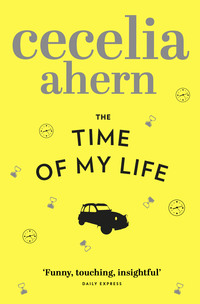
Читать книгу: «The Time of My Life»
The Time of My Life
Cecelia Ahern

Copyright
Published by HarperCollinsPublishers Ltd
1 London Bridge Street
London SE1 9GF
www.harpercollins.co.uk
First published in Great Britain by HarperCollinsPublishers 2011
This edition published by Harper 2016
Copyright © Cecelia Ahern 2011
Cover design by Heike Schüssler © HarperCollinsPublishers 2016
Cecelia Ahern asserts the moral right to be identified as the author of this work.
A catalogue copy of this book is available from the British Library.
This novel is entirely a work of fiction. The names, characters and incidents portrayed in it are the work of the author’s imagination. Any resemblance to actual persons, living or dead, events or localities is entirely coincidental.
All rights reserved under International and Pan-American Copyright Conventions. By payment of the required fees, you have been granted the non-exclusive, non-transferable right to access and read the text of this e-book on screen. No part of this text may be reproduced, transmitted, down-loaded, decompiled, reverse engineered, or stored in or introduced into any information storage and retrieval system, in any form or by any means, whether electronic or mechanical, now known or hereinafter invented, without the express written permission of HarperCollins.
HarperCollinsPublishers has made every reasonable effort to ensure that any picture content and written content in this ebook has been included or removed in accordance with the contractual and technological constraints in operation at the time of publication
Source ISBN: 9780007350452
Ebook Edition © May 2016 ISBN: 9780007432837
Version: 2019-04-30
Note to Readers
This ebook contains the following accessibility features which, if supported by your device, can be accessed via your ereader/accessibility settings:
Change of font size and line height
Change of background and font colours
Change of font
Change justification
Text to speech
Praise for Cecelia Ahern
‘Cecelia Ahern’s novels are like a box of emeralds … they are, one and all, dazzling gems’
Adriana Trigiani, author of The Shoemaker’s Wife
‘Beautiful and unexpected … both thought-provoking and life-affirming’
Sunday Express
‘Intricate and emotional … really completely lovely’
Grazia
‘A wry, dark drama’
Daily Mail
‘Life-affirming, warm and wise’
Good Housekeeping
‘Cecelia Ahern is an undisputed master when it comes to writing about relationships … Moving, real and exquisitely crafted.’
Heat
‘Exceptional … both heartbreaking and uplifting’
Daily Express
‘Both moving and thought-provoking’
Irish Independent
‘An exquisitely crafted and poignant tale about finding the beauty that lies within the ordinary. Make space for it in your life’
Heat
‘An unusual and satisfying novel’
Woman
‘Ahern cleverly and thoughtfully turns the tables, providing thought-provoking life lessons.’
Sunday Express
‘An intriguing, heartfelt novel, which makes you think about the value of life’
Glamour
‘Insightful and true’
Irish Independent
‘Ahern demonstrates a sure and subtle understanding of the human condition and the pleasures and pains in relationships’
Barry Forshaw
‘Utterly irresistible … I devoured it in one sitting’
Marian Keyes
‘The legendary Ahern will keep you guessing … a classic’
Company
For my precious girl, Robin
‘You used to be much more … “muchier”.
You’ve lost your muchness.’
The Mad Hatter to Alice in the film of
Alice in Wonderland (2010)
Contents
Cover
Title Page
Copyright
Note to Readers
Praise for Cecelia Ahern
Dedication
Epigraph
Chapter One
Chapter Two
Chapter Three
Chapter Four
Chapter Five
Chapter Six
Chapter Seven
Chapter Eight
Chapter Nine
Chapter Ten
Chapter Eleven
Chapter Twelve
Chapter Thirteen
Chapter Fourteen
Chapter Fifteen
Chapter Sixteen
Chapter Seventeen
Chapter Eighteen
Chapter Nineteen
Chapter Twenty
Chapter Twenty-one
Chapter Twenty-two
Chapter Twenty-three
Chapter Twenty-four
Chapter Twenty-five
Chapter Twenty-six
Chapter Twenty-seven
Chapter Twenty-eight
Chapter Twenty-nine
Chapter Thirty
Epilogue
Acknowledgements
Let’s Hear from you
Keep Reading …
About the Author
Also by Cecelia Ahern
About the Publisher

CHAPTER ONE
Dear Lucy Silchester,
You have an appointment for Monday 30 May.
I didn’t read the rest. I didn’t need to, I knew who it was from. I could tell as soon as I arrived home from work to my studio apartment and saw it lying on the floor, halfway from the front door to the kitchen, on the burned part of the carpet where the Christmas tree had fallen – and landed – two years ago and the lights had singed the carpet hairs. The carpet was a cheap old thing chosen by my penny-pinching landlord, a grey worn industrial yarn that looked as though more feet had trodden over it than the apparently ‘lucky’ testicles of the bull mosaic in Galleria Vittorio Emmanuele II in Milan. You’d find a similar kind of fabric in my office building – a more appropriate location as it was never intended to be walked on barefoot, made only for the steady stream of on-foot shiny leather-shoe traffic moving from cubicle to photocopier, photocopier to coffee machine, coffee machine to emergency exit stairwell for a sneaky smoke, ironically the only location which failed to alert the fire alarm. I had been a part of the effort to find the smoking spot and each time the enemy had located us, we began efforts to find a new safe house. The current place was easy to find – hundreds of butts in piles on the ground to mark the spot, their lives sucked out of them by their users in panicked distressed frenzy, their souls floating around the insides of lungs while their outsides were dropped, stamped on and deserted. It was a place more worshipped than any other in the building, more than the coffee machine, more than the exit doors at six p.m., most certainly more than the chair before the desk of Edna Larson – the boss lady – who ate good intentions like a broken dispenser that swallowed your coins but failed to spit out the bar of chocolate.
The letter lay there on that dirty singed floor. A cream woven envelope with grand George Street font declaring my name in certain no-doubt-about-it black ink, and beside it, a gold embossed stamp, three swirls joined together.
The triple spirals of life. I knew what it was because I’d received two similar letters already and I’d Googled the symbol. I’d failed to make an appointment for either of the requests to meet. I’d also failed to phone the number supplied to rearrange or cancel. I’d ignored it, swept it under the rug – or would have if the Christmas tree lights hadn’t set fire to the shagpile that used to be there – and forgotten about it. But I hadn’t really forgotten about it. You never forget about things you’ve done that you know you shouldn’t have done. They hang around your mind, linger like a thief casing a joint for a future job. You see them there, dramatically lurking nearby in striped monochrome, leaping behind postboxes as soon as your head whips around to confront them. Or it’s a familiar face in a crowd that you glimpse but then lose sight of. An annoying Where’s Wally? forever locked away and hidden in every thought in your conscience. The bad thing that you did, always there to let you know.
A month on from ignoring the second letter and this one had arrived with another rescheduled appointment, and no mention of my previous failures to respond. It was like my mother – its polite failure to acknowledge my shortcomings was making me feel even worse.
I held the fancy paper at the corner between my thumb and forefinger and tilted my head to read it as it flopped to the side. The cat had pissed on it again. Ironic really. I didn’t blame him. My illegally owning a pet in a high-rise apartment block in the middle of the city and holding down a full-time job meant the cat had no opportunity to go outside to relieve himself. In an attempt to rid myself of my guilt I had put framed photographs of the outside world around the apartment: the grass, the sea, a postbox, pebbles, traffic, a park, a collection of other cats, and Gene Kelly. The latter obviously to service my needs but I hoped the others would dispel any longing he had to go outside. Or to breathe fresh air, to make friends, to fall in love. Or to sing and dance.
As I was out five days a week from eight a.m. often to eight p.m. and sometimes didn’t come home at all, I had trained him to ‘eliminate’, as the cat trainer had phrased it, on paper so he would get used to using his litter box. And this letter, the only piece of paper left lying on the floor, was surely just a confusion to him. I watched him move self-consciously around the edge of the room. He knew it was wrong. It was lurking in his mind, the thing he’d done that he knew he shouldn’t have done.
I hate cats but I liked this cat. I named him Mr Pan after Peter, the well-known flying young boy. Mr Pan is neither a boy who will never age nor, oddly enough, does he possess the ability to fly, but there is a strange resemblance and it seemed appropriate at the time. I found him in a skip down an alleyway one night, purring as though in deep distress. Or perhaps that was me. What I was doing down there shall remain private but it was raining hard, I was wearing a beige trenchcoat and after mourning the loss of a perfect boyfriend over too many tequilas, I was doing my best to channel Audrey Hepburn by chasing the animal and calling out ‘Cat!’ in a clear and unique, yet distressed tone. Turned out it was a day-old kitten and it’d been born a hermaphrodite. Its mother or owner, or both, had shunned it. Though the vet informed me that the kitten had more male than female anatomy, naming him felt as though I alone took the responsibility of choosing his sex. I thought of my broken heart and my being passed up for a promotion because my boss had an inkling I was pregnant – though it was after the holidays and my annual gorge-fest had been a wild boar short of a Tudor banquet – I’d been through a particularly horrific month of stomach cramps; a street bum had groped me late one night on the train; and when I had enforced my opinion at work I’d been called a bitch by my male counterparts and so I decided life would be easier for the cat as a male. But I think I made the wrong decision. Occasionally I call him Samantha or Mary or something feminine and he looks up with what I can only describe as thanks before sloping off to sit in one of my shoes and gaze wistfully at the stiletto and the world he’s been deprived of. But I digress. Back to the letter.
I would have to attend the appointment this time. There was no way around it. I couldn’t ignore it; I didn’t want to irritate its sender any further.
So who was the sender?
I held the drying page by the corner and again tilted my head to read the flopped paper.
Dear Lucy Silchester,
You have an appointment for Monday 30 May.
Yours sincerely,
Life
Life. Why of course.
My life needed me. It was going through a tough time and I hadn’t been paying enough attention to it. I’d taken my eye off the ball, I’d busied myself with other things: friends’ lives, work issues, my deteriorating and ever needy car, that kind of thing. I’d completely and utterly ignored my life. And now it had written to me, summoned me, and there was only one thing for it. I had to go and meet with it face to face.
CHAPTER TWO
I’d heard about this kind of thing happening which is why I wasn’t making a great dramatic deal about it. I generally don’t become overexcited about things anyway, I’m just not one of those people. I’m not easily surprised by things either. I think it’s because I expect that anything can happen. That makes me sound like a believer and I’m not necessarily that either. I’ll phrase it better: I just accept things that happen. All things. So my life writing to me, though unusual, wasn’t surprising; it was more of an inconvenience. I knew that it would demand much of my attention for the foreseeable future and if that was an easy thing for me then I wouldn’t have received the letters in the first place.
I beat the ice from the fridge-freezer with a knife and retrieved a cottage pie with my blue hand. While I waited for the microwave to ping I ate a slice of toast. Then a yoghurt. It still wasn’t ready so I licked the lid. I decided that the arrival of the letter gave me permission to open a bottle of €3.99 Pinot Grigio. I stabbed the remainder of the ice from the fridge-freezer while Mr Pan ran to hide in a pink heart-decorated wellington boot still covered in dried muck from a summer music festival three years ago. I removed a wine bottle I’d forgotten to take from the freezer which was now a frozen solid block of alcohol and I replaced it with the new bottle. I wouldn’t forget this one. I mustn’t. It was the last bottle left in the wine-cellar-stroke-corner-cupboard-under-the-cookie-jar. Which reminded me of cookies. I also ate a double chocolate chip cookie while I waited. Then the microwave pinged. I emptied the pie onto the plate, a big unappetising messy pile of mush, still cold in the middle but I hadn’t the patience to put it back in and wait thirty seconds more. I stood at the counter to eat and poked at the warm parts around the edges.
I used to cook. I used to cook almost every night. The nights I didn’t, my then boyfriend cooked. We enjoyed it. We owned a large apartment in a converted bread factory with floor-to-ceiling steel grid windows and original exposed brickwork on most walls. We had an open-plan kitchen-cum-dining-room and almost every weekend we had friends around for dinner. Blake loved cooking, he loved entertaining, he loved the idea of all of our friends, even family, joining us. He loved the sound of ten to fifteen people laughing, talking, eating, debating. He loved the smells, the steam, the oohs and aahs of delight. He’d stand at the kitchen island and tell a word-perfect story while dicing an onion, splashing the red wine into a beef bourguignon, or flambéing a baked alaska. He never measured anything, he always got the balance just right. He got the balance of everything just right. He was a food and travel writer, he loved going everywhere and tasting everything. He was adventurous. At weekends we never sat still, we climbed this mountain and that mountain, during summers we’d go to countries I’d never heard of. We jumped out of an airplane twice, we’d both bungee jumped three times. He was perfect.
And, he died.
Just joking, he’s perfectly fine. Alive and well. Cruel joke I know but I laughed. No, he’s not dead. He’s still alive. Still perfect.
But I left him.
He has a television show now. He’d signed the deal when we were still together. It’s on a travel channel we both used to watch all the time, and now and then I switch over and watch him walking the Great Wall of China or sitting in a boat in Thailand eating pad thai; and always, after his word-perfect review, in his perfect clothes – even after a week of climbing mountains, shitting in woods and not showering – he looks into the camera with his perfect face and he’ll say, ‘Wish you were here.’ That’s the name of the show. He told me in the weeks and months that followed our traumatic break-up, while he was crying down the phone, that he’d named it for me, that every time he said it he was talking to me and only me and never ever to anybody else. He wanted me back. He called me every day. Then every two days. Eventually it was once a week and I knew he’d been grappling with the phone for days trying to wait for that one moment to speak to me. Eventually he stopped calling and he’d send me emails. Long detailed emails about where he’d been, about how he felt without me, so depressing and so lonely I couldn’t read them any more. I stopped replying to him. Then his emails got shorter. Less emotional, less detailed, always asking me to meet him though, always asking for us to get back together. I was tempted, don’t get me wrong, he was a perfect man, and having a perfect, handsome man want you is sometimes enough to make you want him back, but that was in the weak moments of my own loneliness. I didn’t want him. It wasn’t that I’d met anybody else either, I told him that time and time again though perhaps it would have been easier if I’d pretended I had because then he could have moved on. I didn’t want anybody else. I didn’t really want anyone. I wanted to just stop for a while. I wanted to stop doing things and stop moving. I just wanted to be on my own.
I left my job, got a new one at an appliance company for half the salary. We sold the apartment. I rented this studio apartment, a quarter of the size of any other home I’d owned. I found a cat. Some would say I stole it but nevertheless, he/she is mine now. I visit my family when held at gunpoint, I go out with the same friends on nights that he’s not there – my ex-boyfriend, not the cat – which is more often now that he’s travelling so much. I don’t miss him and when I do miss him, I switch on the TV and I get enough dosage of him to feel content again. I don’t miss my job. I miss the money a little bit when I see something in the shops or in a magazine that I want, but then I leave the shop or I turn the page and I get over it. I don’t miss the travelling. I don’t miss the dinner parties.
And I’m not unhappy.
I’m not.
Okay, I lied.
He left me.
CHAPTER THREE
I was halfway through the bottle of wine by the time I built up the – not courage, I didn’t need courage, I wasn’t afraid – I needed to care. It took half a bottle of wine to care about returning a call to my life, and so I dialled the number listed on the letter. I took a bite of a chocolate bar while I waited for the phone to connect. It was answered on the first ring. It didn’t give me time to chew, never mind swallow my chocolate.
‘Oh, sorry,’ I said with a stuffed mouth. ‘I’ve chocolate in my mouth.’
‘That’s okay dear, take your time,’ an upbeat older woman with a smooth American-pie Southern accent said perkily. I chewed quickly, swallowed and washed it down with some wine. Then I retched.
I cleared my throat. ‘Finished.’
‘What was it?’
‘Galaxy.’
‘Bubble or caramel?’
‘Bubble.’
‘Mmm, my favourite. How can I help you?’
‘I received a letter about an appointment on Monday. My name is Lucy Silchester.’
‘Yes, Ms Silchester, I have you in the system. How does nine a.m. suit?’
‘Oh well, actually that’s not why I’m calling. You see, I can’t make the appointment, I’m working that day.’
I waited for her to say, Oh silly us, asking you to come on a work day, let’s cancel the entire thing, but she didn’t.
‘Well, I guess we can work around you. What time do you finish?’
‘Six.’
‘How about seven p.m.?’
‘I can’t because it’s my friend’s birthday and we’re going for dinner.’
‘What about your lunch break? Would a lunch meeting suit you?’
‘I’ve to bring my car to the garage.’
‘So, just to summarise, you can’t make the appointment because you’ve work in the day, you’re bringing your car to the garage on your lunch break and you’ve dinner with friends in the evening.’
‘Yes.’ I frowned. ‘Are you writing that down?’ I heard tapping in the background. This bothered me; they had summoned me, not the other way around. They were going to have to find a time.
‘You know, sweetheart,’ she said in her long Southern drawl – I could almost see the apple pie slithering from her lips and landing on her keyboard, then her keyboard hissing and going alight, and my summons being forever wiped from the memory. ‘You’re obviously not familiar with this system.’ She took a breath and I jumped in before the boiling apples had a chance to drip again.
‘Are people usually?’
I’d knocked her off her train of thought.
‘Pardon me?’
‘When you contact people, when life summons people to meet with it,’ I emphasised, ‘are people usually familiar with the procedure?’
‘Well,’ the longest sing-song that sounded like way-eell, ‘some are and some aren’t, I suppose, but that’s what I’m here for. How’s about I make it easier for you by arranging for him to come to you? He’d do that if I asked.’
I thought about that, then suddenly, ‘Him?’
She chuckled. ‘That catches people out too.’
‘Are they always hims?’
‘No, not always, sometimes they’re hers.’
‘Under what circumstances are they men?’
‘Oh, it’s just hit or miss, sweetheart, there ain’t no reason for it. Just like you and me being born what we are. Will that be a problem for you?’
I thought about it. Couldn’t see why it would. ‘No.’
‘So what time would you like him to visit you?’ She tapped some more.
‘Visit me? No!’ I shouted down the phone. Mr Pan jumped, opened his eyes, looked around and closed them again. ‘Sorry for shouting,’ I composed myself. ‘He can’t come here.’
‘But I thought you said that wouldn’t be a problem for you.’
‘I meant it’s not a problem that he’s a man. I thought you were asking if that would be a problem.’
She laughed. ‘But why would I ask you that?’
‘I don’t know. Sometimes health spas ask that too, you know, in case you don’t want a male masseuse …’
She chuckled. ‘Well, I can guarantee he won’t be massaging any part of your anatomy.’
She made anatomy sound dirty. I shuddered.
‘Well, tell him I’m very sorry but he can’t come here.’ I looked around at my dismal studio flat that I always felt quite cosy in. It was a place for me, my own personal hovel; it was not for entertaining guests, lovers, neighbours, family members or even emergency services when the rug caught fire, it was just for me. And Mr Pan.
I was huddled up by the arm of the couch and a few steps behind me was the end of my double bed. To my right was a kitchen countertop, to my left the windows and beside the bed was a bathroom. That was about the size of it. Not that the size bothered me, or embarrassed me. It was more the state of it. My floor had become the wardrobe. I liked to think of my scattered belongings as stepping stones, my yellow brick road … that kind of thing. The contents of my previous top-dollar penthouse wardrobe were bigger than the new studio apartment itself and so my too many pairs of shoes had found their home along the windowsill, my long coats and full-length dresses hung on hangers at the right- and left-hand ends of the curtain pole and I slid them open and closed as the sun and moon requested just like regular curtains. The carpet was as I have already described, the couch monopolised the small living area reaching from windowsill to kitchen counter, which meant you couldn’t walk around it but had to climb over the back to sit on it. My life could not visit me in this mess. I was aware of the irony.
‘My carpets are being cleaned,’ I said, then I sighed as if it was just such a nuisance that I couldn’t bear to think about it. It wasn’t a lie. My carpets very much needed to be cleaned.
‘Well, can I recommend Magic Carpet Cleaners,’ she said brightly, as though suddenly jumping to commercial hour. ‘My husband,’ ma husbaand, ‘is a devil for shining his boots in the living room and Magic Carpet Cleaners get that black polish right out, you wouldn’t believe. He snores too. Unless I fall asleep before him I get none the rest of the night so I watch those infomercials and one night I saw a man shining his shoes on a white carpet, just like my husband and that’s what caught my attention. Was like the company was made just for me. They took the stain right out, so I had to go out and get me some. Magic Carpet Cleaners, write it down.’
She was so intense I found myself wanting to invest in black shoe polish in order to test these magical cleaning infomercial people and I scrambled for a pen, which in accordance with the Pen Legislation Act of Since the Beginning of Time was not anywhere in sight when I needed it. With marker in hand I looked around for something to write on. I couldn’t find any paper so I wrote on the carpet, which seemed appropriate.
‘Why don’t you just tell me when you can come see him, save us the back and forth.’
My mother had called a special meeting of the family to gather on Saturday.
‘You know what, I know that this is so important, being summoned by my life and all, and despite having an important family gathering on Saturday, I’d really love to meet with him then.’
‘Oh,’ ewwww, ‘sweetheart, I will make a special note that you were willing to miss that special day with your loved ones to meet with him but I think that you should take that time to be with your family. God only knows how long you’ve got ’em for and we’ll see you the following day. Sunday. How does that grab you?’
I groaned. But not out loud, it was inside, deep within, a long agonised painful sound from a painful agonised place deep inside. And so the date was set. Sunday, we would meet, our paths would collide and everything I’d considered to be secure and anchored would suddenly slip and slide and change beyond belief. That’s what I’d read would happen in a magazine interview with a woman who had met with her life. They provided before and after photos of her for the benefit of the uneducated reader who couldn’t access picture images in their mind. Interestingly, before she’d met her life, her hair hadn’t been blowdried, but it was after; she had no make-up or spray tan on before, but had after; she wore leggings and a Mickey Mouse T-shirt before and was photographed in harsh lighting, but wore a softly draped asymmetric dress afterwards in a perfectly lit studio kitchen where a tall vase of artistically placed lemons and limes showed how life had apparently made her more attracted to citric flavours. She wore glasses before meeting with life, she wore contacts afterwards. I wondered who had changed her more; the magazine or her life.
In just under a week’s time I was going to meet my life. And my life was a man. But why me? I felt my life was going just fine. I felt fine. Everything in my life was absolutely fine.
Then I lay back on the couch and studied the curtain pole to decide what to wear.
CHAPTER FOUR
On the fateful Saturday that I’d been dreading ever since the day before I even heard about it, I pulled up to the electric gates of my parents’ home in my 1984 Volkswagen Beetle that had backfired all the way up the exclusive estate, attracting a few unhealthy glares from the sensitive rich people. I didn’t grow up in the house I was waiting outside and so it didn’t feel like a return to home. It didn’t even feel like my parents’ home. It was a house that they lived in when they weren’t in their holiday house, that they lived in when they weren’t in their domestic house. The fact that I was waiting outside, pending permission to be granted, detached me from it even more. I had friends who drove straight up driveways, knew passwords and alarm codes, or used their own keys to visit their parents. I didn’t even know where the coffee mugs were kept. The big gates had the desired effect, designed to keep out vagrants and deviants – and daughters – though the deterrent for me was being trapped inside. A burglar would climb over them to get into the house, I would scale them to get out. As though picking up on my mood, my car, who I named Sebastian after my grandfather who was never without a cigar in his hand and as a result developed a hacking cough that eventually sent him to his grave, seemed to run out of steam as soon as it realised where we were going. The route to my parents’ house was a tricky system of windy narrow roads in Glendalough that dipped and rose, twisted and turned around one giant mansion after another. Sebastian stopped and spluttered. I wound down my window and pressed the intercom.
‘Hello, you’ve reached the Silchesters’ Home for the sexually deviant, how can we fulfil your needs?’ came a breathy male voice down the line.
‘Father, stop messing about.’
There was an explosion of laughter through the speaker, causing two power-walking Botoxed blondes to end their secret nattering and whip their high pony-tails around to stare. I smiled at them but as soon as they saw me, a brown unimportant thing in a junk of metal, they looked away and shook their VPL-free tight little Lycra-covered raisin bottoms forward again.
The gates made a shuddering sound, unstuck themselves and then parted.
‘Okay, Sebastian, let’s go.’ The car jerked forward, knowing what lay in its wake: a two-hour wait beside a bunch of pretentious automobiles he had nothing in common with. How similar our lives would be. The long gravelled driveway gave way to a car park with a water fountain of an open-mouthed lion spewing up murky water. I parked away from Father’s bottle green Jaguar XJ and his 1960 Morgan +4 which he called his ‘weekend car’, and which he drove wearing his weekend attire of vintage leather gloves and goggles as though he were Dick Van Dyke in Chitty Chitty Bang Bang. He also wore clothes with these items, in case the image was more disturbing than intended. Beside Father’s cars was my mum’s black SUV. She had specifically asked for something that would require minimum driving effort on her part, and she had parking sensors covering so many angles that if a car drove by three lanes away on a motorway it beeped to signal its proximity. On the other side of the gravelled area was my eldest brother Riley’s Aston Martin and my brother Philip’s – the middle child’s – family Range Rover that had been pimped up with all the upgrades including television screens in the backs of the headrests for the kids to watch on their ten-minute drive from ballet to basketball practice.
‘Leave the engine running, I’ll be out in two hours max,’ I said, then patted Sebastian on the head.
I looked up at the house. I don’t know what era it was, but it was not ‘Georgewardian’ as I had joked at the Schuberts’ Christmas party much to my brothers’ amusement, my father’s disgust and my mother’s pride. The house was striking, it was originally built as a manor by Lord Somebody who later gambled away his fortune and it was sold to somebody else who wrote a famous book and therefore we were required by law to place a brass plaque with his name outside the gates for literary geeks but mostly for passing power-walkers with raisin bottoms to look at and frown at because they didn’t have a brass plaque outside their own houses. Famous Literary Writer had an illicit relationship with a male Depressed Poet who built an East Wing in order to get away on his own. The house had an impressive library containing communications from Lord Somebody to Lady Whatever, then more sweet talk from Lord Somebody to Lady Secret while he was married to Lady Whatever, and original writings from Famous Literary Writer which were framed and hanging on the walls. Depressed Poet’s works stood unprotected on the shelf beside a world atlas and Coco Chanel’s life story. He didn’t sell well, not even after he died. After a well-documented tumultuous affair, Famous Literary Writer drank all his money away and the house was sold to a well-to-do German family who brewed beer in Bavaria and used it as their holiday home. While here, they also added on a very impressive west wing and a tennis court, which from the evidence of their faded black-and-white photographs their overweight and seemingly unhappy sailor-suited son Bernhard did not like to avail of. It was also possible to find an original bottle of the family beer in a walnut cabinet in the Silchester bar. The memories and traces of these other lives were palpable in the house and I often wondered what exactly it was Mum and Father would leave behind apart from Ralph Lauren’s latest interiors.
Two animals which I still couldn’t identify greeted me with scowls at the base of the stone steps leading to the front door. They looked like lions but they had horns and two legs twisted together in what could only be described as a debilitating stance that made me think that hundreds of years of staring at the fountain had left them desperate for the toilet. Unless Ralph Lauren was going through a dark phase, my money was on the drunk writer or the depressed poet to have chosen them.
The door opened and my brother Riley grinned out at me like a Cheshire cat.
‘You’re late.’
‘And you’re disgusting,’ I referred to the intercom exchange.
He laughed.
I trudged up the steps and passed over the threshold into the black and white marble-floored hall with double-height ceiling where a chandelier the size of my flat dripped down.
‘What, no gift?’ he said, giving me a hug longer than I wanted just to annoy me.
I groaned. He was joking but I knew he meant it. My family belonged to a very serious religion called the Church of Social Etiquette. The heads of their church were People. As in, every action acted and word spoken was done on the basis of what would ‘People’ think? Part of that etiquette required you to bring a gift to a person’s house even if that person was family and you were just calling by. But we didn’t just do calling by. We did arranged visits, made appointments, spent weeks, months even, trying to rally the troops.
‘What did you bring?’ I asked him.
‘A bottle of Father’s favourite red wine.’
‘Suck-up.’
‘Only because I want to drink it.’
‘He won’t open it. He’d rather wait until everyone he loves is long dead and buried before he even thinks about sitting in a locked room to open it himself. Bet you ten, actually twenty,’ I needed petrol money, ‘he won’t open it.’
‘Your understanding of him is almost touching but I have faith in him. It’s a deal.’ He held out his hand.
‘What did you get Mum?’ I looked around the entrance hall to see what I could swipe for a gift.
‘A candle and bath oil but before you make a thing about it, I found it in my apartment.’
‘Because I bought it for what’s-her-name, that girl you dumped who laughed like a dolphin.’
‘You got Vanessa a gift?’
We were walking through the endless spaces of the house, room after room of seating areas and fireplaces. Couches we were never allowed to sit on, coffee tables we couldn’t put our drinks on.
‘As a consolation prize for going out with you.’
‘She can’t have appreciated it much.’
‘Bitch.’
‘Yeah, dolphin-laughing bitch,’ he agreed, and we smiled.
We reached the final room in the back of the house. Once Lady Somebody’s drawing room and then Depressed Poet’s rhyming room, it was now Mr and Mrs Silchester’s entertainment room: a walnut built-in bar with beer on tap and a smoky mirror on the back wall. In the glass case along the bar stood the original German beer from the 1800s with a black-and-white photo of the Altenhofen family posing on the front steps of the house. The room had plush salmon-toned carpets that your feet sank into, tall leather-upholstered chairs at a cocktail bar and smaller leather chairs dotted around walnut tables. Its main feature was a bay window which overlooked the valley below and the rolling hills beyond. The garden was three acres of rose gardens, a walled garden and an outside swimming pool with fresh water. The double doors from the bar were open and gigantic limestone slabs led down to a water feature in the centre of the lawn. To the side of the fountain and beside the rush of the babbling brook a table had been set up with white table linen, crystal and silverware. In my family there was no such thing as informality. It was such a wonderful picture. Shame I’d have to ruin it.
My mother was floating around the table in a white tweed Chanel to-the-knee number and monochrome flats, swatting away the wasps that threatened to invade her garden party. There wasn’t a hair out of place on her blonde head, she held the same small smile on rose pink lips regardless of what was going on in the world or in her life or in the room. Pimped-up Range-Rover-owner-slash-reconstructive-plastic-surgeon-slash-closet-boob-job-surgeon and middle child Philip was already seated at the table talking to my grandmother who was sitting poised as usual in a floral garden-party dress, back poker straight, her hair scraped tightly in a bun, her cheeks and lips an appropriate rouge, pearls around her neck, her hands clasped in her lap and her legs joined at the ankles, no doubt as learned at finishing school. She sat quietly, not looking at Philip and probably not listening either while she surveyed my mother’s work with her ever disapproving eye.
I looked down at my dress and smoothed it.
‘You look great,’ Riley said, looking away and trying to make me feel that he wasn’t just attempting to fill me with confidence. ‘I think she’s got something to tell us.’
‘That she’s not our real mother.’
‘Oh, you don’t mean that,’ I heard a voice behind me.
‘Edith,’ I said, before I’d turned around. Edith had been a housekeeper for Mum and Father for thirty years. She’d been there for as long as I could remember and brought us up more than any of the fourteen nannies who had been employed to take care of us throughout our lives. She had a vase in one hand and a gigantic bouquet of flowers in the other. She placed the vase down and held her arms out to embrace me. ‘Oh Edith, they’re lovely flowers.’
‘Yes, they are, aren’t they? I just bought them fresh today, I went to that new market down by …’ she stopped, looked at me suspiciously. ‘Oh, no. No, you don’t.’ She moved the flowers away from me. ‘No, Lucy. You can’t have them. Last time you took the cake I’d made for dessert.’
‘I know, that was a mistake and I’ll never do it again,’ I said sombrely, then added, ‘because she keeps asking me to make it again. Ah, come on Edith, just let me see them, they’re beautiful, really beautiful.’ I batted my eyelashes.
Edith resigned herself to fate and I lifted the flowers from her arms.
‘Mum will love them. Thanks,’ I smiled cheekily.
She fought a smile; even when we were kids she’d found it hard to give out to us. ‘You deserve what’s coming to you now, that’s all I can say.’ Then she returned in the direction of the kitchen, while dread filled inside me to the point of bursting. Riley led the way and I struggled to walk down the wide steps with the bouquet which took two of my strides next to Riley’s one. He was down ahead of me and Mum almost lit up like a firework at the sight of her precious son making his way to her.
‘Lucy, sweetheart, they’re beautiful, you shouldn’t have,’ Mum said, taking the flowers from me and over-exaggerating her thanks as though she’d just been handed the Miss World title.
I kissed my grandmother on the cheek. She acknowledged it slightly with a small nod of her head but didn’t move.
‘Hi, Lucy,’ Philip stood to kiss me on the cheek.
‘We’ll have to stop meeting like this,’ I said to him quietly, and he laughed.
I wanted to ask Philip about the kids, I knew that I should, but Philip was one of those people who actually took the enquiry way too far and would go into the verbal diarrhoea of every single thing his children had said and done since I’d seen them last. I loved his children, I really did, but I just didn’t care so much for what they’d eaten for breakfast that morning, though I’m pretty sure it was something to do with organic mangoes and dehydrated dates.
‘I should put these in water,’ Mum said, still admiring the flowers for my benefit though the moment had long since past.
‘I’ll do it for you,’ I jumped at the chance. ‘I saw the perfect vase for them inside.’
Riley shook his head incredulously behind her back.
‘Thank you,’ Mum said, as though I’d just offered to pay her bills for her lifetime. She looked at me adoringly. ‘You look different, did you do something with your hair?’
My hand went immediately to my chestnut mane. ‘Em. I slept with wet hair last night.’
Riley laughed.
‘Oh. Well, it’s lovely,’ she said.
‘That will give you a cold,’ my grandmother said.
‘It didn’t.’
‘It can.’
‘But it didn’t.’
Silence.
I left, and tottered over the grass in my heels to get to the stone steps. I gave up and kicked off my shoes; the stone under my feet was warm from the sun. Edith had moved the vase from the bar but I was happy about that; another errand to waste more time. I calculated in my head that from my late arrival to the flower/vase errand I had passed twenty minutes of the dreaded two-hour stay.
‘Edith,’ I called half-heartedly for nobody’s benefit but my own, moving from room to room, moving further away from the kitchen where I knew she would be based. There were five large rooms facing the back garden. One from Drunken Literary Writer’s time, two from the main original part of the house and then another two from the German beer family. Once I had walked through all of the rooms which were connected by oversized double doors, I stepped out in the hallway and looped my way back round. Across the hallway I could see the massive walnut double doors to my father’s office were open. It was where Famous Literary Writer had penned his famous novel. It was where my father went through endless mounds of paperwork. Sometimes I even wondered if there was anything printed on the paper or if he just liked the feel of it, if it was some nervous disposition that meant he must look at and touch and turn paper.
Father and I have the best relationship. Sometimes our thoughts are so similar it’s almost as if we’re the same person. When people see us they are blown away by our bond, by the respect he holds for me, by the admiration I hold for him. Often he’d take days off work just to pick me up from my apartment and take me off on an adventure. It was the same when I was a child, the only daughter in the family, he spoiled me. Daddy’s girl, everybody called me. He’d phone me during the day just to see how I was, send me flowers and Valentine’s cards so I didn’t feel lonely. He really was a special guy. We really did have a special bond. Sometimes he’d take me to a barley field on a windy day and I’d wear a floaty dress and we’d run around in slow motion and he’d become the tickle monster and try to catch me, chasing me around and around until I’d fall down on the barley which would be all around me, waving back and forth in the breeze. How we’d laugh.
Okay, I lied.
That was probably obvious from the slow-motion barley-field image. I pushed it too much there. In truth, he can barely stand me nor I him. But we do stand each other, just about enough, somewhere on the cusp of standing each other for the sake of world peace.
He must have known I was outside his office but he didn’t look up, just turned another mysterious page. He’d kept those pages far from our grasp all of our lives, so much so that I’d become obsessed about discovering what was on them. When I was ten years old I finally managed to sneak into his office one night when he’d forgotten to lock the door, and when I saw the papers, with my heart pounding manically in my chest, I couldn’t understand a word that was written on them. Law talk. He’s a High Court judge and the older I got the more I came to understand how regarded he was as a leading expert on Irish criminal law. He’d presided over murder and rape trials since his appointment to the High Court twenty years ago. He was a real bag of laughs. His old-school views on many things had been nothing short of controversial; at times, if he hadn’t been my father, I’d have taken to the streets in protest – or maybe that was because he was my father. His parents were academics, his father a university professor, his mother – the floral-dress-wearing old woman in the back garden – was a scientist. Though apart from creating tension in every room she walked into I don’t know exactly what she got up to. Something to do with maggots in soil in certain climates. Father’s a European Universities Debating Champion, graduate of Trinity College Dublin and the Honourable Society of King’s Inns whose motto is ‘Nolumus Mutari’ meaning ‘We Shall Not Be Changed’ and that right there says a lot about him. All I know about my father is what the plaques on his office walls declare to the world. I used to think that everything else about him was a great big mystery that I would someday figure out, that I would unlock a secret and suddenly he would all make sense; and that in the end of his days – he an old man and me a responsible beautiful career woman with a stunning husband, longer legs than I’d ever had before and the world at my feet – we’d try to make up for lost time. Now I realise there is no mystery, he is the way he is, and we dislike each other because there isn’t a part of either of us which can even begin to understand a minuscule part of the other.
I watched him from the doorway in his panelled office, head down, glasses low on his nose reading papers. Walls of books filled the room and the smell of dust, leather and cigar smoke was thick even though he’d stopped smoking ten years ago. I felt a tiny rush of warmth for him, because all of a sudden he looked old. Or at least older. And older people were like babies; something about their demeanour made you love them despite their ignorant selfish personalities. I’d been standing there for a while taking the place in and pondering this sudden feeling of warmth, and it seemed unnatural to just walk away without saying anything so I cleared my throat, then decided to do an awkward knuckle rap on his open door, a manoeuvre which caused the cellophane wrapped around the flowers to rustle loudly. He still didn’t look up. I stepped inside.
I waited patiently. Then impatiently. Then I wanted to throw the flowers at his head. Then I wanted to pick each flower, petal by petal, and flick them in his face. What began as a mild innate happiness to see my father then turned to the usual feelings of frustration and anger. He just made things so difficult all of the time, always a barrier, always uncomfortable.
‘Hi,’ I said and I sounded like a seven-year-old again.
He didn’t look up. Instead he finished reading the page, turned it and finished reading that one too. It may only have been one minute but it felt like five. He finally looked up, took his glasses off and looked down at my bare feet.
‘I brought these flowers for you and Mum. I was looking for a vase.’ It was probably the closest thing to Dirty Dancing’s ‘I carried a watermelon’ that I’d ever said.
Silence. ‘There isn’t one in here.’ In my head I heard him say, You fucking fool, though he would never actually swear, he was one of those people who said “ruddy” which annoyed me to no end.
‘I know that, I just thought I’d say hi while I was on my way.’
‘Are you staying for lunch?’
I tried to figure out how to take that. He either wanted me to stay for lunch or he didn’t. It must have meant something, all his sentences were coded and usually had undertones implicating me of being an imbecile. I searched for the meaning and then for what could be the possible follow-up. Couldn’t figure it out. So I said, ‘Yes.’
‘I will see you at lunch.’
Which meant, Why would you disturb me in my office with a ridiculous ‘hi’ in your bare feet when I am due to see you at lunch any minute from now, you ruddy fool. He put his glasses back on and continued reading his papers. Again I wanted to fling the flowers at his head, one by one, just ping them off his forehead, but out of respect for Edith’s bouquet I turned and walked out of there, my feet making a squeaky sound as they stuck to the floor. When I got to the kitchen I dumped the flowers in the sink, picked at some food, and went back outside. Father was there already greeting his sons. Firm handshakes, deep voices, a few renditions of ‘We are men’; then they gorged on a couple of pheasant legs, clinked pewtered jugs, groped a boob or two, wiped their drooling mouths and burped – or at least I imagined them do that – and then they sat.
‘You didn’t greet Lucy, sweetheart, she was finding a vase for the beautiful flowers she gave us.’ Mum smiled at me again as if I alone was all that was good in the world. She was good at doing that.
‘I saw her in the house.’
‘Oh, that’s lovely,’ Mum said studying me again. ‘Did you find a vase?’
I looked at Edith who was placing bread rolls on the table. ‘Yes, I did. The one in the kitchen beside the bin.’ I smiled at her sweetly, knowing she would understand this to mean I had placed them in the bin, which I hadn’t, but I liked teasing her.
‘Where your dinner is,’ Edith smiled back sweetly and mum looked confused. ‘Wine?’ Edith looked over my head, to everybody else but me.
‘No, I can’t, I’m driving,’ I responded anyway, ‘but Riley’s going to have a glass of the red he brought for Father.’
‘Riley is driving,’ Father said, not addressing anyone in particular.
‘He could have a small drop.’
‘People who drink and drive should be locked up,’ he snapped.
‘You didn’t mind him having a glass last week,’ I tried not to be confrontational but it wasn’t really working.
‘Last week a young boy wasn’t thrown through the windscreen of a car because the ruddy driver had too much to drink.’
‘Riley,’ I gasped, ‘tell me you didn’t?’
It was in poor taste, I know, but I think I kind of wanted it to be, for Father’s sake, so he began a conversation with his mother as though I had never spoken. Riley shook his head incredulously, whether at my inappropriate humour, or because he’d failed to wet his lips with Father’s precious wine, I wasn’t sure but either way he lost the bet. Riley reached into his pocket and handed me a twenty-euro note. Father looked at the transaction disapprovingly.
‘I owed her money,’ Riley explained.
Nobody at the table believed I could possibly have loaned anybody any money so it all backfired on me. Again.
‘So,’ Mum began, as soon as Edith had finished setting up and we were all settled. She looked at me. ‘Aoife McMorrow married Will Wilson last week.’
‘Ah, I’m so delighted for her,’ I said enthusiastically, stuffing a bread roll into my mouth. ‘Who’s Aoife McMorrow?’
Riley laughed.
‘She was in your tap-dance class.’ Mum looked at me, utterly surprised I’d forgotten my time-step acquaintance from when I was six years old. ‘And Laura McDonald had a little girl.’
‘Ee-I-ee-I-oh,’ I said.
Riley and Philip laughed. No one else did. Mum tried to but didn’t get it.
‘I met her mother at the organic fair yesterday and she showed me a photo of the baby. Beeeauuuutiful baby. You’d eat her. Married and a mother all in one year, imagine that.’
I smiled tightly. I felt Riley’s intense stare urging me to be calm.
‘The baby was ten pounds, Lucy, ten pounds, can you believe it?’
‘Jackson was nine pounds two ounces,’ Philip said. ‘Luke was eight pounds four and Jemima was eight pounds six.’
We all looked at him and pretended to be interested, then he went back to eating his bread.
‘It’s a lovely thing,’ Mum said looking at me and scrunching her face up and hunching her shoulders. ‘Motherhood.’
She was looking at me like that for too long.
‘I was married by the time I was twenty,’ my grandmother said as though it was some major feat. Then she stopped buttering her bread and looked me dead in the eye. ‘I finished university when I was twenty-four and had three children by the time I was twenty-seven.’
I nodded as if in awe. I’d heard it all before. ‘Hope they sent you a medal.’
‘Medal?’
‘It’s just an expression. For doing something … amazing.’ I tried to hold back on the bitter sarcastic tone that was just dying to get out. It was on the sidelines warming up, begging me to let it go on as a substitute for politeness and tolerance.
‘Not amazing, just the right thing, Lucy.’
Mum came to my defence. ‘Sometimes girls have babies in their late twenties now.’
‘But she’s thirty.’
‘Not for a few weeks,’ I replied, pasting on a smile. Sarcasm took its training top off, got ready to run on to the pitch.
‘Well, if you think you can have a baby in a fortnight you’ve a lot to learn,’ Grandmother said, biting into her bread.
‘Sometimes they’re older these days,’ Mum said.
My grandmother tutted.
‘They have careers now, you see,’ Mum continued.
‘She doesn’t have one. And what precisely do you imagine I was doing in the laboratory? Baking bread?’
Mum was put out. She had baked the bread on the table. She always baked the bread, everyone knew that, especially my grandmother.
‘Not breastfeeding anyway,’ I mumbled, but it didn’t matter, everybody heard me and they were all looking at me, and they weren’t all happy looks. I couldn’t help it, the substitutes were on the pitch. I felt the need to explain my comment. ‘It’s just that Father doesn’t strike me as a breastfed man.’ If Riley’s eyes could have widened any more they would have popped out of his head. He couldn’t help it, whatever laugh he’d been trying to keep in came out as a bizarre-sounding splurge of happy air. Father picked up his newspaper and cut himself off from the unfavourable conversation. He rustled it open in the same shuddering motion that I’m sure his spine was doing. We’d lost him, he was gone. Lost behind more paper.
‘I’ll check the starters,’ Mum said quietly and gracefully slid from the table.
I didn’t inherit Mum’s gracefulness. In fact Riley did. Suave and sophisticated, he oozed charm and even though he’s my brother I know he’s a real catch at thirty-five. He’d followed Father into the legal profession and was apparently one of our finest criminal lawyers. I’d overheard that being said about him; I hadn’t experienced his talents first-hand, not yet anyway but I wasn’t ruling it out. It gave me a warm and tingly feeling thinking my brother held a get-out-of-jail-free card for me. He was often seen on the news going in and out of court with men with tracksuit tops over their heads and handcuffed to police officers, and many was an embarrassing time when I’d silenced public places to shout proudly at the TV, ‘There’s my brother!’ and when I’d received glares of anger, I’d have to point out it wasn’t the man with the tracksuit top over his head accused of doing inhumane things but the dashing one in the fancy suit beside him but by then nobody cared. I believed Riley had the world at his feet; he wasn’t under any pressure to get married, partly because he’s a man and there are bizarre double standards in my house and partly because my mother has an unusual crush on him which means no woman is good enough for him. She never nagged or moaned but had a very distinct way of pointing out a woman’s flaws in the hope of planting the seed of doubt in Riley’s mind forever. She would have had more success if she’d simply used a flash card of a vagina when he was a child and then shook her head and tutted. She’s excited he’s living it up in a swanky bachelor pad in the city and she visits him on the odd weekend when she gets the opportunity to fulfil some sort of odd thrill. I think if he was gay she’d love him even more, no women to be in competition with and homosexuals are so cool now. I heard her say that once.
Mum returned with a tray of lobster cocktails and after a shellfish episode at lunch in the Horgans’ home in Kinsale, which involved me, a tiger prawn and a fire brigade, she also carried a melon cocktail for me.
I looked at my watch. Riley caught me.
‘Don’t leave us in any more suspense, Mum, what have you got to tell us?’ he said, in his perfect way that brought everyone back from their heads to the table. He had that ability, to bring people together.
‘I won’t have one, I don’t like lobster,’ Grandmother said, pushing the plate away in mid-air before it had even reached the table.
Бесплатный фрагмент закончился.