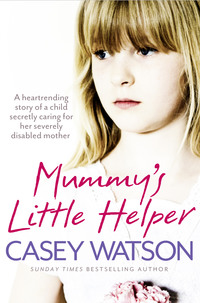
Читать книгу: «Mummy’s Little Helper»

Contents
Cover
Title Page
Dedication
Acknowledgements
Chapter 1
Chapter 2
Chapter 3
Chapter 4
Chapter 5
Chapter 6
Chapter 7
Chapter 8
Chapter 9
Chapter 10
Chapter 11
Chapter 12
Chapter 13
Chapter 14
Chapter 15
Chapter 16
Chapter 17
Chapter 18
Chapter 19
Chapter 20
Chapter 21
Chapter 22
Chapter 23
Chapter 24
Chapter 25
Chapter 26
Epilogue
Exclusive sample chapter
Casey Watson
Copyright
About the Publisher
Acknowledgements
I would like to thank all of the team at HarperCollins, the lovely Andrew Lownie, and my friend and mentor, Lynne.
Chapter 1
I love my family. I really do. They’re the best in the world in almost every respect. But sometimes they do tend to gang up on me.
‘Mum, that’s bonkers,’ my daughter Riley said, as I brandished the clutch of paint-colour cards I had collected that morning from the local DIY superstore. ‘You said it yourself. Trust me, I remember very clearly. You said, “The upstairs is just fine as it is.”’
‘Perfect,’ my husband Mike chipped in pointedly. I glared at him. ‘Honest!’ he persisted, ignoring it. ‘That’s what you said, love. That the whole house was perfect. Perfect as it was, you said. Remember?’
That was true, certainly. But I chose to pretend I hadn’t heard him. Instead I looked at my Kieron, for support. If I could rely on one person at this point, it would be my son. He wouldn’t let them browbeat me in this scurrilous fashion, surely? But I was sorely mistaken.
‘Come on, you did, Mum,’ he said, his face a picture of innocence, even as he threw me to the lions. ‘And we did do the downstairs …’
‘The whole of the downstairs,’ added Riley. ‘And in a week. Look. I still have the blisters to prove it!’
I fanned my rainbow of blues and pinks and fixed them all with a steely glare. ‘All right then,’ I said. ‘I’ll be the little red hen, then. I shall just have to do it by myself!’
Except I wouldn’t. I knew I’d talk them round eventually.
That had been a week back, and true to my prediction I had managed to persuade Mike of the logic of my plan, and with him on board the kids had caved in and helped too. It had been, I’d decided, an inspired idea. With one bedroom for us, and one earmarked for visitors, we had two bedrooms free for our fostering needs. Two bedrooms, to my mind, meant one blue and one pink. That way, I explained to Mike, we’d be always at the ready, whichever gender John Fulshaw sent us next. John Fulshaw was our fostering-agency link worker, and a dear friend. He’d trained us, and had been by our sides ever since.
‘Save time and money doing it this way in the long run,’ I’d pointed out. And I knew Mike couldn’t argue with that. We’d been fostering for four years now and had no thoughts of stopping, so being prepared for anything – and anyone – made sense. Though back at the start, when we’d taken in our first foster child, Justin, I had, I knew, gone slightly overboard. So much so that, when he left us, and our next child was a girl, it was no small task changing our boy’s room to a girl’s room. I’d gone so mad I’d football themed almost everything in it, right down to the border, the carpet, the clock and the curtains – I’d even painted footballs on the bookcase!
And, as ever, the family rallied round, just as they had this time. It seemed incredible to think we’d been in our new home for barely a month. It was the beginning of February now, and we’d only moved in a couple of days before Christmas. If it hadn’t been for everyone pitching in to get the place the way I wanted it – what with the holidays, and having just waved goodbye to our last foster child, Spencer – I felt sure that I wouldn’t have felt half as settled as I did.
But, yes, Mike was right, the house was perfect. It had been perfect when we’d viewed it, and was even more perfect now. I could barely believe our luck, really. We’d been eighteen years in our last house, and it had been something of a wrench leaving our children’s childhood home. There were just so many happy memories wrapped up in it.
And it had been a stressful situation that had prompted it, as well. The move had actually been brought about because of problems with Spencer. He’d been a particularly challenging child to foster, to put it mildly, and his antics (at just eight he’d already been like a one-boy walking crime spree) had caused a lot of upset in the neighbourhood. We weren’t exactly forced out, but a great deal of bad feeling had developed, and it had hit home that bringing children such as this into our lives could (and in this case did) have an impact on others, too.
It had certainly forced us to think about the future. And as soon as we’d sat down and considered our options, we realised the timing was right anyway. Not that we’d downsized. Though our own children had flown the nest (Kieron was settled with his girlfriend Lauren, and Riley and her partner David even had two little ones of their own) we’d moved house with children very much still in mind. Our new place was that little bit further out of town, that bit more open and leafy, that bit more suited to serving our fostering needs.
And now, I thought, as I looked around my two freshly painted bedrooms, the house itself was, as well. Now all I needed was a child to put in one of them.
‘So is there anything in the pipeline?’ Riley asked me, having admired both the makeovers. It was Tuesday lunchtime, and Levi, my eldest grandson, was back in nursery full time now, so she’d brought baby Jackson over for a sandwich and a natter before going to pick him up. It seemed impossible to me – almost like the blink of an eye – that my first grandson was three now, and that Jackson would be one year old next month.
Impossible but true. Where had all the time gone? I shook my head. ‘Not as yet,’ I told Riley. ‘Though when I spoke to John last week he seemed to think there might be another little boy coming up. With mainstream carers at the moment, but they’re apparently struggling to cope with him. Multiple issues,’ I went on. ‘And some really entrenched disturbing behaviours, by all accounts. John’s kind of put us on standby while they decide what to do.’
Riley laughed. ‘I bet your ears pricked up straight away,’ she commented. ‘Multiple issues … disturbed behaviours … Sounds right up your street, Mum.’
Which was true; it was exactly why I’d come into fostering. I’d already been thinking about it when I first saw the advertisement for the agency – back when I’d been working as a behaviour manager in a large comprehensive school. An ad seeking people who actively wanted to take on challenging children, the children the system was failing to cope with. ‘Fostering the unfosterable’ had been the slogan. And it had gripped me straight away. It was what I did at school. It was what I felt I was best at. Oh, yes, I thought, challenging was right up my street.
I nodded. ‘But that was last week,’ I said, as we headed back downstairs. ‘I thought I might have heard back by now. I might call him later, as it happens. See what the score is …’
Riley rolled her eyes. ‘You just can’t do it, Mum, can you?’
‘Do what?’ I asked her.
She burst out laughing. ‘Do nothing!’
I didn’t call John in the end. After all, if he had a child for us he’d have called me about them, wouldn’t he? But there was no denying I leapt for my mobile when I heard it buzzing at me the following afternoon. Riley was spot on. I was no good at doing nothing. And since I couldn’t take a job – that was a stipulation for our kind of intense fostering – without a child in, I’d soon be climbing all those freshly painted walls. There was only so much cushion plumping a woman can do and stay sane – even a clean freak like me.
And it wasn’t just through lack of an occupation that I was bored. Now we’d moved house, Mike, who was a warehouse manager, had a slightly longer journey to work and back every day, and with us new to the area, filling the day was itself a challenge. I needed to get out and about, make new friends and get to know the neighbours. But all of these things would take time.
It was also still winter, the days short and mostly murky, not really conducive yet to ambling round the neighbourhood, striking up conversations with strangers. And though our new garden was delighting me almost daily with tantalisingly unidentifiable green shoots, I’d never been much of a one for sitting around. I might be a grandma, but I was still only forty-four. A new challenge was exactly what I wanted.
I was in luck. I picked up my mobile to find John’s name on the display. ‘John,’ I said. ‘How very nice to hear from you. Are we on?’
‘Yes and no,’ he said, piquing my interest immediately. ‘Though, if you’re up for it, it’s going to be something of a change of plan.’
‘Oh?’ I asked, intrigued, pulling out a kitchen chair to sit down. He sounded a little tired and I wondered what he might have been up to. His wasn’t an everyday sort of job, for sure.
‘Well, if you and Mike are amenable, that is.’
‘You already said that,’ I said. ‘Which sounds ominous in itself.’
‘Not at all,’ he was quick to correct me. ‘Not in the way you probably mean, anyway. I mean as in we’re no longer planning on lining you up with that lad we talked about. Got something of an emergency situation on our hands. It’s a girl. Nine years old. Rather unusual scenario for us. I’ve spent most of the day at the General as it happens.’
‘The hospital?’
‘Yup. Got a call from social services first thing. The mother’s quite ill. She has multiple sclerosis –’
‘Oh, the poor thing.’
‘Yes, the whole situation’s pretty grim, frankly. Collapsed this morning, by all accounts, while out trying to buy her daughter a birthday present – she’s going to be ten soon. The little girl’s called Abigail, by the way – Abby – and she’s obviously terribly distraught. Looks like Mum’s going to have to be hospitalised for a period. And there is no other family, which means they have no choice but to …’
‘… take her into care?’ My heart went out to her. The poor child. Not to mention the poor mother. Having their lives ripped apart so suddenly like this. ‘No family at all?’ I asked.
‘Two second cousins, that’s all, both of whom live hundreds of miles away. And they’re not remotely close. Never even met the daughter, let alone know her. So it’s not workable. The last thing anyone wants is for little Abby to be dragged off somewhere, when Mum’s here in hospital, as you can imagine. So she’s had a social worker appointed – Bridget Conley. Have you come across her?’
The name was familiar, but I didn’t think our paths had yet crossed. But I was more interested in how Mike and I fitted into this. From what John was telling me this was a pretty straightforward scenario. A routine foster placement while a care package was presumably put in place for the mother so that they could both go home. Short term. Crisis management. Not the sort of thing Mike and I were needed for. Our speciality involved long-term placements and a defined behaviour-management programme, and was usually for kids who’d been in the care system a long time already and/or had come from profoundly damaging backgrounds. I said as much to John.
‘Ah, well, that’s where this isn’t quite what you might expect, Casey. The mum’s had MS for years. Periods of remission here and there, thankfully, but her condition is quite advanced. The fact that she made it into town at all was something of a miracle, apparently. She’s pretty much housebound and quite profoundly disabled …’
‘So how’s she been managing to look after her little girl, then? You say there’s no family …’
‘Not much of anything or anyone, really, it seems to me. Certainly no care or support in place. She’s mentioned a neighbour, but we’ve already had a clear impression that in terms of who’s looked after whom, it’s been the other way around. Little Abby’s been her carer, pretty much.’
Which was a sobering thought, but still didn’t fully answer my question. ‘But why us?’ I asked again. ‘I mean, we’re obviously happy to step in, you know that. But if it’s only going to be temporary …’
‘It’s not going to be that temporary,’ John corrected me. ‘That’s what we’ve been thrashing out today. The medics have given Mum a less than good prognosis, and there’s no way in the world they’re ever going to discharge a sick patient back to the care of a nine-year-old girl. Bottom line is that even if they manage to get her stable and home, and a package of medical support put in place for her, she’s clearly not going to be in a position to care for her daughter, which leaves social services with no choice but to take responsibility for Abby, doesn’t it? That’s the truth of it. Now the genie’s out of the bottle, so to speak …’
And the cat out of the bag, come to that. John was right, of course. Now they knew about it, they couldn’t un-know it. Which left everyone concerned in the worst of all situations. ‘God,’ I said, as the enormity of it hit home for me. I tried to imagine being told I could no longer look after my own children. Having to watch them being taken away from me, when they needed me. It hardly bore thinking about. ‘Poor, poor woman,’ I said to John. ‘She must be beside herself …’
‘Completely distraught,’ John agreed. ‘As you can imagine. But not stupid. She knows there’s no other choice here.’
‘And the poor little girl … how on earth is she dealing with all this?’
‘Badly,’ John said. ‘Which is where you and Mike come in. Because now we’ve met her we don’t think she’s suitable for mainstream care, basically. We’ve had a long chat with Mum this afternoon, and she wants what’s best for her child, after all.’
‘Of course …’
‘And, well, we’re all of the opinion that Abby might be, well, how shall I put it? A little idiosyncratic. I must stress that this isn’t coming from Mum, before you ask. It’s just our assessment, based on what Bridget has seen, and from what we know of how the two of them have been living. I’m obviously not conversant with all the details, but the bottom line would seem to be that this particular nine-year-old is not like any normal nine-year-old. She’s been caring for her mum from a very young age, and has basically had no sort of childhood. I know it sounds daft and, yes, we could be over-dramatising this, but our feeling is that being with you and Mike, and doing the programme kind of back to front, if you like, would give her the best chance of getting back on track. You know, getting her used to living as a child again, basically.’
‘You’ve obviously met her,’ I said. ‘How did she seem to you?’
‘Odd, definitely. Twitchy. Has some pronounced – very obvious – tics. I think that’s how I’d describe it. Anxious. Incredibly anxious. Wound up about as tight as she can be, is my feeling. I mean she’s in a state of trauma right now, obviously, but, reading between the lines, there’s probably much more besides. So it seemed to us that the best thing would be to take this bull by the horns. Crazy to slot her into a mainstream placement only to have it break down again in a matter of days or weeks.’
‘Absolutely,’ I agreed, feeling that familiar surge of adrenalin that always accompanied the prospect of a new child. ‘Though I hope your faith in us isn’t going to be misplaced, John. We’re not psychiatrists …’
‘I know. Absolutely. And we’ll obviously be reviewing things as a matter of urgency. Counselling’s probably a must-do that needs flagging up right away. But I know you two can give her that something extra, in terms of structure, that she probably needs right now.’
‘I like to think so. We’ll certainly do our best. So. When do you want to schedule a meeting? Just name the day.’
‘Ah,’ said John. And it was a kind of ‘ah’ I’d heard from him before. ‘That’s the thing,’ he went on. ‘I was wondering if we could skip that part of the process.’
‘Ri-ight …’ I said.
‘Because I really think we need to bring her now.’
‘Ri-ight …’ I said again, waiting for the next part of this process. The one where not only did we skip an initial meeting, but also skipped the first ‘get to know you a little’ visit, which was included to be sure both parties felt happy to proceed. I was fairly confident about this because by now I knew John well.
And he didn’t let me down. ‘We were kind of hoping you’d agree to take her on right away. If you’re amenable, that is …’ he finished apologetically. ‘Are you? I know it’s a lot to ask.’
I smiled to myself, loving how John always observed all the little protocols, bless him. Because when you thought about it, it wasn’t a lot to ask, really, was it? It was the job we did and I couldn’t think of a single prior occasion when ‘the process’, as written in the foster carer’s bible, had ever actually happened by the book.
And who cared? Doing things by the book was boring anyway. ‘Of course we are,’ I reassured him. ‘Well, I am, at any rate, and so will Mike be, I’m sure, just as soon as I call and tell him. He’ll be glad, to be honest, because it’ll give me something else to think about besides all the home improvements he’s terrified I’m going to schedule for our already perfect house.’
John laughed. ‘So I’ve actually done him a favour then, have I? Okay, so, let me see … okay if we pitch up in something like an hour and a bit?’
I told him yes, and immediately mentally switched gears. Outside the sun was slinking away from overseeing another grey February day. But suddenly I couldn’t care less. I disconnected and immediately reconnected – this time to Mike. I couldn’t wait for him to get home. Our New Year had begun.
Chapter 2
Mike was home just in time for us to belt to the local supermarket and stock up with a few supplies before John arrived with our new house guest. On a bit of a New Year health kick, I had little in the way of treats in, and the couple of Christmas biscuits I’d had left in the tin had been hoovered up by Jackson and Riley the day before. It would be a bit of a mad rush, but I was determined to get it done, as I had no idea how things would pan out when Abigail arrived, and wanted to be able to concentrate all my energies on her. On the way I briefed Mike about what I already knew.
‘What a dreadful situation,’ he said as we parked the car. ‘Really makes you count your blessings, doesn’t it?’ I nodded. ‘But, at the same time, it couldn’t be better timing for us, could it? Sounds like she’s going to be the opposite of Spencer, at least, bless him.’
He was certainly right there. Our last foster child, to use the parlance, had run us ragged. So much so that I think we’d both been holding our breath when we’d been given the all clear two weeks back. Up till then we’d been on standby and unable to take another child, just in case his new situation – back with Mum and Auntie, but not Dad – proved to be unworkable for keeps. He had become so dear to us, and I was looking forward to hearing how he was getting on, but there was no doubt a part of me was warming to the idea of having the novelty (which it would be) of a quiet and well-behaved little girl taking his place. A distressed and anxious one, clearly – and no wonder, given her circumstances – but one with a completely different set of challenges to be overcome.
I grabbed a basket and tried to compile a list in my head of the sort of goodies I thought Abigail might like, getting Mike – six foot three to my own five foot nothing – to reach the items I couldn’t. Things didn’t normally involve so much guesswork, of course. The usual procedure, as well as those all-important meetings we weren’t having, involved the child filling in a short questionnaire we’d devised, in which they could tell us about all their likes and dislikes. It was just one of the ways we could help them feel settled at what was inevitably a stressful and unhappy time in their lives. With everything new and different it could be a comfort for a child to have some constants still in place – be it a favourite snack or special meal, or a much-loved TV programme not missed; such details could make all the difference to a child in distress.
With Abigail, however, we were going in blind, so I just used my judgement to throw in what occurred to me, while Mike lugged the increasingly heavy basket. ‘And at least we have some girl’s toys tucked away,’ I said, remembering our last little girl, Olivia, who’d come to us from a home of appalling neglect, and owned nothing bar one filthy, balding doll. I’d had something of a field day down at the charity shops for Olivia, and still had a good supply of soft toys and doll’s clothes, even if at nine Abigail might be too old for the enormous plastic play kitchen which had been my best-ever find to date.
Mike frowned, though. ‘I imagine playing’s going to be the last thing on her mind, love,’ he pointed out. ‘For the moment, at least. Poor kid. She must be reeling.’
He was right, of course. This was a uniquely sad and strange scenario – and for all of us. One step at a time. We quickly paid and hurried home.
We’d just finished putting things away and boiling the kettle when John’s car pulled up outside. I loved that this new house gave me a window onto the world. My kitchen was at the front of the house this time, and as it was where I spent most of my time it enabled me to indulge in my secret desire to be a ‘nosey neighbour’. I also liked the fact that we only had a small front garden. One, better still, that was covered with pebbles, so I wouldn’t have to spend much time on maintenance. The other positive was that just across the small road beyond our garden there was a nice grassy area with a children’s play section. That was enough to quell any guilt I had about my small but beautifully kept courtyard; that and the fact that we had a rather large back garden that I intended to fill with child-friendly play things for both the grandchildren and the children we’d be fostering.
Abigail looked dwarfed as she walked up the path in between John and her social worker. Still in her green-and-black school uniform, she stole a quick glance at me and Mike as we opened the front door. She was a pretty little girl, slim and petite, with her long fair hair held in two bunches which were neatly tied with matching green ribbon.
She also looked terrified. I was used to greeting children in distress, of course. There can be few things more bewildering and disorientating for a child than being made to go and live with complete strangers. But most children who came into foster care did so in carefully managed stages, so that even if the process was, by its nature, a relatively quick one, by the time it came to actually being deposited with their temporary family, the child had at least been there for a visit.
Poor Abby had had no such preparation. In less than a day her whole life had imploded. She’d gone to school this morning fully expecting to go home again and instead, she’d been picked up and told her mother was ill in hospital and that tonight she would have to sleep somewhere else. I was used to dealing with kids from bad family situations, but it still seemed inexplicable to me that this sweet little girl didn’t have a single other place she could go to. When my own two were her age it would have been unthinkable. Riley had her little gang of sleepover mates, most of whose mums were friends of mine too. All would have stepped in during a crisis like this one, just as I’d have stepped in had it been them.
My thoughts also naturally went to my Kieron, and how he would have fared in such a crisis. He was all grown up now – twenty-two – but he had Asperger’s Syndrome, a mild type of autism. He functioned well, had been to college and was doing well in life, but a change – any change – to his routine really stressed him. For someone like him, such a thing would be a major trauma. I’d thanked God many times for my network of friends and family, who knew his needs and idiosyncrasies and so could always help de-stress him. How would I have ever coped without them over the years?
Yet for this poor little girl there was no one. The social worker had already questioned both Abby and her mum about this, thinking, quite rightly, that if no family could be found at short notice, then a sleepover with a close pal would be the very next best thing. But no, it seemed the child didn’t have anywhere else to go. Unbelievable. And what on earth must have been going through her mind, knowing not only that complete strangers were rearranging her whole future, but that she had to go and live with some, too? I could only hope that the enormity of what might happen long term hadn’t yet impinged on her consciousness. As far as I was concerned, the best way to manage her in the short term would be to focus very much on the here and now.
I smiled my broadest smile as she hesitantly stepped into the hallway. Both her hands gripped the straps of the backpack she was carrying, and so tightly that the knuckles were white. I smiled as I recognised the logo on the backpack: ‘Glee’, accompanied by the all-singing, all-dancing cast publicity photo. Straight away I was thinking that if Abby liked all the latest stage-school TV programmes and paraphernalia, she would get along famously with Lauren. Lauren was Kieron’s girlfriend and was at performing arts college, and was used to me roping her in to help out with similarly minded foster children.
I also recognised the primary-school logo on Abby’s sweatshirt. Stanholme Primary, although the furthest away, was one of the better schools in the area, and also a feeder school for the big comprehensive I used to work at, and I’d known a couple of the teachers there. It was good to have a pre-existing connection with the place. It gave me a head start in that direction, at least.
‘Here she is. Here’s Abigail!’ John said, with a slightly forced brightness – he looked as worn out as he’d sounded on the phone. I ushered the trio into the dining room and Mike took their orders for hot drinks. Not that he had to go far to make them; like our last house, this too had an open-plan kitchen/dining set-up, the only difference being that the two were separated by a huge arch. Perfect, once again, for keeping an eye on kids.
Right now, of course, I had my eyes on Abigail. She’d hardly spoken – only mumbled an affirmative to a hot chocolate – and looked completely at sea, as if she might burst into tears or make a run for it at any moment. Again, this felt so different from what we’d seen before. We might be strangers – as might be John – but all our previous children had come to us with at least some sort of relationship, however slight, with the social worker assigned to them. As a result they usually clung to them, both physically and emotionally. But that was definitely not the case here.
Bridget Conley, a tall woman in her early forties, I guessed, filed in behind John. She looked nice enough, if a little detached, but it was so immediately obvious she and Abigail had barely met. It would have been so even if I hadn’t already known that. No one’s fault – all this had happened in less than a day, after all – though I couldn’t help feeling it a pity that they hadn’t managed to make some sort of connection. Bridget (whose face was vaguely familiar to me, nothing more) looked friendly and personable, but also as if she’d come from the sort of high-level meeting that she’d felt the need to power-dress for that morning. Where social workers normally dressed to suit the work they did – in comfortable, non-threatening, relaxed clothes, in my experience – Bridget looked more like a head teacher or a politician: all sharp angles, crisp creases and clacky shoes.
And I’d been right. ‘Apologies,’ she began as she started fishing in a laptop bag. ‘I’m not at all up on the paperwork, I’m afraid.’ She grimaced. ‘Been attending a case conference with my manager and her boss. Hence the suit and heels, I’m afraid.’ She grinned, somewhat sheepishly. ‘Why on earth do these things always get me so flustered? You’d think with twenty years in the job I’d be a little less bothered about dressing up for the upper echelons, wouldn’t you?’ She laughed then, and I found myself warming to her. A woman very much like myself, I thought.
John, too, was pulling the inevitable manila file from his briefcase, with such scant notes as he’d presumably been so far able to make. And looking at the tableau of officialdom in front of me made me have something of a ‘eureka!’ moment. While Mike clattered with cups and teaspoons, I looked straight at John. ‘I tell you what,’ I said to him. ‘How about you all take a breather for a moment and enjoy a cup of tea. Been quite a long and stressful day, eh?’ I said, turning my gaze now to Abigail. ‘And why don’t you and I take a look round my beautiful new garden? We’ve only just moved in here, and I’m so excited about it. And it’ll be dark soon …’ I held out my hand.
My hunch had been right. No sooner had Abigail seen it than she’d grabbed hold of it gratefully and, finally being persuaded to take off the backpack, she let me lead her from the room. It was if she’d been drowning and was desperate for a life-belt to cling on to; an escape from the turbulent waters of this surreal situation that she had suddenly, inexplicably found herself in.
I led her through the living room and pulled open the French doors that looked out onto the garden. ‘How about that, then?’ I asked her.
I watched her gaze go exactly where I’d imagined it would – to the enormous trampoline in the far corner. It had been something we’d inherited – literally – as we’d been told the previous tenants, who’d gone abroad, had had no time to dismantle it and sell it. So they’d simply left it for whoever moved into the house next, much to Levi and Jackson’s delight. ‘It’s a big one, isn’t it?’ I added, smiling down at Abby now.
She dutifully smiled back and stepped outside with me into the garden. ‘You know, I have two little grandsons, Abigail. There’s Levi, who’s three, and baby Jackson, who’s nearly one. If you like, when they come to play you could show them how to bounce on it.’
Abigail, who was still clutching my hand, looked thoughtful. ‘Yes, I’d like that,’ she said, sounding almost painfully solemn. ‘But Mrs Watson? I think you need to put a net around it first. I’ve seen them on TV and you need those for very little people.’
Bless her, I thought, touched by her serious tone. ‘You know what?’ I said. ‘You’re right. And I never thought about that, love. I’ll have to mention it to Mike, won’t I? Good point. By the way, do you prefer to be called Abigail or Abby?’
Again, she seemed to need to think carefully before answering. ‘Well, my mummy calls me Abby, so I think I’d prefer that. Though my teachers call me Abigail, so I don’t suppose it matters. Whichever you want, really.’
She looked up at me, managed to find another half-smile from somewhere. ‘No contest, then,’ I said. ‘Abby it is.’
She didn’t seem to know what to do or say then, and seemed content to let me lead her on a short tour of the garden, while I did the bulk of the talking. Now clearly wasn’t the time to expect her to open up to me. She’d probably been bombarded with questions from the minute she’d been fetched from school and taken to the hospital. And I didn’t doubt her mind was very much still back there, with her poor mum. My heart went out to her. She must have felt as if she’d been abducted by aliens, which, in a practical sense, she sort of had. What I imagined she most needed was a distraction from the clamour of her fearful thoughts. ‘So,’ I told her, ‘I’m called Casey, okay? No “Mrs Watson”. And Mike, that great big man you just met in there? Well, he’s my husband. And what we do is look after children who, for whatever reason, can’t stay in their own homes for a bit. Did John explain all that to you? Why you’re here?’
Abigail nodded. It was growing dark now and I led us across to the bench seat on the patio. It was cold, but not wet, as it was partly sheltered by a fibre-glass lean-to. It was the only disappointment; a poor second to the wonderful conservatory we’d had in the last house. But it was functional, at least. And also temporary. Mike didn’t know it, but I fully intended to wait a few months, and then badger him mercilessly about getting us a new one. I patted the space beside me on the bench, and she obediently sat down, finally letting go of my hand.
‘So that’s what we’re going to do,’ I went on. ‘Take care of you. So you mustn’t worry about anything, okay? And the first thing we’re going to do is get things sorted so we can get you back to visit your mum as soon as possible –’
‘Tonight?’ she asked timidly. ‘I really need to make sure she’s okay.’
I shook my head. ‘Not tonight, I don’t think,’ I said gently. ‘But definitely this week. If not tomorrow, the next day. After school. We’ll make sure of that, don’t worry. We’ll fix it up with John and Bridget, before they go. And Mummy’ll be fine, you know. She’s in a safe place, and they’ll take really good care of her, just like we’re going to take really good care of you. Now then, how about that hot chocolate and a biscuit? They’ll be wondering where we’ve got to out here, won’t they? Hmm?’
I turned now, to look at her properly. The outside light had already picked out a shiny trail on her face, which marked where tears were slipping silently down her cheeks. The instinctive thing to do, as had been the case with holding out a hand to her, was to pull her towards me and hug her. It was as natural to me as breathing, as it would be to anyone. But with kids in care – particularly the long-term emotionally damaged kids we mostly dealt with – often that’s the last thing they need or want. Starved of normal human relationships, or, sometimes, all too familiar with dangerously inappropriate ones, they can find it almost impossible to empathise or be physical with the very people who most want to help them. But this was not that; this was a normal and clearly much-cherished little girl, who wanted nothing more keenly to be back with the mum who loved her. I scooped her into my arms and she sobbed hard against my chest, and as she did so I reflected that some good might come of this. Fingers crossed, they would soon sort out something workable for her mum’s care and, that done, she’d be able to enjoy at least some semblance of normality for what still remained of her childhood.
I had no reason to expect things to be otherwise at that point. Silly me. Is life ever that simple?
Chapter 3
Abby seemed much better for a cry and a cuddle, and when we returned to the dining room she had got herself composed again, and settled down to a biscuit and her by now lukewarm hot chocolate, which she wouldn’t let Mike pop into the microwave for her. ‘It’s safer to drink it like this, anyway,’ she said quietly, before wrapping both her hands around the mug.
‘So,’ said John, once he’d confirmed details of the hospital visit and reassured Abby that she’d soon be able to see her mum again. ‘I think we’re about done here. And I expect this little lady needs to get to bed, eh?’ He looked at Abby, who was staring into her now empty mug as if it might hold the answer to how she had come to be here. She looked up at him, as if the word ‘bed’ was physically painful. All she wanted, I felt sure, was her own bed.
Mike and I exchanged glances while Bridget said her goodbyes. The mood was sombre now, Bridget having outlined, albeit in the gentlest of tones, that for the moment, at least, Abby would only be able to visit her mum a couple of times a week. Though I understood why – daily visits would be both impractical (the hospital was some distance away) and could potentially slow down the process of adjustment – I really felt for her. This was the mum she had seen every single day for her entire life. No wonder she looked so distraught.
And to really hammer home the drastic and abrupt nature of this disaster, here she was, being deposited with us – a pair of strangers. We were used to this, of course – this business of children who hardly knew us being delivered to our doorstep – but we really were strangers to Abby. No preliminary visits, no chance to get used to the idea; I kept reminding myself that she’d first clapped eyes on us less than an hour ago. I also tried to keep in mind that in the Second World War this was something that hundreds of thousands of kids had gone through, my own and Mike’s parents included. But that was a lifetime away, and knowing it would be of absolutely no comfort to this traumatised child. I stood up again and went round to her side of the table. ‘I thought we might have a little sit-down together before bed,’ I said, placing my hands on her shoulders and dipping my head close to hers. ‘Once we’ve shown you your bedroom and you’ve unpacked and we’ve had our tea, of course. And a rummage through my special bits and bobs box, as well. I had this idea. I thought it might be an idea to get a bit of a diary started. Even a scrapbook, perhaps, that we can stick pictures and special things into. So you can keep mummy up to date with what you get up to while you’re here. Would that be an idea? I bet she’d like that, don’t you?’
I could once more see the white of Abby’s knuckles as she held on to the mug. She was close to tears again, I noticed, now John and Bridget were leaving. For all that there hadn’t been time for them to forge a bond yet, Bridget’s was obviously still the most familiar face in the room.
And Bridget could clearly see that herself. She wasn’t stupid; she knew that to gush at Abby now would create a chink in her fragile composure. Like every social worker, I imagined she’d had her fair share of situations where a desperate child had clung on to her for grim death. ‘Splendid!’ she declared briskly, as she shrugged on her jacket and slid her slim sheaf of papers back into their slip-case. ‘And when I’m back –’ She glanced at me now. ‘Which will be in – let me see now … two weeks – you can show me all the things you’ve been up to with Mike and Casey, hmm? All the adventures you’ve been having with them. Yes?’
Poor Bridget. Abby looked positively mortified by this. As well she might have. She’d already had so much ‘adventure’ in this one day that I felt sure the principal thought going through her mind right then was that even one more adventure would be one too many.
Abby had come to us with a small, carefully packed suitcase, which would have been collected from home after she’d been picked up from school by the on-duty social worker. By this time they would already have put the wheels in motion, so that John could sort an emergency placement, i.e. us. It was a well-oiled machine, social services, in this regard, but for Abby it must have been terrifying.
I sat on the bed and watched as she carefully began taking out the contents, having opened the dresser drawers ready. The case was full. It contained another set of school uniform, a small pile of neatly folded clothes, plus pyjamas, socks and pants, a pink toothbrush and a doll. As she went methodically through the contents, I wondered who’d packed it, then rolled my eyes at my own stupidity. She would have done it; who else? She was used to doing everything for herself, wasn’t she? I made a point of not fussing too much about helping her put things away; she seemed to have a very set way of doing everything, and I could see she was also double checking everything as she did it: she put socks in a drawer, closed it, then opened it again to check, and only then moved on to the next task, which she’d do similarly. It was odd, but I decided to let her get on with it; interfering would probably only make her more anxious than she already was.
‘That’s a pretty doll,’ I said instead, as she took out the last couple of items, which were an equally carefully packed set of doll’s clothes. The doll herself – which was a large one, with long blonde wavy hair, much like her own – was currently dressed as a mermaid. The other outfits, I could see, were also mermaid ones, and quite elaborate; one was decorated with tiny pink feathers, and the other, blue sequins. The doll was clearly much loved, and taken very good care of – a world away from the scant possessions most of our foster kids arrived with. Abby propped her against the pillows and smoothed her hair.
‘She’s called Ariel,’ she told me. ‘Aren’t you, Ariel?’
‘Well, hello, Ariel,’ I said. ‘Very pleased to meet you. But, gosh, look at the time. It’s getting late, isn’t it?’ I stood up to draw the pink-and-purple butterfly-print curtains and flick the switch on the matching bedside lamp. They’d been a real find on eBay – my latest stuff-procurement hobby – and a great asset to my foster-bedroom decorating plans. The room looked cosy and welcoming, at least. ‘Way past teatime, in fact,’ I added. ‘Mike’ll be starving. Are you hungry?’
Poor Mike would, too, I thought, wondering if he was rummaging in the kitchen cupboards as I spoke. I’d left him downstairs washing up the cups and saucers. But Abby shook her head. ‘Not even a little,’ she said. ‘We had some food at the hospital. I don’t really feel like eating anything else, if that’s okay.’
‘Of course,’ I reassured her, remembering the hot chocolate. She’d left the biscuit, but a mug of milky chocolate was pretty filling in itself. And it was gone seven now. I could always make her a sandwich later, if she wanted one. I said so. ‘Here, let’s have that,’ I added, gesturing to the now empty suitcase. ‘I’ll pop it on the top of the wardrobe for you.’
‘But will they make tea for Mummy?’ she wanted to know, as she placed her pyjamas on the pillow beside the doll and carefully smoothed the duvet cover where the case had rucked it up.
‘What, the hospital? Of course they will.’
‘They won’t forget about her, will they?’
I shook my head. ‘Why would they forget about her?’
Abby didn’t look convinced. ‘If she’s sleeping, they might. She needs her sleep. And if she’s asleep they might forget her, mightn’t they?’ She was nibbling the skin around her fingers and talking through them, and I had to stop myself from automatically reaching across and gently pulling her hands from her mouth. Instead, I filed it away for a conversation to have another day. As a child Kieron had always been a great one for nibbling his fingers, and occasionally still did it even now. And with his Asperger’s, it was also one of the signs we would look out for. An intense bout of whittling his fingernails to the quick was a sure sign that, even if outwardly he seemed to be coping, inside he most definitely was not.
‘Sweetheart,’ I told Abby, ‘you absolutely mustn’t worry. They have a system in hospitals, about food and when they bring it, and if a patient is sleeping they always make a note to come back and offer them something later on.’
‘But what if they don’t? I mean, they might not. They might forget. They have so many patients to look after.’
‘They won’t forget,’ I said. ‘Promise. They check every patient regularly. There will be a nurse nearby every single hour of every day.’ I pulled the bedroom door open wider. ‘Now, then, how about we go down and get that box out, and see what we’ve got? I was thinking that perhaps we could go on the internet and find some pictures to print out. You could have the cast of Glee on the cover of it, perhaps. Something like that.’
Abby nodded, seemingly mollified, and produced a small smile which I hope betrayed at least a spark of enthusiasm. ‘Okay,’ she said, as I turned to lead the way back downstairs.
Before following me, however, she crossed the bedroom and carefully turned off the bedside lamp, then reached up and flipped the switch for the main light, as well. And then, as we crossed it, she turned off the landing light too. Then on again, as if undecided, and then off again. ‘Oh, don’t worry,’ I began as we were plunged back into near blackness. ‘We usually leave that one till we’ve gone up to bed.’
She turned to face me, her expression one of complete consternation.
‘But what about the bills?’ she asked incredulously.
It seemed that bills, and the worry of them, not to mention that of timetables for everything from laundry to medication, were what took up most of this small girl’s time. After we’d spent a focused half-hour gathering the raw materials for her new scrapbook, I suggested she go up and change into her pyjamas and that we could then watch some TV before she went to bed. We’d abandoned hope of having our usual meal and Mike contented himself with a couple of extra biscuits, the plan being, since Abby still had no interest in dinner, that we’d order in a take-away to eat once she’d gone to bed. It wasn’t the usual thing we’d do on a random Tuesday evening, but this, of course, wasn’t a usual sort of day.
She’d come back down now and we’d tried to find out a little more about her. There was no point in setting up a tailored behaviour modification programme till we had more idea both about the small person for whom we’d tailor it and the behaviours which most needed modifying.
And it soon became clear – just as John had warned us – that whatever behaviours were worrying social services, they were the result of a life dominated by caring for her mother.
‘So what sort of things do you and your friends like doing?’ Mike asked her, as we settled in the living room. Abby had gone straight to the big new recliner armchair by the fireplace. It had been a moving-in extravagance, and was already Mike’s favourite – but tonight he’d had to come and join me on the sofa. Not that he didn’t often, but I smiled even so. After a long day at the warehouse he liked nothing better than to press the button that made the footrest pop out, and more often than not declare, ‘Fit for a king, this!’
But I knew he didn’t mind, bless him. There was a David Attenborough wildlife programme coming on shortly, which we’d both been keen to see, and which Abby had expressed interest in watching too. Her mum, she explained, had really liked the series about the sea – when ‘she could still actually see the telly,’ she’d added sadly.
She turned to Mike now. ‘I don’t really have many friends,’ she told him, one hand twiddling a few strands of her hair round and round. ‘I don’t have much time for things like that.’
Mike raised his eyebrows. ‘What, none?’ he asked, mock-incredulously. ‘Not even one special best friend for ever? A BFF – isn’t that what they call them these days?’
Abby shook her head. ‘Not really,’ she repeated, with a shrug. I watched her carefully, but she didn’t seem to be distressed making this admission – simply stating a fact. ‘I don’t need friends anyway,’ she added quietly. ‘I have Mummy.’
‘And a very busy life, by the sound of it,’ I said quickly, anxious that she didn’t get upset again. Which she clearly was. She was twiddling her hair even faster, though she didn’t seem conscious of the fact. ‘Oh, and look, the programme’s starting,’ I said, glad of a distraction for the poor child. ‘We’ve been looking forward to seeing this all week.’
And it was good, too, except I kept getting distracted by Abby who, though her eyes were on the television, seemed in some sort of trance, and continued to play constantly with her hair. As I kept glancing at her, I realised she was no longer playing with a lock of hair, but with single strands, which she’d carefully separate out, using both hands, then wind around her index finger, as you might roll cotton around a pencil, then, with a tiny jerk, pull from her head.
Again and again this would happen – it was almost ceaseless. She’d get hold of a strand of hair, spool it slowly up, then – tug – she’d have freed it, whereupon she’d uncoil it and then let it spring free from her finger. Even at a distance of several feet across the room, I could see a tiny nest of hairs growing on the chair arm. And even with the experience of many deeply distressed children, I could see I was dealing with something different here. John had alluded to ‘behaviours’, but this was new territory. I would definitely have to read up on what we might potentially be dealing with. And definitely not forget about that sandwich.
Chapter 4
John called at nine, as he’d promised he would the night before, for an update on how things had gone. But it was John, not me, who had the most to say in terms of updating, having just returned to his office from a further trip to Abby’s home.
In the next few days, assuming Abby’s mum remained in hospital, she’d be allocated to a health-care team, who’d take charge of things at home for her, but as a stop-gap it had fallen to Bridget. So John had gone and met her there first thing. Abby’s mum, who was apparently called Sarah, had been anxious about the place being empty, and had requested that she go back to check things, make sure the heating had been set to low, and that the windows were all locked, as well as to collect a list of further items for Abby – school books and footwear and her winter coat and so on – none of which, in the rush, she’d had time to take with her, and about which both mother and daughter had been fretting.
‘So it made sense for me to take them,’ John explained. ‘Since I’d be the next one stopping by at yours. So I’ll bring them up when I come to you next week. And I am so glad I did go, I can tell you, because it’s given me a really useful insight. Just incredible. You’d have to see it to believe it, trust me. It’s told us volumes in terms of how these two have been living. It’s no wonder they were under the radar. Honestly, Casey, if an alien came to earth on a reconnaissance mission, they’d have everything they needed in that one house alone. There is an instruction for absolutely everything. Anyway, first up, how has Abby been overnight? Okay?’
I told him about the hair pulling, and that it was something I’d keep an eye on, but reassured him that, all things considered, she’d been fine. She’d been fast asleep the couple of times I’d gone in and checked on her, and had woken looking marginally less traumatised at least. Though not for long – not once she’d remembered about school.
A taxi had been organised the day before, to take her, and had arrived promptly at eight, its exhaust billowing white in the cold air. It had struck me as a little odd that she’d be going to school at all, but, as Bridget had pointed out, it was important that Abby had at least some normality to cling on to. Besides, it was a special day – it was Abby’s class assembly, which was as good a reason as any not to miss it.
But, despite apparently accepting this at the hospital the day before, she’d been upset by its arrival, when the reality of actually going to school sunk in. Not because she was anxious about being there, particularly, but because she was so anxious about her mother’s welfare. ‘But what about Mummy’s breakfast?’ she’d asked me, her chin wobbling, as I’d tried to coax her into eating some of her own. I’d gently reminded her that the nurses would have seen to it she had breakfast. ‘But what if they don’t?’ she persisted. ‘Or what if they don’t know what she likes?’
I’d sat down and explained about the little menu cards for meals they had in hospitals and how patients could tick boxes to say what they wanted, be it porridge, Weetabix or toast and marmalade and so on. But this just threw up another whole set of problems. ‘But she won’t be able to read it. Will they realise that?’ she asked plaintively. ‘Will they just think she can and then get cross when she hasn’t ticked things?’
I told her no, they certainly wouldn’t get cross about anything. And that they knew about her mum’s MS and how reading was a bit difficult, and reassured her that someone would go through the list with her. Which, along with my promise to ring the hospital while she was at school, seemed to settle her enough for her to sit at the kitchen table, at least.
‘But then there were the bins,’ I explained to John now.
‘The bins?’ he asked. ‘What bins?’
‘The bins at her house. Wednesday is dustbin day where they live, apparently. And she was really worried about who would take the bins out for them.’
‘Ah,’ John said. ‘Well, you can certainly reassure her on that point. We’ve seen the next-door neighbours – the ones on the right, anyway. The house the other side is currently empty – and they’ve given us a number, in case we need to get in touch with them. I’m hoping that when we next have contact with Sarah we’ll be able to persuade her to give them a key as well. I’ll ring them if you like; ask them to deal with the bins. That way you can at least put the poor girl’s mind at rest.’
‘That would be good, John. Because you know what she did, before she left for school?’
‘Tell me.’
‘She was just about to get into the taxi when she turned around and ran back – I actually thought she’d decided she wasn’t going at this point, of course – but, no. She grabbed our wheelie bin and dragged it to the pavement.’
‘Your wheelie bin? Why would she put out your wheelie bin?’
‘I know. And I’d already told her it wasn’t our bin day. But then I realised she probably just had to do it, didn’t she? She just couldn’t bear to get in that taxi without doing it. Would probably have fretted about it all day.’
‘Bless her,’ said John. ‘That’s exactly the kind of thing we thought might be a problem. And it’s no surprise, frankly, given what Bridget and I have seen this morning. Really brings it home to you how things have been for the poor girl.’
John went on to describe what he’d found at the family home, which was as much of an eye-opener as he’d promised. The whole house, he explained, had been totally modified for a young child to do absolutely everything. There were sticky notes everywhere – some recent, some old and yellowing – on which were hand-written instructions for doing just about everything you could think of. How to operate the washing machine, how to set the timer and the thermostats for the heating and hot water, how to operate the cooker, the microwave and the grill. There were notes on what temperature setting to use for the fridge – summer and winter – and an inventory of the contents of all the drawers and the cupboards, including crockery and cutlery, pots, pans and bakeware, glasses and mugs, housewares and food. The kitchen also contained evidence of just how much routine there was here. There was a big wall chart, detailing what meals would be eaten and when, and a ring binder, chock full of simple recipes, many of which had been painstakingly written out in a child’s handwriting, while others had been torn from magazines.
Abigail also had her own little dedicated cleaning cupboard, where on the inside of the door was written a long list of chores and when to do them: polish wooden furniture and banisters Mondays, bleach in toilet daily, white wash on Thursday, and so on. The house was also liberally strewn with small coloured plastic steps, some of the type you’d use when toilet training a toddler, others larger – including one four-foot stepladder, even – to provide access to high-mounted cupboards.
‘Everything you could think of,’ John finished. ‘Simply everything. Right down to a light-bulb inventory and book of money-off coupons – all in sections – one for each supermarket nearby. If it needs organising, basically, it’s been organised into the ground. Never seen anything quite like it in my life. I suspect there’s not been a minute of a single day that doesn’t – well, didn’t – come with its own list of jobs. Boot camp. That’s the word. It’s just like boot camp. Quite remarkable.’
‘What was the mother thinking?’ I wondered, trying to put myself in her shoes. ‘Why on earth didn’t she get them some help?’
‘Exactly,’ John said. ‘That’s what Bridget and I were both stumped by. I mean, it’s hardly as if help for these sorts of things isn’t publicised, is it? Couple of clicks of a mouse would have her straight to the MS website, wouldn’t it?’
‘So did Bridget talk to her about that?’
‘A little, she says, though none of it was particularly enlightening. She just said they always managed by themselves, pretty much. Which I can sort of see, I suppose. If you’re fairly isolated, anyway. Because it’s obviously happened gradually – as has the progression of the disease, of course. So I suppose I can see how it’s just become their version of “normal”. And Abby will never have known any different, will she? Though, that said, she must surely have seen the way other families work, mustn’t she? When she’s gone to friends’ houses for tea and so on – something must have clicked.’
‘I’m not sure she’s done a great deal of that sort of thing,’ I told him. ‘According to her, she has no friends. Hasn’t got the time for them.’
‘Well, that does ring true,’ he said, ‘given what we’ve seen this morning. Anyway, we might find out a little more about all that later on today. Bridget wasn’t first on the scene, of course – it was the on-duty social worker … So she’s going to chase that up when whoever it was is back in the office later. See if she can find out any more about what’s been discussed. But it’s certainly odd, isn’t it? To cut yourself off from help in that way. Though right now the most pressing thing is to try to find some family. It seems incredible that there’s absolutely no one who could help.’
‘I’ll obviously see what I can find out from Abby, too,’ I said. ‘Maybe she can throw a bit more light on things.’
‘That would be helpful. Anyway, the main thing right now is for you to make sure she’s okay. From what I’ve seen this morning, it’s no wonder she has anxiety-related issues. Her whole life seems to have been one long to-do list, so some emotional fall-out’s going to be expected, isn’t it? She’s going to find the loss of control hard to adjust to, I’m sure.’
John was right, of course. Abby was dropped home from school and the very first thing she did when I opened the front door to her was to go ‘brrr’, and ask me where the central heating controls were. Mindful of my discussion with John earlier I simply took her upstairs and showed her, as she had such a pinched, anxious look on her face, that it was clear this was something that had been on her mind for a while.
‘Can I have a look?’ she asked me, once we were upstairs and peering into the airing cupboard. The controls were set high on the wall, and it was difficult for her to see them. She was a tiny little thing for her age – a good six inches shorter than Spencer, who’d just left us, even though she was a good year older than him.
‘Of course,’ I said, spreading my arms. ‘Shall I pick you up so you can see?’
She seemed to consider for a moment. As I’m sure I would have done, in her shoes. But her need to know soon seemed to triumph over her shyness. She raised her own arms so I could get my hands under her armpits and lift her up.
As soon as the control panel was at eye level I heard – and felt – her sigh. ‘You’ve got this set too late,’ she said, tapping the panel with a finger.
‘Have I?’ I asked her, as I let her back down to the floor. Despite the gravity of the situation, this was such a surreal moment that I struggled to keep the smile off my face.
Her own expression was deadly serious. ‘It’s winter,’ she pointed out. ‘So what I expect you’ve probably done is forget about the clocks having gone back, when you moved in. Did you check it? Because I think it’s set to come on an hour too late.’
I couldn’t help but be impressed by her logic. That and the fact that she’d remembered that we’d not long moved in. ‘Are you cold?’ I asked her, because despite that I wasn’t really sure why it was bothering her anyway. I certainly wasn’t cold. I rarely was. I went at my domestic chores with far too much energy to feel chilly.
Abby shook her head. ‘No, no, not me,’ she explained. ‘I’m at school all day, aren’t I? It’s you. This really needs to come on at around three o’clock.’
There wasn’t much to say to that really, other than that I wasn’t cold, and only tended to put the heating on before teatime if I had my little grandsons round and it was a particularly cold day. Which I did, but as soon as I’d done so, and explained that it was obviously different for her mum – she would feel the cold, of course – she seemed even more agitated than she’d been in the first place.
So when we came back downstairs – after she’d changed out of her uniform, and also changed her dolly – I decided I would just go with the flow. Which I’d clearly need to. As soon as I wondered out loud what we could have for tea, she was once again looking stressed and asking questions.
‘Don’t you know what you’re cooking tonight?’ she asked me. ‘Don’t you have a chart?’
‘No, sweetheart,’ I explained, remembering what John had told me earlier. ‘Not really. I mean, I do have a rough plan – some things to choose from. But I generally see what I’ve got in the fridge and cupboards, then just cook what we most fancy having.’
I was reminded then of Justin, our first foster child. Compared to Abby, his background couldn’t have been more different. A veteran – aged only eleven – of twenty failed placements (foster homes and children’s homes), he’d come to us in such a state of emotional distress and anger that there had been times when Mike and I had despaired of ever being able to even reach him, let alone do anything to help him.
Abby was so different, on so many levels, yet it seemed we had exactly the same issue in the kitchen; that, like Justin, she needed a very clear set of rules – to know, as he had, exactly what we were eating on which day, and when. So, in terms of strategy, perhaps they weren’t going to be so different after all. At least, not in this respect. I smiled at her.
‘But now you’re here,’ I said to her, ‘I’m happy to do things your way – it will be such a treat not to have to think what to cook, I can tell you. So. What would you like for tea?’
This seemed to be exactly the right thing to say because she immediately looked happier, putting a finger to her lips, and tapping them as she consulted the chart she obviously had in her head.
‘Well,’ she said, ‘it’s Wednesday, which is normally scrambled eggs and beans on toast day. If … um … that’s all right with you,’ she added politely.
‘Of course it is,’ I told her. ‘I’ve got plenty of both.’ I was just about to add that she could help me make it if she liked when she rolled up the sleeves of the hoodie she’d changed into. ‘Right,’ she said brightly. ‘I’ll get started, then.’
Of course, one of the things I was aware was in our brief was to gently re-train her to accept that she was a child and, as such, needed to reclaim a childhood. Which obviously meant accepting the normal child–adult roles, which, on the evidence of her first twenty-four hours in our company, was going to be something of a challenge.
But it was early days, so I decided I would let her have a degree of autonomy. For today at least. I told her we would prepare everything and cook it together, ready for when Mike got home from work.
‘And you should have seen her,’ I told Mike, after we’d finished our tea and I had the chance of a quiet few minutes upstairs with him, while Abby sat and wrote in her new scrapbook. ‘There was nothing she couldn’t do. She knew how to crack the eggs, whisk them, open the bean tins, and use the correct bowl for them, work out the microwave – absolutely everything.’
Mike grinned. ‘And it tasted good too! Sounds like we’ve lucked out with this one,’ he joked. ‘A dream, by the sounds of it, certainly compared with young Spencer! More like a housekeeper than a foster child, given half a chance!’
It obviously was a joke, and she certainly wouldn’t be given that half a chance, but even so, I was struggling to see where the challenge in this challenging child lay. Yes, she would have all sorts to deal with in the coming weeks, but compared with the sort of kids we usually looked after, this just didn’t seem to be even on the same scale.
But as later that evening we sat and watched her pulling strands of hair out again, a part of me – the rational part – knew better. She was also, we noticed, clock watching – or watch-watching, more accurately. Checking the little pink watch on her wrist again and again and again; looking at it, tapping the face, then pulling her sleeve back over it, then looking and tapping and covering it again. What she was watching for, what precise timing was being monitored, we didn’t know: when I asked why – if there was something she needed to remember to do – she coloured. Yet she continued to do it, right until the time she went to bed.
No. I knew better. However benign, compared with other kids’, her problems seemed to me, she was with us for a reason, as John had pointed out.
And we’d find out the extent of it soon enough.
Chapter 5
The visit to see Sarah, Abby’s mother, had been arranged for around four the following afternoon and, having seen Abby off to school, I spent much of the day wondering what I was going to find when I met her.
Meeting family members in my role as a foster carer was something I’d learned I could never second-guess. It was such a singular and unnatural situation. In some circumstances, of course, you never got to meet the birth parents of a child you cared for, because all contact had been stopped by social services. Other times the relationship was civil, even if tense. Sometimes a parent was angry and downright hostile – we’d had a baptism of fire in that regard, for sure.
You never knew what to expect. Each situation was different. I’d been sworn at, I’d been threatened, I’d been genuinely scared, often, but the experience that had left the most lasting impression had been a couple of years back, with our second foster-child, Sophia, who had come to us after her mother had fallen down the stairs, and ended up in hospital, in a coma.
Like Sarah, Sophia’s mother had been on her own, with very little in the way of family, which was why Sophia, after a period of being looked after by an uncle, had finally had to come into care. Visits to Sophia’s mother, by the time she had come to live with us, meant visits to a room in a hospice. She was on a life-support system, in a persistent vegetative state, and seeing her for the first time was profoundly shocking. She was so beautiful, and so young, like a sleeping Disney princess. It was an experience I would never forget.
I wasn’t expecting anything quite so dramatic – or, indeed, distressing – today. In fact I was looking forward to meeting Sarah. Most kids are in care because they can’t be left with their families, more often than not because the families in question were unfit, for whatever reason, to care for them.
This was different. Sarah clearly loved her daughter. It was just cruel fate that had conspired against the pair of them. It was frustrating, certainly, that she’d felt unable to ask for help up to now – and the results of her over-reliance on her little girl were obviously a problem – but who was I to say I wouldn’t have done the same in her situation?
And perhaps the illness had crept up on her – multiple sclerosis was like that, wasn’t it? And the situation at home – the way everything had been arranged for Abby to do everything – had obviously grown up over a number of years. And if I knew anything about anything it was that if a situation developed gradually, it could easily become just another version of ‘normal’ – you sometimes didn’t notice it as anything that odd. Perhaps, up till now, Sarah had, to her mind, been coping, and it had taken this crisis to show her she was not.
Much as I looked forward to meeting her, however, I had realised I was woefully ignorant when it came to having a clue about the specifics of her disease.
Mike likewise. ‘Incredible, really,’ he’d commented the night before, once we were in bed. ‘Not to mention lucky.’ He was right. There was no one in the family who’d had multiple sclerosis, and neither of us knew anyone who had either. ‘I think the only person I know of who has had MS is that guy at work – d’you remember?’ said Mike. ‘The one they thought had a drink problem, and almost got sacked? Poor guy. I wonder what happened to him in the end.’
And so it went on. Though, once again, being in the dark was not a new situation for us. When Sophia had come to us with Addison’s disease, we’d had to learn a lot of medical stuff in a very short time just to be sure her illness was kept under control. Were it not, we’d been warned, she could die. This, thankfully, was different. Physically, Abby was just fine. And Sarah wasn’t our responsibility. But we still felt we needed to understand things a little better if we were going to help Abby through this stressful period. At the very least there was the central – and still unanswered – question about what was going to happen with Sarah long term.
In the end, I’d gone downstairs and got the laptop, so we could get a better picture of what we were dealing with. And having familiarised ourselves a little with the mechanics of the condition, we’d spent what turned out to be a dispiriting half-hour, reading about the many ways multiple sclerosis could disable a person. Not the most edifying kind of bedtime reading.
But there was no point in being negative. One thing our reading had surprisingly thrown up was a prevailing sense of optimism. Though some people had the disease very aggressively, others seemed to have a cycle of illness and remission, with a few lucky ones living long and mostly manageable lives. Perhaps all would be well after all.
Abby came home from school and just had time to run upstairs and change out of her uniform before it was time for me to drive her to the hospital. Sarah was a patient at the big general hospital in the next town to ours and it would be at least an hour’s drive. Thankfully we’d be doing it just before the rush hour, and would have missed the worst of it by the time we travelled back. I’d packed some sandwiches and a drink for Abby and brought my usual pile of gossip magazines. Apart from pleasantries, my role was essentially one of chauffeur. Supporter too, of course, but beyond that, this was all about them. It was completely new territory for me, this situation – a very unusual circumstance – and I’d already asked how I should play it. Both John and Bridget had told me that I had to take a back seat, and unless Sarah wanted to ask me anything about Abigail’s day-to-day routine, then I shouldn’t get involved, because one fact still applied: this child was in care now, and all decisions about her welfare were the responsibility of social services.
‘So, all excited?’ I asked Abby now, once we were in the car and under way. She’d changed into some jeans and a T-shirt and was carrying her Glee backpack. I’d suggested she bring the scrapbook we’d made together so she could show her mum what she’d written and the pictures she’d drawn. I saw her face form a look of enquiry now.
A look of hopeful enquiry, too. I cursed my choice of words. ‘Oh!’ she answered, her eyes widening. ‘Is Mummy coming home tonight now?’
‘Sorry, sweetheart. No, I’m afraid not. Not yet. I just meant were you excited about seeing Mummy. Bet you are, eh? And I bet she can’t wait to see you.’
Despite my knowing Abby knew that this wasn’t going to happen, it was sad to see her looking so crestfallen. She fell silent and began to chew the skin around her fingers, staring out of the window at the leaden February sky.
‘There’s a sandwich in the box there, I said. ‘And a banana, if you’d like it. And a carton of juice. I think it’s –’
‘Will they have given Mummy tea yet, d’you think?’ she interrupted. I watched her tap her watch face for about the fifth time since we’d got into the car. Perhaps the hands stuck sometimes.
I looked at the clock on the dashboard. ‘Not yet, I think, no. It’s still a bit early, so –’
‘But it’s teatime,’ she said plaintively. ‘If she doesn’t have her tea now, they’ll be all behind with her bath. And it’s Coronation Street tonight.’ She frowned, and then seemed to think of something else to worry her. ‘D’you think they even know what days are Mummy’s bath days?’
‘Love, I’m sure Mummy will have told them. Anyway, it’s a hospital and in hospital they tend to give you a bed bath every day.’
‘What’s a bed bath?’
‘It’s what they do when you can’t get out of bed.’
This seemed to horrify her. ‘Don’t they help her?’
‘Yes, I’m sure they do. When she needs to get up, of course they do. They –’
‘I think I should write a list for them,’ she decided, unclipping her seat belt.
‘Sweetheart, don’t undo that –’
‘But I have to get some paper, so I can do a list for them. I’ve got some in my backpack. It won’t take a second.’
‘Love, please do up your seat belt. It’s against the law not to wear your seat belt …’
But needless to say, by the time I had said this, she’d made a grab for her backpack and was already buckled up again. ‘I think I must,’ she said firmly, rootling for a pen.
I let her sit and write for a few minutes, conscious that she was right – she probably did need to, if only to transfer her anxieties to the page.
‘All done?’ I asked, once it seemed she’d run out of things to add to it.
She seemed happier now. ‘I think so. I’ve had to leave some of the food things. Do they have a list for the whole week on that menu card you told me about?’
I tried to dredge up a memory of when I’d last seen one. It had been a very long time back. ‘I don’t think so,’ I said. ‘I think it’s a new one for each day.’
‘That’s a bit silly,’ she said. ‘It would be much easier if they did it for the week, wouldn’t it? Then they’d know what to buy. Much more organised.’ She began scribbling something else.
I could have given her five minutes’ worth of hospital catering arrangements, and how patients came and went and how it wouldn’t be practical, but as I didn’t think it would calm her down any I decided against it.
‘Speaking of being organised,’ I said instead. ‘It’s going to be half-term in a week or so. Is there anything special you’d like to do? Any outings we could go on? Anyone from school you might like to have round to play? Or come and see a film with us, perhaps? I’m sure there’ll be lots of things on.’
Abby shook her head, making her bunches dance around. Her list complete, she was back absently chewing on her fingers. I wondered about drawing her attention to the fact, but decided against. ‘Hmm?’ I urged. ‘What d’you think?’
‘I’m not sure we should arrange anything,’ she said, having given the matter her usual moment of thought. I had never seen a child so young be so measured in what she said. ‘If you don’t mind, that is,’ she added. ‘What if Mummy’s home?’ I was about to answer, but before I could formulate the most diplomatic reply she answered herself anyway. ‘And if she’s not, we’ll be going to visit her anyway, won’t we?’
Which seemed to be the end of the matter for her. ‘Of course we will,’ I said. ‘But that won’t be all day every day, will it? I’m sure we can find one day to go out for a little treat. Maybe bowling. There’s a thought. My Kieron loves bowling. You’ll meet him soon … Yes, there’s a thought. Have you ever been bowling? For a friend’s birthday or something, maybe?’
I was fishing, but she didn’t seem to notice. She took her fingers from her mouth and shook her head again dismissively. ‘I don’t really have time to go out to birthdays.’ She said the word birthday with a slight but discernible air of contempt.
‘What, never?’
She shook her head again. But then her expression changed. ‘I could, if I wanted. I do get invited. But I don’t go. Everyone’s always so silly …’
‘Silly? How?’
‘Just …’ She sighed heavily. ‘Just so childish.’
‘But that’s okay, isn’t it? You know. When it’s a party, and you’re playing games and stuff?’
Abby frowned again. ‘I mean just silly all the time. I mean the girls are. They just do silly things and talk about silly things. And boys … And I just never understand why they find it all so interesting …’
Again, the word ‘interesting’ held that slight note of irritation, as if she found herself beached on the shores of a foreign country, and couldn’t seem to get her head around the crazy things the locals did. Which perhaps she couldn’t. And perhaps wouldn’t, given the few things she’d told me. Did she ever – had she ever – done any normal kids’ things?
But Abby was spared the pain of any further Casey interrogations as the hospital buildings rose into a grey and brick bulk on the horizon and I became preoccupied, out of necessity, as I’d fully expected to, by the business of working out how and where to legally park the car. It wasn’t a hospital I knew well, but at least it had the usual array of enormous signs, all groaning under the weight of so much necessary information: outpatients, main hospital, accident and emergency, nurses’ accommodation, staff car park, X-ray, chapel, catering services and so on. Plus the reliably unhelpful list of named buildings, all given their titles in homage, no doubt, to various esteemed, long-dead medical notables. I scanned the visual overload and eventually found ‘visitor parking’, which, as I’d also expected, was about half a mile distant and, while bristling with warnings about the consequences of illegal parking, pretty thin on available parking spaces.
We found one in the end, however, after a short bout of anxious circling, and I had just enough coins for the pay and display. I said as much to Abby, as I rummaged in my purse. ‘Next time,’ I said, almost as a mental note to self, ‘we must remember to bring enough change with us.’
I heard the zip on the backpack being opened once again. ‘I’ll make a new list for that,’ Abby reassured me.
I’m not sure what I had expected. Our stint of internet research had thrown up so many images, both mental and visual, that I realised I had no ready picture in my mind for Sarah, just a general expectation that she’d in some way ‘look’ ill.
But she didn’t. Yes, she looked as if some movements were causing her pain – I noticed her wince as she waved a hand to greet us, for example – but if you gave her a cursory glance, you’d never think her ‘ill’. The only evidence that there was something serious going on – though I didn’t know what – was that there was a mound under the blanket, where her legs were, which I presumed was the outline of some sort of cage or box, keeping the covers from touching her.
The ward the duty nurse had directed us to was a six-bedder, the last of several identical bays. There was only one other bed occupied in her section at present, it seemed: a sleeping middle-aged woman, the top of whose bedside cabinet was crammed with cards and flowers. It made the lack of either on Abby’s mum’s bed feel very stark and I cursed myself for not thinking to bring some.
Sarah, who looked to be in her early thirties, was quite well built, which gave her a healthy sort of glow, though I noticed that her hair, which was a caramel to Abby’s blonde, was lank and looked as though it hadn’t been washed for a while. She had the same eyes as Abby, greyish green and deep set, and as we drew nearer I could see dark circles beneath them. I tried to imagine what it must be like to be her – to be so ill that you were separated from your only child in this fashion. And worse, to know she was being cared for by strangers. How did that feel? I really couldn’t imagine.
I put a broad smile on my face, conscious of her silent inspection. That at least wouldn’t set any alarm bells ringing, I didn’t think. Though I knew how to discipline children of any age and size (it had been my job for so many years now that I had long since perfected ‘the look’) I was not an intimidating-looking character. At just five foot nothing, and in sweatshirt and leggings, plus comfy boots, mine was not the kind of look that would alarm anyone. And though I had more that once been called an ‘old witch’ (due to my black hair – teenagers could be so imaginative) by the odd miscreant who’d fallen foul of me in my days working at the local comprehensive, where adults were concerned my problem was more usually of being underestimated.
‘Nice to meet you,’ I said, beginning to extend a hand but, unsure if she’d want to shake it, transferred it to the pocket in my jumper instead. I knew from our recent research that MS sufferers could have pain in their hands. I looked at the cage again. And their legs too, I guessed.
Abby had seen it too.
‘Mummy, what’s that?’ she asked, alarmed. ‘Why have you got a house on your leg?’
‘I broke my ankle, poppet,’ she explained. ‘When I fell. Didn’t they tell you that?’
Abby shook her head. ‘No, they didn’t,’ she said indignantly.
‘Compound fracture, unfortunately,’ Sarah said, now looking at me. ‘Hence all this. Never rains but it pours, eh?’
By now Abby had sped straight to the other side of the bed and placed a quick peck on her mother’s cheek. Now she grabbed her arm and began stroking it. It seemed an odd way to greet her – I’d have expected her to fling her arms around her. But then I realised that perhaps Sarah was in more pain than she was showing; the way Abby was so gentle and restrained in her movements made me wonder at a long-standing unspoken agreement that she had to be careful how she touched her, for fear of hurting her.
Abby seemed different – very matter-of-fact now she was with her mum, the two of them clearly slipping into long-established roles. While I exchanged pleasantries with Sarah – difficult to do in such circumstances but clearly something she was as keen to cling to as I was – Abby fussed around, plumping pillows and firing questions at her mother about when she’d been bed-bathed (she’d taken in what I’d said to her, clearly), what she’d eaten, whether she was all right for all her various medications, how she’d been sleeping and whether she had enough clothes. The notes she’d made in the car were ticked off as she did this, and I couldn’t help notice how clipped and precise her manner had become. It really was as if she’d morphed into a mini-professional carer. And, even more tellingly, how comfortable her mother seemed with this. I kept expecting Sarah to make her first enquiry about Abby’s day, but Abby had hardly paused to draw breath and, once again, Sarah seemed happy to let her continue.
‘Anyway,’ I finished, conscious that this was precious time for them to be together, ‘I’m going to go and grab myself a coffee and leave you two to it.’
This seemed to galvanise Sarah. ‘Poppet,’ she said to Abby, who was now busy rootling in the bedside cabinet for a comb. ‘Up at the end of the ward – ask the nurse; she’ll direct you – there’s a little library of books. Do you want to choose one for us to read?’
Abby popped her head up, and nodded. ‘What kind?’ she asked.
‘Oh, you choose,’ said Sarah. ‘You know what we like.’
Abby nodded again, and trotted back down the ward.
Sarah turned to me. She had clearly been anxious that we speak alone. ‘Look,’ she said, as Abby disappeared from the bay, ‘I know what you’re probably thinking.’
‘I’m not –’ I began helplessly.
‘How it looks,’ she went on, as if I should have known. ‘I know, because the social worker’s told me. But you must understand –’ She really emphasised the ‘must’. She looked at me earnestly. ‘That, well, it’s not what it must look like. She’s honestly fine. Really. I don’t think they quite get it …’ She paused, and formed her mouth into a thin smile. ‘There is no one. There is really no one. So I have had to be single minded. Do you understand?’ Her eyes seemed to be willing me to say yes. Even though I wasn’t sure quite what I was supposed to be understanding.
‘I like to think I do …’ I began again. ‘I obviously have no personal experience of your situation, but –’
‘It was always just so important that I made her independent.’
‘She’s certainly that,’ I agreed, wondering whether to say any more. ‘Though –’
Sarah’s eyes flashed and I sensed I was on tricky ground here. ‘She’s very capable,’ I went on. ‘I can see that. Though she does seem, well, a little over-anxious, understandably. Which is why they asked Mike and I …’
‘But that’s exactly what I mean,’ Sarah said. This conversation was becoming more confusing by the minute. If she had a point to make, it was a long time coming. ‘I’ve had to make her that way, for just this eventuality,’ she said. ‘I’ve relapsed before.’ She sighed heavily. ‘And once I’m over this, I don’t doubt, at some point, that I’ll relapse again. This is a bitch of a disease. You never know when it’s going to get you. And it’s always been my number one priority to be sure Abby can look after herself.’ She paused, and I could see she was becoming upset now. ‘The absolute last thing I ever wanted was to be a burden to Abby. It’s just us, you see …’ The wry smile flashed back. ‘Me and her against the world. What with her having no dad …’
‘He’s not contactable at all?’
‘No! No, not at all. Never been there. Not since before I even had her.’
‘But maybe …’
‘Really, don’t even go there. I told you. There’s no one.’ She looked past me, and then changed her expression completely. ‘Ah, poppet!’ she said brightly. ‘What have you found? So.’ She turned to me again. ‘How long do we have, Casey?’
I turned around, to see Abby trotting up, clutching two big hardbacks. Chick-lit, by the looks of things. Obviously large print. Both pink. I checked the time on my mobile. ‘Say, forty-five minutes? Would that be okay?’
‘That’ll be perfect,’ Sarah gushed. ‘Abby is such a brilliant reader, aren’t you, poppet? Top of the class last term, weren’t you?’
Abby nodded happily, pulling the visitor chair round, ready to commence her reading. Happily, but with that same air of brittleness. As if inhabiting a role.
I left them to it and had the nurse direct me to the restaurant, a little puzzled by my short exchange with Sarah. She’d seemed so anxious to get through to me, but I wasn’t quite sure what to make of it. One thing was clear, though. I felt she’d been misguided. From what little I’d seen so far – and, admittedly, it hadn’t been much – her determination not to be a burden on her daughter had been misplaced. In having Abby so independent that she could do everything for the pair of them hadn’t she actually created the situation she’d been so anxious to avoid? She had actually made herself a burden, both physically and emotionally. With Abby feeling it was her responsibility to be her mother’s sole carer, taking that responsibility away – as had now, in fact, happened – had left the poor child in a horrible, lonely limbo.
Surely the thing to have done was to get every scrap of care that was available so that Abby could at least have a shot at a normal childhood? A chance to do all the normal childhood things? As it was, she was now a fish out of water socially, with no support network of friends to help her through. Let alone loved ones.
What a grim thing, to have absolutely no family. And once again, I simply couldn’t quite imagine how that felt. But I berated myself as I queued for my coffee. It was none of my business. I was simply there to foster Abby, and do the best job I could in terms of minimising her emotional fall-out. Sorting everything else in their lives out was the remit of Sarah and Abby’s social workers, one of whom – from what Sarah had hinted anyway – had been busy trying to do just that. She clearly felt defensive about what had been said to her. But what was that? I felt an itch start – and itch that wanted scratching.
No, I told myself. Casey, just leave it.
Chapter 6
Despite my resolution not to get involved in things that weren’t my business, Abby was my business and, if it concerned her, it concerned me. So I woke early on Friday morning in a determined mood and with a mental list of questions that needed answers. All of which meant that I couldn’t get back to sleep, so by the time the alarm was due to go off I was already down in the kitchen, pen in one hand, a mug of strong coffee clutched in the other. Since I’d given up smoking, it was my only remaining vice, and one I wouldn’t be giving up any time soon. I sipped the bitter nectar gratefully as I transferred the questions that had been teeming in my brain to a piece of paper. As soon as the taxi came and picked Abby up for school, I knew I had a couple of calls to make.
‘Is it Christmas again?’ asked Mike, trudging blearily into the kitchen and blinking in the brightness of the strip light. ‘Seeing you up at this hour is giving me the strangest feeling of déjà vu.’
It was still pitch-dark, not even seven, and I’d already been up half an hour. I grinned at him. ‘Love, if this were Christmas the turkey would already be in the oven, I’d have Slade blaring out, the Quality Street open, and by now I’d have pulled at least one cracker.’
I pushed my chair back and went across to make him a coffee too – a posh one, from the swish machine we’d treated ourselves to for Christmas. And speaking of Christmas, it was a fair observation. I was nuts about it, and would throw myself into it wholeheartedly, but for the rest of the year Mike was the early riser in the household, bringing the coffee up to me, not vice versa. ‘Well, that’s a relief,’ he said, stretching and yawning. ‘For a minute there I thought you’d be having me up in the loft looking for fairy lights.’
I passed him his coffee. ‘Just couldn’t sleep, that’s all,’ I told him. ‘You know what it’s like when you wake up and straight away your brain reminds you about all the things you need to do? So I thought I’d take a leaf out of Abby’s book and make a list.’
Mike frowned as he sipped his drink. ‘You’re not stressed, are you love?’ he asked, nodding towards the ceiling. ‘About Abby? I mean, compared to Spencer … in fact, compared to all the other kids we’ve had …’
‘No, not at all,’ I reassured him, shaking my head. ‘I’m just on a mission to find out what’s going on there. You know, the more I know about this the harder it is for me to understand how the two of them could have become so isolated. You’d have thought someone would have known what was happening at home, wouldn’t you? What about the GP? I mean, he or she must be prescribing drugs for her, mustn’t they? Or the neighbours? Or, come to that, Abby’s school. Surely they’d have noticed something? It almost beggars belief.’
Mike rolled his eyes. ‘Love, you’re asking me that? You’re asking yourself that? Look at Ashton and Olivia. There’s your answer, right there. Just remember the sort of things that went on in that household. Compared to that, let’s be honest, this is nothing.’
Mike was right, of course. The siblings he’d mentioned – both now thriving in new permanent foster-families, thankfully – had come to us looking like a pair of Dickensian urchins: underweight, covered in scabs, eye-poppingly filthy and feral, yet still living with their parents in the sort of conditions that would have the RSPCA throwing their hands up in horror, let alone the NSPCC. And that was before you took the sexual abuse into account … No, in comparison, this wasn’t a big social scandal. Just a woman who, for whatever reason – blind optimism, maybe? – had seemed to have turned ‘muddling through without troubling the outside world’ into something of an art form.
This was confirmed when I rang Abby’s school, after she’d left for it in the taxi, in the hopes that I’d be able to have a few words with her teacher. Knowing how school timetables tended to work was always a bonus, and I was spot on in being able to grab five minutes with the man, who was a youngish-sounding teacher called Mr Elliot.
‘I’m completely gobsmacked,’ he admitted, when I introduced myself to him. He had no idea that Abby had even been taken into care.
‘I mean, I knew her mum had had to go into hospital,’ he said. ‘But nothing about her going to stay with a foster family or anything. I just assumed she was with other family members. Is this long term?’
I told him I didn’t know. ‘So no one’s been in touch?’ I asked, confused myself now about how this fairly important information had failed to get to him. Not that it didn’t happen from time to time. It had only been a few days, after all, and perhaps Bridget hadn’t yet got around to it.
‘Not to my knowledge,’ he said. ‘Though that doesn’t mean they haven’t. The head teacher was away on a course all day yesterday, so it’s possible that the news just hasn’t trickled through yet … This is a big school, and I wasn’t in myself on Tuesday. These things happen, I suppose … Anyway, thanks for letting me know now.’
‘I’m sure social services will be in touch with you as well,’ I reassured him. ‘Oh, and just so you know, she’ll be coming by taxi each day for the time being, and picked up by taxi as well. I was just phoning myself so we could have a chat about Abby. Under the circumstances, she has a number of issues, as you can imagine …’
‘Circumstances? Forgive me, but as I say, I’m not up to speed.’
‘As a result of her mother’s MS,’ I began.
‘Really? She’s been diagnosed with MS? The poor woman.’
‘Yes, but not recently,’ I explained, once again shocked. He didn’t know this? ‘She’s been suffering with it for years,’ I went on. ‘Abby’s been her carer since she was little, apparently.’
Mr Elliot was even more stunned by this information and maintained he had absolutely no idea. So I spent a few minutes describing the situation, and filling him in on what had been going on at home – as described to me by John and Bridget – after which Mr Elliot seemed flabbergasted.
Not to mention embarrassed. ‘I don’t think anyone here knew anything about this,’ he confirmed. And I believed him. He didn’t sound like he was just covering his back. ‘And you know, Mrs Watson, it explains a great deal. The lateness, the tiredness, the days she’s come in missing kit or uniform …’
So they had noticed something. ‘So why didn’t the school get in touch with her mum?’ I asked him.
‘Oh, believe me, we have. I can think of at least half a dozen letters that have gone home – by post, this is. Not to mention countless phone calls as well. But you know, there’s always been a response from Abby’s mum. And with a plausible excuse as to why, as well. We just – well, I hesitate to say it to you now – but we just thought she was a slightly introverted, slightly difficult child. Only child, of course, and sometimes they can have their own challenges, can’t they? You know – with sharing and so on – connecting with their peers. Oh dear …’ he tailed off. ‘Oh dear, oh dear.’
I wasn’t about to engage in a debate about only children. I’d dealt with children from all sizes of family in my past career, and if I knew one thing it was that you couldn’t make blanket judgements about why children were the way they were. Some only children thrived, some kids from big families didn’t. But, to be fair to Mr Elliot, he was somewhat on the spot, and probably feeling awful about not picking up on all this before.
‘I know,’ I said, ‘but I can see how it happened. And you’ll have only had her in your class for a term and a bit, anyway, wouldn’t you?’ He agreed he had. ‘And from what I’ve seen so far, I think her mum’s been very keen to be self-supporting. It’s just that perhaps she was being unrealistic about just how sick she was. The collapse has at least brought things out into the open. Perhaps now she’ll get some proper help and support. Anyway,’ I finished, ‘I’m glad I’ve been able to put you in the picture. Let’s hope that between us we can help Abby through all this. School’s an important routine right now for her, of course, and she does have a need to keep to routines. Just one last thing –’
‘Of course,’ Mr Elliot answered.
‘Friends. Abby’s adamant she doesn’t actually have any. Is she really that isolated from her peers? Only she has her birthday coming up and I wanted to arrange something for her, but without some friends to invite I don’t know if it’s even feasible.’
I heard a sigh. ‘I’m afraid she’s telling you the truth,’ Mr Elliot said sadly. ‘I mean she mixes okay in class – well, up to a point – as best as can be expected. But, well, between you and me, she has something of a temper. Very easily irritated. She does tend to turn other kids off. I’ve not had a parents’ evening with her mother yet, to be honest. But it would definitely be something I’d be mentioning to her. It’s not that she’s bullied or anything. Just that, well, as I say, she doesn’t seem to want friends. She really is a loner, I’m afraid.’
And now I knew that Sarah always had answers to the school’s concerns, I could see how easy it had been for Abby to remain under the radar.
Schools were busy places, and this one was a large one. And there were likely to be all too many kids constantly above the radar and causing a whole lot more grief.
Kids like the ones I generally fostered myself.
I called John afterwards, both to update him on things generally and to fill him in on school and pass on the message that Abby’s teacher had been completely in the dark. And then I put the whole thing out of my mind and decided to get on with my day. After all, my role in all this was simply to take care of Abby for as long as was needed – not concern myself with whatever was going on with her mother. Of course I couldn’t know then just how dramatic the consequences of ‘concerning myself with Sarah’ would be.
But for now, it was just a small itch of curiosity, easily put out of sight and out of mind. I did my housework with my mind on my own family, mostly, happy that Riley would be over with the little ones the following day. I adored my grandsons as much as any self-respecting nanna, and time spent with them was always very precious.
It would also, I thought, be nice for Abby to meet them, and something of a distraction for a little girl who had way too much of the weight of the world on her shoulders and not a soul – from what Mr Elliot had said – to support her. That she was feeling it was growing ever more obvious as well. When Abby arrived home from school I’d intended to sit her down and see if we could make a little progress with that, at least in relation to school. Once John had fed my news through to Bridget, and she’d been in touch with them herself, perhaps they could start taking measures to keep a closer eye on her and help her through this difficult period.
I made some pancakes, which I could microwave for when she got in, and pondered this odd little girl. Because she’d come to us so suddenly we still hadn’t really had a chance to get to know all her likes and dislikes. As this obviously hadn’t happened, filling it in with Abby now might be the perfect way to get her to open up a little about herself and give me an opportunity to probe a little deeper into school and friendships.
But I was unprepared for how strung out she clearly was. She’d come in from school pale and drawn-looking, and with half her packed lunch uneaten. And though she accepted a hot chocolate, she refused anything else, adamant that she wasn’t hungry. I didn’t press it. I had a feeling it would just stress her more, and at a time when she had more than enough to contend with. And not just with her mother – though she was co-operative enough about answering my questions (even a little animated describing the things she most enjoyed on TV, however unusually adult her choices), as soon as I mentioned having spoken to her teacher her eyes immediately filled with tears.
‘It’s all right, sweetie. You’re not in any trouble,’ I reassured her. ‘I just needed to have a chat with Mr Elliot this morning, so he knows who I am and that you’re staying here, that’s all.’
‘But I couldn’t help it!’ she spluttered, as if she wasn’t even taking in what I was saying, the tears now spilling onto her cheeks. ‘I couldn’t!’
I felt mortified. The last thing I wanted was to upset her. But upset her I clearly had. She was looking really distressed. ‘Couldn’t help what?’ I asked her gently, getting up from the kitchen table and returning with some tissues. ‘Sweetheart, you’re not in trouble, I promise,’ I said. ‘What is it? What couldn’t you help?’
‘About the rota for the beans! And I said I was sorry!’
I had no idea what she was talking about, and gently said so. Upon which she explained, juddering, through both tissue and tears now, that she’d been supposed to be the one watering some bean seeds her group had been growing for an experiment, and how she’d come into school late and forgotten and she’d already been told off, but how someone’s bean had died now and they were all saying it was her fault and someone had been really nasty and called her names and how everybody hated her. And so on. This had been on Monday – so before everything had happened with her mum – but the girl, who was apparently called Hayley (I made a mental note: not one for the party list, then), had got everyone to gang up on her and how it was just horrible.
‘But I couldn’t help it!’ she said again, distress morphing into indignation. ‘I have to go to the post office on Monday!’ she sobbed. ‘To get mummy’s money. And they don’t open till nearly school time and if there’s a queue I have to wait!’
‘You do this every week?’ I asked her.
She looked surprised at the question. ‘Of course,’ she said. ‘Monday is money day. If I didn’t, we wouldn’t have anything to eat, would we?’
Which was a valid enough point. And there was no point in my asking if the teachers knew about this, because I already knew the answer to that one.
‘And I just get so tired,’ she said, her shoulders slumping. She began turning the half-empty chocolate mug around in her hands. Round and round it went, in slow, precise circles. ‘That’s why I forget things,’ she explained. ‘I didn’t mean to forget. I just get so tired when I’m in school.’
‘I’m not surprised,’ I said. ‘What with all the things you do for Mummy. I’d be tired too. And forgetful. But that’s one of the reasons I needed to speak to Mr Elliot,’ I added slowly, keeping an eye on her expression, in case something I said unleashed another flood. ‘Because if they know, they can help you better, and make sure the other children –’
‘How can they help me?’ she wanted to know. ‘I shouldn’t be made to go to school, even. Least, not that much. I have too many more important things to do at home. And what if Mummy falls over? She falls over and she can’t get back up again. What if that happens when I’m at school? An’ she can’t get to the toilet, or anything?’
There was something about the way she said this that made me prick up my ears. ‘Has that happened, Abby?’
I could see her chin dimpling and her eyes filling up again. She didn’t answer. Which I took to mean yes. On both counts. What an image. How on earth did she deal with something like that? She was so slight, for one thing, so, physically, it would be a struggle. And what about psychologically? And there being no one to tell. No one to share it with. How could any mother consider that an acceptable state of affairs? I got out of my seat and squatted down beside Abby’s. Unlike many of the kids I dealt with, she didn’t seem to have any attachment issues, at least; as before, she seemed happy enough to let me pull her into my arms. I could feel her sobs against my chest. ‘I just want Mummy back,’ she mumbled brokenly into my sweatshirt. ‘I just want my mummy back. I want to go home. Please. When can I go HOME?’
‘I know, my love.’ I said, rubbing her back and hugging her. ‘I know.’
I just didn’t know when I could give her an answer.
Chapter 7
‘Listen, winter,’ declared Riley, peering miserably out of the kitchen window. ‘We’ve had enough of you now. Go AWAY!’
It was Saturday lunchtime and the rain was coming down in stair rods, bouncing off the garden furniture that sat huddled on the patio, and turning the whole of our pretty new back garden into a bog. Right now there was such a big pond on the sagging trampoline that I wouldn’t have been surprised to find ducks sitting on it. Not to mention frogspawn and a pair of koi carp.
I didn’t mind the rain myself – it was what made Britain so green and pleasant, after all – but if there were two things that were often incompatible as bedfellows it was rain and stressed mothers with under-fives to keep entertained.
‘It’ll stop,’ I reassured my scowling daughter, as I joined her at the window. ‘You wait. Look. That’s a patch of blue up there, isn’t it?’
Riley snorted. ‘Mother, what are you like? Blue? Come on – that’s just a very slightly different shade of grey. Even your positive mental attitude doesn’t have the power to change that.’ She turned around. ‘So, what shall we do then? Play shops? Make some fairy cakes? Take to the bottle …?’
‘Er, go down to the woods?’
‘What, as in swim there?’
We might have moved house, amassed two grandsons and taken on a new foster child, but some things in the Watson family never changed. Riley and I tended to spend our Saturdays together, while Mike and Kieron did their weekly bit of father–son bonding. Of all the routines Kieron loved (and he loved his routines) having his dad watch him play Saturday league football was his favourite. If Mike wasn’t on the touchline it would thoroughly spoil his day. So, come rain, shine or hurricane, Mike would always be there.
Though one thing, it occurred to me, had changed. Now Kieron was living with his girlfriend Lauren, in a self-contained flat above her parents, I was at least spared the Herculean task – and it would be Herculean, on a day like this – of trying to get the mud out of my son’s kit. And we’d half-planned, Riley and I, to take the little ones on an adventure. It had been such a whirlwind moving into the house, and what with Christmas and New Year, there’d been little opportunity explore the place yet. And it was an area I hardly knew, so I’d been itching to get out and about to investigate our surroundings properly. I’d also spotted that there was a footpath off the green in front of the house, which the lady in the shop had said led down to a little patch of woodland. Perfect for little ones, she’d said (I’d been in there at the time with Levi), as it even had a little stream, where we could go pond dipping.
I’d also fancied getting out because I thought it would be good for Abby. The weekend had started badly, with the early morning news from John Fulshaw that Sarah had contracted some sort of viral infection. We had planned to go and visit her again early evening, but this was now out of the question, both because she was too poorly, and because of the risk of spreading the infection. John could only pass on the news that they’d update us on Sunday.
With her mum already so unwell, I knew Abby would be really traumatised about the news and I’d dreaded having to tell her. Once she’d got over her upset after school the previous evening, she’d talked of little else other than seeing her mum again, and making sure the hospital were looking after her properly.
She’d reacted as I’d expected, her eyes filling once again with tears, and I felt dreadful that I couldn’t even promise her she’d see Sarah on the Sunday either, because, no matter how much I reassured her and plied her with that positive mental attitude of mine, I knew all too well the sort of thoughts that must have been going through her mind.
But I’d been right in thinking that my grandsons would prove a useful distraction. As soon as they arrived, it was as if the storm cloud over her own head had been spirited away. Within minutes of meeting them, she was completely besotted. Which, endearing as they were, I actually found fascinating initially. You could usually get a sense of how older children would be with little ones, and it was more often than not the case that the kids in big families were more at ease around babies. It stood to reason; children with lots of siblings, and perhaps nieces and nephews, just felt more relaxed around babies and toddlers because they were used to having them around. Only children, on the other hand, sometimes had difficulties relating. Without other children in their home lives they were often more used to solitude and their own space, and found the behaviour of little ones challenging. Snatching toys, creating chaos out of order, throwing tantrums – I’d seen it often. All behaviours that could make such children irritable.
It was a generalisation, of course, and a ‘rule’ that was often broken, but, given what we already knew of Abby, my hunch was that though she might enjoy playing with Levi and Jackson for a bit, she would soon find them a little bit tiresome. After all, she found the other kids in school difficult to deal with and, given her home life, she was clearly a solitary child.
Which was one of the reasons I’d been keen to get out on a long walk. Yet it had not been the case – far from it. Straight away she’d set about entertaining the pair of them, dragging out the toy boxes I kept in the hall, under the stairs, and suggesting games she could set up for the little ones to play. It was almost as if she was a mini playgroup leader, and the boys – even Jackson, who was still at that slightly clingy stage – were happy to let her organise them.
‘She’s a sweetie,’ remarked Riley, who had returned from her vigil at the kitchen window and was now preparing some pasta for our lunch. We’d eat at home now, as opposed to going out with some sandwiches, as we’d originally planned, and see how the sky looked after that. If the worst came to the worst then we’d stay in and make those fairy cakes – why not? – but I was still hopeful we’d get out at some point.
I nodded, watching how Abby followed Jackson’s every move, like a particularly over-anxious mother hawk. They were over on the other side of the dining room, building a castle out of Duplo, and all three were engrossed in the task. ‘I feel so sorry for her,’ I told Riley, keeping my voice low. ‘I’m just so aghast how she’s soldiered on so long without anyone having twigged to what was going on at home.’
I told Riley about the conversation I’d had with Abby’s teacher, and about what John and Bridget had found at the house, and how isolated Abby had become. Riley shook her head. ‘Unbelievable,’ she said. ‘What was her mother thinking?’
‘That she’d be less of a burden on Abby, if Abby knew how to look after herself. That’s what she told me, anyway.’
Riley’s face made her feelings clear. ‘Look after herself? Or her mother? Because that sounds more like it to me.’
‘I’m sure there must be an element of that,’ I agreed. ‘But I don’t think that was her intention. I think she really thought she was doing the right thing. I –’
I stopped then, as Abby was fussing around Jackson, who was trying to head off for a quick cruise around the coffee table but was being restrained, much to his annoyance, by her holding onto his dungaree straps. He was growing in confidence every day and he’d be walking soon, I reckoned. If he was allowed to, that was. ‘He’s fine, sweetie,’ I reassured Abby, who was looking anxiously in our direction. ‘Just let go of him. He’ll be okay. And if he falls on his bottom, that’s fine. It’s all part of him learning …’ At which point, of course, Abby having grudgingly relinquished her hold on him, he did fall. And quite sharply, too, having been straining against her.
Abby’s wail of anguish drowned out Jackson’s one of frustration, and she scooped him up as if he’d toppled ten feet, rather than ten inches. ‘Honestly, love,’ Riley tried to reassure her also, ‘he’s fine!’
Abby wasn’t mollified, and still cradled a by now wriggling and indignant Jackson. ‘But he could have fallen against the coffee table and hit his head!’ she persisted. She let him go, however, as he was getting ever more cross in her grasp. She stood up instead, looked around, and seemed to consider. ‘Perhaps I should move the table, do you think?’
We both watched in amusement. She was already reaching for the pile of magazines and the TV remote that were on it.
‘There’s no need …’ I began. Then I thought better of stopping her. ‘But if you’ll feel happier, then by all means. You could slide it around behind the armchair.’ I indicated where. ‘Do you want me to come and help you?’
Silly question. Getting ‘help’ was an alien concept for Abby. The job was done before I could even finish speaking.
Matters didn’t change much over lunch. I was beginning to realise that Abby was incapable of relaxing in the presence of the little ones. By the time we had finished preparing the food there had been major health and safety work accomplished in the living room. Presumably thinking I wouldn’t mind, since I’d been happy enough about her moving the coffee table, Abby had set to work building a little fortress for the three of them. She’d removed all the seat and back cushions from both the sofa and the armchairs and the three of them were now playing Duplo in what looked like some sort of World War One foxhole.
I didn’t mind at all, but once we called them all for lunch itself I began to get an unexpected insight into just how ingrained and acute her anxiety was.
‘Is it okay if I feed Jackson?’ she asked Riley politely, as we sat down.
‘Of course you can, sweetheart,’ Riley answered. ‘If you want to. Be my guest.’ Jackson didn’t really need much help with eating these days, of course. He ate a lot of what we did, and loved feeding himself, too, so by now Riley would only feed him if we were eating on the hoof and she didn’t want the usual attendant mess.
And he was happy enough to let Abby feed him, in any case; like all little ones, he enjoyed the attention. But Abby was much too stressed to enjoy it herself. ‘I think this spaghetti needs mashing up, doesn’t it?’ she asked me anxiously. She was already busy crushing the strands to a virtual pulp. ‘Or he might choke, mightn’t he? You can’t be too careful, you know.’
‘It’s just fine, love,’ I reassured her. ‘He can’t choke on it. It’s too soft.’ Even so, she began giving him the tiniest little mouthfuls, and it was no wonder he kept trying to grab the spoon out of her hand.
Levi, seated the other side of her, was another cause for her hawk-eyed concern. ‘Open wide,’ she kept saying, every time he spooned up a new mouthful. ‘I need to check your mouth’s empty before you put any more food in.’
Levi, clearly bemused, would obediently do so, but after the sixth or seventh time of being inspected in this fashion he turned to me, confused. ‘Nana,’ he wanted to know, ‘is Abby a little mummy?’
Which had us all smiling, Abby included. However, it didn’t escape my notice – though again I didn’t press it – that her own lunch was largely untouched.
We did get our walk in the end, though it ended up being the Sunday before we could head down to explore the woods, when the clouds had finally shifted enough for us to enjoy a little sunshine, even if it was boggy under foot. We’d had a second call from John, too; Sarah was okay, sent her love and would call Abby that evening, but they felt it inadvisable for her to visit that day. They hoped we’d be able to visit again on Monday or Tuesday, which news Abby took on board without too much visible upset.
But the constant tension that I realised seemed always to be around her soon began to manifest itself again. We headed out and the little patch of woodland turned out to be delightful. A tract of land that had been preserved between two large areas of housing, it followed the course of a stream that tumbled down a slight incline, and was criss-crossed with several meandering paths. It was obviously a haven for dog walkers and children, and even in gloomy February, with very little growing yet, it was, I decided, a real find.
But I wasn’t sure Abby could even see it, let alone enjoy it. It was as if, in Levi and Jackson, she had found something else to get herself worked up about. It certainly seemed to be the only thing on her mind.
‘So,’ Mike had asked her, as we’d headed down the pathway across the green. ‘Did you enjoy playing with Levi and Jackson yesterday?’
This simple enquiry had unleashed a kind of torrent; it was as if she’d spent the whole of the previous night worrying and now needed her fears about them to be allayed. Did Riley, she wanted to know, know how to look after them properly? Did she understand about filling a bath with cold water before hot water so there was no danger of scalding them accidentally? Did she understand about germs? Did she have a fire blanket and did she keep it somewhere accessible? Did she have stair gates that she kept closed at all times?
Mike chuckled as we began to make our way through the woods. ‘Oh, don’t you worry. Of course she does,’ he reassured her, glancing across at me, his expression one of mild amusement. ‘Fixed to the wall, they are,’ he added. ‘They even borrowed my drill to do it. And, actually, now I think about it, I’m still waiting for it back.’
‘How d’you know about stair gates and all that stuff, love?’ I asked her. I wondered if she had more experience of little ones than I’d first thought. And if so, from where? Maybe Sarah wasn’t so isolated after all. Maybe there was a friend we didn’t know about.
Бесплатный фрагмент закончился.