Читать книгу: «Duet»

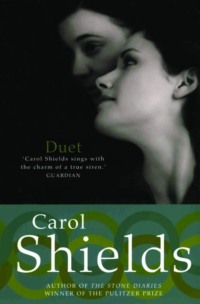
Duet
Carol Shields

Table of Contents
Cover Page
Title Page
Introduction
Judith
September
October
November
December
January
February
March
April
May
Charleen
Chapter 1
Chapter 2
Chapter 3
Chapter 4
Chapter 5
Chapter 6
Chapter 7
About the Author
The Work of Carol Shields
Copyright
About the Publisher
Introduction
I’ve always thought of my first two books as ‘companion’ novels, a term I seem to have invented. Small Ceremonies was published in 1976, and a year later, 1977, came The Box Garden. There is no sense of this second book being a sequel to the first, but a number of threads connect them. Above all, they are about two women, Judith and Charleen, who happen to be sisters.
The mother of the two women also appears in both novels. Mrs McNinn is an sour, disenfranchised housewife whose only relief is found in the manic redecorating of her small suburban house. Judith, a biographer, is scarcely touched by her mother’s narrowness; Charleen, on the other hand, a poet, has been thwarted by her bitter mother.
These are both short novels, and the idea of publishing them together makes sense to me. Each enriches and fills out the other, and together they lead to the sisters’ discovery of what their mother really is; an artist who, like themselves, stumbles toward that recognition.
Carol Shields
Judith
For Inez
1902-1971
September
Sunday night. And the thought strikes me that I ought to be happier than I am.
We have high tea on Sunday, very Englishy, the four of us gathered in the dining ell of our cream-coloured living room at half-past five for cold pressed ham, a platter of tomatoes and sliced radishes. Slivers of hardboiled egg. A plate of pickles.
The salad vegetables vary with the season. In the summer they’re larger and more varied, cut into thick peasant slices and drenched with vinegar and oil. And in the winter, in the pale Ontario winter, they are thin, watery, and tasteless, though their exotic pallor gives them a patrician presence. Now, since it is September, we are eating tomatoes from our own suburban garden, brilliant red under a scatter of parsley. Delicious, we all agree.
‘Don’t we have any mustard?’ my husband Martin asks. He is an affectionate and forgetful man, and on weekends made awkward by leisure.
‘We’re all out,’ I tell him, ‘but there’s chutney. And a little of that green relish.’
‘Never mind, Judith. It doesn’t matter.’
‘I’ll get the chutney for you,’ Meredith offers.
‘No, really. It doesn’t matter.’
‘Well, I’d like some,’ Richard says.
‘In that case you can just go and get it yourself,’ Meredith tells him. She is sixteen; he is twelve. The bitterness between them is variable but always present.
Meredith makes a sweep for the basket in the middle of the table. ‘Oh,’ she says happily, ‘fresh rolls.’
‘I like garlic bread better,’ Richard says. He is sour with love and cannot, will not, be civil.
‘We had that last Sunday,’ Meredith says, helping herself to butter. Always methodical, she keeps track of small ceremonies.
For us, Sunday high tea is a fairly recent ceremony, a ritual brought back from England where we spent Martin’s sabbatical year. We are infected, all four of us, with a surrealistic nostalgia for our cold, filthy flat in Birmingham, actually homesick for fog and made edgy by the thought of swerving red buses.
And high tea. A strange hybrid meal, a curiosity at first, it was what we were most often invited out to during our year in England. We visited Martin’s colleagues far out in the endless bricked-up suburbs, and drank cups and cups of milky tea and ate ham and cold beef, so thin on the platter it looked almost spiritual. The chirpy wives and their tranquil pipe-sucking husbands, acting out of some irrational good will, drew us into cozy sitting rooms hung with water colours, rows of Penguins framing the gasfires, night pressing in at the windows, so that snugness made us peaceful and generous. Always afterward, driving back to the flat in our little green Austin, we spoke to each other with unaccustomed charity, Martin humming and Meredith exclaiming again and again from the back seat how lovely the Blackstones were and wasn’t she, Mrs Blackstone, a pet.
So we carry on the high tea ritual. But we’ve never managed to capture that essential shut-in coziness, that safe-from-the-storm solidarity. We fly off in midair. Our house, perhaps, is too open, too airy, and then again we are not the same people we were then; but still we persist.
After lemon cake and ice cream, we move into the family room to watch television. September is the real beginning of the year; even the media know, for the new fall television series are beginning this week.
I know it is the beginning because I feel the wall of energy, which I have allowed to soften with the mercury, toughen up. Get moving, Judith, it says. Martin knows it. All children know it. The first of January is bogus, frosty hung-over weather, a red herring in mindless snow. Winter is the middle of the year; spring the finale, and summer is free; in this climate, at least, summer is a special dispensation, a wave of weather, timeless and tax-free, when heat piles up in corners, sending us sandalled and half-bare to improbable beaches.
September is the real beginning and, settling into our favourite places, Martin and I on the sofa, Meredith in the old yellow chair and Richard stretched on the rug, we sit back to see what’s new.
Six-thirty. A nature program is beginning, something called ‘This Feathered World.’ The life cycle of a bird is painstakingly described; eggs crack open emitting wet, untidy wings and feet; background music swells. There are fantastic migrations and speeds beyond imagining. Nesting and courtship practices are performed. Two storks are seen clacking their beaks together, bang, slash, bang, deranged in their private frenzy. Richard wants to know what they are doing.
‘Courting.’ Martin explains shortly.
‘What’s that?’ Richard asks. Surely he knows, I think.
‘Getting acquainted,’ Martin answers. ‘Now be quiet and watch.’
We see an insane rush of feathers. A windmill of wings. A beating of air.
‘Was that it?’ Richard asks. ‘That was courting?’
‘Idiot,’ Meredith addresses him. ‘And I can’t see. Will you kindly remove your feet, Richard.’
‘It’s a dumb program anyway,’ Richard says and, rolling his head back, he awaits confirmation.
‘It’s beautifully done, for your information,’ Meredith tells him. She sits forward, groaning at the beauty of the birds’ outstretched wings.
A man appears on the screen, extraordinarily intense, speaking in a low voice about ecology and the doomed species. He is leaning over, and his hands, very gentle, very sensitive, attach a slender identification tag to the leg of a tiny bird. The bird shudders in his hand, and unexpectedly its ruby throat puffs up to make an improbable balloon. ‘I’d like to stick a pin in that,’ Richard murmurs softly.
The man talks quietly all the time he strokes the little bird. This species is rare, he explains, and becoming more rare each year. It is a bird of fixed habits, he tells us; each year it finds a new mate.
Martin, his arm loose around my shoulder, scratches my neck. I lean back into a nest of corduroy. A muscle somewhere inside me tightens. Why?
Every year a new mate; it is beyond imagining. New feathers to rustle, new beaks to bang, new dense twiggy nests to construct and agree upon. But then birds are different from human beings, less individual. Scared little bundles of bones with instinct blurring their small differences; for all their clever facility they are really rather stupid things.
I can hear Meredith breathing from her perch on the yellow chair. She has drawn up her knees and is sitting with her arms circled round them. I can see the delicate arch of her neck. ‘Beautiful. Beautiful,’ she says.
I look at Martin, at his biscuity hair and slightly sandy skin, and it strikes me that he is no longer a young man. Martin Gill. Doctor Gill. Associate Professor of English, a Milton specialist. He is not, in fact, in any of the categories normally set aside for the young, no longer a young intellectual or a young professor or a young socialist or a young father.
And we, I notice with a lazy loop of alarm, we are no longer what is called a young couple.
Making the beds the next morning, pulling up the unbelievably heavy eiderdowns we brought back with us from England, I listened to local announcements on the radio. There was to be a ‘glass blitz’ organized by local women, and the public was being asked to sort their old bottles by colour – clear, green and brown – and to take them to various stated depots, after which they would be sent to a factory for recycling.
The organizers of the blitz were named on the air: Gwen Somebody, Peg Someone, Sue, Nan, Dot, Pat. All monosyllabic, what a coincidence! Had they noticed, I wondered. The distance I sometimes sensed between myself and other women saddened me, and I lay flat on my bed for a minute thinking about it.
Imagine, I though, sitting with friends one day, with Gwen, Sue, Pat and so on, and someone suddenly bursting out with, ‘I know what. Let’s have a glass blitz.’ And then rolling into action, setting to work phoning the newspapers, the radio stations. Having circulars printed, arranging trucks. A multiplication of committees, akin to putting on a war. Not that I was unsympathetic to the cause, for who dares spoof ecology these days, but what I can never understand is the impulse that actually gets these women, Gwen, Sue, Pat and so on, moving.
Nevertheless, I made a mental note to sort out the bottles in the basement. Guilt, guilt.
And then I got down to work myself at the card table in the comer of our bedroom where I am writing my third biography.
This book is one that promises to be more interesting than the other two put together, although my first books, somewhat to my astonishment, were moderately well received. The press gave them adequate coverage, and Furlong Eberhardt, my old friend and the only really famous person I know, wrote a long and highly flattering review for a weekend newspaper. And although the public hadn’t rushed out to buy in great numbers, the publishers – I am still too self-conscious a writer to say my publishers – Henderson and Yeo, had seemed satisfied. Sales hadn’t been bad, they explained, for biography. Not everyone, after all, was fascinated by Morris Cardiff, first barrister in Upper Canada, no matter how carefully researched or how dashingly written. The same went for Josephine Macclesfield, prairie suffragette of the nineties.
The relative success of the two books had led me, two years ago, into a brief flirtation with fiction, a misadventure which cost me a year’s work and much moral deliberation. In the end, all of it, one hundred execrable pages, was heaved in the wastebasket. I try not to think about it.
I am back in the good pastures of biography now, back where I belong, and in Susanna Moodie I believe I have a subject with somewhat wider appeal than the other two. Most people have at least heard of her, and thus her name brings forth the sweet jangle of familiarity. Furthermore Susanna has the appeal of fragility for, unlike Morris Cardiff, she was not the first anything and, unlike Josephine, she was not aflame with conviction. She has, in fact, just enough neuroses to make her interesting and just the right degree of weakness to make me feel friendly toward her. Whereas I had occasionally found my other subjects terrifying in their single-mindedness, there is a pleasing schizoid side to Susanna; she could never make up her mind what she was or where she stood.
The fact is, I am enamoured of her, and have felt from the beginning of my research, the pleasant shock of meeting a kindred spirit. Her indecisiveness wears well after the rough, peremptory temper of Josephine. Also, she has one of the qualities which I totally lack and, therefore, admire, that of reticence. Quaint Victorian restraint. Violet-tinted reserve, stemming as much from courtesy as from decorum.
Decency shimmers beneath her prose, and one sense that here is a woman who hesitates to bore her reader with the idle slopover of her soul. No one, she doubtless argued in her midnight heart, could possibly be interested in the detailing of her rancid sex life or the nasty discomfort of pregnancy in the backwoods. Thus she is genteel enough not to dangle her shredded placenta before her public, and what a lot she resisted, for it must have been a temptation to whine over her misfortunes. Or to blurt out her rage against the husband who brought her to the Ontario wilderness, gave her a rough shanty to live in, and then proceeded into debt; what wonders of scorn she might have heaped on him. One winter they lived on nothing but potatoes; what lyrical sorrowing she might have summoned on that subject. And how admirable of her not to crow when her royalty cheques came in, proclaiming herself the household saviour, which indeed she was in the end. But of all this, there is not one word.
Instead she presents a stout and rubbery persona, that of a generous, humorous woman who feeds on anecdotes and random philosophical devotions, sucking what she can out of daily events, the whole of her life glazed over with a neat edge-to-edge surface. It is the cracks in the surface I look for; for if her reticence is attractive, it also makes her a difficult subject to possess. But who, after all, could sustain such a portrait over so many pages without leaving a few chinks in the varnish? Already I’ve found, with even the most casual sleuthing, small passages in her novels and backwoods recollections of unconscious self-betrayal, isolated words and phrases, almost lost in the lyrical brush-work. I am gluing them together, here at my card table, into a delicate design which may just possibly be the real Susanna.
What a difference from my former subject Josephine Macclesfield who, shameless, showed every filling in her teeth. Ah, she had an opinion on every bush and shrub! Her introspection was wide open, a field of potatoes; all I had to do was wander over it at will and select the choice produce. Poor Josephine, candid to a fault; I had not respected her in the end. Just as I had had reservations when reading the autobiography of Bertrand Russell who, in passages of obsessive self-abasement, confessed to boyhood masturbation and later to bad breath. For though I forgive him his sour breath and his childhood excesses, it is harder to forgive the impulse which makes it public. Holding back, that is the brave thing.
My research, begun last winter, is going well, and already I have a lovely stack of five-by-seven cards covered with notations. It is almost enough. My old portable is ready with fresh ribbon, newly conditioned at Simpson-Sears. It is ten o’clock; half the morning is gone. Richard will be home from school at noon. I must straighten my shoulders, take a deep breath and begin.
Far away downstairs the back door slammed. ‘Where are you?’ Richard called from the kitchen.
‘Upstairs,’ I answered. ‘I’ll be right down.’
At noon Martin eats at the university faculty club, and Meredith takes her lunch to school, so it is only Richard and I for lunch, a usually silent twosome huddled over sandwiches in the kitchen. Today I heated soup and made cheese sandwiches while Richard stood silently watching me. ‘Any mail?’ he asked at last.
‘In the hall.’
‘Anything for me?’
‘Isn’t there always something for you on Mondays?’
‘Not always,’ he countered nervously.
‘Almost always.’
Richard dived into the hall and came back with his air-letter. He opened it with a table knife, taking enormous care, for he knows from experience that an English airletter is a puzzle of folds and glued edges.
While we ate, sitting close to the brotherly flank of the refrigerator, he read his letter, cupping it toward him cautiously so I couldn’t see.
‘Don’t worry,’ I chided him. ‘I’m not going to peek.’
‘You might,’ he said, reading on.
‘Do you think I’ve nothing to do but read my son’s mail?’ I asked, forcing my voice into feathery lightness.
He looked up in surprise. I believe he thinks that is exactly the case: that I have great vacant hours with nothing to do but satisfy my curiosity about his affairs.
In appearance Richard is somewhat like Martin, the same bran-coloured hair, lots of it, tidy shoulders, slender. He will be of medium height, I think, like Martin; and like his father, too, he speaks slowly and with deliberation. For most of his twelve years he has been an easy child to live with; we absorb him unthinking into ourselves, for he is so willingly one of us, so generally unprotesting. At school in England, when Meredith raged about having to wear school uniforms, he silently accepted shirt, tie, blazer, even the unspeakable short pants, and was transformed before our eyes into a boy who looked like someone else’s son. And where Meredith despised most of her English schoolmates for being uppity and affected, he scarcely seemed to notice the difference between the boys he played soccer with in Birmingham and those he skated with at home. He is so healthy. The day he was born, watching his lean little arms struggle against the blanket, I gave up smoking forever. Nothing must hurt him.
Absorbed, he chewed a corner of his sandwich and read his weekly letter from Anita Spalding, whom he has never met.
She is twelve years old too, and it was her parents, John and Isabel Spalding, who sublet their Birmingham flat to us when we were in England. The arrangements had been made by the university, and the Spaldings, spending the year at the English School in Nicosia, far far away in sunny Cyprus, left us their rambling, freezing and inconvenient flat for which we paid, we later found out, far too much.
To begin with our feelings toward them were neutral, but we began to dislike them the day after we moved in, interpreting our various disasters as the work of their deliberate hands. The rusted taps, the burnt-out lights, the skin of mildew on the kitchen ceiling, a dead mouse in the pantry, the terrible iciness of their lumpy beds; all were linked in a plot to undermine us. Where was the refrigerator, we suddenly asked. How is it possible that there is no heat at all in the bathroom? Fleas in the armchairs as well as the beds?
Isabel we imagined as a slattern in a greasy apron, and John we pictured as a very small man with a tiny brain pickled in purest white vinegar. Its sour workings curdled in his many tidy lists and in the exclamatory pitch of his notes to us. ‘May I trust you to look after my rubber plant? It’s been with me since I took my degree.’ ‘You’ll find the stuck blind a deuced bother.’ ‘The draught from the lavatory window can be wretched, I fear, but we take comfort that the air is fresh.’ Even Martin took to cursing him. (These days I find it harder to hate him. I try not to think of John Spalding at all, but when I do it is with uneasiness. And regret.)
If nothing else the Spaldings’ flat had plenty of bedrooms, windy cubicles really, each equipped like a hotel room with exactly four pieces; bed, bureau, wardrobe and chair, all constructed in cheap utilitarian woods. It was on a bare shelf in his wardrobe that Richard discovered Anita’s letter of introduction.
He came running with it into the kitchen where we stood examining the ancient stove. At that time he was only nine, not yet given to secrecy, and he handed the letter proudly to Martin.
‘Look what I’ve found.’
Martin read the letter aloud, very solemnly pronouncing each syllable, while the rest of us stood listening in a foolish smiling semicircle. It was a curious note, written in a puckered, precocious style with Lewis Carroll overtones, but sincere and simple.
To Whoever is the Keeper of This Room,
Greetings and welcome. I am distressed thinking about you, for my parents have told me that you are Canadians which I suppose is rather like being Americans. I am worried that you may find the arrangements here rather queer since I have seen packs and packs of American films and know what kind of houses they live in. This bed, for instance, is rotten through and through. It is odd to think that someone else will actually be sleeping in my bed. But then I shall be sleeping in someone else’s bed in Nicosia. They are a Scottish family and they will spend the year in Glasgow, probably in someone else’s flat. And the Glasgow family, they’ll have to go off and live somewhere, won’t they? Isn’t it astonishing that we should all be sleeping in one another’s beds. A sort of roundabout almost. Whoever you are, if you should happen to be a child (I am nine and a girl) perhaps you would like to write me a letter. I would be delighted to reply. I am exceedingly fond of writing letters but have no connexions at the moment. So please write. Isn’t the kitchen a fright! Not like the ones in the films at all.
Your obedient servant,
ANITA DREW SPALDING 9
It took Richard more than a month to write back, although I reminded him once or twice. He hates writing letters, and was busy with other things; I did not press him.
But one dark chilly Sunday afternoon he asked me for some paper, and for an hour he sat at the kitchen table scratching away, asking me once whether there was an ‘e’ in homesick; his or hers, we never knew, for he didn’t offer to show us what he’d written. He sealed it shyly, and the next day took it to the post office and sent it on its way to Cyprus.
Anita’s reply was almost instantaneous. ‘It’s from her,’ he explained, showing us the envelope. ‘From that Cyprus girl.’ That evening he asked for more paper.
Once a week, sometimes twice, a thick letter with the little grey Cyprus stamp shot through our mail slot. At least as often Richard wrote back, walking to the post office next to MacFisheries at the end of our road in time for the evening pickup.
We never did meet the Spaldings. We left England a month before they returned. We thought Richard would be heartbroken that he would not see Anita, but he seemed not to care much, and I had the idea that the correspondence might drop off when he got home to Canada. But their letters came and went as frequently as ever and seemed to grow even thicker. Postage mounted up, draining off Richard’s pocket money, so they switched occasionally to air-letters. Always when Richard opens them, he smiles secretly to himself.
‘What on earth do you write about?’ I asked him.
‘Just the same stuff everyone writes in letters,’ he dodged.
‘You mean just news? Like what you’ve been doing in school?’
‘Sort of, yeah. Sometimes she sends cartoons from Punch. And I send her the best ones out of your old New Yorkers.’
I find it curious. I don’t write to my own sister in Vancouver more than four times a year. To my mother in Scarborough I write a dutiful weekly letter, but sometimes I have to sit for half an hour thinking up items to fill one page. Martin’s parents write weekly from Montreal, his mother using one side of the page, his father the other, but even they haven’t the stamina of these two mysterious children. Richard’s constancy in this correspondence seems oddly serious and out of proportion to childhood, causing me to wonder sometimes whether this little witch in England hasn’t got hold of a corner of his soul and somehow transformed it. He is bewitched. I can see it by the way he is sitting here in the kitchen folding her letter. He has read it twice and now he is folding it. Creasing its edges. With tenderness.
‘Well, how is Anita these days?’ My light voice again.
‘Fine.’ Noncommittal.
‘Has she ever sent a picture of herself?’
‘No,’ he says, and my heart leaps. She is ugly.
‘Why not?’ I ask foxily. ‘I thought pen-pals always exchanged pictures.’
‘We decided not to,’ he says morosely, wincing, or so I believe, at the word pen-pal. Then he adds, ‘It was an agreement we made. Not to send pictures.’
Of course. Their correspondence, I perceive, is a formalized structure, no snapshots, no gifts at Christmas, no postcards ever. Rules in acid, immovable, a pact bound on two sides, a covenant. I can’t resist one more question.
‘Does she still sign her letters “your obedient servant?”’
‘No,’ Richard says, and he sighs. The heaviness of that sound tells me that he sighs with love. My heart twists for him. I know the signs, or at least I used to. Absurd it may be, but I believe it; Richard is as deeply in love at twelve as many people are in a lifetime.
The house we live in – Martin, the children and I – is not really my house. That is, it is not the kind of house I once imagined I might be the mistress of. We live in the suburbs of a small city; our particular division is called Greenhills, and it is neither a town nor a community, not a neighbourhood, not even a postal zone. It is really nothing but the extension of a developer’s pencil, the place on the map where he planned to plunk down his clutch of houses and make his million. I suppose he had to call it something, and perhaps he thought Greenhills was catchy and good for sales; or perhaps, who knows, it evoked happy rural images inside his head.
We are reached in the usual way by a main arterial route which we leave and enter by numbered exits and entrances. Greenhills is the seventh exit from the city centre which means we are within a mile or two of open countryside, although it might just as well be ten.
Where we live there are no streets, only crescents, drives, circles and one self-conscious boulevard. It is leafy green and safe for children; our lawns stretch luscious as flesh to the streets; our shrubs and borders are watered.
As soon as the sewers were installed nine years ago, we moved in. The house itself has all the bone-cracking cliches of Sixties domestic architecture: there is a family room, a dining ell, a utility room, a master bedroom with bath en suite. A Spanish step-saving kitchen with pass-through, colonial door, attached garage, sliding patio window, split-level grace, spacious garden. The only item we lack is a set of Westminster chimes; the week we moved in, Martin disconnected the mechanism with a screw-driver and installed a doorknocker instead, proving what I have always known, that despite his socialism, he is 90 per cent an aristocrat.
It is a beige and uninteresting house. Curtains join rugs, rugs join furniture; nubby sofa sits between matching lamps on twin tables, direct from Eaton’s show room. Utilitarian at the comfort level, there is nothing unexpected. This is a shell to live in without thought.
And in a way it is deliberate, this minimal approach to decorating. My sister Charleen and I, now that we are safely grown up, agree on one thing, and that is that as children we were cruelly overburdened with interior decoration. The house in which we grew up in Scarborough – the old Scarborough that is, before television, before shopping centres, the Scarborough of neat and faintly rural streets – that tiny house was in a constant state of revitalization. All our young lives, or so it seemed, we dodged stepladders, stepped carefully around the wet paint, shared the lunch table with wallpaper samples. Our little living room broke out with staggered garlands one year, with French stripes the next, and our girlish bedroom at the back of the house was gutted almost annually. Shaking his head, our father used to say that the rooms would grow gradually smaller under their layers and layers of paint and paper. We would be pushed out on to the street one day, he predicted. It was his little joke, almost his only joke, but straining to recall his voice, do I now hear or imagine the desperate edge? Better Homes and Gardens was centred on our coffee table, cheerful with new storage ideas or instructions for gluing bold fabric to attic ceilings. The dining table was in the basement being refinished, or the chesterfield was being fitted for slipcovers. The pictures were changed with the seasons. ‘My house is my hobby,’ Mother used to say to the few visitors we ever had; and even as she spoke, her eyes turned inward, tuned to the next colour scheme, to the ultimate arrangement, just out of reach, beamed in from House and Garden, a world the rest of us never entered. Nor wished to.
Still we have put our mark on this place, Martin and I. The floor tiles rise periodically, reminding us they are now nine years old. The utility room is so filled with ski equipment that we call it the ski room. The dining ell has been partitioned off with a plywood planter which looks tacky and hellish, though we thought it a good idea at the time. Hosiery drips from the shower rail in the en suite bathroom. In the cool dry basement our first married furniture glooms around the furnace, its Lurex threads as luminous and accusing as the day we bought it; Richard’s electric train tunnels between the brass-tipped legs. The spacious garden is the same flat rectangle it always was except for a row of tomato plants and a band of marigolds by the fence.
The house that I once held half-shaped in my head was old, a nook-and-cranny house with turrets and lovely sensuous lips of gingerbread, a night-before-Christmas house, bought for a song and priceless on todays market. Hung with the work of Quebec weavers, an electic composition of Swedish and Canadiana. Tasteful but offhand. A study, beamed, for Martin and a workroom, sunny, for me. Studious corners where children might sit and sip their souls in pools of filtered light. A garden drunk with roses, criss-crossed with paths, moist, shady, secret.
This place, 62 Beaver Place, is not really me, I used to say apologetically back in the days when I actually said such things. ‘We’re just roosting here until something “us” turns up.’
I never say it now. If we wanted to, Martin and I could look in his grey file drawer next to his desk in the family room. Between the folders for Tax and Health, we would find House, and from there we could pluck out our offer-to-purchase, the blueprints, the lot survey, the mortgage schedule and, clipped to it, the record of payments along with the annual tax receipts. It’s all there. We could calculate, if we chose, the exact dimensions of our delusions. But we never do. We live here, after all.
Up and down the gentle curve of Beaver Place we see cedar-shake siding, colonial pillars, the jutting chins of split-levels, each of them bought in hours of panic, but with each one, some particular fantasy fulfilled. The house they never had as children perhaps. The house that will do for now, before the move to the big one on the river lot. The house where visions of dynasty are glimpsed, a house future generations will visit, spend holidays in and write up in memoirs. Why not?
Something curious. One day last week, having been especially energetic about Susanna Moodie and turning out six pages in one morning, I found myself out of paper. There must be some in the house, I thought and, although I prefer soft, pulpy yellow stuff, anything is useable in a pinch, I searched Meredith’s room first, being careful not to disturb her things. Everything there is so carefully arranged; she has all sorts of curios, souvenirs, snapshots, a music award stencilled on felt, animal figurines she collected as a very young child, cosmetics in a pearly pale shade standing at attention on her dresser. Everything but paper.
In Richard’s room I found desk drawers filled with Anita Spalding’s letters, each one taped shut from prying eyes. Mine perhaps? Safety patrol badges, a map of England with an inked star on Birmingham, a copy of Playboy, hockey pictures, but not a single sheet of useable paper.
Martin will have some, I thought. I went downstairs to the family room to look in his desk. Nothing in the top drawer except his Xeroxed paper on Paradise Regained, recently rejected by the Milton Quarterly. In his second drawer were clipped notes for an article on Samson Agonistes and offprints of an article he had had printed in Renaissance Studies, the one on Milton’s childhood which he had researched in England. The third drawer was full of wool.
I blinked. Unbelievable. The drawer was stuffed to the top with brand new hanks of wool, still with their little circular bands around them. I reached in and touched them. Blue, red, yellow, green; fat four-ounce bundles in all colours. Eight of them. Lying on their sides in Martin’s drawer. Wool.
It couldn’t be for me. I hate knitting and detest crocheting. For Meredith perhaps? An early Christmas present? But she hadn’t knitted anything since Brownies, six years ago, and had never expressed any interest in taking it up again.
Frieda? Frieda who comes to clean out the house on Wednesday? She knits, and it is just possible, I thought, that it was hers. Absurd though. She never goes in Martin’s desk, for one thing. And what reason would she have to stash all this lunatic wool in his drawer anyway? Richard? Out of the question. What would he be doing with wool? It must be Martin’s. For his mother, maybe; she loves knitting. He might have seen it on sale and bought it for her, although it seemed odd he hadn’t mentioned it to me. I’ll ask him tonight, I thought.
But that night Martin was at a meeting, and I was asleep when he came home. The next day I forgot. And the next. Whenever it pops into my mind, he isn’t around. And when he is, something makes me stumble and hesitate as though I were afraid of the reply. I still haven’t asked him, but this morning I looked in the drawer to see if it was still there. It was all in place, all eight bundles; nothing had been touched. I must ask Martin about it.
As Meredith grows up I look at her and think, who does she remind me of? A shaded gesture, a position struck, or something curious she might say will touch off a shock of recognition in me, but I can never think who it is she is like.
I flip through my relatives – like flashcards. My mother. No, no, no. My sister Charleen? No. Charleen, for all her sensitivity, has a core of detachment. Aunt Liddy? Sometimes I am quite sure it is my old aunt. But no. Auntie’s fragility is neurotic, not natural like Meredith’s. Who else?
She has changed in the last year, is romantic and realistic in violent turns. Now she is reading Furlong Eberhardt’s new book about the prairies. While she reads, her hands grip the cover so hard that the bones of her hands stand up, whey-white. Her eyes float in a concerned sweep over the pages, her forehead puzzled. It’s painful to watch her; she shouldn’t invest so much of herself in anything as ephemeral as a book; it is criminal to care that much.
Like my family she is dark, but unlike us she has a delicious water-colour softness, and if she were braver she would be beautiful. She is as tall as I am but she has been spared the wide country shoulders; there are some blessings.
It is an irony, the sort I relish, that I who am a biographer and delight in sorting out personalities, can’t even draw a circle around my own daughter’s. Last night at the table, just as she was cutting into a baked potato, she raised her eyes, exceptionally sober even for her, and answered some trivial question Martin had asked her. The space between the movement of her hand and the upward angle of her eyes opened up, and I almost had it.
Then it slipped away.
Last night Martin and I went to a play. It was one of Shaw’s early ones, written before he turned drama into social propaganda. The slimmest of drawingroom debacles, it was a zany sandwich of socialism and pie-in-the-eye, daft but with brisk touches of irreverence. And the heroes were real heroes, the way they should be, and the heroines were even better. The whole evening was a confection, a joy.
During the intermission we stood in the foyer chatting with Furlong Eberhardt and his mother, our delight in the play surfacing on our lips like crystals of sugar. Mrs Eberhardt, as broad-breasted as one of the Shavian heroines, encircled us with her peculiar clove-flavoured embrace. A big woman, she is mauve to the bone; even her skin is faintly lilac, her face a benign fretwork of lines framed with waves of palest violet.
‘Judith, you look a picture. How I wish I could wear those pant suits.’
‘You look lovely as you are, Mother,’ Furlong said, and she did; if ever a woman deserved a son with a mother fixation, it was Mrs Eberhardt.
Martin disappeared to get us drinks, and Furlong, by a bit of clever steering, turned our discussion to his new book. Graven Images.
‘I know I can count on you, Judith, for a candid opinion. The critics, mind you, have been very helpful, and thus far, very kind.’ He paused.
For a son of the Saskatchewan soil, Furlong is remarkably courtly, and like all the courtly people I know, he inspires in me alleys of unknown coarseness. I want to slap his back, pump his hand, tell him to screw off. But I never do, never, for basically I am too fond of him and even grateful, thankful for his most dazzling talent which is not writing at all, but the ability he has to make the people around him feel alive. There is an exhausted Byzantine quality about him which demands response, and even at that moment, standing in the theatre foyer in my too-tight pantsuit and my hair falling down around my rapidly ageing face, I was swept with vitality, almost drunk with the recognition that all things are possible. Beauty, fame, power; I have not been passed by after all.
But about Graven Images, I had to confess ignorance. ‘I’ve been locked up with Susanna for months,’ I explained. It sounded weak. It was weak. But I thought to add kindly, ‘Meredith is reading it right now. She was about halfway through when we left the house tonight.’
At this he beamed. ‘Then it is to your charming daughter I shall have to speak.’ Visibly wounded that I hadn’t got around to his book, he rallied quickly, drowning his private pain in a flood of diffusion. ‘Public reaction is really too general to be of any use, as you well know, Judith. It is one’s friends one must rely upon.’ He pronounced the word friends with such a silky sound that, for an instant, I wished he were a different make of man.
‘Meredith would love to discuss it with you, Furlong,’ I told him honestly. ‘Besides, she’s a more sensitive reader of fiction than I am. You, of all people, know fiction isn’t my thing.’
‘Ah yes, Judith,’ he said. ‘It’s your old Scarborough puritanism, as I’ve frequently told you. Judith Gill, my girl, basically you believe fiction is wicked and timewasting. The devil’s work. A web of lies.’
‘You just might be right, Furlong.’
When Martin came back with our drinks, Furlong issued a general invitation to attend his publication party in November. He beamed at Martin, ‘You two must plan to come.’
‘Hmmm,’ Martin murmured noncommitally. He doesn’t really like Furlong; the relationship between them, although they teach in the same department, is one of tolerant scorn.
The lights dipped, and we found our way back to our seats. Back to the lovely arched setting, lit in some magical way to suggest sunrise. Heroines moved across the broad stage like clipper ships, their throats swollen with purpose. The play wound down and so did they in their final speeches. Holy holy, the crash of applause that always brings tears stinging to my eyes.
All night long memories of the play boiled through my dreams, a plummy jam stewed from those intelligent, cruising, early-century bosoms. Hour after hour I rode on a sea of breasts: the exhausted mounds of Susanna Moodie, touched with lamplight. The orchid hills and valleys of Mrs Eberhardt, bubbles of yeast. The tender curve of my daughter Meredith. The bratty twelve-year-old tits of Anita Spalding, rising, falling, melting, twisting in and out of the heavy folds of sleep.
I woke to find Martin’s arm flung across my chest; the angle of his skin was perceived and recognized, a familiar coastline. The weight was a lever that cut off the electricity of dreams, pushing me down, down through the mattress, down through the floor, down, into the spongy cave of the blackest sleep. Oblivion.
October
The first frost this morning, a landmark. At breakfast Martin talks about snow tires and mentions a sale at Canadian Tire. After school these days Richard plays football with his friends in the shadowy yard, and when they thud to the grass, the ground rings with sound. Watching them, I am reassured.
It is almost dark now when we sit down to dinner. Meredith has found some candles in the cupboard, bent out of shape with the summer heat but still useable, so that now our dinners are washed with candlelight. I make pot roast which they love and mashed potatoes which make me think of Susanna Moodie. In the evening the children have their homework. Martin goes over papers at his desk or reads a book, sitting in the yellow chair, his feet resting on the coffeetable, and he hums. Richard and Meredith bicker lazily. Husband, children, they are not so much witnessed as perceived, flat leaves which grow absently from a stalk in my head, each fitting into the next, all their curving edges perfect. So far, so far. It seems they require someone, me, to watch them; otherwise they would float apart and disintegrate.
I watch them. They are as happy as can be expected. What is the matter with me, I wonder. Why am I always the one who watches?
One day this week I checked into the Civic Hospital for a minor operation, a delicate, feminine, unspeakable, minimal nothing, the sort of irksome repair work which I suppose I must expect now that I am forty.
A minor piece of surgery, but nevertheless requiring a general anaesthetic. Preparation, sleep, recovery, a whole day required, a day fully erased from my life. Martin drove me to the hospital at nine and came to take me home again in the evening. The snipping and sewing were entirely satisfactory, and except for an hour’s discomfort, there were no after effects. None. I am in service again. A lost day, but there was one cheering interlude.
Shortly before the administering of the general anaesthetic, I was given a little white pill to make me drowsy. In a languorous trance I was then wheeled on a stretcher to a darkened room and lined up with about twelve other people, male and female, all in the same condition. White-faced nurses tiptoed between our parked rows, whispering. Far below us in another world, cars honked and squeaked.
Lying there semidrugged, I sensed a new identity: I was exactly like a biscuit set out to bake, just waiting my turn in the oven. I moved my head lazily to one side and found myself face to face, not six inches away from a man, another biscuit. His eyes met mine, and I watched him fascinated, a slow-motion film, as he laboured to open his mouth and pronounce with a slur, ‘Funny feeling, eh?’
‘Yes,’ I said. ‘As though we were a tray of biscuits.’
‘That’s right,’ he said crookedly.
Surprised, I asked, ‘What are you here for?’
‘The old water works,’ he said yawning. ‘But nothing major.’
Kidneys, bladder, urine; a diagram flashed in my brain. ‘That’s good,’ I mumbled. Always polite. I cannot, even here, escape courtesy.
‘What about you?’ he mouthed, almost inaudible now.
‘One of those female things,’ I whispered. ‘Also not major.’
‘You married?’
‘Yes. Are you?’ I asked, realizing too late that he had asked because of the nature of my complaint, not because we were comparing our status as we might had we met at a party.
‘Yes,’ he said. ‘I’m married. But not happily.’
‘Pardon?’ Courtesy again, the scented phrase. Our mother had always insisted we say pardon and, as Charleen says, we are children all our lives, obedient to echoes.
‘Not happily,’ he said again. ‘Married yes,’ he made an effort to enunciate, ‘but not happily married.’
A surreal testimony. It must be the anesthetic, I thought, pulling an admission like that from a sheeted stranger. The effect of the pill or perhaps the rarity of the circumstances, the two of us lying here nose to nose, almost naked under our thin sheets, horizontal in midmorning, chemical-smelling limbo, our conversation somehow crisped into truth.
‘Too bad,’ I said with just a shade of sympathy.
‘You happily married?’ he asked.
‘Yes,’ I murmured, a little ashamed at the affirmative ring in my voice. ‘I’m one of the lucky ones. Not that I deserve it.’
‘What do you mean, not that you deserve it?’
‘I don’t know.’
‘Well, you said it,’ he said crossly.
‘I just meant that I’m not all that terrific a wife. You know, not self-sacrificial.’ I groped for an example. ‘For instance, when Martin asked me to type something for him last week. Just something short.’
‘Yeah?’ His mouth made a circle on the white sheet.
‘I said, what’s the matter with Nell? That’s his secretary.’
‘He’s got a secretary, eh?’
‘Yes,’ I admitted, again stung with guilt. This was beginning to sound like a man who didn’t have a secretary. ‘She’s skinny though,’ I explained. ‘A real stick. And he shares her with two other professors.’
‘I see. I see.’ His voice dropped off, and I thought for a minute that he’d fallen asleep.
Pressing on anyway I repeated loudly, ‘So I said, what’s the matter with Nell?’
‘And what did he say to that?’ the voice came.
‘Martin? Well, he just said, “Never mind, Judith.” But then I felt so mean that I went ahead and did it anyway.’
‘The typing you mean?’
‘Uh huh.’
‘So you’re not such a rotten wife,’ he accused me.
‘In a way,’ I said. ‘I did it, but it doesn’t count if you’re not willing.’ Where had I got that? Girl Guides maybe.
‘I never ask my wife to type for me.’
‘Why not?’ I asked.
‘Typing I don’t need.’
‘Maybe you ask for something else,’ I suggested, aware that our conversation was slipping over into a new frontier.
‘Just to let me alone, to let me goddamned alone. Every night she has to ask me what I did all day. At the plant. She wants to know, she says. I tell her, look, I lived through it once, do I have to live through it twice?’
‘I see what you mean,’ I said, hardly able to remember what we were talking about.
‘You do?’ Far away in his nest of sheets he registered surprise.
‘Yes. I know exactly what you mean. As my mother used to say, “I don’t want to chew my cabbage twice.”’
‘You mean you don’t ask your husband what he did all day?’
‘Well,’ I said growing weary, ‘no. I don’t think I ever do. Poor Martin.’
‘Christ,’ he said as two nurses began rolling him to the doorway.
‘Christ. I wish I was married to you.’
‘Thank you,’ I called faintly. ‘Thank you, thank you.’
Absurdly flattered, I too was wheeled away. Joy closed my eyes, and all I remember seeing after that was a blur of brilliant blue.
‘You haven’t read it yet, have you?’ Meredith accuses me.
‘Read what yet?’ I am ironing in the kitchen, late on a Thursday afternoon. Pillowcases, Martin’s shirts. I am travelling across the yokes, thinking these shirts I bought on sale are no good. Just a touch-up they’re supposed to need, but the point of my iron is required on every seam.
‘You haven’t read Furlong’s book?’ Meredith says sharply.
‘The new one you mean?’
‘Graven Images.’
‘Well,’ I say apologetically, letting that little word ‘well’ unwind slowly, making a wavy line out of it the way our mother used to do, ‘well, you know how busy I’ve been.’
‘You read Pearson’s book.’
‘That was different.’
Abruptly she lapses into confidence. ‘It’s the best one he’s written. You’ve just got to read it. That one scene where Verna dies. You’ll love it. She’s the sister. Unmarried. But beautiful, spiritual, even though she never had a chance to go to school. She’s blind, but she has these fantastic visions. Honestly, when you stop to think that here you have a man, a man who is actually writing from inside, you know, from inside a woman’s head. It’s unbelievable. That kind of intuition.’
‘I’m planning to read it,’ I assure her earnestly, for I want to make her happy. ‘But there’s the Susanna thing, and when I’m not working on that, there’s the ironing. One thing after another.’
‘You know that’s not the reason you haven’t read it,’ she says, her eyes going icy.
I put down the iron, setting it securely on its heel. ‘All right, Meredith. You tell me why.’
‘You think he’s a dumb corny romantic. Flabby. Feminine.’
‘Paunchy,’ I help her out.
‘You see,’ her voice rises.
‘Predictable. That’s it, if you really want to know, Meredith.’
‘I don’t know how you can say that.’
‘Easy.’ I tell her. ‘This is his tenth novel, you know, and I’ve read them all. Every one. So I’ve a pretty good idea what’s in this one. The formula, you might say, is familiar.’
‘What’s it about then?’ her voice pleads, and I don’t dare look at her.
I shake a blouse vigorously out of the basket. ‘First there’s the waving wheat. He opens, Chapter One, to waving wheat. Admit it, Meredith, Saskatchewan in powder form. Mix with honest rain water for native genre.’
‘He grew up there.’
‘I know, Meredith, I know. But he doesn’t live there now, does he? He lives here in the east. For twenty years he’s lived in the east. And he isn’t a farmer. He’s a writer. And when he’s not being a writer, he’s being a professor. Don’t forget about that.’
‘Roots matter to some people,’ she says in a tone which accuses me of forgetting my own. Nurtured on the jointed avenues of Scarborough, did that count?
‘All right,’ I say. ‘Then you move into his storm chapter. Rain, snow, hail, locusts maybe. It doesn’t matter as long as it’s devastating. Echoes of Moses. A punishing storm. To remind them they’re reaching too high or sinning too low. A holocaust and, I grant you this, very well done. Furlong is exceptional on storms.’
‘This book really is different. There’s another plot altogether.’
I rip into a shirt of Richard’s. ‘Then the characters. Three I can be sure of. The Presbyterian Grandmother. And sometimes Grandfather too, staring out from his little chimney corner, all-knowing, all-seeing, but, alas, unheeded. Right, Meredith?’
Stop, I tell myself. You’re enjoying this. You’re a cruel, cynical woman piercing the pink valentine heart of your own daughter, shut up, shut up.
She mumbles something I don’t catch.
‘Then,’ I say, ‘we’re into the wife. She endures. There’s nothing more to say about her except that she endures. But her husband, rampant with lust, keep your eye on him.’
‘You haven’t even read it.’
‘Watch the husband, Meredith. Lust will undo him. Furlong will get him for sure with a horde of locusts. Or a limb frozen in the storm and requiring a tense kitchen-table amputation.’
‘Influenza,’ Meredith murmurs. ‘But the rest really is different.’
‘And we close with more waving wheat. Vibrations from the hearthside saying, if only you’d listened.’
‘It’s not supposed to be real life. It’s not biography,’ she says, giving that last word a nasty snap. ‘It’s sort of a symbol of the country. You have to look at it as a kind of extended image. Like in Shakespeare.’
‘I’m going to read it,’ I tell her as I fold the ironing board, contrite now. ‘I might even settle down with it tonight.’
We’ve had the book since August. Furlong brought me one, right off the press one steaming afternoon. Inscribed ‘To Martin and Judith Who Care.’ Beautiful thought, but I cringed reading it, hoping Martin wouldn’t notice. Furlong seems unable to resist going the quarter-inch too far.
Furlong’s picture on the back of the book is distressingly authorly. One can see evidence of a tally taken, a check list fulfilled. Beard and moustache, of course. White turtleneck exposed at the collar of an overcoat. Tweed and cablestitch juxtaposed, a generation-straddling costume testifying to eclectic respectability.
A pipe angles from the corner of his mouth! It’s bowl is missing, the outlines lost in the dark shadow of the overcoat, so that for a moment I thought it was a cigarillo or maybe just a fountain pen he was sucking on. But no, on close examination I could see the shine of the bowl. Everything in place.
The picture is two-colour, white and a sort of olive tone, bleeding off the edges, Time-Life style. Behind him a microcosm of Canada – a fretwork of bare branches and a blur of olive snow, man against nature.
His eyes are mere slits. Snow glare? The whole expression is nicely in place, a costly membrane, bemused but kindly, academic but gutsy. The photographer has clearly demanded detachment.
The jacket blurb admits he teaches creative writing in a university, but couched within this apology is the information that he has also swept floors, reported news, herded sheep, a man for all seasons, our friend Furlong.
Those slit eyes stick with me as I put away the ironing; shirts on hangers, handkerchiefs in drawers, pillowcases in the cupboard. They burn twin candles in my brain, and their nonchalance fails to convince me; I feel the muscular twitch of effort, the attempt to hold, to brave it out.
Poor Furlong, christened, legend has it, by the first reviewer of his first book who judged him a furlong ahead of all other current novelists. Before that he was known as Red, but I know the guilty secret of his real name: it is Rudyard. His mother let it slip one night at a department sherry party, then covered herself with a flustered apology. We grappled, she and I, in a polite but clumsy exchange, confused and feverish, but I am not a biographer for nothing; I filed it away; I remember the name Rudyard. Rudyard. Rudyard. I think of it quite often, and in a way I love him, Rudyard Eberhardt. More than I could ever love Furlong.
Meredith slips past me on the stairs. She is on her way to her room and she doesn’t speak; she doesn’t even look at me. What have I done now?
‘Martin.’
‘Yes.’
‘What are you doing?’
‘Just going over some notes.’
‘Lecture notes?’
‘Yes.’
It is midnight, the children are sleeping, and we are in bed. Martin is leaning into the circle of light given off by our tiny and feeble bedside lamp, milkglass, a nobbly imitation with a scorched shade.
‘Do you know I’ve never heard you give a lecture?’
‘You hate Milton.’ He says this gently, absently.
‘I know. I know. But I’d like to hear you anyway.’
‘You’d be bored stiff.’
‘Probably. But I’d like to see what your style is like.’
‘Style?’
‘You know. Your lecturing style.’
‘What do you think it’s like?’ He doesn’t raise his eyes from his pile of papers.
But I reply thoughtfully. ‘Orderly, I’m sure you’re orderly. Not too theatrical, but here and there a flourish. An understated flourish though.’
‘Hummm.’
‘And I suppose you quote a few lines now and then. Sort of scatter them around.’
‘Milton is notoriously unquotable, you know.’ He looks up. I am in my yellow tulip nightgown, a birthday present from my sister Charleen.
I ask, ‘What do you mean he’s unquotable. The greatest master of the English language unquotable?’
‘Can you think of anything he ever said?’
‘No. I can’t. Not a thing. Not at this hour anyway.’
‘There you are.’
‘Wasn’t there something like tripping the light fantastic?’
‘Uh huh.’
‘It’s hard to see why they bother teaching him then. If you can’t even remember anything he wrote.’
‘Memorable phrases aren’t everything.’
‘Maybe Milton should just be phased out.’
‘Could be.’ I have lost him again.
‘Actually, Martin, I did hear you lecture once.’
‘You did? When was that?’
‘Remember last year. No, the year before last, the year after England. When I was taking Furlong’s course in creative writing.’
‘Oh yes.’ He is scribbling in the margin.
‘Well, on my way to the seminar room one day I was walking past a blank door on the third floor of the Arts Building.’
‘Yes?’
‘Through the door there was a sound coming. A familiar sound, all muffled through the wood. You know how thick those doors are. If it had been anyone else I wouldn’t even have heard it.’
‘And it was me.’
‘It was you. And it’s a funny thing, I couldn’t hear a word you were saying. It was all too muffled. Just the rise and fall of your voice. And I suppose some sort of recognizable tonal quality. But it was mainly the rise and fall, the rise and fall. It was your voice, Martin. There wasn’t a notice on the door saying it was you in there teaching Milton, but I was sure.’
‘You should have come in.’
‘I was on my way to Furlong’s class. And besides I wouldn’t have. I don’t know why, but I never would have come in.’
‘I’d better just check these notes over once more.’
‘Actually, Martin, it was eerie. Your voice coming through the wood like that, rising and falling, rising and falling.’
‘My God, Judith, you make me sound like some kind of drone.’
‘It’s something like handwriting.’ I propped myself up on one elbow. ‘Did you know that it’s almost impossible to fake your handwriting? You can slant it backhand or straight up and down and put in endless curlicues, but the giveaway is the proportion of the tall letters to the size of the small ones. It’s individual like fingerprints. Like your voice. The rhythm is personal, rising and falling. It was you.’
‘Christ, Judith, let me get this done so I can get some sleep.’
‘The funny thing is, Martin, that even when I was absolutely certain, I had the oddest sensation that I didn’t know you at all. As though you were a stranger, someone I’d never met before.’
‘Really?’ He reaches for my breasts under the yellow nylon.
‘You were a stranger. Of course, I realized it was just the novelty of the viewpoint. Coming across you unexpectedly. In a different role, really. It was just seeing you from another perspective.’
‘Why don’t we just make love?’
But I am still in a contemplative frame of mind. ‘Did you ever think of what that expression means? Making love?’
‘They also serve who only stand and wait.’
‘Milton, eh?’
‘Uh huh.’
‘Well, that’s quotable.’
‘Fairly.’
‘Martin. Before you turn out the light, there’s a question I’ve been wanting to ask you for weeks.’
‘Yes?’
‘I don’t want you to think I’m prying or anything.
‘Who would ever suspect you of a thing like that?’ His tone is only slightly mocking.
‘But I notice things and sometimes I wonder.’
His hand rests on the lamp switch. Judith, just shoot.’
‘I was wondering, I was just wondering if you were really happy teaching Milton year after year?’
The light goes out, and we fall into our familiar private geometry, the friendly grazing of skin, the circling, circling. The walls tilt in; the darkness presses, but far away I am remembering two things. First, that Martin hasn’t answered my question. And second – the question I have asked him – it wasn’t the question I had meant to ask at all.
Бесплатный фрагмент закончился.