Читать книгу: «The Cavendon Luck»


Copyright
Published by HarperCollinsPublishers Ltd
The News Building
1 London Bridge Street
London SE1 9GF
www.harpercollins.co.uk
First published in Great Britain by HarperCollins 2016
This edition published by Harper 2017
Copyright © Barbara Taylor Bradford 2016
Cover design by Heike Schüssler © HarperCollinsPublishers Ltd 2016
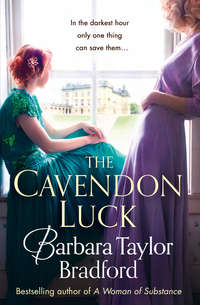
Cover photographs © Ilina Simeonova/ Trevillion Images (front); Angelo Hornak/ Corbis (house); London Express/ Getty Images (planes); Shutterstock.com (sky).
Barbara Taylor Bradford asserts the moral right to be identified as the author of this work.
A catalogue copy of this book is available from the British Library.
This novel is entirely a work of fiction. The names, characters and incidents portrayed in it are the work of the author’s imagination. Any resemblance to actual persons, living or dead, events or localities is entirely coincidental.
All rights reserved under International and Pan-American Copyright Conventions. By payment of the required fees, you have been granted the non-exclusive, non-transferable right to access and read the text of this e-book on screen. No part of this text may be reproduced, transmitted, down-loaded, decompiled, reverse engineered, or stored in or introduced into any information storage and retrieval system, in any form or by any means, whether electronic or mechanical, now known or hereinafter invented, without the express written permission of HarperCollins.
Source ISBN 9780007503339
Ebook Edition © June 2016 ISBN: 9780007503322
Version 2017-03-23
Dedication
For Bob, with all my love always
Table of Contents
Cover
Title Page
Copyright
Dedication
Characters
Part One: The Inghams & The Swanns
Predictions
Chapter One
Chapter Two
Chapter Three
Chapter Four
Chapter Five
Chapter Six
Chapter Seven
Chapter Eight
Foreign Intrigue
Chapter Nine
Chapter Ten
Chapter Eleven
Chapter Twelve
Chapter Thirteen
Chapter Fourteen
Chapter Fifteen
Chapter Sixteen
Chapter Seventeen
Chapter Eighteen
Games of Chance
Chapter Nineteen
Chapter Twenty
Chapter Twenty-One
Chapter Twenty-Two
Chapter Twenty-Three
Chapter Twenty-Four
Love in Many Guises
Chapter Twenty-Five
Chapter Twenty-Six
Chapter Twenty-Seven
Chapter Twenty-Eight
Chapter Twenty-Nine
Chapter Thirty
Chapter Thirty-One
Chapter Thirty-Two
Chapter Thirty-Three
Chapter Thirty-Four
Chapter Thirty-Five
Chapter Thirty-Six
Chapter Thirty-Seven
Chapter Thirty-Eight
Chapter Thirty-Nine
Chapter Forty
No Goodbye
Chapter Forty-One
Chapter Forty-Two
Chapter Forty-Three
Chapter Forty-Four
Chapter Forty-Five
Part Two: Women & War
Against All Odds
Chapter Forty-Six
Chapter Forty-Seven
Chapter Forty-Eight
Chapter Forty-Nine
Land of Hope and Glory
Chapter Fifty
Chapter Fifty-One
Chapter Fifty-Two
Chapter Fifty-Three
Fifty-Four
Chapter Fifty-Five
Chapter Fifty-Six
Chapter Fifty-Seven
Blitz
Chapter Fifty-Eight
Chapter Fifty-Nine
Standing Tall
Chapter Sixty
Chapter Sixty-One
Chapter Sixty-Two
Chapter Sixty-Three
Acknowledgements
Keep Reading …
About the Author
Books by Barbara Taylor Bradford
About the Publisher
CHARACTERS
ABOVE THE STAIRS
THE INGHAMS IN 1938
Charles Ingham, 6th Earl of Mowbray, aged 69. Owner and custodian of Cavendon Hall. Referred to as Lord Mowbray. He is now married to Charlotte Swann, 70, who is the 6th Countess of Mowbray.
THE CHILDREN OF THE EARL AND HIS FIRST WIFE, FELICITY, NOW DECEASED
Miles Ingham, heir to the earldom, aged 39. He is known as the Honourable Miles Ingham and is married to Cecily Swann, 37. They have three children: Miles’s heir, David, 9, Walter, 7, and Venetia, 5. Miles runs the Cavendon estate. Cecily commutes between Cavendon and their London townhouse to run her fashion business.
Lady Diedre Ingham Drummond, eldest daughter, aged 45. She is now widowed and lives in London with her son, Robin, 11. She works at the War Office again. They come to Cavendon at weekends where they have their own quarters.
Lady Daphne Ingham Stanton, second daughter, aged 42. She remains married to Hugo Ingham Stanton, 57. They live permanently at Cavendon Hall, in the South Wing, with their five children.
Lady DeLacy Ingham, third daughter, aged 37, living in London and at Cavendon. DeLacy remains unmarried. Long divorced from Simon Powers, she reverted to her maiden name years before.
Lady Dulcie Ingham Brentwood, fourth daughter, aged 30. She lives in London and at Cavendon. She is married to Sir James Brentwood, 45, one of England’s greatest actors, who was knighted by King George VI. They have three children: twins Rosalind and Juliet, 9, and a son, Henry, 6.
The four daughters of the Earl are still referred to affectionately as the Four Dees by the staff.
The children of Lady Daphne and Mr Hugo Stanton are Alicia, aged 24; Charles, 20; the twins, Thomas and Andrew, age 17, and Annabel, aged 14.
OTHER INGHAMS
Lady Vanessa Ingham Bowers, sister of the Earl, aged 56. She is married to Richard Bowers, 58. They live in London and at Skelldale House on the Cavendon estate, which Lady Vanessa inherited from her sister Lady Lavinia Ingham Lawson, deceased.
Lady Gwendolyn Ingham Baildon, the widowed aunt of the Earl, aged 98, who resides at Little Skell Manor on the estate. She was married to the late Paul Baildon.
The Hon. Hugo Ingham Stanton, first cousin of the Earl, aged 57. He is the nephew of Lady Gwendolyn, the sister of his late mother. He is married to Lady Daphne.
BETWEEN STAIRS
THE SECOND FAMILY: THE SWANNS
The Swann family has been in service to the Ingham family for one hundred and eighty-five years. Consequently, their lives have been intertwined in many different ways. Generations of Swanns have lived in Little Skell village, adjoining Cavendon Park, and still do. The present day Swanns are as devoted and loyal to the Inghams as their forebears were, and would defend any member of the family with their lives. The Inghams trust them implicitly, and vice versa.
THE SWANNS IN 1938
Walter Swann, valet to the Earl, aged 60. Head of the Swann family.
Alice Swann, his wife, aged 57. A clever seamstress who still makes outfits for Lady Daphne’s daughters.
Harry, son, aged 40. A former apprentice landscape gardener at Cavendon Hall, he is now running the estate with Miles.
Cecily, daughter, aged 37. She is married to Miles and is a world-renowned fashion designer.
OTHER SWANNS
Percy, younger brother of Walter, aged 57. Head gamekeeper at Cavendon.
Edna, wife of Percy, aged 58. Does occasional work at Cavendon.
Joe, their son, aged 37. Works with his father as a gamekeeper.
Bill, first cousin of Walter, aged 52. Head landscape gardener at Cavendon. He is widowed.
Ted, first cousin of Walter, aged 63. Head of interior maintenance and carpentry at Cavendon. Widowed.
Paul, son of Ted, aged 39, working with his father as an interior designer and carpenter at Cavendon.
Eric, brother of Ted, first cousin of Walter, aged 58. Butler at the London house of Lord Mowbray. Single.
Laura, sister of Ted, first cousin of Walter, aged 51. Housekeeper at the London house of Lord Mowbray. Single.
Charlotte, aunt of Walter and Percy, aged 70. Now 6th Countess of Mowbray. Charlotte is the matriarch of the Swann and Ingham families. She is treated with great respect by everyone. Charlotte was the secretary and personal assistant to David Ingham, the 5th Earl, until his death. She married the 6th Earl in 1926.
Dorothy Pinkerton, née Swann, aged 55, cousin of Charlotte. She lives in London and is married to Howard Pinkerton, a former Scotland Yard detective. She works with Cecily at Cecily Swann Couture.
CHARACTERS BELOW STAIRS
Mr Henry Hanson, Butler
Mrs Jean Weir, Housekeeper
Miss Susie Jackson, Cook
Mr Gordon Lane, Under butler
Mr Ronald Gorme, Second footman
Miss Kate Smithers, Head housemaid
Miss Brenda Caine, Second housemaid
Mr John Goff, Chauffeur
OTHER EMPLOYEES
Miss Angela Chambers, nanny for Cecily’s children, usually addressed as Nanny or Nan.
Miss Eileen Marks, the governess, usually addressed as Miss Marks. The governess is not at Cavendon in the summer. The children are not in school.
THE OUTDOOR WORKERS
A stately home such as Cavendon Hall, with thousands of acres of land, and a huge grouse moor, employs local people. This is its purpose for being, as well as providing a private home for a great family. It offers employment to the local villagers, and also land for local tenant farmers. The villages surrounding Cavendon were built by various earls of Mowbray to provide housing for their workers; churches and schools were also built, as well as post offices and small shops at later dates. The villages around Cavendon are Little Skell, Mowbray and High Clough.
There are a number of outside workers: a head gamekeeper and five additional gamekeepers; beaters and flankers who work when the grouse season starts and the Guns arrive at Cavendon to shoot. Other outdoor workers include woodsmen, who take care of the surrounding woods for shooting in the lowlands at certain times of the year. The gardens are cared for by a head landscape gardener, and five other gardeners working under him.
The grouse season starts in August, on the Glorious Twelfth, as it is called. It finishes in December. The partridge season begins in September. Duck and wild fowl are shot at this time. Pheasant shooting starts on 1 November and goes on until December. The men who come to shoot, usually aristocrats, are always referred to as the Guns, i.e., the men using the gun.
PART ONE
PREDICTIONS
Tinker, tailor,
Soldier, sailor,
Rich man, poor man,
Beggar man, thief.
Old English nursery rhyme
ONE
Cecily Swann Ingham stood on the outside steps of the office annexe at Cavendon Hall, glancing around. What a change in the weather, she thought. From a gloomy, overcast morning it had become a radiant afternoon.
Blue sky. No clouds. Brilliant sunlight filtering through the leafy trees. A perfect day in late July. A smile of pleasure touched her face fleetingly.
Walking down the steps and crossing the stable yard, she headed for the dirt path through Cavendon Park which led to Little Skell village.
Cecily thought suddenly of her son’s birthday earlier in the month as she strode ahead. It had poured with rain that day and spoiled their plans for the garden party. The celebration was held indoors in the end. She couldn’t help wishing it had been a glorious day like this. On the other hand, David hadn’t minded about the weather. It was his ninth birthday and he had enjoyed every moment, as had his brother, seven-year-old Walter, and their sister Venetia, who was five. It had been a happy time for the family, and that was what counted most; their enjoyment derived from the festivities, and what Miles always called the ‘gathering of the clan’.
Later that night when they were in bed, Miles had drawn her closer to him, and had wondered out loud where all the years had gone. She had said she didn’t know and had reminded him that time always flew when they were together.
He had laughed and pulled her even closer, stroking her hair. After a moment, she had added that they had been busy raising three children, going about their own business and keeping Cavendon safe.
She recalled how he had murmured his thanks for all that, had wrapped his arms around her, then slipped on top of her, kissing her, touching her tenderly. Within seconds they were making love to each other with the same excitement and joyousness they had always known.
Suddenly, remembering that night so clearly, she couldn’t help wondering if he had made her pregnant on their son’s ninth birthday? They had both been so eager for each other, and intense. It had been a passionate night.
The idea of pregnancy lingered. She was thirty-seven. If she was pregnant, then so be it. I must think of another child as a gift, because soon my child-bearing years will be over. But having a child with war coming? This thought troubled her. She pushed it away, and hurried on towards the village. And her mind turned to the huge amount of work she and Miles had done to make Cavendon Hall and the family safe. Her brother Harry had plunged in too, as well as her four sisters-in-law. They had been hard years in so many ways.
Each of them had made all sorts of sacrifices, and had frequently used their own money to keep everything afloat.
But they had done it.
The Inghams and the Swanns, pulling together, had accomplished miracles. Cavendon was now set on the right course. And it was safe.
Yet even now, today, there was that awful little knot in her stomach. Earlier, Cecily had put this down to her worry about Harry plus her concern for Greta, her personal assistant, but she knew instinctively that neither was the real reason for her anxiety.
It was something entirely different, and it troubled her constantly, nagged at her, gave her sleepless nights.
Germany’s menacing Third Reich was casting a giant shadow across Britain, as it had done for the longest time over central Europe. And that was causing her tension. The Reich was sinister and dangerous, and the threat of war hovered. Cavendon would be at risk if there was an invasion … the whole country would be at risk. And Europe, too. The whole world, actually. She understood that only too well.
When Cecily came to the walled rose garden she paused, then pushed open the heavy oak door and went down the steps. The fragrance of late-blooming summer roses enveloped her instantly. She breathed deeply and sat down on an iron garden seat. Leaning back, she closed her eyes, trying to relax for a few moments.
This lovely old garden had not changed for centuries; it was a tranquil refuge for her, as it always had been since she was a child. She sat in here almost every day, if only for a few minutes. She loved the scent of the roses, the peacefulness behind the high brick walls. This place soothed her troubled senses, helped her to clear her mind, sort out her worries.
Her thoughts went to her mother. Cecily knew she was busy with preparations for war, working with the women in the three villages who were members of the Women’s Institute. It was run by Charlotte, who was the president. They were quite an amazing collection of village women, and had come up with solutions to make life easier if war did come to their shores.
Of course it will come, Cecily muttered to herself. The Prime Minister, Neville Chamberlain, believed he could appease Adolf Hitler, who had already annexed Austria and was eyeing Sudetenland in Czechoslovakia.
On the other hand, Winston Churchill understood the futility and terrible danger of appeasement, and kept on warning the government that war was imminent. Churchill was right, she was certain of that. Horrific as that thought was.
The drone of a low-flying aircraft cut off Cecily’s thoughts, and she jumped up, lifted her head to the blue sky, and that first flash of fear dissipated at once.
The small plane did not bear the emblem of Nazi Germany, the swastika. It belonged to Noel Jollion, the nineteen-year-old son of Commander Edgar Jollion of the Royal Navy, who lived on the other side of Mowbray village, near High Clough. The commander had built an airstrip in a long field on his land at Burnside Manor because his son loved flying.
Returning to the garden seat, Cecily sat down, and tried to throw off her concern about the war. But she was finding it difficult this afternoon. It was on her mind.
Last week Hanson had taken her and Miles down into the vast cellars of Cavendon, and had shown them the preparations he had begun to make for war.
The cellars were always crisply clean, with whitewashed walls and well-swept floors. Hanson had pointed out a stack of camp beds which he had brought out of storage. There were sofas, armchairs and small tables, all of which had been in the attics. The Earl had told him to make the cellars as comfortable as possible, in case they had to live in them. Also all of the paintings and other objets d’art would be placed in the lower vaults as soon as there was a declaration of war between Britain and Germany, he had told them.
It seemed to her that Hanson, as usual, had been very efficient. There was even a refrigerator which had been purchased at Harrods and delivered by a Harrods van. What would they do without Hanson? He was supposed to retire in December. He was seventy-six and had been in service at Cavendon for fifty years. She for one hoped that wouldn’t happen. He looked as fit as a fiddle and they needed him.
Reluctantly, Cecily left her sanctuary, and continued on her way to her parents’ house in the village. But first she must stop at the Romany wagon where Genevra lived. She needed to talk to her.
TWO
When Cecily turned the bend in the dirt path, she immediately saw Genevra, who was sitting on the steps of the wagon, waiting for her. As usual, she was wearing an old Cecily Swann frock, given to her by Cecily’s mother. It was red-and-white striped cotton, a summer frock, and it suited her.
The gypsy raised her hand and waved.
Cecily waved back, smiling. She noticed that there was a wooden chair waiting for her. This thoughtfulness pleased her.
Genevra had an excited expression on her face, an expectancy about her. She was thirty-nine, the same age as Miles, though she did not look her age, appeared to be much younger. She was still a good-looking woman – dark, exotic – and her abundant hair was as raven-black as it had been in her youth.
When they had moved their wagons to the lower field five years ago, Genevra had invited Cecily into her wagon for the first time for a glass of mint tea. Not wishing to hurt her, feeling bound to accept this invitation, Cecily had gone inside and had discovered, to her enormous surprise, a treasure trove.
Genevra was an artist, and a talented one at that. The paintings on the walls of the extremely neat living area had astonished Cecily. They were landscapes of Cavendon for the most part, and executed in brilliant, vivid colours. Later, DeLacy had told her they would be categorized as Naïve art.
Yet they had a style, a genuinely unique style of their own. Genevra’s style, Cecily called it. The paintings were bold, commanding, caught the eye at once. But it was the shimmering look of the bright colours, the odd sheen on the canvas that captivated everyone, and at once.
Cecily had soon found out that Genevra had been painting since her childhood. Her brother Gervaise had encouraged her, and when she was older he had bought her canvases and oil paints when he could afford them. She was totally self-taught, a natural and gifted artist.
Cecily had instantly asked if she could buy one of them. Genevra had refused that day. Instead she had offered her a painting as a gift. In the end, Cecily had chosen one that was evocative, and very meaningful to her. The painting showed a corner of the high wall in the rose garden, and a profusion of late-blooming roses, a fusion of many different pinks and faded reds against a portion of the grey stone wall.
Genevra came down the steps to greet Cecily; as always she did a little bob, a sort of curtsey, as she took Cecily’s outstretched hand in hers.
‘I put out a chair, Mrs Miles,’ Genevra said, indicating the wooden chair.
‘Thank you,’ Cecily murmured, and sat down.
Genevra returned to her place on the steps.
Cecily stared at Genevra, frowning. She thought she looked a bit pinched, tired. ‘You haven’t been sick again, have you?’ she asked worriedly. She had not seen her for ten days.
Genevra smiled faintly. ‘No. Not sick. Good.’
‘You look a bit peaked to me.’
‘I’m not sick, liddle Ceci,’ Genevra muttered, eyeing her knowingly. ‘I’ll be first ter knows that. Then I’ll tell yer, and yer’ll be the second ter knows. Not dying. Not yet.’
‘Don’t be cross. I care for you, Genevra.’
‘Aye, I knows that, Mrs Miles.’
‘I’m going away on Monday with Miles. We’re going to visit Lady Daphne and Mr Hugo in Zurich. If you need anything whilst I’m gone, my mother will help you.’ She smiled at her. ‘You just have to go and see her.’
Genevra nodded. ‘Yer going on holiday. Mrs Alice tell me that.’
‘Just for two weeks. Miles needs a rest …’ Cecily’s voice trailed off. She had suddenly noticed a strange look on Genevra’s face. ‘What is it? Is there something wrong?’
‘The sight. It just comes over me. Yer knows that.’
Cecily nodded, remained quiet. After all these years, she knew she had to be still. And mute.
‘Yer’ll have ter be brave, liddle Ceci, as yer’ve allus been. There’ll be deaths. War is coming. Big war. Bad times. Terrible things coming.’ The Romany woman halted, closed her eyes. After a moment she opened them, added, ‘Yer’ll rule at Cavendon. I’ve allus knowed that.’
‘Why now?’ Cecily asked, a frown settling on her face.
‘What do yer mean?’ Genevra sat staring at Cecily.
‘Why are you telling me this now? Usually you’re rather secretive, not always so open.’
‘Cos I knows yer believe me, tek me predictions as truth … understand ’em.’
‘I do, yes, that’s true, Genevra.’
‘The future. Yer’ll have that, Ceci. And yer will rule.’
‘With Miles?’
Genevra did not answer, staring up at Cavendon Hall, towering on the hill high above them. The golden house, shimmering in the sunshine. A blessed house.
‘When you sound strange like this I don’t really understand what you mean,’ Cecily protested, returning Genevra’s hard stare.
‘Bad times are coming.’
‘Do you mean the war?’
Genevra inclined her head. ‘Life. Hard times. Bad times. Death, destruction, sorrow, pain. Much suffering. All coming.’
Turning her head, Genevra looked at Cavendon once more. Unexpectedly, tears filled her eyes. The golden sheen which usually gilded the walls had vanished. It was no longer golden. It was doomed. The great stately home was covered in shadows … shadows growing darker and darker. In her mind’s eye she saw huge black clouds floating around its rooftop. She heard thunder; there were streaks of white lightning.
After a while, Genevra finally opened her eyes, said in a low tone, ‘Turmoil. Chaos.’ She shook her head, became silent, and wiped the tears from her face with her fingertips.
There was a long silence.
Genevra smiled faintly. ‘Swanns rule.’
Cecily said, ‘Cavendon has been lucky over the past few years. The luck will last, won’t it? Nothing will change, will it?’
‘It allus does. Good luck. Bad luck.’ Genevra shook her head, and leaned forward, her gaze penetrating. ‘It comes. It goes. Nobody knows … Luck belongs ter nobody … luck belongs ter life. Nowt yer can do about it, liddle Ceci. Do yer understand me?’
‘I do, Genevra, and I thank you.’
THREE
When the front door suddenly flew open, Alice sat up with a start, and then instantly jumped to her feet as Cecily walked in, a huge smile on her face. Hurrying forward, Cecily took hold of her mother and kissed her, hugged her close.
‘Sorry I’m late, Mam,’ she said, and then turned and closed the door behind her.
‘I was just doing paperwork; no problem, Ceci,’ Alice murmured, and mother and daughter walked into the room together. They sat down in two armchairs facing each other, and Alice said, ‘You look bonny today, love, but pale pink has always suited you.’
‘I know, and thanks. You look pretty good yourself, Mam.’
‘Of course I do, I’m wearing a dress my daughter made for me. I like it, and it’s comfortable and cool on a hot day like this.’
‘I’ve made another version of it, also in cotton,’ Cecily confided. ‘It’s a sort of wrap dress, almost like a robe, and it ties at one side. I’m doing the same style for the winter collection made of light cashmere. I’ll bring you several when they’re ready.’
‘Thank you, love, you’re always so thoughtful.’
‘Don’t be silly, you’re my mother, you can have anything you want from me. Anyway, when we spoke on the phone yesterday you said you were making a plan. But for what?’
‘I came up with an idea. Creating a communal allotment for the village. I went straight to Charlotte and asked her for a field. And she asked the Earl, and he agreed it was a wonderful idea, very practical, and he immediately gave me a field.’
Alice nodded as she finished her sentence, looked a little pleased with herself. ‘That’s how it came about, and it was as simple as that … just asking.’
Alice stood up and beckoned to Cecily. ‘Come over to my desk, and pull up a chair. I want to show you my plan.’
Within seconds the two of them were sitting side by side at Alice’s desk, where her Women’s Institute papers were spread out, along with the detailed plan of the field that was going to be the communal allotment. This would be planted and tended by the women who wished to do this work.
Turning to Alice, Cecily said, ‘It is a practical idea. Food will be a problem if war comes.’
‘When it comes,’ Alice corrected.
‘Too true,’ Cecily agreed, and then said in a slightly odd tone, ‘you could just as easily have asked Miles for a field, or even your son. Harry does run the estate with Miles, you know.’
‘You’re right, I could have done that, Ceci. But I don’t think that would have been the correct thing. The Sixth Earl is still the Sixth Earl; he’s not dead yet, and it is his land. I thought it only proper to approach him, via Charlotte.’
‘I understand now, Mam,’ Cecily answered, offering Alice a warm smile.
Looking down at the large sheet of paper, she saw how cleverly the field had been designed to work as an allotment.
Each square patch was marked, and the name of the vegetable to be grown there written in. ‘Potatoes, carrots, parsnips,’ Cecily read out. ‘Onions, sprouts, cabbage, cauliflower …’ She stopped, suddenly laughing, and shook her head. ‘You’re a master planner, Mother! Harry must get his talent for gardening and landscaping from you.’
‘Goodness me, he’s much cleverer than I am,’ Alice murmured, and turned in her chair. She gave her daughter a knowing look. ‘Did you manage to speak to Harry? You know … about that … person.’
Shaking her head, Cecily replied in a low voice, ‘No, I didn’t. We were supposed to have a chat earlier this afternoon.’
‘His affair with that scandalous woman has started to leak out!’ Alice exclaimed, her tone suddenly turning angry. ‘He thinks it’s a big secret, but it isn’t, and your father now knows about it. He’s furious. You know how much His Lordship abhors scandal. And scandal is about to flare around your brother.’
‘I agree with everything you’re saying, Mother, but he is a grown man. Forty years old to be exact. He’ll tell me it’s none of my business.’
‘But you will speak to him?’ Alice sounded anxious, and there was a concerned look in her eyes.
‘I will, I promise. I’ll do it tomorrow morning,’ Cecily reassured her mother.
Alice nodded, and pursed her lips. Her voice was more even and steady when she said, ‘He ought to know better than to get involved with her. Pauline Mallard is a married woman. Furthermore, she’s an American heiress, a socialite, living the high life in London and New York. And now in Harrogate. But I suppose you know all this.’
‘Well, yes, I do, Mam.’
‘In the end she’ll make a fool of him, you’ll see. And, not only that, she’s a lot older than he is.’
‘But rather beautiful, I hear. A stunning redhead,’ Cecily interjected.
‘And rather promiscuous … that’s what I hear,’ Alice shot back, obviously wanting to have the last word.
‘After Genevra gave me the message, she said something rather odd right out of the blue. She told me not to say anything to Harry about the woman. I was really taken aback. Genevra then added that she would drop him, that she was not his destiny, some other woman was.’
Alice stared at her. ‘How could Genevra know about Pauline Mallard? Do you think he brought her here to the house? And that Genevra saw them together?’
‘No, I’m sure not. However, I was struck by the way she said it, so sure of her sight, as she calls it, her visions of the future. And then there was her use of the word “destiny”.’ Cecily’s voice was puzzled.
She cleared her throat, and went on slowly, ‘Genevra has her own particular speech pattern, Mam. It’s jerky, rather staccato, and mostly her sentences are composed of small words. So I found it curious that she even knew a word like destiny, since she doesn’t read.’
‘Oh but she does!’ Alice exclaimed.
‘Are you sure?’
‘Of course. I taught her.’
Cecily was so surprised she gaped at Alice. ‘When did you do that and why didn’t you ever tell me?’
‘It never occurred to me. It was just sort of … happenstance. After you’d gone off to live with Aunt Dorothy and Uncle Howard in London, I’d dropped off some of your old dresses for her. She came over to thank me, and asked about you. She was very intense, and it struck me then that she had a strong connection to you, Ceci, and was concerned about you and your wellbeing. I showed her some of those first little stories about your designs in the fashion magazines. That’s when she confessed she couldn’t read. I taught her. She learned to read at my knee.’
‘How lovely of you to do that.’ Cecily was impressed and it showed on her face.
‘She was very appreciative.’ Alice hesitated for a few moments before finally asking, ‘Did you ever feel there was this … connection between you, Cecily?’
‘I did. I still do. She told me twenty-five years ago that Swann will rule. So yes, there is this connection between us.’
‘What did she actually say twenty-five years ago?’ Alice asked, filled with curiosity.
‘It wasn’t actually what she said … I ran into her one day on the dirt road. She took a long twig and drew a square with a bird perched on top of it in the dirt. I asked her what it meant, and she wouldn’t tell me. Then she said it was nowt, nothing, and skipped off.’
‘And today she told you what it meant?’
‘No, she didn’t. I sort of figured it out years ago. The square represented Cavendon Hall and the bird a swan. What she was saying in the drawing was that the Swanns and the Inghams would link up.’
Alice did not respond for a moment and then murmured quietly, ‘She couldn’t have known then that your life would turn out the way it did. That you, a Swann, would marry the son of an earl. So there must be something to her claim to have the sight, to have the ability to foresee the future. You believe her predictions, don’t you?’
‘Yes. I have always believed them, and I always will.’ Cecily took hold of her mother’s hand. ‘She’s proved it to me. She gave us a piece of paper at our wedding. Swann Rules, it said, with the drawing next to it.’
After Cecily left, Alice went out to the garden, carrying her watering can. As she moved around the beds, giving the flowers water, her thoughts remained on the Swanns and Inghams.
Blood. It was her three grandchildren who had the mixed blood: Ingham and Swann. Like Cecily, she sometimes wondered if there really had been other members of the two families who had produced an offspring. Or maybe two. She had no idea.
Only Charlotte Swann Ingham would know that. She had the record books that dated back for centuries, locked up in a safe, a safe now at Cavendon Hall. It was in her dressing room. After telling her this, Charlotte had handed her a sealed envelope, and told her the new code for the safe was inside. ‘Please give it to Cecily and tell her to lock it up,’ Charlotte had then instructed her, and this Alice had done.
Putting the watering can down, lowering herself on to the garden seat, Alice sat for a moment or two looking out towards the moors. It was the end of July on Sunday, the first day of August on Monday. That was when the heather would start to bloom; within a week or two the moors would look like a rolling sea of lavender.
David, Cecily’s first son, had eyes the colour of the moors, the lavender eyes so unique to the Swanns. Otherwise, he was the spitting image of his father, Miles, with his features. Walter had them too, but he had also inherited Cecily’s colouring and her chiselled features. As for five-year-old Venetia, she was a true Ingham through and through, with her golden hair and bright blue eyes. Alice smiled to herself, thinking how much Venetia resembled Lady Dulcie when she had been the same age.
Grandchildren. They were very precious, and she would love to have more. Harry wanted a family. He had said that a few months ago. He would like to be married, he had confided, so he could have a child – several children, in fact.
He had the makings of a good father; there was no doubt in her mind about that. But Pauline Mallard, believed to be forty-eight, was certainly past the child-bearing age. A spurt of anger erupted in Alice. Instantly, she pushed it away. She wasn’t going to dwell on that woman.
Within a few seconds her natural compassion overcame her anxiety about Harry, and her annoyance with him. She suddenly felt a rush of sympathy for her son.
FOUR
Greta Chalmers put the receiver down and let her hand rest on it for a moment. She felt as if she had a tight band around her chest and tears brimmed in her green eyes. She swallowed them back and blinked a few times.
She had never heard her father sounding so despairing and morose, and she knew the reason why. He saw no way out of his predicament, no solution to his dilemma. At the end of their conversation he said, ‘I’m trapped. We’re trapped. There’s nothing anybody can do, liebling.’ After telling her he loved her, that they all loved her, he had hung up.
And she loved them: her father, her stepmother, Heddy, her half-sister, Elise, and half-brother, Kurt. They lived in Berlin but, being Jewish, they had now come to realize that they must leave as soon as possible, escape the dangers of the monstrous Third Reich. They wanted to come to England; they knew they had a home with her until they found a place of their own. They had passports but no visas, no travel papers. They were stuck, as her father had just said.
Greta’s mind raced. So many ideas were jostling around for prominence. She glanced at her watch. It was now almost three thirty and Cecily would be coming back into the office at any moment. Taking control of herself as best she could, Greta let go of the phone, sat up straighter, arranged the collar of her cotton dress, and smoothed one hand over her dark brown hair.
Reaching for the last letter she had typed she put it in the folder, reminded herself that she must be composed when Cecily arrived. She knew that Cecily worried about her, and her father’s problems. But so far she had not come up with a solution. No one she knew had, and she did have a number of good friends in London. Her employer had also turned out to be a true friend who had her best interests at heart.
The moment they met Greta and Cecily had ‘clicked’, as Cecily termed it. They had taken to each other at once and had been on an even keel ever since. Never a cross word, never a step out of place on both their parts.
Cecily often joked about their compatibility, the way they were frequently thinking the same thing at the same time. ‘May babies, that’s why,’ Cecily had said after their first year of working together. They were both born in the first week of May, but Cecily was six years older than Greta.
She loved her job as Cecily Swann’s personal assistant, and even though there was a lot of work, her boss worked just as hard as she did. They found satisfaction in their careers, and sometimes Greta shuddered when she remembered how she almost hadn’t gone for the interview at the shop in the Burlington Arcade. Cold feet, timidity perhaps, or even her lack of experience had got in the way for a while. But in the end she had gathered up her courage and gone to meet the famous designer. And she had got the job. She had started working at Cecily Swann Couture the next day.
Following Cecily’s earlier advice, Greta took her small notebook out of her handbag and picked up a pencil. She would make a list, as Cecily had suggested, writing down everything she had to do to make her house ready for her family.
Yesterday, when she had arrived at Cavendon, Cecily had told her to be positive about the future, reassuring her that her family would make it out of Nazi Germany eventually, that she would have to take them in. Greta wanted to do that, and to cherish them.
Many times in the last few years, Greta had wished her husband, Roy, had still been alive. He would have taken care of this situation in no time at all, made short shrift of it. But he was dead and gone. Five years ago now, and he had been far too young to die.
Bending her head, Greta began to make a list of extra things she would have to buy to make her house in Phene Street more comfortable.
‘Here I am!’ Cecily cried, hurrying into Greta’s office. ‘Sorry I’m late when you’ve got your train to catch.’
‘I’ve plenty of time. Goff said we should leave at four thirty for me to get the six o’clock to King’s Cross.’
‘So we can relax for a moment, and have a chat. I’ll sign my letters and go over my appointments with you. What do I have in London on Monday?’
‘There aren’t too many,’ Greta answered. ‘I kept the day light since you’re leaving for Zurich on Tuesday.’
After signing her letters, Cecily looked across at her assistant and said carefully, ‘Did you manage to get hold of your father?’
‘I did, and he sounded a bit down in the dumps, to be honest.’ Greta was surprised her voice was so steady.
Cecily nodded. ‘Of course he did, he’s troubled and frustrated. But look, I’m going to try to help you solve this. And you know what I’m like when I get my teeth into something.’
Despite her worries, Greta laughed. ‘A dog with a bone.’
‘That’s true,’ Cecily answered. ‘When there’s a problem, I have to solve it – and quickly, before it gets out of hand. I need help with this matter, Greta. I’m sure you realize that. I do have someone I can talk to, who might be able to guide me in the right direction.’
Greta simply nodded. She had total faith in her, knew that if anyone could help it was Cecily – this beautiful and talented woman whom she trusted totally.
Cecily was crossing the grand entrance hall at Cavendon a little later, when she heard the sound of music. Instantly she stopped, stood still for a moment listening intently.
The magical sounds were coming from the yellow drawing room and the piano, a recent addition, was being played by Daphne’s daughter, Annabel. No one else could conjure up such miraculous music on the ivory keys the way she did.
The fourteen-year-old had been playing since her childhood. It was her passion and she was superb. Cecily was forever telling Daphne how gifted she was. And good enough to be a concert pianist one day, she always insisted.
Daphne merely smiled serenely, no doubt because she believed the same thing yet did not want to admit it. The lovely Daphne, to whom Cecily was devoted, was far too refined to push her children forward for accolades. But the five of them were talented and very clever. Alicia wanted to be an actress, Charlie a journalist, and the twins intended to join Hugo in the world of finance.
Continuing across the hall, knowing she was yet again running late for afternoon tea, Cecily headed for the drawing room. She opened the door and stood on the threshold, peering in.
She let out a small sigh of relief when she realized she was not the last after all. For once. Aunt Charlotte and the Earl were already there, and so was Lady Gwendolyn. Annabel, of course, was still sitting at the piano, starting a new piece. It was Beethoven’s ‘Moonlight Sonata’. Obviously Diedre had arrived from London earlier than usual. She sat between Lady Gwen and her son, Robin, who was eleven, and chattering to her, filling her in. As he usually did, he was spending the summer at Cavendon with his cousins.
Her own brood, David, Walter and Venetia, were at the children’s table on the other side of the drawing room. This was an innovation of Charlotte’s, who believed they would enjoy afternoon tea better if they had their own private table. The children had jumped at the idea. There were two empty chairs, obviously for Robin and Annabel.
As she stepped forward, Cecily heard a little shriek of delight. Venetia had spotted her. A small bundle of joy composed of an angelic face, blonde curls and bright blue eyes hurtled towards her, her face wreathed in smiles.
Crouching down, Cecily caught her five-year-old daughter in her arms and hugged her. She whispered, ‘You see, I kept my promise. I’m not the last today.’
Venetia’s blue eyes sparkled with laughter and her face was filling with dimples. She whispered back, ‘Daddy will be last, Mummy. LAST!’
Suppressing her own laughter, Cecily looked at her and shook her head. ‘Maybe not, darling. Where’s Aunt DeLacy? Is she hiding somewhere in the room, do you think?’
Giggling, shaking her head, Venetia whispered, ‘She’ll be the last?’
‘I think so,’ Cecily answered. This was a little game between them. Cecily was generally always the last to arrive for tea, and Miles teased her about it. Her little daughter would protest about his teasing and now Venetia was obviously thrilled to bits that her mother had arrived before her father this afternoon.
Taking hold of Venetia’s hand, Cecily led her into the room, smiling at everyone and greeting them affectionately. Walking over to the children’s table, she kissed her sons, David and Walter, who were grinning at her and nodding their heads. They were also pleased she had made it before Miles; that was very obvious. Cecily was highly amused.
Robin stood up and went to kiss her, then hurried over to the children’s table, followed by Annabel. Cecily bent over and kissed Lady Gwendolyn, and said, ‘How beautiful you look in your purple frock, Great-Aunt. It still suits you.’
‘Thank you, Cecily; I must tell you, it’s several years old. But then you know that.’ Lady Gwendolyn chuckled, went on. ‘I’m very thrifty, and I keep all of the clothes you make for me. It’s a good thing your other clients don’t, or you’d be out of business in no time at all.’
Nodding her agreement, Cecily sat down between Lady Gwen and Diedre. She turned to Diedre, said sotto voce, ‘Can I speak to you later? It’s a work thing.’
Diedre merely nodded her agreement.
Looking across the room at her, the Earl said warmly, ‘Thank you, Ceci, for allowing Greta to do those few letters for me this morning. It was a great help.’
Greta often lent a hand and had a particular rapport with Diedre and Robin, whom she’d helped get through the terrible months after the death of Paul Drummond, Diedre’s husband and Robin’s father.
‘It wasn’t a problem: she was happy to help out.’
Charles Ingham gazed at his daughter-in-law, a loving expression in his eyes. He treated her like one of his own daughters these days, and he admired her tremendously. ‘I feel sorry for Greta. She worries so much about her family, and feels helpless to do anything. Has she heard from her father lately?’
‘As a matter of fact, she spoke to him today. Professor Steinbrenner believes they are stuck in Berlin for the moment.’
The Earl’s face was serious when he began, ‘Things are bad in Europe. And we—’
Charlotte interrupted him swiftly. In a low voice, she murmured, ‘Let’s not discuss Europe and what’s going on … in front of the children.’ She had just noticed that David and Robin were listening intently to their grandfather’s conversation. ‘Little pigs have big ears,’ she finished in a low tone.
Before Charles could make a response, the door flew open and DeLacy came into the room in a rush, looking flushed and out of breath.
‘Hello, everyone!’ she exclaimed, and went immediately to her father and Charlotte, kissing them both. Hurrying across the floor, she went over to Lady Gwendolyn and, sitting down next to her, squeezed her hand, leaned in and kissed her cheek. ‘You asked me for news of Dulcie and James when you phoned me at the gallery the other day. I’m happy to tell you I received a letter from Dulcie this morning—’
‘Sorry, Charlotte, sorry Papa for being late. Couldn’t avoid it. I had to take an important phone call,’ Miles announced, entering the room on the heels of DeLacy.
‘It’s not a problem, Miles,’ the Earl said.
‘You’re forgiven,’ Charlotte added, her voice warm and welcoming. He had always been a favourite of hers.
‘You’re late, you’re late, you’re late,’ sang a chorus of young voices, all sounding very gleeful indeed.
Venetia began to giggle, and so did Cecily, and just at that moment the door opened and Hanson strode in, looking purposeful.
Focusing on Lord Mowbray, he asked, ‘Shall we serve tea, my lord?’
‘Yes, please do so, Hanson. Now that everyone has arrived.’
Inclining his head, Hanson turned on his heel, beckoned Gordon Lane, the under butler, to come in with the largest tea trolley, filled with a silver tea service, cups, saucers and plates. Gordon was followed by two of the maids, also pushing trolleys laden with tea sandwiches, scones, strawberry jam and Cornish cream. There was a cream cake and a variety of delectable pastries.
Cups were filled, plates of sandwiches were passed around, and once again afternoon tea was served in the same way it had been for years. It was a ritual everyone enjoyed. Once the staff had moved the trolleys to the back of the yellow drawing room, and everyone had settled, Lady Gwendolyn spoke out. ‘Now come along, DeLacy, do give us the news from Hollywood USA.’
‘I will indeed,’ DeLacy answered, putting her cup in its saucer. ‘Dulcie and James are well, as are the twins, Rosalind and Juliet, and little Henry. In fact, the children are flourishing. James is halfway through his new movie and enjoying working at Metro-Goldwyn-Mayer. However, Dulcie and James want to come back to England.’ DeLacy paused and gave Great-Aunt Gwendolyn a pointed look. Her eyes went to her father, Charlotte and her sister Diedre.
Lady Gwendolyn said, ‘I believe we know the reason. A true-blue Englishman like James must feel it’s his duty to be on these shores at this particular and dangerous moment in history. And, knowing Dulcie, I’m quite certain she feels exactly the same way.’
‘Oh, no question about that,’ Charles said, then glancing at Charlotte he asked, ‘Don’t you agree?’
‘I do indeed. And you know that Dulcie’s an Englishwoman down to her toes.’
Miles, jumping into the conversation, exclaimed, ‘I suppose they’ll leave California when he finishes the picture.’
‘Hopefully, yes,’ DeLacy answered her brother. ‘However, according to Dulcie, there might be a problem. James has a big contract with MGM. Apparently Louis B. Mayer, who runs the company, is a great fan of his; signing James was a coup for him. Dulcie thinks he might not want to release James from the contract.’
‘Because he has other films to make, I suspect,’ Diedre asserted. ‘A signed contract is very binding, as you well know. Not only that, James is a big money-earner for MGM. Of course they won’t want to let him go.’
Cecily interjected, ‘But everything’s negotiable. I’m sure there is a way around the problem, should one develop.’ Glancing at DeLacy, she smiled at her dearest friend. ‘What about Felix and Constance? I thought they were in America at the moment, DeLacy.’
‘Yes, in New York. They’ll be going out to Los Angeles next week. Dulcie’s praying Felix will be able to handle Mr Louis B. Mayer.’
Staring at DeLacy curiously, Miles asked, ‘Why do you refer to him by his full name? It sounds so odd.’
DeLacy laughed. ‘It does, doesn’t it? But that’s how Dulcie refers to him in her letters, and I guess I just picked up on it, repeated her words.’
‘I am perfectly certain Felix Lambert is quite a crafty fox, and Constance as well,’ Diedre said. ‘That’s why James trusts them to represent him. Leave it to them. They’ll come up with something. After all, they are professionals. I’ve discovered it’s always a good idea to leave it to the pros.’
Cecily nodded. ‘I couldn’t agree more. And, from my experience with him, Felix is bound to pull something out of the hat.’
DeLacy nodded. She then addressed her father. ‘You’ll be very pleased to know Dulcie is thrilled with the way I’ve been running her art gallery. Especially since we’ve been making huge profits, and especially this year. It should make you happy as well, Papa. You’ll be getting quite a large cheque from the gallery for the Cavendon Restoration Fund.’
‘I am delighted, DeLacy. Well done, darling,’ her father said.
‘I say, that’s great news, old thing,’ Miles exclaimed. Rising, he went over to his sister, leaned over and hugged her. ‘And it’s true, you have been doing a fabulous job.’
DeLacy smiled up at him. ‘Thanks to you. You’re the one who has trained me how to run a business. And so has Ceci.’
Miles half smiled, and went over to the children’s table. Before he could say a word, a little chant started. ‘Late, late, late. Late, late, late.’
He ruffled Walter’s hair, who was the leader of this choir. ‘You’re all little rascals. Very naughty boys, don’t you know?’
‘Am I a naughty girl?’ Venetia asked, staring at her father, her eyes dancing.
Walking around the table, standing next to her chair, he said softly, ‘I suppose you are. But that doesn’t mean I don’t love you, Venetia.’ He smoothed his hand over her white-blonde hair. ‘And you are definitely my favourite daughter.’
‘Oh Daddy, don’t be silly. There’s only me.’
‘I sometimes feel there are quite a few of you lurking around.’
FIVE
The arrangement they had made was to meet in the conservatory just before dinner, but Diedre was not there when Cecily arrived. Walking across the terracotta floor, she went over to the French doors, stood looking out at the moors rolling towards the North Sea, admiring the view. It was familiar, but never failed to please her.
Twilight had descended and the sky was already growing darker. It was a deeper blue and the far horizon was streaked with a mixture of colours: lavender and apricot, and a deep pink bleeding into red.
Red sky at night, shepherd’s delight, red sky in the morning, shepherd’s warning. These words ran through her head as she remembered how often her mother had said them to her when she was a child.
Turning away from the window, Cecily strolled over to the desk, ran one hand across the mellow old wood, and lovingly so. How often she had stood here, talking to Daphne, who had made it her desk, having commandeered it when she was seventeen and facing terrible problems in her young life.
The conservatory had soon become Daphne’s private place, her haven. None of the family ever used it, and so she had taken it for herself.
From here she had planned her marriage to Hugo, a joyful event, and later it had become her command post.
After a moment longer, lingering near the desk, she walked across to a wicker chair, part of a grouping, and sat down. Her thoughts turned to Diedre. Cecily knew that the best person to talk to about Greta’s family and their predicament was Diedre. In 1914 she had gone to work at the War Office and had remained there after the Great War had ended. Only when she became engaged to Paul Drummond did she resign.
Cecily knew how grief-stricken she had been when Paul had unexpectedly, and very suddenly, died; she had helped her as best she could through that devastating first year of widowhood. One day, quite unexpectedly, Diedre had confided she was returning to her old position at the War Office. She had explained that work would ease her grief and loneliness. Also, she had explained, there was going to be a war, a very bad war, and she would be needed.
Although Diedre had never discussed her job at the War Office, Cecily was quite positive she worked in Intelligence, and Miles agreed with her. Therefore, if anyone knew how to extract someone from a foreign country, she was sure it was Diedre.
Cecily’s thoughts now turned to Greta. She had grown very attached to her and cared about her, worried about her wellbeing. Her assistant was extremely sincere, had enormous integrity, and was a hard worker; certainly Cecily had grown to depend on her. She had great insight into people, especially those who were meaningful to her; Cecily knew how much Greta was suffering because of the situation that existed in Berlin.
Greta’s father was a well-known professor of philosophy. He had studied Greats at Oxford years ago, and become an expert on Plato. In fact, he ranked as one of the greatest professors in his field. Greta adored him. She was fond of her stepmother, Heddy. As for her two half-siblings, Kurt and Elise, they were almost like her own children, and she worried about them constantly. Cecily hated to see her suffer and was mortified that she herself could do nothing to help. Leaning back in the wicker chair, Cecily closed her eyes, her mind whirling.
The sharp click of high heels on stone brought Cecily up sharply in her chair. Diedre strode into the conservatory, looking elegant in a navy-blue silk dress, which Cecily had made for her.
It was cut on the cross and made Diedre look taller and even svelter than ever. But then, Diedre had long been known for her chic fashion sense, spending much of her time in London.
‘You always make my clothes look so much better,’ Cecily exclaimed, her face filled with smiles.
Diedre laughed. ‘Thank you for the lovely compliment, but it is the dress, you know that. And it’s become my favourite.’ Diedre sat down in a chair, and said, ‘You sounded anxious earlier. So let’s talk. What’s wrong?’ Like Great-Aunt Gwendolyn, Diedre got straight to the point.
‘Greta’s family is Jewish. They need to get out of Germany. I would like to help her if I can. But I need advice. Your advice, actually.’
When she heard these words, Diedre stiffened in the chair. She shook her head vehemently. ‘That’s a tough one. Hard. And there’s no advice I can give you, Ceci.’
‘Her father, stepmother and their two children don’t have the proper travel documents apparently. They’re at their wits’ end,’ Cecily said, and fell silent when she became aware of the look of dismay on Diedre’s face, the fear in her eyes.
Diedre, who was acutely observant, understood people, knew what made them tick, was aware Cecily was being genuine and sincere about wanting to help Greta. Yet she was unaware how hard a task that would be. Not wishing to be too quickly dismissive, Diedre now said, ‘You told me a bit about Greta, when she first came to work for you. Please fill me in again. I’ve forgotten most of what you told me.’
‘Greta is German by birth, like her father. But her mother, who died when she was a child, was English. Her name was Antonia Nolan. After her mother’s untimely death, her father sent her to live with her grandmother, Catherine Nolan, who’s still alive, by the way, and lives in Hampstead. It was she who brought Greta up.’
‘Now it’s all coming back to me,’ Diedre murmured. ‘She went to Oxford, didn’t she?’
‘Yes, following in her father’s footsteps. Eventually, her father remarried, but Greta stayed on in London, preferring her life here.’
Diedre nodded. ‘And I remember something else. Greta married an Englishman, an architect.’
‘That’s right, Roy Chalmers. Sadly he died of leukaemia about five years ago now.’
‘Just out of curiosity, is Greta a British citizen? It occurs to me that with an English mother and an English husband, she must have become one. Didn’t she?’
‘Yes, and she has a British passport.’
‘I’m glad to hear it, and that passport is important here, a necessity in wartime. It won’t help her family in any way, but I’m relieved to know she can’t be interned, anything like that.’
‘She could be if she were a German? Is that what you’re saying, Diedre?’
‘I am.’
‘Well, she’s all right, protected by her English nationality. Still, she has been talking about going to Berlin to check up on her father, assess the situation,’ Cecily murmured.
‘She mustn’t go! No, no, that’s dangerous.’
‘Perhaps I could go instead. What do you think?’
‘Absolutely not. I won’t let you. There’s something else … her father might well be under scrutiny. He’s a famous man, could easily be on a list of troublemakers, so called. Being watched and not knowing it.’
‘She’ll be very upset if that’s true,’ Ceci exclaimed.
‘Don’t tell her what I said. She must not know. And she certainly cannot go to Berlin.’ Diedre sounded stern as she continued. ‘Look, I’m sorry to be negative, but the situation in Berlin is worse than you can possibly know, or even imagine. It’s dangerous – full of thugs, foreigners and Nazis, a sinister city. No one is safe.’
Cecily nodded. ‘I understand. And I do make a point of listening to you. You’re the one who knows what’s going on there better than anyone else I know.’
‘A few months ago a new rule was made. Jews were forced to go and have their passports stamped with the letter “J” for Jew.’ Diedre said this quietly.
Cecily gaped at her, aghast. ‘What a hideous rule!’
‘Yes it is. Everything they do is hideous. No, horrific.’ Diedre leaned forward, coming closer to her sister-in-law, went on in a lower voice, ‘Hitler was made Chancellor of Germany in January of 1933, and only seven months later he built the first concentration camp. It’s called Dachau.’
‘Jews are interned in the camp. Is that its purpose?’
‘That’s right, it is. And so are others … Catholics, and dissident politicians, and anyone who doesn’t agree with the Nazi credo. Anti-Semitism is rife. Hatreds fester. Violence is paramount. And people are arrested for no reason at all.’ Diedre gave Cecily a long hard stare. ‘Hitler became a virtual dictator in January of 1933 and he means to swallow up as much of Central Europe as he can.’
‘Why? Power? Does he want to rule the world?’
‘Yes. But he also wants land, the blessed space, to breed his perfect race of Aryans. Lebensraum … that’s what he calls it … this dream of land, on which to create a master race.’
Cecily was pale, and her eyes were fastened on Diedre. ‘I don’t frighten easily, but what you’re telling me does make me worried,’ Cecily confided softly.
‘Worry if you want, Cecily, but don’t be afraid. We must all be brave and strong. And we must make sure not to have our necks under the German jackboot. That would be disastrous.’
Diedre paused. ‘Look, Ceci, please don’t repeat any of this to the family. I shouldn’t really have told you. I trust in your confidentiality and your loyalty to me.’
‘You know you can trust me. But could I tell Miles?’
‘Yes, you can. However, he must be discreet as well. No chitchatting with Charlotte and Papa. You must insist on that.’
‘I will.’ There was a slight hesitation before Cecily went on, ‘Yours is an office job, isn’t it? I mean, you’re not out there, are you? Out there doing … things?’
‘No, I’m not. I’m … well, let’s say I’m in management. Nevertheless, I have my own rules and I do not forget them.’
‘What are they? Can you tell me, Diedre?’
‘Believe no one. Tell no one. Remember everything. Walk alone.’
SIX
Instinctively Harry Swann knew that something was wrong. Pauline had not been herself since his arrival at four o’clock, ostensibly for tea. They did actually have tea in her elegant drawing room. But it was swift. She was anxious always to retreat to her bedroom for several hours of intimacy and extraordinary passion.
Now, as he lay next to her in bed, their sexual appetite for each other sated, he tried to figure out why she had been so strange. Not remote, not distant, as she often was, rather she had been distracted. Or perhaps ‘preoccupied’ was a better word. Certainly he had picked up on it the moment he had entered her house and when she had greeted him coolly in the entrance foyer.
Even when they first began to make love, she had been less fervent than usual; but once he had begun to arouse her in the way she liked, she had become more focused. She was a voluptuous woman, extremely erotic and sensuous, eager for sex, hungry for it, and she oozed feminine lust. Her craving for him was enormous and endless; she gave herself willingly to him, did anything he wanted. It had been this way since the beginning of their affair and they never failed to give each other enormous sexual pleasure.
They had done that this afternoon but, instead of lingering in his arms, touching him, stroking him, murmuring loving words, she had moved on to her side at once, her back to him.
Puzzled and slightly hurt, he finally spoke. ‘What’s wrong, darling? You’ve turned away from me, and you’re very silent. Usually you’re full of love for me … after we’ve devoured each other. And we certainly did that a short while ago.’
There was a moment of silence before she said, ‘I’ve misled you … and I’m feeling guilty.’
Pushing himself up on one elbow, Harry brought her face around and looked down at her. ‘Guilty in what way?’
‘I let you think Sheldon was coming home tomorrow. He phoned at lunchtime today. He said he’d be here for dinner tonight. You’ve got to leave; you can’t linger as you generally do.’
Genuinely taken aback, Harry gaped at her for a moment, then got up and hurried across the room, making for the chair where his clothes were laid.
Pauline leapt off the bed and rushed after him, put her arms around him and pressed herself close to his body. ‘I can’t bear for you to leave like this. We always make love again before you leave. Always. Let’s do it now, here, standing up. Come on, I’ll lean against the door.’ She reached up, pulled his face down to hers and kissed him passionately. He responded; he never failed to do so with her. He felt himself growing hard but, just as he was about to succumb to her red-hot desire for him, his common sense kicked in.
‘No, no, we can’t. It’s too risky,’ he said firmly, glancing at his watch. ‘It’s almost six fifteen. Sheldon could be here any moment and we’d be caught red-handed.’
Pauline shook her head. ‘No, he won’t make it before seven, I’m certain of that.’ She leaned against the door, staring at him, her desire running high. She was hot with longing for him, had never wanted anyone like this, never loved any other man before him. And she knew she could not have him. Unexpected tears welled and she moved back and into his arms so he would not see them.
But he had. He held her tightly, stroked her long auburn hair. ‘Why are you crying?’
‘Because you’re angry with me … because I didn’t tell you he was coming home tonight,’ she lied. ‘Say you forgive me, Harry. Please.’
He looked down at her and smiled, touched her face with tenderness. ‘There’s nothing to forgive, my Pauline, my dearest love. I was startled, that’s all, not angry, never with you.’
Reaching for his clothes, Harry rushed over to her bathroom.
Pauline stood watching him moving across the bedroom, struck yet again by the beauty of his lithe body, and the tears came back, rolled down her cheeks. Slipping into her dressing room, she closed the door, stood for a moment wiping away her tears. Then she picked up a towel, placed it on the padded stool before sitting down.
They had made love several times this afternoon and she was full of him. He might have made her pregnant. She hoped so. But she was forty-eight. Too late, wasn’t it? She breathed deeply. The scent of his cologne, Jicky, and the smell of him was all over her.
She reached for a bottle of perfume, was about to spray herself, but changed her mind. She wanted his smell on her. There was a knock on the door and she went to open it.
Harry stood there, gazing at her. A slow smile slid across his face. ‘You look beautiful.’ He took hold of her arm, tightened his grip and brought her closer. ‘You’d better get dressed,’ he said, and asked, ‘Will you be alone next week?’
‘I suppose so.’ She touched his face gently. ‘I’ll phone you as soon as I can.’
Harry nodded and let go of her arm. And he was gone.
Pauline turned away from the door, dressed swiftly, attended to her hair and makeup. Usually she bathed after their love-making but not today. She wanted his seed in her, wanted his baby, yearned to have part of him for the rest of her life. A son or a daughter. It didn’t matter as long as it was his.
Pauline Mallard went downstairs to wait for Sheldon Faircross, her husband, knowing he would be arriving shortly. Crossing the floor of the library, she went to the drinks table and filled a glass with sherry. She stood for a moment, staring down into the pale liquid, her mind still on Harry Swann.
In some ways she regretted meeting him and having an affair with him, because he had, in a sense, ruined her life. She had fallen in love for the first time. That was verboten. And now she knew she would have to let him go. A divorce and remarriage was not in the cards. Harry could never be hers. She was in a trap.
When she had married Sheldon fifteen years ago, she had agreed to play by his rules. He would sort out the mess of her finances, created by her first two husbands. Both of them had spent a great deal of her inheritance from her father, the late Allan Mallard, one of America’s greatest tycoons.
With Sheldon’s help, her financial affairs were in better order, but she was not quite the great heiress she had once been. Nevertheless, she was by no means poor. And neither was Sheldon; he was a millionaire many times over.
Sheldon’s rules were very simple. A self-made man, he wanted the prestige of her name, her beauty and elegance, on his arm and at the head of his dinner table. He also demanded her total loyalty.
However, because he had no interest in her sexually, preferring young men, he had told her she could have her love affairs as long as she was discreet. Also, he had made her swear she would never reveal his own sexual predilection.
She had willingly agreed at the time. Not only did she have her own money intact again, she had the legitimacy of marriage to a well-known tycoon, a wonder on Wall Street, but also Sheldon’s great fortune to spend as she wished. And permission to have as many affairs as she wanted. Sheldon had made it clear that her dalliances with other men must be only sexual. No emotional entanglements, he had insisted. And until Harry, it had all worked. Now she wanted to marry Harry, be his wife, have his baby. And have Harry all to herself. He was the best lover she had ever had. And a lovely man.
Still staring into the sherry, she thought: I could walk away from Sheldon. He manages my money and has control of it. But money doesn’t matter to me. Harry will look after me.
Bringing the glass to her mouth, she swigged some of the sherry, and reminded herself that the money did matter to her. She had been born into it, enjoyed spending it, and she would miss it. If she were honest, she would also miss her life on the international scene. Harry would never enjoy that life; he might well be genuinely besotted with her, but he was devoted to Cavendon and the Inghams.
No way out, she thought, I’m stuck. And then she swung around as Sheldon said, ‘Good evening, Pauline. I see you’re alone.’
‘Hello, Sheldon, and naturally I’m alone.’
‘Harry’s just left though. I’m certain of that.’
Pauline merely nodded and walked over to the fireplace. Sheldon joined her, kissed her cheek. He went and poured himself a single malt and strolled across the room.
‘The affair must have run its course by now,’ Sheldon said, joining her on the sofa.
‘I suppose …’ was all she could say.
‘Harry has no doubt fallen in love with you. They all do, actually. But how do you feel about Harry?’
‘He’s been gentlemanly, caring. He’s a nice man.’
‘And great in the sack, I’ve no doubt. He wouldn’t have lasted this long with you if he hadn’t been hot to trot whenever you beckoned.’ Sheldon laughed.
Pauline was silent. She hated Sheldon’s weird outbursts of vulgarity and discussions about her affairs. She had frequently thought that he might get some sort of kick out of discussing them. In the way some men enjoy voyeurism.
When there was no response, Sheldon said, ‘I spoke to Tiger this morning. She’s invited us to stay with her at the château in Versailles. She’s giving a big summer party. We’re invited. And I accepted for us both.’
Pauline was momentarily startled, then said swiftly, ‘That’s great, Sheldon. She’s such a marvellous hostess.’
‘And she has great taste. In other guests. There’ll be a lovely group of delectable men and women staying for the long weekend.’
‘I see,’ Pauline murmured, realizing what he was getting at. After a brief pause, she asked, ‘How’s your Italian lover?’
Sheldon grinned at her. ‘He’s run his course. I’ve sent him back to Italy. I’m fancy-free, my darling, just like you.’
‘Am I fancy-free?’ Pauline raised a brow quizzically.
‘Of course. Harry has to go now, Pauline. It’s been too long, this affair, and it’s becoming serious. Remember, we have a deal, you’ll always be married to me, and I’ll safeguard your money, and you can have as many men as you want. Just think, Tiger is bound to have someone delicious lined up for you.’
Swallowing back incipient tears, Pauline said, ‘When is this party in Versailles? And are we going to Paris first?’
‘We’re leaving Harrogate on Sunday. We’ll go back to London for a few days. Paris next weekend, then on to Versailles.’
‘Good heavens, Sheldon, I can’t leave on Sunday. You’re only giving me tomorrow to pack!’
‘All you need is your jewellery and a few clothes. Mrs Heath will send on everything else. It doesn’t matter, really, because I intend to take you shopping to Chanel and Schiaparelli. I also have in mind a few new pieces of jewellery from Cartier as well.’
She nodded, forced a smile. ‘What great ideas you have, Sheldon,’ Pauline remarked, understanding that he was taking her away from Harrogate before she could see Harry again. Today was the end of their affair. Sheldon had just made sure of that.
As she sat there, listening to him talking about their Paris trip, she suddenly heard another voice at the back of her head. It was her late father, Allan Mallard, explaining that he never did anything without a lawyer at his side. A bevy of lawyers, if needs be. He had said that so many times. Warning her, she supposed.
I need a lawyer, maybe a bevy of lawyers, she thought. High-powered, Manhattan lawyers, with clout. They will help me to take back control of my life. My inheritance. A divorce from Sheldon. Then I can go to Harry. We can be married. The mere idea of this made her smile.
Sheldon, as usual scrutinizing her intently, said, ‘You look happy all of a sudden, Pauline. Why the smile?’
‘I was just thinking about the future …’ She let the sentence go unfinished, leaning back against the cushions.
‘Ah yes. Our trip to Versailles will be part of that. Tiger has promised us lots of fun.’
Pauline nodded, her mind racing, making plans to go to New York. She would not allow Sheldon to thwart her. He was about to get the shock of his life. Yet another happy smile spread across her face as she thought of Harry Swann and their future together.
Бесплатный фрагмент закончился.