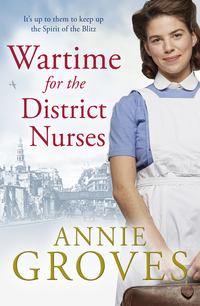
Читать книгу: «Wartime for the District Nurses»


Copyright
Published by HarperCollinsPublishers Ltd
1 London Bridge Street
London SE1 9GF
www.harpercollins.co.uk
First published in Great Britain by HarperCollinsPublishers 2019
Copyright © Annie Groves 2019
Cover design by Holly Macdonald © HarperCollinsPublishers Ltd 2019
Cover photographs © Jonathan Ring (models), Lebrecht Music & Arts / Alamy Stock Photo (background)
Annie Groves asserts the moral right to be identified as the author of this work.
A catalogue copy of this book is available from the British Library.
This novel is entirely a work of fiction. The names, characters and incidents portrayed in it are the work of the author’s imagination. Any resemblance to actual persons, living or dead, events or localities is entirely coincidental.
All rights reserved under International and Pan-American Copyright Conventions. By payment of the required fees, you have been granted the non-exclusive, non-transferable right to access and read the text of this e-book on screen. No part of this text may be reproduced, transmitted, down-loaded, decompiled, reverse engineered, or stored in or introduced into any information storage and retrieval system, in any form or by any means, whether electronic or mechanical, now known or hereinafter invented, without the express written permission of HarperCollins.
Source ISBN: 9780008272241
Ebook Edition © April 2019 ISBN: 9780008272258
Version: 2019-02-25
Dedication
Many, many thanks Teresa Chris, Kate Bradley and Pen Isaac – the dream team.
Contents
Cover
Title Page
Copyright
Dedication
Chapter One
Chapter Two
Chapter Three
Chapter Four
Chapter Five
Chapter Six
Chapter Seven
Chapter Eight
Chapter Nine
Chapter Ten
Chapter Eleven
Chapter Twelve
Chapter Thirteen
Chapter Fourteen
Chapter Fifteen
Chapter Sixteen
Chapter Seventeen
Chapter Eighteen
Chapter Nineteen
Chapter Twenty
Chapter Twenty-One
Chapter Twenty-Two
Chapter Twenty-Three
Chapter Twenty-Four
Chapter Twenty-Five
Chapter Twenty-Six
Chapter Twenty-Seven
Chapter Twenty-Eight
Chapter Twenty-Nine
Chapter Thirty
Chapter Thirty-One
Read on for a Q&A with Jenny Shaw, the author behind Annie Groves
Keep Reading …
About Annie Groves
Also by Annie Groves
About the Publisher
CHAPTER ONE
Summer 1940
Edith Gillespie woke up and for a moment could not work out where she was. Her brain was too befuddled with sleep to remember and there was no light to give her a clue. She struggled to work it out.
Not in the house where she’d grown up in south London, that was for sure, because there would have been the sound of at least one of her many siblings breathing, or snoring, or sneezing. She’d never had the luxury of a room to herself for all those years, not until she’d left home to train as a nurse. She didn’t think she was in her nurses’ dormitory, though. That had been near a station and you could always hear the trains, or porters and drivers shouting. After that she’d chosen to take extra training as a district nurse, but this didn’t feel like the home in Richmond. It must be wherever she’d gone after that.
Now it all came back to her. She was at the North Hackney Queen’s Nurses home on Victory Walk, in Dalston. This was her little attic room, and the reason it was so dark was that the blackout blind was firmly in place. The country was at war, and had been for nearly a year. It was warm as it was summer, and from the birdsong outside it was already dawn. Slowly she sat up and shook her head, trying to wake up.
Her dream lingered on the fringes of her mind. The details had gone but the sensation of happiness – of being cared for – remained, and she smiled in the darkness, savouring that comforting and thrilling feeling. Somebody loved her and she loved them back.
Then she remembered and cried out despite herself. Harry was gone. Harry Banham, the most handsome and wonderful man in the world, had not made it back from Dunkirk, and she was alone. Her dream had lied. There was nobody to hug her, to hold her and tell her how beautiful she was. There was no golden future for the couple who’d attracted envious glances wherever they’d gone. The life they’d so recently begun to plan was never going to happen. Sobs came from her throat and dimly she realised that she started most of her days like this, waking in the hope of seeing Harry and then coming back to reality with a sickening bump.
Her alarm clock began to ring and she reached automatically to silence it, then crept across the rag rug to the window and pulled back a corner of the blind. Sunshine edged its way into the little room, revealing that it was far from luxurious but had all the essentials. The room of a woman who had a job to do.
Edith turned to her wardrobe. The full-length mirror on its door reflected her slight figure, with her short, dark hair sticking up from where she’d slept on it. Her dark eyes took it in and she automatically smoothed it back down. Then she took out her uniform, shaking out the creases. Time to start the day. No matter that her heart was still raw from recent bereavement. Plenty of others were in the same boat. She had to carry on as normal and do what was required of her. After all, she was a nurse.
‘Gladys, whatever are you doing?’
Edith arrived downstairs for breakfast to be greeted by her colleague, Mary Perkins, complaining loudly. Mary had never been one for waking up in the best of tempers and now her voice rose over the clattering of saucepans and pots being stacked on the lino floor of the storeroom, which was squeezed between the stairs and the large area they all used as a canteen and common room.
Gladys, who helped out their cook and with general domestic duties, stood up and pushed her lank brown hair from her eyes. Even though the morning was still young she looked as if she’d already been up for hours.
‘We got to hand over all our scrap metal,’ she said. ‘The government says so. There’s going to be a collection or we can take it to the council. So I’m sorting out all our old pots what aren’t no real use any more.’
‘Yes, but can’t you do so quietly?’ Mary wailed. ‘Surely they can’t need it right now? The council depots won’t even be open, and I’ll bet all their staff are still safely asleep, like anybody sensible would be.’
Gladys shook her head. ‘I got other things to do later. So I thought I’d get on and do this now, then it will be one job done and ticked off me list.’
Edith nodded to herself. This time last year, Gladys wouldn’t have said boo to a goose, but she’d changed in the months in between, gaining in confidence and learning to read. Now she was standing up to Mary, who had a heart of gold, but was used to a lifetime of speaking sharply to servants.
‘Come on,’ Edith said, not wanting to start the day with a row. ‘I’m starving. Let’s have some toast.’ She steered Mary away and over to a vacant dining table, as Gladys resumed her sorting and stacking.
Mary plonked herself down on the hard wooden chair, which made her rich brown curls bounce around her cross face, and allowed Edith to fetch her some toast and a cup of tea. ‘It’s too bad,’ she grumbled.
‘What? That Gladys has to get up even earlier than usual to clear out the broken saucepans?’ Edith thought that was a bit much, even for Mary.
Mary shook her head. ‘No, of course not. I know I’m being silly.’ She sighed as she smeared a small amount of butter across the toast. ‘It’s nothing to do with Gladys really. It’s Charles.’
Edith raised her eyebrows in sympathy, even though she sometimes envied Mary for the fact that her boyfriend was still alive and so she really didn’t have much to complain about. However, she liked to hear about what her friend’s beau was doing, partly because he was a captain in the army and generally knew what was going on in the wider world, even if he wasn’t permitted to tell them the half of it. ‘What’s wrong, then? Spill the beans.’
Mary crunched into her toast and took a second slice. It would take more than a minor argument to make her lose her appetite. She finished her mouthful and looked up, her expression changing from annoyed to sad. ‘Well, of course I hardly see him, he’s so busy. Then, when we do manage to find an evening when he’s not on duty, he’s so preoccupied that I sometimes wonder if he hears a word I say.’ She patted one of her curls into place. ‘Yesterday I spent ages doing my hair, wearing my nicest silk blouse and making sure I looked my very best to cheer him up. Boost his morale and all that. But he didn’t even notice. Didn’t say a thing.’
Edith set down her own piece of toast. ‘I expect he did and just didn’t want to mention it,’ she suggested.
‘But I want him to mention it!’ Mary cried, her usually bright blue eyes now filled with irritation. ‘It took me ages, and you know how hard it’s becoming to buy nice makeup and find a way to make your favourite perfume last. I don’t want to let him down when he takes me to lovely restaurants.’
‘Of course,’ said Edith, although her experience of lovely restaurants was nonexistent. Harry used to take her to a local pub, the Duke’s Arms, or one of the nearby cinemas, and that was all they had needed.
‘He keeps going on about the threat of Hitler invading,’ Mary confided. ‘I tell him, he won’t. He wouldn’t dare. Mr Churchill will defend us. That’s what he’s promised to do and I believe him. There’s no need to worry on that score. Charles won’t tell me any details but he looks so tired and drawn, poor lamb. Yesterday he couldn’t even spare the time for a proper meal. We just went to the hotel bar nearest to his office and had a quick supper there. Not that it wasn’t lovely,’ she added loyally.
‘I bet it was,’ said Edith. Mary had been adamant up until the actual outbreak of hostilities that there wasn’t going to be a war, that Mr Chamberlain would stop it. So Edith didn’t have any great faith in her friend’s abilities to predict the future. Yet she could not fault her for steadfastness and optimism, qualities which might be very important in the days to come, if her own worst fears of invasion came true.
‘I’m beginning to think he’s a bit of a fusspot,’ Mary admitted. ‘He was so carefree and fun when we first met, and now his mind is always on something else, I can just tell.’ She reached for the marmalade and carefully helped herself to a small amount, to leave enough for whoever sat at the table next. Nobody could slather it on their toast any more, the ingredients were too scarce. Sugar had been rationed since the start of the year and oranges had all but disappeared.
‘Well, he’s got an important job to do,’ Edith pointed out. She checked her watch. ‘As have we.’
Hastily Mary finished off the last of her breakfast. ‘I’d better go and restock my Gladstone bag. I didn’t get around to it last night, what with preparing to go out with Charles. I don’t want to run short of anything.’
Edith made a face of mock horror. ‘I should think not. And don’t so much as breathe such a thing in front of Gwen.’
Mary glanced hastily around, as if mentioning the name of their fearsome deputy superintendent was enough to conjure up her presence. ‘Heaven forfend. Right, I’m off. See you later.’
Edith grinned, although she knew that Gwen’s bark was worse than her bite. The older woman had been kindness itself when they’d first learnt the news about Harry. But that was a side of Gwen that few people saw. She would have been perfectly right to berate Mary if the young nurse had been mistaken enough to set off on her rounds without a properly stocked bag. Every district nurse relied upon this most vital piece of equipment, which contained everything she might need when visiting a patient’s house. It was no exaggeration to say that lives depended on it.
‘You’re up early.’
Edith turned around at the sound of a chair scraping beside her, and looked up into the steady blue eyes of her best friend, Alice Lake, who lowered her tall frame to sit at the vacant place at the table.
‘Couldn’t sleep for ages and then I woke up before the alarm,’ Edith admitted.
Alice nodded in sympathy as she set down her bowl of porridge. ‘Again,’ she said.
Edith shrugged. Alice was the only nurse who knew about her dreaded moments when she awoke thinking Harry was still alive and then remembered that he wasn’t. Yet she was getting better. At first the realisation would make her feel so sick that she couldn’t face breakfast, and would end up shaking with exhaustion by the end of her morning rounds. Now she could manage some toast and set off with something like her old energy, because she knew that neither Harry nor the rest of his family, who lived nearby, would have wanted her to fail in her chosen profession.
‘Who’s your first patient?’ Alice asked, knowing that the best way to help Edith was to concentrate on work.
‘Dennis,’ Edith replied. He was one of their favourites, a teenager with a tubercular hip who required regular visits, and whose life was one of discomfort at best, but who never complained. ‘He’s been pretty bright recently, and Dr Patcham thinks we might even be able to try him walking for short periods with crutches. I don’t want to rush him though. His leg muscles are wasted from lying in bed for so long.’
Alice beamed at the idea. ‘Imagine how happy his mother would be. I know she thought her son would never walk again.’
Edith agreed. ‘It would be a small miracle – but don’t tell anyone or it might jinx it. Anyway, I’d better go.’
‘Give them my best and tell them I’ll see them soon,’ Alice called, raising her teacup as Edith departed.
The sunlight flooded the corridor of the big old Victorian house as Edith strode along it, to pick up her own bag before setting off on her bicycle for the day. It was true that there was finally a ray of hope for young Dennis, and it was moments like that which had led her to do this job in the first place. There was a long way to go for him, and he might always have a limp; everything would be easier if he could leave his crowded street and move to somewhere with fresh air, but she might as well recommend him to fly to the moon. Besides, even the countryside was open to attack; areas around airfields had started to see enemy planes overhead and nowhere was guaranteed to be safe.
‘So you aren’t missing much, Harry Banham,’ she murmured to herself, carefully wedging the bulging leather bag into the bicycle basket. She knew she didn’t mean it, though. She would have given anything for him to be back with her, laughing with his friends, joking with his family, throwing his beloved little niece into the air and catching her before his mother could tell him off. She shook her head, and automatically checked that her dark wavy hair was secure under her cap. It was no use; he was gone, and she had work to do.
‘Gillian! No, put it down.’ Mattie Askew, nee Banham, pushed herself to her feet and padded on swollen ankles across the family kitchen to try to stop her daughter from pulling a china bowl off the low shelf where it shouldn’t have been in the first place. ‘Ma, stop her, I’m too slow.’
Flo Banham swung around from where she was peeling potatoes at the kitchen sink and in one swift movement rescued the bowl with one hand and caught her granddaughter with the other, lifting her up and holding her so their eyes were level. ‘No you don’t, my girl,’ she said lovingly but firmly. ‘You know that’s not a toy. Heaven knows you’ve got enough of those, so when I put you down, you’re to play with them and not with my china.’
Gillian roared with laughter and tapped her grandmother’s nose.
‘Don’t you try and get around me like that.’ Flo put the little girl back on the mat and wiped her hands on her faded and threadbare apron. ‘Oh, she’s got a surprise coming. Just wait until her baby brother or sister arrives.’
Mattie groaned and rubbed her growing bump. ‘Can’t come soon enough for me. Whatever was I thinking of, carrying a baby through the heat of summer. We’ll both melt before it’s due. Nearly three more months! I don’t think I can do it.’
Flo tutted. ‘Of course you will. That’s Lennie’s child you’ve got there, and you owe it to him to bring it safely into the world.’
Mattie rolled her eyes. ‘You don’t have to remind me. As if I’d forget.’ Her husband Lennie had been taken prisoner at Dunkirk, only weeks after she’d written to him to say he was going to be a father for the second time. He’d been beside himself with joy at the news, and it was knowing that which kept her going. That and caring for their firstborn: Gillian, now nearly eighteen months old, and growing better at walking and talking every day. The toddler assumed, quite rightly, that she was the centre of everyone’s attention, and wasn’t old enough to miss the people who should have been there: her father and her doting Uncle Harry.
The third missing face belonged to Mattie’s older brother, Joe, who was in the navy. Nobody knew exactly where he was or what he was doing, as letters arrived home in no regular pattern, depending on if and when he was in port. He was a master at writing long, funny, affectionate letters without actually telling them anything. She looked forward to them, as they were as entertaining as reading a real book. Lennie, even Mattie would be first to admit, wasn’t a great one for letters, but he had managed to send one from his prison camp to assure everyone back home that he was alive and as well as possible. Mattie had already sent off one parcel via the Red Cross to make his stay more bearable.
Mattie sank back down onto the comfy chair, keeping a close eye on Gillian, who had found her teddy bear which had rolled under the kitchen table. Then came a gentle waft of welcome cool air as the door to the back kitchen opened and Stan Banham strode in. He was an imposing figure, tall and straight-backed, although his face had grown etched with new lines ever since the news had come through about Harry. He was the local trusted Air Raid Precautions warden, as well as working full time, and Mattie knew that whatever happened, her father would be there to make everything better. He was the rock on whom they all depended. She struggled to her feet. ‘Fancy some tea?’ she asked as brightly as she could, despite the heavy weight of the growing baby.
Stan smiled at his only daughter and then at his granddaughter, who ducked out from beneath the table and held her arms up, demanding a cuddle. Stan obliged. ‘No, you sit yourself down, I’ll just have a glass of water to cool off,’ he said, tousling Gillian’s fine brown hair before gently putting her down again. ‘It’s warm out there. The heat will have died down before I go out on my rounds; that’s something to be thankful for.’
Flo looked at him. ‘Well, that’s good,’ she said slowly. ‘Have you heard anything more today? About what’s going on? Down the market there are all sorts of rumours. Some say Hitler’s just waiting to pounce, that he’s got all his tanks lined up on the French coast.’
Stan shook his head. ‘You know better than to listen to rumour. People will repeat any old rubbish.’ He took a deep breath, easing off his light jacket. While he didn’t want to give anyone false hope, one of his foremost duties as an ARP warden was to prevent panic and keep everyone calm. If necessary that applied to his own family too. ‘We’ll take whatever comes and do our best. That’s all we can do. We won’t be frightened by silly tales or scaremongers. Worrying never solved anything, you know that as well as I do.’
Flo nodded, reassured as ever by her husband’s presence. ‘Then that’s what we’ll do,’ she said with determination. ‘And we’ll start with my potato pie.’
CHAPTER TWO
Billy Reilly wiped his itching eyes. They were red from tiredness, not helped by his underlying anxiety that this was the calm before the storm. He gazed up at the darkening sky, searching for any enemy planes. They’d been spotted in small numbers in Kent and along the south coast, sneaking over the Channel, as was common knowledge down at the docks where he worked. You couldn’t stop sailors and dockers talking to each other. How much everyone else knew was anyone’s guess, but he had a pretty good idea of what was going on.
He forced himself to concentrate on the job in hand. As well as working his full shift of hard manual graft, he now had an evening of ARP duty, walking the streets of Dalston, checking that everyone had put up their blackout blinds correctly and generally helping out whenever he was called upon. He’d learnt most of what he needed to know from his colleague Stan, who everyone looked up to. Billy had known Stan since he was at school, as Stan’s sons were two of his best friends. Or, rather, they had been; now there was just Joe left.
He was used to his duties now and found it easier to confront householders who refused to obey the regulations. In some ways it was easier in summer, as the longer hours of daylight meant nobody needed to use their gas – or, in rare cases, electric – lamps until late in the evening. During the winter months, when he’d been new to the work, there had been plenty of rows, as people pointed out that the expected air raids and gas attacks hadn’t happened and so what was the point of putting up ugly black blinds? Some wardens were lenient, insisting on the blinds only when there was a warning siren, but Billy thought that was the start of a slippery slope and aimed to be equally strict with everybody. Lives might depend on it.
He wondered whether he could find an excuse to call in on Kathleen. He wanted to more than anything else in the world but didn’t like to push his luck. He could tell himself it was out of simple concern for her welfare, as she had nobody else to look out for her and her little son. She struggled to make ends meet and he loved helping her out in small ways. Yet, if he was honest, he knew the real reason was that he’d been in love with her for years but had missed his opportunity to tell her.
She’d been another person Billy had known from school, and he’d always thought she was the prettiest girl there. Gradually they had drifted into the same circle of friends and they had all stayed in touch after leaving, when Billy had gone to work down at the docks. Just as he was gathering his courage to tell her how he felt, she’d met that handsome wastrel Ray Berry, and before you could say knife she’d gone and married him.
Billy drew a sharp breath at the thought of the man who had treated Kath so badly. She’d hidden his true nature from them all for ages, but it had got to the point where anyone could see the bruising. And it wasn’t only Kath who’d suffered. Ray had resented their baby son, which was unforgivable. When the news had come that Ray had not survived Dunkirk, most people had felt relief.
Yet Kathleen had been more distant since that day. It was as if she felt guilty at sharing the relief, the knowledge that Ray could never hurt her or little Brian ever again. So Billy was biding his time, not wanting to rush things, to ask for too much too soon. One thing was certain though; he didn’t intend to be pipped to the post again. Kathleen was the only woman for him, and if he had to wait until she realised that they were destined to be together, then so be it.
Peggy sighed as she dutifully fastened the blackout blinds in her mother-in-law’s kitchen. This was not how she had imagined her life turning out. She had moved in after she and Pete had got married in the autumn, with the plan that they would have their own house as soon as the war was over. Pete had been happy at the thought of his wife and his mother keeping one another company while he fought for his country. He hadn’t hesitated to enlist in the army when war broke out, even though their long-awaited wedding had been only weeks away. Everything had been going so well; they still managed to marry, and he’d had a wonderful period of leave at Christmas. She’d realised she was pregnant and they’d been thrilled. But then she had miscarried, and before that really sank in, Pete had been killed at Dunkirk.
‘Are you finished in there, Peggy love?’
‘Nearly,’ Peggy called back, from between gritted teeth. She hadn’t minded Mrs Cannon at first. They’d always got along well, and the older woman had welcomed her into her home, pleased that Pete was so happy in his choice of bride. Everyone could see how well suited they were; they’d been together since meeting at school, although they’d only become serious once Peggy had started working at the gas-mask factory.
Now, though, every tiny request or comment drove Peggy to the point of screaming. Nothing she did was ever quite right. The forks weren’t the right way round in the cutlery drawer. She hadn’t used enough Reckitt’s Blue in the washing. She didn’t know the best way to darn the frayed elbow of a jumper. None of these complaints on its own was enough to spark a row, but added together they were stifling.
It wasn’t that Peggy had to do all the housework. She knew she was lucky; plenty of young women her age were expected to do the lion’s share of the cleaning and cooking as well as working full time. Mrs Cannon was not like that and had been heard to boast that Peggy was a good girl, putting in all those hours at the factory and then helping out around the house. Peggy groaned inwardly. It was just that when she did help, it always provoked gentle criticism.
‘Come and listen to the wireless,’ called Mrs Cannon from the front room. ‘That Wilfrid Hyde-White is going to be on – he’s ever so good.’
‘Thank you, I will,’ Peggy replied, wanting to hit her head against the wall. Another evening beckoned of sitting either side of the fireplace with the wireless in pride of place in the middle of the mantelpiece, knitting or sewing on buttons while the Home Service played at full volume. Peggy preferred the music programmes, especially if Ella Fitzgerald came on, but her mother-in-law didn’t like those kinds of singers. Peggy had often wondered if she could get away with simply turning the sound down a few notches. Mrs Cannon was a little deaf but would not admit it.
Running out of excuses to stay in the kitchen, she painted on a smile as she went through to where her mother-in-law was already sitting in her armchair, knitting at the ready.
‘Thank you, dear,’ said Mrs Cannon, her eyes twinkling in appreciation. ‘I don’t know how I’d manage without you around, I really don’t. I find it so hard to reach the tops of the windows now, what with my lumbago, and arthritis in my fingers. You’re so nimble, you’re lucky.’
‘It’s nothing,’ said Peggy, keeping the smile in place though her cheeks ached. She took the other armchair, the slightly less comfy one, and reached for her sewing bag. She brought out a skirt on which she had optimistically let out the waist when she’d been pregnant; she might as well take it in again. Her fingers trembled slightly at the memory as she threaded her needle.
‘Oh, what good eyesight you have,’ Mrs Cannon said warmly. ‘I remember when I used to be able to do that without my glasses. Not any more. Those days are long gone.’
Peggy nodded. ‘What are you knitting?’ she asked, for something to say, although she already knew the answer. It was the same cardigan her mother-in-law had been working on all week.
‘Just a little something to keep me warm when autumn comes,’ she answered, the same as she always did. ‘I can do one for you if you like.’
Peggy tried not to shudder. The colour, a dull brown, was not at all to her taste. ‘No, you save the wool for yourself,’ she said hastily, knowing that if she were to wear such a shade it would drain every ounce of colour from her face.
So Mrs Cannon thought she was lucky, did she? Peggy could not imagine feeling much worse. Stuck in here, with the sound of those blasted needles clacking away, knowing that any minute now there would be a well-meant but undermining comment about her sewing technique. How was that lucky? No baby, no Pete. How she had loved him, with his athletic frame and dark eyes that sent her weak at the knees every time he looked at her. How she missed holding him, being held by him. She’d never feel like that again. No man could ever come close to Pete, and that heady rush of first love that grew stronger by the year until they’d realised that they were meant for each other. All that had gone, vanished in the waters off Dunkirk.
The only way in which she counted herself lucky was that she was certain how he had died. One of his comrades had seen it happen: one quick, fatal bullet. He wouldn’t have suffered. He had been serving his country, which was what he had wanted to do. He was no coward, had never flinched from physical confrontation. If there was a wrong to be righted, Pete had been the man. For a minute Peggy thought of Edith; nobody was able to reassure her of Harry’s fate. His body hadn’t been found. He had failed to return to his unit, and wasn’t on any of the wounded lists, and so they had to assume he’d drowned and not resurfaced. How unbearable for them all.
Peggy had liked Edith on the occasions when they’d all gone out together. She always seemed keen to enjoy herself, to have a bit of fun, to let her hair down after a hard day’s work, and had fitted in easily to their group of old school friends. A thought occurred to her and she accidentally jabbed the needle into her finger.
‘Are you all right, dear?’ Mrs Cannon asked at once. ‘Haven’t made yourself bleed, have you?’
‘No, no,’ Peggy said, swiftly hiding the telltale dot of blood. She pretended to search for her scissors while the idea grew. She really could not stand the thought of every evening turning out like this, cooped up in the little front room full of trinkets, every one bearing some kind of memory of Pete, with just his old mother for company. Perhaps Edith would like an evening out. They could go to the Duke’s Arms and nobody would mind two women out on their own as they were well known there. Harry and Pete had been regulars, and were well liked. They could sit in the beer garden at the back and watch the world go by. Anything was better than this. Peggy gave a genuine smile and Mrs Cannon smiled back.
Peggy decided she would send a message to the nurses’ home the very next morning.
CHAPTER THREE
Edith sped along Dalston Lane on her bike, the breeze catching at her dark hair escaping from her starched cap. She was heading for one of the smaller side streets but had been there often enough not to have to check her bearings. That was often the way with a patient who required nursing twice a day. What with Dennis and this patient, she had a busy round even without any new cases.
She was on her way to see a three-year-old boy who not only had measles but had developed the complication of pneumonia as well. He was a very sick child, and Edith’s heart ached for him and his mother. She had not yet met the father, who was out working all hours at one of the local factories which had changed from producing pencils to munitions. He must have been earning a decent wage as the house was in a reasonable condition compared to many she visited, and yet it was barely big enough for the family, which numbered five children altogether.
Edith knocked smartly at the door, which must have been painted fairly recently, as it was nowhere near as chipped as its neighbours. Mrs Bell opened up at once, and ushered Edith inside. ‘I’m terribly glad to see you, nurse. Vinny’s been all hot and he can’t sleep, poor little mite.’ She turned to another child right behind her. ‘Out you go, Freda, you know you’re to keep out of nurse’s way and not go near any of her things. We don’t want you down with it as well. One’s enough, one’s more than enough.’ The woman sounded at the end of her tether.
Freda, who looked about six, regarded Edith with big, curious eyes. ‘Is me brother goin’ ter die, miss?’ she asked.
Edith crouched down to the girl’s level and met her gaze. ‘Not if I have anything to do with it,’ she said cheerfully. ‘We’re going to look after him and see that he has the best possible chance of getting better. So you can do your bit by making sure you’re quiet when you go past his door and letting him rest.’
‘All right, miss.’ The little girl seemed reassured. ‘He’s got my bedroom, though. I want it back.’
‘Freda!’ cried the mother. ‘You know it’s because it’s the smallest room, and Vinny can’t share with the boys if he’s so sick. You’ll just have to put up with it. He needs it more than you do.’
Edith smiled, feeling sorry for the little girl. It wasn’t her fault that she had been turfed out of her room. ‘When he’s properly better you can go back to how it was before,’ she assured her. The girl nodded solemnly and ran into the kitchen.
‘Nurse, I’m so sorry,’ gasped the mother, stricken. ‘You’ll think we brung them up with no manners.’
Edith began to climb the stairs towards the back bedroom on the topmost floor. ‘Not a bit, Mrs Bell. Sometimes we forget how the other children are affected if one of the family is sick. They can be frightened and don’t know what to do to make it better. Sometimes they think it’s their fault.’ She paused. ‘All you can do is keep telling them everyone’s doing their best and they aren’t to blame one way or the other.’
‘You’re very kind, nurse,’ Mrs Bell replied, sounding unconvinced. She and Edith paused on the top landing outside the bedroom door. As quietly as she could, Edith took off her coat, nurse’s cap and apron and hung them over the banister. From her bag she took out an overall and handkerchief to wear over her hair, along with everything she would need to treat the little boy. They had to minimise all risk of contamination, even though it meant carrying around extra items and added to the length of the visit.
Mrs Bell had queried why this was necessary to start with, but Edith promised her it was set down in the strict guidelines for such a case. She also required a bowl of disinfectant and a nailbrush to be left outside the bedroom door so that she, Mrs Bell or the doctor when he came could ensure their hands were clean going in and going out. Mrs Bell had protested. ‘Where can I put that without the other kids knocking it over? This ain’t a hospital where you can see what’s going on. The older boys sleep in that room opposite, and they’ll stick their noses into everything.’
Edith had looked around and noticed a small bookshelf at her head height; she was on the short side. ‘That might do,’ she said.
Mrs Bell had tutted. ‘We ain’t got many books and, those we have, the little darlings scribble all over, so we put our good ones up there. I’ll have to put them in me and Terry’s room, otherwise they’ll draw animals all over the pages.’ She removed the precious copies of Pears’ Cyclopaedia, the Bible and the Children’s Everything Within.
Now Edith carefully reached for the bowl, standing on tiptoe, making sure not to dislodge the envelope she had to leave for the doctor containing the patient’s report and chart. Grimly she thought that the people who devised the guidelines might have meant well but they hadn’t reckoned on big families living in confined spaces. And this was one of the luckier households.
Finally they were ready to go into the little bedroom. It was warm inside, but Mrs Bell had left the window open as instructed, so that what passed for fresh air around Dalston could freely circulate. On the narrow bed under a threadbare candlewick bedspread lay a little boy, propped on pillows and scarcely making a sound. Edith gently crouched beside him. ‘How are you feeling, Vinny?’ she asked.
‘Hot,’ he whispered.
Edith turned to Mrs Bell, lingering in the doorway. ‘Could you fetch him a glass of cold water?’ she asked, reaching for the tray set on the battered dressing table. All the crockery and cutlery that Vinny used had to be kept separate, so as not to infect the rest of the family, although that presented another hurdle for his mother.
Glad to be of use, Mrs Bell set off back downstairs, and Edith could properly assess her patient without causing his anxious parent even more worry. As she would with every case, she took his temperature, pulse and respiration, and noted them for comparison later. ‘Oh, you are a spotty boy,’ she said softly. ‘How am I going to recognise you when you’re better, eh? You’ll look so different.’ The little boy tried to smile but he was clearly too exhausted.
Edith shut the window and then set about sponging him down, noting that his spots were actually fading slightly. Perhaps he was turning the corner. ‘Are you hungry?’ she asked encouragingly. ‘Maybe Mummy can bring you some beef tea.’ But he shook his head.
She went on to check his eyes and ears in case of any extra complications. ‘And have you had a pain in your tummy?’ she wondered, knowing that any disturbances of that kind could indicate still further problems. Wearily he shook his head once more, and turned his face into the pillow.
Edith swiftly finished her work and was just opening the window again when Mrs Bell returned, glass in hand. She had put on the flannel overall that Edith had lent her so that her own housecoat wouldn’t spread infection throughout the rest of the home. ‘See if you can get him to drink it,’ Edith urged. ‘He might still be off his food but he’s got to keep up his fluid intake. That’s more important than getting him to eat anything. Maybe some thin soup, when his appetite returns.’
Mrs Bell sat on the bed and looked at her boy with exhausted, concerned affection. ‘He’s a good little chap usually. Loves his pie and mash.’
Edith smiled. ‘It might be a while before he manages any pie. Mash would be good though, with beef gravy if there’s any going. But whatever you do, don’t let anyone else eat his leftovers or they might still catch this and we don’t want that.’
Mrs Bell’s shoulders slumped. ‘That’s easier said than done. We can’t afford to waste food. There’s too many mouths to feed and that’s a fact.’
Edith nodded in acknowledgement. The guidelines insisted that a patient’s leftover meals should be burnt or flushed down the lavatory, which was fine if you had a bathroom upstairs, but far from easy if not. Again the rules were hard to apply in circumstances such as these. ‘Just do your best,’ she said encouragingly. ‘You’ve managed very well so far. Having a mother who is prepared to go to all these lengths makes a great difference – you’d be surprised. I know all these rules seem silly, but they work. I do believe he might be on the mend.’
Mrs Bell’s expression changed to one of hope. ‘Really? Do you think so?’
Edith bit her lip, wondering if she had said too much too soon. After all, it was only an impression she’d formed and she wasn’t the doctor. However, she had seen such cases before and knew what to look for. ‘It’s early days,’ she cautioned, ‘but I’d say his spots have gone past the worst. Also his temperature is down a notch even though he feels hot. So keep on doing what you’re doing, and we’ll see how he goes on.’
Mrs Bell hurriedly wiped one eye. ‘Thank you, nurse,’ she said softly. ‘I don’t know what we’d do without you.’
‘There’s a message for you,’ Mary greeted her on her return.
For a moment Edith’s heart flew to her mouth and her pulse quickened, but then she damped down the feeling. The one person she most wanted to hear from would never write to her again.
‘Looks as if it’s from Peggy,’ Mary went on, oblivious to what Edith was thinking. ‘I haven’t seen her for ages, have you?’
‘No,’ Edith replied, taking the envelope and sticking it in her skirt pocket while she set down her bag. ‘Blimey, my arm’s aching from carrying all that extra stuff. So many infectious cases at the moment – or is it just me?’
Mary shrugged. ‘I had two confirmed of measles today, and one suspected case. I shall have to notify the school. What a palaver. Fancy some tea?’ she added, heading for the stairs to the common room.
‘I’ll see you down there,’ said Edith, knowing she would have to sort out her bag first.
When she eventually joined her friend, several other nurses had gathered on the same table, comparing measles cases.
‘It’s so hard on the mothers,’ said Belinda, a tall, dark-haired nurse who had joined the home in the New Year, fresh from her QNI training, but who was now thoroughly used to working on the district. ‘They all say the same thing – they wish they’d never come back after being evacuated. They think that if they’d stayed away in their billets, the children would still be all right.’
Edith sat down. ‘That’s daft, though. You can catch measles as easily out in the countryside as in the city. It doesn’t care who it infects.’
Alice agreed. ‘Yes, of course, but it’s true that the parents feel awful and blame themselves. Anyway, it will be the end of term soon and perhaps some families will go back to where they were evacuated because of the threat of invasion.’
Mary immediately turned on her. ‘Don’t talk rot. There won’t be one.’
Alice looked at her levelly. ‘We don’t know that, Mary. There might well be. We just can’t say. The fact is that some parents have told the schools they’re taking their children away again, and it’s making the teachers’ lives very difficult as they don’t know what to plan for the new September term, invasion or no invasion.’ One of Alice’s friends was a teacher at a nearby primary school, and so she was up to date on their day-to-day problems.
Mary wasn’t prepared to argue with Alice, who – it was generally acknowledged – was better informed than anyone else when it came to current affairs, as she spent much of her spare time reading the newspapers or glued to the news on the wireless. She decided to change the subject instead.
‘What did Peggy have to say?’ she asked, turning to Edith.
Edith had quite forgotten about the envelope in the hurry to sort out her potentially infected clothing, find a fresh set for tomorrow’s visit, and to restock her Gladstone bag for the morning. ‘I don’t know. I haven’t had a moment to look.’
‘Well, how about now?’ demanded Mary impatiently. In the absence of any letters for herself, Edith receiving one was the next best thing.
Edith obligingly reached into her pocket and drew it out, jagging it open with her index finger. ‘All right … she says it’s a shame we haven’t seen each other for a while, and she knows what it feels like …’ Edith took a quick gulp and went on, ‘so why don’t I come and meet her in the Duke’s Arms on Friday evening after work and we can pretend it’s like old times. Well, without Harry and Pete, of course.’ There, she’d done it, she’d said his name in front of a group of people and not broken down. She silently patted herself on the back.
‘Would you want to?’ asked Alice doubtfully.
Edith sighed. ‘If you’d asked me even last week, I’d have said no. But she might have a point. I don’t want to spend the summer moping around. Harry wouldn’t have wanted it and neither would Pete. After all, what harm could it do? It’s only down the road and we’ll know lots of people there. Clarrie might come.’ Peggy’s friend Clarrie worked in the gas-mask factory as well. She too was part of the old school gang. ‘Why don’t you come along, Al? Or Mary? Belinda?’
Alice shook her head. ‘I don’t think so. You go, but I’ll stay in.’ Everyone knew her idea of a good time was an evening spent reading a book in her room.
Belinda raised her eyebrows. ‘I might. There’s a chance my brother will be in town, and if he is I’ll want to try to meet him, but who knows with the trains these days. So I’ll see, if that’s all right with you.’
Mary beamed. ‘Count me in. Charles will be working late again, and so just you try to stop me.’
Gwen let her good friend Miriam take the window seat as they stepped onto the bus. Miriam had been adamant that Gwen should not waste her day off but accompany her to the West End for a shopping trip. Gwen had gone along, but more for the pleasure of spending the afternoon with her friend than with the intention of buying anything. She wasn’t particularly interested in what she wore; clothes served a purpose and that was that. Most of the time she wore her nurse’s uniform anyway. Miriam, however, had other ideas.
‘You can’t let what’s going on in the world stop you doing what you enjoy,’ she had said. ‘For me, that’s buying nice clothes. No, don’t wrinkle your nose like that. If you don’t want to buy anything yourself, I shan’t make you, but do me the favour of coming along and telling me what suits me best.’
Gwen had recognised this was simply a ruse, as nobody knew what suited Miriam better than Miriam herself. Now she glanced at her friend, beautifully turned out in a lilac skirt with matching light cotton jacket over a cream blouse with a delicate lace collar. She had kept her figure and it was hard to believe she had an adult son. Other women might have been jealous, but Gwen was happy for her, as she knew it mattered to Miriam that she looked smart. She had her role to play as the wife of a successful businessman. Also, she simply loved clothes.
‘I’m sure this little summer coat will come in useful,’ she said happily, patting the bag on her lap. ‘And how lucky that they had a scarf to go with it. You could have got one as well, Gwen.’
Gwen laughed. ‘Where would I wear it? Teaching first aid? I don’t think so.’
‘You’d wear it for the pure pleasure of it,’ Miriam laughed. ‘I always feel better when I have a nice scarf. It can make or break an outfit, you know.’
Gwen raised her eyebrows. ‘I’m sure it can. Just not one of mine.’ She glanced down at her plain grey skirt and serviceable beige blouse, which she’d run up from material she’d found at Ridley Road market.
‘Yes, even yours.’ Miriam tapped her on the arm. ‘Something in dark green would lift it. I have something I could lend you if you like.’
Gwen shook her head. ‘Thank you, but it would be wasted on me. You keep it. You’ll enjoy it more.’
They fell silent as they passed the shop fronts of Tottenham Court Road. There were still goods to buy but not as many as this time last year. There was an unspoken air of people going shopping while they still could. It was partly why Gwen had come. Even if she didn’t want anything, it was still a spectacle, and she didn’t know if or when she would be able to do so again. Like so many Londoners she was filled with a sense of deep foreboding.
A young couple got on and sat a few seats in front of them. The young man wore the uniform of the RAF, and the girl looked as if she had been crying as her eyes were red and puffy. She clung to his arm and looked imploringly up into his face. They were too far away for Gwen to hear what they were saying, but it wasn’t hard to guess.
She caught Miriam’s gaze.
Miriam shifted in her seat. ‘Did I tell you what I have decided to do?’
‘I don’t think so.’
Miriam nodded in determination. ‘I’m joining the WVS.’
‘The Women’s Voluntary Services?’
‘Yes, exactly.’ Miriam’s face was serious. ‘I am tired of hearing the news and feeling I’m doing nothing.’
‘But you’re always so busy,’ Gwen pointed out. ‘You’ve opened your house to families escaping Hitler.’
Miriam shrugged. ‘The families are no trouble – this new couple don’t have children, and they see to themselves most of the time. I have plenty of spare hours and I want to do something worthwhile with them. They need people who are organised and prepared to turn their hand to anything, so I thought I might fit in.’
‘Well, I should think they’d welcome you with open arms,’ Gwen said decisively. ‘You must let me know how you get on. If I can help, I will, but I won’t be able to join full time or anything like that. We’re going to be even busier from now on.’
‘Really?’ Miriam asked. ‘Do you know something I don’t about what’s happening over in France or Germany?’
Gwen realised her friend had misunderstood. ‘No, I meant at the home. We’re taking on two more newly qualified district nurses. These ones are Irish. They start as soon as we can sort out their accommodation.’
Miriam looked surprised. ‘I thought your home was full?’
‘It is,’ said Gwen, ‘but the woman who owns one of the flats next door has told us she’s going to live with her sister, and she’s given us first refusal on renting it from her. Fiona says we’d be silly to turn down the chance. It’s only small but it has two rooms. They don’t need a living room, as they can share our common room and canteen. It’s ideal, even if highly irregular. I don’t say I approve of bending the rules like that but, as long as Fiona’s happy, who am I to say no? She’s in charge.’
Miriam nodded in assent. ‘These aren’t normal times, are they? I could be wrong and I hope I am, but you might need every pair of hands available soon.’
Gwen stared out of the window, as the bus went past Sadler’s Wells. ‘I’d love you to be wrong, I really would,’ she said, ‘but I have a horrible feeling you aren’t.’
Бесплатный фрагмент закончился.