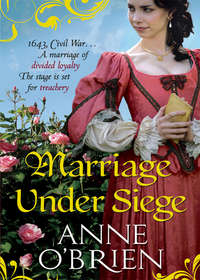
Читать книгу: «Marriage Under Siege»

About the Author
ANNE O’BRIEN taught history in the East Riding of Yorkshire before deciding to fulfil an ambition to write historical fiction. She now lives in an eighteenth-century timbered cottage with her husband in the Welsh Marches, a wild, beautiful place renowned for its black-and-white timbered houses, ruined castles and priories and magnificent churches. Steeped in history, famous people and bloody deeds, as well as ghosts and folklore, the Marches provide inspiration for her interest in medieval England.
Visit her at www.anneobrienbooks.com
Also by
ANNE
O’BRIEN
VIRGIN WIDOW
DEVIL’S CONSORT
PURITAN BRIDE
THE KING’S CONCUBINE
Marriage Under Siege
Anne O’Brien

My Lord,
If you have received this you will be free and in Ludlow with Mary and Joshua. I know that you blame me for your imprisonment at Leintwardine. It was not by my hand, but I fear that nothing I can say, considering our past history, will put my actions into a better light.
I have done what I can to put matters right between us and pray that it will be enough. When we married, I did not realise that divided loyalties, even when they do not exist, could cause so much suspicion and pain.
I pray for your safety. As I told you at Leintwardine, I do not, for one moment, regret our marriage. But sometimes destiny is a stern master and cannot be gainsaid. I understand your sentiments towards me. I am only sorry that I was never able to prove my love for you. I have never found it easy to explain my emotions—and would not have burdened you with them anyway.
For the rest, I cannot write it.
God keep you safe.
Honoria
Prologue
They drew rein at the crossroads.
‘So, Josh—what now? Ludlow is closer than Brampton Percy and it has the guarantee of a welcome and a few home comforts. Do you go home?’
‘Perhaps not.’ Sir Joshua Hopton, eldest son and heir to one of the foremost Parliamentarian families in Ludlow, tried without success to tuck his cloak more securely round him. Rain dripped from the brim of his hat, but was ignored. They were so wet that it mattered little. ‘I have a mind to witness your homecoming as the new Lord—so I will forgo the delights of Ludlow until tomorrow.’
‘Well, then, let us go on. You will no doubt be as welcome as I am.’ A swirl of low cloud and mist hid the faint gleam of cynicism in the cold eyes of Sir Joshua’s companion as he shortened his reins, slippery from the wet. ‘More so, I venture.’
Without further conversation, they turned their horses to the west, towards the Marches’ stronghold of Brampton Percy as a fresh flurry of rain, heavily spiked with hail, pattered with diamond-bright intensity on men and horseflesh alike.
Their escort fell in behind.
Chapter One
An hour later the two round towers, built to overawe the local populace and protect the gateway with its massive double portcullis, loomed dark and forbidding before the small party of travellers. The March day was now drawing to an early close with scudding clouds and a chilling wind that whipped the travel-stained cloaks, tugged at broad-brimmed hats and unsettled the weary horses. It was not weather in which to travel, given the choice. Nor was the castle a welcoming prospect, but the two men approached confidently, knowing that they were expected and that the gate would not be closed against them.
It had been a long journey from London to this small cluster of houses and its imposing castle of Brampton Percy in the depths of the Welsh Marches. Days of poor weather, poor accommodation and even poorer roads in the year of Our Lord 1643. The War, now into its second year, had given rise to any amount of lawlessness, encouraging robbers and thieves to watch the two men with their entourage and their loaded pack horses with more than a little interest, but they had finally arrived at their destination without event. Perhaps the air of determination, of watchfulness and well-honed competence that surrounded the travellers, together with the clear array of weapons, had kept the footpads at bay. Certainly none had been prepared to take the risk.
More problematic had been the small groups of armed forces that frequently travelled the roads in these troubled times. It was not always easy to identify their affinity, to determine friend from foe, Royalist from Parliamentarian. For these two travellers and their dependants, a Parliamentarian force would have signified a friend, an exchange of news, some protection if they chose to travel on together. A Royalist party would have signalled at best instant captivity and a hefty ransom after a long and uncomfortable imprisonment in some local stronghold, at worst, ignominious death, their bodies stripped of everything of value and left to rot in a roadside ditch. So they had travelled carefully and discreetly, their clothes dark and serviceable, nothing to advertise their economic circumstances or social standing other than the quality of their horseflesh and the tally of servants who accompanied them.
On this final afternoon in the rural fastness of north-west Herefordshire, the heavy showers of rain and sleet had cleared, but there was no glimmer of sun or lightening of the heavy clouds, making the sight of the gatehouse doubly welcome. The village street was silent except for chickens scratching in the mud, the inhabitants taking refuge from the elements and the uncertainty, but the travellers were aware of watchful eyes as they passed. Their hands tightened on their sword hilts. No one could afford to be complacent, even when the assurance of hospitality was close at hand.
They made their way past the darkened forge at the crossroads, the timbered inn, the squat shape of St Barnabas’s church with its square tower, until their horses’ hooves clattered on the wet cobbles before the gateway. Immediately they were hailed by a watchman who had been posted to warn of their coming. After the briefest of conversations one of the metal-studded gates was pulled back, allowing them access across a wide dry ditch and beneath the fearsome metal teeth of the portcullis above their heads to the relative sanctuary of an inner passage, which led in turn to an inner courtyard. Someone had hung a lantern in readiness. It guttered, flickering wildly in the draughts, and did little to dispel the shadows of the inner court but yet was a sign of welcome to warm the hearts of the travellers. Servants now emerged from the stableblock and from the heavy wooden door that led from the top of an outdoor stone staircase into the Great Hall of the main house. They were clearly expected. Horses were held, baggage untied, the weary animals led away for food and grooming, servants shepherded in the direction of the kitchen range, leaving the two men to stand and take stock of their surroundings.
‘An impressive establishment.’ Sir Joshua, the shorter of the two, looked around with interest, trying unsuccessfully to keep his already saturated boots out of the standing water that was refusing to drain from the cobbled courtyard. ‘A little medieval for my taste, with little prospect of comfort—but definitely impressive. Built to keep out the Welsh, I expect, as well as the border raiders. Do you remember much of it?’
‘More or less, but I have not been here for years. Lord Edward was not the most welcoming member of the family in recent times.’ His companion, taller, broader, pulled off his hat and ran a hand through the heavy waves of damp hair that clung uncomfortably to his neck.
‘That’s families for you. And now it’s all yours!’
‘Mmm. But do I want it?’ The new owner turned on his heel and surveyed the claustrophobic weight of the heavy stone walls that surrounded them on all four sides, the small windows and the filthy cobbles, with a jaundiced air. ‘There was some argument years back. The story goes, according to my mother, that Lord Edward ordered my father out of the house at the point of a blunderbuss and threatened to fire without warning if he ever set eyes on him or my mother again. Or their children! I believe he described us as hell-born brats. Which was, as I recall, in all honesty the truth!’ A flash of a grin lit his face in the sombre light. ‘It did not trouble my sire overly. He never had any expectations of inheriting, after all. And he hated Edward like the Devil.’
The two men turned towards the outer staircase which would take them up to the main door.
‘Medieval or not,’ the new, albeit reluctant, lord continued, ‘I shall be glad to get out of this wind. I presume you will stay the night, Josh.’
Sir Joshua Hopton laughed. ‘Nothing would get me to travel on tonight. Tomorrow will be soon enough. Lead on, Francis. As this is one of the strongest Royalist areas in the country, I do not fancy my chances if I travel on alone and am recognised. My family is too well known for its disloyal sympathies in this locality.’
‘Come, then. I will be glad to give you the freedom of Brampton Percy’s hospitality. Don’t look too closely to your left, but the rat that has just run along the wall is as large as an Irish wolfhound. Are you sure you wish to stay? Your bedchamber might boast a similar occupant.’
On a companionable laugh, the two men stepped through the doorway into a vast high-beamed room that had been constructed as the Great Hall of the twelfth-century border fortress of Brampton Percy. It was vast and echoing, still in the state of its original construction with an open minstrels’ gallery at the far end and any number of wooden screens, strategically placed in an attempt to deflect the prevalent draughts. Apart from a carved oak chest and two oak chairs with high backs and carved arms, the room was empty.
‘Welcome, my lord.’ A quiet voice spoke from behind them and a dark-suited individual emerged from the doorway, which would undoubtedly lead to the servants’ quarters, to bow with grave courtesy and respect. He was of slight build, elderly, with close-cropped white hair, clad in black. He addressed his next words to the new owner, clearly recognising him. ‘We have been expecting you, Sir Francis. My Lord Mansell, as I should now say. You will most likely not remember me. I am Foxton, Lord Edward’s Steward. If I may say so, my lord, I remember you from your visits here as a boy.’ His face remained solemn, but the wavering light from the candle that he carried caught the faintest of twinkles in his dark eyes.
‘Foxton. Yes, of course.’ A smile crossed Lord Mansell’s dark features, lightening his somewhat bleak expression as memories of happier times touched him. ‘The years pass, do they not? I believe I have one painful memory.’ His smile took on a wry twist. ‘Did you not cuff my ear for breaking a pane of rare coloured glass in the chapel?’
‘Indeed I did, my lord,’ the Steward replied with placid acknowledgement. ‘Children can be most high spirited. As you say, it is many years ago.’ Foxton placed the candle on the oak chest and stepped closer. ‘Allow me to take your cloaks and hats.’
‘This is Sir Joshua Hopton.’ Mansell indicated his fellow traveller. ‘He will stay tonight and then travel on to Ludlow tomorrow. I presume we can accommodate him?’
‘Of course, my lord. There will be no difficulty.’
They unfastened mud-caked cloaks, shaking off excess moisture, and handed over hats and gloves. Mansell looked askance at his boots and breeches, also liberally spattered and stained with signs of hard travel. ‘We are not fit for company, Foxton, but I believe that food and drink would be most welcome before anything else—and a fire. We have travelled far and fast today.’
‘Not to mention a comfortable seat.’ Sir Joshua groaned as he stretched his arms, flexed his shoulders. ‘I was becoming welded to that animal to my detriment. Anything with a cushion will be an answer to a prayer.’
‘Of course, Sir Joshua. All has been prepared in the old solar. Robert here will show you the way, my lord, if you have forgot. I hope you will accept my condolences on this sad occasion. All at Brampton Percy are relieved that you could come here so rapidly, given the unexpectedness of Lord Edward’s death and the dangers that threaten God-fearing folk when they set foot outside their homes.’
‘Thank you, Foxton. It is good to be here.’ Mansell’s words were politely bland, but he refused to meet Josh’s eye, deciding that it would not be politic to inform his new Steward of his true sentiments towards his inheritance.
‘I doubt they will be so delighted with your presence when they realise that your views on the present state of affairs in general and His Majesty in particular do not match so well with those of Lord Edward.’ Josh’s words were quietly spoken, for Francis’s ears only. ‘Or those of the rest of this county.’ His brows rose in anticipation. ‘It will be interesting to see the reaction when your neighbours discover that they have acquired a Parliamentarian fox in their comfortable Royalist hen-coop.’
‘Very true.’ Mansell grimaced, but refused to be drawn further. ‘I think that perhaps I will not mention that tonight—it is likely to be an inflammatory subject, as you say, and I have not the energy for anything more than food and a bed. Tomorrow, we shall see.’ He turned back to Foxton, who was preparing to carry off the garments in the direction of the kitchens. ‘Lord Edward’s burial, Master Foxton. Have arrangements been made for it to take place?’
‘Indeed, my lord. The Reverend Gower—the recent incumbent in the church here—has it all in hand. It is to be conducted here tomorrow, Wednesday, at St Barnabas’s, if that is to your convenience.’
‘I do not see any reason why not.’
They turned to follow in the wake of Robert—a soberly dressed servant whose lack of co-ordination and interested glances towards the newcomers betrayed his youth—heading towards the staircase at the far end of the Hall. Their boots sounded hollowly on the oaken boards of the vast room.
‘There is no need for you to feel that you should stay for that event.’ Mansell turned towards his friend, returning to the previous conversation, understanding Sir Joshua’s desire to reassure himself of the safety of his family in Ludlow. ‘And on first acquaintance, I doubt that I can offer you much in the way of comfort here.’ He raised his head to take in the hammer beams above with their festoons of cobwebs and shivered a little as the draughts permeated his damp clothes. There was clearly no form of heat in the room, no warming and welcoming fire, in spite of the vast cavern of a fireplace built into one wall. ‘I would think that nothing has been spent on this place, and certainly no major improvements made since it was built—when?—over three hundred years ago.’
‘Your first impression is most astute, my lord.’
The voice, calm and well modulated and distinctly feminine, took Mansell by surprise. He came to a rapid halt and looked round, keen eyes searching the deep shadows. He could not see the owner.
‘Most of the castle dates back over three hundred and fifty years, my Lord Mansell,’ the observation continued from his right. ‘And I can vouch for the fact that there has been little, if any, attempt to either improve, refurbish or extend it—to the detriment of all comfort and pleasure.’
He swung round. And saw a figure, certainly the owner of the voice, partly concealed in the shadows by the carved screen that ran along the north side of the Great Hall. Her clothes were dark; a glimpse of the pale skin of hands and face being the only sign that initially caught his attention. Presuming that it was merely a servant girl, if an unusually outspoken one, engaged in conducting her own household tasks, he would have continued his progress with merely an inclination of the head in her direction and a lift of his brows, but a discreet cough from Foxton behind him drew Mansell’s attention.
‘My lord …’
The lady approached with graceful steps to stand beside Foxton, her eyes never leaving Mansell’s face. As she emerged from the shadows he glimpsed a movement beside her which soon transformed itself into a large hound. It remained close to the lady’s skirts, as if it sensed her need for protection, its pale eyes fixed on Mansell, its lips lifted into the faintest of snarls, exposing long teeth. Mansell assessed its elegant limbs, its rough grey pelt, its broad head tapering to a narrow muzzle and allowed his lips to curl into a slight smile. So here was the wolfhound itself! The dog growled low in its throat, only quietening when a slender hand was placed on its head in warning.
Thus Mansell turned his attention to the lady, but with cursory interest. A relative? A female dependant? Clearly not a servant, not even the housekeeper, as now indicated by the style and quality of her raiment.
She stood quietly before him, waiting for Foxton, or Mansell, to take the initiative. She was dressed completely in black from head to foot with no decoration or redeeming features, no jewellery, no lace, but her gown was of the finest silk and the fashioning spoke of London. Her brown hair was neatly and severely confined at the nape of her neck, without curls or ringlets to soften the impression. An oval face with clear hazel eyes, well-marked brows and an unsmiling mouth. Her skin was pale, with delicate smudges beneath her eyes, the severe colour of her dress robbing her of even a reflected tint that might have been flattering. She looked, he thought, on the verge of total exhaustion. She was young, but yet not a girl. Not a beauty, but with a composed serenity that had its own attraction. Serene, that is, until he noted her hands, which were clasped before her, but not loosely. Her fingers, slender and elegant, were white with tension. And he could see a pulse beating rapidly in her throat above the high neckline of her gown. He returned his gaze to her face, his brows raised in polite enquiry. The lady simply stood and waited. He had the impression—why, he was unsure—that she had been standing in the shadows of the room since his arrival, watching and listening, making her own judgement. A finger of disquiet touched his spine.
Mansell had no idea who she was. And yet, there was perhaps something familiar about her … He cast a glance at Foxton to help him out of this uncomfortable situation. Before the steward could speak, the lady curtsied and spoke. Her voice, as before, was calm and soft, quite confident, confirming that she was no housekeeper.
‘We have been expecting you, Lord Mansell. You must be weary after your journey.’ There was not even the faintest smile of welcome to warm the conventional words. ‘And your travelling companion. I have arranged for food and wine in the solar, if that will please you. It is the warmest room.’
‘Thank you. Foxton has so directed us. Mistress …?’ He saw the quick glance pass between Foxton and the lady.
‘I see that Lord Edward did not see fit to inform you, my lord.’ She met his enquiring gaze without shyness, her composure still intact. It ruffled him that he was the only one to feel in any way compromised by this situation.
‘Inform me? I am not sure …’ Impatience simmered. His brows snapped together in a heavy frown, usually guaranteed to provoke an instant response. Josh saw it and awaited the outcome with interest.
‘My lord.’ Foxton came to his rescue. ‘If I might be permitted to introduce you.’ He bowed towards the still figure at his side, his face enigmatic, but his eyes sharp. ‘I have the honour to introduce to you Honoria, Lady Mansell. The wife—the recent bride—of Lord Edward. This gentleman, my lady, is Sir Francis Brampton, a distant cousin of Lord Edward and, as heir to the title, now Lord Mansell. And Sir Joshua Hopton, who travels with him.’
The lady sank into a deep curtsy as the two gentlemen bowed. Sir Francis took the opportunity to attempt to marshal the jumble of facts and impressions that assailed him. This was not what he expected when he had received the news of Edward’s sudden death. This could probably provide him with an unnecessary complication. He forced his mind to focus on the most startling of the developments.
‘Edward’s wife? I was not aware.’ He fixed the lady with a stark stare as if the fault were hers. And then frowned as he took in her neat hair and clear features. ‘And yet … I believe that we have met before, my lady.’
‘We have, my lord, but I did not expect you to remember. It was more than two years ago—in London, before the outbreak of hostilities.’
‘Of course.’ He failed to hide the surprise in his voice. ‘You are Mistress Ingram, the Laxton heiress, if I am not mistaken. You were at Court in the autumn of 1640. At Whitehall. I was there with Katherine …’
‘Yes. I am—that is to say, I was Honoria Ingram.’
‘Indeed, we were introduced at one of the Queen’s masques. One of Inigo Jones’s extravaganzas.’ There was the merest hint of distaste in his voice.
‘I was there with Sir Robert Denham, my guardian, and his family.’
‘I know Sir Robert, of course. But my cousin’s wife! I had no idea …’
‘How should you, my lord?’ She watched his reactions with some detached interest, but without emotion, without involvement.
‘Lord Edward had always given the impression—to my father—that he had chosen not to marry and never would. We were given to believe that he did not hold women and the state of matrimony in very high regard.’
‘As for that, my lord, I am not in a position to give an opinion.’
The lady before him grew even paler, if that were possible. Lord Francis groaned inwardly at his clumsy choice of words and his thoughtless lack of tact. There was no excuse for it. Sir Joshua’s inelegant attempts to cover a laugh with a fit of coughing irritated him further and elicited a fierce glance in his direction before Mansell turned back to his cousin’s widow in a hopeless attempt to mend a few fences.
‘Forgive me, my lady. That was unwarranted. I did not intend any discourtesy. My manners appear to have gone begging after four days of travel in adverse conditions. Will you accept my apology?’
The lady gave her head a little shake. ‘It is not necessary, my lord. Your assessment of the situation is most percipient and quite correct. I believe that it was certainly not Lord Edward’s intent to marry until very recently. The prospect of a fortune in land and coin, however, can make even the most obstinate or the most jaundiced of men change his mind.’ The pause was barely discernible. ‘And Lord Edward was, without doubt, both.’
‘How long ago—since you were married?’ Mansell could not mistake the bitterness in her tone, however much she might try to conceal it, as she exposed the reason for the marriage with such terrible clarity.
For the first time the lady hesitated a little before she replied, perhaps disinclined to reveal more. There was the ghost of some emotion in her clear gaze, a mere shadow, but it was too fleeting for him to interpret. Her face remained impassive and her voice, when she finally answered, was without inflection as if explaining a matter of no account.
‘Four weeks ago, my lord, I was a bride. Now, I am a widow. I believe that it is Mr Wellings’s intention—Lord Edward’s lawyer from Ludlow, you understand—to discuss your inheritance and my jointure with you on Thursday, the day after the funeral.’ She turned away towards the staircase, effectively masking any further reaction to his questions and hindering any attempt on Mansell’s part to pry further. ‘Now, my lord, perhaps you and Sir Joshua would care to leave this extremely draughty hall for a place of a little more comfort. My solar is at least warm and relatively draught free. I am afraid that you will not find Brampton Percy, as you so astutely commented, very conducive to either comfort or convenience.’
Chapter Two
Wednesday, the day of Lord Edward Mansell’s funeral, saw a continuation of steady rain and high winds. It seemed to the new Lord Mansell most apposite to be standing beside a coffin in a gloomy churchyard in such dire conditions. It matched his mood exactly. The trees, some such as the towering horse chestnuts with the merest hint of spring growth, were lashed without sympathy as the rain drummed heavily on the surface of Lord Edward’s coffin and on the small crowd of mourners who had turned out to mark his passing. There was a collective sigh of relief as Lord Edward’s earthly remains were finally carried into the church where they would be laid to rest in the family vault, allowing everyone to get in out of the rain.
Few of the local families had chosen to attend the passing of the old lord. The war was beginning to stretch the traditional ties of local loyalties and Lord Edward had never been a popular member of the county elite. Too irascible, too penny-pinching, reluctant to extend even the basic needs of hospitality to his neighbours. And, more often than not, downright unpleasant. Therefore, given the state of the roads and the possibility of enemy action, even on a small local scale, many had elected to stay at home.
There was no sign of Viscount Scudamore of Holme Lacy, although it was true to say, even by those who disliked his youthful flippancy and lack of respect for convention, that he would have the furthest to travel. But also absent was any representative of Fitzwilliam Coningsby of Hampton Court near Leominster. Or Henry Lingen. But some had made the effort. Henry Vaughan was present, as well as Sir Richard Hopton. And Mansell was conscious of Sir William Croft’s brooding presence at his shoulder throughout the burial service. There was family connection here, through history and marriage, but the new lord did not relish the forthcoming conversation with his powerful relative. Sir William, major landowner in the county and owner of Croft Castle, had a reputation as a staunch Royalist and had, without doubt, more than a little influence in county politics.
The family retainers from Brampton Percy were present in force, of course, and some tenants from the village cottages and surrounding farms—but they had braved the weather more to get their first sighting of the new Lord Mansell, he mused cynically, than any desire to pay their last respects to Lord Edward.
The Reverend Stanley Gower droned on through the service, his nasal intonation increased by a heavy cold, as damp and chill rose from the stone floor and walls and the congregation coughed and shuffled.
‘For as much as it hath pleased Almighty God of his great mercy to take unto himself the soul of our dear brother Edward here departed …’
Mansell sighed silently, doubting that any of those present regarded Lord Edward Mansell in the light of a dear brother. He kept his gaze fixed on the scarred boards of the old box pew before him, effectively masking his own thoughts. Sir Joshua sat at his side, gallantly lending his support—as he had cheerfully explained when he postponed his journey to Ludlow, the prospect of enjoying the explosion of temperament when Croft was made privy to his new neighbour’s political leanings was too good an opportunity to miss. Mansell had expressed himself forcefully and succinctly, threatening to banish Josh from the proceedings and send him on his way if he dared say one word out of place but, indeed, he appreciated the solid presence beside him in the grim atmosphere.
Alone in the old lord’s pew, the worn outline of the Brampton coat of arms engraved on the door, sat Lady Mansell. It had been her own choice to sit alone. Mansell had every intention of lending his support to the widow, but she had chosen otherwise. She had absented herself from the company until the last moment, deliberately isolating herself in her lord’s pew. He turned his head slightly to assess her state of mind, intrigued by this unlooked-for influence on his inheritance.
Honoria Brampton remained unaware of his regard. She sat perfectly still, gloved hands folded in her lap, the hood of her cloak pushed back from her neat coils of hair. No shuffling, no fidgeting, she looked straight ahead towards the distant altar. Lord Mansell could detect no trace of tears, no obvious distress on her calm face, her eyes somewhat expressionless and unfocused. He frowned a little, but had to admit that after their single encounter he would have expected no less.
On the previous night she had arranged for the provision of food and warmth and then simply withdrawn with instructions to the servants to ensure their comfort. She had made no effort to entertain, to explain the death of her husband, to enquire after their journey. All was competently and capably ordered, but Lady Mansell was personally uninvolved. And yet not, it would seem, from overwhelming grief. Mansell shrugged his shoulders in discomfort within his sodden cloak and shuffled his booted feet on the cold flags. It was, of course, difficult to judge on such slight acquaintance and it would be unfair of him to presume.
The service came to an end, even the Reverend Gower spurred into hurrying his words as the restlessness of the congregation made itself felt and his cold threatened to overwhelm him. The coffin was duly carried to the south aisle and manoeuvred, with some difficulty and muttered imprecations, to be lowered into the vault below the stone flags with the decayed remains of other de Bramptons.
‘… dust to dust; in sure and certain hope of the Resurrection to eternal life …’
The congregation proceeded in a wave of relief out into the churchyard.
‘Well, my lord.’ Croft appeared at Mansell’s side and offered his hand. ‘Unpleasant circumstances, I know, but welcome to the county. I knew your father, of course. I shall be pleased to make your acquaintance, my boy. And introduce you with pleasure to the rest of my family on a more auspicious occasion.’
I doubt it. Lord Mansell kept his thoughts to himself and returned the clasp with a smile and inclination of his head. ‘Thank you, Sir William. I remember my father speaking often of you and your boyhood activities. He held you in great affection. I trust you will return with me to the castle. Let us get in out of this Godforsaken rain and see if the content of Lord Edward’s cellar can help to thaw us out.’
‘I would not gamble a fortune on it!’ Sir William guffawed, raindrops clinging to his bushy eyebrows. ‘But I will willingly help you discover the flaws in your inheritance! I am not sure that you will be successful in finding even a keg of ale, much less anything of a stronger nature—I would definitely not bet my last coin on it. Lord Edward did not spend money willingly. Indeed, he claimed that he never had it to spend—but only because he could never be bothered to collect it efficiently. I fear that your new estates will prove to be a burden, my lord, unless you are willing to take the time and energy to whip them into shape.’
Mansell turned away with a shrug and a suitable comment—and was immediately conscious of Lady Mansell’s approach to stand beside him on the mired pathway. She had pulled up the hood to hide her hair and most of her face. She looked lost and fragile, alone amidst the groups of mourners. For one moment he thought that she swayed, that she might lose her balance, so he stepped forward and took her arm in a strong clasp.
‘My lady,’ he murmured in a low voice, ‘are you well? Do you need help?’
Her whole body stiffened under his impersonal touch and, although she did not actively pull away, she gave no outward appreciation of his offer of help. There was the merest flicker of her eyelids as she turned her face to his. And a look of shock as if she had been unaware of her surroundings until that moment, as if she were merely going through the motions of what was expected of her. She blinked at Mansell with a frown of recognition—and then shook her head as she pulled her arm from his grip. He could see her visibly withdraw from him, her eyes fall to hide her thoughts.
‘Thank you, my lord. I need no help. I have to return to the castle to ensure that the guests have all they require.’
She turned and walked away from him towards the forbidding gateway.
A simple repast had been laid out in the Great Hall. Bread, meat, cheese and pasties on large platters. Jugs of wine and larger vessels of beer were available, in spite of Sir William’s fears to the contrary. A vast table had been set up with chairs for those who might be infirm. A fire had been lit in the enormous fireplace. It was too meagre to do more than lift the atmosphere, but it was a gesture, and the few who returned to the castle with Lord Mansell gravitated to its flickering cheerfulness, steam rising from damp velvet and mud-caked leather. The guests expressed their sympathies in suitable if not exactly honest terms to the new lord and to Lady Mansell, the servants efficiently poured beer and mulled wine, and the gathering gradually relaxed into gossip, family matters and local affairs typical of such an event.
Mansell found Foxton hovering at his elbow, an expression of some concern on his lined face.
‘Is everything to your satisfaction, my lord? We did what we could. But you must understand … Forgive me, my lord, but—’
‘Yes. Thank you, Foxton. It is better than I could have expected in the circumstances.’ He made no attempt to cloak his knowledge of the state of the once-magnificent castle of Brampton Percy. It was clear for all to see. A run-down estate. No money, no care over past decades, no stores to draw on in any emergency. Where the money from the rents went, Heaven only knew. If, indeed, they had ever been collected as he’d been led to believe. It had taken Mansell less than twenty-four hours to see the dire need here. And, as Josh had pointed out with delicate malice, it was now all his. ‘You have made the guests feel most welcome, Master Foxton. You have my gratitude.’ A smile of genuine warmth touched his harsh features. ‘I think that Lord Edward was not aware of the debt which he owed to your stewardship. But I am.’
Foxton bowed his appreciation. ‘It is my duty and an honour to serve your family, my lord. As my own father did before me. But this—’ he gestured with his hand ‘—is Lady Mansell’s doing, my lord. She was most particular that we should be able to offer some hospitality, and, not knowing who or how many would wish to mark the passing of Lord Edward … If anyone wishes to stay the night, my lord, a number of bedchambers have been made ready.’
Mansell raised his brows in some surprise at the foresight, but made no comment other than, ‘Thank you, Foxton. I am grateful.’
He turned from his Steward to locate the widow. There she was, almost invisible in the gloom in her black gown, moving between the guests, exchanging a word here, supplying another glass of wine there, listening to a whispered confidence or an offer of condolence. The grey shadow of the huge wolfhound had emerged from its temporary incarceration in the stables to attach itself firmly to her skirts once more. Lady Mansell carried herself confidently, gracefully, apparently having recovered from her momentary dislocation in the churchyard. But although she conversed with ease there was no animation and she did not smile. Her aloof composure struck Mansell anew. But perhaps even more remarkable, he quickly noticed, was the care and deference of the servants towards her. They watched her, ready to anticipate her needs, to respond to her every desire. Even Foxton. She might only have been mistress of Brampton Percy for a bare four weeks, yet in that time, however fickle the loyalties of servants might be, she appeared to have been taken under the caring wing of the whole household.
How did she do it? Mansell mused as he watched her from a distance and later voiced his thoughts to Sir Joshua over a mug of ale. ‘She would appear to have no conversation of any merit—or certainly no desire to entertain. No charm. No warmth. Yet even Sir Edward’s hound follows her every step and appears inseparable from her. What is it that they respond to?’
Sir Joshua shrugged. ‘I know not. I have not seen her smile or show pleasure. I watched Thomas Rudhall try to engage her in conversation a little while ago.’ Joshua turned to survey the assembled group, to locate the gentleman.
‘Oh? Another family connection, I presume.’
‘Yes. A cousin of yours, I would think. And a very important one—in his opinion. And, more to the point, a widower. There he is—the large rumpled individual propping up the fireplace, scattering crumbs as he speaks. From Rudhall Park. Poor Thomas tried very hard to flatter the grieving and wealthy widow with his consequence and attention.’
‘And?’
‘She drew in her skirts as if to avoid contamination and looked at him as if he had crawled out of the slime in your inner courtyard.’ Sir Joshua’s face split in a reminiscent grin. ‘Our self-important Thomas made a hasty exit towards the ale. His dreams of a rich, youthful widow with a handsome jointure to warm his bed shattered by one sharp encounter. I could wish to have heard what she said to him.’
‘At least she has good taste.’ Mansell’s lips curled as he assessed his unprepossessing relative, who was at present waxing eloquent and loudly on the strength of local Royalist forces and the certain defeat of Parliament. ‘I imagine that the past four weeks have not been a source of amusement for her. She might not regard wedlock with any degree of tolerance and I wager few women would be attracted by Rudhall’s dubious charms. I remember little of my cousin Edward, but marriage to him must have been … a trial.’ Mansell hesitated a moment, a frown drawing together his heavy brows. ‘Perhaps even worse than that for a gently brought-up girl. Perhaps that is the problem.’
‘At least she now has her freedom. The lady should be rejoicing.’
‘She should indeed. Ah … my own rejoicing is over, Josh! I believe that I must brace myself. Sir William Croft is striding in this direction and I fear I cannot escape. I think the time is fast approaching when I must answer for my sins.’ Mansell’s smile was wry. ‘But I do not believe that I wish to be too apologetic!’
‘When are you ever?’ Josh raised his brows in mock surprise. ‘I will leave you to work out your own salvation, Francis—meanwhile, I will go and talk to the widow and try my own charms on her. If only to ruffle the Rudhall feathers, scruffy as they are. Just try not to shock your powerful relative too much on your first meeting.’
Sir William Croft approached, a tankard of ale clasped in one large hand. In spite of his advancing years he remained robust and active, his broad features ruddy and weatherbeaten, a force to be reckoned with. Authority wrapped him round like a velvet cloak and he wore it comfortably.
‘I suppose I should say that I am sorry about Edward’s demise,’ he stated brusquely, without preamble. ‘But I have to admit to being even more sorry about your brother’s death last month. A terrible thing, to have lost James so young.’
Mansell’s reply was tight-lipped and curt. ‘Yes. A great waste.’
‘And your own tragic loss. Both Katherine and the babe. More than a year ago now, isn’t it? And then your father …’ He shook his head at the terrible unpredictability of life and death. ‘A desperate time for your family.’
‘Yes.’
‘Forgive me, boy.’ Sir William closed a large hand on Mansell’s rigid arm, the warm pressure indicating the depths of sympathy which he would not convey in words. ‘I see you have no wish to speak of it, but it would have been discourteous not to express my condolences—and those of my Lady. Your mother wrote to her about Katherine. We never knew her, of course.’
‘No.’ If Mansell’s response had been coldly controlled before, now it was glacial. The rigid set of his shoulders discouraged further comment on the subject.
Sir William shuffled uncomfortably, then took a deep, spine-stiffening draught from his tankard. ‘Your mother. I suppose she is taking it hard?’
‘Yes.’ Mansell visibly relaxed a little, and took a glass of wine from a servant. ‘She is in London at present with Ned and Cecilia. I fear she finds time heavy on her hands. And is in constant despair that either I or Ned will also become victim of a stray bullet, as James was.’
‘And, of course, it has handed you a lot of unexpected responsibility. How do you feel about it?’
‘Uncomfortable.’ Mansell responded to the older man’s obvious concern with more honesty than he might usually allow. And besides, the new direction held no vicious memories, guaranteed to strike and tear at the unwary with cruel talons. ‘I suddenly seem to have inherited two titles. First my father’s knighthood, and now Edward’s barony, making me responsible for not only my father’s possessions but also Edward’s acres. It was not the life that I had planned.’
‘Don’t forget the inheritance from Edward’s bride,’ Sir William reminded him with a sharp glance. ‘She will have an excellent jointure as his widow from the estate, of course, but Mistress Ingram must have brought great resources with her to the marriage. The Laxton estates in Yorkshire themselves must bring in a tidy sum. I can tell you, it was the talk of Herefordshire when Edward suddenly upped and wed at his time of life. Why in God’s name should he suddenly change the habits of a lifetime? Not to mention the financial cost! We had no idea—always presumed he would go to his grave with no direct dependants. But no—and he must have beggared himself and his tenants in raising the funds to buy Mistress Ingram’s wardship from old Denham. As you will soon be aware, Edward was the worst of landlords. From what I know of the matter, his record-keeping was disorganised in the extreme, his collection of rents erratic and his investment in the estate nil.’ Sir William, a conscientious landlord himself, shook his head in disbelief. ‘His pockets were invariably empty, he was always pleading poverty and living in a style worse than that of his meanest tenant. His lands are widespread with great potential, but you would not think it to look at them. Look at this place.’ He waved his hand to encompass the medieval gloom of the Great Hall. ‘And to bring a new bride here!’ He huffed in disbelief.
‘As you say.’ Mansell did not need to follow Sir William’s gaze to know the truth of it. ‘I was unaware of either the marriage, or the extent of the property that now falls to my care. Or the state in which I find it. I could wish, for the most selfish of reasons, that my brother James had lived to take on the inheritance.’
Sir William nodded. There was nothing to say. He took a contemplative draught of the ale, his thoughtful gaze resting on the lady in question at the far side of the Hall. ‘Poor girl,’ he muttered as if to himself.
‘Why do you say that?’ Mansell realised that it might be in his interests to hear Sir William’s more knowledgeable assessment of the match.
‘Did you know your cousin at all?’ The rough brows rose in exaggerated query.
‘Not really.’
‘I thought not or you would not ask. I would not wish to speak ill of the dead, and certainly not on the day of his burial. But let me just say this—Edward had few friends to respect or mourn him, as is obvious from the paltry turn-out here. Local unrest would not normally keep friends and neighbours away from a good funeral! And his merits as a sensitive and caring husband for a young girl? Well, all I can say is that Denham must have been out of his mind—should never have allowed it.’
Francis watched Lady Mansell as she eased an elderly lady to her feet from a settle by the fire and restored her stick to her gnarled hand. His lips thinned a little in sudden distaste. So his own thoughts on the marriage were confirmed. Poor girl indeed.
‘It will be difficult for you to enjoy your gains in the circumstances, my boy, although we are quieter here than many areas,’ Sir William continued, interrupting his younger relative’s thoughts, sure of his subject now. ‘Most of the families hereabouts are loyal to the King or have the sense to keep their mouths shut and their doubts to themselves. Connections between families are still strong—much intermarriage has strengthened family ties over the centuries of course. Your own family has close connections with many apart from us at Croft Castle. The Scudamores, of course. The Pyes, the Kyrles of Walford—none of them here, you notice. And the Rudhalls—the son was at the church earlier but—ah, yes, there he is by the screen, looking as if he has lost his best hunter as usual. You will have noticed that the Coningsbys did not put in an appearance?’
‘I had. Is there a reason? Your knowledge of my family intricacies is much greater than mine.’
‘No marriage connections with the Coningsbys, of course—but a deadly feud between Fitzwilliam Coningsby and Edward going back many years; I have forgotten the details. But a lot of history there. You might find that you inherit it along with the property. You might want to watch your back, my boy.’
‘I am sure I shall soon discover. But tell me, Sir William, how did my cousin’s loyalties lie in present politics?’
‘Royalist, of course. Hereford is well under the command of Coningsby as Governor in the city. He and I muster the trained bands as required. There has been little unrest so far. The nearest Parliamentary garrison is Gloucester under Colonel Massey and that is too far away to be much of a threat in everyday matters. So we organise affairs to our own liking with little interference from those self-serving blackguards such as John Pym in London.’
Mansell took a deep breath. It really would not be politic to remain silent longer on such a crucial issue, however difficult the outcome. His eyes held Sir William’s in a forthright stare. ‘Perhaps I should tell you clearly, Sir William. My own sympathies lie with Parliament. I cannot in all conscience support a man such as Charles Stuart who would bleed his country dry, ignore the advice of Parliament—or even its very existence—and would have used the Catholic Irish to invade and subjugate his own people. I am not a Royalist—and nor would I be content to keep my mouth shut and my head down, as you put it. I will speak up for my beliefs, and act on them if necessary.’
Silence. As sharp as the honed blade at Sir William’s side.
Sir William took another gulp of ale. ‘Well, my boy.’ He eyed Mansell quizzically, perhaps a hint of respect in his fierce eyes under their grizzled brows. ‘That will put the hunting cat amongst the local pigeons. I like a man who knows his own mind and is not afraid to state it. But are you sure? I had never expected your father’s son to speak such treason. And neither would he! He will be turning in his grave to hear you!’
Mansell laughed, but harshly, and the bitterness did not escape Sir William. ‘Oh, yes. I am sure. Will this situation—your family connection with a traitor—make matters uncomfortable for you?’
‘Yes. It will. No point in beating about the bush. My wife will expect me to welcome you for the sake of your father and mother. My political associates will damn you as spawn of the Devil. So what am I expected to do?’ Sir William finished the ale and wiped his mouth with the back of his hand as he contemplated the future. The lines of authority and experience around his eyes deepened as he weighed the situation. Mansell simply waited for him to come to a most personal decision, hoping that he had not totally alienated this proud but honest man. He was not disappointed.
‘I will try not to forget what I owe to family. Or the strength of historical connection. I owe that to your family and mine. But I never dreamed … Did your father know of your … your political inclination before he died?’
‘Yes, he did. And although he could not support me—he remained true to the Stuart cause until the end—he did not try to dissuade me. But our relationship was not easy in the months before he died.’ Mansell’s eyes were bleak as he remembered the pain and disillusion which had marked his father’s last days.
‘Well, then. It has indeed been a day of revelation.’ Sir William hesitated a moment. ‘It could put you in a dangerous position, you realise.’
‘How so? I am hardly a threat to my neighbours, outnumbered as I am.’
‘So it would seem. But a Parliamentarian stronghold such as this in a Royalist enclave? A severe weakness, many would say, particularly as some of your neighbours might believe that your potential influence is now too great, given your fortunate increase in wealth and property. Some might decide that it would be best policy to divest you of some of that influence. Permanently!’ He showed his teeth without humour. ‘Some such as Fitzwilliam Coningsby!’
‘You are surely not thinking of a physical assault, are you?’ Mansell did not know whether to laugh at the prospect or to be horrified.
‘I hope not. But put your mind to your other properties. It would do well for you to see to their security before word of this gets out. As it most assuredly will.’
‘And you would give me that time, Sir William?’
‘I could. For the sake of family, you understand. But don’t expect too much of me. I am not enamoured of the work of Mr Pym and his rabble of supporters who would oust the rightful monarch—and replace him with what? God only knows. It would put all our lives and property in danger if we allowed such a thing to happen. Yours too, my lord.’
‘Now is not the time for such a discussion. But I am grateful for your advice and tolerance, Sir William. I hope that I can repay it.’ His features were softened a little by a genuine smile. ‘And not put you into too great a difficulty with Lady Croft.’
Sir William grunted, turning to collect his cloak and hat from the chest against the wall. ‘I must be going. What will Lady Mansell do now?’
‘I have no idea. Although I expect that she is more than well provided for. I presume, given the wardship, that she has no family to return to.’
Sir William shook his head. ‘These are not good times for young women, particularly wealthy ones, to exert their independence.’
‘I am aware. That, Sir William, is the next problem for me to consider.’
‘I wish you good fortune. And if you will take my advice, you will mention your allegiance towards Parliament to no one, at least not until you are certain that you can hold your property. I would hate you to lose it before you have taken possession!’ He laced his cloak and pulled his hat low on his brow. ‘Take care, my boy. Take care.’ Sir William clapped Mansell on the shoulder. ‘Local politics run very deep.’
The guests had all gone at last. Honoria, Lady Mansell, stood with her back to the smoking fire, listening to the silence around her. Absently she stroked the coarse shoulders of Morrighan, the wolfhound, who pressed close. Now what? Until this moment there had been so many necessary tasks for her to supervise or undertake, so much to fill her mind. Now there was nothing—until the business dealings with Mr Wellings, Edward’s lawyer, on the following morning. No one had taken up the offer of hospitality. How would they, in all honesty, wish to stay in this dismal castle, the very air redolent of despair, of hopelessness. Even Sir Joshua had gone to pack his few possessions prior to making the short journey to Ludlow before night fell. What should she do now? Her brain seemed to be incapable of coming to any sensible decision. All she wished to do was retire to her room and sleep for a week. Or weep from the relief that she was no longer governed by Lord Edward’s demands. But she would not! Tears solved no problems.
The great door at the end of the Hall opened to admit a blast of cold air and the new lord. He hesitated for a moment as he saw her there and then, as if reaching a difficult decision, walked slowly towards her, eyes intent. She lowered hers. It would not do to increase her vulnerability by a show of emotion or uncertainty. Or weakness. If she had learnt anything at all in her short life, it was just that.
She remembered him vividly from their first encounter at Whitehall. He had not remembered her, except as a vague acquaintance—indeed, how should he? She was not a noticeable person, would not draw a man’s attention in a crowd. Her hair, her face, her figure were all acceptable, she supposed, but really quite commonplace. Certainly not attractive enough to catch the eye of a man such as Francis Brampton, as he was then styled. But she remembered him.
And she remembered his wife. His betrothed as she had been then in the final months of 1640. Katherine. A lively, laughing sprite of a girl. A vibrant beauty with slender figure, tawny hair and jade green eyes, a young girl experiencing the pleasures of Court for the first time—the allure of the masques, the songs, the dancing. And they had so clearly been in love. A glance. A touch. A smile. Such small gestures had shouted their passion to the roof timbers. So much promise for the future of their marriage together. With an effort of will, Honoria closed her eyes to blot out the memory and governed her mind against the envy that had engulfed her and still had the power to bruise her heart. How could her own experience of marriage have been so empty of love, so painful and humiliating?
But, after all, what right had she to complain? Katherine was dead.
Honoria saw Mansell now when she raised her eyes once more, her control again securely in place, her lips firm. Not a courtier, in spite of his appearance at the sophisticated Court of Charles and Henrietta Maria, but rather a man of action. A soldier, perhaps. She knew that he was a younger son and so had been prepared to make a name for himself as a soldier or, more likely, politician. But then his elder brother had died, in a minor, meaningless skirmish against opposing forces near their estates in Suffolk, thus thrusting Sir Francis, as he became, into the role of head of family, into the elite of county society.
Бесплатный фрагмент закончился.