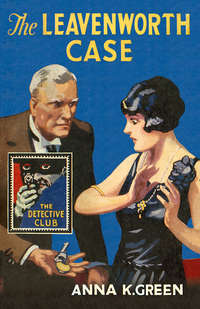
Читать книгу: «The Leavenworth Case»

Copyright
Published by COLLINS CRIME CLUB
An imprint of HarperCollinsPublishers Ltd
1 London Bridge Street
London SE1 9GF
www.harpercollins.co.uk
First published by G.P. Putnam’s Sons 1878
Published by The Detective Story Club for Wm Collins Sons & Co. Ltd 1929
Introduction © John Curran 2016
Cover design © HarperCollinsPublishers Ltd 1929, 2016
A catalogue copy of this book is available from the British Library.
This novel is entirely a work of fiction. The names, characters and incidents portrayed in it are the work of the author’s imagination. Any resemblance to actual persons, living or dead, events or localities is entirely coincidental.
All rights reserved under International and Pan-American Copyright Conventions. By payment of the required fees, you have been granted the non-exclusive, non-transferable right to access and read the text of this e-book on screen. No part of this text may be reproduced, transmitted, down-loaded, decompiled, reverse engineered, or stored in or introduced into any information storage and retrieval system, in any form or by any means, whether electronic or mechanical, now known or hereinafter invented, without the express written permission of HarperCollins.
Source ISBN: 9780008137595
Ebook Edition © August 2016 ISBN: 9780008137601
Version: 2016-06-22
Table of Contents
Cover
Title Page
Copyright
Introduction
Book One: The Problem
Chapter I: ‘a Great Case’
Chapter II: The Coroner’s Inquest
Chapter III: Facts and Deductions
Chapter IV: A Clue
Chapter V: Expert Testimony
Chapter VI: Side-Lights
Chapter VII: Mary Leavenworth
Chapter VIII: Circumstantial Evidence
Chapter IX: A Discovery
Chapter X: Mr Gryce Receives New Impetus
Chapter XI: The Summons
Chapter XII: Eleanore
Chapter XIII: The Problem
Book Two: Henry Clavering
Chapter XIV: Mr Gryce at Home
Chapter XV: Ways Opening
Chapter XVI: The Will of a Millionaire
Chapter XVII: The Beginning of Great Surprises
Chapter XVIII: On the Stairs
Chapter XIX: In My Office
Chapter XX: ‘Trueman! Trueman! Trueman!’
Chapter XXI: A Prejudice
Chapter XXII: Patch-Work
Chapter XXIII: The Story of a Charming Woman
Chapter XXIV: A Report Followed by Smoke
Chapter XXV: Timothy Cook
Chapter XXVI: Mr Gryce Explains Himself
Book Three: Hannah
Chapter XXVII: Amy Belden
Chapter XXVIII: A Weird Experience
Chapter XXIX: The Missing Witness
Chapter XXX: Burned Paper
Chapter XXXI: Q
Chapter XXXII: Mrs Belden’s Narrative
Chapter XXXIII: Unexpected Testimony
Book Four: The Problem Solved
Chapter XXXIV: Mr Gryce Resumes Control
Chapter XXXV: Fine Work
Chapter XXXVI: Gathered Threads
Chapter XXXVII: Culmination
Chapter XXXVIII: A Full Confession
Chapter XXXIX: The Outcome of a Great Crime
Footnotes
The Detective Story Club
About the Publisher
INTRODUCTION
NOT ONLY was Anna Katharine Green (1846–1935) the first woman to write a detective novel—thereby earning the soubriquet ‘The Mother of Detective Fiction’—but she also included in it many themes and ideas that later became commonplace in the genre.fn1 And as further proof of her importance in the development of detective fiction she also introduced, later in her career, two distinct ‘types’ of detective, each very different, each contributing to an emerging form; and each much copied in the years that followed.
Born into a well-to-do family in New York’s Brooklyn Heights, Anna Catherinefn2 Green was raised, on the death of her mother, by a stepmother who encouraged Anna’s interest in writing. After graduating with a B.A. from Ripley College in Vermont in 1866—an impressive achievement for a woman at that time—she submitted some poems to the eminent American poet Ralph Waldo Emerson. He encouraged her to continue writing, but advised her to abandon poetry. Green, fearing that her lawyer father would not approve of novel-writing, began, in secret, to write a detective novel. When, on its completion, she did show it to him, he was sufficiently impressed—possibly because of the novel’s significant legal content—to arrange for a well-known critic to bring it to the attention of publisher George Putnam. The Leavenworth Case: A Lawyer’s Story was published in the US in 1878 and in the UK the following year. It was an immediate success and marked the beginning of a prolific writing career.
Appearing almost half a century before the heyday of the Golden Age, The Leavenworth Case embodies many of that era’s distinctive features. Ebenezer Gryce, described by himself as ‘a professional detective’, and one who would feature in a dozen novels over the following thirty years, investigates the murder, in his New York home, of wealthy Horatio Leavenworth. The reader is presented with the body in the locked library, a victim on the point of changing his will, a floor-plan of the murder scene, a coroner’s inquest with medical and ballistic evidence, and a second death. We encounter a lawyer-narrator, Everett Raymond, with a romantic interest in the outcome of the case, a butler, a secret marriage, an initialled handkerchief, a second floor-plan, and that device beloved of many later Golden Age writers: a numbered listing of significant points. All of these are instantly recognisable from hundreds of detective novels over the following century.
Ebenezer Gryce is described as ‘a portly, comfortable personage with an eye that never pounced’. Unlike the gimlet eye of many detectives, his rarely rested on the person he addressed but ‘was always on some insignificant object in [the] vicinity’, variously described as being ‘on intimate terms with the door-knob’ or as ‘fixing his eyes upon the poker though not with any hostile intention’. Distinct from many investigators, Gryce does not dominate or draw attention to himself and this unpretentiousness makes him a character with which readers can identify. He is self-made, self-effacing, unencumbered by family and uncomfortable in the presence of members of the upper-class; and he is a rheumatism sufferer. All of which goes some way to explain why he is rarely listed among the Great Detectives.
Viewed from today’s perspective the novel can be considered somewhat over-written and, in certain passages, sentimental. The narrator rhapsodises a shade too much over the beauty of the two main suspects; said suspects are given to fainting conveniently, and vital evidence is delayed in the interests of gallantry. But none of this should deter the reader who relishes a well-constructed plot with an unequivocal emphasis on ‘Whodunit’. And throughout the novel facts are fairly offered to the reader—the Book I inquest is a model of legal and forensic presentation—with inferences drawn from these facts. Particularly impressive also are the discussions of, and deductions drawn from, letters in Books II and IV.
The significance of Green and The Leavenworth Case can be judged by the interest shown by two eminent contemporary practitioners of the form: Arthur Conan Doyle, with whom Green had corresponded, made a point of meeting her when he visited America in 1894; and writing in The Critic on 28 January 1893, Wilkie Collins, author of the ground-breaking The Moonstone (1868), admired both the plot and the manner of its telling:
‘[Green’s] powers of invention are so remarkable—she has so much imagination and so much belief (a most important qualification for our art) in what she says … Dozens of times in reading the story I have stopped to admire the fertility of invention, the delicate treatment of incident—and the fine perception of event on the personages of the story.’
If the creator of Sherlock Holmes and the pioneer of the detective novel are not two impressive enough advocates for Green’s reputation, then the discovery that Agatha Christie was an admirer surely is. Before embarking on her first book, The Mysterious Affair at Styles, she had read little detective fiction but records in An Autobiography (1977) how much she had enjoyed the Sherlock Holmes stories—then still appearing intermittently in the Strand Magazine—as well as two influential novels: The Mystery of the Yellow Room (1908) by Gaston Leroux (1868–1927) and The Leavenworth Case. Although she mis-spells the title of Green’s novel, its influence on Christie’s early work is evident in the adoption, and adaptation, of many of its elements; elements which would become synonymous with the detective novel during the imminent Golden Age of Detective Fiction.
If we amend ‘locked library in New York’ to ‘locked bedroom in Essex’ the influence of Green’s novel on The Mysterious Affair at Styles is clear: an upper-class domestic setting, a lovelorn male narrator who also acts as the detective’s helper, a wealthy victim, a contentious will, a limited circle of suspects, the inclusion of a floor-plan and the plot device of an incriminating document; furthermore, the method adopted by the killer to conceal that document is identical in Leavenworth and Styles. More than forty years later, during his investigation of The Clocks (1963), Hercule Poirot, musing over milestone titles of detective fiction, comments on The Leavenworth Case’s ‘studied and deliberate melodrama’, noting particularly ‘the excellent psychological study’ of the murderer and calling the book ‘admirable’ overall. And if that’s the opinion of Hercule Poirot, who are we to disagree?
Anna Katharine Green continued to write for the next forty years, producing over thirty novels and five short story collections. In 1897, at which stage she had published fourteen novels and one collection, she introduced the spinster detective Amelia Butterworth, narrator of That Affair Next Door. When a young woman with a face battered beyond recognition is found in the neighbouring house, Amelia joins forces (unofficially) with Leavenworth’s Gryce to solve the mystery. Their collaboration is initially antagonistic and it is not until they compare notes that they successfully solve the case. Amelia Butterworth, the earliest example of the elderly female detective, the meddlesome amateur with time on her hands and curiosity on her mind, appeared in two further novels.
Almost twenty years later, in The Golden Slipper (1915) Green introduced, in a series of linked short stories, yet another detective: the young, professional female. Violet Strange is not merely a younger version of Amelia Butterworth; she is a detective through necessity. Although from a privileged background Violet needs money (for a purpose not disclosed until her last adventure, ‘Violet’s Own’) and undertakes professional detection for a fee. Although many of her cases are concerned with theft or missing valuables some (e.g. ‘The Second Bullet’) involve the investigation of a mysterious death. Like most of Green’s output the setting is among the privileged classes, a milieu through which Violet can move with ease and conviction.
In 1884 Green married Charles Rohlfs, an actor—he collaborated with her in the stage dramatisation of The Leavenworth Case in 1891—and, later, a highly respected furniture designer. The couple had three children, two of whom tragically pre-deceased them. Green published her final novel, The Step on the Stair, in 1923. She died in New York on 11 April 1935; Charles died in June 1936.
The Leavenworth Case was filmed as a silent movie directed by Charles Giblyn in 1923, and was remade as a more lavish ‘talkie’ by Lewis D. Collins, released in 1936. A different ending to the American release had to be filmed to satisfy the British film censors, leaving UK viewers somewhat bemused at the illogical change of identity of the killer at the end of the film. Both versions of the 1936 black-and-white film survive, although the only known US print is sadly incomplete, having been heavily re-edited for television in the 1950s.
The contribution of Anna Katharine Green to the development of detective fiction is immense, and The Leavenworth Case was an obvious choice for inclusion in the first batch of Detective Story Club classics in 1929. The book showed, as Wilkie Collins noted, impressive ‘fertility of invention’ in a well-constructed and well-paced story, full of much that subsequently became commonplace in the genre. Her creation of two types of female detective paved the way for countless followers. Green, a pioneer in a genre that would later come to be dominated by women, was, indeed, ‘The Mother of Detective Fiction’.
DR JOHN CURRAN
December 2015
BOOK ONE
CHAPTER I
‘A GREAT CASE’
‘A deed of dreadful note.’
—MACBETH
I HAD been a junior partner in the firm of Veeley, Carr & Raymond, attorneys and counsellors at law, for about a year, when one morning, in the temporary absence of both Mr Veeley and Mr Carr, there came into our office a young man whose whole appearance was so indicative of haste and agitation that I involuntarily rose at his approach and impetuously inquired:
‘What is the matter? You have no bad news to tell, I hope.’
‘I have come to see Mr Veeley; is he in?’
‘No,’ I replied; ‘he was unexpectedly called away this morning to Washington; cannot be home before tomorrow; but if you will make your business known to me—’
‘To you, sir?’ he repeated, turning a very cold but steady eye on mine; then, seeming to be satisfied with his scrutiny, continued, ‘There is no reason why I shouldn’t; my business is no secret. I came to inform him that Mr Leavenworth is dead.’
‘Mr Leavenworth!’ I exclaimed, falling back a step. Mr Leavenworth was an old client of our firm, to say nothing of his being the particular friend of Mr Veeley.
‘Yes, murdered; shot through the head by some unknown person while sitting at his library table.’
‘Shot! Murdered!’ I could scarcely believe my ears.
‘How? When?’ I gasped.
‘Last night. At least, so we suppose. He was not found till this morning. I am Mr Leavenworth’s private secretary,’ he explained, ‘and live in the family. It was a dreadful shock,’ he went on, ‘especially to the ladies.’
‘Dreadful!’ I repeated. ‘Mr Veeley will be overwhelmed by it.’
‘They are all alone,’ he continued in a low business-like way I afterwards found to be inseparable from the man; ‘the Misses Leavenworth, I mean—Mr Leavenworth’s nieces; and as an inquest is to be held there today it is deemed proper for them to have someone present capable of advising them. As Mr Veeley was their uncle’s best friend, they naturally sent me for him; but he being absent I am at a loss what to do or where to go.’
‘I am a stranger to the ladies,’ was my hesitating reply, ‘but if I can be of any assistance to them, my respect for their uncle is such—’
The expression of the secretary’s eye stopped me. Without seeming to wander from my face, its pupil had suddenly dilated till it appeared to embrace my whole person with its scope.
‘I don’t know,’ he finally remarked, a slight frown, testifying to the fact that he was not altogether pleased with the turn affairs were taking. ‘Perhaps it would be best. The ladies must not be left alone—’
‘Say no more; I will go.’ And, sitting down, I despatched a hurried message to Mr Veeley, after which, and the few other preparations necessary, I accompanied the secretary to the street.
‘Now,’ said I, ‘tell me all you know of this frightful affair.’
‘All I know? A few words will do that. I left him last night sitting as usual at his library table, and found him this morning, seated in the same place, almost in the same position, but with a bullet-hole in his head as large as the end of my little finger.’
‘Dead?’
‘Stone-dead.’
‘Horrible!’ I exclaimed. Then, after a moment, ‘Could it have been a suicide?’
‘No. The pistol with which the deed was committed is not to be found.’
‘But if it was a murder, there must have been some motive. Mr Leavenworth was too benevolent a man to have enemies, and if robbery was intended—’
‘There was no robbery. There is nothing missing,’ he again interrupted. ‘The whole affair is a mystery.’
‘A mystery?’
‘An utter mystery.’
Turning, I looked at my informant curiously. The inmate of a house in which a mysterious murder had occurred was rather an interesting object. But the good-featured and yet totally unimpressive countenance of the man beside me offered but little basis for even the wildest imagination to work upon, and, glancing almost immediately away, I asked:
‘Are the ladies very much overcome?’
He took at least a half-dozen steps before replying.
‘It would be unnatural if they were not.’ And whether it was the expression of his face at the time, or the nature of the reply itself, I felt that in speaking of these ladies to this uninteresting, self-possessed secretary of the late Mr Leavenworth, I was somehow treading upon dangerous ground. As I had heard they were very accomplished women, I was not altogether pleased at this discovery. It was, therefore, with a certain consciousness of relief I saw a Fifth Avenue stage approach.
‘We will defer our conversation,’ said I. ‘Here’s the stage.’
But, once seated within it, we soon discovered that all intercourse upon such a subject was impossible. Employing the time, therefore, in running over in my mind what I knew of Mr Leavenworth, I found that my knowledge was limited to the bare fact of his being a retired merchant of great wealth and fine social position who, in default of possessing children of his own, had taken into his home two nieces, one of whom had already been declared his heiress. To be sure, I had heard Mr Veeley speak of his eccentricities, giving as an instance this very fact of his making a will in favour of one niece to the utter exclusion of the other; but of his habits of life and connection with the world at large, I knew little or nothing.
There was a great crowd in front of the house when we arrived there, and I had barely time to observe that it was a corner dwelling of unusual depth when I was seized by the throng and carried quite to the foot of the broad stone steps. Extricating myself, though with some difficulty, owing to the importunities of a boot-black and butcher-boy, who seemed to think that by clinging to my arms they might succeed in smuggling themselves into the house, I mounted the steps and, finding the secretary, by some unaccountable good fortune, close to my side, hurriedly rang the bell. Immediately the door opened, and a face I recognised as that of one of our city detectives appeared in the gap.
‘Mr Gryce!’ I exclaimed.
‘The same,’ he replied. ‘Come in, Mr Raymond.’ And drawing us quietly into the house, he shut the door with a grim smile on the disappointed crowd without. ‘I trust you are not surprised to see me here,’ said he, holding out his hand, with a side glance at my companion.
‘No,’ I returned. Then, with a vague idea that I ought to introduce the young man at my side, continued: ‘This is Mr—, Mr—, excuse me, but I do not know your name,’ I said inquiringly to my companion. ‘The private secretary of the late Mr Leavenworth,’ I hastened to add.
‘Oh,’ he returned, ‘the secretary! The coroner has been asking for you, sir.’
‘The coroner is here, then?’
‘Yes; the jury have just gone upstairs to view the body; would you like to follow them?’
‘No, it is not necessary. I have merely come in the hope of being of some assistance to the young ladies. Mr Veeley is away.’
‘And you thought the opportunity too good to be lost,’ he went on; ‘just so. Still, now that you are here, and as the case promises to be a marked one, I should think that, as a rising young lawyer, you would wish to make yourself acquainted with it in all its details. But follow your own judgment.’
I made an effort and overcame my repugnance. ‘I will go,’ said I.
‘Very well, then, follow me.’
But just as I set foot on the stairs I heard the jury descending, so, drawing back with Mr Gryce into a recess between the reception room and the parlour, I had time to remark:
‘The young man says it could not have been the work of a burglar.’
‘Indeed!’ fixing his eye on a door-knob nearby.
‘That nothing has been found missing—’
‘And that the fastenings to the house were all found secure this morning; just so.’
‘He did not tell me that. In that case’—and I shuddered—‘the murderer must have been in the house all night.’
Mr Gryce smiled darkly at the door-knob.
‘It has a dreadful look!’ I exclaimed.
Mr Gryce immediately frowned at the door-knob.
And here let me say that Mr Gryce, the detective, was not the thin, wiry individual with the piercing eye you are doubtless expecting to see. On the contrary, Mr Gryce was a portly, comfortable personage with an eye that never pierced, that did not even rest on you. If it rested anywhere, it was always on some insignificant object in the vicinity, some vase, inkstand, book, or button. These things he would seem to take into his confidence, make the repositories of his conclusions; but as for you—you might as well be the steeple on Trinity Church, for all connection you ever appeared to have with him or his thoughts. At present, then, Mr Gryce was, as I have already suggested, on intimate terms with the door-knob.
‘A dreadful look,’ I repeated.
His eye shifted to the button on my sleeve.
‘Come,’ he said, ‘the coast is clear at last.’
Leading the way, he mounted the stairs, but stopped on the upper landing. ‘Mr Raymond,’ said he, ‘I am not in the habit of talking much about the secrets of my profession, but in this case everything depends upon getting the right clue at the start. We have no common villainy to deal with here; genius has been at work. Now sometimes an absolutely uninitiated mind will intuitively catch at something which the most highly trained intellect will miss. If such a thing should occur, remember that I am your man. Don’t go round talking, but come to me. For this is going to be a great case, mind you, a great case. Now, come on.’
‘But the ladies?’
‘They are in the rooms above; in grief, of course, but tolerably composed for all that, I hear.’ And advancing to a door, he pushed it open and beckoned me in.
All was dark for a moment, but presently, my eyes becoming accustomed to the place, I saw that we were in the library.
‘It was here he was found,’ said he; ‘in this room and upon this very spot.’ And advancing, he laid his hand on the end of a large baize-covered table that, together with its attendant chairs, occupied the centre of the room. ‘You see for yourself that it is directly opposite this door,’ and, crossing the floor, he paused in front of the threshold of a narrow passageway, opening into a room beyond.

‘As the murdered man was discovered sitting in this chair, and consequently with his back towards the passageway, the assassin must have advanced through the doorway to deliver his shot, pausing, let us say, about here.’ And Mr Gryce planted his feet firmly upon a certain spot in the carpet, about a foot from the threshold before mentioned.
‘But—’ I hastened to interpose.
‘There is no room for “but”,’ he cried. ‘We have studied the situation.’ And without deigning to dilate upon the subject, he turned immediately about and, stepping swiftly before me, led the way into the passage named. ‘Wine closet, clothes closet, washing apparatus, towel-rack,’ he explained, waving his hand from side to side as we hurried through, finishing with ‘Mr Leavenworth’s private apartment,’ as that room of comfortable aspect opened upon us.
Mr Leavenworth’s private apartment! It was here then that it ought to be, the horrible, blood-curdling it that yesterday was a living, breathing man. Advancing to the bed that was hung with heavy curtains, I raised my hand to put them back, when Mr Gryce, drawing them from my clasp, disclosed lying upon the pillow a cold, calm face looking so natural I involuntarily started.
‘His death was too sudden to distort the features,’ he remarked, turning the head to one side in a way to make visible a ghastly wound in the back of the cranium. ‘Such a hole as that sends a man out of the world without much notice. The surgeon will convince you it could never have been inflicted by himself. It is a case of deliberate murder.’
Horrified, I drew hastily back, when my glance fell upon a door situated directly opposite me in the side of the wall towards the hall. It appeared to be the only outlet from the room, with the exception of the passage through which we had entered, and I could not help wondering if it was through this door the assassin had entered on his roundabout course to the library. But Mr Gryce, seemingly observant of my glance, though his own was fixed upon the chandelier, made haste to remark, as if in reply to the inquiry in my face:
‘Found locked on the inside; may have come that way and may not; we don’t pretend to say.’
Observing now that the bed was undisturbed in its arrangement, I remarked, ‘He had not retired, then?’
‘No; the tragedy must be ten hours old. Time for the murderer to have studied the situation and provided for all contingencies.’
‘The murderer? Whom do you suspect?’ I whispered.
He looked impassively at the ring on my finger.
‘Everyone and nobody. It is not for me to suspect, but to detect.’ And dropping the curtain into its former position he led me from the room.
The coroner’s inquest being now in session, I felt a strong desire to be present, so, requesting Mr Gryce to inform the ladies that Mr Veeley was absent from town, and that I had come as his substitute, to render them any assistance they might require on so melancholy an occasion, I proceeded to the large parlour below, and took my seat among the various persons there assembled.
CHAPTER II
THE CORONER’S INQUEST
‘The baby figure of the giant mass
Of things to come.’
—TROILUS AND CRESSIDA
FOR a few minutes I sat dazed by the sudden flood of light greeting me from the many open windows; then, as the strongly contrasting features of the scene before me began to impress themselves upon my consciousness, I found myself experiencing something of the same sensation of double personality which years before had followed an enforced use of ether. As at that time, I appeared to be living two lives at once: in two distinct places, with two separate sets of incidents going on; so now I seemed to be divided between two irreconcilable trains of thought; the gorgeous house, its elaborate furnishing, the little glimpses of yesterday’s life, as seen in the open piano, with its sheet of music held in place by a lady’s fan, occupying my attention fully as much as the aspect of the throng of incongruous and impatient people huddled about me.
Perhaps one reason of this lay in the extraordinary splendour of the room I was in; the glow of satin, glitter of bronze, and glimmer of marble meeting the eye at every turn. But I am rather inclined to think it was mainly due to the force and eloquence of a certain picture which confronted me from the opposite wall. A sweet picture—sweet enough and poetic enough to have been conceived by the most idealistic of artists: simple, too—the vision of a young flaxen-haired, blue-eyed coquette, dressed in the costume of the First Empire, standing in a wood-path, looking back over her shoulder at someone following—yet with such a dash of something not altogether saint-like in the corners of her meek eyes and baby-like lips, that it impressed me with the individuality of life. Had it not been for the open dress, with its waist almost beneath the armpits, the hair cut short on the forehead, and the perfection of the neck and shoulders, I should have taken it for a literal portrait of one of the ladies of the house. As it was, I could not rid myself of the idea that one, if not both, of Mr Leavenworth’s nieces looked down upon me from the eyes of this entrancing blonde with the beckoning glance and forbidding hand. So vividly did this fancy impress me that I half shuddered as I looked, wondering if this sweet creature did not know what had occurred in this house since the happy yesterday; and if so, how she could stand there smiling so invitingly—when suddenly I became aware that I had been watching the little crowd of men about me with as complete an absorption as if nothing else in the room had attracted my attention; that the face of the coroner, sternly intelligent and attentive, was as distinctly imprinted upon my mind as that of this lovely picture, or the clearer-cut and more noble features of the sculptured Psyche, shining in mellow beauty from the crimson-hung window at his right; yes, even that the various countenances of the jurymen clustered before me, commonplace and insignificant as most of them were; the trembling forms of the excited servants crowded into a far corner; and the still more disagreeable aspect of the pale-faced, seedy reporter, seated at a small table and writing with a ghoul-like avidity that made my flesh creep, were each and all as fixed an element in the remarkable scene before me as the splendour of the surroundings which made their presence such a nightmare of discord and unreality.
I have spoken of the coroner. As fortune would have it, he was no stranger to me. I had not only seen him before, but had held frequent conversation with him; in fact, knew him. His name was Hammond, and he was universally regarded as a man of more than ordinary acuteness, fully capable of conducting an important examination, with the necessary skill and address. Interested as I was, or rather was likely to be, in this particular inquiry, I could not but congratulate myself upon our good fortune in having so intelligent a coroner.
As for his jurymen, they were, as I have intimated, very much like all other bodies of a similar character. Picked up at random from the streets, but from such streets as the Fifth and Sixth Avenues, they presented much the same appearance of average intelligence and refinement as might be seen in the chance occupants of one of our city stages. Indeed, I marked but one amongst them all who seemed to take any interest in the inquiry as an inquiry; all the rest appearing to be actuated in the fulfilment of their duty by the commoner instincts of pity and indignation.
Dr Maynard, the well-known surgeon of Thirty-sixth Street, was the first witness called. His testimony concerned the nature of the wound found in the murdered man’s head. As some of the facts presented by him are likely to prove of importance to us in our narrative, I will proceed to give a synopsis of what he said.
Prefacing his remarks with some account of himself, and the manner in which he had been summoned to the house by one of the servants, he went on to state that, upon his arrival, he found the deceased lying on a bed in the second-storey front room, with the blood clotted about a pistol-wound in the back of the head; having evidently been carried there from the adjoining apartment some hours after death. It was the only wound discovered on the body, and having probed it, he had found and extracted the bullet which he now handed to the jury. It was lying in the brain, having entered at the base of the skull, passed obliquely upward, and at once struck the medulla oblongata, causing instant death. The fact of the ball having entered the brain in this peculiar manner he deemed worthy of note, since it would produce not only instantaneous death, but an utterly motionless one. Further, from the position of the bullet-hole and the direction taken by the bullet, it was manifestly impossible that the shot should have been fired by the man himself, even if the condition of the hair about the wound did not completely demonstrate the fact that the shot was fired from a point some three or four feet distant. Still further, considering the angle at which the bullet had entered the skull, it was evident that the deceased must not only have been seated at the time, a fact about which there could be no dispute, but he must also have been engaged in some occupation which drew his head forward. For, in order that a ball should enter the head of a man sitting erect at the angle seen here, of 45 degrees, it would be necessary, not only for the pistol to be held very low down, but in a peculiar position; while if the head had been bent forward, as in the act of writing, a man holding a pistol naturally with the elbow bent, might very easily fire a ball into the brain at the angle observed.
Upon being questioned in regard to the bodily health of Mr Leavenworth, he replied that the deceased appeared to have been in good condition at the time of his death, but that, not being his attendant physician, he could not speak conclusively upon the subject without further examination; and, to the remark of a juryman, observed that he had not seen pistol or weapon lying upon the floor, or, indeed, anywhere else in either of the above-mentioned rooms.
I might as well add here what he afterwards stated, that from the position of the table, the chair, and the door behind it, the murderer, in order to satisfy all the conditions imposed by the situation, must have stood upon, or just within, the threshold of the passageway leading into the room beyond. Also, that as the ball was small, and from a rifled barrel, and thus especially liable to deflections while passing through bones and integuments, it seemed to him evident that the victim had made no effort to raise or turn his head when advanced upon by his destroyer; the fearful conclusion being that the footstep was an accustomed one, and the presence of its possessor in the room either known or expected.
The physician’s testimony being ended, the coroner picked up the bullet which had been laid on the table before him, and for a moment rolled it contemplatively between his fingers; then, drawing a pencil from his pocket, hastily scrawled a line or two on a piece of paper and, calling an officer to his side, delivered some command in a low tone. The officer, taking up the slip, looked at it for an instant knowingly, then catching up his hat left the room. Another moment, and the front door closed on him, and a wild halloo from the crowd of urchins without told of his appearance in the street. Sitting where I did, I had a full view of the corner. Looking out, I saw the officer stop there, hail a cab, hastily enter it, and disappear in the direction of Broadway.
CHAPTER III
FACTS AND DEDUCTIONS
‘Confusion now hath made his master-piece;
Most sacrilegious murder hath broke ope
The Lord’s anointed temple, and stolen thence
The life of the building.’
—MACBETH
TURNING my attention back into the room where I was, I found the coroner consulting a memorandum through a very impressive pair of gold eye-glasses.
‘Is the butler here?’ he asked.
Immediately there was a stir among the group of servants in the corner, and an intelligent-looking, though somewhat pompous, Irishman stepped out from their midst and confronted the jury. ‘Ah,’ thought I to myself, as my glance encountered his precise whiskers, steady eye, and respectfully attentive, though by no means humble, expression, ‘here is a model servant, who is likely to prove a model witness.’ And I was not mistaken; Thomas, the butler, was in all respects one in a thousand—and he knew it.
The coroner, upon whom, as upon all others in the room, he seemed to have made the like favourable impression, proceeded without hesitation to interrogate him.
‘Your name, I am told, is Thomas Dougherty?’
‘Yes, sir.’
‘Well, Thomas, how long have you been employed in your present situation?’
‘It must be a matter of two years now, sir.’
‘You are the person who first discovered the body of Mr Leavenworth?’
‘Yes, sir; I and Mr Harwell.’
‘And who is Mr Harwell?’
‘Mr Harwell is Mr Leavenworth’s private secretary, sir; the one who did his writing.’
‘Very good. Now at what time of the day or night did you make this discovery?’
‘It was early, sir; early this morning, about eight.’
‘And where?’
‘In the library, sir, off Mr Leavenworth’s bedroom. We had forced our way in, feeling anxious about his not coming to breakfast.’
‘You forced your way in; the door was locked, then?’
‘Yes, sir.’
‘On the inside?’
‘That I cannot tell; there was no key in the door.’
‘Where was Mr Leavenworth lying when you first found him?’
‘He was not lying, sir. He was seated at the large table in the centre of his room, his back to the bedroom door, leaning forward, his head on his hands.’
‘How was he dressed?’
‘In his dinner suit, sir, just as he came from the table last night.’
‘Were there any evidences in the room that a struggle had taken place?’
‘No, sir.’
‘Any pistol on the floor or table?’
‘No, sir.’
‘Any reason to suppose that robbery had been attempted?’
‘No, sir. Mr Leavenworth’s watch and purse were both in his pockets.’
Being asked to mention who were in the house at the time of the discovery, he replied, ‘The young ladies, Miss Mary Leavenworth and Miss Eleanore, Mr Harwell, Kate the cook, Molly the upstairs girl, and myself.’
‘The usual members of the household?’
‘Yes, sir.’
‘Now tell me whose duty it is to close up the house at night.’
‘Mine, sir.’
‘Did you secure it as usual, last night?’
‘I did, sir.’
‘Who unfastened it this morning?’
‘I, sir.’
‘How did you find it?’
‘Just as I left it.’
‘What, not a window open nor a door unlocked?’
‘No, sir.’
By this time you could have heard a pin drop. The certainty that the murderer, whoever he was, had not left the house, at least till after it was opened in the morning, seemed to weigh upon all minds. Forewarned as I had been of the fact, I could not but feel a certain degree of emotion at having it thus brought before me; and, moving so as to bring the butler’s face within view, searched it for some secret token that he had spoken thus emphatically in order to cover up some failure of duty on his own part. But it was unmoved in its candour, and sustained the concentrated gaze of all in the room like a rock.
Being now asked when he had last seen Mr Leavenworth alive, he replied, ‘At dinner last night.’
‘He was, however, seen later by some of you?’
‘Yes, sir; Mr Harwell says he saw him as late as half-past ten in the evening.’
‘What room do you occupy in this house?’
‘A little one on the basement floor.’
‘And where do the other members of the household sleep?’
‘Mostly on the third floor, sir; the ladies in the large back rooms, and Mr Harwell in the little one in front. The girls sleep above.’
‘There was no one on the same floor with Mr Leavenworth?’
‘No, sir.’
‘At what hour did you go to bed?’
‘Well, I should say about eleven.’
‘Did you hear any noise in the house either before or after that time, that you remember?’
‘No, sir.’
‘So that the discovery you made this morning was a surprise to you?’
‘Yes, sir.’
Requested now to give a more detailed account of that discovery, he went on to say it was not till Mr Leavenworth failed to come to his breakfast at the call of the bell that any suspicion arose in the house that all was not right. Even then they waited some little time before doing anything, but as minute after minute went by and he did not come, Miss Eleanore grew anxious, and finally left the room saying she would go and see what was the matter, but soon returned looking very much frightened, saying she had knocked at her uncle’s door, and had even called to him, but could get no answer. At which Mr Harwell and himself had gone up and together tried both doors, and, finding them locked, burst open that of the library, when they came upon Mr Leavenworth, as he had already said, sitting at the table, dead.
‘And the ladies?’
‘Oh, they followed us up and came into the room and Miss Eleanore fainted away.’
‘And the other one—Miss Mary, I believe they call her?’
‘I don’t remember anything about her; I was so busy fetching water to restore Miss Eleanore, I didn’t notice.’
‘Well, how long was it before Mr Leavenworth was carried into the next room?’
‘Almost immediate, as soon as Miss Eleanore recovered, and that was as soon as ever the water touched her lips.’
‘Who proposed that the body should be carried from the spot?’
‘She, sir. As soon as ever she stood up she went over to it and looked at it and shuddered, and then calling Mr Harwell and me, bade us carry him in and lay him on the bed and go for the doctor, which we did.’
‘Wait a moment; did she go with you when you went into the other room?’
‘No, sir.’
‘What did she do?’
‘She stayed by the library table.’
‘What doing?’
‘I couldn’t see; her back was to me.’
‘How long did she stay there?’
‘She was gone when we came back.’
‘Gone from the table?’
‘Gone from the room.’
‘Humph! When did you see her again?’
‘In a minute. She came in at the library door as we went out.’
‘Anything in her hand?’
‘Not as I see.’
‘Did you miss anything from the table?’
‘I never thought to look, sir. The table was nothing to me. I was only thinking of going for the doctor, though I knew it was of no use.’
‘Whom did you leave in the room when you went out?’
‘The cook, sir, and Molly, sir, and Miss Eleanore.’
‘Not Miss Mary?’
‘No, sir.’
‘Very well. Have the jury any questions to put to this man?’
A movement at once took place in that profound body.
‘I should like to ask a few,’ exclaimed a weazen-faced, excitable little man whom I had before noticed shifting in his seat in a restless manner strongly suggestive of an intense but hitherto repressed desire to interrupt the proceedings.
‘Very well, sir,’ returned Thomas.
But the juryman stopping to draw a deep breath, a large and decidedly pompous man who sat at his right hand seized the opportunity to inquire in a round, listen-to-me sort of voice:
‘You say you have been in the family for two years. Was it what you might call a united family?’
‘United?’
‘Affectionate, you know—on good terms with each other.’ And the juryman lifted the very long and heavy watch-chain that hung across his vest as if that as well as himself had a right to a suitable and well-considered reply.
The butler, impressed perhaps by his manner, glanced uneasily around. ‘Yes, sir, so far as I know.’
‘The young ladies were attached to their uncle?’
‘Oh yes, sir.’
‘And to each other?’
‘Well, yes, I suppose so; it’s not for me to say.’
‘You suppose so. Have you any reason to think otherwise?’ And he doubled the watch-chain about his fingers as if he would double its attention as well as his own.
Thomas hesitated a moment. But just as his interlocutor was about to repeat his question, he drew himself up into a rather stiff and formal attitude and replied:
‘Well, sir, no.’
The juryman, for all his self-assertion, seemed to respect the reticence of a servant who declined to give his opinion in regard to such a matter, and drawing complacently back, signified with a wave of his hand that he had no more to say.
Immediately the excitable little man, before mentioned, slipped forward to the edge of his chair and asked, this time without hesitation: ‘At what time did you unfasten the house this morning?’
‘About six, sir.’
‘Now, could anyone leave the house after that time without your knowledge?’
Thomas glanced a trifle uneasily at his fellow servants, but answered up promptly and as if without reserve:
‘I don’t think it would be possible for anybody to leave this house after six in the morning without either myself or the cook’s knowing of it. Folks don’t jump from second-storey windows in broad daylight, and as to leaving by the doors, the front door closes with such a slam all the house can hear it from top to bottom, and as for the back door, no one that goes out of that can get clear of the yard without going by the kitchen window, and no one can go by our kitchen window without the cook’s a-seeing of them, that I can just swear to.’ And he cast a half-quizzing, half-malicious look at the round, red-faced individual in question, strongly suggestive of late and unforgotten bickerings over the kitchen coffee-urn and castor.
This reply, which was of a nature calculated to deepen the forebodings which had already settled upon the minds of those present, produced a visible effect. The house found locked, and no one seen to leave it! Evidently, then, we had not far to look for the assassin.
Shifting on his chair with increased fervour, if I may so speak, the juryman glanced sharply around. But perceiving the renewed interest in the faces about him, declined to weaken the effect of the last admission, by any further questions. Settling, therefore, comfortably back, he left the field open for any other juror who might choose to press the inquiry. But no one seeming to be ready to do this, Thomas in his turn evinced impatience, and at last, looking respectfully around, inquired:
‘Would any other gentleman like to ask me anything?’
No one replying, he threw a hurried glance of relief towards the servants at his side, then, while each one marvelled at the sudden change that had taken place in his countenance, withdrew with an eager alacrity and evident satisfaction for which I could not at the moment account.
But the next witness proving to be none other than my acquaintance of the morning, Mr Harwell, I soon forgot both Thomas and the doubts his last movement had awakened, in the interest which the examination of so important a person as the secretary and right-hand man of Mr Leavenworth was likely to create.
Advancing with the calm and determined air of one who realised that life and death itself might hang upon his words, Mr Harwell took his stand before the jury with a degree of dignity not only highly prepossessing in itself, but to me, who had not been over and above pleased with him in our first interview, admirable and surprising. Lacking, as I have said, any distinctive quality of face or form agreeable or otherwise—being what you might call in appearance a negative sort of person, his pale, regular features, dark, well-smoothed hair and simple whiskers, all belonging to a recognised type and very commonplace—there was still visible, on this occasion at least, a certain self-possession in his carriage, which went far towards making up for the want of impressiveness in his countenance and expression. Not that even this was in any way remarkable. Indeed, there was nothing remarkable about the man, any more than there is about a thousand others you meet every day on Broadway, unless you except the look of concentration and solemnity which pervaded his whole person; a solemnity which at this time would not have been noticeable, perhaps, if it had not appeared to be the habitual expression of one who in his short life had seen more of sorrow than joy, less of pleasure than care and anxiety.
The coroner, to whom his appearance one way or the other seemed to be a matter of no moment, addressed him immediately and without reserve:
‘Your name?’
‘James Trueman Harwell.’
‘Your business?’
‘I have occupied the position of private secretary and amanuensis to Mr Leavenworth for the past eight months.’
‘You are the person who last saw Mr Leavenworth alive, are you not?’
The young man raised his head with a haughty gesture which well-nigh transfigured it.
‘Certainly not, as I am not the man who killed him.’
This answer, which seemed to introduce something akin to levity or badinage into an examination the seriousness of which we were all beginning to realise, produced an immediate revulsion of feeling toward the man who, in face of facts revealed and to be revealed, could so lightly make use of it. A hum of disapproval swept through the room, and in that one remark, James Harwell lost all that he had previously won by the self-possession of his bearing and the unflinching regard of his eye. He seemed himself to realise this, for he lifted his head still higher, though his general aspect remained unchanged.
‘I mean,’ the coroner exclaimed, evidently nettled that the young man had been able to draw such a conclusion from his words, ‘that you were the last one to see him previous to his assassination by some unknown individual?’
The secretary folded his arms, whether to hide a certain tremble which had seized him, or by that simple action to gain time for a moment’s further thought, I could not then determine. ‘Sir,’ he replied at length, ‘I cannot answer yes or no to that question. In all probability I was the last to see him in good health and spirits, but in a house as large as this I cannot be sure of even so simple a fact as that.’ Then, observing the unsatisfied look on the faces around, added slowly, ‘It is my business to see him late.’
‘Your business? Oh, as his secretary, I suppose?’
He gravely nodded.
‘Mr Harwell,’ the coroner went on, ‘the office of private secretary in this country is not a common one. Will you explain to us what your duties were in that capacity; in short, what use Mr Leavenworth had for such an assistant and how he employed you?’
‘Certainly. Mr Leavenworth was, as you perhaps know, a man of great wealth. Connected with various societies, clubs, institutions, etc., besides being known far and near as a giving man, he was accustomed every day of his life to receive numerous letters, begging and otherwise, which it was my business to open and answer, his private correspondence always bearing a mark upon it which distinguished it from the rest. But this was not all I was expected to do. Having in his early life been engaged in the tea-trade, he had made more than one voyage to China, and was consequently much interested in the question of international communication between that country and our own. Thinking that in his various visits there, he had learned much which, if known to the American people, would conduce to our better understanding of the nation, its peculiarities, and the best manner of dealing with it, he has been engaged for some time in writing a book on the subject, which same it has been my business for the last eight months to assist him in preparing, by writing at his dictation three hours out of the twenty-four, the last hour being commonly taken from the evening, say from half-past nine to half-past ten, Mr Leavenworth being a very methodical man and accustomed to regulate his own life and that of those about him with almost mathematical precision.’
‘You say you were accustomed to write at his dictation evenings? Did you do this as usual last evening?’
‘I did, sir.’
‘What can you tell us of his manner and appearance at the time? Were they in any way unusual?’
A frown crossed the secretary’s brow.
‘As he probably had no premonition of his doom, why should there have been any change in his manner?’
This giving the coroner an opportunity to revenge himself for his discomfiture of a moment before, he said somewhat severely:
‘It is the business of a witness to answer questions, not to put them.’
The secretary flushed and the account stood even.
‘Very well, then, sir; if Mr Leavenworth felt any forebodings of his end, he did not reveal them to me. On the contrary, he seemed to be more absorbed in his work than usual. One of the last words he said to me was, “In a month we will have this book in press, eh, Trueman?” I remember this particularly, as he was filling his wine-glass at the time. He always drank one glass of wine before retiring, it being my duty to bring the decanter of sherry from the closet the last thing before leaving him. I was standing with my hand on the knob of the hall-door, but advanced as he said this and replied, “I hope so, indeed, Mr Leavenworth.” “Then join me in drinking a glass of sherry,” said he, motioning me to procure another glass from the closet. I did so, and he poured me out the wine with his own hand. I am not especially fond of sherry, but the occasion was a pleasant one and I drained my glass. I remember being slightly ashamed of doing so, for Mr Leavenworth set his down half full. It was half full when we found him this morning.’
Do what he would, and being a reserved man he appeared anxious to control his emotion, the horror of his first shock seemed to overwhelm him here. Pulling his handkerchief from his pocket, he wiped his forehead. ‘Gentlemen, that is the last action of Mr Leavenworth I ever saw. As he set the glass down on the table, I said good-night to him and left the room.’
The coroner, with a characteristic imperviousness to all expressions of emotion, leaned back and surveyed the young man with a scrutinising glance. ‘And where did you go then?’ he asked.
‘To my own room.’
‘Did you meet anybody on the way?’
‘No, sir.’
‘Hear anything or see anything unusual?’
The secretary’s voice fell a trifle. ‘No, sir.’
‘Mr Harwell, think again. Are you ready to swear that you neither met anybody, heard anybody, nor saw anything which lingers yet in your memory as unusual?’
His face grew quite distressed. Twice he opened his lips to speak, and as often closed them without doing so. At last, with an effort, he replied:
‘I saw one thing, a little thing, too slight to mention, but it was unusual, and I could not help thinking of it when you spoke.’
‘What was it?’
‘Only a door half open.’
‘Whose door?’
‘Miss Eleanore Leavenworth’s.’ His voice was almost a whisper now.
‘Where were you when you observed this fact?’
‘I cannot say exactly. Probably at my own door, as I did not stop on the way. If this frightful occurrence had not taken place I should never have thought of it again.’
‘When you went into your room did you close your door?’
‘I did, sir.’
‘How soon did you retire?’
‘Immediately.’
‘Did you hear nothing before you fell asleep?’
Again that indefinable hesitation.
‘Barely nothing.’
‘Not a footstep in the hall?’
‘I might have heard a footstep.’
‘Did you?’
‘I cannot swear I did.’
‘Do you think you did?’
‘Yes, I think I did. To tell the whole: I remember hearing, just as I was falling into a doze, a rustle and a footstep in the hall; but it made no impression upon me, and I dropped asleep.’
‘Well?’
‘Some time later I woke, woke suddenly, as if something had startled me, but what, a noise or move, I cannot say. I remember rising up in my bed and looking around, but hearing nothing further, soon yielded to the drowsiness which possessed me and fell into a deep sleep. I did not wake again till morning.’
Here requested to relate how and when he became acquainted with the fact of the murder, he substantiated, in all particulars, the account of the matter already given by the butler; which subject being exhausted, the coroner went on to ask if he had noted the condition of the library table after the body had been removed.
‘Somewhat; yes, sir.’
‘What was on it?’
‘The usual properties, sir, books, paper, a pen with the ink dried on it, besides the decanter and the wineglass from which he drank the night before.’
‘Nothing more?’
‘I remember nothing more.’
‘In regard to that decanter and glass,’ broke in the juryman of the watch and chain, ‘did you not say that the latter was found in the same condition in which you saw it at the time you left Mr Leavenworth sitting in his library?’
Бесплатный фрагмент закончился.