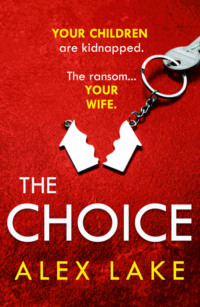
Читать книгу: «The Choice»
THE CHOICE
Alex Lake

Copyright
Published by HarperCollinsPublishers Ltd
1 London Bridge Street
London SE1 9GF
www.harpercollins.co.uk
First published in Great Britain by HarperCollinsPublishers 2020
Copyright © Alex Lake 2020
Cover design by Claire Ward © HarperCollinsPublishers Ltd 2020
Cover photograph © Magdalena Russocka / Trevillion Images
Alex Lake asserts the moral right to be identified as the author of this work.
A catalogue copy of this book is available from the British Library.
This novel is entirely a work of fiction. The names, characters and incidents portrayed in it are the work of the author’s imagination. Any resemblance to actual persons, living or dead, events or localities is entirely coincidental.
All rights reserved under International and Pan-American Copyright Conventions. By payment of the required fees, you have been granted the non-exclusive, non-transferable right to access and read the text of this e-book on screen. No part of this text may be reproduced, transmitted, down-loaded, decompiled, reverse engineered, or stored in or introduced into any information storage and retrieval system, in any form or by any means, whether electronic or mechanical, now known or hereinafter invented, without the express written permission of HarperCollins.
Source ISBN: 9780008373542
Ebook Edition © August 2020 ISBN: 9780008373566
Version: 2021-03-16
Dedication
To my three
Contents
Cover
Title Page
Copyright
Dedication
Part One
Saturday, 7 March 2020
Part Two
Late July 2004
September 2004, Birmingham University
Saturday, 7 March 2020, 8.30 p.m.
Birmingham, October 2004
Saturday, 7 March 2020, 10.00 p.m.
Birmingham, November 2004
Sunday, 8 March 2020, 4 a.m.
Sunday, 8 March 2020, 6.03 a.m.
Birmingham, December 2006
Sunday, 8 March 2020, 6.15 a.m.
Grappenhall Library, 2009
Sunday, 8 March 2020, 6.45 a.m.
Chester, 2011
Sunday, 8 March 2020, 2 p.m.
Summer 2012
Sunday, 8 March 2020, 4.55 p.m.
Summer 2012
Late Summer 2012: Wedding Day
Sunday, 8 March 2020, 5.31 p.m.
2013 Christening
Sunday, 8 March 2020, 5.35 p.m.
2013: Christening Party
Sunday, 8 March 2020, 5.41 p.m.
2014
Sunday, 8 March 2020, 5.44 p.m.
Part Three
Sunday, 8 March 2020, 5.50 p.m.
Sunday, 8 March 2020, 6.40 p.m.
Monday, 9 March 2020, 8 a.m.
Tuesday, 10 March 2020, 7 a.m.
Tuesday, 10 March 2020, 6 p.m.
Wednesday, 11 March 2020, 8 a.m.
Read on for a sneak peek of Alex Lake’s new novel, coming 2021 …
Keep Reading …
Acknowledgements
About the Author
Also by Alex Lake
About the Publisher
PART ONE
Saturday, 7 March 2020
Look at him. I mean, just look. Baggy, out-of-date jeans with brown leather brogues that have not seen shoe polish in years, shirt untucked over his spreading stomach. It’s pathetic. No effort at all. Shabby. Second rate.
I’m doing nothing wrong. He deserves everything he gets.
Out he climbs, his car – not washed, of course – parked on the road outside under a flickering streetlamp. He pauses, checking over his shoulder that everything is all right.
It’s OK, he thinks, everything’s fine. He looks at the car. The kids are arguing in the back seat. One of them puts the interior light on, then off, then on again.
He hesitates outside the local shop. He’s about to go back and tell them, Stop it, you’ll break the light, but he pushes the door open and steps out of the early spring dark and into the shop.
He can leave them there, for a few minutes. The car’s unlocked – he doesn’t want the alarm to go off – but no harm will come to them. He won’t be in the shop long enough. His three-year-old daughter is buckled into a car seat, so she’s going nowhere. His five-year-old middle son is erratic and wilful, but he won’t get out of the car. He’ll be too scared, and if he tries his big brother – all of seven years old – will stop him. He’s sensible; a typical, rule-following first child.
So they’ll stay in the car. Safe.
Brother, brother, sister.
Daughter, son, son.
The lights of his life, no doubt. Annoying, at times, and hard work, but he loves them. He and his wife are blessed. Their children are the most important things in the world to them.
Yet he leaves them in a car on the road, unattended.
It’s not illegal. He probably knows that. He’s probably checked. The law allows you to leave children in a car provided there is no undue risk.
Which is exactly the point.
He thinks the risk is acceptable, so small as to be easily dismissed. He won’t be long, the kids won’t get out of the car and they can’t start it as he has the keys.
There are other sources of danger, of course – a runaway truck careering into the parked car and crushing it. An earthquake opening up a rift in the road underneath the car. A flash flood washing it and his children away.
All as near to impossible as makes no difference.
So he is right. The risk is small.
It is safe to leave them in the car for a few minutes while he goes into the shop. After all, what’s the alternative? Get them all out, chase them around? And then there’s the virus: it’s hit Italy and Spain hard, and it could be the same here. People are nervous; they don’t want their kids running around in a shop, picking things up and touching door handles and counter tops. He would have to corral them, which would turn a quick stop into an expedition.
At least that’s the excuse he makes. The excuse a lot of parents make. In fact, it would not make it into an expedition. It would just make it take five minutes longer, which, when you think what might happen if you leave them alone and unprotected, is not all that much of a price to pay.
But never mind. It is very improbable anything will happen to them. The odds are vanishingly small.
It’s one in a million that the kids are in danger.
And that’s the thing. It might be a one in a million chance, but that doesn’t mean it won’t happen.
It means it’ll happen one time out of a million.
One time in a million there will be a stranger out there with bad intentions.
But who? Who would it be?
He’ll be asking that question for a long time.
Matt
1
Matt Westbrook stepped into the shop. It was one of the last of its kind – an independent local shop stocking a mixture of groceries, alcohol, newspapers, magazines and basic home cleaning and maintenance supplies – and he was the only customer.
He was only there because it was open and it was on his way home and Annabelle had texted to say they needed milk, coffee, bread, pasta, and beer or wine – and, if they had any, toilet paper and disinfecting wipes – and could he stop and get them on his way home with the kids?
Which was fine. She was recovering from a cold and didn’t need to go out on a chilly night. He could pick up the stuff and do a big shop the next day at the supermarket. He wouldn’t bother with the wine, though – they were trying for another baby, so she was off the booze and he didn’t much feel like drinking alone.
They had three already, which was quite a handful, but he had managed to persuade her to add one more. Norman, seven, was named after her late father, a physics teacher and one of the most creative and inspiring people Matt had ever met. Keith – named after the Rolling Stone, if anyone asked – had come next, followed by Molly. Each kid had brought with them worse morning sickness and harder labours: Norman was nine pounds, Keith ten, and Molly eleven. As far as Annabelle was concerned, that was nature’s way of telling them to stop at three, but the years passed and the memories faded and, after a while, she had agreed to try for another.
His friends thought he was crazy, but he liked having kids. It was chaotic and busy, for sure, but he enjoyed it. More than that: he loved it. At work he daydreamed of sitting on the couch watching a movie with the three of them snuggled up to him and Annabelle, or of coming home and reading them a book.
And even though Norman was only seven he felt the time slipping away. He couldn’t bear the thought there were only eleven years to go until he left for university or a career or whatever came his way, to be followed swiftly by Keith and Molly.
The first seven years had vanished in the blink of an eye, so eleven more was nothing. He wasn’t ready for it, and the only way to stop it was to have more kids. Five, maybe, or six.
Annabelle might have something to say about that, but he’d cross that bridge when he came to it.
He looked out of the shop window at the car. The doors were still closed. The front doors were unlocked, but the rear doors were child-locked so, even if they tried, the kids wouldn’t be able to get out. They’d have to climb into the front and go out that way, which was unlikely.
Still, he’d be as quick as he could. He didn’t need a police officer walking past and seeing them and questioning where their mum or dad was. He was pretty sure it wasn’t against the law to leave them there but he still didn’t want to discuss whether it was good parenting or not to do so.
He grabbed a basket and moved around the shop. Milk, skimmed. A block of Irish cheddar cheese. A bag of pasta – fusilli, he noted, whatever that was. Coffee, not a brand he recognized and probably awful, but it would have to do. Bread, brown, unsliced – they had surprisingly good loaves here – and a warm baguette. He paused at the wine shelf. Maybe he would have a glass after all. Red, perhaps. It was cold, the nights drawing in. He picked up a bottle of Cabernet. That would do.
The checkout was at the far end of the shop. He carried his basket over and put it down.
‘All right, mate.’ The man behind the counter was in his fifties and had a Liverpool accent. ‘Got everything you wanted?’
‘Yes, thanks. Just grabbing a few bits.’ He glanced around. ‘Got any wipes?’
‘We’re out. Toilet paper’s all gone too.’ He shook his head. ‘Load of fuss about nothing, if you ask me.’
‘You never know,’ Matt said. ‘There’s quarantine in parts of Italy.’
‘Won’t happen here, mate. But I’ll sell people whatever they want to buy.’
The man punched in the prices, one by one. Easy to fiddle the take. Perhaps this place was a front for a gang, a place to quietly wash clean their ill-gotten gains.
‘Twenty-seven fifty,’ he said.
Matt hesitated and looked at the basket. Seven quid for the wine. A fiver for the coffee. He’d looked at the price of those. Which left fifteen-fifty for the bread, milk, baguette and pasta. How much was bread? Three pounds? Milk and pasta? The same probably. Which meant the baguette was outrageously expensive.
Or they all were.
The man looked at him, his expression questioning. For a moment Matt thought about asking for the prices of the bread, coffee, milk and pasta, but then the man interrupted.
‘Everything OK, mate?’
He nodded, and handed over two twenties. If this was a front for a gang they didn’t need to use it to launder any money. They were robbing people in plain sight.
‘Thanks,’ he said, and picked up his change and his shopping. It was definitely the supermarket next time.
2
As he left, Matt noticed the local newspaper had a story on the front page about a new signing for the rugby league team. It was the photo that caught his eye, a picture of a famous Australian playing for the Australian national team.
That would be quite the coup.
He was about to pick up a copy and go back to the counter – even this shop couldn’t charge more than the cover price for a newspaper – when he glanced out of the window. A quick check on the kids, that was all; make sure they were still safely in the car.
He blinked, then looked left and right.
There must be some mistake.
The car was gone.
That was impossible. He had left it there only a minute ago.
But there was no car there. As if to make the point, a blue Mercedes pulled up and parked right where his car had been.
He must have parked it further up the street. It was strange; he would have sworn he’d left it almost exactly outside the shop. Maybe he had, and it was the angle from which he was looking out of the window that meant he couldn’t see it.
Still. There was a church on the other side of the road, the main gate directly opposite the door.
And when he had got out of the car he had looked at that gate. He remembered it distinctly: his sister had got married there and a memory had come to him of her wedding day. It had been pouring with rain – a real deluge – and when Tessa and Andy came out all the guests had been holding umbrellas over the path to make a tunnel. They had walked through them to the main road and into the vintage silver Rolls-Royce that had taken them to the reception.
He had looked at the gate and remembered that day.
And when he had done so he had been standing more or less opposite it.
Which meant the car had moved.
His palms prickled with sweat. The kids must have taken off the handbrake, or somehow started the car and driven it off. He patted the pocket of his jeans. The keys were in there, so at least that was off the table.
He forgot the newspaper and jogged to the door. He needed to sort this out, right away. The man behind the counter coughed.
‘Everything all right?’
‘Yes. Just – I can’t remember where I left my car.’
‘Happens all the time, mate. People forget where they park.’
‘It’s not exactly that—’ He stopped talking. There was no point explaining. He opened the door and looked up and down the street.
The car was nowhere to be seen.
He took a deep breath. His mind was starting to swim and he needed to concentrate. He couldn’t afford to panic. He had to be methodical, but it was almost impossible to fight back the desire to scream and set off at a sprint in some – any – direction.
He looked left, to the village centre, and then right, to the swing bridge over the ship canal. In both directions the street was more or less straight, so he would have seen his car if it was there.
It wasn’t.
‘Where’s the fucking car?’ he murmured. It couldn’t just be gone.
But it was. His car was gone, with his kids inside. He began to lose the battle against the fear and panic, because either they had moved it, or it had moved itself, or someone else had moved it. None of them were happy thoughts. As the thought sunk in, he clenched his fists, digging his fingernails into his palms. He had to think.
It couldn’t have been driven away, because he had the keys – there was no way the kids had jump-started it – which meant it had rolled away – hard to imagine on a flat road, and even harder to imagine it had rolled out of sight – or it had been pushed away.
His kids couldn’t have done that, so someone else would have had to do it.
And how far could you push a car in a few minutes? Maybe around a corner, but not much further than that.
A wave of relief broke over him. This was a prank. One of his friends, or more likely a few of them, after a beer or two – had seen the kids in the car and moved it to give him a scare. He pictured them, laughing as they released the handbrake and pushed the car down the street. There was a side street about thirty yards away, on the right. That’s where they would have taken it.
That’s where he would find them, standing by the car, laughing.
He would not be laughing with them. This was not funny at all.
He jogged towards the side street. Banner Road. He’d never noticed the name before; he’d remember it now. He slowed at the corner and turned.
There was a skip on the right and a white van parked on the left, but other than that the side street was empty.
The fear roared back and rose into a full-on panic. Where the fuck was his car? Where could it be?
He sprinted out onto the main road and looked up and down, once, twice, a third time.
Still nothing.
He ran back to the shop – to the last place the car had been – and stood outside the window, breathing heavily. His car was gone. His children were gone.
The shop door opened.
‘You OK, mate?’
He turned around. The man from the shop – the owner, maybe – was standing on the threshold, arms folded, his eyes narrowed in suspicion.
‘It’s my car. It’s gone.’
‘What do you mean?’
‘I left it here, but it’s nowhere to be seen.’
‘You sure it was here?’
‘Yes.’ He paused. Was it possible he had parked somewhere further away and walked to the shop? Had he misremembered looking at the church? No – he also remembered thinking he was only using the shop because it was more convenient than a detour to the supermarket, which would hardly have been the case if he had parked a walk away. Besides, he had checked on the kids when he got out.
‘Yes. It was here.’
‘What is it?’
‘Discovery. Land Rover.’
The man stuck out his bottom lip. ‘Nice vehicle. Maybe someone nicked it. Was it locked?’
‘No, but—’
‘Mate, you should lock your car.’
‘I know, but—’
‘I mean, it’s easy to nick ’em if you can get in. Just plug a laptop into the data port and boom, job done. I heard it takes about fifteen seconds. You can’t leave a car unlocked.’
‘I only left it unlocked because—’
‘There’s no excuse, mate. You—’
‘Listen to me!’ Matt shouted. ‘I left it unlocked because my kids were in there.’
There was a long silence.
‘Fuck me,’ the man said. ‘You need to call the filth. Get the cops on this as soon as.’
‘I know.’ Matt took his phone from his pocket and unlocked the screen.
He was about to dial 999 when the phone buzzed. A message appeared.
Do not call the police.
He stared at it, his eyes wide. Dots scrolled under the message, and another appeared.
I repeat: tell no one and do not inform the authorities. I will know if you do and you will never see your children again.
More dots scrolled, then another message appeared.
My instructions will follow. Await them.
3
Matt stared at his phone. The man from the shop walked over to his side.
‘What is it?’ he said.
Matt did not want to answer. ‘It’s OK. I’m fine.’
The man tilted his head and looked at him sideways. ‘You don’t seem fine.’
‘I am. It’s just – I’m fine.’
‘Someone took your car with your kids in it, and you’re fine?’ He nodded at the phone. ‘What was that?’
Matt had no intention of telling him, because if he told him the man might take it upon himself to call the police, which Matt was not yet ready to do – he might be, soon, but he needed to think this through.
Which meant being alone.
‘Look,’ he said. ‘I appreciate the concern, but I promise. It’s all OK. That was their mum. She has them.’
The man shrugged. It was clear from his expression that he didn’t believe a word Matt was saying, but Matt didn’t care.
‘OK, mate,’ he said. ‘Whatever you say.’
He turned and walked back into the shop. Matt headed for a bus shelter a few yards up the road and sat on the bench.
He read the messages again.
Do not call the police.
I repeat: tell no one and do not inform the authorities. I will know if you do and you will never see your children again.
My instructions will follow. Await them.
He tried to think through what all this meant. If the car wasn’t nearby then it wasn’t a prank – none of his friends would have gone this far, and besides, none of them knew how to steal a car. What had the man said? Fifteen seconds with a laptop plugged into a data port in the car? Sounded simple but so did loads of computer things, yet they were still way beyond the capabilities of him and his friends.
So someone had come to the car while he was in the shop, climbed in, started it somehow, and driven away.
With his children in the back seat. His stomach clenched and a cold sweat broke out on his head and neck.
It was crazy – the one time he had left his kids in the car and some random car thief had chosen that moment to steal it.
And then text him.
Which meant it wasn’t a random car thief at all. If they had his number, they must have been targeting him – and his kids – specifically. But who the hell would do that?
He had no idea, but he did know one thing. This was planned. Someone had been watching, waiting for this opportunity.
The panic thickened, and his legs weakened. He let out a low groan. If this was planned, that meant there was a reason. Someone wanted his kids.
But the kids weren’t all they wanted, or the person behind it would not have sent him a message. They would just have disappeared.
So there was something else. But what? Was someone trying to punish him? He thought through all the areas of his life: family, friends, the law firm where he was a partner, any parents of the kids’ friends or classmates that they had fallen out with. Was there someone he had slighted? Or who the kids had upset?
It was possible, but he couldn’t think of anything, and surely anything sufficient to provoke this would have been obvious.
So what the fuck was going on?
In his hand, his phone buzzed.
I have his kids and his car. Easy to steal. Especially when you have the key. His spare, taken from the jar above the fridge in his kitchen, one day last summer when they were off on their family holiday. Too easy.
It’s time to let him know what’s happening.
Time to tear up everything he thought he knew and send him into a world of pain and confusion and fear.
I can’t wait. He’s had it coming for a long time.
I can’t use the same phone, though. Hopefully he’s not foolish enough to call the police, but there are no guarantees. The fucking idiot left his kids in an unlocked car, after all.
He assumed, like people do, that the world is safe. He assumed that what he sees around him every day – polite people, organized into nice little groups at work or at home, following the rules, saying please and thank you and worrying they might have upset someone – he assumed that this is how things are.
And he’s right. Most people are like that.
But not all. Some of us see the truth. Some of us see that other people are mere tools to be used to get what you want. The idea you might deny yourself something because it could hurt someone’s feelings is absurd. Why would you care about feelings? You either get what you want or you don’t. To let other people’s arbitrary emotional states obstruct you is foolishness. Worse, it is weakness.
And I am not weak. I was, once, and I learned my lesson. I suffered at the hands of someone who took what they wanted from me without a thought for what it did to me.
It made me who I am. Showed me the way I should live my life. I made sure to explain that to them before they died.
I also learned from them that you have to be careful. You cannot let people know you think of them as nothing but ways and means to get what you want. You have to learn to resemble them. Most of the time a smile and a question and an interested look is all it takes.
It’s ironic: people love me. They think I’m kind and helpful, because that’s what I want them to think. They trust me.
Which is very useful. Once you have earned somebody’s trust it is the easiest thing in the world to abuse it.
Occasionally someone figures it out. My mother did, when she realized what I had done. Poor woman. It broke her heart.
I know what you are, she said, her eyes wide with shock. I’ve known it all along. I just didn’t admit it to myself.
So I was putting her out of her misery, I suppose. It didn’t have to be such a painful death, but there had to be something in it for me, didn’t there?
Anyway, it’s time to give Matt the next piece of the puzzle. It’ll answer a few of his questions, inform him about the situation he’s in, clear some things up.
But it won’t help. Soon he will realize that for every question answered, more have been asked.
But first, the phone needs to be thrown away. The Bridgewater canal – oldest in the country, apparently – will be a fine place for it. No problem to pull over his dirty Land Rover Discovery and get out. The kids are unconscious. Hopefully the dose was correct. Not too strong. Not yet.
Pull the phone battery out, then two splashes as the phone and battery drop into the dark, oily water.
A new phone, booted up.
Type in his number – memorized, of course – and send the message.
Four words.
Four shocking words.
Watch sixty seconds tick by. One turn of the dial for the second hand. Analogue. No Apple Watch or Fitbit. Those things are a pain. Constantly buzzing and beeping. Measuring where you are and reporting it to some server. No, I don’t want that.
Then the rest of the messages, followed by two more splashes.
Better safe than sorry.
Words Matt Westbrook should have paid more attention to.
Matt
Matt looked down at his phone and read the text message.
It was just four words.
Four shocking words.
This is a kidnapping.
He stared at the screen and read them again.
This is a kidnapping.
He slumped on the bench. His legs were shaking. Norman, Keith and Molly, the three people at the centre of his life, the three people he and Annabelle had built everything around, had been kidnapped.
He was sure, in that moment, that he’d never see them again. Something would go wrong and they would be gone forever.
He started to shake with sobs. They were his life now, for sure, but they were also his future. They were supposed to go to high school then university, to fall in love and get married, to have children. Or do something else. Become astronauts. Cure cancer. Form a rock band. Whatever. It didn’t matter.
As long as they were there, in his and Annabelle’s lives.
His phone buzzed again, and he turned to look at it. There was another message.
The ransom demand will follow.
Ransom? They were being held for ransom?
What did he have that anybody could possibly want? Money? He and Annabelle were comfortable but they were hardly in a position to pay millions, which was presumably what this person wanted. They wouldn’t have gone to all this trouble unless they thought there was a large payoff at the end of it all.
If so, they were mistaken. He earned a reasonable salary from his law firm, and Annabelle made a steady income as a writer. She had published four novels, but none of them had earned anything like the kind of money that would make this worthwhile.
So he and Annabelle would not be able to pay. The kidnapper was going to ask for millions, in the mistaken belief their victims had it, and when he said he didn’t have the money they would think he was lying, and hurt his children.
‘Oh God,’ he said, clutching his forehead. ‘Oh God, please.’
‘Are you OK?’
An elderly woman with a wheeled shopping bag, like the one his mum had had when he was a child, stood in the bus shelter.
‘No,’ he said. ‘I mean, yes, I’m fine.’
‘All right,’ she said. ‘Let me know if—’
Another buzz, another message:
Remember. Do not contact the police under any circumstances. I will know immediately if you do and you will never see your children again.
He let out a wail of terror. The elderly woman studied him.
‘Are you sure you’re OK?’ she asked. ‘Can I help? I could call someone?’
He stood up. His house was on the other side of the village, about half a mile away.
‘I have to get home,’ he said. ‘I have to go.’
And then he started running.
Annabelle
1
Annabelle Westbrook sat on the couch, her legs tucked underneath her, and sipped her tea. It was lemon and ginger, and even though she knew it made no difference she felt like it helped with her cold. If it was a cold. There was some new virus going about and she had been lethargic and achy and running a fever, so there was every chance it was that. Either way, it had been a rough few days, but she was feeling better.
And she was starting to feel hungry. When Matt got back she would make something to eat. Maybe cheese on toast, with a splash of Worcestershire sauce on the top. When she and her brother, Mike, were kids that had been their dad’s Sunday speciality; she associated it with memories of sitting around the kitchen table on Sunday evenings, their dad drinking a big mug of tea as they ate his cheese on toast. He was a creative and adventurous cook – after their mum had died he had had to learn, and he had turned out to be pretty good – and during the week he made tagines and curries and a fantastic lasagne and moussaka and whatever else he dreamed up when he came back from the school where he taught physics. It meant they ate late – at around 7 p.m. – but that was fine by her. She loved ending the day around the table with her dad and brother.
You have to eat together, her dad said. Every day if you can.
Sundays, though, were not for cooking. They were for spending together, as a family of three, small and tight and independent. They went for hikes and to football matches and on canoe trips and swimming in lakes and rivers and whatever else they felt like.
And then on Sunday evenings, all time for cooking consumed, it was cheese on toast, and it was her favourite meal of the week.
She felt ready for some this evening, thank God. It might perk her up enough to try for the baby Matt had persuaded her was a good idea.
She smiled at the thought. It was so sweet how much he loved being a father. It was clear he would have as many as she would allow, but four – if it happened – would be the limit.
Her phone started to ring. She had left it in the kitchen; it could wait. She cradled her tea and sank into the sofa.
A few seconds later it rang again. She closed her eyes and let it ring out.
It rang again. Whoever it was, was really trying. It could be her dad; there might be a problem. She put her mug on the carpet and walked into the kitchen.
She felt a jolt of concern when she looked at the screen. It was Matt.
‘Hi,’ she said. ‘You need me?’
‘Annabelle,’ he said. ‘Why didn’t you answer?’
He sounded alarmed and her concern grew.
‘I was in the living room. My phone was in the kitchen.’
‘Good.’ He was panting, his breath short. ‘Is everything OK?’
‘Yes,’ she said. ‘Why wouldn’t it be?’
There was more heavy breathing. ‘I’m on my way home.’
She noticed he had not answered the question. ‘You sound like you’re out of breath.’
‘I’m running.’
She looked up at her reflection in the window. She was frowning.
‘You’re running? Why are you running?’
‘I’ll explain when I’m back.’ He paused. His voice was tense and serious. ‘I’ll be there any minute. I need to know you’re OK.’
‘I’m fine. But it doesn’t sound like you are. What’s going—’
‘I’ll be right there,’ he interrupted.
The phone went dead. Annabelle leaned on the table. Matt was running? Why wasn’t he in the car? And why did he think she might not be OK?
What the hell was going on?
She held one hand to her stomach. Sweat prickled on her brow. The sick feeling was back.
Although this time it was not only the cold. It was worry.
2
She heard footsteps outside the front door a few minutes later and went to open it. He was standing on the step, a shopping bag in each hand, a packet of pasta poking out of a hole in one of them. His face was flushed and he was breathing heavily.
Her chest tightened in alarm. He had sounded terrible on the phone, but he looked worse.
And not only was he not in the car. He was alone.
‘Matt,’ she said. ‘Where are the kids?’
He stepped into the house. His expression was rigid, but there was a wild look in his eyes. She realized with a start that it was fear.
‘Sit down,’ he said. ‘You need to sit down.’
‘I don’t need to sit down,’ she said. ‘Where are the kids? Tell me where the kids are!’
He took her elbow and guided her into the living room and onto the sofa. Her tea was still on the carpet beside it.
Matt sat next to her. He was no longer breathing heavily; now he was taking short, shallow breaths. It could have been the running, but it looked more like he was trying not to panic.
‘Matt,’ she said. ‘What’s going on?’
He blinked, his expression almost puzzled. He opened his mouth to speak, but nothing came out.
‘Matt! Where are the children? Tell me!’
‘They’re gone,’ he said, his voice breaking. ‘The children are gone.’
Matt
She didn’t react for a few seconds, then, as the words registered, her mouth fell slightly open.
‘Gone?’ she said. ‘What do you mean gone?’
He swallowed. His heart was racing and his mouth was dry and it was hard to speak. Annabelle was staring at him, her eyebrows knitted together in a deep frown.
‘I …’ he started, ‘I went into the shop to get the stuff. I left the kids in the car—’
‘Oh my God.’ Her eyes widened. ‘Matt. What happened?’
‘I wasn’t gone long, maybe only a few minutes. I checked out of the window and they were OK, but—’
‘Matt, what are you saying? Tell me what happened?’
‘—after I paid and went outside the car was gone.’
‘Gone?’ He could see his words were not fully sinking in. ‘How could the car be gone?’
‘Somebody took it. But – Annabelle. The kids were in it. They took the kids too.’
His wife didn’t answer. She folded her arms, then lifted one hand to her mouth, then put her hands in her lap.
‘What?’ she said, a barely controlled panic in her voice belying her attempts to compose herself. ‘What did you say?’
‘The car was gone. With the kids.’
‘Maybe they took off the handbrake and it rolled away.’
‘No. I checked.’
‘Maybe you didn’t check in the right place.’ She stood up. ‘We need to look for them. We can take my car. Maybe they drove it off somehow. Or the police moved it. If it was parked illegally the police may have moved it. Did you call them?’
‘No,’ he said. ‘I didn’t.’
‘You didn’t? Why not? We have to call them, now!’
‘We can’t.’
She was staring at him, her eyes wide, her nostrils flared. ‘Why not? Of course we can call the police. Our children are missing!’
‘We can’t,’ he said. ‘There’s more. And it’s worse.’
Annabelle
She was reeling from his breathless arrival. She could hardly grasp what he was saying. His words were close to meaningless sounds, but she forced herself to focus.
He had told her he’d left the kids in the car, and the car had been taken.
The kids were gone.
He had not called the police.
She could make no sense of this. The kids were in their car and someone had taken it and he had not called the police.
But it was the last thing he had said that scared her the most. He had said there was more, and it was worse.
How could anything be worse?
For a moment she was not sure she wanted to find out. She had an overwhelming urge to close her eyes and pretend this was not happening. All she wanted was for this to stop, right now, and be over before it got going. Because whatever it was, it was not good.
But she had no choice.
‘Matt,’ she said. ‘Just tell me.’
He looked at her, his face a mask of shock and fear. ‘They’ve been kidnapped,’ he said in a low voice. ‘Someone is holding our kids for ransom.’
The word hung in the air between them.
‘Kidnapped,’ she said, the word odd in her mouth, almost as if she did not recognize – or could not believe – what it meant. ‘Did you say kidnapped?’
‘Yes.’ His face was pale, the blood drained from it.
‘OK,’ she said. It sounded totally inadequate, but what was she supposed to say? This was a total catastrophe: normal language didn’t work. But there was good news in this. Ransom meant you paid the kidnapper’s price and they would release the hostages, which meant there was hope.
So this was good, in a way.
‘What do they want?’ she said.
‘I don’t know. They didn’t say yet.’ He held up his phone and showed her the screen. ‘These messages came just after I left the shop.’
She took his phone and read the texts.
Do not call the police.
I repeat: tell no one and do not inform the authorities. I will know if you do and you will never see your children again.
My instructions will follow. Await them.
He reached over and tapped the screen. ‘Then these came from a different number.’
This is a kidnapping.
The ransom demand will follow.
Remember. Do not contact the police under any circumstances. I will know immediately if you do and you will never see your children again.
So that was why he had not called the police. It made sense now, but she wanted them to know. They needed help with this.
‘Shouldn’t we tell the police?’ she said. ‘How would the kidnapper know? It could be a bluff to stop us involving them.’
‘It could be,’ Matt said. ‘But it could be real. Maybe whoever it is knows someone. Or it’s a cop. And if there is a way they could find out—’
‘We won’t see the kids,’ she said. ‘If it’s true, we can’t risk it. We have to wait. See what they want.’ She looked at the phone. ‘Were there any other messages?’
‘No. That was the last one.’
‘Did you call the number?’
‘Not yet.’
‘We should. I will.’ She tapped the screen and lifted the phone to her ear.
‘Are you calling?’ he said.
‘Yes.’ She listened for the ringing to start, but it never came. It went straight to a recorded message.
The number you have called does not have a voice mailbox set up. Thank you.
Then the line went dead.
She put the phone down.
‘What is it?’ Matt said.
‘An automated message saying no voicemail has been set up.’
‘If they’re using different numbers, they probably get rid of the phones afterwards.’
She pictured someone throwing a phone into a bin then taking a new one from a rucksack and typing in a number.
Matt’s number.
‘My God,’ she said. ‘They know your number. Which means this isn’t random. It isn’t someone who saw an opportunity and grabbed it.’ She took a deep breath in an attempt to control the panic rising in her chest. It didn’t work. ‘This was planned,’ she said. ‘Someone was watching and waiting.’ She felt a wave of nausea. ‘They’ve been watching us, Matt.’
Matt stood and began to pace the room. ‘I know.’
‘But why? What do they think we have? What do they want?’
‘I can’t think of anything,’ Matt said.
‘But to go to all this effort …’ Annabelle’s voice tailed off. ‘This is fucking unbelievable. Why would anyone do this? What do they want from us?’
‘It must be money,’ Matt said. ‘What else is there?’
‘But we don’t have the kind of money that would make this worthwhile,’ Annabelle said.
‘Maybe they think we do.’
‘But we don’t,’ she said. ‘And if we say we don’t they’ll think we’re holding out on them and’ – she choked back a sob – ‘and they’ll hurt the kids. Matt, they’re going to hurt my babies. We have to stop them. Please, we have to stop this!’
‘How?’ Matt said.
‘I don’t know,’ she said. ‘I don’t have any ideas.’
And then, in her hand, her husband’s phone buzzed.
This will be a shock for them. It will be the last thing they’re expecting. They will be thinking the ransom will be for money, because they – in particular he, I don’t blame her so much – are people of very feeble imagination.
Like the rest of the common herd, snouting around in the dirt for a few scraps, leaving the real prizes for those who can see the truth.
What else is there, they will think. What else could anyone want from them? The dirty Land Rover Discovery? No – that has already been taken. The three kiddoes? They too, have already been taken. Their house, as modest as his ambition? Impossible. How could they give me their house without me revealing who I am? It’s hardly portable property.
So what else could I want?
His resignation? What would be the point? For him to humiliate himself? It’s a pleasant thought, I admit, but please. I am not that sort of petty-minded person. I am not that shallow.
And he’ll be humiliated enough, as it is.
Which leaves only one thing. That grubbiest of motives, money.
Which is, frankly, beneath me.
They don’t know that, though, so they will conclude that I will be asking for cash. Lots of it. Which confuses them, because they aren’t wealthy. Not poor, but nowhere near rich enough to make their kids the target of kidnappers looking for a ransom. I mean, think about what has gone into this. To pull this off required preparation and time. And a vastly superior nerve and intelligence. Let’s not forget that. Even they will have worked out that the person who took his car and children must have been watching, waiting for an opportunity.
And they would only do that if there was a significant reward, which means a lot of money.
Which they don’t have.
So they’ll conclude it’s a mistake. This is a mistake and someone thinks they’re richer than they are, so they’re going to have to say they can’t come up with the one or two or three million they get asked for.
This will worry them. They will fear that the kidnapper will be angry if they say they can’t pay. And eventually, if they keep saying it, the kidnapper will realize it’s true and disappear, along with their children.
They are probably working out what they can offer. Sell the house, ask relatives. Maybe they can come up with half a million.
Tops.
But they don’t need to worry. I won’t be asking for money. I want something much more valuable.
And the time has come to let them know what that is.
I will tell them what I want, and they will give it to me. It will be a shock to him. A blow, a loss almost beyond imagining.
Not to her, though. Neither a shock, nor a blow. It will be welcome.
Time now, then, to introduce them to their new futures.
Same method: take out a new phone. Type a new message.
Press send.
And wait.
Annabelle
The message was from another new number. Annabelle held it so that both she and Matt could read it.
If you want to see your children again you will do exactly as I say. Understood?
She squeezed his upper arm. ‘Jesus,’ she whispered. ‘This is actually happening.’
He glanced at her. ‘I think they want a reply. For us to say we got the message.’
‘OK,’ she said. She typed a reply.
Understood.
The reply was immediate.
Good. And I see you have not informed the police. So we can move forward.
‘They know,’ Annabelle said. ‘They know we haven’t told the police.’
‘It could be a bluff,’ Matt said. ‘Or a guess.’
‘Maybe.’ She pressed her head to his chest. This was unbelievable. They were having a text conversation with the kidnapper of their children. Her stomach heaved. She dropped the phone and staggered out of the living room. The door of the downstairs bathroom banged as she slammed it open and threw up in the toilet bowl. She stayed kneeling before it, her hands on the tiled floor.
Matt appeared in the doorway.
‘I’m so sorry,’ he said. ‘If I hadn’t left them—’
‘Don’t,’ Annabelle said. She didn’t want to go down this route, not now. She didn’t know where it would end, because he was right, if he hadn’t left them …
But that wasn’t going to bring them back, and at the back of her mind she couldn’t stop the idea that this was coming someday, whatever they did. This person was so determined, so twisted, that they were going to get to their kids one way or another, come what may.
‘Ask for proof they’re alive,’ she said. ‘I need to know my babies are OK.’
He typed a message and showed it to her.
Please send proof the children are well.
The reply was immediate.
Later. First, I tell you what I want.
‘This is it,’ Matt said. ‘This is when whoever this is asks for something we don’t have and we have to try and sort this mess out.’
‘You still think it’s money?’
‘It’s always money. What else could it be? We’ll do whatever we have to, Annabelle. Sell the house. Ask my sister. Your brother. They can have everything we own.’
She closed her eyes. ‘What if it’s not enough? What if we’re nowhere near having what they want?’
‘We’ll offer what we can,’ Matt said.
‘And if that’s not enough?’ Annabelle said. ‘If they think it’s too risky to be worth it to them and we never hear from them again?’
‘We’ll take the risk anyway. Beg them to return the kids. We’ll promise not to pursue them if they do. We’ll promise not to tell anyone. They can have everything and walk away.’ He got to his feet. ‘But we can cross that bridge later.’ He held out her hand for the phone and typed a message.
What do you want?
They stared at the screen, waiting. The silence seemed to stretch forever, then the reply came.
The ransom is Annabelle. If you want to see your children again, you will exchange them for her.
The silence stretched on.
‘No,’ Annabelle said eventually. ‘No, not this. That’s crazy. It’s impossible.’
‘I’m going to call the number,’ Matt said. ‘Talk to them. This is madness.’
Before he could call, another message arrived.
You have my demand. It is simple and non-negotiable. Further instructions will come tomorrow morning. You will have one chance to agree. If you accept my terms, your children will be returned to you unharmed. If not, you will never see them alive again.
Matt pressed call. She watched as his face contorted in agony.
‘Shit!’ he said. ‘Too late. Just a message saying there’s no voicemail. The phone’s dead. It’s been switched off, or destroyed.’
Annabelle barely heard the words. She folded her arms tightly.
‘Matt,’ she said. ‘It’s me. I’m the ransom.’
‘No. That’s not going to happen. It’s ludicrous.’
‘Maybe,’ Annabelle said. ‘But it’s happening. This is real, Matt.’
‘There’s a way out of this,’ he said. ‘There has to be.’
‘Then what is it?’ she said. ‘What the hell are we going to do?’
Бесплатный фрагмент закончился.