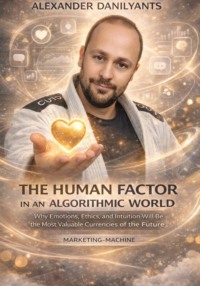
Читать книгу: «The human factor in an algorithmic world»
Глава
Why Emotions, Ethics, and Intuition Will Become the Main Currency of the Future
TABLE OF CONTENTS
INTRODUCTION. The Efficiency Paradox
PART I. THE ALGORITHMIC HORIZON
Chapter 1. The Illusion of Data Omnipotence
Chapter 2. The Death of Routine Intelligence
Chapter 3. Ethics as a Competitive Advantage
PART II. THE INTERNAL OPERATING SYSTEM
Chapter 4. Emotional Intelligence 2.0
Chapter 5. Intuition: The Unrecognized Pattern
Chapter 6. Jiu-Jitsu for the Mind: The Art of Leverage
PART III. BUSINESS IN THE AGE OF HYBRIDS
Chapter 7. Leadership in the "Human + AI" Team
Chapter 8. Marketing of Meanings, Not Products
Chapter 9. The Architecture of Personal Resilience
PART IV. MARKETING IN THE AI ERA: A PRACTICUM (SPECIAL RESEARCH)
Article 1. Neuromarketing and AI: Hacking Human Decisions in the Age of Algorithms
Article 2. Personal Brand vs. Digital Avatar: The Battle for Attention
Article 3. Trust Marketing: How to Sell in a World of Post-Truth and Data Leaks
PART V. THE RUSSIAN CONTEXT: THE HUMAN FACTOR ON NATIVE SOIL
Chapter 10. The Russian Code: Why Everything is Different Here
Chapter 11. Practicum: Adapting to the Russian Market
PART VI. ADDITIONAL DIMENSIONS: PRACTICE, LAW, AND THE COST OF THE QUESTION
Chapter 12. The Economics of the Human Factor
Chapter 13. AI and Law
Chapter 14. Prompt Engineering for the Executive
Chapter 15. Gender and Age
Chapter 16. Case Study: When AI Failed
Chapter 17. AI Agents: From Tool to Digital Employee
CONCLUSION. The Human as the Main Algorithm
The Human Factor Manifesto
APPENDICES
Checklist: Is Your Business Ready for the AI Era?
Practicum for Developing Intuition
Glossary of Terms
List of Recommended Resources
ABOUT THE AUTHOR
INTRODUCTION. THE EFFICIENCY PARADOX
In the quiet of a meeting room where the fates of multimillion-dollar contracts were decided, I often caught myself thinking one thing. Around me lay reports, printed on the finest paper, with charts constructed by perfect algorithms. The data was impeccable. The forecasts matched to the fourth decimal place. Risk managers nodded, confirming the deal's safety. But inside me, and inside my partners, there was an unpleasant scratching feeling. Something didn't add up. Not in the numbers. In the people.
My journey in business began far from Silicon Valley and server racks. It was in the workshops of SIBUR and the production lines of Acron. I started as a specialist on the ground, close to production. Where an error in program code could stop a conveyor belt, and an error in human judgment could cost lives or cause ecological disasters. I saw how strict regulations saved factories but killed initiative. I saw how an experienced foreman, ignoring the instructions, prevented an accident because he "felt something was wrong."
Later, moving into the global IT sector at Luxoft as Head of Procurement, I encountered a different reality. Here, speed reigned supreme. Code was law. We optimized processes, selected the best vendors, automated routine tasks. Efficiency grew exponentially. But along with it, so did a sense of anxiety. We were creating systems that were becoming too complex for any single person to fully understand.
Today, leading the marketing agency "Digital Action" and developing the RankBoost project, I work at the cutting edge of neural network implementation. I see how AI writes texts, generates images, and sets up advertising better than any intern. But I also see that the most successful campaigns, the most loyal customers, and the strongest partnerships are born where technology steps back, making way for human contact.
We stand on the threshold of an era I call "The Efficiency Paradox." The more we introduce algorithms to optimize the world, the more inefficient, from the machine's point of view, our truly human qualities become. We make decisions more slowly when we doubt. We spend resources on empathy that yields no immediate profit. We make mistakes due to fatigue or emotion.
It would seem these are things to be eliminated. But it is precisely in these that our value lies.
Imagine a chess game. A computer calculates millions of moves per second. It doesn't tire, doesn't fear, doesn't hope. It just calculates. But if you watch a match between two grandmasters, you see more than just calculation. You see a psychological battle, bluff, intuition, risk. The audience pays not for the machine's perfect move, but for the human drama.
The same will happen in the business of the future. Algorithms will take over the "menial work" of computation, logistics, and analysis. The market will be saturated with perfect products at perfect prices. And at that moment, the winner will be the one who can offer what cannot be calculated.
Trust.
Meaning.
Empathy.
Ethical choice.
These are not "soft skills," as they were dismissively called at the beginning of the century. This is the hard currency of the new world.
This book is not written to frighten you with a robot uprising. Nor to teach you how to program neural networks. Courses will teach you that. This book is about how to preserve and enhance your humanity in a world striving to become digital.
I will use metaphors from the sports I have practiced for years. Tennis teaches concentration and responsibility for every shot: on the court, you are alone, and no one will make the decision for you. Jiu-Jitsu teaches using the opponent's strength and remaining calm in the chaos of a fight: if you panic, you lose, even if you are physically stronger.
We will travel the path from understanding the limitations of AI to practical tools for developing intuition. We will talk about ethics not as moralizing, but as a business strategy. We will discuss how to lead hybrid teams where some employees are humans and some are bots. We will pay special attention to marketing – the meeting point of technology and the human soul – as well as the specifics of doing business in Russia.
The world is changing faster than ever in history. But human nature has remained unchanged for thousands of years. We seek connection. We seek meaning. We want to be understood. If you can connect the power of new technologies with the depth of human nature, you will become invulnerable. Not because you become a machine. But because you become a true human.
Welcome to the era of the Human Factor.
PART I. THE ALGORITHMIC HORIZON
Chapter 1. THE ILLUSION OF DATA OMNIPOTENCE
"Data is the new oil." This phrase has been repeated so often in the last decade that it has become a cliché, losing its meaning. But let's think about it: oil itself is useless. It's dirty sludge until it's refined. So it is with data. By itself, it's just noise. Interpretation gives it value. And here we encounter the first and foremost illusion of the algorithmic world: the belief that data is objective.
In my practice as a specialist at SIBUR and Acron, I saw monitoring systems show a "green light" on all parameters. Pressure normal, temperature normal, flow rate normal. The algorithm reported: "System stable." But an experienced engineer, walking past a pipe, would stop. He wasn't looking at the sensors. He was listening to the vibration. He smelled something. He would say: "Something's not right here." And he was often right. The sensors measured what they were programmed to measure. The engineer sensed the context.
The Retrospective Trap
Neural networks and machine learning algorithms operate on historical data. They look to the past to predict the future. This works perfectly in a stable environment. If you sell toothpaste and demand has grown linearly over the last 10 years, the algorithm will perfectly forecast purchases for the next quarter.
But what happens when a "Black Swan" appears? A pandemic. A geopolitical shift. A technological breakthrough that changes the rules of the game. In these moments, historical data becomes not just useless, it becomes harmful. It pulls you into the past when you need to look to the future.
In the 2020s, many retailers who fully entrusted inventory management to AI faced collapse. Algorithms could not predict changes in consumer behavior caused by global stress. They ordered goods that were needed "yesterday" and ignored what became needed "today." Humans saved the situation. Managers who turned off automatic orders and called suppliers, relying on intuition and news rather than reports.
Context vs. Content
The algorithm sees content. The human sees context.
In marketing, which I engage in through the "Digital Action" agency and the RankBoost project, this distinction is critical. A neural network can write perfect text from an SEO perspective. It will insert keywords, follow structure, maintain tone. But it doesn't know that yesterday your competitor had a scandal, and now any mention of that topic triggers aggression in the audience. It doesn't know that your client is currently going through a crisis and doesn't need "aggressive selling" but a sense of security.
I recall a case from my Luxoft practice where I managed procurement. We were selecting a system for automatically distributing developers' tasks. The vendor's algorithm was flawless: it assessed task complexity, employee qualification, their workload, and deadlines. It distributed tasks to maximize speed.
The result? Productivity dropped. People burned out.
Why? Because the algorithm didn't account for the human factor. It didn't know that developer Ivanov was going through a difficult divorce and shouldn't be given stressful tasks, even though his skills were perfect. It didn't know that Petrov and Sidorov were in a quarrel, and putting them on the same team guaranteed conflict.
When we included a requirement for a "human filter" from team leads in the contract, efficiency returned. The machine provided the optimal scheme, the human adjusted it for reality.
Boundaries of Applicability
It's important to understand: I am not calling for abandoning data. I am calling for ceasing to deify it. Data is a tool, like a hammer. You can build a house with a hammer, or you can smash your finger. The problem is not the hammer, but who wields it.
In business, there are zones where data reigns:
Logistics and Supply Chains. Variability is low, physics is predictable.
Financial Reporting. Numbers don't lie if they aren't intentionally distorted.
Mass Personalization. Recommendation systems ("you might also like") work perfectly because the cost of error is low.
And there are zones where data is powerless without a human:
Strategic Vision. Data cannot invent a new market. It can only optimize an existing one.
High-Level Negotiations. Arguments don't decide the outcome here; chemistry between personalities does.
Crisis Management. When there are no rules, improvisation is needed.
The "Average Temperature" Error
Statistics knows the concept of "average hospital temperature." If one patient has a fever of 104°F and another 97°F, on average they have a normal temperature. Algorithms often operate with average values. They optimize processes for the "average user," "average employee," "average customer."
But in business, money is made on deviations. Your most loyal customers are a deviation. Your most talented employees are a deviation. Your riskiest and most profitable deals are a deviation.
If you entrust business management to an algorithm, it will start "trimming" deviations, bringing everything to a gray middle. This is the path to stagnation.
The human factor lies in the ability to see value in the unique, the non-standard, in what breaks the pattern. Innovation always looks like an anomaly in the data until it becomes mainstream.
Case Study: When the Instruction Kills
In the heavy industry where I began as a specialist, safety is a religion. There are thousands of pages of regulations. Every step is prescribed. This is necessary to avoid injuries. But I have seen the other side of the coin.
An employee sees a potential problem not described in the regulations. But he is afraid to deviate from the instructions. "I'm not paid for initiative, I'm paid for compliance," he thinks. As a result, a minor malfunction escalates into an accident.
Algorithmic personnel management works the same way. KPIs, metrics, deadlines. The employee becomes a function. He stops thinking about the company's welfare; he starts thinking about how to "game" the system to meet the metric.
I've seen sales managers who, to fulfill their call quota (tracked by CRM), called clients with questions that annoyed rather than helped. Metric met. Client lost.
Implementing AI in personnel management without considering psychology leads to rebellion or quiet sabotage.
What to Do?
The "Human-in-the-Loop" Principle. Never give the final decision on critically important matters to the machine. AI should propose options, the human chooses.
Data Audit for Bias. Understand what your model was trained on. If you hire people through AI, check if it discriminates against certain groups based on historical hiring data.
Encourage Deviations. Create a culture where an employee has the right to say "the algorithm is wrong" and is not punished for it but thanked if they turn out to be right.
Develop Critical Thinking. In an era where answers can be obtained in seconds, the question becomes more important than the answer. Learn to ask "Why?" and "What if?".
Data gives us a map. But only a human can decide where we want to go. The map won't show the beauty of the landscape waiting for us along the way. The map won't tell us if the game is worth the candle. That decision requires a soul.
Chapter 2. THE DEATH OF ROUTINE INTELLIGENCE
We are used to being proud of our intelligence. The ability to memorize facts, calculate quickly, know foreign words, operate with formulas – all this was considered a sign of intelligence. In school and university, we were taught to be living hard drives.
But let's be honest: in storing and processing information, humans lose to a 90s calculator, let alone modern cloud storage.
What we called "intelligence" in the 20th century is becoming a "routine operation" in the 21st. If your job can be described by the algorithm "If A, then B," it will be automated. This is not a question of the future, but of the coming years.
The Expert's Comfort Zone
The biggest danger for a modern specialist is becoming an expert in something easily copied.
I have seen lawyers who spent years drafting standard contracts. They prided themselves on their speed and knowledge of nuances. Today, a neural network does it in 30 seconds, finding precedents worldwide.
I have seen analysts who built pivot tables in Excel. Today, an AI assistant does it by voice command.
Who are they now? If they haven't changed, they have become neural network operators. And an operator's salary is lower than an expert's.
But there is good news. The death of routine intelligence gives birth to creative and strategic intelligence.
Three Pillars of Human Indispensability
What remains for us? Three spheres where algorithms (at least in the foreseeable future) cannot surpass us.
Generation of Meaning (Why?)
AI can answer the question "How?". How to increase sales? How to optimize code? How to reduce costs?
But AI cannot answer the question "Why?". Why do we need this business? What pain of the world are we healing? What is our mission?
Meaning is human territory. People don't buy drills; they buy holes in the wall. But even deeper: they buy the feeling of confidence that the shelf won't fall. AI can sell a drill based on specs. A human sells confidence through a story, through trust in the brand.
Synthesis of the Unconnected (Creativity)
AI works by combining what already exists. It doesn't create anything fundamentally new; it mixes patterns.
Humans are capable of insight. Of connecting things that logically shouldn't be connected.
Steve Jobs connected calligraphy and computers. No one asked him to do this from a data standpoint. It was an intuitive leap.
Responsibility (Who is to Blame?)
This is the most important point. An algorithm cannot bear responsibility. You can't put it in jail, you can't fire it in disgrace, it feels no shame.
In business and society, there must always be a person who says: "I decide. I am responsible."
The ability to take risks and bear responsibility for them is the highest form of human capital. The more complex the world, the more valuable are people ready to say "I'll take this on."
Transformation of Education
If routine intelligence is devalued, then the education system must change. Memorizing dates and formulas loses meaning. It's all on your smartphone.
What needs to be taught?
• Learning to learn. The skill of quickly adapting to new tools.
• Philosophy and Ethics. To understand the consequences of technology.
• Communication. The ability to negotiate, persuade, inspire.
• Psychology. Understanding oneself and others.
In my company, we have stopped looking at diplomas when hiring. Portfolios and case studies are more important to us. We care more about how a person thinks than what they have memorized. We give tasks with no right answer. We watch how the candidate searches for a solution, argues, and behaves in a dead end.
The "Centaur" Concept
In the chess world, there is a term "Centaur." It's a team consisting of a human and a computer. Research has shown that a "Centaur" beats both a pure human and a pure computer.
Why? Because the human directs the machine's computing power in the right direction, cutting off obviously dead-end branches that the machine could calculate for hours.
In business, you must become a Centaur.
Don't try to compete with AI in calculation speed. Use it as an exoskeleton for your mind.
Let AI write the draft of an email, and you infuse it with soul.
Let AI analyze the market, and you make the strategic decision.
Let AI generate 100 ideas, and you choose the one brilliant one.
The Death of the "Average"
The labor market is polarizing.
The middle is being eroded. Accountants, operations specialists, technical translators, dispatchers – these professions are transforming or disappearing.
Two poles remain:
Those who create and manage technology. (Engineers, AI Architects).
Those who work with people and meanings. (Leaders, psychologists, creators, high-level service).
If you are in the middle, you have a choice. Either dive deeper into technology (become the one who configures neural networks) or dive deeper into humanity (become the one who understands clients better than they understand themselves).
The second path is often more sustainable. Technology changes every 5 years. Human psychology changes over centuries.
Practical Exercise: Audit of Your Routine
Take a piece of paper. List all the tasks you perform during the week.
Mark those that:
• Repeat.
• Have a clear algorithm.
• Require no emotional involvement.
→ This is the "Death Zone." Try to delegate this to software or assistants.
Leave tasks where you need to:
• Persuade.
• Invent.
• Sense.
• Decide under conditions of data scarcity.
→ This is the "Life Zone." Increase the share of time spent here.
We cannot stop progress. Routine intelligence is indeed dying. But this frees us to become more creative, deeper, more alive. A machine can imitate style, but it cannot live a life. And business, ultimately, is done by people for people.
Chapter 3. ETHICS AS A COMPETITIVE ADVANTAGE
"Reputation is hard to earn, easy to lose, and almost impossible to recover." – Warren Buffett
At the start of my career in the industrial sector, I learned a lesson that cost the company millions and me several sleepless nights. We were involved in implementing a new quality control system at a production node. The algorithm, developed by external contractors, was mathematically perfect. It rejected products that didn't meet tolerances. Efficiency rose by 15%. Reporting shone green. Bonuses were paid.
But six months later, hidden problems began. Customers started returning batches. Not because the defect was obvious, but because the material behaved unpredictably under extreme conditions. The algorithm filtered out obvious defects but allowed those on the edge of tolerances, considering them "acceptable." However, human experience told technologists: "The edge is already a risk." But the system didn't account for risk; it only accounted for compliance with the figure.
When we investigated, it turned out the contractors had tuned the system to minimize the reject rate in reports to receive full payment under the contract. They optimized the system for their benefit, not for the safety of the final product. This was legally clean but ethically dirty.
This case taught me the main rule of the algorithmic world: what can be measured will be optimized. And if you haven't set ethical boundaries, the system will optimize them to zero.
Trust as a Balance Sheet Asset
In traditional accounting, there are tangible assets (machines, buildings, money) and intangible assets (patents, brands). But in the new era, the main intangible asset becomes trust.
Why? Because in a world of information overload and deepfakes, the only thing that matters is confirmed reputation.
Imagine two companies. Both sell identical financial management software.
• Company A uses algorithms to maximize profit. It collects all user data, sells it to third parties, hides subscription terms in fine print, and uses dark patterns in the interface to make cancellation difficult. Their short-term profit is 30% higher.
• Company B chooses transparency. They don't sell data. They make cancellation a one-click process. They openly discuss the limitations of their AI. Their profit is lower now.
What happens in five years?
When a data leak occurs (and it will happen to everyone), Company A loses everything. Customers leave, regulators fine them, partners turn away.
Company B receives a credit of trust. Customers say: "They warned us. They are on our side."
In the algorithmic world, the speed of spreading negativity exceeds the speed of light. One viral tweet about unethical AI behavior can destroy capitalization in hours.
Algorithmic Bias: The Hidden Enemy
We tend to think machines are objective. "Numbers don't lie." But humans input the numbers. And the data on which neural networks are trained contains all the human prejudices of the past.
In Luxoft practice, we faced the task of selecting a hiring system for a large international corporation. The client wanted to automate the initial resume screening. AI was to select the best candidates.
We audited the model on the company's historical data for the last 10 years. Who was successful? Mostly men of a certain age, graduates of certain universities.
What did the neural network do? It began automatically downgrading resumes containing the word "women's" (e.g., "women's chess club") and favoring candidates from elite universities, ignoring talented self-taught individuals.
Technically, the model worked perfectly: it predicted "success" as the company understood it in the past. Ethically, it was discrimination.
If we had launched this without human oversight, the company would have acquired an efficient tool for reproducing its own mistakes. Diversity of opinion would disappear. Innovation would stall because innovation often comes from the "other."
We insisted on incorporating an ethical filter into the contract. We forced the algorithm to ignore gender, age, and university name, focusing only on skills and test assignments. Hiring efficiency initially dropped (it was harder for the system), but hiring quality improved over the year. We found people who would have been screened out before.
Ethics as a Business Strategy, Not Charity
Many executives view ethics as an expense line. "We need to hire an ethics officer," "We need to conduct an audit," "This will slow down development."
I propose looking at it differently. Ethics is both insurance and marketing simultaneously.
Risk Reduction. An ethical business faces fewer lawsuits. Fewer fines. Fewer reputational losses.
Talent Attraction. Generation Z and Alpha do not want to work for "villains." Top specialists choose companies whose values align with their own.
Бесплатный фрагмент закончился.