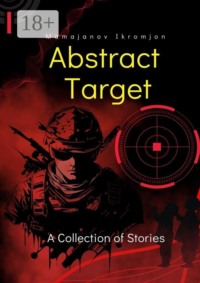
Читать книгу: «Abstract Target»
© Ikromjon Mamajanov, 2026
ISBN 978-5-0071-0644-3
Created with Ridero smart publishing system
Part I: “ABSTRACT TARGET” — Synopsis
In a remote corner of East Asia, the war has raged on for five years without end. Though the United States withdrew the bulk of its forces after the major offensives concluded, a small outpost still remains hidden in the mountains, a last foothold to keep from losing its grip on the region entirely.
From that outpost, Marine Corps reconnaissance sniper Taylor is sent to watch a single, isolated house standing alone in the desert. The reason is simple: intelligence suggests that the leader of a local insurgent group known as “Sun” will eventually arrive at that very house. Taylor’s orders are straightforward — stay hidden on the ridge, observe, and report back to base the moment the leader appears.
But as the days pass, the mission begins to mean something else to him entirely. What he sees through his scope is no longer just a future target. Down there, in the scorching sand and dust, a family is struggling to survive: Laylo, a mother who lost her husband to the war, and her two children — eight-year-old Atal, who is trying with all his might to become the man of the house, and his little sister, Lalmo. From time to time, an old family friend, Anzirat, comes to visit them as well.
For twenty-four days, Taylor watches every part of this family’s life unfold — the hunger, the thirst, the waiting, the small joys, and the devastating losses — seeing it all with his own eyes, unseen by them in return. Slowly, the isolation transforms him from a mere observer into something far more.
At last, on the twenty-fourth day, the expected visitor — the leader of the “Sun” movement — arrives at the house. And Taylor is faced with a choice unlike any he has ever known: follow his orders and call in the strike, or stay silent. Neither path comes without a price.
Abstract Target is the story of how a war fought from a distance reaches down and touches the lives of ordinary people — children most of all. It is also the story of one soldier caught between duty and conscience, and of where a single decision can ultimately lead him.
Part I: Abstract target
In this sun-drenched, desolate expanse of Far East Asia, framed by jagged mountains smelling of salt and dry dust, time moved like sluggish, muddy water.
Five years had elapsed since military operations commenced in this remote corner of the globe. Following the failure of the last major engagement, the United States had withdrawn the bulk of its forces from the region. Yet, to preserve a semblance of strategic oversight and mitigate the bloodshed between local armed militias and forces defending their homeland, a small, isolated outpost remained concealed deep within the mountains.
Scout Sniper Taylor of the United States Marine Corps lay motionlessly on a weathered concrete slab — roughly three by four meters — protruding from the sheer face of a cliff halfway up the mountain. This exposed ledge served as both his quarters and his observation post. Flanked by two neighboring peaks that stood slightly lower than his own, the expansive plain below and the narrow entrance to the gorge unfolded before him like the palm of a hand.
Suddenly, his eye caught a motion near the distant foothills to the right — a faint, almost imperceptible flick of movement. Slowly, Taylor shifted from his prone position, easing forward toward the outer brink of the slab, right at the edge of the precipice. Dropping onto one knee, he brought his rifle up and adjusted the glass of his optic scope to resolve the shadow.
Through the magnifying lenses, he spotted dry bushes swaying gently at the base of the mountain. The moment a target materialized, his index finger settled softly against the trigger, ready to neutralize the threat. Holding his breath, he scrutinized the tamarisks. Finally, a wild mountain goat bounded out from between the bushes and vanished into the rocks.
Exhaling softly, Taylor stood and retreated to his primary position against the rock wall where the slab met the mountain.
It was then that his gaze drifted to a corrugated steel drainage pipe nestled right beside the slab. Wide enough for a man to crawl into, the conduit plunged inward, slanting steeply down into the belly of the mountain for several hundred meters. The dark mouth of the pipe lay silent, looking like a secret passage into the earth, exhaling a damp, cool breath from the subterranean gloom.
Taylor stepped toward the edge once more, setting one foot firm and kneeling down to scan the valley through his binoculars. But the calm was short-lived.
Without warning, the terrifying roar of automatic gunfire thundered from the mountain slope to his right. Bullets cracked through the thin air, whistling past his ear before smashing violently into the rock wall behind him. Shards of stone exploded outward. Within a fraction of a second, Taylor hit the deck, staying low as he army-crawled backward from the edge.
Instantly, a hail of gunfire erupted from the opposite peaks on both flanks. Multiple armed insurgents had locked onto his position. Taylor’s saving grace was that both enemy firing positions sat considerably lower than his concrete perch; most of the incoming rounds slammed harmlessly into the thick lower lip of the slab.
Pressing himself flush against the cold concrete, Taylor reached for his tactical radio and hailed the base. He delivered a concise sitrep and requested immediate reinforcement. The response over the comms was bleak: the nearest QRF was at least an hour out. Furthermore, to prevent the relief squad from riding into an ambush, Taylor was ordered to fix the enemy positions and transmit their coordinates.
Determined to ascertain their exact locations, he crept toward the edge and carefully raised his head. The rocks rang out again with deafening concussions. A bullet struck his helmet full-on. The force of the impact snapped his head back violently, but miraculously, the Kevlar held, sparing him from a fatal injury.
Taylor realized instantly that returning fire with his bolt-action sniper rifle from this angle was impossible; exposing his head again meant certain death. Conversely, the insurgents could not scale the sheer cliff face to close in on him due to the brutal terrain.
The small arms fire subsided momentarily, but a far greater threat loomed. At the foot of the mountain on his left — approximately five hundred meters out and lower down — two combatants emerged. They were setting up a mortar tube, aiming it straight at Taylor’s ledge. Seconds later, the tube thumped ominously. The incoming shell whistled through the air and detonated against the cliff wall just short of the concrete slab. The shockwave shook the mountain, filling the air with dense dust and debris.
Taylor knew all too well that the first shot was merely a ranging round. The next shell would hit his platform with pinpoint precision, obliterating everything on it. For the first time in his career, an overwhelming sense of helplessness crept into his chest. The pounding of his heart echoed louder in his ears than the gunfire outside. Cold sweat stung his eyes, trickling down his face as though it would never stop.
Yet Taylor had not been selected for scout-sniper duty by accident. His defining trait, the quality that set him apart from every marine in his unit, was his ability to make split-second, life-saving decisions under intense mortal peril.
In an instant, he low-crawled toward the rear of the slab — straight toward the dark, hundred-meter drainage pipe sinking into the mountain. Seconds were everything now. Taking a calculated risk, he lifted his head just enough to glimpse the mortar team below. One of the insurgents was already aligning a second shell over the muzzle.
Time seemed to freeze for Taylor. Those critical seconds between life and death stretched into hours. He watched the insurgent drop the shell into the tube…
Taylor didn’t hesitate. He threw himself headfirst into the pitch-black, bottomless metallic drainage pipe.
The damp, suffocating darkness swallowed him whole. Taylor plummeted downward into the chute. Above him, a deafening explosion rattled the metal walls of the pipe as the mortar shell struck the concrete slab he had just abandoned — the entire mountain shuddered. Fighting to slow his breakneck descent, Taylor pressed his arms, elbows, and entire body against the rusted iron walls. Even as his uniform tore and the jagged metal scraped his skin, he fought with everything he had for survival.
The vertical shaft ended abruptly, dropping him onto the bottom elbow. Though the impact shook his frame, it caused no major injury. Drawing ragged breaths, he caught his bearings. As his eyes adjusted to the gloom, he realized the pipe now ran horizontally for several hundred meters. At the far end, a faint speck of daylight flickered.
Wasting no time, Taylor crawled eagerly toward the light. Every movement inside the iron tube echoed hollowly, but the detonations and distant gunfire outside muffled his noise.
He halted roughly three meters before the pipe’s exit. Stepping straight out would be suicidal. Pushing his rifle forward, Taylor used his optic scope to reconnoiter the daylight opening and the terrain beyond.
The lens brought into focus a sunlit slope covered in crushed stone and parched earth. Shifting his scope slightly, Taylor froze: standing on a small clearing just two hundred meters from the pipe’s mouth were the same two insurgents. They were still gathered around the mortar tube, chuckling in satisfaction as they prepped another round, convinced they had turned the sniper’s upper perch to dust. It never crossed their minds that their quarry had slipped down from above and was now lurking right beneath their feet.
Taylor’s vision locked through the crosshairs. His finger squeezed the trigger with smooth, unyielding discipline. The bullet found its mark — one insurgent crumpled instantly into the dirt without so much as a twitch.
Hearing the crack of the rifle, the second insurgent lunged behind a nearby boulder in a panic. He immediately took up a defensive posture facing upward — toward Taylor’s old concrete perch on the cliff. Completely oblivious to where the shot had actually originated, he believed the giant boulder offered him complete cover from the high ground.
As the insurgent prepared to return fire toward the cliffside, he had no idea Taylor was positioned almost directly on his right flank. Taylor seized the opportunity, targeting the insurgent’s exposed side. Before the man could figure out the source of the lethal fire, Taylor’s second bullet put a definitive end to his resistance.
A heavy silence settled over the mountain, replacing the fierce battle that had shaken the peaks moments before. Taylor remained inside the pipe’s mouth, resting in the damp gloom of the conduit that had saved his life, allowing his breathing to steady as he listened to the wind howling through the rocks.
He didn’t rush to step out into the open. Instead, he lay motionless in the shadow of the metallic barrel, keeping his rifle trained on the two corpses and the abandoned mortar.
His combat experience warned him that now was the time for patience, not celebration. The remaining insurgents behind the ridge would soon notice the loss of communication or grow suspicious of the sudden silence, coming down to inspect their fallen comrades. Of that, Taylor was certain.
Slowing his breathing to a calm rhythm, Taylor inhaled the damp iron air and waited patiently for his next targets to walk into the trap. Twenty minutes passed. He glanced briefly at his wrist watch — every second counted on the battlefield. Soon enough, his patience was rewarded. A silhouette armed with an assault rifle crept cautiously from the shadow of the rocks, approaching the clearing where the bodies lay.
Though his finger rested on the trigger, Taylor held his fire. He waited. He knew the force that had pinned him down earlier consisted of more than just two men. Though he hadn’t visually counted them during the ambush, his instincts and ear for combat had already computed the tactical math.
Staring into the dark opening, he mentally reconstructed the cadence of the firefight — the acoustics, the impact frequency of incoming rounds, the distinct signatures of automatic weapons firing from different angles… Yes, there were at least five of them. Two were dead by the mortar; that meant at least three more were still operating nearby.
Taylor’s calculations proved exact. Moments later, two more armed men stepped out from the rocks behind the first. They gathered over their fallen comrades, looking around in bewilderment, still expecting danger from the mountain high above. All three targets were now laid out plain in Taylor’s scope.
The lead insurgent knelt, carefully examining the entrance wound on his comrade’s forehead. A mix of rage and disbelief crossed his face as he moved to inspect the second body. Driven to analyze the threat, he lined up the bullet trajectories, pointing his index finger through the air to trace the angle of fire.
Slowly, his pointing finger rotated… until it aimed directly at the dark mouth of the drainage pipe where Taylor lay concealed.
A terrifying realization flashed in the insurgent’s eyes, but it was already too late.
He barely caught the flash of muzzle fire emerging from the subterranean gloom before the deafening crack of the rifle cut through the air. The impact threw him backward instantly. The remaining two insurgents froze in terror, unable to comprehend what was happening. Their final, panicked gazes remained locked onto the abyss of the pipe as the darkness claimed them.
Chapter II
Nestled deep within the mountain range, this isolated U.S. outpost was designed primarily for intelligence gathering and analytical operations. It housed no large offensive strike forces; its military presence consisted solely of a small specialized unit tasked with perimeter defense. Inside the secure command rooms, watchstanders worked around the clock, illuminated by dozens of glowing monitors. Analysts spoke in hushed tones as they processed digital satellite telemetry, thermal imaging, and topographical maps. Behind every flickering dot and set of coordinates lurked a potential threat.
Inside the spacious office of the Chief of Staff, silence reigned. General Smith sat back in his leather chair before summoning his chief of tactical operations.
A moment later, a knock echoed at the door, and Captain Drop entered. His posture was military crisp, carrying a thick leather binder tucked under his arm containing top-secret files and operational details.
“Report, Captain,” General Smith said calmly, fixing his gaze on the officer.
“Sir,” Captain Drop began, unbinding the file on the desk, “activity among local insurgent groups and freedom movements in our sector has spiked dramatically. Currently, the greatest threat to both our base and regional stability is the armed militia known as ‘The Sun’. Unfortunately, tracking down their leader — known simply as ‘The Leader’ — has proven impossible so far. However, intelligence has identified five primary strategic locations he is likely to visit or occupy.”
“Have reconnaissance teams been deployed to those points?” the General asked, stepping up to an electronic wall map.
“Yes, sir. To four of them,” Captain Drop replied, pointing out four red markers on the digital display. “We are facing a severe manpower shortage for the fifth location. Every skilled sniper and seasoned scout in our roster is currently assigned to outer perimeter security. The situation is volatile, sir; we cannot pull a single operator from the defensive line.”
General Smith’s brows furrowed, his expression darkening. “Then what is your proposal, Captain?”
“I recommend assigning the new arrival to the fifth point, General. He meets all operational requirements.”
Captain Drop pulled a specific personnel file from the binder and handed it across the desk. General Smith opened it, his eyes settling on the photograph and the name typed beneath it: Sergeant Taylor Grey. Scout Sniper, United States Marine Corps…
“This man isn’t right for the job, Captain,” General Smith said flatly, without looking up from the file.
Surprised by the immediate rejection, Captain Drop stood straight. “Permission to speak freely, General? May I ask why?”
“Look at what’s listed under his personal interests,” General Smith said, tapping his finger against the bottom of the page. “He reads Leo Tolstoy’s ‘The Kingdom of God Is Within You’. That’s not just fiction, Captain. That is an ardent manifesto calling for total pacifism and the laying down of arms! His mind isn’t filled with battle tactics — it’s filled with humanism. He’ll hesitate at the first sign of contact; he’ll ponder sin before pulling the trigger. I don’t need a philosopher out there. I need an operator who executes orders without question.”
Captain Drop stood his ground. He flipped to the next page and slid it toward the General.
“Look at the next page, sir… That’s Taylor’s latest after-action report from yesterday. He was pinned down alone in a mountain ambush. Under extreme pressure, he utilized a drainage pipe to flank the enemy single-handedly, neutralizing five insurgents on his own. His philosophy didn’t stop his finger from squeezing the trigger. The man can be trusted.”
General Smith stared at the fresh report, the body count, and the tactical summary. An uncomfortable silence filled the room. Finally, he closed the binder and tossed it onto the desk.
“For your sake, I hope you’re right, Captain Drop,” General Smith said with a heavy sigh. “Very well. Place him at the fifth point. The responsibility rests entirely on your shoulders.”
With that, the General turned and strode briskly out of the room, signaling the discussion was over. Left alone, Captain Drop let out a long breath and tucked Taylor’s dossier back under his arm.
***
Captain Drop stood inside the darkened observation room behind the one-way mirror, his eyes fixed on the interrogation room across from him. Seated at a metallic table directly under a bright overhead light was Taylor. Though his face bore the physical toll of yesterday’s engagement — exhaustion and minor cuts — his demeanor was eerily calm.
On the other side of the table sat Dr. Miller, the base’s chief military psychologist, turning through Taylor’s file. Before sending Taylor back out on a high-stakes covert assignment after a bloody engagement that left five men dead, evaluating his mental stability was non-negotiable.
Dr. Miller looked over his rimless glasses, peering intently at the Marine. “How are you feeling, Taylor?” he began in a measured tone. “Any restlessness, nightmares, or recurring flashes of that drainage conduit since yesterday?”
Taylor kept his eyes fixed on a single spot, answering almost motionlessly, “No, sir. Everything is fine. Sleeping well, health is fine.”
The psychologist spun his pen between his fingers, skimming through the tactical notes. “According to the report, you calculated that there were five hostiles based purely on muzzle blasts and acoustics without seeing them first. And you eliminated all five from inside a single pipe. What was going through your mind at that moment, as you took those shots?”
Taylor paused briefly. Behind the glass, Captain Drop instinctively leaned closer to the mirror…
“Nothing was going through my head, Doctor,” Taylor replied calmly. “Inside that pipe, I was simply calculating balance. Five rounds, five targets. If I had hesitated, you’d be asking these questions to someone else.”
Dr. Miller nodded, seemingly satisfied with the answer, though his diagnostic routine was far from over. He flipped the page.
“Very well. Tell me then… what did you feel when that insurgent’s finger pointed straight at the mouth of the pipe where you were hiding? He had figured out the threat. You saw that terror in his eyes through your scope, didn’t you?”
Taylor’s gaze sharpened slightly. “I didn’t see his eyes, sir. I saw the crosshairs. He made his choice. I made mine. He was late. I wasn’t.”
Dr. Miller set his pen down, straightened his back, and looked directly into Taylor’s eyes. “What was your true objective when you threw yourself into that drainage pipe, Taylor?”
“To stay alive and improve my tactical position, sir,” Taylor answered curtly. Then, unexpectedly, he turned the question back on the doctor: “How did you interpret it?”
“To be honest, Taylor… jumping into an unmapped pipe under fire isn’t something most people would think of. And even if it crossed someone’s mind, very few would have the sheer audacity to execute it…”
Taylor offered the psychologist a subtle, knowing smile. Hidden behind his gentle grin was a faint touch of irony, as if he were looking at a man who could never truly comprehend the reality of survival.
Dr. Miller caught the subtle shift instantly. “Taylor, I think you understand exactly what I mean. But you evaded the question anyway.”
Chapter 3:
“That pipe may seem terrifying to you, sir,” Taylor said, his calm, mysterious smile remaining intact. “But to me, it was not.”
“That pipe was extremely dangerous for anyone — for any human being — at that moment!” the psychologist said, his voice rising slightly as he struggled to maintain his composure. “You could have perished inside that hole.”
“Mr. Miller, I have no intention of belittling you,” Taylor’s voice sounded unnaturally serene. “But from a professional standpoint, you were trained and educated solely to speak with people, to analyze them. We, on the other hand, are trained to fight. Fear is a foreign concept to us.”
The psychologist took the sniper’s words as a personal insult. Though a flash of anger flared in his veins, he suppressed it, striving to keep his mask of composure intact.
“Soldier!” the doctor said. “If you ask any rational, ordinary person about this situation, they would deem jumping into that dark pipe as nothing short of suicide.”
Taylor narrowed his eyes and fixed his gaze on the doctor. “Mr. Miller, my respect for you is boundless. But rational people in that situation would also tell you that out of sheer desperation, putting a bullet through their own head with their own weapon would have been much easier and far less painful. Yet I did not surrender.”
Doctor Miller fell silent. The psychologist was utterly checkmated. Standing behind the two-way mirror of the interrogation room, Captain Drop smiled aristocratically upon hearing Taylor’s words. All his lingering doubts had vanished completely.
At that moment, Captain Drop turned toward the general seated in the chair behind him with a triumphant expression, as if asking, “Well, how about that?”
“Sir! Did he pass the test?” the captain asked triumphantly.
The general rose heavily from his seat. “Yes… with a score of 105%. As I said before, that extra 5% of intelligence is precisely what we need. Prepare him for the operation.” With those words, the general walked toward the door and left the room.