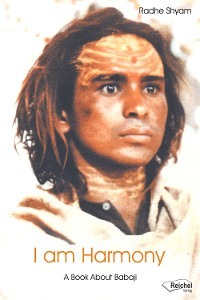
Читать книгу: «I am Harmony»
The book
There is a tradition of Babaji that goes back thousands of years. Twice in the past hundred years, Babaji has appeared, lived and taught in the tiny village of Haidakhan in the Kumaon foothills of the Himalayas. In the 1890's, He built the temple on the top of the hill where the Ashram is located. During His ministry from 1970 to 1984, nine small temples and several more ashram buildings were built. His association with the village and ashram has given Him the name of Haidakhan Baba, among many other names.
Babaji comes to teach humanity a way of life which He summed up in the words, "Live in Truth, Simplicity and Love and practice Karma Yoga." He taught that the whole of Creation is the manifestation of the Divine Energy and that humankind must learn to live in harmony and unity with all of the created universe. The Energy of The Divine is in every created element and all things must be treated with love and respect.
Babaji said of Haidakhan: "Here in Haidakhan the old world has been destroyed. I am teaching you this: The New World begins from here! I want you to be happy and in peace."
The author
 |
Radhe Shyam was born in Sioux City, Iowa, in 1928. He was christened Charles Swan. His father became a Presbyterian minister, so Charles went to school in four Iowa and Nebraska towns where his father was pastor. He received a B.A. in history and M.A. in political science from the University of Nebraska. He taught history and English in a Presbyterian mission school in Tehran, Iran, from 1950-1953. Upon graduation from the University of Michigan Law School in 1957, Radhe Shyam started a career of work in the Office of Foreign Buildings in the Department of State in Washington, D.C.
After 22 years in various positions in the Office of Foreign Buildings, Radhe Shyam retired in 1979. On a trip, early in 1980, intended to launch a consulting business, he met Haidakhan Baba - Babaji - in Vrindaban, India. Soon after, he abandoned the consulting career and his home in Washington, D.C., to live for five years in Babaji's ashram in the foothills of the Himalayas in northwestern India. Babaji gave Charles the name Radhe Shyam, one of the names of Lord Krishna.
"I Am Harmony" is the story of Radhe Shyam's and others' experiences of life and spiritual growth in the presence of this unique Himalayan Master. In 1991, after publication of "I Am Harmony", Radhe Shyam went to Russia, where "I Am Harmony" was published in Russian. He lived five years in the city of Voronezh, south of Moscow, working with Association Peace Through Culture, U.S.A. to help create cultural, educational and business connections between Russia and the West. Since 1996, he has lived in Pittsburgh, Pennsylvania, with Sita Rami, who is now head of the Adoptions and Foster Care office at the Three Rivers American Indian Center, and practices law.
Radhe Shyam passed away in 2006. He was, the true epitome of the selfless karma yogi generously giving of himself and working until the end on this new edition of "I Am Harmony" and serving as Board member of the American Haidakhan Samaj. It was his last wish to publish this new and revised edition. He lives on through the book, which has touched the hearts of so many people around the world. His presence, generous spirit, and guidance will always be with us through "I am Harmony".
Radhe Shyam
I am Harmony
A Book About Babaji

Table of Content
COVER
THE BOOK / THE AUTHOR
TITLE
TABLE OF CONTENT
ACKNOWLEDGEMENTS
FOREWORDS
Foreword to the second edition
Foreword to the first edition
CHAPTER I
We Meet Haidakhan Baba
CHAPTER II
Previous Manifestations of Babaji
CHAPTER III
Predictions and Preparations for Babaji's Return: Mahendra Maharaj and Vishnu Dutt Mishra
CHAPTER IV
Babaji's Return to Haidakhan
CHAPTER V
How Babaji Identified Himself
CHAPTER VI
How Babaji Called People to Himself
CHAPTER VII
Some Leelas of Babaji
CHAPTER VIII
Babaji Teaches: The Concepts of Guru and Sanatan Dharma
CHAPTER IX
Babaji Teaches: Truth, Simplicity, Love and Unity
CHAPTER X
Babaji Teaches: Jap and Karma Yoga
CHAPTER XI
Babaji Prophesies
CHAPTER XII
Babaji Shows a Path to God-Realization
CHAPTER XIII
Babaji Teaches About Religion and the Significance of Haidakhan
CHAPTER XIV
Mahasamadhi
CHAPTER XV
Afterwards
CHAPTER XVI
A Challenge to Adventure
MORE PHOTOS
GLOSSARY OF TERMS
BIBLIOGRAPHY AND RECOMMENDED FURTHER READING
NOTES
IMPRINT

"I bow to Thee, O Lord, Image of mercy; To Shiva, Who is affectionate to His disciples, Doer of Goodness, The Destroyer of sins and suffering; To Thee, the incarnation of compassion, I surrender always."
ACKNOWLEDGEMENTS
On the (1990) publication of this book, I need to make a number of acknowledgements for help without which this book might never have seen the light of day.
First and foremost, I acknowledge Shri Shri Haidakhan Wale Baba, Mahavatar Babaji, Who, in 1981, instructed me to write this book and Who has, I think, inspired many of its pages.
I thank "Om Shanti Devi" and Sheila Devi Singh for a vast quantity of translation of Babaji's words from Hindi into English, without which I would have missed even more of the kaleidoscopic activity which took place in Babaji's presence. I am grateful to the many people who shared with me significant personal experiences which illustrate Babaji's teachings and His methods of teaching. Their experiences, the written experiences of people of 'Old Haidakhan Baba,' and my own experiences with Him form the major part of this book.
I owe many thanks to the generous hosts who arranged travel for Babaji and His followers to many cities in India, who housed and fed us, and whose functions provided opportunities to share experiences of Babaji, as well as stimulating new experiences. I thank the many devotees who lived in Haidakhan and acted their roles in Babaji's earthly play and to those who maintain some semblance of His presence there still.
I thank Swami Fakiranand for encouraging my use of his voluminous files and stories about Haidakhan Baba. I thank Vishnu Dutt Shastriji again and again for his comprehensive knowledge of the Vedic scriptures and of Babaji's message and teachings, for the beauty and clarity of his explanations and exhortations, and for his generous sharing of his knowledge and wisdom. And I thank Shri Trilok Singh - whom Babaji called "Muniraj," King of the Sages - for his steady and uplifting example, and for his constancy in service to The Divine.
In the United States, where this book was completed and published, I want to acknowledge and thank Brad Bunnin for sharing his comprehensive knowledge of copyright and publishing law; Bill Bowman, for his assistance in establishing the Spanish Creek Press; and Richard Baltzell for excellent advice on publishing and distribution of the book. I thank Elizabeth Weisiger for finding the Ringier America printing firm and brokering the contract for the printing of this book, and Virginia Masi for executing J.D. Marston's book cover design.
I am deeply obliged to friends for providing photographs which illustrate the chapters: to Robert Linn for the painting of Shri Babaji on the cover of the 1990 edition; to Paramananda; to Anton Waelti; to Rajendra Kumar Sharma; to Deborah Wood; to Ram Singh Sammal; to Arun Vora; to Roland and Gertraud Reichel; to Lisetta Carmi; and to Balbir Singh Sethi. I regret that I do not know who took the other photographs.
I bless Jackie for buying the book that gave us our first knowledge of Babaji. I thank my brother Arthur Swan for reading the manuscript several times and especially for a thorough and helpful critique of a near-final draft of the book. I thank Sita Rami for leading me to Babaji and for her constant support of this project. I acknowledge a great debt to Ram Dass (J.D. Marston) and Ramloti (Deborah Wood) for the growing experiences we shared in establishing an ashram in Crestone, Colorado, based on Shri Babaji's teachings, schedule and methods. And I thank all the members of the American Haidakhan Samaj and the Loving Relationships Training who participated to any degree in that experience.
Crestone, Colorado, July 1990
FOREWORDS
FOREWORD TO THE SECOND EDITION
Since the first publication of "I Am Harmony", in 1990, the book has gone around the world with its account of Shri Babaji's most recent ministries and teachings on Earth. "I Am Harmony" has been translated and published in Bulgarian, Croatian, German, Italian, Japanese, Korean, Polish, Russian, Slovenian and Swedish; it has been translated into Dutch and is awaiting publication; and it is in process of translation into Latvian and Serbian.
With the original printing exhausted, the American Haidakhandi Samaj has authorized and supported the republication of the book in a new format. The new format allows the inclusion of additional and different photographs from many people, most of whom are mentioned in the earlier forward or are unknown. I would like to thank Emam and Ramloti for their contribution of several of the color images in this new edition. The 2006 reprinting of "I Am Harmony" contains few other changes: the story of Shri Babaji's ministries in the past two centuries has not changed since "I Am Harmony" was published in 1990. For this edition, the first chapter of the 1990 edition was trimmed and moved to the last chapter in the current printing, and a few typographical and other errors have been corrected.
Thought was given to up-dating this edition to reflect what has been accomplished by Shri Babaji's followers since His Mahasamadhi, but that is a whole new story. You can learn some of that story by going to the listing of Babaji ashrams and centers around the world, which has been added to the information sections at the end of the book. Their websites offer a good deal of information.
FOREWORD TO THE FIRST EDITION
Paramahansa Yogananda called Mahavatar Babaji the "Yogi-Christ of modern India." The Haidakhan worship service describes Babaji as "Supreme Guru, Lord of mercy", "King of sages" and "Lord of the universe."
This book is about Babaji1, a great manifestation of The Divine Who has a history of appearing in a flesh-and-blood human form throughout the course of human civilization to help humankind understand, experience and achieve its relationship to The Divine. The tradition of Babaji's manifestations is that He appears in remote places at varying intervals in time - especially when humanity is undergoing major changes and challenges that have a potential for purification and the elevation of the whole human race - and, by example and teaching, helps transform a few people who may be inspired to share the teachings and help humanity take a few more steps forward on the path toward conscious reunion with the Divine Source of this whole Creation.
His teaching is not sectarian, but is supportive of all religions that guide human beings toward a life lived in harmony with The Divine. The practitioner of any of the major religions of the world today can find inspiration and support in the life and teachings of Babaji. Babaji taught from the basis of the ancient, eternal truths, but He focused the teachings on present-day problems.
The experience of Divinity seems a rather rare thing in human lives these days. Many people believe that a relationship or communication with an aware Creator is impossible. But, unless we totally discredit the experiences and statements of thousands of saints and holy men and women of all ages and all religions, it must be acknowledged that some people have seen, heard, or otherwise experienced The Divine in some way.
There is a mythology of Babaji in the Himalayan regions that reaches back into very early human civilizations. Paramahansa Yogananda's "Autobiography of a Yogi"2, published in 1946, introduced the stories and experiences of Mahavatar Babaji to the West in a book which dealt mainly with people's experiences of Him between 1861 and 1920, in India. There are books written about a manifestation of Babaji as Haidakhan Baba in the period of about 1890 to 1922. And now there are books written about the manifestation of Babaji which was experienced by many thousands of people in the period from June 1970 to February 14, 1984. This book collects and shares some of the stories from the long history and focuses on the experiences people had of this latest manifestation of Babaji. People still encounter Babaji in various ways all over the world. These experiences are by no means limited to India or to that physical manifestation of Babaji which 'died' on February 14, 1984.
Babaji is a spiritual being who serves constantly as a link between the Formless Divine and the physical creation, between God and humankind. He states that He is a manifestation of Lord Shiva, one of the names India gives to The Divine - a form of God known as a renunciate, a helper, and the greatest of Teachers. There are a number of stories (some of them in this book) which attest to His ability to create forms - either astral or flesh-and-blood human - at will. On one occasion, He told a devotee who had knowledge of His having been seen and experienced in three widely-separated places in India on the same day, that He could be seen in as many as eight forms at the same time. Some people who have experienced one or more of the forms of Babaji have come to the belief that there are five forms of Shiva (see the frontispiece which gives one commonly-pictured form of the five-faced Lord Shiva) involved with Earth at any given time. One is usually to be found in Nepal in an "old" form and another in a "young" form; one is often present as Haidakhan Baba; one may be elsewhere in India; and a fifth may be in a spirit or astral form. And all of these forms come and go at will. Such is the experience and belief of many people in the Kumaon Hills.
Each of the forms, when encountered in the flesh, in dream, or in vision, has divine attributes. Always, Babaji appears to give some form of blessing or teaching. There are many experiences of people (some are related in this book) which give evidence of what we would call miraculous powers exhibited by Babaji. Even if you wish to discount or discredit such experiences, He remains an unusual and unusually powerful character who fulfills the predictions and declarations that He comes into human society to serve and to teach. He does not make an issue of His divinity. It helps in the transmission of His teachings if the disciple acknowledges that divinity, but He accepts any honest seeker of Truth who is ready and open to learning and spiritual growth.
People saw Him in many roles - as Lord Shiva, the Supreme Guru, purifier, friend, the Divine Child, the Divine Mother, Divine Father, Supreme Yogi, a healer, an Immortal. He is all of those things and we see in Him that for which we look. We also see ourselves in Him, for He mirrored each of us, so we could see where we were on our Paths and gain insight into ourselves and what we needed to work on. He is a great Teacher and Guide, working on each individual who is open to Him, while still managing to give a cohesive program to all who come to Him.
His chief concern is with the human spirit or soul - that in humankind which is closest to The Divine, which carries the spark of The Divine. He teaches that the Creator and all of the Creation is One: He sees the whole Creation as the Manifestation of The Divine. Gods, demons, humans, animals, plants, rocks - all are 'built' with the building blocks of the divine Creative Energy. The Divine at rest is formless, chaotic Energy; when It is moved to create forms, the Conscious Energy moves in accordance with Divine Law to shape sub-atomic particles, which combine to make atoms, which combine over and over to create, over aeons of time, the universes we humans eventually see. All created forms, then, are aspects of The Divine, Which experiences Itself in action through all of these forms throughout the whole period of Creation.
Babaji taught that these myriad forms which make up the Creation function best when they function in harmony with The Divine and with each other. Because the times require it and have prepared the way for this knowledge, Babaji extended Christ's message of "love thy neighbor" to a message of concern for harmony among all created forms. All forms - human and other - are so tightly interrelated that we cannot abuse one form without disrupting the rest. That interrelationship is so close that beneficial actions offered by one created being to another have beneficial results throughout the whole universe. The very vibrations of our emotions or being have effects throughout the Creation.3
To be in Babaji's presence was an opportunity to gain an understanding of this principle. His Presence transformed and uplifted the atmosphere of any room or area into which He walked, and each person in His Presence felt the enlivening of the spark of The Divine within him / herself and a quickened sense of harmony with the people and other life around them. Babaji seemed to literally vibrate a feeling of love and harmony with a force that brought those around Him into a sympathetic, harmonious level of vibration. The concept of unity and the need for harmony within the Creation has a very profound effect on human responsibility for the Earth on which we live, and for the universe beyond Earth's atmosphere.
Babaji seeks to bring humankind back to an awareness of its unity with The Divine and with all other created forms in the universe. Both His words and His actions focus on the need for harmony among all elements of Creation. He pointed to human abuses of Nature and warned of coming catastrophic reactions of Nature, which can be mitigated by focused, conscious, disciplined human action taken in harmony with the Divine Law.
Babaji comes not to espouse any particular religion (He says all religions lead to The Divine), but to show and teach a way of life. Babaji called this way of life Sanatan Dharma - the Eternal Way (or Law or Truth). He indicated that the Creation was manifested and is extended and maintained in accordance with the Sanatan Dharma; that humanity's deviations from this Law of Life create imbalances and disruptions in the harmonious operation of the Universe; and that He comes - again and again - to help restore balance and the Sanatan Dharma. He teaches people - and shows by His example - that leading lives based on Truth, Simplicity and Love can restore to the individual, to societies, and to our whole world the inner peace and balance on which alone world peace and social justice can be established.
The great spiritual Masters throughout the ages of human civilizations have all shown a valid Way to different peoples at different ages in different cultures, emphasizing what their people needed to learn at that time to advance them on the Way and bring them into closer harmony with The Divine. Each way has been tested and has led people to "God-realization" and each has developed great saints. The important thing is for a person to focus on and follow a path that is suitable and inspiring for him or her. To wander aimlessly, tasting the fruits of this and that interesting philosophy or ritual is likely only to lead one in circles, rather than to a clear goal. Discipline - of mind and body - is an essential element of Babaji's teaching; without discipline and hard work, nothing valuable is achieved.
Following a Path of discipline is no easy thing for a human being distracted by the lure of many pleasures, as we particularly are in this age. The Bhagavad-Gita, a truly inspired Indian scripture, describes one's mind and senses as a team of twelve strong horses hitched to a chariot. If the charioteer (the individual soul) cannot tame and control his team, he is off for a wild ride through life; but if he can exercise control over his team, he controls great power and speed in action. One's religion or philosophy- whatever shapes one's way of living -is the most important factor in life; but that factor is useless if it leads to no practical end or output. Babaji looked not only to one's inner spirit but to the results, the products, of people's lives. He looked for beneficial action performed in harmony with the Divine Will and all of Creation.
We human beings tend to become like those we choose as role models; we become what we focus on, or like the people with whom we most associate. Babaji, like most Teachers, urged His followers to "go to the wise and learn." The Katha Upanishad, another early and inspired Indian scriptural work, helps in the definition of "the wise" whom we should seek out.
"The good is one thing; the pleasant is another. These two, differing in their ends, both prompt to action. Blessed are they that choose the good; they that choose the pleasant miss the goal.
"Both the good and the pleasant present themselves to man. The wise, having examined both, distinguish the one from the other. The wise prefer the good to the pleasant; the foolish, driven by fleshly desires, prefer the pleasant to the good."4
Babaji taught by His own example and by guiding people into experiences they needed for growth. He showed people how to live in harmony with The Divine and Its Creation. He put people into situations where they could experience The Divine, however briefly. He sought practical results from His followers - even as they struggled toward purification and enlightenment. On one day, Babaji admonished: "You monkeys and bears! Only wagging your tails won't be enough! You will have to do something practical, something useful. Babaji says you must work hard and put [the teachings] into practice. First, be inspired yourselves; then inspire others with this message of karma yoga [work]."5 He urged His followers to spend some time in His ashrams, with their monastic schedule and style, to experience and practice a pure, focused life in harmony with The Divine and all of Nature. Then go out to serve, as "householders" living in the real world, or to create ashrams "as islands in a sea of materialism" to serve in whatever capacities our countries need.
Babaji lived and taught squarely against the Western quip of "you only live once." He taught from the position that the human soul, like its Source and Goal, is eternal and that the experience of millions of lifetimes in various forms of the soul proceeds in a continuum from life to life. Each life in human form is an opportunity and challenge to build toward perfection of the soul, which returns again and again (through reincarnation) until the soul attains perfection. The soul's goal is to return to a state of unity with the Divine Perfection from which it came and from whence it has strayed in its experiencing itself and life's pleasures through constantly expanding senses and the concept of itself as an individual body, rather than as a manifestation of the Supreme Soul. Each lifetime can take the soul and its temporary human body closer to the goal of reunion, or we can throw away a lifetime's opportunity through ignorance or willfulness.
In His teaching and life, Babaji used miraculous powers, but indicated (as have other Masters} that they are attainable by anyone who can exercise the discipline to focus his or her mind and follow their Path to unity with The Divine. The powers come from thinking, working, living in harmony with the Creative Energy of the Universe. Babaji, for example, knew - even before they arrived or spoke to Him - who was coming to His ashram, whether they were ready for the experience of Haidakhan, whether they should stay or go. He read people's minds, healed their ailments, guided them into experiences they needed. And it has been people's experience that He comes and goes in human form, at will, through the course of human history.
His Message is not sectarian, but for all human beings of whatever religious or philosophical leaning. Hindus, Moslems, Christians, Parsis, agnostics, animists, atheists, and others came to live and learn in His presence. His teachings and actions express the best in all religions and can challenge, enrich and expand spiritual knowledge, wisdom and experience within the framework of any of them. Krishna, Moses, Jesus, Mohammed, all stated that their highest and best followers can be identified by how they live - how they put into practice the religion they profess. Jesus, when asked "Which is the first commandment of all?", answered, "...thou shalt love the Lord thy God with all thy heart, and with all thy soul, and with all thy mind, and with all thy strength: this is the first commandment. And the second is like, namely this, Thou shalt love thy neighbour as thyself." Babaji s teachings are focused on living in harmony with The Divine, and loving the whole of Creation as thyself, more than on worshiping The Divine by any particular ritual or belief. He would surely agree with a statement attributed to His old friend, Neemkaroli Baba, "It is better to see God in everything than to try to figure it out."
When He had given His message, through example, experience and teaching, Babaji left, in order that people might absorb the Message and learn to live in Truth, Simplicity and Love, rather than to blindly follow His charming and beautiful Presence like so many sheep.
This book is a collection of people's experiences of Babaji; it is something of a biography of Babaji based on personal stories and recollections of people in whose veracity I have reason to believe. No one person and no one book can possibly "capture" this Being in print: The Divine in Its manifest forms is beyond human capacity to understand or to relate. Still, I invite you to read this book about Babaji as I and others have experienced Him. He does not come to create a new religion or to establish a "new God"; He comes to remind and teach humankind of a harmonious way of life. Whether you experience Babaji as divine or as a stimulating, challenging, unusual human being, His life and message (which are really the same thing) have much to offer to people in this era of change and possible growth.

"I surrender to Thee, O Lord; Thou alone art my refuge; Thou alone art my mother, my father, my kin, my all; Thou art my Lord in the world and in the scriptures. Hail, hail, O King of Sages, Remover of the pain of Thy devotees! From the Haidakhan Aarati (worship service)
CHAPTER I
WE MEET HAIDAKHAN BABA
Margaret met me in New Delhi on February 21, 1980, and insisted we go the very next morning to meet Babaji, despite an unconfirmed business meeting I had requested at the Indian Ministry of External Affairs. We arranged for a car and driver and rode for two and a half hours south, to Vrindaban, where there is a Babaji ashram.
We rode across the flat plains of central India, sharing the sometimes divided highway with forms of transportation that reflected thousands of years of human existence - cars, smoke-belching trucks, crowded buses, two-wheeled, horse-drawn carts, four-wheeled, rubber-tired ox carts, a few camels, one or two laden elephants, and hundreds of people walking along the side, carrying everything from children to bundles of firewood and jugs of water. It was a lovely scene (and a slow ride), similar to what I had experienced in other third-world countries during my just-completed career in the Department of State in Washington, D.C.
What was more unusual, in my experience, was the peaceful repose of a sari-clad Margaret sitting beside me as we drove to meet Babaji. In the United States, Margaret Gold was a lawyer and teacher of law, a dynamo of energy directed at relieving the problems of all who came into her sphere. For much of the time as we drove, she was content to sit quietly, repeating a mantra6 as she moved the beads of her mala (rosary) through her fingers, and occasionally pointing out to me the timeless beauties of the Indian landscape. It was clear that the seven weeks she had spent in Babaji's presence in India had made a profound change in Margaret.
When we reached Vrindaban, our driver slowly and carefully threaded his way through the crowded, narrow streets of the ancient town, famed as the childhood home of the great Lord Krishna. The rivers of people, rickshaws, hand carts, ox carts, cows, pigs and other cars parted gently to allow our progress to the winding, narrow lane on which Babaji's Vrindaban ashram is located. Our driver parked in a wide spot in the street and Margaret led me toward the door of the ashram.
We left our shoes on a porch outside the entrance, along with a hundred other pairs of shoes and sandals, and walked into Babaji s ashram. The temple, which occupies two-thirds of the ground floor area of the ashram, was jammed with perhaps four hundred devotees who were sitting cross-legged on the floor, singing and chanting rhythmically, with harmonium, drums and bells playing. Margaret and I got into the long line of people who were going to where Babaji sat, yogi-fashion, on a raised dais, blessing devotees, receiving their gifts of flower garlands, candies, nuts, fruits, etc., and Himself giving out gifts. Margaret and I both had gifts for Babaji. Margaret had a mobile of hearts from Finland and I had a golden, heart-shaped locket that I had bought in Paris for $300 and on which I had paid another $100 in customs duties at the airport in Bombay.
It took perhaps fifteen minutes for us to reach Babaji, so I had a chance to see how people knelt before Him and touched His feet, handed Him a gift, or just raised up for His touch of blessing. When my turn came, I felt awkward in kneeling and touching my forehead to the floor before Him, but I did that and looked up at Him. Babaji was older - looking like someone in his early 30's - and chubbier than the photographs of Him that I had seen. He looked intently into my eyes as I reached to hand Him my little jewel box with its locket and chain. Babaji took the box, gave it a puzzled look and handed it back to me to open. I opened the box and gave it back to Babaji, who glanced casually at my gift - apparently far less impressed by it than I - and gave it to the devotee standing at His left who was handling the gifts which Babaji did not immediately give away.
I stood up to go, but Babaji motioned for me to sit down before Him at His right. So I sat on the floor, legs crossed, and watched Babaji for five or ten minutes. He sat soberly, with His hand raised in blessing, for some devotees. Others He received with a smile or laughter and a touch of blessing, perhaps exchanging a few words in Hindi. With an impish grin on His face, He threw apples, oranges, and candies into the laps of the ladies and children sitting directly in front of Him. There was constant hustle, noise, and activity swirling around Babaji, and yet an atmosphere of peace and serenity. I remembered the many "little miracles" of my European trip on my way to India and I chuckled to myself as I inwardly asked, "Is this God on earth?"
After a few minutes, the mustachioed Indian devotee standing at Shri Babaji's left came to me and said Babaji had told him to take me to see "Swamiji," who could answer my questions in English. I wondered if Babaji had been reading my mind, as people said He did. We picked our way through the crowded temple to the far corner where Swami Fakiranand7, a 70-year-old devotee who administered Babaji's ashram at Haidakhan, sat selling English and Hindi literature about Babaji. We talked for a few minutes about Babaji as the present physical manifestation of the scriptural Lord Shiva; then Swamiji was called away to a meeting. I stood up in that corner farthest from Babaji and watched the scene, so foreign to anything that even my Foreign Service travels had prepared me for.
Soon I saw Babaji beckoning for someone to come to Him. The man next to me said Babaji was telling me to come, so I walked back through the crowd, feeling that four hundred pairs of eyes were on me. As I knelt before Babaji, He opened a cardboard box and took out two big round pieces of sugar-and-milk candy and placed them in my right hand. I sat at His feet, eating the candy and looking up into His face. He was full of kindness and love, beyond anything I recollect having seen in any person's face and form; He seemed to literally radiate that love, like a measurable energy force. Suddenly, Babaji moved to get up; He leaned forward, put both His hands on my back and raised Himself to His feet, then hurried along the path through the crowd and out of the temple area. It was time for lunch. Margaret and her American and European friends came to tell me that Babaji had honored me greatly in His welcome and that I had been greatly blessed. I had no experience of how Babaji greeted other newcomers, but my mind and body held the 'charge' of His blessing for a long time. Even through the great confusion of entering into a culture that was very strange to me, I felt that I had been pulled to Babaji by His will and in His time.
In typical ashram fashion, we sat cross-legged on the floor of the temple for our noon meal, about a hundred people at each sitting. Plates made of broad leaves sewn together were placed before each person and devotees served us, from steaming buckets, with rice, lentils, vegetables, fried bread (chapatis), a sweet, and tea in stainless steel 'glasses.' The food we ate had been offered first to Babaji and blessed by Him. This blessed food is called prasad: all the meals served to Babaji's devotees, wherever He went, were blessed and served as prasad. We ate with our right hands. As I ate, Shri Babaji came back into the temple, stood before me, and asked my name.
After prasad, there was a period for rest and household activities before Babaji's late afternoon darshan - the time in which a saint sits with devotees to share his or her radiance, advice and uplifting energy - and the evening aarati (a sung worship service). Margaret and I went to a guesthouse and napped and bathed before starting back to Babaji's ashram.
Vrindaban is the town where Lord Krishna, a great manifestation of The Divine as Lord Vishnu, and the central character of the Indian epic, The Mahabharata, lived as a child with his cow-herding tribe. Scriptural tradition places Lord Krishna's time in Vrindaban about 6700 years ago, but many historians guess the time to be much closer to the birth of Christ. Recent archaeological finds push the date back toward the traditional dates. Under any circumstances, Vrindaban is an old town and its narrow, winding, crowded streets, even though paved now with asphalt, provide the many religious pilgrims and tourists with a setting more conducive to spiritual search than the bustling, aggressive commercial cities of India. Vrindaban is still famous for its milk and milk products and there are many street-side stalls and shops where delicious hot milk or milky tea, called chai, is served, and we could buy milk-and-sugar sweets to offer to Shri Babaji. Outside the many temples, street vendors offered flower garlands at a rupee or so each, to be offered to The Divine during the evening worship services. The streets were full of activity - shoppers, vendors, strollers, rickshaws, bicycles, horse-drawn carts, ox carts, a few cars, many cows, some pigs and piglets. As the afternoon came to a close, Vrindaban's thousand temples offered up the sounds of bells and gongs and chanting and the sweet scent of incense.
Babaji's ashram also filled and again people waited in long lines to touch His feet with reverence and offer their gifts and themselves, while Om Namah Shivaya8 was sung to many tunes. That evening, after aarati, when I placed a flower garland on Babaji's knees and knelt before Him, He put the garland around my neck. On my way back to my place, I stopped in a darkened area behind and to the left of Babaji to talk with an Indian devotee. I happened to look away from the devotee to look at Babaji: I saw He had turned just at that second to look over His left shoulder at me, and before I could even smile at Him, I was aware of an orange flying past a column and over the outstretched hands of three or four devotees - a left-handed, sideways shot that hit me square in the chest, as if to say, "Who else but God could make a shot like that?" Babaji laughed and turned back to the devotees in front of Him.
For two days Margaret and I were caught up in the excitement and joy of being with Babaji. We were up at 3:30 a.m. to bathe and make our way to the temple before 5 for the first activity of the day. Hours were spent in the temple, singing and chanting and being bathed in the waves of love, peace and joy emanating from Babaji and His devotees. We talked with devotees from many parts of India, Europe and North America, hearing tales of their experiences with Babaji.
After two days, Margaret and I went back to Delhi to tend to my business with the Ministry of External Affairs; then we drove back to Vrindaban. We arrived at the temple late in the evening; the service was over, the temple nearly empty and scantily lit. We feared we had missed Babaji, who was about to leave for Bombay. But Babaji appeared out of the dark shadows in the temple and, through interpreters, told Margaret and me to join Swamiji and a party of mostly Western devotees who were going to the ashram in Haidakhan that night.
We rode through the night on the narrow-gauge train to Haldwani, at the edge of the plains where the foothills of the Himalayas begin to rise. Pedal rickshaws carried us, two by two, with baggage behind, through busy shopping streets to the modest shop of Trilok Singh, a grain and vegetable dealer and strong devotee of Babaji, from which place most of the last 'legs' of people's trips to Haidakhan depart. On this occasion, there was a jeep to take Swamiji and some of his party to the end of the road up the river valley, to what is known as "the dam site."
As the jeep wound its way through the hills overlooking the river, I was amazed at the beauty of the area. Most of the hills are covered with trees - lots of pine - and, here and there, families had cleared, over the years, terraces along the hillside which were, at that season, richly green with corn, wheat, or vegetables. On the edges of some of the fields were stone houses with red tin roofs and barns, outside of which oxen and buffaloes stood or lay. Overhead, eagles flew; a family of monkeys fled through the trees as the jeep rolled by. Down in the wide, stony valley a chastened river flowed quietly in one or more channels down a largely dry bed; the river's time to howl is from July through September, when the monsoon turns the quiet stream into a raging demon and cuts off easy access between the Haidakhan valley and the plains.
In the mid-70's, the Indian Government decided to build a dam near the mouth of 'Babaji's' Gautam Ganga (the river which flows through Babaji's ashram at Haidakhan) in order to supply water to plains cities and farms. A road was built to the dam site, which greatly benefited the farmers of the valley. But despite work crews at the site every year and a dedication speech by Prime Minister Indira Gandhi, the dam has never gotten under way. Nor is it likely to, since engineers note that the rock at the site is too crumbly, too likely to shift, to support a dam; and the monsoon erosion would fill the reservoir with mud within ten or fifteen years, anyway. But the project has supplied needed jobs in the valley, brought buses to the mouth of the valley, and created tea shops where travelers to and from Haidakhan and other villages can sit while they wait for the infrequent buses.
Our jeep stopped at the dam site and we got out to walk the remaining three or four miles up the riverbed to Haidakhan. Village men carried our baggage for ten rupees (about one dollar) - a price then set and enforced by Babaji to provide villagers with a fair income and to keep villagers from gouging naive foreigners who would pay almost anything asked. On our hike up the river on that trip, I counted twenty-one river crossings, some ankle-deep, some knee-deep. As our party walked, we met valley dwellers going to the bus, dogs barked at us from their hillside stations, and as we neared the houses on the hillsides, children came out to shout "Bhole Baba ki jai!" - "Hail to the Simple Father!" - one of Shri Babaji's many names. There was a strong sense of coming home, despite the strangeness of the whole scene and culture.
Within sight of the ashram, about a quarter mile downstream, there is an island in the riverbed on which a tree grows. Legend has it that Lord Shiva brought His consort to the mount known locally as Mount Kailash, which rises above the island, and that Sati used to bathe in the river by the island. The crown of this Mount Kailash and the cave at its feet are associated with Lord Shiva's doing thousands of years of tapas (meditation and other spiritual practices) here for the benefit of humankind. There is now an orange-painted statue of Shri Hanuman - a god9 with the form of a monkey, who came to earth to serve Lord Ram and His consort, Sita - stationed on this island to greet and bless travelers and pilgrims.
I was confused by the numbers of gods and holy figures I was being 'introduced to' in the Hindu culture and I asked what to make of Hanuman. I learned then (and over and over in later experience) that despite the hundreds of identifiable, storied gods, goddesses, and demons in the Hindu culture and religion, the scriptures and thoughtful Hindus firmly declare that "The Lord is One, without a second."10 The multiplicity of gods and goddesses arises from human efforts to demonstrate and give form to the many aspects of the One, Formless God, to illustrate and personalize the laws which make the universe operate in harmony and the principles which underlie the creation, maintenance and 'destruction' (or purification) of the universe. Adherents worship that form - or those forms - of The Divine which are most attractive to them, or whose qualities they wish to attain. And, if one gives credence to statements from past and present, The Divine appears to sincere devotees in the forms that they worship and expect to encounter. Hanuman, noted for his strength and his wholehearted devotion and service to God (as Lord Ram), is a great favorite all over India. Hanuman is also a great favorite of Shri Babaji and His devotees.
Our journey up the valley ended with a climb up what is called "The 108 Steps." (There are actually a few more than 108 steps from the riverbed to the ashram's temple garden, but 108 has a spiritual and numerological significance.) Near the top of the steps is a one-story building housing an office and tiny bedroom for Swami Fakiranand, facing the steps, and, facing the other direction, a small room in which Babaji slept and received visitors. Outside Babaji's room was a concrete terrace which contained an ancient pipal tree and a sacred fire pit, at which Babaji performed a dawn fire ceremony every day He was in Haidakhan. The terrace, shaded by the sacred pipal tree, looks out over the valley and the little village of Haidakhan. Margaret and I spent ten days in the Haidakhan ashram, living very simply and following the schedule which Babaji had established. We got up at 4 a.m. and went to the river to bathe, in predawn temperatures hovering around 40 degrees Fahrenheit. There was an hour or so for meditation and a hot cup of chai before the hour-long aarati service at sun-up. The ashram did not serve breakfast. The concept was that one meal a day, at noon, is sufficient for simple living, but Babaji also provided an evening supper and frequently distributed fruits, nuts and candies, or gave tea parties, so no one felt hunger. But Western devotees, used to breakfast, found cereals and buffalo milk or cheese and biscuits and chai at the village tea shops. Then we went to work.
Shri Babaji taught that work done without selfish, personal motive, dedicated to The Divine as service performed in harmony with all of Creation, is the highest form of worship. It is also a means of purification for a devotee, transforming inner negativity and hostility and opening the individual to spiritual growth. This is karma yoga. So there were work sessions both morning and afternoon. Our work at that time was enlarging the terrace on the right bank of the Gautam Ganga, where four small temples had been built and two more were under construction. Both men and women tackled the slopes of the hillside with pickaxes and shovels, carrying the dirt away in wheelbarrows and (mostly) in metal pans which Indian laborers carry on their heads. "Moving the mountain" seemed an impossible task with those simple tools, but progress was noticeable week by week, if not day by day. Patience was one of the virtues which Babaji taught through experiences.
At noon, we stopped and washed in the river and sat in the warm sun on the cemented terrace outside the ashram kitchen to eat. There was half an hour or so to rest, then back to work until just before sundown. We washed or bathed and went to the evening aarati service. After the service, the kitchen crew served supper, generally left-overs from the noon prasad, but occasionally something freshly cooked. The ashram rule was that lights go out at 10 p.m., but there were many conversations held after supper until weariness put an end to them.
Margaret had come to my house in Washington shortly after the sudden death, from a bee sting, of my wife Jackie at the end of October 1978. Margaret was a teacher of Transcendental Meditation, looking for a job and a place to stay. I was then part of a State Department team negotiating the contract for construction of the new American Embassy compound in Moscow and I needed someone to house-and-cat-sit while I traveled back and forth before and after Christmas, 1978. By the time my travels were over, I found Margaret so charming and supportive that I had asked her to marry me. She didn't say "yes," but she stayed on in the house. Margaret, like Jackie and me, had read Paramahansa Yogananda's "Autobiography of a Yogi" and had been fascinated by the tales of Mahavatar Babaji. When she learned, in the summer of 1979, of Babaji's presence in Haidakhan, Margaret had decided to travel with Leonard Orr and a group of Rebirthers to meet Babaji in January 1980. I had helped her make the trip and Margaret was to have joined me on a post-retirement business trip through Europe and Israel to test the possibilities of establishing an international consulting firm. But when I got to London to meet Margaret on her return from Haidakhan, I found two letters from her saying that all she wanted to do was to spend the rest of her life in Babaji's presence; and thanks for everything. After a night of pondering what to do, I extended my airline ticket from Tel Aviv to New Delhi and cabled for an interview in the Ministry of External Affairs. It was in this way that I met Babaji somewhat earlier than my Capricornian schedule had contemplated.
In New Delhi, in Vrindaban, and during the ten days in Haidakhan, I tried to talk Margaret into returning to the United States and marriage, but she was firm in her desire to stay with Babaji. I grew more and more concerned with my need to pursue my consulting business proposal and, finally, headed back to the U.S.A. Margaret went with me to Delhi to see me off, but she would not go back to the United States with me.
In Washington, D.C., I sat at my desk to prepare a report to my prospective clients on my findings on the business trip, but nothing came. Day after day I went to my desk, then wandered off, stymied and bewildered. I read through the Haidakhan aarati service morning and evening and almost always ended up teary and in confusion. I could not understand what had happened to me. After about ten days of this, words began to flow from my pen and in another ten days I had a good report in the mail to my prospective clients. I had a contractual obligation to my former office and I sat to complete work on that project and went through the same process of "nothingness," followed by a burst of work.
Margaret called from India to tell me that when Babaji returned to Haidakhan, His first question to her was, "Why did your friend leave without My permission?" A few days later, Babaji sent Margaret out of the ashram (for the third time in her three-month stay) and told her to "go to your home." She considered her home was with Babaji, so she went to another of His ashrams.
I was so upset, so 'incomplete' in my relationships with both Margaret and Babaji, that six weeks after my return from India I was back on a plane, bound for New Delhi and Haidakhan.
When I reached the top of the "108 Steps" at the Haidakhan Ashram, Margaret was standing in the door of Swami Fakiranand's office, cleaning a rug. I had left Washington so precipitously that I had not sent a telegram. Margaret almost fainted from surprise, but she recovered quickly and told me that Babaji was giving darshan by the temple and that I should wash before going to see Him.
Shri Babaji was sitting on His dais in the kirtan hall, the three-walled room whose open side faced the temple which housed the marble statue of 'Old Haidakhan Baba.' Babaji was talking with an Indian devotee, so I knelt and touched His feet and sat down. When Babaji finished His conversation, He turned to me and asked, "Why did you leave without My permission?" (I learned later that ashram protocol required that one have Babaji s permission to stay in the ashram and that one was expected to clear things with Babaji before leaving the ashram.) I told Him that I had needed to work on my new business proposal, and told Him how the work had gone and why I had returned. After a few minutes more of giving darshan, Babaji left His dais and took me to the bottom of the stairs leading to guestrooms in the largest building in the ashram. He told an Indian devotee to give me one of those rooms, and we took my luggage upstairs.
When I came back down, people were sitting down to eat the noon meal. Margaret started to sit apart from me and Babaji came over to us, told the person between us to move, and firmly sat us down together. He told me, "You can have her in your room, if you like," and walked away. Margaret was appalled and annoyed; ashram rules separated male and female sleeping arrangements. Before Margaret had finished telling me I should not ask her to stay in my room, Babaji came back to us and said to me, "You can marry her, if you like," and then He went off to the room where He ate a few morsels of the food offered to Him. Margaret's indignation was great, but, even then, she recognized that she had surrendered her will to His; she would not deny anything He required of her. But, lawyer-like, she noted that in both statements Babaji had left the choice to me and she started working to make certain that I would not "exercise my option."
Babaji played with us for a week. We did share the guest-room, and we worked together, ate together, went together to talk to Babaji. On one occasion, at the temple near the hillside work project, as we knelt before Babaji, He took our right hands in His, pressed them together, and laughingly said, in English, "You're married! You're married!" and then quickly walked away, leaving us wondering if He were serious. We knew that He 'threw' people into situations to test them and help them grow through their problems and desires; but there was also the possibility that He really willed our marriage. So we began asking Babaji, "Is this marriage Your Will?," or was it my desire that Babaji was fulfilling? When Margaret asked that question of Him one day, Babaji responded that He was supporting my desire. When I asked on another occasion, I got a noncommittal response.
After a few days of this, I agreed with Margaret that I had no desire to be wedded to a woman who didn't want to be married. I went to Babaji to tell Him so. I knelt before Him, touched His feet, and raised my head to speak. And Babaji got up and hurried away. Because He stopped talking about the marriage, we concluded He had stopped playing the marriage game with us. We decided that if He asked again, I would tell Babaji that there would be no marriage.
Early in this visit to Haidakhan, I had gotten a case of diarrhea and Shri Babaji had told me to rest and eat carefully. Late one morning, a week after my arrival, I had taken a nap and I was awakened by the sound of the temple bells welcoming Babaji back from the work sites across the river. I heard Babaji's laughter and felt pulled to go to His presence. When I got to Him, He was seated on the wall outside His room and about twenty devotees, including Margaret, were standing and sitting around Him. I knelt before Him and as I rose up, Babaji asked, "What do you want to say?" With my mind stilled by sleep, I had nothing to say; but what came out of my lips was, "Baba, we just want to do Your Will." And Babaji replied, "It is My Will that you marry." And, without further ado, Babaji married us on the spot - literally tied our hands together, sent us to the temple to make our pranams, had rings produced for us to exchange, and told us to arrange a wedding feast for the next day!
The next day I had a mundan - a complete head shave, hair and mustache gone. Shri Babaji sometimes recommended mundans for healing, or for helping a person work through a spiritual block (like attachment to one's established looks and identity), or simply as a symbol of one's submission to his or her guru. I think it was the latter thought that prompted my request to Moti Bhagwan, the ashram barber, for the mundan.
In the late afternoon, Margaret and I went to the garden where Shri Babaji was directing the evening's work. He tenderly led us to a log and sat us on it so we could look down the lovely valley. A few days before, Babaji had given Margaret the name Sita Rami. Ram was the first of the great "human" forms of The Divine in the Hindu experience, and Sita was His wife, so perfect and so devoted to Lord Ram that she is still held up to Indian girls and women as the ideal of womanhood. The name Sita Rami combines both the male and female energies and aspects of God. Babaji asked if I had any other desire. I laughed and said that now that I had a new wife and a mundan, I would like a new name. Without hesitation, Babaji said my name was Radhe Shyam (or Radheyshyam). A devotee explained to me that Shyam is one of the many names of Lord Krishna and Radha was His most devoted female follower; in stories and pictures, Krishna and Radha are linked. So Babaji gave both of us powerful names that link the male and female energies of The Divine.
We stayed in the ashram for about a week after our marriage. Babaji blessed us in so many ways that we were dizzy with it. We came from heaven. We were made for each other in heaven. The gods smiled on our marriage; even the birds of the valley were rejoicing. He had never seen a more perfect couple. We began to think that maybe He was serious about this marriage.
Early in May, Babaji sent us back to the United States. We asked when we could return to Haidakhan. He gave us the charge of sending money for three more temples to be built on the right bank of the river; that would cost "three or four lakhs of rupees" - about $50,000 at that time. When the money had been sent, we could return, "if you wish."
As we left the ashram, Shri Babaji told us that our names, repeated together - Sita Ram, Radhe Shyam - constitute a mantra. And His last words to us, as we started down the 108 steps from the ashram to the riverbed, were "Be happy, children!"
By coincidence or otherwise, everything we turned to in the United States went well. We sold our house very well in an awful real estate market. Mortgage rates fell from 18-19% in May to 11% in July, and after our contract was signed on July 4, rates climbed again to 18% by the end of the year. We were able to send Babaji $50,000 for the three new temples in less than four months after our return. In four more weeks, we managed to give away the rest of the proceeds and officially terminate my stalled effort to start the consulting business. At the end of August, we applied for visas to return to India.
Our lives had been totally changed by our encounters with Shri Babaji. Our thoughts were very much focused on The Divine and on service to the whole of Creation. Religion, or spirituality, had an immediate, practical, moment-to-moment relationship to our lives. We felt the 'pull' of Babaji's love, joy and wisdom and wanted further to experience His presence and teaching. We had much to learn and wanted to have Him be our guru, wanted Him to accept us as His disciples. So, late in December, 1980, when our visas came, we went back to India to be with Babaji again, to sit at the feet of the Master and learn about and from Him.


"There is a great saint, an ocean of all qualities, Whose beginning and end nobody knows," From the Haidakhan Aarati.
"In the beginning was the Word, and the word was with God, and the Word was God. The same was in the beginning with God. All things were made by him; and without him was not anything made that was made." John 1: 1-3 (King James translation)
"Creating all things, he entered into everything. Entering all things, he became that which has shape and that which is shapeless; he became that which is conscious and that which is not conscious; he became that which is gross and that which is subtle. He became all things whatsoever; therefore the wise call him the Real." From the Taittiriya Upanishad
CHAPTER II
PREVIOUS MANIFESTATIONS OF BABAJI
Some Experiences of Yogananda's Line
There is a belief in, a tradition of, and there are published reports of earlier manifestations of Babaji. The traditions extend back to prehistory; the written reports start with the second half of the 19th century - or go back to the early centuries A.D., depending on how you choose to interpret a scriptural prophesy.
Millions of people all over the world have read about Mahavatar Babaji in Paramahansa Yogananda's Autobiography of a Yogi11,which was first published in the United States of America in 1946. Yogananda's guru's guru, Lahiri Mahasaya, began talking and teaching about Babaji in the 1860's and his disciple Shri Yukteswar - Yogananda's guru - wrote a book in 1894, under Babaji's instructions, which gave some information about Babaji.
Yogananda, passing on information obtained by Lahiri Ma-hasaya, Shri Yukteswar, and himself, in conversations with Shri Babaji, stated that Mahavatar Babaji gave yoga initiation to the great Shaivite teacher, Shri Shankara (788-820 A.D.) and to the poet-saint Kabir (1440-1518), as well as to Lahiri Mahasaya.12 There are no facts relating to birth or family in any of His manifestations.13
Yogananda's spiritual line's experience of Babaji began in the autumn of 1861, when Shyama Charan Lahiri was 33 years old.14 He was then an accountant in the Military Engineering Department of the British Raj in India, a married man with four children. A telegram from the head office directed his transfer from his post in Danapur, a town near Benares, to Ranikhet, in the Almora District of the Kumaon Hills in modern Uttar Pradesh state (renamed Uttaranchal in 2000). After thirty days of travel by horse and buggy, Lahiri reached his new office. His duties were not demanding and he was able to spend many hours roaming the hillsides. The area has been known, since before written history, for the saints who live and wander there, and Lahiri felt a strong desire to see them.
One afternoon, on Dronagiri Mountain, he heard a distant voice calling his name. He followed the voice and found a smiling young man who welcomed him and took him to a cave which contained some woolen blankets and some water bowls. The young man asked Lahiri if he remembered these things. In English, the young man said that it was apparent that his telegram had taken effect. When a baffled Lahiri asked what he meant, the young man said that he referred to the telegram that directed Lahiri to transfer to Ranikhet. He himself had put the suggestion into the mind of Lahiri's superior officer. The young man said that when a person feels unity with all of humanity, he or she can work through anyone's mind.
Since Lahiri remained bewildered by all this, the young man tapped him lightly on the forehead and suddenly Lahiri began remembering his previous life. He recognized Babaji, the cave, the blankets and water bowls and recalled the years he had spent in this cave in his last incarnation.
That night Shri Babaji initiated Lahiri into kriya yoga in a spectacular palace created by Babaji to satisfy a desire of Lahiri, from some long past life, since all desires must be attained and fulfilled before one embarks on this last high spiritual climb. When the initiation rites were completed, the palace disappeared, but Babaji and the disciples who accompanied Him remained with Lahiri on Dronagiri Mountain. During another seven days, Lahiri, in an unbroken state of bliss, attained Self-knowledge.
On the eighth day, Lahiri fell at Babaji's feet and implored Him to let him stay always in the wilderness with Shri Babaji. Babaji told Lahiri his duty was to serve in the city as an example of the ideal yogi-householder; people burdened by ties to work and family would take inspiration from him. Babaji said the family man is not barred from attaining the highest yogic growth; one who faithfully pursues a spiritual path can attain enlightenment.
The next morning, when Lahiri knelt at Shri Babaji's feet for blessing, Babaji told Lahiri that there was no separation between them; that whenever Lahiri called on Him, wherever Lahiri was, Babaji would come to him.
Soon after Lahiri's return to his office in Ranikhet, a letter came from the head office saying that his transfer to Ranikhet had occurred by error and that he should return to Danapur. On his way back to his post, Lahiri stopped to visit friends in Moradabad. His high spirits compelled him to share the tale of his miraculous experiences and his friends were incredulous. In his enthusiasm, Lahiri said that if he called Him, his guru would appear. He was immediately put to the test. Lahiri went into a windowless, quiet room and told his friends to wait outside until he called. Lahiri went into meditation and asked Babaji to appear. The room filled with a glow from which a luminous figure of Babaji appeared.
Babaji sternly rebuked Lahiri for calling Him for a trifle. Truth, He said, is not for the person of idle curiosity. Spiritual truths are discovered by people who overcome their skepticism. Babaji agreed to remain, but told Lahiri that from then on He would appear to Lahiri only when he needed Him, not always when he called.
The door was opened and the friends stared in disbelief. One laughed; saying this was a case of mass hypnotism, since no one could possibly have entered the room without their knowledge. Babaji smiled and let each one touch his warm, solid flesh, and they all prostrated before him. Babaji asked that a simple, sweet dish - halva - be prepared and talked pleasantly with them while it was being made. After they had eaten, Babaji blessed each one, then disappeared in a sudden flash of light.
Lahiri Mahasaya, after his initiation by Shri Babaji, became a great teacher and saint. There are recorded incidents of miraculous healing attributed to him; of restoring at least one person to life the day after his death; healing the blind; disappearing from sight in the presence of people; simultaneous appearances in two places; and, the day after his death, appearing to three disciples in three different cities at the same hour, in the flesh.
After his initiation, Lahiri Mahasaya met Babaji several times in unexpected circumstances. One of these incidents illustrates a point which seems to run through all of Shri Babaji's manifestations. At a khumba mela15 in Allahabad, Lahiri was astounded to find Babaji kneeling before a matted-haired renunciate. Lahiri asked Babaji what He was doing. Babaji replied that he was washing the feet of a renunciate, that he would then clean his cooking utensils; He said that He was practicing the virtue of humility.
Shri Yukteswar, who was Yogananda's guru, was perhaps the greatest of Lahiri Mahasaya's disciples. He, too, was a miracle-worker. During his lifetime, he met Shri Babaji three times. On the first of these occasions, Shri Babaji set Yukteswar on another of the themes which Babaji has pressed in recent times. Babaji said that East and West must establish a middle path of activity and spirituality. India had much to learn from the West in material development and India could teach the methods by which the West would be able to place its religious beliefs on the foundations of yogic science. Babaji said there were potential saints in America and Europe who were waiting to be enlivened.16
On a later occasion, Shri Babaji instructed Yukteswar to write a book showing the underlying unity between the Christian and Hindu scriptures. This work resulted in Yukteswar's "The Holy Science."17
Shri Yukteswar's outstanding and most beloved disciple was Paramahansa Yogananda. While Yogananda was a babe in arms, Babaji informed Yukteswar that He would send him a disciple to train for dissemination of yogic knowledge in the West. In 1920, when Yogananda was committed to going to the United States of America to start this work, but experienced concern about leaving his native land for the materialistic West, Shri Babaji, in answer to hours of Yogananda's prayers, knocked on his door and came to confirm to Yogananda that he was the disciple sent to Yukteswar for this task, and to give His blessings on the venture.
Scriptural References
There are indications of Shri Babaji's manifestations long before the events described above. There are two books of religious prophesy - one ancient and one modern - which 'foretell' the appearance of Lord Shiva in a 'human' form during Lord Krishna's incarnation, at the end of the Dvapara Yuga and the beginning of the Kali Yuga, with the implication that this form will continue to assist mankind through the Kali Yuga (the Iron Age; also translated as the Age of Strife, Conflict or Darkness).
The older book is the Shiva Purana, which was put into its present form in (perhaps) the fourth or fifth century A.D., but which contains written and oral material from a far more distant past. There is the following statement concerning one of the many incarnations of Lord Shiva to carry out His worldly activities.
"In the twenty-eighth aeon of Dvapara, there will be... born... Krishna... as the foremost of the sons of Vasudeva."
"Then I [Shiva] too shall be born with the body of a Brahmacarin and the soul of by means of Yogic Maya to the great surprise of the worlds."
"On seeing a dead body forsaken in the cremation ground I shall enter into it and make it free from ailments by means of Yogic Maya... Then I will enter the holy divine cavern of Meru along with you [Lord Brahma] and Visnu. O Brahma, I shall then be known as Lakulin."
"The physical incarnation thus and the holy Siddha centre will be greatly renowned as long as the earth lasts."18
It is an historical fact that there was a great religious figure in India named Lakulish (a form of the name Lakulin, which means "one who carries a staff"). Tradition states that he lived at the time of Lord Krishna.19 Lakulish settled in a place called Kayavarohan, in modern Gujarat state, which is said to have been established as a religious teaching center by Maharshi Vishwamitra in the still earlier era of Lord Ram. Lakulish is credited with formulating and propagating the Pashupatmat form of Shaivism and establishing twelve "Jyotirlingams" (special phallic forms symbolic of Lord Shiva's creative energy) around India. The administration of these jyotirlingams and the learning centers associated with them lasted for about a thousand years. The lingams and their temples still exist. Haidakhan Baba frequently walked with a heavy staff, and Mount Meru is another name for Mount Kailash, where Lord Shiva has performed thousands of years of tapas. When Babaji visited Kayavarohan in 1980, He was greeted and worshipped as Lakulish and Lord Shiva.
The present text of the Shiva Purana was compiled some time later than Lakulish's era and it is now impossible to determine whether the prophesy in the Shiva Purana was contained in the earlier written versions or oral traditions, or was written at a later time to exalt Lakulish's Pashupatmat sect. Whether Lakulish represents the first appearance of Shri Babaji in a human form or not, a tradition among Shri Babaji s followers is that He has been in and out of physical worldly activities in an identifiable 'human' form (but not limited to one form only) at least since the end of the Dvapara Yuga, the time of Lord Krishna.
The modern book referred to is "Shrisadashiv Charitamrit"20, a divinely inspired book published by Shri Vishnu Dutt Shastri in 1959. The first chapter of this book relates the visions given to Shri Vishnu Dutt of a discussion among the ancient, fabled sage Narada and the gods, concerning the need to send someone to the earth to help and guide humankind. All concerned agreed that only Lord Samba Sadashiv (a subtle form of The Divine as Shiva, Who is believed to have interacted with the created universe since the beginning of Time) has the qualities needed for this task. Therefore, they went to Lord Samba Sadashiv and prayed that He go to the world and help it in its miseries. The Lord responded with this statement:
"I will very soon come to the world. In the Treta Yuga, I will come with Rama as a brahmachari and clean the world of non-knowledge. In the Dvapara Yuga, I will enter and give knowledge to all those who will open their hearts to me. Vishnu then will enter into me as a swan and the people of Kumaon will begin to call me Paramhansa [the Supreme Swan; the swan is a symbol of knowledge] and Brahmachari [a brahmachari is a dedicated, celibate student, a seeker of knowledge]."21
Vishnu Dutt Shastri understood this prophesy to have reference to Babaji. Babaji is believed by many to be a manifestation of the earliest forms of the Formless Divine (like "the Word" used in the gospel of John) and, in early and recent manifestations, is associated with the Kumaon Hills of Uttar Pradesh, where one of His many names is Brahmachari Baba.
"Shrisadashiv Charitamrit" also contains chapters relating to other earthly manifestations of Shri Babaji. Chapters V and VI deal with the period of Lord Ram. In a later chapter, Lord Shiva glorifies Ram to Lord Vishnu and concludes with the statement, "My heart is always filled with Ram's glory. As an incarnation of devotion, Ram is everything."
Another chapter deals with Lord Samba Sadashiv's appearance in Vrindaban in Lord Krishna's time. It describes Samba Sadashiv having darshan of the baby Krishna and the later worship of Shiva by Lord Krishna. Shri Babaji, in His recent incarnation, mentioned on a few occasions that He was one of the teachers of Jesus Christ during His years between the ages of twelve and thirty, on which the New Testament is silent. And, as stated above, Shri Babaji said that, some centuries later, He also had initiated Shri Shankara and the great religious poet Kabir into yogic practices. He told others that He lived in Tibet as the great Buddhist saint Milarepa in the eleventh and twelfth centuries AD.
A Dream Confirmed
There is evidence from two or three sources of an incarnation of Shri Babaji in Tibet about six hundred years ago. Swami Fakiranand, the man who administered Babaji's ashram at Haidakhan, wrote in the early 1970's of the following experience:
"In 1972, Babaji gave me a drawing of His previous physical manifestation of a long time ago. This drawing showed Him with four arms... a typical feature of divinity. In one hand, He is holding a coudi shell (a conch); in the second a trishul (trident); in the third, a kamandalu (water pot); and in the fourth a chakra (symbol of a spiritual center). [These are all traditional symbols of Lord Shiva.] Somehow, I always forgot to ask Babaji when and where this drawing was made.
"In October, 1972, during the time of Navratri, the Shri Jagadamba Yagna ceremony was performed at my native village of Dhanyan, District Almora, U.P. The ceremony was being held in the presence of [Babaji].
"On the fourth day of Navratri, on 11th October, at about 3 a.m., I dreamt I was in Tibet and in the company of a group of lamas. The picture of Babaji with four arms I had with me, and in the dream I showed it to everyone present, asking them whether they knew when it was made and where it came from.
"Then I met... a lama by the name of Jaukshu Lama, and it was he who told me that he himself had drawn the picture about 600 years ago and that its place of origin is Tibet. At that time, Baba Haidakhan had assumed the divine body of a lama and was well known as Lama Baba, and Jaukshu Lama was one of His ardent devotees. Jaukshu Lama proceeded to tell me:
"I was a very devoted worshipper of Lord Shiva and it was the great longing of my life to be blessed with the darshan of my adored deity. This was my constant request of my master. Little did I know then that my master Himself was Lord Shiva.
"It was in the middle of a severe winter and I kept on pestering my great master to wear a chola (a long shirt worn by sadhus), since it was bitterly cold; but my master would never wear anything except wrap His body with a sheet. However, one day He did give me permission to make a chola for Him.
"I was overjoyed and bought a piece of cloth for the purpose, but when I started to make it at night, I suddenly remembered that I had forgotten to take His measurements. So I went straightway to His hut.
"The door was covered with a straw mat, so I peeped through its chinks. What I now saw struck me dumb with amazement. Lord Shiva was sitting there in deep meditation. In one hand, He was holding a coudi shell, in the second a trishul, in the third a kamandalu, and in the fourth a chakra. I pinched myself to see whether I was awake or asleep, for I could not make out whether what I saw was real or whether I was just imagining it. Then it occurred to me that my Lord might think I was spying on Him, so I ran back to where I was staying. Now I realized for certain that my master (Babaji) was Lord Shiva Himself.
"You may imagine my immense joy at the fulfillment of my life-long prayer. The fact was that I had been living with my Lord Shiva all those years without realizing it.
"The next day, I had a chola made for Him with four sleeves, and took it to my master. When He saw it, He was furious with me, saying, 'What is this? Do you take Me for a juggler? Or are you playing games with Me?' Then I told Him what I had seen the previous night - which, of course, He knew all along; it was just His lila [God's 'play'] - and He continued to speak, softly, to me: 'Since it was your life-long desire, I had to fulfill it, and so I showed you what you saw last night.'
"Jaukshu Lama finished his narrative by saying, 'This was when I made the drawing of what I had seen.'
"In the same year [1972]... when Babaji was at Haidakhan ...five or six lamas came there to have the darshan of Prabhu [the Lord]. Babaji conversed with them in their own language, telling them about His having been a lama in Tibet. This was the first time He had mentioned this to anyone. In reply, the lamas hailed Him with 'Lama Baba ki jai!' [Hail to Lama Baba.]
"This whole incident has also been confirmed by the present day, well-known saint, Gangotri Baba, also known as Swami Akhananda, who, on instruction of Bhagwan Haidakhan, has been living in the Himalayas... for the last fifty years. This covers the period of Bhagwan Haidakhan's disappearance [after] 1922.
"When Gangotri Baba came to Vrindaban in February 1973, I had a satsang [religious discussion] with him. During our conversation, he told me that Jaukshu Lama, he himself, and I had all been devotees of Bhagwan Haidakhan in Tibet during the time of His being Lama Baba, and that we all have been His disciples for many lifetimes."22
Stories of 'Old Haidakhan Baba'
The manifestation of Shri Babaji in the 19th century and into the 20th century is well documented and remembered by living persons. There are several books in print (mostly in Hindi) which relate the stories of people's experiences of this incarnation, which, for the sake of easy differentiation, Babaji's present devotees call 'Old Haidakhan Baba.'
Mahendra Baba and Baba Hari Das wrote that this incarnation of Babaji, in the Kumaon Hills area, began around the year 189023 in an unnamed village in the hills east of Nainital. The residents of this village saw, on several consecutive days, a bright light (jyoti) which appeared on a nearby hill, stayed for some time, and then vanished. The villagers concluded this was a divine sign and assembled one day, before the usual time of this appearance, and began to sing bhajans - devotional songs. This time, when the light appeared, a divine youth emerged from it. The people begged him to come to their village. He stayed in the house of the forest guard, Shri Dhansingh. Dhansingh, afraid that this divine youth might leave, locked him in his room every day when he (Dhansingh) went off to his work. One day during Dhansingh's absence, the curious and enchanted villagers broke open the lock and discovered that Babaji had disappeared.
Some time later, Shri Babaji appeared in the village of Haida-khan (closer to Nainital), on the banks of the Gautam Ganga. (In its lower stretches, above and below Haldwani, this river is known as the Gola River.) He stayed in Haidakhan for some time and returned there often when He traveled around northern India and through the Himalayas. This gave Him the name - among many other names - of Haidakhan Baba. He built a small ashram in Haidakhan and in the mid-1890's He designed and helped construct a unique octagonal temple in the ashram.24 An interesting feature of this temple is that the stone slabs used in this small temple are not available anywhere near the locality. Elders of Haidakhan village in the 1970' s recalled their parents telling them that Babaji took workers to a hill and, after putting a mark on the rocks, asked them to take out the slabs. These rocks changed into entirely different nature.25
Babaji was well known throughout the Kumaon area and the Himalayas, which He covered on foot many times, traveling with a small band of devotees. His miracles and His more 'normal' routine of living were unusual even in this area where miracle-working saints were numerous. His food habits were also unusual. It is said that He never ate cereal foods. Occasionally, when a devotee insisted, He would eat fruits or milk. Shri Shiromani Pathak, of Sheetlakhet in the Almora District, where the Siddhashram was built for Babaji, stayed with Babaji for a period of six months and did not see Him take food or water during that time. Neither was Babaji ever found asleep.26
"One day in February some saints who had heard of the fame of Shri Munindra Baba [one of Haidakhan Baba's names] went to see him. During their conversation with him, they began to talk about kaphal fruit. Some local people noted that kaphal was available in the hills only in May and June, and never in the winter. The desire arose in them that Babaji would give them kaphal as prasad. Responding to their thoughts, Shri Babaji went a little distance away and brought back - from who knows where - some ripe kaphal fruits still on the branch, and distributed the fruits to them as prasad."27
Babaji daily used to perform yagya, or hawan, a religious fire ceremony in which offerings of Earth's bounty are made to the fire which is viewed as a symbol of the mouth of the Divine. When ghee (purified butter), which is used as an oil, was not available, Babaji used water, instead. Once, in Ranikhet, the son of Shri Ram Datt told the Christian principal of his college about this practice of Babaji. The principal was curious and went to see Babaji, who was doing hawan on the flat roof of a devotee's house. Whenever Babaji poured water into the hawan pit, the fire flared up to a height of eight to ten meters. The principal became an ardent devotee of Shri Babaji.28
Another of the widely-observed miracles of Babaji was to sit in the center of four or five fires, for hours at a time. Elderly people in Haidakhan still tell their grandchildren of seeing Babaji sit in the midst of fire - or of gathering wood for these fires. Giridhari Lal Mishra wrote of this practice.
"Nobody has ever seen another incarnation or saint who has such a complete and clear control over the five fires as Munindra Bhagwan had. Wonderful was his tapasya with five fires; it gave evidence that he was the form of Lord Sadashiv.
"Shri Moti Singh, who is about 100 years old and lives near Devguru, described with moving words in his hill dialect the fire tapasya of Prabhu [God]. When he was a child, Moti Singh used to go with his mother to see the fire tapasya of the Lord.
"In the summer, Shri Babaji would collect heaps of wood and cow dung, each heap being only a short distance from the others. He would sit in the middle of the heaps and the fires would ignite themselves by his yogic powers. At that time, Babaji used to wear just a sheet of light cloth. Intense fires burned all around him. He would sit in the middle of the fires for many days. When the fires burned low, more wood was added.
"The people who saw this used to fear that his body would burn to ashes. Shri Moti Singh used to tell his mother, with tears flowing from his eyes: 'Mother, look! The yogi must have been burned by now.'
"After the intensity of the fire subsided, the great Yogi's body used to shine like the rising sun; it was almost impossible to look at him. When he stood up and removed the sheet from his body, water dripped from the cloth.
"Once he sat amid the fires continuously for 45 days. He came out of it only because of the intense prayers of his devotees.
"Wonderful is the Lord and limitless are his yogic powers."29
* * * * * * * *
"Shri Jwaladatt Joshi was a great devotee of Shri Babaji. He was a high-ranking officer in the service of the rajah (king) of Gwalior. The king of Gwalior was a great devotee of God and habitually served saints.
"Once at the court, Shri Jwaladatt described the divine leelas of Shri Babaji and from that day on, the king had a great desire to have Babaji's darshan. As Shri Bhagwan did not have a fixed place to stay, Jwaladattji said he was unable to help the king meet Babaji.
"After some time, Shri Babaji unexpectedly came to Jwaladattji's house. Jwaladattji was very pleased to have Babaji's darshan, and he immediately sent word to the king.
"The king went immediately to Jwaladattji's house and requested Babaji to go to the palace and give his darshan. Touched by the king's feelings, Babaji consented and went to the palace in the evening. There the queen and the rest of the royal company had their lives blessed by having Shri Babaji's darshan.
"After Babaji had left the palace, the king asked the queen, 'How old do you think Shri Munindra Maharaj is?' The queen answered, 'He is not less than 80 years old.'
The king was astonished by her answer, because he had seen Babaji as an eleven-year-old boy."30
* * * * * * * *
One summer, Shri Munindra Bhagwan [Babaji] was in the Khurpatal Ashram in Nainital. One day an educated young man heard about Babaji's leelas from people who had seen him. He also learned that Babaji wore a cap which covered his ears, and from this the young man guessed that maybe Babaji was Ashvatthama [one of the immortal warriors who fought in the battle at Kurukshetra in the Mahabharata epic], because people said Babaji had some wounds dating back to the Mahabharata war. The young man thought that maybe Babaji wore such a cap to hide the head wound that Ashwatthama received after the battle at Kurukshetra. The young man went to the Khurpatal Ashram to check into this.
"As soon as the young man reached the ashram, Shri Babaji told him that he wanted to have a bath, because it was so hot. Hearing this, the young man pressed to be allowed to bring water from the lake for Babaji's bath. He thought that Babaji would take off his cap to have his bath, which would give an opportunity to see the wound.
"Babaji asked the young man to carry his lunghoti and towel and go to the lake for the bath. The young man was very happy, thinking that at the lake he would have enough time to check for the wound.
"When they reached the lake, Babaji told the man to take off his (Babaji's) kurta (shirt) and cap and give him a bath. Strangely enough, before removing Babaji's cap, the young man forgot his desire to check on Babaji's wound. After removing Babaji's kurta and cap, the young man gave Babaji his bath with much faith, and dried his body. He dressed Babaji again with lunghoti, kurta and cap.
"The whole process took almost half an hour, but the thought of checking Babaji's wounds did not come to the young man's mind until Babaji was completely dressed again; only then did he remember and regretted having forgotten to check.
"Shri Babaji then said to the young man, with great love: 'When one goes to a great soul, one should go with faith, compassion and love; and if one has some doubts, one should pray to God Himself to remove them. By the Lord's Grace only, the knowledge of a saint's greatness comes. Only a saint can test a saint - or one on whom the saint's grace falls, whose heart is simple and who is without ego. When a human being does not even know himself, how can he test a great saint? A saint is a form of God, and to judge a saint is as difficult as judging God 'Himself'."31
* * * * * * * *
Yogi Jalendar Nath, a third-generation Babaji devotee, relates the following experiences of his grandfather, Shri Birshan Singh Gusain, with Shri Babaji. Yogiji heard these stories from his grandmother as a child, and from his 90-year-old uncle, who was a child when some of these incidents occurred. Most of these stories are well known throughout the area where Birshan Singh lived.
Near the village of Barrechina in the Almora District of Uttar Pradesh is a locally famous temple called Shakteshwar Mahadev Temple. It and its predecessors are believed to have existed on this spot for three thousand years or more. Shri Babaji used to visit the ancient ashram here quite frequently. Babaji used a very old dhuni (sacred fire pit) and stayed in a hut with an open side from which He could talk to people who came to see Him.
Birshan Singh Gusain met Shri Babaji there in the 1890's. Birshan Singh was then in his mid-60's, a widower with a mostly-grown-up family. Babaji told Birshan Singh that he should marry again, and Birshan was married to a thirty-year-old woman. After the marriage, the bride declared she wanted nothing to do with this old man and she refused to leave her father's house. Several times Birshan Singh went to the bride's father's house to ask her to come to his home, but he was rudely rebuffed.
The old man was a great devotee of Shri Babaji and he decided to live and travel with Babaji, serving Him in any possible way. Leaving family matters in the hands of his mature eldest son, Birshan Singh stayed with Babaji for seven years, walking through the Himalayas - to Nepal, Tibet, and China - and here and there in northern India.
At the end of those seven years, when Birshan was about 74, he and Shri Babaji were in Haldwani. Babaji told Birshan it was time for him to establish a home again and raise more children. The old man protested that he had tried several times to set up his marriage but he had always been harassed and refused. Babaji told him to try again. Birshan walked for four or five days to reach his village of Chhani, beyond Almora. As he entered the town, friends greeted him with the news that his wife had been washing and cleaning her belongings for the past three days, getting ready to move into her husband's house. Birshan was warmly welcomed by his wife and her family, and he took her to live with him. When Birshan Singh was 75, a daughter was born. Yogij's father was born the next year, and another son followed. Birshan's wife, who also became a great devotee of Shri Babaji, always considered these children as gifts of God.
Even with a new young family, old Birshan used to spend a great deal of time with Shri Babaji, serving Him when He was at Shakteshwar Mahadev Temple or occasionally traveling with Him. One summer Birshan had been around home enough to plow his rice fields and plant the paddy, but he had not been there when the hillside streams were directed into the fields to irrigate the young rice; the neighbors' fields had been irrigated, but Birshan's had not, and his rice crop was threatened with ruin. The critical neighbors began to whisper, "Let us see what Birshan's children will eat this winter."
Babaji came to visit at Shakteshwar Mahadev Temple. He asked Birshan what his neighbors were saying, and Birshan tried to pass it off by saying, "It is nothing." But Babaji made Birshan Singh tell Him that the neighbors were saying Birshan spent so much time with Babaji that his children would have nothing to eat that winter. Babaji told Birshan not to worry.
As they sat and talked, Birshan noted that it was getting cloudy. Soon it began to rain heavily all around them. Babaji commented that it was "a nice rain" After thirty minutes or so, when the rain stopped, Babaji sent Birshan out to check the fields and see how much it had rained. As Birshan walked past his neighbors' fields, he was amazed to see no evidence of rain; but when he came to his fields, they were knee-deep in water.
The rice crop that year from Birshan's fields was many times greater than normal. The family had so much rice that they ate from that harvest for more than two years; Birshan did not even plant rice in the second year.
Once Birshan singh suffered a fall from a great height. The fall broke his back and left him unconscious and bleeding from cuts in many places. Villagers carried his unconscious form to his home. Everyone thought he was either dead or dying; his wife started to weep and mourn.
All night Birshan lay unconscious and unmoving. The next morning, his wife, restless and upset, arose at 3 a.m. and went to open the big, front, double doors of the house. Babaji was standing outside. Birshan's wife burst into tears and made pranam to Babaji. Babaji asked why she was crying and she replied that Birshan was almost dead. She led Babaji to Birshan's side.
Babaji told her not to worry. He sent her out to the fields to find a special herb. When she returned with the herb, Babaji made a paste of it and told Birshan's wife to apply the paste to the place where the back was broken. Some time after this had been done, Babaji put His hand under Birshan Singh's back and lifted the unconscious body to a sitting position.
As he was propped up, Birshan Singh regained consciousness. He was delighted to see his guru and Lord sitting beside him and Birshan got up and knelt and made his pranam to Shri Babaji, with no expression of or comment about pain: he was completely healed. He asked what had happened, then sent his wife to the barn to get cow's milk for Babaji to drink.
Babaji said He would not take anything; He had just come from Jaganath, where he was about to perform a yagya (fire ceremony), and He must return quickly to the people who were waiting. (There is a Jaganath temple about eighteen kilometers from Shakteshwar Mahadev Temple; not quite close enough for a walk back for an early morning ceremony.) Birshan's wife came in from her kitchen with a plate of flour, rice, sugar, and other things traditionally offered to saints in the Kumaon Hills, and Babaji took just a pinch of each and put them into His shoulder bag. The wife then ran to the barn to get the milk for Babaji.
Babaji told Birshan Singh that He really must go quickly, but that He would stop at the temple to make a morning offering. Birshan made his pranam and Babaji hurried out. Birshan's wife came running from the barn with a container of milk for Babaji. He was two or three hundred yards ahead of her, crossing the fields toward the temple. She lost sight of Babaji, but she heard a conch blown and the temple bells rung. When she ran into the temple, the lingam (symbol of Lord Shiva) had been watered (water is one of the traditional offerings to God), but there was no Babaji in the temple or anywhere in sight.
* * * * * * * *
Dr. Hem Chand Joshi was a widely known language scholar who reportedly was able to read, write, speak and teach in fifty-two languages. He was also a great devotee of Shri Babaji. During his lifetime, he collected stories about Haidakhan Baba and wrote the manuscript of a book about Him. The book was not published during his lifetime but was set aside to be published when Babaji would return. The book was found and published by Dr. Joshi's widow at Shri Haidakhan Baba's instruction after His return in 1970. The following is a story from this book.
"Dr. Joshi's father-in-law, Shri G.N. Joshi, had been suffering from tuberculosis for three or four years and had on this day succumbed to the dreaded disease. A pall of gloom descended on the family and the household, and heart-rending cries rent the skies. The dead body was brought outside the house and placed under a lemon tree.
"People from the village came to join the family in lamenting the loss, and preparations were under way to make the cortege to carry the body to the cremation grounds. As the last holy bath was being given to the body, Babaji suddenly appeared on the scene
"Shri G.N. Joshi's mother fell at Baba's feet and prayed thus: 'My Lord, now that You have come to me in my time of crisis, please give me Your Grace and somehow grant another lease of life to my dead son. I am worried to death regarding my young daughter-in-law (G.N. Joshi's wife). How will she bear this irreparable loss and go through her life all by herself? I have three other sons, but my heart weeps for this young, 24-year-old girl. Please, Lord, please...'
"The Lord smiled and said, 'Don't worry; your son will be all right.'
"Everyone who was present got a very sly look about him and a murmur broke out, as if to ask how can anything be done to a dead body at this stage, when all was over bar the shouting? But, obviously, Babaji had other ideas.
"Suddenly Babaji became seriousness personified and broke a branch from the very tree under which the dead body lay, and He started to do the now-familiar 'jhara'.32 Barely a minute had passed when He told the lamenting mother, 'Don't worry; warmth seems to be returning to the body.' One more minute and He said, 'I can even feel his pulse returning.'
"The entire crowd stood bewildered: what was Bhagwan Haidakhandi up to? G.N. Joshi is dead and how and from where is He calling him back? It seemed that everybody who heard Babaji s proclamations had lost his power of comprehension. But anybody would do so, seeing this kind of spectacle.
"A little later, Shri Babaji asked if it was possible to get some milk from a woman's breast. It was possible and a cup or so was brought to Babaji. Sip by sip, He fed this milk to G.N. Joshi and then, with His hands, He opened Joshi's eyes.
"Everyone saw that Shri G.N. Joshi had come alive and was looking around in total surprise. Practically everyone had heard that Baba Haidakhan was God incarnate, but now they had actually witnessed it.
"Now Babaji ordered them to take Joshiji into the house; but superstitions are hard to get over and even now everyone was afraid to lift the body back into the house, for fear that this ghostly spirit might take possession of them should they touch the body.
"Babaji once again smiled and said, 'Don't worry. This man is alive and not dead, as you think. Take him inside; nothing will go wrong.'
"Shri G.N. Joshi was subsequently taken to his bed in the house where slowly but surely he began to recover. By and by he started drinking milk and taking food, etc.
"Babaji left thereafter, but came back to the house after eight days and told the family members to take Shri G.N . Joshi to the nearby river (Ramganga). There the Lord took a few dips in the river Himself and asked people to give a few dips to Shri G.N. Joshi, also. After that, He asked them to lay him on his stomach and cover him with a blanket. After half an hour or so, people saw that a lot of filthy, foul-smelling water ran out of Joshi's nose.
"The Lord then asked Joshi to accompany Him and, to and behold!, Joshiji got up and walked up the hill for a distance of two and a half miles, quite comfortably, back to the house.
"This happened in 1910 or 1911 and after being given this fresh lease on life he eventually died in 1950 or 1951, a 40-year lease renewal."33
* * * * * * * *
There are many stories of Shri Babaji raising people from the dead. There are even a few examples of the following variant of the resurrection story. This story is written by Shri Giridhari Lal Mishra.
"Once Haidakhan Baba was traveling with a devotee (Jeevanchand Joshi) to Badrinath [a religious pilgrim center in the Indian Himalayas]. En route, the devotee was struck by cholera. After a violent but short period of vomiting and profuse dysentery, he was very close to breathing his last.
"Babaji, compassionate as ever, felt sorry for him and said, 'I shall leave My body instead of you, as there is no one to mourn My loss.' The attack of cholera subsided immediately, as far as the devotee was concerned, but Babaji, on the other hand, was hit by the same disease very quickly and He told the devotee, 'When I leave My body, consign the lifeless form to the flames and the ashes to the Ganga.' Shortly afterwards, He left the human body. The devotee, grief-stricken though he was, did as he had been instructed by Babaji.
"Shortly thereafter, the devotee returned to his home town of Almora. On arrival at his house, he was informed that Shri Babaji was staying, for the last few days, at another devotee's house. It was impossible to believe that this could be true, as he had himself done the last rites. Nevertheless, he hastened to this devotee's house. Lo and behold! Babaji was sitting there in person! He did not even believe his eyes until he had felt Babaji's body.
"The entire episode so shocked the devotee that he was practically insane for about six months."34
* * * * * * * *
Shri Mahendra Baba spent many years looking for Babaji. Just before he found Babaji, Mahendra Baba met an old man named Shiromani Pathak in a small village named Sheetlakhet, in the Almora District of Uttar Pradesh. Shiromani had known 'Old Haidakhan Baba' (Babaji had left the scene over twenty-five years before Mahendra Baba met Shiromani) and had helped create the Siddhashram for Babaji, just outside of Sheetlakhet. The old man took a great liking to Mahendra Baba and the two sat and talked for hours through the night about Babaji. Whenever Mahendra Baba asked Shiromani about Babaji, Shiromani would burst into tears and Mahendra Baba would wait for him to get quiet again. Mahendra finally got this story of Babaji from Shiromani.
"An hour before my uncle died, he said, 'Just see how gracious He is! Give Him something to sit on. Worship Him!' Those present around him thought he was delirious, but, actually, Shri Sadashiv was giving him liberation by showing Himself to him in His glorious body. From that very moment [Shiromani] said, he, too, felt a great desire to obtain a sight of Him. It became an over-whelming wish, but how to meet Him? He had heard tales of His wonderful appearance, but had never been blessed by a sight of His form.
"One day, unexpectedly, 200 to 250 men came to his house, and with them were some palanquins. In one beautiful palanquin, ceremoniously surrounded by many rich and respectful people with folded hands, was a great and merciful Sage, wearing a shirt and cap, and with a loving smile on His face, shedding grace on all animate and inanimate things around Him. Shiromanji, at that time, was suffering from a very septic wound. As soon as he heard of Shri Bhagwan's arrival, he ran toward Him with joy. He slipped on the wooden steps and a splinter of wood pricked his foot, and he fell down in a faint. The people surrounding him were anxious about him, but Shiromanji was lying with his head resting on the merciful Master's lap in a trance which would put to shame the trance of great Brahma Rishis, and was experiencing a nectar-like peace, fully gratified.
"After resting at this place for some time, Shri Maharaj, with all His worshippers, whose number had swelled to thousands within a short time, left to proceed onwards.
"There was no fixed programme for Shri Maharaj; wherever He went, there, without any effort or call, thousands of men and women collected. Hearing of His coming, there was seldom anyone who could stay at home. There were no questions and answers, but people experienced peace at the mere sight of His presence.
"Many learned Sanskrit scholars, ministers, social reformers and social workers, and rajas and nawabs came to see Him. In the presence of this Great One - the final goal of all teachings, the solution of the existence of the Self - the natural practice of mutual intercourse and the tranquility of those who realized Brahman was available to all in equal measure.
"Always of sweet countenance, compassionate eyes, benevolent behaviour, slender of body, with child-like gestures, dressed only in shirt (kurta) and cap - these physical features were a source of supernatural attraction for all. Of food, He took very little; He drank a lot of buttermilk. When He opened His palms, the group of devotees around Him got intoxicated with their divine fragrance. His hair never grew longer. He never slept. Shiromanji lived with Him for six months but he never saw Him sleep. If someone clothed Him, He allowed Himself to be clothed, but He never asked for clothes and, even if there were clothes available, He never used them. His devotees presented Him with costly clothes, gold coins and many precious things, but He did not even glance at these uninteresting things. Yes, to entertain His devotees, He sometimes used to play with the things, like a child, for ten or fifteen minutes; then anything could happen - anyone could take the things; He made no arrangements about their disposal. To Him, dust and precious things were all alike. To Him, friend and foe, detractor and admirer, sinner and saint, in His compassionate sight, all had rights to His mercy.
"[Shiromani] recounted to me great, wonderful, and unheard-of stories of His supernatural acts, seen by himself. Due to my doubtful nature, sometimes I used to wonder at his stories and then Shiromanji used to swear on his faith, his own self, his son, and on everything, that whatever he told me was perfectly true.
"At that time, even though my heart had not much faith, I was forced to believe in these supernatural happenings. We talked together for hours. At that time I also thought to myself that though I had no inclination for prayers, repetitions of religious verses, and discourses on religious subjects, yet how interesting I found these talks! They drew me forcibly. The whole purport of [Shiromani's] talk was that Shri Haidakhan Baba was Ishwara Himself! This personification of God was extraordinary!
"[Shiromani] had seen many instances with his own eyes when the dead were made alive, when the illiterate were given instant eloquence to compose, the childless were given sons, those with financial troubles were given the boon of patrons. Devotees in search of divine qualities had all their desires fulfilled and gained power over occult phenomena. Those in search of salvation, not only from India but from Europe, and the holy men from Tibet, by taking refuge under His fearless and generous protection, gained illumination. People of diverse views and religions and great devotees had their hopes fulfilled by coming to the feet of the Lord. The long and the short of Shiromanji's good company and talk was to prove this. He swore repeatedly under oath, and greatly agitated, about these phenomena."35
* * * * * * * *
In 1921 or 1922, Shri Babaji made some preparations for ending the incarnation. Gangotri Baba, who became a widely-known saint, was then about fifty years old; he had retired from his profession as a school teacher. On his return from a pilgrimage to the Tibetan Mount Kailash, Gangotri Baba met Sombhari Baba in the town of Haldwani. Sombhari Baba (a great siddha yogi) told Gangotri Baba that Haidakhan Baba wanted to see him in His ashram at Kathgharia, about three miles outside of Haldwani.
Gangotri Baba went straight to the Kathgharia Ashram and sat with Haidakhan Baba. Haidakhan Baba said that He was about to leave the material world and go to the astral plane to do other work. He told Gangotri Baba to take up the work He was leaving behind. Haidakhan Baba instructed Gangotri Baba to go to live near the mountain village of Gangotri, from which he later received his name. Babaji also instructed Gangotri Baba to take special care of Dr. Hem Chand Joshi, the linguist, and his wife, Durga Devi. Then Babaji handed to Gangotri Baba a tulsi mala (a necklace or rosary made of tulsi wood beads) in a cotton mala bag and told him to keep it safely, saying, "I will take it back when I come next time."36
In the autumn of 1922, Haidakhan Baba traveled again to Tibet and ended this trip with a stop in the town of Ashkot, just inside the Indian border with western Nepal. Babaji stayed in Ashkot for a few days as a guest of the local rajah (king). When Babaji left the town, the rajah himself helped carry the palanquin in which Shri Babaji sat. A few miles out of Ashkot, Babaji sent the rajah back to Ashkot and continued His journey with some devotees and some of the rajah's attendants.
When the party came to the junction of the Kali and Gori Rivers, Shri Babaji told the party that He would return again for the benefit of all human beings. Then He stepped onto the waters of the river, which is deep and swift at that point, walked to the center of the river and sat yogi-fashion and changed into Light and disappeared.37

"Whenever there is a decline of righteousness in the world, Then Thou comest in the world to save righteousness; O Destroyer of sins, cleanse us of all our defects! Hail, hail, O King of Sages, Remover of the pain of Thy devotees." From the Haidakhan Aarati
CHAPTER III
PREDICTIONS AND PREPARATIONS FOR BABAJI'S RETURN:
MAHENDRA MAHARAJ AND VISHNU DUTT MISHRA
Mahendra Baba finds Babaji
During the years of Shri Babaji's physical absence, from 1922 to 1970, a great siddha yogi38 came on the scene to tell people about Babaji and to foretell and prepare for His return.
The man who became known as Mahendra Baba, or Mahendra Maharaj, was born on March 4, 1908, in the home of his maternal grandfather in a village called Manika, near Mithila, Bihar. Mithila is the reputed birthplace of Lord Ram's wife, Sita. His childhood and boyhood were spent in this grandfather's home.
Mahendra's grandfather was a staunch devotee of the Goddess Durga - one of the names and aspects of The Divine Mother, the Creatrix and Nurturer. The family was well-to-do and well-educated. Mahendra attended the local school and when he came home from school he was taught Sanskrit by learned teachers. He also studied several other languages, including English.
The grandfather was learned in Sanskrit, astrology, and the ritualistic worship of God. He had a room separate from the rest of the household where he could do his pujas (ritual worship). He also read Durga Saptshati ("Seventy Verses in Praise of Goddess Durga") in Sanskrit several times a day. Young Mahendra soon learned to read it, too.39
In his childhood and youth, Mahendra had several experiences of Babaji. He said that, as a very young child, he was healed of a near-fatal illness by a vision of Babaji and the Divine Mother, Goddess Durga. On his fifth birthday, Mahendra went to a sweet shop to buy candy and was given sweets by Shri Babaji. A man in Bombay, whom Mahendra Baba insisted on treating as a friend, rather than as a devotee, says that Mahendra Baba told him that when he graduated from high school, Mahendra went to buy sweets to celebrate the event and that, at the sweet shop, he was embarrassed by the stare of a tall, old saint. When Mahendra received his sweets, he offered some to this saint. The saint refused the sweets but said he wanted to go to Mahendra's home. Mahendra led the saint to his home and for the next six days and nights the saint taught Mahendra yogic knowledge. Then the saint walked out of the house and did not return. Mahendra had asked this guru where he came from (he replied that he had come from the Himalayas), but he had not asked his name. It is customary to call religious men "Baba" or "Maharaj," so Mahendra had needed no other name in his conversations with the saint.
Mahendra told other devotees that as soon as he reached boyhood he developed a desire to go to Vrindaban and meditate; he had a great love and respect for Lord Krishna. One day, when still a young boy, he asked his mother's permission to go to Vrindaban and repeat Krishna's name and 'find God.' His mother wept and begged him not to go until he had more education and understood spirituality better.
Mahendra went to college in Patna, Bihar. He told his friend in Bombay that while he was in Patna he saw his saintly teacher again. On a cold December day, Mahendra and a number of other college students saw and were intrigued by a 'mahatma' (great soul) and followed him through the city streets. The mahatma went to the bank of the Ganges River, threw off his outer clothes, waded out to an island in the river, and sat yogi-fashion. As he sat, the whole area around him became warm; the boys on the river bank took off their winter wraps as they stood and watched the saint. The saint shouted out to them, "Do not try to test a yogi's powers!" and the boys quickly left the area.
Mahendra capped his formal education with a Master of Arts degree in philosophy from Bhagalpur University in Bihar. His writings indicate a high degree of learning; they are so full of Sanskrit quotations and allusions to scriptural and literary incidents that they often make heavy reading for educated readers and they are extremely difficult to translate. Mahendra Maharaj told people that after he completed his education, he took part in Mahatma Gandhi's political movement for a while and visited many cities while involved in this work.
Mahendra said he decided to leave his home in 1928. One day, while out for a walk, he decided to go to Benares, so he just kept on walking - a distance of at least two hundred miles from his home. He spent some time in the Vishwanath Temple in Benares and then started a school. After a few days, his grandfather, learning where Mahendra was, sent him some money and said he would come to see Mahendra. On hearing this, Mahendra used the money his grandfather sent to move on to Vrindaban, where he "fell at the feet of Mother Radhaji."40
He settled down for a long stay for 'sadhana' (religious practices for spiritual growth) in the village of Lohban, some miles from Vrindaban and close to Mathura, where Lord Krishna was born. His stay there lasted about twenty years, during which time he traveled a good deal and spent much time also in the Datta District of Gujarat, near the town of Ambaji, an area closely associated with the Divine Mother Amba. He never again visited his family in Bihar. While in Lohban, Mahendra Baba organized sessions for japa (repetition of God's names), for singing devotional songs, and for reading of scriptures like the Ramanaya. Many people came to him and were benefited by their association with him.41 He is still well remembered in Lohban. In 1984, the people of the village gave land and began collecting funds to build a temple and a small ashram in honor of Mahendra Maharaj and Shri Haidakhan Baba.
Though Mahendra Baba went to Vrindaban and Lohban to be with Lord Krishna and Mother Radha, he did not forget his great desire to find his guru. He walked through the Himalayas - in India, Nepal, and Tibet - searching for the guru who had come from the Himalayas to teach him yogic knowledge. It is said of Mahendra Baba that he never begged for food or other things - as most religious wanderers do - and that he often went hungry and in want, though usually people brought him food and gave him things he needed, without his asking. He spent much time in long fasts and meditated for long periods, wearing little, eating little, and speaking little. He was known for his severe penance. His growing number of devotees, including the rajah (king) of the Datta area, used to offer him food and sweets to ease his penance and preserve his health, but he rarely accepted these things.
For years, Mahendra Baba prayed that he might find his guru from the Himalayas, but he continued to be in ignorance of who he was. We are told that in 1949 Mahendra Baba had a vision at the Ambaji Temple in Datta in which the Goddess Durga came to him and told Mahendra Baba to go to the Almora District of Uttar Pradesh to look for his guru. His search in the Almora District is the first major theme in Mahendra Baba's book, "Anupam Kripa."
Early in the summer of 1949, he went to a temple in the town of Almora and stayed there for three or four days, but since he did not find his guru there he became restless and walked to Kosi, five or six miles away The next day he walked to a Surya Devi temple a mile above Kosi. In the evening, a villager offered to lead Mahendra Baba to another temple farther into the mountains. In the dark of early night, they walked along a path about a foot wide, high above a stream. Tired and hungry though Mahendra Baba was, there was no room to sit on the path and rest. After two hours, the villager pointed out the path to the temple and disappeared into the darkness to go home to his sick son. Mahendra Baba groped his way to a tiny village, but was stopped by barking dogs. He called out names of God and was heard by some women in the village temple, who sent a man to help him. The man offered to feed him, but Mahendra Maharaj asked only that he be led to the Shatrudra temple and, after midnight, they reached the Shiva Bolenath temple at Shatrudra.
As soon as Mahendra Maharaj drank the water of the stream that flows near the temple, his hunger and thirst vanished and he went to sleep on the porch of the temple. Very soon he was awakened by the priest of the temple, who, in great agitation, said, "Maharaj, tell me quickly what food I should bring for you. Tell me quickly, for the Lord Himself has told me sternly that an ascetic is hungry, and I am to feed him. See how, even now, my heart is beating!" Mahendra Baba protested he wanted nothing and he was so obviously tired that the priest told him to go to sleep. As Mahendra Baba settled down to sleep again, the priest went into the temple and stumbled against a bundle in the darkness. It contained flour, so he insisted on making bread and a vegetable in great quantities and fed Mahendra Maharaj well.
From place to place, like this, for eleven days, Mahendra Baba was led across the Almora District to Sheetlakhet where he met Shiromani Pathak, who, after an all-night talk42, sent Mahendra Maharaj on to the Siddhashram, just half a mile or so below Sheetlakhet.
"I came to the Ashram with [its] priest. Even a poet would be unable to describe the beauty of the place. In the Ashram is a bungalow type of travelers' rest house, a Laxmi Devi temple, with a stream constantly flowing by, and a hermitage. On the highest point is another hut from which one gets a view of the snow-covered peaks of Nandakot, Badrinarayan, Nilkanth, and many others.
"At some distance from the hut there are two deodar trees known by the names of 'Nar' and 'Narayan.' The priest told me to seat myself there - though neither any sadhu nor pilgrim usually is allowed to stay in this hut. In it are kept only Shri Maharaj's pictures, His mala [rosary], some books on Durga, Vishnu, the Gita, and certain other things pertaining to religious observances. No one has any right to use it. But, by the Lord's Grace, the priest opened the lock as soon as we reached the hut.
"I saluted the pictures and made obeisance [pranam]. My mind became exhilarated at once. What was this? These pictures were of my Gurudev43 who had long ago made me His own when I was a student!"44
Immediately, Mahendra Maharaj was overwhelmed with doubt, confusion, and conflict. Joy and the pains of doubt chased each other through his mind. He thought of fasting, but when he slept, the Goddess Mother appeared in his dreams and said, "Brother, I am hungry." He woke up crying and offered food and sweets to the goddess, and then ate from the offerings. He could not concentrate on jap (repetition of God's names) or meditation.
For three days Mahendra Baba lived in this inner confusion.
"I used to ask myself, 'What is the use of passing my time this way? Even after meeting Him, He forgets me; I cannot live without Him. Oh, mind of mine!, either forget Him completely and get immersed in worldly wealth and ease, or, by the might of your soul-force, lay your head at your Beloved's feet.' I made up my mind that I would fast unto death from the following day or until Shri Maharaj would root out this doubt of mine...
"Due to the cold, I had a late bath, and said my prayers, did my meditation and jap, and read a part of the scriptures; then I closed my door carefully from the inside and chained it. There was a small window on one side of the room, but it was closed with an iron grille; even so, I closed the shutters carefully and pushed the bolt shut... Making my obeisance to Shri Maharaj, I intended to sleep, never expecting that His Grace would descend so soon on me.
"In Shri Bhagwat I had read of Dhruva and had also read the lives of modern saints, such as Narasingh Mehta and others. These great rishis had attained salvation after great trials borne with strength and devotion. I was inexperienced, not a devotee, with neither faith nor love, and did not expect to meet the Lord so soon - though I knew His Grace would descend on me, for, if He did not intend to bestow it on me, why should He have called me to His holy temple? I knew for a certainty that He would pour His Grace on me. Such thoughts ran through my mind for some time; then I felt sleepy, for I was not afflicted with such great love for Him as to drive away sleep. I did not want to eat or drink, my mind was not directed toward ceremonies or singing sacred verses, so I decided to pass my time in sleep.
"Unthinkingly, whilst going to sleep, I looked toward the door while stretching out my legs - and I saw Shri Bhagwan standing there! From where He had come, and when, these things are unknown. Due to lack of space, the suddenness of His appearance, overwhelming reverence, and weakness of body and mind, I could not get up, but sat up and put both my weak and sinful hands on His holy feet - speechless; I was struck dumb!
"Even though my eyes were directed at His holy feet, I tried to catch a glimpse of His lotus-like face. For some time, He kept looking at me affectionately, as if making me His own by His Grace. I was oblivious of all external things. I was not aware of anything, except the intoxicating nectar of His Presence. Only that day did I realize my complete merging in Him - a true state of oneness with Lord Shiva Himself.
"Breaking my trance-like condition, Shri Bhagwan asked, 'Baba, what do you want?' That sweet voice of Shri Bhagwan was indescribable. Saints like Shri Valmiki, Vaidvyas, and others, on such occasions, have thought silence the best speech. In His generous and compassionate presence, I became whole. He was as happy to call an orphan under His fearless protection as a nursing cow feels on seeing her weak and wobbly child! The beauty of His revered body, its fragrance, the delicacy of His skin and His gentleness were beyond not only my vision but my knowledge, also. Then, putting His hands on my head, He asked, 'Baba, what do you want?'
"Hearing these words from His lotus-like appearance, and at the sight of His holy feet, I felt in my heart as if a royal father, seeing his son's pitiful condition, was instantly ready to give away everything to relieve him; so also was Shri Bhagwan eager to help me by bestowing on me the boon of all worldly and supernatural powers. Shri Bhagwan, Sambasadashiva, Lord of the Three Worlds and of all living creatures, was bestowing on me the great boon of salvation!
"I was filled with ecstasy! To appear before His child like this! To grant my wish by His Grace! With delight and great happiness, keeping my hands pressed to His holy feet, in a low voice I said, 'Your blessings.' The compassionate Lord's eyes filled with tears; His strong heart melted. Putting both His holy hands again on my head, and saying, 'Baba, this way has been closed: He disappeared from my sight."45
It took some time for the overwhelmed Mahendra Baba to calm down. After a while, he unlatched his door and went out onto the verandah, looking everywhere in amazement and happiness, to see if he could see Lord Shiva again. The ashram priest came by and Mahendra Baba asked him to go and ask Shiromani to come to him, and to bring food from the shops in Sheetlakhet. Mahendra Baba stood confused as to whether what he had seen was a reality or a delusion.
"...There were a number of reasons for my doubt. First of all, I have a doubting nature; secondly, Maharaj was not dressed in a cap and kurta [the long shirt] when He appeared to me; a short length of cloth was wrapped around His waist, and half of it was tied lower down. The cloth was very bright and attractive. In a semi-conscious condition, thinking of Shri Prabhu's compassion and power, again and again I was overpowered with the joy of His Presence.
"Meanwhile, [Shiromani] arrived. The priest came a bit later with his purchases. I asked [Shiromani] what sort of clothes Shri Baba wore. In a grave voice, he explained that He had no special type of apparel. We sometimes made Him wear a kurta and cap, he said; sometimes a jacket and turban, and for a short time Shri Prabhu would accept whatever we gave. Generally, He had a dhoti [a long length of cloth], half of which was wrapped round the upper part of His body, and the rest around the lower part.
"As soon as I heard this, my doubts vanished. Then, pointing to the side of the room Shri Bhagwan had glanced at just before He left, I asked him, ' [Shiromani], was there ever a door on this side of the room?' [Shiromani] was greatly astonished at this question. Falling at my feet, he asked, 'Are you deluding me? Are you yourself Shri Haidakhan Wale Baba? He, also, did not have any fixed likeness! The All-powerful Lord, putting on all sorts of forms; He was in the habit of appearing in various forms; He was God!' Saying this, he started weeping.
"Now Shiromanji regained his composure and, holding me by the hand, took me into the room. He pointed out to me certain signs showing where a door-frame had been formerly, in the direction toward which Shri Maharaj had pointed. It was only a mark of where the door had been. I could not fully understand the significance of the door and so I requested [Shiromani] to explain it fully to me. He told me that Shri Maharaj's room had a door on that side, but one of the devotees had it blocked and opened another, for his own convenience. This was enough for me; I had been granted what I longed for, and my heart said that even if I died now, I had, by His great blessing, attained peace in this world.
"For the next five or six days there was no will to do anything. Then a strong desire arose that the world should hear the blessed and compassionate message of Lord Shiva. Only He could save humanity in these dark days in the world. I examined and searched my heart minutely to see whether there was any lurking desire hidden in my heart to achieve greatness or fame for myself, which sought to be gratified in this way. But it is useless to write more about that, for by the Lord's blessing, such a motive was not there, and is not now present. The prompting of this wish was for the good of humanity only, and especially for those who believed in me as their spiritual teacher, and wished to attain salvation through my help - though often then, and even now, I explain my inability to give them this aid. I explained to them that this is all Bhagwan's Lila [God's activity or 'play'] and I was a mere messenger of His. But I felt I should give to humanity this blessed message of the Lord. So be it!"46
After leaving Siddhashram, Mahendra Maharaj made a visit to Haidakhan - the first of many visits there. He spent about a week in the cave where 'Old Haidakhan Baba' used to sit. During the third or fourth night of his stay, he was awakened by a rattling sound, which was repeated two or three times. When he fell asleep again, the noise woke him again and he jumped up in alarm. He was amazed at his fright; he had slept in fearful forests and on mountains without such fear. Thinking that whatever God sent him was for his good, "not out of faith or fear, but just to pass the time"47 he started reciting prayers. He lost consciousness and in this state he composed prayers to Shri Munindra (one of the names of The Divine) through the power of divine Grace. Repeating the verses gave him great joy. But after saying them once, he started to forget them. He thought that if he had a pencil and a light he could have written them down. Then he thought that if they were inspired by God, God would not forget them but would bring them back to Mahendra Baba's memory in the morning, whereas if they were of his own making, there was no harm in forgetting them. So he went peacefully to sleep.
A teacher from the village used to pass by the cave and bring milk to Mahendra Baba. At 8 a.m., the teacher found Mahendra Baba still asleep and awakened him, saying, "I think you are an educated person; take this pencil and paper in case you wish to write something."
Before drinking the milk, Mahendra Baba sat on a stone near the river, in front of the cave, and, after saying a short prayer, he began writing the verses which had come to him in the night. "Ah! At that time each word of the invocations appeared as if illumined. With extreme joy I wrote down the mantric illuminated words with hands trembling with emotion; then, thanking God for His boundless grace and greatness, I drank the milk."48
Mahendra Maharaj stayed in the cave another three or four days and composed poetic invocations and prayers without any effort. Some gave teachings; others gave explanations of beautiful but difficult Sanskrit verses. The thought came to him that since childhood he had prayed that he did not want wealth, acclaim, beautiful women, or poetry, but here, by God's grace, he had acquired this poetic power which he was using with joy. He concluded this gift was an enticement, a test49 - and Mahendra Maharaj tore up all his own compositions, saving the divinely given one, and left Haidakhan.
Shri Manherlal K. Vora of Bombay states that soon after the experiences at Siddhashram and Haidakhan, Mahendra Baba came to the Vora home, still pondering his experiences, still wavering between faith and doubt. Mahendra Baba had Mr. Vora take him to Ramana Maharshi's ashram50 at Tam Vana Malali near Madras. There Mahendra Maharaj was reassured that Haidakhan Baba was great, and was a reality, and that he (Mahendra Baba) was in good hands.
Mahendra Baba wrote to many friends and acquaintances about his experiences; he began to teach and preach more urgently the Message of God; he assembled the Haidakhan Aarati (the sung worship service), writing parts of it himself and incorporating hymns from other traditional aaratis; he went to the several ashrams established by 'Old Haidakhan Baba' and repaired and maintained those which had decayed, and united the devotees 'Old Haidakhan Baba' had left with those who learned of Him through Mahendra Baba's efforts.
Some Experiences with Babaji
As you may remember, Mahendra Baba went to Vrindaban and its vicinity because of his great devotion to and love for Lord Krishna. One day he was bathing in the Ganges River and thinking of returning to Vrindaban after his bath.
"Reciting the mantra to my Guru whilst bathing, I prayed to the compassionate Lord, Shri Haidakhan:
"Prabhu [God] You are Ishwara, the Refuge of all creation, .the embodied Guardian and ever-existing, compassionate Lord. It has been said, 'O Lord, Your supremely effulgent Form is the complete form of God; O Changeless God, there is none to equal Thee in the universe.' Therefore, I pray for a vision of You at Vrindaban in the form of Shri Krishna.'
"I made this prayer and then forgot it. There is no doubt of the fact that Shri Prabhu, Manmunindra Shri Haidakhan Baba, and the Great Lover, the happy Lord Shyam of Vrindaban, are one and the same."51
Back in Vrindaban, one morning Mahendra Baba came upon a place associated with Krishna, where a play was being presented under a banyan tree, with Krishna playing His flute to Radha. Mahendra Baba remembered his desire to see Krishna and prayed to Him for a vision. Hardly had he completed the thought than he 'saw' the Yamuna River flowing near a banyan tree. Under the banyan tree, surrounded by growing wild flowers, stood Shri Krishna, as a beautiful young boy, smiling gently, looking at Mahendra Baba from the corners of His eyes, and playing His flute, softly and sweetly, like Pan. "I felt as if my sight - reaching up to glance at His eyes, found their brilliance so great that it forgot its natural function and became a fish, swimming in that ocean of love - became unconscious with joy." After quite some time, he 'awoke' from this vision and saw again the play going on under another banyan tree, with the same actors as before, the same audience; and Mahendra Baba became his old self again. But he was filled with wonder and joy and found himself repeating, "The Great Guru Shri Haidakhandi Himself is Krishna! It is Shri Krishna dressed in a gown and cap appearing as Shri Haidakhan Baba!"52
* * * * * * * *
The year 1957 was a year of great significance for Mahendra Maharaj and Shri Babaji's devotees. Mahendra Maharaj spent a good deal of time at the Kathgharia Ashram, about three miles from Haldwani - a place established by 'Old Haidakhan Baba,' in which He used to stay for fairly long periods of time. A statue (murti) of Shri Babaji was installed at the temple in this ashram on Sunday, February 24, 1957. Prior to the installation, a festival was held for four or five days, which was attended by thousands of people, many of them from distant places. Although neither devotees nor police made any effort to enforce discipline, there was no disorder - and no stealing; in fact, lost items - even items of jewelry - were returned to their owners.
On Saturday night, a large throng of people, including great sages and saints, learned men and philosophers, people from East and West, gathered to hear the Ramayana being read and to sing kirtan (religious songs) through the night prior to the installation on Sunday morning. Mahendra Baba, Vishnu Dutt and Giridhari Lal Mishra, and a tailor named Ram Chandra were locked in a room in the ashram with the murti, to provide space and time to make a kurta for the murti, and they were happily talking about Shri Babaji. At about eleven o'clock, at the height of the celebration, when the compound was filled with happiness, love and worship, some ladies sitting under the banyan tree, singing songs, saw a Divine Light. For a moment or two they did not understand its significance and were frightened. Then, as it moved here and there in human form, they understood it to be the vision of Shri Babaji for which they had been praying. Some of them ran to tell others and hundreds came running to see, amid a great clamor of rejoicing voices. A devotee ran to the room where Mahendra Maharaj and the others worked, and shouted, "Baba, Shri Haidakhan Baba has come!" Instantly, the four dropped their work and ran out and shared in this experience. After a few more minutes, the Light entered the room where the murti was and disappeared.
"This Light was about ten feet away from the gathering and Maharaj walked about there for some time along a straight line of about 125 feet, about two feet above the ground. Everyone saw it merely in the form of Light.
"The description of this Light is given in almost all religious books. Wherever there is a description of Him, it is always in the form of Light. In the great Vedic Gayatri Mantra, the word 'Bharg' has this significance. In the New Testament, the Light mentioned is in no way different from that written of in Hindu scriptures. In the Buddhist, Jain, Islamic - in fact, in all religions - there is this written reference to 'the Light.' But in such a collective form, during a sacrificial ceremony, for such a long time, walking about before all, showing His Glorious Image to all - such an event is almost unheard of in history."53
Some people reported that they saw, in the Light, the form of 'Old Haidakhan Baba,' clad in kurta (long shirt) and cap; Vishnu Dutt Shastriji says that he saw in the Light, which passed him at a distance of about ten feet, the young form of Shri Babaji. Shri Laxmi Narayan Mittal of Gwalior told me that the Light was so bright and pulsating that it was impossible to distinguish the features of the Form within the Light.
Later in the year 1957, Mahendra Maharaj wrote the book "Anupam Kripa," to share with others the experiences of Shri Babaji's Grace in the form of these appearances to him and others. The next year, Mahendra Baba wrote "Divya Kathamrit," which, like the Hindu Puranic texts, relates discussions among the gods, with guidance for humankind, and foretells the coming of Shri Babaji and activities which He would undertake.
In 1958, Mahendra Baba, who had been spending more and more time in Vrindaban, living with devotees on his visits there, persuaded his devotees to acquire property in Vrindaban to build an ashram. Devotees (mostly from Bombay) raised about 55,000 rupees and bought land and built the first rooms of the present ashram. Although Mahendra Baba had precise ideas for a fitting marble temple to Babaji on this site, it was not built in his lifetime. However, in 1958, when the first rooms were inaugurated, Mahendra Baba brought the murti of 'Old Haidakhan Baba' that was installed at Kathgharia in 1957, to this new ashram, where it remains today.
Mahendra Baba's Teachings
Mahendra Baba's teachings anticipated Shri Babaji's message in many respects; he communed deeply and often with Shri Babaji. He wrote of the essential unity of all of Creation and the necessity of harmony among all the elements of Creation. In a pamphlet entitled "Blessings and Precepts,"54 Mahendra Baba had this to say on these concepts:
"The human body and the infinite Brahman are similar in their creational structure. The materials for formation of both are the same. The resemblance is not in the physical body of the five elements only, but also in the subtle and causal bodies...
"If any part of the body is broken, one feels pain and consequential want. So also it is an indubitable fact that if there be any injury in any part of the universe, its effect - whether we know it or not - is sure to fall on the entire Brahman, in the natural course of events. [Italics mine.] Just as our affairs in our short lives are to some extent hereditary, in the same way actions in the vast universe are also determined and well organized. In the activity of our bodies, the cooperation of the sense organs is necessary; it is the same in the operation of the cosmos through the basic elements of Creation."55
Mahendra Baba wrote about the 'Jivatma' (the individual soul, or atma) and the 'Parmatma' (the universal Soul, or Brahman), noting that "the nature of both Jivatma and Parmatma is wholly identical. They are the manifested states of the same Being, just as the limited intelligence of childhood and the experience of old age are of the same person."
"Whether separately or unitedly - that is, individually or in association - a harmonious and genial cordiality is beneficial for all. If the literary man assigns to harmony a proper place in his realm; the administrator and politician conform to a harmonious way of thinking; the religious preceptor - keeping in view one truth in all religions - on seeing the same ideal in the infinite number of practices, preaches a religion of harmony to mankind throughout the entire world; then, surely, all demoniac and evil propensities, like manmade worries, envy, and vindictiveness, will very soon be banished from our society.
"We should begin this harmonious practice of general usefulness in our homes. We should regard all members of our family as parts of our body. We should entertain the same pure feeling of affinity toward our families as we have toward the organs of our bodies. Just as our pleasure and pain affect our minds and we feel worried and uneasy under those circumstances, we should be moved similarly in their weal and woe.
"From this stage, we shall learn to do service to the whole universal brotherhood. Mean selfishness has kept us dissociated from the universal fraternity: in reality, we are children of the same parents. Our wants are the same; we are inhabitants of the same earth; and the same God is the object of worship by us all."56 [Italics mine.]
Mahendra Maharaj, following Lord Shiva's counsel, urged people to follow the path of Truth, Simplicity and Love (Satya, Saralta, and Prem). Mahendra Baba described Truth as "Whatever the mind thinks, the voice should tell and the organs should do." In "Blessings and Precepts," he stated it this way:
"In all the religious books of the world, Truth has been given the highest veneration for the reason that there is most excellent harmony in it. Whatever the mind thinks, the eye should see the same, the ear should hear the same, speech should speak the same; in other words, perfect harmony and cooperation are necessary in mind, speech and action. That all these should remain in their proper place as complementary to each other is conducive to good."
Leading a simple, natural life develops the 'simplicity' that is helpful to walking this Path. To be 'simple', in this context, requires a clear conscience and detachment toward (not rejection of) the materialistic world. The practice of Truth, as defined above, helps in the development of Simplicity. Greed and lust and resultant anger, hostility, sorrow, and the strengthening of feelings of separateness are not compatible with Simplicity. To lead a simple life, one should consider practicing voluntary poverty. This is not a directive to renounce activity or wealth (which often comes to those who practice Truth, Simplicity and Love), but a standard against which to consider one's personal demands or one's criteria for personal "needs" in life.
Love is the basis of devotion. According to the Hindu scriptures, physical or sexual love does not lead beyond itself; but when the same love, or passionate desire, is directed toward God alone, it becomes devotion.
Mahendra Baba taught that will power supports Truth; physical power is involved in the control of Simplicity; the power of the heart controls Love and devotion. By practicing Truth, Simplicity and Love, one can gain control over mind, body and the feelings of the heart. By the harmonious use of these 'controls' and by practicing tolerance and the remembrance of God's name, one can reach God. Walking this Path leads to a happy, useful, and contented life in the material world in which we live, based on realization of what life is all about.57
Vishnu Dutt and Giridhari Lal Mishra

Vishnu Dutt Mishra -"Shastriji"
Vishnu Dutt Mishra and Giridhari Lal Mishra were two brothers from the present Indian state of Rajasthan. Their father and father's fathers before them were the raj gurus (gurus of the kings) of the Alwar state, and Vishnu Dutt has also held this title. Vishnu Dutt is a "shastri" - a scholar with an "acharya" degree in Sanskrit from Benares University (the equivalent of a Ph. D.) - who taught Hindi and Sanskrit in the secondary school at Rajgarh, District Alwar, in Rajasthan. His younger brother, Giridhari Lal, was a highly respected judge in the Rajasthan Judicial Service.
In 1951 or 1952, when Vishnu Dutt was about 43 and Giridhari Lal was about 37 years old, and when Giridhari Lal was performing his duties and living in Bandikui (not far from Rajgarh), Mahendra Baba visited Bandikui. Giridhari Lal met Mahendra Baba during that visit. On the same day, Vishnu Dutt felt called to go to Bandikui and he also met Mahendra Baba, through Giridhari Lal, at the railroad station, as Mahendra Baba was leaving Bandikui. As the train was about to move, Mahendra Baba told Vishnu Dutt that when the two brothers lived in the same town, he would come to them. After about one month, Giridhari Lal was transferred from Bandikui to Rajgarh, and Mahendra Baba started visiting them frequently.
Vishnu Dutt (known as "Shastriji") had a remarkable memory for the scriptures, in both Sanskrit and Hindi, and could recite long passages from memory. Mahendra Maharaj used to ask Shastriji to recite various scriptures to him. One day, in 1954, Mahendra Baba remarked, "You recite so well; why can't you write some literature?"
The next day, Mahendra Baba had Giridhari Lal take him to a place outside of Rajgarh for his bath. When Shastriji, at home, took his bath, as he poured the first pitcher of water, an original sloka (a religious verse of praise) came into his mind, and he spoke it as he bathed. He wrote it down and when Mahendra Baba returned, Shastriji showed him the sloka. Mahendra Baba was delighted and said that a gift of 10,000 rupees could not make him so happy. He told Shastriji the sloka - and the ability to compose it - was the blessing of the Divine Mother and that he now had Her full blessings.
The next day, when Shastriji went to school, in a free period he started writing slokas - and they flowed easily, almost automatically. When he showed them to Mahendra Maharaj that evening, Mahendra Maharaj was so excited that he literally jumped for joy, and then put his hand on Shastriji's head in blessing. Ever since this time, Shastriji has been able to compose easily whatever he wishes. He had never written anything for publication before, nor had any thought of doing so.
The following day Mahendra Maharaj left for Vrindaban. As he was sitting in the bus, he blessed Shastriji again and assured him that he could write whatever he wanted. This started Shastriji on his first book, "Sadguru Stuti Kusmanjali," a book of prayers to and verses about Shri Babaji. The whole book was written in seven or eight days. It was written in Sanskrit verse and translated into Hindi, also in verse form. When it was completed, Giridhari Lal read it and became very excited, asking how such an excellent book could be written in such a short time. He insisted that he and Shastriji take the manuscript to Mahendra Maharaj, so they went to Vrindaban the next day.
They found Mahendra Maharaj sitting by a small pond, in meditation. They sat down before him and after two or three minutes he opened his eyes. Immediately, he asked what they had brought, and Shastriji handed the manuscript to Mahendra Baba. Mahendra Baba had Shastriji read the book to him as they sat there. Shastriji read until about 3 p.m., when Mahendra Baba interrupted and apologized for not having given them tea, even yet, but this day was closing day for shops in this part of Vrindaban and what could he do? "Well," he said, "you go on reciting and we'll see about food later." Shastriji continued to read. About twenty minutes later, a young girl, carrying a tray of sweets and tea, came up and put the tray before them and went away.
After he heard the whole book read to him, Mahendra Maharaj commented that Shastriji wrote excellent Sanskrit verse, but that his Hindi verse should equal that of Tulsidas, Kabir, and other great poets. That time will come, he said; but, until then, you should write only in Sanskrit.
About six weeks after this, Mahendra Baba sent word to Shastriji that he should take leave from his teaching duties and come to Vrindaban immediately. Shastriji found Mahendra Baba in a small room at Shyamji s house, above a sweet shop. Mahendra Baba was sitting in front of a photograph of 'Old Haidakhan Baba.' Shastriji made a pranam to the photograph and told Mahendra Baba that he had never before seen a photograph of Haidakhan Baba but that he had seen that form in his dreams. In 1940, in the temple to Laxman in his home in Rajgarh, Shri Laxmanji had given Shastriji a vision, or dream, of Babaji in the same form as he now saw in the photograph, and told Shastriji that "He [Babaji] can give you everything."
Mahendra Maharaj then told Shastriji that the time had come when he could write such beautiful compositions that they would excel those of Tulsidas, Kabir, and everyone. Shastriji made a pranam to Mahendra Baba and asked him how to proceed with the writing. Mahendra Baba protested, "How can I give these blessings?" He removed the jasmine garland that was hung on Babaji's photograph. He gave the garland to Shastriji, saying, "Your daughter is the incarnation of Saraswati [the Goddess of Knowledge and artistic inspiration]. You give this mala to her and she will give you the outline of what has to be written." (At that time, Shastriji's daughter was four years old.)
When Shastriji returned home from Vrindaban, the whole family came to greet him and to inquire what Mahendra Maharaj had wanted. The four-year-old daughter came, too, so Shastriji took the garland and put it on her, as directed by Mahendra Maharaj. The girl took the pen from Shastriji's pocket, found a piece of paper and started scribbling on the paper. Each day, the little girl scribbled on a number of pages, and each day Shastriji wrote exactly the same number of pages of poetry (slokas). If she scribbled on ten pages, he wrote ten pages of slokas; if she scribbled on twenty-five pages, he wrote twenty-five pages of slokas. Occasionally, she would return for a second session of scribbling and Shastriji wrote more pages of poetry.
The book Shastriji was beginning to write was "Shrisadashiv Charitamrit," the book which chronicles the "Babaji leela" from discussions among the gods, through His manifestations in the eras of Lord Ram and Lord Krishna, and on up through that of 'Old Haidakhan Baba' (and now - as of December 1983 - the latest manifestation of Shri Babaji). While Shastriji was writing this book, Mahendra Maharaj used to come to Shastriji's home every week or ten days to check on the progress of the writing.
One evening, as Shastriji was reciting to Mahendra Baba what had been written recently, he came to a description of the Divine Mother. As Shastriji recited this, he saw Mahendra Maharaj's body turn into that form of the Divine Mother that his slokas described. Suddenly, there was 'Ma,' wearing a red sari, with a big red spot of kum-kum in the middle of her forehead, wearing a jeweled nose-ring - altogether a beautiful form beautifully adorned. Shastriji was greatly frightened, but he could not stop his recitation. This experience continued for a full twenty-five minutes, while Shastriji recited, by the end of which he was drenched in sweat from his nervousness. When the recitation ceased, the familiar form of Mahendra Maharaj was straightening out his beard and mustache; he slapped his right thigh and said to Shastriji, "You got scared by just this much?"
The following day Mahendra Maharaj enriched Shastriji's powerful spiritual experience by directing the family to a Hanuman temple some miles outside of Rajgarh where Mahendra Maharaj sat, with Shastriji at his side, and sang a religious song to Lord Hanuman three times. By the time Mahendra Maharaj had repeated the song the third time, Shastriji saw the statue of Hanuman come alive and begin to expand immensely. Shastriji was so frightened that he fainted. When Mahendra Baba brought Shastriji out of his faint, Mahendra took the family on to an ancient and particularly holy Shiva temple. There, both Mahendra Baba and Shastriji took ritual baths and then Mahendra Baba directed Shastriji in giving the Shiva lingam at the temple a ritual bath.
The result of this series of powerful experiences was to put Shastriji into such a trance that for a full six months thereafter he had no feelings: he did not experience hunger or thirst; he did not feel like temple worship because if he went to a temple or to a Shivalingam he saw only Babaji standing there blinking His eyes.
Shastriji had no desire to speak and he remained silent. His wife became quite worried about Shastriji and called some doctors to examine him; they reported that he was perfectly all right, he was just not speaking.
Throughout this six months, Shastriji 'saw things' - "like a whole show, going on and on." He watched these 'visions' and wrote what he saw - whatever passed before his eyes. He had never gone to Haldwani or been in that area, but, during this period, he had visions of how Haidakhan started (early in Creation), how it changed and grew. He saw the Haidakhan Cave formed, saw the trees as they grew. He saw the similar growth of each of Shri Babaji's ashrams. He 'saw' Lord Shiva and other gods and 'listened' to their conversations; he saw Shiva/Babaji play His role in Lord Ram's time and in Krishna's time. And what he saw, he wrote - in Sanskrit verse, in the same meter in which the Ramayana was written. And when, years later, he went to Haidakhan, Siddhashram, Kathgharia, and other Babaji ashrams, he saw that his descriptions were accurate.58
The visions were received by Vishnu Dutt Mishra in 1954 and 1955, and he wrote then the Sanskrit slokas which describe what he saw. In the following two years, Shastriji composed Hindi verse translations of the Sanskrit slokas and added commentary in Hindi. The book, with eight chapters, was published in 1959, and the Rajah of Alwar had a limited edition printed in gold leaf.
The second chapter of "Shrisadashiv Charitamrit" relates a number of conversations between Lord Shiva and other gods and goddesses. One of these conversations, between Lord Shiva and His Shakti (called Jagadamba, the Universal Mother, in this instance) contains the following statements.
Jagadamba requested Lord Shiva to go to the world to help mankind, and Shiva replied:
"To make You happy, I will go to the world as Sadguru Mahavatar Shri Haidakhandi Baba."
Jagadamba responded:
"As I am the other half of Your body, I should be Your first disciple. I would like to precede You in the world and tell Your world about Your Glory. I will be instrumental in bringing all the people of the world to You. As Your disciple, I want always to remain with You. My name should be Shri Charanashrit Shri Paramguru Mahendra Maharaj."59
Lord Shiva granted Jagadamba's request and continued:
"When I come to the world, I will first go to the Kumaon and appear in a cave at the base of Mount Kailash. Although I will go around the world as an immortal saint, I will come for some time to the caves of Kumaon.
"In that place there is an herb called 'Haira'; the Gautam Ganga flows there twenty-four hours a day; nearby there is a beautiful cave. This place will become famous in the world as 'Haidakhan Vishwa Mahadham.'60 This place I love. I will become known as 'Haidakhan Baba.' People of the area will have My first darshan in the form of a divine, pure, peaceful sadhu."
"Whoever reaches this place will not be touched by the evils of the Kali Yuga. I shall grant the wishes of all who come. I shall perform great yagyas [fire ceremonies] there and people from all over the world can have My darshan there. I Myself shall tell people how they are to worship Lord Shiva. I will give the greatest mantra to the people - Om Namah Shivaya - and I will go from house to house, telling them to repeat this mantra."61
The fourth chapter of "Shrisadashiv Charitamrit" records, among other things, teachings of Shri Babaji as He spoke (in Shastriji's visions) to saints and siddhas who came to Him and asked Him to teach them. One of the basic teachings of Shri Babaji in these visions centered on the repetition of God's Names. Babaji is quoted as saying:
"To realize the Universal Soul - the Soul of men and of Nature - only the Name of the Lord can help. There is no difference between Name and Form. By practicing the repetition of the Lord's Name, the devotee becomes the Name Itself - the Name of the Lord. His Form and the one reciting the Name unite: the Name is the Lord. To reach the Ultimate, the practice of the repetition of the Lord's Name is the best practice."
"The Lord Himself resides in the heart of him who recites His Name."
"The mixing of Truth, Simplicity, and Love with the Lord's Name gives 'tasty food'; then the Lord is happy. The best and easiest religious practice (sadhana) in the world is nama japa [repetition of the Name]. Its recitation with faith leads to the ultimate happiness. To recite the Lord's Name with every breath is the way to work properly; it creates a divine atmosphere.
"All material wealth, all attachments will pass; the one thing that is permanent is the Word of the Lord. Awake, and forget your worries!"
Shri Sambasadashiv is quoted in this Chapter as saying:
"I Myself always recite the Name of the Lord; that is why I am happy. Only those reciting the Name of the Lord with every breath are true karma yogis.62 There is no knowledge without the Name of the Lord. You speak so many words, but not the Name of the Lord."
"Have faith! Reciting the Name of the Lord is not the first, but the last stage of spiritual practice."
"When lions enter the forest, the other animals run away. Likewise, all evil thoughts will vanish with the recitation of the Lord's Name. Reciting the Name of the Lord will bring you the company of good people and you will be near saints. Blessed are the few who will discard the kingdom of the world for the Lord's Name. Such a devotee always resides in My heart;"
Chapter Four also contains these comments about human activity and aspirations for those who seek God-realization:
"Without knowledge, karma [activity or work] is useless. Without love and devotion, karma is useless. Plain karmas bring miseries. Karma, japa, and knowledge together bring happiness and simplicity. Good character and detachment are necessary for the realization of the Lord.
"In the womb, you take a vow not to get attached; but as soon as you come out, you get entangled. Abandon attachment! Your mind plays tricks on you! That is why you are after pleasures! All worldly things - including the desire for liberation - are obstacles to which you are attached. If you want divine peace, leave behind ignorant karmas."
Mahendra Baba Leaves
While Vishnu Dutt Mishra was working on "Shrisadashiv Charitamrit," his brother Giridhari Lal - having had visions of and 'talks' with 'Old Haidakhan Baba' - gathered stories of 'Old Haidakhan Baba' and published them in a book called "Bhagwan Shri Haidakhan Wale Baba." Mahendra Baba, Giridhari Lal and Vishnu Dutt Mishra all came to the conclusion, on the basis of their research, visions, and spiritual insight, that 'Old Haidakhan Baba,' the Babaji of whom Shri Yogananda and Shri Yukteswar wrote, and the (then - coming, or foretold) Haidakhan Babaji of recent manifestation are all manifestations of Lord Shiva and all are the same Entity.
Mahendra Maharaj spent twenty years after his experience of Shri Babaji at Siddhashram telling people of this Babaji, developing a degree of unity among them, caring for the ashrams, creating and teaching people a sung service of worship of Babaji as the manifestation of Lord Shiva, and telling people that Shri Babaji would re-apear, and that they could hasten that appearance with their prayers. Many miracles are attributed to Mahendra Maharaj, which he always insisted were the blessings of Haidakhan Baba - not his. Illiterate people, with his blessing, became learned scholars or composers; the literate Vishnu Dutt Mishra became a powerful and widely recognized religious poet and prophet; dying devotees were restored to health; poor people attained riches; childless couples had children. And he continued to predict Shri Babaji's return in physical form; in 1968 or 1969, he is said to have told some people that Babaji would come in 1970; others say he told a few people Babaji would come "soon."
In the summer of 1969, Mahendra Maharaj felt somewhat unwell and decided to go to hill stations (the 5000 -7000-foot, cool resorts in the foothills of the Himalayas) for his health. He left Vrindaban with two devotees and went to Haldwani, then on to Almora for about twelve days. There was nothing particularly wrong with him and the cooler weather restored his good feelings. He came back to warmer Haldwani, on the plains, and stayed at the home of his devotee Mistrilal.
Giridhari Lal Mishra died, in Rajgarh, unexpectedly, of a heart attack, on June 11, 1969. Shastriji wrote a letter to Mahendra Maharaj telling him of Giridhari Lal's death. The letter took twelve days to catch up with Mahendra Maharaj. When he received it, in Haldwani, Mahendra Maharaj commented to disciples around him that when his best disciple has departed, "What is the point in my staying here?" Mahendra Baba then sent one of his devotees to deliver his condolences to Vishnu Dutt. That evening, at about 8 p.m., Mahendra Ma-haraj became very sick. Doctors were called to Mistrilal's house, but they could do nothing; at 8:30 Mahendra Maharaj had left his body.
A decision was made to take his body to Vrindaban for cremation, and telegrams were sent to devotees in Bombay, Gwalior, and Gujarat. A wooden carrier was made; Mahendra Maharaj's body was given its ritual bath and dressed, and chandan (sandalwood paste) was applied to his forehead. The body was put on blocks of ice and covered with flower garlands and driven off to Vrindaban in a truck.
When the truck and the devotees reached Vrindaban, they drove all around the town so that all who knew him could have Mahendra Maharaj's last darshan and pay their respects. At about twelve noon, the body of Mahendra Maharaj was cremated on the banks of the Yamuna River in the town that he had loved all his life. With hundreds of weeping devotees gathered, soon after the fire was lit, Mahendra Maharaj's hand lifted up and gave his final blessing to his mourning friends and devotees.

"Hail, hail to Lord Haidakhan, Who incarnated for the liberation the world!" From the Haidakhan Aarati.
CHAPTER IV
BABAJI'S RETURN TO HAIDAKHAN
Ram Singh Makes a Murti
Master Ram Singh Sammal has taught in the school in Okhal-dunga since the 1956-57 school year. He was born a few miles down the path from Okhaldunga to Haldwani, in a village called Himatpur-Lachampur, in 1937. Tradition has it that the Sammal ancestors came from the Punjab after some now-forgotten disaster in a time before the English moved into the Kumaon area (1815). Now Sammals occupy much of the land in this area.
Ram Singh's family is a family of farmers, and he still walks down the hill toward Haldwani on Sundays and school holidays to tend his farm in his native village. His mother was very devoted to God. Siddha-like, what she told people - or foretold - came to pass, and because her statements of future events were so consistently accurate, people from the whole area came to her for guidance, though she did not encourage this or set herself up as a special person. She and her family used to pay special respect to Nantin Baba, a saint who was widely known and revered.
When he was still a very young child, Ram Singh heard from his family the stories of 'Old Haidakhan Baba' and the miracles He performed. Early in his life, Ram Singh developed a very strong desire to see Babaji. This desire was fanned by his meeting Mahendra Baba in 1955, as he walked the Okhaldunga route from Haldwani to Haidakhan. After that, Mahendra Baba stopped occasionally to visit Ram Singh.
In 1962, Ram Singh had a series of dreams about 'Old Haidakhan Baba.' One night, at 2:30 a.m., Babaji came to Ram Singh in a dream and said, "Make My murti."63 Babaji repeated His words and the dream ended. During the day, Ram Singh told his mother of the dream, but she said there was no hurry to make a murti; it was nice that he had had Babaji's darshan. The next night, again at 2:30 a.m., Ram Singh had the same dream. This time, his mother said there must be something to this dream. On the third night, the same dream came at the same time. Both mother and son decided Ram Singh should make a murti.
On the fourth day, in the evening, as Ram Singh was saying his evening prayers, his mind became concentrated on making the murti; he had no idea how to go about making a murti. He drifted into meditation and, in his meditation, Ram Singh 'saw' several instruments useful in sculpting. He made drawings of what he had seen, then went to a blacksmith and asked if he could make those instruments for him. When they were made, on the first following school holiday Ram Singh and some of his students went into the jungle and brought back some special 'holy' clay.
On the next holy day, Ram Singh took his clay and made a pile of it which he expected he could scrape and shape into a murti about eighteen to twenty inches tall. He sketched into the clay lines to delineate hands, feet, legs, etc. As he looked at the clay and wondered what to do next, the school master came to tell Ram Singh that Nantin Baba was in Haldwani and wanted Ram Singh to come to him; if Ram Singh came to him in Haldwani, Nantin Baba would return with him to Ram Singh's house. With some feelings of relief, Ram Singh put his clay away (covering it with wet cloths to keep it workable) and left quickly.
Ram Singh stayed with Nantin Baba in Haldwani for three days, basking in his powerful presence, finding answers to spiritual questions just by looking into his eyes with love and faith. Then Nantin Baba came with Ram Singh to his house in Okhaldunga, and Nantin Baba stayed there for nine days.
The first three days, Ram Singh said nothing about the dreams of Babaji and the murti project, but then he related the whole story. Nantin Baba looked at what Ram Singh had done, said it was a nice project, and encouraged Ram Singh to work on it.
On the ninth day, Nantin Baba said he wanted to go to the Surya Devi temple, in the jungle a few miles from Okhaldunga. Seven other people joined them for the walk. When they reached the temple, late in the afternoon, they found Surya Devi Baba - a middle-aged renunciate who took care of the temple and usually stayed there - in residence. Whether for this reason or some other, Nantin Baba decided not to spend the night there, but to walk on; so the whole party left.
The jungle was very dense and it soon became very dark. Nantin Baba selected a big, spreading tree and sat down under it. Everyone but Nantin Baba was very much afraid of the animals known to roam in the jungle, so they quickly built and lit a fire. Nantin Baba told Ram Singh to go to the nearby stream and get water. They could hear the sounds of a large animal coming their way, and Nantin Baba cautioned Ram Singh about tigers in the jungle. Ram Singh was very much afraid and he went to wake up a friend who had drifted off to sleep, in order to have company in the jungle; but Nantin Baba shouted at him not to disturb his friend. So Ram Singh gathered all his courage and walked into the dark jungle, toward the water and the noise of the approaching animal. But, before he had taken many steps, Nantin Baba sent someone to accompany him. Together, they got the water and brought it back, in complete safety. Nantin Baba then cooked kitcheri (a moist rice dish, with whatever vegetables are available, and spices) and fed all the group.
As they sat near the fire after their meal, a tiger walked into their midst; everyone - except Nantin Baba - was scared almost to death. Someone picked up a stone to throw; Nantin Baba told the company to sit still. The tiger walked up to Nantin Baba and lay down before him, put his great head on his paws and looked steadily at Nantin Baba. The tiger lay there, focused and looking, for five or six minutes, then got up and quietly walked away. The company around Nantin Baba, who had been terribly frightened by the tiger's presence, experienced a great sense of bliss when the tiger left, and all through the night in the jungle.
The next day, Nantin Baba sent Ram Singh back to his home with the instruction that his most important work was to complete the murti of Haidakhan Baba. When he got to his home, Ram Singh found the pile of clay too hard, too dry, to shape, so he started all over again with a new pile of clay.
As he worked on the new pile of clay, Ram Singh talked to Babaji as he would if he had seen Babaji sitting in the room with him. He said he didn't know how to shape the hands or feet, how to show the legs, how to give the impression of a kurta hanging over His body; or anything else. He told Babaji that he had heard that Baba had a scar on His head from the Mahabharata War, and he asked what he should do.
Every night, for twenty-two nights in a row, at 2:30 a.m., Shri Babaji appeared to Ram Singh in dreams. Each night Babaji helped Ram Singh with the next day's problem on the murti. Babaji would sit yogi-fashion and tell Ram Singh to observe how and where His legs crossed, let Ram Singh measure lengths and breadths of His body by his hands or by finger-widths. Then during the day, Ram Singh wrote the dream in his diary and followed Babaji's guidance to shape the clay. When they were working on the head of the murti, during one dream Shri Babaji bent His head toward Ram Singh, told Ram Singh to part His hair and locate the scar on His head, and to measure it with his fingers. (The scar measured five or six finger-widths.) In this fashion, with very practical help from Shri Babaji, the murti was finished in twenty-two or twenty-three days.
Two or three days after the murti was finished, a ninety-year-old man of the village, a disciple of Nantin Baba, came to Ram Singh's house and told him to go and get Nantin Baba, who was then just about half a mile away. It was a hot mid-day, so Ram Singh found Nantin Baba lying down, resting. Ram Singh made a pranam to Nantin Baba and picked up his luggage, and Nantin Baba followed Ram Singh to his home without a word. At the house, Nantin Baba asked about the murti. Ram Singh showed the murti to Nantin Baba, who said that even a great artist could not have made such a fine murti of Shri Babaji.
Again Nantin Baba stayed with Ram Singh for nine days. During that time, Ram Singh (with help from the village) made a large, one-room hut of stone and mud-and-cow-dung mortar, with a thatched roof. Nantin Baba installed the murti with the proper Vedic ceremonies and he taught Ram Singh how to perform puja to the murti.
When all this was done, Ram Singh asked Nantin Baba if he would see Babaji in His physical form during this lifetime. Nantin Baba answered that all forms are one, the same; as the seed is and becomes the flower, so also God is in all forms. Then he added that Ram Singh would see Babaji in His physical form.
Very soon, people came to see Ram Singh's murti. Someone from Haidakhan village asked Ram Singh to give, or sell, the murti to him. Ram Singh refused to part with that very special murti, but he agreed to make a bigger murti for the Haidakhan temple. So he made a second murti of clay. But before the man from Haidakhan could get the murti, the murti cracked, then fell apart, at neck and legs, into three big pieces. Ram Singh was greatly disappointed; he had spent much time and effort on this murti. That night Babaji appeared to Ram Singh again, in a dream, and, looking sternly at Ram Singh, Babaji asked, "Do you want to start a business of making murtis?" Ram Singh's disappointment vanished with the dream.
Nantin Baba told Ram Singh to keep the door of the hut locked; not to make it common; to keep it only for his own worship and meditation. After many years, he said, people from all over India and from abroad would come to see it; then the hut should be open. He told Ram Singh that Shri Babaji would come to his house, and that Ram Singh would see Him, touch Him, and serve Him.
Ram Singh Meets the Oldest Man in Creation
Some weeks after the murti episode was completed, while Ram Singh was walking in the forest, he saw a beautiful young boy who seemed to be about twelve or thirteen years old, sitting straight, in meditation, with closed eyes. Ram Singh walked up to the boy, who opened his eyes and smiled. Spontaneously, Ram Singh said, "You look like the Absolute God in human form."
Ram Singh says that this young boy stayed in the hill area around Haidakhan and throughout the Kumaon region thereafter, but no one recalls seeing him earlier than 1961 or 1962. He lived alone, with no home, but often would spend some days, even a few weeks, outside someone's house yard or on village common land. He moved here and there around the area, often organizing and performing yagyas (fire ceremonies with all-day readings from scriptures). He was often found sitting in deep meditation. People enjoyed a strong sense of bliss in his presence.
Ram Singh walked through the hills with this young boy many times; so did others. He was fairly widely recognized in the area. People still recall seeing him in the hills and once or twice he came to Haidakhan, to the temple which 'Old Haidakhan Baba' had built. He performed fire ceremonies with Ram Singh in Ram Singh's hut with the murti of 'Old Haidakhan Baba.'
Ram Singh used to mention this boy to Nantin Baba, who told Ram Singh that one who has control over sitting, eating and sleeping is a Great Realized One; ordinary people, even 'ordinary' saints, do not have such control. Nantin Baba said, "You think he is a child? He is the oldest 'man' in Creation." Some time in 1968 or 1969, this young boy went to a banker in Almora and asked him for a donation of 100,000 rupees to build up the Haidakhan Ashram. His request was, of course, denied. Some time in the same period, a young hotel-keeper from Haldwani, who often spent time with the saints of this area, came upon this boy in the jungle and was so impressed by his beauty and purity that he spent several days with him in the jungle.
At this time, the young boy - now a young man in form - was also seen in Haldwani several times. Among other stops he made were two visits to Shri Trilok Singh, a wholesale vegetable and grain dealer. On one occasion, the young baba walked into Trilok Singh's shop and sat there for some time, quietly looking, then left without having said a word. On another occasion, he went to Trilok Singh's home, while a religious function was being celebrated there, and joined in the singing of the Hanuman Chalisa - a hymn of praise to the Shiva avatar Hanuman (the god with a monkey form who served Ram and Sita), who is a symbol and example of devotion and service to God.
In the second half of 1969, Surya Devi Baba - the keeper of the Surya Devi temple in the jungle - became ill and could not shake his illness. After a time, the young man came to the Surya Devi temple and stayed for some months nursing Surya Devi Baba. He made food for Surya Devi Baba, washed his clothes, kept the area clean, went into the jungle to collect medicinal herbs, and made herbal medicines for him; and at last Surya Devi Baba regained his health.
Surya Devi Baba thought this young sadhu was a wandering boy looking for a guru, so he took the young man on as a disciple. After a few more months, his 'disciple' told Surya Devi Baba that he was going to go to Haidakhan. For a moment, Surya Devi Baba had the idea that this young sadhu was "something very special," extraordinary, so he allowed him to go his way.
The young sadhu apparently went from the Surya Devi temple to a village called Kalichora (near Kathgodam, up-river from Haldwani) and stayed there, at a temple which 'Old Haidakhan Baba' and other saints used to frequent, for about three months. Robbers came and murdered a sadhu who was living there. A man who lived in the village of Kalichora told the young sadhu not to stay there because it was unsafe; he took him into his own home. The sadhu performed a nine-day yagya there and then, in June, 1970, the villager took the young sadhu to Haidakhan.
Babaji Returns
There are conflicting stories as to who saw Babaji first in Haidakhan when He returned to begin His recent teaching mission. In the light of subsequent experiences of Him, it is possible that all the stories are truthful, even if they appear to conflict: He was clearly capable of being in more than one place or one form at a time. Several people, including myself, have attempted to investigate the facts of His return to Haidakhan, and have only gotten deeper into confusion.
A man from Nepal, who spent months on this research, concluded that Babaji s first appearance was on top of Mount Kailash (the Kurmanchal or Kumaon Kailash, opposite the village of Haidakhan) and that after He had been there a few days, the priest of the temple up there brought Him down to the Haidakhan Cave.
A widely published and believed story was that of Chandramani, a man who lives a mile or so beyond Haidakhan village on the slopes of Mount Siddeshwar.64 On a night in June, at about 3 a.m., he dreamed that his father, who had been dead for about twenty-five years, appeared to him and told him that Shri Haidakhan Baba had reappeared in a physical body and was staying in the Haidakhan Cave; he urged his son to go and have Haidakhan Baba's darshan. Chandramani awoke and went quickly down the hill and down the riverbed to the Cave. There he found an old man with a long white beard, wrapped in a white sheet. When the old man saw him, he told Chandramani, "My child, you should return home at once and come back only after three days." Chandramani went home, but he immediately put milk in a jar and returned to the Cave.
When he entered the cave the second time, Chandramani was amazed to find a young man - 20 or 22 years old, perhaps - who also had long hair, a long beard, and a big mustache. The young man drank a little of the milk and told Chandramani not to tell anyone what he had seen in the Cave. When Chandramani went back to the cave on the next two days, he could not find the man (young or old). Subsequently, Chandramani found Him sitting in the temple that 'Old Haidakhan Baba' had built, in a young form and without a beard or mustache.
Shri Shyam Behari Lal Gaur, a bank manager and an Ayurvedic doctor from Jaipur, states that he and several hundred devotees of Mahendra Maharaj had gathered at the Kathgharia Ashram on June 23, 1970, to observe the anniversary of Mahendra Baba's passing, and afterwards perhaps two hundred of those devotees walked into Haidakhan and spent a day or two there. On the night of the 25th or 26th of June, many of these people were sitting up late near the temple, meditating or singing kirtan. From about midnight to about 4 a.m., these people saw a divine light (jyoti). A big ball of white light appeared at the top of Mount Kailash, stayed there for a while, and then came slowly down the hillside (on the unclimbable slope of Kailash, which faces the ashram) and stopped for a time above the holy Haidakhan Cave. From there, the white light moved down the river three hundred meters or so to the island where Sati, Shiva's consort, is said to have bathed. From the ball of white light a ball of blue light emerged, and the two lights moved about a meter apart. They joined again, parted again, moved back upstream to the Cave, then down to the tree. This movement continued for three or three-and-a-half hours in full view of the people sitting by the ashram temple. At about 4 a.m. the light disappeared. The devotees left the ashram that day. Later, Shri Babaji told Dr. Gaur that if they had stayed on another day or two they would have met Him in His new physical form.
Dhan Singh, about seventy years old, who had a tea shop in the village of Haidakhan, used to go to the Haidakhan temple every morning to offer water to the shivalingam. Toward the end of June, the Forest Guard stationed in Haidakhan came to Dhan Singh's teashop in the afternoon and told Dhan Singh that there was a small, young sadhu sitting at the Haidakhan temple who looked like a "Great One."
The next morning, when Dhan Singh went to offer his water to the lingam, he took with him tea leaves, sugar, and milk and he went into the old hut in front of the temple, which 'Old Haidakhan Baba' had built, and made tea for the young baba. He continued this practice, when Babaji was in the ashram, for about two years. When Dhan Singh first saw Babaji, He had a very short beard; after two days it was gone.
Бесплатный фрагмент закончился.