Читать книгу: «A Word In Your Shell-Like»
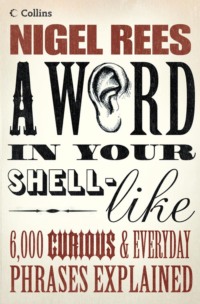
A Word in Your Shell-Like
6,000 Curious & Everyday Phrases Explained
Nigel Rees

Table of Contents
Cover Page
Title Page
Epigraph
Introduction
Abbreviations
A
B
C
D
E
F
G
H
I
J
K
L
M
N
O
P
Q
R
S
T
U
V
W
X
Y
Z
Acknowledgements
About the Author
Copyright
About the Publisher
‘Thou art a retailer of phrases, and dost deal in remnants of remnants’
William Congreve, The Way of the World (1700)
‘False English, bad pronunciation, old sayings and common proverbs; which are so many proofs of having kept bad and low company’
4th Earl of Chesterfield, Advice to his Son on Men and Manners (1775)
‘Sir, it [an earthquake] will be much exaggerated in popular talk; for, in the first place, the common people do not accurately adapt their thoughts to the objects; nor, secondly, do they accurately adapt their words to their thoughts: they do not mean to lie; but, taking no pains to be exact, they give you very false accounts. A great part of their language is proverbial, If anything rocks at all, they say it rocks like a cradle; and in this way they go on’
Samuel Johnson, quoted in James Boswell, The Life of Samuel Johnson (1791) – for 14 September 1777
‘Blank cheques of intellectual bankruptcy’
A definition of catchphrases attributed to Oliver Wendell Holmes (1809–94)
‘What do I mean by a phrase? A clutch of words that gives you a clutch at the heart’
Robert Frost, interviewed in the Saturday Evening Post (16 November 1960)
Introduction
A Word in Your Shell-like is an extensive examination of more than 6,000 phrases, detailing their origins, dates, meanings and use. But what is a ‘phrase’? Although it is technically possible for a phrase to consist of one word, I have mostly limited myself to clusters of two or more words and left analysis of single words to the etymologists and lexicographers. Within this definition of a phrase, however, fall idiomatic expressions, proverbial sayings, stock and format phrases, catchphrases, clichés, journalese, headline fodder, slogans, advertising lines, as well as titles of books and entertainments which either quote a specific source or themselves create a form of words. There is also a number of ‘short quotations’ – phrases derived from famous sayings that may be said to have a life of their own.
As to my choice of phrases for inclusion, I have simply concentrated on those about which there is something interesting to say with regard to their origins and use. I have not always restricted myself to phrases that have caught on in an enduring fashion – which might be the criterion for inclusion in a more formal dictionary – but I also look at phrases that may have had only a brief flowering. This is because to record them here may help to explain an allusion that might puzzle the reader of a novel or other work. In addition, even a briefly popular phrase can help to evoke a period and thus should be examined as part of the social history of the language.
These are the main types of phrase that I have explored in this book:
Catchphrase: simply a phrase that has ‘caught on’ with the public and is, or has been, in frequent use. It might have originated with a particular person – like CALL ME MADAM – or it might not be traceable to a particular source – like BACK TO THE DRAWING-BOARD!
Cliché: a worn or hackneyed phrase. There are some who would say that the clichés of journalism are used in such a way that they amount to a special language – journalese – which does not deserve to be condemned. I disagree.
Euphemisms: phrases used when you are trying to be gentle – or, in modern guise – when you are trying to be politically correct. The word ‘loophemism’ coined by Frank Deakin of Wilmslow in 1995 describes the largest number of such phrases in this book, having to do with going to the lavatory: (GO AND) SEE A MAN ABOUT A DOG.
Nannyisms: usually of a cautionary nature, these sayings may have been handed down by actual nannies or by grown-ups of a nannyish tendency: BACK IN THE KNIFE-BOX, LITTLE MISS SHARP.
Format phrase: a basic phrase or sentence structure capable of infinite variation by the insertion of new words – like ONE SMALL STEP FOR—, ONE GIANT LEAP FOR—where the sentence structure can be adapted to suit the speaker’s purpose.
Idiom: a picturesque expression that is used to convey a metaphorical meaning different from its literal one – or, as The Oxford Dictionary of Current Idiomatic English puts it, that has a meaning ‘not deducible from those of the separate words’. For example, if I say someone is a SQUARE PEG IN A ROUND HOLE it is obvious he or she cannot literally be such a thing. My hearers will know exactly what I mean, although I have not told them directly. Like the term ‘catchphrase’, ‘idiom’ could be applied to most of the phrases in this book, but I have tried to restrict its use to those that conform to the above definition.
Quotation, short: a number of phrases that are parts of quotations – e.g. WINTER OF DISCONTENT – are also included, especially when they have been used as the titles of popular books or films. Equally, when original phrases chosen as titles have become part of popular speech, they also are covered.
Saying, brief: this is what is sometimes called ‘a well-known phrase or saying’ (as in ‘re-arrange these words into a well-known phrase or saying’) but, unlike a formal ‘quotation’, is probably not attributable to a precise source, be it speaker, book or show. Proverbial expressions most commonly fall into this category.
Slogan: a phrase designed to promote a product, idea or cause – or which has this effect. However, at times I have employed it rather loosely to cover any phrase that is used in advertising – in headlines, footnotes, but not necessarily in a selling line that names the product. BODY ODOUR (or BO) could hardly be described as a slogan in itself, but as an advertising line it did help to promote a product.
Stock phrase: a regularly used phrase that can’t be said to have ‘caught on’ like a full-blooded catchphrase – for example, a celebrity’s verbal mannerism (CAN WE TALK?), by which he or she is known but which can’t be said to have ‘caught on’ with the public as a proper catchphrase should. It also refers to phrases which get regularly trotted out but which, again, cannot be said to have passed into the language generally.
A word about dating: Eric Partridge was always ‘game’ (as someone once felicitously put it) to try to pinpoint when a phrase came into use, though many of his stabs at it were no more than guesses. Using the citations that I have accumulated, I have tried to be a little more precise in this area. When I say that a phrase was ‘Current in 1975’, I mean that I simply have a record of its use then – not that I think it was first used in that year. It may also have been current long after that date. When I say that a phrase was ‘Quoted in 1981’, I mean precisely that – not that it was originated in that year. It might have been coined long before. On the whole I have not indulged in speculation about when a phrase might have entered the language but have simply recorded hard and fast examples of its use.
In case you find my interpretation of alphabetical order puzzling, the phrases are listed in what is known as ‘letter by letter’ order – that is to say, in alphabetical order of letters within the whole phrase exactly as it is written. Thus, for example, nicest things come in smallest parcels appears before nice work if you can get it! and move the goalposts before Mr.
Cross-references to other entries are made in SMALL CAPITALS.
Abbreviations
Apperson: G. L. Apperson, English Proverbs and Proverbial Phrases, 1929
Bartlett: Bartlett’s Familiar Quotations (15th edn), 1980, (16th edn), 1992, (17th edn), 2002
Benham: Benham’s Book of Quotations, 1907, 1948, 1960
Bible: The Authorized Version, 1611 (except where stated otherwise)
Brewer: Brewer’s Dictionary of Phrase and Fable, (2nd edn), 1894, (3rd edn), 1923, (13th edn), 1975, (14th edn), 1989
Burnam: Tom Burnam, The Dictionary of Misinformation, 1975; More Misinformation, 1980
Casson/Grenfell: Sir Hugh Casson & Joyce Grenfell, Nanny Says (ed. Diana, Lady Avebury), 1982
CODP: The Concise Oxford Dictionary of Proverbs, 1982
DOAS: Wentworth & Flexner, Dictionary of American Slang, 1960 (1975 revision and 1987 edition, ed. Robert L. Chapman)
DNB: The Dictionary of National Biography
Flexner: Stuart Berg Flexner, I Hear America Talking, 1976; Listening to America, 1982
Grose: Francis Grose, Dictionary of the Vulgar Tongue, 1785–1823
Mencken: H. L. Mencken’s Dictionary of Quotations, 1942
Morris: William and Mary Morris, Morris Dictionary of Word and Phrase Origins, 1977
ODP: The Oxford Dictionary of Proverbs (3rd edn), 1970
ODQ: The Oxford Dictionary of Quotations (2nd edn), 1953, (3rd edn), 1979, (4th edn), 1992, (5th edn), 1999
OED2: The Oxford English Dictionary (2nd ed,) 1989, (CD-ROM version 3.0), 2002
Partridge/Catch Phrases: Eric Partridge, A Dictionary of Catch Phrases (2nd edn, edited by Paul Beale), 1985
Partridge/Slang: Eric Partridge, A Dictionary of Slang and Unconventional English (8th edn, edited by Paul Beale), 1984
Safire: William Safire, Safire’s Political Dictionary, 1978
Shakespeare: The Arden Shakespeare (2nd series)
Slanguage: Brigid McConville & John Shearlaw, The Slanguage of Sex, 1984
Street Talk: Street Talk: The Language of Coronation Street, eds Jeffrey Miller & Graham Nown, 1986
A
abandon hope all ye who enter here! Ironic but good-humoured welcoming phrase – a popular mistranslation of the words written over the entrance to Hell in Dante’s Divina Commedia (circa 1320). ‘All hope abandon, ye who enter here!’ would be a more accurate translation of the Italian, ‘lasciate ogni speranza voi ch’entrate!’
—abhors a vacuum PHRASES A format based on the maxim ‘Nature abhors a vacuum’ that François Rabelais quotes in its original Latin form, ‘natura abhorret vacuum’, in his Gargantua (1535). Galileo (1564–1642) asserted that it was the reason mercury rises in a barometer. An early appearance in English is, ‘The Effatum, That Nature abhors a Vacuum’, from Robert Boyle, A Free Enquiry Into the Vulgarly Receiv’d Notion of Nature (1685). ‘Nature abhors a straight line’ was a saying of the English garden landscaper Capability Brown (1715–83). Clare Boothe Luce, the American writer and socialite (1903– 87), is supposed to have said, ‘Nature abhors a virgin’, but this may just be a version of the line in her play The Women (1936): ‘I’m what nature abhors – an old maid. A frozen asset.’ ‘Nature abhors a vacuum and what appears ultimately to concern the Reagan Administration most of all is the possibility that President Mitterrand’s France will gradually abandon its traditional military protection of central Africa and the Sahara’ – Financial Times (12 August 1983); ‘I quickly developed a pear-shaped figure that testified to my indolent lifestyle. I became the archetypal also-ran that PE masters could barely bring themselves to talk to without risk of life-threatening apoplexy: they abhorred my idleness as Nature abhors a vacuum’ – The Guardian (24 June 1986).
abide with me See CHANGE AND DECAY.
above and beyond (the call of duty) Phrase expressing an outstanding level of service, used in tributes and such like. OED2 has several ‘above and beyonds’ but not this precise one. Above and Beyond was the title of an American TV series of military stories (circa 1996).
Abraham’s bosom Where the dead sleep contentedly. From Luke 16:23: ‘And it came to pass, that the beggar died, and was carried by the angels into Abraham’s bosom.’ The phrase alludes to Abraham, first of the Hebrew patriarchs. Compare ARTHUR’S BOSOM.
absit omen See GESUNDHEIT.
absolutely, Mister Gallagher! / positively, Mister Shean! Phrases of agreement; roundabout ways of saying ‘yes’, taken from the American vaudevillians (Ed) Gallagher and (Al) Shean whose act flourished in the early part of the 20th century. The exchange was included in a popular song ‘Mr Gallagher and Mister Shean’ (1922) though, in that song, the order of words was ‘positively, Mister Gallagher / absolutely, Mr Shean’. Each syllable of the adverbs is emphasized – e.g. ‘pos-it-ive-ly’, ‘ab-so-lute-ly’.
accidents will occur in the best-regulated families A catchphrase used lightly to cover any domestic upset. The basic proverbial expression, ‘Accidents will happen’ was known by the 1760s; this full version by the 1810s. Best known in the form delivered by Mr Micawber in Charles Dickens, David Copperfield, Chap. 28 (1850): ‘“Copperfield,” said Mr. Micawber, “accidents will occur in the best-regulated families; and in families not regulated by…the influence of Woman, in the lofty character of Wife, they may be expected with confidence, and must be borne with philosophy”.’ Dickens had earlier used the saying in Pickwick Papers (1836–7) and Dombey and Son (1844–6).
(an) accident waiting to happen Hindsight phrase, frequently used in the wake of a disaster. This is the survivors’ and experts’ way of pointing to what, to them, seems the foreseeable and inevitable result of lax safety standards that will now probably be corrected only as a result of the tragedy. Much used in relation to the late 1980s spate of disasters in the UK (Bradford City football ground fire, Zeebrugge ferry overturning, Piper Alpha oil-rig explosion, Kings Cross Tube fire, Hillsborough football stadium crowd deaths). Used as the title of a 1989 book on the subject by Judith Cook. ‘Ignorance and neglect cost 51 lives [in the Marchioness boat disaster]…“You don’t need the benefit of hindsight to say this was an accident waiting to happen,” he said’ – Today (16 August 1991).
according to Cocker By strict calculation, exactly. Edward Cocker (1631–75) was an arithmetician who is believed to have written down the rules of arithmetic in a popular guide.
according to Hoyle Exactly; correctly; according to the recognized rules; according to the highest authority. The phrase comes from the name of the, at one time, standard authority on the game of whist (and other card games). Edmond Hoyle was the author of A Short Treatise on the Game of Whist (1742). ‘If everything goes according to Hoyle, I’ll go into semiretirement there’ – Melody Maker (21 August 1971).
(an) ace in the hole A hidden advantage or secret source of power. An American phrase used as the title of a Cole Porter song in the show Let’s Face It (1941), of a Billy Wilder film (US 1951) and of an Annie Proulx novel, That Old Ace In the Hole (2002). It came originally from the game of stud poker. A ‘hole’ card is one that is not revealed until the betting has taken place. If it is an ace, so much the better. DOAS dates the use of the expression, in a poker context, to the 1920s, OED2 to 1915. In British English, the nearest equivalent would be to talk of having an ace up one’s sleeve. ‘In the long haul…AM’s ace in the hole may be the $213 million net operating loss carryforward it still has left from its 1981–2 losses’ – The New York Times (6 May 1984).
(an) Achilles’ heel The vulnerable point of any person or thing. Referring to Achilles, the foremost warrior in the Trojan war, who sulked in his tent, was hero of the Iliad and was vulnerable only at the heel (in allusion to the story of the dipping of Achilles’ heel in the river Styx). ‘Divorce is the Achilles’ heel of marriage’ – Bernard Shaw, letter (2 July 1897). It was cited as a ‘dying metaphor’ by George Orwell, ‘Politics and the English Language’ in Horizon (April 1946). ‘If Oppenheimer has an “Achilles” heel, it is his overriding loyalty to his friends’ – Arthur Holly Compton, Atomic Quest (1956); ‘It is the refusal to condemn which is the Achilles heel of contemporary Christian psychology’ – Catholic Herald (28 January 1972).
(an) acid test A crucial test. Originally an ‘acid test’ involved the use of aqua fortis to test for gold. Cited as a ‘lump of verbal refuse’ by George Orwell, ‘Politics and the English Language’ in Horizon (April 1946). ‘The treatment accorded Russia by her sister nations in the months to come will be the acid test of their good will’ – President Woodrow Wilson, quoted in The Times (9 January 1918); ‘The acid test of any political decision is, “What is the alternative?“’ – Lord Trend, quoted in The Observer (21 December 1975); ‘Let’s get South Africa working. For we must together and without delay begin to build a better life for all South Africans. This is going to be the acid test of the government of national unity’ – Nelson Mandela, quoted in Financial Times (3 May 1994); ‘If the same weight is not given to the improvement of human capital as to market share, profit and other organisational priorities, small wonder the human resources function is often viewed as unrelated to the “real” goals of the company. The acid test here is: do the job descriptions of all staff (board of directors, executive, administration) include meaningful percentages of weights and time spent in subordinate development with examples of what this means in practice?’ – Financial Times (6 May 1994).
(an) action man A person who is given more to action than to thought, named after a boy’s doll that could be dressed in various military-type costumes with appropriate accoutrements. Prior to his marriage in 1981, Charles, Prince of Wales, was noted for his enthusiastic sporting activities in many fields. Coupled with his active service in the Royal Navy, such expenditure of energy caused him to be accorded this nickname. A report of a General Medical Council disciplinary inquiry in The Independent (29 March 1990) stated: ‘He told the hearing: “Mr Bewick is an Action Man, not a philosopher. Action Man’s advantage is that at the drop of a hat, he can go anywhere and do anything”.’
action this day Instruction phrase, for office use. ‘ACTION THIS DAY’, ‘REPORT IN THREE DAYS’ and ‘REPORT PROGRESS IN ONE WEEK’ were printed tags that Winston Churchill started using in February 1940 to glue on to memos at the Admiralty. Subtitled ‘Working with Churchill’, the book Action This Day (1968) is a collection of the reminiscences of those who had been closely associated with Churchill during the Second World War. ‘She [Margaret Thatcher] had the draft of that circular on her desk that night. She said “Action this day” and she got it. We didn’t stop to argue’ – Hugo Young, One of Us, Chap. 6 (1989).
(an) actor laddie An actor with the booming voice and declamatory manner of the Victorian and Edwardian stage. The expression presumably derives from the habit of adding the somewhat patronizing endearment ‘laddie’ when talking to junior members of their companies. The playwright Ronald Harwood singled out Frank G. Carillo as an example of the breed, from the early 1900s: ‘[He] intoned rather than talked, in a deep, trembling voice ideally suited to melodrama and he used it with equal fortissimo both on and off the stage.’ Sir Donald Wolfit, himself somewhat prone to this manner, described Carillo as one of the few actors he had actually heard use the word ‘laddie’.
actress See AS THE BISHOP.
act your age (also be your age)! Grow up, behave in a manner more befitting your years. Probably from the US and in use by the 1920s. An elaboration heard in the UK (1985) – act your age, not your shoe size (normal shoe sizes in the UK are in the range 4–12).
Adam’s rib The film Adam’s Rib (US 1949) is about husband and wife lawyers opposing each other in court and stars Spencer Tracy and Katharine Hepburn. It is also the title of a 1923 Cecil B. de Mille film about marriage, with biblical flashbacks. The phrase alludes to Genesis 2:21–2, which states that God made woman from one of Adam’s ribs. Compare SPARE RIB.
adjust See DO NOT.
(an) admirable Crichton A resourceful servant. Also applied – broadly – to anyone of intellectual accomplishment. The Admirable Crichton has been the title of a novel by Harrison Ainsworth (1837) and of J. M. Barrie’s play (1902; films UK 1918, 1957), the latter about a butler who succours his shipwrecked aristocratic employer on a desert island. The term had originally been applied to James Crichton (1560–85), Scottish traveller and scholar, by Sir Thomas Urquhart in The Jewel (1652).
adopt, adapt, improve Motto of the National Association of Round Tables of Great Britain and Ireland, from 1927 onwards. The Prince of Wales (later Edward VIII) had said in a speech at the British Industries Fair in Birmingham (1927): ‘The young business and professional men of this country must get together round the table, adopt methods that have proved sound in the past, adapt them to the changing needs of the times and, whenever possible, improve them.’ The Round Table movement is a social and charitable organization for young professional and business men under the age of forty (after which age Rotary takes over).
adrift See CAST ADRIFT.
advance Australia Motto of the Commonwealth of Australia when the states united in 1901. In the 1970s and 1980s, as republicanism grew, it acquired the force of a slogan and was used in various campaigns to promote national pride (sometimes as ‘Let’s Advance Australia’). In 1984, ‘Advance Australia Fair’, slightly adapted, superseded ‘God Save the Queen’ as the country’s national anthem. This song, by Peter Dodds McCormick, had first been performed in Sydney in 1878, though the alliterative slogan ‘Advance Australia’ apparently existed earlier when Michael Massey Robinson wrote in the Sydney Gazette (1 February 1826): ‘“Advance Then, Australia”, / Be this thy proud gala /…And thy watch-word be “Freedom, For Ever!”’
advise and consent The title of Allen Drury’s novel about Washington politics Advise and Consent (1959; film US 1962) (not ‘advice’) is taken from US Senate Rule 38: ‘The final question on every nomination shall be, “Will the Senate advise and consent to this nomination?”’ In the US Constitution (Art. II, Sect. 2), dealing with the Senate’s powers as a check on the President’s appointive and treaty-making powers, the phrase includes the noun rather than the verb, ‘Advice and consent’. Originally, George Washington as President went in person to the Senate Chamber (22 August 1789) to receive ‘advice and consent’ about treaty provisions with the Creek Indians. Vice-President Adams used the words, ‘Do you advise and consent?’ Subsequent administrations have sent written requests.
(the) affluent society Label applied to Western society in the mid-20th century. John Kenneth Galbraith’s book The Affluent Society (1958) is about the effect of high living standards on economic theories that had been created to deal with scarcity and poverty. The resulting ‘private affluence and public squalor’ stemmed from an imbalance between private and public sector output. For example, there might be more cars and TV sets but not enough police to prevent them from being stolen. The Revd Dr Martin Luther King Jnr, in a 1963 letter from gaol, used the phrase thus: ‘When you see the vast majority of your twenty million Negro brothers smouldering in an airtight cage of poverty in the midst of an affluent society…then you will understand why we find it difficult to wait.’ The notion was not new to the mid-20th century. Tacitus, in his Annals (circa AD 115) noted that ‘many, amid great affluence, are utterly miserable’ and Cato the Younger (95–46 BC), when denouncing the contemporary state of Rome said: ‘Habemus publice egestatem, privatim opulentiam [public want, private wealth].’ The punning tag of the effluent society, a commonplace by the 1980s, had appeared in Stan Gooch’s poem ‘Never So Good’ in 1964, and indeed before that.
after I’ve shampooed my hair, I can’t do a thing with it (or I washed my hair last night – and now…)! Commonplace excuse for one’s less than good appearance and a domestic conversational cliché. In Are You a Bromide? (1907), the American writer Gelett Burgess castigated people who spoke in what he called ‘Bromidioms’, like this one. The second part is sometimes given as a chorused response as though anticipating the cliché involved.
after the Lord Mayor’s show comes the shit-cart A reference to the anti-climactic appearance of a dust-cart and operative to clean up the horse manure that is left behind after the Lord Mayor’s annual show (really a procession) in the City of London. Partridge/Catch Phrases suggests that it is a late 19th century Cockney observation and one that could be applied to other from-the-sublime-to-the-ridiculous situations.
after you, Claude! / no, after you, Cecil! Catchphrase exchange spoken by Horace Percival and Jack Train playing two over-polite handymen, Cecil and Claude, in the BBC radio show ITMA (1939–49). It still survives in pockets as an admirable way of overcoming social awkwardness in such matters as deciding who should go first through a door. In the early 1900s, the American cartoonist Fred Opper created a pair of excessively polite Frenchmen called Alphonse and Gaston who had the similar exchange: ‘You first, my dear Alphonse’ – ‘No, no, you first, my dear Gaston.’
afternoon men Drunkards (‘afternoon’, presumably because they have imbibed a liquid lunch). ‘As if they had heard that enchanted horn of Astolpho, that English duke in Ariosto, which never sounded but all his auditors were mad, and for fear ready to make away [with] themselves…They are a company of giddy-heads, afternoon men.’ This is the final part of the quotation given by Anthony Powell as the epigraph to his novel Afternoon Men (1931). He gives the source as Burton’s Anatomy of Melancholy. The only other use found of the term ‘afternoon men’ is from the same work. In the introductory ‘Democritus to the Reader’, Burton has: ‘Beroaldus will have drunkards, afternoon men, and such as more than ordinarily delight in drink, to be mad.’
age See ACT YOUR.
age before beauty! A phrase used (like AFTER YOU…) when inviting another person to go through a door before you. In the famous story, Clare Boothe Luce said it to Dorothy Parker, ushering her ahead. Parker assented, saying, ‘Pearls before swine.’ Mrs Luce described this account as completely apocryphal in answer to a question from John Keats, Parker’s biographer, for his book You Might as Well Live (1970). The saying presumably originated when people first started worrying about the etiquette of going through doors. It does not occur in Jonathan Swift’s Polite Conversation (1738), as one might have expected. A variant reported from New Zealand (1987) is dirt before the broom, though Partridge/Catch Phrases has this as the response to ‘Age before beauty’ (which it describes as a ‘mock courtesy’). Other versions are dust before the broom (recorded in Dublin, 1948) and the dog follows its master. Whichever phrase is used, it usually precipitates a response. An exchange between two boozy buffoons at a pub door in Posy Simmonds’s cartoon strip in The Guardian (19 May 1985) included these phrases: ‘“Certainly! Dogs follow their master!” “Dirt before the broom!” “Shepherd before sheep!” “Shit before shovel!”’ Another phrase to offer in reply is: grace before meat!
(the) age of anxiety Label for the mid-20th century. It was the title of a long poem by W. H. Auden, written 1944–6 – an expression of loneliness in the midcentury. It was the inspiration of Leonard Bernstein’s second symphony (1947–9), which became known as ‘The Age of Anxiety’, and was used as the score for a ballet (US 1950), also with the title.
(the) age of Aquarius The astrological age, lasting two thousand years, which was said to be beginning in the 1960s (following the Piscean Age). ‘This is the dawning of the Age of Aquarius,’ sang the cast of the ‘American tribal love-rock musical’ Hair (1968), in what was to become something of a hippy anthem. This new age held forth the promise of more liberal values, world freedom and brotherhood, as well as promoting general optimism.
(the) age of innocence The Age of Innocence was the title of a novel published in 1920 by the American writer Edith Wharton. In it, she looked back on the New York of her youth and told the story of a love affair frustrated by the morals of the time. Presumably, the description ‘age of innocence’ is ironically applied to this earlier period.
(an) age of kings An Age of Kings was the title of a fifteen-part fortnightly BBC TV serialization of Shakespeare’s history plays from Richard II to Richard III, transmitted live in 1960. The phrase does not appear to have been used before. TV parodist Alan Melville came up with a version entitled ‘An Eternity of Kings’.
(the) age of miracles is past As with (the) age of chivalry is past, this proverb is now used more often in the ironic negative, i.e. when saying ‘the age of miracles is not past’ or ‘the age of chivalry is not dead’ out of feigned gratitude for a stroke of good fortune or an unexpected courtesy. In its original positive form, ‘miracles’ was current by 1602. ‘The age of chivalry is gone’ occurs in Edmund Burke’s Reflections on the Revolution in France (1790). In about 1900, Oscar Wilde wrote in a letter: ‘[Frank Harris] keeps Bosie in order: clearly the age of miracles is not over.’ In Ira Gershwin’s lyric for the song ‘A Foggy Day (in London Town)’ (1937) are the lines: ‘I viewed the morning with alarm. / The British Museum had lost its charm. / How long, I wondered, could this thing last? / But the age of miracles hadn’t passed.’
Auntie/Aunty BBC (or plain Auntie/Aunty) The BBC was mocked in this way by newspaper columnists, TV critics and her own employees, most noticeably from about 1955 at the start of commercial television – the Corporation supposedly being staid, over-cautious, prim and unambitious by comparison. A BBC spokesman countered with, ‘An Auntie is often a much loved member of the family.’ The corporation assimilated the nickname to such effect that when arrangements were made to supply wine to BBC clubs in London direct from vineyards in Burgundy, it was bottled under the name Tantine. In 1979, the comedian Arthur Askey claimed that he had originated the term during the Band Waggon programme as early as the late 1930s. While quite probable, the widespread use of the nickname is more likely to have occurred at the time suggested above. Wallace Reyburn in his book Gilbert Harding – A Candid Portrayal (1978) ascribes the phrase to the 1950s’ radio and TV personality. The actor Peter Bull in I Know the Face, But… (1959) writes: ‘I would be doing my “nut” and probably my swansong for Auntie BBC.’ The politician Iain Macleod used the phrase when editing The Spectator in the 1960s. Jack de Manio, the broadcaster, entitled his memoirs To Auntie With Love (1967), and the comedian Ben Elton had a BBC TV show The Man from Auntie (1990–4).
au reservoir! A jokey valediction (obviously based on au revoir) popularized by E. F. Benson in his Lucia novels of the 1920s. The phrase may have existed before this, possibly dating from a Punch joke of the 1890s.
(an) auspicious occasion Cliché used in speech-making or at any time when portentousness or pomposity is demanded. In fact, almost any use of the word ‘auspicious’ is a candidate for clichédom: ‘Drinking around the imposing stone in order to celebrate some auspicious occasion’ – Charles T. Jacobi, The Printers’ Vocabulary (1888); ‘An auspicious debut on the platform was made the other day by Mr Winston Churchill, elder son of the late Lord Randolph Churchill’ – Lady (5 August 1897); ‘What about a glass of sherry to celebrate the auspicious occasion?’ – ‘Taffrail’, Pincher Martin (1916); ‘The longer the game wore on the more obvious it became that Forest could not even rise to this auspicious occasion, much as they yearned to give their manager the mother and father of all send-offs’ – The Sunday Times (2 May 1993).
Austin Reed service See IT’S ALL PART OF THE SERVICE.
Australia See ADVANCE.
author! author! The traditional cry of an audience summoning the playwright whose work it has just watched to come on the stage and receive its plaudits. Date of origin unknown. ‘After the final curtain [at the first night of Lady Windermere’s Fan (1892)] the applause was long and hearty, and Wilde came forward from the wings to cries of “Author!”’ – Richard Ellman, Oscar Wilde, Chap. 14 (1987); Author! Author! – title of a book (1962) by P. G. Wodehouse.
avoid ‘five o’clock shadow’ The expression ‘five o’clock shadow’ for the stubbly growth that some dark-haired men acquire on their faces towards the end of the day would appear to have originated in adverts for Gem Razors and Blades in the USA before the Second World War. A 1937 advert added: ‘That unsightly beard growth which appears prematurely at about 5 pm looks bad.’ The most noted sufferer was Richard Nixon, who may have lost the TV debates in his US presidential race against John F. Kennedy in 1960 as a result. In his Memoirs (1978), Nixon wrote: ‘Kennedy arrived…looking tanned, rested and fit. My television adviser, Ted Rodgers, recommended that I use television make-up, but unwisely I refused, permitting only a little “beard stick” on my perpetual five o’clock shadow.’
(to) avoid---like the plague To avoid completely, to shun. The OED2 finds the poet Thomas Moore in 1835 writing, ‘Saint Augustine…avoided the school as the plague’. The 4th-century St Jerome is also said to have quipped, ‘Avoid as you would the plague, a clergyman who is also a man of business.’ A well-established cliché by the mid-20th century. It may have been Arthur Christiansen, one of the numerous former editors of the Daily Express about that time, who once posted a sign in the office saying: ‘ALL CLICHÉS SHOULD BE AVOIDED LIKE THE PLAGUE.’
Avon calling! A slogan first used in the USA in 1886. The first Avon Lady, Mrs P. F. A. Allre, was employed by the firm’s founder, D. H. McConnell, to visit customers at home and sell them cosmetics.
award-winning---As used in promotion, especially of theatre, films and publishing. Depressing because it does not describe its subject in any useful way. Almost any actor in a leading role is likely to have received one of the many theatrical awards available at some time, just as any writer may (however illegitimately) be called a ‘best-selling author’ if more than just a few copies of his or her books have been sold. The phrase was in use by 1962. From the Evening Standard (London) (17 February 1993): ‘Why go on about the latest “award-winning documentary maker”? If you get a documentary on television, you win an award: it goes with the territory.’ ‘Giles Cooper, who died nearly twenty years ago, is described in today’s Times as “award-winning playwright Giles Cooper”. I’d have thought one of the few things to be said in favour of death was that it extinguished all that’ – Alan Bennett, diary entry for 30 June 1984, quoted in Writing Home (1994); ‘Awardwinning actor Michael Gambon can also be seen…David Hare has written many successful plays and screenplays, including his award-winning trilogy…the Pulitzer Prize winning author, John Updike…’ – Royal National Theatre brochure (26 June–28 August 1995); ‘We also introduce some new writers this week. Allison Pearson, the award-winning TV Critic of the year, joins us from the Independent on Sunday…Kenneth Roy, another new award-winning voice…will be writing a personal weekly peripatetic notebook’ – The Observer (27 August 1995).
away See AND AWAY.
aw, don’t embarrass me! British ventriloquist Terry Hall (b. 1926) first created his doll, Lenny the Lion, from a bundle of fox fur and papier-mâché – with a golf ball for a nose – in 1954. He gave his new partner a gentle lisping voice, and added a few mannerisms and a stock phrase that emerged thus: ‘He’s ferocious! (drum roll) / He’s courageous! (drum roll) / He’s the king of the jungle! (drum roll) / – Aw, don’t embarrass me! (said with a modest paw over one eye).’ Unusually for the originator of a successful phrase, Terry Hall said (in 1979) that he made sure he did not overuse it and rested it from time to time.
awful See AMUSING.
awkward See AS AWKWARD.
(the) awkward age Adolescence – when one is no longer a child but not yet a fully fledged adult. Current by the late 19th century and possibly a development of the French l’âge ingrat. Hence, The Awkward Age, the title of a novel (1899) by Henry James.
(the) awkward squad Of military origin and used to denote a group of difficult, uncooperative people, the phrase originally referred to a squad that consisted of raw recruits and older hands who were put in it for punishment. The phrase may also have been applied to a group of soldiers who are briefed to behave awkwardly and in an undisciplined fashion in order to test the drilling capabilities of an officer under training. Sloppy in Our Mutual Friend (1864–5) is described by Charles Dickens as ‘Full-Private Number One in the Awkward Squad of the rank and file of life’. The dying words of the Scots poet Robert Burns in 1796 are said to have been, ‘John, don’t let the awkward squad fire over me’ – presumably referring to his fear that literary opponents might metaphorically fire a volley of respect, as soldiers sometimes do over a new grave.
(I) awoke one morning and found myself famous Byron’s famous comment on the success of the first two cantos of Childe Harold in 1812 has become an expression in its own right. It was first quoted in Thomas Moore, The Letters and Journals of Lord Byron (1830).
AWOL ‘Absent WithOut Leave’ – unwarranted absence from the military for a short period but falling short of actual desertion. This expression dates from the American Civil War when offenders had to wear a placard with these initials printed on it. During the First World War, the initials were still being pronounced individually. It does not mean ‘absent without official leave’.
(to have an) axe to grind The expression meaning ‘to have an ulterior motive, a private end to serve’ would appear to have originated with an anecdote related by Benjamin Franklin in his essay ‘Too Much for Your Whistle’. A man showed interest in young Franklin’s grindstone and asked how it worked. In the process of explaining, Franklin – using much energy – sharpened up the visitor’s axe for him. This was clearly what the visitor had had in mind all along. Subsequently, Franklin (who died in 1790) had to ask himself whether other people he encountered had ‘another axe to grind’. Cited as a ‘dying metaphor’ by George Orwell in ‘Politics and the English Language’ in Horizon (April 1946). ‘Manhattan Cable showed that some of the most ordinary people are very good on TV. In Britain, where the idea of access is a familiar one, it’s still a very mediated and restricted thing where you have to have a politically correct axe to grind’ – The Guardian (24 October 1991).
aye, aye, that’s yer lot! Signing-off line of Jimmy Wheeler (1910–73), a British Cockney comedian with a fruity voice redolent of beer, jellied eels and winkles. He would appear in a bookmaker’s suit, complete with spiv moustache and hat, and play the violin. At the end of his concluding fiddle piece, he would break off and intone these words.
aye caramba See EAT MY SHORTS.
aye, well – ye ken noo! ‘Well, you know better now, don’t you!’ – said after someone has admitted ignorance or has retold an experience that taught a lesson. It is the punch line of an old Scottish story about a Presbyterian minister preaching a hell-fire sermon whose peroration went something like this: ‘And in the last days ye’ll look up from the bottomless pit and ye’ll cry, “Lord, Lord, we did na ken [we did not know]”, and the Guid Lord in his infinite mercy will reply…“Aye, well – ye ken noo!”’
ay thang yew! A distinctive pronunciation of ‘I thank you!’ picked up from the cry of London bus conductors by Arthur Askey for the BBC radio show Band Waggon (1938–39) and used by him thereafter. He commented (1979): ‘I didn’t know I was saying it till people started to shout it at me.’ Later, as I Thank You, it became the title of one of Askey’s films (1941).
B
(a’)babbled of green fields One of the most pleasing touches to be found in all of Shakespeare may not have been his at all. In Henry V (II.iii.17), the Hostess (formerly Mistress Quickly) relates the death of Falstaff: ‘A’parted ev’n just between twelve and one, ev’n at the turning o’ th’ tide: for after I saw him fumble with the sheets and play with flowers and smile upon his fingers’ end, I knew there was but one way; for his nose was as sharp as a pen, and a’babbled of green fields.’ The 1623 Folio of Shakespeare’s plays renders the last phrase as ‘and a Table of green fields’, which makes no sense, though some editors put ‘as sharp as a pen, on a table of green field’ (taking ‘green field’ to mean green cloth.) Shakespeare may well have handwritten ‘babld’ and the printer read this as ‘table’ – a reminder that the text of the plays is far from carved in stone and a prey to mishaps in the printing process, as are all books and newspapers. The generally accepted version was inserted by Lewis Theobald in his 1733 edition. As the 1954 Arden edition comments: ‘“Babbled of green fields” is surely more in character with the Falstaff who quoted the Scriptures…and who lost his voice hallooing of anthems. Now he is in the valley of the shadow, the “green pasture” of Psalm 23 might well be on his lips.’ Francis Kilvert, the diarist, makes a pleasant allusion to the phrase in his entry for 15 May 1875: ‘At the house where I lodge there is a poor captive thrush who fills the street with his singing as he “babbles of green fields”.’
babes in the wood (1) Simple, inexperienced, trustful people who are easily fooled. Known by 1866. So called by way of allusion to ‘The Children in the Wood’, an old ballad based on the case of two Norfolk children whose uncle plotted to kill them in order to obtain their inheritance. But one of the ruffians employed to do the deed prevented it, and the children were left in a wood to perish. The story (sometimes held to be true and to have taken place in Wayland Wood near Watton) was published in Norwich by Thomas Millington in 1595. In ballad form, it is mentioned in a play by Rob Yarrington (1601) and in Percy’s Reliques (1765). The story also forms the basis of the popular British pantomime format, Babes in the Wood.
(2) The name has also been applied to Irish ruffians who ranged the Wicklow mountains and the Enniscorthy woods towards the end of the 18th century.
(3) It was also given to men in the (wooden) stocks or pillory.
babies See KILL YOUR DARLINGS.
baby See DON’T THROW.
---Babylon PHRASES. Used to describe groups of people or whole societies where high living and scandals abound. The link to the biblical Babylon is not direct. Although heathen, that was rather a place of magnificence and luxury. In 588BC, Nebuchadnezzar, King of Babylon, took Jerusalem and carried away many of the inhabitants to Babylon where they became slaves. These somewhat stuffy Jews reacted strongly to the amorality of the Babylonians (described by Herodotus), and Babylon became a byword for cruelty and vice. When the Romans took Jerusalem in AD 70, some Jewish writers (including the author of the Book of Revelation) referred to Rome as Babylon. The modern connotation of Babylon probably goes back at least as far as Disraeli, who wrote in Lothair (1847): ‘London is a modern Babylon’. Dickens has Mr Micawber make the same comparison in David Copperfield (1850), but here Babylon is evoked only to signify a magnificent, big city. So Brewer (1894) may have been a touch off the mark in saying that ‘The Modern Babylon’ is ‘London…on account of its wealth, luxury and dissipation’. The key to why, since film-maker Kenneth Anger entitled his book of movie scandals Hollywood Babylon in 1975, we have had a spate of titles like Rock’n’Roll Babylon (1982), Washington Babylon (1996), TV Babylon (1997) and Hamptons Babylon (1997) seems to lie in the popularization of the idea of Babylon as a city of decadence promoted by D. W. Griffith in his film Intolerance (US 1916). The Anger book is prefaced by a poem by Don Blanding ‘as recited by Leo Carillo in the 1935 musical Star Night at the Cocoanut Grove’: ‘Hollywood, Hollywood…/ Fabulous Hollywood…/ Celluloid Babylon, / Glorious, glamorous…/ City delirious, / Frivolous, serious…/ Bold and ambitious, / And vicious and glamorous…’ This led to Gary Herman, for example, writing of the original Babylon in his preface to Rock’n’Roll Babylon: ‘[It] was the capital of a vast and profligate empire. [Similarly] in the rock world, its citizens may start from humble beginnings, but soon they are ushered into lush hanging gardens where there are no dreams of democracy and change, only dreams of power, wealth and the perfect tan.’ In a separate development, because the Babylonians had enslaved the Israelites, Afro-Caribbean people with a history of enslavement have taken to referring to their oppressors – and by extension prosperous and privileged members of racist white society – as ‘Babylon’. In particular, ‘The Babylon’ means the police. A No.1 hit of 1977 for Boney M, the West Indies group, was ‘Rivers of Babylon’, based on ‘By the rivers of Babylon, there we sat down, yea, and wept’ (Psalm 137:1) – which in the Book of Common Prayer is, ‘By the waters of Babylon we sat down and wept.’ But, equally, this Babylonic allusion has also been used in what would seem to be the more traditional sense: in 1945, Elizabeth Smart likened New York to Babylon in the title of her novel, By Grand Central Station I Sat Down and Wept, a short, account of a love affair written in ‘poetic prose’. Much earlier, in a letter of 12 June 1775, Horace Walpole wrote: ‘By the waters of Babylon we sit down and weep, when we think of thee, O America!’
(a) bachelor gay Someone who puts himself about in a way characteristic of the unmarried male. ‘A Bachelor Gay (Am I)’ is the title of a song by James W. Tate in The Maid of the Mountains (1917). An arch phrase, to be used only within quotation marks, even before the change in meaning of ‘gay’ from the 1960s onwards. ‘“He was a bachelor gay,” says Diana. “He left his first wife and small child, years before I knew him…After that he’d lived at separate times with two other women and walked out on both of them. He said to me: “You must appreciate I’ve been around a lot.” It was part of the appeal’ – Daily Mail (29 November 1993).
back See—IS BACK.
back burner See PUT (SOMETHING ON).
back in the knife-box, little Miss Sharp! A nannyism addressed to a person with a sharp tongue. Compare the similar you’re so sharp you’ll be cutting yourself. Casson/Grenfell also has: ‘Very sharp we are today, we must have slept in the knife box / we must have slept on father’s razor case / we must have been up to Sheffield’. Also there is Mr Sharp from Sheffield, straight out of the knife-box! Paul Beale found a homely example of the knife-box version in Donald Davie’s autobiographical study These the Companions (1982): ‘More than twenty-five years ago I [composed] a poem which has for epigraph what I remember my mother [in Barnsley, Yorkshire] saying when I was too cocky as a child: “Mr Sharp from Sheffield, straight out of the knife-box!”’ Earlier than all this, Murdstone referred to David – Charles Dickens, David Copperfield, Chap. 2 (1849) – as ‘Mr Brooks of Sheffield’, to indicate that he was ‘sharp’. There was indeed a firm of cutlery makers called Brookes of Sheffield – a city that has for centuries been the centre of the English cutlery trade.
back of a lorry See FELL OFF THE.
backroom boys Nickname given to scientists and boffins – and specifically to those relied on to produce inventions and new gadgets for weaponry and navigation in the Second World War. Compare The Small Back Room, the title of a novel (1943) by Nigel Balchin. The phrase was originated, in this sense, by Lord Beaverbrook as Minister of Aircraft Production when he paid tribute to his research department in a broadcast on 19 March 1941: ‘Let me say that the credit belongs to the boys in the backrooms [sic]. It isn’t the man who sits in the limelight who should have the praise. It is not the men who sit in prominent places. It is the men in the backrooms.’ In the US, the phrase ‘backroom boys’ can be traced to the 1870s at least, but Beaverbrook can be credited with the modern application to scientists and boffins. The inspiration quite obviously was his favourite film, Destry Rides Again (1939), in which Marlene Dietrich jumped on the bar of the Last Chance saloon and sang the Frank Loesser song ‘See What the Boys in the Back Room Will Have’.
(with our) backs to the wall This expression, meaning ‘up against it’, dates back to 1535 at least but was memorably used when the Germans launched their last great offensive of the First World War. On 12 April 1918, Sir Douglas Haig, the British Commander-in-Chief on the Western Front, issued an order for his troops to stand firm: ‘Every position must be held to the last man: there must be no retirement. With our backs to the wall, and believing in the justice of our cause, each one of us must fight on to the end.’ A. J. P. Taylor in his English History 1914–45 (1966) commented: ‘In England this sentence was ranked with Nelson’s last message. At the front, the prospect of staff officers fighting with their backs to the walls of their luxurious chateaux had less effect.’
back to basics John Major, the British Prime Minister, launched this ill-fated slogan in a speech to the Conservative Party Conference in 1993: ‘The message from this Conference is clear and simple. We must go back to basics…The Conservative Party will lead the country back to these basics, right across the board: sound money, free trade; traditional teaching; respect for the family and the law.’ A number of government scandals in the ensuing months exposed the slogan as hard to interpret or, at worst, suggesting rather a return to ‘the bad old days’. The alliterative phrase (sometimes ‘back to the basics’) may first have surfaced in the USA where it was the mid-1970s’ slogan of a movement in education to give priority to the teaching of the fundamentals of reading, writing and arithmetic.
back to normalcy Together with ‘Return to normalcy with Harding’, this was a slogan effectively used by US President Warren G. Harding. Both were based on a word extracted from a speech he had made in Boston during May 1920: ‘America’s present need is not heroics but healing, not nostrums but normalcy, not revolution but restoration, not agitation but adjustment, not surgery but serenity, not the dramatic but the dispassionate, not experiment but equipoise, not submergence in internationality but sustainment in triumphant nationality.’ Out of such an alliterative bog stuck the word ‘normalcy’ – a perfectly good Americanism, though it has been suggested that Harding was actually mispronouncing the word ‘normality’. He himself claimed that ‘normalcy’ was what he had meant to say, having come across it in a dictionary.
back to square one Meaning ‘back to the beginning’, this phrase is sometimes said to have gained currency in the 1930s through its use by football commentators on British radio. Radio Times used to print a map of the football field divided into numbered squares to which commentators would refer. Thus: ‘Cresswell’s going to make it – FIVE. There it goes, slap into the middle of the goal – SEVEN. Cann’s header there – EIGHT. The ball comes out to Britton. Britton manoeuvres. The centre goes right in – BACK TO EIGHT. Comes on to Marshall – SIX’ (an extract from the BBC commentary on the 1933 Cup Final between Everton and Manchester City). The idea had largely been abandoned by 1940. Against this proposition is the fact that square ‘one’ was nowhere near the beginning. The game began at the centre spot, which was at the meeting point of squares three, four, five and six. On the other hand, when the ball was passed to the goal-keeper (an event far commoner than a re-start after a goal), then this would indeed have been ‘back to square one’ (though, equally, two, seven or eight). Indeed, Partridge/Catch Phrases prefers an earlier origin in the children’s game of hopscotch or in the board game Snakes and Ladders. If a player was unlucky and his or her counter landed on the snake’s head in Square 97 or thereabouts, it had to make the long journey ‘back to square one’.
(ah, well,) back to the drawing-board! Meaning ‘We’ve got to start again from scratch’, this is usually said after the original plan has been aborted. It is just possible this phrase began life in the caption to a cartoon by Peter Arno that appeared in The New Yorker (3 January 1941). An official, with a rolled-up engineering plan under his arm, is walking away from a recently crashed plane and saying: ‘Well, back to the old drawing board.’
back to the jungle A return to primitive conditions, nearly always used figuratively (as in ‘a return to the Dark Ages’). Winston Churchill, in a speech about post-Revolution Russia on 3 January 1920, referred to a recent visitor to that country: ‘Colonel John Ward…has seen these things for many months with his own eyes…[and] has summed all up in one biting, blasting phrase – “Back to the jungle”.’
back to the land The cry ‘Back to the land!’ was first heard at the end of the 19th century when it was realized that the Industrial Revolution and the transfer of the population towards non-agricultural work had starved farming of labour. From The Times (25 October 1894): ‘All present were interested in the common practice that it was desirable, if possible, to bring the people back to the land.’ At about this time, a Wickham Market farmer wrote to Sir Henry Rider Haggard, who was making an inventory of the decline, published as Rural England (1902): ‘The labourers “back to the land”. That is the cry of the press and the fancy of the people. Well, I do not think that they will ever come back; certainly no legislation will ever bring them. Some of the rising generation may be induced to stay, but it will be by training them to the use of machinery and paying them higher wages. It should be remembered that the most intelligent men have gone: these will never come back, but the rising generation may stay as competition in the town increases, and the young men of the country are better paid.’ By 1905, the Spectator (23 December) was saying: ‘“Back-to-the-land” is a cry full not only of pathos, but of cogency.’ In the 1970s, a British TV comedy series was called Backs to the Land, playing on the phrase to provide an innuendo about its heroines – ‘Land Girls’, members of the Women’s Land Army conscripted to work on the land during the Second World War (though the WLA had first been established in the First World War.)
(either) back us or sack us From a speech by James Callaghan, when British Prime Minister, at the Labour Party Conference (5 October 1977). This became a format phrase in British politics, usually spoken by an individual rather than a whole government. From The Independent (25 October 1989): ‘The Chancellor of the Exchequer [Nigel Lawson] was last night challenged by the Opposition to stand up to the Prime Minister, say “Back me or sack me” and end confusion over who is running the economy…“It is time to say (to the Prime Minister) either back me or sack me”…Mr Smith said.’ Compare PUT UP OR SHUT UP.
bacon See BRING HOME THE.
bad See ANYONE WHO; CAN’T BE.
bad egg See GOOD EGG.
badger See BALD AS A.
(a) bad hair day A day on which you feel depressed, possibly because – as it used to be put – you ‘can’t do a thing’ with your hair. American origin, early 1990s. ‘I’m fine, but you’re obviously having a bad hair day’ – line delivered by Kristy Swanson in the film Buffy, The Vampire Slayer (US 1992); ‘“Having a bad hair day”, in the fastchanging slang favoured by Californian teenagers, is how you feel when you don’t want to leave the house: out of sorts, ugly and a bit depressed…having a bad hair day is meant to be a metaphor for a bad mood’ – The Daily Telegraph (19 December 1992); ‘The Chanel public relations director is having what Manhattanites describe as a bad hair day. But, somewhat perversely, she is quite enjoying herself’ – The Times (13 January 1993); ‘[Hillary Clinton] stopped saying “two-fer-one” and “vote for him, you get me” – but still, one bad hair day was following the next. Soon she started making jokes about it with her campaign staff. “How ‘bout it?” she’d say. “Another bad hair day?”’ – The Guardian (19 January 1993).
bah, humbug! Dismissive catchphrase, derived from Charles Dickens, A Christmas Carol, Stave 1 (1843): ‘“Bah,” said Scrooge. “Humbug!”’ Ebenezer Scrooge, an old curmudgeon, userer and miser, has this view of the Christmas spirit until frightened into changing his ways by the appearance of visions and a ghost. The derivation of the word ‘humbug’ meaning ‘deception, sham’ is uncertain but it suddenly came into vogue circa 1750.
(a) baker’s dozen Thirteen. In use by the 16th century, this phrase may have originated with the medieval baker’s habit of giving away an extra loaf with every twelve to avoid being fined for providing underweight produce. The surplus was known as ‘inbread’ and the thirteenth loaf, the ‘vantage loaf’. A devil’s dozen is also thirteen – the number of witches who would gather when summoned by the devil.
(the) balance of power The promotion of peace through parity of strength in rival groups – an expression used by the British Prime Minister, Sir Robert Walpole, in the House of Commons (13 February 1741). Safire (1978) states that the phrase had earlier been used in international diplomacy by 1700. Initially, the phrase appears to have been ‘the balance of power in Europe’. In 1715, Alexander Pope wrote a poem with the title ‘The Balance of Europe’: ‘Now Europe’s balanc’d, neither side prevails; / For nothing’s left in either of the scales.’
bald See FIGHT BETWEEN.
(as) bald as a badger/bandicoot/coot Completely bald. ‘Bald as a coot’ has been known since 1430. The aquatic coot, known as the bald coot, has the appearance of being bald. The Australian marsupial, the bandicoot, is not bald but is presumably evoked purely for the alliteration and because the basic ‘coot’ expression is being alluded to. As for badger, the full expression is ‘bald as a badger’s bum’. There was once a belief that bristles for shaving brushes were plucked from this area. Christy Brown, Down All the Days (1970), has, rather, ‘bald as a baby’s bum’.
bald-headed See GO AT SOMETHING.
(Mr) Balfour’s poodle A reference to the House of Lords. David Lloyd George spoke in the House of Commons on 26 June 1907 in the controversy over the power of the upper house. He questioned the Lords’ role as a ‘watchdog’ of the constitution and suggested that A. J. Balfour, the Conservative leader, was using the party’s majority in the upper chamber to block legislation by the Liberal government (in which Lloyd George was President of the Board of Trade). He said: ‘[The House of Lords] is the leal and trusty mastiff which is to watch over our interests, but which runs away at the first snarl of the trade unions. A mastiff? It is the Right Honourable Gentleman’s poodle. It fetches and carries for him. It bites anybody that he sets it on to.’ Hence, all subsequent ‘—’s poodle’ jibes usually applied to one politician’s (or government’s) subservience to another. ‘Ninety per cent of respondents feared military action against Baghdad would result in more September 11-style attacks on the West, while 54 per cent thought it fair to describe Mr Blair as “Bush’s poodle”’ – The Age (Australia) (13 August 2002).
by their fruits shall ye know them Meaning, ‘you can judge people by the results they produce’. A direct quotation from Matthew 7:20 in the part of the Sermon on the Mount about being wary of false prophets.
by the pale moonlight (sometimes in the pale moonlight) Poetic phrase, first found in Sir Walter Scott, The Lay of the Last Minstrel, Canto 2, St. 1 (1805): ‘If thou would’st view fair Melrose aright, / Go visit it by the pale moonlight.’ Next, ‘in the pale moonlight’ occurs in Charles Dickens, The Old Curiosity Shop, Chap. 43 (1840). Then from the song ‘Who Were You With Last Night?’ (1912), written by the British composer of music-hall songs Fred Godfrey (1889–1953) with Mark Sheridan: ‘Who were you with last night? / Out in the pale moonlight’. John Masefield’s ‘Captain Stratton’s Fancy’ (1903) has: ‘And some are all for dancing by the pale moonlight’; and from the much later film Batman (US 1989): ‘Have you ever danced with the devil in the pale moonlight?’
(to get/have someone) by the short and curlies To have someone in a metaphorical position from which it is impossible to escape – from the fact that if someone is holding you by the short (and sometimes curly) hairs on the back of the neck, it is very painful. The phrase probably does not have anything to do with pubic hairs. Recorded by Eric Partridge as British forces’ slang in 1948 and dated by him to about 1935. This would seem to be an extension of to get/have someone by the short hairs, which dates from 1905 at least and possibly back to the 1890s.
by the sword divided Consciously archaic phrase devised for the title of the BBC TV historical drama By the Sword Divided (1983–5). Set in the English Civil War, this series was created by John Hawkesworth who commented (1991): ‘When I first wrote down the idea for a story about the Civil War I called it The Laceys of Arnescote…[but] I decided the title didn’t convey the sort of Hentyish swashbuckling style that we were aiming at, so I thought again. The title By the Sword Divided came to me as I was walking along a beach in Wales.’ Earlier, in dealing with the Civil War period, Macaulay had written in his History of England, Chaps. 1–2 (1848): ‘Thirteen years followed during which England was…really governed by the sword’; ‘the whole nation was sick of government by the sword’; ‘anomalies and abuses…which had been destroyed by the sword’.
C
cabbage-looking See I’M NOT SO.
Cabbage Patch Kids Millions of soft, ugly dolls with this name were sold in 1983–4. Created by American entrepreneur Xavier Roberts, they became a craze around the world. People did not purchase them but, tweely, ‘adopted’ them. Whereas, in Britain, babies that are not delivered by the stork are found under a gooseberry bush, in the USA, they are found in ‘cabbage patches’. The ‘stork’ and ‘cabbage-patch’ theories of childbirth were known by 1923; the ‘gooseberry-bush’ by 1903. Compare Mrs Wiggs of the Cabbage Patch (1901), the title of a US children’s novel by Alice Hegan Rice.
cabbages and kings Phrase from Lewis Carroll’s ‘Walrus and the Carpenter’ episode in Through the Looking Glass and What Alice Found There, Chap. 4 (1871): ‘The time has come,’ the Walrus said, / ‘To talk of many things: / Of shoes – and ships – and sealing-wax – / Of cabbages and kings…’ The American writer O. Henry took Cabbages and Kings as the title of his first collection of short stories (1904), and there is a book, Of Kennedys and Kings: making sense of the Sixties by Harris Wofford (1980). However, the alliterative conjunction of ‘cabbages’ and ‘kings’ predates Carroll. In Hesketh Pearson’s Smith of Smiths, a biography of the Reverend Sydney Smith (d. 1845), he quotes Smith as saying about a certain Mrs George Groce: ‘She had innumerable hobbies, among them horticulture and democracy, defined by Sydney as “the most approved methods of growing cabbages and destroying kings”.’
cads See PLAY THE GAME.
Caesar’s wife must be above suspicion An example of this phrase occurs in Lord Chesterfield’s letters (circa 1740): ‘Your moral character must be not only pure, but, like Caesar’s wife, unsuspected.’ Originally, it was Julius Caesar himself who said this of his wife, Pompeia, when he divorced her in 62 BC. In North’s translation of Plutarch’s Lives – which is how the saying came into English in 1570 – Caesar is quoted thus: ‘I will not, sayd he, that my wife be so much as suspected.’ Pompeia was Caesar’s second wife, and, according to Suetonius, in 61 BC she took part in the women-only rites of the Feast of the Great Goddess. But it was rumoured that a profligate called Publius Clodius attended, wearing women’s clothes, and that he committed adultery with Pompeia. Caesar divorced Pompeia and at the subsequent inquiry into the desecration was asked why he had done so. ‘Caesar’s wife must be above suspicion,’ he replied. He later married Calphurnia.
ça ira…à la lanterne ‘Ah! Ah! ça ira, ça ira / Les aristocrates à la lanterne’ is the refrain of the French revolutionary song, first heard when the Parisians marched on Versailles (5–6 October 1789). Ça ira, though almost impossible to translate, means something like ‘That will certainly happen’, ‘It will go’, ‘Things will work out.’ À la lanterne is the equivalent of the modern ‘string ‘em up’ (lanterne being a street lamp in Paris useful for hanging aristocrats from). The inspiration for the first line of the refrain may have been Benjamin Franklin’s recent use of the phrase in connection with the American Revolution of 1776. After the French Revolution, the phrase Ça ira caught on in Britain.
cakes and ale A synonym for ‘enjoyment’, as in the expression ‘life isn’t all cakes and ale’. On 4 May 1876, the Reverend Francis Kilvert wrote in his diary: ‘The clerk’s wife brought out some cakes and ale and pressed me to eat and drink. I was to have returned to Llysdinam to luncheon…but as I wanted to see more of the country and the people I decided to let the train go by, accept the hospitality of my hostess and the cakes and ale which life offered, and walk home quietly in the course of the afternoon’ – a neat demonstration of the literal and metaphorical uses of the phrase. Cakes and Ale is the title of a novel (1930) by W. Somerset Maugham. The phrase comes from Sir Toby Belch’s remark to Malvolio in Shakespeare’s Twelfth Night, II.iii.114 (1600): ‘Does thou think, because thou art virtuous, there shall be no more cakes and ale?’. The Arden edition comments that cakes and ale were ‘traditionally associated with festivity, and disliked by Puritans both on this account and because of their association with weddings, saints’ days, and holy days’.
Calcutta See BLACK HOLE; OH!
call See ANSWER THE; DON’T CALL US.
(to) call a spade a spade To speak bluntly, to call things by their proper names without resorting to euphemisms. But why a spade? Said to have arisen when Erasmus mistranslated a passage in Plutarch’s Apophthegmata where the object that ‘Macedonians had not the wit to call a spade by any other name than a spade’ was rather a trough, basin, bowl or boat in the original Greek. The phrase was in the English language, however, by 1539.
calling all cars, calling all cars! What the police controller says over the radio to patrolmen in American cop films and TV series of the 1950s. For some reason, it is the archetypal cop phrase of the period, and evocative. However, the formula had obviously been known before this if the British film titles Calling All Stars (1937), Calling All Ma’s (1937) and Calling All Cars (1954) are anything to go by. Indeed, the phrase appears in an American advertisement for Western Electric radio equipment, dated 1936.
call me madam When Frances Perkins was appointed Secretary of Labor by President Roosevelt in 1933, she became the first American woman to hold Cabinet rank. It was told that when she had been asked in Cabinet how she wished to be addressed, she had replied: ‘Call me Madam.’ She denied that she had done this, however. It was after her first Cabinet meeting when reporters asked how they should address her. The Speaker-elect of the House of Representatives, Henry T. Rainey, answered for her: ‘When the Secretary of Labor is a lady, she should be addressed with the same general formalities as the Secretary of Labor who is a gentleman. You call him “Mr Secretary”. You will call her “Madam Secretary”. You gentlemen know that when a lady is presiding over a meeting, she is referred to as “Madam Chairman” when you rise to address the chair’ – quoted in George Martin, Madam Secretary – Frances Perkins (1976). Some of the reporters put this ruling into Perkins’s own mouth and that presumably is how the misquotation occurred. Irving Berlin’s musical Call Me Madam was first performed on Broadway in 1950, starring Ethel Merman as a woman ambassador appointed to represent the USA in a tiny European state. It was inspired by the case of Pearl Mesta, the society hostess whom Harry Truman had appointed as US Ambassador to Luxembourg.
(the) call of the unknown (or challenge…) Not recorded in OED2. Found in the speech that the Norwegian explorer Fridtjof Nansen gave when he was installed as Rector of the University of Aberdeen in November 1926: ‘We will find in the lives of men who have done anything, of those whom we call great men, that it is this spirit of adventure, the call of the unknown, that has lured and urged them along on their course…’
(a) callow youth An immature, inexperienced young person (in slightly archaic use). ‘One overhears a callow youth of twenty address a still fascinating belle of forty’ – A. M. Binstead, More Gal’s Gossip (1901); ‘There is a slightly awkward father-and-son relationship here between the gullible, disapproving, callow youth who lived and the sophisticated man who writes, and it is the open unresolvability of this tension which makes the book so recognisable and so true’ – The Guardian (17 May 1994); ‘On his first ever visit to the regal ski resort of St Moritz, King Farouk of Egypt, then a callow youth, felt a sartorial fool. He had arrived at the Suvretta House Hotel wearing a black morning suit and nervelessly flicked back the tails as he helped his mother’ – Daily Mail (24 December 1994).
(the) camera cannot lie (or does not lie or never lies) A 20th-century proverb, though its origins have not been recorded. In the script for the commentary of a film (‘Six Commissioned Texts’, I., 1962), W. H. Auden wrote: ‘The camera’s eye / Does not lie, / But it cannot show / The life within.’ ‘The camera cannot lie. But it can be an accessory to the untruth’ – Harold Evans, Pictures on a Page (1978).
camel See EYE OF.
came the dawn (or comes the dawn) A stock phrase of romantic fiction in the early 20th century – also reported to have been a subtitle or inter-title from the early days of cinema. C. A. Lejeune wrote that it was one of the screen title captions illustrated by Alfred Hitchcock in his early days in the cinema, ‘in black letters on a white ground.’ This is confirmed by François Truffaut’s Hitchcock (English version, 1968) in which Hitchcock refers to it as ‘narrative title’. He also mentions a similar title phrase: ‘The next morning…’ ‘Came the Dawn’ was the title of a P. G. Wodehouse short story reprinted in Mulliner Omnibus (1927). The phrase is spoken by Tony Cavendish in the George S. Kaufman/Edna Ferber play The Royal Family (1927), in which he is a swashbuckling silent film actor, given to speaking in the clichés of screen titling. Again, the line is spoken in the film The Bad and the Beautiful (US 1952) to describe the change of scene the morning after a party and a gambling loss. It is quoted as ‘Comes the Dawn’ in Flexner (1982). Before the coming of film sound, it was possible for a catchphrase to emerge from this kind of use. In A Fool There Was (US 1914), Theda Bara ‘spoke’ the inter-title kiss me, my fool, and this was taken up as a fad expression. Similarly, Jacqueline Logan ‘said’ harness my zebras in Cecil B. De Mille’s King of Kings (US 1925). This became a fad expression for ‘let’s leave’ or as a way of expressing amazement – ‘Well, harness my zebras!’
(as) camp as a row of tents Extremely affected, outrageous, over the top. A pun on the word ‘camp’, which came into general use in the 1960s to describe the manner and behaviour of (especially) one type of homosexual male. As it happens, one of the suggested origins for the word ‘camp’ in this sense is that it derives from ‘camp followers’, the female prostitutes who would accompany an army on its journeyings to service the troops in or adjacent to their tents.
can a (bloody) duck swim! (sometimes does/will a fish swim!) This is said by way of meaning ‘You bet!’, ‘Of course, I will’. ODP has ‘Will a duck swim?’ in 1842. Winston Churchill claimed he said the ‘can’ version to Stanley Baldwin when the Prime Minister asked if he would accept the post of Chancellor of the Exchequer in the 1924 government. Lady Violet Bonham Carter spoke the phrase to Churchill when he asked her to serve as a Governor of the BBC in 1941. After this, he referred to her as his ‘Bloody Duck’, and she had to sign her letters to him, ‘Your BD’.
(he/she) can dish it out but can’t take it in Said of people who are unable to accept the kind of criticism they dispense to others. A reader’s letter to Time Magazine (4 January 1988) remarked of comedienne Joan Rivers’s action in suing a magazine for misquoting her about her late husband: ‘For years she has made big money at the expense of others with her caustic remarks. Obviously Rivers can dish it out but can’t take it in.’ The idiomatic phrase was established by the 1930s. In the film Little Caesar (US 1931), Edward G. Robinson says, ‘He could dish it out but he couldn’t take it in.’ In the film 49th Parallel (1941), Raymond Massey, as a Canadian soldier, apparently plays with the phrase when he says to a Nazi, ‘When things go wrong, we can take it. We can dish it out, too.’
candle See CARE OF; HOLD A.
(a) candle in the wind The song ‘Candle in the Wind’ (1973) has words by Bernie Taupin and music by Elton John. The opening words ‘Goodbye Norma Jean’ refer to Marilyn Monroe (who was born Norma Jean Mortenson/Baker): ‘It seems to me you lived your life / Like a candle in the wind. / Never knowing who to cling to / When the rain set in. / And I would have liked to have known you / But I was just a kid / That candle burned out long before / Your legend ever did.’ Elton John sang a revised version of the song at the funeral of Princess Diana (7 September 1997): ‘Goodbye England’s rose; / May you ever grow in our hearts…/ And it seems to me you lived your life / Like a candle in the wind; / Never fading with the sunset / When the rain set in.’ But where did the original title phrase come from? Mencken (1942) gives ‘Man’s life is like a candle in the wind’ as a ‘Chinese proverb’. A French dictionary of proverbs lists ‘La vie de l’homme est comme une chandelle dans le vent’ as Chinese. A Dutch collection of Oriental quotations has: ‘What is the life of Man? A candle in the wind, hoar frost on the roof, the spasm of a fish in the frying pan.’ A poem by the Chinese poet Bai Juyi (772–846) describing the illusory character of reality contains the phrase ‘a candle’s flame in the wind.’ A Latin emblem book by the French author Denis Lebey de Batilly (1596 edn) has a picture of a man seated at a table amidst classicist architecture. On the table is not a candle but a classical oil-lamp with burning wick. Big clouds with faces and puffed-up cheeks blow at the flame. The Latin motto is (in corrected form): ‘QUID EST HOMO SICVT LVCERNA IN VENTO POSITA [what is Man but a lamp in the wind].’ The four-line Latin commentary says, in translation (from German): ‘Man is like a small lamp, which in the dark night is exposed to the winds blowing from all sides. His flame of life feeds on such meagre, such unreliable oil – it is extinguished when the gale of Death grabs it.’ The English novelist George Meredith later majored in wind-blown candle images in several of his novels. ‘The light of every soul burns upward. Of course, most of them are candles in the wind. Let us allow for atmospheric disturbance’ is from his novel, Diana of the Crossways, Chap. 39 (1885), where it is spoken by the heroine. Charles Joaquin Quirk, an American Catholic priest and a professor at Loyola University, published a book with the title Candles in the Wind in 1931. There is also a book with the same title by Maud Diver (1909). Alexander Solzhenitsyn wrote a play entitled Candle in the Wind (1960) about moral choices in any society, either communist or capitalist. The original Russian title was Svecha na vetru: (svet kotoryj v tebe) [(A) candle in the wind: (the light which is in thee)], which refers to Luke 11:35. Of course, Taupin may not have been aware of any of these earlier uses. Indeed, according to Philip Norman’s biography of Elton John, Elton (1991), Taupin heard that someone had applied the phrase to the singer Janis Joplin (1943–70), ‘also doomed to early death from drugs’, and took it on from there.
can do! ‘Yes, I can do it!’ in a sort of Pidgin English, popular in the Royal Navy before the First World War. The opposite no can do was established by the time of the Second World War.
can I do you now, sir? From ITMA, and one of the two greatest catchphrases from the BBC radio show (1939–49). It was spoken by Mrs Mopp (Dorothy Summers), the hoarse-voiced charlady or ‘Corporation Cleanser’, when entering the office of Tommy Handley, as the Mayor. Curiously, the first time Mrs Mopp used the phrase, on 10 October 1940, she said, ‘Can I do for you now, sir?’ This was soon replaced by the familiar emphases of ‘Can I do you now, sir?’ that people could still be heard using decades later. Bob Monkhouse recalled (1979) that Dorothy Summers said: ‘Oh, I do wish people wouldn’t expect me to be only Mrs Mopp. That awful char. I never wanted to say it in the first place. I think it was rather distasteful.’ She seems to have been the only person to detect any double meaning in it.
can I phone a friend? Contestant to host (Chris Tarrant) in the original British version of the TV quiz Who Wants To Be a Millionaire? (1999– ). Before answering questions, contestants were encouraged to firm up their resolve by consulting the studio audience or by phoning a friend who had been lined up in advance.
cannon fodder Soldiers regarded as people whose only purpose is to get killed in battle. This may be seen as a translation of the German Kanonenfutter (known by the 1840s) or the French chair à canon (current at about the same time). However, a letter from Captain Richard Pope, describing Marlborough’s cavalry in 1703, uses the phrase with confidence, suggesting that it was an established concept even then: ‘Such a set of ruffians and imbeciles you never beheld, you may call them cannon fodder, but never soldiers.’ Indeed, Shakespeare has the phrase ‘food for powder’, meaning the same thing, in Henry IV, Part 1, IV.ii.65 (1597).
(a) can of worms An unpleasantly complicated problem, as in such phrases as ‘that’s another can of worms’, ‘let’s not open that can of worms’. The image is that of opening a can of tinned food only to find that it is full of writhing maggots. So the implication is that it would be better not to look into something in case it presents unexpected problems. Probably of American origin, by the late 1940s. ‘Mr Berger has opened, in an old American phrase, a fine can of worms. He is suggesting that an impeached President, should he be found guilty, could appeal to the Supreme Court’ – The Times (22 May 1973).
can snakes do push-ups? See IS THE POPE.
can’t be bad! Congratulatory response to good news, popular in Britain in the 1970s – ‘I’ve made a date with that well-stacked blonde in the typing pool’ – ‘Can’t be bad!’ Possibly linked to the usage in the Beatles’ song ‘She Loves You’ (1963): ‘Because she loves you / And you know that can’t be bad…’ ‘Further up the pecking order is the 27-ish woman who left to set up a gilt-trading operation at a rival for £300,000. “She’s nothing special, but she’ll stay three years and do an okay job for them, and from her point of view it can’t be bad”’ – The Independent (13 May 1994); ‘Colin Montgomerie three-putted for the first time in the week as he shot a 72 for 279, but he insisted: “After taking four weeks off and tying for 17th place in America, that can’t be bad”’ – Daily Record (6 March 1995); ‘Uncomfortable parallels between Dracula and Nicolae Ceausescu, the former Stalinist dictator, meant that such a gathering was impossible in the Communist era. But now Europe’s second poorest country after Albania can cash in on the legend. Can’t be bad for garlic growers either’ – Financial Times (22 May 1995).
(he) can’t chew gum and fart at the same time He is really stupid and incapable. The most notable use of this (presumably traditional American) jibe was by President Lyndon Johnson about the man who was eventually to turn into another US President: ‘That Gerald Ford. He can’t fart and chew gum at the same time’ – quoted in Richard Reeves, A Ford Not a Lincoln (1975), and in J. K. Galbraith, A Life in Our Times (1981). This is the correct version of the euphemistic: ‘He couldn’t walk and chew gum at the same time.’
can’t pay, won’t pay Slogan adopted by those objecting to the British government’s Community Charge or ‘poll tax’ in 1990 and by other similar protest groups. Can’t Pay, Won’t Pay was the English title of the play Non Si Paga! Non Si Paga! (1974) by Dario Fo, as translated by Lino Pertile (1981).
(you) can’t throw a brick without hitting…It is very easy to do something because you can’t miss. ‘Combe Regis is just the place for you. Perfect hotbed of golf. Full of the finest players. Can’t throw a brick without hitting an amateur champion’ – P. G. Wodehouse, Love Among the Chickens, Chap. 2 (1906/1921). ‘In a Lancashire cotton-town you could probably go for months on end without once hearing an “educated” accent, whereas there can hardly be a town in the South of England where you could throw a brick without hitting the niece of a bishop – George Orwell, The Road to Wigan Pier (1937). Obviously, this is a development of what appears in Mark Twain, The Innocents Abroad, Chap. 37 (1869): ‘I could throw a rock here without hitting a captain…You’d fetch the captain of the watch, maybe.’
can we talk? Stock phrase of Joan Rivers, the American comedienne and TV chatshow host, by 1984.
(the) canyons of your mind Title phrase of Vivian Stanshall’s 1968 hit song ‘Canyons of Your Mind’ (with the Bonzo Dog Band): ‘In the canyons of your mind / I will wander through your brain / To the ventricles of your heart, my dear / I’m in love with you again.’ Curiously, the phrase was taken from the 1966 Val Doonican hit ‘Elusive Butterfly’ (written by Bob Lind, who had recorded it himself in 1965): ‘You might have heard my footsteps / Echo softly through the distance / In the canyons of your mind.’
can you hear me, mother? The British comedian Sandy Powell (1900–82) recalled in 1979: ‘It was in about 1932/3, when I was doing an hour’s show on the radio, live, from Broadcasting House in London. I was doing a sketch called “Sandy at the North Pole”. I was supposed to be broadcasting home and wanting to speak to my mother. When I got to the line, “Can you hear me, mother?” I dropped my script on the studio floor. While I was picking up the sheets all I could do was repeat the phrase over and over. Well, that was on a Saturday night. The following week I was appearing at the Hippodrome, Coventry, and the manager came to me at the band rehearsal with a request: “You’ll say that, tonight, won’t you?” I said, “What?” He said, “‘Can you hear me, mother?’ Everybody’s saying it. Say it and see.” So I did and the whole audience joined in and I’ve been stuck with it ever since. Even abroad – New Zealand, South Africa, Rhodesia, they’ve all heard it. I’m not saying it was the first radio catchphrase – they were all trying them out – but it was the first to catch on.’
can you tell Stork from butter? Slogan for Stork margarine in the UK from circa 1956. One of the earliest slogans on British commercial TV, it was invariably alluded to in parodies of TV advertising. In the original ads, housewives were shown taking part in comparative tests and tasting pieces of bread spread with either real butter or with Stork.
captains courageous The phrase comes from a ballad, ‘Mary Ambree’, included in Thomas Percy’s Reliques (1765): ‘When captains courageous whom death could not daunt, / Did march to the siege of the city of Gaunt, / They mustered their soldiers by two and by three, / And the foremost in battle was Mary Ambree.’ Hence, Captains Courageous, title of a novel (1897) by Rudyard Kipling.
captains of industry Prominent figures in business and commerce. ‘Captains of Industry’ was a heading in Thomas Carlyle’s Past and Present (1843). ‘A hardnosed captain of industry who wanted a pretty mannequin from tidewater aristocracy’ – D. Anthony, Long Hard Cure (1979); ‘So where are the captains of industry, the entrepreneurs and knights of yesteryear – the modern equivalents of those Victorian worthies who steered the once-great civic authorities?’ – Independent on Sunday (1 May 1994); ‘He has created his own brand of lobbying where prospective clients are wooed by conversation littered with the names of MPs and ministers, captains of industry and mandarins and the endless parties and lunches which they all attend’ – Daily Telegraph (21 October 1994).
caravan See DOGS BARK.
carbon-copy murders Killings that replicate other recent crimes and may have been inspired by them. Journalistic cliché by the 1950s/60s. Listed by Keith Waterhouse as a cliché to be avoided in Daily Mirror Style (1981). But who knows what carbon paper is nowadays? ‘Victim of the week-old “carbon copy” murder’ – Daily Telegraph (3 April 1961); ‘Detectives probing that crime revealed they are checking for possible links with the “carbon copy” murder of housewife Wendy Speakes at Wakefield, Yorkshire, a year ago…A spokesman for Lincolnshire police said last night: “We have requested the file on the Wakefield case because of the similarities with our inquiry. It appears to be a carbon copy murder”’ – Daily Mirror (12 October 1994).
carcase See HABEAS.
card-carrying Paid-up, committed members of any movement (but mostly political or social). ‘The most dangerous Communists in the nation today are not the open, avowed, card-carrying party members’ – Bert Andrews, Washington Witch Hunt, Chap. 2 (1948).
cared See AS IF I.
Cardew do! See HOW DO YOU DO.
careful See BE GOOD AND.
careless talk costs lives Security slogan, during the war, in the UK, from mid-1940. This became the most enduring of security slogans, especially when accompanied by Fougasse cartoons – showing two men in a club, for example, one saying to the other ‘…strictly between four walls’ (behind them is a painting through which Hitler’s head is peeping), or two women gossiping in front of Hitler wallpaper. Compare loose talk costs lives – security slogan (USA only) from the same war.
care of candle ends Proverbial expression for making petty economies. It is possible to melt the stubs of candles down and make new candles from the wax. The OED2 has a citation from 1668, referring to filching candle ends and laying them away, which is not conclusive. But the following citation from 1732 is quite clearly an allusion: ‘When Hopkins dies, a thousand lights attend / Who living, sav’d a candle’s end” – Alexander Pope Moral Essays – Epistle III to Allen Lord Bathhurst (1732). In the days when candles were a major expense in grand houses, the candle ends were a perquisite of certain servants, to be re-used or sold. British Prime Ministers W. E. Gladstone and John Major seem to have defended themselves from accusations of ‘saving candle ends’ by arguing that ‘many a mickle maks a muckle’. ‘There were scenes of wild enthusiasm, bordering on delirium, in the streets of London yesterday as [Prime Minister] John Major spoke out once more – with all the passion at his command – on the topic of the Citizen’s Charter. Oh, yes. It has been criticised for dealing with a lot of little things. But, said Mr Major, quoting the less colourful Mr Gladstone, “…if you add the candle ends together you get a whole candle”’ – The Guardian (4 December 1992).
caring and sharing The word ‘caring’ – to describe official ‘care’ of the disadvantaged – was stretched almost to breaking point during the 1980s to embrace almost anybody concerned with social and welfare services, in all sorts of combinations that sought to manipulate the hearer. Marginally worse was the facile rhyme of ‘caring and sharing’ used, for example, to promote a Telethon-type fund-raiser in Melbourne, Australia (November 1981). The phrase is probably of American origin: ‘The love I feel for our adopted children is in no way less strong than the love I feel for the three children in our family who were born to us…It is the caring and sharing that count’ – Claudia L. Jewett, Adopting the Older Child (1978); ‘Jeffrey, a very famous model, was walking along a sandy beach, the salt wind ruffling his hair, a small boy on his shoulders. “Caring and sharing, you see,” murmured Geary’ – Daily Telegraph (11 June 1994).
carpe diem Motto meaning ‘enjoy the day while you have the chance’ or ‘make the most of the present time, seize the opportunity.’ From the Odes of the Roman poet Horace. Another translation of the relevant passage is: ‘While we’re talking, envious time is fleeing: / Seize the day, put no trust in the future.’
Бесплатный фрагмент закончился.