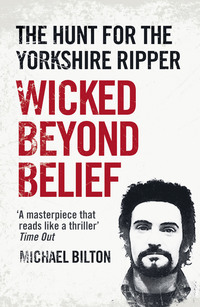
Читать книгу: «Wicked Beyond Belief»
Wicked Beyond Belief
The Hunt for the Yorkshire Ripper
Michael Bilton

Copyright
HarperPress
An imprint of HarperCollinsPublishers
1 London Bridge Street,
London SE1 9GF
First published by HarperPress in 2003
The extract from a report of High Court hearing R v Peter Coonan (formally Sutcliffe) before Mr Justice Mitting, on 1 March 2010, published in the Independent, is reproduced with kind permission of The Press Association.
Michael Bilton asserts the moral right to be identified as the author of this work
A catalogue record for this book is available from the British Library
WICKED BEYOND BELIEF: THE HUNT FOR THE YORKSHIRE RIPPER. Copyright © Michael Bilton 2003, 2006, 2012. All rights reserved under International and Pan-American Copyright Conventions. By payment of the required fees, you have been granted the non-exclusive, non-transferable right to access and read the text of this ebook on-screen. No part of this text may be reproduced, transmitted, down-loaded, decompiled, reverse engineered, or stored in or introduced into any information storage and retrieval system, in any form or by any means, whether electronic or mechanical, now known or hereinafter invented, without the express written permission of HarperCollins ebooks.
HarperCollinsPublishers has made every reasonable effort to ensure that any picture content and written content in this ebook has been included or removed in accordance with the contractual and technological constraints in operation at the time of publication.
Ebook Edition © MAY 2012 ISBN: 9780007388813
Version: 2020-11-16
Dedication
For my Father
Contents
Title Page
Copyright
Dedication
Dramatis Personae
Chronology
Preface
1. Contact and Exchange
2. The Diabetic Detective
3. ‘A Man with a Beard’
4. Tracks in the Grass
5. Impressions in Blood
6. A Fresh Start
7. Punter’s Money
8. ‘The Job Is Life; Life Is the Job’
9. A Miserable Place To Die
10. Chinese Walls
11. The Wrong Track
12. Going Covert
13. ‘He Comes from Sunderland’
14. Bad Feelings
15. Swamped by Paper
16. ‘He Lives Somewhere, He Works for Someone’
17. ‘The Beast I Am’
18. Mad or Bad?
19. DNA, DNA, DNA
20. A Suitable Case for Treatment?
21. Unmasked: Leeds, West Yorkshire, 2006
The Final Chapter: Crime and Punishment in 2011
Note on Sources
Text Notes and References
Bibliography
Author’s Note on the Appendices
Appendix A: Statement of Peter William Sutcliffe to West Yorkshire Police, 4 January 1981
Appendix B: Subsequent Police Statements, January-February 1981
Searchable Terms
Acknowledgements
About the Author
Praise
About the Publisher
DRAMATIS PERSONAE
BOREHAM, LESLIE: High Court judge who presided over the trial of Peter Sutcliffe at the Old Bailey in May 1981.
BOYLE, JOHN: Detective inspector Ripper squad, January 1981. Interrogated Peter Sutcliffe after his arrest.
BYFORD, LAWRENCE: Her Majesty’s Inspector of Constabulary, responsible for the West Yorkshire police area. Conducted review of what went wrong with the Ripper investigation. Reported to Home Secretary in December 1981.
CATLOW, GRANGE: Detective superintendent Manchester CID. Jack Ridgway’s deputy.
CRAIG, DONALD: Assistant chief constable (crime) West Yorkshire 1975/76 before he retired.
DOMAILLE, JOHN: Detective chief superintendent, senior investigating officer (SIO) on murder of Patricia Atkinson in Bradford, 1977. Head of Special Homicide Investigation Team (Ripper squad) April 1978–March 1979.
ELLIS, STANLEY: Dialect expert and senior lecturer at University of Leeds. Advised police on ‘Geordie’ tape.
EMMENT, LESLIE: Deputy chief constable, Thames Valley police. Member of Byford advisory/review team.
FINLAY, ALF: Detective superintendent, SIO for Jacqueline Hill murder in Leeds, November 1980.
GEE, DAVID: Professor of forensic pathology at Leeds University and Home Office consultant pathologist. Conducted post-mortems on Ripper victims.
GERTY, DAVID: Assistant chief constable, West Midlands police. Member of Byford advisory/review team.
GILRAIN, PETER: Detective chief superintendent, SIO for Barbara Leach murder in Bradford, September 1979.
GREGG, CHRIS: Detective chief superintendent, head of West Yorkshire Police Homicide and Major Enquiry Team (HMET). Launched the hunt for the hoaxer.
GREGORY, RONALD: Chief constable of West Yorkshire.
HARVEY, RONALD: Commander, New Scotland Yard. Special adviser on crime to Home Office. Member of Byford advisory/review team.
HAVERS, SIR MICHAEL: QC, MP. Attorney General. Led prosecution at Sutcliffe’s trial.
HOBAN, DENNIS: Detective chief superintendent and head of Leeds CID. SIO for first two Ripper murders, Wilma McCann and Emily Jackson, in 1975/76. Died March 1978.
HOBSON, JIM: Detective chief superintendent. Dennis Hoban’s deputy in Leeds. SIO on inquiry into Irene Richardson’s murder. Put in overall charge of the investigation in late November 1980, six weeks before Peter Sutcliffe was arrested.
HOLLAND, DICK: Detective superintendent. Pivotal figure in the Yorkshire Ripper investigation. Drafted in after the murder of Jane MacDonald in 1977 and remained until the killer was arrested.
HYDES, ROBERT: Probationer police constable in Sheffield, South Yorkshire. Arrested Peter Sutcliffe, 2 January 1981.
KIND, STUART: Professor of forensic science, head of Home Office Central Research Establishment at Aldermaston, 1980. Member of Byford advisory/ review team.
LAPISH, TREVOR: Detective chief superintendent, SIO on Yvonne Pearson murder in Bradford, January 1978.
LAPTEW, ANDREW: Detective constable on Ripper squad, July 1979, when he interviewed Peter Sutcliffe and named him as a strong suspect.
LEWIS, JACK WINDSOR: Linguistic expert and lecturer at University of Leeds who advised police on tape and letters.
MILNE, HUGO: Psychiatrist who examined Peter Sutcliffe and gave evidence for the defence at his trial.
O’BOYLE, ‘DES’ FINBARR: Detective sergeant, Ripper squad, January 1981. Interrogated Peter Sutcliffe after his arrest.
OLDFIELD, GEORGE: Assistant chief constable (crime) West Yorkshire police. Ran the Yorkshire Ripper investigation 1977–80.
OGNALL, HARRY: QC. Senior member of the prosecution team at Sutcliffe’s trial.
OUTTERIDGE, RON: Forensic scientist. Spent two months with Russell Stockdale advising Ripper squad in 1979.
RIDGWAY, JACK: Detective chief superintendent. SIO on murders of Jean Jordan and Vera Millward in Manchester in 1977/78. Ran five-pound note inquiry.
RING, ROBERT: Police sergeant in Sheffield, South Yorkshire. Arrested Peter Sutcliffe, 2 January 1981.
SHAW, GRAHAM: Detective Superintendent, S10 West Yorkshire Police. Led police arrest team in Sunderland in hoaxer case.
SLOAN, ANDREW: National Coordinator of Regional Crime Squads in 1980. Member of Byford advisory/review team.
SMITH, PETER: Detective sergeant, Ripper squad, January 1981. Interrogated Peter Sutcliffe after his arrest and took his confession.
SMITH, STUART: Detective Sergeant, West Yorkshire Police. Conducted interviews with John Samuel Humble.
STOCKDALE, RUSSELL: Forensic scientist on several Ripper murders. Spent two months with Ron Outteridge advising Ripper squad in 1979.
SUMMERSKILL, SHIRLEY: MP and former Home Office minister who vetoed a public inquiry into the Black Panther case in 1976 and argued that the police had learned lessons from any errors made.
SUTCLIFFE, SONIA: Peter Sutcliffe’s wife. They married in 1974 and divorced some time after his arrest.
THATCHER, MARGARET: Prime Minister in 1980 at the time of the killing of the Yorkshire Ripper’s final victim in November 1980. Ordered William Whitelaw to beef up the Ripper investigation.
WHITELAW, WILLIAM: Home Secretary, 1979/80.
ZACKRISSON, DAVID: Detective inspector in Northumbria police. Wrote report in 1979 warning the ‘Geordie’ tape was an elaborate hoax.
CHRONOLOGY
1969
30 SEPTEMBER: Bradford, West Yorkshire. Peter Sutcliffe arrested in the red-light area and charged with going equipped for theft ‘with a hammer’.
1975
5 JULY: Keighley, West Yorkshire. Anna Rogulskyj attacked. Senior investigating officer (SIO): Detective Superintendent P. J. Perry.
15 AUGUST: Halifax, West Yorkshire. Olive Smelt attacked. SIO: Detective Chief Inspector Dick Holland.
28 AUGUST: Silsden, near Keighley. Tracey Browne attacked. SIO: Detective Superintendent Jim Hobson. Unacknowledged Ripper attack.
30 OCTOBER: Leeds, West Yorkshire. Wilma McCann murdered a hundred yards from her home. SIO: Detective Chief Superintendent Dennis Hoban.
20 NOVEMBER: Preston, Lancashire. Joan Harrison murdered. SIO: Detective Chief Superintendent Wilf Brooks, Lancashire CID.
1976
20 JANUARY: Leeds. Emily Jackson murdered. SIO: Detective Chief Superintendent Dennis Hoban.
9 MAY: Leeds. Marcella Claxton attacked at Roundhay Park. SIO: Detective Chief Superintendent Jim Hobson. Unacknowledged Ripper attack.
1977
5 FEBRUARY: Leeds. Irene Richardson murdered in Roundhay Park. SIO: Detective Chief Superintendent Jim Hobson.
23 APRIL: Bradford. Patricia Atkinson murdered in her flat. SIO: Detective Chief Superintendent John Domaille.
26 JUNE: Leeds. Jayne MacDonald murdered. SIO: Assistant Chief Constable (ACC) (Crime) George Oldfield.
10 JULY: Bradford. Maureen Long attacked. SIO: ACC (Crime) George Oldfield.
1 OCTOBER: Manchester. Jean Jordan murdered. SIO: Detective Chief Superintendent Jack Ridgway, Manchester CID.
14 DECEMBER: Leeds. Marilyn Moore attacked. SIO: Detective Chief Superintendent Jim Hobson.
1978
21 JANUARY: Bradford. Yvonne Pearson murdered. SIO: Detective Chief Superintendent Trevor Lapish.
31 JANUARY: Huddersfield, West Yorkshire. Helen Rytka murdered. SIO: ACC (Crime) George Oldfield.
25 APRIL: Special Homicide Investigation Team (Ripper squad) set up at Millgarth police station, Leeds, under Detective Chief Superintendent John Domaille, with Detective Superintendent Jack Slater as his deputy, plus ten other detectives.
16 MAY: Manchester. Vera Millward murdered. SIO: Detective Chief Superintendent Jack Ridgway.
1979
MARCH: Detective Superintendent Dick Holland takes over Ripper squad at Millgarth; also in charge of the centralized incident room.
4 APRIL: Halifax. Josephine Whitaker murdered. SIO: ACC (Crime) George Oldfield.
2 SEPTEMBER: Bradford. Barbara Leach murdered. SIO: Detective Chief Superintendent Peter Gilrain.
1980
21 AUGUST: Leeds. Marguerite Walls murdered at Farsley. SIO: Detective Chief Superintendent Jim Hobson. Unacknowledged Ripper killing.
24 SEPTEMBER: Leeds. Uphadya Bandara attacked at Headingley. SIO: Detective Superintendent Tom Newton. Unacknowledged Ripper attack.
5 NOVEMBER: Huddersfield. Teresa Sykes attacked. SIO: Detective Superintendent Tony Hickey. Unacknowledged Ripper attack.
17 NOVEMBER: Leeds. Jacqueline Hill murdered. SIO: Detective Superintendent Alf Finlay.
25 NOVEMBER: ACC (Crime) George Oldfield sidelined as head of the Ripper inquiry. Jim Hobson takes over with temporary rank of ACC.
26 NOVEMBER: External advisory team appointed by Her Majesty’s Inspector of Constabulary, Mr Lawrence Byford. Reports to the chief constable before Christmas.
1981
2 JANUARY: Peter Sutcliffe arrested in a car with a prostitute in Sheffield, South Yorkshire.
5 JANUARY: Peter Sutcliffe charged with murder of Jacqueline Hill.
22 MAY: Peter Sutcliffe found guilty of thirteen murders. Sentenced to life imprisonment.
2006
18 OCTOBER: John Humble arrested in Sunderland and later convicted for being the sender of the Ripper hoax letters and tapes.
PREFACE
Poor Wilma. A strong-willed and feisty woman, she was determined to live life on her terms. It was either her way or no way. A driver picked her up. She agreed, late one night in October 1975, to a risky proposition from a total stranger: sex for a fiver. With a bunch of small kids to care for on her own, this was how she got by. And now? She was dead, the first publicly acknowledged victim of the Yorkshire Ripper.
Her body – shrouded by a low-hanging mist at the edge of a football field – was found early the next morning. The damp and miserably cold vapour clung as grimly and insistently to the frail corpse lying on that grassy bank as it did to the rest of the city of Leeds that autumn.
The fog was almost a symbol of the terror and fear that was to come. It seemed to hang perpetually over the North of England for some considerable time, like some mysterious and impenetrable miasma. And it never lifted for five long years. It enveloped and chilled the lives of millions who lived there, men and women, young and old. But most of all women.
A year later, MPs in the House of Commons voiced deep concerns about a major police investigation that turned into a fiasco with tragic results. There was little or no glory for the detectives who had led the hunt for the notorious killer called the ‘Black Panther’, who turned out to be Donald Neilson from Bradford – a vicious and cold-blooded criminal, wanted for the murders of three sub-postmistresses and the kidnapping and murder of heiress Leslie Whittle. As in the Yorkshire Ripper case there had been an all-important hoax tape-recording that threw detectives off the trail of the real killer. Like the Ripper case the hunt involved several police forces. Like the Ripper case there was a great deal of resistance to calling for help from outside, and when the end came it was two bobbies in a patrol car who made the arrest, not realizing they had caught a vicious killer. Finally, as in the Ripper case, when it was over there was a need for scapegoats: the officer in charge suffered the humiliation of being shifted sideways – out of CID and into uniform.
Some MPs demanded an inquiry into the mismanaged conduct of the Black Panther investigation, but the then Labour Government refused. Home Office Minister Dr Shirley Summerskill told Parliament the case:
has been discussed by chief officers of police collectively and I am quite sure they are fully aware of the need to learn any lessons which may be learned from such an investigation … the fact that a particular investigation is a matter for discussion by chief officers of police is a reflection of our system of policing in this country. The local control of police forces is an essential element of that system. Chief constables in this country, unlike some continental countries, do not come under the direction of a Minister of the Interior, in the enforcement of the law. The responsibility of deciding how an offence should be investigated is for them and them alone.
But when the Yorkshire Ripper case concluded five years later in 1981 it was abundantly obvious that Britain’s chief constables, and the police service as a whole, had disastrously failed to learn the lessons of the Black Panther investigation. Government ministers, senior officials at the Home Office and the Government’s law officers saw little merit in an agonizing public debate over the Yorkshire Ripper investigation. MPs’ demands for transparency were turned down, and there would be no public inquiry. But there was a major shock in store for the criminal justice establishment when Sutcliffe’s trial opened at the Old Bailey in London.
The prosecution, led by the Attorney General, Sir Michael Havers, pushed for a suspiciously speedy hearing, accepting a guilty plea to manslaughter from the accused, Peter Sutcliffe, on the grounds that mental illness had diminished his responsibility for his crimes. It all seemed done and dusted. The court proceedings would be over within half a day because both defence and prosecution were in complete accord.
However, they had not reckoned with the Judge’s reaction. To his very great credit Mr Justice Boreham refused what was in essence a plea bargain. Instead he ordered a full and open trial by jury to determine whether Sutcliffe was mad or bad. The jury would hear the evidence and decide for themselves whether Sutcliffe was guilty or not guilty of murdering thirteen women; or was guilty of manslaughter because he did not know what he was doing. Justice demanded that this gravest of matters should not be swept under the carpet. Ultimately he was convicted and given a thirty-year minimum sentence.
It seems extraordinary that nearly thirty years later the arguments about Sutcliffe’s responsibility for his crimes had never gone away. A new team of lawyers came back with a vengeance in 2010, when the Yorkshire Ripper went to court saying that having served his minimum sentence, he was entitled to know when he would be released. For the public at large the very idea seemed preposterous, incredible even; but Sutcliffe’s psychiatrists at Broadmoor secure hospital had declared their great success in treating him and were arguing that all along he had suffered from mental illness, meaning that his responsibility was diminished when he committed his crimes. Sutcliffe’s lawyers argued this meant he was entitled to a reduction of his minimum sentence.
All this was made possible because the European Court of Human Rights in 2002 ruled that judges – not the Home Secretary – should decide how long a lifer spends in gaol. So once again Peter Sutcliffe stood at centre stage making headlines, once more his activities invaded the psyche of the British public, fearful that the courts might actually believe he was almost an unintended victim of the Ripper case and set him free. Politically, the very idea was quite toxic, and the Prime Minister and Justice Secretary were both put on the spot, as an anxious public demanded to know: ‘Is this man actually going to be freed?’
Dealing as it did with one of the most notorious killers in British criminal history, the Yorkshire Ripper case raised crucial questions. Before her death, Myra Hindley – the 1960s Moors murderer of several children – had routinely tested the patience of the public with her woeful cries that she had served her time. Now another notorious serial killer was following suit. Thirty years before, the thought that Sutcliffe would ever be freed would have seemed utterly fanciful. Then Britain woke up and found that three decades had slipped by, the thirty-year minimum sentence passed at the Old Bailey in May 1981, was almost at an end – and now the law was different.
After Sutcliffe was snared in January 1981, there were enormous issues raised which needed truthful answers, especially about the failure of the police to solve very serious crimes. Today, such matters would be openly debated and inquiries held. But back then the public at large, the families of the Yorkshire Ripper’s victims, the media, the taxpayers of West Yorkshire, MPs, even seasoned high-ranking detectives closely involved in homicide investigations, were never given answers. The key questions had been: Why did it take so long to catch this terrible serial killer? Had the police been up to the task? Who should be held accountable for mistakes that were made? The reason for this was the huge sensitivity surrounding shocking errors in the investigation.
Sutcliffe’s official toll was thirteen dead and seven attempted murders. We now know that he attacked many more women and that there were many opportunities to apprehend him which were tragically missed. In recent times, public disquiet over the Stephen Lawrence murder in London and the multiple killings by Dr Harold Shipman resulted in full and transparently open inquiries. In contrast, public disquiet over the Yorkshire Ripper investigation was flatly dismissed with platitudes that everything would be better in future. No open inquiry took place. Serious questions were posed but the answers only emerged behind closed doors. A high-level secret inquiry had recommended revolutionary changes in the way the police investigated serious crime, and yet openness, transparency and the acknowledgement that the public had a perfect right to know the truth about the police hunt for the Yorkshire Ripper were nowhere to be seen.
In January 1982, seven months after Sutcliffe was given twenty terms of life imprisonment, the then Home Secretary appeared before Parliament to announce the findings of an internal Home Office inquiry by one of Britain’s most senior and respected policemen, Mr Lawrence Byford. He had brilliantly investigated what went wrong with the Yorkshire Ripper case, but William Whitelaw, the Home Secretary, refused to publish Byford’s penetrating report which stripped bare all the mistakes that were made. Instead a brief four-page summary of its main conclusions and recommendations was placed in the House of Commons library. This summary only scratched the surface of the body of crucial facts garnered during Byford’s six-months-long inquiry by an eminent team of senior British police officers and the country’s leading forensic scientist, which was a model of its kind.
In a quiet and unsensational way, Byford’s report laid out its unvarnished and unpalatable truths in more than 150 closely typed pages. It contained much extraordinary detail. Such was the confidentiality surrounding the report that it was printed privately outside London and not by Her Majesty’s Stationery Office. No senior civil servant, not even the Permanent Secretary to the Home Office, was allowed to view a copy until Mr Byford delivered it personally to William Whitelaw. As one of Her Majesty’s Inspectors of Constabulary, Byford knew that in preparing the report he and his inquiry team had a grave duty to perform not merely for the benefit of the police service, but for the country as a whole.
Byford and his team did not shirk their responsibility. The changes his report recommended were truly ground-breaking, so much so that a cynic might say that if there had been no Yorkshire Ripper, it might have been well to invent him, as the sole means to force dramatic but profoundly necessary changes upon a creaking police service.
As a staff writer for the Sunday Times based in Yorkshire from 1979 to 1982, I became closely acquainted with some of the detectives, pathologists, forensic scientists and outside advisers who were most closely involved in the Ripper case. Over the succeeding years many of the figures principally involved in the investigation spoke to me off the record about their work on the Ripper Inquiry and how it personally affected them. Some, like Dick Holland and George Oldfield – key members of the Ripper Squad – went to their graves feeling they had been scapegoated. Others felt their actions and motives were totally misunderstood. Until I had got my hands on a copy – some seventeen years after it was written! – the Byford Report had remained an official secret. It was not till the summer of 2006 that the Home Office at last released the report and some of their own files, following an application under the Freedom of Information Act. Britain’s most senior detectives, those with responsibility for investigating major crimes, had not been allowed to study this vital account of what had gone wrong.
I read the Byford Report for the first time in 1998, and realized that here was a sensational story. Answers now fell into place. All too many mistakes had been made, and a good number of those closely involved with the most important criminal investigation in British history agreed that the full story deserved to be told so that the British public – and more urgently, future generations of detectives – could learn its lessons. Hence this book.
For me the real story was as thrilling and chilling as any crime novel, containing as it did such complex characters and so many twists and turns. The more I got to know the detectives the more fascinated I became by who they were – and why it was that some of them had got it so disastrously wrong. These were not one-dimensional figures, and I endeavoured, as I wrote the narrative, to put flesh and bones on some of them so that they could be seen for what they were, human beings trying to do a difficult job.
Some were clearly better than others, but I have no intention of pillorying anyone for mistakes that were made. As a writer you cannot examine how an institution works and forget the very people who make up that institution. When the institution fails you need to look at its whole structure, which in the case of the police service starts with ordinary policemen and women on the beat and progresses upwards through a hierarchy, beyond the chief officers, to the Inspectorate of Constabulary, the Home Office civil servants in the Police Department, and then the ministers in charge, ending with the Home Secretary.
You had to live in the North of England to comprehend how such a terrible series of crimes terrified a major part of the British Isles. Still today, what most people want to know is: What went wrong? Why did it take so long to catch Peter Sutcliffe?
Even thirty years later, and allowing for the benefit of hindsight, some of what has emerged about the investigation seems truly shocking. As with other notorious murder cases, when the subject of the Yorkshire Ripper is mentioned it brings dreadful memories flooding back for those most intimately involved. The families of Sutcliffe’s victims deserved to know what really happened during that awful period when a beast called Peter Sutcliffe roamed the North of England creating outright terror. They also needed to know that some good came out of that terrible era and that lessons were learned about complex cases.
The police officers trying to track down this utterly ruthless killer were decent and honest men. Amid the chaos that gripped the investigation there were some brilliant detectives. Most were totally committed, but tragically some, just like the police service for which they worked, were way out of their depth. The British police have an extraordinary record in solving homicides, and G.K. Chesterton’s reflection that ‘society is at the mercy of a murderer without a motive’ is now only partially true. Random prostitute murders are still every senior investigating officer’s worst nightmare, but in recent times we have seen successful investigations into the serial killing of call-girls in Suffolk and a fresh round of prostitute murders in Bradford. It is very different now from that period in the last century when the hunt for the Yorkshire Ripper was so complex and protracted that it simply overwhelmed the West Yorkshire Police. Many of the detectives involved paid a high price – ruined careers, ruined health, ruined marriages – and in a few cases it led to their premature deaths.
Now as then, I am not remotely interested in Peter Sutcliffe, the individual. Many have asked whether I ever wanted to interview him. The answer was a resounding. ‘No!’ What could he tell me that I didn’t already know – that he was a sick and perverted killer who got powerful sexual thrills from having women at his mercy as he slaughtered them? For me it would have been a worthless exercise to ask Sutcliffe serious questions and expect believable or valuable answers. The detectives though were another matter completely. I was intrigued by them as people, and by the service for which they worked. I wanted to put the reader in their shoes, as they attended a murder scene or an autopsy or a press conference. There can be no freedom without a system of laws and we need these dedicated men and women to enforce those laws. The British police service remains one of our pivotal institutions; it safeguards much of what we take for granted.
More than three decades after attending his trial in Court Number One at the Old Bailey in May 1981, I resolutely maintain that there was only a single villain in the Yorkshire Ripper case. It was, and is, the monstrous and twisted individual I saw giving evidence in his own, highly implausible, defence of the indefensible. Peter Sutcliffe was, and remains, wicked beyond belief and it will come as a comfort to many that some of our most senior judges, led by the Lord Chief Justice himself, seem to agree with me.
Michael Bilton, January 2012
1
Contact and Exchange
Exactly twenty-nine minutes after the body of Wilma McCann was found, the telephone rang beside Hoban’s bed. It was at 8.10 a.m. Early-morning calls were nothing new for the head of Leeds CID. He had been sound asleep for nearly an hour, having crawled between the sheets next to his wife, Betty, not long before dawn. He had been up since 1 a.m. at a murder scene in another part of the city for most of the night. A phone call now was the last thing he needed. The control room at Wakefield was on the line. ‘A murder, sir,’ the operator said. ‘A woman, at the Prince Philip playing fields, Scott Hall Road, Chapeltown. Found by the milkman, sir. The local police surgeon is at the scene already and Mr Craig is on his way.’ Craig! The assistant chief constable in charge of crime was turning out. That settled it – Hoban couldn’t take his time, he wanted to be there before him.
Betty was already downstairs making a cup of tea. She knew what to expect. No point in making him breakfast. He’d be up and off. He’d wash and shave, take his insulin, get dressed. Then he’d be gone. She knew it would be midnight before she saw him again. ‘There’s another murder, young woman this time in Chapeltown,’ he said downstairs in the hallway, kissing her on the cheek and saying goodbye at the same time. ‘Dennis …’ she hardly had time to say ‘take care’ before he was gone. Through the front-room window she saw him reverse his blue Daimler on to the road and drive off. For the umpteenth hundred time in thirty years of marriage, Betty was left alone while her husband went chasing criminals.
A freelance photographer arrived at the playing field before Hoban. The scenes of crime team had not yet put up a tarpaulin screen to shield the body from prying eyes. A uniformed officer prevented the freelance going any further. A 500 mm telephoto lens was clipped on to his Nikon camera. Looking through the eyepiece, he could clearly see one hundred yards away the body of a woman on its back, trousers above her ankles. Just then several figures moved into the framed image from left and right. Two uniform constables from the area traffic car were dragging a crude canvas screen closer towards the woman. And just then, moving slowly into frame from the right, the scenes of crime photographer arrived with his large plate camera already clamped on to its tripod. The freelance had only seconds to take the shot before the body was obscured. His shutter clicked and almost immediately the camera’s motor-drive whirred and wound on. A pathetically sad image of a murder victim in the morning mist was captured for all time on 35 mm film.
More newsmen turned up. Film crews from the local television stations; reporters from the Evening Post. There was some relief for the waiting journalists when Hoban arrived, clearly identifiable in his light-coloured raincoat, belted at the waist, his brimmed hat hiding his receding hairline. There was an almost symbiotic relationship between them and the local CID chief, and so a formal ritual was played out. They would wait patiently, perhaps go door-knocking to see if any local neighbours knew what happened. He’d do what he had to do, then help them. Those in search of a story and pictures needed the goodwill of the man in charge. They had to be patient and not take liberties, not impinge on the investigation. To solve this murder, any murder, Hoban knew he needed information from the public. The media were a valuable resource, so he’d personally make sure they got the story in time for the first edition of the Post and the first news summary on the local TV stations at midday.
Formal greetings with his colleagues were just that. Formal. It was cold. There was low-lying fog. The men around him stamped their feet, arms folded against their chests, trying to keep warm. Some had been waiting at the crime scene for nearly an hour since the woman was found at 7.41 a.m. by the passing milkman. The date was 30 October 1975, the eve of Halloween and only days to go to Fireworks Night. It was that time of year when local kids had been making effigies of Guy Fawkes, standing on street corners, asking ‘Penny for the Guy’. The local milkman was making the early-morning round with his ten-year-old brother. Mist hanging over the area made it difficult to see properly as Alan Routledge drove his electric-powered milk van into the rectangular tarmac car park of the Prince Philip Centre. He got out to deliver a crate of milk and there, on a steep banking on the far side of the car park, near the rear of the caretaker’s house and the sports field clubhouse, spotted what he at first thought was a bundle of rags or perhaps a children’s ‘Guy’. Out of curiosity the brothers edged closer. It was the body of a woman. Routledge ushered his sibling away and ran for a phone. He told the police operator he had found a woman with her throat cut.
The uniformed officers laid down a series of duckboards across the grassy area to the murder scene. Hoban moved forward, treading carefully on the slatted wood. Devlin, the police surgeon, greeted him. The woman lay on her back, at a slightly oblique angle across the slope, the head pointing uphill and the feet directed towards the edge of the car park. Her reddish-coloured handbag lay beside her, its leather strap still looped around her left hand. Her white flared slacks had been pulled down below her knees; both her pink blouse and her blue bolero-style jacket had been ripped apart. Her bra, a flimsy pink-coloured thing, had been pulled up to expose her breasts. Blood from stab wounds had leaked over to the right side of her body. The blood had dried. More blood from a stab wound on the left side of her chest trickled down to the edge of her pants, obviously, thought Hoban, because her feet were pointing downhill. Her auburn hair had been backcombed into a beehive style high above her head, but now much of it was spread out on the grass. She had worn a pair of shoes with an inch-thick sole and a four-inch heel. Her knickers were in the normal position covering her genitalia. They bore a large, colour printed jokey motif, part of which Hoban could easily read without bending down: ‘Famous meeting places’. A small button lay behind her head and some coins were in the nearby grass. The wounds were divided into several areas: a stab wound to the throat; two stab wounds below the right breast; three stab wounds below the left breast and a series of nine stab wounds around the umbilicus.
By the time the local Home Office pathologist arrived at 9.25 a.m. Hoban knew the dead woman’s name and the fact that she lived barely a hundred yards away. The back entrance to her council house in Scott Hall Avenue opened out on to the playing field. Neighbours told officers making house to house inquiries how Wilma McCann lived with four young children, separated from her husband. Two of the children had gone looking for their mother at first light when she failed to return home, after having left the eldest, Sonje, aged nine, in charge. Sonje and her brother went to wait at the nearby bus stop to see if their mother had caught an early-morning bus home. They were standing there freezing when a neighbour found them with their school coats over their pyjamas.
Nothing surprised Hoban any more, he’d seen all this before. Desperate women. Children neglected. Leeds City council officials had already been alerted that the four McCann children would almost certainly need foster care. No one knew at first where their father lived. Initially, because Wilma was found so close to her home, Hoban considered that this might be a domestic incident that got out of hand. Perhaps the former husband was involved. Then he heard that Wilma frequently went out at night to the local pubs and clubs to ‘have a good time’ – and she got paid for it. Like many single mothers on the breadline, she slept with men for money. She came and went via the back entrance to hide the fact that she left the children alone for several hours and frequently returned late at night. For this she had paid the terrible price. Although she had no convictions for prostitution, Hoban knew the fact that she was a good-time girl would be a major complication.
Standing there that morning, he hoped and expected they could solve this case quickly. The victim would surely have some relationship to the killer – a motive would be established and with luck and a fair wind they would have their man. The other senior man to arrive at the McCann murder scene was the forensic pathologist, David Gee, who knew Hoban well and admired his professionalism as a top detective. Each had earned the respect of the other. They had already spent most of the night together at the scene of another murder elsewhere in the city and Gee also had only just dropped off into a very deep sleep when the phone call came through alerting him to this latest case. Not unreasonably, he regarded it as a bit of a nuisance. He had made good speed, considering he had to drive in to Leeds from Knaresborough, twenty miles away, during the morning rush hour. Hoban filled him in on all he knew so far. Gee – notebook in one hand, biro in the other – stood as he always did, listening intently. For a few minutes he looked at and around the body. Eventually he drew a diagram and wrote a few cryptic remarks. For a murder involving multiple stab wounds it was what he would have expected. There was heavy soiling of the skin at the front and right side of the neck because of the stab wound on the throat. Blood was staining the grass beside the victim’s head. The blood trickling from the chest and abdomen had also soiled the right side of the victim’s blouse. Other spots of dried blood could be seen on the front of both her thighs, on the upper surface of her slacks and the upper surface of her right hand.
Gee’s very first thoughts were that the blood seepages running vertically downwards from the stab wounds in all directions suggested she had been stabbed to death where she lay. One blood trickle ran into the top of her knickers and then along it. When the panties were removed, he could see the trickle did not run down inside, probably indicating that no sexual intercourse had taken place either just before or just after the stabbing. Some blood soiled her long and tangled hair, but this was maybe due to blood escaping from the wound to her neck.
Once the body had been photographed, Ron Outtridge, the forensic scientist from the Home Office laboratory at Harrogate, moved closer and began taking Sellotape impressions from the exposed portions, hoping to find tiny fibres, perhaps from the killer’s clothing. Gee took swabs from various orifices – vagina, anus, mouth. Then he began measuring the temperature of the body at roughly half-hourly intervals. In an hour, between 10.30 and 11.30 a.m., Wilma’s corpse grew colder by two degrees, falling to 71.5°F. However, once the sun came up, the external temperature began to rise. By a simple calculation Gee determined that death happened around midnight, according to the hourly rate at which the body dropped in temperature. A gentle south-westerly breeze eventually blew the fog away and by 11.40 the temperature was 59°F, quite warm for an autumn day. The sky, however, remained overcast and there were a few spots of rain. For protection, the body was partly covered by a plastic sheet raised above the corpse on a metal frame so as not to contaminate any clues. By this time there was slight rigor mortis. Outtridge then removed the slacks, shoes and handbag. Plastic bags were placed over the head and hands and the body was gently wrapped in a much larger plastic sheet for the short journey by windowless van to the local mortuary. There the rest of the clothing was removed and handed over to Outtridge. A fingerprint specialist examined the body for prints on the surface of the skin.
The team, including Hoban and Outtridge, gathered again for the formal post-mortem at 2 p.m. It was a long and exacting process which took four hours. Most officers hate post-mortems. ‘It is not only the sight but the smell of the body and the disinfectants,’ recalls one senior detective who had been involved on countless murder inquiries. ‘The smell would cling to your clothing and when I got home I would strip, put clothes in the washer and my suit on the line. I would then have a shower but I would also lose my sex drive for several days. I think a lot of policemen are affected in this way.’
After the formalities of measuring and weighing the body, Gee quickly made an important discovery. Because Wilma had been lying on her back when found, there had been no examination of the rear of her head. On the examination table, her head propped up on a wooden block, he quickly located two lacerations of the scalp that had been concealed by her long hair. One was a vertical and slightly curved laceration, two inches in length, its margins relatively clean cut and shelving towards the right. This wound penetrated the full thickness of the scalp and through it a deep fracture in the skull could be clearly observed. Two inches to the left was another head injury, not so severe. Gee pointed out the two wounds, and later this portion of Wilma’s skull was shaved so they could be photographed prior to her brain being removed and studied.
Gee then began minutely examining the fifteen stab wounds to the body, trying to follow the track of each beneath the surface of the skin. It was a difficult task. The majority of wounds to her abdomen were very close together. It proved impossible to show the direction of each individual track of each individual wound. He had greater success in tracking the wounds to the neck and chest. Here, patiently, slowly, was a scientist methodically at work trying to learn what kind of weapon or weapons had been used to kill Wilma; and to determine more precisely how she actually died.
Gee’s final conclusion was that death occurred within minutes of the victim being struck on the head, then stabbed. He believed the weapon involved in the stabbing was more than three inches long and a quarter of an inch broad. She’d been hit on the head with a blunt object with a restricted striking surface. It could have been a hammer, but at this stage Gee favoured something like an adjustable spanner. There was nothing special about the stab wounds. The victim had been struck from the left side. Death had occurred probably early on the morning of 30 October.
Back in his office later that night Hoban began absorbing the information flowing in. House to house inquiries by the Task Force began to give a more detailed and increasingly depressing picture of Wilma’s lifestyle. Her former husband had been traced. Her parents were contacted in Scotland. Criminal records showed she had four convictions for drunkenness, theft and disorderly conduct. The local vice squad believed she was a known prostitute, though she had never been cautioned.
Wilma had been born and brought up near Inverness, one of eleven children. Her father was a farm worker. She had been christened Willemena Mary Newlands. According to her mother, she had been a good speller as a child, full of life but inclined to go her own way. Mrs Betsy Newlands said she had brought up all eleven children strictly. Wilma had to be in bed by 10 p.m. every night and when her father discovered her wearing make-up he took it from her and buried it in the garden. She could quickly become emotional, and when she did everyone would know about it. From leaving the local technical school she went to work at the Gleneagles Hotel near Perth. She had been pregnant with her daughter, Sonje, before she was out of her teens.
After Sonje was born, Wilma met a joiner, Gerald Christopher McCann from Londonderry, Northern Ireland. They married on 7 October 1968. A few years later they moved to the Leeds area, where five of Wilma’s brothers lived. She and Gerry had three children of their own in fairly quick succession – a son and two daughters. But by February 1974 the marriage was over. Wilma couldn’t settle, she hadn’t the self-discipline to adapt to either marriage or motherhood. She liked her nights out. And she liked other men. Gerry left and soon took up with another woman and had a child by her. He continued to see his kids after school and bought them birthday presents, Wilma did not ask for money from National Assistance but earned it her way – when she went out in the evening. Gerry McCann wanted a divorce on the grounds of his wife’s adultery and Wilma was happy to give it to him. Court proceedings were imminent.
From early on after Wilma and Gerry separated, nine-year-old Sonje seemed to be doing most of the caring for her half-brother and half-sisters at the house. In fact Wilma came to rely increasingly on the little girl, who was expected to grow up quickly and take on board responsibilities for her siblings way before her time. As a mother, Wilma was hopeless. She had degenerated into a terrible drunken state. The house, when police searched it, was filthy. She was sexually promiscuous and irresponsible and Gerry, a caring father, had become increasingly concerned that, since their separation, Wilma was neglecting the children’s welfare and leaving them alone for long periods in the evenings.
Hoban knew inner-city Leeds intimately. He had worked there for thirty years, he knew the streets, he knew the back alleyways, the pubs and clubs. He met his vast network of informants there – the criminal classes who gave him tipoffs that made him probably the best-informed detective in the city. He knew the wide boys, the spivs, the con men, the burglars, the pickpockets, the whores, the fences. He also knew the serious criminals, the ones who thought nothing of taking a shotgun on an armed raid on a bank or post office. He had, over the years, locked up hundreds of criminals and earned himself a fierce reputation. Newspapers referred to him as ‘Crime Buster’, or more particularly as the ‘Crime Buster in the sheepskin coat’ – a fitting reference to Hoban’s liking for sartorial elegance in the city responsible for making the made-to-measure suits that clothed half the male population of England through chain stores like Hepworth and Montague Burton.
Hoban’s extraordinary gift for solving crime and his energy and dedication had marked him out from the beginning of his police career. Commendations from magistrates and judges at the assize courts and quarter sessions came thick and fast. There was an inevitability about him rising to the top. He could move easily among those who skated the line between what was legal and what was not. He would drift into a pub or nightclub and soon there would be an exchange of glances as he clocked one of his snouts, some thief, vagabond or ne’er-do-well with information to sell. Thirty seconds apart, they would make for the gentlemen’s lavatory where a ten-shilling note was exchanged for a piece of paper or a discreetly whispered conversation.
Hoban was not a great drinker. His diabetes put paid to that. But he enjoyed social occasions and he loved the status his job gave him. He thrived on working his way up from humble origins to the top, to being a Citizen of the Year in Leeds. And he luxuriated in his work as a police officer. It wasn’t a job, it was a way of life. It was like a drug. He knew it. Betty knew it. His two sons knew it. And murder was his greatest professional challenge. Finding the person or persons who had snuffed out the life of some undeserving man or woman from among the half million souls who lived in the city of Leeds – that took some doing. And Hoban was very good at it. He had been involved in almost forty murders and solved them all.
The day Wilma’s body was discovered and the hunt for her killer launched, Hoban returned to Betty at midnight, his mind troubled by the fact that Wilma McCann, because she persistently had sex for money, might not have known the man who killed her. In these situations the search for an individual who killed with frenzied violence was a top priority because they were such a danger. The early stages of a murder inquiry took precedence over almost everything. The following morning he was due to undergo firearms training on a local range. Before Hoban drifted off to sleep he had to remind himself he must contact someone and cancel the appointment.
For the next week, apart from Sunday, Hoban worked until midnight every day. On the Sunday he went in an hour later, working only a twelve-hour day, so he was home that night shortly after ten o’clock. Wednesday he took off and spent the day with Betty. He tried to be home by 10 p.m. if he could, but frequently it was impossible. Occasionally other crucial duties as the head of the city’s Criminal Investigation Department demanded his time which took him away from the murder inquiry, such as briefing the assistant chief constable, Donald Craig, or a conference with prosecution counsel in connection with other cases destined for trial. But Hoban, once these appointments were out of the way, kept himself and his officers hard at it. He made frequent appeals through the press and on local radio for people to come forward with information. He needed eyewitnesses who had seen Wilma, possibly with her killer.
As each detail came in, it was filed in the index system at the murder incident room. This in turn generated more inquiries: men friends, especially previous lovers, to be traced, interviewed and eliminated; vehicle sightings to be checked; follow-up interviews arising from house-to-house inquiries to be actioned, carried out, checked and then more follow-up actions sanctioned. A more detailed picture of Wilma’s movements on the night she died began to emerge slowly. She had left home at about 7.30, telling Sonje that the younger kids were not to get out of bed. She was ‘going to town again’ and would be back later. From 8.30 to 10.30 p.m. she had been in various city centre pubs. About 11.30 she was on her own at the Room at the Top nightclub, in the North Street/Sheepscar area of the city. The last positive sighting of her was about 1 a.m. when two officers in a patrol car spotted her in Meanwood Road. Other witnesses had seen her trying to hitch a lift by jumping out in front of cars, causing them to stop. She was roaring drunk. The laboratory report, while it showed no trace of semen in her body, did confirm she had consumed a hefty amount of alcohol, between twelve and fourteen measures of spirit. Reports came in of a lorry driver who had stopped near where Wilma was seen weaving her way down the road. Initially, there was some confusion, because another lorry was also seen to pull up and an eyewitness saw Wilma engaged in conversation with the driver.
An early search of her home produced an address book and so began the task of locating a large number of Wilma’s clients, though Hoban discreetly told the press they were searching for past ‘boyfriends’. He appealed for any not yet contacted to come forward. To label a victim a prostitute in this situation was unhelpful. Experience showed the public were somehow not surprised at what happened to call girls. Photographs and stories in the press about Wilma’s orphaned children were intended to create sympathy.
A week after Wilma was killed, Hoban had late-night roadblocks set up on the route she had taken when she left the Room at the Top. As a result, the lorry driver who stopped to talk to her revealed he didn’t pick her up in response to her plea for a lift home. She was totally drunk and clutching a white plastic container in which she was carrying curry and chips. He was heading for the M62 motorway, across the Pennines to Lancashire. A day or so later a car driver came forward to say he had seen Wilma getting into a ‘K’ registered, red or orange fastback saloon, looking similar to a Hillman Avenger. The driver was said to be coloured, possibly West Indian or African, aged about thirty-five, with a full face ‘and thin droopy moustache’. He was wearing a donkey jacket.
Six weeks after the murder, Hoban’s investigation was clearly floundering. All the normal checks had revealed nothing. The witness pointing them in the direction of the red or orange hatchback also mentioned an articulated lorry, which he said had been parked nearby. Despite inquiries at 483 haulage companies the police drew a blank. A total of twenty-nine former ‘boyfriends’ were interviewed and eliminated. They were still searching for the driver of the fastback car to come forward.
From December 1975 and into the New Year Hoban resumed more of his duties as the head of Leeds CID. There were important functions to attend – dinners held by the Law Society and the Junior Chamber of Commerce. He had court appearances in Birkenhead as a result of a famous incident at Headingley when a protest group dug up part of the cricket pitch and poured oil over the wicket, causing the Test match against Australia to be abandoned. The protesters were an unlikely group, trying to right an injustice in the case of George Davis, a London criminal they claimed had been wrongly imprisoned for a bank robbery. It was a high-profile case and Hoban was intimately involved.
He made his obligatory appearance at the chief constable’s pre-Christmas cocktail party for senior officers at the force headquarters in Wakefield. The chief, Ronald Gregory, had reason to be pleased with the way things were going in his administration. Two years previously the West Yorkshire Police Force had merged with the big city forces in Leeds and Bradford to create the West Yorkshire Metropolitan Police, one of the larger forces in the country, stretching across a wide area of the North of England. Gregory knew there would be tensions in bringing together the county coppers with the city forces. Leeds and Bradford had had autonomy previously, each with their own budget, chief constable and head of CID. Gregory hadn’t wanted too much disruption and hadn’t insisted on major changes in personnel. The cocktail party, at lunchtime on 22 December, was another getting-to-know-you session.
Hoban knew many of the senior detectives in the newly combined force. Before becoming the senior detective in Leeds, he had been deputy coordinator of No. 3 Regional Crime Squad, which covered a wide area of Northern England. As a detective superintendent he had close contact with his counterparts in the major towns and cities in the West Riding. The senior men were expected to get along with each other and make the amalgamation work. But the easy-going jollity of the cocktail party was in part an illusion. It still rankled the senior Leeds officers that the West Riding men were in the driving seat. As city detectives they were used to dealing with tough gangs and sophisticated crime. They believed the county boys lacked the hard experience needed to deal with ruthless criminals. ‘Donkey Wallopers’, they called them. However, on this occasion the chat was friendly. Most knew Hoban had an unsolved murder, but this was nothing new in their line of work. His reputation stood him in good stead. He was viewed as ‘a hard and occasionally ruthless man’ – ‘a decent bloke’ – ‘a fucking great detective’.
Renewed inquiries among prostitutes in the Chapeltown area over Christmas and the New Year of 1976 produced information about a fifty-year-old Irishman, known to drive a clapped-out Land-Rover, who frequented the area. It was a total red herring. Neither the Irishman, nor the driver of the vehicle thought to be an orange/red fastback car, was ever traced. (In retrospect, it seems highly likely that the driver of the fastback car was Peter Sutcliffe, who at the time drove a lime green K registered Ford Capri. It was some years before the Ripper squad learned that street lighting at night could often give witnesses a confusing picture of the colour of vehicles they were trying to describe. Sutcliffe had a swarthy appearance, which at night and at a distance could have led to him being confused for a light-coloured West Indian. And, of course, he had a droopy moustache.)
By the middle of January 1976 the McCann murder squad, numbering 137 officers, had worked 53,000 hours. Five thousand houses had been called at, these inquiries having generated most of the 3,300 separate index card references in the incident room. These in turn had spawned 2,880 separate actions or follow-ups. Five hundred and thirty-eight statements were taken. There were other clues which were never resolved. The vaginal swabs taken by the pathologist found no trace of semen, but there was a positive semen reaction on the back of Wilma’s trousers and pants. Forensic scientists at the Harrogate laboratory were unable to produce a blood group, most likely because the person who deposited this sample did not secrete his blood cells in his bodily fluids. (Possibly Sutcliffe masturbated over Wilma after he attacked her.) Keeping details of the injuries secret from the media, Hoban announced at one point that the killer seemed to have ‘very personal feelings towards Wilma’. He was clearly speculating elliptically that the frenzied nature of the attack and the physical presence of some sexual motive, i.e. the semen, perhaps made this a personal assault.
In Wilma’s home the scenes-of-crime officers amassed a large number of fingerprints. A fragment of fingerprint on a door jamb was never eliminated. A purse missing from her handbag was never found. To help jog the memory of potential witnesses, a woman police officer dressed up in Wilma’s clothes and a photograph of Wilma’s face was superimposed. Two thousand posters were distributed to shops and other businesses, but little hard information was produced. There was little to distinguish this case from many other unsolved murders. According to Professor Gee: ‘We simply had an unsolved murder in which the only slightly unusual feature was the use of two weapons to cause the injuries.’
‘We are quite certain the man we are looking for hates prostitution,’ Hoban said. ‘I am quite certain this stretches to women of rather loose morals who go into public houses and clubs, who are not necessarily prostitutes, the frenzied attack he has carried out on these women indicates this.’
He knew that a man capable of killing twice probably enjoyed it, which meant he would go on doing it till caught. He was never more serious than when he issued a dark warning to the public via the press: ‘I believe the man we are looking for is the type who could kill again. He is a sadistic killer and may well be a sexual pervert.’ Emily Jackson had been killed with a ferocity ‘that bordered on the maniacal’. ‘I cannot stress strongly enough that it is vital we catch this brutal killer before he brings tragedy to another family.’
After several months, to Hoban’s obvious distress, his men were getting nowhere. He had tried everything he knew to push the inquiry forward, but the search for the killer was like hunting for a ghost. Every line of inquiry that could be followed was followed. A thousand Land-Rover drivers were checked out. Nothing. Dodgy punters were closely questioned. Nothing. The prostitutes were asked time and again to rack their brains to identify clients who might have been capable of two brutal murders. Countless men were checked as a result. Nothing. An artist’s impression was drawn of the man with the bushy beard. Nothing. He wrote to local family doctors asking them to come forward with the names of patients who might be capable of killing prostitutes. He was frustrated yet again. The Patients’ Association said such a request would prevent men with violent impulses from seeking medical help. The British Medical Association merely restated that the relationship between doctors and patients was confidential.
Hoban was getting weary and his health was suffering. His diabetes was taking its toll and he began to complain to Betty about a pain in his eye. The strong possibility of the killer striking again continued to bother him. By the time the inquests into both the deaths opened in May 1976, he had little new to say apart from the fact that he was certain the two women had been murdered by the same man. Hoban also knew there was a desperately cruel paradox. If there was to be any hope of apprehending the killer, more clues were needed: fresh clues and lines of inquiry that could only be forthcoming if the killer struck again. Another woman would probably have to die. Hoban could only wait.
2
The Diabetic Detective
Dennis Hoban liked what he knew and his entire life was spent living in the north-west quadrant of Leeds. It was his town, he knew its people, and via the medium of local television and newspapers they knew him. It was the city’s prosperity which had drawn his family there. Both his father and grandfather were Irish immigrants from Cork. His father had been first a lorry driver, then a sales rep for a haulage firm. Dennis was born in 1926, the year of the General Strike.
When Hoban became a fully fledged detective in 1952, Leeds was an overcrowded town bursting at the seams, with masses of substandard housing fit only for demolition. Some 90,000 homes needed demolishing, 56,000 of them squalid back-to-backs built a hundred years earlier eighty to ninety to the acre. Post-war housing estates were planned and built across the city, but the council house waiting list stretched out for twenty years. It made Hoban and Betty determined to own their own home.
Their first son was born while they were living next to Dennis’s parents in Stanningley, a working-class district well to the west of the city centre. Then they moved to nearby Bramley, where Betty’s widowed mother came to join them. In the late 1960s the couple bought a brand-new Wimpey home with a large garden on the Kirkstall-Headingley borders, even though Hoban was the world’s worst and least interested gardener. Neither could he turn his hand to DIY in the home, though he loved cars. Shortly after they married he had bought the chassis of a Morris 8 which stood on the drive of their home. Hoban rebuilt it with a wooden frame and aluminium sheeting, but his real hobby was being a policeman. Whatever cars the family possessed were frequently used in his job, often taking part in high-speed car chases.
While his close-knit family endured his obsession with work, all his working life Hoban coped with two ailments, diabetes and asthma. The regime of daily insulin injections was bothersome. Lazy about using his hypodermic syringe, he had no routine for taking insulin. Consequently there were plenty of times when he felt ‘squiggly’, the word he used for being hypoglycaemic. Then he knew he had to eat something sweet, usually a few cakes from the kitchen pantry. He would administer the insulin in a very haphazard way, never at specific times. Then it would be jab – straight into his thigh. ‘He didn’t look after himself,’ his son Richard reflected. ‘He didn’t live in a world where he could look after himself. He never ate well because he was at his best when he was in pubs and clubs and smoky dives getting information from his snouts.’
The family evening meal was often a snatched affair. He would arrive home, wash, shave, eat, watch the Yorkshire TV soap opera Emmerdale Farm, and then be off back to work. He rarely smoked. It would have exacerbated his asthma, already made worse in his early years by the fact that Leeds was one of the most polluted places in the North of England. Soot and smoke from the mills and factories were blown over the town by the prevailing south-westerly winds. For several generations those who could afford it had moved to the cleaner areas of Leeds in the Northern Heights, and ultimately Hoban and Betty joined them.
They had only just moved round the corner to a new and slightly bigger semi-detached house in 1976 when, a few weeks after the inquest verdicts on Wilma McCann and Emily Jackson, they learned he was on the move professionally. As part of a wider reshuffle among the senior management, he was being transferred to the West Yorkshire force headquarters at Wakefield, fifteen miles away. He was to be deputy to the new CID chief of the amalgamated force. A West Riding man, George Oldfield, was being promoted to assistant chief constable (crime). Within a few months Hoban had moved offices to the brand-new divisional police headquarters in Bradford, still as Oldfield’s deputy, but this time in charge of the CID for the entire Western area of the force.
Two and a half years after the amalgamation between West Yorkshire Police and the Leeds and Bradford city forces, the chief constable, Ronald Gregory, had decided to make crucial changes among the senior management. Moving senior personnel around would provide a better balance between the city and county forces. West Riding men transferred into the Leeds and Bradford divisions – some of the senior city boys had to bite the bullet and move to towns like Pontefract, Huddersfield and Halifax. A new culture was being created and these moves were not always popular. Enmities and petty rivalries abounded. Bradford police viewed Leeds detectives as ‘flash bastards’. ‘More gold than a Leeds detective,’ was a popular saying among the Bradford CID, a reference to their Leeds colleagues’ penchant for wearing gold wrist identity bracelets and rings bearing a gold sovereign. Leeds and Bradford officers called their West Riding colleagues ‘Donkey Wallopers’ or ‘The Gurkhas’ – because they took no prisoners, a reference not to West Riding detectives ‘finishing off the enemy’, but a belief by the city men that the county boys hardly ever got to make an arrest.
These important structural changes in the way Yorkshire and the rest of the country was policed had been a long time coming. The amalgamations, creating one big West Yorkshire force covering half a million acres and a population of more than 2 million, had been delayed for more than half a century. Bringing about cost efficiencies and rational organization to law enforcement had been a drawn-out, tortuous process. For almost a hundred years very little had altered in the way the various police forces of Britain were controlled.
By this time the West Riding of Yorkshire no longer existed officially. At the stroke of a pen in 1974 a massive local government reorganization approved by Parliament did away with a nomenclature that had defined an entire region of Northern England for hundreds of years. The East, West and North Ridings of Yorkshire – titles originating from the Anglo-Saxon word thriding, meaning ‘a third’ – became mere counties, bits and pieces of their local geography seemingly thrown into the air by civil servants and politicians in London, only to land as new structures called Humberside, North Yorkshire, South Yorkshire and West Yorkshire.
Hoban’s home town of Leeds had managed to weather the storms of economic upheaval over the years better than most. In the immediate post-war years, it remained a giant among the great manufacturing towns. In 1952 it was at the centre of the world’s clothing industry. Montague Burton was the world’s largest multiple tailor, with 600 outlets. Burton’s was only one of several large clothing factories in Leeds, all of which subsequently closed. In the words of Denis Healey, a local MP: ‘It went on making three-piece suits long after people stopped wearing waistcoats, and failed to adapt to the growing taste for casual wear.’
Leeds was a key part of England’s central industrial belt, whose origins, wealth and history had been essentially determined by two pieces of natural good fortune. First was the topography of the landscape across Yorkshire from the Pennines going eastwards – rough moorland and fells capable of little but sustaining sheep farming. It had done this for centuries. In addition there was the availability of vast quantities of water. Via becks and streams flowing off the fells and moors, water from the heavens poured into an abundance of river systems passing through the West Riding in its search for the sea. The rivers not only provided power for the wool and textile mills; their pure soft water also cleaned the wool. Later canals were built east and west of Leeds and waterways made navigable, allowing the wool, its finished products and other manufactures to be transported to both coasts. As the engines of the industrial revolution turned faster, so the population of Yorkshire’s towns and cities multiplied. It doubled and doubled again.
By 1840 Leeds was an industrial and commercial centre with a population of 150,000 and still expanding. Fifty years on and the official census of 1891 recorded Leeds’ population as 395,000. Many were immigrants or their descendants. They had come flooding in initially in the early 1800s from the rural areas of England, but also from deprived parts of Scotland and then Ireland, following the potato famine. Later in the 1880s they were joined by Jews escaping the pogroms in Poland and the province of Knovo in Russia. The only word in English many Jewish immigrants knew was ‘Leeds’. In an effort to escape compulsory military conscription or religious persecution, they had headed for the place which for them signified a modern term for El Dorado.
Dominating the city centre was the magnificent edifice of the town hall, built to demonstrate the achievements of a city bursting with pride at its commercial and industrial dynamism. But where the urban poor were concerned, Leeds, like many other overcrowded British cities, had little to celebrate. In 1858 a sizeable number of the town’s then 15,000 Irish immigrants, who lived in some of the worst housing, were said to have been among the cheering crowds of more than 100,000 who waved flags and shouted greetings to Queen Victoria as she arrived to perform the opening ceremony for the new town hall. The streets were lined with palm trees and triumphal arches and some 18,000 people sang the National Anthem. Looking down on the scene, the town hall’s massive clock tower, rising 225 feet above the new building, was the finishing touch, symbolizing Leeds at its grandest. Yet unseen by the sovereign were the depressing conditions in which many of her subjects existed.
Leeds truly was a perfect example of what Disraeli termed the ‘Two Nations’. It was a town with a physical divide. While great swathes were dirty, soot-ridden, cramped and crowded, other areas, in the Northern Heights, provided cleaner air and fashionable housing for the middle classes. The wealthy escaped the dirt and soot while the tens of thousands of the urban poor who provided the raw manpower for the factories and workshops were herded into overcrowded, insanitary dwellings. Drinking houses and brothels abounded. There were thirteen brothels within a hundred yards of where one unsuspecting churchman had his rooms. He noted that, ‘The proceedings of these miserable creatures who tenanted them were so openly disgusting that I was obliged to call in the rule of law to abate the nuisance.’ Forty-six beerhouses were closed down by police on the grounds that they were frequented by thieves, prostitutes and ‘persons of bad character’. Prostitutes were easily distinguished from factory girls in beerhouses by their tawdry finery and the bareness of their necks, though the costume and headdresses of the factory girls were not dissimilar. In many establishments there was a convenience upstairs for vice. Lord Shaftesbury described parts of Leeds as ‘a modern equivalent of Sodom’.
In accordance with the wishes of the town’s middle classes, prostitution in Leeds in the 1850s was controlled by the police rather than banned. They classified and kept a register of the proprietors and inmates of the town’s eighty-five brothels and lodging houses. This ‘has tended materially to check disorder and to aid the police in detecting crime and bring offenders to justice’, said the chief constable at the time. ‘Any attempt at the removal of these places would answer no good, for the sons and daughters of vice would find a resting place elsewhere and most like would get into respectable neighbourhoods where their proximity would be deeply deplored.’
Had Queen Victoria taken a full guided tour, she would have gone to the rear of the new town hall, which was used as court and bridewell. Below ground she would have entered a different world, one of thievery, violence and drunkenness. Known as the Central Charge Office, the bridewell held prisoners arrested within the town who awaited an appearance in court. The original cells, situated under the front steps, each contained a wooden bench and shackle rings for wrist and ankle; stone-flagged floors, whitewashed walls and gas lighting. A cell held up to four prisoners, each entitled to half a loaf of bread, a pint of ale and sufficient straw for bedding. Right through to the late 1970s, the central bridewell remained a forbidding place. Hoban even gave his young sons a guided tour of the ‘dungeons’. The eighteen cells had no natural light, ventilation or exercise facilities. Conditions in the bridewell, which failed to clear legal certification, had long been criticized, and just at the point of Hoban’s move to Wakefield the Home Office cut an improvement programme to save money.
Leeds had formed its own police force in 1836, paid for out of local rates and overseen by a watch committee made up of local burgers. Like many other newly formed police forces, they were also responsible for fire-fighting. Money for equipment, clothing and everything else came from local funding. The wealthy and local taxes paid for peace and law and order. The preservation of peace and good order were the central priorities laid down by the members of the watch committees. Neighbouring Bradford, slower off the mark in setting up its own police force, did so in 1848. Its headquarters were in a building which housed the city’s fire engines. Police out-stations in both cities were linked to headquarters by morse-code telegraph until the 1890s, when they were replaced by telephones and police call boxes.
Before 1968 the West Riding of Yorkshire was served by nine separate forces. In addition to Leeds and Bradford, the city of Wakefield and the boroughs of Dewsbury, Halifax, Huddersfield, Barnsley and Doncaster each had their own local force. Most were small organizations. The surrounding local government county area had a force based at Wakefield called the West Riding Constabulary. In 1956 it had 354 men in its ranks. Covering a vast geographical area, it was way ahead of other forces in recognizing the importance of keeping intelligence on criminals and was one of the first in the country to establish a criminal intelligence bulletin, the West Riding Police Reports. This confidential publication, printed on the West Riding’s own printing press at the force headquarters, circulated details of crimes and wanted villains between forces.
A 1920 Report by a Parliamentary Committee praised the West Riding’s lead in drawing up a list of classes of criminals by their modus operandi. The force’s chief constable stressed the importance of creating a central clearing house of intelligence information: ‘Its full advantage cannot be developed unless the reports are complete and in the proper form.’ The system was mostly used in the North of England, and not by all forces even then. The First World War interrupted a plan to introduce a similar scheme in the Midlands and the South of England. The Parliamentary Committee was enthusiastic about the West Riding clearing house and believed it to be a big advance not only in detecting crime but also in the systematization of the detective method. ‘The greatest advantage should be taken of it,’ they said, and recommended the Home Office and Scottish Office to develop it further and extend it across the whole of Britain.
Twenty-first century computers can store limitless amounts of information and be programmed to draw links between seemingly unconnected facts in an intelligent way. Police forces around the world, like every other institution and business, are now utterly dependent on them. But in Hoban’s time there were no computers in which local intelligence could be stored. He and his detectives in a murder incident room relied on a card index system, with its complex classifications.
The Parliamentary Committee investigating the police service in 1919–20 was given a simple example where police officers knew how a particular criminal worked, but had no way of passing on the information. There was a burglar in Liverpool who regularly defecated in a corner in every house he broke into. This was known to detectives in the city but not outside Liverpool. How could they inform other forces and how could they communicate the information? ‘There is any amount of knowledge which is not available beyond the actual man who possesses it, or the actual police force which records it,’ a witness told the committee. ‘It is difficult to classify that sort of thing. Every police officer had this knowledge fifteen or sixteen years ago, and we tried to card it in Liverpool but we were up against another difficulty. We had many of these cards describing the methods followed by the particular criminal described on the card, but we had no system by which we could index them. So except for the personal memory of the man who prepared the cards, and he had a very good memory, the thing was valueless and we would not get out an index.’
The person who in 1909 solved this problem for Britain’s police was the then chief constable of the West Riding, Major-General L. W. Atcherley. He got the cooperation of all neighbouring county and borough forces and established a clearing house for information at his Wakefield HQ. In this way intelligence reports about the routes used by travelling thieves and swindlers were analysed. It was well known that thieves travelled to other towns to commit crimes and had long been doing so. In April 1853 three pickpockets from Leeds were arrested among a large crowd come to witness an execution at York Castle, along with numerous other petty thieves who had travelled from as far afield as Manchester and Yarmouth.
By a careful comparison of a modus operandi and a personal description of the criminal, a long list of undetected crimes committed by the same man in different police authorities could be cleared up. Different ways of committing crimes like larceny were broken down and filed separately. A handbook let an individual officer understand and use the system with little delay. He was taught the clues to look for. ‘Four years’ experience in the West Riding with its twenty-two divisions has proved the utility of this system and although the number of cases of reported crime in the county police area has increased by a third, the percentage of undetected crime is very low, and much less in proportion to what it used to be in former years,’ a report revealed immediately prior to the First World War.
The ‘peculiarity of method’, according to the 1920 Parliamentary Report, gave the policemen their clues to solving crime. ‘The leading feature of the Wakefield system which is proving its value against the modern travelling thief and swindler, is the investigation of crime through its methods. In the past, knowledge of this sort has remained far too much in the possession of this or that policeman or this or that police force … the clearing house is the machinery for the detection of crime.’ This prescient observation came to have real force more than sixty years later during the Yorkshire Ripper investigation. The keeping of records, and how and where they were administered, was a key feature unrecognized during the prolonged murder hunt, and it had the most tragic results.
Of all the great institutions in Britain, the police service has been among the slowest to bring about radical reform. The prime reason has been the jealously guarded principle that police forces should be subject to control by local communities through watch committees. The argument raged for more than a hundred years. Bradford and Leeds successfully stayed out of the great amalgamation in 1968, only to be absorbed into the West Yorkshire force six years later. Historically, British police forces have been fiercely independent, even leading to arguments over whether the ‘office of constable’ was one subject to local or central control under the British constitution. Towns and boroughs fought to achieve the right to choose their own chief constable rather than have one imposed on them by government. Legislation to bring about reform was seen as interfering with their independent control over the organization and expenditure of the police force in their area.
When amalgamations were proposed, they often met with fierce resistance – not least in Yorkshire. The city of York mounted vigorous opposition to legislation which would have amalgamated forces in the 1850s, provided money from the Treasury for efficient forces, and set up a system of inspections. York also opposed Palmerston’s Police Bill, fearing ‘the police would become a standing army entrusted with powers unheard of in the darkest ages of tyranny’. The York Herald proclaimed: ‘To surrender up the control of the police to the executive government would be an act of folly which every lover of constitutional liberty ought to do all in his power to prevent.’ County magistrates and local watch committees would become mere puppets: ‘Local control of policing which allowed local communities to decide which form of policing best suited them would disappear.’
In 1920 Parliament heard arguments pleading for police forces to be banded together if they were to become more efficient. Forty-eight police forces had less than twenty-five men in their ranks and forty forces had less than fifty officers. The boroughs of Louth and Tiverton consisted of a chief constable, two sergeants and eight constables; total strength: eleven men. Bigger forces meant better administration, training and the chance for individual officers to gain wider experience.
Amalgamations were still high on the agenda when the Royal Commission on the Police reported in 1962. So was the question of the educational standards of men being recruited into the police service. The 1920 Parliamentary Committee had found the system lacking in this respect; so did the Report of the Royal Commission. ‘We have come across no recent instance of a university graduate entering the service, only about 1 per cent of recruits have two or more GCE A levels, a further 10 per cent have five subjects or more at O level and an additional 20 per cent have one to four O levels.’ The report strongly criticized the police service for failing to recruit anything like its proper share of able, well-educated young men. The commissioners’ principal concern was being able to attract sufficient recruits who would make good chief constables fifteen or twenty years hence. This without question remained a problem for the British police force for generations. ‘They preferred to educate the recruited rather than recruit the educated,’ said one senior detective, closely involved in the Yorkshire Ripper case, who had himself given up a university place to get married and join the police force.
Absence of a grammar school or university education had not proved a barrier to men like Hoban, who had left school aged fourteen with no qualifications, joined the Leeds City Police aged twenty-one, and in 1960 become the force’s youngest detective inspector. He achieved promotion on grounds of merit and consistent hard work. The police force in Leeds which Dennis Hoban joined in 1947 after wartime service in the Royal Navy aboard motor torpedo boats had hardly changed in technological terms since Edwardian times. They still carried whistles to draw attention. It was only in 1930 that the city police got its own motor patrol section and even then it consisted of one motor car, one three-wheeled vehicle, two motorcycle combinations and a solo motorcycle. For years bicycles provided the extra mobility for the forces of law and order in their everyday fight against crime.
Leeds got its first police boxes containing a telephone in 1931, and these were the mainstay of communication with officers on the beat until the 1950s, when they were replaced by telephones in pillars. Communication between police stations and headquarters was by wireless. In 1955, by which time Hoban was a fully fledged plain-clothes detective, thirty-three police cars in the city were fitted with radios, but it was to be another ten years before individual personal radio sets were issued to officers. In the mid-1950s, Leeds had had plain-clothes detectives for a hundred years, but specialization within the town’s CID did not emerge until the 1960s, with the setting up of crime squads, a drug squad in 1967 and a stolen vehicles squad in 1970. Hoban, in the early 1960s, took part in an experimental project involving undercover detectives working over a wide area and drawn from several major cities, towns and county forces. They targeted major criminals, using covert surveillance to gather intelligence, often over weeks and months at a time. It was the forerunner of the Regional Crime Squads.
Many smaller towns had their own chief constables – but less than 300 officers. Unlike Hoban’s family, plenty of police officers were tied tenants, living in police houses, including some of the senior officers. There were considerable restrictions in terms of promotion. Some smaller towns, like Dewsbury and Wakefield, had to advertise externally to obtain suitably qualified senior officers above the rank of inspector. The efficiency of the police was a key phrase during the post Second World War period, when important questions about the future were being discussed. Efficiency wasn’t simply a value-for-money term, it also called in question the ability of the police to tackle modern problems, and especially modern criminals, who were far more mobile, being prepared to live in one area of the country and commit crime in another. By the time Parliament voted for large-scale amalgamations in the early 1960s, they were long overdue. Rising crime rates were a national problem.
Once amalgamations had taken place, the actual moulding of large new forces from smaller ones carried sizeable headaches in terms of management. Some towns had given their constables special rights. For example, in Huddersfield Borough a constable could not be moved from his home without his consent. Many a police officer, either buying his own home or firmly settled with a young family in a police house, refused to be uprooted and sent to the other side of the county. West Riding officers were used to being moved, but those in the towns and cities were familiar with their back yard and had got used to it. There were other privileges. Huddersfield being a textile town, officers had uniforms made of specially woven cloth, dyed and finished in police indigo blue – top quality worsted – a reflection of the predominance of wool merchants on the local watch committee. Pride dictated that their officers be dressed in the best cloth – and the uniforms were tailor made. ‘Then we went into the West Riding,’ said one who went on to become a senior detective, ‘and it was like the army, they got the nearest bloody size. There were only two sizes – too big and too small.’
The Leeds City Force of Hoban and his colleagues, with a strength of 1,300 men, was already bigger than some of the newly amalgamated county forces like Cumbria, Wiltshire, Suffolk and Dorset. Plenty of policemen and politicians in Leeds and nearby Bradford wanted the two cities to combine into one large metropolitan force instead of being lumped together with the rest of West Yorkshire. The ever-expanding Leeds–Bradford conurbation is such that the two are for all practical purposes virtually joined together, separated only by a small tract of land; even the local regional airport is called Leeds–Bradford, though each city retains its separate identity.
Бесплатный фрагмент закончился.