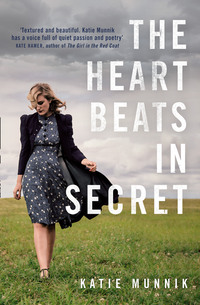
Читать книгу: «The Heart Beats in Secret»


Copyright
The Borough Press
An imprint of HarperCollinsPublishers Ltd
1 London Bridge Street
London SE1 9GF
www.harpercollins.co.uk
First published in Great Britain by HarperCollinsPublishers 2019
Copyright © Katie Munnik 2019
Cover photographs © Elizabeth Ansley / Trevillions Images
Cover design by Ellie Game © HarperCollinsPublishers Ltd 2019
Katie Munnik asserts the moral right to be identified as the author of this work.
A catalogue copy of this book is available from the British Library.
Excerpt from The Trail Of The Lonesome Pine Words and Music by Harry Carroll and Ballard MacDonald © 1927 Shapiro Bernstein & Co Inc Shapiro Bernstein & Co Limited, New York, NY 10022-5718, USA
Reproduced by permission of Faber Music Ltd All Rights Reserved.
Excerpt from Basho, translated by Lucien Stryk, Penguin 1985
Excerpt from A Doctor Discusses Pregnancy, William G. Birch, Budlong Press 1963
Excerpt from Everybody’s Pudding Book, by Georgiana Hill, Richard Bentley 1862
This novel is entirely a work of fiction. The names, characters and incidents portrayed in it are the work of the author’s imagination. Any resemblance to actual persons, living or dead, events or localities is entirely coincidental.
All rights reserved under International and Pan-American Copyright Conventions. By payment of the required fees, you have been granted the non-exclusive, non-transferable right to access and read the text of this e-book on screen. No part of this text may be reproduced, transmitted, down-loaded, decompiled, reverse engineered, or stored in or introduced into any information storage and retrieval system, in any form or by any means, whether electronic or mechanical, now known or hereinafter invented, without the express written permission of HarperCollins.
Source ISBN: 9780008288082
Ebook Edition © April 2019 ISBN: 9780008288068
Version: 2019-12-19
Praise for The Heart Beats in Secret:
‘Textured and beautiful. Katie Munnik has a voice full of quiet passion and poetry’
Kate Hamer
‘Munnik unfurls her story in quiet, reflective prose, but there is much to enjoy along the way’
Town and Country
‘[A] powerful, multi-generational novel … full of secrets, stories and discoveries’
Prima
‘Beautifully written and moving’
Woman’s Own
‘The Heart Beats in Secret is a spacious and yet densely woven work … beautifully written’
The Cardiff Review
Dedication
For Mike, of course.
Epigraph
What are heavy? Sea-sand and sorrow:
What are brief? To-day and to-morrow:
What are frail? Spring blossoms and youth:
What are deep? The ocean and truth.
Christina Georgina Rossetti
Contents
Cover
Title Page
Copyright
Praise for The Heart Beats in Secret
Dedication
Epigraph
Part One
Chapter 1: Pidge: 2006
Chapter 2: Felicity: 1967
Chapter 3: Pidge: 2006
Chapter 4
Chapter 5
Chapter 6: Felicity: 1967
Chapter 7: Pidge: 2006
Chapter 8
Chapter 9
Chapter 10: Felicity: 1968
Chapter 11: Pidge: 2006
Chapter 12
Part Two
Chapter 1: Jane: 1940
Chapter 2
Chapter 3
Chapter 4
Chapter 5
Chapter 6
Chapter 7
Chapter 8
Chapter 9
Chapter 10
Chapter 11
Part Three
Chapter 1: Felicity: 1969
Chapter 2
Chapter 3
Chapter 4
Chapter 5
Chapter 6
Chapter 7
Chapter 8
Chapter 9
Chapter 10
Chapter 11
Chapter 12
Close: Pidge
Jane: 2006
Acknowledgements
About the Author
Also by Katie Munnik
About the Publisher
For Columba Livia,
to be delivered after I am dead
Well, my dear, the house is yours. Regardless of what your mother might expect, I think it only makes sense. She wouldn’t really want it anyway. All the way out here on the other side of the world, isn’t it? Perhaps she might like to sell it and use the money, though I’m not sure that’s necessary. She seems comfortable where she is. And she’s never been one to look for windfalls or godsends. But maybe you could use a few, so I’m leaving it to you.
It’s a good old house. Friendly in its way. I’ve been happy here. Don’t worry, I wouldn’t be offended if you sell it, and I won’t haunt you. I promise. But before you decide anything, do come and see the old place. You haven’t been out here since you were a child, and it may feel different to you now. So come and stay for a while. Long enough to get a handful of warm days – we do get them here, you know, the kind when you open the windows in the morning and leave them open all day, forgetting about them until the curtains blow in just before sunset, when the wind shifts. I have never figured out why it does that. I always meant to ask someone, but never got around to it. Does it happen elsewhere? Or is it only here in this house? Maybe you know, my dear Pidge. Does anyone call you that any more? I must say, when I was drawing up the official paperwork, I had to be so careful with the spelling of your real name. Your mother was right – it has a lovely ring to it. But I was right, too, wasn’t I? It is a strange name to saddle any child with. Yet you, my dear, wear it well. Felicity said that the other mothers wanted to use old-fashioned names, like the ones their grandmothers wore – Jean, Rosa, Edith. Or natural-sounding names like Oak and Ivy, which are only apt out there in the woods. But she wanted something distinctive for you. Oh, your grandfather laughed! It is a beautiful name, even a little fancy in the best way, though pigeons are just as common as the rest of us. But perhaps no one knows Latin these days so that doesn’t matter. I hope you haven’t found it a burden. We all burden our children, I suppose. One way or another.
I hope this house won’t be a burden for you. It’s only a house. Or a bit of money, if you want it that way instead. You would need to clear things out first, so that’s another reason to visit. There may be a few things here you would like to keep. Books or photos, or sentimental odds and ends. It is all fairly old, but it has been useful. Useful or lovely.
When you come, you can take the car out, too. I’ve left that to you as well, though there’s a man in the village who would be happy to buy it. Just ask at the hotel and Muriel will point you in the right direction. She’ll also have a set of house keys for you, if there’s any trouble getting them from the lawyer. You’ll know her when you see her. I thought it best to provide local solutions so you don’t need to go into the city unless you’d like to. There’s more than enough to see around here. Drive out along the coast. Go see some ruins. Or the old doo’cots. There’s a man named Izaak who lives near here. A few years ago, he put together a calendar with drawings of all the local doo’cots. Beehives and lecterns and all that. He’s clever at shading and really captures the way light touches old stone. There should be a copy of it somewhere around the house. Maybe in the bookcase. I can’t quite remember.
Anyway, be well, my dear. Be happy. Live where you like, but when you’re here, do take some flowers to the kirkyard and think of me a little. And if you stay until they are ripe, be sure to eat all the brambles you can find.
With all my love,
Gran
PART ONE
1
PIDGE: 2006
LONDON AND BREAKFAST AT THE AIRPORT. JUST COFFEE and a scone – a crumbled thing that tasted of margarine, and the coffee was too hot so I drank it down quickly. It was only fuel. Mateo had arranged the rental car for me. He likes to do that sort of thing. Said that if he couldn’t be there, he could at least help with the details. So he bought me a guidebook about local history. He planned out my route and bookmarked the maps. And he’d arranged the car. I could pick it up at the airport, then drive north to Edinburgh. I could have flown, but it was cheaper to drive. Mateo said I was crazy – these Canadians and their long distances – but really, I wanted the space. And the effort. I didn’t want to be delivered to my grandmother’s empty house like a package. I wanted to make a journey of it. So I’d drive straight through, listen to the radio, watch the weather. Then a hotel room for the night and a bus in the morning to Aberlady. Mateo had written all the details on a bit of paper that I slipped into my passport, and he also sent it all by email so I’d have everything in one place, if worse came to worse.
‘Worst,’ I said.
‘What?’
‘Nothing. But you mean if I lose the paper.’
‘Well, yes.’
‘I’ll be fine, love.’
‘Of course. I just want you to be looked after.’
‘Thank you.’
After a pause, he asked me if I knew why.
‘Why?’
‘Yes. Why she left you the house. Why not your mother?’
We were sitting together upstairs in the gallery, side by side like an old couple, looking down into the garden courtyard. I’d hoped that we could have lunch – our last day at work together before I flew – but he had a meeting booked, so we just managed a quick chat in the middle of the morning. Bright sunlight fell in through the windows overhead, and the pale stone walls hushed the space like snow in a clearing. Everything was glass and granite, which suits Ottawa well. Like ice, snow and bedrock.
‘Maybe she thought I’d like it,’ I said. ‘I might. Like it, I mean. You might like it, too. It’s a good house.’
At one end of the courtyard, volunteers were setting out materials for a children’s craft session – lots of coloured paper set on bright foam mats.
‘You mean to vacation there? I am not sure about that.’
‘There’s a beach.’
‘Not a real beach. Too cold for that, no?’
‘Maybe, but it’s lovely. With sand and everything. I used to swim there when I was a child.’
‘Under a frozen sun.’ He smiled and took my hand in his. He had beautiful Spanish hands, soft and perfect. Gentle. I tried to smile, too.
When I first knew Mateo, we used to meet here often. I’d pick up the phone when the shop was quiet and I could slip away and he’d leave his office or the archive to grab a moment together. We’d just sit. Maybe hold hands. I think neither of us could quite believe our luck. You don’t stumble on love like this, do you? Just open your eyes one day at work and there it is. That doesn’t happen. Except it does.
‘I suppose I might sell it,’ I said. ‘A bit more money for the condo. Maybe we could afford a little more that way.’
‘Yes, maybe. But there is another question. Did she give it to you or leave it to you?’
‘What’s the difference? She just wrote that the house was mine.’
‘Money is the difference. Inheritance tax. But I am sorry to be talking about money when you are grieving. None of this matters. I only wondered. And wondered about your mother, as well.’
The volunteers were laughing now, their voices brittle at this distance, their hair shining in the falling light. Mateo sat with me for as long as he could, still holding my fingers in his beautiful hands. After he left, I took my usual route back through the European rooms to visit the Klimt. I like her. Her face doesn’t change. In the shop, I sell a lot of postcards; so many people want to take her home. I want to ask them why. I wonder who they see in her eyes.
I pulled off the highway at a service station, a place where everything looked plastic and you could buy pre-wrapped muffins and coffee in cups to take away, or choose to sit at small tables and eat plates of fried eggs, ham and chips. I bought a boxed sandwich, a coffee and a chocolate bar I didn’t want and ate in the car.
Over the border into Scotland, the highway narrowed, the landscape rising on either side, and the traffic thinning away. I expected rain. Or sheep. Or both. Everything was green – so much greener than home – and the April sun was warm through the windshield. Then before Edinburgh, I saw a sign for Birthwood. The sudden scent of home: cedar, wild garlic, pennyroyal and pine. I glanced away and back again, but there it was. I hadn’t misread. Birthwood. She never told me it was an old name. A real name. It felt odd seeing it on an official sign. I wanted to stop and take a photo or turn off the highway to see – but to what end? Nostalgia. Suspicion. Romance. I kept going, driving north-east.
No more service stations now, just small villages with bakeries and convenience stores, low white houses with heavy black lintels, old stone walls. A few trees and, beyond them, fields that stretched out to the greening hills, then cloud-hills clustered up, grey against a grey sky. I turned the car radio on and off again. Birthwood must be a small place. There had been no sign of it on the map. A crossroads, then, or the name of a farm. Insignificant but for the fact that Felicity had never told me about it.
This stretch of highway ran along an old Roman road. That had been on the map. Ancient history in ten miles to an inch.
When I was a child, the woods at home were timeless. Bas taught me people had passed among the trees for centuries, following the seasons and animals, coming and going and coming again. Others arrived from further away – traders, priests and settlers. For a while, they tried to stay, then moved on and built cities elsewhere. The forest returned and thickened, but Bas could still find their traces. He showed me wheel ruts and weathered split-rail fences that divided up the now-indifferent bush, crumbled houses and broken barns kneeling like fallen dinosaurs or other long-forgotten beasts stumbling towards extinction. The built history of people didn’t last long. A couple of centuries at most. The trees themselves might almost remember.
Out here on the highway and beneath these bare hills, time felt different. Stretched and snapped. The Ninth Legion marched away at the end of my mother’s childhood. Tacitus scribbled notes in my grandmother’s living room. In the space between the Roman roads and the plastic sandwiches, you could lose your balance.
I could see why my mother left.
But that’s not fair. It would be different if you were born here. This is one of the places where my mother was born. Not quite here, but down this road, anyway.
She used to count out her births for me. The first happened so early she couldn’t remember it and she’d say that to make me laugh. Then she’d tell me about her mother’s labour, her grandmother’s flat, about her father who was a soldier and couldn’t be there.
The second was a beautiful picture – light after rain, pavements shining and the clatter of pigeons lifting from the rooftops to wheel over the city, out towards the sea. She was young and everything was starting. She told me this story after thunderstorms or when I couldn’t sleep. She stroked my hair, then whispered French rhymes in my ear.
There was a third story, too, but she wasn’t good at telling it. She’d polish it and change it after arguments or when she was worried. I sat on our cabin’s doorstep and watched the wind ripple the surface of the lake as she wondered aloud about the things we get to keep, the things we release and the way we might, if we’re lucky, get to choose.
2
FELICITY: 1967
I LIED MY WAY INTO AN INTERVIEW. THAT’S WHERE IT started. I hadn’t meant to, but what with the rain, my wet shoes and Dr Ballater that February, it happened. I wouldn’t have planned it. I didn’t have the nerve.
When I worked for Dr Ballater, I was docile. Polite. He came into my high school looking for a sensible girl to help with the surgery’s desk work. Just for a few weeks before Christmas, he said. Miss Jones suggested I would be suitable and summoned me to meet the doctor in her office. He stood quite close to the door so when I stepped into the room, I saw him immediately. I don’t think he meant to startle me; he just wanted to see how I might react. So, I didn’t. Or rather, I politely said hello, shook his hand and sat down in the chair Miss Jones offered. Dr Ballater spoke in a soft voice, describing the work and the practice, meeting my gaze directly as he did so. I folded my hands in my lap and nodded.
Before the war, he may have been handsome, but now it was hard to tell. He had what can only be described as a splodge of a face. I suppose that’s not kind, but I’m not sure how else to describe it. A puckered welt ran from above his left eyebrow, across his misshapen nose, and down to his chin. The skin around the wound looked raw and mottled. He didn’t make me nervous – there were plenty of injured men around when I was growing up. Still I kept noticing how his skin pulled as he spoke and how each expression dragged on long after his words. It was difficult to act naturally. He seemed a kind and tired man.
I thought he was my father’s age, and maybe he was. He said that when the war started he had only recently qualified. Like so many young men, he’d been persuaded by the call to arms.
‘I assumed I would be given ambulance duty,’ he said. ‘Like the writers in the Great War. Instead, they planted me in a field hospital as a surgeon. That didn’t last long. A bomb fell on us and they sent me home.’
He told me that on my first day. I guess he wanted to get it out in the open. After that, he never spoke about the war, nor did he speak about his return home, so I needed to fashion that part of the story myself. A long convalescence in a grand manor house somewhere in the west of Edinburgh. Daffodils on the lawn. Starched sheets and painkillers. I imagined a nurse with gentle hands. Soft eyes meeting his. And tragedy, too. There must have been tragedy because I knew he lived alone. That part of the story needed work. Maybe she was married; maybe she had died. Influenza perhaps, but that didn’t strike me as wonderfully romantic. Maybe she’d been caught in an air raid. London then, I supposed, but maybe Edinburgh. Mum had told me about the planes over Marchmont on the night I was born. Maybe Dr Ballater’s sweetheart was killed that night. How strange to imagine.
This was how I passed afternoons at the surgery, keeping an eye on the mantel clock, and half dreaming out of the window. At quarter past four, Dr Ballater liked a pot of tea brought through to his desk. At first, that was my least favourite part of the day. The kitchen always smelled like bleach, and the bamboo tray felt too light to be sturdy. I balanced my way along the short hallway from the kitchen, and Dr Ballater opened the door just as I arrived. I hated knowing that he stood waiting for me, listening to my steps. That face behind the door. It was better when he walked back towards his desk and cleared a space for the tray. He opened a drawer and removed an elaborately embroidered tea cosy. The lost love must have made it for him, of that I was sure. He set it on the teapot with such precision and told me he was happy to have me. My typing was good, and the patients thought I was friendly.
He started asking me to join him in the afternoons. ‘Just a wee blether and a cup of tea, wouldn’t that be nice?’
He told me about his childhood in the countryside, not far from Biggar, about the hills there and the clear sky at night. He asked me how I liked school, about my parents and how they were feeling. Once he asked me what my plans might be for after school and I waffled nervously. I really hadn’t thought that far, not in detail at least. I imagined a flat somewhere. Maybe over in Glasgow, though Edinburgh might be more practical. I would be chipping in with other girls, of course. Cooking small meals over a hotplate, sharing adventures. The previous Christmas, I’d worked the January sales in Patrick Thomson’s, and one of the other temporary girls talked on about her bedsit, which sounded exciting. I could imagine that. But just what I’d be doing there, I hadn’t a clue. That wasn’t an answer to Dr Ballater’s question. So, I said I was looking into university and might read geology. It didn’t sound unreasonable as I said it.
He suggested that nursing might be a better fit.
‘It’s a good life and there are always those that need helping.’
In the end, that’s what I did. Signed up for the new degree programme at Edinburgh University and found a flat-share which was cold and nowhere near as romantic as I’d hoped. We all worked hard and stayed over in the hospital when we could, to keep warm. Sometimes, we went for coffee or to the films, and on Saturday evenings we were welcome to join the boys at the student union for the weekly dance.
The spring I graduated, one of the medical students invited me to the May Ball and I cut my hair like Sylvie Vartan, bobbed and fringed. I barely knew him and we danced until they turned the lights on. Was that polite? I suppose it was. Then he walked me home to my student digs in Marchmont, a long beautiful saunter along Coronation Walk. The cherry blossom was thick overhead and underfoot – blossom soup, blossom salad – and the night was so clear and almost bewitching, but he was certainly polite and I wished he wasn’t. I climbed the stairs alone and felt a little guilty for my loneliness as I fell asleep. In the morning, I caught a train home to East Lothian to see my parents, the sea and the sky dirt-pearl grey.
There was a job waiting for me with Dr Ballater. That worked out rather well. My parents were happy to have me home again, and we all knew that it wouldn’t be a permanent arrangement, but in the meantime, I could save up for a car. I banked my money in an empty margarine tub on the shelf next to my alarm clock.
For the next five years, I worked for Dr Ballater. Each year, I weighed and measured all the schoolchildren, and inspected their scalps. I bought that car and established a rota of housebound widows who might benefit from a visiting nurse. In the autumn, I helped with the kirk jumble sale. In the spring, it was the Easter tea. Mum couldn’t be bothered with all the village business, as she called it. She was far happier pruning the trees in her orchard or foraging about in the hedgerows. Sometimes, she would have the minister’s wife round for a cup of tea or Muriel would come up from Drem, but mostly, she and Dad lived quietly and left the social affairs to me. I found I liked it when the village ladies dropped by the surgery with invitations and requests for assistance. It kept me busy and helpful. Cheerful, as befits.
Then it was February 1967 and I noticed snowdrops beside the surgery door. Maybe they grew there every spring but I only noticed them that February afternoon when the front windows were open and Dr Ballater was whistling, a thin, windy whistle, lilting and sweet.
I opened the door softly, hung my coat on the hook in the hallway and checked my hair in the mirror. Combing it back into place with my fingers, I wondered if it might be time for a trim.
Dr Ballater was still whistling when I entered his room and noticed the tea tray was already placed on his desk. He asked me to marry him.
Abrupt as that.
I said nothing, and he apologized, the meat of his face flushing red.
‘I should let you come in the door properly. I should let you settle.’ He turned away from me, adjusting the mugs on the tray. ‘Can I pour you a cup of tea?’
‘Yes. Thank you, Dr Ballater.’ The words felt brittle in my mouth.
‘George. Please,’ he said, and his hands shook a little as he filled a mug, or maybe it was just that the pot had been overfilled. ‘There. Milk? Sugar?’
‘Yes. Please.’
A splash and then two spoonfuls, heaped, and he placed the mug in front of me, awkwardly passing me the spoon, too, in case I wished to stir my tea. I did and then crossed my ankles.
‘So, will you?’
‘I … I don’t know. I didn’t …’
‘No, no. I’ve rushed things, I’m sure. You didn’t expect this. I can see that now. But I do … I should think you will need to marry someone. You are not the kind of girl who wouldn’t. I should be glad if you would have me. I can always find another nurse.’
The wind caught the curtain, blowing it out into the room with a curve like a bell, and I thought of those snowdrops outside. They must have been there every year. They must.
‘Here, this is for you, Felicity,’ he said, my name sounding too soft as he held out his hand stiffly, giving me a twenty-pound note. ‘Take it. You might like to go buy yourself a dress from Edinburgh, or something of that ilk over the weekend, and think, think about it. We will speak next week.’
The steps out of Waverley station were always windy, and I hadn’t worn my working shoes. My good shoes – low heels, patent leather toes and a clever covered buckle – made an unfamiliar click as I climbed the steps. I’d worn my trench coat, too, which might be protection against any rain, but wasn’t really warm enough at all. The weather was bright and brisk with thin grey clouds wisped high over the castle as I walked towards Woolworths. This was silly, I thought. I didn’t need a dress. I didn’t want a dress. Maybe I should head to the top floor for a coffee in the tartan-carpeted restaurant. Instead, I browsed the book selection. Twenty pounds would buy me a very solid armload of stories. But that wasn’t what Dr Ballater had in mind.
So, instead I found a white pillbox hat made of thick felt, which matched my trench coat and looked stylish. I also bought a leather bag with a good shoulder strap and two stout handles. The kind of thing you might take for a weekend away somewhere. Paris. Bruges. Would Dr Ballater take me to Paris? Would we sit together on a terrace drinking coffee, or a glass of wine, even? If I said yes, I would find out, I supposed. That was the trick of it. I had to give him an answer and things were going to change whatever it might be. The shop girl wanted to wrap my hat and place it in a smart box, but I told her that I would like to wear it. She paused, then said, Of course. I told her I could carry my bag, too, just as it was.
I stepped out of the shop into a different day, the sky slate grey and a sharp wind. My mother would say that I really did need a pair of gloves, but the new leather handles felt good in my bare hand, and a brave face conceals all shivers. Which was something else she might say. I turned the collar up on my coat and adjusted my purse under my arm. If you didn’t know, you might just think that I had arrived in town from parts far flung and sophisticated rather than dumpy old East Lothian forty minutes away. Yet if that was true, and if I were really that person, why on earth would I come here? What would I want to see? Old stones and old folk standing in the rain.
That morning, I’d told my parents about Dr Ballater’s suggestion.
‘Oh,’ said my mother.
‘And how are you going to respond?’ Dad asked.
‘I don’t know.’
‘No,’ said Mum. ‘It looks like you don’t.’
‘Do you like him? You do, don’t you?’ Dad asked. ‘I knew his family during the war. Good people. He might be as good a chance at happiness as any.’
‘I’m not sure,’ said Mum. ‘He is older, isn’t he?’
‘Felicity has always been an old soul.’
‘Yes,’ she said, and it didn’t sound like encouragement. They didn’t say anything else, just sat together at the kitchen table, over half-cups of tea and the crossword puzzle like every other morning for the last hundred years. I kissed them both and said I’d be home again in the evening in time for tea.
I crossed Princes Street towards the gardens, pushed along by a swift, rushing wind and my mind filled with the words of the old hymn – so wild and strong, high clouds that sail in heaven along – so filled, so full I could almost sing. But best not to. Spring wind or no, Edinburgh might not approve. I kept my peace and walked sedately into the garden. Past the gate, down and down the steps in my pinching shoes, no angel blocked the way, no flaming sword to bar my path, but a gardener walked towards me holding a giant arrow under his arms. He smiled and nodded at me and, looking the other way, I saw another gardener on the slope beside the steps, surrounded by dozens of small potted plants. I wondered if I imagined them, summoned them somehow. Only once I was sitting down did it occur to me that they must have been working on the floral clock. That would have been interesting to watch. Still, it felt so good to sit down and slip my shoes off for a moment.
You are not the kind of girl who wouldn’t.
What the hell did that mean? What kind of girl was I?
Predictable. Suggestible. Polite.
The castle looked down from its rock foundation like Edinburgh’s broken tooth against a threatening sky. I took off my hat and folded it in half, opened it again and set it on my skirt. A sensible skirt my mother had made me in hunter-green tweed with flecks of purple. The kind of material that might be fashioned into an interesting tea cosy.
Then the rain started in earnest. Princes Street was crammed with cars, so I headed east. The North British Hotel has a lovely lobby, and I figured I could loiter there until it dried up a little. Stepping inside, I was surprised to see so many other women standing about. Mostly my age or younger, although also here and there, older women checking their watches and watching the crowd. A woman stepped forward, holding a clipboard. She wore her dark hair in a neat chignon, a serviceable broach pinned to her lapel.
‘Your interview number, please. Do you have it to hand?’
‘No, I—’
‘Did you not receive one by post? With your interview invitation?’
‘No. I didn’t.’
‘Oh dear. Another one. There have been so many slip-ups and confusions today. Some days run smoothly, and others … well, if you give me your name and details, I will add you to the list. Don’t spend a moment on worry, dear. It will come right in the end. Teaching or nursing? Teaching?’
‘No. Nursing.’
‘Ah, my apologies. I’m usually right with my guesses. Clever of you to catch me out. And better luck for you. Not so much of a crowd for nursing here today. Your name?’
‘Felicity. Felicity Hambleton.’
‘Perhaps doubly lucky, then. By name and by nature. It will be your turn soon.’
‘Thank you.’
She smiled and turned to speak to the next girl come in from the rain, a redhead in NHS spectacles clutching a soggy brown envelope to her chest.
So, nursing interviews. I’d never call it answered prayer, but maybe a way forward. I looked more carefully around the room and saw a sandwich board propped up near the reception desk.
Agnew Employment Agency:
Canadian Recruitment
Teachers:
Protestant School Board
of Greater Montreal, Quebec
Nurses and Midwives:
Various – Montreal, Quebec,
the Northern Territories
Near the doors to the hotel ballroom, folding chairs were arranged in a row, and girls sat waiting, shuffling along each time a name was called. Teachers or nurses: so that was the game. For some, it was easy to guess. I looked for wristwatches, writers’ calluses, inky fingers. I could imagine chalk dust brushed out of tweed skirts that morning, shoes polished before bed last night. My own shoes looked the worse for wear, water spots marking the patent leather toes, but you pay a price for glamour in Scotland. And, as the lady said, I might just score a few points for being distinctive. I sat down, opened my handbag and applied more lipstick.
Let’s see. Canada. The frozen north. What did I know about Canada? Cold and snow. Ice hockey. Indians. French. Oh dear. I hadn’t thought of that. Any job in Quebec would require French, wouldn’t it? Proper working French, which was likely a notch or two more advanced than mes lunettes sont sur la table. I tried to remember the other posters that hung on the French room wall at school. Les légumes verts. Les saisons. Chaud. Froid.
When my name was called, I was thinking about imperfect conjugations. What the hell – let it happen, whatever it would be. It was sure to be better than a walk in the rain. I picked up my new bag, smiled at the girl sitting next to me and stepped into the ballroom.
The interview was brief, the interviewer a thin, pale man in heavy glasses, sitting at one of the many small tables in the room, each with another interviewer just like him. He held a red Parker Duofold with a gold nib, but most of the notes were taken by the woman beside him. She sat very straight in her chair, her papers set at an angle on the tabletop, and she was writing with her left hand. She paused at the end of my name.
‘Avec un y,’ I said, quickly. ‘Not ie.’ The woman smiled. I crossed my ankles and straightened the hem of my skirt over my knees. The interviewer apologized for misplacing my details. There had been problems with the administration. Might I be able to send a fresh copy early next week?
‘Of course, of course. Pas de problème.’
He asked about my experience and my training, nodding as I mentioned the University of Edinburgh.
‘That is one of the reasons why we are here. The best programme in Europe, it is. We’re lucky to be able to scoop up girls like you.’
‘Are there no appropriate Canadian nurses?’
‘Yes, yes, of course. Still, the Edinburgh degree programme is cutting edge, and there’s a greater chance of real bilingualism here than, say, in Edmonton. Your French is good, I assume?’
‘Bien sûr.’
‘The proximity to France, no doubt. And the Auld Alliance, too, I should think. Now then, Church of Scotland?’
‘Yes. Does that matter?’
‘No, it isn’t crucial. For the teachers, yes, with board regulations, but in the hospital, it can still help. Montreal is a city of Presbyterian expats, at least on the anglophone side.’
‘Quite.’
‘So, not the north? No grand polar adventure for you? Is it Montreal you want?’
‘Yes. Yes, I suppose it is.’
His assistant spoke out in a clear, crisp voice.
‘You will do nicely.’
‘Thank you,’ I said, but she kept her face set and slid an envelope across the table towards me.
‘Here is a packet of information from the agency. In it, you will find a copy of the contract, details about immigration, and about Montreal as an international city. And, naturally, about the agency’s involvement with your career. There are forms to finalize as well. You will find it all quite self-explanatory. If you have any questions, there are telephone numbers for our representatives in London.’ She wrote a note next to my name, glanced at her watch, and looked past me towards the doors. All settled.
‘Thank you,’ I said again. The interviewer stood to shake my hand.
‘You’re welcome. Enjoy Canada.’
Outside, the rain had stopped, and the afternoon was brash with daylight. I stepped away from the shadow of the hotel and onto the still-wet pavement. Pigeons, hundreds of pigeons clattered up before me, a broad arc of flight over the gardens and, above the castle, the sky was slashed open into gold, bright gold. All those wings and gold, too. My breath felt sharp and new, and, away to the west, the pavements shone.
No one, it seems, is born just once.
3
PIDGE: 2006
MY MUM TOLD STORIES WHENEVER WE TRAVELLED. We’d be hitchhiking out from the camp in the cab of some truck, headed to Ottawa, or Montreal, and I’d sit up on Felicity’s blue-jeaned knees, her long hair tickling my face as I leaned back into her skinny chest and all the way she’d make the driver laugh with her tall tales and stories, her toothy laughing smile. Sandy Gibb the Glass Man, astronauts at Expo and swimming pregnant in a moonlit lake. She could make a story of anything. Maybe I should have told her about this trip. I told the gallery that I needed time away to sort through my grandmother’s things. They filed that under ‘personal reasons’ and then reasonably told me to take as much time as I needed. I told Mateo that I would need to organize the details of her estate, and he said that he understood. I told myself I’d be cleaning the bungalow. Before I left Ottawa, I’d imagined lots of cleaning. All those large windows and the wooden floors, too. Linoleum tiles in the kitchen. Then the bath to scour, old pots to scrub, and Persian carpets to shake out in the sunshine. It seemed like therapeutic work. Cleansing. Solitary.
Mateo said once that it was my aloneness that first caught him. I wondered if he meant loneliness, if he was mistranslating, but he said no, he meant aloneness. He said it was intriguing.
Maybe it was living at the camp with Felicity. There was lots of time then to be alone. In the night when she was at the birthing house. Or in the afternoon, when she opened her books and settled down to work at the small table in our cabin and she liked to have the space to herself, so she sent me outside. In the summer, there were always lots of children to play with, but as soon as the nights got too cold for tents, the field would empty and I’d be alone again.
When I was a little older, around nine or ten, Felicity started to take me with her to births, particularly when there were small children. She had me tell them stories and invent games to keep them entertained and distracted. Rika thought it best for children to keep away from a birth, but she never made rules, only suggestions. I’d heard Rika talking about this with Felicity one afternoon, and because they were talking about children, I listened.
‘What about when a mum wants them there?’ Felicity asked. ‘Should we come up with some pretence to get them outside anyway?’
‘No. Always only tell the truth. She needs to go so far into herself to open for the baby, and lies aren’t going to help that.’
‘And neither are kids in the room?’
Rika laughed. ‘You got it, babe. It can be hard to open for one baby when you are listening to another one prattle.’
I lay above them on the top bunk with my National Geographic. They probably forgot I was there, but it didn’t matter. They never kept anything from me. I’d heard everything, all the complications and contradictions. I learned how things can be difficult when babies come and how sometimes they don’t. How it’s possible to hope for two things at once. Release. Safety. Or time and space. I looked up from my magazine and let my eyes trace the lines on the river maps pinned to the wall. Blue ink meant water, and in this neck of the woods, the names were beautiful. The Ottawa, the Picanoc, the Gatineau, La Pêche.
‘If she really wants them close, then make space by all means. But often she only thinks she wants them so that she can keep an eye on them. So, we give the kids a safe, cared-for space away from her, and likely she’ll choose to be quiet and alone.’ Rika was always teaching like this and Felicity wanted to learn. She’d come to the camp pregnant, and after I was born, she decided to stay and help out.
I tried to explain all this – the work, the help, the study, and Rika – to Mateo in our early days, but he was more interested in my stories of long days spent alone in the woods, of climbing trees and swimming naked and summer nights and winter afternoons spent in snowshoes out on the ice. I told him how I lay down flat on my back on the snowy lake and imagined the cold depth of the water hidden beneath me, the hollow sky above me. I told him that lying there alone, I felt contained like a coin in my own pocket and perfectly happy.
On my own, the travel felt long. I arrived in Edinburgh late in the evening and found the hotel, just as Mateo had suggested. In the morning, the streets were wet, and through the window in the hotel’s breakfast room, I watched tourists with umbrellas, golf bags and suitcases pass by on their way to the trains. Pigeons huddled on the damp rooftops, and I drank strong tea, thinking about the house.
It sits away from the village and you can see the sea from the house, but not the sands. For the sands, you need to cross a footbridge and walk out past the flat lands, the marshlands and scrub trees. You pass through places where the way is lined by barbed-wire fencing, keeping the sheep in and the dogs out, and then places where the path is only a trace through open landscape. It is a bit of a walk to get to the beach, but a good walk.
Closer to the house, the shore is thick with black silt washed down from farmland nearby. A small stream cuts through the mud, a snaking path for the running tide. The bay is wide, open like a bowl, but the sea here is narrow, a silver band between East Lothian and Fife leading into the North Sea. When the tide fills the bay, it comes in quick and strange, leaving a wide sandbar dry across the mouth. That’s where the geese gather at night and where the shipwrecks sit. Felicity never let me walk out that far. She said they were just rusty submarines left over from the war and not particularly interesting.
The house was a place we visited in winter because in the winter Felicity got homesick. Gran kept the back bedroom ready for us, just in case. She knew that Felicity found the white winters at the camp hard. The days were quiet and short, the trees were bare, the path deep with snow and she had to tuck my trousers into the tops of my knitted socks to keep me warm.
When it got too quiet, too cold, and too bright, she pulled down the army surplus backpacks from the rafters and filled them with sweaters, skirts, books and warm scarves. We’d leave behind the textbooks, their precise illustrations, and the river maps. Then Felicity would bundle me into my thick winter coat, rub my face with Vaseline to keep the wind away, and we hitchhiked off to the city to find the airport bus. We never had enough pennies to commit to an annual flight, but whenever we needed to, we managed to fly. Felicity said that this was yet one more advantage of staying away from the public schools: flight was always possible. She also said that there were ample books at the camp to fill anyone’s brain usefully, and that if there was anything extra that I wanted to know, I could always ask Bas.
I could ask Bas anything and he gave me answers like small prizes slipped into my waiting hands. He was the one who told me pine needles keep you healthy like oranges do. He showed me how to hold hens’ eggs up to a candle to see the chick growing inside, and taught me that adult loons leave the lake a whole month before their children every autumn. The next generation migrates alone, relying on instinct, and he said instinct was a feeling and feelings matter. In return, I told him all the things I knew. That some grown-ups kept their eyes open at the table when we said the blessing. That all my mother’s hair was fair and curly – under her arms, too, and even under her skirt – while mine was dark and flat. That some spider-webs could outlast thunderstorms. That pennies smell like blood and blood smells like fish and that you couldn’t smell bruises at all.
I suspect my gran had something to do with the enough pennies when it came to airplanes. We never had much. We didn’t need much, really. Life in the woods wasn’t about pennies, and mainly the camp was self-sufficient anyway. We grew plenty of food in the fields across the lake and sold what we wouldn’t eat at the road-end all through the summer. Pies, tarts and deep baskets of strawberries and raspberries from the gardens, and wild blueberries from the rocky places along the lakeshore. What we couldn’t eat or sell, we saved. Bas made berry schnapps and wine coolers, and throughout the summer and into the fall, the canning kettle boiled on the woodstove and the air in the farmhouse kitchen was thick with sugar, vinegar and cloves. Felicity said she came by canning honestly, and told me about Gran’s preserves: rosehips, apple chutney, gorse wine and bramble jam. Saving things up must be in her blood and she crinkled her forehead a little fiercely when she said it, though no one would ever say she wasn’t authentic. A good camp word, authentic. Rika used it like a compliment, as though some folk weren’t and might only be acting. Did adults do that? I wasn’t sure. When I asked Bas, he shrugged and pulled the dressing-up box from the cupboard, asking who I was going to be that afternoon. I acted out every story my mother told me. A pirate tree-nymph. A mountaineering beaver. Or my favourite role of all: the Blessed Virgin herself. Bas always made time for stories, layering me with blankets, helping me to belt a pillow to my middle that I might stagger my way towards Bethlehem. He played every innkeeper with arms open wide, and with a straight face and a shining eye, found a footstool for my swollen virgin ankles and wondered if I might like a mug of tea.
‘I don’t know,’ I said. ‘Did they have tea then?’
‘I’m not sure. Maybe that comes later. It’ll be the wise men who leave some with you, but I don’t think you’ve met them yet, have you?’
‘Are you foolish, Bas? Or wise?’
‘Probably foolish, your holiness. Most probably.’
‘I think you’re wise. You know how to make bread. That’s wise, isn’t it?’
‘Wise enough for this world. Would you like some jam, too, m’lady?’ He spread it thick and I ate it stickily with fingers and lips jelly red.
Bas always knew what to offer, how much to ask, when to be silent or serious or good. He was good at keeping a story going. Much later, I realized the gentleness that took, and the strength.
Stories are fragile things, eggshell thin and porous.
After breakfast, I picked up a few groceries in a small convenience store near the hotel. Enough to live on for a little while, I thought, and there would be shops to explore in Aberlady once I’d settled in.
Then I turned in the car at the rental agency and found the bus. It shuddered out of the city, through suburbs, past rows of stucco houses with gravel yards or small lawns and the occasional incongruous palm tree. Most of the people on the bus were old, chatting with their neighbours, holding shopping bags. A pile of free newspapers at the front of the bus sat untouched, and I thought about leaving my seat to collect one but looked out the window instead.
The road passed on through small towns and smaller towns until at last the way opened up and I could see the colour of the fields and the line of the coast. The clouds had lifted, or maybe the wind had blown them back out to sea. It was a windy landscape, with small, crooked trees and hawthorn hedges along the roadside, and white birds hovered high above the waves, holding the wind in their wings. Then a wooded stretch, denser now, and in between the trees, old cement blocks sat heavily – anti-tank defences left over from the war. I remembered Felicity telling me about them, and about the railings set in the churchyard’s stone wall. They had been sawn off when the country needed more metal for airplanes, leaving iron coins set into the stone. She showed me how to press my thumb in each one – one a penny two a penny – and how to climb up the loupin-on stanes, that long-abandoned set of steps that Victorian ladies used to climb up to their high horses.
Just past the church, the bus stopped and I collected my bags. I hadn’t packed much because I wanted space to bring things home again. I wasn’t sure what, but maybe Gran had left something specific for me to find. Heirlooms or papers or photographs. I’d search the house as if for clues and maybe find why Gran had left it to me. Felicity had trained me to look for stories, hadn’t she?
I crossed the street to the hotel – a big whitewashed building with picnic tables and plant pots out front, trellises against the wall, and ivy. The door was open and no one sat at the desk in the front hall. I wasn’t sure about ringing the bell. It looked as if it would make a great deal of noise. I stood there for a moment, examining the map laid out on the wooden counter, the coastline curved like the back of a fish, or like a belly facing the sea. Then, an old woman came through a door behind me and cleared her throat.
‘Hello,’ she said. ‘Are you looking for a meal?’
‘No. Well … I’m really here to collect keys,’ I said. ‘For my grandmother’s house. Jane Hambleton. I was sent a letter that mentioned there would be a set of keys here. With Muriel?’ I opened up my shoulder bag and pulled out the letter for the woman to read, but she just looked into my face with a soft smile.
‘Yes, of course,’ she said. ‘That’s me. And you are Jane’s little Pidge. Felicity’s, I mean. You and I met when you were small. You won’t remember me, but your mother brought you here. And you look just like her. Except for the hair, maybe. The colour suits you.’ She coughed a little laugh and asked about my mother. ‘Is she keeping well? She’s here with you too, then?’
‘No, it’s just me. She’s back in Quebec. She’s well. Happy.’
‘Ah, yes. Settled there, I suppose. Such a shame that she couldn’t make it home in time for her mum’s funeral, but I suppose it was unexpected, wasn’t it? And so quick. But such a shame. And just before your own arrival. She was so looking forward to seeing you. She told me so many times that you were coming and that you might pop in here first, and that’s when she left the keys here. I think she was worried you might arrive when she was out for a walk or even down in the garden and that she wouldn’t hear you. But I’m sure all that’s in the letter, isn’t it? Ah well, things come out as they will, won’t they? Are you planning to stay long?’
‘I don’t quite know. There’s the house …’
‘Yes, I suppose it will need sorting through. All Jane’s lovely things. And Stanley’s books and papers, too. I don’t think she let go of much after his death.’
‘She left it to me. The house, I mean.’
‘Oh, that’s wonderful. It’s a good house, a cracking garden. So, you think you might stay?’
‘I live in Ottawa. My partner is there, and my work.’
‘Of course, of course. Yes, you’ll just be wanting to see it and sort, won’t you? Well, while you’re here, do pop in again. The kitchen does a lovely bit of lunch, if you ever need a meal. Cooking for one can be awkward, can’t it?’ Muriel reached over and straightened a messy pile of golf brochures beside the bell on the desk. ‘But you need the keys and you must be tired. Just arrived, and all that way, too. Ah yes, here they are.’
She found a small brown envelope under the counter and slid it across the map towards me. It looked as if there might be anything inside. A wedding ring. Ashes. Dragons’ teeth. I slipped it away into my pocket. ‘Thank you.’
‘Would a cup of tea help? You must be absolutely shattered. You’ve only just arrived, haven’t you? You have the aeroplane look about you.’
‘I’m just off the bus. I stayed in Edinburgh last night.’
‘Well, you come along through here and I’ll see about some tea. Unless you’d prefer a coffee?’
‘No, tea’s fine. Thanks.’
I followed her through the door at the end of the hallway, past a bar and a lounge with sofas and chairs and then into a larger room with tables set for lunch. White napkins and slate coasters.
‘Sit anywhere you like. Do you fancy something to eat?’
‘No. I’m not sure. I can’t quite fathom what time of day it is.’
‘Travel will do that. You sit down now. You’ll feel better with the tea in you. Sugar, too. It does wonders. And I’ll bring you a scone as well. You look like some bulking up might do you good.’
‘Thank you. That sounds wonderful.’
I chose a small table by the window. My fingers picked at the flap on the back of the envelope and then ripped the paper and shook out the contents into my hand. A heavy mortice key fell into my palm and sat there like a finger bone. No wonder Felicity thought in fairy tales, if this was the key to her childhood home.
My mother’s third birth came in bits and pieces. There were always sliced apples and something about the grass growing outside the cabin. She tried out new versions on me, changing the weather or time of day, approaching everything from a different angle. I liked it best when she began it in the afternoon. The morning story often featured rain and sometimes books left on the lawn. Once, she told me a fox ran across the grass with a vole in its mouth, and a crow shouted down from the trees, startling the fox so she dropped her prize as Felicity sat with me on the porch, watching. I didn’t like that telling at all. But the afternoon story went like this: we were together on the porch, Felicity on a stump stool and me sleeping swaddled in a blanket that Rika had knit, lying in a cradle Bas had carved. The rain was over, and the weather would be dry now, so she sat slicing the apples into rings, then threading them onto garden twine to dry in the wind. I could see her hands doing all this; she did it every autumn. Out on the lake, a loon surfaced and called, and I woke gently, my eyes bright as water. I didn’t cry or make a fuss and all afternoon, the loon sat there on the lake, calling and calling, and Felicity sliced all the apples and not one was wasted. Later, she’d hook the twine over a peg high up on our cabin wall, where the apple rings would grow dark and leathery. Felicity liked saving things to use later, saving up the seasons. I don’t know why this story counted as a birth, but she said it did.
My own birth was a tale she told lightly. When I asked questions, she smiled and said I already knew what I needed to – I had seen Rika working, helping, and I knew what needed to happen. It was like that, Felicity said. Like every other birth. Every mother is strong like that.
But all her counted stories made me wonder how many births I might have. Do you get to decide? Can you make them happen?
Бесплатный фрагмент закончился.