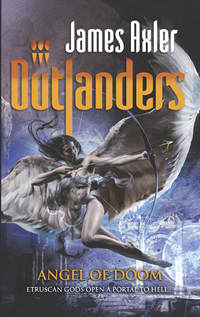
Читать книгу: «Angel Of Doom»
MYTHIC PROPORTIONS
Insidious alien forces conspiring to enslave humanity grow increasingly dangerous and defiant. Willing to do whatever it takes to defeat these ancient invaders, the Cerberus rebels carry on the fight for freedom.
DAMNATION THRALL
The Cerberus fighters embark on an urgent quest to discover what happened to expeditions lost in Italy, on land that once belonged to the Etruscan empire. On site they encounter the monstrous Charun, armed with the hammer of the gods, and Vanth, the angelic winged huntress with a heart of evil. These alien gods are intent on opening a portal to bring their kind to earth, harnessing the power of victims’ minds while using their bodies as shock troops. As the river Styx is poised to flow again, the Cerberus team must prevail or an invasion from a barbaric dimension will lay siege to Europe…and beyond.
A second brilliant sun had appeared, blazing white and hot
Edwards scrambled to his feet, standing on the front of the Manta. The machine pistol snapped down into his fist, ready to go into action, but the strange glowing disc wasn’t moving. He put on his shadow suit’s faceplate and hoped for the visor to screen and filter out the blinding light, as well as analyze the object in the sky.
The range was ten miles, and it was advancing quickly.
He activated his Commtact microphone. “Guys, wherever you are…”
Nothing. No response, not even static. He turned his gaze back to the sky. For all the polarization of the lenses, he couldn’t make out a detail of the blazing comet looming ever closer. But in the space of fifteen seconds, it had closed to nine miles. He couldn’t get details about the shape of the object, only its range, and there was no guarantee that was right.
Edwards turned to open the cockpit, but the command signal to remotely open the canopy was also jammed.
He was in a complete blackout.
Angel of Doom

James Axler
 www.millsandboon.co.uk
A dreadful ferryman looks after the river crossing, Charon, appalling filthy he is, with a bush of unkempt white beard upon his chin, with eyes like jets of fire.
—Virgil, Aeneid
The Road to Outlands—From Secret Government Files to the Future
Almost two hundred years after the global holocaust, Kane, a former Magistrate of Cobaltville, often thought the world had been lucky to survive at all after a nuclear device detonated in the Russian embassy in Washington, DC. The aftermath—forever known as skydark—reshaped continents and turned civilization into ashes.
Nearly depopulated, America became the Deathlands—poisoned by radiation, home to chaos and mutated life forms. Feudal rule reappeared in the form of baronies, while remote outposts clung to a brutish existence.
What eventually helped shape this wasteland were the redoubts, the secret preholocaust military installations with stores of weapons, and the home of gateways, the locational matter-transfer facilities. Some of the redoubts hid clues that had once fed wild theories of government cover-ups and alien visitations.
Rearmed from redoubt stockpiles, the barons consolidated their power and reclaimed technology for the villes. Their power, supported by some invisible authority, extended beyond their fortified walls to what was now called the Outlands. It was here that the rootstock of humanity survived, living with hellzones and chemical storms, hounded by Magistrates.
In the villes, rigid laws were enforced—to atone for the sins of the past and prepare the way for a better future. That was the barons’ public credo and their right-to-rule.
Kane, along with friend and fellow Magistrate Grant, had upheld that claim until a fateful Outlands expedition. A displaced piece of technology…a question to a keeper of the archives…a vague clue about alien masters—and their world shifted radically. Suddenly, Brigid Baptiste, the archivist, faced summary execution, and Grant a quick termination. For Kane there was forgiveness if he pledged his unquestioning allegiance to Baron Cobalt and his unknown masters and abandoned his friends.
But that allegiance would make him support a mysterious and alien power and deny loyalty and friends. Then what else was there?
Kane had been brought up solely to serve the ville. Brigid’s only link with her family was her mother’s red-gold hair, green eyes and supple form. Grant’s clues to his lineage were his ebony skin and powerful physique. But Domi, she of the white hair, was an Outlander pressed into sexual servitude in Cobaltville. She at least knew her roots and was a reminder to the exiles that the outcasts belonged in the human family.
Parents, friends, community—the very rootedness of humanity was denied. With no continuity, there was no forward momentum to the future. And that was the crux—when Kane began to wonder if there was a future.
For Kane, it wouldn’t do. So the only way was out—way, way out.
After their escape, they found shelter at the forgotten Cerberus redoubt headed by Lakesh, a scientist, Cobaltville’s head archivist, and secret opponent of the barons.
With their past turned into a lie, their future threatened, only one thing was left to give meaning to the outcasts. The hunger for freedom, the will to resist the hostile influences. And perhaps, by opposing, end them.
Contents
Cover
Back Cover Text
Introduction
Title Page
Quote
The Road to Outlands
Chapter 1
Chapter 2
Chapter 3
Chapter 4
Chapter 5
Chapter 6
Chapter 7
Chapter 8
Chapter 9
Chapter 10
Chapter 11
Chapter 12
Chapter 13
Chapter 14
Chapter 15
Chapter 16
Chapter 17
Chapter 18
Chapter 19
Chapter 20
Chapter 21
Chapter 22
Chapter 23
Chapter 24
Chapter 25
Chapter 26
Copyright
Chapter 1
They had marched from the sea, landing on the western coast of Italy after a long journey, and when they arrived, they were a full expedition. Three of the fifteen-foot-tall Gear Skeletons, the walking combination of body armor and tank, had been the heavy muscle of the Olympian expedition to Italy. Forged from secondary orichalcum, which combined both lightness of frame with incredible durability, the fearsome war machines were armed with shoulder-mounted light machine guns. But the Gear Skeletons were also versatile, their strength obviating the need for bulldozers or other heavy machinery.
Captain Myrto Smaragda and nineteen of her brethren, brave Olympian men and women, were the bulk of the expedition escorting the powerful war machines. They were experienced soldiers who wore Praetorian armor, a blend of leather and polymer to pay homage to the armor of ancient Greek warriors, all the way down to the odd officer’s side arm: a three-foot falcata such as Smaragda’s own keen sword. The human troops were no more primitively armed than their walking robotic companions. Each soldier was equipped with a helmet with advanced night-vision optics and built-in comms that would keep the warriors in touch with each other. The radio with the power to reach back home to New Olympus rode on the broad back of one of the three Spartans. The device was capable of broadcasting hundreds of miles, thanks to the ancient Annunaki technology, especially the charged energy modules that were built into the millennium-old skeletal robots.
The Gear Skeletons had been designed for use by a smaller race. Former archivist Brigid Baptiste of the Cerberus Redoubt had explained that they were made to accommodate trans-adapts: half-size humanoids of great cleverness, density and durability. As such, there was nearly no leg room for a full-size human. Fortunately the horrors of war had meant there were plenty of capable amputee volunteers to ride in the chests of these great war machines. Amputees were the only norms who could pilot the machines from their truncated cockpits.
Despite their impressive weaponry, Smaragda and her unit were not here as conquerors; they were here as explorers. Even so, they came equipped to defend themselves from whatever horrors lurked on the Mediterranean Sea or in the Etruscan countryside. For years Smaragda and her fellow warriors had battled against the mutated hordes unleashed from the Crack, an abyssal canyon wherein the genetic weapons of long-lost eras were rekindled and turned into a means of ensuring the domination of the young Greeks.
“Remember this. We believed in the ideals of freedom, even as Hera covered our eyes with the scales of her deception,” Diana had told them. “Zoo gave his life so that we could be free of the facade of a false war and to ensure our freedom and self-determination. We can do no less to protect the liberty and freedom of those who will be our neighbors and, hopefully, allies or friends.”
The caution toward gentleness was accompanied by another admonition. “I also will not throw away twenty-three lives and three ancient, alien artifacts to prove how nice we are. If someone tries to kill you, you kill them right back! We’re not loading cupcakes and cotton balls into your machine guns.”
So here the group was, the Spartans ambling with their long brass limbs taking enormous but slow strides so that they didn’t force the New Olympian soldiers to march too hard or heavy. Smaragda knew the giant machines had the ability to cross a hundred miles in the space of an hour, their nimble, precise legs allowing them traction and sure footing on even the roughest of terrain. Even so, the pilots weren’t impatient, allowing their machines to move at such a sedate pace. The Charged Energy Modules that activated and motivated their limbs were remarkable pieces of technology thanks to the Annunaki, the same aliens who had at once created the warrior robot suits and the ones who had kicked off the massive, crippling war that had left New Olympus slow to recover.
Even so, there was little assurance that the CEMs, despite capturing and recovering them from the crashed scout ship that inserted itself into the war, were an inexhaustible supply of power. Just because they had not run one down completely didn’t mean they could not be drained. No one knew how to recharge them, despite the combined efforts of New Olympian and Cerberus scientists.
Unnecessary wear and tear on the crystalline jewels of concentrated energy was to be frowned upon, as well as pain and injury to the pilots. The properties of secondary orichalcum made it rustproof and immutable from hammering or cutting by conventional tools. It also did well to absorb even the hardest of falls and other impacts, lessening the effects upon the pilots. But even with those amazing attributes, the amputee warriors nestled in their chests were still vulnerable. They had not been called Gear Skeletons for nothing, requiring conventional vehicle panels to enclose the users to shield them from the elements and oncoming attacks.
Even with their cushioned pilot chairs, however, movement at high speed and the prodigious leaps the war suits were capable of did leave their pilots with pulled and torn ligaments as well as minor fractures in their spinal columns, even whiplash.
More vulnerable to attack, the body-armor clad Praetorians at least didn’t have to worry about their own physical abilities ripping them or shattering them when they fought to the limits of their bodies.
Smaragda flicked the visor of her helmet to scan mode, sweeping along the sides of the road, searching for unusual heat sources on infrared. The last thing they needed was an ambush. There was not supposed to be an enemy force in this part of the country, despite the rumors that had drawn them here.
Something dark had been awakened in recent days. Towns and villages in the interior had stopped communicating, stopped trading, disappearing as if they had never existed. One man returned from a visit to such a village, his hair turned white, speaking of “they who walked as ghosts” and of winged angels, both horrible and wonderful.
The Italians had turned to their neighbors, seeking help, and New Olympus’s new rulers sensed that such occurrences bore the stink of urgency. A full army would be too much, but with the stories of the horrible angels, the trio of mobile armor suits was, hopefully, going to be sufficient. There was a line between coming in too hard or too soft. Smaragda felt better with the Skeletons lumbering at her side.
All being well, with them present, they would be prepared for the very worst. Three giants with shoulder-mounted machine guns and enormous axes and swords would dissuade any opponent, even if they were winged angels of gigantic proportion themselves.
Smaragda scanned the sides of the road leading to the town that had spooked the Etruscan traders so badly, looking for signs of what could have terrified the lone survivor. She gripped her M-16 rifle tightly, but she kept her finger wrapped around the handle, firmly under the trigger guard so as not to accidentally set off the weapon. She was in no mood to waste ammunition or to cause undue injury. Carrying your gun with your finger on the trigger was a sure way to do both.
Over the heavy, ponderous thuds of the Spartans’ gigantic claws, Smaragda picked up something that she couldn’t quite make out. She immediately held up her fist.
The trained Olympians came to a halt.
Deafening silence descended upon the Greek column and she realized what felt so odd.
There were birds on the branches of the trees along the road, but they made no sound. They were still, no nervous tics she’d seen other birds display as they, even in rest, continuously turned their heads, making certain nothing was creeping up on them. The visible birds, however, was not what had truly disturbed her.
There were trees, heavy and dense with foliage, but the impunity of nests of hidden birds was not accompanied by the riot of tweets and chirps that warned any intruder of how outnumbered they would be if they dared enter the thicket. The countryside was silent.
Smaragda stepped off the road, closing on one of the closest trees. Her men watched as she slung the rifle, then drew the falcata. With a twist, she rapped the spine against a low-hanging branch where a songbird perched.
The creature turned its attention toward her, blinked with eyes slow and gummy, but did not launch. Even the turn of its head was casual, unconcerned, not the flicker movement of a normal bird. Smaragda gave the branch another tap with the spine of her sword. The songbird took a clumsy sideways step further along the branch, then unfurled its wings.
Just before she could tap the branch a third time the songbird took off, wings flapping powerfully, moving with the natural strength and speed of the creature, the limbs beating with the urgency necessary to keep the tiny thing aloft. It wasn’t as if the songbird was in some sort of debilitating trance. It flew straight and true.
It just didn’t seem to care. The normally skittish creature would have taken off on Smaragda’s approach, let alone not stay in place for two raps on its perch.
“Not good,” she said.
Niklo spoke up. “This place has bad mojo.”
Niklo had ten years on Smaragda and it showed in his gruff, grizzled looks. He’d been through plenty of battles, before Hera and Z005 arrived in Greece, mixing it up with bandits and other coldhearted thugs who made their living preying off the defenseless and helpless in postapocalyptic, shattered Greece. When the hydra drones rose up, Niklo had been one of the first who knew what to do back when the best weapons were swords and muskets. Before Hera had opened the Olympus Redoubt and its stockpiles of late-twentieth-century armaments, it was a matter of toughness.
Smaragda and Niklo had been thrown together in the madness of the hydra wars, quickly gaining each other’s trust as they’d stood the line against swarms of mutant clones bred in the ancient vats of the Crack.
Niklo’s unease at the strangeness of this dead countryside echoed hers and, with those five words, cemented Smaragda’s instincts. Despite the fact that Smaragda had gotten an officer’s commission and Niklo remained master sergeant, there was no jealousy or animosity between them. Smaragda’s role entailed much more red tape, something Niklo could pawn off onto her. In the meantime, officer corps didn’t regularly get issued a Squad Automatic Weapon, either, and the brawny, grizzled Niklo loved using the light machine gun to plow their way out of an ambush with a long belt of ammo.
“Tan, get on the radio. We’re experiencing something weird. Everyone, if your weapons aren’t hot already, safeties off,” Smaragda ordered.
“You heard the lady!” Niklo bellowed. “Heads on swivels, standard perimeter protocols!”
“Movement!” came a cry from their scout up the road.
Smaragda turned and jogged toward the man. Niklo cut her off.
“You talk to home base,” he told her.
Smaragda wrinkled her nose, not wanting to expose any of her men to danger while she was busy on the blower back to Olympus. Even so, she was the one in charge and she was the one whose opinion and authority mattered. This was a chain-of-command decision.
“If things look bad, you hold down the trigger until you melt the barrel laying down cover fire for our retreat,” Smaragda ordered him. “And you make damn sure you come back, or I’m swimming across the Styx and dragging you back to life.”
Niklo smirked, his lined face a road map of seventy years lived in the space of forty, dark eyes twinkling. “Myr, I’m counting on you getting me back from Hades.”
The Olympians, turned into a well-oiled military machine of professional warriors, remained in their defensive positions, alert and ready for trouble. No one was in the line of fire of the other and each had a designated vector to scan and search. Everyone knelt, making themselves smaller targets and bringing their knee and thigh armor up to their chests to bolster the protection of their vital organs against incoming fire.
Thanos—“Tan” to his platoon mates and friends, who seemed to be everyone—looked concerned as he was on the radio. “Not getting a signal. Something is jamming us.”
“How can that be?” the pilot of the Spartan asked. “This radio is designed to transmit across hundreds of miles. It’s predark technology, solid-state and can cut through any interference like a knife through mud.”
Tan shook his head. “Listen to this.”
Smaragda took the receiver. The only sound on the other end was…unnatural.
A knocked-out radio should only receive static, white noise, the pop and crackle of random frequencies and the hiss of electromagnetic radiation pouring off the sun onto the surface of the Earth.
A jammed radio should not be singing in unholy but beautiful tones. She couldn’t bear to listen to the blasphemous signal for more than a few seconds before handing the radio back to Tan. He didn’t seem to be in a hurry to put it back to his ear, either.
She tried the helmet comm. “Niklo, come back.”
As soon as she stopped transmitting, there was that song; a high, melodic tone, singing verses in a long-forgotten tongue. But even without understanding the words, Smaragda knew it spoke to something that did not belong on Earth. It was a prayer. What was worse, she knew something was listening and somewhere, beyond the veil of her senses, it was struggling to respond.
“Karlo, Rosa, go grab Niklo and Herc and bring them back. We’re heading back to the boat. If you see anyone or anything that’s not Niklo or Herc, open fire,” Smaragda said.
So much for a mission of peace and mercy. Smaragda didn’t like the idea of sending off her soldiers to retrieve their teammates under orders to kill any strangers. However the singing and the odd behavior of the wildlife around them added up to this road being nothing less than a murder trap.
And she’d led her platoon right into it.
Karlo and Rosa jogged up the road to where Herc, the scout, had called back about movement. Niklo had only been out of radio contact for a minute, but it felt like a lifetime. The only heartening thing was that there had been no sound of gunfire. After all, if Niklo didn’t cut loose with the SAW, that meant there was no enemy force rising to engulf them. The Olympian sergeant would have made any ambush pay for their surprise, and the light machine gun would have been heard for miles.
The silence around them, the damned silence smothering the platoon, ate at her. Smaragda upped the magnification on her helmet optics, scanning the road ahead. It had been midday when they’d stopped, clouds moving in. The day had been growing steadily grayer and dimmer, but now the light was fading even faster, when the sun should be highest in the sky.
Her blood seemed to thicken in her veins as even the high-tech optics in her Praetorian helmet, the same advanced night-vision and telescopic lenses that Kane and Grant had as part of their Magistrate armor suits, showed nothing.
“Captain?” A voice spoke up.
“Movement?” Smaragda asked.
“No. Just…smoke,” Tan said.
Smaragda flipped up the visor on her helmet. There, invisible to the infrared scanners, was a roiling, spreading cloud that billowed out onto the road. She glanced through on infrared again. No one seemed to be inside the cloud, utilizing it as cover or concealment. Who knew if the smoke had some properties that could be filtering out even the body heat of her fellow Praetorians?
“Should we open fire?” another soldier asked, nerves jangling in his voice.
“On what?” Smaragda asked. “We might just end up cutting Niklo and the others apart.”
“But they’re not on the infrared,” Tan noted.
“Retreat,” Smaragda ordered.
“Smoke’s closing in on the road behind us,” announced the Spartan at the back of their formation. “I’m going to…”
“Stay put!” Smaragda commanded. “Don’t enter the smoke.”
Every instinct told her to open fire into the infection of black ink spilling onto the road on either end, bracketing them in.
Smaragda wouldn’t risk the lives of her men in a friendly fire incident.
“GS 26, knock us a road through the trees, now!” Smaragda ordered.
The suit in the center of the formation reacted quickly, plunging into the woods. Large, brassy arms wielding unimaginable strength pushed against trunks, shoving trees out of the ground, roots snapping. Branches shattered against the suit’s broad shoulders and Smaragda waved her men into the gap being created by the bulldozer-like robot. She stayed at the back of the group, watching as the walls of inky, foreboding smoke began to close in on where they used to be. It was as if the clouds were only following the road, forming perfect columns, not spreading out into the forest and upon the path that Skeleton 26 pushed through. Smaragda continued stepping backward, minding the exposed roots and splinters left in the robot’s wake.
She kept the muzzle of her rifle aimed at the wall of darkness and turned sideways, skipping back after her men.
“Niklo, I’ll be back,” she whispered. “If you’re alive.”
Silently she repeated that thought. Leaving soldiers under her command behind, in a lurch, was as bad a defeat as seeing them fall in bloody heaps.
“Everyone comes home.” Smaragda repeated the motto of the Praetorians. “Sooner or later, we’ll be back for you.”
A scream split the air. She whirled and looked down the trough cut through the woods. Of the three Spartans in the unit, she could only see one, the other two having disappeared behind a wall of darkness that intercepted them. Of the fifteen soldiers she’d pushed into retreat in the wake of the Spartans, she saw only six, and they were in full retreat.
The mighty robot’s shoulder guns opened up onto the shadowy smoke as it lunged for the brass giant. The flash and flicker of muzzle-blasts did little to dent or illuminate the choking, inky fog that seemed to grow tentacles with which to entrap the robot.
Smaragda shouldered her rifle, but realized that opening fire into the fog would mean that she could be blindly gunning down fellow soldiers taken captive by the cloud. She wanted to yell for a cease-fire from the robot but, watching the giant fight for its life, she noted that tracer rounds struck the smoke, then bounced off the cloud.
GS 26 lashed out with its battle-ax, the edges heated to steamy white by elements inside the gigantic weapon. The ax seemed to fare better, lopping off solid hunks of the darkness, but only if they were slender tendrils. Anything thicker than a human torso caught the ax, forcing the Spartan to struggle and wrench the blade free.
Tendrils whipped out, snatching up another of her men.
Smaragda lunged, drawing her falcata and slashing at the tentacle of living night. Blade met alien smoke and it was as if she tried to chop a tree branch. The solidness of the tendril of cloud rattled her arm, tendons popping as she put enough force into the swing for a follow-through.
The soldier in the fog’s grasp turned ashen, eyes wide with horror. He breathed out, wisps of frosting moisture escaping from his lips.
“Run!” he rasped. “Get away! Live to…”
Another whip of darkness wrapped around the Praetorian’s head and, within moments, he was wrenched off of his feet and into the smoke as if he was never there.
Lashing smoke fingered out toward her, but she swatted the pseudopods aside, scrambling into retreat.
The Gear Skeleton still fighting the fog disappeared; one hand reached up, clawing at the air in the hope of grasping some anchor, but the robotic claw stilled and was sucked into the darkness.
Smaragda turned and raced off a side trail between the trees. Whatever the smoke was, it seemed to have trouble flowing through and around the trunks of the forest. She swerved and wove, bounding over fallen logs and branches. She regretted lifting the visor so that she could see the midnight horror that expanded onto the road as leaves and fronds slapped and slashed at her face and eyes. She struck a tree trunk at full speed while half blinded by a leaf raking her naked eyeball.
The impact jarred her, but she seized the trunk, using it to maintain her footing.
She glanced back and saw that there were three tentacles winnowing their way around trunks, stretched out at far back as she could see through the trees. Smaragda raised her M-16 and opened fire. Rifle rounds shattered the eerie silence that had fallen in the wake of the last Spartan’s disappearance, but they did nothing to dispel the living darkness stretching and seething after her.
Smaragda turned and ran again, having paused only to slide down her eye shield, leaving the advanced optics out of the way.
Smaragda ran for as long and as hard as she could.
Within an hour she was at the coast, on her knees, her chest burning, shoulders aching, trying to vomit but having nothing to spit up.
Twenty-two people were now gone.
She was the lone survivor.
She pulled off her helmet and, for a moment, thought something else had come after her. A sheet of white spilled down over her eyes and she screamed in shock.
Then she realized why she was so stunned.
Before the smoke her hair had been as dark as a raven’s feathers.
Now the tresses that she could see were as pale and wispy as silken icicles.
Trembling, Smaragda looked around for the boat that had brought the expedition.
“Live to tell what happened,” she said in a terrified murmur.
“Live to tell what…happened…” she repeated.
Tears drenched Smaragda’s cheeks as she struggled to her feet.
Chapter 2
Domi crouched deeply as she faced off with the man in black. Perfectly balanced in her hand was the handle of one of her favorite knives, its flats gleaming under the harsh lights. She was a small woman, hardly five feet in her bare feet, and Domi was almost constantly barefoot. Her body looked thin and frail, her complexion was white as bone and her hair was wispy, silvery and trimmed short so as to provide little more than peach fuzz for an opponent to grab on to. Most startling about Domi was her eyes, ruby-red gems that denoted the cause of her pale flesh and translucent hair.
The girl was an albino. And yet she was facing off against a man a foot taller and easily a hundred pounds heavier than she was, her muscles tense, ready for battle. In the centuries before skydark, the cataclysmic nuclear Armageddon that drove humankind to the brink of extinction, albinos had been considered frail. Indeed, as a child, she had been, but surviving in the deadly world outside of the villes, in the harsh wilderness between tiny islands of civilization, had hardened her.
She was thin of limb, yes. But her muscles were corded tight and had strength and swiftness within them, making her akin to a panther. Her “claws” were her knife and her “bite” was a deadly little .45-caliber Detonics Combat Master, which she didn’t have access to now.
The big man in front of her was powerful, armored, and even inside that armor, had a lightness on his feet, bouncing on the ground in a taunting dance, making it apparent that he expected her to charge him. He was dangling himself as bait, waiting for her to commit to an attack before he turned it around.
Domi was a survivor, though. Before she’d begun to learn how to read under the tutelage of Lakesh and Brigid Baptiste, her school had been expanses of desert or gnarled, predator-stalked forests. Her teachers had been the cruel and the powerful, seeking to use her as meat or pleasure or, in some grisly cases, both. And the feral albino girl had been a quick student, passing every test thrown at her.
This was not the first time she’d faced the armored brute in front of her. His head was encased in a glossy but tough helmet, shielding his face and preventing her from seeing if he was blinking or shifting his glance. Without a view of his tells, Domi was partially blinded, at her usual disadvantage. With nothing to betray her enemy’s thoughts, and even his body language distorted by the bouncing dance he shuffled, all of her usual cues as to where or when to strike or even to defend were gone.
The brute lunged. He had his own blade, twice the length of Domi’s, almost a short sword that looked normal-size in his massive fist. The movement startled the wild girl, but even when reflexively responding to the sudden rush, Domi’s body reacted with speed and agility. The edge of the knife whistled through the air and she could feel the brush of wind off its cold, unyielding dagger on her bare upper arm, the lethal edge missing her by fractions of an inch.
Domi’s swift sidestep planted her left foot down hard for support, bracing her so that she could kick up with her other leg, the knee striking the big knife-man in the side. She’d aimed instinctively away from the bulletproof polycarbonate shells that shielded his abdominal muscles and into the ballistic cloth side panel. The impact was more than sufficient to elicit a grunt from behind the opaque black visor of her foe’s helmet.
Domi brought her knife around, finding a brawny shoulder and stabbing into it. Even as she plunged the blade down, she wrapped her other arm around his, snaring it tightly to give her leverage on him and to make her harder to reach with his free hand. The armored brute lurched erect and Domi’s feet left the ground. Now she was riding a bucking beast, and just to make certain he couldn’t shake her free, she wound her muscular legs around his forearm and wrist.
Suddenly the brute not only had to deal with the bulk of his armor and the throbbing pain of her stab, but also the unbalancing, unsettling weight of the feral girl.
“Dammit!” Edwards shouted as he toppled off balance, bringing them both down to the exercise mat.
Domi stabbed again at the ballistic cloth between the polycarbonate plates that would have provided protection against slashing, stabbing steel. Fortunately for the former Magistrate, Domi’s knife was a blunt-edged aluminum copy, meant for training. Even though its edges were soft, rounded, unable to cut anything softer than mud, when you stabbed someone with the tip, it still was hard, unyielding metal slamming into soft flesh.
And it hurt, much to Edwards’s dismay.
“I thought these things weren’t supposed to injure you,” Edwards grunted as Domi slithered off his arm.
“Not normally,” Domi replied, her verbiage clipped as she was still brimming with adrenaline from the training session. “But ’m not normal.”
“You can say that again, runt.” Edwards looked her over. He was used to her dropping pronouns and adjectives while stressed or energized for combat, so was not worried about her suffering some sort of episode or being too out of breath. Indeed, the comment about her not being normal showed she still retained her wits, sense of humor and a significant skill at wordplay.
“Still, I’m damned glad I was wearing armor,” Edwards added, giving her a poke in the shoulder with his fist. “Just too bad you found the kinks in it, little cheater.”
“Was the point,” Domi answered, rubbing her knuckle-brushed upper arm. She smirked at his accusation of cheating. “Pardon pun.”
Edwards grinned, pulling off his helmet. His hair was a close-shaved scruff around his melon-size head, showing off his bullet-bitten ear. Though the Magistrate armor was designed to be environmentally adaptive, beads of sweat still formed thanks to the exertion and condensation of Edwards’s breath inside the helmet.
When they’d met at first, and were being assigned to either run or be a part of the Cerberus Away Teams, Edwards had bristled at the concept of working “beneath” such a young, tiny female.
That was dozens of sparring matches ago, across the past several months. Since then the brawny former Magistrate had come to respect Domi. There were times when she sounded barely more educated than a toddler, and she always looked like a frail wisp of a creature, but there was strength and intelligence in there.
It wasn’t the kind of phenomenal intellect as displayed by others such as Brigid Baptiste or Mohandas Lakesh Singh, who boasted unique scientific and mathematical acumen. It was more the wisdom and agility of mind showed by fellow former Magistrates Kane and Grant. It was knowledge that didn’t involve splitting atoms, but observation of her surroundings, instincts that helped her react and respond to danger at speeds beyond even the most trained soldiers that Edwards knew of.
Being under her command, even if it was a mere three people in the whole Cerberus Away Team, was no threat to his abilities, his prodigious strength and paramilitary Magistrate training. His teammate, the beautiful and bright freezie Sela Sinclair, was another sharp mind and strong woman Edwards had learned to respect.
The Magistrates had been a strictly masculine community, a group of men who were of similar size, similar strength, each picked and groomed from even before birth to become part of the hybrid barons’ elite enforcers. They had been forged as rough, macho and gung ho, their individuality limited by the stripping of their first names. Edwards had been born Edwards, as his father before him and that father before him. His mother had been a donor, a handpicked maiden chosen to bear a healthy child, to mix with the genes of a soldier and warrior to produce an ideal fighting man.
Edwards had been given very little of a normal youth. It was spent physically training, learning the laws and procedures of the Magistrates, not being a boy. For him, as well as Domi, the luxuries of childhood were absent, little chance of play or exploring and nurturing a sense of awe and wonder.
Now, in the wake of the barons’ evolution and shedding of their hybrid-human forms, Edwards was a lawman who found a new vocation as a warrior in the defense of Cerberus Redoubt, and an avocation as an adventurer, a hero to swoop in to the rescue and restore order.
Through this selfless assistance of others, Edwards felt awakened. Reborn even. In helping others, in traveling the world for the purposes of growing knowledge, for the effort of building a world, he was young again. He was alive whereas before he’d merely survived and existed. It was a lesson, a transformation, that Domi had also undergone.
Domi herself was a child of the wilderness. Later, in the Tartarus Pits, the hellish subterranean area in the shadow of the Administrative Monolith in the center of Cobaltville, she’d had to scrabble as a petty thief and was pressed into servitude as a prostitute. It was only her acceptance as an ally, the affection of Grant as a surrogate father and protector, the gentle love of Lakesh, that had turned her from a feral savage into an avid student. She’d gone from a slum criminal totally out for herself to someone who understood that love and affection were not necessarily displayed by sexual desire, as with Grant, and that intimacy could come with gentility, not cruelty, as with Lakesh.
Given such an environment that nurtured goodness, growth and intelligence, Edwards found himself only mockingly grumbling about “babysitting trips with nerds to ruins” and actually showing excitement about learning about the history of the strange planet they lived upon.
“Hey, you two!”
It was Sela Sinclair, who herself had not become involved in the ever-escalating sparring matches of Domi and Edwards. Sinclair’s preference for combat was not the close-quarters of knives and fists but rather the application of leverage and focused energy, usually in the form of the collapsible baton she had become intimate with in her pre-skydark life as an Air Force officer. It didn’t mean she didn’t lack for bare-handed skill, but when things came to a hands-on approach her preference was for the strength-amplifying qualities of an ASP telescoping fighting stick, the same way that Domi preferred a sharp knife. And even then, the ASP was only for situations where she didn’t necessarily require the killing of an opponent.
Sinclair folded her arms, leaning on one leg, hip tilted jauntily.
“Something come up?” Domi asked.
“The CAT teams are being called in for a briefing,” Sinclair said. “Something about a call from New Olympus.”
Domi perked up at the sound of that. Edwards and Sinclair had joined her in that prior mission, arriving later with armor kits meant for Sandcats and Humvees that would be adapted to the Olympian Spartans. They had also been present when Hera Olympiad had gone berserk with power, standing their ground against her madness and the ever-growing energies and mass of her corrupted command node.
Hera, a Cobaltville scientist who had been sent to retrieve Annunaki artifacts from Greece while the Overlord Marduk was still Baron Cobalt, had acquired a smart-metal control nodule when one of Marduk’s Nephilim drone troopers was captured. Using the knowledge she had gained from her exploration of the Crack, she’d manipulated the smart-metal pod to provide herself a new form of clothing. Because the pod was now reacting with an intelligent mind, it followed her commands rather than simply existed as a suit of body-conforming armor.
Of course, Marduk had known of her interference with the Annunaki electronics. He’d tried to take control of her and, barring that, his psychic assault had driven her insane.
Hera had bonded that module with another piece of Annunaki technology, a Threshold, and an electrical drone weapon on top of that. CAT Beta—Domi, Sinclair and Edwards—had been at the forefront of the battle against the out-of-control Hera as she’d continued to add mass and energy to her suit’s frame, assisted by Brigid Baptiste.
Despite the defeat of the superhuman Hera, the damage to New Olympus had been significant. There were sorties from Cerberus to the Grecian nation, teams mostly there to excavate and open up collapsed and damaged tunnels in the deep underground military base that had been the Olympian redoubt. The digging and rebuilding were necessary, as Hera’s destruction had cut off access to redoubt supplies of ammunition, food and medicine stored for the hundreds of years since before skydark.
Rebuilding had been going well, but for New Olympus to actually send out a call for help meant something big had popped up.
“Shower and change. You’ve got fifteen minutes,” Sinclair told them.
The two Beta Team members headed to the gymnasium locker room where Domi helped Edwards out of his bulky Magistrate armor, cutting the usual de-prep time by half, allowing Edwards to do more than just let the showerhead spit on him for a second. That both teammates were naked was not a distraction to either.
Domi had her devotion to Lakesh, and Edwards was uninterested in settling down and of no mind to steal the scientist’s woman. Indeed, Edwards was a man of personal discipline, and while he believed that men and women could be lovers and work together, he personally did not want to complicate his relationship with the tiny Domi. Edwards also had a preference for taller, fuller-figured women, and to the massive former Magistrate, Domi’s appearance was more of a prepubescent boy’s than an object of sexual desire. Hell, knowing her for this long, becoming nearly a brother to her on the CAT team, she was not an object. She was Domi. Friend. Living being. Person. Not an object of lust.
From what Edwards had read or seen in vids from before the destruction of mankind, he could appreciate that at least one thing had advanced forward since the age of “civilization.” Humanity needed to grow up, to not just focus on their baser instincts and rut like animals. Reproduction was important, but there were other much more vital matters that needed attendance.
By the time Edwards finished his shower and dressed, he and Domi arrived at the briefing with minutes to spare.
In fact, they had both entered sooner than Kane and Grant, and were there to see Brigid Baptiste, the third member of the group that had been entitled CAT Alpha. Brigid was not happy to see Kane and Grant ambling in so slowly after their counterparts had showed such promptness, and she let her distaste for the situation show in her scowl.
“I told you we shouldn’t have stopped for coffee,” Grant said, catching the disgust in Brigid’s glare. He slid into his chair at the meeting table, setting the travel mug down in front of him. Kane shrugged at his friend’s statement of being “busted.”
“It’s not like we’re the B-team,” Kane noted, giving a wink to Domi, who wrinkled her nose at the mock insult. If there was a rivalry between the CAT teams, no one on either of the two squads had been made aware of it. They were comrades and allies. The only rank came from the fact that Sinclair was awakened after Kane, Brigid and Grant became a team, and Edwards had only recently found himself a free agent in the wake of the collapse of the baronies. Kane’s joke was taken in stride, not in malice, and Brigid rolled her eyes.
“As you know, ever since our first contact with New Olympus, we’ve been sending over manpower and assistance to help them with their rebuilding,” Brigid began. “They’ve reciprocated by helping to design Kane’s exoskeleton during…recent troubles.”
“I didn’t get to blow-dry and curl my hair for this recap?” Edwards asked, rubbing his closely shaved pate.
Brigid chuckled. “Sorry, but you know I try to be as completest as possible.”
Edwards shrugged. “Not a problem. I just needed something to…distract me.”
Domi nodded in recognition. Edwards was referring to Ullikummis’s attack and conquest of the Cerberus Redoubt. Not only was Edwards present for that, but also he’d been infected with one of the stony Annunaki’s seeds, making him a puppet, a pawn of the exiled godling. Memories of that time, the loss of life and the madness of their enslavement, were still recent and raw.
“Right now, they’re starting to expand their area of influence over there, peacefully.” Brigid quickly added the peacefully. “They’d sent out an excursion into what used to be the Etruscan countryside.”
“Italy?” Sela Sinclair asked.
Brigid nodded.
Sinclair smirked. “I always wanted to take a vacation in the countryside with the vineyards.”
Brigid gave the Air Force veteran a one percent salute, akin to the gesture that Kane and Grant gave each other. She continued speaking. “Out of twenty soldiers and three Spartans sent into the Italian countryside, there was only one person who returned. The commander of the ground platoon. She was in shock to the point that her hair turned white. She claimed they had encountered an amorphous, seemingly sentient darkness that was immune to gunfire and had swallowed people. Even their robotic support team was unable to break the bonds.”
“Bulletproof fog that eats soldiers,” Grant murmured. “Do you have any historical correlation and background for that, Brigid?”
“Nothing so far,” she replied. “The only possible link to an inky, all-enveloping blackness is the relation of one of the old gods of Italy—Charun.”
“That sounds like the ‘mythological guy who has a boat on the river of the dead’ Charon?” Kane asked. Brigid acknowledged that Kane got the pronunciation and identity correct. “Any relation?”
“Charun, it is believed, was a renamed chooser of the slain in Etruscan mythology. He was a winged god of death,” Brigid explained. “An invulnerable fog or a wave might be in reference to the river Styx’s alleged properties of making anyone dipped in it invulnerable, like Achilles.”
“You’ve been hitting the research hard enough,” Kane mentioned. “Sometimes, it’s best to put speculation aside and put feet on the ground.”
“And hope that we’re not stumbling into a trap,” Sinclair added. “You want us to come with you?”
“In general, we rarely send both teams into the field together, but in this instance, it would be beneficial to have you along. My ankle still isn’t at a hundred percent, so my running and jumping will be impaired, and DeFore still wishes to make certain Kane hadn’t received anything permanent in regard to the crack he received on his head. I’m under the presumption that the reason the expedition encountered such a powerful surge was due to the size of the intrusion,” Brigid said.
“So if we show up with three to six people, we can slip under their radar, so to speak,” Edwards concluded. “I can figure out why you want Beta with you.” He glanced toward Domi as if to provide clarity.
“Indeed. We’ll also be heading to Olympus in two groups. One via traditional mat-trans, and Edwards and Grant in the Mantas,” Brigid added. “We’ll see if our jerry-rigged weapons systems for them might prove sufficient to deal with a superhuman threat.”
“If we have a target that we can use the Mantas against,” Grant added. “Who knows if the thing generating that weird black mass will be out in the open.”
“We’ll cross that bridge when we come to it,” Kane said. “The first thing we need to do is get to New Olympus.”
“And since we’re taking the Mantas, we’ll catch up to you in a few hours,” Edwards pointed out. “Don’t drink all the hospitality before we get there.”
Kane chuckled. “It’s not the hospitality you should worry about.”
Edwards didn’t say it out loud, but looking at the concerned features of Brigid Baptiste in the wake of the briefing, he knew that something out there was going to be a terrible challenge.
Then again, that was the reason for the existence of the Cerberus Away Teams, he added grimly and silently.
Бесплатный фрагмент закончился.