Читать книгу: «J. R. R. Tolkien»

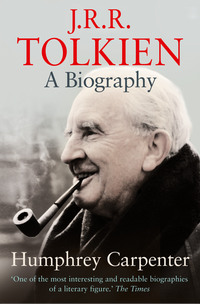
J.R.R. TOLKIEN
A BIOGRAPHY
HUMPHREY CARPENTER

Copyright
Published by HarperCollinsPublishers 1 London Bridge Street London SE1 9GF www.tolkien.co.uk
First published in Great Britain by George Allen & Unwin 1977
Copyright © The Estate of the late Humphrey Carpenter 1977, 1978, 1982

Humphrey Carpenter asserts the moral right to be identified as the author of this work
All rights reserved under International and Pan-American Copyright Conventions. By payment of the required fees, you have been granted the non-exclusive, non-transferable right to access and read the text of this e-book on-screen. No part of this text may be reproduced, transmitted, down-loaded, decompiled, reverse engineered, or stored in or introduced into any information storage and retrieval system, in any form or by any means, whether electronic or mechanical, now known or hereinafter invented, without the express written permission of HarperCollins e-books.
Source ISBN: 9780261102453
Ebook Edition © MAY 2011 ISBN: 9780007381258
Version: 2019-11-11
Dedicated to the memory of ‘The T.C.B.S.’
Contents
Cover
Title Page
Part One
A VISIT
PART TWO: 1892–1916: Early years
CHAPTER I: BLOEMFONTEIN
CHAPTER II: BIRMINGHAM
CHAPTER III: ‘PRIVATE LANG.’ – AND EDITH
CHAPTER IV: ‘T.C, B.S., ETC.’
CHAPTER V: OXFORD
CHAPTER VI: REUNION
CHAPTER VII: WAR
CHAPTER VIII: THE BREAKING OF THE FELLOWSHIP
PART THREE: 1917–1925: The making of a mythology
CHAPTER I: LOST TALES
CHAPTER II: OXFORD INTERLUDE
CHAPTER III: NORTHERN VENTURE
PART FOUR: 1925–1949(i):‘In a hole in the ground there lived a hobbit’
CHAPTER I: OXFORD LIFE
CHAPTER II: PHOTOGRAPHS OBSERVED
CHAPTER III: ‘HE HAD BEEN INSIDE LANGUAGE’
CHAPTER IV: JACK
Additional Images
CHAPTER V: NORTHMOOR ROAD
CHAPTER VI: THE STORYTELLER
PART FIVE : 1925–1949(ii): The Third Age
CHAPTER I : ENTER MR BAGGINS
CHAPTER II: ‘THE NEW HOBBIT’
PART SIX : 1949–1966: Success
CHAPTER I : SLAMMING THE GATES
CHAPTER II : A BIG RISK
CHAPTER III: CASH OR KUDOS
PART SEVEN: 1959–1973: Last years
CHAPTER I: HEADINGTON
CHAPTER II: BOURNEMOUTH
CHAPTER III: MERTON STREET
POSTSCRIPT: THE TREE
APPENDIX A
APPENDIX B
APPENDIX C
APPENDIX D
INDEX
About the Author
AUTHOR’S NOTE
ALSO BY HUMPHREY CARPENTER
Copyright
About the Publisher
Part One
A VISIT
It is mid-morning on a spring day in 1967. I have driven from the centre of Oxford, over Magdalen Bridge, along the London road, and up a hill into the respectable but dull suburb of Headington. Near a large private school for girls I turn left into Sandfield Road, a residential street of two-storey brick houses, each with its tidy front garden.
Number seventy-six is a long way down the road. The house is painted white and is partially screened by a tall fence, a hedge, and overhanging trees. I park the car, open the arched gate, go up the short path between rose bushes, and ring the front door bell.
For a long time there is silence, except for the rumble of distant traffic in the main road. I am beginning to think of ringing again or of turning away when the door is opened by Professor Tolkien.
He is slightly smaller than I expected. Tallness is a quality of which he makes much in his books, so it is a little surprising to see that he himself is slightly less than the average height – not much, but just enough to be noticeable. I introduce myself, and (since I made this appointment in advance and am expected) the quizzical and somewhat defensive look that first met me is replaced by a smile. A hand is offered and my own is firmly grasped.
Behind him I can see the entrance-hall, which is small and tidy and contains nothing that one would not expect in the house of a middle-class elderly couple. W. H. Auden, in an injudicious remark quoted in the newspapers, has called the house ‘hideous’, but that is nonsense. It is simply ordinary and suburban.
Mrs Tolkien appears for a moment, to greet me. She is smaller than her husband, a neat old lady with white hair bound close to her head, and dark eyebrows. Pleasantries are exchanged, and then the Professor comes out of the front door and takes me into his ‘office’ at the side of the house.
This proves to be the garage, long abandoned by any car – he explains that he has not had a car since the beginning of the Second World War – and, since his retirement, made habitable and given over to the housing of books and papers formerly kept in his college room. The shelves are crammed with dictionaries, works on etymology and philology, and editions of texts in many languages, predominant among which are Old and Middle English and Old Norse; but there is also a section devoted to translations of The Lord of the Rings into Polish, Dutch, Danish, Swedish, and Japanese; and the map of his invented ‘Middle-earth’ is pinned to the window-ledge. On the floor is a very old portmanteau full of letters, and on the desk are ink-bottles, nibs and pen-holders, and two typewriters. The room smells of books and tobacco smoke.
It is not very comfortable, and the Professor apologises for receiving me here, but he explains that there is no space in the study-bedroom in the house where he actually does his writing. He says that in any case this is all temporary: soon he will, he hopes manage to finish at least the major part of the work promised to his publishers, and then he and Mrs Tolkien will be able to move to more comfortable quarters and congenial surroundings, away from visitors and intrusions. He looks slightly embarrassed after the last remark.
I climb past the electric fire and, at his bidding, seat myself in a wheel-back chair, as he takes his pipe from the pocket of his tweed jacket and launches into an explanation of his inability to spare me more than a few minutes. A shiny blue alarm clock ticks noisily across the room as if to emphasise the point. He says that he has to clear up an apparent contradiction in a passage of The Lord of the Rings that has been pointed out in a letter from a reader; the matter requires his urgent consideration as a revised edition of the book is about to go to press. He explains it all in great detail, talking about his book not as a work of fiction but as a chronicle of actual events; he seems to see himself not as an author who has made a slight error that must now be corrected or explained away, but as a historian who must cast light on an obscurity in a historical document.
Disconcertingly, he seems to think that I know the book as well as he does. I have read it many times, but he is talking about details that mean little or nothing to me. I begin to fear that he will throw some penetrating question at me that will reveal my ignorance – and indeed now he does ask me a question, but fortunately it is rhetorical and clearly requires no more than the answer ‘yes’.
I am still nervous that there will be other and harder questions, doubly nervous because I cannot hear everything that he is saying. He has a strange voice, deep but without resonance, entirely English but with some quality in it that I cannot define, as if he had come from another age or civilisation. Yet for much of the time he does not speak clearly. Words come out in eager rushes. Whole phrases are elided or compressed in the haste of emphasis. Often his hand comes up and grasps his mouth, which makes it even harder to hear him. He speaks in complex sentences, scarcely hesitating – but then there comes a long pause in which I am surely expected to reply. Reply to what? If there was a question, I did not understand it. Suddenly he resumes (never having finished his sentence) and now he reaches an emphatic conclusion. As he does so, he jams his pipe between his teeth, speaks on through clenched jaws, and strikes a match just as the full stop is reached.
Again I struggle to think of an intelligent remark, and again he resumes before I can find one. Following some slender connecting thread, he begins to talk about a remark in a newspaper that has made him angry. Now I feel that I can contribute a little, and I say something that I hope sounds intelligent. He listens with courteous interest, and answers me at some length, turning my remark (which was really very trivial) to excellent use, and so making me feel that I have said something worth saying. Then he is off on some tangential topic, and I am once more out of my depth, able to contribute no more than a monosyllable of agreement here and there; though it does occur to me that I am perhaps valued just as much as a listener as a participant in the conversation.
As he talks he moves unceasingly, pacing about the dark little room with an energy that hints at restlessness. He waves his pipe in the air, knocks it out in an ashtray, fills it, strikes a match, but scarcely ever smokes for more than a few puffs. He has small, neat, wrinkled hands, with a plain wedding-ring on the third finger of the left hand. His clothes are a little rumpled, but they sit well on him, and though he is in his seventy-sixth year there is only a suggestion of tubbiness behind the buttons of his coloured waistcoat. I cannot for long keep my attention from his eyes, which may wander about the room or stare out of the window, yet now and then will return to dart a glance at me or rest a steady gaze as some vital point is made. They are surrounded by wrinkles and folds that change with and emphasise each mood.
The flood of words has dried up for a moment and the pipe is being lit again. I perceive my opportunity, and state my business, which now seems unimportant. Yet he turns to it immediately with enthusiasm, and listens to me attentively. Then, when this part of the conversation is done, I get up to go; but for the moment my departure is evidently neither expected nor desired, for he has started to talk again. Once more he refers to his own mythology. His eyes fix on some distant object, and he seems to have forgotten that I am there as he clutches his pipe and speaks through its stem. It occurs to me that in all externals he resembles the archetypal Oxford don, at times even the stage caricature of a don. But that is exactly what he is not. It is rather as if some strange spirit had taken on the guise of an elderly professor. The body may be pacing this shabby little suburban room, but the mind is far away, roaming the plains and mountains of Middle-earth.
Then it is all over, and I am being ushered out of the garage and taken to the garden gate – the smaller one opposite the front door: he explains that he has to keep the garage gates padlocked to stop football spectators parking their cars in his drive when they attend matches at the local stadium. Rather to my surprise, he asks me to come and see him again. Not for the moment, as neither he nor Mrs Tolkien has been well, and they are going on holiday to Bournemouth, and his work is many years behind-hand, and letters are piling up unanswered. But some time, soon. He shakes my hand and is gone, a little forlornly, back into the house.
PART TWO 1892–1916: Early years
CHAPTER 1 BLOEMFONTEIN
On a March day in 1891 the steamer Roslin Castle left dock to sail from England to the Cape. Standing on the stern deck, waving to the family she would not see again for a long time, was a slim good-looking girl of twenty-one. Mabel Suffield was going to South Africa to marry Arthur Tolkien.
It was in every way a dividing point in her life. Behind her lay Birmingham, foggy days, and family teas. Ahead was an unknown country, eternal sunshine, and marriage to a man thirteen years her senior.
Although Mabel was so young, there had been a long engagement, for Arthur Tolkien had proposed to her and she had accepted three years earlier, soon after her eighteenth birthday. However, her father would not permit a formal betrothal for two years because of her youth, and so she and Arthur could only exchange letters in secret and meet at evening parties where the family eye was upon them. The letters were entrusted by Mabel to her younger sister Jane, who would pass them to Arthur on the platform of New Street Station in Birmingham, when she was catching a train home from school to the suburb where the Suffields lived. The evening parties were generally musical gatherings at which Arthur and Mabel could only exchange covert glances or at most the touch of a sleeve, while his sisters played the piano.
It was a Tolkien piano, of course, one of the upright models manufactured by the family firm that had made what money the Tolkiens once possessed. On the lid was inscribed: ‘Irresistible Piano-Forte: Manufactured Expressly for Extreme Climates’; but the piano firm was in other hands now, and Arthur’s father was bankrupt, without a family business to provide employment for his sons. Arthur had tried to make a career in Lloyds Bank, but promotion in the Birmingham office was slow, and he knew that if he was to support a wife and family he would have to look elsewhere. He turned his eye to South Africa, where the gold and diamond discoveries were making banking into an expanding business with good prospects for employees. Less than a year after proposing to Mabel he had obtained a post with the Bank of Africa, and had sailed for the Cape.
Arthur’s initiative had soon been justified. For the first year he had been obliged to travel extensively, for he was sent on temporary postings to many of the principal towns between the Cape and Johannesburg. He acquitted himself well, and at the end of 1890 he was appointed manager of the important branch at Bloemfontein, capital of the Orange Free State. A house was provided for him, the income was adequate, and so at last marriage was possible. Mabel celebrated her twenty-first birthday at the end of January 1891, and only a few weeks later she was on board Roslin Castle and sailing towards South Africa and Arthur, their betrothal now blessed with her father’s approval.
Or perhaps ‘tolerance’ would be a better word, for John Suffield was a proud man, especially in the matter of ancestry which in many ways was all he had left to be proud of. Once he had owned a prosperous drapery business in Birmingham, but now like Arthur Tolkien’s father he was bankrupt. He had to earn his living as a commercial traveller for Jeyes disinfectant; yet the failure of his fortunes had only strengthened his pride in the old and respectable Midland family from which he was descended. What were the Tolkiens in comparison? Mere German immigrants, English by only a few generations – scarcely a fit pedigree for his daughter’s husband.
If such reflections occupied Mabel during her three-week voyage, they were far from her mind on the day early in April when the ship sailed into harbour at Cape Town, and she caught sight at last of a white-suited, handsome, and luxuriantly-moustached figure on the quay, scarcely looking his thirty-four years as he peered anxiously through the crowd for a glimpse of his darling ‘Mab’.
Arthur Reuel Tolkien and Mabel Suffield were married in Cape Town Cathedral on 16 April 1891, and spent their honeymoon in a hotel at nearby Sea Point. Then came an exhausting railway journey of nearly seven hundred miles to the capital of the Orange Free State, and the house which was to be Mabel’s first and only home with Arthur.
Bloemfontein had begun life forty-five years earlier as a mere hamlet. Even by 1891 it was of no great size. Certainly it did not present an impressive spectacle to Mabel as she and Arthur got off the train at the newly built railway station. In the centre of the town was the market square where the Dutch-speaking farmers from the veldt trundled in aboard great ox-wagons to unload and sell the bales of wool that were the backbone of the State’s economy. Around the square were clustered solid indications of civilisation: the colonnaded Parliament House, the two-towered Dutch Reformed church, the Anglican cathedral, the hospital, the public library, and the Presidency. There was a club for European residents (German, Dutch, and English), a tennis club, a law court, and a sufficiency of shops. But the trees that had been planted by the first settlers were still sparse, and the town’s park was, as Mabel observed, no more than about ten willows and a patch of water. Only a few hundred yards beyond the houses was the open veldt where wolves, wild dogs, and jackals roamed and menaced the flocks, and where after dark a post-rider might be attacked by a marauding lion. From these treeless plains the wind blew into Bloemfontein, stirring the dust of the broad dirt-covered streets. Mabel, writing to her family, summed up the town as ‘Owlin’ Wilderness! Horrid Waste!’
However for Arthur’s sake she must learn to like it, and meanwhile the life she found herself leading was by no means uncomfortable. The premises of the Bank of Africa, in Maitland Street just off the market square, included a solidly built residence with a large garden. There were servants in the house, some black or coloured, some white immigrants; and there was company enough to be chosen from among the many other English-speaking residents, who organised a regular if predictable round of dances and dinner-parties. Mabel had much time to herself, for when Arthur was not busy in the bank he was attending classes to learn Dutch, the language in which all government and legal documents were worded; or he was making useful acquaintances in the club. He could not afford to take life easy, for although there was only one other bank in Bloemfontein, this was the National, native to the Orange Free State; whereas the Bank of Africa of which Arthur was manager was an outsider, a uitlander, and was only tolerated by a special parliamentary decree. To make matters worse, the previous manager of the Bank of Africa had gone over to the National, and Arthur had to work doubly hard to make sure that valuable accounts did not follow him. Then there were new projects in the locality which might be turned to the advantage of his bank, schemes connected with the Kimberley diamonds to the west or the Witwatersrand gold to the north. It was a crucial stage in Arthur’s career, and, moreover, Mabel could see that he was intensely happy. His health had not been consistently good since he arrived in South Africa, but the climate seemed to suit his temperament; seemed, as Mabel noticed with the faintest apprehension, positively to appeal to him, whereas after only a few months she herself came to dislike it heartily. The oppressively hot summer and the cold, dry, dusty winter tried her nerves far more than she liked to admit to Arthur, and ‘home leave’ seemed a very long way off, for they would not be entitled to visit England until they had been in Bloemfontein for another three years.
Yet she adored Arthur, and she was always happy when she could entice him from his desk and they could go for walks or drives, play a game of tennis or a round of golf, or read aloud to each other. Soon there was something else to occupy her mind: the realisation that she was pregnant.
On 4 January 1892 Arthur Tolkien wrote home to Birmingham:
My dear Mother.
I have good news for you this week. Mabel gave me a beautiful little son last night (3 January). It was rather before time, but the baby is strong and well and Mabel has come through wonderfully. The baby is (of course) lovely. It has beautiful hands and ears (very long fingers) very light hair, ‘Tolkien’ eyes and very distinctly a ‘Suffield’ mouth. In general effect immensely like a very fair edition of its Aunt Mabel Mitton. When we first fetched Dr Stollreither yesterday he said it was a false alarm and told the nurse to go home for a fortnight but he was mistaken and I fetched him again about eight and then he stayed till 12.40 when we had a whisky to drink luck to the boy. The boy’s first name will be ‘John’ after its grandfather, probably John Ronald Reuel altogether. Mab wants to call it Ronald and I want to keep up John and Reuel…
‘Reuel’ was Arthur’s own second name, but there was no family precedent for ‘Ronald’. This was the name by which Arthur and Mabel came to address their son, the name that would be used by his relatives and later by his wife. Yet he sometimes said that he did not feel it to be his real name; indeed people seemed to feel faintly uncomfortable when choosing how to address him. A few close school-friends called him ‘John Ronald’, which sounded grand and euphonious. When he was an adult his intimates referred to him (as was customary at the time) by his surname, or called him ‘Tollers’, a hearty nickname typical of the period. To those not so close, especially in his later years, he was often known as ‘J.R.R.T.’ Perhaps in the end it was those four initials that seemed the best representation of the man.
John Ronald Reuel Tolkien was christened in Bloemfontein Cathedral on 31 January 1892, and some months later he had his photograph taken in the garden of Bank House, in the arms of the nurse who had been engaged to look after him. His mother was clearly in excellent health, while Arthur, always something of a dandy, posed in a positively jaunty manner in his white tropical suit and boater. Behind stood two black servants, a maid and a house-boy named Isaak, both looking pleased and a little surprised to be included in the photograph. Mabel found the Boer attitude to the natives objectionable, and in Bank House there was tolerance, most notably over the extraordinary behaviour of Isaak, who one day stole little John Ronald Reuel and took him to his kraal where he showed off with pride the novelty of a white baby. It upset everybody and caused a great turmoil, but Isaak was not dismissed, and in gratitude to his employer he named his own son ‘Isaak Mister Tolkien Victor’, the last being in honour of Queen Victoria.
There were other disturbances in the Tolkien household. One day a neighbour’s pet monkeys climbed over the wall and chewed up three of the baby’s pinafores. Snakes lurked in the wood-shed and had to be avoided. And many months later, when Ronald was beginning to walk, he stumbled on a tarantula. It bit him, and he ran in terror across the garden until the nurse snatched him up and sucked out the poison. When he grew up he could remember a hot day and running in fear through long, dead grass, but the memory of the tarantula itself faded, and he said that the incident left him with no especial dislike of spiders. Nevertheless, in his stories he wrote more than once of monstrous spiders with venomous bites.
For the most part life at Bank House maintained an orderly pattern. In the early morning and late afternoon the child would be taken into the garden, where he could watch his father tending the vines or planting saplings in a piece of walled but unused ground. During the first year of the boy’s life Arthur Tolkien made a small grove of cypresses, firs, and cedars. Perhaps this had something to do with the deep love of trees that would develop in Ronald.
From half past nine to half past four the child had to remain indoors, out of the blaze of the sun. Even in the house the heat could be intense, and he had to be clothed entirely in white. ‘Baby does look such a fairy when he’s very much dressed-up in white frills and white shoes,’ Mabel wrote to her husband’s mother. ‘When he’s very much undressed I think he looks more of an elf still.’
There was more company for Mabel now. Soon after the baby’s first birthday, her sister and brother-in-law May and Walter Incledon arrived from England. Walter, a Birmingham merchant in his early thirties, had business interests in the South African gold and diamond mines, and he left May and their small daughter Marjorie at Bank House and travelled on to the mining areas. May Incledon had arrived in time to keep her sister cheerful through the bitterness of another wintry summer in Bloemfontein, a season more hard to bear because Arthur too was away for some weeks on business. It was intensely cold, and the two sisters huddled around the dining-room stove while Mabel knitted garments for the baby and she and May talked about Birmingham days. Mabel was making little secret of her irritation with Bloemfontein life, its climate, its endless social calls, and its tedious dinner-parties. Home leave could be taken soon now, in a year or so – though Arthur was always suggesting reasons for postponing their visit to England. ‘I will not let him put it off too long,’ wrote Mabel. ‘He does grow too fond of this climate to please me. I wish I could like it better, as I’m sure he’ll never settle in England again.’
In the end the trip had to be postponed. Mabel found that she was pregnant again, and on 17 February 1894 she gave birth to another son. He was christened Hilary Arthur Reuel.
Hilary proved to be a healthy child who flourished in the Bloemfontein climate, but his elder brother was not doing so well. Ronald was sturdy and handsome, with his fair hair and blue eyes – ‘quite a young Saxon’, his father called him. By now he was talking volubly and entertaining the bank clerks on his daily visit to his father’s office downstairs, where he would demand pencil and paper and scribble away at crude drawings. But teething upset him badly and made him feverish, so that the doctor had to be called in day after day and Mabel was soon worn out. The weather was at its worst: an intense drought arrived, ruined trade, spoilt tempers, and brought a plague of locusts that swarmed across the veldt and destroyed a fine harvest. Yet despite all this, Arthur wrote to his father the words that Mabel had dreaded to hear: ‘I think I shall do well in this country and do not think I should settle down well in England again for a permanency.’
Whether they were to stay or not, it was clear that the heat was doing a great deal of harm to Ronald’s health. Something must be done to get him to cooler air. So in November 1894 Mabel took the two boys the many hundreds of miles to the coast near Cape Town. Ronald was nearly three now, old enough to retain a faint memory of the long train journey and of running back from the sea to a bathing hut on a wide flat sandy shore. After this holiday Mabel and the children returned to Bloemfontein, and preparations were made for their visit to England. Arthur had booked a passage and had engaged a nurse to travel with them. He badly wanted to accompany them himself; but he could not afford to be away from his desk, for there were railway schemes on hand that concerned the bank, and as he wrote to his father: ‘In these days of competition one does not like to leave one’s business in the hands of others.’ Moreover time spent away would be on half pay, and he could not easily afford this in addition to the expense of the voyage. So he decided to stay in Bloemfontein for the time being and to join his wife and children in England a little later. Ronald watched his father painting A. R. Tolkien on the lid of a family trunk. It was the only clear memory of him that the boy retained.
The S.S. Guelph carried Mabel and the boys from South Africa at the beginning of April 1895. In Ronald’s mind there would remain no more than a few words of Afrikaans and a faint recollection of a dry dusty barren landscape, while Hilary was too young even to remember this. Three weeks later, Mabel’s little sister Jane, now a grown woman, met them at Southampton; and in a few hours they were all in Birmingham and cramming into the tiny family house in King’s Heath. Mabel’s father was as jolly as ever, cracking jokes and making dreadful puns, and her mother was kind and understanding. They stayed on, and the spring and summer passed with a marked improvement in Ronald’s health; but though Arthur wrote to say that he missed his wife and children very badly and was longing to come and join them, there was always something to detain him.
Then in November came the news that he had contracted rheumatic fever. He had already partially recovered, but he could not face an English winter and would have to regain his health before he could make the journey. Mabel spent a desperately anxious Christmas, though Ronald enjoyed himself and was fascinated by the sight of his first Christmas tree, which was very different from the wilting eucalyptus that had adorned Bank House the previous December.
When January came, Arthur was reported to be still in poor health, and Mabel decided that she must go back to Bloemfontein and care for him. Arrangements were made, and an excited Ronald dictated a letter to his father which was written out by the nurse.
9 Ashfield Road, King’s Heath, February 14th 1896.
My dear Daddy,
I am so glad I am coming back to see you it is such a long time since we came away from you I hope the ship will bring us all back to you Mamie and Baby and me. I know you will be so glad to have a letter from your little Ronald it is such a long time since I wrote to you I am got such a big man now because I have got a man’s coat and a man’s bodice Mamie says you will not know Baby or me we have got such big men we have got such a lot of Christmas presents to show you Auntie Gracie has been to see us I walk every day and only ride in my mailcart a little bit. Hilary sends lots of love and kisses and so does your loving
Ronald.
This letter was never sent, for a telegram arrived to say that Arthur had suffered a severe haemorrhage and Mabel must expect the worst. Next day, 15 February 1896, he was dead. By the time a full account of his last hours had reached his widow, his body had been buried in the Anglican graveyard at Bloemfontein, five thousand miles from Birmingham.
CHAPTER II BIRMINGHAM
When the first state of shock was over, Mabel Tolkien knew that she must make decisions. She and the two boys could not stay for ever in her parents’ crowded little suburban villa, yet she scarcely had the resources to establish an independent household. For all his hard work and conscientious saving, Arthur had only amassed a modest sum of capital which was chiefly invested in Bonanza Mines, and though the dividend was high it would not bring her an income of more than thirty shillings a week, scarcely sufficient to maintain herself and two children even at the lowest standard of living. There was also the question of the boys’ education. Probably she could manage this herself for some years, for she knew Latin, French, and German, and could paint, draw, and play the piano. Later when Ronald and Hilary were old enough they must take the entrance examination for King Edward’s School, Birmingham, which Arthur had attended and which was the best grammar school in the city. Meanwhile she must find cheap accommodation that she could rent. There were plenty of lodgings to be had in Birmingham, but the boys needed fresh air and the countryside, a home that could make them happy despite their poverty. She began to search through the advertisements.
Ronald, now in his fifth year, was slowly adjusting to life under his grandparents’ roof. He had almost forgotten his father, whom he would soon come to regard as belonging to an almost legendary past. The change from Bloemfontein to Birmingham had confused him, and sometimes he expected to see the verandah of Bank House jutting out from his grandparents’ home in Ashfield Road; but as the weeks passed and memories of South Africa began to fade, he took more notice of the adults around him. His Uncle Willie and his Aunt Jane were still living at home, and there was also a lodger, a sandy-haired insurance clerk who sat on the stairs singing ‘Polly-Wolly-Doodle’ to the accompaniment of a banjo, and making eyes at Jane. The family thought him common, and they were horrified when she became engaged to him. Ronald secretly longed for a banjo.
In the evening his grandfather would return from a day spent tramping the streets of Birmingham and cajoling orders for Jeyes Fluid from shopkeepers and factory managers. John Suffield had a long beard and seemed very old. He was sixty-three, and he vowed that he would live to be a hundred. A very jolly man, he did not seem to object to earning his living as a commercial traveller, even though he had once managed his own drapery shop in the city centre. Sometimes he would take a sheet of paper and a pen with an extra fine nib. Then he would draw a circle around a six-pence, and in this little space would write in fine copperplate the words of the entire Lord’s Prayer. His ancestors had been engravers and plate-makers, which was perhaps why he had inherited this skill; he would talk with pride about how King William IV had given the family a coat of arms because they did fine work for him, and how Lord Suffield was a distant relative (which was not true).
So it was that Ronald began to learn the ways of the Suffield family. He came to feel far closer to them than to the family of his dead father. His Tolkien grandfather lived only a little way up the road, and sometimes Ronald was taken to see him; but John Benjamin Tolkien was eighty-nine and had been badly shaken by his son’s death. Six months after Arthur died, the old man was in his own grave, and another of the boy’s links with the Tolkiens was severed.
There was, however, Ronald’s Aunt Grace, his father’s younger sister, who told him stories of the Tolkien ancestors: stories which sounded improbable but which were, said Aunt Grace, firmly based on fact. She alleged that the family name had originally been ‘von Hohenzollern’, for they had emanated from the Hohenzollern district of the Holy Roman Empire. A certain George von Hohenzollern had, she said, fought on the side of Archduke Ferdinand of Austria at the Siege of Vienna in 1529. He had shown great daring in leading an unofficial raid against the Turks and capturing the Sultan’s standard. This (said Aunt Grace) was why he was given the nickname Tollkühn, ‘foolhardy’; and the name stuck. The family was also supposed to have connections with France and to have intermarried with the nobility in that country, where they acquired a French version of their nickname, du Téméraire. Opinion differed among the Tolkiens as to why and when their ancestors had come t England. The more prosaic said it was in 1756 to escape the Prussian invasion of Saxony, where they had lands. Aunt Grace preferred the more romantic (if implausible) story of how one of the du Téméraires had fled across the Channel in 1794 to escape the guillotine, apparently then assuming a form of the old name, ‘Tolkien’. This gentleman was reputedly an accomplished harpsichordist and clock-repairer. Certainly the story – typical of the kind of tale that middle-class families tell about their origins – gave colour to the presence of Tolkiens in London at the beginning of the nineteenth century, making their living as clock and watch manufacturers and piano-makers. And it was as a piano-maker and music-seller that John Benjamin Tolkien, Arthur’s father, had come to Birmingham and set up business some years later.
The Tolkiens always liked to tell stories that gave a romantic colouring to their origins; but whatever the truth of those stories the family was at the time of Ronald’s childhood entirely English in character and appearance, indistinguishable from thousands of other middle-class tradespeople who populated the Birmingham suburbs. In any case Ronald was more interested in his mother’s family. He soon developed a strong affection for the Suffields and for what they represented. He discovered that though the family was now to be found chiefly in Birmingham, its origins were in the quiet Worcestershire town of Evesham, where Suffields had lived for many generations. Being in a sense a homeless child -for his journey from South Africa and the wanderings that now began gave him a sense of rootlessness – he held on to this concept of Evesham in particular and the whole West Midland area in general as being his true home. He once wrote: ‘Though a Tolkien by name, I am a Suffield by tastes, talents and upbringing.’ And of Worcestershire he said: ‘Any corner of that county (however fair or squalid) is in an indefinable way “home” to me, as no other part of the world is.’
By the summer of 1896 Mabel Tolkien had found somewhere cheap enough for herself and the children to live independently, and they moved out of Birmingham to the hamlet of Sarehole, a mile or so beyond the southern edge of the city. The effect of this move on Ronald was deep and permanent. Just at the age when his imagination was opening out, he found himself in the English countryside.
The house they came to was 5 Gracewell, a semi-detached brick cottage at the end of a row. Mabel Tolkien had rented it from a local landowner. Outside the gate the road ran up a hill into Moseley village and thence on towards Birmingham. In the other direction it led towards Stratford-upon-Avon. But traffic was limited to the occasional farm cart or tradesman’s wagon, and it was easy to forget the city that was so near.
Over the road a meadow led to the River Cole, little more than a broad stream, and upon this stood Sarehole Mill, an old brick building with a tall chimney. Corn had been ground here for three centuries, but times were changing. A steam-engine had been installed to provide power when the river was low and now the mill’s chief work was the grinding of bones to make manure. Yet the water still tumbled over the sluice and rushed beneath the great wheel, while inside the building everything was covered with a fine white dust. Hilary Tolkien was only two and a half, but soon he was accompanying his elder brother on expeditions across the meadow to the mill, where they would stare through the fence at the water-wheel turning in its dark cavern, or run round to the yard where the sacks were swung down on to a waiting cart. Sometimes they would venture through the gate and gaze into an open doorway, where they could see the great leather belts and pulleys and shafts, and the men at work. There were two millers, father and son. The old man had a black beard, but it was the son who frightened the boys with his white dusty clothes and sharp-eyed face. Ronald named him ‘the White Ogre’. When he yelled at them to clear off they would scamper away from the yard, and run round to a place behind the mill where there was a silent pool with swans swimming on it. At the foot of the pool the dark waters suddenly plunged over the sluice to the great wheel below: a dangerous and exciting place.
Not far from Sarehole Mill, a little way up the hill towards Moseley, was a deep tree-lined sandpit that became another favourite haunt for the boys. Indeed, explorations could be made in many directions, though there were hazards. An old farmer who once chased Ronald for picking mushrooms was given the nickname ‘the Black Ogre’ by the boys. Such delicious terrors were the essence of those days at Sarehole, here recalled (nearly eighty years later) by Hilary Tolkien:
‘We spent lovely summers just picking flowers and trespassing. The Black Ogre used to take people’s shoes and stockings from the bank where they’d left them to paddle, and run away with them, make them go and ask for them. And then he’d thrash them! The White Ogre wasn’t quite so bad. But in order to get to the place where we used to blackberry (called the Dell) we had to go through the white one’s land, and he didn’t like us very much because the path was narrow through his field, and we traipsed off after corn-cockles and other pretty things. My mother got us lunch to have in this lovely place, but when she arrived she made a deep voice, and we both ran!’
There were few houses at Sarehole beside the row of cottages where the Tolkiens lived, but Hall Green village was only a little distance away down a lane and across a ford. Ronald and Hilary would sometimes buy sweets from an old woman with no teeth who kept a stall there. Gradually they made friends with the local children. This was not easy, for their own middle-class accents, long hair and pinafores were the subject of mockery, while they in their turn were unused to the Warwickshire dialect and the rough ways of the country boys. But they began to pick up something of the local vocabulary, adopting dialect words into their own speech: ‘chawl’ for a cheek of pork, ‘miskin’ for dustbin, ‘pikelet’ for crumpet, and ‘gamgee’ for cotton wool. This last owed its origins to a Dr Gamgee, a Birmingham man who had invented ‘gamgee-tissue’, a surgical dressing made from cotton wool. His name had become a household term in the district.
Mabel soon began to educate her sons, and they could have had no better teacher – nor she an apter pupil than Ronald, who could read by the time he was four and had soon learnt to write proficiently. His mother’s own handwriting was delightfully unconventional. Having acquired the skill of penmanship from her father, she chose an upright and elaborate style, ornamenting her capitals with delicate curls. Ronald soon began to practise a hand that was, though different from his mother’s, to become equally elegant and idiosyncratic. But his favourite lessons were those that concerned languages. Early in his Sarehole days his mother introduced him to the rudiments of Latin, and this delighted him. He was just as interested in the sounds and shapes of the words as in their meanings, and she began to realise that he had a special aptitude for language. She began to teach him French. He liked this much less, not for any particular reason; but the sounds did not please him as much as the sounds of Latin and English. She also tried to interest him in playing the piano, but without success. It seemed rather as if words took the place of music for him, and that he enjoyed listening to them, reading them, and reciting them, almost regardless of what they meant.
He was good at drawing too, particularly when the subject was a landscape or a tree. His mother taught him a great deal of botany, and he responded to this and soon became very knowledgeable. But again he was more interested in the shape and feel of a plant than in its botanical details. This was especially true of trees. And though he liked drawing trees he liked most of all to be with trees. He would climb them, lean against them, even talk to them. It saddened him to discover that not everyone shared his feelings towards them. One incident in particular remained in his memory: ‘There was a willow hanging over the mill-pool and I learned to climb it. It belonged to a butcher on the Stratford Road, I think. One day they cut it down. They didn’t do anything with it: the log just lay there. I never forgot that.’
Outside the school-room hours his mother gave him plenty of story-books. He was amused by Alice in Wonderland, though he had no desire to have adventures like Alice. He did not enjoy Treasure Island, nor the stories of Hans Andersen, nor The Pied Piper. But he liked Red Indian stories and longed to shoot with a bow and arrow. He was even more pleased by the ‘Curdie’ books of George Macdonald, which were set in a remote kingdom where misshapen and malevolent goblins lurked beneath the mountains. The Arthurian legends also excited him. But most of all he found delight in the Fairy Books of Andrew Lang, especially the Red Fairy Book, for tucked away in its closing pages was the best story he had ever read. This was the tale of Sigurd who slew the dragon Fafnir: a strange and powerful tale set in the nameless North. Whenever he read it Ronald found it absorbing. ‘I desired dragons with a profound desire,’ he said long afterwards. ‘Of course, I in my timid body did not wish to have them in the neighbourhood. But the world that contained even the imagination of Fafnir was richer and more beautiful, at whatever cost of peril.’
Nor was he content merely to read about dragons. When he was about seven he began to compose his own story about a dragon. ‘I remember nothing about it except a philological fact,’ he recalled. ‘My mother said nothing about the dragon, but pointed out that one could not say “a green great dragon”, but had to say “a great green dragon”. I wondered why, and still do. The fact that I remember this is possibly significant, as I do not think I ever tried to write a story again for many years, and was taken up with language.’
The seasons passed at Sarehole. Queen Victoria’s Diamond Jubilee was celebrated and the college on top of the hill in Moseley was illuminated with coloured lights. Somehow Mabel managed to feed and clothe the boys on her meagre income, eked out with occasional help from Tolkien or Suffield relatives. Hilary grew to look more and more like his father, while Ronald developed the long thin face of the Suffields. Occasionally a strange dream came to trouble him; a great wave towering up and advancing ineluctably over the trees and green fields, poised to engulf him and all around him. The dream was to recur for many years. Later he came to think of it as ‘my Atlantis complex’. But usually his sleep was undisturbed, and through the daily worries of the family’s poverty-stricken existence there shone his love for his mother and for the Sarehole countryside, a place for adventure and solace. He revelled in his surroundings with a desperate enjoyment, perhaps sensing that one day this paradise would be lost. And so it was, all too soon.
Christianity had played an increasingly important part in Mabel Tolkien’s life since her husband’s death, and each Sunday she had taken the boys on a long walk to a ‘high’ Anglican church. Then one Sunday Ronald and Hilary found that they were going by strange roads to a different place of worship: St Anne’s, Alcester Street, in the slums near the centre of Birmingham. It was a Roman Catholic church.
Mabel had been thinking for some time about becoming a Catholic. Nor did she take this step alone. Her sister May Incledon had returned from South Africa, now with two children, leaving her husband Walter to follow when he had completed his business. Unknown to him she too had decided to become a Catholic. During the spring of 1900 May and Mabel received instruction at St Anne’s, and in June of the same year they were received into the Church of Rome.
Immediately the wrath of their family fell upon them. Their father John Suffield had been brought up at a Methodist school, and was now a Unitarian. That his daughter should turn papist was to him an outrage beyond belief. May’s husband, Walter Incledon, considered himself to be a pillar of his local Anglican church, and for May to associate with Rome was simply out of the question. Returning to Birmingham he forbade her to enter a Catholic church again, and she had to obey him; though for consolation – or was it revenge? – she turned to spiritualism.
Walter Incledon had provided a little financial help for Mabel Tolkien since Arthur’s death. But now there would be no more money from that source. Instead Mabel would have to face hostility from Walter and from other members of her family, not to mention the Tolkiens, many of whom were Baptists and strongly opposed to Catholicism. The strain that this induced, coupled with the additional financial hardship, did no good to her health; but nothing would shake her loyalty to her new faith, and against all opposition she began to instruct Ronald and Hilary in the Catholic religion.
Meanwhile it was time for Ronald to be sent to school. In the autumn of 1899 at the age of seven he took the entrance examination for King Edward’s, his father’s old school. He failed to obtain a place, for his mother had probably been too easy-going in her teaching. But a year later he took the examination again and passed, entering King Edward’s in September 1900. A Tolkien uncle who was uncharacteristically well-disposed towards Mabel paid the fees, which then amounted to twelve pounds per annum. The school was in the centre of Birmingham, four miles from Sarehole, and for the first few weeks Ronald had to walk much of the way, for his mother could not afford the train fare and the trams did not run as far as his home. Clearly this could not continue, and regretfully Mabel decided that their days in the country would have to end. She found a house to rent in Moseley, nearer the centre of the city and on the tram route, and late in 1900 she and the boys packed their belongings and left the cottage where they had been so happy for four years. ‘Four years,’ wrote Ronald Tolkien, looking back in old age, ‘but the longest-seeming and most formative part of my life.’
King Edward’s School could scarcely be missed by a traveller arriving in Birmingham on the London & North Western Railway, for it rose majestically above the subterranean smoke and steam of New Street Station. Resembling the dining-hall of a rich Oxford college, it was a heavy and soot-blackened essay in Victorian gothic by Barry, architect of the rebuilt Houses of Parliament.1 The school, founded by Edward VI, was generously endowed, and the governors had been able to open branch-schools in many of the poorer parts of the city. But the educational standard of King Edward’s itself, the ‘High School’, was still unrivalled in Birmingham, and many of the hundreds of boys who sat on worn benches construing their Caesar while the railway engines whistled below went on to win awards at the major universities.
By 1900 King Edward’s had almost outgrown its buildings and was cramped, crowded, and noisy. It presented a daunting prospect to a boy who had been brought up in a quiet country village, and not surprisingly Ronald Tolkien spent much of his first term absent from school because of ill health. But gradually he became accustomed to the rough-and-tumble and the noise, and indeed soon grew to like it, settling down happily to the routine of school, although he did not as yet show any outstanding aptitude in class-work.
Meanwhile, home life was very different from what he had known at Sarehole. His mother had rented a small house on the main road in the suburb of Moseley, and the view from the windows was a sad contrast to the Warwickshire countryside: trams struggling up the hill, the drab faces of passers-by, and in the distance the smoking factory chimneys of Spark-brook and Small Heath. To Ronald the Moseley house remained in memory as ‘dreadful’. And no sooner had they settled than they had to move: the house was to be demolished to make room for a fire-station. Mabel found a villa less than a mile away in a terrace row behind King’s Heath Station. They were now not far from her parents’ home, but what had dictated her choice was the presence in the road of the new Roman Catholic church of St Dunstan, corrugated outside and pitch-pine within.
Ronald was still desperately forlorn at being severed from the Sarehole countryside, but he found some comfort in his new home. The King’s Heath house backed on to a railway line, and life was punctuated by the roar of trains and the shunting of trucks in the nearby coal-yard. Yet the railway cutting had grass slopes, and here he discovered flowers and plants. And something else attracted his attention: the curious names on the coal-trucks in the sidings below, odd names which he did not know how to pronounce but which had a strange appeal to him. So it came about that by pondering over Nantyglo, Senghenydd, Blaen-Rhondda, Penrhiwceiber, and Tredegar, he discovered the existence of the Welsh language.
Later in childhood he went on a railway journey to Wales, and as the station names flashed past him he knew that here were words more appealing to him than any he had yet encountered, a language that was old and yet alive. He asked for information about it, but the only Welsh books that could be found for him were incomprehensible. Yet however brief and tantalising the glimpse, he had caught sight of another linguistic world.
Meanwhile his mother was becoming restless. She did not like the King’s Heath house and she had discovered that she did not like St Dunstan’s Church. So she began to search around, and once again she took the boys on long Sunday walks in search of a place of worship that appealed to her. Soon she discovered the Birmingham Oratory, a large church in the suburb of Edgbaston that was looked after by a community of priests. Surely she would find a friend and a sympathetic confessor among them? What was more, attached to the Oratory and under the direction of its clergy was the Grammar School of St Philip, where the fees were lower than King Edward’s and where her sons could receive a Catholic education. And (a deciding factor) there was a house to let next door to the school. So, early in 1902, she and the boys moved from King’s Heath to Edgbaston, and Ronald and Hilary, now aged ten and eight, were enrolled at St Philip’s School.
The Birmingham Oratory had been established in 1849 by John Henry Newman, then a recent convert to the Catholic faith. Within its walls he had spent the last four decades of his life, dying there in 1890. Newman’s spirit still presided over the high-ceilinged rooms of the Oratory House in the Hagley Road, and in 1902 the community still included many priests who had been his friends and had served under him. One of these was Father Francis Xavier Morgan, then aged forty-three, who shortly after the Tolkiens moved into the district took over the duties of parish priest and came to call. In him Mabel soon found not only a sympathetic priest but a valuable friend. Half Welsh and half Anglo-Spanish (his mother’s family were prominent in the sherry trade), Francis Morgan was not a man of great intellect, but he had an immense fund of kindness and humour and a flamboyance that was often attributed to his Spanish connections. Indeed he was a very noisy man, loud and affectionate, embarrassing to small children at first but hugely lovable when they got to know him. He soon became an indispensable part of the Tolkien household.
Without his friendship, life for Mabel and her sons would have shown scant improvement on the previous two years. They were living at 26 Oliver Road, a house that was only one degree better than a slum. Around them were mean side-streets. St Philip’s School was only a step from their front door, but its bare brick classrooms were a poor substitute for the gothic splendours of King Edward’s, and its academic standard was correspondingly lower. Soon Ronald had outpaced his class-mates, and Mabel realised that St Philip’s could not provide the education that he needed. So she removed him, and once again undertook his tuition herself: with much success, for some months later he won a Foundation Scholarship to King Edward’s and returned there in the autumn of 1903. Hilary too had been removed from St Philip’s, but he had so far failed to pass the entrance examination to King Edward’s; ‘not my fault’, his mother wrote to a relative, ‘or that he didn’t know the things; but he is so dreamy and slow at writing’. For the time being she continued to teach the younger boy at home.
On his return to King Edward’s, Ronald was placed in the Sixth Class, about half way up the school. He was now learning Greek. Of his first contact with this language he later wrote: ‘The fluidity of Greek, punctuated by hardness, and with its surface glitter captivated me. But part of the attraction was antiquity and alien remoteness (from me): it did not touch home.’ In charge of the Sixth Class was an energetic man named George Brewerton, one of the few assistant masters at the school who specialised in the teaching of English literature. This subject scarcely featured in the curriculum, and when taught it was confined chiefly to a study of Shakespeare’s plays, which Ronald soon found that he ‘disliked cordially’. In later years he especially remembered ‘the bitter disappointment and disgust from schooldays with the shabby use made in Shakespeare of the coming of “Great Birnam Wood to high Dunsinane hill”: I longed to devise a setting by which the trees might really march to war.’ But if Shakespeare failed to please him there was other meat more suited to his taste. By inclination his form-master Brewerton was a medievalist. Always a fierce teacher, he demanded that his pupils should use the plain old words of the English language. If a boy employed the term ‘manure’ Brewerton would roar out: ‘Manure? Call it muck! Say it three times! Muck, muck, muck!’ He encouraged his pupils to read Chaucer, and he recited the Canterbury Tales to them in the original Middle English. To Ronald Tolkien’s ears this was a revelation, and he determined to learn more about the history of the language.
At Christmas 1903 Mabel Tolkien wrote to her mother-in-law:
My dear Mrs Tolkien,
You said you like one of the boys’ drawings better than anything bought with their money so they’ve done these for you. Ronald has really done his splendidly this year – he has just been having quite an exhibition in Father Francis’ room – he has worked hard since he broke up on December 16th, and so have I, to find fresh subjects: – I haven’t been out for almost a month – not even to The Oratory! – but the nasty wet muggy weather is making me better and since Ronald broke up I have been able to rest in the mornings. I keep having whole weeks of utter sleeplessness, which added to the internal cold and sickness have made it almost impossible to go on.
I found a postal order for 2/6 which you sent the boys some time ago – a year at least – which has been mislaid. They’ve been in town all afternoon spending this and a little bit more on things they wanted to give. – They’ve done all my Xmas shopping – Ronald can match silk lining or any art shade like a true ‘Parisian Modiste’. – Is it his Artist or Draper Ancestry coming out? – He is going along at a great rate at school – he knows far more Greek than I do Latin – he says he is going to do German with me these holidays – though at present I feel more like Bed.
One of the clergy, a young, merry one, is teaching Ronald to play chess – he says he has read too much, everything fit for a boy under fifteen, and he doesn’t know any single classical thing to recommend him. Ronald is making his First Communion this Christmas – so it is a very great feast indeed to us this year. I don’t say this to vex you – only you say you like to know everything about them.
Yours always lovingly,
Mab.
The New Year did not begin well. Ronald and Hilary were confined to bed with measles followed by whooping-cough, and in Hilary’s case by pneumonia. The additional strain of nursing them proved too much for their mother, and as she feared it proved ‘impossible to go on’. By April 1904 she was in hospital, and her condition was diagnosed as diabetes.
The Oliver Road house was closed, the scant furniture was stored, and the boys were sent away to relatives, Hilary to his Suffield grandparents and Ronald to Hove to stay with the family of Edwin Neave, the sandy-haired insurance clerk who was now married to his Aunt Jane. Insulin treatment was not yet available for diabetic patients, and there was much anxiety over Mabel’s condition, but by the summer she had recovered sufficiently to be discharged from hospital. Clearly she must undergo a long and careful convalescence. A plan was proposed by Father Francis Morgan. At Rednal, a Worcestershire hamlet a few miles beyond the Birmingham boundary, Cardinal Newman had built a modest country house which served as a retreat for the Oratory clergy. On the edge of its grounds stood a little cottage occupied by the local postman, whose wife could let them have a bedroom and sitting-room, and could cook for them. It would be an ideal setting for recuperation, and all three of them would benefit from the renewed contact with country air. So, late in June 1904, the boys rejoined their mother and they all went to Rednal for the summer.
Бесплатный фрагмент закончился.