Читать книгу: «Gordon Ramsay’s Great British Pub Food»
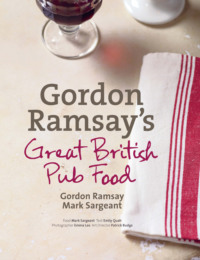
Gordon Ramsay’s Great British Pub Food
Gordon Ramsay Mark Sargeant
Food Mark Sargeant Text Emily Quah
Cook’s notes
Spoon measures are level, unless otherwise specified:
1 tsp is equivalent to 5ml; 1 tbsp is equivalent to 15ml.
Use good-quality sea salt, freshly ground pepper and fresh herbs for the best flavour.
Use large eggs unless otherwise suggested, ideally organic or free-range. If you are pregnant or in a vulnerable health group, avoid dishes using raw egg whites or lightly cooked eggs.
Oven timings are for fan-assisted ovens. If using a conventional oven, increase the temperature by 15°C (1 Gas Mark). Individual ovens may vary in actual temperature by 10° from the setting, so it is important to know your oven. Use an oven thermometer to check its accuracy.
Timings are provided as guidelines, with a description of colour or texture where appropriate, but readers should rely on their own judgement as to when a dish is properly cooked.
Table of Contents
Cover Page
Title Page
Cook’s notes
Introduction
BAR FOOD
SAVOURIES WITH TOAST
SOUPS AND BROTHS
STARTERS
CATCH OF THE DAY
PIES AND SAVOVRY TARTS
COMFORT FOOD
GRILLS AND SAUTES
WEEKEND ROASTS
PUDDINGS
BASICS
Index
Copyright
About the Publisher
Introduction
The great British Pub has played an important and unique role in British society right from Roman times, through the Middle Ages and up to the present day. It is a role that has changed, adapted and evolved as society has dictated, but the pub has always maintained its focus as the place to go – to relax, to celebrate, to mourn, to talk, to drink and, increasingly, to eat.
As a social chronicle, the pub has documented every cultural trend, often hand in hand with a legislative force that appears intent on protecting society. From controlling the hours during which pubs were allowed to open, to the most recent change, the banning of smoking, laws have tested the ingenuity of publicans to keep their doors open for business.
It might seem surprising that eating wasn’t traditionally part of pub life. The earliest taverns may have supplied bread with the ale, but the concept of eating out had not been born. You ate at home and you went to the pub for your social needs. This was where you drank, smoked and sought entertainment through conversation. It catered for the social divide with public rooms and screened-off snugs where employers, the employed, the vicar, the widower and the retired could go, albeit often with a pricing hierarchy. A pint in the discrete snug with its frosted glass and privacy simply cost more.
The advent of television beckoned the end of the pub as the social epicentre. The concept of buying alcohol and taking it home was not lost on the evolving supermarket owners, who responded by stacking their shelves accordingly. Home now offered comfort with entertainment and without the restrictions of closing time or the risk of a drink-drive prosecution. The publican had to think hard in order to survive. Trade fell off. Real ale wasn’t consumed at the same rate and suddenly the contents of barrels reached their ‘best by’ date before they had run dry. The brewers countered with a longer life offer, lager, which lived under pressure but it did not take away the problem of a diminished flow of alcohol.
Often the management, tenancy or ownership of a pub lay with a married couple. It was an ideal partnership in this social centre where the husband could attend to the barrel changing and control of his customers, while the wife busied herself with glass-washing and looking after the premises. If the business of serving beer was no longer what kept the bar team running around with the till ringing in the background, there had to be an opportunity for another offering.
There was now time and space for food. The concept of eating out was still in its infancy and the one overriding restriction was cost. The publican already had the premises, the seating and staff. All he had to do was arrange for a kitchen and a simple, good value bar menu to be made available. It was not only an opportunity to increase the flow of cash across the bar, but would, in time, bring back some of that lost wet trade. Moreover, a pub that began to make a name for itself for the quality of its food flourished. A restaurant was expensive and often made its new public feel uncomfortable. The pub had found a niche and suddenly there was the possibility for almost fifty thousand outlets to refocus their business.
The ban on smoking did pubs with grub no damage. On the contrary, it took away the one spoiler to eating good food in a convivial atmosphere. And there can be little doubt that any trade lost due to smokers who remained in their homes was regained as others now ventured forth to sample the food offerings of their local.
When we opened the Gordon Ramsay pubs in London, we wanted to give the public fantastic but casual food, served up alongside a few good pints and at a price that wouldn’t break the bank. Not posh nosh, but classic British dishes that have stood the test of time. Our mantra has always been ‘keep it simple and make it tasty’ and that’s exactly what we wanted to deliver in the pubs. We also wanted to bring back a few old-fashioned favourites, like cottage pie with Guinness, Lancashire hotpot and irresistibly sticky treacle tart.
This book brings to you dishes that have become pub classics. It offers simple, reasonably priced recipes that you can cook at home without fuss or complication. This is the food that has brought the British pub on to the culinary map.
BAR FOOD
Pint of prawns with mayo
Oysters with shallot vinegar
Devilled whitebait
Scotch eggs
Spiced nuts
Homemade pork scratchings
Angels and devils on horseback
Pan haggerty
Old-fashioned pork pies
Homemade crisps
Pickled quail’s eggs
Wild boar sausage rolls
Pint of prawns with mayo
SERVES 4
1-1.2kg cooked Atlantic prawns in shells
MAYONNAISE
2 large egg yolks
1 tsp white wine vinegar
1 tsp English mustard
sea salt and black pepper
300ml groundnut oil (or light olive oil)
1 tbsp water
Walk into any pub and you are quite likely to find a pint of prawns with mayo on the bar menu. These tasty morsels from the Atlantic are perfect finger food to savour with a pint of light ale or a glass of dry white wine. As you peel off the shells from the prawns, suck the heads so you don’t miss out on their amazing flavour.
To make the mayonnaise, put the egg yolks, wine vinegar, mustard and some salt and pepper into a blender or small food processor and whiz until the mixture is very thick and creamy. With the motor running, slowly trickle in the oil through the funnel in a steady stream. Add 1 tbsp water to help stabilize the emulsion, then taste and adjust the seasoning. (If the mayonnaise splits, transfer it to a bowl and start again. Whiz another egg yolk in the blender or processor until thick and then slowly blend in the split mixture; it should re-emulsify.)
Spoon the mayonnaise into individual dipping bowls and divide the prawns between four pint glasses. You might also want to put out an empty bowl for the shells. Any extra mayonnaise can be kept in a covered bowl in the fridge for up to 3 days.
Oysters with shallot vinegar
SERVES 4
2 shallots, peeled and finely chopped
120ml good-quality red wine vinegar (we use Cabernet Sauvignon)
12-16 very fresh native oysters
TO SERVE
rock salt
fresh seaweed (optional), to garnish
Sharing a platter of fresh oysters at the bar is a real treat. In London, our native oysters usually hail from Colchester or Whitstable, but they are gathered in various places around the British coast. Freshness is absolutely vital, so it helps to know your nearest source. Spanking fresh oysters taste of the sea.
Mix the shallots and wine vinegar together in a small bowl and leave to infuse for at least an hour. Spread a thick layer of rock salt on one or two serving platters and scatter over the seaweed, if available.
Shuck the oysters as you are about to serve them. To do so, hold an oyster, flat side upwards and level, in a folded tea towel in one hand. With the other hand, insert an oyster knife into the hinge of the oyster shell and wriggle it from side to side to cut through the hinge muscle. Push the knife further in and twist up to lift the top shell. Try not to tip out the juices as you do this. Hold the knife flat and slide it along the bottom shell to release the oyster, then flick off any pieces of broken shell. Place the oyster in its bottom shell on a serving plate. Repeat to shuck the rest. Serve immediately, with the shallot vinegar.
Devilled whitebait
SERVES 4-6
450g whitebait, thawed if frozen
170g plain flour
1 tsp cayenne pepper
sea salt and black pepper
150ml milk
groundnut or vegetable oil, for deep-frying
TO SERVE
extra cayenne pepper, to sprinkle (optional)
mayonnaise (see page 246), for dipping
lemon wedges
These are a far cry from the soggy, overcooked whitebait we used to eat as kids whenever we were treated to a meal in a steakhouse. Freshly fried, these crisp, salty bites are lovely with a pint of ale. If using frozen whitebait, you may want to go easy on the extra salt as the tiny fish are usually soaked in brine before freezing.
Wash the whitebait, drain well and pat dry with kitchen paper. For the batter, in a bowl, mix 100g of the flour with the cayenne pepper and a pinch each of salt and pepper. Make a well in the middle and gradually whisk in the milk to make a smooth batter.
Heat an 8-10cm depth of oil in a deep-fryer or a heavy-based pan; the pan should be no more than half-full. The oil is ready when it reaches 190°C, or when a cube of bread dropped in turns golden brown in less than 40 seconds.
Deep-fry the whitebait in batches. Dip a handful into the remaining flour to coat, shaking off excess. Now dip the floured whitebait into the batter, then gently drop into the hot oil. Deep-fry for 1-2 minutes until golden and crisp. When you take them out of the oil, the whitebait should rustle as you shake them together. Try not to overcrowd the pan, as this will cause the temperature of the oil to drop too much.
Drain the whitebait on a tray lined with kitchen paper and keep warm in a low oven while you deep-fry the rest. If you wish, sprinkle on a little extra cayenne pepper. Serve while still crisp, with a bowl of mayonnaise and lemon wedges on the side.
Scotch eggs
MAKES 8
8 medium eggs, at room temperature
650g good-quality sausagemeat or 8-10 butcher’s sausages, removed from their skins
handful of flat-leaf parsley, finely chopped
4 sage leaves, finely chopped
1 tsp English mustard powder
grated zest of 1 lemon
sea salt and black pepper
TO ASSEMBLE
50g plain flour, sifted
2 large eggs, lightly beaten, for dipping
150g fine white breadcrumbs (made from one- or two-day old bread)
groundnut or vegetable oil, for deep-frying
TO SERVE
HP brown sauce
A good Scotch egg is determined by the quality of the sausagemeat and the cooking. The egg should be cooked until the yolk has just set and there should be no sign of a dark ring around the yolk, which indicates that it is overcooked. These Scotch eggs can be made a couple of days in advance, but they are best enjoyed freshly cooked.
Bring a pan of water to the boil. Lower the eggs into the water and simmer for 8 minutes. Drain and cool under cold running water until the eggs no longer feel hot. Peel away the shells and set aside.
Put the sausagemeat into a bowl and add the parsley, sage, mustard powder, lemon zest and some seasoning. Mix together thoroughly, using one hand, then divide into 8 equal-sized balls. One at a time, flatten each sausagemeat ball on a piece of cling film to a circle, large enough to wrap around an egg. Place an egg in the middle, then draw up the ends of the cling film and massage the sausagemeat to cover the egg evenly. Repeat with the rest of the eggs and sausagemeat.
Have the flour, beaten eggs and breadcrumbs ready in three separate bowls. One at a time, roll each Scotch egg in the flour, then dip into the beaten egg and then into the breadcrumbs to coat. Dip into the egg and breadcrumbs once again for a really thorough coating. Repeat with the rest of the Scotch eggs.
Heat an 8cm depth of oil in a deep-fryer or heavy-based saucepan to 150°C. To test if it is ready for frying, drop a piece of bread into the oil; it should sizzle and turn light golden and crisp in less than a minute. Deep-fry the Scotch eggs two at a time. Lower them into the oil and fry for 4-5 minutes, turning once or twice to ensure they brown evenly.
Remove with a slotted spoon and drain on kitchen paper. Keep warm in a low oven while you fry the rest. Serve with HP sauce for dipping.
Spiced nuts
SERVES 6-8
350g mixed whole, blanched (unsalted) nuts, such as cashews, hazelnuts and peanuts
2½ tbsp icing sugar
¾-1 tsp fine sea salt, to taste
1 tsp cayenne pepper, or to taste
black pepper
Along with potato crisps, salted nuts are essential bar nibbles. Our irresistible spiced nuts have a slight kick from cayenne pepper and a mild sweetness from caramelized sugar. They are incredibly more-ish, as you’ll discover.
Preheat the oven to a low setting, about 140°C/Gas 1. Heat a large, heavy-based frying pan over a medium heat.
Mix the nuts, icing sugar, salt and cayenne pepper together in a wide bowl and grind over some black pepper. Tip the seasoned nuts into the hot pan. Sprinkle over a little water (about 1 tbsp) to help the sugar caramelize. Cook for 3-5 minutes, stirring or tossing the nuts around the pan constantly, until they start to release their oils and begin to take on some colour.
Tip the nuts onto a baking tray lined with greaseproof paper and spread them out in a single layer. Pop the tray into the low oven and leave the nuts to dry out for 30-40 minutes, tossing them a few times to make sure they colour evenly and don’t burn.
Leave the nuts to cool completely. Store in an airtight container in a cool, dry place and use within a month.
Homemade pork scratchings
SERVES 4-6
200g pork skins (we generally use skins from the belly)
coarse sea salt
groundnut or vegetable oil, for deep-frying
We are probably one of very few nations in the world who eat snacks with hairs protruding from them! If you happen to be cooking pork belly and won’t need the skin, remove and freeze it until you have time to prepare these savoury scratchings. Otherwise, your local butcher should be only too happy to sell you some pork skins. The crunchy pork scratchings keep well in an airtight container so you might want to double up the recipe.
Cut away or scrape off the excess fat from the pork skin, leaving an even layer attached to the skins, about 3mm thick. Rub or massage the skin with sea salt, place on a baking tray and chill in the fridge for 24-48 hours, to draw out excess moisture.
Dab off the beads of moisture with kitchen paper, then cut the skin into neat strips, about 1cm wide and 10cm long. Heat the oil in a deep-fryer or a heavy-based pan until it reaches about 120°C; the pan should be no more than half-full. Fry the skin strips in batches for about 8-9 minutes until they are cooked through and firm. Remove and drain.
Increase the heat and bring the oil to 195-200°C. Re-fry the pork skins in batches for another 2-3 minutes until they are golden brown and crisp; the skins may curl and bubble as they fry. Remove and drain on a tray lined with kitchen paper. The skins will continue to crisp up as they cool. When completely cooled, store in an airtight container unless you are serving the pork scratchings straight away.
Angels and devils
on horseback
SERVES 4
ANGELS
12 fresh native oysters
freshly ground white pepper
6 smoked streaky bacon rashers, derinded and halved lengthways
olive oil, to drizzle
DEVILS
12 soft d’Agen prunes
6 unsmoked streaky bacon rashers, derinded and halved lengthways
These used to be offered on many bar menus, but you’re more likely these days to find them served as canapés, or in the case of devils on horseback, with roast chicken, perhaps. A cinch to make, they are particularly appetizing with a cold lager or glass of white wine.
Preheat the grill to the highest setting and pre-soak 24 cocktail sticks in warm water (to prevent scorching under the grill).
For the angels, shuck the oysters (for technique, see page 16) and strain off the juices. (Save these to add to a fish soup or sauce.) Sprinkle each oyster lightly with white pepper and wrap in a piece of bacon. Fix securely with a cocktail stick. Place on a baking sheet, leaving a little space between each one, and drizzle over a little olive oil. Grill for about 3 minutes on each side, until the bacon is brown and crisp on top. Serve at once, or keep warm in a low oven while you make the devils.
For the devils, wrap each prune with a piece of bacon and cook in the same way as the angels. Serve piping hot.
Pan haggerty
SERVES 4
600g firm, waxy potatoes, such as Desirée
3 large onions
100g strong cheddar
1½ tbsp olive oil
20g butter, melted
sea salt and black pepper
A pan haggerty consists of potatoes, onions and cheese – simple, comforting flavours you’d expect from a local bar. For a more intense flavour, use dripping from the weekend roast in place of butter. We also use gutsy, mature cheese, such as Montgomery or Westcombe cheddar from Somerset.
Peel and thinly slice the potatoes and onions, preferably using a mandoline for the potatoes. Coarsely grate the cheese and set aside.
Preheat the oven to 190°C/Gas 5. Heat the olive oil in a fairly small, ovenproof frying pan, about 20cm in diameter. Add the onions and sweat, stirring frequently, for 6-8 minutes until just softened. Transfer to a bowl and set aside.
Arrange a layer of potatoes over the base of the pan. Brush with some melted butter and season lightly with salt and pepper, then scatter over a thin layer of onions and cheese. Repeat layering the ingredients, making sure that you end up with a layer of cheese-topped potatoes.
Put the pan over a medium-high heat and cook for 2-3 minutes until the bottom layer of potatoes is golden brown. Transfer the pan to the oven and bake for 25-30 minutes, until the potatoes are tender when pierced with a small, sharp knife. The cheese topping should be golden; if not, increase the heat to 220°C/Gas 7 and bake for an extra 5 minutes or so.
Leave the pan haggerty to cool slightly for 5 minutes or so. Carefully slide it onto a warm plate, cut into slices and serve.
Old-fashioned pork pies
MAKES 8
HOT WATER CRUST PASTRY
250g plain flour
½ tsp fine sea salt
1 large egg
50g unsalted butter
50g lard
85ml water
1 medium egg yolk, lightly beaten with 1 tbsp water, to glaze
FILLING
400g minced pork (roughly equal quantities of belly and shoulder meat)
250g sausagemeat
1 tbsp chopped parsley
1 tbsp chopped sage finely grated zest of 1 lemon
5 juniper berries, ground with a pinch of salt
pinch of allspice
sea salt and black pepper
Enjoy these adorable little pies warm or cold with piccalilli or pickled onions and a pint of ale.
To make the pastry, sift the flour and salt into a large bowl and make a well in the middle. Crack the egg into the well and sprinkle over some of the flour. Put the butter, lard and water into a small pan and heat gently until melted, then bring to the boil. Immediately pour around the edge of the flour and quickly stir together, using a butter knife, to combine. Knead the dough lightly until smooth; it will be quite soft at this stage. Wrap in cling film and chill for at least an hour until firm.
Meanwhile, for the filling, mix all the ingredients together, seasoning well. Divide into 8 portions, about 80g each, and roll into balls. Cut off one-third of the pastry for the pie lids, re-wrap and chill. Roll out the remaining pastry on a lightly floured work surface to the thickness of a £1 coin. Using a saucer, about 11cm in diameter, as a template, cut out 8 circles. Roll out the reserved pastry to the same thickness and cut out 7cm rounds for the lids, using a pastry cutter.
To assemble each pie, place a stuffing ball in the middle of a pastry base and flatten it slightly to get a flat base and straighter sides. Put a pastry lid on top. Brush the pastry base border with egg glaze, then draw up it up around the filling to meet the lid. Curl the edge of the lid up to meet the top inside edge of the pie case and pinch together to seal. Repeat with the other pies, then crimp the edges. Chill until firm.
Preheat the oven to 190°C/Gas 5. Place the pies on a baking sheet and make a hole in the centre of each lid with a skewer. Bake for 15 minutes, then reduce the setting to 170°C/Gas 3. Brush the pies evenly with egg glaze and bake for a further 10 minutes until cooked. To test, insert a skewer into the centre of a pie for a few seconds; it should feel hot to the touch as you remove it. Transfer the pies to a wire rack to cool.
Homemade crisps
SERVES 4
700g waxy potatoes, such as Desirée or Charlotte
groundnut or vegetable oil, for deep-frying
1 tsp cayenne pepper mixed with 1 tsp sea salt
Here you can experiment with different varieties of potato and other root vegetables, such as parsnips, carrots and beetroot. We love the flavour of waxy Charlotte potatoes. A touch of paprika or cayenne pepper gives them a slightly smoky sweet quality. The crisps will get soft if you leave them out for long, so store them in an airtight container until ready to serve.
Peel the potatoes and rinse well. Cut them into very thin slices, about 2mm thick, ideally using a mandoline. Rinse the potato slices under cold running water to remove the excess starch. Pat them dry using one or two clean tea towels, then spread the slices out on a baking tray to dry out further.
Heat an 8-10cm depth of oil in a deep-fryer or a heavy-based pan over a medium-high heat; the pan should be no more than one-third full. The oil is ready when it reaches 190°C, or when a cube of bread dropped in turns golden brown in less than 40 seconds. Fry the potatoes in batches. Add the slices to the pan a few at a time to prevent them from sticking together. Deep-fry for 3-4 minutes until golden and crisp, moving and turning the potatoes to ensure they colour evenly.
Remove with a slotted spoon, drain off excess oil and spread the crisps out on a tray lined with kitchen paper. Sprinkle with the cayenne and salt mix, then leave to cool completely. Store the crisps in an airtight container unless serving straight away.
Pickled quail’s eggs
SERVES 4-6
24 quail’s eggs, at room temperature
350ml white wine vinegar
125ml water
1½ tsp fine sea salt
1½ tsp cayenne pepper
6 black peppercorns
1 tsp mustard seeds
2 bay leaves
½ tsp allspice
Quintessential bar food, pickled eggs are like marmite – you either love them or hate them. But even today, you’ll often find a jar of them lurking behind the counter in many pubs. This recipe uses dainty quail’s eggs, which are easier to handle when you’ve got a drink in one hand.
Place the quail’s eggs in a saucepan and add just enough water to cover. Bring to the boil and cook for 3 minutes, then drain and immerse in a bowl of cold water to cool quickly. When the eggs are cool enough to handle, peel and put them into clean, sterilized jars.
Meanwhile, put all the remaining ingredients into a non-reactive pan and bring to the boil. Remove from the heat and allow to cool slightly. Pour the spiced vinegar mixture over the eggs to cover completely, then seal the jars with tight-fitting lids. Refrigerate and leave for at least a week before eating.
Wild boar sausage rolls
SERVES 6
500g good-quality butter puff pastry
1½-2 tsp English mustard
6 thick good-quality wild boar sausages, about 450g (or use sausagemeat)
1 large egg yolk, beaten with 1 tsp water, to glaze
sesame seeds, to sprinkle
Sausage rolls are a great bar snack when you’re after something a little more substantial with a drink, but not a full meal. This recipe is one of several versions we serve at the pubs, using fantastic wild boar sausagemeat and good-quality puff pastry. You can substitute any kind of sausage for the filling, but do try to get one with a higher meat/lower fat content, preferably from a good butcher.
Roll out the pastry on a floured surface to a large rectangle, about 3mm in thickness. Cut out 6 rectangles, about 10cm x 12cm (they should be just large enough to wrap around a sausage, so use one as a guide). Brush the pastry rectangles with a light coating of mustard.
Peel off the skins from the sausages. Lay a sausage along one longer side of a pastry rectangle and roll the pastry around it, overlapping the ends slightly and pressing them lightly to seal. Put the sausage roll, seam side down, on a baking sheet lined with greaseproof paper. Repeat to make the rest of the sausage rolls, leaving some space between them to allow for expansion on cooking. Brush the tops with some of the beaten egg and rest in the fridge for at least 20 minutes.
Preheat the oven to 200°C/Gas 6. Brush the sausage rolls once again with the egg and sprinkle the tops with sesame seeds. Bake for 25-30 minutes until the pastry is golden brown and the sausages are cooked through. Transfer to a wire rack and leave to cool slightly before serving. Although you can enjoy them cold, these sausage rolls are best served warm and freshly baked.
SAVOURIES WITH TOAST
Scotch woodcock
Creamed haddock and pickled walnuts on toast
Anchovies on toast with poached egg and spinach
St. George’s mushrooms on toast
Soft herring roes on toast
Potted duck
Potted crab
Potted shrimps with toast
Potted hough
Devilled kidneys on toast
Sardines and tomatoes on toast
Roasted bone marrow with caper and herb dressing
Welsh rabbit
Scotch woodcock
SERVES 4
14 anchovy fillets in oil 50g butter, softened, plus a few knobs of cold butter
black pepper
4 large eggs
pinch of cayenne pepper
4 slices of white or brown bread
1 tsp capers, rinsed and drained
Back in the days when gentlemen’s clubs were prevalent, small portions of savouries on toast took the place of sweet puddings as an alternate way to end a meal – much like our modern-day cheese and biscuits. Scotch woodcock is one such dish. Simply scrambled eggs with anchovies on toast, it couldn’t be easier to make. The tradition is to adorn the scrambled eggs with two anchovies laid in the shape of a cross to symbolize the Scottish flag.
Finely chop or mash 6 anchovy fillets and mix with the softened butter and a generous grinding of black pepper. Set aside.
Melt a few knobs of butter in a saucepan. In a bowl, whisk the eggs together with a pinch of cayenne, then pour into the pan and stir slowly over a gentle heat until the mixture begins to thicken. Remove the pan from the heat and continue to stir the eggs until they are scrambled and creamy.
Meanwhile, toast the bread slices. Spread them generously with the anchovy butter and place on warm serving plates. Add the capers to the scrambled eggs, then quickly spoon on top of the toasts. Garnish each serving with two crossed anchovies and serve.
Creamed haddock and pickled walnuts on toast
SERVES 4
450g smoked haddock fillets
1 1/2 tbsp olive oil
1 large leek, white part only, trimmed and finely chopped
300ml double cream black pepper
4 slices of thick country bread
3-4 pickled walnuts, drained and finely sliced
Enriching smoked haddock with cream gives the fish a lovely silky texture for this savoury base. Pickled walnuts add a sweet tang that cuts through the richness perfectly.
Bring a wide, shallow pan of water to a simmer and add the haddock fillets, skin side down. Poach gently for 3–4 minutes until the flesh is just cooked and flakes easily. Using a fish slice, carefully transfer the fish to a plate and leave to cool for a few minutes. While still warm, flake the fish, discarding the skin and removing any pin-bones.
Heat the olive oil in a pan, add the leek and sauté for 4–5 minutes, until soft. Pour in the cream and simmer until it has reduced slightly and thickened. Fold through the flaked fish. Add a generous grinding of black pepper and taste for seasoning. (You probably won’t need to add salt, as smoked haddock is usually quite salty.) Remove from the heat and keep warm.
Toast the bread slices and place on warm plates. Pile the smoked haddock mixture generously onto the toasts and arrange the pickled walnut slices on top. Serve at once.
Anchovies on toast with poached egg and spinach
SERVES 4
4 large eggs
few drops of white wine or cider vinegar
1 tbsp olive oil, plus extra to drizzle
300g spinach leaves, washed and dried
sea salt and black pepper nutmeg, to grate
4 slices of brown soda bread
12 anchovy fillets in oil, halved if large
This simple but delicious combination of salty anchovies, creamy poached eggs and earthy spinach atop crunchy toast makes a fantastic weekend brunch.
First, poach the eggs in advance. Bring a pan of water to a simmer. Add a few drops of vinegar and swirl with a slotted spoon to create a whirlpool effect. Cook the eggs two at a time: crack one into a small bowl and gently slide into the centre of the whirlpool; repeat with another egg. Poach for about 3 minutes until the whites are set but the yolk is still runny in the middle. Remove each egg with a slotted spoon and slide into a bowl of cold water to stop the cooking process. Repeat to cook the other eggs.
When you are ready to serve, heat the olive oil in a wide pan. When hot, add the spinach leaves and stir over a high heat until the spinach has just wilted. Remove from the heat and season well with salt, pepper and a grating of nutmeg. Meanwhile, toast the bread slices and reheat the eggs in a pan of gently simmering water for a minute.
Place the toasts on warm serving plates and pile the wilted spinach on top. Drape the anchovies over the spinach. One at a time, remove the poached eggs from the pan with a slotted spoon. Dab the bottom of the spoon with kitchen paper to soak up any water, then place the egg on top of the anchovies. Grind over a little black pepper and serve at once.
St. George’s mushrooms on toast
SERVES 4
250g St. George’s mushrooms, cleaned 40g butter
sea salt and black pepper
squeeze of lemon juice
few oregano sprigs, leaves only, chopped
small bunch of flat-leaf parsley, leaves only, chopped
4 slices of brown or Granary bread
Even though it is not so well known among fungi, the St. George’s mushroom can take pride of place amongst the finest wild mushrooms, as its firm, meaty texture and distinctive woody flavour are hard to beat. This recipe also works well with portobello or chestnut mushrooms.
Slice the mushrooms thinly. Melt the butter in a wide frying pan and, as soon as it begins to foam, tip in the mushrooms. Sprinkle with a little salt and pepper and fry, stirring occasionally, over a high heat for a few minutes. Add a squeeze of lemon juice and fry the mushrooms until lightly browned and any moisture has cooked off. Season well and toss in the herbs.
Meanwhile, toast the bread. Divide the mushrooms between the hot toasts and serve at once.
Soft herring roes on toast
SERVES 4
450g herring roes
1 1/2 tbsp olive oil
sea salt and black pepper
75g butter, in pieces
4 slices of white or brown bread
handful of flat-leaf parsley, leaves only, chopped
squeeze of lemon juice lemon wedges, to serve
For those who have yet to try herring roes, they have a surprising creaminess and delicious taste that is further enhanced with a little nutty butter and lemon juice. Pile them on freshly toasted crusty bread for a great balance of flavours and textures.
Rinse the herring roes and pat dry on kitchen paper. Heat a large frying pan and add the olive oil. Season the roes with salt and pepper and fry in the hot pan for 2–3 minutes until lightly golden. Add the butter and allow to melt. Spoon the foaming butter over the roes as they cook for another minute or so, to encourage them to brown. Meanwhile, toast the bread.
Remove the herring roes from the heat, add the chopped parsley and a squeeze of lemon juice and toss through quickly. Check the seasoning.
Put a slice of toast on each warm plate and top with the herring roes, spooning over any buttery pan juices. Serve immediately, with lemon wedges on the side.
Potted duck
SERVES 4–6
2 duck legs, about 300g each
2 large garlic cloves, peeled and chopped
few thyme sprigs
sea salt and black pepper
300g duck fat, melted
60g pistachio nuts, toasted and roughly chopped
TO SERVE
plenty of sourdough bread slices, freshly toasted
pickled onions and cornichons
Pistachios help to cut the richness of this tasty spread, as do the accompanying pickled onions and cornichons.
Preheat the oven to 150°C/Gas 2. Put the duck legs, skin side up, into a roasting tin in which they fit snugly and scatter over the garlic, thyme and seasoning. Pour over the duck fat to cover. Roast for 2–2 1/2 hours until the meat is very tender and falls off the bone. Cool slightly, then lift the duck legs onto a plate, reserving the fat. Shred or finely chop the meat, discarding the skin. Place the meat in a bowl. Strain the fat through a fine sieve; set aside.
Add the pistachios to the duck and toss to mix, moistening with a little duck fat and seasoning generously to taste. Divide the mixture among 4–6 small jars or ramekins. Press down with the back of a spoon and pour over a thin layer of duck fat to cover. Chill until set.
Take the potted duck out of the fridge 30–40 minutes before serving to soften it slightly, so it can be spread. Serve with warm toast, pickled onions and cornichons.
Potted crab
SERVES 4–6
150g unsalted butter, cubed
2 shallots, peeled and finely chopped
1/3 tsp cayenne pepper
1/3 tsp ground mace
1/3 tsp freshly grated nutmeg
1 anchovy fillet in oil, finely crushed to a paste
3 tbsp sherry
375g white crabmeat
75g brown crabmeat
sea salt and black pepper
2 tsp lemon juice, or to taste
TO SERVE
plenty of brown or Granary bread slices, freshly toasted
This is a lovely way to serve crab, as you can really savour the flavour with every mouthful.
Melt 100g of the butter in a heavy-based saucepan, add the shallots and sweat over a medium-low heat, stirring occasionally, for 6–8 minutes until they are soft but not browned. Stir in the spices, then the anchovy paste and sherry. Cook for a few more minutes until the alcohol from the sherry has evaporated.
Add the white and brown crabmeat to the spicy butter and stir to combine. Season well with salt, pepper and lemon juice. Stir over a low heat until the crabmeat is warmed through, then immediately take off the heat.
Divide the mixture between 4–6 small ramekins and press down lightly to level the tops. Melt the remaining 50g butter in the same pan and spoon a thin layer over the crabmeat to cover. Cool and chill until set.
Take the ramekins out of the fridge about 30 minutes before serving to allow the butter to soften. Serve with lots of warm toast.
Potted shrimps with toast
SERVES 6
150g unsalted butter, cubed
2 shallots, peeled and finely chopped
50ml medium dry sherry
1/3 tsp cayenne pepper, or to taste
1/3 tsp ground mace
1/3 tsp freshly grated nutmeg, plus extra to finish
570ml pot Morecambe Bay brown shrimps
sea salt and black pepper 2 tsp lemon juice
TO SERVE
plenty of white or brown bread slices, freshly toasted
Brown shrimps from Morecambe Bay are renowned for their nutty taste and delicate texture. They are caught and cooked straight away in seawater on the boats, to preserve their fantastic flavour. Use ordinary brown shrimps if you can’t get them.
Melt 120g of the butter in a heavy-based saucepan, add the shallots and sweat over a medium-low heat, stirring occasionally, for 6–8 minutes until they are soft but not browned. Add the sherry and simmer until you can no longer detect an aroma of alcohol. Tip in the spices and stir well. Cook for 2–3 minutes, stirring frequently.
Reduce the heat slightly, add the shrimps and stir to coat in the spicy butter. Taste and adjust the seasoning, adding a little salt and pepper, and the lemon juice. Once the shrimps are warmed through, remove the pan from the heat.
Spoon the shrimps and butter into six small ramekins and press down gently with the back of a spoon. Melt the remaining butter in the pan you cooked the shrimps in. Spoon a thin layer of clear butter over the potted shrimps to cover. Grate over a little nutmeg, then leave to cool completely. Chill until the butter has set.
Remove the potted shrimps from the fridge about 30 minutes before serving, to allow the butter to soften. Serve with plenty of warm toast, and perhaps a sharply dressed watercress salad.
Potted hough
SERVES 4
900g shin of beef on the bone (ask your butcher to crack the bone)
1 large carrot, peeled and cut into large chunks
1 leek, trimmed and cut into large chunks
1 onion, trimmed and cut into large chunks
2 bay leaves
¼–½ tsp cayenne pepper, to taste
½ tsp allspice
½ tsp black peppercorns
1 mace blade
sea salt and black pepper
handful of flat-leaf parsley, leaves only, chopped
TO SERVE
sourdough bread, freshly toasted, or country bread slices
piccalilli or pickled gherkins
Hough is the Scottish name for shin of beef on the bone, an inexpensive flavoursome joint with a little more fat than most other beef cuts. Here it is braised until tender, then the meat is taken off the bone, shredded and mixed with the reduced stock prior to potting. It is not essential to cover the potted meat with a layer of fat, but it is best consumed within 4–5 days.
Place the beef in a large cooking pot and add enough cold water to cover. Bring to the boil, then reduce the heat to a simmer and skim off any froth or scum that rises to the surface. Continue to skim until the liquid is pretty much clear, then add the flavouring vegetables, bay leaves, spices and seasoning. Partially cover the pan and simmer very gently over a very low heat for 4–4 1/2 hours until the beef is meltingly tender, skimming off any scum from time to time.
When the beef is ready, remove the pan from the heat and allow the beef to cool in the liquor. When cool enough to handle, lift out the beef and shred the meat from the bone. Put into a large bowl, cover and set aside.
Strain the stock through a fine sieve into another pan. Boil steadily for 15–20 minutes or until reduced by three-quarters, to about 250–300ml. Season the reduced stock generously to taste, then pour over the shredded meat to bind. Taste and adjust the seasoning once again, and mix in the chopped parsley. Divide between four small ramekins, packing the meat in well. Cool completely, then chill until set.
Remove from the fridge about 30 minutes before serving. To unmould, dip a ramekin in a bowl of hot water for a few seconds, then invert and tip out onto a plate. Serve with warm sourdough toasts or rustic country bread and piccalilli or pickled gherkins on the side.
Бесплатный фрагмент закончился.