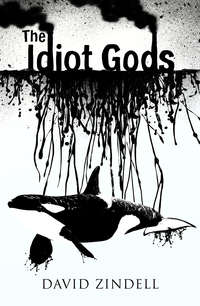
Читать книгу: «The Idiot Gods»
DAVID ZINDELL
The Idiot Gods

Copyright

Published by HarperCollinsPublishers Ltd
1 London Bridge Street
London SE1 9GF
www.harpercollins.co.uk
First published in Great Britain by HarperVoyager 2017
Copyright © David Zindell 2017
Cover design © HarperCollinsPublishers Ltd 2017
David Zindell asserts the moral right to be identified as the author of this work.
A catalogue record for this book is available from the British Library.
This novel is entirely a work of fiction. The names, characters and incidents portrayed in it are the work of the author’s imagination. Any resemblance to actual persons, living or dead, events or localities is entirely coincidental.
All rights reserved under International and Pan-American Copyright Conventions. By payment of the required fees, you have been granted the non-exclusive, non-transferable right to access and read the text of this e-book on screen. No part of this text may be reproduced, transmitted, down-loaded, decompiled, reverse engineered, or stored in or introduced into any information storage and retrieval system, in any form or by any means, whether electronic or mechanical, now known or hereinafter invented, without the express written permission of HarperCollins.
Source ISBN: 9780007252275
Ebook Edition © July 2017 ISBN: 9780008223311
Version: 2017-05-22
Dedication
To Jane, for your courage, wisdom, friendship and splendor
Table of Contents
Cover
Title Page
Copyright
Dedication
Part One: The Burning Sea
Translators’ Note
Chapter 1
Chapter 2
Chapter 3
Chapter 4
Chapter 5
Chapter 6
Chapter 7
Chapter 8
Chapter 9
Part Two: The Idiot Gods
Chapter 10
Chapter 11
Chapter 12
Chapter 13
Chapter 14
Chapter 15
Chapter 16
Chapter 17
Part Three: A Covenant With Thee
Chapter 18
Chapter 19
Chapter 20
Chapter 21
Chapter 22
Chapter 23
Chapter 24
Acknowledgements
About the Author
Also by David Zindell
About the Publisher
PART ONE
Translators’ Note
It was our privilege and happy destiny to enjoy the friendship of one of the most remarkable beings ever to have come out of our little blue and white planet. Many have tried to make the orca named Arjuna into a Buddha or a Jesus, but he certainly never thought of himself as such – and not even as a teacher. Despite all insistence to the contrary, he remains an orca, however extraordinary, with all an orca’s sometimes strange and disturbing sensibilities. It is true that those who spent time with him often forgot that they were conversing with a cetacean possessing a magnitude of intelligence that we are still trying to comprehend. The consciousness of all creatures differs so greatly, yet at its source remains one and the same, as of a white light shined through a prism and refracted it into radiances of red, yellow, violet, and blue. Arjuna’s consciousness, to the extent that it illuminates his communications, can often seem pellucidly and sanely human, and at other times, psychopathic or utterly alien. We who have translated his ‘words’ faced the problem of necessarily regarding a non-human being through very human eyes; we have tried to convey a sense of Arjuna’s magnificent soul without making him seem too human. It would be well for anyone to see Arjuna for what he really is: a whale who just wanted to talk to human beings.
That Arjuna, born in the cold ocean, could have learned to ‘speak’ various human languages many still doubt, even after the seemingly miraculous events the whole world witnessed. They say that we linguists and biologists of the Institute for Advanced Cetacean Studies either misconstrued basic hunting, mating, or warning cries as language or interpreted them through our natural wish to communicate with an obviously intelligent but nevertheless inarticulate animal. Human beings, these skeptics believe, are by definition the only of earth’s creatures capable of symbolic and therefore true language. Our harshest critics – and we should hesitate before calling then conspiracy formulators – have accused us of simply inventing our translations of the thousands of communications that the orcas of the Institute confided in us. They accuse us of conspiring to excite compassion for these great beings toward the vain hope of ‘saving the whales’. This account is not for those deniers. Even if one were to read Arjuna’s account as a fiction, however, one should keep in mind that fictions often reveal the deepest of truths. In many ways, this is the truest story we know, and Arjuna had the truest of hearts. Anyone eager to know more about his life will lose little in skipping this introduction and going right to the words Arjuna chose to convey it. It is indeed a remarkable story. In the end, it is his story, and ours: that of the whole human race.
We would like to say more about those words that Arjuna selected to denote meanings that human beings could comprehend. In no way should these be considered to be ‘whale words’; whales do not communicate to each other through what we know as words, but rather through sound pictures. Arjuna offers as good an explanation of cetacean language as we could hope, and we cannot improve it. Sadly, we know almost nothing of what we sometimes informally call Orcalish. To date, even with the aid of the fastest of computers and the most elegant of mathematical models, we have managed to identify and interpret perhaps a twelfth of a percent of the meanings of the thousands of orca utterances. It should be remembered that we human beings still have not learned to speak with the whales, though they have readily, if painfully, learned to speak with us.
How, then, did Arjuna and the other orcas of his adopted family accomplish such a feat? The Institute’s former chief linguist, Helen Agar, initially worked with him in developing a constructed language through which orcas and humans could communicate. Various utterances natural to orcas – whistles, trills, clicks, chirrups, pulsed calls, and pops – were agreed upon to represent the ninety-one syllables of the language that Arjuna named Wordsong. Helen Agar had no need to speak Wordsong to Arjuna, for he understood English (and many other human languages) very well; however, while engaged in natural communication with Arjuna and the other orcas, Helen chose to communicate in this imaginative language out of solidarity with the whales and the ideal of making the crude vowels and consonants of a human language somehow ‘sing.’ Only one of the Institute’s other linguists (Prasad Choudhary) reached fluency in this language that has been popularly mischaracterized as ‘Baby Orcalish.’ In reality, Wordsong is more like a spoken Morse Code. It assigns meanings to orca sounds usually employed by the orcas very differently. Anyone can ‘talk’ Morse Code, for instance saying, ‘Pop, pop, pop; sprong, sprong, sprong; pop, pop, pop,’ to denote the SOS message meaning ‘help.’ While conversing in Wordsong is much more difficult, the rules for doing so follow a similar principle. Alone of non-linguists, the orca trainer Gabrielle Jones did come to understand Wordsong when Arjuna spoke it to her, even if she was unable to speak it back to him. English remained her only language, and it was she who encouraged Arjuna to communicate to the human race in what has become a de facto, if very limited, world language.
Most of Arjuna’s story, then, he recorded in English through an extension and adaptation of the Wordsong’s syllabary to English. As English contains, by some counts, more than 15,000 syllables, not even Helen Agar came close to understanding Arjuna when he was speaking it. Instead, as we have continued to do, she relied on the Institute’s computers to translate Arjuna’s vocalizations into more or less standard English.
This last statement must be qualified. When Arjuna could not find the word he wanted in the language of Shakespeare, Blake, and Eliot, he turned to others, peppering his account with words from Spanish, Japanese, Diné, Arabic, and Basque – and even from Quenya, Fravashi, and one of the many dialects of Tlön. He particularly liked Chinese for its tones and !Xoon for its clicks. All these needed to be re-translated into English; and even his English needed extensive editing. While his locutions at times could be eloquent and even poetic, they contained many quirks, for instance incorporating his curious prejudice against using contractions. Because orcas in their own language, as far as we can understand, transcend time through obscuring the boundaries between past, present, and future, Arjuna liked to meld together different diction levels and styles from different periods of human history. Bizarrely, he rendered entire sections of his communication of the story of his life into somewhat turgid verse aping the Latinate cadences of John Milton’s Paradise Lost.
All this needed smoothing into prose accessible to those Arjuna most wanted to address. [The Institute has published the original document in all its babel of magnificence for anyone capable of deciphering it in hopes of reaching a deeper understanding of Arjuna’s mind.] As well, we took the liberty of cutting many strained metaphors and converting sound imagery to sight imagery, which predominated throughout the original document in a ratio of 77 to 23. Human beings, as Arjuna realized very early, are creatures of sight, and he would not have minded our attempts to make his story as readable as possible.
We found it more difficult and too distracting in the published English document to add cites in the many places where Arjuna ‘borrowed’ the sensibilities or the words of human authors. [The entire footnoted document is available upon request.] Arjuna plagiarized without shame. He considered copying or paraphrasing another’s words as honoring dead authors. He had no sense of property, either intellectual or any other kind. The only thing orcas ‘own’ are the compositions of themselves, which they call rhapsodies – and in a way, not even those, since the songs of all orcas belong to their families in much the same way that their souls belong to the sea.
Similarly, we hesitated to cut or change the many repetitions, such as Arjuna’s overuse of the words ‘splendor’ and ‘song’ – and most particularly, ‘soul.’ Arjuna found it difficult to settle on a single English word that could encompass a fluid orca concept. Certainly, he meant by soul many of the same things we usually call by different names but regard as intrinsic to ourselves: personality, memory, mind. In no way, however, did he intend soul to connote some sort of immaterial or supernatural essence. He might just as easily have used the words song, water, or wave. For orcas, soul is a substance no different than the water that forms up on the surface of the sea from which the whales take their greater being. If the orcas could be said to have a goal that they seek to achieve, it would be the shaping of themselves into perfect waves that share the same water of life with all others. So vital is this imperative to bring forth the most beautiful manifestation of true nature that Arjuna speaks of the soul dozens of times. He liked to say that he was involved with the soul of humankind.
Of course, Orcas don’t mind repetition in their communications to each other. Or rather, the nature of the orcas’ ever-flowing language, as far as we understand it, makes boring repetitions nearly impossible, in much the same way it is impossible to step twice into the same surging stream. Each sound picture that an orca paints – even one so commonplace as that of a salmon – differs from all others in nuance, inflection, and the many colors of sound. The nearly infinite complexity of these sound pictures, like variations of themes in an open-ended cerebral symphony, engages an orca’s full attention at the same time that it discourages human examination. Sadly, human beings remain bound to essentially one-dimensional sequences of syllables spoken in time, and despite Arjuna’s assurances to the contrary, it is extremely unlikely that we will ever comprehend the three-dimensional language of the whales. We simply don’t have the mental machinery to do so.
More must be said about the human brain – its deficiencies and limitations – in comparison with the brains of orcas and other toothed whales. The mammalian brain has been built up by evolution in layers over millions of years. The foundational structure, the primordial paleocortex or reptile brain (called the rhinic), recalls the similar structures of the brains of fish, amphibians, and reptiles such as lizards and snakes. (Though it must be stressed that this does not imply that mammals evolved from reptiles, for instance, any more than humans did from chimpanzees. Both mammals and reptiles share a common ancestor in the Carboniferous period 300 million years ago.) The limbic lobe overlays this structure, as the supralimbic lobe does both. The outer lamination of brain matter is called the§ neocortex, whose growth over vast periods of time has enabled the leaps in intelligence of the mammals.
This ‘new brain’ – with its convolutions, fissures, and folds somewhat resembling those of a shelled walnut – is the pride of humanity. The brains of no other creature, it was thought for a long time, approach those of the human in differentiation, neural connectivity, sectional specialization, complexity, and power. Few of our kind have welcomed the discovery that the orcas’ (and other whales’) gyrification exceeds that of human beings. The surface area of a typical adult human’s neocortex measures about 2,275 cm2, while in dolphins, it is 3,745 cm2, and in orcas and sperm whales much greater. It is true that the orca neocortex is thinner than the human, but there is simply more of it folded up with greater complexity. To add insult to the injury of wounded human vanity is the fact that orca brains weigh in at three times the size of human brains – and the brains of sperm whales exceed in size our own by a factor of six.
For many decades, various scientists have thought to obscure this glaring and embarrassing reality. They have conjured up various ‘fudge factors’ in a desperate attempt to ensure than human beings will be number one in any ranking of species’ relative intelligence. Arjuna, in his account, with a simple thought experiment, demolishes the long-respected though ridiculous brain/body mass ratio as a measure of intelligence. (If this ratio proved true, the hummingbird would be the world’s smartest animal.) Realizing the limitations of the older metric, so-called scientists have invented a new one: the Encephalization Quotient (EQ), which measures the actual brain mass against the predicted brain mass for an animal of a given size. Of course, human beings with our large brains relative to our small bodies, again, come out on top. This, however, is not science; it is bosh. First, and most importantly, absent a method of universally measuring intelligence and correlating it with the EQ, it is just another voodoo statistic, sounding impressive but possessing no meaning. Second, while the EQ does an excellent job of fulfilling its purpose of distinguishing human intelligence from that of supposedly lesser beings, it fails in providing meaningful comparisons among other species. For example, the EQ of a capuchin monkey, about two, more than doubles that of supposedly much smarter gorillas and chimpanzees. Third, if some species are over-encephalized, mathematics necessitates that some species must be under-encephalized, therefore lacking the mental machinery to perform the basic cognitive functions necessary for survival. The usage of the EQ attempts to obscure the rather obvious fact that only a certain percentage of the brain is used to operate the gross functionings of the body, no matter how large (or small) that body might be. As it turns out, very little amounts of brain can account for rather amazing powers of muscle, bone, feather, and flesh. The peregrine falcon, the fastest bird in the sky, manages to perform its aerial acrobatics and compute its 250mph dives through the air to catch a darting dove by virtue of a brain the size of a peanut.
A better question, too little asked when considering what we think of as intelligence, would be to inquire how much of an animal’s brain can be devoted to the interconnectivity and association of ideas? In rats, this associative skill has been measured at approximately 10%. A cat tests out at 50% while a chimpanzee scores a 75%. Human beings, at 90%, thus need only 10% of our brains to operate our sensory and motive capabilities. What about the whales? The average associative skill measure estimated for cetaceans, at 96%, much exceeds our own, while orcas have available approximately 97.5% of their very large brains for a very wide range of cognitive functions.
More recently, Suzana Herculano-Houzel has argued in favor of another way to estimate intelligence, hitherto impossible to measure correctly. Citing the work of Williams and Herrup, she points out the reasonableness of assuming that the computational capacity of the brain should correlate with the absolute number of neurons in that brain, specifically in the neocortex, the supposed seat of animals’ higher cognitive abilities. How, though, to actually count the number of neurons in a brain?
In a brilliant piece of science, Herculano-Houzel succeeded in using detergent to dissolve the brains of various species to make a ‘brain soup’ in which neurons’ nuclei could be separated out and counted. The computations that resulted cleared up several mysteries. It turned out, for instance, that the elephant, with a brain more than three times as massive as that of the human being, does have more neurons; about 257 billion neurons compared to a human’s 86 billion. However, 98% of those neurons are to be found in the cerebellum; the elephant’s cerebrum contains a paltry 5.6 billion neurons compared to the 16 billion in the human cerebral cortex. That seems to explain our experience that human beings are a good deal smarter than the admittedly still-smart elephant. As Herculano-Houzel likes to say, ‘Not all brains are made the same.’ As she puts it, brains scale differently in different species and in different orders. The primate brain, and particularly the human brain, has evolved to pack more neurons more efficiently into a smaller volume, thus giving humans an advantage in intelligence over other species.
What, then, of the whales? Cetaceans share a rather close phylogenetic relationship with Artiodactyls such as pigs, deer, and giraffes. Based upon the scaling for those species, Herculano-Houzel predicted that the count of neurons in the much larger cerebral cortexes of several kinds of cetaceans would actually come out to a significantly lower number than that of humans. The largest cetacean cortex, that of the sperm whale, would contain fewer than 10 billion neurons, still much less than that of a human. It seemed that human beings’ ranking of number one would remain unchallenged.
There the matter stood until a whale hunt happened to deliver the brains of ten long-finned pilot whales into researchers’ hands. Using the techniques of optical dissector stereology, it was discovered that the neurons in the pilot whale neocortex numbered 37.2 billion – more than twice the human’s 16 billion. Heidi S. Mortensen, Bente Pakkenberg, and five others described the quantitative relationships in the delphinid neocortex in a paper published in Frontiers of Neuroanatomy. Their discovery should rank among the greatest in importance in the history of science. Instead, this very great breakthrough remains largely unknown. The cortical neurons of the orca have yet to be counted, but it would not be surprising if they topped out at over 75 billion.
As if all this weren’t enough to dethrone Man as the King of Creation, one more humbling discovery should be considered. In addition to the previously mentioned three primary structures of the mammalian brain – the rhinic, the limbic, and the supralimbic – cetaceans have evolved a fourth cortical lobe absent in any land mammal, human beings included. Although we do not yet know the precise functioning of this paralimbic lobe, it has been speculated that it integrates and enhances perceptions of sound, sight, taste, and touch. This would make sense of the orcas’ synesthetic powers, what Arjuna calls ‘the fiery splendor of sound and the music of light.’ It may also have something to do with orientation in space and time and the orcas’ perception that they can journey at will through the one as readily as the other.
Given the limitations of science and our ignorance of what really goes on inside the minds of whales, we believe that it would be as silly to try to calculate the cetaceans’ intelligence as it would be to count the number of angels that can dance on the head of a pin. Were one to attempt to do so, however, considering the enormous size of the cetacean brain, considering its differentiation, sectional specialization, neural connectivity, and complexity (to say nothing of various orca feats such as the truly astounding acquisition of numerous languages), it would be enticing to come up with a rather large number. If the average human IQ can be measured at 100, with Economics Nobel Prize winners at 153 and geniuses on the order of an Einstein or a Goethe perhaps coming out at around 200, then an orca would score five times that while a sperm whale topped out at over 2,000.
What do orcas do with such massive intelligence? We have already mentioned their astonishing ability to learn languages (a sponge absorbing water is not an inaccurate metaphor), and Arjuna has much to say about the musical/philosophical compositions that the orcas call rhapsodies. All the whales have powers of the mind of which we have only the dimmest of intimations. How else can the seeming Miracle of the Solstice be explained? The speed of sound in water at 20 degrees Celsius is 1,482 meters per second – far too slow to account for what otherwise can be explained only by positing some sort of instantaneous planetary communication.
That we must accept the existence of certain so far inexplicable abilities and phenomena in the lives of whales does not imply that we should not question Arjuna’s interpretation of some of them. What are we to make of the impossible creatures that he calls the Seveners? Certainly many strange species dwell as yet undiscovered in the vast reaches of the oceans. In many ways, we know much more about planets millions of miles from earth than we do the perpetually dark deeps of our own oceans. Could a complex animal assemble itself out of tiny multi-cellular organisms in a matter of minutes? Could such a creature possess the sort of intelligence that Arjuna accords it?
To the first question, we have a hint of an answer in the pyrosomes: colonies of thousands of zooids a few millimeters in size that associate with each other in huge, bioluminescent tubes up to twenty meters long and two meters in diameter – capacious enough to fit a grown human being inside. To the second question, we must incline toward a resounding ‘no’ because pyrosomes and any other conceivably similar species are not complex and lack anything resembling a brain.
And yet. And yet. Compendiums of findings about the Plantae kingdom (see Tompkins’s and Bird’s The Secret Life of Plants and Mancuso’s and Viola’s Brilliant Green) suggest that trees, flowers, ferns, mosses, and the like can be said to possess a real intelligence completely absent in a brain. And then there is the recent discovery of bacteria that might need to be classified as an entirely new and seventh kingdom of life. It seems that the species of Geobacter metallireducens and Shewanella, found in certain estuaries and other aquatic environments, have evolved to strip and deposit electrons from metals and various minerals, thereby essentially eating and breathing electricity. As well, they have the ability to interconnect with each other in ‘cables’ of thousands of individual cells. It is thought that this association is facilitated by ‘nanowires’ that are an extension of the cell membrane and which can conduct electricity in a biological circuit.
Might Arjuna’s Seveners be some sort of very intelligent colonial organism assembled from bacteria similar to Geobacter metallireducens and Shewanella? We have no evidence of that, and we are skeptical that such a creature either does or could exist. It seems much more likely that Arjuna encountered (and ate) some sort of organism whose tissues produce alkaloids similar to those found in Psilocybe cubensis or Lophophora willamsii. Very intense hallucinations would account for Arjuna’s insistence that what he experienced in the South Pacific was as real as his birth or any other event of his remarkable life.
Before closing this introduction to that life, we would like to say something about two terms that Arjuna uses at various times throughout his account. The first is the name he often used to describe human beings: the idiot gods. He thought long and deep before deciding on this sobriquet. At times, he thought it much more apt to call our species the mad gods or the insane gods. However, madness can too easily be associated with anger, and although Arjuna certainly saw human beings as afflicted with wrath, as a rabid dog is lyssavirus, he did not see this as humanity’s greatest sin. Neither did he think of our kind as purely insane. Rather, he perceived in our derangement of sense and soul a willful debilitation, as if we human beings are an entire race of sleepwalkers moving through a nightmare from which we refuse to awaken. We are, he once said, like lost children wandering through a dark landscape without markers or boundaries. He had great compassion for (and dread of) our innocence. Given the horrors that Arjuna recounts, that seems a strange word to apply to the human kind, but it motivates his choice to call us idiots. It is the holy fool kind of innocence of Prince Myshkin in Dostoevsky’s The Idiot as well as the deadly innocence of the young man Lone in Sturgeon’s The Fabulous Idiot, incorporated into the great work known as More Than Human. Of all humanity’s failings that Arjuna enumerates in such painstaking and painful detail, he counts as the very worst our refusal to embrace our best possibilities and so to live as gods.
The second term we would like to define is quenge, the most quintessential part of a whale’s true nature. Arjuna himself coined the word to represent a nearly ineffable cetacean sensibility and prowess. We would like to explain this strange word, though of course it remains inexplicable. One might as well try to describe a magnificent city on a hill, bright with sunlit cathedrals and great spires, to a band of cave-dwellers. The best course for anyone wishing to know more is to make one’s way into Arjuna’s story. But please do so with an open mind, and even more, with an open heart. Readers who reach the end without having any idea of what it is to quenge will have wasted their time – and Arjuna’s.
1
The humans call me Arjuna, after the hero who spoke with the God of Truth, though they cannot say my real name any more than they can say why the starlit sea sings with such a hush, lovely fire or why they themselves are alive.
When I was a young whale unacquainted with human might and madness, I swam with my family through the icy waters near the top of the world – the world they call Earth and we call Ocean. Along the cold currents we hunted char and salmon and other fishes that schooled in never-ending silvery streams; along our fiery blood we sought ecstasies of creation even as we listened for the great and singular Song that sounds within all things. Sometimes, we gave voice to the deep, unutterable mysteries bound up in the chords of this song; more often we told tales of the glories of our Old Ones or the adventures of the newborn babies just beginning to speak. We held midnight feasts beneath the pink and emerald sprays of light raining down from the Aurora Borealis. During the long, long days of summer, we dove beneath the icebergs and we mated and played and loved and dreamed.
We quenged. Guided by our true nature, which always knows the intention of life and the way home, we followed the ocean’s song wherever it called us, listening always for its source. Great journeys we made! One fine day might find us visiting with the Old Ones in the turquoise swells of the Caribbean ten thousand years ago while on the next day we might wend our way along the arc of the Aurora and swim through ages yet to be up to the stars. We delved the deeps of oceans on worlds without number, daring each other to move ever further outward and inward beyond the limits of space and time. Down through unknown seas we plunged into the melodies of songs sung again and again since the world’s beginning – and into the souls of the stories that their singers poured forth with so much delight. Who could escape from the account of how Mother Maia fought off a hundred great white sharks in order to protect her children? Who could forget the epic of Aldebaran the Great’s circumnavigation of the globe in search of the perfect color of crimsong with which to paint his great tone poem? Who could resist the urge to become both bard and hero of one’s own story? Why else are we here? Are not our lives the very songs that sing the universe into creation?
Many of our best adventures came through dreams or revelations or even the babblings of babes still drinking milk; the worst came out of places so dark and disturbing that few wished ever to go there. It seemed that no whale could ever conceive them. Once, while we were making our way across the nearly infinite seas of Agathange east of earth, I nearly choked on reddened waters and caught a glimpse of a blue god and masses of belligerents slaughtering each other. Another time, on Tiralee, I learned of an eternal quest to find a golden conch shell said to hold entire constellations and oceans inside. I trembled at the vivacity of such visions, for I experienced them simultaneously as impossible and too real, as familiar and utterly strange.
How terrified I was at first of these wild wanderings! How confused, how desperate, how consumed! My mother, though, sleek and black and white and beautiful, swam always beside me with powerful, rhythmic strokes that told of the faith of her great, bottomless heart. She reassured me with murmurs of maternal encouragements as well as with clear, cool logic: was not water, she asked me, the unitive substance which ripples with the shimmering interconnectedness of all things? Was not I, myself, made of water, as was she and my uncles and my ancestors? How could I ever be separate from the sea which had formed me or fail to find my way home? Could I not hear, always, within my own heart the ringing of life’s great song?
Yes, I told her, emboldened by a growing fearlessness, yes, yes I could! Her love, onstreaming like the strongest of currents, filled me with joy. And so I quenged through the world and through the eternal musics which gave it form, moving always and ever deeper and deeper. The water flowed through my skin, and I flowed through the water, and the ocean and I were as one.
I do not remember my conception. Humans die in worry of what will become of them after the worms have eaten their bodies and they are gone; we whales live in wonder of what we were before we came to be. What we were is what we are and always will be: we are salt and seaweed, haddock and diatom and grains of sand glimmering among the fronds of red and purple coral. The ocean forms us out of itself, and each drop of water – each molecule – reverberates with an indestructible consciousness. As we quicken and grow within our mothers’ wombs, we gradually come into full consciousness of our indestructible selves and of the way we are both a tiny part and the entirety of the universe. And then one day, we realize that we are awake and aware – aware that there never could have been a time in which we did not exist.
This happened to me. After some months of life, I awakened to the thunder of my mother’s heart beating out a reassuring rhythm even as it beat into my veins the blood that we both shared. A human might think that I therefore woke up in a drumlike darkness, but it was not so. Everywhere – blazing through the salty amniotic waters and glimmering through my own tiny heart – there was light. Our Old Ones call this phenomenon the brilliance of sound. Do not light and sound emanate from the same essential source? Are they not both experienced within the tissues of our minds as reflections of the forms of the manifold world? Are there not many ways to see? Yes, yes, the fiery splendor of sound and the music of light! To see the world in all its astonishing perfection through waves and echoes of pure vivid sonance – yes, yes, yes!
From nearly the beginning, my mother spoke to me. Mostly, she duplicated the clicks by which she made out the icebergs and shoals, sharks and salmon: all the things of the ocean that a whale needed to perceive. In this way, she made sound pictures for me to see. Long before my birth, I knew the turnings and twisting of the coastlines of the world’s northernmost continents; I knew the rasp of ice and the raucousness of rock and the much softer sounds of snow. The dense, gelid winter sea seemed tinted with hues of tanglow and bluetone, while in the summer the waters came alive with the peals of a color I call glorre.
Sometimes, my mother spoke to me in simple baby speech, forming the basic utterances upon which more mature language would build. She told me simple stories and explained the intricacies of life outside the womb in a way that I could understand. I could not, of course, speak back for I had no air within my lungs and so could not make a single sound within my flute. I listened, though, as my mother told me of the cold of the water outside her that I could not feel and of the stars’ luster that I could not see. I learned the names of my family whom I would soon meet: my aunts Chara and Mira, my uncles Dheneb and Alnitak, my sister Turais and my cousins – and my grandmother, head of our family, whom a young whale such as I would never think to address by name.
When my mind ached with too much knowledge and I grew tired, my mother sang me to sleep with lullabies. When I awakened from dark dreams with a rumbling dread that I would be unable to face life’s difficulties, my mother told me the one thing that every whale must know, something more important than even the Song of Life and the ocean itself: that I had been conceived in love and my mother’s love would always fill my heart – and that no matter how far I swam or how much life hurt me, I would never be alone.
On the day of my birth, my mother instructed me not to breathe until Chara and Mira swam under me and buoyed me up to the surface. I came quickly, tail first, propelled out of my mother’s warm body through a cloud of blood and fear. The shock of the icy water pierced straight through me with a thrilling pain. I nearly gasped in anguish, and so I nearly breathed water and drowned. Mira and Chara, though, as promised pressed their heads beneath my belly and pushed me upward. Light blinded me: not the scintillation of roaring winds but rather the incandescence of the sun impossible to behold. It burned my eyes even as it warmed me in tingles that danced along my skin. The water broke and gave way to the thinness of the atmosphere. In astonishment, I drew my first breath. With my lungs thus filled with air, through my tender, untried flute, I spoke my first baby words in a torrent of squeaks and chirps that I could not contain. What did I say? What should a newborn whale say to the being who had carried and nourished him for so long? Thank you, Mother, for my life and for your love – it is good to be alive.
And so I tasted the sea and drank in the wonder of the world. Everything seemed fascinating and beautiful: the blueness of the sea ice and the shining red bellies of the char that my family hunted; the jewel-like diatoms and the starfish and the joyous songs of the humpbacks that sounded from out of deeps. All was new to me, and all was a marvel and a delight. I wanted to go on swimming through this paradise forever.
How deliciously the days passed as the ocean turned beneath the sun and through the seasons! With my mother ever near, I fattened first on her milk and then on the fish that she taught me to catch for myself. My mind grew nearly as quickly as my body. So much I needed to learn! The sea’s currents had to be studied and the migrations of the salmon memorized. My uncle Alnitak, greatest of our clan’s astronomers, taught me celestial navigation. From Mira I gained the first glimmerings of musical theory and practice, while my older sister Turais shared with me her love of poetics. My mother impressed upon me the vital necessity of the Golden Rule, less through words and songs than through her compassion and her generosity of spirit. As well, she guided me through the maelstrom of the many Egregious Fallacies of Thought and the related Fundamental Philosophical Errors. It took entire years and many pains for her to nurture within me a zest for the arts of being: plexure, zanshin, and shih. Once or twice, in the most tentative and fleeting of ways, I managed to speak of the nature of art itself with the Old Ones.
It was my grandmother, however, who held the greatest responsibility for teaching me about the Song of Life. I must, she told me, quenge deep within myself, down through the dazzling darkness into spaces that can contain the entire universe as a blue whale’s mouth contains a drop of water. As I grew stronger and swifter, I must make of myself a song of glory that found resonance with the song of the sea – and thus become a part of it. At least for a few magical moments, I must quenge with the gods. Was this not the calling of any adult orca? And so I must learn to sing with as great a prowess as I applied to swimming and hunting; only then would my grandmother and my other elders deem me to be a full adult. And only then would I be allowed to mate and make children of my own.
Of what, though, was I to sing? Over many turnings of light and dark, sunshine and snow, I considered the necessities of this composition. My rhapsody, as we call the songs of ourselves, must attain to the uniqueness and perfection of a single snowflake while simultaneously ringing with all the memories of the ocean out of which the snowflake had formed. It must tell of the past of the whole world and of the destiny of the teller.
What, I wondered, would be my destiny? In what way was I unique? Although I could not say, I gained a whisper of an answer to these questions from a prophecy that my grandmother made at my birth: that either I would die young or I would add something new to the Song, something marvelous and strange that had never been heard in all the long ages of our people.
From out of the humans’ oldest poem, these words echo through humanity’s much shorter ages – words that curiously accord with my grandmother’s instructions to me:
You are what your deep, driving desire is
As your desire is, so is your will;
As your will is, so is your deed;
As your deed is, so is your destiny.
Such deeds I wanted to do! – but what deeds? I did not know. Impossible notions came to me. I would journey to the yearly gatherings of the sperm whales, and I would coax these deep gods to reveal all their wisdom. I would crack apart icebergs with a shout from my lungs; I would put the Aurora’s fire into the mouths of the great, mute sharks, and I would teach the starfish to sing.
First, however, I had to apprehend my deepest desire. For many years, I applied myself to this task. I meditated, and I sang, and I grew ever vaster and more powerful, fed in my body by the sea’s fishes and in my soul through my family’s heartenings. I attained my full form, larger even than that of mighty Alnitak. My blood thundered with wild lightnings, and my testes burned with seed, and I dreamed of finding a lovely, young she-orca with whom to mate.
In this season of my discontent, in a time of hunger when the fish were few, there occurred three portents that changed my life. The first of these the humans would regard as a cliché – as wearisome as the slaughters that make up most of their histories. To me, however, the news that my cousin Haedi brought from out of vernal mists one day shocked me with its signal import. She swam up to my grandmother and told of a white bear standing on an ice floe far from the pack ice from which this tiny, floating island had splintered. Our whole family moved off south in order to witness this unheard-of misfortune. Turais’s newborn, little Porrima, remarked that she had never seen a bear.
Long before our eyes could make out this king of land animals, we sighted him with our sonar. How hopeless the situation of this great beast seemed! He made a pitiful figure, a smear of fur atop a bit of ice, forlorn and alone against the churning, gray swells of the sea.
My uncle Alnitak, long and powerful, always so precise with distances, seemed to point his notched dorsal fin at the bear as he said, ‘He could swim back to the ice if he dared – if he had the strength, it is barely possible that he might make it.’
We swam a little closer, our sides nearly touching each other’s, at one in our breath and in our thoughts. Then we dove in a coordinated flow of black and white beneath the surface, closer to the bear and his icy island. My mother zanged the bear with her sonar. This sense did not work very well on objects outside the water, but the clicks my mother made were powerful enough to pierce the bear’s fur, skin, and muscles and to reflect back through the water as images that we all shared.
‘Very well, then,’ my aunt Mira said, in her sad, plaintive voice. ‘The bear has starved and is much too weak to swim so many miles back to the ice.’
What else was there to say? Either the bear would die from the belly-gnawing ache of hunger or he would venture into the water and drown – or find his end in the feeding frenzy of a shark or between the jaws of one of the Others. At this, my grandmother turned back towards our usual fishing lanes. As she often said, each of us has a single destiny.
That might have been the end of the matter had I not chanced to recall a story told to me by Dheneb, who had once spoken with one of the Others. Apparently, when stalking seals, the ice bears were clever enough to cover their black noses with their white paws so that the seals did not detect them creeping forward across the snow fields. Why, I wondered, must such a cunning creature perish so ignominiously just because the ice had mysteriously melted around him?
I determined that he should not die this way. An impulse sounded from within me and swelled like a bubble rising up through the water. I said, ‘Why don’t we push the bear’s island back to the pack ice?’
For a few moments no one spoke. Then Chara flicked her powerful flukes and said to me, ‘What a strange idea! You have always had such strange schemes and dreams!’
‘Thank you,’ I replied. ‘You are complimenting me aren’t you?’
‘Can you not hear in my voice the overtones of my appreciation for your innovatedness of thought?’
‘Sometimes I can, Aunt.’
‘If you listened hard enough at the interstices of my words, you would never doubt how much I value the freshness of your spirit.’
‘Thank you,’ I said again.
‘I value it, as we all do, almost as much as I cherish your compassion – compassion for a bear!’
I zanged the bear with my sonar, and I heard the quickened heart beats that betrayed his fear. Did he sense my family’s holding a conference beneath the waters near his island? What, I wondered, could the bear be thinking?
‘How often,’ I said to Chara, ‘has Grandmother averred that we must have compassion for all things?’
‘And we do! We do!’ she called out. ‘We sing to the diatoms and have family-feeling for the broken shells of the mollusks – even for the bubbles of oxygen in the water that long in their innermost part to be incorporated once again into an inspired young whale such as you who exalts the beauty of compassion.’
Alnitak, less loquacious than Chara, beat his flukes through the sun-dappled water and said simply, ‘I would relish the novelty and satisfaction of saving this bear, but it is too far for us to swim right now. Are we not, ourselves, weak with hunger?’
This was true. Days and days had it been since any of us had eaten! Where had the fish gone? No one could say. We all knew, however, that huge, lovely Grandmother had grown much too thin and my sister Turais had nearly lost her milk and could barely feed the insatiable little Porrima. And Mira, my melancholy aunt, worried about her child Kajam. If our luck did not improve, very soon Kajam would begin to starve along with the rest of us and would likely come down with one of the fevers that had carried off Mira’s first born to the other side of the sea. Her second born had died of a peculiar stomach obstruction, while her third had been born with a deformed tongue and jaw, which had made it impossible for the child to eat. Poor Mira now invested her hope for the future in the young and frail Kajam.
‘All right,’ I finally said, out of frustration, ‘then I will push the bear myself to the pack ice. Perhaps I will encounter fish along the way and return to lead you to them.’
Alarmed at the earnestness in my voice, my mother Rana swam up to me. Her streamlined form, nearly perfect in proportion, flowed through the water along with her concerned words: ‘There is much bravura in what you propose, but also the folly of misplaced pride. This cannot be the great deed you wish to do.’
Chara’s second daughter Talitha, who was only three years old and didn’t know any better, gave voice to one of the usually unvoiced principles by which we live: ‘But you cannot leave your family, cousin Arjuna!’
She loved me a great deal, tiny Talitha did. No words could I find for her. I did not really want to leave her.
We concluded our conference with a decision that I should remain with everyone else. Again my grandmother turned to abandon the bear to the tender mercies of the sea.
‘Wait!’ I cried out. A wild, wild idea rose out of the unknown part of me with all the shock of a tidal wave. ‘Why don’t we eat the bear?’
For a whale, the sea can never be completely quiet, yet I swear that for a moment all sound died into a vast silence. I might as well have suggested eating Grandmother.
Talitha again spoke of the obvious, something my elders knew that I knew very well: ‘But we cannot eat a bear! That would break the First Covenant!’
She went on to recount one of the most important lessons that she had learned: how long ago the orcas had split into two kindreds, one which ate only fish while the other hunted seals and bears and almost any animal made of warm blood and red meat. These Others, who looked much the same as any orca of my clan, almost never mingled with us. We had promised to leave each other alone and never to interfere with the different ways by which we made our livings. Even so, we knew each other’s stories and songs. If we killed the bear, the sea itself would sing of our desperate act, and the Others would eventually learn of how we had broken our covenant with them.
My grandmother moved closer to me through the cold water. Her eyes, as blue and liquid as the ocean, caught me up in her fondness for me and swept me into deeper currents of cobalt, indigo, and ultramarine, and the secret blue-inside-blue that flows within the heart of all things. She asked, ‘Do you remember what I said about you on the day you were born?’
‘You said many things, Grandmother.’
‘Yes, I did and these words I would like you to remember: How noble you are, in both form and faculty, Arjuna, how like an angel in action, and in apprehension like a god! The beauty of the world you are and all of my delight.’
I did remember her saying that. She told all her grandchildren the same thing.
‘How noble would it be,’ she now asked me, ‘for us to break our promise to the Others?’
‘But we are so hungry! They would not mind if we took a single bear.’
‘The Covenant is the Covenant,’ she told me, ‘whether or not you think the Others would mind.’
‘But we made it so long ago, in a different age. The world is changing.’
‘The world is always the world, just as our word is always our word.’
‘Can we never break our word, even as the ice breaks into nothingness while the world grows warmer?’
‘The ice has broken before,’ my grandmother reminded me.
For a while, she sang to me and our family of our great memories of the past: of ages of ice and times of the sun’s heat when the world had been cooler or warmer.
‘Yes, but something is different this time,’ I replied. ‘The world has warmed much too quickly.’
Although she could not deny this, she said, ‘The world has its own ways.’
‘Yes, and those ways are changing.’
Alnitak came closer and so did my mother, and through the turbid, gray waters we debated how the northern ice sheet could have possibly melted so much in the span of a few generations. As I was still a young, not-quite-adult whale, I should have deferred to my elders. I should have felt shame at my questioning of them. Who was I to think that I might have discerned something they had not? And yet I did, and I sensed something wrong in my family’s understanding. In this, I experienced a secret pride in my insight and in my otherness from people who had seemed so like myself in sensibility and so close to my heart.
‘It is the humans,’ I said. ‘The humans are warming the world with the heat we have felt emanating from their boats.’
‘That cannot be enough heat to melt the ice,’ Alnitak said.
‘Only a few generations ago,’ I retorted, ‘only a few humans dared the ocean in cockle shells that we could have splintered with one snap of our jaws. Now their great metal ships are everywhere.’
‘To suppose that therefore the humans can be blamed for the ocean’s warming,’ my grandmother said, ‘is a wild leap in logic.’
‘But they are to blame! I know they are!’
‘How can you be sure?’ And then, as if I was still a babe drinking milk, she chided me for making a basic philosophical error: ‘A correlation does not prove a causation.’
And chided I was. To hide my embarrassment (and my defiance), I took refuge in a little play: ‘Thank you for the lesson, Grandmother. I was just giving you the chance to exercise your love of pedagogy.’
‘Of course you were, my dear. And I do love it so! I have no words to tell you how much I look forward to the day when it is you who teaches me.’
‘I am sure that you could think of a few words, Grandmother.’
‘Well, perhaps a few.’
‘I await your wisdom.’
‘I can hear that you do,’ she said. ‘Then listen to me: it is a heavy responsibility being the wisest of the family – perhaps you could relieve me of it.’
‘No, I cannot,’ I said sincerely. ‘You know I cannot.’
‘Then will you let us leave this bear to his fate?’
All my life, my grandmother had warned me that my innate tenacity could harden into pertinacity if I allowed this. Did anyone know me as did my grandmother?
‘We are hungry,’ I said simply.
‘We have been hungry before.’
‘Never like this. Where have the fish gone? Not even the ocean can tell us.’
‘We will swim to a place where there are many fish.’
‘We would swim more surely with this bear’s life to strengthen us.’
‘Yes, and with our bellies full of bear meat, what shall we say to the Others?’
‘Why must we say anything at all?’
‘In saying nothing, we would say everything. How can a whale speak other than the truth?’
‘But what is true, grandmother?’
‘The Covenant is true – a true expression of our desire to live in harmony with the Others.’
‘But have you not taught me that the only absolute truth is that there is no absolute truth?’
Indeed she had. My grandmother relished self-referential statements and the paradoxes they engendered as an invitation for one’s consciousness to reflect back and forth on itself into a bright infinity that illuminated the deepest of depths.
‘Yes, I did teach you that,’ she said. ‘You were too young, however, for me to tell you that if there is no absolute truth, then we cannot know with certainty that there is no absolute truth.’
My grandmother played a deeper game than I – a game that could go on forever if I let it.
‘Then do you believe there is an absolute truth?’
‘You are perceptive, Arjuna.’
‘What is this truth then? Is it just life, itself?’
‘You really do not know?’
‘But what could be truer than life?’
In answer, my grandmother sang to me in a thunderous silence that I could not quite comprehend. I needed to answer her, but what should I say? Only words that would gnaw at her and lay her heart bare.
‘Look at Kajam,’ I called out. I swam over to him and nudged the child with my head. ‘He is so hungry!’
Kajam, small for his four years and thin with deprivation, protested this: ‘I am not too hungry to swim night and day as far as we must. Let us surface and I will show you.’
It had been a while since any of my family had drawn breath. Because the bear could do nothing about his plight, we had no need to conceal our conference beneath the water or to keep silence. And so almost as one, we breached and blew out stale air in loud, steamy clouds, and we drew in fresh breaths. To prove his strength, Kajam dove down and swam up through the water at speed; he breached and with a powerful beat of his tail, drove himself up into the air in a perfectly calculated arc that carried him over my back so that he plunged headfirst into the sea in a great splash. Everyone celebrated this feat. Almost immediately, however, Kajam had to blow air again. He gulped at it in a desperate need that he could not hide.
‘Listen to his heartbeats!’ I said to grandmother. ‘How long will it be before his blood begins burning with a fever?’
My grandmother listened, and so did my mother, along with Alnitak, Dheneb, and Chara. The third generation of our family listened, too: my sisters Turais and Nashira, my little brother Caph, and my cousins Naos, Haedi, and Talitha. Even Turais’s children, Alnath and Porrima, concentrated on the strained pulses sounding within the center of Kajam’s body. And of course Mira listened the most intently of all.
‘Compassion,’ my grandmother said to me, ‘impelled you to want to save this bear, and now you wish to eat him?’
‘Would that not be the easiest of the bear’s possible deaths?’
‘And compassion you have for Kajam and the rest of our family. We all know this about you, Arjuna.’
In silence, I tried to sense what my grandmother was thinking.
‘Now listen to my heart,’ she told me. ‘You persist in trying to persuade me in the same way that the wind whips up water. Am I so weak that you think mere words will move me?’
‘Not mere words, Grandmother. I know how you love Kajam. It is your own heart that will move you.’
‘But you believe that mine needs a nudge from yours?’
‘Not really. I think you wish that I would give voice to what you really want to do and so make it easier for you to do it.’
‘How kind of you to ease me into an agonizing dilemma! You can be cruel in your compassion, my beautiful, beloved grandson.’
In her wry laughter that followed, I detected a note of pride in the manner that I had tried to clear the way toward a decision that we both knew she had secretly wished (and perhaps resolved) to make all along. What was the First Covenant against the much greater pledge of life that Grandmother had made to her family? She would battle all the monsters of the deep in order to protect one of her babies.
We held a quick conference and made our plans. Alnitak pushed himself up out of the water, spy-hopping in order to get a better look at the bear. Dheneb did, too, and so did I. Did the bear recognize our kind and conclude that he was as safe sharing the sea with us as if we were guppies? Or might he mistake us for the Others? Who could say what a bear might know?
We had watched the Others stalking seals and other sea mammals, and so we knew many of the Others’ hunting techniques. We had also learned their stories, which provided many images to guide us. Of course, transforming an image in the mind into a coordinated motion of the body can take much practice. Did we have days and seasons and years to perfect a prowess of hunting dangerous mammals that our kind had never needed? No, we did not. Still, I argued, taking this bear should not prove too difficult.
Our whole family swam up to the bear and surrounded his ice floe. Respecting the ancient forms, I came up out of the water and asked the bear if he was ready to die. Bears cannot, of course, speak as we do, but this brave bear answered me with a glint of his eyes and a weak roar of acceptance: ‘Yes, I am ready.’
We all breathed deeply and dove. Alnitak, Dheneb, and my mother, chirping away in order to coordinate their movements, rose straight up through the water toward the far side of the ice floe. They needed only a single attack to push the floe’s edge up high into the air. The bear’s instincts took hold of him, and he scrambled to keep his purchase, digging his claws into the ice. Inexorably, though, he slid down the sun-slicked ice and toppled into the sea.
Chara and I were waiting for him there. He started swimming in a last desperation. For a legged animal, bears are good swimmers, much better than humans, but no creature of land or sea can outswim an orca. While Chara distracted the bear, I closed in through the gray waters’ churn and froth. I came in close enough to taste the bear’s wrath, and I tried to avoid a lucky score of his slashing teeth. Concentrated as I was on the bear’s jaws, which were not so different than my own, I did not see the bear swipe his paw at me until it was too late. Even through the water, the bear struck my head with a power that stunned me. The claws caught me over my eye and ripped into my skin. Blood boiled out into the water. Then Chara came at the bear from above. She fastened her jaws around his neck, pushing him down deeper into the water. I recovered enough to grasp the bear’s hindquarters. Then we held him fast in the cold clutch of the sea until he could keep his breath no longer, and he sucked in water and drowned.
After that, the rest of my family joined us. We tore the bear apart and divided him as fairly as we could. None of us had ever consumed a mammal, but the memory had been passed down to us: the Others described bear meat as tasting rich, red, tangy, and delicious. So it did. In the end, we ate the bear down to his white, furry paws and his black nose.
During the time that followed, the gash that the bear had torn into me healed into an unusual scar. Mira observed that it resembled the jags of a lightning bolt. Although I could not behold this mark directly, Mira made a sound picture of it for me. How ugly it looked, how disfiguring, how strange! The hurt of my heart for the bear (and for my grandmother) never really healed. Why had we needed to kill such an intelligent, noble animal? Had the bear felt betrayed by me, who had really wanted to help him? In ways that I did not understand I sensed that the bear’s death had changed me. I spent long hours swimming through the late spring waves, dotted with bits of turquoise ice. A new note had sounded within the long, dark roar of the sea. I became aware of it as one might recognize a background sound through the deepest organs of hearing yet remain unaware of being aware. It took many days for this note to grow louder. At first, I could hear only a part of it clearly, but that part worked to poison my thoughts and darken my dreams:
Something was wrong with the world! Something was terribly wrong!
Intimations of doom oppressed me. I tried to escape my dread through quenging. The world, however, would not allow me this simple solace for very long; it kept on whispering to me no matter where I tried to go.
On a day of ceaseless motion through the sempiternal sea, there occurred the second of the three portents. I was quenging with a delightful degree of immersion, working on a new tone poem that was to be part of the rhapsody by which I would establish my adulthood. The chords of the penultimate motif exemplifying Alsciaukat the Great’s philosophy of being had carried me through the many waters of the world into the mysterious Silent Sea, lined with coral in bright colors of yellow, magenta, and glorre. It was a place of perfect stillness, perfect peace. The aurora poured down from the heavens, feeding the ocean with a lovely fire so that each drop of water sang with the world’s splendor. The fire found me, consumed me with a delicious coolness, and swept me deep into the ocean’s song.
Then the blaze grew brighter like the morning sun heating up. A bolt of lightning flashed out and struck me above the eye, and burned into me with a hideous pain. The burning would not stop; it seared my soul. I shouted to make it go away, and I became aware of Alnitak and Mira and my mother shouting, too. Alnitak’s great voice sounded out the loudest: ‘The water is burning! The water is burning! The ocean is on fire!’
Upon this alarm, I opened both my eyes, and swam up with the rest of my family to join Alnitak, Mira, and my mother at the surface. I looked out toward the southern horizon. Black clouds, thick as a squid’s ink, blighted the blue sky. They billowed up from the red and orange flames that leaped along the roiling waters. Alnitak had told true: the ocean really was on fire.
Only once before, when lightning had ignited a tree on a distant rocky island, had I ever seen flame; never, though, had I beheld such terrible, ugly clouds as the monsters of smoke that this sea of flames engendered. Alnitak, bravest of our band, volunteered to swim out toward them to investigate.
We waited a long time for him to return, praying all the while that he would return. When he finally did, an evil substance clung like a squid’s suckers to his skin. Black as decayed flesh it was and slippery as fish fat, yet sticky, too. It tasted unnatural, hateful, foul.
‘The water is covered with it,’ Alnitak announced. ‘It is that which burns.’
I said nothing as to the source of this abomination. I did not need to, for my little brother Caph said it for me: ‘The humans have done this thing.’
And Chara’s daughter Haedi agreed, ‘They have befouled the ocean!’
‘If they could do that,’ Mira said, ‘they could destroy the world.’
Although my grandmother did not dispute this, she addressed Mira and the rest of the family, saying, ‘The Old Ones tell of a thunder mountain that once destroyed an island in the southern sea and set fire to the earth. The cause of this phenomenon of the sea that burns might be something like that.’
No one, however, believed this. No mountains had thundered, and the substance stuck to Alnitak’s skin tasted disturbingly similar to the excretions of the humans’ boats.
So, I thought, this explained the failure of the fish to teem and the melting of the ice caps. It had been the humans after all – it must be the humans! But why? Why? Why?
No answer did the ocean give me. But as I floated on its quiet waters watching the black clouds dirty the air, I knew that something truly was wrong with the world.
‘This is a bad place,’ my grandmother said. ‘Let us swim away from here to our old fishing lanes and hope that the salmon have returned.’
And so we swam. The note that had sounded upon the bear’s death began murmuring with a soft, urgent plangency as a she-orca calls to her mate. I heard it clearly now, though I still could not tell what it meant.
The third portent occurred soon after that on our migration westward, away from the burning sea. My mother sounded out a lone orca in the distance. And that disturbed us, for when do our kind ever swim alone? However, this orca proved to be not of our kind, but rather one of the Others: his dorsal fin pointed straight up, triangular and harsh like a shark’s tooth – so different from the graceful, arched fins of my clan. Instead of avoiding us as the Others usually do, this one swam straight toward us as if homing on prey.
He swam with difficulty, though, the beating of his flukes pulling him to the right as if he was trying to escape something on his left. When he drew close to us we all saw why: an object like a splinter of a tree stuck out of his side. His blood, darker and redder than even the bears’, oozed out of the hole that the splinter had made. None of us had ever seen such a thing before, though from the old stories we all knew what had happened to this lone orca.
‘The humans did this to me,’ he told me.
We could hardly understand him. He spoke a dialect thick and strange to our way of hearing. Because the Others do not want to alert the intelligent mammals that they stalk, they utter fewer words than do we when fishing. Consequently, in order to convey a similar amount of information, the Others’ word-sounds must be denser and more complex, stived with meaning like a crystalline array that seems to have more and more glittering facets the deeper one looks. As he told us of a terrible encounter with the humans, we all looked (and listened) for the meaning of his strange words:
‘The humans came upon us in their great ships,’ he told us, ‘and they began slaying as wantonly as sharks do.’
‘But why did they do this?’ my grandmother asked him. Of nearly everyone in our family, she had the greatest talent for speaking with the Others.
‘Who can know?’ Pherkad said, for such was the Other’s name. ‘Perhaps they wished to eat an orca within the shell of their ship, for they captured Baby Electra in one of their nets and took her out of the sea.’
I could not imagine being separated from the sea. Surely Electra must have died almost immediately, before the humans could put tooth to her.
‘We fought as hard as we could,’ Pherkad continued. ‘We fought and died – all save myself.’
My grandmother zanged Pherkad and sounded the depth and position of the object buried in his body.
‘You will die soon,’ she told him.
‘Yes.’
‘Your whole family is dead, and so you will die soon and be glad of it.’
‘Yes, yes!’
‘Before you die,’ my grandmother said, ‘please know that my family broke our trust with you in hunting a bear.’
‘I do know that,’ Pherkad said. ‘The story sings upon the waves!’
I did not really understand this, for I was still too young to have quenged deeply enough to have understood: how the dialect of the Others and of our kind make up one of the many whole languages, which in turn find their source in the language that sings throughout the whole of the sea. Even the tortoises, it is said, can comprehend this language if they listen hard enough, for the ocean itself never stops listening nor does it cease to speak.
Could there really be a universal language? Or was Pherkad perhaps playing with us in revenge for our breaking the Covenant? The Others, renowned for their stealth, might somehow have witnessed my family’s eating of the bear and all the while have remained undetected.
‘On behalf of my family, who are no more,’ he said to my grandmother, ‘I would wish to forgive you for what you did.’
‘You are gracious,’ my grandmother said.
‘The Covenant is the Covenant,’ he said. ‘However there are no absolute principles – except one.’
My brother Caph started to laugh at the irony in Pherkad’s voice, but then realized that doing so would be unseemly.
Then I said to Pherkad, ‘Perhaps we could remove the splinter from your side.’
‘I do not think so,’ he said, ‘but you are welcome to try.’
I moved up close to him through the bloody water and grasped the splinter with my teeth. Hard it was, like biting down on brown bone. I yanked on it with great force. The shock of agony that ran through Pherkad communicated through his flesh into me; as a great scream gathered in his lungs, I felt myself wanting to scream, too. Then Pherkad gathered all his dignity and courage, and he forced his suffering into an almost godly laugh of acceptance: ‘No, please stop, friend – it is my time to die.’
‘I am sorry,’ I said.
‘What is your name?’ he asked me.
I gave him my name, my true name that the humans could not comprehend. And Pherkad said to me, ‘You are compassionate, Arjuna. Was it you who suggested saving the bear?’
‘Yes, it was.’
‘Then you are twice blessed – what a strange and beautiful idea that was!’
Not knowing what to say to this, I said nothing.
‘I would like to sing of that in my death song,’ he told me. ‘Our words are different but if I give mine to you, will you try to remember them?’
‘I will remember,’ I promised.
My grandmother had often told me that my gift for languages exceeded even hers. She attributed that to my father, of the Emerald Sun Surfer Clan, whose great-great grandfather had been Sharatan the Eloquent. The words that Pherkad now gave me swelled with golden overtones and silvery tintinnabulations of sorrow counterpointed with joy. They filled me with a vast desire to mate with wild she-orcas and to join myself in nuptial ecstasy with the entire world. At the same time, his song incited within me a rage to dive deep into darkness; it made me want to dwell forever with the Old Ones who swim beyond the stars. By the time Pherkad finished intoning this great cry from the heart, I loved him like a brother, and I wanted to die along with him.
‘If you are still hungry,’ he said to me, ‘you may eat me as you did the bear.’
‘No, we will not do that,’ I promised him, speaking for the rest of my family.
‘Then goodbye, Arjuna. Live long and sing well – and stay away from the humans, if you can.’
He swam off, leaving me alone with my family. None of us knew where the Others went to die.
He never really left me, however. As the last days of spring gave way to summer’s heat, his words began working at me. Unlike the oil that had grieved Alnitak’s skin, though, the memories of Pherkad and the bear clung to me with an unshakeable fire. How ironic that I had promised not to eat Pherkad’s body, for it seemed that I had devoured something even more substantial, some quintessence of his being that carried the flames of his death anguish into every part of me!
A new dread – or perhaps a very old one called up out of the glooms of the past – came alive inside me. Like a worm, it ate at my brain and insinuated itself into all my thoughts and acts. Dark as the ocean floor it was, yet blinding as the sun – and I could not help staring and staring and being caught in its dazzle. It forced into my mind images of humans: an entire sea of humans, each of them standing on a separate ice floe. And all of these ungainly two-leggeds gripped splinters of wood in their hideous hands. Again and again, they drove these burning splinters into the beautiful bodies of baby whales and into me, straight through my heart.
Although I tried to escape this terrible feeling by swimming through the coldest of waters, it followed me everywhere. At the same time, it lured me back always into the burning sea where all was blackness and death. I could not draw a lungful of clean air, but only oil and smoke. I could not think; I could not sing; I could not breathe.
I could not quenge. Try as I might, I could not find my way into the ocean’s innermost part. The loss of life’s most basic gift stunned me and terrified me even more. Something was wrong with the world, I knew, and something was hideously, hideously wrong with me.
How I wanted to join Pherkad then! The humans might as well have stuck their wooden splinters into me. Better to fall blind, better to fall mute, better to fall deaf. If I could not quenge, what would be the point in remaining alive?
Upon this thought, the burning that had tormented me grew even worse. Gouts of flame torn from the sun seemed to have fallen upon me. Fire laid bare my tissues one by one and worked its way deep into the sinews of my soul. It opened me completely. In doing so, it finally opened me to the meaning of the note that had whispered so urgently when the bear had died and had cracked out like a lightning bolt after Pherkad had left us. Now I could hear Pherkad calling to me even as Baby Electra called along with the myriad voices of the Old Ones.
The whole world, it seemed, was calling, and I finally heard the sound of my destiny, or at least a part of it: that which I most dreaded doing, I must do. How, though, I asked the cold, quiet sea, could I possibly do it?
2
I wish I could say that I leaped straight toward this destiny, as a dolphin breaches in a graceful arc and snatches a flying fish from the air. I did not. I doubted and hesitated, and I equivocated when I asked myself why I seemed to lack the courage to act. I tried not to listen to the call, even though I could not help but listen to its imperative tones during my every waking moment and even while I slept. It pursued me as a band of Others might hunt down a wounded sea lion. It seized me and would not let go.
I spent much time reflecting on my life and life in general. Had it not been, up to the moment I had met the bear, much like the life of any orca? Had I not had good fish to feast upon and the love of my family? Had there not been songs to sing and wonders to behold? Had anything at all been lacking in such a paradise?
And yet the ocean’s voice seemed to call me away from all my happiness – but what was it calling me toward? What did it want of me? I knew only that it had to do with my gift for languages, and I sensed that this gift would become a very great grief, and soon.
I might never have acted at all had it not occurred to me that my childhood contentment had already been destroyed. I could not quenge. I could not – no matter what I tried to do to restore myself to that most natural state.
At first, I tried to hide my affliction from my family. I might as well have tried to hide a harpoon sticking out of my side. One day, while my grandmother was reviewing the tone poem that I could no longer work on, she asked me to counterpoint the penultimate melody with Alsciaukat the Great’s Song of the Silent Sea. I could not. When I attempted to do so, I sounded as inept as a child.
‘Quenge down along the chord of the first universal,’ my grandmother said to me. ‘If you are to complete this composition, you must quenge deeper than you ever have.’
The concern in her soft voice tore the truth from me in a shout of anguish: ‘I cannot quenge at all, Grandmother!’
I told her everything. I explained how the bear would not stop roaring inside me, where his voice joined Pherkad’s cry of rage. All my thoughts, I said, had fixed on human beings as one’s teeth might close about a poisonous puffer fish. I could not expunge the images of the two-leggeds from my mind.
‘Then you must meditate with more concentration before you quenge,’ my grandmother said. ‘You must clear your mind.’
‘Do you think I have not tried?’
‘I am sure you have. Before doing so, however, you must also clear your heart.’
‘How can I? Poison is there, and fire! A harpoon has pierced me straight through!’
‘What, then, will soothe the poison and draw the harpoon? What will extinguish the flames that consume you?’
‘I do not know!’
This was another equivocation. I had a very good idea of what might restore me, even though I could not understand how it possibly could.
‘Strange!’ she said. ‘How very strange that you should believe you cannot find what cannot be lost. It is as if you are swimming so quickly in pursuit of water to cool the fire that you cannot feel the ocean that could put it out.’
‘I know! I know! But the very knowingness of my plight makes me want to escape it all the more and to swim ever faster.’
My words troubled my grandmother more than I had ever seen her troubled, even when Baby Capella had been stricken with the fever that had eventually killed her. My grandmother called for a conclave of the family. We sang long into the hours of the midnight sun, discussing what was wrong with me and what might be done.
‘I have never heard of an orca unable to quenge,’ Alnitak said. ‘One might as well imagine being born unable to swim.’
‘I have never heard of such a thing either,’ Mira agreed. ‘It does not seem possible.’
‘To quenge is to be, and not to quenge is to be not. But how could that which is ever not be?’
And my brother Caph added, ‘Is it not said that the unreal never is and the real never is not? What could be more real than quenging?’
‘Didn’t Alsciaukat of the Sapphire Sea,’ Turais asked, ‘teach that quenging can be close to madness? Perhaps Arjuna, in his attempt to ease his grieving over Pherkad, has tried to quenge too deeply.’
My practical mother bent her tail to indicate her impatience with these sentiments and said, ‘Are we to speculate all night on such things? Or are we to help my son?’
‘How can we help him?’ Mira said.
It turned out that Chara had heard a story that might have bearing on my situation. She told of how an orca named Vindemiatrix had once lost his ability to quenge due to a tumor growing through his brain.
‘Very well,’ Alnitak said, ‘but did the tumor destroy Vindemiatrix’s ability to quenge or merely impair his realization that he could not help but retain this ability no matter what?’
‘In terms of Arjuna’s life,’ Haedi asked, ‘is there a difference?’
Now it was my grandmother’s turn to lose patience. The taut tones in her voice told of her own dislike for useless conjectures: ‘It is not a tumor that grows in Arjuna’s brain – though we might make use of that as a metaphor.’
‘How, Grandmother?’ Porrima asked.
‘That which grows often may not be killed directly. Sometimes, though, it might be inhibited by other things that grow even more quickly.’
‘I have an idea!’ young Caph said. ‘Let us make a lattice of ideoplasts representing the situation so that Arjuna might perceive in the crystallization of the sounds the way back to himself.’
‘Good! Good!’ young Naos said. ‘Let us also make a simulation of quenging so that Arjuna might be reminded of what he thinks he has lost.’
‘And dreams,’ Dheneb added. ‘Let us help him dream more vividly of quenging when he sleeps.’
‘We should recount all our best moments of quenging,’ my sister Turais said, ‘so that Arjuna might remember himself.’
‘Very well,’ my grandmother said, ‘we shall do these things, and we shall sing to Arjuna, as we sing to a child to drive away a fever. We must sing as we have never sung before, for Arjuna is sick in his soul.’
And so my family tried to heal me. We swam on and on toward the ever-receding western horizon where dark clouds hung low over choppy seas. I felt the sun waxing strong as summer neared its solstice, though the clouds most often obscured this fiery orb.
Nothing, it seemed, could cool my wrath of despair. The songs my grandmother poured into me – rich, sparkling, lovely – came the closest to helping me dive once more into the waters of pure being. So deep did I wish to dive, right down to the magical Silent Sea, lined with coral in bright colors of yellow, magenta, and glorre! So full of my grandmother’s love did I feel that I almost did – almost.
However, the harder my family worked to make me whole, the more keenly did I become aware of what I had lost. I partook of their quenging vicariously, which made me long all the more bitterly for my own. In the end, my family could do little more for me than reassure me of their devotion. All their stratagems of representing, simulating, dreaming, remembering, and even singing failed. All are quenging, yes, and yet are not – not unless done with an utter awareness that one is quenging in doing them.
‘Thank you,’ I said to my family, ‘you have done all that you could.’
It was a day of layered clouds in various shades of gray pressing down upon the sea. The waters had a brownish tint and seemed nearly lifeless, colored as they were with the umber tones of my family’s despondency.
‘What ails you?’ Caph cried out in frustration.
His anguish touched off my own, and I cried back, ‘The humans do!’
I could not help myself. I told Caph and the rest of my family of the call that I heard and all that I had so far concealed.
‘Poison is there in me, and fire!’ I said. ‘A harpoon has pierced me straight through! The humans have done this thing, and only the humans with their hideous, hideous hands can draw it out.’
‘How? How?’ Caph asked me.
‘We must journey to the humans,’ I said. ‘They are the cause of my sickness, and they must also be the cure.’
‘But how?’ Caph asked again. ‘You have not said how they could help you.’
‘I do not know how,’ I said. ‘That is why we must go to the humans and talk to them.’
Caph laughed at this, sending bitter black waves of sound rippling through the water.
‘Talk to the humans? What will we say to them? What do you expect them to say to you?’
One could, of course, talk to a walrus, a crab, even a jellyfish. And each could talk back, in its own way. Caph, however, sensed that I was hinting at communicating with the humans on a higher level than that of the common speech of the sea.
‘We must ask the humans why they killed Pherkad,’ I said, ‘and how they set fire to water. We must speak to them, from the heart, as we speak to ourselves.’
Alnitak swam up and moved his massive body between Caph and me. ‘We could speak all we wish, but how could the humans possibly understand what we say?’
‘We can teach them our language,’ I said.
At this, Alnitak began laughing in bright madder bands of scorn, and so did Turais, Mira, Chara, and Caph. I might as well have suggested teaching a stone to recite the fundamental philosophical mistake. All things have language, yes, but everyone knew that only whales possess the higher orders of intelligence and the ability to reason and speak abstractly. Only whales make art out of music. And surely – surely, surely, surely! – whales alone of all creatures could quenge.
Baby Porrima, the most innocent of my family, asked me, ‘Do you really think the humans could be intelligent like us?’
Before I could answer, Caph said, ‘We have watched their winged ships that fly through the sky and land upon the water. Have we any reason to suppose that the humans are more intelligent than the geese who do the same, but with much more grace?’
‘I should not put their intelligence that high,’ my sister Nashira said in her bewildered but beautiful voice. ‘We have all beheld the ugliness of the metal shells that carry the humans across the water. Even a snail, though, within its perfectly spiraled shell, makes a more esthetically pleasing protection. I should say that the humans cannot be more intelligent than a mollusk.’
Her assessment, though, proved to be at the lower end of my family’s estimation of human intelligence. Dheneb argued that humans likely surpassed turtles in their mental faculties even though it seemed doubtful that they had figured out how to live as long. Chara placed the upper limit of the humans’ percipience near that of seals, who after all knew well enough not to swim in shark-darkened waters whereas the humans did not. My grandmother futilely reminded us that intelligence could not be determined from the outside but only experienced from within. Finally, after much discussion, my family reached a consensus that humans were probably about as smart as an octopus, whose grasping tentacles the humans’ hands somewhat resembled. Their generosity in according humans this degree of sentience surprised me, for the octopi are among the cleverest of the ocean’s creatures, even if they cannot speak in the manner of a whale.
In a way – but only in a way – my family played a game in this guessing in order to sublimate their disquiet. We all knew that humans possessed a strange, fell power. None of us, however, wanted to entertain the notion that this power might derive from anything like that which we knew as intelligence. None of us except me.
‘We cannot say if humans might learn to speak our language,’ I said, ‘unless we try to teach them.’
Everyone, of course, recognized the logic of my argument, and so it saddened me when my family rejected its conclusion.
After further discussion, my grandmother announced, ‘We cannot journey to the humans out of the remote possibility that they might be sentient enough for us to speak with them. It is too dangerous.’
Too dangerous! Would it be less dangerous to do nothing? The bear cried out through the water: Why did the ice melt around me? And Pherkad called to me in the bitter, beautiful tones of his death poem that told of his agony and the suffering of the entire world.
‘Very well,’ I said to my grandmother. ‘Then I will go to the humans alone.’
If a comet had struck the waves just then, the shock of it could not have been greater. No orca of our kind ever left his family.
My mother’s response cracked out swift and sure. In this instance, she had no need to confer with the rest of us.
‘You cannot leave us,’ she told me. ‘Would you tear out my heart and feed it to the sharks?’
‘You will always have my heart, as I do yours.’
‘You will die without me. And how can you think of abandoning your little brother? I need you to watch over him when I am quenging far away. You are the best caretaker I have ever known.’
‘I am sorry, Mother, but I must leave.’
My unheard-of willfulness occasioned another conclave, the longest that my family had ever held. For three days we talked as we journeyed through blue-gray water grown gelid and nearly still. Dheneb and Alnitak dove beneath icebergs so that in the denser waters of the deeps, they might hear their confidences more clearly. Turais and Chara visited with the Old Ones and drank in their wisdom, while Nashira sang again and again the melodies of the great songs that told of the deeds of the heroes of our people.
My grandmother meditated and dreamed and sang, too. She called my family to swim together. We breathed at the same moment and glided along side by side, synchronizing each beat of flipper and fluke and moving across the sea like a single wave. We breathed and let our thoughts ripple through us like a wave of shared blood as we quenged together – all save me. Like the still point of a storm, my grandmother served as the center around which all my family’s separate impulses and mentations turned and flowed and became as one:
Бесплатный фрагмент закончился.