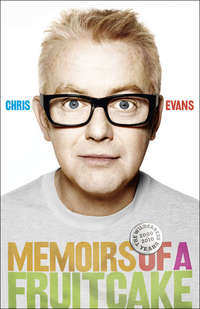
Читать книгу: «Memoirs of a Fruitcake»
CHRIS
EVANS
MEMOIRS OF A FRUITCAKE
The Wilderness Years 2000–2010
(plus a bit before but it didn’t sound as good)

Copyright
HarperCollinsPublishers 1 London Bridge Street, London SE1 9GF
www.harpercollins.co.uk
First published by HarperCollinsPublishers 2010
1 3 5 7 9 10 8 6 4 2
© Chris Evans 2010
Chris Evans asserts the moral right to be identified as the author of this work
All photographs are courtesy of the author with the exception of the following:
Plate 1: Page 1, middle left: PHOTOGRAPH BY GARRETT BRENNAN/CPI, CAMERA PRESS LONDON; Page 1, bottom left: PHOTOGRAPH BY GARRETT BRENNAN/CPI, CAMERA PRESS LONDON; Page 3, above right: © Starstock/Photoshot; Page 5, middle left: courtesy of Gordon MacGeachy; Page 5, middle right: courtesy of Gordon MacGeachy; Page 5, bottom right: © Talking Sport/Photoshot
Plate 2: Page 11, below right: Neale Haynes/Contour by Getty Images; Page 12, below: © Jackie King; Page 10 middle right: Jeff Moore/Jeff Moore/Empics Entertainment; Page 13, below: © Brian J. Ritchie/Rex Features; Page 15, above left: courtesy of the Radio Times; Page 15, above right: © The One Show; Page 16, © Rankin
Endpaper photographs © Camera Press/James Peltekian; Getty Images; Daily Mirror/Mirrorpix; Press Association Images; Starstock/UPPA/Photoshot; Rex Features; Shutterstock
A catalogue record of this book is available from the British Library
HB ISBN 978-0-00-734568-7
TPB ISBN 978-0-00-734569-4
All rights reserved under International and Pan-American Copyright Conventions. By payment of the required fees, you have been granted the nonexclusive, nontransferable right to access and read the text of this e-book on-screen. No part of this text may be reproduced, transmitted, downloaded, decompiled, reverse-engineered, or stored in or introduced into any information storage and retrieval system, in any form or by any means, whether electronic or mechanical, now known or hereinafter invented, without the express written permission of HarperCollins e-books.
Ebook Edition © SEPTEMBER 2010 ISBN:9780007345724
2016-11-30
Dedication
To my mum Minnie, my daughter Jade, my son Noah and most of all to my wife Natasha, who put up with me spending six months in the garage with my past instead of spending six months in the house with the present.
And to my balls, which thankfully I still have after Tash capitulated on her threat to cut them off if I hadn’t finished this book before our summer holidays in Portugal, something I failed spectacularly to do.
Contents
Cover
Title Page
Copyright
Dedication
Introduction: Top 10 Highlights of My Tale So Far
Part One: Memoirs of a Fruitcake
Top 10: ‘Turns’ I Have Employed
Top 10: Things a Proprietor Should Never Do
Top 10: Crazy Things to Do With Your Money
Top 10: Must Haves When I Built My Dream House
Top 10: Restaurants I’ll Never Forget
Top 10: Unforgettable Showbiz Moments
Top 10: Things That Come in a Bottle
Top 10: Perks I Gave Out as a Boss
Top 10: Dodgy Decisions I Have Made
Top 10: Ways Drinking too Much Leads to Fooling Yourself
Top 10: Quotes to Get You Through Moments of Doubt
Top 10: Things Drinking Can Destroy
Top 10: Facts About Sleep
Top 10: Bad Things That Can Happen When You’re Drunk
Top 10: Things People Often Think I Am But I’m Not
Plates 1
Part Two: When Billie Met Chris
Top 10: Ways to Know You’re in Love
Top 10: Fab Hotels I’ve Stayed in
Top 10: Things That Make a Wedding Brilliant
Top 10: Really Bad Career Moves that I Have Experienced
Top 10: Reasons Why I Love California
Top 10: Celebrity Encounters
Top 10: Great Things to Do with Your Money
Top 10: Visionaries
Top 10: Things I Love About Britain
Top 10: Turkeys I Have been Involved in
Top 10: Things to Do When the Shit’s About to Hit the Fan
Top 10: Saturday Night Television Treats
Top 10: Moments When You Know You Have to Let Go
Plates 2
Part Three: The Return of Radio Boy – Take Three
Top 10: Things I’ve Gotten Away With
Top 10: Fruitcake Moments
Top 10: TV/Radio Jobs I Have Turned Down
Top 10: Things I’ve Learned About Marriage
Top 10: Johns/Jons/Johnnys/Jonnys/ Johnnies/Jonathans I know
Top 10: Things I Wanted as a Kid
Top 10: Things I Love about Ferraris
Top 10: Things that Can Happen When You Fail to Confront an Awkward Situation
Top 10: Things to Bear in Mind if You Ever Get Your Own Radio Show
Top 10: Most Pivotal Messages I Have Ever Received (in Chronological Order – Not in Order of Importance)
Top 10: Things that You Learn to Accept as You Grow Older
Top 10: Best Things About the Mornings
Top 10: Things a Producer Does for a DJ (Well, Mine for Me, to be More Precise)
Top 10: What ifs About Taking Over Europe’S Most Popular Breakfast Radio Show
Postscript Top 10 Things I Still Want to do
What next?
Also by the Author
About the Publisher
INTRODUCTION TOP 10 HIGHLIGHTS OF MY TALE SO FAR
10 Born with ginger hair and glasses to Mum and Dad (Martin and Minnie) in Warrington in 1966
9 Younger brother to Diane and David
8 Father died of cancer when I was thirteen and life changed – soon afterwards, I obtained my first job in a newsagent’s
7 Heard Timmy Mallett on the radio, fell in love with the wireless
6 Secured job at Piccadilly Radio in Manchester, as tea boy
5 Moved down to London, worked at BBC Greater London Radio
4 Was chosen to front The Big Breakfast with Gaby Roslin and Zig and Zag
3 Created Don’t Forget Your Toothbrush, followed by TFI Friday, for Channel 4
2 Took up post as host of Radio 1 Breakfast Show, walked out after a year (idiot)
1 Bought Virgin Radio from Richard Branson after borrowing £85 million
NOW THERE ARE SHOWBIZ STORIES and then there are stories about showbiz – the latter for me infinitely more interesting and compelling. These are the stories behind the stories if you like, about how the business works and sometimes doesn’t work and what kind of people want, or more often need, to be part of such madness.
That’s what this book is. It is my story of my madness and my experience in show business. It was always a dream, it’s often been a nightmare, but it’s never been dull. If my first book was the climb up the mountain to fame, fortune and the life I thought I wanted, this second volume sees me diving head first off a cliff and then trying to figure out why.
In the days when I took over the ownership of Virgin I was a ‘live for today’ kind of guy. I tended to jump in with both feet, and worry about the consequences later.
It’s only recently that I have woken up to the fact that the live for today philosophy, although often liberating and fantastically exciting at the time, can be damaging and destructive to almost everything you hold dear. Of course there’s nothing wrong with the pursuit of one’s hopes and aspirations but real life must always be taken care of first – or at least very quickly afterwards, because to achieve success at the expense of a single other human being is wholly unacceptable.
While it’s admirable to strive with energy and ambition fuelling your tank, this does not serve as an excuse to start hundreds of things off willy-nilly without at least giving some thought to how they might be concluded. This is the number one crime of the irresponsible dream seeker whose lives are littered with false starts, broken middles and a severe lack of happy endings.
It’s better to enjoy happiness and a clear conscience by doing the right things by people along the way. The keys to the kingdom of contentment and a good night’s sleep are only a few decent decisions away. Talent is not an excuse to use and abuse or take short cuts.
So let’s see how little of this I realised when I needed to, shall we? Because, as you will soon see, having bought my radio station for all the right reasons – things would end up going very, very wrong.
Little did I know that in the ensuing years, I would enter the list of the top 500 richest people in Britain whilst simultaneously becoming a lout, a drunk, dangerously unstable, generally out of control, almost completely friendless, full of hubris, and the unhappiest I’d ever been. These darkest of days would also see me plumb the depths of self-destruction, usually the more publicly the better and not care who witnessed me doing it.
Why I didn’t take this journey to its mortal conclusion and how the hell I got my life back on track I am as keen to discover as you – so let’s go.
Buckle up my friends – this one really is a bumpy ride.
PART ONE
MEMOIRS OF A FRUITCAKE
TOP 10 ‘TURNS’ I HAVE EMPLOYED
10 Chris Moyles
9 Gaby Roslin
8 Terry Wogan
7 Vernon Kay
6 Danny Baker
5 Jimmy Tarbuck
4 Lionel Blair
3 Melanie Sykes
2 Terry Venables
1 Jonathan Ross
SO WHERE WERE WE?
Ah yes, October 1997 and I had launched my breakfast show on Virgin Radio – a great gig, except that Virgin’s owner, Richard Branson, was about to sell the station to the Capital Group, whereupon I would be out of a job in just ten weeks; barely enough time to get used to the decor.
That’s when the highly precocious ruse occurred in my ludicrously over-ambitious mind; to see if I could buy the station myself. It was the craziest of my not inconsiderable list of crazy ideas to date, but if I wanted to stay on the air then I had no choice. After my disastrously self-indulgent, ego-fuelled departure from Radio 1 only a few months before, my reputation was in tatters, rendering me virtually unemployable.
Astonishingly, with the help of some major financial backers, and with a top team around me, I pulled it off. Two months after joining the station I snapped up the ownership of Virgin Radio from under the noses of the Capital Group, overnight finding myself breakfast DJ and proprietor rolled into one.
I’d been in a few fairly daunting positions before in my rollercoaster career, though nothing quite on this scale. However, my owning Virgin Radio was only ever destined to be a temporary proprietorship. I was always going to have to sell the station to repay the people who had lent me the money in the first place – a story we will get to all in good time.
Meanwhile, I was still presenting TFI Friday every week, so my new job of media mogul had to be fitted in between my morning radio programme and the Friday TV show. But hey, I was a young man with vast amounts of energy, limitless enthusiasm and more ideas than I knew what to do with. What could possibly go wrong? I asked myself.
Answer; everything. But not just quite yet.
There I was, king of my own media castle, albeit with the minor inconvenience of owing the banks, my investors and Richard Branson £85 million.
Was I nervous? Not in the least. Not a lot can make you nervous after borrowing £85 million – unless it’s the possibility of losing it. But I wasn’t going there. I was excited and couldn’t wait to get to grips with my new empire.
In the beginning, before I discovered there was also a downside to being the boss, what turned me on most was the freedom I had to be creative. I was now in a similar position to many of my heroes, two in particular, namely Charlie Chaplin and Jim Henson. I have been a fan of both for years.
Chaplin was a truly exceptional man, almost more so for his business acumen than his on-screen genius. As soon as Charlie could afford to, he bought his own studios on La Cienega Boulevard in Los Angeles, where he began to self-fund and self-produce some of his most famous movies. With independence came control and with control came purity and perfection. He could green-light his own projects and make them exactly as he wanted without having to kowtow to any studio egomaniacs.
This situation only served to bolster Charlie’s already formidable confidence, and with talent plus creative control equalling power and profitability, before he was thirty the boy from the slums of south London was earning well in excess of $1 million a year – back in the 1920s!
Jim Henson was equally autonomous with his legendary Muppet productions almost half a century later; the beautifully ironic connection being that he bought the old Chaplin studios to use as his base. My favourite part of this story is that whereas in Chaplin’s day there was a giant statue of his tramp standing proudly on the roof for all of Tinseltown to see, when Jim moved in he erected a similar-sized statue of Kermit the Frog. And best of all – in homage to the studio’s former illustrious owner – Henson also dressed the world’s favourite amphibian as Chaplin’s tramp, complete with black suit, funny shoes, cane and bowler hat. This cleverest of tributes can still be seen atop the studio roof today.
With thoughts like these racing through my mind, I couldn’t help feeling inspired by the massive opportunities that lay ahead of me. I too owned my own company, the Ginger Media Group, consisting now of a television production arm – Ginger Productions, which made TFI Friday – and a radio station. I also had a five-year lease on my own television studio, and I was surrounded by producers, writers and people who could make things happen at a moment’s notice.
Almost straight away I decided to take advantage of my new-found freedom.
It was a Saturday morning and I’d just been for a run. Having returned home a little sweaty I decided to treat myself to a few bubbles and a good old soak – I love the lure of the lather. I lay there luxuriating and listening to one of our competitors, broadcasting that it was the first day of the footy season and how we should all be lapping it up.
The presenter and his various contributors sounded progressively more ebullient, and as the show went on, the more I felt we were missing out as my station had little if anything to do with football. This was a big day for millions of people and we were not part of it.
‘Hang on a minute, I don’t need to feel like this anymore,’ I thought. ‘I own the damn radio station, I can do anything I want and I don’t have to ask anyone’s permission.’
I jumped out of the bath, rang the studio and told the DJ who was currently on air to inform the guy who followed him that he could have the afternoon off. I was on my way in and I would be presenting our new Saturday afternoon sports and music show.
‘Really, what shall I say it’s called?’ he asked.
‘Oh, er – hang on a sec, I’ll ring you back with that.’
I hadn’t considered a title. Two minutes later I was back on the phone.
‘Tell him – and the listeners whilst you’re at it – that the new show is called Rock and Roll Football. Music and footy all the way till final score. It does exactly what it says on the tin.’
After making a quick cup of tea and throwing on some clothes, I began a ring round of the biggest footie heads I knew and asked them to come and help me. To a man they obliged, although they had little idea as to what exactly they might be helping me with.
That afternoon we launched one of the most straightforward shows I have ever been involved in. All we did was play music whilst watching Sky Sports Soccer Saturday with the sound down. Every time there was a goal we let our listeners know where it had occurred and who had scored it, then it was back to the music. At half-time we would have a quick ‘round the grounds’ catch-up, also featuring different halftime treats from different clubs; curries, kebabs, pork pies, pasties and whatever else fans were munching on.
Come five o’clock we presented our own slapdash version of the classified results, followed by any breaking footie stories, followed by half an hour of going-out music, which was exactly what we had intended to do the second the original programme had come off air.
Rock and Roll Football remained on air every Saturday afternoon during the football season until 2008 – almost a decade after I had left the radio station, picking up some pretty hefty sponsors along the way. And all because of a sweaty jog resulting in me needing a bath and a few bubbles.
As my reign as boss continued, my creative freedom quickly extended to hiring new talent that I thought might strengthen our line-up. My first top-three signings were ex-England football manager Terry Venables, BRMB’s Harriet Scott and the über-famous Jonathan Ross.
Because Rock and Roll Football had been an instant hit, I decided to start the sporting theme earlier on in the schedule and asked El Tel to co-host a football phone-in at midday on Saturday.
Terry was another hero of mine who had since become a pal. We first met in a local wine bar, when he let me into the secret of how he set about organising the England team to trounce Holland 4-1 at Wembley during Euro 96. He swore me to secrecy, so all I can say is it was simple but genius. Now I wanted that genius on the radio. Thankfully, he agreed and our footy phone-in was born.
Hiring Harriet Scott, my first female signing, was the result of listening to a good old-fashioned demo-tape that someone played me one morning. She had clearly racked up a lot of hours on the wireless, sounding warm and at ease, her style flowing effortlessly thanks to all those little tricks of the trade without which a radio show can sound so terribly clunky.
We called her agent and offered her a gig straight away. She accepted and a few weeks later moved down from Birmingham to London to become the new host of our afternoon show.
However, there was more to Harriet than first met the eye. She was a young lady who’d had her own fair share of headlines in the past – front pages of the tabloids, no less.
‘Oh, I remember now,’ I exclaimed one night in the pub when she mentioned the incident in question. The story was all about a to-do she’d had with the husband of a famous female television presenter with whom it was alleged she was having a secret liaison. Apparently during one of their dates she’d whacked him one and given him a black eye in the process. The tabloids subsequently splashed the picture of the bloke and his shiner all over their front pages. ‘Feisty little Harriet,’ I thought.
‘And yet you seem so calm and gentle and … small,’ I said to her.
‘Yeah, well you just watch it matey, there’s plenty more where that came from,’ she giggled. At least I think she giggled.
Several years later, when I was no longer her boss, Harriet and I dated for a while – a most enjoyable experience from beginning to end I’m glad to say, and one from which I emerged entirely injury-free. Goodness only knows what the other fellow had done to incur her wrath.
Jonathan Ross was the next name on my hit list, and oh what twists and turns our relationship would come to experience. Jonathan has been a recurring theme throughout my career for reasons that will become evident as the pages of this story unfold, but I initially encountered him in my very first job after I’d moved down to London.
I was a wet-behind-the-ears twenty-three-year-old from Manchester’s Piccadilly Radio and had managed to blag a job as a production assistant on a new night-time station called Radio Radio.
Jonathan was quickly becoming the hottest new face on television with his Channel 4 chat show The Last Resort and had agreed to present a one-hour radio show twice a week for the fledgling network in return for a squillion pounds. Unfortunately for everyone involved none of this lasted very long, with the company folding only a few months later under spiralling costs and practically zero advertising revenue.
Following Radio Radio, our paths had crossed several times since, as I had now become a recognisable face in my own right and had appeared as a guest on his Saturday Zoo show, as well as attempting to collaborate with him in an effort to get him back on television when he’d lost his way a bit.
[Adopt Michael Caine voice here] Now not a lot of people know this but I actually wrote TFI Friday for Jonathan. I was going to produce it with him as the presenter.
I’d asked him over to my flat in north London for a cup of tea, where the two of us lay on the grass in my garden, chewing the television fat. I remember it vividly, second only to the day I asked Jools Holland (my ultimate TV hero) to be musical director on Don’t Forget Your Toothbrush, another red-letter day for the Evans boy.
My initial idea for Jonathan was for a Sunday show based in a church, with Jonathan as the preacher/host, the congregation/audience in the pews, guests in the confessional and music from the choir area.
The Sunday Joint, as I had titled it, slowly evolved into TFI Friday after I came to the conclusion it was probably better to piggyback on the natural positive energy of a Friday evening than try to manufacture similar energy on a Sunday.
The main man at Channel 4 at the time liked the idea for the show but when I declared Jonathan as my first-choice host, replied with these exact words:
‘Everyone knows Jonathan is yesterday’s man.’
This didn’t stop the same exec trying to rehire him a few years later when he was back on top.
As Jonathan’s brother Paul always says, ‘Form is temporary – class is permanent.’ Bravo Paul and bravo Jonathan, for now at least.
After I eventually took up the mantle of TFI Friday, Jonathan’s career continued to flounder but I was always wondering how I could get to work with him. Now I owned my own radio station I could simply offer him a job.
Our Saturday line-up was becoming an unexpected highlight of the week, with Terry at lunchtime, Rock and Roll Football in the afternoon, and Johnny Boy Revell and his Wheels of Steel ushering us into Saturday night. If Wossy was at a loose end, he could do a lot worse than kick off our Saturdays with a mid-morning music/interview show…
For me he is the most natural talker in British broadcasting. He isn’t just blessed with a sharp mind and a quick jaw; it’s almost as if Jonathan needs to talk to stay alive.
The only other person I’ve seen blessed/blighted with this condition is the great Danny Baker, who runs JR pretty close when it comes to the art of rabbiting. I once went out for lunch with both of them. I don’t think I said more than fifteen words for the duration of the whole meal, as Jonathan and Danny went head to head in a conversational clash of the titans. They talked continuously and – for the most part – at the same time. I was sure that neither of them listened to a single word the other one had to say.
When I made the call to JR about coming to work for me it was a really big deal. I felt almost audacious as I sat in my recently purchased, stupidly big, green Bentley parked spookily enough in Great Portland Street, right outside what is now Radio 2. Of course little did any of us know at the time how important that building would become to both our stories in a decade’s time.
As I dialled his number on my car phone, I continued to rehearse my pitch to him as to why he might want to join the wonderful world of the wireless. After no more than a couple of rings he picked up and I launched straight in.
‘What do you have to lose?’ I concluded after I was done.
‘Chris, I’m not so sure you know, radio’s what you do, I’m a telly man, always have been, and that’s where I want to be.’
I suspected this was how the conversation might go and I could understand Jonathan’s concerns. Some television people – in those days, especially – may have seen radio as a step down, but I had prepared my little spiel. I told Jonathan that radio was the best ‘shop window’ in our business bar none; the perfect advert for a broadcaster’s talent. I explained to him that because he was so natural he had nothing to fear. I added that radio also has a knack of easing a broadcaster back into people’s consciousness, whilst also affording them a more intimate relationship with a much more discerning and receptive audience.
This – and whatever else I said during the course of our brief chat – must have struck a chord, as Jonathan called me back a couple of days later, saying he was up for it. He was on air within a fortnight and quickly settled in to become another quality cannon to add to our weekend arsenal of radio fire power.
We gave him a show that ran from ten till one on a Saturday morning. It was precisely the time my old Greater London Radio show had aired almost a decade before, not the only thing the two shows had in common. I called in my old colleague Andy Davies to produce Jonathan. Andy had done exactly the same for me at GLR, so I thought he would be the perfect person to hold Jonathan’s hand – and I’m glad to say I was right.
The happy couple were still together ten years later, doing an almost identical show for the mighty Radio 2 and winning countless awards in the process. The shop-window theory worked a treat; within a year of joining us, the BBC came for Jonathan in a big way, transferring his show lock, stock and barrel to Saturday mornings on their national FM network.
With the power of Radio 2 behind him, Jonathan was firmly back on the entertainment map and it was only a matter of time before the clarion call of television could be heard. The birth of his Friday night BBC 1 talk show followed in 2001 and in no time at all Jonathan was back on top, where he would remain for the best part of the next decade.
The irony was that Jonathan wrote to me asking if I would be a guest on that first series of his talk show, some three years after I had employed him at the radio station and approximately a year after I had gone slightly cuckoo and off into my wilderness years. In many ways, Jonathan and I had effectively swapped places, but the last thing I wanted to do at that point was jump back on the bus. I replied to him by letter saying, ‘Thanks old boy, deeply flattered, good luck with your new venture but I’m not really “at it” anymore.’
I meant every word at the time and in truth never expected to be ‘at it’ again – least of all with him, on the very same show, nine years later, which is exactly what happened.
I did eventually appear on Friday Night with Jonathan Ross in October 2009 to promote my first book, It’s Not What You Think.
However, as you will come to learn, this was a book that only came about as a result of Jonathan’s infamous appearance on Russell Brand’s radio show. I can assure you that if Jonathan and Russell had not made that phone call to Andrew Sachs, neither of my two books would ever have come into being, but that is a story I will return to later on.
TOP 10 THINGS A PROPRIETOR SHOULD NEVER DO
10 Get drunk with the staff
9 Think an employee is ever having a natural conversation with them
8 Park a big posh car right outside the building
7 Have more meetings
6 Become involved in personal issues
5 Trust anyone
4 Be swayed from your core beliefs
3 Employ pals
2 Employ beautiful secretaries
1 Incentivise the workforce: reward – yes; dangle carrot – no. One day you will run out of carrots
WITH THE PURCHASE OF VIRGIN RADIO, unbeknown to me, the seeds of what was to become a lonely and almost fatal madness had also been sown. The aforementioned artistic freedom was there, for sure, but this came hand in hand with corporate responsibility, and these two components, yoked together, were never going to happily coexist. Something I would unfortunately have to discover the hard way.
I should have spotted the signs. I remember turning up for work at Golden Square in Soho one morning, no more than a month into my tenure. It was the middle of winter, when early mornings are painful to the touch. No sooner had I entered the building than I was confronted with what must have been fifty or sixty boxes piled on the ground floor, taking up so much room they almost made the corridor impassable. Upon inspection I discovered that inside each of these boxes was a brand new computer.
‘What do we need all these computers for?’ I remember asking myself. ‘What’s wrong with the ones we already have? Who is cleared to sign cheques for such large orders and shouldn’t I know about purchases of such bulk?’
Not the most colourful of thoughts with which to start one’s day.
For ownership – see headaches. Lord, why did I not realise? Lots of people (OK, men, mostly) like the idea of owning their local pub, or golf course, or restaurant, but it’s far better just to go there, have some fun, pay the bill and leave the mowing of the fairways and cleaning of the dirty pots to someone else.
Worse than managing things, though, is managing people.
I will never forget my first encounter with a group of my new employees, when I organised for all the DJs to meet up at the local pub for a bonding session. I thought they would be a like-minded bunch to start with; my fellow presenters in a world full of padded walls, soundproof glass and overblown egos. In contrast to other stations – where off air, the DJs barely ever see or speak to each other – I was determined that at my radio station things would be different. We would be one big happy family, like the Monkees on telly, or the Beatles in A Hard Day’s Night. I thought a regular get together would give my guys a voice, a feeling of inclusiveness – nothing too cute or touchy-feely, merely a line of communication to each other and to me, their boss. I thought the best plan would be to organise a lunchtime meeting in a pub round the corner from the studio.
Wrong!
The morning meeting I had across town that day overran and, as a result, I found myself having to sprint the mile or so back to base to make it on time for our DJ summit. I eventually arrived at the pub a few minutes after one o’clock, puffed out and red in the face but nonetheless excited about the prospect of meeting my elite guard all together for the first time. I was looking forward to a few beers and getting down to the business of encouraging the guys to spring forth their opinions and visions for our future together.
Wrong! Again.
There they were, my all-star line-up, stood somewhat lacklustre to say the least, at the bar, barely saying a word to each other.
What on earth were they thinking? Did they have it in their minds that I was going to fire them on the spot?
Looking back, perhaps they did. Perhaps it was exactly that, their lack of cheery chat may well have been terror-induced, but they were not to know my motive was one of unification, not suppression.
Already I could sense that this wasn’t going to plan and they were getting the wrong end of the stick. I was definitely one of them but in danger now of being perceived as a potential enemy – as having crossed over to the dark side.
Sure DJs did fall by the wayside as a result of my proprietorship. The management of people is a huge and complicated task and one that takes a very special talent, a talent not to be underrated.
‘Show me the money,’ Tom Cruise famously said in Jerry Maguire. Tom, you were wrong.
‘Show me the manager,’ any day of the week.
TOP 10 CRAZY THINGS TO DO WITH YOUR MONEY
10 Spend it on people you have never met before
9 Spend it on people you don’t like
8 Spend it on people you suspect don’t like you
7 Spend it on really expensive wine, when everyone is too far gone to appreciate it
6 Spend it on holidays you don’t want to go on
5 Lend it to idiots
4 Invest in businesses run by idiots
3 Play the stock market (the big boys have the rest of us by the balls)
2 Think for one second it can ever buy you happiness
1 Forget how hard you worked to earn it
ULTIMATELY, MY OWNERSHIP OF THE GINGER MEDIA GROUP (GMG) would last no longer than two years, thank God, after which my brief and bizarre run as a rookie media mogul would morph into my becoming a multi-millionaire part-time DJ, with too much time on his hands and a bank account burning a hole in his pocket. Sounds fabulous, doesn’t it?
So why, then, is such coveted good fortune all too often the downfall of the people who come to experience it?
Perhaps it’s something to do with the paradise syndrome – a recognised psychological condition in which people imagine things are too good to be true, and so end up sabotaging them until they return once again to the shitty bad old days.
Was this what happened to me? I suspect it was. But before I get to the part where it all went wrong, let me cut to the chase and tell you how all this money ended up coming my way in the first place.
It was my job as proprietor of GMG, along with my CEO, David Campbell – DC, as I’ve always known him – and my agent Michael, to grow our new business from day one, just as we had promised our investors we would do. We had claimed to be able to at least double the £87 million we had originally paid, within three to five years. If and when this was achieved, we had agreed to sell it again and all retire to the Bahamas – or as it turned out in my case, Guildford.
Our initial plan for the ‘growing’ part was based around building up our already established television and radio business, whilst at the same time diversifying into becoming a more broad-based media company. The internet had just been born, and digital television and radio-broadcast platforms were taking their first steps as toddlers. In short, we were witnessing the beginnings of a communications and technological revolution, and rarely, if ever, had there been a better time for expansion.
GMG’s growth was, however, about to be stunted.
There was a problem, you see, a very simple problem – we were too successful, too quickly, without really doing very much at all. The ratings and revenue from the radio station increased at such an unexpected rate after we had taken over that the business almost immediately doubled and then almost tripled in value. Suddenly there was very little for us to do, over and above turning up for work every day. There was no need to push ourselves, there was no need to look for new opportunities and, most importantly of all, there was no need for us to take any risks.
So what was the problem, you may ask?
Well, it was like this. I had a very ambitious management team consisting of several natural entrepreneurs whose very DNA dictated they had to take any money-making heat they could get their hands on and turn it into a full-blown volcano – whether it was needed or not. Unfortunately at this juncture, because of our premature success in reaching and exceeding all our financial targets, these same guys soon found themselves at direct loggerheads with the boys and girls in our boardroom.
The management wanted to stick to the original brief of expansion, whereas our investors only cared about extracting the added value. As this point had already been reached, the investors understandably didn’t want any further and unnecessary throws of the dice.
Here’s what happened next:
Everyone knew we were worth millions more than just a few months before, maybe even as much as a hundred million more, maybe even more than that. In short, we were very good for credit, almost fireproof. Not surprisingly the management team decided the time was ripe for taking on bigger challenges – like buying a national newspaper for example, specifically the Daily Star.
If you want to make money, never buy a gleaming champion for sale at the top of the market, go instead for a leaky old boat that no one wants or cares about anymore.
The Daily Star was that boat; it was losing money hand over fist, had problems with its printing and distribution, and had become a predictable one-trick pony of gossip, girls and sport done on the cheap. However it was still also enjoying half-decent circulation figures and, with a little love and affection both behind the scenes and on the page, my trusty CEO, DC, reckoned it could be polished up and be back in the black within a year. He had investigated alternative ways of printing and the sharing of distribution facilities to help cut costs, and he and I had even had a clandestine lunch with Piers Morgan who, in principle, had agreed to be our editor.
Our thinking was something along the lines of radio stations being very similar to newspapers in so many ways. Why couldn’t our millions of new listeners become millions of new readers, and vice versa?
As momentum around Project Star gathered pace, the frisson of our second big deal was well and truly in the air – especially when we discovered we could snap up this ailing daily for the knock-down price of just £25 million, a snip at the time for a UK national newspaper title.
Alas, though, it was not to be.
The board rejected our request for permission to buy the Daily Star hands down. We had the deal in the bag, but they were insistent we didn’t need it. Their exact phrase was ‘Why do we need to bet the ranch anymore?’
The board left us in no doubt that they were more than happy with things as they stood. My management team, on the other hand, could not have been less satisfied with the situation. In fact they were about to throw their toys, along with their immense talent, right out of our company pram.
As soon as they were informed of the board’s decision, all three of them – the chief executive officer, the financial officer and the managing director – walked straight out of the building.
I couldn’t believe it.
Here was I, a radio DJ, former newsagent, kiss-o-gram and forklift-truck driver, now alone at the head of a £200 million company with close to two hundred employees and hundreds of thousands of pounds flowing in and out of our accounts on a daily basis.
I needed my boys back and I needed them back bloody quickly. I summoned the board to an emergency meeting scheduled for the second I came off the air the next day.
‘The management feel they can no longer work with you and have left,’ I offered up as a starter.
‘They have what?’ said one of the board.
‘They’ve gone, they’re no longer here, I am on my own and I am just a DJ, I have no idea what really goes on here and we need to get them back.’
‘Oh dear,’ said another member of the board.
‘Precisely,’ I concurred.
‘Well, this is not good, not good at all,’ said a third.
‘I agree wholeheartedly,’ I whimpered. By now they could see I was distressed.
‘What exactly is their issue?’ said the guy who had spoken first.
‘Growing the company is what they do, they identified a perfectly valid opportunity and you have refused point blank to support them.’
The board were sympathetic to their case but immovable when it came to taking any risk. I have to say they had a perfectly sound argument and one with which I was finding it very difficult to disagree. However, I still had a problem.
‘That may be the case,’ I bleated, increasingly desperate, ‘but I don’t know if you’ve noticed, I am on my own on this side of the table and all our employees are about to arrive at work and wonder where the hell the three blokes who run this place have disappeared to.’
‘So what do you want us to do?’ said the first one.
I hadn’t actually thought about the answer to this question. I just presumed the board would know what to do. I opened my mouth and hoped something half-sensible might come out.
‘You need to reassure them that it’s because of their efforts that we find ourselves in the position of having to do nothing.’ So far so good. ‘And then you need to tell them how good they are and … er … give them some more money.’
I have no idea where this last bit came from.
‘You want us to give the management a bonus for walking out?’
I wasn’t sure if I did or not but I wasn’t about to stop now.
‘Yes, more money, they’re businessmen after all, that’s what they’re about. We need to get them back in the door and re-incentivise them at the same time. A cheque each is the only way.’
Now this, dear friends, is me being extremely bad at business but extremely good at selling. Let’s face it, this was a terrible idea. People often say what a great businessman I am but there is nothing further from the truth. I am many things, but I am not, never have been and never will be a great businessman.
Although the management had an almost justifiable beef, there’s no way they should have deserted me in the first place, let alone been rewarded for doing so.
Indeed, when I foolishly tried a similar stunt a couple of years down the line, the whole episode ended up costing me £13 million and I didn’t work for the next three years.
But I must have been very convincing on the day because the board actually agreed to my suggestion, authorising me to dish out some new share options in the direction of my management team – if they deigned to return to work, that is.
I skipped off to the restaurant where they were waiting, happy to be the bearer of good news and confident they would see sense.
When I turned up they looked like three naughty schoolboys hoping to high heaven they weren’t going to get caned. If I’m totally honest, they looked like they thought they might be about to get fired. I suspect that they’d had time to reflect on their impetuousness and were perhaps beginning to think better of it. No need, though, for I only brought glad tidings of great joy.
‘You are all bonused up and back in business’, I declared to three visibly relieved and frankly somewhat surprised faces.
I only wish someone had been able to say the same to me later when, as I’ve said, I tried a similar stunt, but there I go, jumping the gun again.
Now, houses next and how to buy a really big one that you definitely can’t afford.
TOP 10 MUST HAVES WHEN I BUILT MY DREAM HOUSE
10 Helipad
9 Trout lake
8 Hot tub (wooden – outdoor)
7 Village shop in the kitchen
6 Library
5 Waterfall in the library
4 Identical replica of my local pub
3 Steam room
2 Cinema
1 Space
WITH THE ROCK-STAR LIFESTYLE COMES THE ROCK-STAR MANSION and all that goes with it. It’s all so unoriginal, I know, but nobody teaches you how to be rich and I fell for every cliché in the book.
I’d been looking for a place ‘out of town’, as they say, for a year or two and as the millennium was looming I still hadn’t seen anything that remotely took my fancy. Not for want of trying, I might add, as I spent most weekends viewing properties from the east coast of Kent all the way down to the sand dunes of Dorset.
If there was a big house with land for sale, I wanted to see it. I looked at castles, farms, lighthouses, windmills – I even looked at one place that had its own airstrip where the chap who owned it said I could have his Fokker thrown in for free!
So far, though, for one reason or another, nowhere had quite clicked. In fact it was getting to the point where I had just about exhausted all combinations of commutable counties and different types of dwellings therein. I needed something to happen to help me change my mindset, and it did, on a skiing holiday to Whistler in Canada, of all places.
This holiday was a freebie and, like most freebies, was probably more trouble than it was worth. After all who would travel several thousand miles to another continent for a skiing holiday that lasted just four days? Me and my old pal Johnny Boy Revell, that’s who. We were both from council estates and still hadn’t quite got over the fact that people were willing to give us stuff for free.
We almost felt like we had to go, despite the immense jetlag and the fact that by now we were both well off enough to pay for ourselves to go first class practically anywhere in the world. But a bargain was a bargain and so off we trotted deep into the snowy peaks of the Canadian Rockies.
Barely able to keep our eyes open when we arrived, we just about managed to hire a Chevrolet Silverado 4x4 pickup truck, throw our gear in the back and get on our way. We were soon to discover there are some things that can blow the cobwebs of jetlag clean out of the water.
Almost the second we hit the mountain road we became overwhelmed by what lay before us. In less than half an hour we were in a wilderness of calm and serenity, a world away from the hubbub of the tempestuous media rat race. There really was nothing but a blanket of white for as far as our tired eyes could see. Truly spellbinding.
As we continued on our way, we passed countless expanses of icy blue water, one of which was so breath-takingly beautiful we just had to stop, get out and stare at it for a few minutes.
As the wonder of the Rockies continued to astound, a newfound sense of peace slowly began washing over the pair of us but, where I was concerned, I could also feel a slight trace of anger beginning to gnaw at its heels.
‘Where is this anger coming from?’ I thought. ‘This isn’t right, I was about to be really content. Please leave me alone.’
But it wasn’t going anywhere. It wanted a word.
‘Why on earth haven’t you sorted out a house in the country back in the UK yet?’ it snorted. ‘You spend every weekend cooped up in your flat in London crawling from one ugly watering hole to the next when you could be out and about feeling the way you do now. You have the money, go get a life!’
I had to concede this anger had a point. I made a private deal with it to do two things when I returned back home.
1. I would buy a Chevrolet Silverado 4x4.
2. I would buy a house in the country within a month.
True to my word, I ordered the Chevy immediately upon my return, to be delivered on Christmas Day 1998. As for the house, I concluded that because I had looked at well over a hundred in the last year, at least one of which must have been suitable, it could only be reluctance on my part to commit to a big move out of the city that was the problem, rather than not having found a suitable property.
So here’s what I decided to do:
I would simply instruct an estate agent to take me to look at the five best houses currently for sale in the south-east of England, regardless of cost. After seeing all five, I would then undertake to buy the one that I liked the most, even if I didn’t really like it that much at all. This way I was forcing myself into a ‘yes’ situation.
I know this philosophy is a little extreme, especially for a boy who started life on a council estate with little more than his pocket money, his push bike and a paper round, but this is where I now found myself and I was determined to make the most of it.
There was more drastic action to come.
Because these houses were likely to be tens of miles apart, maybe even hundreds, it was going to be quite difficult to compare and contrast them. I therefore informed the agent to arrange all five viewings consecutively on one single day and to meet me that morning at Battersea heliport. I also kindly requested he seek permission from the vendors concerned for us to land in their gardens. We were about to have the viewing trip of a lifetime.
When we climbed up above Richmond Park on the Wednesday morning in question the rest of the world was at work. I don’t know who had to try the hardest to play it cool, the agent or myself. We were both grinning from ear to ear.
Extravagant as this strategy may seem, there was more than a grain of sanity in what we were doing. After all, we were dealing with houses worth several million pounds each, and if it took a one-day lease of a Twin Squirrel to secure the right one, then it would be money well spent. The fact that it was a tonne of fun in the process was merely a bonus, albeit a pretty big one. Plus it meant I could also get to spy into the gardens of any potential new neighbours whilst we were at it.
The first property we looked at was in Windsor, right on the River Thames. It was huge, Georgian, white and stunning. After a quick scoot round, enough to gain a mental picture, we were back on board and up and away again. Next stop Chichester, to look at a renovated castle. This was also very nice. Protected by its own moat, with fabulous lawns, the present owners had spent a small fortune renovating their home by blending ultra-modern with genuinely ancient. As a result there was lots of new glass, mixed in with old stone – a real wow house, but just a bit too far away from London to make it practical.
Two landings completed, two houses down and Windsor was still winning. Time then for number three. The pilot tracked back over the South Downs, overflying Goodwood and Midhurst, before landing on the lawn of a fabulous house just off the A3, complete with its own lake, working water-mill and state-of-the-art recording studio.
‘Who lives in a house like this?’ I could hear the voice in my head say.
‘Roger Taylor from Queen’s place,’ whispered the agent, as if he’d heard me.
The story goes that when Queen had their first hit album, Roger went straight out and bought this house. It didn’t occur to him that they might not have another one; Roger told me this story himself. He also told me about the first time Freddie Mercury came over to visit. He said that Freddie couldn’t believe how audacious the band’s drummer had been with his recent purchase, so much so that he immediately felt compelled to return to London to buy a brand-new white Rolls-Royce from Jack Barclays. Having achieved this in no more than a couple of hours, Freddie was back at Roger’s in his new wheels in time for tea.
Roger couldn’t have been more welcoming that day and his house was to die for; so fabulous, in fact, that he ended up withdrawing it from the market and staying there himself, though not before adding a new library wing – all 7,000 square feet of it.
Time then for house number four.
Ladies and gentlemen, I present to you Hascombe Court, a turn-of-the-century manor house set in forty-seven acres of Gertrude Jekyll gardens, situated a few miles south of Guildford. This house was heaven on earth, sitting atop a hill overlooking the quaint little village from which it took its name.
No more than fifteen minutes after we landed there I made a call to my long-suffering accountant.
‘Kirit, I would like to buy a house.’
‘OK, that’s fine, where is it and how much?’
‘It’s near Guildford and it’s £4 million, which is a bargain because it was £5.5 million.’ This was true; it had been on the market for over a year. I couldn’t believe no one had snapped it up.
‘Chris, you don’t have £4 million.’ ‘I know that, but can we get it?’
Poor Kirit – who actually isn’t poor at all but you know what I mean – he’s had to cope with several telephone calls like this over the years, the most recent being when I bought a car I couldn’t afford at an auction in Italy in 2007. That phone call followed exactly the same lines and both times I’m happy to say he came up with the funds required to indulge my desires.
I never ask how he does it – I think it’s probably best I don’t know – but following such episodes I try not to call him again about anything for as long as I possibly can.
On this occasion I would have to call Kirit back sooner rather than later as it transpired that Hascombe Court and its forty-seven acres turned out to be only the half of it – literally.
After the phone call I discovered that over the road was the second half of the estate which was made up of a farm, three cottages and another hundred and twenty-seven acres which was also up for sale.
‘Kirit, I need a further £1.5 million, there’s more of the estate to be bought.’
‘I see,’ he sighed.
I was so sure about Hascombe Court that I didn’t even bother going to look at house number five, asking the pilot to return us safely and swiftly to London.
Within four weeks I had completed the purchase of both lots for a total purchase price just shy of £6 million. I suddenly had an idea how Roger may have felt all those years before, wondering where his band’s next hit might come from, but you know what? I really didn’t care. Besides, I could always sell it again if I had to, which was a bloody good job because that’s precisely what was destined to happen.
They say one of the best ways to go about making a small fortune is to start with a big one and lose most of it. That is exactly what the stars had lined up for me but I was yet to do the losing bit. So, let’s find out how that happened first, shall we?
Бесплатный фрагмент закончился.