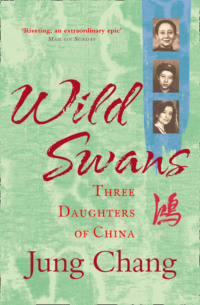
Читать книгу: «Wild Swans»
WILD
SWANS
Three Daughters of China

JUNG CHANG

 Copyright
William Collins
An imprint of HarperCollinsPublishers Ltd. 1 London Bridge Street London SE1 9GF
www.harpercollins.co.uk
First published in Great Britain by HarperCollinsPublishers 1991
This 25th anniversary edition published 2016
Copyright © Globalflair 1991, 2003
Jung Chang asserts the moral right to be identified as the author of this work
A catalogue record for this book is available from the British Library
All rights reserved under International and Pan-American Copyright Conventions. By payment of the required fees, you have been granted the nonexclusive, nontransferable right to access and read the text of this ebook on-screen. No part of this text may be reproduced, transmitted, downloaded, decompiled, reverse-engineered, or stored in or introduced into any information storage and retrieval system, in any form or by any means, whether electronic or mechanical, now known or hereinafter invented, without the express written permission of HarperCollins ebooks
HarperCollinsPublishers has made every reasonable effort to ensure that any picture content and written content in this ebook has been included or removed in accordance with the contractual and technological constraints in operation at the time of publication
Source ISBN: 9780007176151
Ebook Edition © OCTOBER 2011 ISBN: 9780007379873
Version: 2018-05-14
Praise
‘Of all the personal histories to have emerged out of China’s twentieth-century nightmare, Wild Swans is the most deeply thoughtful and the most heart-rending I’ve read. It moves, in part, like a ghastly oriental fairytale, but the authority and the reticent passion with which Jung Chang speaks her memories—and those of others—is unmistakable.’
COLIN THUBRON, Spectator
‘Wild Swans is a very unusual masterpiece. Everything about it is extraordinary. Not only has it been a popular bestseller, because it is impossible to put down; it has also received the most serious critical attention. The book arouses all the emotions, such as pity and terror, that great tragedy is supposed to evoke, and also a complex mixture of admiration, despair and delight at seeing a luminous intelligence directed at the heart of darkness.’
MINETTE MARRIN, Sunday Telegraph
‘Mesmerising. Like all great stories of survival, no matter what tragedies and horrors are encountered along the way, Wild Swans is ultimately an uplifting book: it is the courage and spirit of this family which will, I believe, be my abiding impression (even if memories of the horrors endured will take a long time to fade).’
ANTONIA FRASER, The Times
‘A quite exceptional book. Jung Chang is the classic storyteller, describing in measured tones the almost unbelievable.’
PENELOPE FITZGERALD, London Review of Books
‘ Wild Swans has stayed in my mind all year. Quite unforgettable.’
MICHAEL IGNATIEFF, Times Literary Supplement
‘An extraordinary story, popular history at its most compelling. Her readiness to record life’s small pleasures as well as its looming horrors is not only an index of Jung Chang’s honesty and good humour, it is a part of what makes Wild Swans so fascinating. To compare Wild Swans to sagas of the kind that fill the bestseller lists may seem to trivialise the real and deadly seriousness of its subject matter, but the book offers many of the pleasures of good historical fiction.’
LUCY HUGHES-HALLETT, Independent
‘Riveting, an extraordinary epic. A work of true, living history drawing deep on family memories, an unmatchable insight into the making of modern China and the impact of war and totalitarianism on the destinies of a quarter of the human race.’
RICHARD HELLER, Mail on Sunday
‘A huge tour de force.’
DEREK DAVIES, Financial Times
‘Immensely moving and unsettling; an unforgettable portrait of the brain-death of a nation.’
J. G. BALLARD
Dedication
To my grandmother and my fatherwho did not live to see this book
Contents
Cover Page
Title Page
Copyright
Praise
Dedication
Family Tree
Chronology
Author’s Note
Map
1 ‘Three-Inch Golden Lilies’
2 ‘Even Plain Cold Water Is Sweet’
3 ‘They All Say What a Happy Place Manchukuo Is’
4 ‘Slaves Who Have No Country of Your Own’
5 ‘Daughter for Sale for 10 Kilos of Rice’
6 ‘Talking about Love’
7 ‘Going through the Five Mountain Passes’
8 ‘Returning Home Robed in Embroidered Silk’
Plates Section 1
9 ‘When a Man Gets Power, Even His Chickens and Dogs Rise to Heaven’
10 ‘Suffering Will Make You a Better Communist’
11 ‘After the Anti-Rightist Campaign No One Opens Their Mouth’
12 ‘Capable Women Can Make a Meal without Food’
13 ‘Thousand-Gold Little Precious’
14 ‘Father Is Close, Mother Is Close, but Neither Is as Close as Chairman Mao’
15 ‘Destroy First, and Construction Will Look After Itself’
16 ‘Soar to Heaven, and Pierce the Earth’
17 ‘Do You Want Our Children to Become “Blacks”?’
18 ‘More Than Gigantic Wonderful News’
19 ‘Where There Is a Will to Condemn, There Is Evidence’
20 ‘I Will Not Sell My Soul’
Plates Section 2
21 ‘Giving Charcoal in Snow’
22 ‘Thought Reform through Labour’
23 ‘The More Books You Read, the More Stupid You Become’
24 ‘Please Accept My Apologies That Come a Lifetime Too Late’
25 ‘The Fragrance of Sweet Wind’
26 ‘Sniffing after Foreigners’ Farts and Calling Them Sweet’
27 ‘If This Is Paradise, What Then Is Hell?’
28 ‘Fighting to Take Wing’
Epilogue
Afterword
Index
Acknowledgments
About the Author
About the Publisher
Family Tree

Chronology
| Year | Family/Author | General |
|---|---|---|
| 1870 | Dr Xia born. | Manchu empire (1644–1911). |
| 1876 | Xue Zhi-heng (grandfather) born. | |
| 1909 | Grandmother born. | |
| 1911 | Empire overthrown; republic; warlords. | |
| 1921 | Father born. | |
| 1922–24 | General Xue chief of police in warlord government, Peking. | |
| 1924 | Grandmother becomes concubine of General Xue. | |
| General Xue loses power. | ||
| 1927 | Kuomintang under Chiang Kai-shek unifies most of China. | |
| 1931 | Mother born. | Japan invades Manchuria. |
| 1932 | Japanese occupy Yixian, Jinzhou. | |
| ‘Manchukuo’ established under Pu Yi. | ||
| Grandmother and mother to Lulong. | ||
| 1933 | General Xue dies. | |
| 1934–35 | Long March: Communists to Yan’an. | |
| 1935 | Grandmother marries Dr Xia. | |
| 1936 | Dr Xia, grandmother, and mother move to Jinzhou. | |
| 1937 | Japan attacks deep into China. | |
| Communist-Kuomintang alliance. | ||
| 1938 | Father joins Communist Party. | |
| 1940 | Father walks to Yan’an. | |
| 1945 | Japanese surrender. | |
| Jinzhou occupied by Russians, Chinese Communists, and Kuomintang. | ||
| Father to Chaoyang. | ||
| 1946–48 | Father in guerrilla unit around Chaoyang. | Kuomintang-Communist Civil War (to 1949–50). |
| Mother becomes student leader, joins Communist underground. | ||
| 1948 | Mother arrested. | |
| Siege of Jinzhou. | ||
| Father and mother meet. | ||
| 1949 | Parents marry, leave Jinzhou, march to Nanjing. | |
| Mother’s miscarriage. | ||
| People’s Republic proclaimed. | ||
| Father arrives in Yibin. | Communists take Sichuan. | |
| Chiang Kai-shek to Taiwan. | ||
| 1950 | Mother reaches Yibin; food-gathering, fighting bandits. | |
| Land reform. China enters Korean War (to July 1953). | ||
| Xiao-hong born. | ||
| 1951 | Campaign to ‘suppress counter-revolutionaries’ (Hui-ge executed). | |
| Mother head of Yibin Youth League under Mrs Ting; full Party membership. | ||
| Grandmother and Dr Xia to Yibin. | ||
| Three Antis Campaign. | ||
| 1952 | I am born. Dr Xia dies. Father governor of Yibin. | Five Antis Campaign. |
| 1953 | Jin-ming born. Family moves to Chengdu. | |
| Mother head of Public Affairs Department for Eastern District. | ||
| 1954 | Father deputy head of Public Affairs Department for Sichuan. | |
| Xiao-hei born. | ||
| 1955 | Mother detained. | Campaign to ‘uncover hidden counter-revolutionaries’ (Jinzhou friends branded). |
| Children into nurseries. | ||
| Nationalization. | ||
| 1956 | Mother released. | Hundred Flowers. |
| 1957 | Anti-Rightist Campaign. | |
| 1958 | Great Leap Forward: backyard steel furnaces and communes. | |
| I start school. | ||
| 1959 | Famine (to 1961). | |
| Peng Dehuai challenges Mao, condemned. | ||
| Campaign to catch ‘rightist opportunists’. | ||
| 1962 | Xiao-fang born. | |
| 1963 | ‘Learn from Lei Feng’; cult of Mao escalates. | |
| 1966 | Cultural Revolution starts. | |
| Father scapegoated and detained. | ||
| Mother to Peking to Father released. | ||
| Father released. | ||
| I join Red Guards; pilgrimage to Peking. | ||
| I leave Red Guards. | ||
| 1967 | Parents tormented. | |
| Marshals fail to stop Cultural Revolution. | ||
| Tings in power in Sichuan. | ||
| Father writes to Mao; arrested; mental breakdown. | ||
| Mother to Peking, sees Zhou Enlai. | ||
| Parents in on-off detention in Chengdu (to 1969). | ||
| 1968 | Sichuan Revolutionary Committee formed. | |
| Family thrown out of compound. | ||
| 1969 | Father to Miyi camp. | |
| I am exiled to Ningnan. | ||
| IX Congress formalizes Cultural Revolution. | ||
| Grandmother dies. | ||
| I work as a peasant in Deyang. | ||
| Mother to Xichang camp. | ||
| 1970 | Aunt Jun-ying dies. I become a ‘barefoot doctor’. | |
| Tings fired. | ||
| 1971 | Mother very ill; to hospital in Chengdu. | |
| Lin Biao dies. | ||
| Mother rehabilitated. | ||
| I return to Chengdu, become steelworker and electrician. | ||
| 1972 | Nixon visit. | |
| Father released. | ||
| 1973 | Deng Xiaoping reappears. | |
| I enter Sichuan University. | ||
| 1975 | Father dies. I meet my first foreigners. | |
| 1976 | Zhou Enlai dies; Deng ousted. | |
| Demonstrations in Tiananmen Square. | ||
| Mao dies; Gang of Four arrested. | ||
| 1977 | I become assistant lecturer; sent to village. | |
| Deng back to power. | ||
| 1978 | I win scholarship to Britain. |
Author’s Note
My name ‘Jung’ is pronounced ‘Yung.’
The names of members of my family and public figures are real, and are spelled in the way by which they are usually known. Other personal names are disguised.
Two difficult phonetic symbols: X and Q are pronounced, respectively, as sh and ch.
In order to describe their functions accurately, I have translated the names of some Chinese organizations differently from the Chinese official versions. I use ‘the Department of Public Affairs’ rather than ‘the Department of Propaganda’ for xuan-chuan-bu, and ‘the Cultural Revolution Authority’ rather than ‘the Cultural Revolution Group’ for zhong-yang-wen-ge.
MAP


1
‘Three-Inch Golden Lilies’
Concubine to a Warlord General
1909–1933
At the age of fifteen my grandmother became the concubine of a warlord general, the police chief of a tenuous national government of China. The year was 1924 and China was in chaos. Much of it, including Manchuria, where my grandmother lived, was ruled by warlords. The liaison was arranged by her father, a police official in the provincial town of Yixian in southwest Manchuria, about a hundred miles north of the Great Wall and 250 miles northeast of Peking.
Like most towns in China, Yixian was built like a fortress. It was encircled by walls thirty feet high and twelve feet thick dating from the Tang dynasty (AD 618–907), surmounted by battlements, dotted with sixteen forts at regular intervals, and wide enough to ride a horse quite easily along the top. There were four gates into the city, one at each point of the compass, with outer protecting gates, and the fortifications were surrounded by a deep moat.
The town’s most conspicuous feature was a tall, richly decorated bell tower of dark brown stone, which had originally been built in the sixth century when Buddhism had been introduced to the area. Every night the bell was rung to signal the time, and the tower also functioned as a fire and flood alarm. Yixian was a prosperous market town. The plains around produced cotton, maize, sorghum, soybeans, sesame, pears, apples, and grapes. In the grassland areas and in the hills to the west, farmers grazed sheep and cattle.
My great-grandfather, Yang Ru-shan, was born in 1894, when the whole of China was ruled by an emperor who resided in Peking. The imperial family were Manchus who had conquered China in 1644 from Manchuria, which was their base. The Yangs were Han, ethnic Chinese, and had ventured north of the Great Wall in search of opportunity.
My great-grandfather was the only son, which made him of supreme importance to his family. Only a son could perpetuate the family name—without him, the family line would stop, which, to the Chinese, amounted to the greatest possible betrayal of one’s ancestors. He was sent to a good school. The goal was for him to pass the examinations to become a mandarin, an official, which was the aspiration of most Chinese males at the time. Being an official brought power, and power brought money. Without power or money, no Chinese could feel safe from the depredations of officialdom or random violence. There had never been a proper legal system. Justice was arbitrary, and cruelty was both institutionalized and capricious. An official with power was the law. Becoming a mandarin was the only way the child of a non-noble family could escape this cycle of injustice and fear. Yang’s father had decided that his son should not follow him into the family business of felt-making, and sacrificed himself and his family to pay for his son’s education. The women took in sewing for local tailors and dressmakers, toiling late into the night. To save money, they turned their oil lamps down to the absolute minimum, causing lasting damage to their eyes. The joints in their fingers became swollen from the long hours.
Following the custom, my great-grandfather was married young, at fourteen, to a woman six years his senior. It was considered one of the duties of a wife to help bring up her husband.
The story of his wife, my great-grandmother, was typical of millions of Chinese women of her time. She came from a family of tanners called Wu. Because her family was not an intellectual one and did not hold any official post, and because she was a girl, she was not given a name at all. Being the second daughter, she was simply called ‘Number Two Girl’ (Er-ya-tou). Her father died when she was an infant, and she was brought up by an uncle. One day, when she was six years old, the uncle was dining with a friend whose wife was pregnant. Over dinner the two men agreed that if the baby was a boy he would be married to the six-year-old niece. The two young people never met before their wedding. In fact, falling in love was considered almost shameful, a family disgrace. Not because it was taboo—there was, after all, a venerable tradition of romantic love in China—but because young people were not supposed to be exposed to situations where such a thing could happen, partly because it was immoral for them to meet, and partly because marriage was seen above all as a duty, an arrangement between two families. With luck, one could fall in love after getting married.
At fourteen, and having lived a very sheltered life, my great-grandfather was little more than a boy at the time of his marriage. On the first night, he did not want to go into the wedding chamber. He went to bed in his mother’s room and had to be carried in to his bride after he fell asleep. But, although he was a spoiled child and still needed help to get dressed, he knew how to ‘plant children’, according to his wife. My grandmother was born within a year of the wedding, on the fifth day of the fifth moon, in early summer 1909. She was in a better position than her mother, for she was actually given a name: Yu-fang. Yu, meaning ‘jade’, was her generation name, given to all the offspring of the same generation, while Fang means ‘fragrant flowers’.
The world she was born into was one of total unpredictability. The Manchu empire, which had ruled China for over 260 years, was tottering. In 1894–95 Japan attacked China in Manchuria, with China suffering devastating defeats and loss of territory. In 1900 the nationalist Boxer Rebellion was put down by eight foreign armies, contingents of which had stayed on, some in Manchuria and some along the Great Wall. Then in 1904–5 Japan and Russia fought a major war on the plains of Manchuria. Japan’s victory made it the dominant outside force in Manchuria. In 1911 the five-year-old emperor of China, Pu Yi, was overthrown and a republic was set up with the charismatic figure of Sun Yat-sen briefly at its head.
The new republican government soon collapsed and the country broke up into fiefs. Manchuria was particularly disaffected from the republic, since the Manchu dynasty had originated there. Foreign powers, especially Japan, intensified their attempts to encroach on the area. Under all these pressures, the old institutions collapsed, resulting in a vacuum of power, morality, and authority. Many people sought to get to the top by bribing local potentates with expensive gifts like gold, silver, and jewellery. My great-grandfather was not rich enough to buy himself a lucrative position in a big city, and by the time he was thirty he had risen no higher than an official in the police station of his native Yixian, a provincial backwater. But he had plans. And he had one valuable asset—his daughter.
My grandmother was a beauty. She had an oval face, with rosy cheeks and lustrous skin. Her long, shiny black hair was woven into a thick plait reaching down to her waist. She could be demure when the occasion demanded, which was most of the time, but underneath her composed exterior she was bursting with suppressed energy. She was petite, about five feet three inches, with a slender figure and sloping shoulders, which were considered the ideal.
But her greatest assets were her bound feet, called in Chinese ‘three-inch golden lilies’ (san-tsun-gin-lian). This meant she walked ‘like a tender young willow shoot in a spring breeze’, as Chinese connoisseurs of women traditionally put it. The sight of a woman teetering on bound feet was supposed to have an erotic effect on men, partly because her vulnerability induced a feeling of protectiveness in the onlooker.
My grandmother’s feet had been bound when she was two years old. Her mother, who herself had bound feet, first wound a piece of white cloth about twenty feet long round her feet, bending all the toes except the big toe inward and under the sole. Then she placed a large stone on top to crush the arch. My grandmother screamed in agony and begged her to stop. Her mother had to stick a cloth into her mouth to gag her. My grandmother passed out repeatedly from the pain.
The process lasted several years. Even after the bones had been broken, the feet had to be bound day and night in thick cloth because the moment they were released they would try to recover. For years my grandmother lived in relentless, excruciating pain. When she pleaded with her mother to untie the bindings, her mother would weep and tell her that unbound feet would ruin her entire life, and that she was doing it for her own future happiness.
In those days, when a woman was married, the first thing the bridegroom’s family did was to examine her feet. Large feet, meaning normal feet, were considered to bring shame on the husband’s household. The mother-in-law would lift the hem of the bride’s long skirt, and if the feet were more than about four inches long, she would throw down the skirt in a demonstrative gesture of contempt and stalk off, leaving the bride to the critical gaze of the wedding guests, who would stare at her feet and insultingly mutter their disdain. Sometimes a mother would take pity on her daughter and remove the binding cloth; but when the child grew up and had to endure the contempt of her husband’s family and the disapproval of society, she would blame her mother for having been too weak.
The practice of binding feet was originally introduced about a thousand years ago, allegedly by a concubine of the emperor. Not only was the sight of women hobbling on tiny feet considered erotic, men would also get excited playing with bound feet, which were always hidden in embroidered silk shoes. Women could not remove the binding cloths even when they were adults, as their feet would start growing again. The binding could only be loosened temporarily at night in bed, when they would put on soft-soled shoes. Men rarely saw naked bound feet, which were usually covered in rotting flesh and stank when the bindings were removed. As a child, I can remember my grandmother being in constant pain. When we came home from shopping, the first thing she would do was soak her feet in a bowl of hot water, sighing with relief as she did so. Then she would set about cutting off pieces of dead skin. The pain came not only from the broken bones, but also from her toenails, which grew into the balls of her feet.
In fact, my grandmother’s feet were bound just at the moment when foot-binding was disappearing for good. By the time her sister was born in 1917, the practice had virtually been abandoned, so she escaped the torment.
However, when my grandmother was growing up, the prevailing attitude in a small town like Yixian was still that bound feet were essential for a good marriage—but they were only a start. Her father’s plans were for her to be trained as either a perfect lady or a high-class courtesan. Scorning the received wisdom of the time—that it was virtuous for a lower-class woman to be illiterate—he sent her to a girls’ school that had been set up in the town in 1905. She also learned to play Chinese chess, mah-jongg, and go. She studied drawing and embroidery. Her favourite design was mandarin ducks (which symbolize love, because they always swim in pairs), and she used to embroider them onto the tiny shoes she made for herself. To crown her list of accomplishments, a tutor was hired to teach her to play the qin, a musical instrument like a zither.
My grandmother was considered the belle of the town. The locals said she stood out ‘like a crane among chickens’. In 1924 she was fifteen, and her father was growing worried that time might be running out on his only real asset—and his only chance for a life of ease. In that year General Xue Zhi-heng, the inspector general of the Metropolitan Police of the warlord government in Peking, came to pay a visit.
Xue Zhi-heng was born in 1876 in the country of Lulong, about a hundred miles east of Peking, and just south of the Great Wall, where the vast North China plain runs up against the mountains. He was the eldest of four sons of a country schoolteacher.
He was handsome and had a powerful presence, which struck all who met him. Several blind fortune-tellers who felt his face predicted he would rise to a powerful position. He was a gifted calligrapher, a talent held in high esteem, and in 1908 a warlord named Wang Huai-qing, who was visiting Lulong, noticed the fine calligraphy on a plaque over the gate of the main temple and asked to meet the man who had done it. General Wang took to the thirty-two-year-old Xue and invited him to become his aide-de-camp.
He proved extremely efficient, and was soon promoted to quartermaster. This involved extensive travelling, and he started to acquire food shops of his own around Lulong and on the other side of the Great Wall, in Manchuria. His rapid rise was boosted when he helped General Wang to suppress an uprising in Inner Mongolia. In almost no time he had amassed a fortune, and he designed and built for himself an eighty-one-room mansion at Lulong.
In the decade after the end of the empire, no government established authority over the bulk of the country. Powerful warlords were soon fighting for control of the central government in Peking. Xue’s faction, headed by a warlord called Wu Pei-fu, dominated the nominal government in Peking in the early 1920s. In 1922 Xue became inspector general of the Metropolitan Police and joint head of the Public Works Department in Peking. He commanded twenty regions on both sides of the Great Wall, and more than 10,000 mounted police and infantry. The police job gave him power; the public works post gave him patronage.
Allegiances were fickle. In May 1923 General Xue’s faction decided to get rid of the president, Li Yuan-hong, whom it had installed in office only a year earlier. In league with a general called Feng Yu-xiang, a Christian warlord, who entered legend by baptizing his troops en masse with a firehose, Xue mobilized his 10,000 men and surrounded the main government buildings in Peking, demanding the back pay which the bankrupt government owed his men. His real aim was to humiliate President Li and force him out of office. Li refused to resign, so Xue ordered his men to cut off the water and electricity to the presidential palace. After a few days, conditions inside the building became unbearable, and on the night of 13 June President Li abandoned his malodorous residence and fled the capital for the port city of Tianjin, seventy miles to the southeast.
In China the authority of an office lay not only in its holder but in the official seals. No document was valid, even if it had the president’s signature on it, unless it carried his seal. Knowing that no one could take over the presidency without them, President Li left the seals with one of his concubines, who was convalescing in a hospital in Peking run by French missionaries.
As President Li was nearing Tianjin his train was stopped by armed police, who told him to hand over the seals. At first he refused to say where he had hidden them, but after several hours he relented. At three in the morning General Xue went to the French hospital to collect the seals from the concubine. When he appeared by her bedside, the concubine at first refused even to look at him: ‘How can I hand over the president’s seals to a mere policeman?’ she said haughtily. But General Xue, resplendent in his full uniform, looked so intimidating that she soon meekly placed the seals in his hands.
Over the next four months, Xue used his police to make sure that the man his faction wanted to see as president, Tsao Kun, would win what was billed as one of China’s first elections. The 804 members of parliament had to be bribed. Xue and General Feng stationed guards on the parliament building and let it be known that there would be a handsome consideration for anyone who voted the right way, which brought many deputies scurrying back from the provinces. By the time everything was ready for the election there were 555 members of parliament in Peking. Four days before the election, after much bargaining, they were each given 5,000 silver yuan, a rather substantial sum. On 5 October 1923, Tsao Kun was elected president of China with 480 votes. Xue was rewarded with promotion to full general. Also promoted were seventeen ‘special advisers’—all favourite mistresses or concubines of various warlords and generals. This episode has entered Chinese history as a notorious example of how an election can be manipulated. People still cite it to argue that democracy will not work in China.
In early summer the following year General Xue visited Yixian. Though it was not a large town, it was strategically important. It was about here that the writ of the Peking government began to run out. Beyond, power was in the hands of the great warlord of the northeast, Chang Tsolin, known as the Old Marshal. Officially, General Xue was on an inspection trip, but he also had some personal interests in the area. In Yixian he owned the main grain stores and the biggest shops, including a pawnshop which doubled as the bank and issued its own money, which circulated in the town and the surrounding area.
For my great-grandfather, this was a once-in-a-lifetime chance, the closest he was ever going to get to a real VIP. He schemed to get himself the job of escorting General Xue, and told his wife he was going to try to marry their daughter off to him. He did not ask his wife for her agreement; he merely informed her. Quite apart from this being the custom of the day, my great-grandfather despised his wife. She wept, but said nothing. He told her she must not breathe a word to their daughter. There was no question of consulting his daughter. Marriage was a transaction, not a matter of feelings. She would be informed when the wedding was arranged.
My great-grandfather knew that his approach to General Xue had to be indirect. An explicit offer of his daughter’s hand would lower her price, and there was also the possibility that he might be turned down. General Xue had to have a chance to see what he was being offered. In those days respectable women could not be introduced to strange men, so Yang had to create an opportunity for General Xue to see his daughter. The encounter had to seem accidental.
In Yixian there was a magnificent 900-year-old Buddhist temple made of precious wood and standing about a hundred feet high. It was set within an elegant precinct, with rows of cypress trees, which covered an area of almost a square mile. Inside was a brightly painted wooden statue of the Buddha, thirty feet high, and the interior of the temple was covered with delicate murals depicting his life. It was an obvious place for Yang to take the visiting VIP. And temples were among the few places women of good families could go on their own.
My grandmother was told to go to the temple on a certain day. To show her reverence for the Buddha, she took perfumed baths and spent long hours meditating in front of burning incense at a little shrine. To pray in the temple she was supposed to be in a state of maximum tranquillity, and to be free of all unsettling emotions. She set off in a rented horse-drawn carriage, accompanied by a maid. She wore a duck-egg-blue jacket, its edges embroidered in gold thread to show off its simple lines, with butterfly buttons up the right-hand side. With this she wore a pleated pink skirt, embroidered all over with tiny flowers. Her long black hair was woven into a single plait. Peeping out at the top was a silk black-green peony, the rarest kind. She wore no makeup, but was richly scented, as was considered appropriate for a visit to a temple. Once inside, she knelt before the giant statue of the Buddha. She kowtowed several times to the wooden image and then remained kneeling before it, her hands clasped in prayer.
As she was praying, her father arrived with General Xue. The two men watched from the dark aisle. My great-grandfather had planned well. The position in which my grandmother was kneeling revealed not only her silk trousers, which were edged in gold like her jacket, but also her tiny feet in their embroidered satin shoes.
When she finished praying, my grandmother kowtowed three times to the Buddha. As she stood up she slightly lost her balance, which was easy to do with bound feet. She reached out to steady herself on her maid’s arm. General Xue and her father had just begun to move forward. She blushed and bent her head, then turned and started to walk away, which was the right thing to do. Her father stepped forward and introduced her to the general. She curtsied, keeping her head lowered all the time.
As was fitting for a man in his position, the general did not say much about the meeting to Yang, who was a rather lowly subordinate, but my great-grandfather could see he was fascinated. The next step was to engineer a more direct encounter. A couple of days later Yang, risking bankruptcy, rented the best theatre in town and put on a local opera, inviting General Xue as the guest of honour. Like most Chinese theatres, it was built around a rectangular space open to the sky, with timber structures on three sides; the fourth side formed the stage, which was completely bare: it had no curtain and no sets. The seating area was more like a café than a theatre in the West. The men sat at tables in the open square, eating, drinking, and talking loudly throughout the performance. To the side, higher up, was the dress circle, where the ladies sat more demurely at smaller tables, with their maids standing behind them. My great-grandfather had arranged things so that his daughter was in a place where General Xue could see her easily.
This time she was much more dressed up than in the temple. She wore a heavily embroidered satin dress and jewellery in her hair. She was also displaying her natural vivacity and energy, laughing and chatting with her women friends. General Xue hardly looked at the stage.
After the show there was a traditional Chinese game called lantern-riddles. This took place in two separate halls, one for the men and one for the women. In each room were dozens of elaborate paper lanterns, stuck on which were a number of riddles in verse. The person who guessed the most answers won a prize. Among the men General Xue was the winner, naturally. Among the women, it was my grandmother.
Yang had now given General Xue a chance to appreciate his daughter’s beauty and her intelligence. The final qualification was artistic talent. Two nights later he invited the general to his house for dinner. It was a clear, warm night, with a full moon—a classic setting for listening to the qin. After dinner, the men sat on the veranda and my grandmother was summoned to play in the courtyard. Sitting under a trellis, with the scent of syringa in the air, her performance enchanted General Xue. Later he was to tell her that her playing that evening in the moonlight had captured his heart. When my mother was born, he gave her the name Bao Qin, which means ‘Precious Zither’.
Before the evening was over he had proposed—not to my grandmother, of course, but to her father. He did not offer marriage, only that my grandmother should become his concubine. But Yang had not expected anything else. The Xue family would have arranged a marriage for the general long before on the basis of social positions. In any case, the Yangs were too humble to provide a wife. But it was expected that a man like General Xue should take concubines. Wives were not for pleasure—that was what concubines were for. Concubines might acquire considerable power, but their social status was quite different from that of a wife. A concubine was a kind of institutionalized mistress, acquired and discarded at will.
The first my grandmother knew of her impending liaison was when her mother broke the news to her a few days before the event. My grandmother bent her head and wept. She hated the idea of being a concubine, but her father had already made the decision, and it was unthinkable to oppose one’s parents. To question a parental decision was considered ‘unfilial’—and to be unfilial was tantamount to treason. Even if she refused to consent to her father’s wishes, she would not be taken seriously; her action would be interpreted as indicating that she wanted to stay with her parents. The only way to say no and be taken seriously was to commit suicide. My grandmother bit her lip and said nothing. In fact, there was nothing she could say. Even to say yes would be considered unladylike, as it would be taken to imply that she was eager to leave her parents.
Seeing how unhappy she was, her mother started telling her that this was the best match possible. Her husband had told her about General Xue’s power: ‘In Peking they say, “When General Xue stamps his foot, the whole city shakes.”’ In fact, my grandmother had been rather taken with the general’s handsome, martial demeanour. And she had been flattered by all the admiring words he had said about her to her father, which were now elaborated and embroidered upon. None of the men in Yixian were as impressive as the warlord general. At fifteen, she had no idea what being a concubine really meant, and thought she could win General Xue’s love and lead a happy life.
General Xue had said that she could stay in Yixian, in a house which he was going to buy especially for her. This meant she could be close to her own family, but, even more important, she would not have to live in his residence, where she would have to submit to the authority of his wife and the other concubines, who would all have precedence over her. In the house of a potentate like General Xue, the women were virtual prisoners, living in a state of permanent squabbling and bickering, largely induced by insecurity. The only security they had was their husband’s favour. General Xue’s offer of a house of her own meant a lot to my grandmother, as did his promise to solemnize the liaison with a full wedding ceremony. This meant that she and her family would have gained a considerable amount of face. And there was one final consideration which was very important to her: now that her father was satisfied, she hoped he would treat her mother better.
Mrs Yang suffered from epilepsy, which made her feel undeserving towards her husband. She was always submissive to him, and he treated her like dirt, showing no concern for her health. For years, he found fault with her for not producing a son. My great-grandmother had a string of miscarriages after my grandmother was born, until a second child came along in 1917—but again, it was a girl.
My great-grandfather was obsessed with having enough money to be able to acquire concubines. The ‘wedding’ allowed him to fulfil this wish, as General Xue lavished betrothal gifts on the family, and the chief beneficiary was my great-grandfather. The gifts were magnificent, in keeping with the general’s station.
On the day of the wedding, a sedan chair draped with heavy, bright-red embroidered silk and satin appeared at the Yangs’ house. In front came a procession carrying banners, plaques, and silk lanterns painted with images of a golden phoenix, the grandest symbol for a woman. The wedding ceremony took place in the evening, as was the tradition, with red lanterns glowing in the dusk. There was an orchestra with drums, cymbals, and piercing wind instruments playing joyful music. Making a lot of noise was considered essential for a good wedding, as keeping quiet would have been seen as suggesting that there was something shameful about the event. My grandmother was splendidly dressed in bright embroidery, with a red silk veil covering her head and face. She was carried in the sedan chair to her new home by eight men. Inside the sedan chair it was stuffy and boiling hot, and she discreetly pulled the curtain back a few inches. Peeping out from under her veil, she was delighted to see people in the streets watching her procession. This was very different from what a mere concubine would get—a small sedan chair draped in plain cotton of the unglamorous colour of indigo, borne by two or at the most four people, and no procession or music. She was taken right around the town, visiting all four gates, as a full ritual demanded, with her expensive wedding gifts displayed on carts and in large wicker baskets carried behind her. After she had been shown off to the town, she reached her new home, a large, stylish residence. My grandmother was satisfied. The pomp and ceremony made her feel she had gained prestige and esteem. There had been nothing like this in Yixian in living memory.
When she reached the house General Xue, in full military dress, was waiting, surrounded by the local dignitaries. Red candles and dazzling gas lamps lit up the centre of the house, the sitting room, where they performed a ceremonial kowtow to the tablets of Heaven and Earth. After this, they kowtowed to each other, then my grandmother went into the wedding chamber alone, in accordance with the custom, while General Xue went off to a lavish banquet with the men.
2
‘Even Plain Cold Water Is Sweet’
My Grandmother Marries a Manchu Doctor
1933–1938
The letter from General Xue’s wife also asked my grandmother’s parents to take her back. Though the point was couched in the traditional indirect manner, my grandmother knew that she was being ordered to move out.
Her father took her in, but with considerable reluctance. By now he had abandoned any pretence of being a family man. From the moment he had arranged the liaison with General Xue, he had risen in the world. As well as being promoted to deputy chief of the Yixian police and entering the ranks of the well-connected, he had become relatively rich, and had bought some land and taken up smoking opium.
No sooner had he been promoted than he acquired a concubine, a Mongolian woman who was presented to him by his immediate boss. Giving a concubine as a present to an up-and-coming colleague was a common practice, and the local police chief was happy to oblige a protégé of General Xue. But my great-grandfather soon began casting around for another concubine; it was good for a man in his position to have as many as possible—they showed a man’s status. He did not have to look far: the concubine had a sister.
When my grandmother returned to her parents’ house, the setup was quite different from when she had left almost a decade before. Instead of just her unhappy, downtrodden mother, there were now three spouses. One of the concubines had produced a daughter, who was the same age as my mother. My grandmother’s sister, Lan, was still unmarried at the advanced age of sixteen, which was a cause of irritation to Yang.
My grandmother had moved from one cauldron of intrigue into another. Her father was resentful of both her and her mother. He resented his wife simply for being there, and he was even more unpleasant to her now that he had the two concubines, whom he favoured over her. He took his meals with the concubines, leaving his wife to eat on her own. My grandmother he resented for returning to the house when he had successfully created a new world for himself.
He also regarded her as a jinx (ke), because she had lost her husband. In those days, a woman whose husband had died was superstitiously held responsible for his death. My great-grandfather saw his daughter as bad luck, a threat to his good fortune, and he wanted her out of the house.
The two concubines egged him on. Before my grandmother came back, they had been having things very much their own way. My great-grandmother was a gentle, even weak person. Although she was theoretically the superior of the concubines, she lived at the mercy of their whims. In 1930 she gave birth to a son, Yu-lin. This deprived the concubines of their future security, as on my great-grandfather’s death all his property would automatically go to his son. They would throw tantrums if Yang showed any affection at all to his son. From the moment Yu-lin was born, they stepped up their psychological warfare against my great-grandmother, freezing her out in her own house. They only spoke to her to nag and complain, and if they looked at her it was with cold stony faces. My great-grandmother got no support from her husband, whose contempt for her was not pacified by the fact that she had given him the son. He found new ways to find fault with her.
My grandmother was a stronger character than her mother, and the misery of the past decade had toughened her up. Even her father was a little in awe of her. She told herself that the days of her subservience to her father were over, and that she was going to fight for herself and for her mother. As long as she was in the house, the concubines had to restrain themselves, even presenting a toadying smile occasionally.
This was the atmosphere in which my mother lived the formative years from two to four. Though shielded by her mother’s love, she could sense the tension which pervaded the household.
My grandmother was now a beautiful young woman in her mid-twenties. She was also highly accomplished, and several men asked her father for her hand. But because she had been a concubine, the only ones who offered to take her as a proper wife were poor and did not stand a chance with Mr Yang.
My grandmother had had enough of the spitefulness and petty vengefulness of the concubine world, in which the only choice was between being a victim and victimizing others. There was no halfway house. All my grandmother wanted was to be left alone to bring up her daughter in peace.
Her father was constantly badgering her to remarry, sometimes by dropping unkind hints, at other times telling her outright she had to take herself off his hands. But there was nowhere for her to go. She had no place to live, and she was not allowed to get a job. After a time, unable to stand the pressure, she had a nervous breakdown.
A doctor was called in. It was Dr Xia, in whose house my mother had been hidden three years before, after the escape from General Xue’s mansion. Although she had been a friend of his daughter-in-law, Dr Xia had never seen my grandmother—in keeping with the strict sexual segregation prevalent at the time. When he first walked into her room, he was so struck by her beauty that in his confusion he backed straight out again and mumbled to the servant that he felt unwell. Eventually, he recovered his composure and sat and talked to her at length. He was the first man she had ever met to whom she could say what she really felt, and she poured out her grief and her hopes to him—although with restraint, as befitted a woman talking to a man who was not her husband. The doctor was gentle and warm, and my grandmother had never felt so understood. Before long, the two fell in love, and Dr Xia proposed. Moreover, he told my grandmother that he wanted her to be his proper wife, and to bring my mother up as his own daughter. My grandmother accepted, with tears of joy. Her father was also happy, although he was quick to point out to Dr Xia that he would not be able to provide any dowry. Dr Xia told him that was completely irrelevant.
Dr Xia had built up a considerable practice in traditional medicine in Yixian, and enjoyed a very high professional reputation. He was not a Han Chinese, as were the Yangs and most people in China, but a Manchu, one of the original inhabitants of Manchuria. At one time his family had been court doctors for the Manchu emperors, and had been honoured for their services.
Dr Xia was well known not only as an excellent doctor, but also as a very kind man, who often treated poor people for nothing. He was a big man, over six feet tall, but he moved elegantly, in spite of his size. He always dressed in traditional long robes and jacket. He had gentle brown eyes, and a goatee and a long drooping moustache. His face and his whole posture exuded calm.
The doctor was already an elderly man when he proposed to my grandmother. He was sixty-five, and a widower, with three grown-up sons and one daughter, all of them married. The three sons lived in the house with him. The eldest looked after the household and managed the family farm, the second worked in his father’s practice, and the third, who was married to my grandmother’s school friend, was a teacher. Between them the sons had eight children, one of whom was married and had a son himself.
Dr Xia called his sons into his study and told them about his plans. They stole disbelieving, leaden glances at one another. There was a heavy silence. Then the eldest spoke: ‘I presume, Father, you mean she will be a concubine.’ Dr Xia replied that he was going to take my grandmother as a proper wife. This had tremendous implications, as she would become their stepmother, and would have to be treated as a member of the older generation, with venerable status on a par with her husband. In an ordinary Chinese household the younger generations had to be subservient to the older, with suitable decorum to mark their relative positions, but Dr Xia adhered to an even more complicated Manchu system of etiquette. The younger generations had to pay their respects to the older every morning and evening, the men kneeling and the women curtsying. At festivals, the men had to do a full kowtow. The fact that my grandmother had been a concubine, plus the age gap, which meant they would have to do obeisance to someone with an inferior status and much younger than themselves, was too much for the sons.
They got together with the rest of the family and worked themselves up into a state of outrage. Even the daughter-in-law who was my grandmother’s old school friend was upset, as her father-in-law’s marriage would force her into a radically new relationship with someone who had been her classmate. She would not be able to eat at the same table as her old friend, or even sit down with her, she would have to wait on her hand and foot, and even kowtow to her.
Each member of the family—sons, daughters-in-law, grandchildren, even the great-grandson—went in turn to beg Dr Xia to ‘consider the feelings’ of his ‘own flesh and blood’. They went down on their knees, they prostrated themselves in a full kowtow, they wept and screamed.
They begged Dr Xia to consider the fact that he was a Manchu, and that according to ancient Manchu custom a man of his status should not marry a Han Chinese. Dr Xia replied that the rule had been abolished a long time before. His children said that if he was a good Manchu, he should observe it anyway. They went on and on about the age gap. Dr Xia was more than twice my grandmother’s age. One of the family trotted out an ancient saying: ‘A young wife who has an old husband is really another man’s woman.’
What hurt Dr Xia more was the emotional blackmail—especially the argument that taking an ex-concubine as a proper wife would affect his children’s position in society. He knew his children would lose face, and he felt guilty about this. But Dr Xia felt he had to put my grandmother’s happiness first. If he took her as a concubine, she would not merely lose face, she would become the slave of the whole family. His love alone would not be enough to protect her if she was not his proper wife.
Dr Xia implored his family to grant an old man’s wish. But they—and society—took the attitude that an irresponsible wish should not be indulged. Some hinted that he was senile. Others told him: ‘You already have sons, grandsons, and even a great-grandson, a big and prosperous family. What more do you want? Why do you have to marry her?’
The arguments went on and on. More and more relatives and friends appeared on the scene, all invited by the sons. They unanimously pronounced the marriage to be an insane idea. Then they turned their venom against my grandmother. ‘Marrying again when her late husband’s body and bones are not yet cold!’ ‘That woman has it all worked out: she is refusing to accept concubine status so that she can become a proper wife. If she really loves you, why can’t she be satisfied with being your concubine?’ They attributed motives to my grandmother: she was scheming to get Dr Xia to marry her, and would then take over the family and ill-treat his children and grandchildren.
They also insinuated that she was plotting to lay her hands on Dr Xia’s money. Underneath all their talk about propriety, morality, and Dr Xia’s own good, there was an unspoken calculation involving his assets. The relatives feared my grandmother might lay her hands on Dr Xia’s wealth, as she would automatically become the manageress of the household as his wife.
Dr Xia was a rich man. He owned 2,000 acres of farmland dotted around the county of Yixian, and even had some land south of the Great Wall. His large house in the town was built of grey bricks stylishly outlined in white paint. Its ceilings were whitewashed and the rooms were wallpapered, so that the beams and joints were concealed, which was considered an important indicator of prosperity. He also owned a flourishing medical practice and a medicine shop.
When the family saw they were getting nowhere, they decided to work on my grandmother directly. One day the daughter-in-law who had been at school with her paid a call. After tea and social chitchat, the friend got around to her mission. My grandmother burst into tears, and took her by the hand in their usual intimate manner. What would she do if she were in her position, she asked. When she got no reply, she pressed on: ‘You know what being a concubine is like. You wouldn’t like to be one, would you? You know, there is an expression of Confucius: “Jiang-xin-bi-xin—Imagine my heart was yours”!’ Appealing to someone’s better instincts with a precept from the sage sometimes worked better than a direct no.
The friend went back to her family feeling quite guilty, and reported her failure. She hinted that she did not have the heart to push my grandmother any more. She found an ally in De-gui, Dr Xia’s second son, who practised medicine with his father, and was closer to him than his brothers. He said he thought they should let the marriage go ahead. The third son also began to weaken when he heard his wife describe my grandmother’s distress.
The ones who were most indignant were the eldest son and his wife. When she saw that the other two sons were wavering, the eldest son’s wife said to her husband: ‘Of course they don’t care. They’ve got other jobs. That woman can’t take those away from them. But what have you got? You are only the manager of the old man’s estate—and it will all go to her and her daughter! What will become of poor me and our poor children? We have nothing to fall back on. Perhaps we should all die! Perhaps that is what your father really wants! Perhaps I should kill myself to make them all happy!’ All this was accompanied by wailing and floods of tears. Her husband replied in an agitated manner: ‘Just give me till tomorrow.’
When Dr Xia woke the next morning he found his entire family, with the sole exception of De-gui, fifteen people in all, kneeling outside his bedchamber. The moment he emerged, his eldest son shouted ‘Kowtow!’ and they all prostrated themselves in unison. Then, in a voice quaking with emotion, the son declaimed: ‘Father, your children and your entire family will stay here and kowtow to you till our deaths unless you start to think of us, your family—and, above all, your elderly self.’
Dr Xia was so angry his whole body shook. He asked his children to stand up, but before anyone could move the eldest son spoke again: ‘No, Father, we won’t—not unless you call off the wedding!’ Dr Xia tried to reason with him, but the son continued to hector him in a quivering voice. Finally Dr Xia said: ‘I know what is on your minds. I won’t be in this world much longer. If you are worried about how your future stepmother will behave, I have not the slightest doubt that she will treat you all very well. I know she is a good person. Surely you can see there is no other reassurance I can give you except her character…’
At the mention of the word ‘character’, the eldest son gave a loud snort: ‘How can you mention the word ‘character’ about a concubine! No good woman would have become a concubine in the first place!’ He then started to abuse my grandmother. At this, Dr Xia could not control himself. He lifted his walking stick and began thrashing his son.
All his life Dr Xia had been the epitome of restraint and calm. The whole family, still on their knees, was stunned. The great-grandson started screaming hysterically. The eldest son was dumbstruck, but only for a second; then he raised his voice again, not only from physical hurt, but also for his wounded pride at being beaten in front of his family. Dr Xia stopped, short of breath from anger and exertion. At once the son started bellowing more abuse against my grandmother. His father shouted at him to shut up, and struck him so hard his walking stick broke in two.
The son reflected on his humiliation and pain for a few seconds. Then he pulled out a pistol and looked Dr Xia in the face. ‘A loyal subject uses his death to remonstrate with the emperor. A filial son should do the same with his father. All I have to remonstrate with you is my death!’ A shot rang out. The son swayed, then keeled over onto the floor. He had fired a bullet into his abdomen.
A horse-drawn cart rushed him to a nearby hospital, where he died the next day. He probably had not intended to kill himself, just to make a dramatic gesture so the pressure on his father would be irresistible.
His son’s death devastated Dr Xia. Although outwardly he appeared calm as usual, people who knew him could see that his tranquillity had become scarred with a deep sadness. From then on he was subject to bouts of melancholy, very much out of character with his previous imperturbability.
Yixian was boiling with indignation, rumour, and accusations. Dr Xia and particularly my grandmother were made to feel responsible for the death. Dr Xia wanted to show he was not going to be deterred. Soon after the funeral of his son, he fixed a date for the wedding. He warned his children that they must pay due respect to their new mother, and sent out invitations to the leading townspeople. Custom dictated that they should attend and give presents. He also told my grandmother to prepare for a big ceremony. She was frightened by the accusations and their unforeseeable effect on Dr Xia, and was desperately trying to convince herself that she was not guilty. But, above all, she felt defiant. She consented to a full ceremonial ritual. On the wedding day she left her father’s house in an elaborate carriage accompanied by a procession of musicians. As was the Manchu custom, her own family hired the carriage to take her halfway to her new home, and the bridegroom sent another to carry her the second half of the way. At the handover point, her five-year-old brother, Yu-lin, waited at the foot of the carriage door with his back bent double, symbolizing the idea that he was carrying her on his back to Dr Xia’s carriage. He repeated the action when she arrived at Dr Xia’s house. A woman could not just walk into a man’s house; this would imply a severe loss of status. She had to be seen to be taken, to denote the requisite reluctance.
Two bridesmaids led my grandmother into the room where the wedding ceremony was to take place. Dr Xia was standing before a table draped with heavy red embroidered silk on which lay the tablets of Heaven, Earth, Emperor, Ancestors, and Teacher. He was wearing a decorated hat like a crown with a tail-like plumage at the back and a long, loose, embroidered gown with bell-shaped sleeves, a traditional Manchu garment, convenient for riding and archery, deriving from the Manchus’ nomadic past. He knelt and kowtowed five times to the tablets and then walked into the wedding chamber alone.
Next my grandmother, still accompanied by her two attendants, curtsied five times, each time touching her hair with her right hand, in a gesture resembling a salute. She could not kowtow because of the mass of her elaborate headdress. She then followed Dr Xia into the wedding chamber, where he removed the red cover from her head. The two bridesmaids presented each of them with an empty gourd-shaped vase, which they exchanged with each other, and then the bridesmaids left. Dr Xia and my grandmother sat silently alone together for a while, and then Dr Xia went out to greet the relatives and guests. My grandmother had to sit, motionless and alone, on the kang, facing the window on which was a huge red ‘double happiness’ paper cut, for several hours. This was called ‘sitting happiness in’, symbolizing the absence of restlessness that was deemed to be an essential quality for a woman. After all the guests had gone, a young male relative of Dr Xia’s came in and tugged her by the sleeve three times. Only then was she allowed to get down from the kang. With the help of her two attendants, she changed out of her heavily embroidered outfit into a simple red gown and red trousers. She removed the enormous headdress with all the clicking jewels and did her hair in two coils above her ears.
So in 1935 my mother, now age four, and my grandmother, age twenty-six, moved into Dr Xia’s comfortable house. It was really a compound all on its own, consisting of the house proper in the interior and the surgery, with the medicine shop, facing onto the street. It was customary for successful doctors to have their own shops. Here Dr Xia sold traditional Chinese medicines, herbs and animal extracts, which were processed in a workshop by three apprentices.
The facade of the house was surmounted by highly decorated red and gold eaves. In the centre was a rectangular plaque denoting the Xia residence in gilded characters. Behind the shop lay a small courtyard, with a number of rooms opening off it for the servants and cooks. Beyond that the compound opened out into several smaller courtyards, where the family lived. Farther back was a big garden with cypresses and winter plums. There was no grass in the courtyards—the climate was too harsh. They were just expanses of hard, bare, brown earth, which turned to dust in the summer and to mud in the brief spring when the snow melted. Dr Xia loved birds and had a bird garden, and every morning, whatever the weather, he did qigong, a form of the slow, graceful Chinese exercises often called t’ai chi, while he listened to the birds singing and chirping.
After the death of his son, Dr Xia had to endure the constant silent reproach of his family. He never talked to my grandmother about the pain this caused him. For Chinese men a stiff upper lip was mandatory. My grandmother knew what he was going through, of course, and suffered with him, in silence. She was very loving towards him, and attended to his needs with all her heart.
She always showed a smiling face to his family, although they generally treated her with disdain beneath a veneer of formal respect. Even the daughter-in-law who had been at school with her tried to avoid her. The knowledge that she was held responsible for the eldest son’s death weighed on my grandmother.
Her entire lifestyle had to change to that of a Manchu. She slept in a room with my mother, and Dr Xia slept in a separate room. Early every morning, long before she got up, her nerves would start to strain and jangle, anticipating the noise of the family members approaching. She had to wash hurriedly, and greet each of them in turn with a rigid set of salutations. In addition, she had to do her hair in an extremely complicated way so that it could support a huge headdress, under which she had to wear a wig. All she got was a sequence of icy ‘Good morning’s, virtually the only words the family ever spoke to her. As she watched them bowing and scraping, she knew they had hate in their hearts. The ritual grated all the more for its insincerity.
On festivals and other important occasions, the whole family had to kowtow and curtsy to her, and she would have to jump up from her chair and stand to one side to show that she had left the chair empty, which symbolized their late mother, to acknowledge their respect. Manchu custom conspired to keep her and Dr Xia apart. They were not supposed even to eat together, and one of the daughters-in-law always stood behind my grandmother to serve her. But the woman would present such a cold face that my grandmother found it difficult to finish her meal, much less enjoy it.
Once, soon after they had moved into Dr Xia’s house, my mother had just settled down into what looked like a nice, comfortable, warm place on the kang when she saw Dr Xia’s face suddenly darken, and he stormed over and roughly pulled her off the seat. She had sat in his special place. This was the only time he ever hit her. According to Manchu custom, his seat was sacred.
The move to Dr Xia’s house brought my grandmother a real measure of freedom for the first time—but also a degree of entrapment. For my mother it was no less ambivalent. Dr Xia was extremely kind to her and brought her up as his own daughter. She called him ‘Father’, and he gave her his own name, Xia, which she carries to this day—and a new given name, ‘De-hong’, which is made up of two characters: Hong, meaning ‘wild swan’, and De, the generation name, meaning ‘virtue’.
Dr Xia’s family did not dare insult my grandmother to her face—that would have been tantamount to treason to one’s ‘mother’. But her daughter was another matter. My mother’s first memories, apart from being cuddled by her mother, are of being bullied by the younger members of Dr Xia’s family. She would try not to cry out, and to hide her bruises and cuts from her mother, but my grandmother knew what was going on. She never said anything to Dr Xia, as she did not want to upset him or create more problems for him with his children. But my mother was miserable. She often begged to be taken back to her grandparents’ house, or to the house General Xue had bought, where everyone had treated her like a princess. But she soon realized she should stop asking to ‘go home’, as this only brought tears to her mother’s eyes.
My mother’s closest friends were her pets. She had an owl, a black myna bird which could say a few simple phrases, a hawk, a cat, white mice, and some grasshoppers and crickets which she kept in glass bottles. Apart from her mother, her only close human friend was Dr Xia’s coachman, ‘Big Old Lee’. He was a tough, leathery-skinned man from the Hinggan mountains in the far north, where the borders of China, Mongolia, and the former Soviet Union meet. He had very dark skin, coarse hair, thick lips, and an upturned nose, all of which are very unusual among Chinese. In fact, he did not look Chinese at all. He was tall, thin, and wiry. His father had brought him up as a hunter and trapper, digging out ginseng roots and hunting bears, foxes, and deer. For a time they had done very well selling the skins, but they had eventually been put out of business by bandits, the worst of whom worked for the Old Marshal, Chang Tso-lin. Big Old Lee referred to him as ‘that bandit bastard’. Later, when my mother was told the Old Marshal had been a staunch anti-Japanese patriot, she remembered Big Old Lee’s mockery of the ‘hero’ of the northeast.
Big Old Lee looked after my mother’s pets, and used to take her out on expeditions with him. That winter he taught her to skate. In the spring, as the snow and ice were melting, they watched people performing the important annual ritual of ‘sweeping the tombs’ and planting flowers on the graves of their ancestors. In summer they went fishing and gathering mushrooms, and in the autumn they drove out to the edge of town to shoot hares.
In the long Manchurian evenings, when the wind howled across the plains and the ice froze on the inside of the windows, Big Old Lee would sit my mother on his knee on the warm kang and tell her fabulous stories about the mountains of the north. The images she took to bed were of mysterious tall trees, exotic flowers, colourful birds singing tuneful songs, and ginseng roots which were really little girls—after you dug them out you had to tie a red string around them, otherwise they would run away.
Big Old Lee also told my mother about animal lore. Tigers, which roamed the mountains of northern Manchuria, were kind-hearted and would not hurt human beings unless they felt threatened. He loved tigers. But bears were another matter: they were fierce and one should avoid them at all costs. If you did happen to meet one, you must stand still until it lowered its head. This was because the bear has a lock of hair on his forehead which falls over his eyes and blinds him when he drops his head. With a wolf you should not turn and run, because you could never outrun it. You should stand and face it head-on, looking as though you were not afraid. Then you should walk backwards very, very slowly. Many years later, Big Old Lee’s advice was to save my mother’s life.
One day when she was five years old my mother was in the garden talking to her pets when Dr Xia’s grandchildren crowded around her in a gang. They started jostling her and calling her names, and then began to hit her and shove her around more violently. They forced her into a corner of the garden where there was a dried-up well and pushed her in. The well was quite deep, and she fell hard on the rubble at the bottom. Eventually someone heard her screams and called Big Old Lee, who came running with a ladder; the cook held it steady while he climbed in. By now my grandmother had arrived, frantic with worry. After a few minutes, Big Old Lee resurfaced carrying my mother, who was half unconscious and covered with cuts and bruises. He put her in my grandmother’s arms. My mother was taken inside, where Dr Xia examined her. One hipbone was broken. For years afterwards it sometimes became dislocated, and the accident left her with a permanent slight limp.
When Dr Xia asked her what had happened, my mother said she had been pushed by ‘Number Six [Grandson]’. My grandmother, ever attentive to Dr Xia’s moods, tried to shush her up because Number Six was his favourite. When Dr Xia left the room, my grandmother told my mother not to complain about ‘Number Six’ again, so as not to upset Dr Xia. For some time my mother was confined to the house because of her hip. The other children ostracized her completely.
Immediately after this, Dr Xia began to go away for several days at a time. He went to the provincial capital, Jinzhou, about twenty-five miles to the south, looking for a job. The atmosphere in the family was unbearable, and my mother’s accident, which might easily have been fatal, convinced him that a move was essential.
This was no small decision. In China, to have several generations of a family living under one roof was considered a great honour. Streets even had names like ‘Five Generations Under One Roof to commemorate such families. Breaking up the extended family was viewed as a tragedy to be avoided at all costs, but Dr Xia tried to put on a cheerful face to my grandmother, saying he would be glad to have less responsibility.
My grandmother was vastly relieved, although she tried not to show it. In fact, she had been gently pushing Dr Xia to move, especially after what happened to my mother. She had had enough of the extended family, always glacially present, icily willing her to be miserable, and in which she had neither privacy nor company.
Dr Xia divided his property up among the members of his family. The only things he kept for himself were the gifts which had been bestowed on his ancestors by the Manchu emperors. To the widow of his eldest son he gave all his land. The second son inherited the medicine shop, and the house was left to his youngest son. He saw to it that Big Old Lee and the other servants were well taken care of. When he asked my grandmother if she would mind being poor, she said she would be happy just to have her daughter and himself: ‘If you have love, even plain cold water is sweet.’
On a freezing December day in 1936 the family gathered outside the front gate to see them off. They were all dry-eyed except De-gui, the only son who had backed the marriage. Big Old Lee drove them in the horse-drawn carriage to the station, where my mother said a tearful goodbye to him. But she became excited when they got on the train. This was the first time she had been on a train since she was a year old and she was thrilled, jumping up and down as she looked out the window.
Jinzhou was a big city, with a population of almost 100,000, the capital of one of the nine provinces of Manchukuo. It lies about ten miles inland from the sea, where Manchuria approaches the Great Wall. Like Yixian, it was a walled town, but it was growing fast and had already spread well beyond its walls. It boasted a number of textile factories and two oil refineries; it was an important railroad junction, and even had its own airport.
The Japanese had occupied it in early January 1932, after heavy fighting. Jinzhou was in a highly strategic location, and had played a central role in the takeover of Manchuria, its seizure becoming the focus of a major diplomatic dispute between the United States and Japan and a key episode in the long chain of events which ultimately led to Pearl Harbor ten years later.
When the Japanese began their attack on Manchuria in September 1931, the Young Marshal, Chang Hsueh-liang, was forced to abandon his capital, Mukden, to the Japanese. He decamped to Jinzhou with some 200,000 troops and set up his headquarters there. In one of the first such attacks in history, the Japanese bombed the city from the air. When the Japanese troops entered Jinzhou they went on a rampage.
This was the town where Dr Xia, now age sixty-six, had to start again from the bottom. He could only afford to rent a mud hut about ten by eight feet in size in a very poor part of town, a low-lying area by a river, under a levee. Most of the local shack owners were too poor to afford a proper roof: they laid pieces of corrugated iron over their four walls and put heavy stones on top to try to stop them from being blown away in the frequent high winds. The area was right on the edge of the town—on the other side of the river were sorghum fields. When they first arrived in December, the brown earth was frozen solid—and so was the river, which was about thirty yards wide at this point. In the spring, as the ice thawed, the ground around the hut turned to a quagmire, and the stench of sewage, kept down in winter because it immediately froze, permanently lodged in their nostrils. In the summer the area was infested with mosquitoes, and floods were a constant worry because the river rose well above the level of the houses and the embankments were poorly maintained.
My mother’s overwhelming impression was of almost unbearable cold. Every activity, not just sleeping, had to take place on the kang, which took up most of the space in the hut, apart from a small stove in one corner. All three of them had to sleep together on the kang. There was no electricity or running water. The toilet was a mud shack with a communal pit.
Right opposite the house was a brightly painted temple dedicated to the God of Fire. People coming to pray in it would tie their horses up in front of the Xias’ shack. When it got warmer, Dr Xia would take my mother for walks along the riverbank in the evenings and recite classical poetry to her, against the background of the magnificent sunsets. My grandmother would not accompany them: there was no custom of husbands and wives taking walks together, and in any case, her bound feet meant that walking could never be a pleasure for her.
They were on the edge of starvation. In Yixian the family had had a supply of food from Dr Xia’s own land, which meant they always had some rice even after the Japanese had taken their cut. Now their income was sharply down—and the Japanese were appropriating a far greater proportion of the available food. Much of what was produced locally was forcibly exported to Japan, and the large Japanese army in Manchuria took most of the remaining rice and wheat for itself. The local population could occasionally get hold of some maize or sorghum, but even these were scarce. The main food was acorn meal, which tasted and smelled revolting.
My grandmother had never experienced such poverty, but this was the happiest time of her life. Dr Xia loved her, and she had her daughter with her all the time. She was no longer forced to go through any of the tedious Manchu rituals, and the tiny mud hut was filled with laughter. She and Dr Xia sometimes passed the long evenings playing cards. The rules were that if Dr Xia lost, my grandmother would smack him three times, and if she lost, Dr Xia would kiss her three times.
My grandmother had many women friends in the neighbourhood, which was something new for her. As the wife of a doctor she was respected, even though he was not well off. After years of being humiliated and treated as chattel, she was now truly surrounded by freedom.
Every now and then she and her friends would put on an old Manchu performance for themselves, playing hand drums while they sang and danced. The tunes they played consisted of very simple, repetitive notes and rhythms, and the women made up the lyrics as they went along. The married women sang about their sex lives, and the virgins asked questions about sex. Being mostly illiterate, the women used this as a way to learn about the facts of life. Through their singing, they also talked to each other about their lives and their husbands, and passed on their gossip.
My grandmother loved these gatherings, and would often practise for them at home. She would sit on the kang, shaking the hand drum with her left hand and singing to the beat, composing the lyrics as she went along. Often Dr Xia would suggest words. My mother was too young to be taken along to the gatherings, but she could watch my grandmother rehearsing. She was fascinated and particularly wanted to know what words Dr Xia had suggested. She knew they must be great fun, because he and her mother laughed so much. But when her mother repeated them for her, she ‘fell into clouds and fog’. She had no idea what they meant.
But life was tough. Every day was a battle just to survive. Rice and wheat were only available on the black market, so my grandmother began selling off some of the jewellery General Xue had given her. She ate almost nothing herself, saying she had already eaten, or that she was not hungry and would eat later. When Dr Xia found out she was selling her jewellery, he insisted she stop: ‘I am an old man,’ he said. ‘Some day I will die, and you will have to rely on those jewels to survive.’
Dr Xia was working as a salaried doctor attached to another man’s medicine shop, which did not give him much chance to display his skill. But he worked hard, and gradually his reputation began to grow. Soon he was invited to go on his first visit to a patient’s home. When he came back that evening he was carrying a package wrapped in a cloth. He winked at my mother and his wife and asked them to guess what was inside the package. My mother’s eyes were glued to the steaming bundle, and even before she could shout out ‘Steamed rolls!’ she was already tearing the package open. As she was devouring the rolls, she looked up and met Dr Xia’s twinkling eyes. More than fifty years later she can still remember his look of happiness, and even today she says she cannot remember any food as delicious as those simple wheat rolls.
Home visits were important to doctors, because the families would pay the doctor who made the call rather than his employer. When the patients were happy, or rich, the doctors would often be given handsome rewards. Grateful patients would also give doctors valuable presents at New Year and on other special occasions. After a number of home visits, Dr Xia’s circumstances began to improve.
His reputation began to spread, too. One day the wife of the provincial governor fell into a coma, and he called in Dr Xia, who managed to restore her to consciousness. This was considered almost the equivalent of bringing a person back from the grave. The governor ordered a plaque to be made on which he wrote in his own hand: ‘Dr Xia, who gives life to people and society.’ He ordered the plaque to be carried through the town in procession.
Soon afterwards the governor came to Dr Xia for a different kind of help. He had one wife and twelve concubines, but not one of them had borne him a child. The governor had heard that Dr Xia was particularly skilled in questions of fertility. Dr Xia prescribed potions for the governor and his thirteen consorts, several of whom became pregnant. In fact, the problem had been the governor’s, but the diplomatic Dr Xia treated the wife and the concubines as well. The governor was overjoyed, and wrote an even larger plaque for Dr Xia inscribed: ‘The reincarnation of Kuanyin’ (the Buddhist goddess of fertility and kindness). The new plaque was carried to Dr Xia’s house with an even larger procession than the first one. After this, people came to see Dr Xia from as far away as Harbin, 400 miles to the north. He became known as one of the ‘four famous doctors’ of Manchukuo.
By the end of 1937, a year after they had arrived in Jinzhou, Dr Xia was able to move to a bigger house just outside the old north gate of the city. It was far superior to the shack by the river. Instead of mud, it was made of red brick. Instead of one room, it had no fewer than three bedrooms. Dr Xia was able to set up his own practice again, and used the sitting room as his surgery.
The house occupied the south side of a big courtyard which was shared with two other families, but only Dr Xia’s house had a door which opened directly into it. The other two houses faced out onto the street and had solid walls on the courtyard side, without even a window looking onto it. When they wanted to get into the courtyard they had to go around through a gate from the street. The north side of the courtyard was a solid wall. In the courtyard were cypresses and Chinese ilex trees on which the three families used to hang up clotheslines. There were also some roses of Sharon, which were tough enough to survive the harsh winters. During the summer my grandmother would put out her favourite annuals: white-edged morning glory, chrysanthemums, dahlias, and garden balsam.
My grandmother and Dr Xia never had any children together. He subscribed to a theory that a man over the age of sixty-five should not ejaculate, so as to conserve his sperm, which was considered the essence of a man. Years later my grandmother told my mother, somewhat mysteriously, that through qigong Dr Xia developed a technique which enabled him to have an orgasm without ejaculating. For a man of his age he enjoyed extraordinary health. He was never ill, and took a cold shower every day, even in temperatures of minus 10°F. He never touched alcohol or tobacco, in keeping with the injunctions of the quasi-religious sect to which he belonged, the Zai-li-hui (Society of Reason).
Although he was a doctor himself, Dr Xia was not keen on taking medicine, insisting that the way to good health was a sound body. He adamantly opposed any treatment which in his opinion cured one part of the body while doing damage to another, and would not use strong medicines because of the side effects they might have. My mother and grandmother often had to take medicines behind his back. When they did fall ill, he would always bring in another doctor, who was a traditional Chinese doctor but also a shaman and believed that some ailments were caused by evil spirits, which had to be placated or exorcized by special religious techniques.
My mother was happy. For the first time in her life she felt warmth all around her. No longer did she feel tension, as she had for the two years at her grandparents’, and there was none of the bullying she had undergone for a whole year from Dr Xia’s grandchildren.
She was particularly excited by the festivals which came around almost every month. There was no concept of the work week among ordinary Chinese. Only government offices, schools, and Japanese factories had a day off on Sunday. For other people only festivals provided a break from the daily routine.
On the twenty-third day of the twelfth moon, seven days before the Chinese New Year, the Winter Festival began. According to legend, this was the day when the Kitchen God, who had been living above the stove with his wife, in the form of their portraits, went up to Heaven to report on the behaviour of the family to the Celestial Emperor. A good report would bring the family abundant food in the kitchen in the coming year. So on this day every household would busily kowtow to the portraits of Lord and Lady Kitchen God before they were set ablaze to signify their ascent to Heaven. Grandmother would always ask my mother to stick some honey on their lips. She would also burn lifelike miniature horses and figures of servants which she made out of sorghum plants so the royal couple would have extra-special service to make them happier and thus more inclined to say many nice things about the Xias to the Celestial Emperor.
The next few days were spent preparing all sorts of food. Meat was cut into special shapes, and rice and soybeans were ground into powder and made into buns, rolls, and dumplings. The food was put into the cellar to wait for the New Year. With the temperature as low as minus 20°F, the cellar was a natural refrigerator.
At midnight on Chinese New Year’s Eve, a huge burst of fireworks was let off, to my mother’s great excitement. She would follow her mother and Dr Xia outside and kowtow in the direction from which the God of Fortune was supposed to be coming. All along the street, people were doing the same. Then they would greet each other with the words ‘May you run into good fortune.’
At Chinese New Year people gave each other presents. When dawn lit up the white paper in the windows to the east, my mother would jump out of bed and hurry into her new finery: new jacket, new trousers, new socks, and new shoes. Then she and her mother called on neighbours and friends, kowtowing to all the adults. For every bang of her head on the floor, she got a ‘red wrapper’ with money inside. These packets were to last her the whole year as pocket money.
For the next fifteen days, the adults went round paying visits and wishing each other good fortune. Good fortune, namely money, was an obsession with most ordinary Chinese. People were poor, and in the Xia household, like many others, the only time meat was in reasonably abundant supply was at festival time.
The festivities would culminate on the fifteenth day with a carnival procession followed by a lantern show after dark. The procession centred on an inspection visit by the God of Fire. The god would be carried around the neighbourhood to warn people of the danger of fire; with most houses partly made of timber and the climate dry and windy, fire was a constant hazard and source of terror, and the statue of the god in the temple used to receive offerings all year round. The procession started at the temple of the God of Fire, in front of the mud hut where the Xias had lived when they first came to Jinzhou. A replica of the statue, a giant with red hair, beard, eyebrows, and cloak, was carried on an open sedan chair by eight young men. It was followed by writhing dragons and lions, each made up of several men, and by floats, stilts, and yangge dancers who waved the ends of a long piece of colourful silk tied around their waists. Fireworks, drums, and cymbals made a thundering noise. My mother skipped along behind the procession. Almost every household displayed tantalizing foods along the route as offerings to the deity, but she noticed that the deity jolted by rather quickly, not touching any of it. ‘Goodwill for the gods, offerings for the human stomachs!’ her mother told her. In those days of scarcity my mother looked forward keenly to the festivals, when she could satisfy her stomach. She was quite indifferent to those occasions which had poetic rather than gastronomic associations, and would wait impatiently for her mother to guess the riddles stuck on the splendid lanterns hung at people’s front doors during the Lantern Festival, or for her mother to tour the chrysanthemums in people’s gardens on the ninth day of the ninth moon.
During the Fair of the Town God’s Temple one year, my grandmother showed her a row of clay sculptures in the temple, all redecorated and painted for the occasion. They were scenes of Hell, showing people being punished for their sins. My grandmother pointed out a clay figure whose tongue was being pulled out at least a foot while simultaneously being cut up by two devils with spiky hair standing on end like hedgehogs and eyes bulging like frogs. The man being tortured had been a liar in his previous life, she said—and this was what would happen to my mother if she told lies.
There were about a dozen groups of statues, set amid the buzzing crowds and the mouth-watering food stalls, each one illustrating a moral lesson. My grandmother cheerfully showed my mother one horrible scene after another, but when they came to one group of figures she whisked her by without any explanation. Only some years later did my mother find out that it depicted a woman being sawed in half by two men. The woman was a widow who had remarried, and she was being sawed in half by her two husbands because she had been the property of both of them. In those days many widows were frightened by this prospect and remained loyal to their dead husbands, no matter how much misery that entailed. Some even killed themselves if they were forced by their families to remarry. My mother realized that her mother’s decision to marry Dr Xia had not been an easy one.
3
‘They All Say What a Happy Place Manchukuo Is’
Life under the Japanese
1938–1945
Early in 1938, my mother was nearly seven. She was very bright, and very keen to study. Her parents thought she should begin school as soon as the new school year started, immediately after Chinese New Year.
Education was tightly controlled by the Japanese, especially the history and ethics courses. Japanese, not Chinese, was the official language in the schools. Above the fourth form in elementary school teaching was entirely in Japanese, and most of the teachers were Japanese.
On 11 September 1939, when my mother was in her second year in elementary school, the emperor of Manchukuo, Pu Yi, and his wife came to Jinzhou on an official visit. My mother was chosen to present flowers to the empress on her arrival. A large crowd stood on a gaily decorated dais, all holding yellow paper flags in the colours of Manchukuo. My mother was given a huge bouquet of flowers, and she was full of self-confidence as she stood next to the brass band and a group of VIPs in morning coats. A boy about the same age as my mother was standing stiffly near her with a bouquet of flowers to present to Pu Yi. As the royal couple appeared the band struck up the Manchukuo national anthem. Everyone sprang to attention. My mother stepped forward and curtsied, expertly balancing her bouquet. The empress was wearing a white dress and very fine long white gloves up to her elbows. My mother thought she looked extremely beautiful. She managed to snatch a glance at Pu Yi, who was in military uniform. Behind his thick spectacles she thought he had ‘piggy eyes’.
Apart from the fact that she was a star pupil, one reason my mother was chosen to present flowers to the empress was that she always filled in her nationality on registration forms as ‘Manchu’, like Dr Xia, and Manchukuo was supposed to be the Manchus’ own independent state. Pu Yi was particularly useful to the Japanese because, as far as most people were concerned, if they thought about it at all, they were still under the Manchu emperor. Dr Xia considered himself a loyal subject, and my grandmother took the same view. Traditionally, an important way in which a woman expressed her love for her man was by agreeing with him in everything, and this came naturally to my grandmother. She was so contented with Dr Xia that she did not want to turn her mind even slightly in the direction of disagreement.
At school my mother was taught that her country was Manchukuo, and that among its neighbouring countries there were two republics of China—one hostile, led by Chiang Kai-shek; the other friendly, headed by Wang Jingwei (Japan’s puppet ruler of part of China). She was taught no concept of a ‘China’ of which Manchuria was part.
The pupils were educated to be obedient subjects of Manchukuo. One of the first songs my mother learned was:
Red boys and green girls walk on the streets,
They all say what a happy place Manchukuo is.
You are happy and I am happy,
Everyone lives peacefully and works joyfully free of any worries.
The teachers said that Manchukuo was a paradise on earth. But even at her age my mother could see that if the place could be called a paradise it was only for the Japanese. Japanese children attended separate schools, which were well equipped and well heated, with shining floors and clean windows. The schools for the local children were in dilapidated temples and crumbling houses donated by private patrons. There was no heating. In winter the whole class often had to run around the block in the middle of a lesson or engage in collective footstamping to ward off the cold.
Not only were the teachers mainly Japanese, they also used Japanese methods, hitting the children as a matter of course. The slightest mistake or failure to observe the prescribed rules and etiquette, such as a girl having her hair half an inch below her earlobes, was punished with blows. Both girls and boys were slapped on the face, hard, and boys were frequently struck on the head with a wooden club. Another punishment was to be made to kneel for hours in the snow.
When local children passed a Japanese in the street, they had to bow and make way, even if the Japanese was younger than themselves. Japanese children would often stop local children and slap them for no reason at all. The pupils had to bow elaborately to their teachers every time they met them. My mother joked to her friends that a Japanese teacher passing by was like a whirlwind sweeping through a field of grass—you just saw the grass bending as the wind blew by.
Many adults bowed to the Japanese, too, for fear of offending them, but the Japanese presence did not impinge greatly on the Xias at first. Middle- and lower-echelon positions were held by locals, both Manchus and Han Chinese, like my great-grandfather, who kept his job as deputy police chief of Yixian. By 1940, there were about 15,000 Japanese in Jinzhou. The people living in the next house to the Xias were Japanese, and my grandmother was friendly with them. The husband was a government official. Every morning his wife would stand outside the gate with their three children and bow deeply to him as he got into a rickshaw to go to work. After that she would start her own work, kneading coal dust into balls for fuel. For reasons my grandmother and my mother never understood, she always wore white gloves, which became filthy in no time.
The Japanese woman often visited my grandmother. She was lonely, with her husband hardly ever at home. She would bring a little sake, and my grandmother would prepare some snacks, like soy-pickled vegetables. My grandmother spoke a little Japanese and the Japanese woman a little Chinese. They hummed songs to each other and shed tears together when they became emotional. They often helped in each other’s gardens, too. The Japanese neighbour had very smart gardening tools, which my grandmother admired greatly, and my mother was often invited over to play in her garden.
But the Xias could not avoid hearing what the Japanese were doing. In the vast expanses of northern Manchuria villages were being burned and the surviving population herded into ‘strategic hamlets’. Over five million people, about a sixth of the population, lost their homes, and tens of thousands died. Labourers were worked to death in mines under Japanese guards to produce exports to Japan—for Manchuria was particularly rich in natural resources. Many were deprived of salt and did not have the energy to run away.
Dr Xia had argued for a long time that the emperor did not know about the evil things being done because he was a virtual prisoner of the Japanese. But when Pu Yi changed the way he referred to Japan from ‘our friendly neighbour country’ to ‘the elder brother country’ and finally to ‘parent country’, Dr Xia banged his fist on the table and called him ‘that fatuous coward’. Even then, he said he was not sure how much responsibility the emperor should bear for the atrocities, until two traumatic events changed the Xias’ world.
One day in late 1941 Dr Xia was in his surgery when a man he had never seen came into the room. He was dressed in rags, and his emaciated body was bent almost double. The man explained that he was a railway coolie, and that he had been having agonizing stomach pains. His work involved carrying heavy loads from dawn to dusk, 365 days a year. He did not know how he could go on, but if he lost his job he would not be able to support his wife and newborn baby.
Dr Xia told him his stomach could not digest the coarse food he had to eat. On 1 June 1939, the government had announced that henceforth rice was reserved for the Japanese and a small number of collaborators. Most of the local population had to subsist on a diet of acorn meal and sorghum, which were difficult to digest. Dr Xia gave the man some medicine free of charge, and asked my grandmother to give him a small bag of rice which she had bought illegally on the black market.
Not long afterward, Dr Xia heard that the man had died in a forced labour camp. After leaving the surgery he had eaten the rice, gone back to work, and then vomited at the railway yard. A Japanese guard had spotted rice in his vomit and he had been arrested as an ‘economic criminal’ and hauled off to a camp. In his weakened state, he survived only a few days. When his wife heard what had happened to him, she drowned herself with their baby.
The incident plunged Dr Xia and my grandmother into deep grief. They felt responsible for the man’s death. Many times Dr Xia would say: ‘Rice can murder as well as save! A small bagful, three lives!’ He started to call Pu Yi ‘that tyrant’.
Shortly after this, tragedy struck closer to home. Dr Xia’s youngest son was working as a schoolteacher in Yixian. As in every school in Manchukuo, there was a big portrait of Pu Yi in the office of the Japanese headmaster, which everyone had to salute when they entered the room. One day Dr Xia’s son forgot to bow to Pu Yi. The headmaster shouted at him to bow at once and slapped him so hard across the face he knocked him off balance. Dr Xia’s son was enraged: ‘Do I have to bend double every day? Can I not stand up straight even for a moment? I have just done my obeisance in morning assembly…’ The headmaster slapped him again and barked: ‘This is your emperor! You Manchurians need to be taught elementary propriety!’ Dr Xia’s son shouted back: ‘Big deal! It’s only a piece of paper!’ At that moment two other teachers, both locals, came by and managed to stop him from saying anything more incriminating. He recovered his self-control and eventually forced himself to perform a bow of sorts to the portrait.
That evening a friend came to his house and told him that word was out that he had been branded a ‘thought criminal’—an offence which was punishable by imprisonment, and possibly death. He ran away, and his family never heard of him again. Probably he was caught and died in prison, or else in a labour camp. Dr Xia never recovered from the blow, which turned him into a determined foe of Manchukuo and of Pu Yi.
This was not the end of the story. Because of his brother’s ‘crime’, local thugs began to harass De-gui, Dr Xia’s only surviving son, demanding protection money and claiming he had failed in his duty as the elder brother. He paid up, but the gangsters only demanded more. In the end, he had to sell the medicine shop and leave Yixian for Mukden, where he opened a new shop.
4
‘Slaves Who Have No Country of Your Own’
Ruled by Different Masters
1945–1947
In May 1945 the news spread around Jinzhou that Germany had surrendered and that the war in Europe was over. US planes were flying over the area much more often: B-29s were bombing other cities in Manchuria, though Jinzhou was not attacked. The feeling that Japan would soon be defeated swept through the city.
On 8 August my mother’s school was ordered to go to a shrine to pray for the victory of Japan. The next day, Soviet and Mongolian troops entered Manchukuo. News came through that the Americans had dropped two atom bombs on Japan: the locals cheered the news. The following days were punctuated by air-raid scares, and school stopped. My mother stayed at home helping to dig an air-raid shelter.
On 13 August the Xias heard that Japan was suing for peace. Two days later a Chinese neighbour who worked in the government rushed into their house to tell them there was going to be an important announcement on the radio. Dr Xia stopped work and came and sat with my grandmother in the courtyard. The announcer said that the Japanese emperor had surrendered. Immediately afterwards came the news that Pu Yi had abdicated as emperor of Manchukuo. People crowded into the streets in a state of high excitement. My mother went to her school to see what was happening there. The place seemed dead, except for a faint noise coming from one of the offices. She crept up to have a look: through the window she could see the Japanese teachers huddled together weeping.
She hardly slept a wink that night and was up at the crack of dawn. When she opened the front door in the morning she saw a small crowd in the street. The bodies of a Japanese woman and two children were lying in the road. A Japanese officer had committed hara-kiri; his family had been lynched.
One morning a few days after the surrender, the Xias’ Japanese neighbours were found dead. Some said they had poisoned themselves. All over Jinzhou Japanese were committing suicide or being lynched. Japanese houses were looted and my mother noticed that one of her poor neighbours suddenly had quite a lot of valuable items for sale. Schoolchildren revenged themselves on their Japanese teachers and beat them up ferociously. Some Japanese left their babies on the doorsteps of local families in the hope that they would be saved. A number of Japanese women were raped; many shaved their heads to try to pass as men.
My mother was worried about Miss Tanaka, who was the only teacher at her school who never slapped the pupils and the only Japanese who had shown distress when my mother’s school friend had been executed. She asked her parents if she could hide her in their house. My grandmother looked anxious, but said nothing. Dr Xia just nodded.
My mother borrowed a set of clothes from her aunt Lan, who was about the teacher’s size, then went and found Miss Tanaka, who was barricaded in her apartment. The clothes fitted her well. She was taller than the average Japanese woman, and could easily pass for a Chinese. In case anybody asked, they would say she was my mother’s cousin. The Chinese have so many cousins no one can keep track of them. She moved into the end room, which had once been Han-chen’s refuge.
In the vacuum left by the Japanese surrender and the collapse of the Manchukuo regime the victims were not just Japanese. The city was in chaos. At night there were gunshots and frequent screams for help. The male members of the household, including my grandmother’s fifteen-year-old brother Yu-lin and Dr Xia’s apprentices, took turns keeping guard on the roof every night, armed with stones, axes, and cleavers. Unlike my grandmother, my mother was not scared at all. My grandmother was amazed: ‘You have your father’s blood in your veins,’ she used to say to her.
The looting, raping, and killing continued until eight days after the Japanese surrender, when the population was informed that a new army would be arriving—the Soviet Red Army. On 23 August the neighbourhood chiefs told residents to go to the railway station the next day to welcome the Russians. Dr Xia and my grandmother stayed at home, but my mother joined the large, high-spirited crowd of young people holding colourful triangle-shaped paper flags. As the train pulled in, the crowd started waving their flags and shouting ‘Wula’ (the Chinese approximation of Ura, the Russian word for ‘Hurrah’). My mother had imagined the Soviet soldiers as victorious heroes with impressive beards, riding on large horses. What she saw was a group of shabbily dressed, pale-skinned youths. Apart from the occasional fleeting glimpse of some mysterious figure in a passing car, these were the first white people my mother had ever seen.
About a thousand Soviet troops were stationed in Jinzhou, and when they first arrived people felt grateful to them for helping to get rid of the Japanese. But the Russians brought new problems. Schools had closed down when the Japanese surrendered, and my mother was getting private lessons. One day on her way home from the tutor’s, she saw a truck parked by the side of the road: some Russian soldiers were standing beside it handing out bolts of textiles. Under the Japanese, cloth had been strictly rationed. She went over to have a look; it turned out the cloth was from the factory where she had worked when she was in primary school. The Russians were swapping it for watches, clocks, and knick-knacks. My mother remembered that there was an old clock buried somewhere at the bottom of a chest at home. She rushed back and dug it out. She was a bit disappointed to find it was broken, but the Russian soldiers were overjoyed and gave her a bolt of beautiful white cloth with a delicate pink flower pattern on it. Over supper, the family sat shaking their heads in disbelief at these strange foreigners who were so keen on useless old broken clocks and baubles.
Not only were the Russians distributing goods from the factories, they were also dismantling entire factories, including Jinzhou’s two oil refineries, and shipping the equipment back to the Soviet Union. They said these were ‘reparations’, but for the locals what this meant was that industry was crippled.
Russian soldiers would walk into people’s homes and simply take anything they fancied—watches and clothes in particular. Stories about Russians raping local women swept Jinzhou like wildfire. Many women went into hiding for fear of their ‘liberators’. Very soon the city was seething with anger and anxiety.
The Xias’ house was outside the city walls, and was very poorly protected. A friend of my mother’s offered to lend them a house inside the city gates, surrounded by high stone walls. The family decamped immediately, taking my mother’s Japanese teacher with them. The move meant that my mother had to walk much farther—about thirty minutes each way—to her tutor’s. Dr Xia insisted on taking her there and collecting her in the afternoon. My mother did not want him to walk so far, so she would walk part of the way back on her own and he would meet her. One day a jeep-load of laughing Russian soldiers skidded to a halt near her and the Russians jumped out and started running in her direction. She ran as fast as she could, with the Russians pounding after her. After a few hundred yards she caught sight of her stepfather in the distance, brandishing his walking stick. The Russians were close behind, and my mother turned into a deserted kindergarten she knew well, which was like a labyrinth. She hid there for over an hour and then sneaked out the back door and got home safely. Dr Xia had seen the Russians chasing my mother into the building; to his immense relief they soon came out again, obviously baffled by the layout.
Just over a week after the Russians arrived, my mother was told by the chief of her neighbourhood committee to attend a meeting the following evening. When she got there she saw a number of shabby Chinese men—and a few women—making speeches about how they had fought eight years to defeat the Japanese so that ordinary people could be the masters of a new China. These were Communists—Chinese Communists. They had entered the city the previous day, without fanfare or warning. The women Communists at the meeting wore shapeless clothes exactly like the men. My mother thought to herself: How could you claim to have defeated the Japanese? You haven’t even got decent guns or clothes. To her, the Communists looked poorer and scruffier than beggars.
She was disappointed because she had imagined them as big and handsome, and superhuman. Her uncle Pei-o, the prison warder, and Dong, the executioner, had told her that the Communists were the bravest prisoners: ‘They have the strongest bones,’ her uncle often said. ‘They sang and shouted slogans and cursed the Japanese until the very last minute before they were strangled,’ said Dong.
The Communists put up notices calling on the population to keep order, and started arresting collaborators and people who had worked for the Japanese security forces. Among those arrested was Yang, my grandmother’s father, still deputy police chief of Yixian. He was imprisoned in his own jail and his boss, the police chief, was executed. The Communists soon restored order and got the economy going again. The food situation, which had been desperate, improved markedly. Dr Xia was able to start seeing patients again, and my mother’s school reopened.
The Communists were billeted in the houses of local people. They seemed honest and unpretentious, and would chat with the families: ‘We don’t have enough educated people,’ they used to say to one friend of my mother’s. ‘Come and join us and you can become a county chief.’
They needed recruits. At the time of the Japanese surrender, both Communists and Kuomintang had tried to occupy as much territory as they could, but the Kuomintang had a much larger and better-equipped army. Both were manoeuvring for position in preparation for renewing the civil war which had been partly suspended for the previous eight years in order to fight the Japanese. In fact, fighting between Communists and Kuomintang had already broken out. Manchuria was the crucial battleground because of its economic assets. Because they were nearby, the Communists had got their forces into Manchuria first, with virtually no assistance from the Russians. But the Americans were helping Chiang Kai-shek establish himself in the area by ferrying tens of thousands of Kuomintang troops to North China. At one point the Americans tried to land some of them at Huludao, the port about thirty miles from Jinzhou, but had to withdraw under fire from Chinese Communists. The Kuomintang troops were forced to land south of the Great Wall and make their way north by train. The United States gave them air cover. Altogether, over 50,000 US Marines landed in North China, occupying Peking and Tianjin.
The Russians formally recognized Chiang Kai-shek’s Kuomintang as the government of China. By 11 November, the Soviet Red Army had left the Jinzhou area and pulled back to northern Manchuria, as part of a commitment by Stalin to withdraw from the area within three months of victory. This left the Chinese Communists alone in control of the city. One evening in late November my mother was walking home from school when she saw large numbers of soldiers hurriedly gathering their weapons and equipment and moving in the direction of the south gate. She knew there had been heavy fighting in the surrounding countryside and guessed the Communists must be leaving.
This withdrawal was in line with the strategy of the Communist leader Mao Zedong not to try to hold cities, where the Kuomintang would have the military advantage, but to retreat to the rural areas. ‘To surround the cities with our countryside and eventually take the cities’ was Mao’s guideline for the new phase.
On the day after the Chinese Communists withdrew from Jinzhou, a new army entered the city—the fourth in as many months. This army had clean uniforms and gleaming new American weapons. It was the Kuomintang. People ran out of their houses and gathered in the narrow mud streets, clapping and cheering. My mother squeezed her way to the front of the excited crowd. Suddenly she found she was waving her arms and cheering loudly. These soldiers really look like the army which beat the Japanese, she thought to herself. She ran home in a state of high excitement to tell her parents about the smart new soldiers.
There was a festival atmosphere in Jinzhou. People competed to invite troops to stay in their homes. One officer came to live with the Xias. He behaved extremely respectfully, and the family all liked him. My grandmother and Dr Xia felt that the Kuomintang would maintain law and order and ensure peace at last.
But the goodwill people had felt toward the Kuomintang soon turned to bitter disappointment. Most of the officials came from other parts of China, and talked down to the local people, addressing them as Wang-guo-nu (‘Slaves who have no country of your own’) and lecturing them about how they ought to be grateful to the Kuomintang for liberating them from the Japanese. One evening there was a party at my mother’s school for the students and Kuomintang officers. The three-year-old daughter of one official recited a speech which began: ‘We, the Kuomintang, have been fighting the Japanese for eight years and have now saved you, who were the slaves of Japan…’ My mother and her friends walked out.
My mother was also disgusted by the way the Kuomintang rushed to grab concubines. By early 1946 Jinzhou was filling up with troops. My mother’s school was the only girls’ school in town, and officers and officials descended on it in droves in search of concubines or, occasionally, wives. Some of the girls got married willingly, while others were unable to say no to their families, who thought that marrying an officer would give them a good start in life.
At fifteen, my mother was highly marriageable. She had grown into a very attractive and popular young woman, and she was the star pupil at her school. Several officers had already proposed, but she told her parents she did not want any of them. One, who was chief of staff of a general, threatened to send a sedan chair to carry her off after his gold bars had been refused. My mother was eavesdropping outside the door as he put this proposal to her parents. She burst in and told him to his face that she would kill herself in the sedan chair. Fortunately, not long afterwards his unit was ordered out of the city.
My mother had made up her mind to choose her own husband. She was disenchanted with the treatment of women, and hated the whole system of concubinage. Her parents supported her, but they were harassed by offers, and had to deploy intricate, nerve-racking diplomacy to find ways of saying no without unleashing reprisals.
One of my mother’s teachers was a young woman called Miss Liu, who liked her very much. In China, if people are fond of you, they often try to make you an honorary member of their family. At this time, although they were not so segregated as in my grandmother’s days, there were not many opportunities for boys and girls to mix, so being introduced to the brother or sister of a friend was a common way for young people who did not like the idea of arranged marriages to get to know each other. Miss Liu introduced my mother to her brother. But first Mr and Mrs Liu had to approve the relationship.
Early in 1946, my mother was invited to spend the Chinese New Year at the Lius’ house, which was quite grand. Mr Liu was one of the biggest shop owners in Jinzhou. The son, who was about nineteen, seemed to be a man of the world; he was wearing a dark green suit with a handkerchief sticking out of his breast pocket, which was tremendously sophisticated and dashing for a provincial town like Jinzhou. He was enrolled in a university in Peking, where he was reading Russian language and literature. My mother was very impressed with him, and his family approved of her. They soon sent a go-between to Dr Xia to ask for her hand, without, of course, saying a word to her.
Dr Xia was more liberal than most men of his time, and asked my mother how she felt about the matter. She agreed to be a ‘friend’ to young Mr Liu. At that time, if a boy and a girl were seen talking to each other in public, they had to be engaged, at the minimum. My mother was longing to have some fun and freedom, and to be able to make friends with men without committing herself to marriage. Dr Xia and my grandmother, knowing my mother, were cautious with the Lius, and declined all the customary presents. In the Chinese tradition, a woman’s family often did not consent to a marriage proposal immediately, as they should not appear too keen. If they accepted presents, this implicitly indicated consent. Dr Xia and my grandmother were worried about a misunderstanding.
My mother went out with young Liu for a while. She was rather taken with his urbanity, and all her relatives, friends, and neighbours said she had made a good match. Dr Xia and my grandmother thought they were a handsome couple, and had privately settled on him as their son-in-law. But my mother felt he was shallow. She noticed that he never went to Peking, but lounged around at home enjoying the life of a dilettante. One day she discovered he had not even read The Dream of the Red Chamber, the famous eighteenth-century Chinese classic, with which every literate Chinese was familiar. When she showed how disappointed she felt, young Liu said airily that the Chinese classics were not his forte, and that what he actually liked most was foreign literature. To try to reassert his superiority, he added: ‘Now, have you read Madame Bovary? That’s my all-time favourite. I consider it the greatest of Maupassant’s works.’
My mother had read Madame Bovary—and she knew it was by Flaubert, not Maupassant. This vain sally put her off Liu in a big way, but she refrained from confronting him there and then—to do so would have been considered ‘shrewish’.
Liu loved gambling, particularly mah-jongg, which bored my mother to death. One evening soon afterwards, in the middle of a game, a female servant came in and asked: ‘Which maid would Master Liu like to serve him in bed?’ In a very casual way, Liu said ‘So-and-so.’ My mother was shaking with anger, but all Liu did was to raise his eyebrow as though he was surprised at her reaction. Then he said in a supercilious way: ‘This is a perfectly common custom in Japan. Everybody does it. It’s called si-qin (“bed with service”).’ He was trying to make my mother feel she was being provincial and jealous, which was traditionally regarded in China as one of the worst vices in a woman, and grounds for a husband to disown his wife. Once again my mother said nothing, even though she was boiling with rage inside.
My mother decided she could not be happy with a husband who regarded flirtations and extramarital sex as essential aspects of ‘being a man’. She wanted someone who loved her, who would not want to hurt her by doing this sort of thing. That evening she made up her mind to end the relationship.
A few days later Mr Liu senior suddenly died. In those days a spectacular funeral was very important, particularly if the dead person had been the head of the family. A funeral which failed to meet the expectations of the relatives and of society would bring disapproval on the family. The Lius wanted an elaborate ceremony, not simply a procession from the house to the cemetery. Monks were brought in to read the Buddhist sutra of ‘putting the head down’ in the presence of the whole family. Immediately after this, the family members burst out crying. From then to the day of the burial, on the forty-ninth day after the death, the sound of weeping and wailing was supposed to be heard nonstop from early morning until midnight, accompanied by the constant burning of artificial money for the deceased to use in the other world. Many families could not keep up this marathon, and hired professionals to do the job for them. The Lius were too filial to do this, and did all the keening themselves, with the help of relatives, of whom there were many.
On the forty-second day after his death, the corpse which had been put in a beautifully carved sandalwood coffin was placed in a marquee in the courtyard. On each of the last seven nights before his interment the dead man was supposed to ascend a high mountain in the other world and look down on his whole family; he would only be happy if he saw that every member of his family was present and taken care of. Otherwise, it was believed, he would never find rest. The family wanted my mother to be there as the intended daughter-in-law.
She refused. She felt sad for old Mr Liu, who had been kind to her, but if she attended, she would never be able to get out of marrying his son. Relays of messengers from the Liu family came to the Xia house.
Dr Xia told my mother that breaking her relationship at this moment was tantamount to letting Mr Liu senior down, and that this was dishonourable. Although he would not have objected to my mother breaking up with young Mr Liu normally, he felt that under the circumstances her wishes should be subordinated to a higher imperative. My grandmother also thought she should go. In addition she said, ‘Who ever heard of a girl rejecting a man because he got the name of some foreign writer wrong, or because he had affairs? All rich young men like to have fun and sow their wild oats. Besides, you have no need to worry about concubines and maids. You’re a strong character; you can keep your husband under control.’
This was not my mother’s idea of the life she wanted, and she said so. In her heart, my grandmother agreed. But she was frightened about keeping my mother at home because of the persistent proposals from Kuomintang officers, ‘We can say no to one, but not to all of them,’ she told my mother. ‘If you don’t marry Zhang, you will have to accept Lee. Think it over: isn’t Liu much better than the others? If you marry him, no officer will be able to bother you any more. I worry day and night about what may happen to you. I won’t be able to rest until you leave the house.’ But my mother said she would rather die than marry someone who could not give her happiness—and love.
The Lius were furious with my mother, and so were Dr Xia and my grandmother. For days they argued, pleaded, cajoled, shouted, and wept, to no avail. Finally, for the first time since he had hit her as a child for sitting in his seat on the kang, Dr Xia flew into a rage with my mother. ‘What you are doing is bringing shame on the name of Xia. I don’t want a daughter like you!’ My mother stood up and flung back the words: ‘All right, then, you won’t have a daughter like me. I’m leaving!’ She stormed out of the room, packed her things, and left the house.
In my grandmother’s time, leaving home like this would have been out of the question. There were no jobs for women, except as servants, and even they had to have references. But things had changed. In 1946 women could live on their own and find work, like teaching or medicine, although working was still regarded as the last resort by most families. In my mother’s school was a teacher training department which offered free board and tuition for girls who had completed three years in the school. Apart from an exam, the only condition for entry was that the graduates had to become teachers. Most pupils in the department were either from poor families who could not afford to pay for an education or people who did not think they had a chance to get into a university, and therefore did not want to stay on at the normal high school. It was only since 1945 that women could contemplate getting into a university; under the Japanese, they could not go beyond high school, where they were mainly taught how to run a family.
Up till now my mother had never considered going to this department, which was generally looked down on as second best. She had always thought of herself as university material. The department was a little surprised when she applied, but she persuaded them of her fervent wish to join the teaching profession. She had not yet finished her obligatory three years in the school, but she was known as a star pupil. The department gladly took her after giving her an exam which she passed with little difficulty. She went to live in the school. It was not long before my grandmother rushed over to beg her to come home. My mother was glad to have a reconciliation; she promised she would go home and stay often. But she insisted on keeping her bed on the campus; she was determined not to be dependent on anyone, however much they loved her. For her, the department was ideal. It guaranteed her a job after graduation, whereas university graduates often could not find jobs. Another advantage was that it was free—and Dr Xia was already beginning to suffer the effects of the mismanagement of the economy.
The Kuomintang personnel put in charge of the factories—those that had not been dismantled by the Russians—were conspicuously unsuccessful at getting the economy moving again. They got a few factories working at well below full capacity, but pocketed most of the revenue themselves.
Kuomintang carpetbaggers were moving into the smart houses which the Japanese had vacated. The house next door to the Xias’ old house, where the Japanese official had lived, was now occupied by an official and one of his newly acquired concubines. The mayor of Jinzhou, a Mr Han, was a local nobody. Suddenly he was rich—from the proceeds of property confiscated from the Japanese and collaborators. He acquired several concubines, and the locals began to call the city government ‘the Han household’, as it was bulging with his relatives and friends.
When the Kuomintang took Yixian they released my great-grandfather, Yang, from prison—or he bought his way out. The locals believed, with good reason, that Kuomintang officials made fortunes out of the ex-collaborators. Yang tried to protect himself by marrying off his remaining daughter, whom he had had with one of his concubines, to a Kuomintang officer. But this man was only a captain, not powerful enough to give him any real protection. Yang’s property was confiscated and he was reduced to living as a beggar—‘squatting by open drains’, as the locals called it. When she heard about this, his wife told her children not to give him any money or do anything to help him.
In 1947, a little more than a year after his release from jail, he developed a cancerous goitre on his neck. He realized he was dying and sent word to Jinzhou begging to see his children. My great-grandmother refused, but he kept sending messages entreating them to come. In the end his wife relented. My grandmother, Lan and Yu-lin set off for Yixian by train. It was ten years since my grandmother had seen her father, and he was a crumpled shadow of his former self. Tears streamed down his cheeks when he saw his children. They found it hard to forgive him for the way he had treated their mother—and themselves—and they spoke to him using rather distant forms of address. He pleaded with Yu-lin to call him Father, but Yu-lin refused. Yang’s ravaged face was a mask of despair. My grandmother begged her brother to call him Father, just once. Finally he did, through gritted teeth. His father took his hand and said: ‘Try to be a scholar, or run a small business. Never try to be an official. It will ruin you, the way it has ruined me.’ These were his last words to his family.
He died with only one of his concubines at his side. He was so poor he could not even afford a coffin. His corpse was put in a battered old suitcase and buried without ceremony. Not one member of his family was there.
Corruption was so widespread that Chiang Kai-shek set up a special organization to combat it. It was called the ‘Tiger-Beating Squad’, because people compared corrupt officials to fearsome tigers, and it invited citizens to send in their complaints. But it soon became apparent that this was a means for the really powerful to extort money from the rich. ‘Tiger-beating’ was a lucrative job.
Much worse than this was the blatant looting. Dr Xia was visited every now and then by soldiers who would salute punctiliously and then say in an exaggeratedly cringing voice: ‘Your honour Dr Xia, some of our colleagues are very short of money. Could you perhaps lend us some?’ It was unwise to refuse. Anyone who crossed the Kuomintang was likely to be accused of being a Communist, which usually meant arrest, and frequently torture. Soldiers would also swagger into the surgery and demand treatment and medicine without paying a penny. Dr Xia did not particularly mind giving them free medical treatment—he regarded it as a doctor’s duty to treat anyone—but the soldiers would sometimes just take the medicine without asking, and sell it on the black market. Medicines were in desperately short supply.
As the civil war intensified the number of soldiers in Jinzhou rose. The troops of the central command, which came directly under Chiang Kai-shek, were relatively well disciplined, but the others received no pay from the central government and had to ‘live off the land’.
At the teacher training department my mother struck up a close friendship with a beautiful, vivacious seventeen-year-old girl called Bai. My mother admired her and looked up to her. When she told Bai about her disenchantment with the Kuomintang, Bai told her to ‘look at the forest, not the individual trees’; any force was bound to have some shortcomings, she said. Bai was passionately pro-Kuomintang, so much so that she had joined one of the intelligence services. In a training course it was made clear to her that she was expected to report on her fellow students. She refused. A few nights later her colleagues in the course heard a shot from her bedroom. When they opened the door, they saw her lying on her bed, gasping, her face deathly white. There was blood on her pillow. She died without being able to say a word. The newspapers published the story as what was called a ‘peach-coloured case’, meaning a crime of passion. They claimed she had been murdered by a jealous lover. But nobody believed this. Bai had behaved in a very demure manner where men were concerned. My mother heard that she had been killed because she had tried to pull out.
The tragedy did not end there. Bai’s mother was working as a live-in servant in the house of a wealthy family which owned a small gold shop. She was heartbroken at the death of her only daughter, and incensed by the scurrilous suggestions in the papers that her daughter had had several lovers who had fought over her and eventually killed her. A woman’s most sacred possession was her chastity, which she was supposed to defend to the death. Several days after Bai’s death, her mother hanged herself. Her employer was visited by thugs who accused him of being responsible for her death. It was a good pretext to extort money, and it did not take long for the man to lose his gold shop. One day there was a knock on the Xias’ door and a man in his late thirties, dressed in Kuomintang uniform, came in and bowed to my grandmother, addressing her as ‘elder sister’ and Dr Xia as ‘elder brother-in-law’. It took them a moment to realize that this smartly dressed, healthy, well-fed man was Han-chen, who had been tortured and saved from the garrotte, and whom they had hidden in their old house for three months and nursed back to health. With him, also in uniform, was a tall, slender young man who looked more like a college student than a soldier. Hanchen introduced him as his friend Zhu-ge. My mother immediately took to him.
Since their last encounter Han-chen had become a senior official in Kuomintang intelligence, and was in charge of one of its branches for the whole of Jinzhou. As he left, he said: ‘Elder sister, I was given back my life by your family. If you ever need anything, anything at all, all you have to do is say the word and it will be done.’
Han-chen and Zhu-ge came to visit often, and Han-chen soon found jobs in the intelligence apparatus for both Dong, the former executioner who had saved his life, and my grandmother’s brother-in-law Pei-o, the former prison warder.
Zhu-ge became very friendly with the family. He had been studying science at university in Tianjin and had fled to join the Kuomintang when the city had fallen into Japanese hands. On one of his visits my mother introduced him to Miss Tanaka, who had been living with the Xias. They hit it off, got married, and went to live in rented rooms. One day Zhu-ge was cleaning his gun when he accidentally touched the trigger and the gun went off. The bullet passed straight through the floor and killed the landlord’s youngest son, who was in bed downstairs. The family did not dare to bring a charge against Zhu-ge because they were frightened of intelligence men, who could accuse anyone they chose to of being a Communist. Their word was law, and they had the power of life and death. Zhu-ge’s mother gave the family a large sum of money as compensation. Zhu-ge was distraught, but the family did not even dare show any anger towards him. Instead, they showed exaggerated gratitude, out of fear that he might anticipate that they would be angry, and harm them. He found this hard to bear, and soon moved out.
Lan’s husband, Uncle Pei-o, prospered in the intelligence system and was so delighted with his new employers that he changed his name to ‘Xiao-shek’ (‘Loyalty to Chiang Kai-shek’). He was a member of a three-man group under Zhu-ge. Initially their job was to purge anyone who had been pro-Japanese, but very soon this slid into watching out for students showing pro-Communist sympathies. For a while, ‘Loyalty’ Pei-o did what was asked of him, but his conscience soon began to trouble him; he did not want to be responsible for sending people to prison or choosing victims for extortion. He asked for a transfer and was given a job as a watchman at one of the city checkpoints. The Communists had left the city of Jinzhou but had not gone very far. They were engaged in constant battles with the Kuomintang in the surrounding countryside. The Jinzhou authorities were trying to keep tight control over the most vital commodities to stop the Communists from getting hold of them.
Being in intelligence gave ‘Loyalty’ power, which brought him money. Gradually he began to change. He started smoking opium, drinking heavily, gambling, and frequenting brothels, and soon contracted a venereal disease. My grandmother offered him money to try to get him to behave, but he carried on as before. However, he could see that food was becoming increasingly scarce for the Xias, and often invited them to good meals at his house. Dr Xia would not let my grandmother go. ‘Those are ill-gotten gains and we don’t want to touch them,’ he said. But the thought of some decent food was sometimes too strong a temptation for my grandmother and occasionally she would sneak off to the Pei-o house with Yu-lin and my mother for a square meal.
When the Kuomintang first came to Jinzhou Yu-lin was fifteen years old. He had been studying medicine with Dr Xia, who thought he had a promising future as a doctor. By now my grandmother had taken on the position of the female head of the family as her mother, sister, and brother were all dependent on her husband for a living, and she felt it was time Yu-lin got married. She soon settled on a woman who was three years older than him and came from a poor family, which meant she would be hard-working and capable. My mother went with my grandmother to see the prospective bride; when she came in to bow to the visitors in the sitting room, she was wearing a green velvet gown which she had had to borrow for the occasion. The couple were married in a registry office in 1946, the bride wearing a rented Western-style white silk veil. Yu-lin was sixteen and his wife was nineteen.
My grandmother asked Han-chen to find Yu-lin a job. One of the vital commodities was salt, and the authorities had forbidden selling it to the countryside. Of course, they were running a salt racket themselves. Han-chen got Yu-lin a job as a salt guard, and several times he was almost involved in serious skirmishes with Communist guerrillas and other Kuomintang factions who were trying to capture the salt. Many people were being killed in the fighting. Yu-lin found the job frightening, and was also tormented by his conscience. Within a few months he quit.
By this time, the Kuomintang was gradually losing control of the countryside, and was finding it harder and harder to get recruits. Young men were increasingly unwilling to become ‘bomb ashes’ (pao-hui). The civil war had become much more bloody, with enormous casualties, and the danger of being conscripted or simply impressed into the army was growing. The only way to keep Yu-lin out of uniform was to buy him some form of insurance, so my grandmother asked Han-chen to find him a job in intelligence. To her surprise, he refused, telling her it was no place for a decent young man.
My grandmother did not realize that Han-chen was in deep despair about his work. Like ‘Loyalty’ Pei-o he had become an opium addict, and was drinking heavily and visiting prostitutes. He was visibly wasting away. Han-chen had always been a self-disciplined man, with a strong sense of morality, and it was most unlike him to let himself go in this way. My grandmother thought that the ancient remedy of marriage might pull him around, but when she put this to him he said he could not take a wife, because he did not want to live. My grandmother was shocked, and pressed him to tell her why, but Han-chen only started weeping and said bitterly that he was not free to tell her, and that she could not help anyway.
Han-chen had joined the Kuomintang because he hated the Japanese. But things had turned out differently from what he had envisaged. Being involved in the intelligence system meant that he could hardly avoid having innocent blood—of his fellow Chinese—on his hands. But he could not get out. What had happened to my mother’s college friend Bai was what happened to anyone who tried to quit. Han-chen probably felt that the only way out was to kill himself, but suicide was a traditional gesture of protest and might bring trouble to his family. Han-chen must have come to the conclusion that the only thing he could do was to die a ‘natural’ death, which was why he was going to such wild extremes in abusing his body and why he refused to take any treatment.
On the eve of Chinese New Year 1947 he returned to his family home in Yixian to spend the festival period with his brother and his elderly father. As if he felt that this was to be their last meeting, he stayed on. He fell gravely ill, and died in the summer. He had told my grandmother that the only regret he would have in dying was not being able to fulfil his filial duty and hold a grand funeral for his father.
But he did not die without fulfilling his obligation to my grandmother and her family. Even though he refused to take Yu-lin into intelligence work, he acquired an identity card for him which said he was a Kuomintang intelligence official. Yu-lin never did any work for the intelligence system, but his membership guaranteed him against being conscripted, and he was able to stay and help Dr Xia in the medicine shop.
One of the teachers at my mother’s school was a young man named Kang, who taught Chinese literature. He was very bright and knowledgeable, and my mother respected him tremendously. He told her and some other girls that he had been involved in anti-Kuomintang activities in the city of Kunming in southwest China, and that his girlfriend had been killed by a hand grenade during a demonstration. His lectures were clearly pro-Communist, and made a strong impression on my mother.
One morning in early 1947 my mother was stopped at the school gate by the old porter. He handed her a note and told her that Kang had gone. What my mother did not know was that Kang had been tipped off, as some of the Kuomintang intelligence agents were secretly working for the Communists. At the time my mother did not know much about the Communists, or that Kang was one of them. All she knew was that the teacher she most admired had had to flee because he was about to be arrested.
The note was from Kang, and consisted of only one word: ‘Silence’. My mother saw two possible meanings in this word. It could refer to a line from a poem Kang had written in memory of his girlfriend, ‘Silence—in which our strength is gathering’, in which case it might be an appeal not to lose heart. But the note could also be a warning against doing something impetuous. My mother had by then established quite a reputation for fearlessness, and she commanded support among the students. The next thing she knew a new headmistress arrived. She was a delegate to the National Congress of the Kuomintang, reputedly with ties to the secret services. She brought with her a number of intelligence men, including one called Yao-han, who became the political supervisor, with the special task of keeping a watch on the students.
The academic supervisor was the district party secretary of the Kuomintang.
My mother’s closest friend at this time was a distant male cousin called Hu. His father owned a chain of department stores in Jinzhou, Mukden, and Harbin, and had a wife and two concubines. His wife had produced a son, Cousin Hu, while the concubines had not. Cousin Hu’s mother therefore became the object of intense jealousy on their part. One night when her husband was out of the house the concubines drugged her food and that of a young male servant, then put them into the same bed. When Mr Hu came back and found his wife, apparently blind drunk, in bed with the servant, he went berserk; he locked his wife up in a tiny room in a remote corner of the house, and forbade his son to see her again. He had a sneaking suspicion that the whole thing might have been a plot by his concubines, so he did not disown his wife and throw her out, which would have been the ultimate disgrace (to himself as well as to her). He was worried that the concubines might harm his son, so he sent him away to boarding school in Jinzhou, which is how my mother met him, when she was seven and he was twelve. His mother soon went mad in her solitary confinement.
Cousin Hu grew up to be a sensitive boy who kept to himself. He never got over what had happened, and occasionally talked to my mother about it. The story made my mother reflect on the blighted lives of women in her own family and on the numerous tragedies that had happened to so many other mothers, daughters, wives, and concubines. The powerlessness of women, the barbarity of the age-old customs, cloaked in ‘tradition’ and even ‘morality’, enraged her. Although there had been changes, they were buried by the still overwhelming prejudice. My mother was impatient for something more radical.
In her school she learned that one political force had openly promised change—the Communists. The information came from a close friend of hers, an eighteen-year-old girl called Shu who had broken with her family and was staying in the school because her father had tried to force her into an arranged marriage with a boy of twelve. One day Shu bade farewell to my mother: she and the man she was secretly in love with were running away to join the Communists. ‘They are our hope,’ were her parting words.
It was about this time that my mother became very close to Cousin Hu, who had realized that he was in love with her when he found that he was very jealous of young Mr Liu, whom he regarded as a dandy. He was delighted when she broke up with Liu, and came to see my mother almost every day.
One evening in March 1947 they went to the cinema together. There were two kinds of tickets: one for a seat; the other, which was much cheaper, for standing only. Cousin Hu bought my mother a seat, but a standing ticket for himself, saying he did not have enough money on him. My mother thought this was a bit odd, and so she stole a glance in his direction every now and then. Halfway through the film she saw a smartly dressed young woman approach him, slide by him slowly, and then, for a split second, their hands touched. She got up at once and insisted on leaving. When they got outside she demanded an explanation. At first Cousin Hu tried to deny that anything had happened; when my mother made it clear she was not going to swallow this, he said he would explain later. There were things my mother could not understand, he said, because she was too young. When they reached her house, she refused to let him in. Over the next few days he called repeatedly, but my mother would not see him.
After a while, she was ready for an apology and a reconciliation, and would keep looking out towards the gate to see if he was there. One evening, when it was snowing hard, she saw him coming into the courtyard accompanied by another man. He did not make for her part of the house, but went straight to where the Xias’ tenant, a man called Yu-wu, was living. After a short time Hu reemerged and walked briskly over to her room. With an urgent edge to his voice, he told her he had to leave Jinzhou immediately, as the police were after him. When she asked him why, all he said was, ‘I am a Communist’, and disappeared into the snowy night.
It dawned on my mother that the incident in the cinema must have been a clandestine mission of Cousin Hu’s. She was heartbroken, as there was now no time to make up with him. She realized that their tenant, Yu-wu, must also be an underground Communist. The reason Cousin Hu had been brought to Yu-wu’s quarters was to hide there. Cousin Hu and Yu-wu had not known each other’s identity until this evening. Both of them realized it was out of the question for Cousin Hu to stay there, as his relationship with my mother was too well known, and if the Kuomintang came to the house to look for him Yu-wu would be discovered as well. That same night Cousin Hu tried to make for the Communist-controlled area, which lay about twenty miles beyond the city boundaries. Some time later, as the first buds of spring were bursting out, Yu-wu received news that Hu had been captured as he left the city. His escort had been shot dead. A later report said Hu had been executed.
My mother had been turning more and more strongly against the Kuomintang for some time. The only alternative she knew was the Communists, and she had been particularly attracted by their promises to put an end to injustices against women. Up to now, at the age of fifteen, she had not felt ready to commit herself fully. The news of Cousin Hu’s death made her mind up. She decided to join the Communists.
5
‘Daughter for Sale for 10 Kilos of Rice’
In Battle for a New China
1947–1948
Yu-wu had first appeared at the house some months earlier bearing an introduction from a mutual friend. The Xias had just moved from their borrowed residence into a big house inside the walls near the north gate, and had been looking for a rich tenant to help with the rent. Yu-wu arrived wearing the uniform of a Kuomintang officer, accompanied by a woman whom he presented as his wife and a young baby. In fact, the woman was not his wife but his assistant. The baby was hers, and her real husband was somewhere far away in the regular Communist army. Gradually this ‘family’ became a real one. They later had two children together and their original spouses remarried.
Yu-wu had joined the Communist Party in 1938. He had been sent to Jinzhou from the Communists’ wartime headquarters, Yan’an, shortly after the Japanese surrender, and was responsible for collecting and delivering information to the Communist forces outside the city. He operated under the identity of a Kuomintang military bureau chief for one of the districts of Jinzhou, a position the Communists had bought for him. At the time, posts in the Kuomintang, even in the intelligence system, were virtually for sale to the highest bidder. Some people bought posts to protect their families from being forced into the army and from harassment by thugs, others to be able to extort money. Because of its strategic importance, there were a great many officers in Jinzhou, which facilitated the Communist infiltration of the system.
Yu-wu played his part to perfection. He gave a lot of gambling and dinner parties, partly to make connections and partly to weave a protective web around himself. Mingled with the constant comings and goings of Kuomintang officers and intelligence officials was an unending stream of ‘cousins’ and ‘friends’. They were always different people, but nobody asked any questions.
Yu-wu had another layer of cover for these frequent visitors. Dr Xia’s surgery was always open, and Yu-wu’s ‘friends’ could walk in off the street without attracting attention, and then go through the surgery to the inner courtyard. Dr Xia tolerated Yu-wu’s rowdy parties without demur, even though his sect, the Society of Reason, forbade gambling and drinking. My mother was puzzled, but put it down to her stepfather’s tolerant nature. It was only years later when she thought back that she felt certain that Dr Xia had known, or guessed, Yu-wu’s real identity.
When my mother heard that her cousin Hu had been killed by the Kuomintang she approached Yu-wu about working for the Communists. He turned her down, on the grounds that she was too young.
My mother had become quite prominent at her school and she was hoping that the Communists would approach her. They did, but they took their time checking her out. In fact, before leaving for the Communist-controlled area, her friend Shu had told her own Communist contact about my mother, and had introduced him to her as ‘a friend’. One day, this man came to her and told her out of the blue to go on a certain day to a railway tunnel halfway between the Jinzhou south station and the north station. There, he said, a good-looking man in his mid-twenties with a Shanghai accent would contact her. This man, whose name she later discovered was Liang, became her controller.
Her first job was to distribute literature like Mao Zedong’s On Coalition Government, and pamphlets on land reform and other Communist policies. These had to be smuggled into the city, usually hidden in big bundles of sorghum stalks which were to be used for fuel. The pamphlets were then repacked, often rolled up inside big green peppers.
Sometimes Yu-lin’s wife would buy the peppers and keep a lookout in the street when my mother’s associates came to collect the literature. She also helped hide the pamphlets in the ashes of various stoves, heaps of Chinese medicines, or piles of fuel. The students had to read this literature in secret, though left-wing novels could be read more or less openly: among the favourites was Maksim Gorky’s Mother.
One day a copy of one of the pamphlets my mother had been distributing, Mao’s On New Democracy, ended up with a rather absent-minded school friend of hers, who put it in her bag and forgot about it. When she went to the market she opened her bag to get some money and the pamphlet dropped out. Two intelligence men happened to be there and identified it from its flimsy yellow paper. The girl was taken off and interrogated. She died under torture.
Many people had died at the hands of Kuomintang intelligence, and my mother knew that she risked torture if she was caught. This incident, far from daunting her, only made her feel more defiant. Her morale was also boosted enormously by the fact that she now felt herself part of the Communist movement.
Manchuria was the key battleground in the civil war, and what happened in Jinzhou was becoming more and more critical to the outcome of the whole struggle for China. There was no fixed front, in the sense of a single battle line. The Communists held the northern part of Manchuria and much of the countryside; the Kuomintang held the main cities, except for Harbin in the north, plus the seaports and most of the railway lines. By the end of 1947, for the first time, the Communist armies in the area outnumbered those of their opponents; during that year they had put over 300,000 Kuomintang troops out of action. Many peasants were joining the Communist army, or swinging their support behind the Communists. The single most important reason was that the Communists had carried out a land-to-the-tiller reform and the peasants felt that backing them was the way to keep their land.
At the time the Communists controlled much of the area around Jinzhou. Peasants were reluctant to enter the city to sell their produce because they had to go through Kuomintang checkpoints where they were harassed: exorbitant fees were extorted, or they simply had their products confiscated. The grain price in the city was rocketing upwards almost day by day, made worse by the manipulation of greedy merchants and corrupt officials.
When the Kuomintang first arrived, they had issued a new currency known as the ‘Law money’. But they proved unable to control inflation. Dr Xia had always been worried about what would happen to my grandmother and my mother when he died—and he was now nearly eighty. He had been putting his savings into the new money because he had faith in the government. After a time the Law money was replaced by another currency, the Golden Yuan, which soon became worth so little that when my mother wanted to pay her school fees she had to hire a rickshaw to carry the huge pile of notes (to ‘save face’ Chiang Kai-shek refused to print any note bigger than 10,000 yuan). Dr Xia’s entire savings were gone.
The economic situation deteriorated steadily through the winter of 1947–48. Protests against food shortages and price gouging multiplied. Jinzhou was the key supply base for the large Kuomintang armies farther north, and in mid-December 1947 a crowd of 20,000 people raided two well-stocked grain stores.
One trade was prospering: trafficking in young girls for brothels and as slave-servants to rich men. The city was littered with beggars offering their children in exchange for food. For days outside her school my mother saw an emaciated, desperate-looking woman in rags slumped on the frozen ground. Next to her stood a girl of about ten with an expression of numb misery on her face. A stick was poking up out of the back of her collar and on it was a poorly written sign saying ‘Daughter for sale for 10 kilos of rice.’
Among those who could not make ends meet were the teachers. They had been demanding a pay rise, to which the government responded by increasing tuition fees. This had little effect, because the parents could not afford to pay more. A teacher at my mother’s school died of food poisoning after eating a piece of meat he had picked up off the street. He knew the meat was rotten, but he was so hungry he thought he would take a chance.
By now my mother had become the president of the students’ union. Her Party controller, Liang, had given her instructions to try to win over the teachers as well as the students, and she set about organizing a campaign to get people to donate money for the teaching staff. She and some other girls would go to cinemas and theatres and before the performances started they would appeal for donations. They also put on song-and-dance shows and ran rummage sales, but the returns were paltry—people were either too poor or too mean.
One day she bumped into a friend of hers who was the granddaughter of a brigade commander and was married to a Kuomintang officer. The friend told her there was going to be a banquet that evening for about fifty officers and their wives in a smart restaurant in town. In those days there was a lot of entertaining going on among Kuomintang officials. My mother raced off to her school and contacted as many people as she could. She told them to gather at 5 p.m. in front of the city’s most prominent landmark, the sixty-foot-high eleventh-century stone drum tower. When she got there, at the head of a sizable contingent, there were over a hundred girls waiting for her orders. She told them her plan. At around six o’clock they saw large numbers of officers arriving in carriages and rickshaws. The women were dressed to the nines, wearing silk and satin and jingling with jewellery.
When my mother judged that the diners would be well into their food and drink, she and some of the girls filed into the restaurant. Kuomintang decadence was such that security was unbelievably lax. My mother climbed onto a chair, her simple dark blue cotton gown making her the image of austerity among the brightly embroidered silks and jewels. She made a brief speech about how hard up the teachers were, and finished with the words: ‘We all know you are generous people. You must be very pleased to have this opportunity to open your pockets and show your generosity.’
The officers were in a spot. None of them wanted to look mean. In fact, they more or less had to try to show off. And, of course, they wanted to get rid of the unwelcome intruders. The girls went round the heavily laden tables and made a note of each officer’s contribution. Then, first thing next morning, they went round to the officers’ homes and collected their pledges. The teachers were enormously grateful to the girls, who delivered the money to them right away, so it could be used before its value was wiped out, which would be within hours.
There was no retribution against my mother, perhaps because the diners were ashamed of being caught like this, and did not want to bring further embarrassment on themselves—although, of course, the whole town knew about it at once. My mother had successfully turned the rules of the game against them. She was appalled by the casual extravagance of the Kuomintang elite while people were starving to death in the streets—and this made her even more committed to the Communists.
As food was the problem inside the city, so clothing was in desperately short supply outside, as the Kuomintang had placed a ban on selling textiles to the countryside. As a watchman on the gates, ‘Loyalty’ Pei-o’s main job was to stop textiles being smuggled out of the city and sold to the Communists. The smugglers were a mixture of black marketeers, men working for Kuomintang officials, and underground Communists.
The usual procedure was that ‘Loyalty’ and his colleagues would stop the carts and confiscate the cloth, then release the smuggler in the hope that he would come back with another load which they could also seize. Sometimes they had a deal with the smugglers for a percentage. Whether they had a deal or not, the guards would sell the cloth to the Communist-controlled areas anyway. ‘Loyalty’ and his colleagues waxed fat.
One night a dirty, nondescript cart rolled up at the gate where ‘Loyalty’ was on duty. He performed his customary charade, poking the pile of cloth on the back while he swaggered around, hoping to intimidate the driver and soften him up for an advantageous deal. As he sized up the value of the load and the likely resistance of the driver, he was also hoping to engage him in conversation and find out who his employer was. ‘Loyalty’ took his time because this was a big consignment, more than he could get out of the city before dawn.
He got up beside the driver and ordered him to turn around and take the consignment back into the city. The driver, accustomed to being on the receiving end of arbitrary instructions, did as he was told.
My grandmother was sound asleep in bed when she heard banging on the door at about 1 a.m. When she opened it, she found ‘Loyalty’ standing there. He said he wanted to leave the cartload at the house for the night. My grandmother had to agree, because the Chinese tradition made it virtually impossible to say no to a relation. The obligation to one’s family and relatives always took precedence over one’s own moral judgment. She did not tell Dr Xia, who was still asleep.
The soldiers took the gold and let my mother go, but they forced everyone into two rooms at bayonet point and shut them in—so they would not send any more signals, they said. It was pitch-dark inside the rooms, and very frightening. But quite soon my mother noticed that the shelling was decreasing. The noises outside changed. Mixed with the whine of bullets were sounds of hand grenades exploding and the clash of bayonets. Voices were yelling, ‘Put down your weapons and we’ll spare your life!’—there were blood-curdling shrieks and screams of anger and pain. Then the shots and the shouts came closer and closer, and she heard the sound of boots clattering on the cobblestones as the Kuomintang soldiers ran away down the street.
Eventually the din subsided a bit and the Xias could hear banging on the side gate of the house. Dr Xia went warily to the door of the room and eased it open: the Kuomintang soldiers had gone. Then he went to the side gate of the house and asked who was there. A voice answered: ‘We are the people’s army. We have come to liberate you.’ Dr Xia opened the gate and several men in baggy uniforms entered swiftly. In the darkness, my mother could see that they were wearing white towels wrapped around their left sleeves like armbands and held their guns at the ready, with fixed bayonets. ‘Don’t be afraid,’ they said. ‘We won’t harm you. We are your army, the people’s army.’ They said they wanted to check the house for Kuomintang soldiers. It was not a request, though it was put politely. The soldiers did not turn the place upside down, nor did they ask for food or steal anything. After the search they left, bidding the family a courteous farewell.
It was only when the soldiers entered the house that it sank in that the Communists had really taken the city. My mother was overjoyed. This time she did not feel let down by the Communist soldiers’ dust covered, torn uniforms.
All the people who had been sheltering in the Xias’ house were anxious to get back to their houses to see if they had been damaged or looted. One house had in fact been levelled, and a pregnant woman who had remained there was killed.
Shortly after the neighbours left there was another knock on the side gate. My mother opened it: half a dozen terrified Kuomintang soldiers stood there. They were in a pitiable state and their eyes were gnawed by fear. They kowtowed to Dr Xia and my grandmother and begged for civilian clothes. The Xias felt sorry for them and gave them some old clothes which they hurriedly put on over their uniforms and left.
At first light Yu-lin’s wife opened the front gate. Several corpses were lying right outside. She let out a terrified yell and ran back into the house. My mother heard her shriek and went outside to have a look. Corpses were lying all over the street, many of them with their heads and limbs missing, others with their intestines pouring out. Some were just bloody messes. Chunks of flesh and arms and legs were hanging from the telegraph poles. The open sewers were clogged with bloody water, human flesh, and rubble.
The battle for Jinzhou had been herculean. The final attack had lasted thirty-one hours, and in many ways it was the turning point of the civil war. Twenty thousand Kuomintang soldiers were killed and over 80,000 captured. No fewer than eighteen generals were taken prisoner, among them the supreme commander of the Kuomintang forces in Jinzhou, General Fan Han-jie, who had tried to escape disguised as a civilian. As the prisoners of war thronged the streets on their way to the temporary camps, my mother saw a friend of hers with her Kuomintang officer husband, both of them wrapped in blankets against the morning chill.
It was Communist policy not to execute anyone who laid down their arms, and to treat all prisoners well. This would help win over the ordinary soldiers, most of whom came from poor peasant families. The Communists did not run prison camps. They kept only middle- and high-ranking officers, and dispersed the rest almost immediately. They would hold ‘speak bitterness’ meetings for the soldiers, at which they were encouraged to speak up about their hard lives as landless peasants. The revolution, the Communists said, was all about giving them land. The soldiers were given a choice: either they could go home, in which case they would be given their fare, or they could stay with the Communists to help wipe out the Kuomintang so that nobody would ever take their land away again. Most willingly stayed and joined the Communist army. Some, of course, could not physically reach their homes with a war going on. Mao had learned from ancient Chinese warfare that the most effective way of conquering the people was to conquer their hearts and minds. The policy toward prisoners proved enormously successful. Particularly after Jinzhou, more and more Kuomintang soldiers simply let themselves be captured. Over 1.75 million Kuomintang troops surrendered and crossed over to the Communists during the civil war. In the last year of the civil war, battle casualties accounted for less than 20 per cent of all the troops the Kuomintang lost.
One of the top commanders who had been caught had his daughter with him; she was in an advanced stage of pregnancy. He asked the Communist commanding officer if he could stay in Jinzhou with her. The Communist officer said it was not convenient for a father to help his daughter deliver a baby, and that he would send a ‘woman comrade’ to help her. The Kuomintang officer thought he was only saying this to get him to move on. Later on he learned that his daughter had been very well treated, and the ‘woman comrade’ turned out to be the wife of the Communist officer. Policy toward prisoners was an intricate combination of political calculation and humanitarian consideration, and this was one of the crucial factors in the Communists’ victory. Their goal was not just to crush the opposing army but, if possible, to bring about its disintegration. The Kuomintang was defeated as much by demoralization as by firepower.
The first priority after the battle was cleaning up, most of which was done by Communist soldiers. The locals were also keen to help, as they wanted to get rid of the bodies and the debris around their homes as quickly as possible. For days, long convoys of carts loaded with corpses and lines of people carrying baskets on their shoulders could be seen wending their way out of the city. As it became possible to move around again, my mother found that many people she knew had been killed; some from direct hits, others buried under rubble when their houses had collapsed.
The morning after the siege ended the Communists put up notices asking the townspeople to resume normal life as quickly as possible. Dr Xia hung out his gaily decorated shingle to show that his medicine shop was open—and was later told by the Communist administration that he was the first doctor in the city to do so. Most shops reopened on 20 October even though the streets were not yet cleared of bodies. Two days later, schools reopened and offices began working normal hours.
The most immediate problem was food. The new government urged the peasants to come and sell food in the city and encouraged them to do so by setting prices at twice what they were in the countryside. The price of sorghum fell rapidly, from 100 million Kuomintang dollars for a pound to 2,200 dollars. An ordinary worker could soon buy four pounds of sorghum with what he could earn in a day. Fear of starvation abated. The Communists issued relief grain, salt, and coal to the destitute. The Kuomintang had never done anything like this, and people were hugely impressed.
Another thing that captured the goodwill of the locals was the discipline of the Communist soldiers. Not only was there no looting or rape, but many went out of their way to demonstrate exemplary behaviour. This was in sharp contrast with the Kuomintang troops.
The city remained in a state of high alert. American planes flew over threateningly. On 23 October sizable Kuomintang forces tried unsuccessfully to retake Jinzhou with a pincer movement from Huludao and the northeast. With the loss of Jinzhou, the huge armies around Mukden and Changchun quickly collapsed or surrendered, and by 2 November the whole of Manchuria was in Communist hands.
The Communists proved extremely efficient at restoring order and getting the economy going again. Banks in Jinzhou reopened on 3 December, and the electricity supply resumed the next day. On 29 December a notice went up announcing a new street administration system, with residents’ committees in place of the old neighbourhood committees. These were to be a key institution in the Communist system of administration and control. The next day running water resumed and on the 31st the railway reopened.
The Communists even managed to put an end to inflation, setting a favourable exchange rate for converting the worthless Kuomintang money into Communist ‘Great Wall’ currency.
From the moment the Communist forces arrived, my mother had been longing to throw herself into working for the revolution. She felt herself to be very much a part of the Communist cause. After some days of waiting impatiently, she was approached by a Party representative who gave her an appointment to see the man in charge of youth work in Jinzhou, a Comrade Wang Yu.
6
‘Talking about Love’
A Revolutionary Marriage
1948–1949
My mother set off to see Comrade Wang one morning on a mild autumn day, the best time of year in Jinzhou. The summer heat had gone and the air had begun to grow cooler, but it was still warm enough to wear summer clothes. The wind and dust which plague the town for much of the year were deliciously absent.
She was wearing a traditional loose pale blue gown and a white silk scarf. Her hair had just been cut short in keeping with the new revolutionary fashion. As she walked into the courtyard of the new provincial government headquarters she saw a man standing under a tree with his back to her, brushing his teeth at the edge of a flowerbed. She waited for him to finish, and when he lifted his head she saw that he was in his late twenties, with a very dark face and big, wistful eyes. Under his baggy uniform she could see that he was thin, and she thought he looked a little shorter than herself. There was something dreamy about him. My mother thought he looked like a poet. ‘Comrade Wang, I am Xia De-hong from the students’ association,’ she said. ‘I am here to report on our work.’
‘Wang’ was the nom de guerre of the man who was to become my father. He had entered Jinzhou with the Communist forces a few days earlier. Since late 1945 he had been a commander with the guerrillas in the area. He was now head of the Secretariat and a member of the Communist Party Committee governing Jinzhou, and was soon to be appointed head of the Public Affairs Department of the city, which looked after education, the literacy drive, health, the press, entertainment, sports, youth, and sounding out public opinion. It was an important post.
He was born in 1921 in Yibin in the southwestern province of Sichuan, about 1,200 miles from Jinzhou. Yibin, which then had a population of about 30,000, lies at the spot where the Min River joins the Golden Sand River to form the Yangtze, the longest river in China. The area around Yibin is one of the very fertile parts of Sichuan, which is known as ‘Heaven’s Granary’, and the warm, misty climate in Yibin makes it an ideal place for growing tea. Much of the black tea consumed in Britain today comes from there.
My father was the seventh of nine children. His father had worked as an apprentice for a textile manufacturer since the age of twelve. When he became an adult he and his brother, who worked in the same factory, decided to start their own business. Within a few years they were prospering, and were able to buy a large house.
But their old boss was jealous of their success, and brought a lawsuit against them, accusing them of stealing money from him to start their business. The case lasted seven years, and the brothers were forced to spend all their assets trying to clear themselves. Everyone connected with the court extorted money from them, and the greed of the officials was insatiable. My grandfather was thrown into prison. The only way his brother could get him out was to get the ex-boss to drop the suit. To do this he had to raise 1,000 pieces of silver. This destroyed them, and my great-uncle died soon afterward at the age of thirty-four from worry and exhaustion.
My grandfather found himself looking after two families, with fifteen dependants. He started up his business again, and by the late 1920s was beginning to do well. But it was a time of widespread fighting among warlords, who all levied heavy taxes. This, combined with the effects of the Great Depression, made it an extremely difficult time to run a textile factory. In 1933 my grandfather died of overwork and strain, at the age of forty-five. The business was sold to pay off the debts, and the family was scattered. Some became soldiers, which was considered pretty much a last resort; with all the fighting going on, it was easy for a soldier to get killed. Other brothers and cousins found odd jobs and the girls married as best they could. One of my father’s cousins, who was fifteen years old and to whom he was very attached, had to marry an opium addict several decades her senior. When the sedan chair came to carry her away, my father ran after her, not knowing if he would ever see her again.
My father loved books, and began to learn to read classical prose at the age of three, which was quite exceptional. The year after my grandfather died he had to abandon school. He was only thirteen and hated having to give up his studies. He had to find a job, so the following year, 1935, he left Yibin and went down the Yangtze to Chongqing, a much bigger city. He found a job as an apprentice in a grocery store working twelve hours a day. One of his jobs was to carry his boss’s enormous water pipe as he moved around the city reclining on a bamboo chair carried on the shoulders of two men. The sole purpose of this was for his boss to flaunt the fact that he could afford a servant to carry his water pipe, which could easily have been put in the chair. My father received no pay, just a bed and two meagre meals a day. He got no supper, and went to bed every night with cramps from an empty stomach; he was obsessed by hunger.
His eldest sister was also living in Chongqing. She had married a schoolteacher, and their mother had come to live with them after her husband died. One day my father was so hungry he went into their kitchen and ate a cold sweet potato. When his sister found out she turned on him and yelled: ‘It’s difficult enough for me to support our mother. I can’t afford to feed a brother as well.’ My father was so hurt he ran out of the house and never returned.
He asked his boss to give him supper. His boss not only refused, but started to abuse him. In anger, my father left and went back to Yibin and lived doing odd jobs as an apprentice in one store after another. He encountered suffering not only in his own life, but all around him. Every day as he walked to work he passed an old man selling baked rolls. The old man, who shuffled along with great difficulty, bent double, was blind. To attract the attention of passersby, he sang a heart-rending tune. Every time my father heard the song he said to himself that the society must change.
He began to cast around for some way out. He had always remembered the first time he heard the word ‘communism’; it was when he was seven years old, in 1928. He was playing near his home when he saw that a big crowd had gathered at a crossroads nearby. He squeezed his way to the front: there he saw a young man sitting cross-legged on the ground. His hands were tied behind his back; standing over him was a stout man with an enormous broadsword. The young man, strangely, was allowed to talk for a time about his ideals and about something called communism. Then the executioner brought the sword down on the back of his neck. My father screamed and covered his eyes. He was shaken to the core, but he was also hugely impressed by the man’s courage and calmness in the face of death.
By the second half of the 1930s, even in the remote backwater of Yibin, the Communists were beginning to organize a sizable underground. Their main plank was resisting the Japanese. Chiang Kai-shek had adopted a policy of nonresistance in the face of the Japanese seizure of Manchuria and increasing encroachments on China proper and had concentrated on trying to annihilate the Communists. The Communists launched a slogan, ‘Chinese must not fight Chinese’, and put pressure on Chiang Kai-shek to focus on fighting the Japanese. In December 1936 Chiang was kidnapped by two of his own generals, one of them the Young Marshal, Chang Hsuehliang, from Manchuria. He was saved partly by the Communists, who helped get him released in return for his agreement to form a united front against Japan. Chiang Kai-shek had to consent, albeit half-heartedly, since he knew this would allow the Communists to survive and develop. ‘The Japanese are a disease of the skin,’ he said, ‘the Communists are a disease of the heart.’ Though the Communists and the Kuomintang were supposed to be allies, the Communists still had to work underground in most areas.
In July 1937 the Japanese began their all-out invasion of China proper. My father, like many others, felt appalled and desperate about what was happening to his country. At about this time he started working in a bookshop which sold left-wing publications. He devoured book after book at night in the shop, where he functioned as a kind of night watchman.
He supplemented his earnings from the bookshop with an evening job as an ‘explainer’ in a cinema. Many of the films were American silents. His job was to stand beside the screen and explain what was going on, as the films were neither dubbed nor subtitled. He also joined an anti-Japanese theatre group, and as he was a slender young man with delicate features, he acted women’s roles.
My father loved the theatre group. It was through the friends he made there that he first entered into contact with the Communist underground. The Communist stance about fighting the Japanese and about creating a just society fired his imagination and he joined the Party in 1938, when he was seventeen. It was a time when the Kuomintang was being extremely vigilant about Communist activities in Sichuan. Nanjing, the capital, had fallen to the Japanese in December 1937, and Chiang Kai-shek subsequently moved his government to Chongqing. The move precipitated a flurry of police activity in Sichuan, and my father’s theatre group was forcibly disbanded. Some of his friends were arrested. Others had to flee. My father felt frustrated that he could not do anything for his country.
A few years before, Communist forces had passed through remote parts of Sichuan on their 6,000-mile Long March, which ultimately took them to the small town of Yan’an in the northwest. People in the theatre group had talked a lot about Yan’an as a place of camaraderie, uncorrupt and efficient—my father’s dream. At the beginning of 1940 he set out on his own long march to Yan’an. He first went to Chongqing, where one of his brothers-in-law, who was an officer in Chiang Kai-shek’s army, wrote a letter to help him cross Kuomintang-occupied areas and get through the blockade that Chiang Kai-shek had thrown up around Yan’an. The journey took him almost four months. By the time he arrived it was April 1940.
Yan’an lay on the Yellow Earth Plateau, in a remote and barren part of northwest China. Dominated by a nine-tiered pagoda, much of the town consisted of rows of caves cut into the yellow cliffs. My father was to make these caves his home for over five years. Mao Zedong and his much-depleted forces had arrived there at different times in 1935–1936, at the end of the Long March, and subsequently made it the capital of their republic. Yan’an was surrounded by hostile territory; its chief advantage was its remoteness, which made it difficult to attack.
After a short spell at a Party school, my father applied to join one of the Party’s most prestigious institutions, the Academy of Marxist-Leninist Studies. The entrance exam was quite stiff, but he took first place, as a result of his reading deep into the night in the loft of the bookshop in Yibin. His fellow candidates were amazed. Most of them had come from the big cities like Shanghai, and had looked down on him as a bit of a yokel. My father became the youngest research fellow in the Academy.
My father loved Yan’an. He found the people there full of enthusiasm, optimism, and purpose. The Party leaders lived simply, like everyone else, in striking contrast with Kuomintang officials. Yan’an was no democracy, but compared with where he had come from it seemed to be a paradise of fairness.
In 1942 Mao started a ‘Rectification’ campaign, and invited criticisms about the way things were being run in Yan’an. A group of young research fellows from the Academy, led by Wang Shi-wei and including my father, put up wall posters criticizing their leaders and demanding more freedom and the right to greater individual expression. Their action caused a storm, and Mao himself came to read the posters.
Mao did not like what he saw, and turned his campaign into a witch-hunt. Wang Shi-wei was accused of being a Trotskyite and a spy. My father, as the youngest person in the Academy, was said by Ai Si-qi, the chief exponent of Marxism in China and one of the leaders of the Academy, to have ‘committed a very naive mistake’. Earlier, Ai Si-qi had often praised my father as a ‘brilliant and sharp mind’. My father and his friends were subjected to relentless criticisms and obliged to undertake self-criticisms at intensive meetings for months. They were told that they had caused chaos in Yan’an and weakened the Party’s unity and discipline, which could damage the great cause of saving China from the Japanese—and from poverty and injustice. Over and over again, the Party leaders inculcated into them the absolute necessity for complete submission to the Party, for the good of the cause.
The Academy was shut down, and my father was sent to teach ancient Chinese history to semi-literate peasants-turned-officials at the Central Party School. But the ordeal had turned him into a convert. Like so many other young people, he had invested his life and faith in Yan’an. He could not let himself be easily disappointed. He regarded his harsh treatment as not only justified, but even a noble experience—soul-cleansing for the mission to save China. He believed that the only way this could be done was through disciplined, perhaps drastic, measures, including immense personal sacrifice and the total subordination of the self.
There were less demanding activities as well. He toured the surrounding areas collecting folk poetry, and learned to be a graceful and elegant dancer in Western-style ballroom dancing, which was very popular in Yan’an—many of the Communist leaders, including the future prime minister, Zhou Enlai, enjoyed it. At the foot of the dry, dusty hills was the meandering, dark yellow, silt-filled Yan River, one of the scores which join the majestic Yellow River, and here my father often went swimming; he loved to do the backstroke while looking up at the simple solid pagoda.
Life in Yan’an was hard but exhilarating. In 1942, Chiang Kai-shek tightened his blockade. Supplies of food, clothing, and other necessities became drastically curtailed. Mao called on everyone to take up hoes and spinning wheels and produce essential goods themselves. My father became an excellent spinner.
He stayed in Yan’an for the whole of the war. In spite of the blockade, the Communists strengthened their control over large areas, particularly in northern China, behind the Japanese lines. Mao had calculated well: the Communists had won vital breathing space. By the end of the war they claimed some sort of control over ninety-five million people, about 20 per cent of the population, in eighteen ‘base areas’. Equally important, they gained experience at running a government and an economy under tough conditions. This stood them in good stead: their organizational ability and their system of control were always phenomenal.
On 9 August 1945, Soviet troops swept into northeast China. Two days later the Chinese Communists offered them military cooperation against the Japanese, but they were turned down: Stalin was supporting Chiang Kaishek. That same day the Chinese Communists started to order armed units and political advisers into Manchuria, which everyone realized was going to be of critical importance.
A month after the Japanese surrender my father was ordered to leave Yan’an and head for a place called Chaoyang in southwest Manchuria, about 700 miles to the east, near the border with Inner Mongolia.
In November, after walking for two months, my father and his small group reached Chaoyang. Most of the territory was barren hills and mountains, almost as poor as Yan’an. The area had been part of Manchukuo until three months before. A small group of local Communists had proclaimed its own ‘government’. The Kuomintang underground then did the same. Communist troops came racing over from Jinzhou, about fifty miles away, arrested the Kuomintang governor, and executed him—for ‘conspiring to overthrow the Communist government’.
My father’s group took over, with the authority of Yan’an, and within a month a proper administration began to function for the whole area of Chaoyang, which had a population of about 100,000. My father became its deputy chief. One of the first acts of the new government was to put up posters announcing its policies: the release of all prisoners; the closure of all pawnshops—pawned goods could be recovered free of charge; brothels were to be closed and prostitutes given six months’ living allowance by their owners; all grain stores were to be opened and the grain distributed to those most in need; all property belonging to Japanese and collaborators was to be confiscated; and Chinese-owned industry and commerce was to be protected.
These policies were enormously popular. They benefited the poor, who formed the vast majority of the population. Chaoyang had never known even moderately good government; it had been ransacked by different armies in the warlord period, and then occupied and bled white by the Japanese for over a decade.
A few weeks after my father had started his new job, Mao issued an order to his forces to withdraw from all vulnerable cities and major communication routes and to pull back into the countryside—‘leaving the high road alone and seizing the land on both sides’ and ‘surrounding the cities from the countryside’. My father’s unit withdrew from Chaoyang into the mountains. It was an area almost devoid of vegetation, except for wild grass and the occasional hazelnut tree and wild fruits. The temperatures fell at night to around minus 30°F with icy gales. Anyone caught outside at night without cover froze to death. There was practically no food. From the exhilaration of seeing Japan’s defeat and their own sudden expansion into large tracts of the northeast, the Communists’ apparent victory was seemingly turning to ashes within weeks. As my father and his men hunkered down in caves and poor peasant huts, they were in a somber mood.
The Communists and the Kuomintang were both manoeuvring for advantage in preparation for a resumption of full-scale civil war. Chiang Kai-shek had moved his capital back to Nanjing, and with American help, had transported large numbers of troops to North China, issuing secret orders for them to occupy all strategic places as fast as possible. The Americans sent a leading general, George Marshall, to China to try to persuade Chiang to form a coalition government with the Communists as junior partners. A truce was signed on 10 January 1946, to go into effect on 13 January. On the 14th the Kuomintang entered Chaoyang and immediately started setting up a large armed police force and an intelligence network and arming local landlords’ squads. Altogether, they put together a force of over 4,000 men to annihilate the Communists in the area. By February my father and his unit were on the run, retreating deeper and deeper into more and more inhospitable terrain. Most of the time they had to hide with the poorest peasants. By April there was nowhere left to run, and they had to break up into smaller groups. Guerrilla warfare was the only way to survive. Eventually my father set up his base at a place called Six Household Village, in hilly country where the Xiaoling River starts, about sixty-five miles west of Jinzhou.
The guerrillas had very few arms; they had to obtain most of their guns from the local police or ‘borrow’ them from landlord forces. The other main source was former members of the Manchukuo army and police, to whom the Communists made a particular pitch because of their weapons and fighting experience. In my father’s area, the main thrust of the Communists’ policy was to reduce the rent and interest on loans the peasants had to pay to the landlords. They also confiscated grain and clothing from landlords and distributed them to the poor peasants.
At first progress was slow, but by July, when the sorghum had grown to its full height ready for harvesting, and was high enough to conceal them, the different guerrilla units were able to come together for a meeting in Six Household Village, under a huge tree which stood guard over the temple. My father opened by referring to the Chinese Robin Hood story, The Water Margin: ‘This is our “Hall of Justice”. We are here to discuss how to “rid the people of evil and uphold justice on behalf of Heaven”.’
Бесплатный фрагмент закончился.