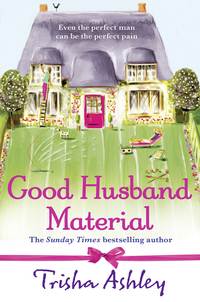
Читать книгу: «Good Husband Material»
TRISHA ASHLEY
Good Husband Material

Copyright
AVON
An imprint of HarperCollinsPublishers Ltd
77–85 Fulham Palace Road
Hammersmith, London W6 8JB
www.harpercollins.co.uk
First published in Great Britain by Judy Piatkus (Publishers) Ltd in 2000
This edition published in Great Britain by HarperCollinsPublishers in 2013
Copyright © Trisha Ashley 2000
Trisha Ashley asserts the moral right to be identified as the author of this work.
A catalogue record for this book is available from the British Library.
This novel is entirely a work of fiction. The names, characters and incidents portrayed in it are the work of the author’s imagination. Any resemblance to actual persons, living or dead, events or localities is entirely coincidental.
All rights reserved under International and Pan-American Copyright Conventions. By payment of the required fees, you have been granted the nonexclusive, nontransferable right to access and read the text of this e-book on-screen. No part of this text may be reproduced, transmitted, downloaded, decompiled, reverse-engineered, or stored in or introduced into any information storage and retrieval system, in any form or by any means, whether electronic or mechanical, now known or hereinafter invented, without the express written permission of HarperCollins.
Source ISBN: 9781847562814
Ebook Edition © March 2013 ISBN: 9780007494088
Version: 2014-07-25
Dedication
For Mary Turner Long, with love.
Table of Contents
Cover
Title Page
Copyright
Dedication
Prologue
Chapter 1: A Dream of a Man
Chapter 2: Home, James
Chapter 3: Painted Out
Chapter 4: Wild in the Country
Chapter 5: The Bourgeois Bitch
Chapter 6: The Posy Profligate
Chapter 7: Drained
Chapter 8: Busted Flush
Chapter 9: Nutthill Nutria
Chapter 10: Just Award
Chapter 11: Nasty in the Woodshed
Chapter 12: Mayday!
Chapter 13: And the Beet Goes on
Chapter 14: In the Drink
Chapter 15: Brief Encounter
Chapter 16: Cat’s Paw
Chapter 17: A Fête Worse than Death
Chapter 18: Fencing
Chapter 19: One Big Ham
Chapter 20: No Change
Chapter 21: Through a Glass, Darkly
Chapter 22: Bugged
Chapter 23: Love Goes West
Chapter 24: Reciprocations
Chapter 25: Blood and Roses
Chapter 26: Pregnant Pause
Chapter 27: Similar Conditions
Chapter 28: Bonfire of the Vanities
Chapter 29: The Great Castrator
Chapter 30: Pupped
Chapter 31: The Least Little Thing
Chapter 32: Tie-dyed
Chapter 33: Christmas Spirit
Chapter 34: Twinkle,Twinkle
Chapter 35: Uncertain Appetites
Chapter 36: Guilt-edged
Chapter 37: The Sweet Wine of Love
Chapter 38: Unlicensed Behaviour
Chapter 39: Dress Optional
Chapter 40: Sold a Pup
Chapter 41: Green-Eyed Men
Chapter 42: Mirror, Signal, Manoeuvre
Chapter 43: Out of the Dark
Chapter 44: Aftershock
Chapter 45: Issues
Chapter 46: Alignments
Chapter 47: Photo Finish
Chapter 48: Besieged
Keep Reading
Acknowledgements
About the Author
Also by the Author
About the Publisher
Prologue
‘The lyrics of the new Goneril single, ‘Red-Headed Woman’, taken from the album of the same name, show a searing agony of loss and grief. Singer/songwriter Fergal Rocco plumbs new depths of helpless agony and despair in a voice that seems to have been created for that very purpose.’
New Musical Express
Fergal: 1986
My first brief glimpse of Tish seems to have been indelibly imprinted on the inside of my eyelids, for even after almost twelve years and God-knows-how-many women, I only have to close my eyes and there she is: a dryad poised far above me in the shivering green oak leaves, stretching forward with one hand reaching out, her expression intent.
Then the sharp crack as the branch gives way beneath her weight, precipitating her into a long downward swoop towards me, apricot hair flying behind her like a wild Renaissance angel – a mermaid swept by the glassy green waves – a ship’s figurehead forging ahead, one out-thrust hand clasping—
Well, not a trident, at any rate, only some small grey thing. It didn’t just then make the same impression that Tish was about to: a bolt from the green.
While I’d like to say I caught her, truth compels me to admit I merely broke her fall, ending flat on my back with the angel sprawled across me. Enormous smoke-grey eyes stared apprehensively down into mine from an inch away. I decided to give in without a struggle.
Then something scuttled shiftily up my arm on hot, pronged feet and bit me savagely on the ear.
I swore and the creature let go and gave an evil laugh.
I’m not joking.
When Dad came round the corner of the house to see what all the noise was, he found the angel still sprawled over me, incoherently apologising and dabbing at my bleeding ear with a wadded-up bit of filmy skirt.
A small, evil-looking grey parrot stood nearby (too near) regarding us with interested, mad eyes.
‘Always Fergal catches the girls,’ Dad said cheerfully, taking the scene in his stride. Then, with his usual aplomb, he removed his jumper and enveloped the parrot in its folds.
The small assassin gave a dismal squawk, echoed by a screech of outrage from behind us. A tiny, well-preserved blonde, like a piece of shellacked fluff, was advancing up the drive with the martial air of one about to rescue her daughter’s honour or die in the attempt.
‘Leticia – get up at once!’
‘Leticia?’ I questioned incredulously, looking up into the grey eyes so close to mine. (And feeling as I did so as if I’d been sucked into a Black Hole and squeezed out on the other side like toothpaste.)
Her hand stopped its rather painful and ineffectual dabbing and she glared. ‘I don’t see that Fergal is any better!’ she said defensively. ‘And anyway, I’m always Tish.’
‘And I’m always Fergal, Angel, so you’ll just have to get used to it.’
Her eyes widened slightly, then she suddenly removed herself from me in a flutter of flowing green fabric (no wonder I hadn’t seen her in the tree) planting her knee unintentionally – I hope – in a delicate part of my anatomy in the process.
‘Leticia is a nice name,’ Dad said interestedly, giving it an Italian pronunciation. ‘And I am Giovanni Rocco, your new neighbour – call me Joe, everyone does. For six months only we rent this house while our own is renovated – the cracks appear, these old houses in London, they are not well built. And this must be your mamma?’
‘I am Mrs Norwood,’ the fluffy little blonde lady said icily, eyeing Dad with the dubiously surprised expression of one meeting a tall, blond, green-eyed Italian for the first time. (My Mediterranean darkness I owe entirely to my Irish mother.)
‘So pleased to meet you – and your charming daughter. This is my eldest son, Fergal. I have four sons and one daughter. Perhaps you have heard the youngest ones playing in the garden? They love this big garden.’
‘Yes, I have heard them. Normally this is such a quiet, select neighbourhood.’
The girl turned pink and began nervously to pleat the folds of her bloodied skirt. ‘I – I like to hear children playing,’ she ventured shyly. ‘I’m glad to meet you, Mr Rocco.’
‘Joe.’
‘Joe,’ she amended. ‘And I’m so sorry my parrot bit your son, only he escaped, you see, and I was trying to catch him.’
I hauled myself up from where I’d been sitting on the grass, stunned in more ways than one, and the blood dripped down my once-white T-shirt.
‘Oh dear,’ she said guiltily. ‘But it’s only a little bite. Ears bleed a lot, don’t they?’
‘Mine certainly seems to,’ I agreed, smiling down at her, and she blushed again and looked away. ‘Perhaps you should come round later and see how I am?’ I added cunningly.
‘Yes, come for dinner,’ said Dad expansively. ‘I stay home tonight, so I will cook – and what is one or two more? You too, Mrs Norwood, and Mr Norwood, of course.’
‘I am a widow. And I am afraid I am otherwise engaged. And Leticia—’
Seeing she was about to scupper any designs I might have on the angel I interrupted rudely, ‘There’s some disease you can catch from parrots, isn’t there? Psittacosis? Tish really ought to come and check on me.’
‘I … is there?’ stammered Tish, looking frightened. ‘Oh dear, then perhaps I had! And you will put some antiseptic on it right away, won’t you?’
‘You can check on that, too – in about an hour?’
She nodded, still looking frightened, until I winked at her, when she blushed again and glanced away, stifling a giggle.
‘Leticia!’ began Mrs Norwood in a hectoring voice. ‘You—’
Whatever she was about to say was silenced by Dad helpfully shoving the wrapped, protesting bundle of parrot into her arms and tucking the jumper as carefully around it as though it were a baby.
She looked even more aghast than she’d done when she saw her daughter entwined with me on the grass, and they both retreated down the drive, accompanied by muffled squawks.
‘Such a pretty girl,’ Dad said appreciatively. ‘So tall and slender, and the hair like sun-warmed apricots. But very young, Fergal – maybe only sixteen or seventeen. The mamma is right to be careful.’
She was only seventeen, and I was her first love, but I was twenty-two and should have known that, for her, it wouldn’t last for ever.
I suppose I was lucky it lasted a year.
Chapter 1: A Dream of a Man
November 1998
Last night I dreamed I was back in Fergal’s arms.
Nothing new there, then.
I often dream about the current heroes of the romantic novels I write, who all bear a definite (physical) resemblance to Fergal. The sort of dreams that make you wake up and feel guilty when you look at your husband.
They certainly add some oomph to my love scenes, though unfortunately only the ones in my novels. I’ve come to the conclusion it would take a lot more than that to add any oomph to James.
This time the dream was of a different genre, more like a rerun of my last encounter with my first untrue love. Maybe my subconscious thought I didn’t suffer enough at the time and decided to run it past me again.
Anyway, there we were entwined like Laocoön in Fergal’s beloved second-hand Frog-eyed Sprite sports car (thoroughly cleaned inside and out with anti-bacterial cleanser by myself when he bought it, of course – after all, who knew where it had been?). Birds were singing, the sun was shining and there was a heady smell of engine oil, old leather and disinfectant … and the equally heady feel of his arms around me as he said confidently in my ear, ‘Goneril are going to make it big this time!’
Goneril was (and still is) the name of the rock band he’d formed together with his brother Carlo and a motley assortment of other art students. Why they had to choose a name that sounds like a venereal disease, I don’t know.
In the year I’d been going out with Fergal the band had gone from being a casual thing they did for fun and to earn some money, to the point of taking over more and more of their lives and time. And now they’d just been asked at the last minute to go on tour as support to a well-known group, the original support band having pulled out.
It meant leaving for the USA almost immediately: make-or-break time.
I looked up into his amazing green eyes and said adoringly, ‘Oh, Fergal, of course you’ll make it! But – I’ll miss you while you’re abroad.’
He pulled away slightly at this, his straight black brows drawn together in a frown. ‘Why should you miss me?’
‘Of course I’ll miss you. You’ll be away for months!’
‘But – you’re coming with me, Tish! I want you with me.’
Gobsmacked wasn’t in it. ‘M-me?’ I stammered. ‘Go on tour with you? But I can’t do that, Fergal – my university course starts in September. Besides, Mother would have a fit if I trailed around after you like a groupie. And, by the way, you never asked me!’
Fergal’s always volatile temper got the better of him at this point and he gave me a little shake. ‘You are my girl, not a groupie, and I want you with me. And why go to college? What does it matter?’
‘What does it matter when you’ve got me?’ was what he really meant, and it made me see red.
‘Of course it matters! I’m looking forward to the course.’
Well, I had been until then.
Fergal had just finished his MA in Fine Art at the RCA, and the plan was that he should make a name for himself with his painting while I got my degree, so that one day we could live in the country together. He would paint and I would write poetry …
Daydreams – but anything seemed possible when I was with Fergal. And of course I hadn’t then realised that although I was a poet, I was not a good poet.
The fine distinction between turning out reams of seamless drivel like a miniature stream-of-consciousness novel and writing real poetry is sometimes hard for a teenager to grasp. My literary skills, I later discovered, lay elsewhere.
But at the time I was all set to study Modern English Literature in pursuit of this, and I thought he should understand, since he seemed just as dedicated to painting until Goneril started to take off.
‘Well – have a year out, then,’ he suggested impatiently. ‘Isn’t it about time you left home and experienced some real life?’
That would look good on my gap-year CV: ‘What did you do in your gap year, Miss Norwood?’ ‘Oh, I just screwed my rock-singer boyfriend over an entire continent. Nothing interesting.’ ‘And was that with the VSO, Miss Norwood?’ etc.
As to experiencing real life, I’d packed more of that into that year with Fergal than I had in all the previous seventeen.
I looked at him in exasperation … and my heart softened a bit. He was absolutely gorgeous, and I loved him so much. But when I remembered how casually he’d assumed I’d just follow him like a little dog at the asking – or the telling – I got angry all over again.
‘Look, Fergal, I’ll be waiting here for you when you come back: it’s not even as if I’m going away to college.’ (And that was solely to be near him. Otherwise I would have applied for something as far away from Mother as possible – the University of Outer Mongolia Scholarship in Non-Rhyming Glottal Stops, say.)
He held me at arm’s length from him, his fingers biting into me. ‘Come with me or that’s it – finish!’
His eyes were as hard and cold as emeralds in his dark face.
Then I lost my temper and in a state of hurt fury said a few cutting things about how easy he’d found it to abandon his art for Filthy Lucre (well, I was only eighteen and a bit idealistic) and then we had our worst row ever. It wasn’t followed by the sort of making-up that healed such spats either, since he took me straight home and dropped me at the gate without another word.
Even then I didn’t think he meant it – he was inclined to say that sort of thing in the heat of the moment – but by next day, when he hadn’t phoned to apologise, I started to get worried and even seriously contemplated abandoning my pride and ambitions and going with him after all. So maybe it wouldn’t last for ever, but wouldn’t it be better to have loved and lost than not to have loved at all?
Who knows what might have happened if poor Grandpa hadn’t had his heart attack that day, so that instead of chewing my fingernails by the telephone I was travelling to Granny’s?
In the end I was there for the whole summer: through the struggle that Grandpa fought and lost, and that of my down-to-earth and stoical grandmother to come to terms with her bereavement.
Mother was entirely useless, of course. She produced one excuse after another as to why she couldn’t come up to lend her support, and then crowned it all by being ‘too prostrate with grief’ to attend the funeral.
‘The woman’s got the backbone of a wet lettuce,’ commented Granny when I told her, and I was glad to see some slight return of her spirits.
Although Mother always disliked Fergal I had extracted a promise from her before I left to tell him where I was if he should ring, and to send on all my mail. But, as she almost gleefully reported, there was nothing to send on: he never contacted me again.
He’d meant what he said after all.
The coup de grâce was a picture cut from a gossip magazine and helpfully forwarded by Mother showing Fergal coming out of some American nightclub with a well-known and beautiful model draped all over him like clingfilm.
I was so devastated I prayed nightly that she would stab him to death in bed with her hipbones, but nothing happened, except that Mother kept sending me cuttings about all the scandalous things Fergal and the rest of the group got up to, until I told her that I didn’t want to know. I didn’t even want the name Fergal mentioned ever again. I hadn’t got time to have a broken heart that summer.
I’d adored Grandpa, and he and Granny had been a mismatched but devoted pair, so I threw myself into helping her in any way I could.
But somehow all the colour seemed to have bled away from my surroundings; having your first close experience of death and your heart broken simultaneously does that, I find. So when Granny decided, in an old-fashioned sackcloth-and-ashes way, to dye every garment she possessed (plus the inside of the washing machine) black, I put all the clothes I had with me in too.
I’d found this dyeing of the clothes a very dramatic gesture – the Dying of the Light, as it were – and I wore nothing but black for years. After all, it stopped all that bother about wondering what to wear, and matching things up, which I really didn’t care about any more. There is only one drawback I discovered with black – you can never see whether it is spotlessly clean or not. Wearing black became a habit, one I only really started to break when Mother pointed out that you can’t get wedding dresses in that colour.
When I finally went home from Granny’s I didn’t dye anything else black, just cut all the rest of my clothes up into little pieces – six-inch, three-inch and one-inch, so as not to waste any – and began on my hobby of patchwork.
But my experience with Fickle Fergal at least made me appreciate James’s steadier, mature qualities when I met him, so I’ve no regrets now over what happened so long ago.
And, look on the bright side, at least I didn’t wake up after this dream feeling guilty: just angry and tear-stained.
I gave James a poke in the ribs with my elbow, handed him a cup of coffee-bag coffee from the Teasmade, and informed him that it was time to get up.
Isn’t it strange that I should hate tea when I adore autumn leaves? But I find I don’t wish to drink dead leaf dust.
‘Day off,’ James grunted, trying to put his head under the duvet.
‘Day off to house-hunt, and I’ve got a feeling we’ll find the country cottage of our dreams today – we’ve just been looking too near London and in the wrong direction. Besides, a day in the country will do us both good. All the leaves have turned gold now, and—’
‘You’ve got enough leaves,’ he said hastily, re-emerging.
I don’t know why he disapproves of my harmless little hobbies. My patchwork brightens the whole flat up; it’s amazing just how much you can make from a wardrobe of old clothes. I’m still at it after all this time, and I’m sure the acreage is more than the sum of the original. Can this be possible? Algebra was never my strong point. Or do my clothes have a Tardis-like quality?
And my leaf collection: James had never minded going for walks in the park or the country while I collected them when we first started going out together, though it transpired that he thought I was going to press them. (And put them in an album perhaps? I know he’s quite a bit older than me, but that’s Victorian!)
‘Oh, no,’ I’d told him at the time, surprised. ‘I like them all curled and natural as they fall. I spread them out to dry, then give them a light coat of acrylic varnish.’
‘Varnish?’
‘They get dusty. This way I can rinse them off.’
‘Oh,’ he’d said, obviously struggling with this concept. Tentatively he’d enquired, ‘Then I suppose you make arrangements or pictures or something with them?’
‘No, I usually just pile them up in baskets and along the window ledges in my room. I like the whispering sound they make when I go in and out.’
He’d given me an affectionate squeeze and said fondly, ‘What funny ideas you have, darling – it must be living alone for so long.’
‘Oh, no, I’ve always had them,’ I’d assured him, only until then I hadn’t thought my little ways were funny.
Still, you can see how harmless my hobbies are, really.
‘I need some more oak leaves, James,’ I told him now. ‘I never seem to find enough of those, and I’d like a whole basketful.’ (I’m a basket person but not, I hope, a basket case, whatever James might imply.)
‘You know, I can’t think why everyone doesn’t collect them – they’re free, in beautiful colours and shapes, and perfectly hygienic if you varnish them.’ (I only collect clean-looking ones anyway, but you can always wipe them over with Dettox.) ‘Isn’t it strange we don’t value them? We could use them as money instead of a lot of germy bits of paper, or—’
There was a gusty sigh from under the bed, which heaved two or three times as if in a heavy swell and I broke off to exclaim indignantly, ‘You let that stupid dog in again last night, didn’t you? You know I don’t like breathing the same air in and out all night, it isn’t healthy. Or hygienic. You’d better get up and take her out so we can get off early.’
‘Plenty of time,’ he muttered, but determinedly I prised him out, assisted by the lure of stopping off for a fat-and-cholesterol-rich breakfast en route.
Fergal: 1998
‘DOES BRITAIN’S SEXIEST ROCKER HAVE A SAD PAST?’
Trendsetter magazine
Past is the operative word. And while I don’t think I could forget Tish if I tried, I don’t try, just go on rubbing salt into the old wound so that it never entirely heals.
Angst is so good for an artist …
My immaculate, fiery angel is the muse I still draw on for inspiration for both songs and paintings alike.
But that’s the Tish I remember. She’s probably Mrs Suburban Housewife now, her dreams stuffed into a drawer to moulder. (Or smoulder – she had a way with words.)
What has become of her now I neither need – nor want – to know.
Chapter 2: Home, James
‘This is it,’ I said, with conviction. ‘This is my cottage!’
‘What?’ muttered James absently, peering through a grubby windowpane at the small, blonde and bubbly estate agent, who was hovering tactfully outside despite the arctic November wind. Her legs below the short skirt were an interesting shade of blue.
He always gets a bit silly over that type, which makes you wonder why he married me: tall, reserved, and as effervescent as flat Guinness.
Come to that, why didn’t he just marry my mother, who is small, determinedly blonde and, if not precisely bubbly, sparkles a bit after the second Martini?
I gave him a nudge with my elbow. ‘Concentrate on the house, James. The estate agent is only being charming to you because she hopes to make a sale.’
He looked hurt. ‘Don’t be silly, darling – I was just thinking about the case I’ve got on. I really shouldn’t have taken a day off to look at houses, and I think I’d better pop into the office for an hour or two after I’ve dropped you at your mother’s.’
The mystery of why he’d chosen to wear one of his natty dark suits to go house-hunting was now clear. (Though admittedly they do set off his sandy-haired rugged-Highlander good looks a treat, a fact he knows very well.)
‘I’m sure Drew, Drune and Tibbs can solicit away without you for one day, James. Especially when it means we’ve at last found the right cottage.’
‘What? You don’t mean this one do you, Tish?’ His bright blue eyes widened in astonishment. ‘I can’t imagine why you wanted to view it in the first place – it’s too small, and it isn’t even detached.’
‘It’s twice as big as the flat: all these chairs make it look smaller. There are thirty-two.’
‘Thirty-two what?’
‘Chairs.’
‘What’s that got to do with anything? Look at the garden – it’s a wilderness.’
‘A big wilderness. There’s some sort of shed out there, too, and plenty of room for a garage at the side of the house.’
‘But the house is old, dark and probably unsanitary,’ he suggested cunningly. ‘It belonged to an old man who didn’t do anything to it for years, and probably died in it.’
‘From an overdose of chairs, perhaps?’ I suggested. ‘People have died in most old houses. Of course I’d have to scrub it from top to bottom before we brought any of our things in, and all the walls and ceilings need painting, and perhaps the floors sanding down and sealing if they’re good enough. Roses round the door … pretty curtains … And just look at the situation! Only one neighbour – and the agent says that’s a sweet little old lady – and the back garden overlooks the parkland of the local big house, so it’ll be very peaceful …’
I tailed off. James was looking stubborn and sulky, one of his limited repertoire of expressions. (And now I come to think of it, ‘indulgent affection’ hasn’t made many appearances lately, or ‘extreme solicitousness denoting a single-minded determination to have sex’.)
‘You know, Tish, I’ve been thinking lately that perhaps we should just look for a small weekend place near the sea instead. Jack’s promised to teach us to sail and—’
‘No. Absolutely not,’ I interrupted firmly. ‘My idea of a fun weekend does not entail sitting with my bottom in icy water, while being alternately hit over the head with a piece of wood and slapped by a bit of wet canvas. Besides,’ I added, hurt, ‘didn’t we always plan to move to the country once we could afford it?’
‘Well … yes, but—’
‘And then I can give up working in the library for
peanuts – which really makes no sense when you think that I could earn just as much from writing, if I had more
time – and we can start a family, and you could commute to work, and get lots of fresh air and exercise in the garden growing our own fruit and vegetables. Isn’t that what we’ve both dreamed of?’
He closed his mouth and said hastily, ‘Yes, darling, of course it is. That is, it sounds wonderful, but perhaps we ought to wait for something detached to come up and—’
‘We’ve been married six years, James. I can see the big three-0 coming up, and you were forty last birthday.’
He winced.
‘We can afford this house, it’s near enough to commute – only about eleven miles to Bedford station. I’ll come off the pill as soon as we move, and we’ll eat a healthy diet and take long walks to get fit.’
James looked slightly punch-drunk. ‘I suppose it might be quite nice here,’ he conceded reluctantly. ‘And,’ he added brightening, ‘Gerry and Viola live only a few miles away, and I’m sure he drives into work. Must leave pretty early. I’ll ask him what it’s like.’ He put his arm around me. ‘I can see you like this place, darling, but don’t set your heart on it. I think we ought to look at a few more first, and once I’m a senior partner we could afford something detached.’
‘I want this one, a real country cottage, not a detached mock-Tudor somewhere. I want to be a country dweller, with muddy wellingtons and a cottage garden. And you used to like the idea of being self-sufficient – you had all those books about it. I think they’re in the back bedroom cupboard. I’ll look them out when we get home.’
He didn’t look too enthusiastic, but he’s a man of short-lived crazes, as I’ve learned the hard way. While I would have expected someone to warn me had I been about to marry a serial killer, no one felt it necessary to inform me that I was about to marry a serial hobbyist. Perhaps it should be written into the marriage ceremony? Thou Shalt Not Become A Serial Hobbyist. Still, I don’t see why he can’t have the same one twice, like the measles, with a bit of exposure to the germ.
He was rather dampening when I enumerated the cottage’s many advantages on the way back to Mother’s house in darkest suburbia for Granny’s birthday tea. I’ll have to work on him; but I’m in love with my cottage, and am beginning to have distinctly now- or-never feelings about making the move.
I think it’s something to do with thirty looming ahead (my birthday is in February) and so few of my ambitions realised. And if I’m going to take the plunge and have a baby, then my sell-by date is just peeping up on the horizon.
One definite plus point to living in the cottage at Nutthill would be that James wouldn’t be so tempted to call in at the pub on his way home from work in the evenings if he had such a long drive ahead of him. (Networking, this is called, apparently.) And with so much to do to the house and garden he won’t have either the time or the money for his Friday night sessions out with ‘the boys’, or our regular show or film and restaurant on Saturday nights.
I never feel relaxed in big, pretentious, expensive restaurants anyway, and would always have preferred to save the money towards the cottage. I’m not much of a social animal, in fact. I like a quiet life and time to write after work, and I enjoy a trip to a museum or art gallery more than anything else.
James’s friends are all about ten years older than I am, with self-assured, well-dressed, boring wives, against whom I stand out like a macaw among a lot of sparrows. They’re all so well-groomed and taupe. If they mix two colours together in a scarf they think they’re daring.
Living so far out into the country would also distance us from James’s appalling old school chum Howard, ageing hippie extraordinaire, who has recently moved back to London after a brief spell crewing on a yacht, where I should think he was as much use as a twist of rotten rope.
He managed to acquire a rich girlfriend in the interval between jumping ship in Capri and being deported. (I hadn’t realised that he knew Comrades came in two sexes, but there you are. She must be deranged.)
James may not immediately see all the cottage’s
advantages …
He dropped me at Mother’s in mid-afternoon (and I can hardly wait to put some distance between myself and Mother – another plus) and drove off to the office to pick up some papers (allegedly) though I did tell him that if he wasn’t back within the hour I’d kill him.
I stifled the ignoble thought that perhaps he just wanted to see his ex-girlfriend Vanessa, recently reinstalled as secretary. When she got divorced and had to find a job, she pleaded with James to put a word in for her, and he felt so sorry for her he persuaded his uncle Lionel to take her on again.
He explained how it was, so I’m not in the least bit worried or jealous about her being there every day, even though she’s another bubbly blonde. From the sound of it, her bubbles may have gone a bit flat; James said her husband was a brute and she’s looking very worn and years older.
Mother was a bit pensive and hurt when he drove off, and nearly as dismal as James when I described the cottage. She only really cheered up again when he returned and fell like a famished wolf on the rather nursery spread of food she associates with birthdays.
Then the cake was brought out and we had to sing ‘Happy Birthday’ with James and Mother trying to harmonise, slightly hampered by Granny, who had already loudly announced that she didn’t want any fuss made about birthdays at her time of life, ignoring us and turning the TV up loudly, so that a repeat of Top of the Pops drowned us out.
Mother keeps trying to persuade everyone that Granny is losing her marbles, but I think anyone who can learn to preset a video recorder deserves Mensa membership, because I’ve never managed it.
‘You can’t possibly want to watch that, Maud!’ Mother broke off to exclaim crossly.
Granny briefly unglued her boot-button eyes from the screen. ‘Why not?’ she demanded belligerently. ‘All them funny clothes and lewd dancing. Best entertainment on the box.’
She returned her avid gaze to the gyrating row of young men clad in enormously baggy trousers and no tops. ‘Eh! There’s more hair on the back of my hands than there is on them poor boys’ chests. And call that a beard? Bum fluff!’
Mother sighed long-sufferingly and cast her baby-blue eyes heavenwards. ‘So vulgar,’ she whispered. ‘Dear James, she’s such a trial to me – and getting more senile by the day.’
I wouldn’t agree with that, though she certainly seems to be reverting to her Yorkshire roots at a gallop!
James squeezed Mother’s hand. ‘At least she has you to look after her, Valerie,’ he said, which I thought was pretty rich considering he knows Mother is the giddy, spendthrift widow of the two. But Mother is the tiny, fluffy fragile sort who seems to appeal to a certain type of man. (She’s tough as old boots really.) She spends large amounts of money she doesn’t have on beauty treatments, make-up and clothes, which is mainly why Granny decided to move in and take over.
I’m sure she thought she could sort Mother out and then leave things running smoothly while she moved to the retirement bungalow she’d set her mind on. Only, as she soon discovered, you can’t organise fluff, it just drifts away with every passing breath of wind.
She’s had to bail Mother out of major financial difficulties at least twice, and even the house itself now belongs to her, so it’s fortunate that Grandpa was a jeweller and had lots of what Granny calls ‘brass’. He was a warm man, she always says, though she won’t say precisely what his thermostat was set to.
Mother has entirely failed to see that she is Granny’s pensioner, not vice versa, and tells everyone she’s trying to make her declining years a joy to her.
Granny hasn’t shown much sign of declining yet, and not much joy either.
So Mother now squeezed James’s hand with sincere gratitude and batted long mascara-lagged eyelashes at him: ‘Dear James – so understanding. So very wise.’
Granny’s deafness has an astonishingly intermittent quality about it unrelated to whether her hearing aid is switched on or off (or even which ear she happens to have plugged it into).
She now remarked without turning her head, ‘Dearest James knows which side his bread is buttered on, and so do you. He—’
She broke off so suddenly that I swivelled round in my chair in alarm, only to find her attention riveted by the appearance on the screen of a dark, extremely angular face: a familiar, very masculine face, framed in long, jet-black hair and with eyes as green as shamrocks.
‘Well, I never did, Tish!’ she gasped. ‘It’s that Fergus who used to live next door – the one you were sweet on. Now that’s what I call a man!’
‘Fergal,’ I corrected automatically. And he’d been what I called a man, too, until fame and fortune had beckoned and he’d gone off without a backward look. It’s not what I call him now.
Still, it gave me a peculiar feeling to see him on screen moodily singing, bright eyes remote and hooded. And even more of a funny feeling in the stomach when the guitars crashed in and he started throwing his lithe body about the stage.
Age does not appear to have withered him or staled his infinite variety.
Top of the Pops seemed an unlikely venue, since Goneril has more of a cult following than a mainstream pop one. They sort of blend Celtic folk music and heavy metal and … and I’m sounding like a groupie, which I never was.
I became slowly aware that conversation at the tea-table was suspended, and I could feel James’s gaze swivelling suspiciously from the TV to me and back again, like some strange radar dish, but until Fergal vanished from the screen to be replaced by shots of the audience, drooling, I couldn’t somehow detach my eyes.
The surprise, I suppose.
‘You went out with him?’ demanded James incredulously. ‘You never said!’
It was a relief to find I could turn my head again. ‘Didn’t I? I’m sure I told you I’d been out with someone who let me down badly, and—’
‘Yes – but you never said it was him.’
‘Well, does it matter? It was all ages before I met you. His parents were renting the house next door and I met him when he came to visit them. We … sort of bumped into each other. But in the end he got famous and went off, and I went to university and then met you, darling.’
‘At least he was a man, and not a big girl’s blouse masquerading as one,’ Granny said with a scathing look at poor James. ‘First time I thought the girl might have some Thorpe blood in her after all, when she took up with him.’
James’s outraged stare almost made me giggle.
‘So foreign – I never liked him,’ Mother said, primly ignoring Granny’s remark, although her cheeks had grown slightly pink. ‘The whole family was volatile. You could hear his parents shouting six houses away. And look how he’s turned out – always in the papers over some scandal, and with a dreadfully cheap girl in tow.’
‘He wasn’t foreign,’ I said weakly (and certainly none of the girls I had ever heard of him being connected with could be described as cheap). ‘His father is Italian born – Rocco of Rocco’s restaurant chain, you know – but his mother is Irish and Fergal was born here in London.’
‘That’s what I said – foreign,’ Mother said triumphantly, recalling unendearingly to my mind all her tactics to blight my romance with Fergal. Not that it would have lasted anyway: Romeo and Juliet fell in love, grew up, argued, and parted. Juliet became a boring suburban housewife getting her kicks from writing romantic novels, and Romeo became a drug-crazed sex-maniac rock star.
Shakespeare for the New Era: not many dead. And all water under the bridge now.
James was still goggling at me as if he’d just noticed for the first time that I’d got two heads, so I smiled rather nervously and hastened to change the subject.
‘Are we going to eat this cake now the candle’s gone out? And Top of the Pops is finishing, so perhaps Granny would like to open her presents, Mother?’
Easily distracted, she began to bustle about, and the subject of Fergal was thankfully dropped.
In the car James was very quiet, which suited me, since it had made me feel very peculiar seeing the real Fergal in action, as opposed to the fantasy, sanitised version who lives a life of his own in a specially constructed holding-pen in my head, and off whom I’ve been vampirically feeding for several years to fuel my writing.
Actually, I should be grateful to Fergal for leaving me in that callous way, because it set me on to a really character-forming curve – even though it might have felt like a downward spiral at times – culminating in my having my first romantic novel accepted, and discovering True Worth and Dependability in James’s sturdy and attractive form.
It was therefore a bit of a shock when Dear Old Dependable James broke the silence by saying sourly, ‘That old boyfriend of yours – what’s his name? Rocca?’ He laughed but it came out as more of a disgusted snort. ‘I suppose they all change their names, but Rocca.’
‘Rocco, James. And it’s his real name.’
‘Of course you’d know that, wouldn’t you, having been the Great Star’s girlfriend? Funny you never mentioned it before, isn’t it? If your grandmother hadn’t let the cat out of the bag I’d still be in the dark.’
‘So would the cat,’ said my unfortunate mouth, which doesn’t always refer to my brain before uttering.
James’s expression became even more sombre, so I hastened on soothingly, ‘And really, James, there was no cat to let out of the bag, if by that you meant a guilty secret. If I’d thought a detailed list of all my old boyfriends would amuse you I’d have given you one.’
‘You didn’t have any other boyfriends. Valerie told me.’
I felt distinctly ruffled both by the idea of him and Mother discussing my suitability (I mean, she probably assured him I’d only been round the block once, low mileage, practically a born-again virgin), and the fact that it should matter who else I’d been out with (or in with) if he loved me. I bet she also tried to smooth over my unattractive points: i.e. my height (I always wear flat shoes), the cleft chin (Mother calls it a dimple) and the strange colour of my hair (strawberry blond).
‘I wouldn’t have thought you were Fergal Rocco’s type anyway, since he’s so extrovert and wild, and you’re as prissy as Snow White and Little Red Riding Hood rolled into one,’ he added unforgivably.
‘Prissy? I am not prissy!’ I exclaimed, hurt and angry. ‘Anyway, when you proposed you said it was my being so reserved and home-loving that attracted you in the first place!’
And then, with a sudden flash of belated illumination, it occurred to me that prissy was just the sort of wife he’d been looking for and thought he’d found, since I’d been quietly working hard at my course and my writing – and at that time wore sombre clothes, too. I probably seemed exactly the sort of girl his uncle Lionel had told him he ought to marry, since neither of them has the ability to tell ‘good girls’ from ‘bad girls’ (possibly because the distinction no longer exists).
A nice, quiet, malleable young girl … only he didn’t realise I’d been hardened into quietness by fire.
James was scowling blackly ahead over the steering wheel. ‘Suddenly discovering that your quiet, librarian wife is the ex-girlfriend of a notorious rock star is a bit unsettling, and I can assure you that Lionel and Honoria wouldn’t have welcomed you into the family as warmly as they did if they’d known.’
‘If that was warm I wouldn’t like to see them meeting someone they disapproved of.’
‘You may yet do so if they find out about this.’
‘I don’t see why they should. Or why their approval should be necessary.’
‘Of course it is! A solicitor needs the right kind of wife. They did comment at the time that you had appalling taste in clothes, but it would probably improve with a
little guidance.’
‘How nice of them!’ I said drily.
Honoria always wears things made out of hairy tweed like sacking, and high-necked shirts.
I remembered the first time Lionel and Honoria had met Granny, Mother having managed to keep her hidden until then.
But James must have told them about her, for we had all been bidden to dine at the pretentious and stuffy restaurant they favoured for such jollifications as interrogating future in-laws.
They had seemed mesmerised both by the size and profusion of Granny’s diamonds, a selection of which had as usual been pinned and hung at random over her billowing bosom. As she often says: if you’ve got ’em, flaunt ’em.
This might have had some bearing on the marked effort to be polite to her they made even after she called the waiter over and demanded, pointing at her soup,‘What do you call this?’
‘Chicken soup, madam,’ he’d replied haughtily.
‘If that’s chicken, it walked through on stilts.’
‘How very droll your dear grandmother is,’ Honoria had remarked in an aside to me. ‘A true original. You are her only grandchild, aren’t you?’
‘What? Oh – yes, Dad was her only child.’ I’d replied vaguely, wondering why I found Mother embarrassing whereas I never found Granny so.
Granny is clever, sharp, kind and loving, and if she doesn’t want to put on airs and graces I don’t see why she should. She says herself that Yorkshire folk are as good as any and better than most.
I gave a snort as I recalled James’s expression when Granny had written down a recipe for chicken soup and told the waiter to give it to the chef; then I realised he was still burbling on about my dress sense. Lack of, that is.
It wasn’t doing much for his driving.
‘Not that your taste has improved,’ he was saying. ‘All that black you used to wear was a bit gloomy, but you’ve gone too far the other way now.’
‘Because I’m happy, and I want to wear bright, cheerful colours while I’m still young enough.’
‘I suppose Fergal Rocco liked you in gaudy clothes?’
He liked me best in no clothes at all.
I just managed to button my mouth before it got away from me, and after a brief struggle in which my lips writhed silently, managed to say with supreme self-control, ‘Look, I only went out with him for a few months, then Goneril went to America and he dropped me like a hot potato. I never saw or heard from him again after he left. Satisfied?’
‘You’ve never seen him since?’
‘No!’
Only in my dreams. And let us hope James doesn’t get a sudden urge to read one of my books (unlikely though it seems) wherein all the romantic heroes are remodelled and transmogrified versions of Fergal.
Tish the literary vampire.
Frankenstein Tish, creating a new Fergal each time from the best bits of the old (and there were some choice bits), joined to new parts culled from my imagination. (I’ve got a good one. Lurid, even.)
Wonder if Fergal gets pale and listless every time I write a new novel? I wouldn’t like to think I was draining his batteries …
Who am I kidding? Yes I would! It would serve him right for breaking my heart.
James pulled up outside the flat with an over-dramatic swerve and stalked silently off without opening my door, one of the little old-world courtesies that first endeared him to me.
I only hope he’s not going to brood over this. I don’t know why he’s so upset about it, since he knew I hadn’t lived in an ivory tower before he came along. (A concrete university accommodation tower, actually – the urge to escape Mother overcame me.)
Perhaps it’s just that the type of man I went out with doesn’t match the image of me he’s been cherishing.
Sometimes lately I’ve thought the image he has of me doesn’t match me very much either.
You know, even now I’m not quite sure how I came to be married to James!
I wasn’t actually looking for Mr Right. Not even for
Mr Will-Do-at-a-Push-if-Desperate.
I remember telling him quite plainly that my life was blighted and I intended living quietly in the country devoting myself to my writing, and him saying he’d always wanted to live in the country too (his self-sufficiency phase). Then he just sort of sneaked up on me with flowers and chocolates and stuff. While spontaneity was not his middle name, dependability was: he was always there.
And being older he seemed rather suave and sophisticated. And attractive, even if not exciting, which was a plus point after Fergal: I’d had excitement. In fact James had practically had ‘Good Husband Material, Ready to Settle Down’ stamped on his forehead.
I don’t know what was stamped on my forehead, but it must have been misleading.
He was, in many ways, terribly conventional, and I think, looking back, that he thought I was too. I was so quiet and stay-at-home (or stay-at-digs) after Fergal.
On this reflection the car door was suddenly wrenched open, and I would have fallen out if I hadn’t still been wearing my seat belt.
‘Are you going to sit in the car all night daydreaming about your ex-boyfriend, or are you coming into the house?’ demanded James with icy sarcasm.
Oh dear.
Over his shoulder I observed something like a giant animated white hearth rug leap the area railing and bound off into outer darkness.
‘Bess is out, James,’ I said helpfully.
Fergal: November, 1998
‘ROCCO ROCKS ART WORLD.’
Sun
‘Is this the face of New Renaissance Man?’
Sunday Times
The painting is four foot square.
Step back, she swims out at you from the green depths.
Step forward, she vanishes.
The lady vanishes.
The gallery is crowded, thanks to the papers who have finally made the link between Fergal Rocco (infamous) singer/songwriter, and Rocco the painter.
At least most of the art critics have been kind. The gallery’s been quietly selling my work since I left the Royal College of Art, so there’s none of this ‘pop singer thinks he can paint’ stuff. That would have really pissed me off.
There are two things I’m serious about: my painting and my music.
There used to be three …
‘Oh, Fergal, you’re so clever,’ Nerissa sighs, lifting a face like a cream-skinned, innocent flower. ‘All these hidden talents.’
She’s small, pretty and curvaceous, and, judging from her short, select list of former conquests, finds fame in a man a powerful aphrodisiac. Nineteen going on immoral, and about as determined to get what she wants as Scarlett O’Hara. Sounds like her too, when she’s trying to get round me, all that fake ‘lil’ ol’ me’ stuff.
Daddy’s bought her everything she’s ever wanted – so far. He’d jib a bit at me, though, even if I were for sale, which I’m not – just available for a short loan.
She’s about the same age Tish was last time I saw her …
Tish.
Swimming out of the green paint like a mermaid; walking hesitantly into the gallery as if summoned by my subconscious.
For a minute I really do think she’s a figment of my imagination as she pauses in the doorway, gazing around. Her eyes seem dazzled by the lights, then they slide over the painting near me and meet mine, and it’s as if we are falling into each other all over again.
Someone coming in behind her touches her elbow to get past, breaking the contact, then she turns on her heel and is gone.
I only realise I’ve taken a stride forward when Nerissa’s weight on my arm brings me up like a sheet anchor.
‘What is it? Where are you going?’
I realise I’ve been holding my breath as though I’ve been swimming underwater for a long distance. ‘Nowhere,’ I sigh. ‘I’m going nowhere.’
Nerissa’s eyes flick from the painted girl behind me back to the empty doorway. She’s never going to be acclaimed as Intellectual of the Year, but she has her own sharp instinct to guide her.
‘That was the one – the girl in the picture, wasn’t it?’
‘The girl in the picture doesn’t exist.’
The lady vanishes.
Again.
She was the one.
Бесплатный фрагмент закончился.