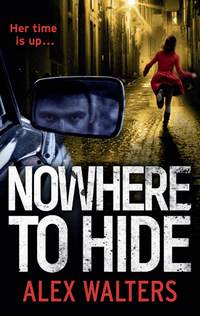
Читать книгу: «Nowhere To Hide»
ALEX WALTERS
Nowhere To Hide

Copyright
AVON
A division of HarperCollinsPublishers
1 London Bridge Street
London SE1 9GF
www.harpercollins.co.uk
First published in Great Britain by
HarperCollinsPublishers 2012
Copyright © Michael Walters 2012
Michael Walters asserts the moral right to be identified as the author of this work
A catalogue record for this book is available from the British Library
This is a work of fiction. Names, characters, places, and incidents either are the products of the author’s imagination or are used fictitiously. Any resemblance to actual events, locales, organizations, or persons, living or dead, is entirely coincidental and beyond the intent of either the author or the publisher.
All rights reserved under International and Pan-American Copyright Conventions. By payment of the required fees, you have been granted the non-exclusive, non-transferable right to access and read the text of this ebook on-screen. No part of this text may be reproduced, transmitted, downloaded, decompiled, reverse engineered, or stored in or introduced into any information storage and retrieval system, in any form or by any means, whether electronic or mechanical, now known or hereinafter invented, without the express written permission of HarperCollins.
Source ISBN: 9781847562876
Ebook Edition © November 2012 ISBN: 9780007452484
Version: 2015-07-23
As always, to James, Adam and Jonny for their support. And, of course, to Christine who made it all possible.
Contents
Title Page
Copyright
Dedication
Prologue
Part One
Chapter 1
Chapter 2
Chapter 3
Chapter 4
Chapter 5
Chapter 6
Chapter 7
Chapter 8
Part Two
Chapter 9
Chapter 10
Chapter 11
Chapter 12
Chapter 13
Chapter 14
Chapter 15
Chapter 16
Chapter 17
Part Three
Chapter 18
Chapter 19
Chapter 20
Chapter 21
Chapter 22
Chapter 23
Chapter 24
Chapter 25
Chapter 26
Chapter 27
Chapter 28
Chapter 29
Chapter 30
Chapter 31
Chapter 32
Read on for case files for our undercover agents
Case Files
Acknowledgments
About the Author
By the same author
About the Publisher
Prologue
They were some miles from the port terminal, out on the open road, before Hanlon felt able to relax slightly. ‘Shit,’ he said. ‘I really thought they were on to us back there.’ He was a short wiry man, muscular, with the air of having drunk one too many strong coffees during the journey over.
At first he thought that Mo was asleep. But the older man opened one eye, peering at him from under his trademark trilby hat. ‘You worry too much, man.’
‘Jesus, Mo. We’ve got plenty to worry about.’
Mo opened both eyes and shrugged. ‘I’d say not, wouldn’t you? All gone smooth as clockwork.’ He eased himself back in the passenger seat and jerked his thumb over his shoulder. ‘Not even any noise from back there.’
Hanlon glanced back over his shoulder. The two women were asleep. Partly exhaustion. Mainly the sedatives Mo had fed them as they were leaving the port. Christ, how had he allowed himself to get mixed up in this? Apart from anything else, it seemed so half-fucking-baked. ‘This worth the hassle, then, you reckon?’
Mo’s eyes were half-closed again, the hat slid low across his forehead. ‘What’s that, man?’
‘You think it’s worth it? All this?’
‘Not ours to judge, man. Being paid for it, aren’t you?’
‘Not enough,’ Hanlon said. ‘Like I say, I thought they were on to us back there.’
‘That was nothing. I been through far worse with those bastards. They didn’t suspect a fucking thing. Even with you shaking like a bare-assed Eskimo.’ Mo tried to sound like he was on the sidewalks of Harlem, but his North Wales intonation kept breaking through.
He was right, though, Hanlon thought. The passports had been convincing enough. The Immigration Officers had waved them through with no more than a couple of questions and a glance into the back of the car. He’d been worried that the two women might make a fuss, either on the ferry or when they reached the border. After all, it was their one chance to get free. But they’d played the game, just as Mo had said they would. Maybe because they were scared of Mo. They had plenty of reason to be scared. But Hanlon thought they’d just lost the will to resist. They’d been through too much. There was no future for them other than this.
‘Feels like there should be a better way of doing it,’ Hanlon went on. He just wanted to keep the conversation going to calm his nerve, keep focused for the long drive. Mo looked like he wanted to sleep. ‘Something less risky.’
‘What you suggest, man? Parcel post? Rolling ’em up in a fucking carpet?’ Mo slid the hat fully across his face, a gesture indicating that the conversation was at an end.
He was right about that as well. As long as the women played ball, this was low risk and cheap. Two couples returning from a long weekend in Dublin. Apparently legitimate British passports. Even the ferry tickets had been bought at a discount.
Hanlon was new to this. He didn’t even know how often they carried out these kinds of transactions. Not very, he guessed. They’d have other means of getting the women into the country in the first place. Most probably they arrived legitimately, lured by the prospect of jobs and money. Then, before they knew it, they’d vanished off the grid, exploited by thugs like Mo and the people he worked for.
Christ, he thought again, how the hell had he allowed himself to get mixed up in this?
Money. That was the short answer. A way to make the quick buck he needed. Low risk, they’d said, though he hadn’t really believed that. Just help them move the merchandise about. That had been the word. Merchandise. One of the less unpleasant words.
Hanlon didn’t know the background and he didn’t want to. Some deal had been done across the Irish Sea, and now they were bringing these two women – hardly more than girls – to work in some brass-house in Manchester. For them, probably no different from doing the same thing in Dublin. Crap either way.
They’d had cheap tickets on the last ferry of the day, so it would be into the small hours before they reached Manchester. God, he felt tired. Mo was snoring gently now, hat flat across his face. The privilege of being the senior partner, Hanlon assumed. You got to snooze your way across North Wales, while the junior oppo kept his eyes on the road. As far as he knew, the car belonged to Mo, though Hanlon assumed the car was stolen or the plates pirated in some way. Presumably, like the faked passports, nothing would be traceable. He didn’t even know for certain who Mo worked for. He had his ideas, but better not to ask too many questions, as long as they paid what was owed.
It was the first and last time, though. They’d suckered him just like they’d suckered those poor cows in the back seat. The difference was that he had an exit route. If they paid him what they’d promised, he’d have enough to settle his debts and get things back on track. Maybe even make an attempt to patch things up with Cath, if it wasn’t too late for that. At least stop her playing silly buggers about giving access to Josh. Not that he had any rights in that department, after everything he’d done.
‘Shit.’ He’d been driving on autopilot, his mind full of his unmissed past and half-imagined future. For a minute or two, he hadn’t registered the flashing blue light in the rear view mirror. He glanced down at the speedometer. It would be fucking typical to be pulled over for speeding. But, no, that was okay.
He leaned over and nudged Mo. ‘Fucking pigs,’ he hissed. ‘Behind us.’
Mo sat up with an alacrity that suggested he perhaps hadn’t been sleeping after all. He looked over his shoulder and peered through the rear window. ‘Christ’s sake, man. Relax. They’re not after us. Probably just the end of their fucking shift. Keen to get back to their loved ones. Or even their wives.’ He snorted at his own wit and prepared to stretch himself back across the seat.
But the police car was already overtaking and slowing in front of them, in an unmistakable signal for them to pull over.
‘Jesus, Mo,’ Hanlon said. ‘What the fuck do we do now?’
Mo was sitting bolt upright, looking less relaxed. ‘Let me do the talking. Keep calm and keep it zipped.’ He looked across at Hanlon, his gaze unwavering. ‘Nothing to worry about, man. Long as you leave it to me.’
‘But the car–’
Mo shook his head. ‘We’re not fucking amateurs, man. Vehicle’s stolen, but it’s a ringer. Licence plates match the type and colour. Name of registered owner’s the same as the passport. It’s all sorted. There’s nothing to worry about.’
‘So why the fuck are they stopping us?’ Hanlon was already pulling into the hard shoulder, carefully following the police vehicle.
‘Probably just routine. Not much opportunity to hassle a black guy out here in the sticks.’ He frowned suddenly, leaning forward in his seat. ‘That not right, man. Who is that guy?’ He watched for a moment as a figure climbed slowly out of the car in front, then turned to Hanlon. ‘Shit, man. Get started. Just fucking drive!’
Hanlon stared back at him, bewildered. He’d already cut the engine. Now, in the face of Mo’s unexpected panic, he frantically twisted the ignition. He slammed his foot on to the accelerator, misjudging the movement, and the engine stalled.
‘Fuck, man. Just get it started.’
Hanlon turned the ignition again, but he’d flooded the engine and the starter turned ineffectually. In the dark outside, the figure had reached the car. Hanlon made another attempt to start the car, trying to remember what to do about a flooded ignition. Then, suddenly, the engine burst into life. As he struggled to put the car into first gear, his mind and actions refusing to coordinate, the car door beside him was pulled open. He jammed the gear stick into what he thought was first, banged his foot hard down on the accelerator and let out the clutch.
The engine coughed and died.
The figure outside said: ‘Need a few more lessons, mate. Don’t take off in third.’
Hanlon looked across at Mo, baffled now. Mo had his head in his hands, his body hunched as if anticipating a blow.
‘Fucking cowboys,’ the figure said. ‘Shouldn’t be let out on your own. Give us all a bad name.’
Hanlon raised his head and stared through the windscreen at the car parked ahead of their own. Not a police car. Not a police car after all. Just a plain dark saloon with one of those magnetic blue beacons that doctors and plainclothes cops use to get through the traffic.
He looked up at the figure standing next to him. Black suit. A baseball cap. Dark glasses. No one he’d be able to recognise in daylight. Beside him, Hanlon could hear Mo breathing rapidly, murmuring something, a voice on the edge of losing it.
‘Nice of you two to do the heavy lifting, though,’ the figure said. He leaned forward and peered into the back seat. There was a gun in his hand, Hanlon noticed, feeling oddly calm now. ‘Bringing these two charming ladies over. I’m sure we’ll use them wisely.’
He straightened up, juggling the gun gently in his hand. Then he looked back down at Hanlon. ‘Sorry about this, son,’ he said, gently. ‘Nothing personal.’
Hanlon stared back, surprised by the softness of the man’s tone. He suddenly had the sense that it was all going to be all right. The man would simply take the women and leave. Okay, he and Mo would lose the payment because they’d fucked up. But he could live with that. He could fucking live.
But the man had already taken a step back and Hanlon knew that, really, nothing would be all right again. He watched as the man crouched slightly, then raised the gun and pointed it past Hanlon into the car.
Hanlon was screaming before the gun was fired. Before he felt the rush of air and heard the explosion. Before he sensed the impact and the sudden jerk from Mo’s body beside him. Before the windows and seats and his own face were showered in Mo’s blood and bone and grey matter.
He was still screaming as he tried ineffectually to free himself from his seat belt, throwing himself sideways in a vain attempt to drag himself from the nightmarish, blood-drenched interior of the car.
And he stopped screaming only when the man outside raised the gun and fired for a second time.
Ken had left his car in one of these back streets, but for the moment he couldn’t quite remember where. Earlier, it had seemed the obvious place, just around the corner from the club, handy for when he came out. But now he’d walked round the block twice and he still couldn’t work it out.
Maybe someone had stolen it. Always possible in an area like this. Not likely, though. Not the kind of car to attract thieves. Too new to be easy pickings, but not so modern or sexy that anyone would be particularly drawn to it. Not one for the boy-racers, or for the professionals who blagged prestige cars to order. A nondescript runabout for the middle-aged. Just the way Kev liked it.
Story of his life, in fact. Keep your head down. Don’t draw attention to yourself. Get to know the right people. Word of mouth. Enough people knew who he was, but not too many. If he wanted some gear, he knew who to go to. If he had some gear to shift, people came to him. Otherwise, he drifted out of sight, unnoticed. An inconspicuous link in the chain.
He didn’t feel particularly inconspicuous tonight, though. He’d made a mistake, lost a bit of control. He wasn’t a good drinker. A cheap drunk, Kev, they always said. A few pints and he’s anybody’s. That wasn’t quite true. Kev was always his own man, no matter what he’d drunk. But on a night like this that just meant there was no one to look out for him.
Shit. He stumbled on a loose paving slab and clutched at a shop front to steady himself. He didn’t really believe the car had been stolen. In any case he was in no state to drive. But he’d wanted to reassure himself that it was still safely there. Now all he could do was hope that his memory would improve once he’d sobered up.
He turned round, trying to get his bearings. Where was he, exactly? He didn’t know Stockport well. He wasn’t even sure why he’d come along this evening. A gentleman’s club, Harvey had said. The audience hadn’t seemed to contain many gentlemen, and the women on stage hadn’t been Kev’s idea of ladies. Expensive bloody drinks, as well, especially when the big man, whoever he was, had moved them on to rounds of shorts. Harvey had told him he’d meet some useful people there. Maybe he had, but in the morning he’d have no bloody idea who they were.
He tottered his way towards the next street corner, looking for some recognisable landmark. There was a knot of street lights at the far end of the street. Probably the A6, the characterless trunk-road that sliced through the town on its way to Manchester. Once he reached that, he’d find a minicab office. This was going to cost him a bloody fortune. A taxi back home, and then another cab back in the morning. Why had he let Harvey talk him into this?
It never paid to stray outside your own territory. He should know that by now. Up in the city, he knew what was what. Who to talk to, who to avoid. Tonight, he’d talked to a few people, suggested a few deals, but he hadn’t known what they thought. He hadn’t even been able to work out who were the real players. Not the mouthy ones, for sure. There’d been a few of those, making the right noises, but that counted for nothing. It was the ones in the background who mattered, the ones who watched you, made their judgements, and said nothing. It was only later that you’d find out whether they were happy or not.
What the fuck had happened to Harvey anyway? He’d been there earlier, had done the introductions, settled Kev in with a crowd who looked mostly like chancers. Then at some point he’d buggered off. Probably found himself some woman. Someone not too choosy.
Shit. This was the last time. Harvey always made out he was doing you a bloody favour, and nine times out of ten you ended up out of pocket.
He stopped again. The lights he’d thought marked the A6 had turned out to be at the corner of some other junction entirely. It was vaguely familiar, but only vaguely. Somewhere he’d driven through maybe. Certainly nowhere he’d ever been on foot. There was a closed down pub opposite, the back end of some industrial buildings. Not the kind of place you’d find a minicab.
He turned, peering through the pale darkness down each of the streets in turn. There wasn’t even anyone around to ask, this time of night. The only sign of life was a car pulling slowly out of a side street further down the road. Judging from the speed, the driver was nearly as pissed as he was. Kev had been half-thinking about trying to flag the car down, ask for directions, even try to cadge a life to the nearest minicab office. But who would pull up for a drunk at this time of the night?
Well, maybe someone who was in the same condition. To Kev’s mild surprise, the car drew up next to him, the electric window slowly descending. If you’re after directions, pal, Kev thought, you’ve come to the wrong fucking bloke.
Kev was on the passenger side of the car and could see only the shape of the driver through the open window. Baseball cap, he noticed irrelevantly. Dark glasses. Who the fuck wears dark glasses to drive at night?
From inside, a flat voice, devoid of intonation, said: ‘Kevin Sheerin.’ It was a statement rather than a question.
Kev suddenly felt uneasy. He glanced both ways along the street, but there was no sign of anyone. Just the stationary car in front of him. A dark saloon. Cavalier or Mondeo or somesuch.
‘Who’s asking?’ he said finally. The wrong response, he realised straight away. No one was asking, but he’d already given all the answer that was needed. The car window was already closing. ‘What the fuck–?’
But that question needed no answer either. Kev, sensing what was coming, had already started to run, but his drunken feet betrayed him and he stumbled on the edge of the pavement, tumbling awkwardly into the road. He rolled over, head scraping against the rough tarmac, trying to drag himself out of the way. He could already taste blood in his mouth.
It was too late. The headlights, full beam, were blinding his eyes. The engine, unexpectedly loud, the only thing he could hear. The moment seemed to last forever, and he told himself that he’d been wrong, that it wasn’t going to happen after all. Then he was at the kerbside, trying to drag himself upright, and the car slammed hard into his crouching body.
For an instant, he felt nothing and he thought that, somehow, miraculously, he’d escaped unscathed. Then he tried to pull himself upright and immediately the pain hit him, agonising, unbearable, a shockwave through his legs and back. He fell forwards again, hitting his head on the curb, scarcely conscious now, thinking; shit, my back–
He had no time to think anything more. The car had reversed a few yards, and now jerked forwards again, the front wing smashing into his legs. He lay motionless as the car rode bumpily over his prone body and disappeared into the night, leaving his mangled, bloody corpse crumpled in the gutter.
Steve woke too early, like every night since they brought him here. It was the silence, he thought. The silence and the darkness. He’d never be comfortable in this place. He was a city boy, used to the traffic-drone that never died away, the wasteful small hours glare of the street lights and office blocks.
He rolled over, pulling the cheap duvet around his body, burrowing in search of further sleep. But the moment had passed. He was awake, mind already racing through the same thoughts, the same anxieties. Feeling a sudden claustrophobia, he threw back the covers and sat up in the pitch black. The room faced east, across the open valley, and the curtains were as cheap and flimsy as the duvet. But there was no sign of dawn, no promise of the rising sun.
He fumbled around the unfamiliar bedside table until he found a switch for the lamp. The sudden glare was blinding but, after a moment, reassuring. The bedroom was as bland and anonymous as ever. Off-white walls, forgettable chain store pictures, inoffensive flat-pack furniture. There’d been a half-hearted attempt to make it homely, but that only highlighted its bleakness, confirmed beyond doubt that no one would ever stay in this place by choice.
It was cold too, he thought, as he reached for his dressing gown. The central heating hadn’t yet come on, and he could taste the damp in the air. He crossed to the window and peered out. A clear night, the sky moonless but full of stars, less dark than he had imagined. In the faint light, he could make out the valley, the faint gleam of the Goyt in the distance. Miles from anywhere. The end of the line, past all civilisation.
He pulled the dressing gown more tightly around him, and stepped out on to the landing. This was his routine. Waking in the middle of the bloody night, making himself a black coffee, sitting and waiting for the sun to rise on another empty day.
The unease struck him halfway down the stairs. Nothing he could put his finger on, just a sudden sense of something wrong. He hesitated momentarily, then forced himself to continue down. Of course something was wrong. Everything was fucking wrong. He didn’t even know why he’d done it. It wasn’t the money – he knew there would be little enough of that, now they didn’t need him any more. It wasn’t the supposed guarantees. He’d few illusions about what those would be worth when the excrement hit the extractor. It wasn’t even that he was doing the right thing. He’d just managed to get himself wedged firmly up shit creek and then discovered that there never had been any paddle.
He pushed his way into the tiny kitchen and went wearily through the familiar ritual – filling the kettle, spooning coffee into the cup, adding two sugars. While the kettle boiled, he stared out of the kitchen window, across the postage stamp of an unkempt garden, towards the Peaks. The eastern sky was lighter now, a pale glow over the bleak moorland.
He stirred the coffee and paused for a moment longer, sipping the hot sweet liquid, gazing vacantly at the darkness. The sense of unease had remained, a thought lurking at the edge of his mind. Something more focused than the usual ever-present anxiety. Some idea that had struck him and receded before he could catch it.
He picked up the coffee and forced himself back into his routine. He would go into the living room, sit on the chilly plastic sofa, switch on the television and watch the silent moving figures, with no interest in turning up the volume. Waiting for yet another bloody morning.
He pushed open the sitting room door, and his mind finally grasped the thought that had been troubling him. The door. He’d closed the sitting room door before going to bed. Another part of his routine, some unquestioned wisdom retained from childhood. Close the downstairs doors in case of fire. Waste of bloody time in a place like this, he’d reasoned. Whole place would be up like a tinderbox before you could draw a breath. But he still closed the doors.
Halfway down the stairs he’d registered, without even knowing what he’d seen, that the living room door was ajar.
He thought of stepping back, but knew it was already too late. In that moment another, more tangible sensation struck him. The acrid scent of cigarette smoke, instantly recognisable in this ascetic, smoke-free official house.
He thrust the door wide and stepped inside. The small table lamp was burning in the corner of the room, The man was sprawled across the tacky sofa, toying lazily with a revolver.
‘Up early, Steve,’ he commented. He was a large man in a black tracksuit, wearing dark glasses, with a baseball cap pulled low over his eyes. His face was neatly shaven and boyish, but there was nothing soft about him. ‘Guilty conscience?’
‘Not so’s you’d notice,’ Steve said. ‘You?’
‘Sleep of the just, mate,’ the man said. ‘Sleep of the fucking just.’
A moment before, Steve had been contemplating how to get out of this. Whether to try to get back into the kitchen or upstairs. Out of the front door, or through the patio windows.
But there was no point. The man knew his name. Knew who he was. Why he was here. Someone had grassed. Why else had he come? Someone would always grass. He ought to know that better than anyone.
There was no way out. No future. There never had been any future, not to speak of, once he’d taken that step. He’d known it then and there was no escaping it now.
Steve felt oddly calm, detached, observing all this from a distance. He saw the man playing aimlessly with his gun. He saw it all, and he felt untroubled. He had no illusions about what the man would do. Perhaps no more than he deserved.
So he stood there, motionless, waiting for it to start. And in that moment – before the flare and the noise, before the impact, before his blood began to seep into the worn fibres of the cheap grey carpet – Steve felt almost relieved.
He’d almost missed it.
Something caught the corner of his eye, some movement. A twitch. He moved himself to the right to try to gain a better vantage through the spyhole.
It was well after midnight. The dead hours of routine patrols when nothing much ever happens. Maybe just some scrote with insomnia – and, Christ knew, all of this bunch ought to have trouble sleeping – shouting the odds, wanting to share his misery with the rest of the fucking world.
But usually nothing much. A fifteen minute stroll along the dimly lit landing, glance into the cells, check that no one was up to no good. There was never any real trouble.
Sometimes Pete tried to kid people that this was a responsible job, stuck up here all night by himself on the landing. If anything happens, it’s up to me to sort it out. Yeah, he thought, up to me to press the bell and summon backup. He was an OSG. Operational Support Grade. Bottom of the pile, with – at least in theory – minimal prisoner contact. Didn’t always work out that way, of course. But nobody expected much of him. Especially not the Prison Officers.
Like that one earlier, who’d been coming up here just as he was ending his previous patrol. Pete had been running a bit late, had lingered a bit too long over his coffee and copy of The Sun. Nobody really cared at this time of the night, but he didn’t like to let things slide, so he’d been a bit out of breath, dragging his overweight body hurriedly round the landings then down the stairs.
He hadn’t recognised the officer who’d met him on the stairs. He thought he knew most of them, but they kept buggering the shifts about and this one was new to him. Christ knew what he was doing going up to the landings at this hour.
Pete had tried to offer a cheery greeting – they were both stuck on this arse end of a roster, after all – but the guy had just blanked him, hardly seeming to register that Pete was there. Well, fuck you as well, Pete had thought, puffing down the last few stairs. He’d heard the officer unlocking the landing doors above him.
Afterwards, he’d been worried that the officer might report him for being late. It was a stupid concern. The guy probably wouldn’t even have known what time Pete was supposed to carry out the patrol. But there was something about him, something about the way he’d ignored Pete on the stairs, that had seemed unnerving. Just the kind of officious bastard who’d grass you up for the sheer hell of it.
So, just in case the guy was still up there, Pete had kicked off his next patrol a little early so he could get it finished on time without busting a gut. But of course the landing had been deserted. Whatever the officer had been doing, he’d finished it and buggered off.
There was nothing else to do. Pete shuffled with effort round the landing, stopping to check on each cell in turn. Everyone sleeping like a baby.
He’d reached the last cell and was preparing to move on to the next landing, when he stopped and looked again.
Yeah, he’d almost missed it. The cell was in darkness and he’d assumed the occupant was securely in bed. Then he’d caught some movement in the periphery of his vision. He hadn’t even been sure he’d seen it at first. He’d shifted his body to get a better view.
Jesus.
There was something – someone – there, jerking and struggling. Someone pressed against the wall behind the door, almost invisible. And now Pete could hear the sound of choking, the awful sound of a wordless, gasping scream…
He reacted better than he’d have expected, racing across the landing to sound the alarm. Then back to the cell, fumbling with his own set of keys. He was supposed to enter the cells only in the direst of emergencies, but surely this counted as one of those. As he pushed open the door, it occurred to him that he might have been suckered. But the landing was sealed and backup would be there in minutes.
He knew straight away he’d done the right thing. The prisoner was hanging halfway up the wall – Christ knew how he’d managed it – some kind of cord tight around his neck. The man’s head lolled to one side, his waxy face already blue in the dim light from the landing.
Pete threw his arms round the prisoner’s body and tried to drag it down from whatever was holding the rope. He struggled at first, afraid that he was doing more harm than good, but knowing the prisoner would have no chance as long as his own weight continued to tighten the cord. Suddenly, as Pete strained to lift the prisoner’s body, the rope gave way and the body toppled sideways, out of Pete’s grip, on to the hard floor.
A nail. A fucking six inch nail hammered into the wall. Where the fuck had he got that from? And the rope, for that matter? Someone was for the high jump.
Pete crouched down by the body, fumbling to loosen the ligature from the prisoner’s neck. The face was purple now, and the old guy looked like he might be a goner already. Pete fumbled around the plastic cord and finally found the knot. He could feel it beginning to give under his trembling fingers. At the same moment, he heard the sound of the landing gates behind unlocked.
By the time the two officers and the principal had reached the cell door, Pete had managed to loosen the rope. He looked up as the three men crowded the doorway: ‘Trying to top himself.’
Pete moved back as the principal officer crouched over the body and began to administer CPR, thrusting hard and rhythmically on the prisoner’s chest. One of the officers was on his radio calling for an ambulance.
Pete dragged himself to his feet, only now beginning to take in what had happened. What he’d just dealt with. ‘Jesus.’ He glanced down at the supine figure, still bouncing under the pounding arms of the principal officer.
The officer with the radio nodded laconically towards Pete. ‘Good work, son. Let’s hope we’re in time. We all get a bollocking if one of them tops himself.’ He took a step back and glanced at the number of the cell. ‘Mind you,’ he added, ‘won’t be too many saying any prayers for this one.’
Pete looked up. ‘That right?’
‘Don’t reckon so.’ The officer moved to lean against the doorframe. ‘This is Keith Welsby. Just another bent copper. There’s one or two would be glad to help him on his fucking way.’
PART ONE
1
‘So you were lying to me.’
Salter gazed back at her, his mouth working hard at a piece of gum. His expression was that of a bored spectator staring into an aquarium at an unfamiliar species of fish. ‘If it wasn’t the kind of thing that gets me branded as sexist,’ he said, finally, ‘I’d say that sounded a tad hysterical, sis.’
She eased herself back in Salter’s uncomfortable visitor’s chair, wondering how to extricate herself from this conversation. There was no way of combatting Salter in this kind of exchange. The most you could hope for was to slow him momentarily on his path to victory.
‘It was a condition of my joining your team,’ she said. ‘I made that clear.’ Which was true, but there was no way of proving it now.
He shrugged, chewing at the gum. ‘Nobody makes conditions in this business. You know that. We do what we’re told.’
‘I’m not trying to be difficult, Hugh–’
‘Never thought you were, sis. All seems easy enough from where I’m sitting.’
She didn’t doubt that. Life tended to look pretty easy from where Hugh Salter was sitting, if only because he was busy making life hard for everyone else. Like his insistence on calling her ‘sis’. A hangover from that last undercover assignment. Salter had invented a family connection supposedly as cover in their telephone conversations. It was a joke now long past its sell-by date, but he knew she was irritated by the implied intimacy.
‘You know my circumstances. There must be someone else.’
He waved his hand around as if the other potential candidates were gathered in the office with them. ‘Believe me, sis, I’ve looked. There’s no one else with your talents.’ He made the last word sound like a double entendre. ‘No one with half your experience.’
That wasn’t entirely bullshit, she knew. Apart from herself, Salter’s team was pretty wet behind the ears. That was how Salter picked them. Bright young things smart enough to do a decent job, but without the confidence to answer back. She tried another tack. ‘Anyway, it’s too risky. It’s against procedures.’
Salter’s smile was unwavering. ‘“Procedures”? Who gives a fuck about procedures? The other side don’t follow procedures.’
And that’s why they’re on the other side, she thought. Out loud, she said, ‘It’s not about bureaucracy, Hugh. It’s about not jeopardising the work. Or me, for that matter.’
‘Look, sis, if there was an alternative, I’d jump at it. I don’t want to do this any more than you do.’
Like hell, she thought. That’s what this came down to. Another of Hugh Salter’s games. She sometimes thought it was what really motivated him. Not career. Not money. Just the opportunity to screw other people around. None of this was a surprise. It was what she’d expected, one way or another, from the moment she’d finally agreed to join Salter’s team.
It had taken him longer than she’d expected, though that was probably just another part of the game. It was six months since the business with Keith Welsby, their former boss and mentor. She’d been here in HQ all that time, working largely on backroom intelligence. Page after page of data on mobile phone numbers, banking transactions, email correspondence. It was important work and she was good at it, but that didn’t make it any less boring. She’d learned to treat the boredom as part of the challenge. You ploughed your way through endless documentation, jotting a note here, a comment there, knowing that most of it was telling you nothing. But you had to keep your head engaged, waiting for the rare moment when something jumped out at you. Some trend, some pattern, some significant link with another piece of data, pages before.
It wasn’t quite that basic, of course. The databases did a lot of the work, highlighting links and trends. Even so, when it came to the detail of a specific case, there was still a heavy dependency on the individual analyst. The most important links were often the least obvious. An odd piece of data – a name, a number – that had snagged in the back of your mind from another file. Sometimes it was little more than intuition, a feeling that there was a link you’d missed or a pattern you’d overlooked. She knew she was good at it. She could cope with the tedium, and she had a gift for finding information that others had missed.
In any case, after everything that had happened, she’d needed a break. She’d nearly been killed, for Christ’s sake. But then so had Salter, and he showed no obvious signs of mental trauma. And it was Salter, in the end, who’d killed Jeff Kerridge and exposed Welsby as corrupt. He’d been acclaimed as a hero and become the new rising star. Marie had watched uneasily from the sidelines, suspicious of Salter and his motives, convinced that, beneath that clean-cut ambition, he was as corrupt as their former boss. But Salter had sailed serenely on, enjoying the fruits of promotion, apparently untroubled by anything that had happened.
So she’d been happy to step back from the front line and lose herself in the rhythm of facts and figures. For the last six months, every day had been the same. The semi-comatose journey up the Northern Line, the short walk along the Embankment, takeaway latte from the staff restaurant. Settle at her desk and boot up the computer. Check emails, then access the database or pull out the files. The same every day. A sandwich at her desk, or lunch with a couple of the other analysts. More data-crunching till it was time to get the Tube home. Despite herself, she’d begun to enjoy the routine, the predictability.
Maybe Salter had hoped she’d be climbing the walls by now. She might have predicted it herself. She’d done this kind of work before and been happy with it, but that was a long time ago. She had been a different person then, she thought, with different expectations. But perhaps she’d changed less than she imagined.
In fairness, she’d always intended to return to the front line eventually. After they’d brought her in from the field, they’d had her formally assessed by Winsor, their pet psych. In his inimitable style, Winsor had stated the blindingly obvious in language that no one fully understood. The upshot was that she’d suffered a major psychological trauma. Well, thanks for that, she’d thought. If you hadn’t brought it up, I might not have noticed.
Winsor’s conclusion was that she was a resilient character, and that there would be no long-term effects as long as they didn’t push her too hard. She had no idea what evidence he had to support this assertion, but she felt no need to challenge it. If they wanted to stick her in a quiet office for a few months, that was fine by her. She had plenty of other problems on her plate, after all.
She looked up at Salter’s blankly smiling face, wondering how to play this. There was no point in trying to match Salter at the gamesmanship. All she could do was play it straight down the line. ‘I take it you’ve cleared this idea, Hugh?’
For a moment he shifted in his seat, his body-language suggesting that he couldn’t fully answer her question. But she knew Salter well enough to recognise that he wouldn’t go into something like this half-cocked. He’d always make sure his backside was covered. ‘I’ve been through the procedures, if that’s what you mean. What do you think this is?’
Well, that was the question. But, as Salter well knew, it was a question she couldn’t begin to answer. ‘It all just seems a bit irregular, Hugh. I mean, the protocols–’
‘The protocols are there as guidance. We’re professionals, Marie. We have to exercise judgement.’ It was the first time he’d used her name. A sign that he was shifting things up a gear.
‘And your judgement is that this is safe?’ she asked.
‘As safe as these things ever are. Christ, Marie, it’s my neck on the block if things go wrong.’
She doubted that. If things went wrong, she would be the one at immediate risk. And she was willing to bet that Salter had made sure he wasn’t in line for any professional blame. One way or another, he’d have everything covered. ‘But it’s the same area. And it’s only been six months. That must be a risk.’
‘There’s always a risk,’ he said. ‘But it’s not the same area. Not the same network at all. We’ve looked at it very carefully.’
‘It’s the north west. There are bound to be overlaps. It just takes one person–’
‘We’ll take care of it. You’ll look different. You’ll be a different person. Even if you should happen to stumble across somebody from before, there’ll be no link. Nobody will have any reason to make the connection.‘
It didn’t sound convincing, she thought. They reason they had protocols was because, whatever the odds, shit still tended to happen. She’d experienced it herself. Some past contact eyeballing her suspiciously because she’d turned up somewhere she wasn’t supposed to be. She could change her hair, her clothes, her lifestyle; but it wouldn’t cut any ice if the wrong people became suspicious. ‘But what if they do, Hugh? What if someone looks at me and thinks, wait a minute, that looks like old Marie who used to run the print shop in Trafford Park?’
‘Christ, Marie. It’s not going to happen, right. You’re the best person for the job, that’s what it comes down to. You can do it.’
Jesus, he was trying to flatter her now. Flattery wasn’t one of Salter’s strong points. His compliments always sounded insincere, she assumed because he didn’t really believe that any other person could match the towering talent that was Hugh Salter. ‘Don’t bullshit me, Hugh,’ she said. ‘You’ve just come to me because I’m convenient. If you tried to give this to one of your youngsters, you might actually have to put some effort into training them.’ She paused, conscious that she was coming close to saying something that she really might regret. ‘Do I actually have any choice in this?’
‘There’s always a choice, sis. But I really want you to give it a go.’
‘I’ll think about it.’ She knew that she might as well have saved both their time and just said yes there and then, but at least she could string out his discomfort for a day or so. ‘Chester?’
‘Chester,’ he agreed. ‘It’s a different world. Jesus, it’s nearly Wales. Safe as houses. No contact with the Manchester bunch at all, so far as we know.’
So far as we know. Hardly the ring of bloody confidence. How much did they know? Three-fifths of fuck all, if past experience was anything to go by. ‘Drug trafficking?’
‘Mainly.’ There was a look of relief on Salter’s face, even though he was trying hard to hard to keep it hidden. He knew he had her hooked now. Once you started talking about the detail, there was no going back. ‘One of those who’ll bring in anything if the price is right. Some cigarettes and booze, but mainly the hard stuff. Comes across from the east coast ports, and then they distribute it around Chester and North Wales.’
‘But not Manchester or Liverpool?’
‘There are bigger fish operating up there. No point in this one trying to compete. He’s got a nice little niche of his own, without antagonising the competition.’
It made sense. The north west was carved up pretty thoroughly by the big boys. That elite bunch had included the infamous Jeff Kerridge, until Salter had blown off the side of Kerridge’s head, supposedly in self defence. They’d had intelligence that Kerridge’s widow, the very redoubtable Helen, was continuing her late husband’s good work. And now Pete Boyle, Kerridge’s former protégé turned competitor, was out of prison and, by all accounts, also rebuilding his influence around Manchester.
That was the real source of her unease, even now. There’d been a point, six months before, when she was convinced that Salter was on Boyle’s payroll. Salter had claimed that, with no one to trust, he’d been forced to go freelance to gather definitive evidence against Kerridge and their corrupt former boss, Keith Welsby. Welsby had ended up behind bars, and was still awaiting trial after a botched suicide attempt. Salter had emerged smelling of roses. But Marie had suspected that the scent concealed a more noxious stink. If Boyle had been looking to depose Kerridge, maybe Salter’s intervention hadn’t been so public-spirited after all. And that in turn raised questions about the manner of Kerridge’s death.
She’d agreed to join Salter’s team because she wanted some closure on all that. She wanted to find out the truth. But the last six months had proved nothing. As far as she could tell, Salter had played everything by the book. He was still tasked with rebuilding the case against Pete Boyle that had collapsed with Welsby’s exposure and Kerridge’s death. They’d arrested Boyle with the expectation of a successful prosecution, but the evidence had been irredeemably tainted by Welsby’s corruption. In Marie’s eyes, the whole affair had ended just too well for Boyle and she suspected that Salter had been part of that.
But she could prove nothing. He’d asked to take on the Boyle case, supposedly as unfinished business, but perhaps simply to ensure that it remained under his control. Whatever his motives, he’d appeared to make some progress. They’d gathered more intercept evidence against Boyle, they’d pinned down one or two more witnesses. A few more tiny pieces of the jigsaw had fallen into place. They were still a long way from having anything they could be confident would stand up in court. But, given that the Prosecution Service had already ended up with egg on its collective face once before, building a new case was always going to be a slow process.
It might be that Salter was simply going through the motions, recognising that he had to be seen to be doing something about Boyle. But Marie had seen and heard nothing that might confirm her suspicions.
And now this. Sending her back to the edge of Boyle’s stamping ground. Pushing protocol to its limit by assigning her to an area where she might be recognised. It wasn’t against the rules exactly, but it wasn’t standard practice.
The generous explanation was that Salter was, in his inimitable style, just jerking her around. He knew the situation with Liam. He knew how difficult things were getting. His initial promise had been that, even when it was time for her to go back into the front line, he’d find some operational role that kept her reasonably close to home. She’d accepted that, at least for the time being, it wouldn’t be possible for her to continue in an undercover position. She assumed they’d find her some investigation or enforcement job in London. It wasn’t exactly the career move she was looking for, but it would do till, one way or another, things became easier on the domestic front.
So maybe this was just Salter pulling the rug from under her, handing her a whole new set of problems to contend with. The less benign interpretation was that he was using her. If her suspicions were correct, and Salter really was on Boyle’s payroll, then maybe she’d been selected to do some of Boyle’s dirty work. As Salter had implied, any drug dealers in Chester were operating on the edge of Boyle’s territory. Perhaps Boyle was looking to expand his empire and her role was to help take out the competition.
Salter was leaning back in his chair, his relaxed manner suggesting that he was confident he’d achieved his objective, even though his words remained tentative. ‘Just give it some thought, sis. That’s all I want. Sleep on it overnight. We can chat about it again tomorrow.’
You smooth bastard, she thought. Whatever other qualities you might or might not have, you’re good at this. You know how to play people. You know I want to be back in the field really; you know the kind of work I want to be doing. You may even know that I’m just looking for a way to trip you up, to prove some link between you and Boyle. You’ve pitched this just right, going out on a limb yourself so you can lure me out after you.
And maybe, her mind continued before she could control her thoughts, he knows what you want at home, too. Maybe he realises that all your talk of wanting to stay near home, of needing to be there for Liam, is so much bullshit. Maybe he knows that you’re looking for a reason to get away.
Maybe. If so, Salter knew her better than she knew herself. She thought she’d reconciled herself to doing whatever it took to stay near Liam. To give him the support he needed. She’d come to terms with that – right up to the point where Salter had dangled this assignment in front of her.
She pushed herself up from her chair, determinedly looking Salter in the eye. ‘Okay,’ she said. ‘I’ll think about it. And I’ll tell you tomorrow.’
Salter smiled back at her, his expression unrevealing. ‘That’s all I can ask of you, sis. All I can ask.’
2
‘Just about there,’ the DI said, pointing to an apparently unremarkable point on the hard shoulder. He gestured off towards the steady stream of traffic heading along the dual carriageway. ‘Cool bastard. It was well out in full view. Wouldn’t have been much traffic at that time of night, but even so…’ His tone sounded almost admiring.
‘You reckon a professional job?’ Brennan asked. It was a miserable day for early autumn. Not raining yet, but leaden skies low over the horizon. Pity any poor bugger who’d just arrived here on holiday. They were standing in a gateway to a field beyond the road. A bleak landscape. Flat grassland, windblown hedges. The tang of the grey sea in the air.
Sheep were munching unheedingly behind them, and Brennan was growing conscious of the layer of mud caking his expensive shoes. Should have changed into an old pair before setting off, but he hadn’t reckoned on getting brought on a field trip quite so quickly. Clearly, they were keen for him to see what he wanted and get out of their hair as speedily as possible.
‘Not much doubt,’ the DI said. ‘All very efficient. Clean as a whistle. Nothing much for forensics.’ Not a Welshman, Brennan thought. Maybe a hint of Scouser there. Come over the border to do missionary work.
‘What about the victims?’ Brennan had read the files and, in his usual way, had memorised most of the salient points. But it was always useful to hear it from the horse’s mouth. Sometimes you heard stuff that they didn’t want to write down. ‘Known?’
‘One of them. Mo Tallent. Small time freelance: runs errands for anyone with a bob or two. The pride of Rhyl. No Talent, we called him.’
‘Very droll.’ Brennan moved to stand next to the DI, who was staring at the grass before him as if the two bodies were still lying there. ‘What about the other?’
‘No record. But one of the immigration officers at the port remembered him driving a car with Tallent in the passenger seat. False passports, so the names don’t tally. False plates on the car, but a match with Tallent’s passport and with the car type and colour if anyone did a cursory check.’
Brennan nodded. ‘So they were on business.’
‘Seems like it. Someone else’s business. Tallent wasn’t connected enough to set up those kind of arrangements on his own.’
‘But we’ve an idea what the business was?’ Brannan straightened up and looked at the DI. Like getting blood from a sodding pebble, he thought, even though we both know I’ve read the bloody file.
The DI nodded. ‘Four of them in the car, according to the border records. Tallent. Mr X. And two women. Working girls, we’re assuming. Probably illegals, being taken to a nice new home in the big city – Liverpool or Manchester. That’s where Tallent did most of his bigger business.’
Brennan turned and surveyed the flat, unenticing landscape. There was some fine country in North Wales. This wasn’t it. ‘What about Tallent’s associates?’
The DI shrugged. ‘We’re pursuing that, of course. But everyone’s clammed up, as you’d expect.’
‘And the women?’ Brennan had already begun to walk back towards the road and their parked car. He couldn’t imagine that he was likely to learn much more from being out here. Other than never to wear his best shoes to work.
‘Nothing. We presume they were taken.’
‘Jesus.’ Brennan paused, his eyes fixed on the passing traffic. ‘Pieces of meat.’
‘Pretty much.’ The DI caught up with him, sounding slightly out of breath. ‘I imagine they’ve probably ended up in your neck of the woods.’ He made the words sound slightly accusatory, as if Brennan had been casting aspersions on local morality.
‘I dare say,’ Brennan agreed. ‘So what do we think this was, then? Turf war?’
‘Something like that. But if so, it’s a bloody serious one. This isn’t just some local hoodlums giving the opposition a warning. This is two very bloody corpses. Expertly dispatched.’ The DI paused, fumbling in his pocket for the car keys. ‘But then I imagine that’s why you’re here.’
Brennan nodded, strolling back along the hard shoulder to where the DI’s car was parked. Just a few yards from the spot where the victims’ car had been parked. ‘Well, I assume that’s why I’m here,’ he said, smiling now. ‘But frankly, at the moment, your guess is almost as good as mine.’
‘Shit. Shit!’
She could hear the voice from the rear of the house, and for a moment she was tempted to turn around, step silently back outside, and head for the pub. There was nothing wrong here that a good evening’s drinking couldn’t cure. Except, of course, that there was. She’d tried drinking it away once or twice. It brought a temporary respite, but everything was still there the next morning. And you had to face it with a hangover.
She closed the front door noisily, making sure she’d unmistakably announced her entrance. ‘Liam?’
‘In the back.’ The fury of his previous utterance had drained away. There was another tone in his voice now. Something not too far removed from despair. Christ, she thought. Another fun-filled night in the Donovan household. Almost immediately she regretted the thought. This wasn’t about her. Whatever this was like for her, it was a thousand times worse for Liam. Of course, she knew that. And of course it didn’t help in the slightest.
She trudged her way slowly through the house and stood in the doorway of the former dining room that Liam had adopted as a studio. He was sitting slumped in his wheelchair in front of his easel. There was paint smeared across the canvas in a way that looked anything but artistic, unless Liam was attempting a radical shift in his painting style.
‘I can’t do it,’ he said.
She didn’t know how to respond. She could offer platitudes, try to tell him it wasn’t true. But they both knew that it was true, at least up to a point. She was no judge of art, though she liked Liam’s paintings. But even she could see that he’d lost something – a sureness of touch that characterised his best work. It wasn’t that his recent work was bad. At least, Marie didn’t think so. She could tell that the same vision was there, the same sense of imagery and perspective. But she recognised that he could no longer render his ideas with his old precision.
She’d tried to reassure him that it didn’t matter. It would just mark a change in style. After all, weren’t there theories that some of the old masters had developed their unique techniques as a result of various medical conditions – poor eyesight, colour-blindness, that sort of thing? Perhaps Liam could work within the confines of his condition to create something new.
It was bullshit, of course, and Liam’s response had been so scathing that she’d never tried the same argument again. But that left her with not much else to say. Even so, Liam stared back over his shoulder at her, challenging her to disagree.
‘What happened?’ she said, finally.
‘Christ knows. I thought I’d have a go at something new. At least try to make a start. I’ve been feeling knackered all week. But I just wanted–’ He stopped, his mouth moving slightly, as if he didn’t have the words to express what was in his mind. ‘I can’t just stop. I’ve got to keep trying.’
She moved forward and put a hand on his shoulder. ‘Tell me what happened.’
‘I’ve not done anything for weeks. Not really. I’ve played around putting a dab or here or there, pretending I was improving things–’ He stopped again. It was as if his mouth ran ahead of his brain, so that he had to stop every minute or two for his thoughts to catch up. ‘But I was just fooling myself. Most of it’s not worth trying to improve, anyway.’ He paused again, watching as she dragged a chair from the corner of the room and sat down beside him. ‘So this afternoon I just thought – well, let’s have a go.’ He waved his hand towards the canvas. ‘I’d been doing some sketches. They weren’t very good, but I thought they’d at least be the basis of something. Shit–’
She looked up at the smears of red and brown paint across the blank sheet. ‘I take it that wasn’t what you intended?’
He stopped and smiled for the first time, recognising that she was trying to engage with him. ‘No, not exactly. Christ, I wasn’t even trying to do anything very complicated. Just a few initial brushstrokes. And I couldn’t even do that properly. The lines were all over the place. In the end, I just scrubbed it out.’ He looked back at her, the smile faded, the eyes despairing. ‘Shit, Marie. It’s the only thing I could do, and now I can’t do it any more.’
There was nothing she could say. There was no point in denying it or in trying to offer any attempt at consolation. She knew from experience that he wouldn’t be in any mood to listen to that. She grasped his hand in hers, squeezing slightly, trying to express physically the emotions she couldn’t articulate in words. It wasn’t worth, now, even trying to pretend that his condition might improve. The consultant had made that clear. Liam had gone well beyond the point where they might expect any remission. The best they could hope for – and even this seemed increasingly forlorn as week followed week – was that his condition might stabilise, that he might remain as he now was. Looking at him this evening, that hardly seemed a consoling thought.
‘Come on,’ she said. ‘I’ll get some supper on. Open a bottle of wine. You’re exhausted now. You can try again tomorrow–’ Even as she said the last words, she regretted them, knowing how Liam was likely to react.
‘Jesus, Marie, haven’t you worked it out yet? I’m always bloody exhausted. I sit around on my arse all day in this bloody contraption, watching fucking makeover shows on TV. And I’m still bloody knackered. It’s not something a good night’s sleep’s going to sort out. Assuming I could even get a good night’s sleep.’
Not even trying to respond to any of this, she climbed to her feet and pushed the wheelchair back through into the sitting room. Depression, she thought. On top of everything else, like some bad joke. Apparently, it wasn’t uncommon for sufferers from multiple sclerosis also to suffer from clinical depression. Liam had had bouts of that before, long before he’d been diagnosed with MS. Just my artistic temperament, he’d half-joked, when they’d first talked about it. But now it looked as though it might have been just one more indicator of this bloody illness. Christ knew, he had enough to be depressed about.
She positioned him in front of the television, searching through the channels to find something that wasn’t entirely mind numbing. That was another thing, she thought. Perhaps the most worrying of all.
Бесплатный фрагмент закончился.