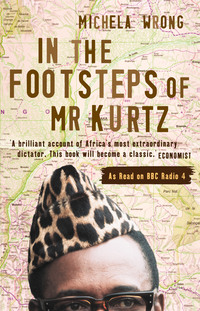
Читать книгу: «In the Footsteps of Mr Kurtz»

In the Footsteps of Mr Kurtz
LIVING ON THE BRINK OF DISASTER
IN THE CONGO
Michela Wrong

COPYRIGHT
First published in Great Britain in 2000 by Fourth Estate
A division of HarperCollinsPublishers Ltd 1 London Bridge Street London SE1 9GF www.harpercollins.co.uk
Copyright © Michela Wrong, 2000
The right of Michela Wrong to be identified as the author of this work has been asserted by her in accordance with the Copyright, Designs and Patents Act 1988
A catalogue record for this book is available from the British Library
All rights reserved under International and Pan-American Copyright Conventions. By payment of the required fees, you have been granted the nonexclusive, nontransferable right to access and read the text of this ebook onscreen. No part of this text may be reproduced, transmitted, downloaded, decompiled, reverse engineered, or stored in or introduced into any information storage and retrieval system, in any form or by any means, whether electronic or mechanical, now known or hereinafter invented, without the express written permission of HarperCollins e-books.
HarperCollinsPublishers has made every reasonable effort to ensure that any picture content and written content in this ebook has been included or removed in accordance with the contractual and technological constraints in operation at the time of publication.
Source ISBN: 9781841154220
Ebook Edition © JUNE 2012 ISBN 9780007382095
Version: 2019-01-14
DEDICATION
To Michael Holman, who made sure the book got written
CONTENTS
COVER
TITLE PAGE
COPYRIGHT
DEDICATION
INTRODUCTION
CHAPTER ONE You can check out any time you like, but you can never leave
CHAPTER TWO Plaything for a king
CHAPTER THREE Birth of the Leopard
CHAPTER FOUR Dizzy worms
CHAPTER FIVE Living above the shop
CHAPTER SIX A nation on Low Batt
CHAPTER SEVEN Never naked
CHAPTER EIGHT The importance of being elegant
CHAPTER NINE I get by with a little help from my friends
CHAPTER TEN A folly in the jungle
CHAPTER ELEVEN The night the pink champagne went flat
CHAPTER TWELVE The Inseparable Four
CHAPTER THIRTEEN Nappies on the floor
CHAPTER FOURTEEN Ill-gotten gains
EPILOGUE
BIBLIOGRAPHY
GLOSSARY
INDEX
ACKNOWLEDGEMENTS
ABOUT THE AUTHOR
ABOUT THE PUBLISHER
INTRODUCTION
‘He won’t be forgotten. Whatever he was, he was not common. He had the power to charm or frighten rudimentary souls into an aggravated witch-dance in his honour; he could also fill the small souls of the pilgrims with bitter misgivings: he had one devoted friend at least, and he had conquered one soul in the world that was neither rudimentary nor tainted with self-seeking. No; I can’t forget him.’
Heart of Darkness—JOSEPH CONRAD
The feeling struck home within seconds of disembarking.
When the motor-launch deposited me in the cacophony of the quayside, engine churning mats of water hyacinth as it turned to head back across the brown expanse of oily water that was the River Zaire, I was hit by the sensation that so unnerves first-time visitors to Africa. It is that revelatory moment when white, middle-class Westerners finally understand what the rest of humanity has always known – that there are places in this world where the safety net they have spent so much of their lives erecting is suddenly whipped away, where the right accent, education, health insurance and a foreign passport – all the trappings that spell ‘It Can’t Happen to Me’ – no longer apply, and their well-being depends on the condescension of strangers.
The pulse of apprehension drummed as I stuffed my clothes back into the ageing suitcase that had chosen the river crossing between Brazzaville and Kinshasa as the moment to split at the seams, transforming me into a truly African traveller. It quickened as a sweating young British diplomat signally failed to talk our way through the red tape and a chain of hostile policemen picked through the intimacies of my luggage, deciding which bits to keep. It subsided as we emerged from our three-hour ordeal, a little the lighter, finally crossing the magic line separating the customs area from the city.
But in truth, the quiet thud of fear would be there throughout my time in Zaire, whether I was drinking a cold Primus beer in the bustling Cité or taking tea in the green calm of a notable’s patio. This ominous awareness of a world of infinite, sinister possibilities had become one of the dominant characteristics of the nation led by the man who started life as plain Joseph Désiré Mobutu, cook’s son, but reinvented himself as Mobutu Sese Seko Kuku Ngbendu Wa Za Banga, ‘the all-powerful warrior who goes from conquest to conquest, leaving fire in his wake’.
By the mid-1990s, Mobutu had become more noticeable by his absence than his presence, a tall, gravel-voiced figure glimpsed occasionally at official ceremonies and airport walkabouts in Kinshasa, or fielding hostile questions at a rare press conference in France with a sardonic politeness that hinted at huge world-weariness. Rattled by the army riots that had twice devastated his cities, belatedly registering the extent to which he was hated, he had withdrawn from a resentful capital to the safety of Gbadolite, his palace in the depths of the equatorial forest, to nurse his paranoia.
His impassive portrait, decked in comic-opera uniform, kept watch on his behalf, glowering from banks, shops and reception halls. ‘Big Man’ rule had been encapsulated in one timeless brand: leopardskin toque, Buddy Holly glasses and the carved cane so imbued with presidential force mere mortals, it was said, could never hope to lift it. He liked to be known as the Leopard, and the face of a roaring big cat was printed on banknotes, ashtrays and official letterheads. But to a population that had once hailed him as ‘Papa’, he was now known as ‘the dinosaur’, a tribute to how sclerotic his regime had become. Certainly, on a continent of dinosaur leaders, of Biya and Bongo, Mugabe and Moi, he rated as a Tyrannosaurus Rex of the breed, setting an example not to be followed. No other African autocrat had proved such a wily survivor. No other president had been presented with a country of such potential, yet achieved so little. No other leader had plundered his economy so effectively or lived the high life to such excess.
Preyed on by young men with Kalashnikovs, its administration corroded by corruption, a nation the size of Western Europe had fallen off the map of acceptable destinations. My battered copy of the Belgian Guide Nagel, picked up in a Paris bookshop, described Kinshasa as a modern capital ‘boasting all the usual attributes of Europe’s great cities’ and encouraged the tourist to explore its museums, monuments and ‘indigenous quarters’. But that had been in 1959, when the world was a white man’s oyster. Kinshasa was now a stop bypassed even by hardened travellers, where airlines avoided leaving their planes overnight for fear of what the darkness would bring. A hardship posting for diplomats, boycotted by the World Bank and IMF, it was a country every resident seemed determined to abandon, if only they could lay their hands on the necessary visa.
I would be there for the end, and for the beginning of the end.
Less than three years after my arrival, the tables were turned and I was the one to experience the curious intimacy the looter shares with his victim, rifling through Mobutu’s wardrobes, touring his bathroom and making rude remarks about his taste in furniture (‘African dictator’ kitsch of the worst kind). Somewhere at the back of one of my drawers, there is a stolen fishknife that was once part of the presidential dining set. My companions in crime were more ambitious – they took monogrammed pillow cases, bottles of fine French wine, even a presidential oil portrait. But looters were being shot on the streets the day we paid our unannounced visit on Marshal Mobutu’s villa in Goma, and I wasn’t going to risk execution for a souvenir.
It was November 1996 and the new rebel movement that had suddenly risen from nowhere in the far east of Zaire had seized control of the area bordering Rwanda. For weeks the frontier crossings leading into this breathtakingly beautiful region of brooding volcanoes and misty green valleys, all rolling down to the blue waters of Lake Kivu, had been closed while the fighting went on. Then suddenly the victorious rebels opened the frontier, and a small flood of journalists who had been kicking their heels on the other side poured across.
When tour agencies were still brave enough to include Rwanda and Zaire in their African itineraries, Goma was a favourite destination for tourists visiting some of the world’s last mountain gorillas. A pretty little town on the black lava foothills, it had now been torn apart by its own inhabitants, who had taken the army’s exodus as the cue for some frenzied self-enrichment. Shops had been eviscerated, the main street was a mess of phone directories, glass and unused condoms, shattered toilet bowls and broken shutters. ‘They’ve attacked me four or five times, but they just won’t believe I don’t have anything left to take,’ gasped a ruined Lebanese trader, waiting at the border post for permission to leave. His eyes were swimming with tears.
The atmosphere was prickly. Starting what was to prove a seven-month looting and raping retreat across the country, Zairean forces had lashed out indiscriminately before pulling out, leaving corpses scattered for kilometres. No one was too sure of the identity of the rebel movement, the new bosses in town. And then there were the roaming Rwandans, whose intervention in Zaire was being denied by the government next door but was too prominent to ignore. Speaking from the corner of his mouth, a resident confirmed the outsiders’ presence: ‘We recognise them by their morphology.’ Then he hurried away as a baby-faced Rwandan soldier – high on something and all the more sinister for the bright pink lipstick he was wearing – swaggered up to silence the blabbermouth.
Somehow, Mobutu’s villa seemed the natural place to go. The road ran along the lake, snaking past walls draped in bougainvillaea, with the odd glimpse of blue water behind. We surprised a lone looter who had decided, enterprisingly, to focus on the isolated villas of the local dignitaries, rather than the overworked town centre. Thinking we were rebels, he stopped pushing a wheelbarrow on which a deep freeze was precariously balanced and ran for cover. As we drove harmlessly by, he was already returning to his task. A stolen photocopier and computer were still waiting to be taken to what, almost certainly, was a shack without electricity.
In the old days, the villa complex had been strictly off limits behind staunch metal gates manned by members of the presidential guard. Now the gates were wide open and the Zairean flag – a black fist clenching a flaming torch – lay crumpled on the ground. There had been no fight for this most symbolic of targets. No one, it was clear from the boxes of unused ammunition, the anti-tank rockets and mortar bombs carelessly stacked in the guards’ quarters, had had the heart for a real showdown.
In the garage were five black Mercedes, in pristine condition, two ambulances, in case the president fell sick and a Land Rover with a podium attachment to allow him, Pope-like, to address the public. A generous allocation for a man whose visits had become increasingly rare. But like a Renaissance monarch who expected a bedroom to be provided in any of his baron’s castles, Mobutu kept a dozen such mansions constantly at the ready across the country, on the off-chance of a visit that usually never came.
It was on venturing inside – could the property possibly be tripwired? – that we really began to feel like naughty children sneaking a look in their parents’ bedroom, only to emerge with their illusions shattered. From outside the villa had looked the height of ostentatious luxury: all chandeliers, Ming vases, antique furniture and marble floors. Close up, almost everything proved to be fake. The vases were modern imitations, they came with price labels still attached. The Romanesque plinths were in moulded plastic, the malachite inlay painted on.
With an ‘aha!’ of excitement, a colleague whipped out a black and white cravat, of the type worn with the collarless ‘abacost’ jacket that constituted Mobutu’s eccentric contribution to the world of fashion. From a distance, the cravats had always appeared complex arrangements of material, folded with meticulous care. Now I saw that they were little more than nylon bibs, held in place with tabs of Velcro. This emperor did have some clothes. But like his regime itself, they were all show and no substance.
Most poignant of all, perhaps, was the pink and burgundy suite prepared for the presidential spouse, although it was impossible to say whether this was the first lady Bobi Ladawa, or the twin sister Mobutu had, bizarrely, also taken to his bed. An outsize bottle of the perfume Je Reviens, which had probably turned rancid years ago in the African heat, stood on the mantelpiece. With their man ravaged by prostate cancer, his shambolic army collapsing like a house of cards, neither woman would ever be returning to Goma. This irreverent plundering was the only proof required of how rapidly the power established over three decades was unravelling.
Rebel uprisings, bodies rotting in the sun, a sickening megalomaniac. In newsrooms across the globe, shaking their heads over yet another unfathomable African crisis, producers and sub-editors dusted off memories of school literature courses and reached for the clichés. Zaire was Joseph Conrad’s original ‘Heart of Darkness’, they reminded the public. How prophetic the famous cry of despair voiced by the dying Mr Kurtz at Africa’s seemingly boundless capacity for bedlam and brutality had proved yet again. ‘The horror, the horror.’ Was nothing more promising ever to emerge from that benighted continent?
Yet when Conrad wrote Heart of Darkness and penned some of the most famous last words in literary history, this was very far from his intended message. The title ‘Heart of Darkness’ itself and the phrase ‘the horror, the horror’ uttered by Mr Kurtz as he expires on a steam boat chugging down the giant Congo river, probably constitute one of the great misquotations of all time.
For Conrad, the Polish seaman who was to become one of Britain’s greatest novelists, Heart of Darkness was a book based on some very painful personal experience. In 1890 he had set out for the Congo Free State, the African colony then owned by Belgium’s King Leopold II, to fill in for a steamship captain slain by tribesmen. The posting, which was originally meant to last three years but was curtailed after less than six months, was to be the most traumatic of his life. It took him nine years to digest and turn into print.
Bouts of fever and dysentery nearly killed him; his health never subsequently recovered. Always melancholic, he spent much of the time plunged into deep depression, so disgusted by his fellow whites he avoided almost all human contact. His vision of humanity was to be permanently coloured by what he found in the Congo, where declarations of philanthropy camouflaged a colonial system of unparalleled cruelty. Before the Congo, Conrad once said, ‘I was a perfect animal’; afterwards, ‘I see everything with such despondency – all in black’.
Mr Kurtz, whose personality haunts the book although he says almost nothing, is first presented as the best station manager of the Congo, a man of refinement and education, who can thrill crowds with his idealism and is destined for great things inside the anonymous Company ‘developing’ the region. Stationed 200 miles in the interior, he has now fallen sick, and a band of colleagues sets out to rescue him.
When they find him, they discover that the respected Mr Kurtz has ‘gone native’. In fact, he has gone worse than native. Cut off from the Western world, inventing his own moral code and rendered almost insane by the solitude of the primeval forest, he has indulged in ‘abominable satisfactions’, presided ‘at certain midnight dances ending with unspeakable rites’ says Conrad, hinting that Kurtz has become a cannibal.
His palisade is decorated by rows of severed black heads; he has been adopted as honorary chief by a tribe whose warriors he leads on bloody village raids in search of ivory. The man who once wrote lofty reports calling for the enlightenment of the native now has a simpler recommendation: ‘Exterminate all the brutes!’ When he expires before the steamer reaches civilisation, corroded by fever and knowledge of his own evil, his colleagues are relieved rather than sorry – a potential embarrassment has been avoided.
Despite its slimness, the novella is one of those multilayered works whose meaning seems to shift with each new reading. By the time Heart of Darkness was published in 1902, the atrocities being committed by Leopold’s agents in the Congo were already familiar to the public, thanks to the campaigns being waged by human rights activists of the day. So while Heart of Darkness is in part a psychological thriller about what makes man human, it had enough topical detail in it to carry another message to its readers. Notwithstanding the jarringly racist observations by the narrator Marlow, the way Heart of Darkness dwells on the sense of utter alienation felt by the white man in the gloom of central Africa, the book was intended primarily as a withering attack on the hypocrisy of contemporary colonial behaviour. ‘The criminality of inefficiency and pure selfishness when tackling the civilising work in Africa is a justifiable idea,’ the writer told his publisher.
So when Kurtz raves against ‘the horror, the horror’, he is, Marlow makes clear, registering in a final lucid moment just how far he has fallen from grace. The ‘darkness’ of the book’s title refers to the monstrous passions at the core of the human soul, lying ready to emerge when man’s better instincts are suspended, rather than a continent’s supposed predisposition to violence. Conrad was more preoccupied with rotten Western values, the white man’s inhumanity to the black man, than, as is almost always assumed today, black savagery.
Why then, nearly a century on, has the phrase, and the title, become so misunderstood, so twisted?
The shift reflects, perhaps, the level of Western unease over Africa, a continent that has never disappointed in its capacity to disappoint: Hutu mothers killing their children by Tutsi fathers in Rwanda; the self-styled Emperor Bokassa ordering his cook to serve up his victims’ bodies in Central African Republic; Liberia’s rebels gleefully videotaping the torture of a former president – the terrible scenes swamp the thin trickle of good news, challenging the very notion of progress.
On a disturbing continent, no country, appropriately enough, remains more unsettling than the very birthplace of Conrad’s masterpiece: the nation that was once called the Congo Free State, later metamorphosed into Zaire and has now been rebaptised the Democratic Republic of Congo.
In Mobutu’s hands, the country had become a paradigm of all that was wrong with post-colonial Africa. A vacuum at the heart of the continent delineated by the national frontiers of nine neighbouring countries, it was a parody of a functioning state. Here, the anarchy and absurdity that simmered in so many other sub-Saharan nations were taken to their logical extremes. For those, like myself, curious to know what transpired when the normal rules of society were suspended, the purity appealed almost as much as it appalled. Why bother with pale imitations, diluted versions, after all, when you could drench yourself in the essence, the original?
The longer I stayed, the more fascinated I became with the man hailed as inventor of the modern kleptocracy, or government by theft. His personal fortune was said to be so immense, he could personally wipe out the country’s foreign debt. He chose not to, preferring to banquet in his palaces and jet off to properties in Europe, while his citizens’ average annual income had fallen below $120, leaving them dependent on their wits to survive. What could be the rationale behind such callous greed?
Zaireans had demonised him, seeing his malevolent hand behind every misfortune. From mass-murder to torture, poisoning to rape – there were few crimes not attributed to him. But if Mobutu had approached near-Satanic proportions in the popular conception, he remained the lodestar towards which every diplomat and foreign expert, opposition politician and prime ministerial candidate, turned for orientation.
Rail as it might, the population, it seemed, simply could not imagine a world without Mobutu. ‘We are a peaceful people,’ Zaireans would say in self-exculpation, when asked why no frenzied assailant had ever burst from the crowd during one of Mobutu’s motorcades, brandishing a pistol. It was to take a foreign-backed uprising, dubbed ‘an invasion’ by Zaireans themselves and co-ordinated by men who did not speak the local Lingala, to rid them of the man they claimed to loathe. The passivity infuriated, eventually blurring into contempt. Every people, expatriates would shrug, deserves the leader it gets.
My attempt to understand the puzzle kept returning me to Heart of Darkness – not to the clichés of the headline writers, with their inverted, modernistic interpretations, but back to Conrad’s original meaning.
No man is a caricature, no individual can alone bear responsibility for a nation’s collapse. The disaster Zaire became, the dull political acquiescence of its people, had its roots in a history of extraordinary outside interference, as basic in motivation as it was elevated in rhetoric. The momentum behind Zaire’s free-fall was generated not by one man but thousands of compliant collaborators, at home and abroad.
Exploring the Alice-in-Wonderland universe they created I would belatedly learn respect. Stumbling upon the surreal alternative systems invented by ordinary Zaireans to cope with the anarchy, exasperation would be tempered by admiration. Above all, there would be anger at what Conrad’s Marlow, surveying the damage wrought by colonial conquerors who claimed to have Congo’s interests at heart, described as a ‘flabby, pretending, weak-eyed devil of a rapacious and pitiful folly’.
CHAPTER ONE
You can check out any time you like, but you can never leave
Kinshasa, 17 May 1997
Dear Guest,
Due to the events that have occurred last night, most of our employees have been unable to reach the hotel. Therefore, we are sorry to inform you that we will provide you only with a minimum service of room cleaning and that the laundry is only available for cleaning of your personal belongings. In advance, we thank you for your understanding and we hope that we will be able soon to assure our usual service quality.
The Management
At 3 a.m. on Saturday morning, a group of guests who had just staggered back to their rooms after a heavy drinking session in L’Atmosphère, the nightclub hidden in the bowels of Kinshasa’s best hotel, heard something of a fracas taking place outside. Peering from their balconies near the top of the Tower, the modern part of the hotel where management liked to put guests paying full whack, they witnessed a scene calculated to sober them up.
Drawing up outside the Hotel Intercontinental, effectively barring all exits, were several military armoured cars, crammed with members of the Special Presidential Division (DSP), the dreaded elite unit dedicated to President Mobutu’s personal protection and held responsible for the infamous Lubumbashi massacre. A black jeep with tinted windows had careered up to the side entrance and its owner – Mobutu’s own son Kongulu, a DSP captain – was now levelling his sub-machine gun at the night receptionist.
Kongulu, who was later to die of AIDS, was a stocky, bearded man with a taste for fast cars, gambling and women. He left unpaid bills wherever he went with creditors too frightened to demand payment of the man who had been nicknamed ‘Saddam Hussein’ by Kinshasa’s inhabitants. Now he was in full combat gear, bristling with grenades, two gleaming cartridge belts crisscrossed Rambo-style across his chest. And he was very, very angry.
Screaming at the receptionist, he demanded the room numbers of an army captain and another high-ranking official staying at the Intercontinental, men he accused of betraying his father, who had fled with his family hours before rather than face humiliation at the hands of the rebel forces advancing on the capital.
Up in Camp Tsha Tshi, the barracks on the hill which housed Mobutu’s deserted villa, Kongulu’s fellow soldiers had already killed the only man diplomats believed was capable of negotiating a peaceful handover. With the rebels believed to be only a couple of hours’ march away, Kongulu and his men were driving from one suspected hideout to another in a mood of grim fury, searching for traitors. Their days in the sun were over, they knew, but they would not go quietly. They could feel the power slipping through their fingers, but there was still time, in the moments before Mobutu’s aura of invincibility finally evaporated in the warm river air, for some score-settling.
The hotel incident swiftly descended into farce, as things had a tendency to do in Zaire.
‘Block the lifts,’ ordered the hotel’s suave Jordanian manager, determined, with a level of bravery verging on the foolhardy, to protect his guests. The night staff obediently flipped the power switch. But by the time the manager’s order had got through, Kongulu and two burly soldiers were already on the sixteenth floor.
Storming from one identical door to another, unable to locate their intended victims – long since fled – and unable to descend, the death squad was reaching near-hysteria. ‘Unblock the lifts, let them out, let them out,’ ordered the manager, beginning to feel rattled. Incandescent with fury, the trio spilled out into the lobby. Cursing and spitting, they mustered their forces, revved their vehicles and roared off into the night, determined to slake their blood lust before dawn.
The waiting was at an end. May 17, 1997 was destined to be showdown time for Zaire. And it looked uncomfortably clear that the months of diplomatic attempts to negotiate a deal that would ease Mobutu out and rebel leader Laurent Kabila in, preventing Kinshasa from descending into a frenzy of destruction behind the departing president, had come to precisely nothing.
The fact that so many of the key episodes in what was to be Zaire’s great unravelling took place in the Hotel Intercontinental was not coincidental. Africa is a continent that seems to specialise in symbolic hotels which, for months or years, are microcosms of their countries’ tumultuous histories. They are buildings where atrocities are committed, coups d’état consecrated, embryonic rebel governments lodged, peace deals signed, and when the troubled days are over, they still miraculously come up with almond croissants, fresh coffee and CNN in most rooms.
In Rwanda, that role is fulfilled by the Mille Collines hotel, where the management stared down the Hutu militiamen bent on slaughtering terrified Tutsi guests during the 1994 genocide. In Zimbabwe, it used to be the Meikles, where armed white farmers rubbed shoulders with sanction-busters during the Smith regime. In Ethiopia it is the Hilton, where during the Mengistu years some staff doubled as government informers; in Uganda, the Nile, whose rooms once rang with the screams of suspects being tortured by Idi Amin’s police.
In Congo the honour most definitely goes to the Hotel Intercontinental. I know, because I once lived there. With one room as my living quarters, another as dilapidated office and a rooftop beer crate as the perch for a satellite telex – my link with the outside world – I soon realised that the hotel, as emblematic of the regime as Mobutu’s leopardskin hat, offered the perfect vantage point from which to observe the dying days of the dinosaur.
The hotel was built on a whim. On a visit to Abidjan in the Ivory Coast, President Mobutu saw the Hotel Ivoire, and decided he wanted one too. For once, his impulses were based on canny business instincts. The Intercontinental was the first five-star hotel in Kinshasa. Until the restoration of the Hotel Memling, its rival in the town centre, there was simply nowhere else to go for VIPS seeking the bland efficiency only an international hotel chain can deliver. During the prosperous 1970s, the 50 per cent government stake in the building was a share in a certified cash cow.
Constructed on a spur of land in leafy Gombe, a district of ambassadors’ residences and ministries, it enjoys some of the best views in Kinshasa. To the east, the Congo river traces a lazy sweep as it emerges from Malebo pool, an expanse of water so vast that, venturing out in a small boat, you can lose sight of the opposite banks and end up wondering whether, by some miracle of geography, you have drifted out to sea.
Across the water, which is transformed into a disturbed mirror of silver and gold each sunset, gleams the distinctive concave tower that serves as the city of Brazzaville’s landmark. The river, that concourse Marlow described as ‘an immense snake uncoiled, with its head in the sea, its body at rest curving afar over a vast country, and its tail lost in the depths of the land’ is the frontier, a fact exploited by the fishermen whose delicate pirogues languidly traverse the waterway for a spot of incidental smuggling.
Nowhere else in the world do two capitals lie so close to each other, within easy shelling distance, in fact, a feature that has been of more than merely abstract interest in the past. The proximity allows each city to act as an impromptu refugee camp when things get too hot at home. From Brazzaville to Kinshasa, from Kinshasa to Brazzaville, residents ping-pong irrepressibly from one to another – sinks, toilets and mattresses on their heads, depending on which capital is judged more dangerous at any given moment.
In peacetime, the river offers release to Kinshasa’s claustrophobic expatriates. Roaring upstream in their motorboats, they picnic in the shimmering heat given off by the latest sandbank deposited by the current or scud across the waves on waterskis, weaving around the drifting islands of water hyacinth. Legend has it a European ambassador was once eaten by a crocodile while swimming and freshwater snakes are said to thrive. Yet far more ominous, for swimmers, is the steady pull of the river, the relentless tug of a vast mass of water powering relentlessly to the sea.
Some of this water has travelled nearly 3,000 miles and descended more than 5,000 feet. It has traced a huge arc curving up from eastern Zambia, heading straight north across the savannah as the Lualaba, veering west into the equatorial forest and taking in the Ubangi tributary before aiming for the Atlantic. The basin it drains rims Angola, Zambia, Tanzania, Burundi, Rwanda, Uganda, Sudan, Central African Republic and Congo-Brazzaville. The catchment area straddles the equator, ensuring that some part is always in the midst of the rainy season. Hence the river’s steady flow, so strong that in theory it could cover the energy needs of central Africa and beyond. In practice, the hydroelectric dam built at Inga is working at a fraction of capacity – one of Mobutu’s many white elephant projects – and even domestic demand is not being met.
The local word for river is ‘nzadi’: a word misunderstood and mispronounced by Portuguese explorers charting the coastline in the fifteenth century. In rebaptising Belgian Congo ‘Zaire’ in 1971, Mobutu was acknowledging the extent to which that waterway, the most powerful in the world after the Amazon, defines his people’s identity. But what should have opened up the region has instead served to isolate it. On the map, the blue ribbon sweeping across the continent looks a promising access route. But the terrible rapids lying between the upper reaches of the Lualaba and Kisangani, Kinshasa and the sea, make nonsense of the atlas.
Looking west from the hotel, you can just glimpse the brown froth from the first of the series of falls that so appalled explorer Henry Morton Stanley when he glimpsed them in 1877. Determined to settle the dispute then raging in the West over the origins of the Nile, he had trekked across the continent from Zanzibar, losing nearly half his expedition to disease, cannibal attack and exhaustion. The calm of Malebo pool, fringed by sandy islands and a long row of white cliffs, had seemed a blessing to him and his young companion, Frank Pocock. ‘The grassy table-land above the cliffs appeared as green as a lawn, and so much reminded Frank of Kentish Downs that he exclaimed enthusiastically, “I feel we are nearing home”,’ wrote Stanley. In his enthusiasm Pocock, the only other white man to have survived this far into the journey, proposed naming the cliffs Dover, and the stretch of open water after Stanley. The reprieve proved shortlived. Three months later, still struggling to cross the Crystal Mountains separating the pool from the sea, Pocock went over one of the rapids and was drowned.
Leopoldville, the trading station Stanley set up here in honour of Leopold II, the Belgian King who sponsored his return to the area to ‘develop’ the region, was originally separate from Kinshasa, a second station established further upriver and dominated by baobab groves. The baobabs have gone now and the two stations have merged to form one inchoate city, a messy urban settlement of fits and starts that always seems about to peter away into the bush, only to sprawl that little bit further afield.
In the city’s infancy, the Belgian colonisers had laid out a model city of boulevards and avenues, sports grounds and parks. But with the population now nudging five million, all thought of town planning has been abandoned, the rules of drainage and gravity ignored. Nature takes its revenge during the rainy seasons, when mini Grand Canyons open up under roads and water-logged hillsides collapse, burying inhabitants in their shacks.
‘It looks as though it’s survived a war and is being rebuilt,’ a photographer friend, a veteran of Sarajevo, remarked after her first visit to Kinshasa. But the damage has been self-inflicted, in two rounds of looting so terrible they have become historical landmarks in people’s minds, so that events are labelled as being ‘avant le premier pillage’ or ‘après le deuxième pillage’, before and after the lootings. It is Congo’s version of BC and AD.
As for rebuilding, the impression given by the scaffolding and myriad work sites dotted around Kinshasa is misleading. The work has never been completed, the scaffolding will probably never be removed. Like the defunct street lamps lining Nairobi’s roads, the tower blocks of Freetown, the fading boardings across Africa which advertise trips to destinations no travel company today services, it recalls another era, when a continent believed its natural trajectory pointed up instead of down.
Down in the valley lies the Cité, the pullulating popular quarters. Matonge, Makala, Kintambo: districts of green-scummed waterways, street markets and rubbish piled so high the white egrets picking through it bob above the corrugated-iron roofs. In heavy rains the open drains overflow, turning roads into rivers of black mud that exhale the warm stink of sewage. On the heights, enjoying the cooler air, are districts like Mont-Fleuri, Ma Campagne and Binza, where spiked walls conceal the mansions that housed Mobutu’s elite and giant lizards in garish purple and orange do jerky press-ups by limpid blue swimming pools.
When the ‘mouvanciers’, as those belonging to Mobutu’s presidential movement were called, ventured downhill, it was usually to the Hotel Intercontinental that they headed in their Mercedes. It was a home away from home. They liked to sit in its Atrium café in their gold-rimmed sunglasses, doing shady deals with Lebanese diamond buyers, ordering cappuccinos and talking in ostentatiously loud voices over their mobile phones while armed bodyguards loitered in the background.
They were the only ones who could afford to patronise the designer-wear shops in the hotel’s arcade or hire the Junoesque whores – renowned as the most expensive in Kinshasa – who swanned along the corridors. They ran up accounts and left the management to chase payment by the government for years. Kongulu owed the casino a huge amount, but who could force a president’s son to pay?
It was never a place where those who opposed the regime could feel comfortable. Mobutu’s portrait stared out from above the main desk, his personality seemed to invest every echoing corridor. The Popular Movement for the Revolution (MPR), the party every Zairean at one stage was obliged to join, rented a set of rooms here and on at least one embarrassing occasion for management, a handcuffed prisoner was spotted in the lifts, being taken upstairs for interrogation.
Time the placing of your international call right and you could eavesdrop on the telephone conversations of guests down the hall, being monitored by the switchboard operators. The room cleaners showed a disproportionate level of interest in guests’ comings and goings. There was always a sense of being under surveillance. ‘We don’t hire them as such, but what can we do if the staff work as spies?’ a hotel executive once acknowledged, with a philosophical shrug of the shoulders.
By the mid-1990s the Intercontinental had, like the country itself, hit hard times. Zaire had become an international pariah and few VIPs visited Kinshasa any more. With occupancy below 20 per cent, service was stultifyingly slow. The blue dye came off the floor of the swimming pool, leaving bathers with the impression they had caught some horrible foot disease. The aroma of rotting carpet – blight of humid climates – tinged the air, the salade niçoise gave you the runs and the national power company would regularly plunge the hotel into penumbra because of unpaid bills. The first time I used the lift it shuttled repeatedly between ground floor and sixth, refusing to stop. ‘Yes, we heard you ringing the alarm bell,’ remarked the imperturbable receptionist when I finally won my freedom. After that I used the emergency stairs.
But there were considerations weighing against the growing tattiness, which accounted for the hotel’s small population of permanent residents. We were betting on the likelihood that if Kinshasa were to be engulfed in one of its periodic bouts of pillaging, the DSP would secure the hotel. They had done so twice before, in 1991 and 1993, when the mouvanciers had slept in the conference rooms, sheltered from a frenzied populace which was dismantling their factories, supermarkets and villas.
The hotel’s long-term guests were a strange bunch, representative in their way of the foreign community that washes up on African shores: misfits of the First World, sometimes intent on good works but more often escaping dubious pasts, in search of a quick killing, or simply seduced by the possibilities of misbehaviour without repercussions – that old colonial delight.
There was the ageing Belgian beauty, still sporting the miniskirts of a thirteen-year-old, who relentlessly sunbathed her way through every crisis, her appetite for ultraviolet seemingly insatiable. On the pool’s fringes hovered the skinny Chinese acupuncturist, whom everyone mistook for a cook because of his starched white hat. He had come to work on an aid project in Zaire which had never seen the light of day. Given the prevalence of HIV in Kinshasa, demand for acupuncture was minimal. But he had stayed on rather than return to communist China. ‘Here, it is bad. But in China, I think, maybe worse,’ he confessed.
On first name terms with most of the mouvanciers was the blond, big-hearted American with a southern drawl who slopped around in flip-flops and T-shirts. Just what he was doing in Kinshasa was a mystery, but he would often use a vague, collective ‘we’ when referring to those in power. The Zairean staff referred to him openly as ‘the CIA man’, although the American embassy claimed to be unaware of his existence. Somehow, one couldn’t help feeling that a real CIA man would have been a bit put out at having his role so universally recognised.
There were bored foreign pilots who flew supplies into UNITA-held territory in Angola, busting UN sanctions on salaries generous enough to merit turning a few blind eyes. ‘I have told my bosses, the one thing I will never do is fly arms,’ said Jean-Marie, a charming Frenchman. ‘They can ask me to do anything else, but not that.’ I would nod sympathetically, pretending to believe him.
Jean-Marie looked great in his pilot’s uniform and spent a lot of time gently chatting up aid workers around the pool. He had shown me a photograph of his girlfriend back in France, who looked stunningly attractive but was clearly half his age. A Saint-Exupéry gone astray, he would return from trips halfway across the world – not carrying arms – and rave with Gallic lyricism about the beauty of the night sky from the pilot’s cockpit. When he fell out with his bosses, he moved into a house the CIA man had started renting, although he said the mysterious goings-on there made him uneasy. One day he disappeared, never to be heard of again, and with him went the several thousand dollars it emerged he had borrowed from the CIA man and his aid-worker girlfriends.
And finally, of course, there was the pony-tailed piano player. Wizened and impassive, he had been playing in the Atrium café as long as anyone could remember. He had tinkled out his lugubrious version of ‘As Time Goes By’ as his frame became more hunched and his hair turned from black, to first salt-and-pepper, and finally to dirty white. By May 1997, it was the piano player’s puzzling absence, as much as any other event, that signalled a fundamental change was looming. A seismic shift in the world as we knew it was about to take place, and the piano player, for one, did not want to be around to see it.
The rebel movement born in Kivu in late 1996, which had triggered hoots of derisive laughter when it had pledged to overturn Mobutu, had proved far more formidable than anticipated. As it had begun capturing territory, sceptical Zaireans had gone from dismissing it as a Rwandan invasion led by a discredited Maoist to welcoming it as a liberation force. Neighbouring countries with long-standing gripes against Mobutu joined the bandwagon and the Alliance of Democratic Forces for the Liberation of Congo-Zaire (AFDL) picked up momentum.
Up in Binza, the mouvanciers had gone from haughty dismissals of the rebel problem to frantic questions: why wouldn’t Mobutu DO something? Drained by prostate cancer, the president had curled up in his lair on the hill like a sick animal. ‘When you are a soldier,’ he declared, ‘either you surrender or you are killed. But you don’t flee.’
Days dragged into weeks. Bracing for the worst, anxious Western governments quietly pulled together a force in Brazzaville whose commandos practised the cross-river trip in high-power motor-launches and helicopters. The diplomats were busy, juggling a stream of visa requests from the mouvanciers with preparations for the evacuation of expatriates who were stubbornly refusing to heed the increasingly forceful warnings issued over the BBC World Service.
‘We’ve built a special cement step to allow women with high heels to get into the motor launches. And I’ve even got peanuts and chocolate bars ready for anyone who might starve to death while we’re waiting for our men,’ an ambassador proudly announced. He had gone on a trial run across the river and returned somewhat breathless. ‘Door to door, it took just three and a half minutes.’
The rebels kept marching. National television broadcast footage of General Nzimbi Nzale, head of the DSP, haranguing his troops for hour after hour, ordering them to defend Mobutu to the death. The camera frame was tight and one assumed, from his hoarse tones, that he was addressing an audience of thousands. But the military made the mistake of allowing a foreign television crew to attend the same event. They filmed the general from behind, revealing a couple of dozen nose-picking soldiers, vacant-eyed, barely paying attention. Could these be the same men who had drawn up a list of strategic sites to be blown up and personalities to be assassinated once the rebels reached the city, a list leaked to Kinshasa newspapers?
In the Hotel Intercontinental the shops, anticipating the looting that traditionally preceded the rebels’ arrival, first slashed the prices on their designer brands and then staged ‘everything must go’ sales, trying to shift stock before a more dramatic type of ‘liquidation to tale’ occurred.
But their usual customers were no longer interested. Quietly, the mouvanciers were abandoning their villas in the hills and moving down to the Hotel Intercontinental, where they spent fitful nights, armed bodyguards perched on seats outside their rooms. You would spot them in the lobby, surrounded by matched sets of Louis Vuitton luggage, before they boarded planes and headed for properties bought years before in Belgium, France, Switzerland and South Africa in preparation for just such a day. It was almost possible to squeeze out a tiny pang of sympathy for these, the most well-heeled refugees in the world.
As for the expatriates, they had been told by their embassies to keep one holdall at the ready for the eventual evacuation, so shopping was ruled out. The designer stock stayed stubbornly put, and the evening ritual amongst journalists staying at the hotel became a window-shopping tour to mentally select which bargain to snatch as the crowds surged through the plate glass.
‘What you have to realise is you’ll only get the chance to go for one item,’ a veteran correspondent told me with deadly seriousness. ‘There won’t be any time for faffing around. So it’s all about focus. Quick in, quick out.’ I dallied for a while over a pair of yellow lace knickers with matching bra. But in the end a tan leather jacket, worth at least $1,000, I reckoned, by Kinshasa prices, won my vote.
We were not the only ones getting light-headed with anxiety. A dinner hosted by a Zairean friend who worked at one of the ministries was a jolly, noisy meal until one of the guests called for silence. Looking around the gathering of lawyers, university professors and consultants, he raised a glass of pink champagne and reminded them that this was exactly the social class targeted for elimination after Liberia’s 1980 army coup. ‘Let us drink a toast to change, and pray we are all still here in a year’s time to celebrate,’ he said.
Soon after, a curfew was announced, and evening outings came to an end. Defeated soldiers and deserters were trickling into Kinshasa, hijacking the first cars they stumbled upon. It was no longer safe to venture out after dark. Instead, along with a growing number of crop-haired ‘security experts’ brought in by the embassies, we were confined to the Intercontinental’s pizzeria, where the band laughably dubbed ‘Le Best’ serenaded us with a muzak medley which always featured a particularly mournful cover version of ‘Hotel California’. ‘You can check out any time you like, but you can never leave,’ they wailed.
All airlines had now cancelled their flights to Kinshasa and the ferries had been requisitioned by the government. After weeks spent wondering whether to go or stay, the decision had been taken out of our hands.
The Hotel Intercontinental manager was finding the experience as claustrophobic as the rest of us. His appearance was as natty as ever, but his face was beginning to show the strain. ‘How much longer is this going to go on? I can’t eat, I can’t sleep. It’s giving me ulcers,’ he confessed over breakfast. Fearing a siege, he had stockpiled enough food, water and diesel to cater for 2,000 people for at least a fortnight. Now he chose to combat the tension the only way he knew how: by entertaining in style. Select, candle-lit dinners were staged in the wine cellars of the hotel. Surrounded by dusty vintages, nestling in the bowels of the building, for one brief night we felt sheltered from the approaching storm.
‘Do you really think these Tutsi troops are going to be as effective as people say?’ asked my neighbour as we savoured the nouvelle cuisine. ‘I suspect it’s all a myth. It’s easy enough beating the Zairean army out in the sticks. But surely when the rebels get to Kinshasa, and the DSP have nowhere left to run, it’ll be completely different?’
It was a view I heard repeatedly, but not one I shared. I had no expectations the DSP would ever do battle. What I feared was that they would go for the soft targets, like journalists. I had developed a habit of shouting in my sleep and regretted now checking into the sixteenth floor. A precise image haunted me: looking through the spyhole in my door and seeing two DSP men, guns cocked, about to break into the room and toss me out of the window. Even if I hit the main building on the trip down, there was no way I could survive the fall from that height.
Radio Trottoir, ‘pavement radio’, as the city’s gossip network was known, was in overdrive. There were rumours of Chinese mercenaries landing in their hundreds, of Zulu troops being called in from South Africa, of goose-stepping soldiers coming in from North Korea to save Mobutu. Also circulating were leaflets telling residents who wanted change to tie white bandanas around their foreheads when the rebels arrived as a sign of support. On the main routes into town, tanks and artillery had been set up. But with each soldier convinced a rival unit was bent on treachery, they were too busy watching each other to stop the steady flow of infiltrators into Kinshasa.
Given the steady ratcheting of tension, it was no surprise that on 15 May anyone who owned a television sat glued to their set. Since mid-afternoon a message had been running across the screen, promising an important press conference. The word on Radio Trottoir was that Mobutu had been meeting with his generals and his departure was about to be announced.
The hours ticked by and nothing happened. The message continued to unroll. Finally, after midnight, a nervous newscaster appeared. To a rapt audience he read out a bland summary of the day’s events, rounded off with a piece of homely advice: viewers should watch out for the small beetles emerging after the recent seasonal rains, which packed a particularly nasty bite.
Whatever talks had taken place in Zaire’s upper echelons, commonsense had not triumphed. Mobutu, who had always warned his countrymen that ‘ma tête vaut cher’ (‘my head won’t come cheap’) could not let go. When he drove to the airport the following day, heading for the jungle palace where, it was said, he planned to exhume his ancestor’s bodies to save them from desecration by the rebels, he stole away in silence, having taken none of the hard decisions demanded.
And so it was that six hours after the death squad’s first unwelcome visit to the Intercontinental, I found myself peering over the balcony, watching as the parking lot below filled with gleaming jeeps and flashy sports cars. Kongulu and his men were back, and this time they had arrived in force.
The lifts filled with panicking women, their hair in a mess, juggling sleepy children in pyjamas, bulging holdalls and plastic bags full of documents. Not only had we been sleeping alongside the regime’s fifth columnists for the last few days, it emerged, we’d been unwitting neighbours of the DSP chiefs’ extended families.
I could see their menfolk patrolling nervously up and down, toting sub-machine guns and draped in cartridge belts. They were wearing their trademark sunglasses, those gold-rimmed feminine accessories which should look comic on a man but instead manage to look as sinister as the wedding dresses and blonde wigs worn by Liberia’s drugged fighters. They are the modern equivalent of the wooden masks donned around night fires by warriors preparing to do battle, which turn their wearers into something utterly alien – faceless instruments of violence capable of unspeakable acts.
Бесплатный фрагмент закончился.