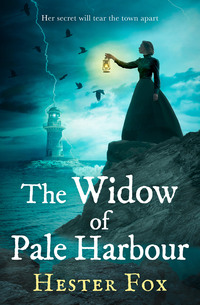
Читать книгу: «The Widow Of Pale Harbour»
A town gripped by fear. A woman cast out. Can he save Pale Harbor from itself?
Maine, 1846. Gabriel Stone is desperate to escape the ghosts that haunt him in Massachusetts after his wife’s death, so he moves to Maine, taking a position as a minister in the remote village of Pale Harbor.
But not all is as it seems in the sleepy town. Strange, unsettling things have been happening, and the townspeople claim that only one person can be responsible: Sophronia Carver, a reclusive widow who lives with a spinster maid in the eerie Castle Carver. Sophronia must be a witch, and she almost certainly killed her husband.
As the incidents escalate, one thing becomes clear: they are the work of a twisted person inspired by the wildly popular stories of Mr. Edgar Allan Poe. And Gabriel must find answers, or Pale Harbor will suffer a fate worthy of Poe’s darkest tales.
HESTER FOX is a keen painter and has a master’s degree in historical archaeology, as well as a background in medieval studies and art history. Hester lives outside of Boston with her husband, cat and new baby.
The Widow of Pale Harbour is her second novel.
Also by Hester Fox
The Witch of Willow Hall
The Widow of Pale Harbour
Hester Fox

Copyright
An imprint of HarperCollins Publishers Ltd
1 London Bridge Street
London SE1 9GF
First published in Great Britain by HQ in 2019
Copyright © Tess Fedore 2019
Tess Fedore asserts the moral right to be identified as the author of this work.
A catalogue record for this book is available from the British Library.
This novel is entirely a work of fiction. The names, characters and incidents portrayed in it are the work of the author’s imagination. Any resemblance to actual persons, living or dead, events or localities is entirely coincidental.
All rights reserved under International and Pan-American Copyright Conventions. By payment of the required fees, you have been granted the non-exclusive, non-transferable right to access and read the text of this e-book on-screen. No part of this text may be reproduced, transmitted, downloaded, decompiled, reverse engineered, or stored in or introduced into any information storage and retrieval system, in any form or by any means, whether electronic or mechanical, now known or hereinafter invented, without the express written permission of HarperCollins.
Ebook Edition © September 2019 ISBN: 9781474083898
Note to Readers
This ebook contains the following accessibility features which, if supported by your device, can be accessed via your ereader/accessibility settings:
Change of font size and line height
Change of background and font colours
Change of font
Change justification
Text to speech
Everyone is enchanted by Hester Fox!
‘This debut recalls Georgette Heyer, with extra spookiness’
The Times
‘Creepy, tense, heartbreaking and beautifully, achingly romantic’
Cressida McLaughlin
‘Steeped in Gothic eeriness it’s spine-tingling and very atmospheric’
Nicola Cornick
‘Beautifully written, with an intriguing plot full of suspense and mystery, The Witch of Willow Hall will cast a spell over every reader’
Lisa Hall
‘A wonderful debut novel’
Linda Finlay
And readers have fallen under her spell too!
‘I could NOT put this thing down!’
‘Do yourself a huge favour and read this NOW!’
‘Historical fiction with a side of romance and major helping of creepiness, this debut novel hits the mark!’
‘Hester Fox has the unique and amazing ability to transport readers to another time and place’
‘The perfect autumn read’
‘The ULTIMATE page turner!’
To Mike
Contents
Cover
Back Cover Text
About the Author
Booklist
Title Page
Copyright
Note to Readers
Praise
Dedication
Verse
Chapter 1
Chapter 2
Chapter 3
Chapter 4
Chapter 5
Chapter 6
Chapter 7
Chapter 8
Chapter 9
Chapter 10
Chapter 11
Chapter 12
Chapter 13
Chapter 14
Chapter 15
Chapter 16
Chapter 17
Chapter 18
Chapter 19
Chapter 20
Chapter 21
Chapter 22
Chapter 23
Chapter 24
Chapter 25
Chapter 26
Chapter 27
Chapter 28
Chapter 29
Chapter 30
Chapter 31
Chapter 32
Chapter 33
Chapter 34
Chapter 35
AUTHOR NOTE
ACKNOWLEDGMENTS
Extract
About the Publisher
“And this was the reason that, long ago,
In this kingdom by the sea,
A wind blew out of a cloud, chilling
My beautiful Annabel Lee;
So that her highborn kinsmen came
And bore her away from me,
To shut her up in a sepulchre
In this kingdom by the sea.”
—Edgar Allan Poe, “Annabel Lee”
1
This was the fourth dead raven to appear on Sophronia Carver’s front path in as many weeks, and there was no explaining it away as coincidence this time.
Except that this one wasn’t dead, not quite.
Sophronia had never killed a living creature before, but as she stared down at the raven and its crooked, twitching wings on her front path, she got the queasy feeling that the most humane course of action might be to snap the poor thing’s neck.
Tugging her shawl tighter against the chill, salty air, she crouched down to peer at the bird. Its feathers were blue and black—darker even than her own inky hair—and as iridescent as the ocean on a moonless night. The bird stared back at her, unmoving except for the slow blink of its glassy eye. She wanted very much to reach out a finger and stroke its slick feathers, but that somehow felt like a breach of confidence, like telling a secret that did not belong to her.
“Helen?” she called, without tearing her gaze away from the bird. “Helen, come quickly.”
Slowly rising to her feet, she gazed about the estate grounds and craned her neck to squint at the roof of the great old house, silhouetted against the heavy clouds. Perhaps the bird had fallen from the eaves. Or perhaps Duchess had felled it, though the old cat could barely bring down a mouse. That at least would explain how it had come to be lain so carefully across the center of the front path, as if it were some sort of pagan offering.
When Sophronia had come across the first dead raven, she had assumed it had been the victim of some sort of sickness, or perhaps weakened by storm winds. The next two she had likewise justified, but with a growing sense of uneasiness.
A prickle of cold blossomed down her spine as she realized that she could no longer dismiss the dead and injured birds. Someone—or something—was leaving them for her to find.
She stiffened, with a darting glance about her, as if someone might be lurking just beyond the broad lawn or out past the gate, watching her. But there was no one—the only movement the breeze through the flaming autumn trees, the only sound the faraway cry of a gull.
The path was supposed to be Safe. The entire grounds of the estate were supposed to be Safe. It was only out past the wrought-iron gate and into the town beyond that chaos and uncertainty reigned. Better to stay inside the grounds, where she had control. Sophronia had long ago learned to push all the bad memories and specters out of the house and into the world beyond, firmly shutting her heart and mind against them. So to see a creature in distress, so close to death—well, that was not Safe.
“Helen?” Sophronia called, louder this time, her voice carrying up the path to where the front door stood open. A moment later, a pale woman of about forty, her dark hair pulled severely back from her face, appeared in the doorway. She frowned at the sight of her mistress standing over the bird.
“Duchess must have caught it,” Sophronia said with a shake of her head as the woman stepped briskly over to where she was standing.
Helen gave her a skeptical look, and then leaned down to examine the bird for herself. “Duchess couldn’t catch her own tail,” she said, scorn edging her husky voice. “It’s the town brats making trouble again, I’d wager.”
Sophronia pressed her lips together tightly. They’d certainly had their share of children from the town coming up to the house, peeking through the windows and knocking at the door, all so that they could earn the distinction among their friends for glimpsing the infamous widow.
Suddenly, it was too unbearable to look at the exposed and broken bird a moment longer. Sophronia might have called for Garrett, the groundskeeper, but he was out on the far end of the property, cutting back the grass. Helen was capable and strong, though, and had a way with animals. “You’ll try to save it, won’t you? And if you can’t, you’ll make it...” Her words trailed off, but her meaning was unmistakable. Quick.
Carefully, Helen positioned her hands under the motionless bird, holding it slightly away from her as she lifted it. She ran a practiced hand along its wings, her dark brows furrowing in a mixture of concern and anger, as if the cruelty of humankind never ceased to surprise her. “Wings are both broken. And there’s something wrong with its foot.” But then she caught Sophronia’s anxious look and softened. “I’ll see what I can do, Sophy.”
Sophronia gave her a warm smile and watched Helen whisk the raven off to the carriage house, her movements brisk and efficient, her posture as neat as a pin. She had taken Helen on as a servant and companion during her early days as a lonely young bride, but over the years, the older woman had proved herself to be a true friend in every sense. Now it was just the two of them against the world, as Helen was so often wont to remind her.
The first raindrops were starting to fall when Sophronia finally allowed herself to stop thinking of the crooked bird and what it might mean and return indoors. Before the thump of the raven landing on the path had startled her from her reverie, Sophronia had been watching the storm roll in upstairs. Her late husband had always pompously referred to the large room lined with bay windows as the “upper piazza,” taking the big old house’s name, Castle Carver, to heart. Sophronia liked to watch storms approach from there; it was a sort of entertainment, drawing back the curtains like those in a theater, the harbor and endless gray sky a stage on which the rowdy gulls acted their plays.
She wandered through the house, unsettled. There were submissions to her late husband’s magazine piling up, submissions for which she was now responsible. Usually she enjoyed curling up in the parlor, tucked under a warm quilt with a cup of tea as she read through the stories and essays, curating which ones she would send along to the board for publication. But the raven had rattled her, and Sophronia was too anxious to read.
Instead, she continued back upstairs and threw the windows open. The rain was picking up now, the clouds building into something even heavier and more expectant. There was no moment so promising, so exciting, as the moment before a storm broke. Living on the Maine harbor, with naught but a finger of land to separate her home from the gray Atlantic, she had the opportunity to witness many storms, all from the safety of her window. On clear days, she could see the old lighthouse jutting out on the rocky promontory outside of town, winking back at her from its empty windows, an ally in her solitude. In the other direction lay a lonesome expanse of trees, dark and wild. It was a deceptively beautiful landscape, the sheer scale of woods and ocean promising endless possibilities, but in reality, it only swallowed up the hopes and dreams of young brides. At least on stormy days, the mist softened the harsh realities of the world, cloaked its darkness.
But today’s storm was different; she could feel it reverberating in her bones. Perhaps the raven had been a harbinger of things to come, an omen. Or perhaps it was just as Helen said—children from the town playing their cruel tricks on her, just like they had for years since her husband had died so violently and suddenly.
Sophronia sighed, drumming her fingers against the windowsill. God, she was so weary of it all. Weary of the solitude, weary of the little town, its people and their narrow minds, weary of the shell she had become. Tonight, she and Helen would eat a small supper in silence—they had few words left to say that weren’t old and stale, used up over the years—and then they would sit in the parlor, play a game of cards, and perhaps Sophronia would read a book or philosophical pamphlet while Helen plucked away at the old pianoforte. Tomorrow the laundry girl, Fanny, would come, and hopefully bring some gossip or news with her. They would chat for a little, and then Fanny would leave, and stillness would settle back over the house. It would be the same as every other day, but monotony was the price of safety. If the grand old house was indeed a castle, then Sophronia was its ghost, forever trapped, restless and roaming the halls.
She leaned out to close the window, but paused, letting the wind sweep up around her in an invigorating embrace. The building energy of the storm electrified her bones and caused tears to prick her eyes. Yes, there was something different about this storm. Change was sweeping toward Pale Harbor, and God knew, she needed it.
2
If Gabriel Stone had known what was inside the dilapidated old church and what it would lead to, he might have turned around, climbed back on the boat and returned to Concord immediately. But the rain was coming down in unforgiving sheets, and after days of travel, the time for reservations had long since passed.
Wiping the rain from his eyes, he stepped back, craning his neck, and turned his face up into the stormy night, taking in the church that he had trekked halfway up the east coast to reach. It was made of unassuming white clapboard, and its steeple barely peeked above the thrashing trees, as if in humble deference to this wild terrain in which it was an outsider, a latecomer, just like him.
It had taken him two coaches, a rail and finally a ship to arrive in Pale Harbor, only to find that no one was awaiting him at the dock. When it had become obvious that it was too dark even to locate his new lodgings, Gabriel had decided to go to the only other place he knew of in the town: his new church. He had followed the sight of the steeple, slogging through muddy roads that weren’t much more than old cow paths, lit only with the occasional lamplight from a lonely cottage window. But when he’d finally arrived at the church, the doors were locked. He was a sopping wet, hungry, short-tempered outsider and damn it, churches were supposed to be a refuge. Putting his shoulder against the old wood door, Gabriel gave another push, and cursed when it would not budge.
The wind howled around him. He shrugged the collar of his coat up in vain, trying to keep the slicing rain from penetrating any farther down his back. He would get in, spend the night, and then, in the light of day, find his lodgings and hopefully the trunks that he had sent ahead.
A glint of shattered glass in the fleeting moonlight caught his eye. A broken window. Gabriel peeled off his sopping wet overcoat, balled it around his fist and punched out the rest of the glass. With all the grace of a wet cat, he shimmied himself through the opening.
The musty air hit him like the release of a breath held in for too long, and he landed awkwardly on his ankle. “Goddamn it,” he muttered, and then, remembering where he was, grumbled an apology. It was as cool as a mausoleum inside, the air untouched for who knew how many years. The only light came from the brief flashes of lightning, and the occasional gasp of moonlight through the racing clouds. His wet clothes clung to him, chilling him down to his bones. It was not an auspicious beginning to his new venture.
“Anyone here?”
His voice echoed off the empty pews and hollow nave. There was no reason anyone would be in the old church, but one never knew if a lost soul had seen the steeple and wandered inside, looking for shelter or religious succor.
Gabriel let his gaze wander over the dark, indistinct shapes of the crumbling interior. It was not a large church—he could have reached the altar in less than twenty paces—but the rows of pews gaping with expectation gave it a sense of restless hunger, repelling and beckoning him at the same time.
So, this was to be his, then. Good God, what business did he have leading a congregation? It had always been Anna’s dream to found a spiritual community, to bring to life the ideals and values about which she so voraciously read and that had surrounded them in Concord. But now she was gone, and the fulfillment of her dreams was left to him. Perhaps he could make her proud in death where he had so often failed in life, but he rather doubted it. He had not been the intellectual, the enlightened thinker that she had so wished of him. This whole plan was madness; he was counterfeiting a version of himself that had never existed, all in the hopes of redeeming himself in the eyes of a woman who was gone. It was pathetic. He was pathetic.
He shook out his hat and pushed the wet hair out of his eyes. Cobwebs hung from the exposed rafters and dust grimed the stained glass, thick and dark. Gabriel cursed again as he tripped over a loose floorboard, steadying himself on the back of a dusty pew. The idea that he could make this a welcoming space was nearly as daunting as the thought of leading a flock to transcendental enlightenment. “Damn,” he murmured again, before he could stop himself. If he was going to be an even half-convincing minister, he was going to have to curb his vulgar habit of cursing.
Discarding his dripping coat, Gabriel cast his eye around for something that would make a suitable bed for the night. An old splintered pew couldn’t be any worse than the coach he had shared with six other gentlemen on his journey, all of whom had apparently been ill-acquainted with the concept of soap. He was just about to lower himself down onto the sturdiest-looking pew when a sound rose above the howling wind outside. Gabriel froze.
Someone was trying to get in. The door at the far end of the aisle was rattling, thumping, as if someone were pushing on it, just as Gabriel had tried at first. Without thinking, he grabbed the first thing that might reasonably serve as a weapon—a tarnished and cobwebbed brass candlestick—and crept to the door, where the latch was jiggling violently. It might have been a decrepit old church, and he might have been there only for a matter of minutes, but it was his decrepit old church, and by God, he would defend it.
Gabriel reached the door, held his breath and waited. His heart was beating in his ears, his mouth suddenly as dry as cotton. He wasn’t scared—he’d long ago lost the capacity for that when he’d lost everything that he held dear—but he didn’t particularly relish any more excitement for the day either. All he wanted was to close his eyes and get as dry as possible.
Just as the door swung open, he raised the candlestick above his head and lunged at the dark shape silhouetted against the rainy night.
“Sweet Jesus, don’t hurt me!” The figure dropped to the ground in a huddling mound. “I—I’m the sexton,” the man said, his voice muffled and pathetic.
Cursing, Gabriel stopped his swing. The candlestick dropped from his grasp, clattering to the floor. Of course it was the sexton. Who else would be interested in this rotting old church?
“Gabriel Stone,” he said, offering his hand to help the man up. “The new minister.” The words tasted strange on his tongue, and he realized it was the first time he had said them out loud.
The man staggered to his feet, wide-eyed and dripping wet. He regarded Gabriel with lingering panic. He was slight, with stooping shoulders and, at about thirty, was only a couple of years younger than Gabriel.
He knew what the man saw: Gabriel was too tall, too broad, too much like a lumbering giant. People glanced cautiously at him out the side of their eyes, as if he were a criminal, a tough. His voice, low and raspy, didn’t help. He was used to the reaction, but it never eased the pang of annoyance—and self-consciousness—that he felt. “I’m not going to hurt you,” he bit off, unable to keep the irritation from his voice. Then he raised his hands, palms up, in a gesture of pacification.
The sexton gave a hesitant nod and swallowed, extending his hand. “Ezekiel Lewis, but folks just call me Lewis. That’s quite the grip you have,” he said, rubbing his hand and warily eyeing the discarded candlestick.
Gabriel had corresponded with someone before coming to Pale Harbor, but as with all things concerning this new venture, he had been unsure of his footing, of exactly what he was supposed to say. Now he wasn’t sure if it was Lewis he’d written to, or someone else in the town when he’d sent ahead notice that the minister who was supposed to come to Pale Harbor had died and that Gabriel was his replacement. That wasn’t strictly true, but it wasn’t a lie, either. When the brilliant Reverend Joshua Whipple of Concord had died in a carriage accident, Gabriel had seized on his chance to be the man that Anna would have wanted. It had all moved so quickly after he’d set the plan in motion, and then there had been no going back.
Gabriel regarded the nervous man and decided to take a gamble.
“I believe you were expecting me?”
Lewis nodded. “I was meant to meet you at the dock, but my cart got stuck in the mud and delayed me. When I couldn’t find you, I figured you might have come up to the church. I don’t suppose you’ll be wanting me to take you to the cottage now, after all?”
The poor man might have been even more soaked than himself, and he had only a threadbare coat to protect him from the elements. “Might as well bide here for a while yet. No use in going back out into the storm,” Gabriel said.
Lewis nodded his agreement, looking grateful. He had closed the door behind him and was rubbing his arms to get warm. “It’s a wonder the ship was even able to make dock in this weather,” he said, after a particularly harsh clap of thunder.
It had been a bumpy ride, the dark water endlessly churning like a witch’s cauldron, and Gabriel had watched more than one of his fellow passengers be sick over the rail. The two men lapsed into silence, the pounding storm outside making the church feel somehow smaller, more intimate. Gabriel, though never one for small talk, somehow found himself falling into conversation easily in the dark.
“Have you been the sexton long?” Lewis was decades younger than Gabriel would have thought someone in his position would be, and it was hardly a trade for an ambitious young man.
“No, sir. That is, there isn’t much need for a sexton these days,” Lewis said, jutting his chin vaguely into the shadowy church. “I work at the cemetery, digging graves and groundskeeping and the like. I come around here a couple of times a month to cut the grass and make sure no one has broken in.” His look grew sheepish. “Might have been a few months since I last came inside.”
Gabriel had begun to move away from the door and farther into the church, inspecting his new domain as much as he could in the near blackness.
Lewis followed him, swallowing. “I’d wanted it cleaned up before you saw it...” he said, trailing off, as he dashed a cobweb away from his face.
“I’ll see to all the cleaning later.” Gabriel squinted into the darkness. The last of the moon had long since slid behind a heavy bank of clouds. “You don’t have a match, by chance?”
Lewis fumbled in his pocket, miraculously producing a dry matchbox, and struck a match. He touched it to a piece of wood, throwing light onto the empty pews and casting grotesque shadows from the forgotten saints.
The cross at the altar would have to go, and Mary stared at him with accusing eyes, as if she knew that her tenure would be short-lived. The stained glass might stay, but everything else was the vestige of an outdated religion and had no place in a home for transcendentalism. Or so he assumed, though he wasn’t quite sure. Anna would have known; she had been so smart, so clever. Unitarianism—with its strict interpretation of monotheism and all things scientific and rational—might have taken root in Boston, but it was transcendentalism, with its wild abandon to the spiritual, that had so enamored her in Concord. Stop thinking about her, he chided himself. Do this for her, but for God’s sake don’t wallow in self-pity.
A flash of movement snapped Gabriel from his thoughts. “What was that?” He put his hand out to stop Lewis.
Lewis swung the light back around toward the altar and took a sharp breath. Something was moving, rustling about in the debris under the cross.
Without thinking, Gabriel began making his way up the aisle, pushing aside detritus. There was something at the altar, a shape blacker than the rest of its dark surroundings. And it was moving.
His skin prickled and despite his cold, wet clothes, sweat beaded along Gabriel’s neck. The walls danced with quivering shadows, the wind howling and gripping the creaking church tighter. He swallowed. It was not a particularly welcoming place, but now a sense of wrongness took hold of him, as if he were not supposed to be here. As if something did not want him here.
A crash and fluttering broke the stillness. Lewis fell to his knees, and Gabriel flinched as something disturbed the air over their heads.
“What the—”
Taking the torch from Lewis, Gabriel held it up, dimly illuminating the rafters. From the darkness above, a pair of gleaming black eyes blinked down at him.
“It’s a bird,” he said, feeling foolish that his heart was still racing, his palms sweating. Lewis, who had lost about three shades from his already pale face, let out a shaky breath. “There are holes in the roof. It must have come through one to get out of the storm.”
The bird—a raven or a crow, something big and black—cocked its head and blinked down at them with vague interest. Then it shuffled its wings a few times and settled down to roost.
Suddenly, Gabriel just wanted to sleep, even if his new lodgings were cold and empty. He’d had enough of the dank church and its accusing shadows. He was just about to broach the idea of plunging out into the storm when he caught a hint of a strange odor.
The whole church had a musty, unused smell about it, but this was different. Pungent, sweet. Acrid to the point of making his eyes water, and only growing stronger. Curiosity overcame apprehension, and he drew closer to the altar.
He jerked backward. “Oh, God.” Gabriel buried his nose in his handkerchief, fighting the rising gag in his throat. Beside him, Lewis made the sign of the cross over his chest.
This must have been what had attracted the carrion bird, why it had been pecking about the altar. It was a wonder he hadn’t smelled it right away. Bones and fur lay before them, strips of rancid flesh. It was such a mess that it was impossible to tell what the animal might have been in life, or even if it had been a single animal.
“What the hell is that doing here?”
Maybe some forest creature had found its way into the church and then perished after it was unable to get out. But something about its position on the altar sent a chill down Gabriel’s spine. Why wasn’t it nearer a door, or window, if it had died trying to get out of the church? How had it come to lie on the most conspicuous feature of the building?
Lewis shifted uncomfortably. “I can’t say I’ve seen anything particularly like this, but—”
Just then a loud crack of thunder rang out, swallowing his words. Lewis jumped back and the light stuttered out, leaving them in darkness.
Gabriel had had enough. The church was in ruins and clearly would need to be addressed in the light of day. The animal remains weren’t going anywhere, and there wasn’t anything they could do about them in the middle of the night anyway.
“All right. Let’s leave it for now.”
A hiss of relief came from the darkness behind him. “Very good, Reverend.”
They gingerly made their way back to the door, and Gabriel shoved his wet hat back on his head. A pang of melancholy ran through him at the thought of arriving at an empty house. He was running away from a painfully empty home in Concord; had he really done all this only to exchange it for another, and in an unfamiliar place, no less?
Between the unsettling discovery at the altar and the icy impassiveness of the church, what little luster his plans had had now faded to a dull and miserable gray. Gabriel was cold, weary and utterly alone. And it was only a matter of time before the town of Pale Harbor discovered him for the fraud he was.
3
The invitations began almost immediately.
If Gabriel had thought that his arrival would be quiet, that he could slip into Pale Harbor unnoticed, then he had been sorely mistaken. It was a small town—Lewis had informed him that their police force consisted of one constable, and the nearest schoolhouse was ten miles away, in the next town—and the arrival of a new transcendentalist minister from Massachusetts had set everyone talking. If he had been a true minister, he would have relished the chance to recruit fresh faces and gather up a flock for his church. But he was not a true minister, and every time he thought of espousing universal truths to a church full of trusting, upturned faces, his heart twisted with guilt. He had thought that doing it for Anna, for making her dream come true, would have been enough, but he was quickly learning that it was not. Without her by his side, his actions were meaningless, his words hollow.
The first invitation came from the Marshalls, who—Lewis had explained in admiring tones—were the foremost family of Pale Harbor, having made a small fortune in the shipment of granite down the east coast. If Gabriel could persuade them to join his congregation, Lewis had assured him, then the whole town would follow. Whether Gabriel wanted a robust congregation was another story, but he would play his part, and at the very least enjoy a hot meal.
He slogged through the dusky little town, the scent of damp fallen leaves and wood smoke filling his lungs. Most of the homes he passed were modest, weather-beaten cottages like his, but old captains’ mansions with stately pillars punctuated the main thoroughfare, reminders of the town’s once-thriving whaling and trading industries. These could have been Anna’s streets, her soft footsteps evaporating into the yawning gray sky. She would have delighted in the tall pines creaking in the wind, the hawks that sat sentry in the spindly boughs far above. The ever-present roll and crash of the ocean would have been her nightly lullaby. Gabriel shook his head, trying to dislodge the painful thoughts.
The road ended abruptly at a steep-gabled house, painted a lush pink and trimmed with white latticework. Rosebushes, nearing the end of their season, climbed defiantly up either side of the porch. Among all the weathered clapboard and peeling paint of the other homes, the house looked like something dropped straight out of the pages of a fairy tale.
As Gabriel climbed the front porch steps, a rosy, stout woman came out and greeted him at the door, beaming at him from under a frilly cap. His melancholy thoughts evaporated, replaced by an anxious knot in his stomach that always formed when mixing with anyone of higher social standing than him.
But Mrs. Marshall put him at ease immediately. “Come in, you poor darling,” she said, tutting at his coat, which had never dried properly from the night before. “You must be the minister. I’m Clara Marshall and I’m so pleased to meet you.”
Gabriel glanced to his side, half-expecting to see a black-frocked minister to whom Mrs. Marshall had addressed her greeting. But, of course, she meant him.
“Er, yes,” he said, recovering. “Gabriel Stone.”
“Mr. Stone, then. Come in, come in. Here, give me that damp coat.”
No sooner had Gabriel stepped into the hall and surrendered his coat to a maidservant than Mrs. Marshall called out, “Girls!” and ushered forth two identical, golden-haired little girls. “Cora and Flora,” she said proudly.
Gabriel dipped his head. “A pleasure.”
“You’re tall,” said Cora, or maybe it was Flora. The other hid her giggles behind her hand.
“Girls, manners!” Mrs. Marshall shot Gabriel an apologetic look, and then passed the twins off to a servant with instructions to have them wash before dinner, and this time make sure they didn’t just pass their hands under water, but to really scrub them.
Throughout the harried introductions, a small, wiry man with graying whiskers was hovering in the hallway, fiddling with a cigar case. “Mr. Stone,” he said, pocketing the case and sticking his hand out. “Horace Marshall. A pleasure to meet you. Come, will you join me for a drink before dinner is called?”
Before Gabriel had a chance to respond, Mr. Marshall was thrusting a cigar into his hand and leading him into a dim parlor, brimming with expensive furniture and fussy ornaments. It was just the kind of place that made Gabriel nervous, as if all it would take was one careless movement to send a priceless figurine crashing over. He held his breath as he followed Mr. Marshall past a stuffed owl under a glass dome and a vase quivering with silk flowers and feathers.
“I can’t tell you how good it will be to have that church cleaned up and full of parishioners,” Mr. Marshall said, lowering himself into an overstuffed chair. “Not just because it’s a shame to let that old building rot away, either. Did you know it used to be a Quaker meeting house back in the last century? One of the oldest in Maine, if not New England. More recently, the Irish here were using it as a Catholic church, but they hadn’t the funds to keep it up.”
Gabriel murmured that he had not known. Perching gingerly on a precarious-looking settee, he searched for an ashtray in which to snuff out his cigar. He’d never liked the things, and the ash was growing long and threatening to spill onto his sleeve.
Oblivious to his predicament, Mr. Marshall tugged at his mustache and continued with his line of thought. “Might do the town good to have more of a godly presence, too.”
Gabriel commandeered a vase and discreetly tapped out his ash. “Oh?”
When Mr. Marshall didn’t respond immediately, Gabriel asked, “And why is that?”
“Hmm?” Mr. Marshall looked at him as if coming out of some deep private thought. “Oh, nothing. It’s only we’ve had some troublemakers lately, and a bit of fire and brimstone might be just the thing to keep them in line.”
“I see.” Gabriel frowned. “Well, transcendentalism generally doesn’t go in for that kind of thing.” That much he knew, at least. That’s what Anna had loved about the spiritual movement, “the exquisite freedom” of it, as she had once told him. There was no good and bad, no heaven and hell, only a beautiful energy that permeated the universe, connecting each and every soul. It was a nice way to look at the world, but it simply wasn’t true. There was good and evil—he had seen so for himself.
Mr. Marshall looked a little disappointed and cleared his throat before taking another puff of his cigar. “Well, I suppose you know what you’re doing. You’re the big city man, but I think hellfire would go a sight farther around Pale Harbor than any of this wishy-washy transcendental business.”
Gabriel choked on his cigar smoke but was spared the need to respond by the maidservant sticking her head into the parlor and announcing dinner.
He hadn’t realized how hungry he was until the covers were lifted off the dishes, revealing steaming platters of buttery fish and fried potatoes, roast beef, succulent green beans and thick chowder. He shifted in his seat so that his hosts wouldn’t hear the rolling growl of his stomach.
Mr. Marshall clapped his hands and rubbed them together in anticipation. “You won’t find food better than this anywhere in Pale Harbor,” he said. “Tell me, have you employed a cook yet?”
“Er, no,” Gabriel said as he helped himself to a heap of potatoes. He’d barely opened his trunks yet, let alone found domestic help.
The twins, who couldn’t have been more than ten, had apparently been deemed mature enough to dine with their parents at the table, and were in the process of trying to wriggle out of their starched smocks. Their whispers and giggles were a constant backdrop to the conversation, and more than once Gabriel glanced up to see them sharing secret conversations behind their hands while staring at him.
With a careful glance at them, Gabriel swallowed his food. “Mr. Marshall—” he started, only to be waved off.
“Please, we don’t stand on ceremony here. Horace.”
If the wealthy businessman had known who Gabriel truly was, would he still have allowed Gabriel to address him so informally? He shifted a little in his seat. “Horace,” he began again, “you mentioned something in the parlor.” He chose his words carefully, mindful of the young girls seated at the table. “When I first went to look at the church, there was...” He cleared his throat. “There was some sort of...” How to describe the pile of remains that had left him so unsettled and had lurked at the back of his mind since the night before? “Some sort of...animal at the altar. A dead one.”
Despite his best efforts, Gabriel had attracted the attention of the twins, who immediately left off their whispers and regarded him with eyes the size of saucers.
Mr. and Mrs. Marshall shared a look. “I expect you will have heard something of the troubles that are plaguing the town?” asked Mr. Marshall cautiously, after a long pause.
“Troubles?”
“Horace!” Mrs. Marshall’s ruddy cheeks pinkened further. “That is not a conversation for the dinner table.”
Unperturbed, Mr. Marshall gave her a dismissive wave and settled back into his chair, swirling his wine around in his glass. “Well, he’s going to hear it sooner or later. He might as well hear it from us without all the embroidery some of the other townsfolk will give the story.”
Mrs. Marshall pressed her lips together before snapping at the twins to cease their giggling.
“Troubles?” Gabriel prompted again.
“Just last week Maggie Duncan found a pile of skinned squirrels in the woods behind her house,” Mr. Marshall said. “At first she thought it was the work of a fox, but what fox eats just the fur and leaves the meat? Then there was some sort of...of effigy. Crude little doll with all manner of buttons and strings sewed about it and stuffed into the hollow of the old elm tree in town.”
Gabriel stiffened in his seat at the descriptions that were eerily similar to what he had found just the other night. This must have been why Mr. Marshall had wanted his church to preach crime and punishment.
A thick silence had settled over the table. Gabriel put down his glass and looked between Mr. and Mrs. Marshall. “What is it?”
A meaningful look passed between the husband and wife. “No one has been apprehended,” Mrs. Marshall said tightly. “But most people around here know who’s behind it without a signed confession.”
Gabriel looked at them blankly, waiting for one of them to elaborate.
“Sophronia Carver,” said Mr. Marshall, as if it cost him something just to say the name. “Nathaniel Carver’s widow.”
“She killed her husband,” Mrs. Marshall added. “And lives in...an unsavory manner that I won’t expound upon in front of the children.”
Gabriel barely had time to ask what constituted an unsavory manner, when the children in question piped up.
“She’s a witch,” said one of the twins.
“It’s true,” said the other twin, nodding gravely. “Lucy Warren looked through her window and saw her stirring at a great pot. And what do you think was sticking out the bottom of her dress?”
Gabriel opened his mouth to say he was sure he had no idea, but the twins were too fast.
“A tail!” they exclaimed in joyful unison.
Neither Mr. nor Mrs. Marshall seemed particularly taken aback by this outburst, Mr. Marshall continuing to saw away at his beef, and Mrs. Marshall only saying indulgently, “A tail! I don’t know where you girls get such stories.”
The twins dissolved into giggles again. “And she has the most horrid scar running down her face.”
“Probably from one of her victims trying to escape!”
“Well, tail or no,” said Mr. Marshall, taking the accusation against Mrs. Carver in stride, “the woman is queer and you can lay your last nickel on the fact that she’s behind all this unpleasant business.”
The dinner was taking on a decidedly peculiar slant and, unused to drinking so much rich wine, Gabriel’s temple was starting to throb. The widow in question would have to be a queer woman indeed to go traipsing about in abandoned churches, setting out dead, mutilated animals. It seemed more likely that it was, as the Marshalls had first suggested, the work of some cruel youngster.
The conversation continued in that vein for a while longer, but Gabriel was no longer listening. He was tired and on edge from trying to say the right things, to sit the right way on these damned uncomfortable chairs. All he wanted was to stand up, thank the Marshalls for the hospitality, and then go back to his empty little house and fall into bed. But then the conversation took an even more horrifying turn.
“Are you married, Gabriel?”
He froze, his fork hovering over his plate. It had been nearly a year, but the question still made him feel as if the carpet had been ripped out from under him, the breath stolen straight from his lungs. He put down his fork, hoping to appear composed in his answer. “My wife passed away. Childbirth,” he added, knowing that if he didn’t provide the cause now he would only be asked later anyway. “The baby died, as well.”
Mrs. Marshall’s face creased and fell. “Oh, dear, I am sorry to hear that.”
Gabriel waved off her concern, but it took a considerable amount of effort to keep himself in the present. It seemed that no matter how far he ran from Concord, Anna would haunt him, never mind that he had hungered for her ghost to follow him here.
“Well, I don’t like to impose where it isn’t my business, but Pale Harbor has any number of good, capable young women who would make good wives to a minister.”
“Clara!” Mr. Marshall exclaimed.
“Well, it’s true,” she said in an injured tone. “I don’t pretend to be a matchmaker, but there’s no hurt in him considering his options.”
Mr. Marshall gave Gabriel an apologetic look as if to say they both knew how women could be. Gabriel dropped his gaze to his plate, his appetite gone.
They finished dinner in silence, even the twins apparently content to be quiet. Afterward, the girls were sent up to bed while the adults retired to the parlor for dessert. Gabriel drank the coffee that was offered to him and ate the fruitcake, nodding politely along at the depthless conversation about the weather and the new portrait studio in Rockport.
Coming here had been a mistake. Why did he think he could converse with prominent, wealthy families? Social graces and etiquette had never been his strong point. What need had a man like him, from his background, for social graces? He’d had to learn everything painstakingly from Anna, and even now he was more suited to enjoying a good story in a tavern than polite small talk over delicate china cups of coffee.
“I should be going,” Gabriel said, standing abruptly.
Mrs. Marshall’s brows drew quizzically together, but she pasted on a bright smile. “Of course, I hadn’t realized how late it was getting. Horace?”
“Mmm? Oh, right, right,” said Mr. Marshall, standing with a grunt.
“Thank you,” Gabriel said, giving Mrs. Marshall a stiff bow of his head. “Dinner was delicious.”
Gabriel’s coat had almost completely dried after the benefit of being on a stove, and the men went out to the porch, where Mr. Marshall lit another cigar. The storm of the previous night had rolled off, leaving in its wake a steady drizzle and crisp breeze.
“You’ll think all it does is rain here,” Mr. Marshall said with a hint of chagrin. “We seem to be stuck in some sort of weather pattern, with storms from the sea rolling into the harbor every few days.”
Gabriel welcomed the rain. Every drop that chilled him to the bone was a penance, a reminder. He deserved to be wet and cold for the role he had played in Anna’s death. If he hadn’t gotten her with child, she would still be here. She had been too delicate, too fragile, for childbearing, and he hadn’t protected her. God, he was doing it again. Stop thinking about her, you dolt.
Mr. Marshall reached for something in his waistcoat pocket, pulling Gabriel from his thoughts. “I hope you won’t mind the presumption, but I’ve taken the liberty of drawing up a list of all the families in town for you.” He handed Gabriel a folded sheet of paper. “Thought you might want to make the rounds and introduce yourself.”
Gabriel took the list and scanned the jumble of names, unable to fathom actually having to put faces to them. “Thank you. I’m sure this will be very useful.”
But Mr. Marshall wasn’t listening. He was worrying at his mustache, staring out into the gray dusk. “There is one name I omitted from that list.” He paused. “You would do well to steer far and clear of Sophronia Carver.”
“The widow?”
Nodding, Mr. Marshall took a slow puff from his cigar. “My wife has a flair for the dramatic, but there’s no getting around the fact that something’s not quite right about what goes on in that house.”
Gabriel followed Mr. Marshall’s gaze to the tip of a white cupola that just showed above the treetops in the distance. His heart grew heavy and his gut churned at the thought of meeting with anyone on the list, least of all the odd widow who had so captured their imaginations.
4
Sophronia looked down at the deluge of ink slowly spreading across her desk and bit back a curse; nothing had gone right that morning. First, she had taken out her favorite wool shawl for the winter, only to find that moths had eaten the fringe clean off. Then the magazine’s board had delivered a stern missive, warning that subscriptions were down from last year and that if she couldn’t bring in a higher caliber of submissions, then the magazine’s future would be in grave jeopardy. It was all bluster on their part, but it still was never a good sign when the board was unhappy. The last straw had been when Duchess had knocked a bottle of ink over a stack of unread submissions. Now half of them were stained and stuck together, and would be unreadable. If the next brilliant submission to save the magazine had been in that pile, she would never know.
But even on the hard days like this, she relished her role as owner and editor of the magazine, and wouldn’t give it up for anything. All the work could be done from her desk in the parlor, and then Garrett would take her packets of papers and notes and mail them to the office in Portland. It gave her a sense of fulfillment, like maybe her solitary life on the hill wasn’t completely fruitless and without merit.
She had worked hard to achieve success as the magazine’s owner. There were half a dozen editors and businessmen who would have been only too happy to see her stripped of her position. So what if her ownership was the result of a technicality? Nathaniel had thought that, should anything happen to him, the magazine would be safest in her name, somewhere competitors couldn’t get at it. She suppressed a grim laugh. If he’d had any idea when he would die, and in the manner he had, no less, he never would have taken the liberty.
“Duchess, you may have cost us the next Shelley or Byron,” Sophronia muttered as she tried to peel the inky pages apart in vain. Duchess gave her an unapologetic glare from the windowsill.
Crouching down, she set all the salvageable pages in front of the grate to dry, and rocked back on her heels. Her vision began to swim as she stared down at her hands, and for a moment they were not stained in black ink, but crimson blood. So much blood...beneath her nails, crusted into her cuticles, smeared across her face. Just like on that fateful night.
The smell of damp earth filled her nostrils, and she could feel the unforgiving wind biting at her cheeks, though the fire was licking away in the grate. Clean, clean... She had to wash her hands, scrub them until they were pink and innocent again before anyone saw and realized what she had done. Heart racing, she rushed to the kitchen sink, pouring scalding water out from the kettle and mercilessly scouring the offending flesh.
The waking nightmare didn’t break until her hands were raw and burned, the skin singing with pain. She jumped back from the sink, trembling with how quickly the chimera had come on. A nervous laugh threatened to erupt, but she held it in. God, what a foolish creature she could be.
A breath of fresh air would revive her and clear away the bad memories. She gave her hands one last harsh wipe on a towel, and then went and fetched her cloak and bonnet and steeled herself to face the outside world.
She pushed the door open. The first few steps outside the house were always the hardest, but if she could just get a little momentum, then by the time she was out the door she could keep going, at least a little ways.
If it wasn’t for the quiver of movement from the breeze, she would have completely missed the sliver of black marking the door. Slowly, she took a step back into the foyer, her gaze trained on the door and the alien object attached to it.
Below the elaborate brass knocker, a long, black feather hung from a nail.
With a trembling hand, Sophronia slowly reached out and touched it, half-hoping that it would be as fleeting and insubstantial as the delusion that had just gripped her in the kitchen. But the soft bristles met her fingers with heart-sinking solidity.
Sophronia’s blood ran cold as she jerked her hand back. It had been still and quiet in the house all morning. How had someone managed to hammer in the nail without her hearing anything?
It was as if whoever had left the ravens had read the doubts in her mind and wanted to make certain that she understood none of this was coincidence or an accident. This was as bold a statement as Martin Luther nailing his theses to the church door. This was a declaration, but of what?
In a fit of panic, Sophronia tried to pry the nail from the door. When it wouldn’t budge, she snatched at the feather, sending torn black filaments floating to the ground. But the quill would not budge.
“Blast it.” She would have to ask Garrett to pry out the nail and patch the hole. At least it could be easily fixed, and Garrett was nothing if not discreet.
But that was little comfort to Sophronia, who felt as if the world were pressing in around her. Felt as if eyes watched her every movement, even through the walls of the house. If she had thought that the change she had felt coming to Pale Harbor was to be positive, then it seemed she was sorely mistaken. Now it was a growing sense of dread that hung over her, as if a predator was circling just beyond her line of sight, slowly closing in on her.

With a letter in his pocket, Gabriel wandered down toward the harbor, looking for the post. It was a small town, with most of the homes and buildings rising up from the edges of the water, clinging to the salty lifeblood that provided its food and industry. His walk took him past the same run-down houses he had seen the previous week, now benevolently gilded in gentle sunlight. He had been in Pale Harbor for a week now, meeting with the townspeople, cleaning out the church and generally gathering his bearings. But it still felt wrong, and he no more felt that he belonged in Pale Harbor than he had in Concord without Anna.
Restless and a little homesick, the night before he had written to the only person in Concord he considered a friend, Tom Ellroy. Tom, who he had known since they were both boys running wild through the Massachusetts countryside, had stuck by him through thick and thin, and there had been plenty of thin, especially when they’d both joined the navy on a boyish whim. Gabriel had four older sisters, and Tom was the brother he’d never had. Tom alone was privy to Gabriel’s reasons for coming to Pale Harbor and the deception he had practiced in getting here.
The morning dawned dry and warm, a crystal-clear September day. Dirt mingled with sand, and every breath carried with it the faint promise of the great ocean beyond. Gabriel was small and inconsequential, a drop of salt water among many in the seaside town, and how liberating it was. In the light of day, the dark discovery in the church seemed far away, and his awkward dinner with the Marshalls insignificant. Maybe he would not be a success as a minister, but he had come this far, and if nothing else, it would be the fresh start he so desperately needed.
Despite the fair weather, the waterfront was quiet, subdued. Only a few small boats bobbed in the placid water, and a handful of dockworkers leisurely unloaded nets full of fish. Mr. Marshall had told Gabriel that twenty-five years ago, Pale Harbor would have been a bustling port, with all sorts of languages being spoken as ships unloaded their goods from lands as far away as China. But the war with the British in 1812 and the subsequent closing of trade routes had strangled the cosmopolitan breath from the town, leaving it choked and withered.
Gabriel ambled down to the water, watching seagulls squabble over a dropped fish. Despite his pledge to take all the rain as a penance, he was enjoying the early autumn sun on his face.
He found two young men taking a rest from unloading crates on the dock, their shirts stuck to their backs with perspiration, their sleeves rolled to the elbows. When he asked them where he could post a letter, they directed him to the dry goods store on the other side of town.
He thanked them and was about to turn to leave. He knew he should introduce himself, tell them about the new church. That’s what a minister was supposed to do. But the idea of proselytizing made him shrink into his skin, and despite days of practicing in front of the mirror, he still tripped over his words and came across as a fool. They would probably scoff at him, just as the Marshalls surely had as soon as Gabriel had left their home, and he couldn’t bear to hear Anna’s dearest beliefs disparaged.
“Not from around here, are you?”
Stopping in his tracks, Gabriel reluctantly turned back. He took a fortifying breath. “No, not from around here.”
The man who spoke had light brown skin and a musical voice with an island lilt. “Thought you might not be local,” he said. “Not with that accent.”
Gabriel hadn’t bothered trying to disguise the brusqueness of his lower-class voice; he felt comfortable here on the docks in a way he hadn’t in the Marshalls’ dining room. But apparently he had been found out as an outsider anyway.
“Might as well be from Dixie,” rejoined the other man.
“Concord,” Gabriel told them, and then added, “Massachusetts. My name is Gabriel Stone.”
“Well, Gabriel Stone from Concord, I’m Manuel,” said the man with the lilting voice. “And this useless lug is Jasper.”
Jasper nodded his introduction. He was young, red-haired and pale, with a smattering of freckles. “You’re the one taking over the old church, then?” he asked Gabriel without preamble.
“That’s right.” Gabriel hoped that his curt response would be the end of it, but Jasper was giving him an assessing look, and both of the men’s curiosity seemed to be piqued.
Manuel raised a brow. “What is it you’ll be preaching?”
Damn it. Gabriel had memorized his little speech, which he had given some dozen or so times in the past week. Unsurprisingly, it came out mechanical and dry.
“Transcendentalism. It’s the belief that God is in nature, and that the answers of the universe can be found within man instead of without. The spirit comes from nature and so knows more than our minds. It’s, uh...” He paused, trying to remember all the correct words. “It’s very popular in Concord,” he finished lamely.
There was painful silence until Manuel finally said, “Meaning no disrespect, but you don’t do much in the way of putting a polish on your creed. If Saint Peter had been as ho-hum in his preaching, then I doubt Jesus would have had a church to name him the rock of.”
The man was right, of course. Without conviction in his words, Gabriel came off as a charlatan. “Well, if you change your minds, you’re always welcome.” He was just about to turn to leave when Jasper stopped him again.
“Seeing as you’re new here, you wouldn’t happen to be looking for some help around the house, would you? A cook, maybe?”
“I might. Why?” Gabriel had imagined that he would keep his own council, moving about an empty house as a monk might a cell, reveling in the solitude. But the mundane day-to-day tasks of keeping a house were proving a drudgery, and the night crept in so close and thick that he longed for some sound other than the groaning of the wind. A light footstep around the house would be welcome, and that was to say nothing of a hot meal. For the past week, he’d been subsisting entirely on bread and molasses and the charity of the townsfolk, the latter of which he was eager to stop using.
“My sister, Fanny, she needs a new position.”
“Does she have references?”
Jasper’s sharp green eyes darkened. “She works up at the castle for that woman,” he said, barely able to choke out the last word.
Gabriel looked between the two men, brow raised. “Woman?”
Manuel gave a jerk of his head toward the hill. “Mrs. Carver,” he said. “The widow.”
Her name had now made its way to his ears several times over the course of the past week, usually in conjunction with the shaking of heads and disdainful grimaces. The people here spoke as if the devil himself was in their midst, and Gabriel was growing more and more curious about this almost mythical figure.
“It’s not a fit place for a young lady of her birth to work,” Jasper continued, his jaw tight. “Me and my sister might be fallen on hard times, but we’re of good stock, and it’s beneath her to be scrubbing away and laundering for the likes of her.”
Mr. Marshall’s warning came back to him. “People here really believe she killed her husband, then?”
Бесплатный фрагмент закончился.