Читать книгу: «A Fish Dinner in Memison»


Copyright
Published by HarperCollinsPublishers Ltd
77-85 Fulham Palace Road
Hammersmith, London W6 8JB
www.harpercollins.co.uk
Copyright © E. R. Eddison 1941
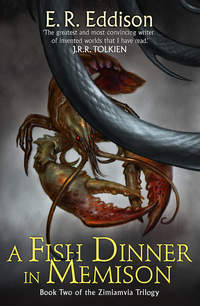
Jacket illustration by John Howe © HarperCollinsPublishers Ltd. 2014
E.R. Eddison asserts the moral right to be identified as the author of this work.
A catalogue copy of this book is available from the British Library.
This novel is entirely a work of fiction. The names, characters and incidents portrayed in it are the work of the author’s imagination. Any resemblance to actual persons, living or dead, events or localities is entirely coincidental.
All rights reserved under International and Pan-American Copyright Conventions. By payment of the required fees, you have been granted the non-exclusive, non-transferable right to access and read the text of this e-book on screen. No part of this text may be reproduced, transmitted, down-loaded, decompiled, reverse engineered, or stored in or introduced into any information storage and retrieval system, in any form or by any means, whether electronic or mechanical, now known or hereinafter invented, without the express written permission of HarperCollins.
Source ISBN: 9780007578153
Ebook Edition © October 2014 ISBN: 9780007578160
Version: 2014-09-09
Dedication
To my son-in-law
Flying Officer KENNETH HESKETH HIGSON
who in an air fight over Italy
saved his four companions’ lives
at cost of his own
I DEDICATE THIS BOOK
which he had twice read.
Proper names the reader will no doubt pronounce as he chooses. But perhaps, to please me, he will let Memison echo ‘denizen’ except for the m: pronounce the first syllable of Reisma ‘rays’: keep the i’s short in Zimiamvia and accent the third syllable: accent the second syllable in Zayana, give it a broad a (as in ‘Guiana’), and pronouce the ay in the first syllable (and also the ai in Laimak, Kaima, etc., and the ay in Krestenaya) like the ai in ‘aisle’: accent the first syllable in Rerek and make it rhyme with ‘year’: keep the g soft in Fingiswold: remember that Fiorinda is an Italian name, Beroald (and, for this particular case, Amalie) French, and Zenianthe, and several others, Greek: last, regard the sz in Meszria as ornamental, and not be deterred from pronouncing it as plain ‘Mezria’.
This divine beauty is evident, fugitive, impalpable, and homeless in a world of material fact; yet it is unmistakably individual and sufficient unto itself, and although perhaps soon eclipsed is never really extinguished: for it visits time and belongs to eternity.
GEORGE SANTAYANA

EURIPIDES, ION, 1615
… though what if Earth
Be but the shaddow of Heav’n, and therein
Each to other like, more than on earth is thought?
MILTON, PARADISE LOST, V. 571
Ces serments, ces parfums, ces baisers infinis,
Renaîtront-ils d’un gouffre interdit à nos sondes,
Comme montent au ciel les soleils rajeunis
Après s’être lavés au fond des mers profondes?
—O serments! ô parfums! ô baisers infinis!
BAUDELAIRE, LE BALCON

SAPPHO, ODE TO APHRODITE
CONTENTS
Cover
Title Page
Copyright
Dedication
Epigraph
Introduction by James Stephens
A LETTER OF INTRODUCTION
I. Aphrodite in Verona
II. Memison: King Mezentius
III. A Match and Some Lookers on
IV. Lady Mary Scarnside
V. Queen of Hearts and Queen of Spades
VI. Castanets Betwixt the Worlds
VII. Seven Against the King
VIII. Lady Mary Lessingham
IX. Ninfea di Nerezza
X. The Lieutenant of Reisma
XI. Night-Piece: Appassionato
XII. Salute to Morning
XIII. Short Circuit
XIV. The Fish Dinner: Praeludium
XV. The Fish Dinner: Symposium
XVI. The Fish Dinner: Caviar
XVII. In What a Shadow
XVIII. Deep Pit of Darkness
XIX. Ten Years: Ten Million Years: Ten Minutes
NOTE
DRAMATIS PERSONAE
MAP OF THE THREE KINGDOMS
ALSO BY E. R. EDDISON
ABOUT THE PUBLISHER
INTRODUCTION
BY JAMES STEPHENS
THIS is a terrific book.
It is not much use asking, whether a given writer is great or not. The future will decide as to that, and will take only proper account of our considerations on the matter. But we may enquire as to whether the given writer does or does not differ from other writers: from, that is, those that went before, and, in especial, from those who are his and our contemporaries.
In some sense Mr Eddison can be thought of as the most difficult writer of our day, for behind and beyond all that which we cannot avoid or refuse – the switching as from a past to something that may be a future – he is writing with a mind fixed upon ideas which we may call ancient but which are, in effect, eternal: aristocracy, courage, and a ‘hell of a cheek’. It must seem lunatic to say of any man that always, as a guide of his inspiration, is an idea of the Infinite. Even so, when the proper question is asked, wherein does Mr Eddison differ from his fellows? that is one answer which may be advanced. Here he does differ, and that so greatly that he may seem as a pretty lonely writer.
There is a something, exceedingly rare in English fiction, although everywhere to be found in English poetry – this may be called the aristocratic attitude and accent. The aristocrat can be as brutal as ever gangster was, but, and in whatever brutality, he preserves a bearing, a grace, a charm, which our fiction in general does not care, or dare, to attempt.
Good breeding and devastating brutality have never been strangers to each other. You may get in the pages of, say, The Mahabharata – the most aristocratic work of all literature – more sheer brutality than all our gangster fictionists put together could dream of. So, in these pages, there are villanies and violences and slaughterings that are, to one reader, simply devilish. But they are devilish with an accent – as Milton’s devil is; for it is instantly observable in him, the most English personage of our record and the finest of our ‘gentlemen’, that he was educated at Cambridge. So the colossal gentlemen of Mr Eddison have, perhaps, the Oxford accent. They are certainly not accented as of Balham or Hoboken.
All Mr Eddison’s personages are of a ‘breeding’ which, be it hellish or heavenish, never lets its fathers down, and never lets its underlings up. So, again, he is a different writer, and difficult.
There is yet a distinction, as between him and the rest of us. He is, although strictly within the terms of his art, a philosopher. The ten or so pages of his letter (to that good poet, George Rostrevor Hamilton) which introduces this book form a rapid conspectus of philosophy. (They should be read after the book is read, whereupon the book should be read again.)
It is, however, another aspect of being that now claims the main of his attention, and is the true and strange subject of this book, as it is the subject of his earlier novels, Mistress of Mistresses and The Worm Ouroboros, to which this book is organically related. (The reader who likes this book should read those others.)
This subject, seen in one aspect, we call Time, in another we call it Eternity. In both of these there is a somewhat which is timeless and tireless and infinite – that something is you and me and E. R. Eddison. It delights in, and knows nothing of, and cares less about, its own seeming evolution in time, or its own actions and reactions, howsoever or wheresoever, in eternity. It just (whatever and wherever it is) wills to be, and to be powerful and beautiful and violent and in love. It enjoys birth and death, as they seem to come with insatiable appetite and with unconquerable lust for more.
The personages of this book are living at the one moment in several dimensions of time, and they will continue to do so for ever. They are in love and in hate simultaneously in these several dimensions, and will continue to be so for ever – or perhaps until they remember, as Brahma did, that they had done this thing before.
This shift of time is very oddly, very simply, handled by Mr Eddison. A lady, the astounding Fiorinda, leaves a gentleman, the even more (if possible) astounding Lessingham, after a cocktail in some Florence or Mentone. She walks down a garden path until she is precisely out of his sight: then she takes a step to the left, right out of this dimension and completely into that other which is her own – although one doubts that fifty dimensions could quite contain this lady. Whereupon that which is curious and curiously satisfying, Mr Eddison’s prose takes the same step to the left and is no more the easy English of the moment before, but is a tremendous sixteenth- or fifteenth-century English which no writer but he can handle.
His return from there and then to here and now is just as simple and as exquisitely perfect in time-phrasing as could be wished for. There is no jolt for the reader as he moves or removes from dimension to dimension, or from our present excellent speech to our memorable great prose. Mr Eddison differs from all in his ability to suit his prose to his occasion and to please the reader in his anywhere.
This writer describes men who are beautiful and powerful and violent – even his varlets are tremendous. Here, in so far as they can be conjured into modern speech, are the heroes. Their valour and lust is endless as is that of tigers: and, like these, they take life or death with a purr or a snarl, just as it is appropriate and just as they are inclined to. But it is to his ladies that the affection of Mr Eddison’s great and strange talent is given.
Women in many modern novels are not really females, accompanied or pursued by appropriate belligerent males – they are mainly excellent aunts, escorted by trustworthy uncles, and, when they marry, they don’t reproduce sons and daughters, they produce nephews and nieces.
Every woman Mr Eddison writes of is a Queen. Even the maids of these, at their servicings, are Princesses. Mr Eddison is the only modern man who likes women. The idea woman in these pages is most quaint, most lovely, most disturbing. She is delicious and aloof: delighted with all, partial to everything (ça m’amuse, she says). She is greedy and treacherous and imperturbable: the mistress of man and the empress of life: wearing merely as a dress the mouse, the lynx, the wren or the hero: she is the goddess as she pleases, or the god; and is much less afraid of the god than a miserable woman of our dreadful bungalows is afraid of a mouse. And she is all else that is high or low or even obscene, just as the fancy takes her: she falls never (in anything, nor anywhere) below the greatness that is all creator, all creation, and all delight in her own abundant variety. Je m’amuse, she says, and that seems to her, and to her lover, to be right and all right.
The vitality of the recording of all this is astonishing: and in this part of his work Mr Eddison is again doing something which no other writer has the daring or the talent for.
He is also trying to do the oddest something for our time – he is trying to write prose. ’Tis a neglected, almost a lost, art, but he is not only trying, he is actually doing it. His pages are living and vivid and noble, and are these in a sense that belongs to no other writer I know of.
His Fish Dinner is a banquet such as, long ago, Plato sat at. As to how Mr Eddison’s philosophy stands let the philosophers decide: but as to his novel, his story-telling, his heroical magnificence of prose, and his sense of the splendid, the voluptuous, the illimitable, the reader may judge of these things by himself and be at peace or at war with Mr Eddison as he pleases.
This is the largest, the most abundant, the most magnificent book of our time. Heaven send us another dozen such from Mr Eddison,
JAMES STEPHENS
15th December 1940
A LETTER OF INTRODUCTION
TO GEORGE ROSTREVOR HAMILTON
MY dear George,
You have, for both my Zimiamvian books, so played Pallas Athene – sometimes to my Achilles sometimes to my Odysseus – counselling, inciting, or restraining, and always with so foster-brotherly an eye on the object we are both in love with, that it is to you sooner than to anyone else that this letter should be addressed. To you, a poet and a philosopher: from me, who am no poet (for my form is dramatic narrative in prose), nor philosopher either. Unless to be a humble lover of wisdom earns that name, and to concern myself as a storyteller not so much with things not of this world as with those things of this world which I take to be, because pre-eminently valuable, therefore pre-eminently real.
The plain ‘daylight’ parts of my story cover the years from April 1908 to October 1933; while, as for the month that runs contemporaneously in Zimiamvia (from Midsummer’s Day, Anno Zayanae Conditae 775, when the Duke first clapped eyes on his Dark Lady, to the 25th July, when his mother, the Duchess of Memison, gave that singular supper-party), it is sufficient to reflect that the main difference between earth and heaven may lie in this: that here we are slaves of Time, but there the Gods are masters.
There are no hidden meanings: no studied symbols or allegories. It is the defect of allegory and symbolism to set up the general above the individual, the abstract above the concrete, the idea above the person. I hold the contrary: to me the value of the sunset is not that it suggests to me ideas of eternity; rather, eternity itself acquires value to me only because I have seen it (and other matters besides) in the sunset and (shall we say) in the proud pallour of Fiorinda’s brow and cheeks – even in your friend, that brutal ferocious and lionlike fox, the Vicar of Rerek – and so have foretasted its perfections.
Personality is a mystery: a mystery that darkens as we suffer our imagination to speculate upon the penetration of human personality by Divine, and vice versa. Perhaps my three pairs of lovers are, ultimately, but one pair. Perhaps you could as truly say that Lessingham, Barganax, and the King (on the one hand), Mary, the Duchess, and Fiorinda (on the other), are but two persons, each at three several stages of ‘awakeness’, as call them six separate persons.
And there are other teasing mysteries besides this of personality. For example: Who am I? Who are you? Where did we come from? Where are we going? How did we get here? What is ‘here’? Were we ever not ‘here’, and, if so, where were we? Shall we someday go elsewhere? If so, where? If not, and yet we die, what is Death? What is Time, and why? Did it have a beginning, and will it have an end? Whatever the answer to the last two questions (i.e., that time had a beginning or that it had not: or an end) is either alternative conceivable? Are not both equally inconceivable? What of Space (on which very similar riddles arise)? Further, Why are we here? What is the good of it all? What do people mean when they speak of Eternity, Omnipotence, God? What do they mean by the True, the Good, the Beautiful? Do these ‘great and thumping words’ relate to any objective truth, or are they empty rhetoric invented to cheer or impress ourselves and others: the vague expressions of vague needs, wishes, fears, appetites of us, weak children of a day, who know little of (and matter less to) the vast, blind, indifferent, unintelligible, inscrutable, machine or power or flux or nothingness, on the skirts of whose darkness our brief lives flicker for a moment and are gone?
And if this is the true case of us and our lives and loves and all that we care for, then Why is it?
Ah, Love! Could you and I with Him conspire
To grasp this sorry Scheme of Things entire,
Would not we shatter it to bits – and then
Re-mould it nearer to the Heart’s Desire!
Why not? Why is there Evil in the world?
Such, in rapid and superficial survey, are the ultimate problems of existence; ‘riddles of the Sphinx’ which, in one shape or another, have puzzled men’s minds and remained without any final answer since history began, and will doubtless continue to puzzle and elude so long as mankind continues upon this planet.
But though it is true that (as contrasted with the special sciences) little progress has been made in philosophy: that we have not today superseded Plato and Aristotle in the sense in which modern medicine has superseded Hippokrates and Galen: yet, on the negative side and particularly in metaphysics, definite progress has been made.
Descartes’ Cogito ergo sum – ‘I think; therefore I exist’ – has been criticized not because its assumptions are too modest, but because they are too large. Logically it can be reduced to cogito, and even that has been shorn of the implied ego. That is to say, the momentary fact of consciousness is the only reality that cannot logically be doubted; for the mere act of doubting, being an act of consciousness, is of itself immediate proof of the existence of that which was to be the object of doubt.
Consciousness is therefore the fundamental reality, and all metaphysical systems or dogmas which found themselves on any other basis are demonstrably fantastic. In particular, materialistic philosophies of every kind and degree are fantastic.
But, because demonstrably fantastic, they are not therefore demonstrably false. We cannot, for instance, be reasonably driven to admit that some external substance called ‘matter’ is prior to or condition of consciousness; but just as little can we reasonably deny the possibility of such a state of things. For, logically, denial is as inadmissible as assertion, when we face the ultimate problems of existence outside the strait moment of consciousness which is all that certainly remains to us after the Cartesian analysis. Descartes, it is true, did not leave it at that. But he had cleared the way for Hume and Kant to show that, briefly, every assumption which he himself or any other metaphysician might produce like a rabbit from the hat must have been put into the hat before being brought out. In other words, the scientific method, applied to these problems and pressed to its logical implications, leads to an agnosticism which must go to the whole of experience, as Pyrrho’s did, and not arbitrarily stop short at selected limits, as did the agnosticism of the nineteenth century. It leads, therefore, to an attitude of complete and speechless scepticism.
If we think this conclusion a reductio ad absurdum, and would seek yet some touchstone for the false and the true, we must seek it elsewhere than in pure reason. That is to say (confining the argument to serious attitudes of speculation on the ultimate problems of existence), we must at that stage abandon the scientific attitude and adopt the poet’s. By the poet’s I mean that attitude which says that ultimate truths are to be attained, if at all, in some immediate way: by vision rather than by ratiocination.
How, then, is the poet to go to work, voyaging now in alternate peril of the Scylla and Charybdis which the Cartesian–Kantian criticism has laid bare – the dumb impotence of pure reason on the one hand, and on the other a welter of disorganized fantasy through which reason of itself is powerless to choose a way, since to reason (in these problems) ‘all things are possible’ and no fantasy likelier than another to be true?
Reason, as we have seen, reached a certain bed-rock, exiguous but unshakable, by means of a criticism based on credibility: it cleared away vast superfluities of baseless system and dogma by divesting itself of all beliefs that it was possible to doubt. In the same way, may it not be possible to reach a certain bed-rock among the chaos of fantasy by means of a criticism based not on credibility but on value?
No conscious being, we may suppose, is without desire; and if certain philosophies and religions have set up as their ideal of salvation and beatitude a condition of desirelessness, to be attained by an asceticism that stifles and starves every desire, this is no more than to say that those systems have in fact applied a criticism of values to dethrone all minor values, leaving only this state of blessedness which (notwithstanding their repudiation of desire) remains as (for their imagination at least) the one thing desirable. And in general, it can be said that no religion, no philosophy, no considered view of the world and human life and destiny, has ever been formulated without some affirmation, express or implied, of what is or is not to be desired: and it is this star, for ever unattained yet for ever sought, that shines through all great poetry, through all great music, painting, building, and works of men, through all noble deeds, loves, speculations, endurings and endeavours, and all the splendours of ‘earth and the deep sky’s ornament’ since history began, and that gives (at moments, shining through) divine perfection to some little living thing, some dolomite wall lighted as from within by the low red sunbeams, some skyscape, some woman’s eyes.
This then, whatever we name it – the thing desirable not as a means to something else, be that good or bad, high or low (as food is desirable for nourishment; money, for power; power, as a means either to tyrannize over other men or to benefit them; long life, as a means to achievement of great undertaking, or to cheat your heirs; judgement, for success in business; debauchery, for the ‘bliss proposed’; wind on the hills, for inspiration; temperance, for a fine and balanced life), but for itself alone – this, it would seem, is the one ultimate and infinite Value. By a procedure corresponding to that of Descartes when, by doubting all else, he reached through process of elimination something that he could not doubt, we have, after rejecting all things whose desirableness depends on their utility as instruments to ends beyond themselves, reached something desirable as an end in itself. What it is in concrete detail, is a question that may have as many answers as there are minds to frame them (‘In my Father’s house are many mansions’). But to deny its existence, while not a self-contradictory error palpable to reason (as is the denial of the Cartesian cogito), is to affirm the complete futility and worthlessness of the whole of Being and Becoming.
It is not to be gainsaid that a position of complete scepticism and complete nihilism in regard to objective truth and objective value is, logically, unassailable. But since, logically, he who takes up that position must remain speechless (for nothing, ex hypothesi, can be affirmed, nor does anybody exist to listen to the affirmation), must desire nothing (for there is nothing to be desired), and do nothing (for nothing is worth doing), therefore ‘the rest is silence’.
Proceeding, then, on the alternative supposition – that is to say, accepting the fact of consciousness as our fundamental reality and this undefined but uneliminable ‘one thing desirable’ as the fundamental value – we are free to speculate on the ultimate problems of metaphysics, using as instrument of investigation our mind at large, which includes (but is not restricted to) the analytic reason. Such speculation is what, for want of a better word, I have called poetic. It might (with some danger of misconception) also be called the kind of speculation appropriate to the lunatic, or to the lover! for—
The lunatic, the lover, and the poet,
Are of imagination all compact.
Three broad considerations may here be touched on:
(1) It does not seem necessary to postulate a plurality of ultimate values. Truth, Beauty, Goodness, are commonly so postulated. The claim of Truth, however, can hardly survive examination. On the one hand, the empirical truths of science or the abstract truths of mathematics are ‘values’ either as a means to power, or else for a kind of rightness or perfection which they seem to possess: a perfection which seems to owe its value to a kind of Beauty. On the other hand, Truth in the abstract (the quite neutral judgement, ‘That which is, is’) can have no value whatsoever: it acquires value only in so far as ‘that which is’ is desirable in itself, and not merely on account of its ‘truth’. If Schopenhauer’s The World as Will and Idea is a statement of the truth, then truth has, ultimately, a negative value and we are better off without it (except as a means to power, etc.). Truth, therefore, is only an ultimate value if it is good. But the ‘Good’, again, is ambiguous, meaning both (a) good as an end to be desired, and (b) moral good. In sense (a) it is surely tautologous to speak of the ‘good’ as distinct from the beautiful; in sense (b) it is arguable (and, as I myself hold, true) that acts are morally ‘good’ only in so far as, in the last analysis, they tend to create, serve, or safeguard, Beauty. The trinity of so-called ‘ultimate values’ is thus reduced to one.
(2) No sane theory of values will ultimately square with the facts of this world as we know it ‘here and now.’ But ultimate value, as we have seen, is one of the ‘bed-rocks’: not so, however, this world, which we know only empirically and as a particular phase of our other ‘bed-rock’ (viz. consciousness). Accordingly, the test of any metaphysic is not that it should square with the world as we know it, but that it should square with the ultimate value. (Cf. Vandermast’s words in Mistress of Mistresses: ‘In this supermundal science concerning the Gods, determination of what Is proceedeth inconfutably and only by argument from what Ought to be.’)
(3) Concrete reality, whether as consciousness or as value, has two aspects which are never in fact separated or separable: the One and the Many: the Universal and the Particular: the Eternal and the Temporal: the Never Changing and the Ever Changing. It is the inseparability of these modes of Being that makes it idle to seek abstract Beauty, Truth, Goodness, apart from their particular manifestations, and equally idle (conversely) to try to isolate the particulars. The Many are understandable only as manifestations of the One: the One, only as incarnate in the Many. Abstract statements, therefore, such as have been occupying our attention in the proceedings pages, can bear no nearer relation to the concrete truths which they describe than (for example) the system of latitude and longitude bears to the solid earth we live on.
It is on these terms only, then (as an explanation of our ‘latitude and longitude’), that it is possible to sum up in a few lines the conception which underlies Mistresses of Mistresses and A Fish Dinner in Memison.
In that conception, ultimate reality rests in a Masculine-Feminine dualism, in which the old trinity of Truth, Beauty, Goodness, is extended to embrace the whole of Being and Becoming; Truth consisting in this – That Infinite and Omnipotent Love creates, preserves, and delights in, Infinite and Perfect Beauty (Infinitus Amor potestate infinitâ Pulchritudinem infinitam in infinitâ perfectione creatur et conservatur). Love and Beauty are, in this duality, coequal and coeternal; and, by a violent antinomy, Love, owing his mere being to this strengthless perfection which he holds at his mercy, adores and is enslaved by her, while Beauty (by a like antinomy) queens it over the very omnipotence which both created her and is her only safeguard.
Ultimate reality, as was said above, must be concrete; and an infinite power, creating and enjoying an infinite value, cannot be cribbed or frozen in a single manifestation. It must, on the contrary, be capable of presenting itself in an infinite number of aspects to different minds and at different moments; and every one of these aspects must be true and (paradoxically) complete, whereas no abstract statement, however profound in its analysis, can ever be either complete or true. This protean character of truth is the philosophical justification for religious toleration; for it is almost inconceivable that truth, realized in the richness of its concrete actuality, should ever present itself to two minds alike. Churches, creeds, schools of thought, or systems of philosophy, are expedient, useful or harmful, as the case may fall out. But the ultimate Vision – the ‘flesh and blood’ actuality behind these symbols and formulas – is to them as the living body is to apparel which conceals, disguises, suggests, or adorns, that body’s perfections.
This ‘flesh and blood’, then, so far as it shapes itself in Mistress of Mistresses and is on the way to further definition in the Fish Dinner, shows this ultimate dualism as subsisting in the two supreme Persons, the divine and perfect and eternal He and She, Zeus and Aphrodite, ‘more real than living man’. All men and women, all living creatures, the whole phemonenal world material and spiritual, even the very forms of Being – time, space, eternity – do but subsist in or by the pleasure of these Two, partaking (every individual soul, we may think, in its degree), of Their divine nature—
‘The Lord possessed Me in the beginning of His way, before His works of old. I was set up from everlasting, from the beginning, or ever the earth was … When He prepared the Heavens I was there: when he set a compass on the face of the depth: when He established the clouds above: when He strengthened the fountains of the deep: when He gave to the sea His decree, that the waters should not pass His commandment: when He appointed the foundations of the earth: then I was by Him, as one brought up with Him, and I was daily His delight, rejoicing always before Him … Whoso findeth Me findeth life, and shall obtain favour of the Lord. But he that sinneth against me wrongeth his own soul: all they that hate Me love death.’
(Proverbs, VIII: there spoken by Wisdom; but it is truer of a less mundane matter. For wisdom can never be an ultimate value but a means only to something beyond itself, e.g. a guide to action; whereas She [l’inutile Beauté] is not a means but the end and mistress of all action, the sole thing desirable for Herself alone, the causa immanens of the world and of very Being and Becoming: ‘Before the day was, I am She’.)
Mundane experience, it must be admitted, goes, broadly, against all this: it affords little evidence of omnipotent love, but much of feeble, transient, foolish loves: much of powerful hatreds, pain, fear, cruelty. ‘Tout passe, tout casse, tout lasse’: death, disease, deformity, come to mortals indiscriminately. ‘And captive good attending captain ill’ – this and all the accusations of Shakespeare’s LXVIth sonnet are true of ‘this vain world’, and always have been true. This world, to say the best of it, has always been both good and bad; to say the best of it, it is a flux, in which, on the whole, the changes compensate each other.
But (standing upon the rock – the Zeus–Aphrodite dualism), we are faced, in this imperfection of mundane experience, with the problem of Evil; and (standing upon that rock) the only solution we can accept is one that shall concede to Evil something less than reality. Lame excuses for the impotence, unskilfulness, inattentiveness, callousness, or plain malevolence of God Almighty, to which all other solutions of the problem reduce themselves, are incompatible with the omnipotence of Love, which can hardly be supposed to possess, in action, the attributes of an idiot or a devil. (It may be said, no doubt, that Love is not omnipotent but subject to some dark  or necessity that binds even a God. Obviously this can neither be proved nor disproved, but it is repugnant to my judgement. For, if true, it means that the Scheme is indeed rotten at the core.)
Sub specie aeternitatis, therefore, this present world is understandable only on the assumption that its reality is not final but partial. On two alternative hypotheses might it thus be credible—
1 as something in the making, which in future aeons will become perfect;
2 as an instrument of , a training-ground or testing place.
Both hypotheses, however, present difficulties: (1) Why need omnipotence wait for future aeons to arrive? why have imperfections at all? (2) (The same difficulty in a different aspect) If perfection were available – and, to omnipotence, what is not? – why need omnipotence arrange for tests or trainings?
We are forced back, therefore, on the question: if illusion, why is there this illusion?
There seems to be no clear answer to this question; and no certain test (short of experience) of the truth of any particular experience. This world has got to be lived through, and the best way of living through it is a question for ethics: the science of the Good in action. A ‘good’ action is an action of Love, i.e. (see above) an action which serves Beauty. The ‘good’ man in action is therefore doing, so far as his action is good, and so far as his power goes, what the divine eternal Masculine is doing: creating, serving, worshipping, enjoying and loving Her, the divine eternal Feminine. And, by complement, the ‘good’ woman in action is doing, so far as in her lies, what the divine eternal Feminine is doing; completing and making up, that is to say, in her unique person, by and in her action and by and in her passivity, ‘whatsoever is or has been or shall be desirable, were it in earth or heaven’. In action therefore, this is ‘All ye know on earth, and all ye need to know.’
But man is not  only, but
 – concerned not with action only but with contemplation – and the unanswered questions in the third preceding paragraph remain. May there possibly be one answer to both? viz. that there is no necessity for these peculiar and (to us) inconvenient arrangements, but that – for the moment – they are amusing?
That they are far from ‘amusing’ to us, here and now – that they daily, for some or other of their helpless victims, produce woes and agonies too horrible for man to endure or even think of – is perhaps because we do not, in the bottom of our hearts, believe in our own immortality and the immortality of those we love. If, for you and me as individuals, this world is the sum, then much of it in detail (and the whole in general plan) is certainly not amusing. But to a mind developed on the lines of the Mahometan fanatic’s, the Thug’s, the Christian martyr’s, is it not conceivable that (short, perhaps, of acute physical torture) the ‘slings and arrows of outrageous fortune’ should be no more painful than the imagined ills of a tragic drama, and could be experienced and appraised with a like detachment? The death of your nearest and dearest, e.g., would be but a deepening of experience for you, if you could believe and know (beyond peradventure and with that immediacy which belongs to sense experience) that there is no death, except of the body in this transient and unsatisfactory life; that Truth rests indeed in that eternal duality whereby the One Value is created and tendered by the One Power; that the Truth is not abstract and bodiless, but concrete in all imaginable richness of spirit and sense; that the parting is therefore but for a while; and, last, that the whole of human history, and the material cosmos known to science, are but trivial occurrences – episodes invented perhaps, and then laid aside, as we ourselves might conceive and in a few minutes reject again some theory of the universe, in conversation after supper.
It may be asked, Why not suicide, then, as a way out? Is not that the logic of such an other-worldly philosophy? The answer surely is that there is a beauty of action (as the Northmen knew), and only seldom is suicide a fine act. Unless it is time to ‘do it in the high Roman fashion’: unless we stand where Othello stood, or Cleopatra, suicide is an ignoble act, and (as such) little to Her liking. The surer we are of Her, therefore, the less we are likely to take, in despair, that dark leap which (though not, as is vulgarly said, an act of cowardice: it demands much courage if done deliberately) is essentially a shirking of the game She sets us. And that game (as no one will doubt, who has looked in the eyes of ‘sparkling-thronèd heavenly Aphrodite, child of God, beguiler of guiles’) is a game which, to please Her, we must play ‘acording to its strict rules’.
This book can be read as well before as after Mistress of Mistresses. The chief persons appear in both books, but each is a self-contained work complete in itself.
Yours affectionately,
E. R. E.
Dark Lane
Marlborough
Wiltshire
29th July 1940
PRINCIPAL PERSONS
THE KING
BARGANAX, DUKE OF ZAYANA
EDWARD LESSINGHAM
LADY MARY LESSINGHAM
THE DUCHESS OF MEMISON
FIORINDA
I
APHRODITE IN VERONA
‘ÇA M’AMUSE.’ The words, indolent, indolently fallen along the slowness of a lovely lazy voice, yet seemed to strike night, no, Time itself, with a sudden division; like as when that bare arrow-like three-octave E, high on the first violin, deep on the cello, stabs suddenly the witched quietude of the andante in the third Rasoumoffsky Quartet. A strange trick, indeed, in a woman’s voice: able so, with a chance phrase overheard, to snatch the mind from its voyaging in this skiff between sightless banks: snatch and translate it so, to some stance of rock, archaean, gripping the boot-nails, high upon mountains; whence, as gathering your senses out of sleep, you should seem to discern the true nature of the stream of things. And here, tonight, in Verona—
Lessingham looked round, quickly enough to catch the half mocking, half listening, inclination of her head as her lips closed upon the lingering last syllable of that private ‘m’amuse’. The words had been addressed, it was clear, to nobody, for she was alone at her table: certainly not to him: not even (curiously) to herself: to velvet-bosomed Night, possibly, sister to sister: to the bats, the inattentive stars, this buzz of Latin night-life; little white tables with their coffee, vino rosso, vino bianco, carafe and wine-glass, the music and the talk; wreaths of cigar-smoke and cigarette-smoke that hung and dissipated themselves on airs that carried from the flower-beds of the mid piazza a spring fragrancy and, from the breathing presences of women, wafts of a more exotic and a deeper stirring sweetness. Over all, the tremendous curved façade of Diocletian’s amphitheatre, ruined deep in time, stood desolate in the glare of electric arclights. In Lessingham’s hand arrested on the table-top, the cigar went out. Into the stillness all these things – amphitheatre, electric lights, the Old and the New, this simple art of living, the bat-winged night, the open face of the dark – seemed to gather and, with the slow upsurging might of their rise, to reach to some timeless moment which seemed her; and which seemed as fixed, while beyond it life and the hours streamed unseizable as the unseizable down-streaming spray-motes into which water is dissipated when it falls clear over a great height – Ça m’amuse.
Then, even as in the andante the processional secular throb of the arpeggios, so Time seemed now to recover balance: catch breath: resume its inexplicable unseizable irreversible way. Not to be explained, yet upon that echo illuminated: not to be caught, yet (for that sudden) unprecedentedly submitting itself within hand-reach: not to be turned back, yet suddenly self-confessed as perhaps not worth the turning. She looked up, and their eyes met.
‘Vous parlez français, madame?’
‘O, depende dello soggetto: depende con cui si parla. To an Englishman, English.’
‘Mixed with Italian?’
‘Addressed to a person so mixed. Or do I not guess aright?’
Lessingham smiled and replied: ‘You pay me a doubtful compliment, signora. Is it not a saying: “Inglese Italianato e Diavolo incarnato”? And as for the subject,’ he said, ‘if the signora will permit a question: is there then a special fitness to be amused, in French?’
‘Simply to be amused – perhaps, No. But to be amused at this – Yes.’
‘And this is?—’
Her hand, crimson-gloved, on which till now her cheek had been resting, traced, palm-upwards, a little half circle of disdain indicative of the totality of things. ‘There is a something logical: a something of precision, about the French, which very well fits this affair. To be polite to it, you must speak of it in French: it is the only language.’
‘There is in Latin, equally, a precision.’
‘O but certainly: and in a steam roller: but not altogether spirituel. Il faut de l’esprit pour savourer nettement cette affaire-là’; and again her hand delicately acknowledged it: ‘this clockwork world, this mockshow, operated by Time and the endless chain of cause and effect. Time, if you consider it,’ she said, ‘works with so ingenious a simplicity: so perfect a machine. Like a clock. Say you are God: you need but wind it up, and it proceeds with its business: no trouble at all.’
‘Until,’ said Lessingham, ‘you have to wind it up again?’
The lady shrugged her shoulders.
‘Signora,’ he said, ‘do you remember M. d’Anquetil, at that enjoyable unrestrained supper-party in La Rôtisserie de la Reine Pédauque? “Je vous confierai que je ne crois pas en Dieu.”’
‘And permit me, sir,’ said she, ‘to continue the quotation from that entertaining book: “Pour le coup, dit l’abbé, je vous blâme, monsieur.” And yet I am glad; for indeed it is a regrettable defect of character in a young man, to believe in God. But suppose, sir, that you in fact were – shall I say? – endowed with that authority: would you wind it up again?’
He paused before answering, held by the look of her: the passivity of her lips, that was like the swept silences of the sky expectant of dawn, or like the sea’s innumerable rippled stillness expectant of the dark after sunset: an assuredness, as native to some power that should so far transcend omnipotence as that it needs no more but merely to be and continue in that passivity, and omnipotence in action must serve it.
Like the oblique wide circle of a swift’s flight, down and round and up again, between earth and sky, the winged moment swung: now twenty years backwards into earliest childhood: the tennis lawn, of a June evening, of the old peelhouse where he was born, youngest of seven, of a great border family, between the Solway and the Cumberland hills: church bells, long shadows, Rose of Sharon with its sticky scent: Eton: then, at eighteen (getting on for eight years ago now), Heidelberg, and that unlucky episode that cut his studies short there. Then the Paris years, the Sorbonne, the obsessed concentration of his work in Montmartre studios, ending with the duel with knives with that unsavoury musician to whose Spanish mistress Lessingham, with the inexperienced ardour and quixotism of youth, had injudiciously offered his protection. And so, narrowly escaping imprisonment, to Provence and his Estremaduran Amaryllis: in a few weeks their parting by mutual consent, and his decision (having overspent his allowance, and in case his late adversary, again in hospital, should die, and that be laid at his door) to enlist in the Légion Etrangère under an assumed name. His desertion after some months (disillusioned with such a school but pleased with the experience for the power it gave him), and escape through Morocco in Egypt. Arrival penniless at the British Agency: news that his father, enraged at these proceedings, had stopped allowances and cut him out of his will. So, work his passage home as a stoker on a P. & O.: upon his twenty-first birthday, the twenty-fourth of November, 1903, land at Tilbury, and (by his mother’s means, that queen of women, seconding friendship and strong argument of flesh and blood) at one again with his father before Christmas; and so a year in England, his own master and with enough money to be trusted to do what money is meant for: look after itself, and leave its owner free. Then east, mainly India: two seasons exploring and climbing, Eastern Himalaya, Karakoram. Journey home, against official advice and without official countenance, dangerously through Afghanistan and Persia: then nearly the whole year 1906 in Greece, on horseback, sailing among the islands, studying in Athens. Then – the nineteenth of December, 1906. Sixteen months ago.
The nineteenth of December: Betelgeuze on the meridian at midnight, his particular star. The beginning: dinner at his sister Anne’s, and on with her party to that historic ball at the Spanish Embassy. Queer composition, to let the theme enter pianissimo, on muted strings, as it were; inaudible under such a blaring of trumpets. Curious to think of: towards the end of the evening, puzzling over his own scribble on his programme, ‘Dijon-Fiammetta’, against the next waltz, and recalling at last what it stood for: ‘Fiammetta’ – flame: red-gold hair, the tea-rose she wore in it, and a creamy dress like the rose’s petals. Their dancing: then, afterwards, sitting out on the stairs: then (as in mutual unspoken agreement to leave deserted partners to their devices in the glitter and heat of the ballroom, and themselves to savour a little longer this quiet), their sitting on, and so through two dances following. Whether Mary was tired, or whether minded to leave the ball of conversation to him, they had talked little. Dark girls were the trumpets in that symphony; and he had throughout the evening neither lacked nor neglected opportunity to store his mind with images of allures, Circean splendours, unstudied witty charms, manifested in several partners of that preferred complexion. The mockery! that on such hushed strings, and thus unremarked, should have been the entry of so imperial a theme. So much so, that the next morning, in idle waking recollection casting up the memories of the night before, he had forgotten her.
And yet, a week later, Christmassing with Anne and Charles at Taverford Manor, he had forgot the others but begun to remember her: first, her talking of Wuthering Heights, a very special book of his: then a saying of her own here and there: the very phrase and manner. She had been of few words that night, but those few singularly as if her own yet not self-regarding: pure Maryisms: daffodils or stars of the blackthorn looking on green earth or out to the sun. As for instance this (comparing Highlanders and the Tyrolese): ‘Mountain people seem all rather the same – vague and butterflyish. If they lose something – well, there it is. All ups and downs. I should think.’ Or this (of the smallness of human beings in an Alpine valley): ‘What weasels we look!’ Also, there had been near the corner of her mouth, a ‘somewhat’, that sometimes slept, sometimes stirred. He had wondered idly who she was, and whether these things took place as well by daylight. And then, next week, at the meet of the West Norfolk, his fresh introduction to her, and satisfying himself on both questions; and, as for the second, that they did.
Then, six months afterwards. Twenty-fourth of June. That river-party: that well planned, well timed, confident proposal: its rejection (a discomfiture in which he had not been singular; rather ninth or tenth; if talk were to be trusted). And, most devastating, something in the manner of her refusal: an Artemisian quality, quiver of startled hind, which stripped scales from his eyes to let him see her as never before: as the sole thing, suddenly, which as condition absolute of continuing he must have, let the world else go hang; and, in the same thunderclap, the one sole thing denied him. And so, that feverish fortnight, ending (thank heaven) with the best terms he might make (her cousin Jim Scarnside playing honest broker): burial of that black No, upon condition he should himself leave the country and not before fifteen months come back for his answer: eighteen months, as first propounded; which he would have shortened to August year (that is harvest time); but Mary would not give ground beyond Michaelmas: ‘An omen too, if you were wise – Vintage.’
Vintage. Vindemiatrix: she who harvests the grape: the delicate star in whose house the sun sits at autumn, and with her mild beams moderates his own to a more golden and more tranquil and more procreative radiance.
Nine months gone: Dahomey, Spain, Corsica. And April now: the twenty-second of April. A hundred and fifty-nine days to go.
The back arrowed swoop of the moment swung high into the unceilinged future, ten, fifty, sixty years, may be: then, past seeing, up to that warmthless unconsidered mock-time when nothing shall be left but the memorial that fits all (except, if there be, the most unhappiest) of human kind: I was not. I lived and loved. I am not. Then (or was it a bat, of the bats that hawked there between the piazza lamps and the stars?) it swung near, flashing darkly past that Dark Lady’s still mouth, at whose corner flickered a something: miraculously that which, asleep or awake, resided near the corner of Mary’s mouth.
Queen of Hearts: Queen of Spades: ‘Inglese Italianato’: the conflict of north and south in his blood; the blessing of that – of all – conflict. And yet, so easily degraded. As woman’s beauty, so easily degraded. The twoness in the heart of things: that rock that so many painters split on. Loathsome Renoir, with his sheep-like slack-mouthed simian-browed superfluities of female flesh: their stunted tapered fingers, puffy little hands, breasts and buttocks of a pneumatic doll, to frustrate all his magic of colour and glowing air. Toulouse-Lautrec, with his imagination fed from the stews, and his canvases all hot sweat and dead beer. Etty’s fine sensuality coarsely bitted and bridled by a convention from without, and starved so of the spirit that should have fed it to beauty from within. Burne-Jones’s beauties, nipped by some frost: Rossetti’s weighted with undigested matter: Beardsley, a whore-master, prostituting his lovely line to unlovely canker-buds. Even the great: even Titian in his Sacred and Profane Love, even Botticelli in his supreme Venus, were (he said in himself), by some meddling from within or without, restrained from the ultimate which I would have, and which as a painter I (Kapaneus’s 


 – with God’s will, or if not, against it) will attain. Did the Greeks, with their painted statues, Apelles with Phryne for his model, attempt it? Did they, attempting, succeed? We can never know. Do such things die, then? Things of the spirit? Sappho’s burnt poems? Botticelli’s pictures of ‘beautiful naked women’ of like quality, perhaps, with his Venus and his nymphs of spring? – poor consolation that he was burnt that burnt them.
Yes. They die 


 – half brother to man-slaying Hector, and his charioteer; under the dusty battle-din before Ilios, ‘mighty, mightily fallen: forgetful of his horsemanship’. All time past, the conflict and the heartbreak (he looked at the amphitheatre, a skeleton lifted up to witness): frozen. He looked at her: her eyes were more still than the waiting instant between the flash and the thunder. No. Not frozen; for that is death. No death here: rather the tenseness of sinew that is in the panther before the leap: Can Grande’s tomb, as this morning, in broad sunshine. Below, under the Gothic canopy carved in stone, the robed figure, lying in state, of the great condottiere, submissive, supine, with pious hands clasped upon his breast as in prayer, ‘requiescat in pace’, ‘Domine, in manus tuas’, etc., weak childhood come back like a song’s refrain, sightless eyes facing upwards. But above, high upon that canopy, the demonic equestrian figure of him in the April sap of his furious youth, helmed and harnessed, sword aloft, laughing on his caparisoned horse that seems itself to be informed with a secret kindred laughter, to say ha! ha! among the trumpets: a stirring together of the warring mights and glories, prides, overthrowings, and swiftnesses, of all worlds, to one flame; which takes on, of its mere eternity and only substantiality, as ice will scorch or fire freeze, the semblance of a death-like stillness.
All this in a few seconds of time: apocalyptically.
Lessingham answered her: ‘Signora, if I were God Omnipotent, I should be master of it. And, being master, I would not be carried by it like a tripper who takes a ticket for a cruise. I would land where I would; put in to what ports I liked, and out again when I would; speed it up where I would, or slow it down. I would wind it to my turn.’
‘That,’ she said, ‘would be a very complicated arrangement. One cannot deny it would be a pleasure. But the French precision, I fear, would scarcely apply itself so fitly, were that the state of things.’
‘You would hardly have me do otherwise?’
Slowly drawing off her right-hand glove, she smiled her secular smile. ‘I think, sir (in my present mood), that I would desire you, even so, to play the game according to its strict rules.’
‘O,’ said Lessingham. ‘And that (if it is permissible to enquire), in order to judge my skill? or my patience?’
Her fingers were busied about her little gold-meshed bag, finding a lira for her wine: Lessingham brought out a handful of coins, but she gracefully put aside his offer to pay for it. ‘I wonder?’ she said, looking down as she drew on her crimson glove again: ‘I wonder? Perhaps my answer is sufficient, sir, if I say – Because it amuses me.’ She rose. Lessingham rose too. ‘Is that sufficient?’ she said.
Lessingham made no reply. She was tall: Mary’s height to an inch as he looked down at her: incredible likenesses to Mary: little turns of neck or hand, certain looks of the eye, that matter of the mouth (a thing surely unknown before a living woman). Unlike Mary, she was dark: jet-black hair and a fair clear skin. ‘Good night, sir,’ she said, and held out her hand. As if bred up in that gracious foreign courtesy, he bowed: raised it to his lips. Strangely, be made no motion to follow her; only as she turned away, watched her gait and carriage, inhumanly beautiful, till she was vanished among the crowd. Then he put on his hat again and slowly sat down again at his table.
So he sat, half an hour more, may be: a spectator: looking at faces, imagining, playing with his imaginations: a feeling of freedom in his veins: that strange glitter of a town at night, offering boundless possibilities. In that inward-dreaming mood he was unconscious of the clouding over of the stars and the closeness of the air, until rain had begun in big drops and the whole sky was split with lightning which unleashed the loud pealing thunder. Hastening back drenched to his hotel with collar turned up and with the downpour splashing again in a million jets from the flooded pavement, he, as in a sudden intolerable hunger, said in himself: ‘It is long enough: I will not wait five months. Home tomorrow.’
She, in the mean while (if, indeed, as between World and World it is legitimate to speak of ‘before’ and ‘after’), had, in a dozen paces after Lessingham’s far-drawn gaze had lost her, stepped from natural present April into natural present June – from that night-life of Verona out by a colonnade of cool purple sandstone onto a daisied lawn, under the reverberant white splendour of midsummer noonday.
Бесплатный фрагмент закончился.