Читать книгу: «Forget Me Not»


Copyright
Published by AVON
A Division of HarperCollinsPublishers Ltd
1 London Bridge Street
London SE1 9GF
www.harpercollins.co.uk
First published in Great Britain by HarperCollinsPublishers 2019
Copyright © Claire Allan 2019
Cover design © Claire Ward, HarperCollinsPublishers Ltd 2019
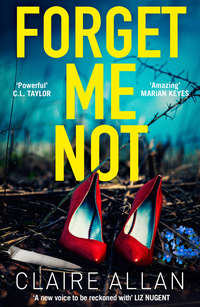
Cover photographs © Karina Vegas/ Arcangel (shoes and background), Shutterstock.com (knife and flowers)
Claire Allan asserts the moral right to be identified as the author of this work.
A catalogue copy of this book is available from the British Library.
This novel is entirely a work of fiction. The names, characters and incidents portrayed in it are the work of the author’s imagination. Any resemblance to actual persons, living or dead, events or localities is entirely coincidental.
All rights reserved under International and Pan-American Copyright Conventions. By payment of the required fees, you have been granted the non-exclusive, non-transferable right to access and read the text of this ebook on screen. No part of this text may be reproduced, transmitted, downloaded, decompiled, reverse engineered, or stored in or introduced into any information storage and retrieval system, in any form or by any means, whether electronic or mechanical, now known or hereinafter invented, without the express written permission of HarperCollins.
Source ISBN: 9780008321918
Ebook Edition © May 2019 ISBN: 9780008321925
Version: 2019-04-26
Praise for Claire Allan:
‘Amazing. I read it in one go.’
Marian Keyes
‘Utterly addictive! Literally couldn’t put it down all day! Compulsive, twisty, tense. And LOVED the ending.’
Claire Douglas
‘A powerful and emotional psychological thriller that will keep you guessing and leave you breathless.’
C.L. Taylor
‘SUCH a good read! It made me feel so uncomfortable, but I still kept gobbling up the pages.’
Lisa Hall
‘Her Name Was Rose is one heck of a read! It’s a psychological thriller with a heart; it’s taut, emotionally challenging and, unlike so many thrillers, each twist and turn is here because it deserves to be and not for the sake of it.’
John Marrs
‘An exciting debut that I couldn’t put down, Her Name Was Rose got under my skin in a way I wasn’t expecting. An intriguing and menacing page turner.’
Mel Sherratt
‘The depth of characterisation and its fast pace is what makes Her Name Was Rose stand out as a thriller. It had me hooked until the end.’
Elisabeth Carpenter
‘A tight and twisted tale with a set of seriously complex characters – kept me guessing right ’til the end. This is going to be one of 2018’s smash hits.’
Cat Hogan
‘All I can say is wow! Such a great concept, expertly delivered to keep you turning the pages. This book toys with the reader until the last page. Trust me, this will be THE book of 2018!’
Caroline Finnerty
‘A brilliantly paced, intriguingly plotted and thoroughly enjoyable story. One of the best psych thrillers I’ve read this year.’
Liz Nugent
‘I devoured it in a couple of days. Claire Allan managed to maintain an unsettling sense of unease that started at the very beginning and didn’t let up at all.’
Elle Croft
‘A superior psychological thriller with an intriguing set-up, a flawed heroine and some great twists. Recommended!’
Mark Edwards
‘Claire Allan’s transition into crime writing is seamless. Her Name Was Rose brings all the emotional heft and depth of characterisation her readers would expect, but with a taut, menacing plot line. A compulsively thrilling read from start to finish.’
Brian McGilloway
‘Mesmerizing to the point of complete distraction. I was totally engrossed in this book.’
Amanda Robson
‘I loved it. The plot is twisty and the issues being dealt with here are big scale but told beautifully through Emily. Her envy and confusion is so real as to be palpable and of course, all too relatable. Creepy and weepy.’
Niki Mackay
‘Claire’s thrillers are twisty like tornadoes.’
Liz Nugent
‘Fantastic, fluid and engaging, a 2019 hit!’
Jo Spain
‘A brilliant and hooky read.’
Fionnuala Kearney
‘A first-rate psychological thriller. Emotional and twisty, with excellent characterisation.’
Patricia Gibney
Dedication
For Julie-Anne, Vicki & Fionnuala
Contents
Cover
Title Page
Copyright
Praise for Claire Allan
Dedication
Prologue
Wednesday, 6 June
Chapter One: Elizabeth
Chapter Two: Rachel
Chapter Three: Elizabeth
Chapter Four: Rachel
Chapter Five: Rachel
Chapter Six: Elizabeth
Chapter Seven: Rachel
Thursday, 7 June
Chapter Eight: Rachel
Chapter Nine: Elizabeth
Chapter Ten: Rachel
Friday, 8 June
Chapter Eleven: Rachel
Chapter Twelve: Elizabeth
Chapter Thirteen: Rachel
Chapter Fourteen: Rachel
Saturday, 9 June
Chapter Fifteen: Elizabeth
Chapter Sixteen: Rachel
Chapter Seventeen: Rachel
Chapter Eighteen: Elizabeth
Chapter Nineteen: Rachel
Chapter Twenty: Rachel
Chapter Twenty-One: Elizabeth
Chapter Twenty-Two: Rachel
Chapter Twenty-Three: Rachel
Sunday, 10 June
Chapter Twenty-Four: Elizabeth
Chapter Twenty-Five: Rachel
Monday, 11 June
Chapter Twenty-Six: ‘Warn them’
Chapter Twenty-Seven: Rachel
Chapter Twenty-Eight: Elizabeth
Tuesday, 12 June
Chapter Twenty-Nine: Rachel
Chapter Thirty: Rachel
Chapter Thirty-One: Elizabeth
Chapter Thirty-Two: Rachel
Chapter Thirty-Three: Rachel
Chapter Thirty-Four: Rachel
Chapter Thirty-Five: Elizabeth
Chapter Thirty-Six: Rachel
Chapter Thirty-Seven: Elizabeth
Chapter Thirty-Eight: Rachel
Chapter Thirty-Nine: Elizabeth
Wednesday, 13 June
Chapter Forty: Rachel
Chapter Forty-One: Rachel
Chapter Forty-Two: Rachel
Chapter Forty-Three: Elizabeth
Chapter Forty-Four: Rachel
Chapter Forty-Five: Rachel
Thursday, 14 June
Chapter Forty-Six: Rachel
Chapter Forty-Seven: Elizabeth
Chapter Forty-Eight: Rachel
Chapter Forty-Nine: Elizabeth
Chapter Fifty: Rachel
Chapter Fifty-One: Elizabeth
Chapter Fifty-Two: Rachel
Chapter Fifty-Three: Rachel
Chapter Fifty-Four: Elizabeth
Saturday, 16 June
Chapter Fifty-Five: Rachel
Wednesday, 20 June
Epilogue: Rachel
Acknowledgements
Keep Reading …
About the Author
Also by Claire Allan
About the Publisher
Prologue
I disappeared on a Wednesday afternoon, in June, right in the middle of the heatwave. I was there one minute and the next I was gone. You might think it hard to disappear in broad daylight. To be visible and then, just seconds later, to be invisible. To have a life, and then moments later to have lost it. It wasn’t hard at all.
It was much too easy.
They found my shoes. Well, one of them, turned upside down and covered in dust. They found my car, unlocked. The driver’s window down. My keys in the ignition. My weekly shop melting and rotting in the boot. Cooking in the unspeakable heat.
They found my bag, my purse, my bank cards. My phone. The memorial card with my mother’s picture on it and some rhyming words of comfort, which were supposed to make me feel better about the fact she’d died of breast cancer in her sixties.
They found traces of blood – mine – on the ground outside. Minute droplets. They found traces of unidentified seminal fluid on the back seat, too. Not my husband’s profile. Evidence of a sexual assault, maybe?
Or maybe not.
Scuff marks on the ground, the ground kicked up. Vomit on the patchy, faded tarmac. Smeared fingerprints – mine.
Signs of a struggle.
Half a packet of Wotsits crisps, crushed into the floor of where the rear seats are. An empty Fruit Shoot bottle – blackcurrant – under the passenger seat. An ankle sock. Pink trim. A booster seat in the front of my car.
Signs I was a mother.
‘She wouldn’t leave the baby,’ they said. The baby was three. Blonde curls and blue eyes. Cupid bow lips. A dimple in her left cheek. I wouldn’t leave the baby, they were right. Not unless I had no choice.
I’d been given no choice.
Wednesday, 6 June
Chapter One
Elizabeth
Even with every window open, this house is still too warm. It’s only half past five in the morning and I know there will be no reprieve from this heatwave. It didn’t cool more than a few degrees overnight and I’ve not slept properly in days. Izzy looked at me mournfully, big brown eyes, pleading for the chance to run about outside before the heat becomes oppressive. I feel sorry for her – even though she’s shed her winter coat, it’s much too warm for her. Like me, she’s become a virtual prisoner in our home.
We’d changed our walking routine a few weeks before. Setting out early now. Before six. Doing our best to avoid the full heat of the sun, though the temperature didn’t seem to drop much overnight. This heatwave was stronger than any I remembered in my lifetime. Even warmer than 1976. That morning I was tired, though. My bones ached and I felt every one of my sixty-seven years, and then some. Still, I’d be back at home within an hour, I reasoned, and I could spend the rest of my morning doing what I had planned – baking bread for my grandchildren, who were coming here after school. I eyed the bananas on the worktop – brown spots seeming to multiply with every hour that passed. I might even throw a quick banana bread in the oven. With chocolate chips. The children would love that.
I had to leave the dough for the bread to prove for another hour anyway – wrapped in clingfilm in the airing cupboard – so I had no excuse but laziness and the persistent ache in my left arm. It hadn’t been the same since it had been broken eighteen months earlier and was, according to the doctor, unlikely to improve further. I’d just have to work through it.
‘Come on, then,’ I called to the dog, who started to wag her tail with great enthusiasm. ‘You win. Just like you always do.’
She bounced her way down the hall, deliriously happy at seeing her lead in my hand. Patting my pockets to make sure I had everything I needed with me – phone, keys, poo bags – I opened the door then watched as Izzy bounded to the end of the garden before stopping, looking back at me and waiting. She was a good dog. She made me leave the house at least once a day, which was a positive thing. I could quite happily have never left the safety of my own home. I preferred my own company. Peace and quiet. My solitary routine. But fresh air was good for body and soul. Or so they said.
I clipped Izzy’s lead to her collar and off we set along Coney Road, narrow, quiet, just far enough from the main roads of Derry to feel as if we were in the middle of nowhere. We’d walk half an hour out on the road and half an hour back, taking in some of the back roads, maybe slip into the country park for a bit.
Striding out, I didn’t put my earphones in. I preferred to be able to hear what was around me. To keep my wits about me, just in case. I doubt I posed an attractive prospect to any would-be kidnapper, rotund and in my mid-sixties, but nonetheless, you never could be too careful. People who wanted to hurt others would do so regardless.
I was glad I’d brought a bottle of water with me. It didn’t take long for me to feel too hot. I chided myself for bringing a jacket. Even though it was light, it was still too heavy for this weather. Everything was too heavy for this weather.
I slipped it off and tied it around my waist. There was a beautiful calm to the morning. The sound of birds tweeting. In a while the city would start to wake up and the rat race would begin again. I was so glad to be out of that now.
After a while, I let Izzy off the lead. She ran on, occasionally stopping to look back at me, teeth flashing a bright canine smile, before setting off again. Occasionally, she’d spot a rabbit or a bird and would speed off up the road, or into the fields to chase them – bounding as she ran. It was then I felt guilty for wanting to stay inside and not walk her. This was where she was at her happiest.
She never wandered far enough that I couldn’t see her. She’d reach a certain point and stop, then turn her head back to me as if to say: ‘Come on, old girl! Keep up.’ She’d wait patiently until I was closer, then set off again.
We walked on until she started barking, running to the hedgerow, yelping and spinning around – running back to me and back to the hedgerow again.
‘What is it, girl?’ I asked as I followed her, wondering what it was she’d uncovered this time: an old ball, ripe for throwing into the field for a prolonged game of catch, or more likely a bone, or the remains of an animal that she’d then roll in, necessitating me wrestling her into the bath when we got home.
Only as I got closer, I saw her pull at something bright. Orange. Fabric. Whatever it was, it was heavy. She pulled and struggled with it, yelping all the time. Despite the heat, I felt a chill run up my spine. I wanted to turn around and run, but Izzy was becoming more and more distressed.
The orange object took shape before my eyes. Sharpened. Came into focus. As did a hand, bluish grey. Izzy pulled back. I noticed her white paws, which just minutes before were brown with mud, were now a dark red. Her barking had become whimpering. I wanted to run but I couldn’t. I was frozen to the spot.
I pulled my phone from my pocket, took a deep breath. Forced myself to keep walking. Before I even reached the crumpled wreck of a body curled in the hedgerow, I’d dialled 999. Asked for help. Police, yes. Ambulance, yes. Was the person breathing? I didn’t know, I wasn’t close enough, but I had to be now. I had to get close. I saw a face, blue, a gaping neck wound. Fibrous tissue, muscle and cartilage all on display. An arm that lay at a strange angle. Dried blood. Fresh blood.
Surely this figure before me was dead. Surely no one could survive such butchery.
‘It’s a woman. A girl,’ I blurted down the phone.
‘Is she breathing?’ The voice on the other end of the line was the calm to my panic.
‘I don’t think so.’
I got down on my knees, repulsed by the sight in front of me but knowing I at least had to check. I had to do what I could. I bent my head down over her body, my ear to her mouth – senses primed to pick up even the slightest whisper of breath. I took her poor, cool wrist in my hand – tried to feel for a pulse. I was shaking. Trying to push away the memories of another time. Other girls. Other men. Other children. Cold and grey and mutilated. This was why I stayed away. The thumping of my heart drowned out all noise, even the yelping of the dog at my feet.
But there it was. The faintest pulse. Thready. Slow. The softest exhalation. Short. Shallow.
‘She’s alive,’ I said to the operator. ‘But only just. Be quick.’
I untied my jacket, placed it on her – as useless as it probably was. Even though it was already hot, she was so cold. The bleeding from her neck wound had been profuse but it had slowed now. I lifted the jacket, moved it and pressed against the wound, almost afraid that I’d press too hard, that my hand would slip inside it.
‘Help’s on the way,’ I said, for my own benefit as much as for that of the unknown woman in front of me. ‘If you can hang on, help is on the way. I’m Elizabeth and I’m not going to leave you. I’m going to be here until the paramedics arrive. So if you could do me a favour and just hang on, that would be great, lovey. It really would.’
I took her hand in mine. Could barely countenance how it could feel so cold and still have life in it.
‘You’re not alone,’ I told her, trying to reassure her.
I wondered who she was and who she belonged to. She wasn’t wearing a wedding ring. There didn’t appear to be much at all distinguishing about her. It was hard to tell the true colour of her hair, matted as it was with mud and blood. If I had to guess, I’d have put her in her mid to late thirties. But it was hard to tell given how bruised and battered she was. Her toenails were painted bright green. It looked so gaudy against the mottled, discoloured skin of her feet – the large areas of raw flesh, gravel-speckled flesh where it looked as though she’d been dragged along the ground, her ankle pointing in the wrong direction.
Someone had wanted this woman very much dead. Someone had left her here. On this quiet country lane, bleeding out.
I could hardly believe she was still alive.
‘You keep fighting,’ I told her. ‘You hold on and keep fighting.’
I was shivering then. Shock was kicking in. My muscles were seizing. I rubbed my arms, tried to release the spasms. Kept an eye out for any traffic that might pass. An ear out for the sound of sirens. Any sound of an approaching police car or ambulance.
I both wished I’d stayed at home and was grateful I was here – at least she had a chance. However small. I put my ear to her mouth again, listened for those shallow breaths. Almost imperceptible but still there. I heard a small gurgle. A rattle. The words ‘Warn them’ carried on the last of her breaths.
Then she was silent. Still.
And I could hear the sirens approaching.
Chapter Two
Rachel
I saw the news on Twitter first: ‘Body of woman found on Derry outskirts.’ It linked to a short article in the Derry Journal saying little more than the headline. Police were at the scene. The Coney Road, from Culmore Point onwards, was closed until further notice. There would be more on this story as it broke.
I felt a shiver run through me. Was it a hit and run, maybe? Oh, God, I hoped it wasn’t a paramilitary attack. No one wanted a return to those days.
No matter the reason, someone would be getting bad news. I shuddered. This woman – she could be a mother, a sister, a friend. Some poor family was about to have their whole world turned upside down.
It was just another reminder that life was short – too bloody short – and as clichéd as it sounds, we don’t know what lies around the corner for any of us. If I’d known this time last year what the following twelve months would bring I might have run away or hidden under my duvet and refused to come out.
I would have wanted to hit pause, but of course I couldn’t. The world kept turning anyway – even though I felt mine had ended with the death of my mother – sixty-five. No age at all. Breast cancer.
I hated that when I talked about her to new people now, the conversation always seemed to wind its way round to how she died. Like it defined her. That final, stupid, too-short battle. Surely everything else she’d done in her life should have mattered more?
I slid my phone back into my bag and along with it I buried my emotions for now. I had to get in front of a classroom of thirty demob-happy youngsters and keep them focused.
At lunchtime, in the staffroom, I pulled my phone from my bag again. Switched it on and looked at it. No substantial updates from the Derry Journal except a photo from the scene – dark hedgerows, bright sunshine. In the distance, beyond the bright yellow, almost festive police tape, there was an ambulance and what looked like the top of one of those white forensic police tents.
Local political representatives were expressing their ‘shock and sadness’, all of them saying it was important not to jump to conclusions until the police had more information. All the police had said so far was that the road would remain closed for some time and that they were appealing for witnesses in relation to the ‘fatality’.
‘We’re appealing for anyone who travelled along the Coney Road on the evening of 5 June or the early hours of 6 June who may have seen any unusual activity to come forward and speak to police.’
I clicked out of the link, tried to join in the chat around the table. The looming end of term meant it wasn’t just the pupils who were feeling giddy at the thought of the long summer break. Still, this news story had brought a sombre feel to the classroom.
‘It’s awful,’ I heard Mr McCallion, one of the geography teachers, say. ‘I heard, from someone who knows these things, that it looks like a murder. A particularly gruesome one at that.’
‘What?’ Ms Doherty, our young, quirky, opinionated art teacher chimed in. ‘Like, is there any kind of a murder that isn’t gruesome? The two tend to go hand in hand,’ she said with a roll of her eyes and a smile that showed she was amused at her own wit.
‘I don’t think us gossiping about it is very appropriate,’ I snapped.
I couldn’t help it. The feeling that some poor woman had lost her life shouldn’t be the subject of staffroom banter. Maybe my own grief had made me raw to it all. Ms Doherty said nothing, but the look she gave me spoke a thousand words. She thought I was a killjoy, a fuddy-duddy. Someone bereft of ‘craic’. She hadn’t known me before my mother died. Before I’d been changed, utterly.
My phone beeped again with a text message from one of my oldest friends, Julie:
Have you heard anything from Clare? She didn’t go into work today. I called round her flat but there was no answer and her phone is off. You know, it’s not like her – and there’s been that woman found …
Julie was always prone to drama and tended to jump directly to the worst possible conclusion about everything, but this time a nagging, sickening feeling started to wash over me. Julie, Clare and I had remained the very best of friends after we’d left school. While I’d trained to teach English, they’d both joined the Civil Service and worked for the Pensions Department on Duke Street. They didn’t do anything without the other knowing.
I immediately tried calling Clare myself, I don’t know why. I hoped for some sort of rational and reasonable explanation as to why she wouldn’t have got Julie’s call. When it went straight to answer service, I wondered who else I could call to try to find her. It would be a bit hysterical to call the hospital, wouldn’t it? I mean, she was a grown woman. She could be anywhere. She might be with her parents. Out with another friend. She’d been seeing someone lately, someone she’d admitted to developing deep feelings for. She could be lying in post-coital bliss in his bed right now, being decadent and loved-up for once in her up-to-now sensible life. I almost envied her, if she was. I couldn’t remember the last time I’d been post-coital anything, never mind blissed-out.
I was about to call Julie back, when my phone rang and her name popped up on the screen. I answered, said hello, expected her to tell me Clare had just rolled into work, hungover but happy.
I hadn’t expected the breathless, sobbing, gasping, almost screaming cry of my friend.
‘It’s her, Rachel. It’s Clare. She’s dead.’
Chapter Three
Elizabeth
I was sitting in front of the kitchen range, shaking. I winced at the sweetness of the tea I’d been given for the shock.
I had just been too late. Even if I’d got to her an hour before, it would probably still have been too late to save her. She shouldn’t really have survived for as long as she did – her wounds were so severe.
‘Mrs O’Loughlin, if we can just go over your statement one more time,’ the kindly-faced police officer said to me.
He’d been lovely. So gentle in his manner. So sorry for what I’d been through, even though I wasn’t the victim here. Not at all.
‘I’m not sure I’ve anything more to tell you,’ I said, placing the cup on the kitchen table, the shake in my hand more pronounced than it normally was. ‘I can’t think of anything more.’
My brain was trying to process the trauma. I knew that. In my younger years I’d worked as a theatre nurse. Cared for many survivors of catastrophic traumas – the de facto warzone that Derry had been during the Troubles meant I saw more than most. Heard more than most. Lost limbs, blast wounds, burns, gunshots, a child who couldn’t be saved, whose body was broken beyond repair by the impact of a car bomb.
Images were coming at me now. Fast. Horrific. I shook my head to try to get rid of them, but they didn’t go. They wouldn’t go and now I had these flashes of that woman, her orange T-shirt and linen trousers – blood-soaked, mud-soaked, wet through. Her eyes, flickering, closed. That wound, jagged, vicious, intentional. The soft warmth of her last breath on my cheek. How gentle it had been for someone who was taken from the world so violently.
‘And you saw no traces of anyone else along the road? No cars passed as you were out walking?’
I shook my head. It had been so quiet. Blissfully quiet.
‘It’s a quiet road at the best of times, especially at that hour of the morning,’ I told him as one of his colleagues offered to refill my teacup.
‘I imagine,’ he said. ‘And she just said those two words? “Warn them”? Nothing more at all?’
‘Well, my hearing isn’t as sharp as it used to be, but no, DI Bradley, she didn’t say anything else. I don’t think she had the strength. The poor girl. Do they know who she is yet? Who she belongs to? Her poor, poor family.’
‘I believe they think they’ve identified her,’ he said, his soft blue eyes sad. ‘But I’m afraid I can’t give you any further information until she’s been formally identified by a family member. You know how it is.’
I nodded. I did, indeed, know how it is, and how it was. I’d stood with family members myself as they’d identified bodies of their loved ones. A matter of procedure. A formality that sometimes felt unspeakably cruel.
‘And you’ve never seen this woman before?’
I shook my head, rubbed my arm to try to ease the aching muscles. ‘I don’t often get out and about, apart from walking Izzy there. My health isn’t what it used to be. And I don’t tend to bump into too many people when I’m around these roads and fields.’
The handsome DI Bradley nodded again, closed his notebook and sat back in his chair.
‘Mrs O’Loughlin, I appreciate this has been exceptionally traumatic for you, but we really appreciate your time and the information you’ve been able to give us. Have you any family members who can call over and sit with you? You’ve had quite a shock.’
‘My son-in-law will be visiting later. He always comes on a Wednesday with my grandchildren. Makes sure I’ve everything I need.’
That reminded me that that bread was still proving in the airing cupboard and the bananas were still overripe in the bowl. I didn’t have the energy left in me to make banana bread any more. The children would have to make do with fresh bread and jam. It had been good enough for their mother when she was little.
He handed me a card with his details. Told me to call him if I could think of anything else. Any detail at all.
‘If there’s any way we can be a support to you then please get in touch. We’ll have someone from victim support get in touch to talk to you about your experience, help you through the trauma.’
‘Detective Bradley, victim support have no need to be wasting their limited resources on me. I’m tougher than I look, you know!’
He smiled. ‘Well, I imagine you are, especially with all the help you’ve given to people in the past, but we all need a little help from time to time,’ he said.
I didn’t argue. There was little point. But I knew I wouldn’t talk to anyone from victim support. I’d just file the horror of this morning’s find with all the other horrors in my mind. They were my cross to carry.
Chapter Four
Rachel
I moved through the early afternoon in a haze. I considered crying off to the head but what good would that have done? I’d just have ended up sitting and thinking about the unthinkable. Not that staying in my classroom stopped that. As much as I tried to focus on my work, I couldn’t. It was stupid of me to ever think that I could have.
My friend was dead. Someone I’d known for thirty years, from the first day we’d sat together on the newly polished floor of the assembly hall in St Catherine’s College, our too-big green pinafores and coats swamping us as we nervously waited to be divided into our form groups.
We’d clicked over a mutual dislike of geography and Kylie Minogue, and we’d stayed friends since. We didn’t live in each other’s pockets, but we were there for each other through everything life threw at us. When Julie had postnatal depression, when Clare’s marriage had crumbled just days before her third wedding anniversary and when I’d fallen to pieces after the death of my mother. The girls had held me up, literally at one stage, as grief took the legs out from under me and I’d fainted. They’d welcomed the steady stream of mourners to our home, directed them to where my mother’s body lay so that they could pay their respects and then offered a cup of tea afterwards. They’d made sure everything ran smoothly, while I’d sat, ashen-faced and bowed with grief, by the side of the coffin, unwilling to move – struggling to let go of my beloved mother.
How could it be that Clare was gone now? That her body had been found by the side of a road? The police weren’t saying murder yet and I hoped, perhaps naively, that it wasn’t murder. That it was an accident. Although I couldn’t think of any possible excuse for her being on that road, alone in the early hours of the morning.
I didn’t know how she’d died. Didn’t know when she’d died. All manner of horrors kept dancing through my head until I couldn’t hold in my pain and my fear any more. I simply lifted my bag, left my Year 12s open-mouthed and walked out of the classroom midway through a discussion on the book Of Mice and Men.
I walked to the head’s office, my legs shaking – the grief hitting me from the ground upwards, weakening me, diminishing me.
‘You’ll have to send someone to deal with my Year 12s,’ I muttered. ‘I’ve got to go home. I’ve had bad news.’
Sheila, my deputy head, looked me up and down. ‘Are you okay, Rachel?’
I didn’t trust myself to speak. I didn’t want to say the words. It was so completely, utterly, surreal. You never expect to have to say those words to anyone. Those are words for TV shows and movies, not for school offices on sunny June days as the school secretary eats an ice cream and talks about her forthcoming holiday.
I just shook my head as a surge of something powerful, painful and overwhelming rose up inside me. She was dead. My friend. I’d be sitting by her coffin next. And if Mr McCallion was right, it was a ‘gruesome murder’.
The shock rose up inside me until I had to run from the room to the staff toilets and throw up until I could barely breathe.
I was aware of someone, Sheila most probably, behind me. I was embarrassed she’d hear me retching, sobbing and trying not to scream. She sat down beside me, put her arm around my shoulder and pulled me into a hug. It should have been awkward. It certainly wasn’t professional. But it was just what I needed in that moment. It gave me time to find my breath again, to slow the shaking.
‘That body,’ I told her. ‘The one found this morning? It’s a friend of mine. One of my oldest friends.’ I stumbled over my words. My tongue felt too big in my mouth. The sentences too alien. ‘People are saying it’s a murder, Sheila.’
She hugged me a little closer, told me that of course I could go, but she wasn’t happy about letting me drive given that I’d had such a shock.
‘Do you want to call Paul?’ she asked.
I shook my head. I didn’t want to call my husband. I wanted, no, needed to go and see Julie. She was the only other person who could possibly understand.
‘I need to see my friend. Our friend. Julie. She works with Clare. Worked. I suppose. We all went to school together.’
I knew I was rambling and talking too much, but I couldn’t seem to stop. Nor could I stop shaking. Once it had started, it became severe. Teeth chattering, legs jiggling. As if I had no control.
‘Maybe we should get you a cup of hot, sweet tea or pilfer a bottle of whisky from the summer fair tombola – for the shock,’ Sheila said.
I shook my head. I knew she meant well, but I couldn’t stomach it and I just wanted to go. It was the adrenaline, I imagined. The shaking and the sickness and the pounding of my heart.
‘Well, let’s get you to your friend, then,’ she said and helped me to my feet. ‘I’m so, so sorry you’re going through this,’ she offered. ‘It’s awful.’
I nodded because I didn’t know what to say, and despite the sickness and the pain in my chest, it still didn’t feel real. I didn’t know just how awful it was to become. Once I knew how she died, I knew it would only be worse. But for that moment I just kept thinking of my friend, hair tied back in a ponytail. Embracing life again in a way she hadn’t through her thirties. My friend smiling from her Facebook page. My friend who had the most contagious laugh in the world.
My friend who was dead.
Julie was perched on the edge of her sofa, her knees tight together, her body stiff with shock. She lit one cigarette off the end of another and continued smoking. Her hand shook as she brought the cigarette to her lips. Her eyes closed on the inhalation and as they did, a tear escaped, running down her already streaked face.
She looked wretched. Old. I’d never looked at one of my old school pals and thought we looked our age before, but Julie did in that moment, in that room. Her usually neatly preened hair was messy, strands of copper escaping from her ponytail, frizzy and unkempt. Her make-up was mostly gone, washed away by her tears and the rough way she pulled the sleeve of her cardigan across her cheeks to dry her face. Her skin would be red and sore later, I thought, as if that would matter. As if that was important in the grand scheme of things.
I’m not sure what I expected. Perhaps that we’d run into each other’s arms and cling on, sobbing like lost souls. That didn’t happen. Julie looked at me through glazed eyes and just shook her head while I sat down at the opposite end of the sofa, my adrenaline gone and a weariness washing over me.
‘Do you want a cup of tea or coffee, or something stronger?’ Julie’s husband, Brendan, asked me.
It had been him who’d let me in, who’d hugged me awkwardly at the door and who’d warned me that Julie was ‘in a bad way’.
‘I’m on the vodka,’ Julie spoke, her voice hoarse.
I noticed the tall glass, half full of a clear liquid and ice cubes, on the floor by her feet.
‘I’ll stick with tea,’ I said, knowing I’d have to deal with the girls later.
How would I tell them? Tell Molly her godmother was gone? I felt something in my stomach contract.
‘Probably the wise choice, I just … I just needed to block it out. Or something,’ Julie said. ‘Oh, Rachel, I can’t believe it. I can’t get my head around it.’
‘How much do you know?’ I asked her.
She took a deep, shuddering breath. ‘Ronan called me. He was in bits, Rachel. Could barely talk. He said the police had just called to their parents’ house, asked about distinctive marks, hair colour, clothes, that kind of thing. They’d found a bank card or something stuffed into her trouser pocket.’ Her voice broke as she spoke. ‘They’ve got to go for a formal identification. Can you imagine that?’
A sliver of hope surged inside me. ‘So the body hasn’t been identified yet? They could be wrong, Julie. Someone could have stolen her card or something. It doesn’t mean it’s her.’
Julie sighed, dragged on her cigarette again. ‘It’s her, Rachel. They had jewellery – that bracelet she always wears. They described the tattoo on her wrist. The identification is just a formality. It’s definitely her.’
The feeling of that sliver of hope disintegrating almost broke me in two. ‘But maybe …’ I offered to no one in particular, the sentence dying on my lips as I realised how futile it was.
Julie just shook her head. ‘I wish. I really, really wish. I can’t stop wishing and hoping, but Ronan was as sure as he could be. He’s going with their parents. He says he’s not sure his mother or father will be up to the task of identifying her. He might have to do it.’
My heart ached for Ronan, Clare’s older brother by eighteen months. As much as he’d roll his eyes at us and our giggling, melodramatic, annoying teenage ways, he’d been almost as much a part of our gang back then as any of us were. He and Julie had even shared an ill-fated snog at the youth club Halloween disco once. It was such a drama at the time. Drama. We hadn’t known the meaning of the word.
This wasn’t how our lives were supposed to go. Julie, Clare and I – we were meant to live to a ripe old age and become our own version of the Golden Girls. This wasn’t meant to be how it ended. I wondered whether I should have a drink, after all. Numb the senses. Dull the edges, just as Julie was doing.
‘Do they know what happened?’ I asked, not sure if I was ready for the response.
Julie’s hand shook more as she took another sip from her glass, shuddering slightly as the vodka slid down her throat.
‘It definitely wasn’t an accident,’ she said. ‘He didn’t have details – I’m not even sure that I want to know them. But the police are treating it as a murder inquiry. I imagine it’ll be all over the news by teatime.’
Brendan walked back into the room and handed me a mug of tea, but my hand was shaking too much to hold it. I sat it on the coffee table in front of me and looked at my friend. I couldn’t speak. I didn’t know what to say. It was taking all my strength to keep breathing normally.
‘She was so happy, Rachel. I don’t know when you last spoke to her, but she was so happy. Said she felt her life was finally going in the right direction. She was finally over that bloody break-up and was ready to move on. It was the brightest I’d seen her in years. I don’t understand it. Who would do this to her? You know Clare like I do; she wouldn’t ever hurt a fly. I don’t understand …’ She finally gave in to her tears, her body shaking.
I thought of the last time I’d seen her. It was about three weeks before. We’d met for a hurried brunch one Saturday. She’d been so happy – glowing, in fact. Told me she believed more than ever that it was absolutely true that life began at forty. She was happy in work, hoping for a promotion, and she’d met someone.
I wondered about him. Did he know? Jesus, could he have done it? We knew so little about him. Had the police spoken to him yet? Did they know who he was? Clare had always been coy about him when we’d talked. Said she didn’t want to ‘jinx’ it. But she’d met him through a dating app and they’d been out a couple of times.
‘He’s a real gentleman. Not a player, like so many of the men on those sites. He seems genuinely interested in a relationship,’ Clare had said.
I’d warned her to take it slowly. She was a romantic at heart – threw herself into relationships too easily. Allowed her heart to be broken. She’d reassured me. ‘We’ve not even slept together yet,’ she’d whispered, blushing. ‘But I’m enjoying the snogging sessions.’ She’d sounded so upbeat. Young. Innocent. I’d been almost jealous of her joie de vivre.
‘Joy of life’. How quickly things had changed. I sat, numb, looking at Julie.
‘Have the police spoken to her new man?’ I asked.
Julie shrugged. ‘I don’t know. Maybe. If they can find him, but you don’t think he’d be behind it, do you? He was making her happy.’
‘There’s something about it all that I don’t like. Did she ever tell you who he was?’
Julie shook her head. ‘She said we’d meet him soon enough. I wasn’t going to push further … Oh, God!’ She doubled over again. Another gut punch. ‘What if they don’t find him?’
‘There’ll be stuff on her phone. Her computer. They’ll find something,’ Brendan piped up. ‘But don’t jump to conclusions. Let the police do their job.’
‘I can’t breathe thinking about it,’ Julie said, tears falling thick and fast.
I felt useless. I couldn’t ease her pain. I couldn’t make sense of any of this. I just hugged her while she cried.
The sound of sobbing was nipping at me. It was too loud. My head was too full. My heart was too sore and yet at the same time I felt as if I were reading lines from a script. No one had these types of conversations in real life. No one. I dropped my head to my hands, covering my eyes, blocking out the glare of the sun through the window.
The doorbell ringing pulled me back to the present. I sat up, moved closer to Julie so that I could hug her as she cried. It seemed such an inadequate gesture.
I heard a man cough as if to announce his presence, and turned round to see Brendan standing with a man in a suit and a uniformed police officer.
‘This is DI Bradley,’ Brendan said. ‘And his colleague Constable King. They wanted to talk to you, Julie. And probably you, too, Rachel, come to think of it.’ He turned to inform them that I was one of Clare’s oldest friends, too.
‘Rachel Walker?’ the policeman asked and I nodded.
‘Yes, it’s good to have you here too, then.’
I nodded again.
Julie and I shifted apart. She pulled the cuff of her cardigan across her face again to dry her tears – her skin now red and angry.
‘I’m very sorry for your loss, Mrs Cosgrove, Mrs Walker,’ Bradley said, looking at both of us in turn.
‘So, it’s definitely her?’ I asked, knowing even as I spoke that it was a stupid question. He’d hardly be here if it was someone else.
‘A positive identification was carried out a short time ago,’ he said.
I felt my body sag and Julie grabbed my hand. Brendan invited the two officers to sit down on the armchairs on either side of the room. DI Bradley took the seat closest to us and pulled out his notebook.
‘We’re trying to speak to as many people as we can, as quickly as we can, to try to gauge Ms Taylor’s last movements. Her brother, Ronan, gave one of my officers your details. He said you were very close to the deceased.’
I shuddered at the use of the word ‘deceased’. It seemed wrong. I felt angry. He shouldn’t be reducing who she was to how her life ended.
‘We are … were … very good friends with Clare. Yes,’ I said.
Julie just nodded.
‘And can I ask, both of you, about the last time you either saw Ms Taylor or spoke with her? When was the last time you received any communication from her at all, be it a text message or social media chat?’
Julie spoke first.
‘I saw her yesterday. At work. We work in the same building – the pensions office. Or we did.’
‘And how was she? Did she talk of her plans for after work?’
Julie shook her head. ‘It was a busy day. We just had a brief chat at lunch. Mostly nonsense stuff. About the book she was reading and holiday plans. I said I’d call her later and maybe we should go for a drink at the weekend.’
‘And you?’ he asked, turning to me. ‘When was the last time you spoke to her?’
‘I think we had a chat on Facebook a few days back. It was something and nothing. I think I asked her how things were going with her new boyfriend. Hang on, I should have it here on my phone.’
I noticed the glance pass between Bradley and his colleague at the mention of a boyfriend, and I rifled in my bag to pull out my phone, scrolling through my messages to find the last chat I’d had with Clare.
God, if only I’d known it would be the last chat I’d have with her, I’d have said more. It would have been more heartfelt than a simple exchange of gossip. I handed my phone over.
‘Do either of you know the identity of this new boyfriend?’ DI Bradley asked.
I shook my head before looking to Julie. I wouldn’t have been surprised if she did know, given how close they were, but she was looking downwards.
‘I don’t,’ she said. ‘I’m so sorry. Clare was so scared of jinxing it, she wanted to keep it to herself for now. It was all fairly new, you see. Do you think it’s him? You do, don’t you?’
‘We’re at the very early stages of the investigation. At this stage we’ve no clear suspects, but nor have we ruled anyone out. How new is fairly new?’ DI Bradley asked.
‘Maybe a month, six weeks at most. Something like that.’
We were interrupted by a knock on the door. Brendan popped his head around and spoke.
‘Sorry, love. I’m just going to go and pick up the kids from school. I’ll take them to your mother’s house, keep them out of the way for a bit.’
Julie nodded, her eyes darting to the packet of cigarettes on the coffee table. She clearly wanted to smoke another one.
I glanced at the clock on the mantlepiece and realised with a start that it was almost three o’clock and I usually picked Molly up from daycare at three thirty on a Wednesday. I needed to go, too, or I’d be late.
‘Actually, DI Bradley, I need to go, too. I have to pick my little girl up from crèche, and I need to collect my car from work first. I’m sorry, my husband’s working in Belfast and there’s no one else who can collect her.’
‘Okay,’ he said. ‘But could you call into the station at some stage in the next twenty-four hours if at all possible? We’d like to take a full statement and get a copy of these messages, Mrs Walker.’
‘Of course,’ I said, taking his business card from him. ‘I’m sorry to have to rush off.’
I was lifting my coat from the arm of the sofa, when Julie spoke.
‘How did she die?’ she asked, her voice small. ‘What happened?’
Constable King shifted a little uncomfortably in her seat. ‘At the moment we can’t say too much while we await a postmortem examination, but it looks as if the cause of death was severe blood loss brought about by knife wounds.’
I felt my stomach tighten again. My legs weaken. I thought of Molly standing at the door of the crèche, some brightly coloured painting in her hand ready to be shoved in my direction with a smile. I thought of how we usually sang nursery rhymes all the way home in the car. How my evenings, which I’d considered so completely dull and ordinary, could never be so again.
I desperately needed to speak to Paul, but more than that, I ached to speak to Michael. Michael who could distract me from any pain, who could help me block the horrific reality of what had happened. Michael who was my guilty pleasure, and my darkest secret.
Бесплатный фрагмент закончился.